A New Trapdoor over Module-NTRU Lattice
and its Application to ID-based Encryption
Jung Hee Cheon1, Duhyeong Kim2, Taechan Kim3, and Yongha Son4 1
Seoul National University, Seoul, Korea [email protected]
2
Seoul National University, Seoul, Korea [email protected]
3
NTT Secure Platform Laboratories, Japan [email protected] 4
Seoul National University, Seoul, Korea [email protected]
Abstract. A trapdoor over NTRU lattice proposed by Ducas, Lyuba-shevsky and Prest (ASIACRYPT 2014) has been widely used in various crytographic primitives such as identity-based encryption (IBE) and digital signature, due to its high efficiency compared to previous lattice trapdoors. However, the most of applications use this trapdoor with the power-of-two cyclotomic rings, and hence to obtain higher security level one should double the ring dimension which results in a huge loss of efficiency.
In this paper, we give a new way to overcome this problem by introducing a generalized notion of NTRU lattices which we callModule-NTRU (MNTRU) lattices, and show how to efficiently generate a trapdoor over MNTRU lattices. Moreover, beyond giving parameter flexibility, we further show that the Gram-Schmidt norm of the trapdoor can be reached to aboutq1/d, where MNTRU coversd≥2 cases while including NTRU asd= 2 case. Since the efficiency of trapdoor-based IBE is closely related to the Gram-Schmidt norm of trapdoor, our trapdoor over MNTRU lattice brings more efficient IBE scheme than the previously best one of Ducas, Lyubashevsky and Prest, while providing the same security level.
Keywords: SIS trapdoor; Module-NTRU lattice; Identity-based encryp-tion
1
Introduction
In [GPV08], Gentry, Peikert and Vaikuntanathan made one of the major break-throughs in lattice-based trapdoor constructions: they showed how to efficiently generate a trapdoor of Short Integer Solution (SIS) functionfA(x) =A·x (modq)
for ann×m random integer matrixA ∈Znq×m (q ≥2). Later, Micciancio and
Peikert [MP12] proposed more versatile trapdoor notion than that of [GPV08], and a new trapdoor of Learning with Errors (LWE) functiongA(s,e) =A·s+e
(modq).
These lattice trapdoors enable to construct first lattice-based hash-and-sign digital signatures and identity-based encryptions (IBE). However, these schemes devised with the lattice trapdoors are quite inefficient since they require the conditionm=Θ(nlogq). This condition is induced from thestatistical propertyof trapdoor constructions: In [GPV08], the trapdoor generation algorithm outputs a pair (A,T)∈Zn×m
q ×Zm×mwhereTis a trapdoor for the SIS functionfA. To
ensure the secrecy ofT, the distribution ofAis set to be statistically close to the uniform distribution overZn×m
q which induces the large parameterm=Θ(nlogq).
To overcome this bottleneck, Ducas, Lyubashevsky and Prest [DLP14] intro-duced a variant of the SIS trapdoor proposed in [GPV08], which exploits computa-tional propertyof NTRU [HHGP+03] instances instead of statistical property. For a polynomial ringR:=Z[X]/(φ(X)) with some monic polynomialφ(X)∈Z[X],a new trapdoor generation algorithm outputs a pairhNTRU∈ RqandTNTRU∈ R2×2
forRq :=R/qRsatisfying (1,hNTRU)·TNTRU= 0 modq.The most distinctive
point is the secrecy of the trapdoorTNTRUis now obtained from the computational hardness assumption of NTRU lattices. Since the new trapdoor is based on polyno-mial ring and only requiresm= 2n(contrary tom=Θ(nlogq) before), it derives much better efficiency compared to the previous lattice trapdoors, and hence several practical cryptosystems has been proposed upon it; a practical lattice-based IBE scheme [DLP14] and a digital signature schemeFalcon[PAFZ19].
However, despite of the efficiency of NTRU trapdoor compared to the previous trapdoors, there still exist some issues related to parameters. Due to security and efficiency issues, the most popular and natural choice of monic polynomial φ(X) isXn+ 1 with power-of-twon.First on the security side, it is known that
NTRU instantiated with such polynomial has a provable security under appropriate parameter regimes [SS11], which meansφ(X) =Xn+ 1 with power-of-twonhas
more sound security ground than other choices. Of course this security reduction does not rule out the usability of other polynomials, but the more important reason lies on efficiency side; several implementation techniques [MSO17,PP19] are based on that choice ofφ(X),and especially the concrete analysis of [DLP14] also focuses on it.
efforts to boost efficiency of NTRU trapdoor over this ring. However, currently it cannot reach to power-of-two case performances, and requires too complicated implementation details.
Meanwhile, ring-LWE-based cryptosystems had also suffered from a similar problem, but they overcame this problem by introducing a general notion of ring-LWE so called module-ring-LWE [LS15]. Roughly speaking, a ring-ring-LWE sample consists of two elements in a polynomial ring Rq. Also for this case,φ(X) =Xn+ 1 is
the most popular choice and hence the total dimension 2nis also quite restrictive. Module-LWE solves this restriction by extending the concept of ring-LWE tod(≥2) elements in a polynomial ringRq.Clearly this yields the total dimensiondn,and
this enables one to use non-power-of-two total dimension such as 768 (n= 256, d= 3) and 1536 (n= 512,d= 2 orn= 256, d= 5), such as [BDK+18,DKL+18].
1.1 This Work
In this paper, we propose a generalized notion of NTRU lattices called module-NTRU(MNTRU) lattices which enables to solve the dimension inflexibility of NTRU-based cryptosystems. We also show efficient generation a trapdoor over MNTRU lattices, and argue that our generalization yields better efficiency than NTRU trapdoor as well as parameter flexibility. Based on our MNTRU trap-door, we construct a new IBE scheme as a generalization of the Gentry-Peikert-Vaikuntanathan (GPV) framework [GPV08] based on NTRU trapdoor. We also rigorously analyze the parameter choices with respect to the correctness and the security of the scheme. Our generalization derives much efficient parameter in-stantiation upon previous IBE scheme over MNTRU lattices. Lastly, we provide a proof-of-concept implementation result on our IBE scheme as summarized in Table1, which includes the comparison with the implementation result in [DLP14]5.
Generalization of NTRU trapdoor. As an analogue of generalization from ring-LWE to module-LWE, we generalize a context of NTRU lattices inR2 to MNTRU lattices in a higher-dimensionalRd. See Figure1 for the overview.
We first review the generation of trapdoor over NTRU lattices. One first randomly samples two small polynomial f and g, which we interpret this by sampling a matrixSNTRU:=
g
−f
∈ R2×1.Assumingf is invertible inR
q, the
NTRU instance is defined byh:=g/f ∈ Rq,where (1, h)∈ R2q satisfies
(1, h)·SNTRU≡0 modq.
5
We remark that this implementation is literally for a proof-of-concept, and speed results should not be taken seriously. There has been many optimization techniques after [DLP14], and our implementation does not consider them.
[DLP14] Ours (d, n,log2q) (2, 1024, 26) (3, 512, 19) Bit-security 876 147
Ciphertext size (bytes) 3328 2432 Masterpksize (bytes) 3328 2432 Usersksize (bytes) 2048 1152
User KeyGen (ms) 22.02 12.6 Enc + Dec (ms) 4.9 1.6
Table 1: Comparison between [DLP14] and our scheme. Both experiments are done on Intel (R) Xeon (R) Silver 4144 processor (2.20GHz CPU). Full implementation can be found on https://anonymous.4open.science/r/4a72c47d-d4d8-4034-9b5c-61f236e9942d/.
NTRU trapdoor(d= 2 case) 1. Sample a matrixSNTRU∈ R2×1
having small entries.
2. Take a vectora= (a1, a2) ∈ R2 such thata·SNTRU= 0.
3. Define an NTRU instance by
h=a−11·a2∈ Rq
4. Solve the NTRU equation to have F ∈ R2
and completes NTRU trapdoor TNTRU= [SNTRU||F].
Hardness Assumption:
Hard to findTNTRUfromh
MNTRU trapdoor
1. Sample matrix SMNTRU ∈ Rd×(d−1) having small entries.
2. Take a vector a= (a1,· · ·, ad) ∈ Rd such thata·SMNTRU=0.
3. Define an MNTRU instance by
h=a−11·(a2,· · ·, ad)∈ Rd
−1 q
4. Solve the MNTRU equation to have F ∈ Rd
and completes NTRU trapdoor TMNTRU= [SMNTRU||F].
Hardness Assumption:
Hard to findTMNTRU fromh
Fig. 1: Overview of NTRU generalization
Here the NTRU lattice is defined by
ΛNTRU:=
(u, v)∈ R2:u+vh= 0 modq ,
which can be understood as a integral lattice in Z2n that contains an unusual short vector (g,−f).Now one who knowsf andg can generate a trapdoor basis TNTRU∈Z2n×2n ofΛNTRUby findingF, G∈ Rsatisfying
so-called NTRU equation, with
TNTRU=
A(g) A(G)
−A(f)−A(F)
where A represents the anti-circulant matrix transform of polynomials (for a detailed definition, see Section2.1).
We generalize this framework ford≥2 cases. For that, we first randomly sample a matrixSMNTRU∈ Rd×(d−1)where each component has small coefficients. Then we construct a vectorhMNTRU= (h1,· · ·, hd)∈ Rdq−1 satisfying
(1,hMNTRU)·SMNTRU≡0 modq,
from which we define adn-dimensional MNTRU lattice
ΛMNTRU,d:=
(
(u0,· · · , ud−1)∈ Rd:u0+
d
X
i=1
uihi= 0 modq
) .
Suchh= (h1,· · ·, hd−1) is determined bydeti/det1 modqwheredetiis a
determi-nant of (d−1)×(d−1) submatrix ofSMNTRU.Then, to extend the matrixSMNTRU to a trapdoorTMNTRU∈ Rd×d,we solve a generalized equation of f G−gF =q,
so-called the MNTRU equation
d
X
i=1
deti·Fi=q.
Now, the solution of the MNTRU equationF = (F1, ..., Fd)t∈ Rd completes the
trapdoor
TMNTRU∈Zdn×dn= A(S)||A(F).
For the IBE scheme construction in GPV framework, the Gram-Schmidt norm ofkT∗MNTRUk plays a crucial role. In this point, we argue that with experimental verification, it can be reached to some small multiple ofq1/d,where the multiple constantcd only depends ond.The effect of this Gram-Schmidt norm change is
addressed in the next subsection.
Remark 1. In [CG17], the MNTRU equation appeared in the context of construct-ing NTRU-basedhierarchical IBE(but not in a name MNTRU equation). However, we cannot find any complete paper except a slide lacking in details, and hence we cannot further compare this with our method.
IBE from MNTRU trapdoor in GPV framework. As we construct a general-ized trapdoorTMNTRUfor MNTRU latticeΛMNTRU,dford≥2,we can also apply
the IBE construction of GPV framework, which includes [DLP14] asd= 2 case. The master key pair is MPK=handMSK=TMNTRU,and the user key extract procedure outputs the last d−1 entries of a vector s= (s0, s1,· · ·, sd−1)∈ Rd
decryption can be understood as a module-LWE based encryption with secret key
s0= (1,−s1,· · · ,−sd−1); precisely, the ciphertext of a binary-coefficientm∈ Ris
given by
c=r·(t, h1,· · ·, hd−1) +e+
jq 2 m
·m,0,· · ·,0
wheret∈ Rqis a value that publicly computed fromid,andrande= (e0,· · ·, ed−1)
are randomly chosen element inRhaving ternary(±1,0) coefficients. The corre-sponding decryption is done by computing
hc,s0i=jq 2 m
·m+e0+rs0−
d−1 X
i=1 eisi.
For correct decryption, modulusqshould be set sufficiently large so that the total error term e0+rs0−Pid=1−1eisi is less than q/4. This is related to the size of
si which is sampled from a discrete Gaussian over a lattice Λ(TMNTRU) using
TMNTRU.Here, the minimal standard deviation σof all known discrete Gaussian samplers [DP16] is proportional to the Gram-Schmidt normkT∗MNTRUk. Since we show thatkT∗MNTRUkcan be reached proportional toq1/d,the total error size is reduced than NTRU (d= 2) case, and hence enables us to choose the smaller modulusq.This leads to overall decreases on key sizes and ciphertext sizes. We also give a proof-of-concept implementation based on the implementation of [DLP14], whose results can be found by Table1.
We finally remark that, although our implementation shows better performance (speeds) than the implementation of [DLP14], the main point of our proposal should be understood as a new way to have better parameters, and implementation issues still remain as a future work. Indeed, there has been many optimization techniques that can be applied to NTRU setting like [MSO17,PAFZ19,PP19], and hence the current implementation of [DLP14] is much faster than its implementation of [DLP14]. It would be a clear future work to check whether such techniques are applicable to MNTRU case.
A Digital Signature Scheme. The key generation and extract procedure can be exploited as a hash-and-sign digital signature, which is aFalcon’s design rationale. In this case, there is no additional error term that was required for encryption, and we do not have the modulusq size condition for correctness anymore. This makes one almost freely chooses the modulusq,and hence we cannot expect global improvement for this case. Indeed, as the public key consists ofd−1 polynomials inRq, and MNTRU trapdoor increases the public key size. Still, one may expect
the signature size drop because it still proportional tokT∗MNTRUk,which would be a glad change in the actual usage. However, as concrete parameter uses quite small q(such as 12289 or 18433 inFalcon), our generalization fails to bring the actual size improvement. For the detailed discussion, we refer AppendixB.
1.2 Roadmap
of NTRU, what we called MNTRU, and discuss about the trapdoor. Based on trapdoor over MNTRU lattices, we construct an IBE scheme in Section4.
2
Preliminaries
2.1 Notations
We will work in the ring R := Z[X]/(Xn + 1) and denote Rq := R/qR =
Zq[X]/(Xn+ 1). Letf :=Pni=0−1fiXi andg:=Pin=0−1giXi be polynomials inRq
wherefi, gi∈Zq for 0≤i≤n−1. Any polynomial operations inRq are carried
out moduloXn+ 1; for instancef·g(orf g) denotes the multiplication inRq. We
also denote the coefficient vector off ∈ R(resp.Rq orR[X]/(Xn+ 1)) by (f)∈Zn (resp.Znq orRn). According to this, for a vectorf = (f1,· · ·, fd)∈R[X]/(Xn+ 1)d, we denotekfkbe the Euclidean norm of ((f1),· · ·,(fd))∈Rdn.For a finite setX, we denote by x←X uniform randomly samplingxfromX. We use ln to denote the natural logarithm and log2 to denote the binary logarithm.
Forf =Pn−1
i=0 fiXi∈ R,we denote then-dimensional anti-circulant matrix of
f by
An(f) :=
f0 f1 · · ·fn−1
−fN−1 f0 · · ·fn−2 ..
. . .. . .. ...
−f1 −f2· · · f0 =
(f) (xf)
.. . (xN−1f)
.
We omit the subscriptnwhen it is clear from context. The anti-circulant matrix preserves the addition and multiplication, that is,An(f) +An(g) =An(f+g) and An(f)× An(g) =An(f g).The same notation applies for a vectorv or a matrix
MoverRby component-wise manner.
For ad×d0 matrixMoverR,we denote anR-module generated by the columns ofMbyΛR(M) =
n
M·x:x∈ Rd0o.Note that this object can be viewed as an
integral latticeΛ(An(M)) inZdn generated by the columns ofAn(M).
2.2 Gaussian Measures
For a full-rankn-dimensional latticeΛ⊂Rn, the discrete Gaussian distribution with width σ >0 and center c∈Rn denoted byDΛ,σ,c is a distribution over Λ
which samplesx∈Λwith the probability
DΛ,σ,c(x) :=
ρσ,c(x)
P
z∈Λρσ,c(z)
whereρσ,c(z) := exp
−kz−ck
2
2σ2
.
There is an well-known parameterηε(Λ) calledsmoothing parameterdefined by
whereΛ∗is a dual lattice ofΛ.We also denote the scaled-versionη0ε(Λ) := √1
2πηε(Λ).
In particular, it is known that from [GPV08]
ηε0(Z)≈ 1 π·
s 1 2ln
2 + 2
ε
.
A Gaussian Sampler. An algorithm that approximately samples the discrete Gaussian is proposed by [GPV08], and we will use for our MNTRU lattices and IBE scheme. Here we omit the detail of the algorithm and simply define the syntax: for a basisB of a latticeL, we denote the [GPV08] algorithm that approximately samplesDΛ,σ,c by
GaussianSampler(B, σ,c).
2.3 Kullback-Leibler Divergence
Instead of the traditional statistical distance concept to measure the distance of two distributions, we especially will make use of Kullback-Leibler divergence (or KL divergence) following the methodology of [DLP14].
Remark 2. In fact, the recent literature is using more general concept of distance called R´enyi divergence, for example in [PAFZ19]. However, the previous work [DLP14] was analyzed with KL divergence, and hence in this paper we stick to the KL divergence for a clear comparison.
Definition 1 (Kullback-Leibler Divergence). Let P and Q be two distribu-tions over a common countable set Ω, and let S ⊂ Ω be the support of P. The Kullback-Leibler Divergence, notedDKL ofQ fromP is defined as:
DKL(P||Q) =
X
i∈S
ln P(i)
Q(i)
P(i)
with the convention thatln(x/0) = +∞for any x >0.
It is known that, if two distributionP andQhas small KL divergence, hardness of any search problem that requires oracle queries forP is preserved even if the oracle queries is replaced withQ.
Lemma 1 (Lemma 1 of [PDG14]). Let AP be an algorithm making at most
q queries to an oracle sampling from a distribution P and returning a bit. Let
A ≥0, andQ be a distribution such thatDKL(P||Q)≤ε.Letx(resp. y) denote
the probability thatAP (resp.AQ)outputs 1. Then,
|x−y| ≤
r qε
2.
Theorem 1 (Theorem 2 of [DLP14]). For any ε ∈ (0,1/4n), if σ ≥
ηε0(Z)kB∗k, then
DKL DΛ(B),σ,c||GaussianSampler(B, σ,c)
≤2
1−
1 +ε 1−ε
n2
≈8n2ε2.
2.4 The NTRU Lattice
We recall the definition of the NTRU lattices.
Definition 2 (NTRU lattices). Let n be a power-of-two integer, and q be a positive integer. For f, g ∈ R, let h = g/f modq. The NTRU lattice ΛNTRU
associated tohandq is
ΛNTRU ={(u, v)∈ R2:u+vh= 0 modq}.
By the definition,ΛNTRUcan also be seen as a full-rank lattice inZ2n generated by the columns ofANTRU=
−An(h)qIn
In On
.
Several cryptosystems that deal with the NTRU lattices base their security on the hardness assumption of the NTRU problem which states that iff, g∈Rq are
random small polynomials, their quotientg/f is indistinguishable from random in Rq.
An interesting aspect of the NTRU lattice is that it can be easily instantiated with a trapdoor basis. More precisely, as explained in [HHGP+03], one can find another basis by computingF, G∈ R such thatgF−f G=q, and then a short trapdoor basis ofΛNTRUis provided by the integral matrix
TNTRU:=
An(g) An(G) −An(f)−An(F)
.
3
Module-NTRU Lattices
In this section, we introduce the generalized notion of NTRU lattices described in Section2.4. To give intuition, we understand the NTRU trapdoor generation by following. First, it samples short polynomialsf, g ∈ R,and we view this by sampling a small matrix S =
g
−f
. Then, an NTRU instance h = g/f ∈ Rq
can be understood by an element obtained from a vector orthogonal toS.In this case, such orthogonal vector is clearly (f, g)∈ R2,andhcomes from the quotient vector (1, g/f)∈ R2
q.Finally, we extendSto the trapdoorTNTRUby solving the NTRU equation that satisfiesgF−f G=q,and defineTNTRU=
A(g) A(G)
−A(f)−A(F)
.
3.1 Construction of MNTRU lattice and trapdoor
Our new construction essentially follows the above described framework for NTRU; we first set a small matrixS∈ Rd×(d−1)which corresponds to (g,−f)t,and consider
a vector orthogonal toS,saydet= (det1,· · ·,detd)7. Then we define a MNTRU
instance by a vectorh∈ Rd−1
q such that (1,h) =det
−1
1 ·det.Finally, we consider a generalized version of NTRU equation defined by
d
X
i=1
deti·Fi=q,
and by concatenatingF = (F1,· · ·, Fd) toS,we complete the trapdoorTMNTRU
generation.
We elaborate from the generation ofS.Firstly, we sample vector of polynomials
fi = (f1,i,· · · , fd,i) ∈ Rd for 1 ≤i ≤ d−1 where each fj,i is a small
polyno-mial(having small coefficients), and define a matrixS= [f1,· · · ,fd−1]∈ Rd×(d−1),
and assume thatS is full-rank inRq which happens with high probability.
To find a vector orthogonal toSoverR,we define Si be the (d−1)×(d−1)
matrix that results from deletingi-th row ofS, and definedeti= (−1)i−1·det(Si).
Then the following lemma holds.
Lemma 2. The vector det= (deti)1≤i≤d satisfies dett·S=0overR.
Proof. We showdettis orthogonal to each columnfi ofSby considering ad×d
matrixMi= [fi ||S].SinceMi has the same two columns, it has determinant 0.
Now the cofactor expansion by the first column implies det(Mi) =dett·fi,which
ends proof. ut
Assuming thatdet1 is invertible inRq (henceSis full-rank inRq), we define the
MNTRU instancehMNTRU ∈ Rdq−1 as
hMNTRU = (h1,· · · , hd−1).
From Lemma 2, it holds that (1,hMNTRU)·S = 0 modq. We then define the dn-dimensional MNTRU lattice ΛMNTRU associated to handqby
ΛMNTRU={(u0,· · ·, ud−1)∈ Rd:u0+u1h1+· · ·+ud−1hd−1= 0 modq},
whose basis is given by
AMNTRU:=
−A(h1)−A(h2)· · · −A(hd−1)qIn
In On · · · On On
On In · · · On On
..
. ... . .. ... ... On On · · · In On
.
7
We proceed to the generation of the MNTRU trapdoor TMNTRU ∈Zdn×dnof ΛMNTRU.For that, we consider thegeneralized NTRU equation (MNTRU equation) which was previously defined in [PP19], where we utilize a restricted version: Given S∈ Rd×(d−1), find polynomialsF
1, ..., Fd∈ Rsuch that d
X
i=1
deti·Fi=q (1)
wheredeti for 1≤i≤dare defined above. This can be done by generalizing the
previous method in [HHGP+03], or applying more developed method of [PP19]. As our proof-of-concept implementation exploits the former method, we give the detailed procedure in AppendixA for completeness. For a solution vectorF = (F1, ..., Fd)∈ Rd of the MNTRU equation, we set the trapdoorTMNTRU∈Zdn×dn
as the concatenation ofAn(S) andAn(F), i.e.,
TMNTRU:= (An(S)||An(F)).
We know that (1,hMNTRU)·S=0 modqfrom Lemma2, and moreover (1) implies that h(1,hMNTRU),Fi = 0 modq, and hence a lattice Λ(TMNTRU) is contained inΛMNTRU.Finally, Lemma3below saysΛ(TMNTRU) is full-rank, which completes the construction of trapdoorTMNTRU for the MNTRU latticeΛMNTRU.
Lemma 3. Λ(TMNTRU)⊃qIdn.
Proof. We only need to show thatΛR(S||F)⊃qRd.Letei∈ Rd denote the unit
vector whose i-th component is 1 for 1 ≤ i ≤d. Since Pd
i=1deti·Fi = q, the determinant ofTMNTRU is (−1)d−1·q. LetM
i,j be the (i, j)-minor ofTMNTRU,
the determinant of (d−1)×(d−1) matrix results from deletingi-th row andj-th column ofTMNTRU, and defineMi:= (Mi,1, Mi,2, ..., Mi,d)t∈Rd. Then, by the
cofactor expansion, it holds that
TMNTRU·Mi = (−1)i−1·det(TMNTRU)·ei=±qei,
which proves our claim. ut
Note that Lemma3only implies thatΛ(TMNTRU) is a full-ranksublatticeof ΛMNTRU,but does not guarantee thatΛ(TMNTRU) =ΛMNTRU,and henceTMNTRU is not proven to be a trapdoorbasisforΛMNTRU; recall that for NTRU case,TNTRU is a basis ofΛNTRU.We first note that it is well known(e.g., Lemma 7.1 of [MG02]) thatTMNTRU can be efficiently converted into a basis B of ΛMNTRU such that
kB∗k ≤ kT∗k. As a more important remark, the full-rank set TMNTRU indeed suffices for the trapdoor usage, and hence we never perform such basis-converting process in our IBE scheme.
quotienth=f g−1∈ R
q is indistinguishable from uniform element inRq.For our
case, we can establish a similar MNTRU assumption, saying
hMNTRU=det−11·(det2,· · ·,detd)∈ Rdq−1
is indistinguishable from a uniform vector inRd−1
q .
In fact, what we exactly need is somewhat weaker notion; to apply the GPV framework, we require SIS is hard over a random choice ofA.Thus, our following IBE scheme is secure under somewhat mild assumption that SIS is hard over AMNTRU on average, where the randomness is from the random choice ofS.
3.2 Minimize the Gram-Schmidt norm of TMNTRU
For an IBE scheme in GPV framework, the users’ secret key issue involves a discrete Gaussian sampling overΛ(TMNTRU).As known discrete Gaussian samplers sample Gaussian having size proportional to kT∗MNTRUk, it is quite important to set TMNTRU to have small Gram-Schmidt normkT∗MNTRUk. In this regard, we now explain how we chooseS∈ Rto minimizekT∗
MNTRUk.
We start from the following lemma adapted from Lemma 2 of [DLP14] that says for MNTRU trapdoor, we only need to seedGram-Schmidt norms to determine
kT∗MNTRUk.
Lemma 4. Let TMNTRU = [t1· · ·tdn] be the MNTRU trapdoor. Then
kT∗MNTRUk= max{kt∗1k,kt∗n+1k,· · · kt∗(d−1)n+1k}
Intuitively, we expect that the minimal occurs when
kt∗1k=kt∗n+1k=· · ·=kt(∗d−2)n+1k=kt∗(d−1)n+1k.
Since the first d−1 norms depend on our choice of fi ∈ Rd, we first choose
fi+1∈ Rd for 1≤i≤d−2 for the firstd−2 equality by
ktin+1k= r
d
d−i · kt1k. (2)
As underlying idea for this choice, we see that t∗in+1 is a projection oftin+1 (of dimensiondn) over a subspace of dimension (d−i)n,and hence random choice of
fi implies
kt∗(i−1)n+1k= r
d−i+ 1
d · kt(i−1)n+1k. We experimentally check this choice offi indeed implies
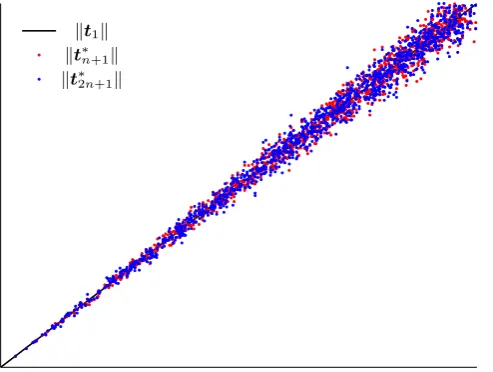
kt∗1k=kt∗n+1k=· · ·=kt∗(d−2)n+1k,
and Figure2in AppendixCshows the result withd= 4 case.
Finally the last onekt∗(d−1)n+1k depends on our choice ofS= [f1,· · · ,fd−1],
such optimal choice is represented bycd·q1/d for some constantcd that depends
only ond,which implies the Gram-Schmidt norm ofTMNTRU can be reached to
kT∗MNTRUk ≤cd·q1/d.
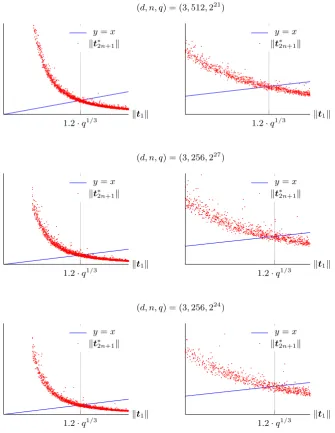
Note that this is consistent with the known result of [DLP14] withc2= p
e/2≈
1.1658,which is also provided with heuristic analysis. Regarding this, we experi-mentally verify that it holds forc3≈1.2 as Figure3in AppendixCindicates.
4
IBE-Scheme from Module-NTRU
In this section, we describe our IBE scheme, whose security is based on MNTRU and Module-LWE.
4.1 Scheme Construction
We start from master key generation procedureKeyGen. It basically generates the MNTRU instance h= (h1,· · · , hd−1)∈ Rdq−1 as the master public key and the
MNTRU trapdoor matrixTMNTRU∈Zdn×dnas the master secret key. The master secret key elements are sampled according to Section3.2, which implies
kT∗MNTRUk=cd·q1/d.
The detailed procedure is given by Algorithm1.
Algorithm 1KeyGen Input: n, q, d
Output: MPK=h∈Rd−1
q andMSK=TMNTRU∈Zdn
×dn
1: fori= 1 tod−1do 2: σi←
q
d d−i+1cd·q
1/d
/√dN .According to Section3.2
3: fi←(f1,i,· · ·, fd,i) where each coefficient offj,i∈ Ris sampled fromDZ,σi 4: end for
5: S←[f1,· · ·,fd−1]
6: det←(det1,· · ·,detd) wheredeti= (−1)i−1·det(Si) 7: h←det−1·(det
2,· · ·,detd)∈ Rdq−1
8: Find a solutionF = (F1,· · ·, Fd)∈ Rdof the MNTRU equationPdi=1deti·Fi=q 9: T←[A(S)||A(F)]
10: returnMPK=handMSK=T
The extract procedure issues the user secret keyskidvalid for userid.The main
task for this is sampling shorts∈ Rd such that
hs,(1,h)i=H(id) modq
where H : {0,1}∗ → R
q is some hash function modeled as a random oracle.
GaussianSampler with the master secret key TMNTRU. The standard deviation σis chosen to yield KL Divergence ofGaussianSampler(TMNTRU, σ) and the ideal discrete GaussianDΛ(TMNTRU),σ less than 2
−λ.It is given byσ=η0
ε(Z)· kT∗MNTRUk whereε= 2−λ/2/(2√2·dn),and more precisely
σ≈ cd
π · s
ln 2 2
λ
2 + log2(4
√
2·dn)
·q1/d. (3)
We also remark that this extract procedure should bestateful,i.e.,it should stores every previously issued user secret keys, otherwise our scheme becomes insecure by repeated queries on the sameid; actually, every IBE scheme based on GPV framework share the same feature, and somestatelessvariants are already argued in previous works. For simplicity we omit them and refer [GPV08]. The detailed procedure can be found in Algorithm2below.
Algorithm 2Extract
Input: An identityid,the master secret keyT,the master public key hand a hash functionH :{0,1}∗→ R
q
Output: A user secret keyskid∈ Rd−1
1: if idis previously queriedthen 2: returnskidin local storage
3: else
4: t←(H(id),0,· · ·,0)∈Rd q 5: σ← cd
π ·
q
ln 2 2
λ
2 + log2(4 √
2·dn)
·q1/d
6: c←GaussisanSampler(T, σ,t)
7: s= (s0, s1,· · ·, sd−1)←t−c .hs,(1,h)i=t 8: Addskid= (s1,· · ·, sd−1) in local storage andreturnskid
9: end if
Our encryption and decryption are done in the same manner to Module-LWE based encryption. In particular, polynomials r, ei are uniformly sampled from {−1,0,1}n.Moreover, our IBE scheme also combines KEM and one-time-pad (OTP)
as in [DLP14]. This combination of OTP is necessary for our case where the width parameterσis chosen to have negligible KL divergence of Gaussian sampler; KL divergence argument only applies for search problems, and without the use of OTP, we cannot guarantee indistinguishability based security of our scheme.
For the decryption correctness, observe that
w=hc,(1,−skid)i=
jq 2 m
·m+e0+rs0−
d−1 X
i=1 eisi.
Then each coefficient of the error polynomial e0+rs0−P
d−1
i=1 eisi should lie
Algorithm 3Encrypt
Input: An identityid, a messageµ ∈ {0,1}m,the master public key h∈Rd−1 q ,hash functionsH:{0,1}∗→Rq andH0:{0,1}n→ {0,1}m
Output: A ciphertextC= (c, c0) wherec∈Rqdandc0∈ {0,1}m. 1: r, ei← {−1,0,1}n for 0≤i≤d−1
2: k← {0,1}n
. kis an ephemeral key 3: t←H(id)
4: c0←rt+e0+q2·k 5: c0←2dlog2qe−3·
j
c0
2dlog2qe−3
k
.Store only 3 most significant bits ofc0 6: c←(c0, c1,· · ·, cd−1) whereci=rhi+ei for 1≤i≤d−1
7: c0←µ⊕H0(k) 8: returnC= (c, c0)
Algorithm 4Decrypt
Input: A ciphertext C = (c, c0),a user secret key skid ∈ Rd−1, and hash functions H :{0,1}∗→ R
q andH0:{0,1}n→ {0,1}m Output: A messageµ∈ {0,1}m
1: s0= (1,−skid)
2: w← hc,s0i 3: k←j2
q ·w
m
4: returnm←c⊕H0(k)
variance. Precisely, it is assumed to behave like 0-centered Gaussian with variance 2
3(kskidk
2+ 1).Using a tail bound for Gaussian distribution, we have the following condition for correctness:
q≥ 32 √
λln 2
3√3 · kskidk. (4)
Moreover, as in [DLP14], one can reduce the size of ciphertext by sending only a few highest order bits ofc0, which not much harm the correctness of decryption.
4.2 Security Analysis by Attack Algorithms
In this section, we give security analysis of our IBE scheme based on the following facts from the literature. First, adapted from [PAFZ19]’s argument, if an N -dimensional latticeΛis known to have an unusually short vector v whose size is evidently smaller than Gaussian Heuristicq2Nπe·det(Λ)1/N, it can be found by
BKZwith blocksizeβ satisfying
0.75pβ/N· kvk ≤δ02β−Ndet(Λ)1/N (5)
where the root Hermite factorδ0 ofBKZβ is given by
β 2πe(πβ)
1
β 2(β1−1)
On the other hand, for any N-dimensional lattice Λ, if one wants to find a vectorv whose size is larger than det(Λ)1/N,the required root Hermite factorδ
0is determined by
δ0N ≤
kvk
det(Λ)1/N. (6)
Based on these facts, we mount lattice attacks on several possible attack points.
Master Key Recovery. One may try to recoverMSKfromMPK,by finding an unusually short vectorfi in a lattice with a basisAMNTRU.Since the short vector
fi is chosen to have norm smaller than
q
d
2·cd·q
1/d,(5) implies that
0.75 q
β dn·
q
d
2·cd·q 1/d
q1/d ≈0.75·cd
r β 2n =δ
2β−dn
0 .
User Key Recovery. The attacker can try to obtain an user secret keyidfrom MPK=h,which involves finding any shorts∈ Rd satisfyinghs,(1,a)i=H(id).
This can be done by finding a short vector (s,1) in adn+ 1-dimensional lattice with determinant qn. For correct decryption, the target vector norm would be
approximately√dn·σwhereσcomes from (3). Then (6) gives a condition
√
dn·σ qn/(dn+1) ≈
√
dn·σ q1/d =δ
dn
0 .
IND-CPA security. Our ciphertext is of the form
(c0, c1,· · ·, cd−1) = (rt+e0, rh1+e1,· · ·rhd−1+ed−1)
for MPK = h. Like the above user key recovery case, one can try to find the dn+ 1-dimensional vector (e0,· · · , ed−1,1) in a lattice with determinantqn. Since we know the unusual short vector (e0,· · · , ed−1,1) of size≈
p
2dn/3 in the lattice, we apply (5)
0.75 r
β dn·
p
2dn/3 = 0.75 r
2β 3 ≤δ
2β−dn
0 q
1/d.
4.3 Parameter Selections
We now set a concrete parameter (d, n, q),and compare our scheme with previous results. First of all, we note that it should be noted that if one wants to use MNTRU dimensiond,the master key generation involves a sampling from a discrete Gaussian with width σ ≈q1/d/√dn. However for d >3 case,σ becomes extremely small
(less than 0.5) for our interest modulusq and dimensionnranges. Thus, in order 7
to hedge against any possible problems regarding this extremely small discrete Gaussian, we conservatively consider only small d, explicitly d = 3. Moreover besides this discrete Gaussian sampling issue, too largedimplies too small width parameterσ,and the resulting secret matrixSwould be almost zero matrix, which can be find out by simple exhaustive search.
In this regard, we instantiate our scheme withd= 3, with modulus parameter q= 219forn= 512,which satisfies the correctness condition (4). Upon our security analysis of Section4.2, the minimal block size for attacking our scheme is 506; Master key recovery requiresβ ≥714,and user key recovery requiresβ ≥612,and IND-CPA security requiresβ ≥506.According to methodology of [ADPS16], we estimate BKZ call with block sizeβ costs 20.292β time, and hence our instantiation
provides about 147 security level. For a pair comparison, we re-evaluate security of [DLP14] parameter (d= 2, n= 1024, q= 227) according to our renewed security analysis of Section4.2; Master key recovery requiresβ≥908,and user key recovery requiresβ≥867, and IND-CPA security requiresβ≥300.
Finally we also compare key sizes and ciphertext size. Clearly the ciphertext and master public key consists of d−1 elements in Rq, so their bitsizes are
(d−1)n(blog2qc+ 1).Next, the user secret key consists of d−1 elements in R
whose coefficients are sampled from a discrete Gaussian of standard deviation σ= cd
π ·
q ln 2
2
λ
2 + log2(4
√
2·dn)
·q1/d from (3); for our caseσ≈2.33·q1/3, and [DLP14] caseσ≈2.28·√q (withλ= 192). This can be stored in various ways, and we followFalcon’s method that requires about (d−1)n·(blog2(σ)c+ 2).
We also check our proposal by a proof-of-concept implementation, and experi-mental results consisting speed results and concrete bit-sizes can be found in Table 1.
References
ADPS16. Erdem Alkim, L´eo Ducas, Thomas P¨oppelmann, and Peter Schwabe. Post-quantum key exchange-a new hope. InUSENIX Security Symposium, volume 2016, 2016.
BDK+18. Joppe Bos, L´eo Ducas, Eike Kiltz, Tancr`ede Lepoint, Vadim Lyubashevsky, John M Schanck, Peter Schwabe, Gregor Seiler, and Damien Stehl´e. Crystals-kyber: a cca-secure module-lattice-based kem. In 2018 IEEE European Symposium on Security and Privacy (EuroS&P), pages 353–367. IEEE, 2018. CG17. Peter Campbell and Michael Groves. Practical post-quantum hierarchical
identity-based encryption. In16th IMA International Conference on Cryptog-raphy and Coding, 2017. https://csrc.nist.gov/Projects/Post-Quantum-Cryptography/round-2-submissions.
Che13. Yuanmi Chen. R´eduction de r´eseau et s´ecurit´e concrete du chiffrement completement homomorphe. PhD thesis, Paris 7, 2013.
DKL+18. L´eo Ducas, Eike Kiltz, Tancrede Lepoint, Vadim Lyubashevsky, Peter Schwabe, Gregor Seiler, and Damien Stehl´e. Crystals-dilithium: A lattice-based digital signature scheme. IACR Transactions on Cryptographic Hard-ware and Embedded Systems, pages 238–268, 2018.
Application of Cryptology and Information Security, pages 22–41. Springer, 2014.
DP16. L´eo Ducas and Thomas Prest. Fast fourier orthogonalization. In Proceed-ings of the ACM on International Symposium on Symbolic and Algebraic Computation, pages 191–198. ACM, 2016.
GPV08. Craig Gentry, Chris Peikert, and Vinod Vaikuntanathan. Trapdoors for hard lattices and new cryptographic constructions. InProceedings of the fortieth annual ACM symposium on Theory of computing, pages 197–206. ACM, 2008.
HHGP+03. Jeffrey Hoffstein, Nick Howgrave-Graham, Jill Pipher, Joseph H Silverman, and William Whyte. Ntrusign: Digital signatures using the ntru lattice. In
Cryptographers’ Track at the RSA Conference, pages 122–140. Springer, 2003.
LS15. Adeline Langlois and Damien Stehl´e. Worst-case to average-case reductions for module lattices. Designs, Codes and Cryptography, 75(3):565–599, 2015.
MG02. Daniele Micciancio and Shafi Goldwasser. Complexity of Lattice Problems: a cryptographic perspectiv. Springer, 2002.
MP12. Daniele Micciancio and Chris Peikert. Trapdoors for lattices: Simpler, tighter, faster, smaller. In Annual International Conference on the Theory and Applications of Cryptographic Techniques, pages 700–718. Springer, 2012.
MR07. Daniele Micciancio and Oded Regev. Worst-case to average-case reductions based on gaussian measures. SIAM Journal on Computing, 37(1):267–302, 2007.
MSO17. Sarah McCarthy, Neil Smyth, and Elizabeth O’Sullivan. A practical implemen-tation of identity-based encryption over ntru lattices. InIMA International Conference on Cryptography and Coding, pages 227–246. Springer, 2017.
PAFZ19. Paul Kirchner Vadim Lyubashevsky Thomas Pornin Thomas Prest Thomas Ricosset Gregor Seiler William Whyte Pierre-Alain Fouque, Jeffrey Hoffstein and Zhenfei Zhang. Falcon: Fast-fourier lattice-based compact signatures over ntru.Post-Quantum Cryptography Standardization Round2 Submissions, 2019. https://csrc.nist.gov/Projects/Post-Quantum-Cryptography/ round-2-submissions.
PDG14. Thomas P¨oppelmann, L´eo Ducas, and Tim G¨uneysu. Enhanced lattice-based signatures on reconfigurable hardware. InInternational Workshop on Cryptographic Hardware and Embedded Systems, pages 353–370. Springer,
2014.
Pei16. Chris Peikert. A decade of lattice cryptography. Foundations and TrendsR
in Theoretical Computer Science, 10(4):283–424, 2016.
PP19. Thomas Pornin and Thomas Prest. More efficient algorithms for the ntru key generation using the field norm. InIACR International Workshop on Public Key Cryptography, pages 504–533. Springer, 2019.
Pre17. Thomas Prest. Sharper bounds in lattice-based cryptography using the r´enyi divergence. InInternational Conference on the Theory and Application of Cryptology and Information Security, pages 347–374. Springer, 2017.
SS11. Damien Stehl´e and Ron Steinfeld. Making ntru as secure as worst-case problems over ideal lattices. In Annual International Conference on the Theory and Applications of Cryptographic Techniques, pages 27–47. Springer,
A
Solving generalized NTRU equation
Letdet= (det1,· · ·,detd)∈ Rd be a vector of polynomial, and let φ=Xn+ 1.
Our goal is to findF = (F1,· · ·, Fd)∈ Rd satisfying
d
X
i=1
deti·Fi=q.
– First, computesi∈Z[X] such that
sideti=Ri modφ,
whereRi∈Zis the resultant ofdeti andφ.
– Compute the GCD δofRi,with coefficientsui ∈Zsuch that
d
X
i=1
uiRi=δ.
– Ifδdivides q,define
Fi0 =q·ui δ si.
The vectorF0 = (F10,· · ·, Fd0) may have too large size, and hence we use Babai’s re-duction onF0 with a matrixS,which gives much shorter solutionF = (F1,· · ·, Fd)
of the MNTRU equation.
B
Application to Signature
Our MNTRU trapdoor can be used for building a signature scheme. Letn be a power-of-two integer,d≥2 be a MNTRU dimension andq >0 be modulus. In this case, we use the samekeygenalgorithm to output a public verification keyVK=a
and a secret signing keySK=TMNTRU.For a messageµ, the signing procedure runs theextractalgorithm witht=H(µ) to output a sign s.The corresponding verification procedure checks whether s is short and hs,(1,a)i = H(µ). The public key size would be (d−1)n· dlog2qe, and the signature size would be (d−1)n·(blog2(σ)c+ 2).Falconchoosesσ≈1.312· kT∗k from R´enyi divergence argument due to [Pre17], which translates intoσ≈1.55·√qin Falconcase, and σ≈1.58·q1/3 in our case.
For the signature usage, there is no encryption phase and we only consider the secret key recovery (the master key recovery in IBE) and the signature forgery (the user key recovery in IBE) attacks. In this case, one can check that the other attacks are only relevant to the total dimension N = nd, in other words, q is irrelevant to security level. Thus, under the same security level, the ring dimension nis proportional to 1/dand hence we conclude that the pk size is asymptotically proportional to 1− 1
d, and the sign size is asymptotically proportional to d−1
d2 .
is not so huge due to the small choice ofq,and indeed the expected size of signature becomes rather larger than the NTRU case due to the constant terms. For example, Falconchoosesqto be the smallest prime such that q= 1 mod 2n(12289) for n= 512 and 1024 case, andq= 1 mod 3n(18433) for n= 768 case8. We focus on n= 768 andd= 2 case having total dimension 1536,where we can divide the same total dimension byn= 512 andd= 3,and use modulusq= 12289.Note that this two parameter sets provide the same security levels, as they have the same total dimension. The concrete sizes are compared in Table2.
[PAFZ19] Ours (d, n, q) (2, 768, 18433) (3, 512, 12289)
Bit-security 195 195
VK size (bytes) 1440 1792 Sig size (bytes) 864 892
Table 2: Comparison between [PAFZ19] and our scheme
However, we remark that our generalization can still contributes for digital signatures by introducing parameter flexibility with power-of-two dimensional rings. We leave an open question that whether many optimization techniques for power-of-two ring case are applicable, which may lead to practical (M)NTRU-based cryptosystem like MLWE-based schemes [BDK+18,DKL+18] in Post-Quantum Cryptography realm.
8
C
Plots of Section
3.2
kt1k kt∗n+1k kt∗2n+1k
Fig. 2:kt∗in+1kvalues withktin+1k= q
d
d−i· kt1kfori= 1,2,
(d, n, q) = (3,512,221)
1.2·q1/3
kt1k
y=x
kt∗2n+1k
1.2·q1/3
kt1k
y=x
kt∗2n+1k
(d, n, q) = (3,256,227)
1.2·q1/3
kt1k
y=x
kt∗2n+1k
1.2·q1/3
kt1k
y=x
kt∗2n+1k
(d, n, q) = (3,256,224)
1.2·q1/3
kt1k
y=x
kt∗2n+1k
1.2·q1/3
kt1k
y=x
kt∗2n+1k
![Table 1: Comparison between [DLP14] and our scheme. Both experiments are doneon Intel (R) Xeon (R) Silver 4144 processor (2.20GHz CPU)](https://thumb-us.123doks.com/thumbv2/123dok_us/7989268.1325923/4.595.198.398.112.214/table-comparison-scheme-experiments-doneon-intel-silver-processor.webp)
![Table 2: Comparison between [PAFZ19] and our scheme](https://thumb-us.123doks.com/thumbv2/123dok_us/7989268.1325923/20.595.203.394.233.296/table-comparison-between-pafz-and-our-scheme.webp)