Patchable Indistinguishability Obfuscation:
iO
for Evolving Software
Prabhanjan Ananth∗ Abhishek Jain† Amit Sahai‡
Abstract
In this work, we introducepatchable indistinguishability obfuscation: our notion adapts the notion of indistinguishability obfuscation (iO) to a very general setting where obfuscated soft-ware evolves over time. We model this broadly by considering softsoft-ware patchesP as arbitrary Turing Machines that take as input the description of a Turing MachineM, and output a new Turing Machine descriptionM0=P(M). Thus, a short patchP can cause changes everywhere in the description ofM and can even cause the description length of the machine to increase by an arbitrary polynomial amount. We further considermulti-program patchable indistinguisha-bility obfuscation where a patch is applied not just to a single machineM, but to an unbounded set of machinesM1, . . . , Mn to yieldP(M1), . . . , P(Mn).
We consider both single-program and multi-program patchable indistinguishability obfusca-tion in a setting where there are an unbounded number of patches that can beadaptivelychosen by an adversary. We show that sub-exponentially secureiO for circuits and sub-exponentially secure re-randomizable encryption schemes1imply single-program patchable indistinguishability obfuscation; and we show that sub-exponentially secure iO for circuits and sub-exponentially secure DDH imply multi-program patchable indistinguishability obfuscation.
At the our heart of results is a new notion of splittable iO that allows us to transform any iO scheme into a patchable one. Finally, we exhibit some simple applications of patchable indistinguishability obfuscation, to demonstrate how these concepts can be applied.
∗
University of California Los Angeles and Center for Encrypted Functionalities. Email: [email protected]. Work done in part while visiting the Simons Institute for Theoretical Computer Science, supported by the Simons Foundation and and by the DIMACS/Simons Collaboration in Cryptography through NSF grant #CNS-1523467. This work was partially supported by grant #360584 from the Simons Foundation and the grants listed under Amit Sahai.
†
Johns Hopkins University. Email: [email protected]. Work done in part while visiting the Simons Institute for Theoretical Computer Science, supported by the Simons Foundation and and by the DIMACS/Simons Collabo-ration in Cryptography through NSF grant #CNS-1523467. Supported in part by a DARPA/ARL Safeware Grant W911NF-15-C-0213 and NSF CNS-1414023.
‡
University of California Los Angeles and Center for Encrypted Functionalities. Email: [email protected]
Work done in part while visiting the Simons Institute for Theoretical Computer Science, supported by the Simons Foundation and and by the DIMACS/Simons Collaboration in Cryptography through NSF grant #CNS-1523467. Research supported in part from a DARPA/ARL SAFEWARE award, NSF Frontier Award 1413955, NSF grants 1228984, 1136174, 1118096, and 1065276, a Xerox Faculty Research Award, a Google Faculty Research Award, an equipment grant from Intel, and an Okawa Foundation Research Grant. This material is based upon work supported by the Defense Advanced Research Projects Agency through the ARL under Contract W911NF-15-C-0205. The views expressed are those of the author and do not reflect the official policy or position of the Department of Defense, the National Science Foundation, or the U.S. Government.
1
Contents
1 Introduction 3
1.1 Our Results . . . 6
1.2 Technical Overview . . . 9
1.3 Related Work: Incremental Cryptography . . . 15
2 PatchableiO: Definitions and Implications 15 2.1 Definition: Single-Programpa-iO . . . 16
2.2 Definition: Multi-Programpa-iO . . . 18
3 Preliminaries 20 3.1 Turing Machines . . . 20
3.2 Patching Turing Machines . . . 20
3.3 Indistinguishability Obfuscation . . . 21
3.4 Garbled TMs with Persistent Memory . . . 22
3.5 Secret-Key Functional Encryption . . . 25
4 Splittable iO 26 4.1 Patchable Encoding Scheme . . . 26
4.2 Definition of Splittable iO . . . 28
5 Splittable iO to Single-Program pa-iO 29 6 Single-Programpa-iO: Stateful to Stateless 35 7 Stateless Single-Programpa-iO to Multi-Program pa-iO 38 7.1 Proof of Security . . . 40
8 Instantiation of Splittable iO 43 8.1 Definitions. . . 44
8.2 Splittable 1-key ABE for TMs. . . 52
8.3 Splittable 1-Key Two-Outcome ABE from Splittable 1-Key ABE . . . 55
8.4 Splittable OEE from Splittable 1-Key Two-Outcome ABE . . . 56
8.5 Splittable iO from Splittable OEE . . . 59
9 Implications ofpa-iO 64 9.1 FE for Unbounded-Input Turing Machines . . . 65
9.2 MIFE for Unbounded-Arity Functions . . . 66
A Preliminaries: Instantiation of Splittable iO 73 A.1 Puncturable Pseudorandom Functions . . . 73
A.2 Garbling schemes . . . 73
B KLW Building Blocks [KLW15] 75
B.1 Security Properties of Primitives of [KLW15] . . . 79
B.2 Security Properties of Positional Accumulators . . . 80
B.3 Security Properties of Splittable Signatures . . . 81
1
Introduction
Program obfuscation is the process of making a program “unintelligible” to any polynomial-time entity while preserving its functionality. A formal study of program obfuscation was initiated more than a decade ago in the works of [Had00,BGI+12]. In the recent years, this research area has seen renewed activity with the emergence of candidate constructions [GGH+13] for a type of general-purpose program obfuscation called indistinguishability obfuscation. This notion has proven to be both extremely useful and the most plausible of existing notions of program obfuscation.
A major limitation of existing notions of program obfuscation is that they only consider “static” programs that do not change with time. In reality, however, programs are rarely changeless. We typically alter programs over time, withpatches (a.k.a updates) causing the programs to grow and vary, in response to demands for greater or new functionality. Can program obfuscation be adapted to deal with this reality? Specifically, can we obfuscate programs thatevolveover time? The central intellectual and theoretical focus of this work is to answer this question.
Obfuscation for Evolving Software. A trivial solution to obfuscating evolving software would
be to simply apply the obfuscator afresh to each updated version of a particular program. For example, to modify an obfuscation of a program M, the obfuscator may simply release a fresh obfuscation ofM0 where M0 is the patched version ofM. Note, however, that in this solution, the total communication complexity is at least |M|+|M0|. In particular, this is the case even if the difference between the programs M and M0 can be described in the form of a small patch P. In contrast, if M was not obfuscated, then we could modify it by simply communicating the patchP
to a user, yielding a total communication complexity of only |M|+|P|. Our goal is to develop a mechanism for program obfuscation that approximately preserves this communication complexity. A bit more precisely, we define a notion of patchable obfuscation where, informally, there are four algorithms:
• Obf(M;r) taking as input a programM, and outputting an obfuscated program hMi, using randomnessr.
• GenPatch(P;r, r0) taking as input a patchP, and outputting an encoded patch hPi, using a combination of the original randomnessr and new randomnessr0.
• AppPatch(hMi,hPi) taking as input an obfuscated program hMi and a patch encodinghPi, and outputting an obfuscated patched program hM0=P(M)i.
• Eval(hMi, x), taking as input an obfuscated program hMi and an input x, and outputting the valuey =M(x).
The key efficiency requirement is that the size of a patch encoding should not depend on the size of the original program M. Specifically, we want that |hPi| = poly(|P|, λ), where λ is the security parameter.
Beyond this basic efficiency requirement, we also discuss some other important considerations w.r.t. patchable obfuscation.
I. No restriction on patches: An important consideration for patchable obfuscation is the
class of patches that we wish to allow. Clearly, the larger the class of patches that we can support, the larger the potential application pool.
and outputs a new programM0. We allow for the unpatched program togrowin size after patching. That is, M0 may be arbitrarily bigger than M.
II. Multiple patches: Another consideration is the number of patches that we wish to allow.
In reality, it may be difficult to anticipate in advance how many times a program may need to be patched. Thus, we allow for an unlimitednumber of patches.
Specifically, we consider two modes of patching:
• Sequential patching: Here, given an obfuscated programhM0iand a sequence of patch
encod-ingshP1i, . . . ,hPni, one can apply the patches one-by-one,in order, to obtainhM1i, . . . ,hMni
s.t. Mi =Pi(Mi−1).
• Parallel patching: Here, given an obfuscated programhM0iand a sequence of patch encodings hP1i, . . . ,hPni, one can apply each patch to hMi, in parallel, to obtain hM1i, . . . ,hMni s.t.
Mi=Pi(M0).
While sequential patching seems to better capture patching of programs in reality, as we discuss later, parallel patching also enables interesting applications of patchable obfuscation. Thus, we consider both patching modes in this work.
III. Support for multiple programs: So far, we have only discussed patching for a single
obfuscated program. Now consider the case where an authority wishes to patchmultipleobfuscated programshM1i, . . . ,hMni. Such a situation often arises in practice where, for example, the programs
M1, . . . , Mnmay correspond to different copies of the same core programM that are individualized
to different users.
One approach to address this scenario would be to release a separate patch for every obfuscated program. In this case, however, the communication complexity grows linearly with the number of obfuscated programs and may quickly become prohibitive. Instead, we would like to build patchable obfuscation where the obfuscator can releaseonepatch that can be applied to all of the obfuscated programs. We refer to this notion asmulti-program patchable obfuscation.
How to Define Security? Of course, we must define security for patchable obfuscation. The
natural direction is to start with a “base” notion of obfuscation (without patching) and extend it to the setting of patching. Our goal in this work is to obtain general positive results for patchable obfuscation. With this viewpoint, we identify indistinguishability obfuscation (iO) [BGI+12] as a natural choice for the base notion. Indeed, over the last few years, several general-purpose candidate constructions, (for example: [GGH+13, BGK+14, BR14]) for iO have been proposed,
and no impossibility results are known. Furthermore, it was shown by [GR07] that iO is, in fact, “best-possible” obfuscation. iO has already enabled a long sequence of exciting applications (see e.g., [SW14, GGH+13, BGJ+16, CHN+16]) and its patchable analogue can be expected to find
even more applications. Finally, we stress that while the security of iO remains an area of intense study, there are several known iO candidates and evenuniversal iOcandidates under well-studied assumptions [AJN+16].
In contrast, powerful (base) notions such as virtual black-box obfuscation [BGI+12] and differing-inputs obfuscation [BGI+12, BCP14, ABG+13] have been shown to be impossible to realize for general functions [BGI+12,GK05,BCC+14,GGHW14,BSW16]. This, in turn, means that patch-able analogues of these notions are also impossible, in general. The notion of virtual grey-box obfuscation [BC10, BCKP14] is impossible for general Turing Machines but seems to circumvent general impossibility results for circuits; however, it has found rather limited applicability so far.
the study of patchable obfuscation for other base obfuscation notions (e.g., obfuscation in weaker adversarial models such as virtual black-box obfuscation in hardware token model [GO96,GKR08,
GIS+10] or generic model [BR14,BGK+14]) is interesting, and we leave this study to future work. We remark that many of the ideas that we develop in this work should be more widely applicable to other notions of obfuscation, and are not intrinsically tied to iO. As such, we envision these ideas to be portable to other notions of patchable obfuscation.
Patchable Indistinguishability Obfuscation. We develop a notion ofpatchable
indistinguisha-bility obfuscation(pa-iO)that naturally extends the standard notion ofiOto the setting of patching. Let us explain our notion for the single-program case, for sequential and parallel patches.
• Sequential patches: Recall thatiO security dictates that given two equivalent programs M0
andM1, obfuscations ofM0 andM1 are computationally indistinguishable. In single-program
pa-iOfor sequential patches, we require that given two equivalent programsM00andM10and a sequence of patch pairs (P01, P11), . . . ,(P0n, P1n) such that for every “level”i∈[n], the patched programs Mi
0 = P0i(Mi
−1
0 ) and M1i = P1i(Mi
−1
1 ) are also equivalent, it should be hard to
distinguish the tuples (hM00i,{hP0ii}n
i=1) and (hM10i,{hP1ii}ni=1). Intuitively, the equivalence
requirement at every patch level i rules out the trivial attack of using a splitting input for the patched programsMi
0 and M1i to distinguish the tuples.
• Parallel patches: Single-program pa-iO for parallel patches is defined similarly to above, except that here we require equivalence for the patched programs M0i =P0i(M00) and M1i =
P1i(M10) at every (parallel) “branch”i∈[n].
A few remarks are in order: (1) It is easy to see that these definitions ensure patch hiding, which is crucial for some of the applications discussed later. (2) Our definitions naturally extend to multi-programpa-iO where we start with multiple pairs of programs and equivalence is required for every pair at every level/branch. (3)We, in fact, consideradaptivesecurity, where the adversary can make the patch queries in an adaptive fashion. See Section2 for further details.
Implications of pa-iO. We view pa-iO as a powerful primitive that is likely to have several applications in the future. To see the power of pa-iO, it is instructive to first compare it with
iO. While iO exists if P=NP,2 we show that multi-program pa-iO for parallel patches implies
secret-key functional encryption (FE) [SW05, BSW11, O’N10]. The construction is remarkably simple: let Mf,x be an input-less machine that simply outputs f(x). We construct an FE scheme
as follows:
• A secret key for a functionf is computed ashMf,⊥i, i.e., an obfuscation ofMf,xwherex=⊥.
• Encryption of a message mcorresponds to generating an encoding hPmi for a patchPm that
modifiesMf,⊥ toMf,m.
• Decryption simply corresponds to applying the patch encoding hPmi on hMf,⊥i to obtain hMf,mi and then evaluating it to obtainf(m).
Correctness and security of the construction follow in a straightforward manner from the cor-rectness and security of pa-iO.3 As we discuss later, the above basic idea can, in fact, be easily extended to multi-input functional encryption [GGG+14], yielding new results.
2
AssumingNP6=co-RP, it was shown thatiOimplies one-way functions [MR13,KMN+14].
3
An observant reader may notice that in the above construction, it is not important whether the size of a patch encoding depends on the size of an unpatched machine Mf,⊥ or not. However, it is important that the size of the
Alternate viewpoint: Obfuscation with Private Homomorphism. Another way of looking at our notion of pa-iOis as a form of iO that supports a kind of semi-privatehomomorphism: the generation of the patch encoding is private – requiring secret information that was used to obfuscate the original program – although the application of the patch encoding is public. Note that unlike encryption, for the security of obfuscation it is critical that this homomorphism is semi-private – if an adversary was allowed to use public information to arbitrarily modify the program underlying an obfuscation, this would trivially allow the adversary to break the security of the original obfuscated program. On the other hand, our notion ofpa-iOand the notion of fully homomorphic encryption [Gen09] share a similarity in that they both require a form of compactness for the notions to be non-trivial.
1.1 Our Results
We state our results below.
I. Patchable Indistinguishability Obfuscation. In this work, we formalize the notion of
patchable indistinguishability obfuscation. We focus on the setting where programs to be obfuscated and patched are described as Turing Machines.
Multi-Program pa-iO: Our main result is a construction of a multi-program pa-iO scheme from sub-exponentially secureiO and sub-exponentially secure DDH.
Theorem 1(Multi-programpa-iO: Sequential patches). Assuming the existence of sub-exponentially secure iO for circuits, sub-exponentially secure DDH, there exists an adaptively secure multi-program pa-iO scheme with unbounded sequential patches, for Turing Machines where the running time of the patch generation algorithm for a patch P is bounded by poly(λ,|P|, `), where λ is a security parameter and `is a bound on the input size to the patched program.
Note that the runtime efficiency of the patch generation algorithm in the above theorem implies the necessary size efficiency for a patch encoding, namely, the size of the encoding of a patch P is bounded by poly(λ,|P|, `).
Single-Programpa-iO: We obtain the above result in two steps. Our first, and key step is to construct a single-program pa-iO scheme for TMs which achieves the desired size efficiency for patches but requires a large state (proportional to the size of the TM being updated) as well as a large patch generation time.
Theorem 2(Single-programpa-iO: Sequential patches). Assuming the existence of sub-exponentially secureiOfor circuits and sub-exponentially secure re-randomizable encryption schemes, there exists an adaptively secure single-program pa-iO scheme with unbounded sequential patches, for Turing Machines where the size of the obfuscation of a patch P is bounded by poly(λ,|P|, `), where λ is a security parameter and `is a bound on the input size to the patched program.
Main Tool: Splittable iO. The main tool in our construction of single-program is an intermediate notion betweeniOand patchable iO, that we refer to assplittable iO. Very roughly, splittableiO
place suitable efficiency and security requirements on the auxiliary information so as to allow us to transfer the patching property of the encoding scheme to the setting ofiO. We refer the reader to the technical overview section for further details on this notion.
From Single-Program to Multi-Program pa-iO: Next, we devise a generic transformation from any such single-program pa-iO scheme to a multi-programpa-iO scheme with the aforementioned effi-cient patch generation property.
Theorem 3 (Single-program to Multi-program pa-iO). Assuming the existence of a succinct gar-bled TM scheme with persistent memory and a compact secret-key functional encryption scheme for general circuits, there exists a general transformation from any single-program pa-iO scheme to a multi-program pa-iO scheme for TMs with efficient patch generation.
In particular, when the underlying primitives are all adaptively secure, then the resulting multi-programpa-iOscheme is also adaptively secure. An adaptively secure succinct garbled TM scheme with persistent memory is known from the works of [CCHR B,ACC+ B] based on sub-exponentially secureiOand DDH assumption, while a compact secret-key functional encryption scheme is known from iO for general circuits.
For the theorems above, we stress that we place no restrictions on the patches. A patch P can be an arbitrary Turing Machine that takes the original program descriptionM as input, and outputs an arbitrary Turing Machine description M0 = P(M) that can differ in arbitrary ways from M. In particular, the description size of P(M) can be any unbounded polynomial in the security parameter, and thus the program size can grow by arbitrary polynomial factors. Furthermore any unbounded polynomial number of patches can be applied sequentially, and the adversary can specify these patches adaptively given all obfuscated programs and patches constructed earlier.
Parallel Patching: We can obtain a similar result for multi-programpa-iOin the context of parallel patches. This result follows the same approach as the case of sequential patches. The first step is to obtain single-programpa-iO scheme with unbounded parallel patches and the second step is to obtain multi-programpa-iO from single-programpa-iO. The construction of single-program pa-iO
with parallel patches will be identical to the one in the sequential patch setting. The transformation from single-programpa-iOto multi-programpa-iOis, however, different from the sequential setting to enable this transformation. Instead of using garbled TM scheme with persistent memory, we instead employ functional encryption for TMs [GKP+13b, AS16] scheme. Since the techniques employed in the parallel patch setting are similar to the sequential patch setting, we omit the transformation. We have the following theorem.
Theorem 4(Multi-programpa-iO: Parallel patches). Assuming the existence of sub-exponentially secure iO for circuits, sub-exponentially secure DDH, there exists an adaptively secure multi-program pa-iO scheme with unbounded parallel patches, for Turing Machines where the running time of the patch generation algorithm for a patch P is bounded by poly(λ,|P|, `), where λ is a security parameter and `is a bound on the input size to the patched program.
Multi-Input FE for Unbounded Arity Functions: We first show that multi-programpa-iOfor paral-lel updates implies secret-key multi-input functional encryption (MIFE) [GGG+14,AJ15,BKS16]
for unbounded arity functions. This implication follows from a straightforward extension of the
pa-iO to (single-input) FE implication discussed earlier.
Theorem 5 (Unbounded-Arity MIFE). Adaptively secure multi-program pa-iO with unbounded
parallel updates implies secret-key MIFE for unbounded arity functions with security against pre-ciphertext key queries.
Combining the above with Theorem 4, we obtain secret-key MIFE for unbounded arity func-tions from sub-exponentially secureiO for circuits, sub-exponentially secure DDH. Previously, this result was only known [BGJS15] from a knowledge assumption, namely public-coin differing-input obfuscation [IPS15] and one-way functions.
FE for TMs with Unbounded Length Inputs: The following implication follows as a simple corollary of Theorem 5.
Theorem 6 (Unbounded-Input FE). Adaptively secure multi-program pa-iO implies secret-key
functional encryption for TMs with unbounded input length with security against pre-ciphertext key queries.
A construction of FE for TMs with unbounded input was recently given by [AS16] based oniO. We emphasize that our construction from multi-programpa-iO is extremely simple, in contrast to the involved construction of [AS16].
We now discuss implications of pa-iO to iO for TMs. We first recall that all recent progress on achieving iO for TMs/RAMs[CHJV15, BGL+15, KLW15, CH16, CCC+16] from iO for circuits has required a polynomial bound ` to be placed on the input length to the obfuscated Turing Machine. We share this need for a polynomial bound ` on the input size, and the size of our obfuscated patches do grow with this bound. Indeed, if we could remove this restriction, then we would show how to bootstrap iO for circuits to iO for Turing Machines without any input length restriction from iO for circuits – this remains a major open question. Achieving iO for Turing Machines without any input length restriction currently requires strong assumption such as output-compressing randomized encodings [LPST16] or knowledge-type assumptions such as public-coin diO [BCP14, ABG+13, IPS15]. We do not know how to achieve these objects using only iOfor circuits.
iO for TMs with Unbounded Length Inputs. So far, in our definition of pa-iO, we have only con-sidered “single-use” patches. More accurately, in our definition of single-program (resp., multi-program) pa-iO for sequential patching, the ith patch Pi can only be applied to the updated
machine (resp., machines) at leveli−1. As we discuss now, such “single-use” patches are, in fact, inherent given the current state of art iniO for TMs.
In particular, is not difficult to see that single-programpa-iO withreusablepatches (i.e., where a patch P is not tied to any “level” and can be applied an arbitrary number of times, to any machine) in fact, impliesiOfor TMs with unbounded length inputs. The construction is extremely simple: let Mx be a family of (input-less) machines parameterized by stringsxof arbitrary length,
Patch P0 is such that it updates any machine Mx to Mxk0 while P1 updates any machineMx to
Mxk1.
To evaluate the above obfuscation on any input x = x1, . . . , x` for an arbitrary `, a user can
transform obfuscation of M⊥ toMx by applying the patchesPx1, . . . , Pxn and then executeMx to
obtain M(x). The correctness of the construction is easy to verify.
While we do not consider security for reusable patches in this work, we view the above as a potential new template for building iO for TMs with unbounded length inputs.
1.2 Technical Overview
We now give an overview of the main technical ideas in our constructions. We start by building a general template for buildingpa-iO, and then discuss our ideas for implementing this template.
1.2.1 A Template for pa-iO
In this section, we devise a general template for building pa-iO starting from any non-patchable obfuscation scheme. We keep the discussion in this section to a high-level, focusing on issues directly related to patching, and largely ignoring implementation issues that may arise due to the specific properties of the underlying non-patchable obfuscation scheme. For simplicity, in this section, we advise the reader to think of the non-patchable obfuscation scheme as general-purpose virtual-black-box obfuscation. Later, in Section 1.2, we discuss the additional challenges that arise in implementing our template when the non-patchable obfuscation scheme is iO, and our solutions for the same.
Let us start with the weaker goal of building single-program pa-iO where the authority issues a single obfuscated program that can then be patched multiple times, in a sequential order. Our initial idea towards achieving this goal is to identify an encoding scheme that supports patching and then combine it with a non-patchable obfuscation scheme to build apa-iO scheme. Intuitively, we say that an encoding scheme is patchable if given an encoding of a machineM and an encoding of a patchP, it is possible to derive an encoding ofM0=P(M). The hope here is that the patching property of the encoding scheme can be translated into patching property for obfuscation.
A natural candidate for a patchable encoding scheme is fully homomorphic encryption (FHE). Indeed, given an encryption (i.e., encoding) of a machine M and an encryption of a patch P, one can obtain an encryption of the patched machineM0=P(M) by homomorphically evaluating the functionf(M, P) =P(M). Starting with FHE and any non-patchable obfuscation scheme, we can build an initial template forpa-iOas follows: to obfuscateM, first encryptM using FHE and then provide an obfuscation of the FHE decryption circuit that has the FHE decryption key hardcoded into it. Evaluation on an input x can be done as follows: first use FHE evaluation to transform encryption of M into an encryption of M(x), and then use the obfuscated decryption circuit to obtain M(x). To patch the obfuscated program, we can simply patch the encryption ofM in the manner as described above.
While this solution seems to offer the functionality of patching, it does not offer any security. Specifically, in the above template, an adversary can choose an arbitrary patch P∗ on its own and then use FHE evaluation of the function fP∗(M) = P∗(M) to transform encryption of M into
an encryption of P∗(M). If this patch P∗ is such that for two equivalent machines M0 and M1,
P∗(M0) andP∗(M1) are not equivalent, then the adversary can easily break the security of pa-iO.
above template does not place this restriction in any way. In particular, we need to crucially use the fact that patch generation is a secret key operation.
Towards that end, we modify the above template such that an evaluator can only apply au-thenticatedpatches. The obfuscation of M consists of an FHE encryption of M as before but the obfuscated FHE decryption circuit now takes as input old encryptionEnc(M), updated encryption
Enc(M0), encrypted patch Enc(P), a signatureσ on Enc(P) and an inputx. It checks if the sig-nature is valid and also ifEnc(M0) is obtained by updatingEnc(M) using P. If the check passes, then it decrypts Enc(M0) and evaluatesM0 on x. During the patching phase, the authority sends both Enc(P) and the signature σ. This signature now prevents a user from applying “invalid” patches to the obfuscation; however, we note that in the context of iO, this authentication will need to be done in a much more careful manner, as we elaborate below.
Enforcing Ordered Executions of Patches. While the above template does not seem to suffer
from any immediate issues when we consider a single patch, unfortunately, its security breaks down when we consider the setting of multiple patches. Indeed, in the above template, given (say) two patch encodings (Enc(P1), σ1), (Enc(P2), σ2), an adversary may first apply the second patch and
then the first patch, which may break the equivalence requirement on the patched machines in the security definition ofpa-iO. In fact, an adversary can also repeatedly apply the same patch multiple times in the above template, which may also break the equivalence requirement on the patched machines in the security definition ofpa-iO. Indeed, the definition ofpa-iOrequires that the patch encodings can only be applied in order, namely, theith patch encoding can only be applied to the (i−1)th patched obfuscation,once.
Towards this, we introduce a mechanism to force a user to apply the patches in order. We begin by observing that instead of authenticating the encrypted patch in the above template, if we instead authenticate the encrypted patched machine, then we can enforce ordered executions of patches. That is, suppose we want to update the machine M using patch P, the authority first computes
Enc(P) and then updates Enc(M) using Enc(P) to obtain Enc(M0). It then signs Enc(M0) and sends the signature4 σ and the encrypted patch Enc(P) to the user. The user now updates
Enc(M) using Enc(P) to obtain Enc(M0). To evaluate the patched obfuscation on an input x, it inputs (Enc(M0), σ, x) to the obfuscated FHE decryption circuit that first checks for validity of the signature and then decrypts Enc(M0) followed by computation ofM0(x), as before. Crucially, by shifting the authentication to the updated encrypted machine instead of encrypted patch, we are now able to prevent the “out-of-order patching” attacks (as well as “repeated patching” attacks) by an adversary discussed above.
A disadvantage of the above solution is that it requires the authority to maintain large state. In particular, at any time, the authority must remember the last patched machine Mi−1 in order
to generate a valid encoding for theith patchPi. Furthermore, the patch encoding generation time
now depends on the size of the machineMi−1. While this loss in efficiency may be acceptable for
the setting of single-program pa-iO, it unfortunately becomes a significant barrier for the setting of multi-programpa-iO. Indeed, in the multi-program setting, the number of obfuscated programs are not a priori bounded; as such, if we were to extend the above template to this case, then the authority’s state size becomes unbounded! (This is because the authority would need to maintain a separate state for every obfuscated program.)
Compressing the State of Authority. In order to resolve this issue we introduce the next
4For this discussion, let us assume that we have a signature scheme where the size of the signature is independent
idea: “delegating” the state of the authority to the user. That is, the authority now maintains the state at the user’s end. Implementing this idea introduces several issues: not only should the state be encrypted at the user’s end but it should also be possible to repeatedly update and also compute on this (updated) encrypted state. To address these issues, we turn to a cryptographic primitive called garbled RAMs with persistent memory. This notion allows for encoding a database and repeatedly update this encoding and compute on the updated encodings. The updating and computation operations are enabled by using encodings of RAM programs which are issued by the authority. Using this primitive, we propose a solution template.
• To obfuscate M, the authority computes: (i) Enc(M) and a signature upon it. (ii) An obfuscation of the FHE decryption circuit (as before) that takes an input x, Enc(M) and a signature σ, and outputs M(x) if the signature is valid. (iii) A database encoding Enc^(M)
ofEnc(M). It then sends Enc^(M),Enc(M), σ and the obfuscated decryption circuit to the
user.
• To evaluate the obfuscation on an inputx, the user inputs (x, Enc(M), σ) to the obfuscated decryption circuit to recover the outputM(x).
• To compute a patch encoding ofP, the authority first computesEnc(P) (as before) and then computes a garbled RAM encodingTeof a RAM machineT that hasEnc(P) hardcoded in it.
The machineT uses FHE evaluation overEnc(M) (in the database encoding) andEnc(P) to computeEnc(M0) and additionally computes signatureσ0overEnc(M)0. It outputsσ0 in the clear. The user, upon receiving the patch encoding, first computes Enc(M0) using Enc(P). It then updates the database encodingEnc^(M) using Te. The result is an updated database
encodingEnc^(M0) and the signatureσ0onEnc(M0). The user can now evaluate the updated
machine on any input in the same manner as before.
Some remarks are in order: first, from an efficiency viewpoint, we need the garbled RAM scheme to be succinct where the size of RAM machine encoding is independent of its running time. This is because we are applying the above idea on a single-program pa-iO scheme where the patch generation time depends on the size of the machine being updated. Second, in order to argue security in the setting of adaptively chosen patches, we need the garbled RAM scheme to satisfy adaptive security as well. Such a garbled RAM scheme (with persistent memory) was recently constructed in the independent works of [CCHR B,ACC+ B].
Finally, we note that while the above idea successfully compresses the state size of the authority, it still does not suffice for the multi-program setting. This is because in the above solution, when extended to the multi-program case, the authority would need to maintain some small state, namely, the garbling key, forevery obfuscated machine, which still leads to a state of unbounded size. We address this problem by developing a generic transformation from any single-programpa-iOscheme with small state (or alternatively, astatelessscheme) into a multi-programpa-iO scheme by using a compact secret-key functional encryption scheme for general circuits. We defer the discussion of this transformation to the next section.
1.2.2 Implementation
Issues related to Indistinguishability Obfuscation. While the above template seems
obfus-cation for circuits. For starters, the above template requires an obfuscation scheme for Turing machines with unbounded length inputs. This is because, the size of the encrypted machine
M can grow arbitrarily over a sequence of updates and thus the input to the obfuscated cir-cuit cannot be a priori bounded. We currently know how to realize this only based on strong knowledge-type assumptions [BCP14,ABG+13, IPS15]. Another technical issue is that standard signature schemes are not “compatible” with iO and more generally, using iO restricts the type of cryptographic primitives that we can use. These challenges were encountered in many recent works [BGL+15,KLW15,CHJV15] whose main goal was reducing the problem of constructing iO for Turing machines, where the length of inputs to be evaluated are a priori bounded, to the prob-lem of constructing iO for circuits. We build upon the primitives and notions introduced in the work of [KLW15] to address these challenges. We recall the Turing machine randomized encodings5 construction by [KLW15].
The core idea in the randomized encodings construction of Koppula et al. [KLW15] is to leverage an obfuscated circuit to perform step-by-step computation of the machine M that is encoded. In more detail, a randomized encoding of (M, x) consists of: (a) input tape initialized with an encoding of M and, (b) an obfuscated circuit Cx that performs “step-by-step” computation of a machine
Ux(·). Here, Ux(·) is a universal TM that takes as input machine M and outputs M(x). By
step-by-step computation, we mean that the circuitCx takes as input time stepi, encoded symbol
and partial information about the current state in an encrypted form and produces a new encoded symbol and state, again in encrypted form, by executing the transition function ofUx. This enables
the size of the circuit Cx to be independent of the length ofM.
To see how the randomized encodings construction might be useful to our setting, note that we could potentially encode the machine M using a patchable encoding scheme that will allow us to patch M. Furthermore, we can allow the machine size to arbitrarily grow, over a sequence of updates, since the size of the circuit Cx is independent of the machine size M. However, the
main issue is that their approach is tied to just a single computation M(x) whereas we require that M be reused on multiple inputs. They propose an approach to achieve reusability by using another layer of obfuscation, with M hardwired in it, that produces fresh encodings of M for every computation. This is highly problematic for us, since patchingM would now correspond to patching the underlying obfuscated circuit.
We need to make the randomized encodings construction of KLW reusable while preserving the underlying encoding of M. A recent work of Ananth et al. [AJS17], proposed in a different context of building iO with constant overhead, achieves this goal. In more detail, they showed how to achieve iO for TMs, with a priori bound in the input length, such that an obfuscation of M
proceeds in two phases: (a)M is encoded using a suitable encoding scheme and, (b) an obfuscation of a circuit that takes as inputxand produces an encoding ofx. The evaluation of the obfuscation on an input xproceeds by first obtaining an encoding ofx (using the obfuscated circuit) and then decoding this using the encoding of M to recoverM(x).
While their work offers a starting point for building patchable iO, we still need to address several issues that specifically arise in the context of patching. For instance, their work only considers the setting when the adversary is given one obfuscated machine whereas in our setting she also receives additionally, patches that share some common randomness with the obfuscated machine. We need to argue that the security holds even with this additional information. Instead of directly digging
5A randomized encoding of (M, x) satisfies two properties: (a) it only reveals M(x) and, (b) the size of the
into the details of [AJS17] to apply it in the context of patching, we undertake a more modular approach. First, we propose an intermediate primitive calledsplittable iOand show that it suffices for building single-program patchable iO. We then show that splittable iO can be implemented assuming only iO for circuits by using the framework of [AJS17]. We describe this primitive in detail next.
Splittable iO: Intermediate Notion between iO and Patchable iO.A splittable iO scheme
is a strengthening of iO and is associated with respect to a patchable encoding scheme. A patchable encoding scheme consists of algorithms: Setup, Encode and Decode. Setup generates a secret key
sk that will be used by Encode procedure to obtain an encoding of M, Esk(M). Decode recovers
the Turing machine M from the encoding Esk(M) using the secret key sk. Additionally, it is associated with two algorithms: patch generation algorithm, used to generate secure patches and patch application algorithm,, that enables applying secure patches on encodings of TMs. The security property requires that the encodings and patches hide the underlying TMs and patches, respectively.
We start with a oversimplified template of splittable iO and make suitable modifications later. An obfuscation ofM, with respect to splittable iO, consists of two parts: (Esk(M), auxM), where
(i) Esk(M) is a patchable encoding of M computed using secret key sk, (ii) auxM computed as a
function of an additional PPT algorithm AuxGen, on (sk,Esk(M)).
Armed with the notion of splittable iO, we show how to construct single-program patchable iO. At first glance, it seems that splittable iO already allows for patching: indeed, sinceM is encoded with respect to a patchable encoding scheme, we can use the patching algorithm to update this encoding. However, this does not work because the obfuscation also contains auxM that is tied to
encoding of M. Indeed, this is necessary for the security of obfuscation to hold. So if the encoding of M is updated, it is necessary to also updateauxM. A naive way of achieving this is to issue a
fresh auxM every time the encoding is patched. That is, initially the user is issued an encoding
of M, Esk(M) and auxiliary information auxM. During the patching phase, a secure version of
patchP with respect to the patchable encoding scheme is issued. Along with this, a freshauxM0 is
issued, which is generated by first patchingEsk(M) usingPe, secure patch ofP, and then executing
AuxGenon input (sk,Esk(M0)).
However this raises the question of efficiency: the patch size now grows with the size of auxM0.
This can be taken care of imposing an efficiency constraint on splittable iO: we require that the size of aux be a polynomial in security parameter and specifically, independent of the size of the machine obfuscated. The next issue is correctness: why should the patched obfuscated machine be correct? for instance: AuxGen could abort on input patched encodings. To take care of this issue, we impose an additional property on splittable iO: the correctness of the obfuscated machine should hold irrespective of whether fresh encodings or patched encodings of the machine are fed to
AuxGen.
maintain correctness of the obfuscation of M, we need to hardwire all possible outputs which is clearly infeasible. Instead we use an indistinguishability-based definition: instead of having one encoding of M, we will consider a pair of encodings of M. That is, obfuscation of M consists of (Esk0(M),Esk1(M)), computed with respect to secret keys sk0, sk1. In addition, it consists of aux
generated usingAuxGen(sk0,Esk0(M),Esk1(M)). Now, we impose a security property that says that aux generated usingsk0 is computationally indistinguishable fromaux generated usingsk1.
We summarize the (informal) definition of splittable iO below. The formal definition can be found in Section 4.2. In addition to the properties of any iO scheme, a splittable iO scheme has the following properties.
1. Splittable Property: An obfuscation of M can be performed in two steps: the first step is encoding M twice using two secret keys sk0 and sk1 of a patchable encoding scheme. The
second step is generation of aux by computing AuxGen on input (sk0,Esk0(M),Esk1(M)),
whereEsk0(M) andEsk1(M) are two encodings ofM andsk0 is the secret key used to encode Esk0(M).
2. Correctness of AuxGen: The correctness of obfuscation of M holds irrespective of whether
AuxGen is executed on fresh encodings of M or whether it is executed on encodings of M
obtained as a result of patching. This will be used to argue the correctness of the resulting patchable iO scheme.
3. Efficiency of aux: We require that the size of aux is a polynomial in λ and in particular, independent of the size of the machine obfuscated. This will be used to argue the patch size efficiency of patchable iO.
4. Indistinguishability of aux: We require that it is computationally hard to distinguish aux
generated using secret key sk0 from aux generated using sk1. This property will be helpful
to argue security of patchable iO.
Going from Single-Program to Multi-Program Patchable Obfuscation. In the solution
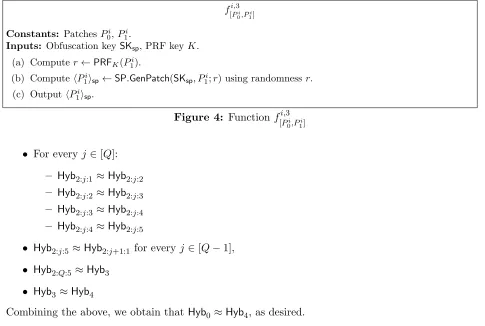
sketched above, every time the authority has to generate a patch, she has to spend time proportional to the size of the obfuscated machine. In particular, recall that one of the steps in the generation of secure patch is computing auxM: this step involves first patching the old encoding Esk(M) and
then executingAuxGen. We will use the trick described earlier to solve the problem: we delegate the state of the authority as well as the computation of the secure patches to the user. This can be implemented by using a suitable garbling scheme that works in the persistent memory setting. Once this mechanism is implemented, the authority is only required to store the garbling key.
While this is a viable solution in the single-program setting, this is undesirable when the au-thority is issuing multiple obfuscated programs. She has to store the garbling keys corresponding to all the machines in this case. The storage space of the authority thus puts a bound on the number of obfuscated machines it can issue.
key and produces a garbled encoding ofP with respect to this garbling key. To carry this out, we only require a secret-keyFE scheme forcircuits.
Putting it Together: A Framework for (Multi-Program) Patchable Obfuscation. Putting
all the components together, we construct a multi-program patchable iO in the following steps:
1. The first step involves formalizing the notion of splittable iO. This is shown in Section4.
2. Next, we show how to obtain single-program patchable iO from splittable iO. This is shown in Section5. The resulting single-program patchable iO scheme is statefull, i.e., the authority is required to maintain a large state.
3. We show how to overcome this problem by giving a transformation from any statefull to a stateless single-program patchable iO scheme. This is shown in Section 6.
4. In the next step, we give a transformation from single-program to multi-program patchable iO. This is shown in Section7.
5. In the last step, we instantiate splittable iO using the framework of [AJS17]. This is shown in Section8.
1.3 Related Work: Incremental Cryptography
The area of incremental cryptography was pioneered by Bellare, Goldreich and Goldwasser [BGG94]. Subsequently, this concept of incremental updates has been studied for various standard primitives such as encryption schemes, signature schemes and so on [BGG95,Mic97,Fis97,BKY01,MPRS12]. We remark that none of these works handled the setting of arbitrary updates.
In a concurrent and independent work, [GP15] consider a related notion called incremental obfuscation. In incremental obfuscation, individual bits of an existing obfuscated program can be updated one-by-one. While their work shares much in spirit with our work, there are several important differences that we describe below.
Our work focuses on support for arbitrary, adaptively chosen patches that may potentially increase the size of the program(s) being patched, and we consider both single-program and multi-program setting. In contrast, their work considers the single-multi-program setting where bit-wise, non-adaptively chosen patches can be applied such that the size of the circuit being patched remains unchanged. Our main efficiency requirement is that the size of the secure patches (or more strongly, the time to generate the secure patches) is independent of the size of the program. In contrast, their work considers the stronger runtime efficiency requirement where the time to apply the secure patch is also independent of the size of the circuit.
2
Patchable
i
O
: Definitions and Implications
2.1 Definition: Single-Program pa-iO
In this section, we present a formal definition of single-program patchable indistinguishability ob-fuscation, denoted as pa-iOsp. We start by presenting the syntax, and then proceed to give a security definition for sequential updates.
Syntax. A pa-iOsp scheme, defined for a class of Turing machines Mwith an associated family
of patches P and update algorithm Update, consists of a tuple of probabilistic polynomial-time algorithmspa-iOsp= (Setup,Obf,GenPatch,AppPatch,Eval) which are defined below.
• Setup,Setup(1λ): It takes as input the security parameterλand outputs the secret keySK.
• Obfuscate,Obf(SK, M): It takes as input the secret key SK and a TMM ∈ M. It outputs an obfuscated TMhMi along with statest.
• (Stateful) Patch Generation, GenPatch(SK, P,st): It takes as input the secret key SK, a description of a patch P ∈ P, and state st. It outputs a patch encoding hPi along with the updated statest0.
• Applying Patch, AppPatchhMi,hPi: It takes as input an obfuscated TM hMi and a patch encoding hPi. It outputs an updated obfuscationhM0i.
• Evaluation, Eval
hMi, x
: It takes as input an obfuscated TM hMi and an input x. It outputs a valuey.
Efficiency. We define two efficiency properties:
• Patch Size Efficiency: For every patchP ∈ P, we require that the size of the patch encoding
|hPi|is a fixed polynomial in (|P|, λ), where (hPi,st0)←GenPatch(SK, P,st).
• Patch Generation Efficiency: For every patch P ∈ P, we require that the running time of
GenPatch(SK, P,st) to be a fixed polynomial in (|P|, λ). The length ofstcould depend on the size of the obfuscated machine its associated with and we require that the running time of
GenPatch to be independent of|st|.
It is easy to see that the second property implies the first property. Our first construction of
pa-iOsp (see Sections 5 and 8) only satisfies the first property. Later, in Section 6, we describe a
modified construction that also achieves the second property.
Correctness for Sequential Patches. At a high level, the correctness property states that
executingUpdateon a TMM and a patchP is equivalent to executingAppPatchon the obfuscation ofM and a secure patch of P. In fact we require that this holds even if there are multiple patches that are applied sequentially.
For any TM M0∈ M,L >0, sequence of patchesP1, . . . , PL∈ P, consider two processes:
• Obfuscate-then-Update: Compute the following: (a) SK←Setup(1λ), (b) hM
0i,st0
←
Obf(SK, M0), (c)
hPii,sti
←GenPatch(SK, Pi,sti−1), (d)hMii ←AppPatch
hMi−1i,hPii
• Update: Mi←Update(Mi−1, Pi).
We require that for all x∈ {0,1}∗, everyi∈[L], EvalhMii, x
=Mi(x).
Remark 1. For the case of parallel patching, we require that hMii ← AppPatch
hM0i,hPii
is a valid obfuscation of machine Mi. We emphasize that for the case of parallel patching, the patches are applied only on the original machine.
Adaptive Security for Sequential Patches. We next give an indistinguishability (IND)-style
definition for modeling the security of an pa-iOsp scheme for the case of sequential patches. In an
IND-security definition, we consider a security game between the challenger and the adversary. In this game, the adversary sends two machines (M00, M10) to the challenger and in response receives an obfuscationhMb0i, wherebis the challenge bit chosen randomly by the challenger. Then the ad-versary submits patch queries, adaptively, to the challenger in a series of phases. In each phase, the adversary chooses a pair of patches (P0i, P1i) and in return gets the patch encodinghPbii. The patch queries of the adversary are restricted in the following manner: suppose (P1
0, P11), . . . ,(P0L, P1L)
is a sequence of adaptive patch queries made by the adversary. We require that the machine
M0i is functionally equivalent with M1i, for every i ∈ [L], where M0i ← Update(M0i−1, P0i) (resp.,
M1i ← Update(M1i−1, P1i)). At the end of the game, the adversary attempts to guess the bitb. If the adversary’s guess is the same as b only with probability negligibly close to 1/2, then we say that the scheme is secure. Henceforth, we use the term adaptive security to refer to this notion. We proceed to formally defining this notion.
The experiment for the adaptive security definition is formulated below. Let A be any PPT adversary.
Exptpa-iOsp A (1λ, b):
1. Asends (M0
0, M10) to the challenger.
2. Challenger executes the setup algorithm to obtain SK ← Setup(1λ). It then sends hMb0i ← Obf(SK, Mb0) to A.
3. Repeat the following steps fori∈ {1, . . . , L}, whereL is chosen by A.
• Asends (P0i, P1i) to the challenger.
• Challenger checks ifM0i ≡M1i, whereM0i ←Update(M0i−1, P0i) andM1i ←Update(M1i−1, P1i).
• Challenger computes hPbii ←GenPatch(SK, Pbi) and sendshPbii toA.
4. Aoutputs the bit b0.
Definition 1(Adaptive Security). A single-program patchable indistinguishability obfuscation scheme
pa-iOsp is said to be adaptively secure against sequential updates if for any PPT adversaryA, there
exists a negligible function negl(·) s.t.
Pr
h
1←ExptpaA-iOsp(1λ,1)i−Prh1←ExptpaA-iOsp(1λ,0)i
Remark 2. For the case of parallel patching, the same security is defined with the only difference being that it is required that the machineMi
0 is functionally equivalent toM1i, whereMbi is obtained by patching Mb0 (the original machine) using Pi .
2.2 Definition: Multi-Program pa-iO
We now present a formal definition of multi-programpa-iO, denoted aspa-iOmp. Informally
speak-ing, pa-iOmp allows an authority to obfuscate an arbitrary number of programs in such a way that
it is possible to later issue a patch encoding that can be used to update all the obfuscated programs at once. The authority who issues the obfuscated programs stores just a “short” information about all the obfuscated programs issued that enables it to produce a single patch that can act on all these programs. In particular, the size of the storage space of the authority is independent of the joint size of all these programs.6 This is in contrast to the single-program setting described above,
where the authority maintains state and this state can be as big as the program whose obfuscation is issued. There is another difference between both the settings: in the single-program setting, if we were to relax the size of the secure patch to be proportional to the size of the updated program then achieving a feasibility result is straightforward – the secure patch will just be the obfuscation of the updated program. Hence the primary goal is to reduce the size of the patch. However, in the multi-program setting, even if we relax the size of the secure patch to be proportional to the size of any of the updated programs, achieving a feasibility result is already non-trivial. As mentioned earlier, the authority does not have enough space to store all the updated programs and hence the above na¨ıve solution, of sending a fresh obfuscation of the updated program, does not work. As we will see later we not only give a feasibility result in this setting but we also achieve a solution with optimal efficiency where the size of the secure patches depend only on the size of their original patches and in particular, independent of the size of any obfuscated programs issued.
Syntax. Apa-iOmpscheme, defined for a class of Turing machinesMand a family of patchesP,
consists of a tuple of probabilistic polynomial-time algorithms pa-iOmp = (Setup,Obf,GenPatch, AppPatch,Eval) which are defined below. We denote the update algorithm associated with (M,P) to beUpdate.
• Setup,Setup(1λ): It takes as input the security parameterλand outputs the secret keySK.
• Obfuscate,Obf(SK, M): It takes as input the secret keySKand a TMM ∈ Mid. It outputs an obfuscated TMhMi.
• (Stateless) Patch Generation,GenPatch(SK, P): It takes as input the secret key SK and a description of a patch P ∈ P. It outputs a patch encoding hPi.
• Applying Patch, AppPatch
hMi,hPi: It takes as input an obfuscated TM hMi and a patch encoding hPi. It outputs an updated obfuscationhM0i.
• Evaluation, EvalhMi, x: It takes as input an obfuscated TM hMi and an input x. It outputs a valuey.
6The reason why the authority can’t store all the programs is because it is a machine that has a priori bounded
Efficiency. Similar topa-iOsp, we define two efficiency properties for pa-iOmp:
• Patch Size Efficiency: For every patchP ∈ P, we require that the size of the patch encoding
|hPi|is a fixed polynomial in (|P|, λ), where (hPi,st0)←GenPatch(SK, P,st).
• Patch Generation Efficiency: For every patch P ∈ P, we require that the running time of
GenPatch(SK, P,) to be a fixed polynomial in (|P|, λ).
It is easy to see that the second property implies the first property. Our construction ofpa-iOmp
presented in Section 7achieves both of the properties.
Correctness for Sequential Patches. For everyQ, L >0, any sequence of TMsM01, . . . , M0Q∈ M, sequence of patches P1, . . . , PL ∈ P, consider the following two processes. For every j ∈
{1, . . . , Q}, i∈ {1, . . . , L}, we have:
• Obfuscate-then-Update: Compute the following: (a) SK ← Setup(1λ), (b) hM0ji ←
Obf(SK, M0j), (c) hPii ←GenPatch(SK, Pi), (d) hMiji ←AppPatch
hMij−1i,hPii
.
• Update: Mij ←Update(Mij−1, Pi).
We require that ∀x∈ {0,1}∗,∀j ∈[Q],∀i∈[L], we have EvalhMj ii, x
=Mij(x).
Adaptive Security for Sequential Patches. We next give indistinguishability (IND)-style
definitions for modeling the security of a patchable obfuscation scheme. As in the case of single-program patchable obfuscation, the definition is based on a game between the challenger and the adversary. The adversary makes TM queries and patch queries to the challenger. One impor-tant distinction is that in this setting, the adversary can make multiple TM queries whereas in the case of single-program obfuscation, it makes just one TM query. We describe the experiment below.
ExptpaA-iOmp(1λ, b):
1. Asubmits a sequence of TM pairs (M01,0, M01,1), . . . ,(M0Q,0, M0Q,1).
2. Challenger executes the setup algorithm to obtain SK ← Setup(1λ). For every j ∈ [Q], it computes hM0j,bi ←Obf(SK, M0j,b) and sendsnhM0j,bio
j∈[Q] to the adversary.
3. Repeat the following steps fori∈ {1, . . . , L}, whereL(λ) is chosen byA:
• Asends (Pi
0, P1i) to the challenger. • Challenger computes hPi
bi ←GenPatch(SK, Pbi). It sendshPbiitoA.
4. For every i ∈ {1, . . . , L}, every j ∈ {1, . . . , Q}, the challenger checks if Mi,j0 ≡ Mi,j1, where
Mi,j0←Update(Mij−1,0, P0i) and Mi,j1 ←Update(Mij−1,1, P1i). If check fails then the challenger aborts the experiment.
Definition 2 (Adaptive security). A multi-program patchable obfuscation schemepa-iOmp is said to be adaptively secure if for any PPT adversaryA, there exists a negligible function negl(·) s.t.
Pr
h
0←ExptpaA-iOmp(1λ,0)i−Prh0←ExptpaA-iOmp(1λ,1)i
≤negl(λ)
Remark 3. For the case of parallel patching, the correctness and security can be similarly defined.
3
Preliminaries
We denote the security parameter by λ. We assume familiarity of the reader with standard cryp-tographic notions.
3.1 Turing Machines
A Turing machine is a tupleM =hQ,Σinp,Σtape,⊥, δ, q0, qacc, qreji, where every element in the tuple
is defined as follows: (a)Qis the set of finite states. (b) Σinpis the set of input symbols. (c) Σtapeis
the set of tape symbols. (d)⊥denotes the blank symbol. (e)δ :Q×Σtape →Q×Σtape× {+1,−1}
is the transition function. (f)q0 ∈Qis the start state. (g)qacc∈Qis the accept state. (h) qrej ∈Q
is the reject state, where qacc6=qrej.
Transforming Turing machines to Circuits. A Turing machine running in time at mostT(n)
on inputs of size n, can be transformed into a circuit of input length n and of size O (T(n))2
. This theorem proved by Pippenger and Fischer [PF79] is stated below.
Theorem 7. Any Turing machine M running in time at most T(n) for all inputs of size n,
can be transformed into a circuit CM : {0,1}n → {0,1} such that (i) CM(x) = M(x) for all
x∈ {0,1}n, and (ii) the size ofC
M is|CM|=O (T(n))2
. We denote this transformation procedure as TMtoCKT.
Adopted Conventions. We denote by RunTime(M, x), the time taken by a Turing machineM
to evaluate on inputx. We adopt the convention that the Turing machine also additionally outputs the time taken to execute. Thus, if we have two inputs x and y, a Turing machine M, then if
M(x) =M(y), by this notation, means that not only doesM onx output the same value asM on
y but also that the running time ofM on both x andy are the same.
In this work, we only consider TMs which run in polynomial time on all its inputs, i.e., there exists a polynomialp such that the running time is at mostp(n) for every input of lengthn.
Equivalence of Programs. Let M0 and M1 be two Turing machines. We denote by M0≡M1
if both M0 and M1 are functionally equivalent, i.e., if M0(x) =M1(x), for all x∈ {0,1}∗.
3.2 Patching Turing Machines
familyP and update algorithmUpdateM,P. AlgorithmUpdateM,P takes as input a Turing machine M ∈ M and a patchP ∈ P and outputs an updated Turing machineMnew∈ M. That is:
Mnew←UpdateM,P(M, P)
A natural way to model patches is to consider them as arbitrary polynomial-time Turing ma-chines. That is, we can model a patch P ∈ P as a polynomial-time Turing machine that takes
M ∈ M as input and outputs a new machine Mnew =P(M) ∈ M. In this case, the UpdateM,P
algorithm simply executes P with input M. One could also consider an alternative modeling of patches whereP is simply a string such thatUpdateM,Pon input (M, P) makes appropriate changes inM as per the description of P to computeMnew.
The primitives we discuss and construct in this work are robust to any such formulation of P
and UpdateM,P.
3.3 Indistinguishability Obfuscation
The notion of indistinguishability obfuscation (iO), first conceived by Barak et al. [BGI+12], guarantees that the obfuscation of two circuits are computationally indistinguishable as long as they both are equivalent circuits, i.e., the output of both the circuits are the same on every input. Analogous to the case of circuits, we can define indistinguishability obfuscation for Tur-ing machines (TMs). We work in a weaker settTur-ing of iO for TMs, as considered by the recent works [CHJV15,BGL+15,KLW15, AJS17], where the inputs to the TM are upper bounded by a pre-determined value. This definition of iO for TMs is referred as succinct iO. The security prop-erty of this notion states that the obfuscations of two machines M0 and M1 are computationally
indistinguishable as long as M0(x) =M1(x) and the time taken by both the machines on input x
are the same, i.e., RunTime(M0, x) =RunTime(M1, x).
iO for Circuits. We define the notion of indistinguishability obfuscation (iO) for circuits below.
Definition 3 (Indistinguishability Obfuscator (iO) for Circuits). A uniform PPT algorithm iO is called an indistinguishability obfuscator for a circuit family {Cλ}λ∈N, whereCλ consists of circuits
C of the form C:{0,1}inp → {0,1}, if the following holds:
• Completeness: For everyλ∈N, everyC ∈ Cλ, every inputx∈ {0,1}inp, whereinp=inp(λ)
is the input length of C, we have that
PrC0(x) =C(x) : C0 ←iO(λ, C)= 1
• Indistinguishability: For any PPT distinguisherD, there exists a negligible functionnegl(·)
such that the following holds: for all sufficiently large λ∈N, for all pairs of circuits C0, C1 ∈ Cλ such that C0(x) =C1(x) for all inputs x∈ {0,1}inp, whereinp=inp(λ) is the input length
of C0, C1, we have:
Pr[D(λ, iO(λ, C0)) = 1]−Pr[D(λ, iO(λ, C1)) = 1]
iO for Turing Machines. Analogous to the case of circuits, we can define indistinguishability obfuscation for Turing machines (TMs). The security property states that the obfuscations of two Turing machinesM0andM1are computationally indistinguishable as long asM0(x) =M1(x). Note
that by our convention adopted for Turing machines, the condition that M0(x) =M1(x) already
ensures that the running time ofM0(x) andM1(x) are the same. The succinctness property states
that the running time of the obfuscation algorithm on input M is independent of the worst case running time of machine M. The same guarantee also holds for the evaluation of the obfuscated TM. We note that this definition was adopted in the works of [BGL+15,CHJV15,KLW15,AJS17].
Definition 4(Succinct iO). A uniform PPT algorithmSuccIOis called an succinct indistinguisha-bility obfuscator for a class of Turing machines {Mλ}λ∈N with an input bound L, if the following
holds:
• Completeness: For every λ∈N, every M ∈ Mλ, every input x ∈ {0,1}≤L, we have that:
Pr[M0(x) =M(x) : M0 ←SuccIO(λ, M, L)] = 1.
• Indistinguishability: For any PPT distinguisherD, there exists a negligible functionnegl(·)
such that the following holds: for all sufficiently largeλ∈N, for all pairs of Turing machines
M0, M1 ∈ Mλ such thatM0(x) =M1(x) for all inputs x∈ {0,1}≤L, we have:
Pr[D(λ,SuccIO(λ, M0, L)) = 1]−Pr[D(λ,SuccIO(λ, M1, L)) = 1]
≤negl(λ)
• Succinctness: For every λ ∈ N, every M ∈ Mλ, we have the running time of SuccIO on
input (λ, M, L) to be poly(λ,|M|, L,log(T))and the evaluation time of Mfon input x, where
|x| ≤L, to be poly(|M|, L, t), where Mf←SuccIO(λ, M, L) andt=RunTime(M, x).
3.4 Garbled TMs with Persistent Memory
A garbled Turing machine is a randomized encoding, where the encoding time is independent of the computation time. It consists of two components – an input encoding and a TM encoding. The input encoding is an encoding of the input tape of the TM. We consider the concept of garbled TMs (GTM) with persistent memory. In this setting, there are multiple TM encodings that sequentially operate on the same input encoding. To be more precise, denote the input encoding ofx to be xe. Now, GTM with persistent memory allows the issue of multiple TM encodings Mf1, . . . ,Mf` such
that (i)Mf1 executes onexand outputs a value y1 and also updates the input tape to befx1, (ii)Mfi
operates on encodingxgi−1; outputsyi and updates the input tape to bexei.
The concept of persistent memory has been studied in the context of RAMs [GHRW14,GLOS15]. For our work, it suffices to consider Turing machines. We describe the primitive formally below.
Suppose M = {Mλ}λ∈N be a class of Turing machines where every M ∈ Mλ is such that
the maximum space taken by M on any input x ∈ {0,1}poly(λ) is 2λ, for every sufficiently large
λ∈N. A garbled TM with persistent memoryGTM, consists of a tuple of algorithms (Gen,GarbDB,
GarbTM,GarbEval).
• Setup, k←Gen(1λ): It takes as input a security parameter and outputs a secret key k.
• Garbling of Turing Machine, Mc ← GarbTM(k, M): It takes as input a secret key k,
• Garbling of Input Tape,DBd ←GarbDB(k, DB): It takes as input a secret keyk, contents
of an input tape DB and outputs an encoding of DB,DBd.
• Evaluation, (y,DBd0)←GarbEval(M ,c DBd): It takes as input an encodingMc, encoding DBd
and outputs a value y and also the updated encodingDBd0.
Remark 4. Previous works considered definitions, where the algorithms also take as input a space bound. In our setting, we set the space bound of the computations to be 2λ and hence the space bound does not explicitly feature in the definitions.
We require that the above scheme satisfy the following properties.
Correctness. Consider a sequence of Turing machines M1, . . . , M` ∈ M, input tape DB
ini-tialized with x. Suppose a sequential evaluation ofM1, . . . , M` on DB leads to outputs y1, . . . , y`
respectively. By this, we mean that Mi when operated on the input tape updated by Mi−1 would
output value yi.
We require that for everyi∈[`], it should hold that (yi,DBdi)←GarbEval(Mci,DB\i−1), where
• k←Gen(1λ)
• Mc1←GarbTM(k, M1)
• DB[0 ←GarbDB(k, DB)
Efficiency. We require that the generation time of the TM encodings be a polynomial only in
the size of the TM and security parameter and in particular, independent of either the input tape size or the computation time. More formally, |GarbTM(k, M)|= poly(λ,|M|). Furthermore, the generation time of the input tape encoding is independent of the program size. That is,
|GarbDB(k, DB)|= poly(λ,|DB|). Finally, we require the running time of the evaluation procedure, on inputMcand DBd (notation as defined above), is polynomial in λand runtime ofM onDB.
Security
We consider a simulation-based definition of GTMs with persistent memory. We first consider the adaptive security notion and provide the definition below. Let A be a (stateful) PPT adversary. And let Sim= (Sim1,Sim2) be a PPT simulator.
Ad.ExptGTMA ,Sim(1λ):
Consider the two processes.
• Honest Execution:
– DB ← A(1λ)
– k←Gen(1λ),
– DBd ←GarbDB(k, DB), – `(λ)← A(DBd)
– ∀i∈[`],nMi← A(M[i−1);Mci ←GarbTM(k, Mi) o