10 |
P a g e
EFFICIENT ROUTING SOLUTIONS FOR AVOIDING
NETWORK TRAFFIC USING FINE GRAINED
TREAM BASED MEASUREMENT SCHEME
K.Akilashri
1, G.Sathish Kumar
21.2
Department of Electronics and Communication Engg,
MNSK College of Engg /Anna University, Chennai,( India)
ABSTRACT
The network system usually falls into the complexity of preventing the real time anomalies in the created
architecture, some streaming analysis and measurements are created for preventing the anomalies but it is
critical for detecting and preventing those problems. The traditional mechanism of slow open-loop measurement
scheme is not feasible for the high speed and complex networks. A new approach called Closed-loop
measurement is introduced and demonstrated the practical realization and functionalities of an efficient
network mechanism. Three streaming algorithms are proposed to provide a tight integration between the
measurement platform and the measurements. The algorithms provide to varying degrees of computational
budgets, detection latency, and accuracy. We empirically evaluate our streaming solutions on a highly parallel
and programmable measurement platform. The algorithms demonstrate a marked 100% accuracy increase from
a recently proposed MRT algorithm in detecting Denial of Service attacks made up of synthetic hard-to-track
elephant flows. The proposed algorithms maintain the worst case complexities of the MRT, while empirically
demonstrating a moderate increase in average resource utilization.
Keywords:
Streaming Analysis, Detection Latency, Denial Of Service Attack, Multi-Resolution Tiling.I.
INTRODUCTION
Accurate traffic measurement and monitoring is a key in wide range of network applications such as detection of
anomalies and security attacks, and traffic engineering. A number of critical network management decisions
such as blocking traffic to a victim destination, re-routing of traffic, or detection of anomalies, require extraction
and analysis of real-time spatio-temporal patterns in network traffic. A high-quality network measurement tool
is crucial for extracting such patterns of interest and making informed decisions to ensure proper network
operation. Today’s high speed networks see huge amounts of streaming traffic, posing enormous computational
and storage requirements for accurate traffic measurements. Traditionally, the measurements are performed by
maintaining limited information of the streaming data. This is done by programming conservative sampling
factors over to the routers that maintain some very limited local storage. The collected sample is next
periodically expired to high-end servers where it is post-processed in answering some higher level user-queries,
such as traffic passing through a subnet or detecting a network anomaly.
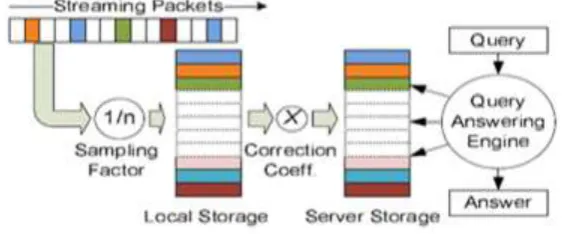
The traditional paradigm is open-loop based in which the measurements are typically blind, or orthogonal, to the
11 |
P a g e
scheme’s reliance on sampling incurs significant measurement inaccuracies. There is a vast amount of researchthat is based on open-loop schemes and their shortcomings. However, the speed and scale, the size, and
complexity of today’s networks limit the feasibility of the paradigm in closing the loop between the
measurements and the requirements in a streaming setup. We address the problem using smart, goal-oriented
closed-loop measurement solution. Central to our proposed scheme is a tight integration between the
measurement requirements, available resources, and the actual measurements. This is achieved by breaking a
higher level user-query into multiple rules of finer granularities and their iterative refinement over time until the
user-query gets answered.
Fig. 1 Traditional Open Loop
The contention is that the interesting traffic patterns could be detected or learned on the fly, via iterative rule
based traffic measurements, online analysis of collected information, and closed-loop evolution of subsequent
rules for further and finer traffic inspection. Each round in the iterative process guides the subsequent
measurements towards the goal, thereby reducing redundant measurements and leading to answering the
user-query over time. The closed loop scheme thus temporally distributes the complexity in answering the user user-query
by breaking it down into multiple rules, or a rule-set, to be answered over multiple iterations. Multi-Resolution
Tiling (MRT) Algorithm has been previously employed in coming up with the rule-sets in an offline closed loop
settings, performing multiple passes over the same data.
Fig. 2 Proposed Closed Loop
In an online setting, such multiple-pass flexibility is not available, and may necessitate an aggressive formation
of the rules, leading to large and redundant rule-sets. Thus the challenge in closed-loop streaming measurements
12 |
P a g e
while remaining within the computing budgets. In this work, we present an online closed-loop measurementsystem that provides solution to the above challenges. Fundamental to our streaming solution are three novel
algorithms that cater to different levels of computational and storage budgets, detection latencies, and user level
knowledge of the anomaly. A key goal of our work is to reduce redundant measurements by closely associating
the computational resources towards the required query, that is, directing the limited resources where they are
needed the most. Another consideration in the design of our algorithms is to maintain scalabilities in
computation and storage costs, while not compromising on the accuracy and latency of the final answer.
We integrate our proposed algorithms using state of the art rule-processing platform, the BURAQ that provides
highly parallel and programmable computational resources on a commodity FPGA device. We provide both
empirical and analytical analysis of our algorithms. The worst case computational complexities of the proposed
algorithms are similar to that of the MRT, whereas two of the three algorithms also demonstrate similar worst
case storage complexities. The results show a marked 100% increase in the detection accuracies from the MRT,
with low to moderate resource utilization of the BURAQ platform. Finally, we provide mathematical upper
bounds on expected false alarms while using our solution. The bounds yield interesting insights in fine tuning
the system accuracy and latency, under any given network conditions and computational budgets.
II. PROBLEM STATEMENT
The major part of the project development sector considers and fully survey all the required needs for
developing the project. Before developing the tools and the associated designing it is necessary to determine and
survey the time factor, resource requirement, man power, economy, and company strength. Once these things
are satisfied and fully surveyed, then the next step is to determine about the software specifications in the
respective system such as what type of operating system the project would require, and what are all the
necessary software are needed to proceed with the next step such as developing the tools, and the associated
operations.
2.1 Online identification of hierarchical heavy hitters: algorithms, evaluation, and applications
In this paper [2], We Propose that Sampling has become an integral part of passive network measurement. This
role is driven by the need to control the consumption of resources in the measurement infrastructure under
increasing traffic rates and the demand for detailed measurements from applications and service providers.
Classical sampling methods play an important role in the current practice of Internet measurement. The aims of
this review are to explain the classical sampling methodology in the context of the Internet to readers who are
not necessarily acquainted with either, to give an account of newer applications and sampling methods for
passive measurement and to identify emerging areas that are ripe for the application of statistical expertise.
2.2 Diamond in the rough: finding hierarchical heavy hitters in multi-dimensional data
According to this paper [5], We propose that Data items archived in data warehouses or those that arrive online
as streams typically have attributes which take values from multiple hierarchies (e.g., time and geographic
location; source and destination IP addresses). Providing an aggregate view of such data is important to
summarize, visualize, and analyze. Develop the aggregate view based on certain hierarchically organized sets of
large-valued regions ("heavy hitters"). Such Hierarchical Heavy Hitters (HHHs) were previously introduced as a
13 |
P a g e
applications and realistic IP data streams, we generalize this problem to multiple dimensions. Identify and studytwo variants of HHHs for multi-dimensional data, namely the "overlap" and "split" cases, depending on how an
aggregate computed for a child node in the multi-dimensional hierarchy is propagated to its parent element(s).
For data warehousing applications, present offline algorithms that take multiple passes over the data and
produce the exact HHHs. For data stream applications, we present online algorithms that find approximate
HHHs in one pass, with provable accuracy guarantees. Show experimentally, using real and synthetic data, that
our proposed online algorithms yield outputs which are very similar (virtually identical, in many cases) to their
offline counterparts. The lattice property of the product of hierarchical dimensions ("diamond") is crucially
exploited in our online algorithms to track approximate HHHs using only a small, fixed number of statistics per
candidate node, regardless of the number of dimensions.
2.3 Applications, technologies, architectures, and protocols for computer communications
In that paper [1], Traffic monitoring, accounting, and network anomaly detection, it is often important to be able
to detect high-volume traffic clusters in near real-time. Such heavy-hitter traffic clusters are often hierarchical,
they may occur at different aggregation levels like ranges of IP addresses) and possibly multidimensional, they
may involve the combination of different IP header fields like IP addresses, port numbers, and protocol).
Without prior knowledge about the precise structures of such traffic clusters, a naive approach would require the
monitoring system to examine all possible combinations of aggregates in order to detect the heavy hitters, which
can be prohibitive in terms of computation resources. In this approach focusing on online identification of
1-dimensional and 2-1-dimensional hierarchical heavy hitters (HHHs), are the two most important scenarios in
traffic analysis. The resulting HHH detection algorithms have much lower worst-case update costs than existing
algorithms and can provide tuneable deterministic accuracy guarantee. As an application of these algorithms, we
also propose robust techniques to detect changes among heavy-hitter traffic clusters. Our techniques can
accommodate variability due to sampling that is increasingly used in network measurement. Evaluation based
on real Internet traces collected at a Tier-1 ISP suggests that these techniques are remarkably accurate and
efficient.
2.4 A Programmable Architecture for Scalable and Real-time Network Traffic Measurements
In this paper [3], we present that SIGCOMM is the flagship annual conference of the ACM Special Interest
Group on Data Communication (SIGCOMM) on the applications, technologies, architectures, and protocols for
computer communication. SIGCOMM members include scientists, engineers, educators and students. They
study all aspects of computer communications and networks, analysis, technical design, engineering,
measurement and management. Members are particularly interested in the systems engineering and architectural
questions surrounding computer communication.
2.5 A dynamically reconfigurable system for stateful measurement of network traffic
According to this paper [4], we Programmable analysis of network traffic is critical for wide range of higher
level traffic engineering and anomaly detection applications. Such applications demand and programmable
network traffic measurements (NTM) at high throughputs. Exploiting the features and requirements of NTM,
and develop an application-specific FPGA based Partial Dynamic Reconfiguration (PDR) scheme that is tailored
to NTM problem. PDR has traditionally been done through swapping of statically compiled FPGA
14 |
P a g e
requirements as they appear during real-time in many applications like NTM. In this paper, novel use offine-grained PDR, performing minute logic changes in real-time and demonstrate its effectiveness in a prototype
solution for programmable and real-time NTM. Specifically make use of flexibility available through the
application and present a number of novel tools and algorithms that enabled developing the BURAQ system.
Our results show 4x area and 1.3x latency improvements of BURAQ from a comparative statically compiled
recent solution.
III. APPROACH
In the Proposed Approach, A novel network routing technique is proposed, called MRT that aims to overcome
the shortcomings of the previously reported network routing schemes which provides an efficient and cost
effective fine grained data transfer. The main goal is to achieve a superb applicability to the network scenario
with densely distributed hand-held devices. The main feature of this system is the strong capability in adaptation
to the fluctuation of network status, traffic patterns/characteristics, user encounter behaviours, and user resource
availability, so as to improve network performance in terms of message delivery ratio, message delivery delay,
and number of transmissions.
The proposed scheme is characterized by the ability of adapting itself to the observed network behaviors, which
is made possible by employing an efficient time window based update mechanism for some network status
parameters at each node. This approach uses time-window based update strategy because it is simple in
implementation and robust against parameter fluctuation. Note that the network conditions could change very
fast and make a completely event driven model.
This scheme takes less energy consumption, and small amount of transmission bandwidth and less
memory space, which could easily simplify the network resource and provide efficient data transmission.
Provide good support in high traffic loads, which results in a significant performance and scalability. Visibility under the scalable measurements, packets can dynamically move under the bandwidth
circumstances.
Measurement wastages are low during the detection of latencies.
3.1 Multi-Resolution Tiling Algorithm
The MRT algorithm helps in guiding the measurements in the vast n-tuples search space. However, the limited
visibility under which the guided measurements have to base their decisions can lead to false negatives and
positives in detecting an anomaly. For instance, a brief spike in activity may lead the MRT to incorrectly declare
presence of a heavy flow, when it may only be a Flash crowd. Similarly, a brief absence of an anomaly can lead
the MRT to disregard a region from future consideration.
3.2 Streaming Algorithm
Streaming algorithms that address the above challenges in goal oriented rule-based online traffic measurements.
A key challenge answered in designing the streaming measurement algorithms is to maintain measurement
scalability, by maintaining an optimized rule-set. We demonstrate streaming solutions that can maintain the
accuracies while significantly reducing the resource budget from naive methods.
15 |
P a g e
The Equilibrium Rollback (ER) Algorithm addresses the problem of MRT resets by adjusting the granularitiesof the expanded flow sets according to the temporal variations in the traffic. This is in contrast with the MRT
that resets the granularities to the highest levels if the threshold requirements are not met.
3.4 Flow Momentum Algorithm
The Equilibrium Rollback helps to gracefully degrade the zoomed granularity when an anomaly temporally goes
under the measurement radars. However, in doing so, the algorithm ends up maintaining information about the
entire traversed hierarchy in the hope that it may be needed if the algorithm needs to rollback.
3.5 Directed Momentum Algorithm
A Smart Directed Momentum (DM) algorithm that directs the search process by associating the limited
resources where they are deemed more profitable. We develop the algorithm in the context of elephant flows.
However, the ideas behind the algorithm are applicable for other types of anomalies.
IV. ARCHITECTURAL DESIGN
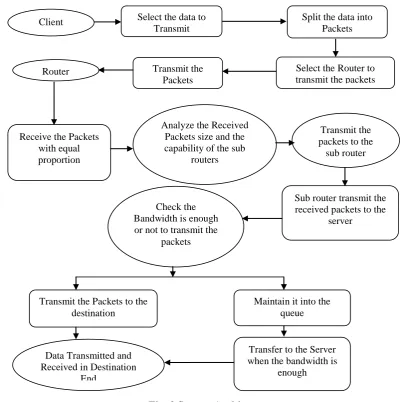
Fig. 3 System Architecture
Client Split the data into
Packets Select the data to
Transmit
Select the Router to transmit the packets
Router Transmit the
Packets
Analyze the Received Packets size and the capability of the sub
routers
Transmit the packets to the
sub router Receive the Packets
with equal proportion
Check the Bandwidth is enough or not to transmit the
packets
Transmit the Packets to the destination
Sub router transmit the received packets to the
server
Maintain it into the queue
Transfer to the Server when the bandwidth is
enough Data Transmitted and
16 |
P a g e
The major part of the project development sector considers and fully survey all the required needs fordeveloping the project. Once these things are satisfied and fully surveyed, then the next step is to determine
about the software specifications in the respective system such as what type of operating system the project
would require, and what are all the necessary software are needed to proceed with the next step such as
developing the tools, and the associated operations. Generally algorithms shows a result for exploring a single
thing that is either be a performance, or speed, or accuracy, and so on. An architecture description is a formal
description and representation of a system, organized in a way that supports reasoning about the structures and
behaviors of the system. System architecture can comprise system components, the externally visible properties
of those components, the relationships (e.g. the behavior) between them.
V. METHODOLOGY
Following are the most frequently used project management methodologies in the project management practice:
1. Network Module
2. Delay Tolerant Network
3. Dynamic Routing
4. Randomization Process
5. Routing Table Maintenance
6. Load on Throughput
5.1 Network Module
Client-server computing or networking is a distributed application architecture that partitions tasks or workloads
between service providers (servers) and service requesters, called clients. Often clients and servers operate over
a computer network on separate hardware. A server machine is a high-performance host that is running one or
more server programs which share its resources with clients. A client also shares any of its resources; Clients
therefore initiate communication sessions with servers which await (listen to) incoming requests.
5.2 Delay Tolerant Network
DTN is characterized by the lack of end-to-end paths for a given node pair for extended periods, which poses a
completely different design scenario from that for conventional mobile adhoc networks (MANETs). Due to the
intermittent connections in DTNs, a node is allowed to buffer a message and wait until the next hop node is
found to continue storing and carrying the message. Such a process is repeated until the message reaches its
destination. This model of routing is significantly different from that employed in the MANETs. DTN routing is
usually referred to as encounter-based, store-carry-forward, or mobility-assisted routing, due to the fact that
nodal mobility serves as a significant factor for the forwarding decision of each message.
5.3 Dynamic Routing
To propose a distance-vector based algorithm for dynamic routing to improve the security of data transmission.
We propose to rely on existing distance information exchanged among neighboring nodes (referred to as routers
as well in this paper) for the seeking of routing paths. In many distance-vector-based implementations, e.g.,
17 |
P a g e
hop denote some unique destination node, an estimated minimal cost to send a packet to t, and the next nodealong the minimal-cost path to the destination node, respectively.
5.4 Randomization Process
The delivery of packets with the destination at a node. In order to minimize the probability that packets are
eavesdropped over a specific link, a randomization process for packet deliveries, in this process, the previous
next-hop for the source node s is identified in the first step of the process. Then, the process randomly picks up a
neighboring node as the next hop for the current packet transmission. The exclusion for the next hop selection
avoids transmitting two consecutive packets in the same link, and the randomized pickup prevents attackers
from easily predicting routing paths for the coming transmitted packets.
5.5 Routing Table Maintenance
In the network be given a routing table and a link table. We assume that the link table of each node is
constructed by an existing link discovery protocol, such as the Hello protocol in. On the other hand, the
construction and maintenance of routing tables are revised based on the well-known Bellman-Ford algorithm.
5.6 Load on Throughput
Investigate the effect of traffic load on throughput for our proposed DDRA; the traffic is also generated based
on variable-bit-rate applications such as file transfers over Transmission Control Protocol (TCP). The average
packet size is 1,000 bytes, and source-destination pairs are chosen randomly with uniform probabilities.
VI. CONCLUSION
Iterative measurements offer streaming measurements and analysis and help overcome the offline nature of
traditional measurements. However, the effectiveness of iterative measurements is heavily tied with smart
algorithms that can efficiently make use of constraints as imposed by the measurement platforms. The
state-of-the-art MRT algorithm is too sensitive to specific traffic patterns and is blind to any constraints or opportunities
arising from measurement platforms. We address the issues with three iterative streaming algorithms that cater
to varying degrees of computational and storage budgets, detection latency, and accuracies of query response.
We evaluate the streaming algorithms on diverse hardware and software-based measurement platforms, for local
as well as distributed measurement settings. The results demonstrate a marked 100% improvement in detection
accuracy compared to MRT, with a moderate increase in storage and computational complexities. In future the
proposed ER and FM algorithms are suitable where detailed information about the anomalous behavior and
computational platform is not available. The algorithms trade computational complexity with storage costs and
detection latencies, with FM offering increased accuracy. The DM algorithm showcases superior accuracy and
detection latency while employing minimal resources, making it an ideal candidate in scenarios where
exceeding the available resources is prohibitive and/or increased characterization of an anomaly is possible.
VII. FUTURE WORK
The work addressed the challenges in closed-loop streaming measurements and analysis in today’s high speed
and complex networks. In particular, we addressed the issues in tracking down anomalous flows within a
18 |
P a g e
streaming algorithm, equilibrium rollback algorithm are neatly explained and implemented with the help ofdynamic routing and throughput maintenance modules. In the future the created modules needs to be expand
further by means of routing table handling module, which is used in the network by giving a routing table and a
link table. The link table of each node is constructed by an existing link discovery protocol, such as the Hello
protocol in. On the other hand, the construction and maintenance of routing tables are revised based on the
well-known Bellman-Ford algorithm, which is used in many ways to help us to move the transmission without any
delay and maintaining the sequence in correct order with the help of other two algorithms like flow momentum
and direct momentum.
VIII
ACKNOWLEDGMENT
We would like to sincerely thank Assistant Prof. G.Sathish Kumar for his advice and guidance at the start of this
article. His guidance has also been essential during some steps of this article and his quick invaluable insights
have always been very helpful. His hard working and passion for research also has set an example that we
would like to follow. We really appreciate his interest and enthusiasm during this article. Finally we thank the
Editor in chief, the Associate Editor and anonymous Referees for their comments.
REFERENCES
[1] L. Yuan, C.N. Chuah, and P. Mohapatra, “Applications, technologies, architectures, and protocols for
computer communications”, 2007.
[2] Y. Zhang, S. Singh, S. Sen, “Online identification of hierarchical heavy hitters: algorithms, evaluation,
and applications”, 2004
[3] F. Khan, L. Yuan, C.N.Chuah “A Programmable Architecture for Scalable and Real-time Network
Traffic Measurements”, 2008.
[4] F.Khan, N.Hosein, “A dynamically reconfigurable system for stateful measurement of network traffic”,
2010.
[5] G. Cormode, F. Korn, S. Muthukrishnan “Diamond in the rough: finding hierarchical heavy hitters in
multi-dimensional data”, 2004.
[6] G. Huang, S. Raza, S. Seetharamanh, and C.-N. Chuah, “Dynamic measurement-aware routing in
practice,” in IEEE Networks Special Issue on Network Traffic Monitoring and Analysis, 2011, pp. 29–34.
[7] N. McKeown, T. Anderson, H. Balakrishnan, G. Parulkar, L. Peterson, J. Rexford, S. Shenker, and J.
Turner, “Openflow: enabling innovation in campus networks,” SIGCOMM Computer Communication
19 |
P a g e
AUTHORS PROFILE
K.Akilashri is currently a PG scholar in Communication Systems from the
Department of Electronics and Communication Engineering at MNSK College of
Engineering, Pudukottai and Tamilnadu. She received his Bachelor Degree in
Electronics and Communication Engineering from Meenakshi College of Engineering,
Chennai and Tamilnadu. Her Research areas include Wireless Sensor Networks,
Communication Engg and Embedded Systems.
G.Sathish Kumar is currently working as a Professor from the Department of
Electronics and Communication Engineering at MNSK College of Engineering,
Pudukkottai and Tamilnadu. He received his Bachelor Degree in Electronics and
Communication Engineering from MNSK College of Engineering, Pudukottai and
Tamilnadu. He received his master degree from Anna University, Thiruchirapalli and
Tamilnadu. His main research interests lie in the area of Digital Image Processing,