EFFICIENT FULLY HOMOMORPHIC ENCRYPTION SCHEME
SHUHONG GAO
Abstract. Since Gentry discovered in 2009 the first fully homomorphic encryption scheme, the last few years have witnessed dramatic progress on designing more effi-cient homomorphic encryption schemes, and some of them have been implemented for applications. The main bottlenecks are in bootstrapping and large cipher expansion (the ratio of the size of ciphertexts to that of messages). Ducas and Micciancio (2015) show that homomorphic computation of one bit operation on LWE ciphers can be done in less than a second, which is then reduced by Chillotti et al. (2016, 2017) to 13ms. This paper presents a compact fully homomorphic encryption scheme that has the following features: (a) its cipher expansion is 6 with private-key encryption and 20 with public-key encryp-tion; (b) all ciphertexts after any number (unbounded) of homomorphic bit operations have the same size and are always valid with the same error size; (c) its security is based on the LWE and RLWE problems (with binary secret keys) and the cost of breaking the scheme by the current approaches is at least 2160 bit operations. The scheme protects function privacy and provides a simple solution for secure two-party computation and zero knowledge proof of any language in NP.
Keywords. Fully homomorphic encryption, data security, lattices, learning with errors (LWE) problem, ring learning with errors (RLWE) problem, NP problems, secure two-party computation, zero knowledge proof, fast Fourier transforms (FFT).
1. Introduction
As cloud computing, internet of things (IoT) and blockchain technology become increas-ingly prevalent, there is an urgent need to protect the privacy of massive volumes of sensitive data collected or stored in computer networks or cloud servers, as many of the networks or servers can be vulnerable to external and internal threats such as malicious hackers or curious insiders. In the case of blockchain technology, it is the privacy issue that prevents widespread enterprise adoption of blockchains, despite the transparency and immutability that the technology offers. The traditional encryption schemes can provide privacy protec-tion of data but do not allow for the performance of analytics on encrypted data without decryption first. The Holy-Grail of cryptography is to have a practical encryption scheme that has the following properties:
(a) encrypted data can be stored anywhere (e.g. untrusted clouds, blockchains, or per-sonal computers at home or at a hacker’s control);
(b) any third party (including cloud servers, hackers, miners or insiders) can perform searching or analytics of an arbitrary function on the encrypted data to get search results in encrypted form, however, only the data owner (who has the secret decoding key) can decode the encrypted search results;
Date: May 21, 2018.
The work presented in this paper was partially supported by the National Science Foundation under grants CCF-1407623, DMS-1403062 and DMS-1547399. Thanks go to the Center of Applied Mathematics, Tianjin University, China, for hosting the author in Summer 2017, and to American Institute of Mathematics (AIM), San Jose, for hosting the author in several SQuaRE meetings in the last few years with Qi Cheng, J. Maurice Rojas and Daqing Wan.
(c) an adversary can access all the encrypted data and use all the available computing powers in the world but still can not compute any information of the original data in reasonable time (say 100 years).
An encryption scheme having all the three properties is called a fully homomorphic en-cryption (FHE) scheme. If (b) is satisfied only for a class of searches (but not all possible searches), then it is called a somewhat homomorphic encryption (SHE) scheme. In compar-ison, traditional cryptosystems (e.g. RSA, AES, elliptic curve cryptosystems, etc [55]) have properties (a) and (c), but not (b) which is the most challenging part of designing an FHE scheme.
The idea of homomorphic encryption was first proposed in 1978 by Rivest, Adleman and Dertouzos [99]. Only in 2009 was the breakthrough discovery made by Gentry [60] for the first fully homomorphic encryption scheme. His work has inspired an explosive surge of research on homomorphic encryption schemes, and the design blueprint of his original scheme has been serving as a prototype for designing more efficient schemes since then. In Gentry’s scheme, random noise is added to ciphertexts (for security reason), the noise grows quickly when one performs homomorphic operations on the ciphertexts, and the size of the new ciphertexts may grow as well. Only a limited number of homomorphic operations can be applied before the noise gets too big to destroy the message encoded in the ciphertexts. Gentry proposes the novel idea of performing homomorphic decoding and bootstrapping to reduce the noise size, then more homomorphic operations can be performed, and continue in this fashion (of bootstrapping whenever needed), any number of homomorphic operations can be performed as needed for an arbitrary search function on the encrypted ciphertexts, hence yielding a fully homomorphic encryption scheme.
To design a practical homomorphic encryption scheme, one has to solve three problems:
(i) Cipher expansion problem. The size ratio of the ciphertexts vs the original data must be small so that communications and storage are not too expensive, and the size of new ciphertexts obtained under homomorphic operations should be independent of the complexity of every search function;
(ii) Time efficiency problem. The cost of homomorphic computing of an arbitrary functionf should be proportional to the complexity of f itself, and the overhead factor should only depend on the security parameterλ;
(iii) Security problem. The security of the scheme must be based on hard mathe-matical problems, and for a scheme deigned for a given security parameter λ(say λ= 120,160, or 200), the cost of breaking the scheme should be at least 2λ (in bit operations).
On the security problem, Regev [97, 98] proved in 2005 an important theorem on the hard-ness of the learning with error (LWE) problem. Thanks to Regev’s work and [25, 88], homomorphic encryption schemes based on the LWE and RLWE problems now have a solid security foundation.
eigenvalues; also a novel technique called flattening is invented to better control noise growth. Though bootstrapping is still prohibitively slow, these schemes can be implemented as lev-eled schemes to compute functions that have designed depth of multiplications, and they can handle patches of many bits simultaneously. The SEAL implementation [33] is already being tested for private genome analysis [78]. In all these schemes, however, the ciphertext expansion is still too large, ranging from a few hundreds to tens of thousands (depending on the designed depth).
On bootstrapping, a recent breakthrough is made by Ducas and Micciancio (2015 [51]), who use the GSW scheme [65] and some novel homomorphic embedding to design a boot-strapping procedure that can compute one homomorphic bit operation in less than a second. This scheme is then improved by Chillotti et al. (2016 [39], 2017[40]), who reduce the boot-strapping time down to 13ms (for one homomorphic bit operation). On cipher expansion, it is stated in [39] that their ciphertext size is still 400,000 times that of the original data, and in [40], this expansion factor is claimed to be reduced to 64 (for message block length 500, but no detail is given).
Our contribution. In this paper, we present a compact FHE scheme that has the following features:
(1) its cipher expansion is 6 under private-key encryption and 10+log2(n) under
public-key encryption wheren(a power of 2) denotes the message block length, all cipher-texts are computed modulo r where r = 16n, and the noise size is bounded by n−1;
(2) its bootstrapping procedure needs only a bootstrapping key and does the following: for any two LWE ciphersEs(x1) andEs(x2)∈Znr×Zr with noise size bounded by
n−1 wherex1, x2∈ {0,1}, it produces three random LWE ciphers:
Es(x1∧x2), Es(x1∨x2), Es(x1⊕x2)∈Znr×Zr
with noise size still bounded byn−1 (no failure at all), and the total time for the bootstrapping procedure (forn= 512) is estimated to be about 130ms, namely 10 times that of [40];
(3) its security is based on the LWE and RLWE problems [97, 98, 88] (with binary secret keys) and, for any message block length n ≥512, the cost of breaking the scheme by the current approaches is at least 2160 bit operations.
Note that, in the bootstrapping of [51, 39, 40], a new LWE cipher produced by boot-strapping may be invalid, with probability about 2−33 (forn= 500). That is a very small
probability, so useful for computing many functions, however, it can not be applied to func-tions that require more than 233 bit operations (unless increasing n). In our scheme, the LWE ciphers after bootstrapping are always inZnr ×Zr with error size bounded by n−1,
hence always valid (no failure at all). This means that one can perform bootstrapping any number (unbounded) of times and all the new LWE ciphers are still inZnr ×Zr with the
same error size n−1. Due to this compactness, the computed ciphertexts do not leak any information on which function is computed, hence the scheme automatically provides function privacy.
Another important feature of our FHE scheme is that the ciphertexts resulted from homomorphic computing are independent random. This is extremely important in designing protocols for secure multi-party computation and for zero knowledge proof. We shall give more details about this in Section 6.
modified from those of [51, 39]. In Section 4, we present our encryption schemes and show how a pseudocode for a general functionf can be computed homomorphically, particularly how to handle ”if-statement”, ”for-loop” and ”while-loop”. We also show how to pack LWE ciphers into RLWE ciphers, hence reduce the ciphertext size of the final result. In Section 5, we present security analysis of our scheme, and in Section 6, we mention some use cases, including secure two-party computation and zero knowledge proof of any language in NP.
2. Basic concepts and techniques
2.1. Cyclotomic rings and norms. Letq be a positive integer andZq =Z/qZ, the ring
of integers moduloq. For an integern≥1, let
Rn=R[x]/(xn+ 1), Rn=Z[x]/(xn+ 1), Rn,q =Z[x]/(xn+ 1, q)
whereRdenotes the field of real numbers and (xn+ 1, q) denotes the ideal ofZ[x] generated
byxn+ 1 andq, namely
(xn+ 1, q) ={u(x)(xn+ 1) +v(x)q: u(x), v(x)∈Z[x]}.
For any polynomial f(x) = Pd
i=0fixi ∈ R[x] and for ` ≥ 1, we define the `-norm and ∞-norm as
kf(x)k`=
d
X
i=0 |fi|`
!1/`
, kf(x)k∞= max
0≤i≤d|fi|.
We shall use the cases when ` = 1,2 and ∞. However, for f(x) = Pd
i=0fix i ∈
Rn, we
define its norm as follows. First find the unique h(x) ∈ R[x] so that degg(x) < n and
f(x)≡h(x) mod (xn+ 1) (i.e.h(x) is the remainder off(x) moduloxn+ 1), then define
kf(x)k=kh(x)k,
where the norm || · ||stands for any one of the `-norm or ∞-norm (similarly below). For example, inR4=R[x]/(x4+ 1), we havek10x4+x+ 8k
∞=kx−2k∞= 2 and
k(x−1)4k1=kx4−4x3+ 6x2−4x+ 1k1=k −4x3+ 6x2−4xk1= 14.
For any real number c and for any u(x), v(x)∈ Rn, we have kcu(x)k =|c|ku(x)k, and if
u(x) ≡v(x) mod (xn+ 1) then ku(x)k = kv(x)k. Also, the usual triangle inequality still
holds, that is,
ku(x) +v(x)k ≤ ku(x)k+kv(x)k.
For m ≥1, elements in Rm
n are viewed as row vectors of length m, similarly for Rmn and
Rm
n,q. Foru= (u1(x), . . . , um(x))∈Rmn, define
kukp=
m
X
i=1
kui(x)kpp
!1/p
, kuk∞= max
1≤i≤mkui(x)k∞.
Also, for any real numberz, the functionbzedenotes the integer closest toz. For example,
b1.6e= 2, b−0.4e= 0, however, b−1.5e=−2 or−1, either is fine. For any vectorv∈Rn
2.2. Probabilistic distributions. We shall use several probabilistic distributions. A ran-dom variable onZq is uniform random if it takes each element ofZq with equal probability,
namely 1/q, and a random variableX onZnq orRn,q is uniform random if each component
(or each coefficient) is independent and uniform random onZq. For any real numberb >0,
by b-bounded uniform random variable X on Z, we mean X is uniform random on the
integers i with |i| ≤b, and X never takes any other value. A random variable X onR is
called Gaussian with parameterα >0 if its density function is
ρα(x) =
1
αexp(−π(x/α)
2), x∈ R.
A Gaussian random variable with parameterαhas expected value 0 and standard deviation α/√2π. A random variableX overRis called sub-Gaussian with parameterαifE(X) = 0 and its moment generating function satisfies
E[exp(2πtX)]≤exp(πα2t2), t∈R.
If X is sub-Gaussian with parameter α, then its tails are dominated by a Gaussian of parameterα, i.e.,
Prob(|X| ≥t)≤2 exp(−π(t/α)2), for allt≥0.
Ab-bounded random variable is always sub-Gaussian with parameterb√2π, a sum of inde-pendent sub-Gaussian random variables onRis still sub-Gaussian. We should note that a
sum of independent sub-Gaussian random variables onZq will be nearly uniform random when the number of variables is large enough; see [36].
Letq >1 be any integer. Each probability distribution onRinduces a discretized distri-bution onZq as follows. Pick a random numberz∈Raccording to the given distribution, computey :=bqzemodq so that y is between −q/2 and q/2, and return y. For example, when q= 11, bq·1.6e=b17.6e= 18≡ −4 modq, however bq·(−1.5)e=b−16.5e=−17 or−16 (then reduce byq), either is fine. We shall use discretized Gaussian distributions on
Zq. For a Gaussian random variableX with parameterα, its discretized Gaussian overZq
is sub-Gaussian with parametercαq for some small constantc≥1.
2.3. LWE problem, LWE ciphers, and modulus reduction. Regev (2005 [97, 98]) introduced the learning with error (LWE) problem overZq. Letχ be a probabilistic
distri-bution onZ, and lets∈Znq be an arbitrary vector (corresponding to a secret key of a user).
An LWE sample is of the form (a, b) wherea∈Znq is uniform random and
b=hs,ai+emodq
withe∈Zbeing randomly chosen according to the distributionχ. The LWE problem over Zq is to findsgiven LWE samples inZnq ×Zq where the number of samples can be as large
as one desires, but should be bounded by a polynomial innlog(q). The decision version of the LWE problem is to distinguish LWE samples from samples with uniform distribution onZnq ×Zq. We callχthe error distribution of the LWE problem.
Theorem 2.1 (Regev [97, 98]). Suppose the error distributionχ is a discretized Gaussian distribution on Zq with parameter α > 0 and αq ≥ 2
√
n. Then solving the LWE problem overZq is at least as hard as solving some approximate shortest vector problem for lattices of dimensionn (under quantum reduction).
Note that Brakerski et al [25] removed the quantum reduction requirement and proved that solvingn-dimensional LWE problem overZq is at least as hard as solving a worst-case lattice problem in dimension √n. It is still an open question whether √n in the lattice problem can be replaced by O(n), which is desirable in applications. Also, a binary-LWE problem over Fq is the LWE-problem overFq where the secret vectors∈Fn
is also hard. For this reason, many cryptosystems in the literature use binary secret vectors
s, and we shall follow this tradition as well.
This breakthrough result shows that the average complexity of solving LWE problem is bounded below by the worst-case complexity of lattice problems. Hence LWE problem is believed to be hard on average, thus forms the security foundation of many post-quantum cryptosystems (that are secure even if quantum computers can be built). There are two minor problems in using Gaussian distributions in practice: one is that Gaussian distribution is relatively expensive to generate (compared to bounded uniform distributions as we use below); another is that there is a small probability of decoding failure for new ciphers computed from bootstrapping. In this paper, we present a compact FHE that never have decoding failure for both fresh and computed ciphertexts.
Error model for the current paper. We shall use bounded uniform distributions for errors, that is, we fixed some boundτ >0 and chooseeuniform randomly in [−τ, τ]. In our choice of public keys and bootstrapping key (described later), theτ will be aboutn, and in the fresh ciphertexts of the original data, we useτ=n−1. Also, in all the ciphertexts from our bootstrapping operations or from homomorphic computing of an arbitrary function, the error size is always bounded by τ =n−1. Our error width 2(n−1) is much bigger than those used in all the proposed homomorphic schemes in the current literature, and is also much bigger than 2√nas required by Regev’s Theorem above.
Our error distribution is not discretized Gaussian, hence we can not apply Theorem 2.1 directly. However, we argue that our error distribution could be better in the sense that the LWR problem may be harder. We present two heuristic reasons. First, suppose one uses a discretize Gaussian Dα,q on Zq with parameterα > 0 so that αq ≈ 2
√
n. Then, for a randomebetween−q/2 andq/2 chosen according toDα,q, the inequality|e| ≤c
√
nholds with high probability (for any constant c ≥ 3). Note that all the known attacks on the LWE problem based on lattice basis reduction become less effective when the error width increases. Since our schemes use a much bigger error width than 2√n, our LWE problem should not be easier. Secondly, we argue from information theory point of view. Note that a uniform distribution on [−n, n] has a much higher entropy than that of a discretized Gaussian onZq with standard deviationc
√
nwherec >0 is a constant [44]. In computing b:=hs,ai+emodq, more information (bits) ofhs,aiis destroyed byein our case. Hence it is harder to reconstructsfrom a list of samples (a, b) from our error distribution.
Conjecture 2.2. Suppose the error distributionχin the LWE problem overZq isτ-bounded uniform distribution whereτ =cnfor some constantc >0. Then solving the LWE problem overZq is at least as hard as solving some approximate shortest vector problem for lattices
of dimensionn.
We should note that it is shown in [88, 30] that the LWE problem with bounded uniform distributions for errors is hard when the number of samples is limited (linear inn). However, the above conjecture is still an open when the number of samples are allowed to be any polynomial inn.
LWE ciphers. Regev [97, 98] also introduced a cryptosystem based on the LWE problem. Let s ∈ Znq be a secret key, Dq = bq/4c and 1 ≤ τ < Dq/2. To encrypt a message bit
x∈ {0,1}, picka∈Zn
q uniform randomly and compute
b:=hs,ai+e+xDqmodq,
wheree∈[−τ, τ] is uniform random or truncated Gaussian. Then (a, b) is a ciphertext for x, denoted as
Es(x) = (a, b)∈Znq ×Zq,
To decrypt a ciphertext Es(x) = (a, b), compute b1:=b− hs,aimodq,
where−q/2< b1≤q/2, andx1:=bb1/Dqe. Thenx=x1. The reason is that
b1≡b− hs,ai ≡e+xDq (mod q),
and |e| ≤ τ < Dq/2 implies that −q/2 < e+xDq ≤ q/2, hence b1 = e+xDq (as real
numbers) andb1/Dq =e/Dq+xwith|e/Dq|<1/2.
Modulus reduction. Next we describe how an LWE ciphertext overZqcan be converted to an LWE ciphertext overZr where ris much smaller thanq. This technique of modulus reduction is used in [23, 25, 27]. Here we show how precisely the error size changes, depending only on the entropy (i.e. the bit size) ofs.
Lemma 2.3. Let s,a∈Zn
q,e∈Z with|e| ≤τ,x∈ {0,1},Dr=br/4c, and
b≡ hs,ai+e+xDq (modq).
(a) Supposeτ≤q(n−3)/(2r),q≥4r, and each entry ofsis in {0,1}. Let b0 =brb/qe, a0 =bra/qe,
computed component wise. Then
b0≡ hs,a0i+e0+xDr (modr),
for somee0∈Z with|e0|< n.
(b) Let ` =dlog2qeand q≥16. Supposeτ ≤q(n`−5)/(2r)and s∈Znq is arbitrary.
Then there exists0∈ {0,1}n`,a0 ∈
Zn`r andb0∈Zr so that
b0≡s0(a0)t+e0+xDr (mod r),
for somee0∈Z with|e0|< n`. Proof. For part (a), note that
b0 =rb
q +0, a 0
i=
rai
q +i, 1≤i≤n,
for somei∈Rwith|i| ≤1/2 for 0≤i≤n. Sinceb=s at+e+xDq+qyfor some integer
y, we have
rb q = n X i=1 si rai q + re
q +x rDq
q +ry,
hence
b0 =
n
X
i=1
sia0i+xDr+e0+ry,
wheree0 is an integer and
e0 =0− n
X
i=1
sii+x
rD
q
q −Dr
+re q .
We claim that|rDq
q −Dr|<1. To see this, letq= 4q1+q0andr= 4r1+r0where 0≤r0<4
and 0≤q0<4. Then
rDq
q −Dr=
(4r1+r0)q1
4q1+q0
−r1=
r1+r40
1 + q0
q1
−r1= r0
4 −q0 r1
q1
1 + q0
q1
,
which has absolute value <1 wheneverq1 ≥4r1, hence true whenq ≥4r. As si∈ {0,1},
x∈ {0,1},|i| ≤1/2 and|e| ≤τ ≤q(n−5)/(2r), it follows that
|e0|<(n+ 1)1 2+ 1 +
rτ q ≤
n+ 3
2 +
For part (b), we write each entry ofsin binary representation: si=
`−1
X
j=0
sij2j,
wheresij ∈ {0,1} for 1≤i≤nand 0≤j≤`−1. Then
hs,ai=
n
X
i=1
siai= n
X
i=1 `−1
X
j=0
sij(ai2j).
Apply part (a) to the case with s replaced by s0 = (sij) ∈ {0,1}n`. This completes the
proof.
Remarks. (i) In the proof of part (a), one can randomize the rounding so that i
is random subGaussian; see Lemma 5 in Ducas and Micciancio (2015 [51]). Then the probability that|0−P
n
i=1sii| ≥ t √
w+ 1 is at most 2 exp(−2t2) where wis the number of nonzero entries in s. Hence, ifτ ≤10q√n/r, then the probability that|e0| ≥20√n is at most 2 exp(−200), which is extremely small. This would allow one to use a smallq=O(√n) for encryption, but there would be a very small probability of decoding failure. We shall use a biggerq=O(n) and make sure that there is no decoding failure at all in our encryption and bootstrapping schemes, hence allows us to perform any number of homomorphic bit operations without decoding failure.
(ii) Part (b) and its proof shows that an LWE problem with arbitrarys ∈ Zn
q can be
reduced to an LWE problem with binarys0 ∈ {0,1}n` over
Zq as well as overZr for any
r < q. Hence the LWE problem with binary secret is as hard as an arbitrary secret with dimension reduced by a factor of log2(q). In the following, we shall only use binarys. 2.4. RLWE ciphers. Lyubashevsky, Peikert and Regev (2010 [87]) introduced the ring learning with error (RLWE) problem in order to get more efficient encryption schemes. Let
Rn=Z[x]/(xn+ 1), andRn,q =Z[x]/(xn+ 1, q),
that is, polynomials are computed modulo xn+ 1 and all the coefficients modulo q. Each
element of Rn,q (or Rn) is of the form a(x) = P n−1
i=0 aixi, where ai ∈ Z, representing an
n-tuple (a0, a1, . . . , an−1)∈Znq (or in Zn). Let s(x)∈ Rn,q be any secret key. An RLWE
sample is of the form (a(x), b(x))∈R2
n,q where a(x)∈Rn,q is uniform random and
b(x) :=s(x)a(x) +e(x) mod (xn+ 1, q),
wheree(x)∈Rn with each coefficient small and random (according to certain distribution).
An RLWE samplev∈R2n,q is said to have error sizeτ if
(1) v(−s(x),1)t≡e(x) (mod (xn+ 1, q)),
wheree(x)∈Rnand||e(x)||∞≤τ. The RLWE problem overZq is to finds(x) given many
RLWE samples where each sample is random and independent. Letm(x) =Pn−1
i=0 mixiwheremi∈ {0,1}, which represents ann-bit message. An RLWE
cipher form(x) with error sizeτ is of the form
(2) REs(m(x)) =v+m(x)Dq(0,1)∈R2n,q
where v∈R2
n,q is an RLWE sample with error sizeτ. Suppose REs(m(x)) = (a(x), b(x)). Then
b(x)−s(x)a(x)≡m(x)Dq+e(x) mod (xn+ 1, q),
wheree(x)∈Rn is random with||e(x)||∞≤τ. Whenτ < Dq/2, one can recoverm(x) from
2.5. Gadget matrix, external product and GSW ciphers. In order to perform ho-momorphic multiplication, Gentry, Sahai, and Waters (2013 [65]) introduced the idea of gadget matrix so that new ciphertexts from multiplication of ciphertexts remain the same size, while previous methods increase the size of new ciphertexts.
Gadget matrix. LetB and`be positive integers so thatB`≥q. Let
g= (1, B, . . . , B`−1).
Every elementa∈Zq can be represented as
a=a0+a1B+· · ·+a`−1B`−1= (a0, a1, . . . , a`−1)gt
whereai ∈Zhas small size. For example, we can let−B/2< ai≤B/2, then (a0, a1, . . . , a`−1)
is unique. This is good for applications where new ciphertexts from homomorphic comput-ing do not need to be random. However there are applications (say zero knowledge proof, see below) where it is important that new ciphertexts are uniformly random (in some sense). Hence we shall allow |ai| to be as big as 2B. The following lemma is straightforward to prove.
Lemma 2.4 (Random Flattening). SupposeB` ≥q and a∈ Z. For 0 ≤i ≤`−1, pick
xi∈Zwith |xi| ≤3B/2 uniform randomly and independently, and let
a−(x0+x1B+· · ·+x`−1B`−1)≡y0+y1B+· · ·+y`−1B`−1 (modq),
where|yi| ≤B/2for0≤i≤`−1. Setai=xi+yifor0≤i≤`−1. Then(a0, a1, . . . , a`−1)
is uniform random solution to
a≡a0+a1B+· · ·+a`−1B`−1 (modq),
with|ai| ≤2B for0≤i≤`−1.
We can extend this to any list of elements inZq. Thus every polynomiala(x)∈Rn,q can
be written as
a(x) =a0(x) +a1(x)B+· · ·+a`−1(x)B`−1= (a0(x), a1(x), . . . , a`−1(x))gt
where ai(x)∈R is independently uniform random with||ai(x)||∞≤2B for 0≤i≤`−1. Define
G=
gt 0 0 gt
an (2`)×2 matrix, called a gadget matrix. Every (a(x), b(x))∈R2
n,q can be written as
(3) (a(x), b(x)) =u(x)G
whereu(x)∈R2`
n is uniform random with||u(x)||∞≤2B. We define
(a(x), b(x))/ G−1=u(x).
The reader should be warned thatGis not a square matrix, so it has no inverse, here we just useG−1as an operator that acts from right on (a(x), b(x)), a row vector of two polynomials
with coefficients inZq (of large size), to getu(x) = (a(x), b(x))/ G−1, a random row verctor
of 2` polynomials each with coefficients at most 2B (of small size). This is a nice trick of trading element size for dimension. For example, whenB= 3 and`= 4, we have
G=
1 3 32 33 0 0 0 0
0 0 0 0 1 3 32 33
t ,
and
(5 + 35x,−14)/ G−1= (−1−x,−1,1 +x, x,1,1,1,−1)∈R8n.
since 5 = 32−3−1, 35 = 33+ 32−1, and−14 =−33+ 32+ 3 + 1. By definition, we have
which will be crucial in bootstrapping below.
External product. For any row vector v ∈ R2n,q and any A ∈Rn,q2`×2 (which denotes
(2`)×2 matrices with entries inRn,q), their external product is defined as
vA= (v/ G−1)A∈R2n,q, which is a random vector in R2
n,q, sincev/ G−1 is a random row vector of length 2` and
A is an (2`×2) matrix. This definition can be extended to define product of any two (m`)×m matrices (to get another (m`)×m matrix), as originally defined by Gentry, Sahai and Waters (2013 [65]). Recently, Chillotti et al (2016 [39, 40]) observed that, for bootstrapping, it is better to use this external product. From the definition, the external product is right distributive, that is, for any two matricesA, B∈R(2`)n,q×2, we have
v(A+B)≡vA+vB (mod (xn+ 1, q)),
where all three terms use the samev / G−1. However, they are not equal if one computes each term independently (unless v / G−1 is deterministic). Also, it is not left distributive, i.e., for two vectorsv1,v2∈R2n,q,
(v1+v2)A6≡v1A+v2A (mod (xn+ 1, q)),
in general, since the operatorG−1 is not linear when acting onv. GSW ciphers. Let s(x) = Pn−1
i=0 sixi, where si ∈ {0,1}, representing an n-bit secret
key of a user. For any m(x)∈ Rn (say with small coefficients) , a GSW cipher for m(x)
with error sizeτ is of the form
(5) GSWs(m(x)) =A+m(x)G∈R(2`)n,q×2
whereA∈R2`n,q×2and each row ofAis an RLWE sample (chosen independent randomly) so
that
A(−s(x),1)t≡w(x) mod (xn+ 1, q) where w(x)∈ R2`
n with||w(x)||∞ ≤τ. An RLWE cipher for m(x) with error size τ is of the form
(6) REs(z) =v+m(x)Dq(0,1)∈R2n,q
wherev∈R2n,q is an RLWE sample so that
v(−s(x),1)t≡e(x) mod (xn+ 1, q),
where e(x)∈Rn with ||e(x)||∞ ≤τ. The next lemma is observed by Chillotti et al (2016 [39]), here we make the error bound explicit in our error model.
Lemma 2.5. Let m0, m1∈Rn be any two polynomials. For any REs(m0)with error size
τ0 and any GSWs(m1)with error size τ1, we have
REs(m0)GSWs(m1) =REs(m0m1),
and REs(m0m1)has error size at most||m1||1τ0+ 4Bn`τ1.
Proof. By assumption, we may let
REs(m0) =v+m0Dq(0,1)∈R2n,q, GSWs(m1) =A+m1G∈Rn,q(2`)×2,
wherev∈R2
n,q andA∈R2`n,q×2 satisfying, modulo (xn+ 1, q),
(7) v(−s(x),1)t≡w0(x), A(−s(x),1)t≡w(x)t,
andw0(x)∈Rnandw(x) = (w1(x), . . . , w2`(x))∈R2`n with||w0(x)||∞≤τ0and||wi(x)||∞≤ τ1for 1≤i≤2`. Let
with||h||∞≤2B. Computing modulo (xn+ 1, q), we have
REs(m0(x))GSWs(m1(x)) ≡ h(A+m1G) =hA+m1hG
≡ hA+m1([v+m0Dq(0,1)]/ G−1)G ≡ hA+m1[v+m0Dq(0,1)]
≡ (hA+m1v) +m0m1Dq(0,1)∈R2n,q,
where, in the second last equation, we used the property ofG−1 from (4). This proves the
first part of the lemma.
It remains to estimate the error size. The error polynomial is, using (7),
(hA+m1v)(−s(x),1)t≡hw(x)t+m1w0(x) (mod (xn+ 1, q)).
Let m1 = P n−1
i=0 m1ixi ∈ Rn and hj = P n−1
i=0 hjixi where hji ∈ Z with |hji| ≤ 2B for
0≤i≤n−1 and 1≤j≤2`. Note that
hw(x)t+m1w0(x) = 2`
X
j=1 n−1
X
i=0
hjixiwj(x) + n−1
X
i=0
m1i·xiw0(x).
Hence
||hw(x)t+m1w0(x)||∞ ≤
2`
X
j=1 n−1
X
i=0
|hji| · ||xiwj(x)||∞+
n−1
X
i=0
|m1i| · ||xiw0(x)||∞
≤ 2`
X
j=1 n−1
X
i=0
2Bτ1+ n−1
X
i=0
|m1i|τ≤(2`)n2Bτ1+||m1||1τ0.
This completes the proof.
3. Homomorphic bit operations
Suppose we are given any two LWE ciphers inZnr×Zr forx1, x2∈ {0,1}with error size
< Dr/4. We want to compute LWE ciphers for
x1∧x2, x1∨x2, x1⊕x2,
still with error size< Dr/4, wherex1∧x2=x1·x2(ANDgate),x1∨x2=x1 ORx2(ORgate)
and x1⊕x2 =x1+x2 (mod 2) (XOR gate, exclusive OR). In this section, we show how to
compute all these new ciphers simultaneously by one bootstrapping operation. Note that a cipher for (x1NAND x2) = 1−x1∧x2 can be obtained from that of x1∧x2 trivially, so we
just need to focus on the above three bit operations. We follow the approach in Ducas and Micciancio (2015 [51]) and Chillotti et al. (2016 [39]), however, we do not need to perform key switch as they do.
Let s = (s0, . . . , sn−1) ∈ {0,1}n, representing an n-bit secret key of a user. Suppose
r≥2nand is divisible by 8,Qis much bigger thanr(to be determined later),B`≥Qand
m=r/2, Dr=br/4c, D˜Q =bQ/8c.
We shall work in the rings
Rm=Z[x]/(xm+ 1), Rm,Q=Z[x]/(xm+ 1, Q).
Define a bootstrapping key to bebk= (C0, . . . , Cn−1) where
Ci= GSWs(si) =Ai+siG∈R (2`)×2
m,Q , 0≤i≤n−1,
whereAi∈R (2`)×2
m,Q is a GSW sample (chosen randomly and independently by the owner ofs)
the secret key sis made public and can be used by anyone else to compute homomorphic operations of ciphertexts.
Suppose Es(x1) = (a1, b1) and Es(x2) = (a2, b2) wherea1,a2∈Znr and
bi≡ hs,aii+xiDr+ei (modr),
for someei∈Zwith |ei|< Dr/4 fori= 1,2. We note that
b1+b2≡ hs,a1+a2i+ (x1+x2)Dr+e1+e2 (modr),
and (inZ),
x1+x2= 2(x1∧x2) + (x1⊕x2).
Hence
(8) b1+b2≡ hs,a1+a2i+ (x1∧x2)·2Dr+ (x1⊕x2)Dr+e1+e2 (modr).
Let u= (u0, . . . , un−1) =a1+a2 ∈Znr, un =b1+b2 ∈Zr, and e =e1+e2 ∈Z. Then |e|< Dr/2 and the equation (8) becomes
(9) un≡
n−1
X
i=0
siui+ (x1∧x2)·2Dr+ (x1⊕x2)Dr+e (mod r).
Letw=un−Pi=0n−1siui. SinceDr=m/2 =r/4, the equation (9) implies the following:
w−r
8 ≡ (x1∧x2)m+
(x1⊕x2)−
1 2
Dr+e (mod r),
w+r
8 ≡ (x1∨x2)m−
(x1⊕x2)−
1 2
Dr+e (mod r).
In the second equation, we used the fact that
(10) (x1⊕x2) = (x1∨x2)−(x1∧x2).
Since|e|< Dr/2 and (x1⊕x2)−1/2 =±1/2, we have
±
(x1⊕x2)−
1 2
Dr+e
≤ 1
2Dr+|e|< 1 2Dr+
1
2Dr=Dr.
Therefore,
w−r
8 ≡ (x1∧x2)m+e1 (modr), (11)
w+r
8 ≡ (x1∨x2)m+e2 (modr), (12)
for some e1, e2 ∈Z with |e1|< Dr and |e2|< Dr. The two equations (11) and (12) were
first observed by Chillotti et al. [39].
Following Ducas and Micciancio (2015 [51]), we use the group homomorphism from the additive subgroup (Zr,+) to the following multiplicative group ofRm,q=Z[x]/(xm+ 1, q):
hxi={xi: 0≤i≤r−1} ≡ {1, x, . . . , xm−1,−1,−x, . . . ,−xm−1},
mappingi∈Zrto xi∈Rm,q. For any subsetT ⊆Zr, let
t(x) =X
i∈T
xi∈Rm,q.
For example, ifr= 20,m= 10 andT ={1,2,−4,17}, then
t(x) =x+x2+x−4+x17≡x+x2−x6−x7(mod xm+ 1).
T ={w, w+m}, thent(x) =xw+xw+m≡xw+ (−1)·xw ≡0 (mod xm+ 1). Hence we should avoid using any subsetT that containswandm+wfor some w.
Lemma 3.1. Suppose r = 2m and m is divisible by 4. Let T = {j ∈ Z : |j| < Dr}
and t(x) = P
j∈Tx
j (mod xm+ 1), and assume w ∈
Zr satisfies (11) and (12). Let the
coefficients of t(x)x−w(mod xm+ 1)atx3m/4 andxm/4 bec1 andc2, respectively. Then
2(x1∧x2) = 1 +c1, 2(x1∨x2) = 1−c2.
Hence, by (10), we have 2(x1⊕x2) =−(c1+c2).
Proof. Letz1=x1∧x2. By (11),w−r/8≡z1m+e1 (modr) for somee1∈T, hence
xw−r/8≡xz1m+e1 ≡(xm)z1xe1≡(−1)z1xe1 (modxm+ 1).
Sincex−r/8≡ −x3m/4, we have
t(x)x−w≡ −(−1)z1t(x)x−e1x3m/4.
Since e1 ∈ T and e1±m 6∈ T, t(x) contains the term xe1 with coefficient 1. Hence the
coefficient ofx3m/4 int(x)x−w is equal to−(−1)z1, which is assumed to bec
1. Therefore,
1 +c1= 1−(−1)z1 = 2z1 as claimed. The proof forc2is similar.
For any subsetT ofZr, we define an RLWE cipher fort(x) =P
j∈Tx
j to be of the form
REs(t(x)) =v+t(x) ˜Dq(0,1)∈Rm,Q2 ,
wherev∈R2m,Qis an RLWE sample. Note that we use ˜DQ=bQ/8cinstead ofDQ=bQ/4c
due to the factor 2 in Lemma 3.1. Note that, for anyz∈ {0,1}andu∈Z, we have
xzu= 1 + (xu−1)z.
LetC= GSWs(z)∈R
(2`)×2
m,Q be any GSW cipher. One can mapzu∈Zr to x
zu, then to a
GSW cipher: G+ (xu−1)C∈R(2`)×2
m,Q . The following lemma is due to Chillotti et al. [39],
but our error bound is simpler.
Lemma 3.2. Let z ∈ {0,1}, u∈Zr andT ⊆Zr. Suppose REs((t(x))∈R2m,Q has error
sizeτ andC=GSWs(z)∈R
(2`)×2
m,Q has error size τ1. Then
REs(t(x))(G+ (xu−1)C) =REs(t(x)xzu)∈R2m,Q,
and furthermore, REs(t(x)xzu)has error size at mostτ+ 4Br`τ1.
Proof. LetC= GSWs(z) =A+zG whereA∈R(2`)m,Q×2 and
A(−s(x),1)t≡w(x) mod (xn+ 1, Q) withw(x)∈Rm and||w(x)||∞≤τ1. Then
G+ (xu−1)C= (xu−1)A+ (1 + (xu−1)z)G= (xu−1)A+xzuG= GSWs(xzu),
and the error polynomial is (xu−1)A(−s(x),1)t≡(xu−1)w(x), with error size ||(xu−1)w(x)||∞≤2||w(x)||∞≤2τ1.
By Lemma 2.5, we have
REs(t(x))(G+ (xu−1)C) = REs(t(x))GSWs(xzu) = REs(t(x)xzu),
with error at mostτ||xzu||
∞+ 4Bm`(2τ1) =τ+ 4Br`τ1.
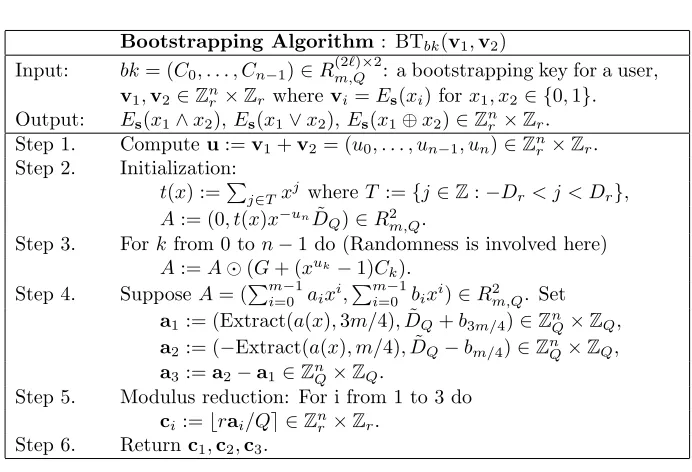
Our bootstrapping algorithm is described in Figure 1. In Step 4 of the algorithm, we need to extract some coefficients. Leta(x) =a0+a1x+· · ·+am−1xm−1∈Rm. We define
Bootstrapping Algorithm: BTbk(v1,v2)
Input: bk= (C0, . . . , Cn−1)∈R (2`)×2
m,Q : a bootstrapping key for a user, v1,v2∈Znr×Zr wherevi=Es(xi) forx1, x2∈ {0,1}.
Output: Es(x1∧x2),Es(x1∨x2),Es(x1⊕x2)∈Znr ×Zr.
Step 1. Computeu:=v1+v2= (u0, . . . , un−1, un)∈Znr ×Zr.
Step 2. Initialization: t(x) :=P
j∈Tx
j whereT :={j∈
Z:−Dr< j < Dr},
A:= (0, t(x)x−unD˜
Q)∈R2m,Q.
Step 3. Fork from 0 ton−1 do (Randomness is involved here) A:=A(G+ (xuk−1)C
k).
Step 4. SupposeA= (Pm−1
i=0 aixi,P m−1
i=0 bixi)∈R2m,Q. Set a1:= (Extract(a(x),3m/4),D˜Q+b3m/4)∈ZnQ×ZQ, a2:= (−Extract(a(x), m/4),D˜Q−bm/4)∈ZnQ×ZQ, a3:=a2−a1∈ZnQ×ZQ.
Step 5. Modulus reduction: For i from 1 to 3 do
ci:=brai/Qe ∈Znr ×Zr.
Step 6. Returnc1,c2,c3.
Figure 1. Homomorphic bit Operations
This is used to get the coefficients ofa(x)s(x) mod (xm+ 1). Note that, moduloxm+ 1,
a(x)s(x) =
n−1
X
k=0 m−1
X
j=0
skajxk+j
≡ m−1
X
i=0
[(s0ai+s1ai−1+· · ·+sia0)
−(si+1am−1+si+2am−2+· · ·+sn−1am−(n−1−i))]xi.
Hence, for 0≤i≤m−1, the i-th coefficient ofa(x)s(x) mod (xm+ 1) is equal to the inner
product ofswith Extract(a(x), i).
Theorem 3.3. Suppose a bootstrapping keybk has error size at mostτ1,ris divisible by 8
and
r≥16n, Q≥ n
n−316Br
2`τ 1.
Then, for any two LWE ciphers Es(xi) = vi ∈ Znr ×Zr with error size < Dr/4 where
xi ∈ {0,1} for i = 1,2, the bootstrapping algorithm in Figure 1 outputs random LWE
ciphersEs(x1∧x2),Es(x1∨x2),Es(x1⊕x2)∈Zrn×Zr, all with error size< n≤Dr/4.
Proof. Let w = un −P n−1
i=0 siui where u = (u0, . . . , un−1, un) ∈ Znr ×Zr is computed in
Step 1. Sincev1 andv2 have error size< Dr/4, the equations (11) and (12) hold. At Step
2, A = (0, t(x)x−unD˜
Q) = REs(t(x)x−un) ∈ R2m,Q, a trivial RLWE cipher for t(x)x−un
with no error. At Step 3, we apply Lemma 3.2 repeatedlyn times. After Step 3, we have A= REs(t(x)x−w) with error size at mostn(4Br`τ1) = 4Bnr`τ1.
At Step 4, lettingA= (a(x), b(x))∈Rm,Q, we have
(13) b(x)≡a(x)s(x) +t1(x) ˜DQ+v(x) mod (xm+ 1, Q),
where t1(x) =t(x)x−w and and v(x) ∈Rm with ||v(x)||∞ ≤ 4Bnr`τ1. Now consider the
coefficients atx3m/4 andxm/4. Let
We have
b3m/4 ≡ hs,u1i+c1D˜Q+v3m/4 (mod Q),
bm/4 ≡ hs,u2i+c2D˜Q+vm/4 (mod Q),
wherec1 andc2 are the coefficients oft(x)x−w atx3m/4 andxm/4, respectively, and|vi| ≤
4Bnr`τ1 fori∈ {3m/4, m/4}. By Lemma 3.1,
˜
DQ+b3m/4 ≡ hs,u1i+ (x1∧x2)·2 ˜DQ+v3m/4 (mod Q),
˜
DQ−bm/4 ≡ hs,−u2i+ (x1∨x2)·2 ˜DQ−vm/4 (modQ),
−(b3m/4+bm/4) ≡ hs,−(u1+u2)i+ (x1⊕x2)·2 ˜DQ−(v3m/4+vm/4) (mod Q),
with|v3m/4+vm/4| ≤8Bnr`τ1. Hence a1,a2,a3 ∈ZnQ×ZQ from Step 4 are LWE ciphers
forEs(x1∧x2),Es(x1∨x2),Es(x1⊕x2) with error at most 8Bnr`τ1.
Finally, at Step 5, we apply Lemma 2.3 (a) toa1,a2,a3 to get LWE ciphers inZnr×Zr
with error size< n. For example, letc1= (v, vn)∈Znr ×Zr, the lemma tells us that
vn≡ hs,vi+ (x1∧x2)·2 ˜Dr+e (modr)
for somee∈Z with|e|< nwhere ˜Dr=r/8, hence 2 ˜Dr=r/4 =Dr.
4. Fully homomorphic encryption scheme
4.1. Key generations. We shall assume thatn≥64 is a power of 2, r is divisible by 8, m=r/2,B = 35r2n, and
(14) r≥16n, q≥nr, 1220r4n2≤Q <1225r4n2=B2.
LetRn=Z[x]/(xn+ 1), Rm=Z[x]/(xm+ 1), and
Rn,r =Z[x]/(xn+ 1, r), Rn,q =Z[x]/(xn+ 1, q), Rm,Q=Z[x]/(xm+ 1, Q),
Dr=br/4c, Dq=bq/4c, D˜Q =bQ/8c, G=
1 0
B 0
0 1
0 B
.
Each user generates a secret key, a public key and a bootstrapping key as described below.
Secret key. Pick s = (s0, s1, . . . , sn−1) ∈ {0,1}n uniform randomly, and let s(x) =
Pn−1
i=0 sixi, representing the n-bit secret key of a user. Public key. A corresponding public key inR2
n,q is generated aspk= (k0(x), k1(x)) where
k0(x)∈Rn,q is chosen uniform randomly and
(15) k1(x) :=k0(x)s(x) +e(x) mod (xn+ 1, q)
withe(x)∈Rn being chosen bounded uniform randomly so that
||e(x)||∞< Dq/(41n),
that is, each coefficient of e(x) is chosen uniform randomly and independently between
−Dq/(41n) andDq/(41n).
Bootstrapping key. A corresponding bootstrapping key bk = (C0, C1, . . . , Cn−1) is
gen-erated as follows. For each 0≤i≤n−1 do the following:
• pickaji(x)∈Rm,Quniform randomly and independently, for 1≤j≤4, • pickeji(x)∈Rmbounded uniform randomly and independently with
||eji(x)||∞≤n, 1≤j≤4,
• Set
Ci:=
a1i(x) b1i(x)
a2i(x) b2i(x)
a3i(x) b3i(x)
a4i(x) b4i(x)
+siGmodQ.
Note that the error in eachCi is at mostn. Let’s check the condition in Theorem 3.3 where
τ1=n,`= 2, andB= 35r2n:
n n−316Br
2`τ 1=
n n−332Br
2n= n
n−31120r
4n2<1220r4n2,
whenevern≥34. Hence, by the choice ofQin (14), we have n
n−316Br
2`τ
1< Q < B2= 1225r4n2.
This means that the bootstrapping algorithm in Figure 1 will work when r and Qsatisfy (14).
Pseudo-random number generatorP. We also need a pseudo-random number generator in order to reduce ciphertext size under encryption with private keys. SupposePis a function that can expand anyn-bit sequenceu∈ {0,1}n(deterministically) into a sequence of 0’s and
1’s of length ndlog2(r)e, denoted by P(u). The sequence P(u) can be uniquely converted into a polynomial in Rn,r, denoted by P(u, x). For example, one can use SHAKE-128
[94], or the lightweight generator [7]. However, the function P needs not to have a strong cryptographic property, but only needs to be statistically uniform, that is, whenu∈ {0,1}n
is uniform random,P(u, x) should be nearly uniform random in Rn,r. The security of our
encryption scheme depends on the RLWE problem in Rn,r and that P(u, x) being nearly
uniform random inRn,r.
4.2. Encryption schemes. Regev [97, 98] introduced an encryption scheme that is se-mantically secure due to his theorem on the hardness of the LWE problem. In order to improve the efficiency of Regev’s scheme, Lyubashevsky, Peikert and Regev [87] introduced an encryption scheme based on the RLWE problem, which they prove is hard assuming the ideal lattice problem in cyclotomic rings is hard. We present two encryption schemes based on the RLWE problem: one using private keys and other using public keys. Our schemes are modified from the scheme in [87], however, we add a step for rounding and modulus reduction. We note that the technique of modulus reduction has been used in [23, 25, 27] (as mentioned earlier), and Brakerski [21] suggested in a comment on using rounding to re-duce ciphertext size. We shall combine all these techniques in our schemes, and by carefully choosing error distributions, we significantly reduce the cipher expansion to 6 for encryption with private keys as in Lemma 4.1 and to 10 + log2(n) for encryption with public keys as in Lemma 4.2.
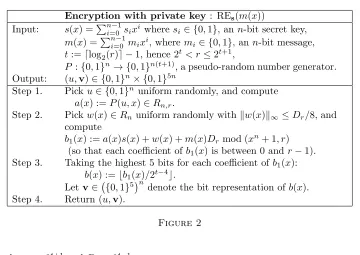
4.2.1. Encryption with private keys. The scheme is presented in Figure 2.
Lemma 4.1. Let r= 2t+1 and(a(x), b(x))∈R2n,r be as computed in Figure 2. Then there
existsw3(x)∈Rn with||w3(x)||∞< Dr/4 so that
2t−4b(x)−s(x)a(x)≡w3(x) +m(x)Drmod (xn+ 1, r).
In particular, whenr= 16n,(u,v)returned in Step 4 has6nbits and represents an RLWE cipher REs(m(x))with error size< n.
Proof. By Step 3, since the coefficients ofb1(x) are between 0 andr−1, we have
b1(x) = 2t−4b(x) +b0(x)
for someb0(x)∈Rn with||b0(x)||∞<2t−4. By Step 2, we have
Encryption with private key : REs(m(x)) Input: s(x) =Pn−1
i=0 six
i wheres
i∈ {0,1}, ann-bit secret key,
m(x) =Pn−1
i=0 mixi, wheremi∈ {0,1}, ann-bit message,
t:=dlog2(r)e −1, hence 2t< r≤2t+1,
P :{0,1}n→ {0,1}n(t+1), a pseudo-random number generator.
Output: (u,v)∈ {0,1}n× {0,1}5n
Step 1. Pick u∈ {0,1}n uniform randomly, and compute
a(x) :=P(u, x)∈Rn,r.
Step 2. Pickw(x)∈Rn uniform randomly withkw(x)k∞≤Dr/8, and
compute
b1(x) :=a(x)s(x) +w(x) +m(x)Drmod (xn+ 1, r)
(so that each coefficient ofb1(x) is between 0 andr−1).
Step 3. Taking the highest 5 bits for each coefficient ofb1(x):
b(x) :=bb1(x)/2t−4c.
Letv∈ {0,1}5n
denote the bit representation ofb(x). Step 4. Return (u,v).
Figure 2
Note thatr= 2t+1andD
r= 2t−1, so
|| −b0(x) +w(x)||∞≤ ||b0(x)||∞+||w(x)||∞<2t−4+Dr/8 = 2t−3=Dr/4.
Therefore, the lemma holds withw3(x) =w(x)−b0(x).
Remarks for the case when r is not a power of 2. One can modify Step 3 of Figure 2 as
b(x) :=bb1(x)/2t−5c,
that is, taking the highest 6 bits for each coefficient ofb1(x). Then the statement in Lemma
4.1 becomes
2t−5b(x)−s(x)a(x)≡w3(x) +m(x)Drmod (xn+ 1, r),
for somew3(x)∈Rnwith||w3(x)||∞< Dr/4, and each ciphertext (a(x), b(x)) = REs(m(x)) hasn(10+dlog2(n)e) bits. For the proof, one can similar show that||w3(x)||∞<2t−5+Dr/8.
Supposer= 2t+ 4r
1+r0>2twherer1≥0 and 0≤r0<4. Then
2t−5+Dr 8 = 2
t−5
+ 2t−5+r1 8 ≤
Dr
4 = 2
t−4
+r1 4,
hence||w3(x)||∞< Dr/4.
4.2.2. Encryption with public keys. The scheme is presented in Figure 3.
Lemma 4.2. Suppose r = 2t+1, r ≥ 16n, q ≥ 4r and n > 164. Let (a(x), b(x)) =
REpk(m(x))∈R2n,r be any ciphertext output by Step 4 of Figure 3. Then
2t−5b(x)−s(x)a(x)≡w3(x) +m(x)Drmod (xn+ 1, r)
for some w3(x)∈Rn with||w3(x)||∞< Dr/4. In particular, whenr= 16n, each ciphertext
REpk(m(x))has n(10 + log2(n))bits and the error, i.e. each coefficient ofw3(x), is random
in(−n, n).
Proof. By Step 3, we have
Encryption with public key: REpk(m(x))
Input: pk= (k0(x), k1(x))∈R2n,q,
m(x) =Pn−1
i=0 mixi: ann-bit message where eachmi∈ {0,1},
t:=dlog2(r)e −1, hence 2t< r≤2t+1.
Output: (a(x), b(x))∈R2 n,r
Step 1. Picku(x)∈Rn with each coefficient random in{−1,0,1},
Pickw1(x)∈Rn randomly with||w1(x)||∞≤Dq/(41n),
Pickw2(x)∈Rn randomly with||w2(x)||∞≤Dq/82.
Step 2. Compute:
a1(x) :=k0(x)u(x) +w1(x) mod(xn+ 1, q),
b1(x) :=k1(x)u(x) +w2(x) +m(x)Dq mod(xn+ 1, q).
(Botha1(x) andb1(x) have coefficients in [0, q−1].)
Step 3. Modulus reduction and rounding:
a(x) :=jrqa1(x)
m
, b(x) :=j2t−5r qb1(x)
k .
(Each coefficient ofb(x) is in [0,26−1], hence has 6 bits.)
Step 4. Return (a(x), b(x)).
Figure 3
where vi(x) ∈ R[x] with degree < n for i = 0 and 1, ||v1(x)||∞ ≤ 1/2 and |v0(x)|∞ < 2t−5. By (15) and Step 2, both computed modulo (xn + 1, q), there exist polynomials
h1(x), h2(x)∈Z[x] so that
b1(x)−s(x)a1(x) =u(x)e(x) +w2(x)−s(x)w1(x) +m(x)Dq+h1(x)(xn+ 1) +qh2(x).
Letw(x) =u(x)e(x) +w2(x)−s(x)w1(x). Then
2t−5b(x)−s(x)a(x) = r
q(b1(x)−s(x)a1(x)) +v0(x)−s(x)v1(x)
= r
q(w(x) +m(x)Dq) +v0(x)−s(x)v1(x)
+r
qh1(x)(x
n+ 1) +rh 2(x)
≡ w3(x) +m(x)Drmod (xn+ 1, r)
where w3(x) = rqw(x) +v0(x)−s(x)v1(x) +m(x)
r
qDq−Dr
. Since q ≥ 4r, we have
|r
qDq −Dr| < 1. We need to estimate the coefficient size of other terms in w3(x) (when
reduced moduloxn+ 1). Note that, fore(x) =Pn−1
j=0 ejxj ∈Rn and any 0≤i≤n−1, we
have
xie(x)≡ −(en−ix0+· · ·+en−1xi−1) +τ xi+· · ·+en−i−1xn−1 (modxn+ 1).
Hence||xie(x)||
∞=||e(x)||∞. By choice,u(x) =Pni=0−1uixi whereui∈ {−1,0,1}. Then
||u(x)e(x)||∞≤
n−1
X
i=0
||uixie(x)||∞=
n−1
X
i=0
||e(x)||∞=n||e(x)||∞≤n Dq
41n = Dq
41.
Similarly, sincesi∈ {0,1}, we have
||s(x)w1(x)||∞≤n||w1(x)||∞≤n Dq
41n = Dq
Therefore,
||w(x)||∞≤ ||u(x)e(x)||∞+||w2(x)||∞+||s(x)w1(x)||∞≤2 Dq
41 + Dq
82 = 5 82Dq. Also,
||v0(x)−s(x)v1(x)||∞≤ ||v0(x)||∞+||s(x)v1(x)||∞≤2t−5+n/2.
It follows that
||w3(x)||∞ ≤ r
q||w(x)||∞+||v0(x)−s(x)v1(x)||∞+||m(x)||∞
≤ 5r
82qDq+ 2
t−5
+n 2 + 1
≤ 5
82Dr+ r 26+
n 2 + 1<
Dr
4 ,
where the last inequality holds providedr≥16nandn >164.
Decryption. Suppose a user has the private keys(x). To decrypt a ciphertext (a(x), b(x)) from REs(m(x)) or REpk(m(x)), the user computes
b1(x) := 2t−4b(x)−s(x)a(x) mod (xn+ 1, r), orb1(x) := 2t−5b(x)−s(x)a(x) mod (xn+ 1, r),
and m1(x) = bb1(x)/Dre. Then m1(x) = m(x), the reason is that b1(x) ≡ w(x) +
m(x)Drmod (xn+ 1, r) for somew(x)∈Rn with||w(x)||∞< Dr/4.
4.3. Suggested parameters. In Figures 4, we list some parameters that satisfy the con-ditions in Theorem 3.3, Lemma 4.1 and Lemma 4.2. We choose primesqandQso that
r|(q−1), r|(Q−1),
hence FFT can be used in computing products of polynomials inRn,q andRm,Q. The row
for cs gives the ciphertext expansion ratio under private-key encryption, that is, the bit
size of a ciphertext of ann-bit message divided by n; the row forcpk gives the ciphertext
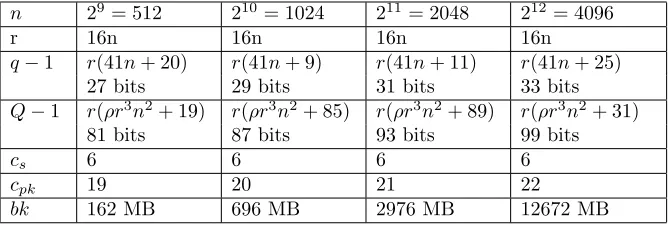
expansion ratio under public-key encryption. The second row underqand Qindicates the bit size ofqandQ, respectively. The row forbkindicates the bit size of bootstrapping keys. It is also possible to pickQas a product of two primes so that FFT can be used, but the details are omitted here.
n 29= 512 210= 1024 211= 2048 212= 4096
r 16n 16n 16n 16n
q−1 r(41n+ 20) r(41n+ 9) r(41n+ 11) r(41n+ 25)
27 bits 29 bits 31 bits 33 bits
Q−1 r(ρr3n2+ 19) r(ρr3n2+ 85) r(ρr3n2+ 89) r(ρr3n2+ 31)
81 bits 87 bits 93 bits 99 bits
cs 6 6 6 6
cpk 19 20 21 22
bk 162 MB 696 MB 2976 MB 12672 MB
Figure 4. Suggested Parameters for private-key and public-key encryp-tions and for bootstrapping, where ρ = 1220. The row of cs gives the
ciphertext expansion under private-key encryption, the row of cpk is for
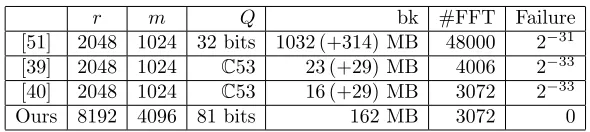
4.4. Efficiency of bootstrapping. Figure 5 below lists the parameters used by the current paper and by Ducas and Micciancio [51] and Chillotti et al. [39, 40] when n = 512. In [39, 40, 51], they usen= 500, however, their bootstrapping algorithms work well forn= 512 (with other parameters the same). The input LWE ciphers are assumed to be inZn
r ×Zr
where r is listed in the table (after rescaling in [39, 40, 51]. For a bootstrapping key bk= (C0, C1, . . . , Cn−1), in [51, 39] eachCiis a 6×2 matrix overRm,QandRm(respectively),
in [40] eachCiis a 4×2 matrix overRmwith real numbers of 32 bits as coefficients, and in the
current paper eachCiis a 4×2 matrix overRm,Q. The column under FFT lists the number
of FFTs of lengthm that need to be computed in the whole bootstrapping algorithm, and the column under Failure is for the failure probability, that is, the probability that the computed new ciphertext is not a valid LWE cipher (to participate in further homomorphic computing. For our bootstrapping algorithm, it always outputs new LWE ciphers with error at most Dr/4, hence there is no failure at all, however, in [51], it has a probability of at
most 2−31 that the new LWE cipher has error bigger than Dr/4, similarly in [39, 40], the
failure probability is at most 2−33 (more precisely 2−33.56). The probability 2−33 is very small, hence useful for computing many functions that need fewer than 226= 67,108,864 bit operations (with failure probability at most 1/128<0.008). However, their bootstrapping algorithm (forn= 512) can not be used to compute functions that need more than 233 bit operations.
As pointed out in [39], 90% of the time of the bootstrapping algorithm is on computing FFTs. Our FFT has length 4 times that of [51, 39, 40], and we use the same number of FFTs as in [40]. Note that, in [40], FFT is computed over complex numbers which have about 53 bits in binary floating points, while our FFT is computed modulo Q which has 81 bits (for n = 512), we use the rough estimate that each operation modulo Q is 2.5 times as expensive as the corresponding complex number operation with 53 bits.1 This means that our bootstrapping algorithm can be implemented with running time about 10 times of [40]. By [40], each homomorphic bit operation can be computed in 13ms. We estimate that our bootstrapping algorithm can compute three LWE ciphers Es(x1∧x2),
Es(x1∨x2) andEs(x1⊕x2) in about 130ms. Of course, this needs to be verified by careful
implementation, and further optimization should be investigated. We hope to do a careful hardware implementation in ASIC (application-specific integrated circuit) in the near future.
4.5. Homomorphic computing of arbitrary functions. Let f : {0,1}N → {0,1}M
be an arbitrary function with input length N and output length M. We suppose that f is given as a Boolean circuit, or a pseudocode (with restricted for-loops and while-loops, see below). In practice, f can be any search function on a large data basex ∈ {0,1}N,
hence N is usually large (say N = 8·240 = 8,796,093,022,208 if the data base has size
1TB). Without loss of generality, we assume thatN =ndwhere n= 512 (or any of 1024 and 2048). The data x is divided into d blocks of length n, that is, x = (x1, . . . ,xd) wherexk = (xk,0, xk,1, . . . , xk,n−1)∈ {0,1}n, and each block is converted into a polynomial
Pn−1
i=0 xk,ixi∈Rn, then encrypted using the private-key encryption scheme or the public-key
encryption scheme described in the previous section:
ck= REs(xk), or REpk(xk), 1≤k≤d. 1The estimation is based on the following argument. We can pickQ=Q
1Q2 whereQ1 andQ2are two
distinct primes with about 41 to 50 bits fornbetween 512 and 4096. By the Chinese remainder theorem, each operation moduloQis equivalent to the corresponding operation moduloQ1 andQ2, separately. So
each multiplication moduloQis equivalent to two multiplications modulo a prime number with at most 50 bits. On the other hand, for complex numbers of the forma+jbwherej=√−1 andaandbare real numbers with 53 bits, one multiplication needs four multiplications and two additions (or three multiplications and 7 additions) of real numbers with 53 bits. Hence it is an overestimate that each operation moduloQ, where
r m Q bk #FFT Failure [51] 2048 1024 32 bits 1032 (+314) MB 48000 2−31
[39] 2048 1024 C53 23 (+29) MB 4006 2−33
[40] 2048 1024 C53 16 (+29) MB 3072 2−33
Ours 8192 4096 81 bits 162 MB 3072 0
Figure 5. Parameter comparison for Bootstrapping with n= 512 where
C53 means operations on complex numbersa+bj wherej = √
−1 anda and b are real numbers with 53 bits in binary floating points. In all four cases, FFTs used in computing the external product have length m, and the number of FFTs used is indicated in the column under #FFT. The column under bk lists the size of bootstrapping keys where the numbers in the parenthesis denote the size of key-switch keys used in their papers. The last column is for the failure probability.
Note that the total bit size of all ck’s is about 6N bits with private-key encryption (and using a pseudo random number generator), or 20N bits with public-key encryption. The ciphertextsck, 1 ≤k≤d, are computed once and stored on a cloud server (or any where in the world) that is reliable (that is, the encrypted data is available and is error free any time), but not necessarily trustful.
Suppose the bootstrapping keybk = (C0, C1, . . . , Cn−1) is public. The cloud server (in
fact anyone, including hackers) can perform homomorphic computing in three steps: (a) unpacking the ciphertextsc1,· · · ,cd to get LWE ciphers inZnr×Zr for the bits of
x,
(b) homomorphic computing of f on the LWE ciphers, using the bootstrapping algo-rithm,
(c) packing the resulted LWE ciphers into RLWE ciphers inR2 n,r.
We describe these steps in details below.
4.5.1. Unpacking. First extract LWE ciphers for the bits of xk from ck for 1 ≤ k ≤ d.
Suppose ck is from private-key encryption. Then ck is of the form ck = (uk, vk) where
ui ∈ {0,1}n and vi ∈ {0,1}5 n
. Apply the pseudo random number generatorP to uk to
get a polynomial ai(x) =P(uk, x) ∈Rn,r, and convertvi into a polynomial bi(x)∈Rn,r.
By Lemma 4.1, we have
2t−4bk(x)≡ak(x)s(x) + n−1
X
i=0
xk,ixi
!
Dr+wk(x) mod (xn+ 1, r),
wherekwk(x)k∞< Dr/4. For 0≤i≤n−1, an LWE cipher for xk,i is
Es(xk,i) = (Extract(ak(x), i),2t−4bk,i)∈Znr×Zr
with error size< Dr/4, wherebk,i is the coefficient ofxi inbk(x).
Next suppose ck is from public-key encryption. By Lemma 4.2, ck is of the form
(ak(x), bk(x))∈R2n,r so that
2t−5bk(x)≡ak(x)s(x) + n−1
X
i=0
xk,ixi
!
Dr+wk(x) mod (xn+ 1, r),
wherekwk(x)k∞< Dr/4. Hence, for 0≤i≤n−1, an LWE cipher forxk,i is
Es(xk,i) = (Extract(ak(x), i),2t−5bk,i)∈Znr×Zr
4.5.2. Homomorphic computing. Letf(x) =y= (y1, . . . , yM)∈ {0,1}M an arbitrary
func-tion. It is desired to compute a valid ciphertext fory from the ciphertextsck, 1≤k ≤d, using the bootstrapping algorithm from the previous section. Supposefis given as a Boolean circuit withN input bits and M output bits. The cloud server can use our bootstrapping algorithm to compute an LWE cipher for each gate of the circuit starting from the input to output, obtainingM LWE ciphers fory1, . . . , yM, one for each. These LWE ciphers will
be the ciphertext for f(x). Since our bootstrapping algorithm does not produce invalid LWE ciphers at all, one can always get the correct answer y = f(x) by decoding the M LWE ciphers. Note that the computed ciphertext forf(x) has a larger ciphertext expansion factor. This should not be a problem in practice since an answer is usually small (say from a few bits to a few thousand bits). However, whenM is large, we need to pack these LWE ciphers into RLWE ciphers; see next subsection for more details.
Now supposef is given as a pseudocode which may contain if-statements, for-loops and while-loops, among other statements. We show below how to homomorphically computef, demonstrated by a few examples.
Homomorphic if-statements. We show how to homomorphically compute if-statements. We demonstrate by a simple case:
“ifa6=bthenuelsev”
where a = (a1, . . . , am) ∈ {0,1}m, b = (b1, . . . , bm) ∈ {0,1}m and u = (u1, . . . , uk) ∈ {0,1}k,v= (v
1, . . . , v`)∈ {0,1}`. Suppose we have computed an LWE cipher for each bit
ofaandb. How do we compute the output of this if-statement? Let z=
m
_
i=1
(ai⊕bi).
Thenz= 1 iffa6=b. We can compute an LWE cipher Es(z)∈Znr ×Zrusing 2m−1 BT
operations, that is, calling the bootstrapping algorithm 2m−1 times. Ifk6=`, we need to paduorvby 0’s so that they have the same length, hence we may assume that`=k. Let
w=zu⊕(1−z)v= (z∧u1⊕(1−z)∧v1, . . . , z∧uk⊕(1−z)∧vk).
Thenw=uifz= 1 andw=vifz= 0, as required by the if-statement. Ifuandvare in plaintext, an LWE cipher for each bitz∧ui⊕(1−z)∧vi is simplyuiEs(z) +vi(1−Es(z)), which still has error size< Dr/4. If the bits ofuandvare given as LWE ciphers with error
size < Dr/4, then an LWE cipher for each bitz∧ui⊕(1−z)∧vi can be computed with
three BTs. Hence this if-statement can be computed using (2m−1) + 3 min{`, k} BTs.
Homomorphic for-loop: Integer addition. Leta= (a0, . . . , am−1) andb= (b0, . . . , bm−1)
be two integers in binary representation wherea0 andb0 are the least significant bits.
Sup-pose we are given LWE ciphers for all the bits ofa and b. We want to compute an LWE cipher for each bit of their sum. Let c = (c0, . . . , cm) represent their sum. We have the
following pseudocode for computing the bits ofc:
Integer addition:
c0:=a0⊕b0; z:=a0∧b0;
forifrom 1 tom−1 do
t1:=ai⊕bi; t2:=ai∧bi;
ci:=t1⊕z; t3:=t1∧z;
z:=t2⊕t3;
end for cm:=z;
In the first line,z represents the carry of a0+b0. The three lines in the for-loop compute
the sumai+bi+z, certainlyci= (ai⊕bi)⊕zis the least significant bit, and the carry bit
is
t2⊕t3= (ai∧bi)⊕(ai⊕bi)∧z= (ai∧bi)⊕(ai∧z)⊕(bi∧z),
which is 1 if and only if two or three of ai, bi, zare equal to 1. Note that each line of the
pseudocode can be computed by one BT, namely, using our bootstrapping algorithm once. Hencea+bcan be computed by 3m−2 BTs.
Homomorphic while-loop: Integer comparison. Let a = (a0, . . . , am−1) and b =
(b0, . . . , bm−1) be two integers as above. We show how to homomorphically test ifa≥b(as
integers), that is, computez∈ {0,1} so thatz= 1 iffa≥b. A pseudocode could be
Integer comparison: z:= (a≥b) z:= 1; i:=m−1;
whilei≥1 andai =bi doi:=i−1 end while
ifai < bi thenz:= 0 end if
Returnz.
The while-loop is hard to implement homomorphically, since there is no priori bound on the largestiwithai6=bi. We introduce a trick to convert the while-loop into a for-loop as
indicated in the following pseudocode:
Homomorphic comparison: z:= (a≥b)
z:= 1; v:= 1; (v= 0 indicates when the above while-loop finishes) forifromm−1 down to 0 do
t:=v∧(ai⊕bi);
v:= (1−t)∧v;
z:= [t∧(ai∨(1−bi))]⊕[(1−t)∧z];
end for Returnz.
Note thatai⊕bi = 1 iffai6=bi, andai∨(1−bi) = 1 iffai≥bi. Hencevchanges from 1 to
0 at the largesti withai6=bi, and it never change back to 1 after that; also, when v= 0,
all the futuretwill always be 0, hencezwill always stay the same. This pseudocode can be directly implemented homomorphically. (Note that LWE ciphers forai⊕bi andai∨(1−bi)
can be computed by one BT, since 1−(ai⊕bi) =ai⊕(1−bi), and one BT can compute
bothai⊕(1−bi) andai∨(1−bi).)
In summary, we see from these examples that one can homomorphically compute any pseudocode that contains if-statements, for-loops and while-loops, the only restriction is that the number of iterations executed in the for-loops and while-loops must be upper bounded by numbers that do not depend on encrypted data. The example for integer comparison shows a trick on how to convert a while-loop for which the number of executed times depends on encrypted data into a for-loop for which the number of executed times is independent of encrypted data. Under these restrictions on the for-loops and while-loops, any pseudo code can be computed homomorphically. Certainly, more careful study is needed on how to convert an arbitrary algorithm into restricted pseudocode and on how to compute them more efficiently.
4.5.3. Packing of LWE ciphers. Suppose the output y of a function y =f(x) has M bits. Then the ciphertext computed forywill be a sequence of M LWE ciphers. We show below how we can pack any n LWE ciphers in Zn
r ×Zr into one RLWE cipher in Rm,r2 where
Lemma 4.3. Supposey0, . . . , yn−1∈ {0,1} and we have nLWE ciphers Es(yi)∈Znr×Zr
with error size < Dr/4for 0≤i≤n−1. With the bootstrapping key bk, one can compute
an RLWE cipher (w(x), v(x))∈R2
m,r form(x) =
Pn−1
i=0 yix
i with error< D
r/4, that is,
v(x)≡w(x)s(x) +z(x) +m(x)Dr (modxm+ 1, r),
wherez(x)∈Rm withkz(x)k∞< n≤Dr/4.
Proof. Set Es(1) = (0, Dr)∈Znr×Zr, the trivial LWE cipher with no error. For each
0 ≤ i ≤ n−1, we compute 1·yi homomorphically using the bootstrapping algorithm in
Section 3, where the Step 5 will be skipped (and ignorea2 and a3 there), giving us LWE
ciphers (ai, bi)∈ZnQ×ZQ so that
bi≡ hai, si+yiDQ+i (mod Q)
wherei∈Zand|i|<4Bnr`τ1= 8Bn2r(since`= 2 andτ1=nin the the bootstrapping
keyCi) for 0≤i≤n−1. Now form
a(x) =
n−1
X
i=0
aixi−1= (a0(x), . . . , an−1(x))∈Rnm,Q, and b(x) = n−1
X
i=0
bixi.
Then
(16) b(x)≡
n−1
X
i=0
ai(x)si+m(x)DQ+(x) (modQ),
where(x) =Pn−1
i=0 ix
i andk(x)k
∞≤8Bn2r. Next, we need to compute the sumPn−1
i=0 ai(x)si homomorphically. For eachsi, we take
the last two rows of the bootstrapping keyCi = GSW(si) (as in Section 4.1), which gives
usaji(x) andbji(x)∈Rm,Qso that
(17)
b3i(x)
b4i(x)
≡
a3i(x)
a4i(x)
s(x) +si
1 B + e3i(x)
e4i(x)
(modxm+ 1, Q),
where keji(x)k∞ < n. We define a shortened external product: for any a(x), b1(x) and
b2(x) from Rm,Q, define
a(x)
b1(x)
b2(x)
= (u1(x), u2(x))
b1(x)
b2(x)
=u1(x)b1(x) +u2(x)b2(x)∈Rm,Q,
where u1(x) and u2(x) are random so that a(x) =u1(x) +u2(x)B with kui(x)k∞ ≤2B. Let’s apply to the bootstrapping key in (17):
vi(x) :=a(x)
b3i(x)
b4i(x)
= (u1(x), u2(x))
b3i(x)
b4i(x)
≡ (u1(x), u2(x))
a3i(x)
a4i(x)
s(x) +si
1 B + e3i(x)
e4i(x)
,
≡ wi(x)s(x) +a(x)si+zi(x),
where
wi(x) =u1(x)a3i(x) +u2(x)a4i(x) =a(x)
a3i(x)
a4i(x)
∈Rm,Q
andzi(x) =u1(x)e3i(x) +u2(x)e4i(x) withkzi(x)k∞≤2·2Bnm= 2Bnr. Now back to (16). We compute
( ˜w(x),v(x)) :=˜
n−1
X
i=0
ai(x)
a3i(x) b3i(x)
a4i(x) b4i(x)
=
n−1
X
i=0
Then
(18) ˜v(x)≡w(x)s(x) +˜
n−1
X
i=0
ai(x)si+ ˜z(x),
where ˜z(x) =Pn−1
i=0 zi(x) withkz(x)˜ k ≤2Bn
2r. By (16) and (18), we have
(19) b(x)−v(x)˜ ≡ −w(x)s(x) +˜ m(x)DQ+ ((x)−z(x))˜ (mod xm+ 1, Q).
Let
˜
w1(x) =−w(x), ˜v1(x) =b(x)−˜v(x), z˜1(x) =(x)−z(x).˜
Thenk˜z1(x)k∞≤8Bn2r+ 2Bn2r≤10Bn2rand (19) becomes
(20) v˜1(x)≡w˜1(x)s(x) +m(x)DQ+ ˜z1(x) (mod xm+ 1, Q),
wherekz˜1(x)k∞≤10Bn2r. Finally, do modulus reduction:
w(x) = r
Qw˜1(x)
, v(x) = r
Qv˜1(x)
,
both are inRm,r. Then (20) becomes
(21) v(x)≡w(x)s(x) +m(x)Dr+z(x) (modxm+ 1, r),
for somez(x)∈Rm.
We need to estimate the coefficient size ofz(x). By our choice,
w(x) = r
Qw˜1(x) +h1(x), v(x) = r
Qv˜1(x) +h2(x),
wherehi(x)∈Rm[x] andkhi(x)k∞≤1/2 for i= 1,2. Then (20) becomes
v(x)≡w(x)s(x)−h1(x)s(x) +h2(x) +m(x)
r QDQ+
r Qz˜1(x),
Hence, in (21), we must have
z(x) =h2(x)−h1(x)s(x) +m(x)
r
QDQ−Dr
+ r Q˜z1(x).
Thus
kz(x)k∞ ≤ 1 2n+
1 2 + 1 +
r Q10Bn
2r
≤ 1
2(n+ 3) + 10r 1220r4n2(35r
2n)n2r
≤ 1
2(n+ 3) + 35 122n < n. This completes the proof.
5. Security analysis
![whereFigure 3 vi(x) ∈ R[x] with degree < n for i = 0 and 1, ||v1(x)||∞ ≤ 1/2 and |v0(x)|∞ <2t−5.By (15) and Step 2, both computed modulo (xn + 1, q), there exist polynomials](https://thumb-us.123doks.com/thumbv2/123dok_us/7978831.1323226/18.612.150.499.111.327/wherefigure-degree-step-computed-modulo-xn-exist-polynomials.webp)