Vol:1, No:4, 2016 Web: http://www.turjoem.com ISSN : 2149-4711
TURJOEM , 2016 , 4 , 16 / 11
ASSESMENT OF THE RELATION BETWEEN DIARRHEA CASES AND WATER INTENDED FOR DRINKING AND CONSUMPTION
Tufan Nayir1, Ersin Nazlıcan2, Muhsin Akbaba2, Serdar Deniz3, Hüseyin İlter4, Kemal Şener3,
1
Directorate of Public Health, Mersin/ Turkey
2 Çukurova University, Department of Public Health, Adana/Turkey 3
Directorate of Public Health, Malatya/Turkey
4
Public Health Agency of Turkey, Ankara/Turkey
Introduction:
Environment, as a system of survival, includes the habitat and conditions where an organism can exist. Water, food and shelter are the most important components of this system. Considering the human’s continuous interaction with his/her environment, it is a fact that problems occurring in these components of environment will have a direct impact on human being. Therefore, water contamination has historically become one of the critical matters that have a direct influence on human health.
Less than 3% of the total water on Earth is freshwater, and 2% of this is found in Antarctic, North Pole and glaciers; unreachable for human. Researches show that 70% of fresh water consumption in the world belong to agriculture, 22% to industry and 8% to household. It is obvious that in the developed countries industry rate increases while in the developing countries, agriculture’s rate is on the rise.(1,2)
As seen in our country where rainfall is limited, 80-85% of fresh water in Mediterranean countries such as Portugal, Spain, Italy and Greece is consumed by agricultural activities. And unfortunately due to the inefficient irrigation systems, %60 of this water intended for irrigation is lost due to vaporization and leakage before reaching the fields. (2,3)
Substantial health problems in communities are defined as “the most common, the deadliest and the most debilitating diseases”. Many diseases caused by water contamination answer to this description. While the populations are increasing at a fast pace, it is more and more important with each passing day to provide healthy water for drinking and consumption with a clean municipal water system and to protect water resources in the best and economical way without causing risks. The most common reason of the infection related diarrhea is called as Rotavirus, which is usually seen in the months of April and November. Rotavirus is kept responsible for 125 million diarrhea virus seen on the children under 5 years of age. Furthermore, it is considered to cause death of around 600.000 children under 2 years of age
Vol:1, No:4, 2016 Web: http://www.turjoem.com ISSN : 2149-4711
TURJOEM , 2016 , 4 , 16 / 12 every year. In the United States, Rotavirus is responsible for the 10-12% of the hospitalization of children under 5 years of age. (4,5,6,7,8)
In Turkey, 12 million cases of acute gastroenteritis are reported each year. Throughout the world, 88% of diarrheal diseases result from contaminated water. 3.1% (1.7 million people) of annual mortality and 3.7% (54.2 million people) of annual disease burden (DALY) stem from diarrheal diseases caused by water pollution. (4,5,6)
Consequently, in order to point out waterborne diarrheal diseases and to provide a source for the control and monitoring studies that will be planned, this study analyses the compliance of portable water with national and international standards in terms of microbiological and physicochemical parameters and the relevance of these results with monthly diarrhea cases.
Material and Method:
This study is a descriptive type of study where the water samples have been taken from residential areas by Provincial Directorates of Public Health during the dates of January 1st and December 31st, 2014 to evaluate the water with bacteriological, chemical and chlorine measurements. In one year, samples were collected from 714 districts in total. For, 2763 samples were used for bacteriological water analysis, 2347 samples were for chemical analysis and 18218 samples for residual chlorine measurement. And the number of diarrhea cases has been derived monthly from each health units according to the result of related ICD-10 code.
The samples are stored in sun proof sterilized glass bottles with sodium thiosulphate. The equipments, if exists, are taken out from the tap and the surrounding of the tap is singed.
For chlorine measurement, values above 0,05mg/L are found acceptable while below that level is considered as inacceptable.
The data analysis has been accomplished by using the program of SPSS 19.0. The level of P < 0,05 is considered meaningful in the analysis results.
Findings
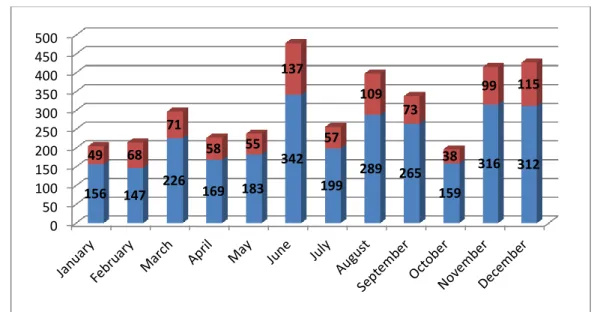
929 out of 2763 samples taken for bacteriological analysis in one year were found to be inconvenient. For the chemical analysis, 26 out of 2347 samples were considered as inappropriate. When we evaluate the status of nonconformity on a monthly basis, the highest nonconformity cases for bacteriological analysis (342) and chemical analysis (6) was in June.
Vol:1, No:4, 2016 Web: http://www.turjoem.com ISSN : 2149-4711
TURJOEM , 2016 , 4 , 16 / 13 Figure 1: Number of nonconformity and samples taken for bacteriological analysis
8552 out of 18218 samples taken for residual chlorine measurement showed insufficient chlorine amounts. When residual chlorine measurement is tracked monthly, the highest insufficiency cases (877, % 55) are seen in the month of November.
Figure 2: Number of nonconformity and samples taken for cholorine analysis
0 50 100 150 200 250 300 350 400 450 500 156 147 226 169 183 342 199 289 265 159 316 312 49 68 71 58 55 137 57 109 73 38 99 115
Number of noncomforming samples Number of all samples taken
0 500 1000 1500 2000 2500 1245 1388 1560 1587 1527 1678 1558 1377 1600 1520 1596 1582 488 663 625 652 739 770 761 683 750 720 877 824
Vol:1, No:4, 2016 Web: http://www.turjoem.com ISSN : 2149-4711
TURJOEM , 2016 , 4 , 16 / 14 Within one year, 17047 cases of diarrhea have been detected. When diarrhea cases are evaluated monthly, it is reported that with the beginning of summer months, the cases are increasing and the highest cases with 2865 people (16.8%) are found to be in August.
The relation between number of diarrhea cases, chemical nonconformity, bacteriological nonconformity, chlorine nonconformity has been assessed with the correlation analysis. Based on this analysis, it has been found that there is no meaningful correlation between the number of diarrhea cases and nonconformity in chemical analyses and residual chlorine measurements; p>0,05. On the other hand, when the correlation between the the number of diarrhea cases on a monthly basis and the nonconformity of bacteriological samples is examined, a strong and meaningful relation is detected (rho=0.642, p=0.025).
Discussion and Suggestions
Water pollution is defined as quality changes as the result of human effects in general sense, which limit or prevent the usage and upset the ecological balances. (9)
Based on the data of Ministry of Health, 17% of city water supply taken from city centers throughout the country, 31,4% of spring waters in city centers, 36,6% of the municipal water taken from districts and 36,3% of the spring waters in districts show nonconformity to standards. (10)
In our study, provincial-wide results indicate that 46,9% are found insufficient in terms of chlorine amount. The reason why chlorine insufficiency ratio is that high might be the problems faced in the chlorination activities. Even though municipal water is chlorinated automatically and centrally in the city center, in peripheries water is still chlorinated in water tanks.
In Turkey, while chlorination is conducted by the municipalities; follow up and measurements of residual chlorine are carried out by directorates of Public Health. In many cities, the state of the tanks is controlled by Public Health Agency of Turkey and corrective actions have been taken and studies have been initiated to supply automatic chlorine devices. Nevertheless, chlorination works are sometimes precluded due to the reasons set forth by the citizens who claim smell or turbidity in the water or when this water is given to the animals, they argue that it impairs the quality of milk or cheese made of it.
A significant part of dirty water borne health problems results from bacterial water pollution both in Turkey and all over the world. 929 (33,6%) out of 2763 samples showed bacteriological nonconformity while 26 (1,1%) out of 2347 samples resulted in chemical
Vol:1, No:4, 2016 Web: http://www.turjoem.com ISSN : 2149-4711
TURJOEM , 2016 , 4 , 16 / 15 nonconformity. Indicators seen in the bacteriological analyses of water were mostly bacteria such as coliform, fecal coliform and E.Coli. (11)
Drinking water has now started to be evaluated in terms of not only microbiological quality but also of psychochemical properties around the world including our country as well.
Water intended for drinking and consumption is the same in terms of qualification. There is a general feeling in the communities that water for drinking can be different from the one for consumption. However, water used in general consumption like cleaning, dish washing, laundry should be ensured that it is clean enough to remove the danger for human health.
The fact that causal analysis has not been implemented in diarrhea cases is the constraint of our study. On the other hand, it is a compatible result with our study to see that agents such as E. Coli, which can be transmitted via dirty and chlorine free waters cause diarrhea more in summer months (12).
In addition, our study proves more diarrhea cases in August in the same way as a study made in Sivas which detected most common diarrhea cases in August and September (13)
During summer months in Turkey, diarrhea is seen more commonly and the findings of our study show parallelism with different studies on this issue.
Water sources of the regions will be monitored in terms of contamination or disinfection together with an active follow up of diarrhea cases in hospitals or etiology studies on diarrhea in the regions.
Furthermore, it is necessary for the Health Agencies and Institutes as well as local authorities to place particular importance to raising awareness of citizens on conscious water consumption because diarrhea today continues its features as to be a significant disease and at the same time clean water supply is getting more and more difficult for human being.
Key Words: Water, Analysis, Diarrhea, case Bibliography
1- Casiadi N. Istanbul Üniversitesi, Sosyal Bilimler Enstitüsü, Avrupa Birliği Anabilim Dalı, Yüksek Lisans Tezi. Avrupa birliğinin Su kaynakları ve yönetimi bütünleşik su kaynakları yönetimi, İstanbul 2010.
2- Güler Ç., Çobanoğlu Z., Su kirliliği Çevre Sağlığı Temel Kaynak Dizisi No:12, Sağlık Bakanlığı, Ankara.
Vol:1, No:4, 2016 Web: http://www.turjoem.com ISSN : 2149-4711
TURJOEM , 2016 , 4 , 16 / 16 3- Gleick H.P., Dirty Water: Estimated Deaths from Water-Related Diseases 2000-2020.
Pacific Institute Research Report, August 15, 2002.
4- Pehlivan E., Özen G., Güneş G., Karaoğlu L., Türkol E., Eğri M. Malatya İshal Salgını (2005): Retrospektif İncelemesi. İnönü Üniversitesi Tıp Fakültesi Dergisi 16 (4) 213-221, 2009.
5- Bishop RF. Natural history of human rotavirus infections.: Z.A. Kapikian, Viral infections of the gastrointestinal tract. Revisedsecond edition. Melbourne, Australia , 1994: 131-165. 6- WHO Diarrhoeal disease, water, sanitation and hygiene. Combating waterborn disease at
the household level, Geneva 2007:123.
7- Parashar UD, Holman RC, Clarke MJ, Bresee JS, Glass RI. Hospitalisations associated with rotavirus diarrhoea in the United States, 1993 through 1995: Surveillance based on the new ICD-9- CM rotavirus-specific diagnostic code. J Infect Dis 1998; 177: 13-17.
8- Öngen B. Türkiye’de İshal Etkenleri. ANKEM Dergisi, 2006;20 (Ek-2): 122-134.
9- Munsuz N., Ünver İ. Su Kalitesi. Ankara Üniversitesi, Ziraat Fakültesi, Yay. No: 1389, Ders Kitabı: 403, Ankara, 1995.
10- Araştırma, Planlama ve Koordinasyon Kurulu Başkanlığı, Sağlık İstatistikleri. Sağlık Bakanlığı, Ankara, 2004.
11- Alemdar S., Kahraman T., Ağaoğlu S., Alişarlı M. Bitlis İli İçme Sularının Bazı Mikrobiyolojik ve Fizikokimyasal Özellikleri. Ekoloji 19, 73; 29-38, 2009.
12- Gelen N. F., Atatürk Üniversitesi Sağlık Bilimleri Enstitüsü Mikrobiyoloji Anabilim Dalı. Diyareli Olgulardan Elde Edilen Dışkı Örneklerinde E. Coli O157:H7 Araştırılması., Yüksek Lisans Tezi, Erzurum, 2014.
13- T. Güneş. Cumhuriyet Üniversitesi Sağlık Bilimleri Enstitüsü, Mikrobiyoloji Anabilim Dalı, Yüksek Lisans Tezi, Yöremizde Bakteriyel Diyare Etkenleri, Sivas 1991.