To learn about the latest version of the Unicode Standard, see http://www.unicode.org/versions/latest/. Many of the designations used by manufacturers and sellers to distinguish their products are claimed as trademarks. Where those designations appear in this book, and the publisher was aware of a trade-mark claim, the designations have been printed with initial capital letters or in all capitals.
Unicode and the Unicode Logo are registered trademarks of Unicode, Inc., in the United States and other countries.
The authors and publisher have taken care in the preparation of this specification, but make no expressed or implied warranty of any kind and assume no responsibility for errors or omissions. No liability is assumed for incidental or consequential damages in connection with or arising out of the use of the information or programs contained herein.
The Unicode Character Database and other files are provided as-is by Unicode, Inc. No claims are made as to fitness for any particular purpose. No warranties of any kind are expressed or implied. The recipient agrees to determine applicability of information provided.
Copyright © 1991–2015 Unicode, Inc.
All rights reserved. This publication is protected by copyright, and permission must be obtained from the publisher prior to any prohibited reproduction. For information regarding permissions, inquire at http://www.unicode.org/reporting.html. For information about the Unicode terms of use, please see http://www.unicode.org/copyright.html.
The Unicode Standard / the Unicode Consortium ; edited by Julie D. Allen ... [et al.]. — Version 8.0 Includes bibliographical references and index.
ISBN 978-1-936213-10-8 (http://www.unicode.org/versions/Unicode8.0.0/) 1. Unicode (Computer character set) I. Allen, Julie D. II. Unicode Consortium. QA268.U545 2015
ISBN 978-1-936213-10-8 Published in Mountain View, CA August 2015
Chapter 18
East Asia
18
This chapter presents modern-day scripts used in East Asia. This includes major writing systems associated with Chinese, Japanese, and Korean. It also includes several scripts for minority languages spoken in southern China. The scripts discussed are as follows:
The characters that are now called East Asian ideographs, and known as Han ideographs in the Unicode Standard, were developed in China in the second millennium bce. The basic system of writing Chinese using ideographs has not changed since that time, although the set of ideographs used, their specific shapes, and the technologies involved have developed over the centuries. The encoding of Chinese ideographs in the Unicode Standard is described in Section 18.1, Han. For more on usage of the term ideograph, see “Logosylla-baries” in Section 6.1, Writing Systems.
As civilizations developed surrounding China, they frequently adapted China’s ideographs for writing their own languages. Japan, Korea, and Vietnam all borrowed and modified Chinese ideographs for their own languages. Chinese is an isolating language, monosyl-labic and noninflecting, and ideographic writing suits it well. As Han ideographs were adopted for unrelated languages, however, extensive modifications were required.
Chinese ideographs were originally used to write Japanese, for which they are, in fact, ill suited. As an adaptation, the Japanese developed two syllabaries, Hiragana and Katakana, whose shapes are simplified or stylized versions of certain ideographs. (See Section 18.4, Hiragana and Katakana.) Chinese ideographs are called kanji in Japanese and are still used, in combination with Hiragana and Katakana, in modern Japanese.
In Korea, Chinese ideographs were originally used to write Korean, for which they are also ill suited. The Koreans developed an alphabetic system, Hangul, discussed in Section 18.6, Hangul. The shapes of Hangul syllables or the letter-like jamos from which they are com-posed are not directly influenced by Chinese ideographs. However, the individual jamos are grouped into syllabic blocks that resemble ideographs both visually and in the relationship they have to the spoken language (one syllable per block). Chinese ideographs are called
hanja in Korean and are still used together with Hangul in South Korea for modern Korean. The Unicode Standard includes a complete set of Korean Hangul syllables as well as the individual jamos, which can also be used to write Korean. Section 3.12, Conjoining Jamo Behavior, describes how to use the conjoining jamos and how to convert between the two methods for representing Korean.
Han Katakana Lisu Bopomofo Hangul Miao Hiragana Yi
In Vietnam, a set of native ideographs was created for Vietnamese based on the same prin-ciples used to create new ideographs for Chinese. These Vietnamese ideographs were used through the beginning of the 20th century and are occasionally used in more recent signage and other limited contexts.
Yi was originally written using a set of ideographs invented in imitation of the Chinese. Modern Yi as encoded in the Unicode Standard is a syllabary derived from these ideo-graphs and is discussed in Section 18.7, Yi.
Bopomofo, discussed in Section 18.3, Bopomofo, is another recently invented syllabic system, used to represent Chinese phonetics.
In all these East Asian scripts, the characters (Chinese ideographs, Japanese kana, Korean Hangul syllables, and Yi syllables) are written within uniformly sized rectangles, usually squares. Traditionally, the basic writing direction followed the conventions of Chinese handwriting, in top-down vertical lines arranged from right to left across the page. Under the influence of Western printing technologies, a horizontal, left-to-right directionality has become common, and proportional fonts are seeing increased use, particularly in Japan. Horizontal, right-to-left text is also found on occasion, usually for shorter texts such as inscriptions or store signs. Diacritical marks are rarely used, although phonetic annota-tions are not uncommon. Older ediannota-tions of the Chinese classics sometimes use the ideo-graphic tone marks (U+302A..U+302D) to indicate unusual pronunciations of characters. Many older character sets include characters intended to simplify the implementation of East Asian scripts, such as variant punctuation forms for text written vertically, halfwidth forms (which occupy only half a rectangle), and fullwidth forms (which allow Latin letters to occupy a full rectangle). These characters are included in the Unicode Standard for com-patibility with older standards.
Appendix E, Han Unification History, describes how the diverse typographic traditions of mainland China, Taiwan, Japan, Korea, and Vietnam have been reconciled to provide a common set of ideographs in the Unicode Standard for all these languages and regions. The Lisu script was developed in the early 20th century by using a combination of Latin let-ters, rotated Latin letlet-ters, and Latin punctuation repurposed as tone letlet-ters, to create a writ-ing system for the Lisu language, spoken by large communities, mostly in Yunnan province in China. It sees considerable use in China, where it has been an official script since 1992. The Miao script was created in 1904 by adapting Latin letter variants, English shorthand characters, Miao pictographs, and Cree syllable forms. The script was originally developed to write the Northeast Yunnan Miao language of southern China. Today it is also used to write other Miao dialects and the languages of the Yi and Lisu nationalities of southern China.
18.1 Han
CJK Unified Ideographs
The Unicode Standard contains a set of unified Han ideographic characters used in the written Chinese, Japanese, and Korean languages. The term Han, derived from the Chinese Han Dynasty, refers generally to Chinese traditional culture. The Han ideographic charac-ters make up a coherent script, which was traditionally written vertically, with the vertical lines ordered from right to left. In modern usage, especially in technical works and in com-puter-rendered text, the Han script is written horizontally from left to right and is freely mixed with Latin or other scripts. When used in writing Japanese or Korean, the Han char-acters are interspersed with other scripts unique to those languages (Hiragana and Katakana for Japanese; Hangul syllables for Korean).
Although the term “CJK”—Chinese, Japanese, and Korean—is used throughout this text to describe the languages that currently use Han ideographic characters, it should be noted that earlier Vietnamese writing systems were based on Han ideographs. Consequently, the term “CJKV” would be more accurate in a historical sense. Han ideographs are still used for historical, religious, and pedagogical purposes in Vietnam. For more on usage of the term ideograph, see “Logosyllabaries” in Section 6.1, Writing Systems.
The term “Han ideographic characters” is used within the Unicode Standard as a common term traditionally used in Western texts, although “sinogram” is preferred by professional linguists. Taken literally, the word “ideograph” applies only to some of the ancient original character forms, which indeed arose as ideographic depictions. The vast majority of Han characters were developed later via composition, borrowing, and other non-ideographic principles, but the term “Han ideographs” remains in English usage as a conventional cover term for the script as a whole.
The Han ideographic characters constitute a very large set, numbering in the tens of thou-sands. They have a long history of use in East Asia. Enormous compendia of Han ideo-graphic characters exist because of a continuous, millennia-long scholarly tradition of collecting all Han character citations, including variant, mistaken, and nonce forms, into annotated character dictionaries.
The Unicode Standard draws its unified Han character repertoire from a number of differ-ent character set standards. These standards are grouped into a number of sources listed in tables in Section E.3, CJK Sources.
Because of the large size of the Han ideographic character repertoire, and because of the particular problems that the characters pose for standardizing their encoding, this charac-ter block description is more extended than that for other scripts and is divided into several subsections. The first subsection, “Blocks Containing Han Ideographs,” describes the way in which the Unicode Standard divides Han ideographs into blocks. This subsection is fol-lowed by an extended discussion of the characteristics of Han characters, with particular attention being paid to the problem of unification of encoding for characters used for dif-ferent languages. There is a formal statement of the principles behind the Unified Han
character encoding adopted in the Unicode Standard and the order of its arrangement. For a detailed account of the background and history of development of the Unified Han char-acter encoding, see Appendix E, Han Unification History.
Blocks Containing Han Ideographs
Han ideographic characters are found in seven main blocks of the Unicode Standard, as shown in Table 18-1.
Characters in the six unified ideograph blocks are defined by the IRG, based on Han unifi-cation principles explained later in this section.
The two compatibility ideographs blocks contain various duplicate or unifiable variant characters encoded for round-trip compatibility with various legacy standards. For historic reasons, the CJK Compatibility Ideographs block also contains twelve CJK unified ideo-graphs. Those twelve ideographs are clearly labeled in the code charts for that block. The initial repertoire of the CJK Unified Ideographs block included characters submitted to the IRG prior to 1992, consisting of commonly used characters. That initial repertoire, also known as the Unified Repertoire and Ordering, or URO, was derived entirely from the G, T, J, and K sources. It has subsequently been extended with small sets of unified ideographs or ideographic components needed for interoperability with various standards, or for other reasons, as shown in Table 18-2.
Table 18-1.
Blocks Containing Han Ideographs
Block Range Comment
CJK Unified Ideographs 4E00–9FFF Common
CJK Unified Ideographs Extension A 3400–4DBF Rare CJK Unified Ideographs Extension B 20000–2A6DF Rare, historic CJK Unified Ideographs Extension C 2A700–2B73F Rare, historic
CJK Unified Ideographs Extension D 2B740–2B81F Uncommon, some in current use CJK Unified Ideographs Extension E 2B820–2CEAF Rare, historic
CJK Compatibility Ideographs F900–FAFF Duplicates, unifiable variants, corpo-rate characters
CJK Compatibility Ideographs Supplement 2F800–2FA1F Unifiable variants
Table 18-2.
Small Extensions to the URO
Range Version Comment
9FA6–9FB3 4.1 Interoperability with HKSCS standard 9FB4–9FBB 4.1 Interoperability with GB 18030 standard
9FBC–9FC2 5.1 Interoperability with commercial implementations 9FC3 5.1 Correction of mistaken unification
9FC4–9FC6 5.2 Interoperability with ARIB standard 9FC7–9FCB 5.2 Interoperability with HKSCS standard
Characters in the CJK Unified Ideographs Extension A block are rare and are not unifiable with characters in the CJK Unified Ideographs block. They were submitted to the IRG dur-ing 1992–1998 and are derived entirely from the G, T, J, K, and V sources.
The CJK Unified Ideographs Extension B block contains rare and historic characters that are also not unifiable with characters in the CJK Unified Ideographs block. They were sub-mitted to the IRG during 1998–2002.
The CJK Unified Ideographs Extension C, D, and E blocks contain rare, historic, or uncom-mon characters that are not unifiable with characters in any previously encoded CJK Uni-fied Ideographs block. Some Extension D characters are in current use, particularly for Cantonese special use characters in Hong Kong. Extension C ideographs were submitted to the IRG during 2002–2006. Extension D ideographs were submitted to the IRG during 2006–2009. Extension E ideographs were submitted to the IRG during 2006–2013. The only principled difference in the unification work done by the IRG on the unified ideo-graph blocks is that the Source Separation Rule (rule R1) was applied only to the original CJK Unified Ideographs block and not to the extension blocks. The Source Separation Rule states that ideographs that are distinctly encoded in a source must not be unified. (For fur-ther discussion, see “Principles of Han Unification” later in this section.)
The six unified ideograph blocks are not closed repertoires. Each contains a small range of reserved code points at the end of the block. Additional unified ideographs may eventually be encoded in those ranges—as has already occurred in the CJK Unified Ideographs block itself. There is no guarantee that any such Han ideographic additions would be of the same types or from the same sources as preexisting characters in the block, and implementations should be careful not to make hard-coded assumptions regarding the range of assignments within the Han ideographic blocks in general.
Several Han characters unique to the U source and which are not unifiable with other char-acters in the CJK Unified Ideographs block are found in the CJK Compatibility Ideographs block. There are 12 of these characters: U+FA0E, U+FA0F, U+FA11, U+FA13, U+FA14, U+FA1F, U+FA21, U+FA23, U+FA24, U+FA27, U+FA28, and U+FA29. The remaining characters in the CJK Compatibility Ideographs block and the CJK Compatibility Ideo-graphs Supplement block are either duplicates or unifiable variants of a character in one of the blocks of unified ideographs.
IICore. IICore (International Ideograph Core) is a set of important Han ideographs, incor-porating characters from all the defined blocks. This set of nearly 10,000 characters has been developed by the IRG and represents the set of characters in everyday use throughout
9FCC 6.1 Interoperability with commercial implementations 9FCD–9FCF 8.0 Interoperability with TGH 2013 standard
9FD0 8.0 Correction of mistaken unification 9FD1–9FD5 8.0 Miscellaneous urgently needed characters
Table 18-2.
Small Extensions to the URO (Continued)
East Asia. By covering the characters in IICore, developers guarantee that they can handle all the needs of almost all of their customers. This coverage is of particular use on devices such as cell phones or PDAs, which have relatively stringent resource limitations. Charac-ters in IICore are explicitly tagged as such in the Unihan Database (see Unicode Standard Annex #38, “Unicode Han Database (Unihan)”).
General Characteristics of Han Ideographs
The authoritative Japanese dictionary Koujien (1983) defines Han characters to be: ...characters that originated among the Chinese to write the Chinese lan-guage. They are now used in China, Japan, and Korea. They are logo-graphic (each character represents a word, not just a sound) characters that developed from pictographic and ideographic principles. They are also used phonetically. In Japan they are generally called kanji (Han, that is, Chinese, characters) including the “national characters” (kokuji) such as touge (mountain pass), which have been created using the same prin-ciples. They are also called mana (true names, as opposed to kana, false or borrowed names).
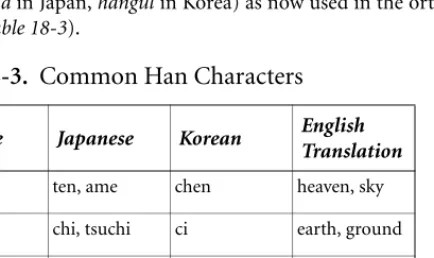
For many centuries, written Chinese was the accepted written standard throughout East Asia. The influence of the Chinese language and its written form on the modern East Asian languages is similar to the influence of Latin on the vocabulary and written forms of lan-guages in the West. This influence is immediately visible in the mixture of Han characters and native phonetic scripts (kana in Japan, hangul in Korea) as now used in the orthogra-phies of Japan and Korea (see Table 18-3).
The evolution of character shapes and semantic drift over the centuries has resulted in changes to the original forms and meanings. For example, the Chinese character
8
tZngTable 18-3.
Common Han Characters
Han
Character Chinese Japanese Korean
English Translation
1
ti#n ten, ame chen heaven, sky2
dì chi, tsuchi ci earth, ground3
rén jin, hito in man, person4
sh#n san, yama san mountain5
shu$ sui, mizu swu water6
shàng jou, ue sang above(Japanese tou or yu, Korean thang), which originally meant “hot water,” has come to mean “soup” in Chinese. “Hot water” remains the primary meaning in Japanese and Korean, whereas “soup” appears in more recent borrowings from Chinese, such as “soup noodles” (Japanese tanmen; Korean thangmyen). Still, the identical appearance and similarities in meaning are dramatic and more than justify the concept of a unified Han script that tran-scends language.
The “nationality” of the Han characters became an issue only when each country began to create coded character sets (for example, China’s GB 2312-80, Japan’s JIS X 0208-1978, and Korea’s KS C 5601-87) based on purely local needs. This problem appears to have arisen more from the priority placed on local requirements and lack of coordination with other countries, rather than out of conscious design. Nevertheless, the identity of the Han char-acters is fundamentally independent of language, as shown by dictionary definitions, vocabulary lists, and encoding standards.
Terminology. Several standard romanizations of the term used to refer to East Asian ideo-graphic characters are commonly used. They include hànzì (Chinese), kanzi (Japanese),
kanji (colloquial Japanese), hanja (Korean), and Chhán (Vietnamese). The standard English translations for these terms are interchangeable: Han character, Han ideographic character, East Asian ideographic character, or CJK ideographic character. For clarity, the Unicode Standard uses some subset of the English terms when referring to these characters. The term Kanzi is used in reference to a specific Japanese government publication. The unrelated term KangXi (which is a Chinese reign name, rather than another romanization of “Han character”) is used only when referring to the primary dictionary used for deter-mining Han character arrangement in the Unicode Standard. (See Table 18-7.)
Distinguishing Han Character Usage Between Languages. There is some concern that unifying the Han characters may lead to confusion because they are sometimes used differ-ently by the various East Asian languages. Computationally, Han character unification presents no more difficulty than employing a single Latin character set that is used to write languages as different as English and French. Programmers do not expect the characters “c”, “h”, “a”, and “t” alone to tell us whether chat is a French word for cat or an English word meaning “informal talk.” Likewise, we depend on context to identify the American hood (of a car) with the British bonnet. Few computer users are confused by the fact that ASCII can also be used to represent such words as the Welsh word ynghyd, which are strange look-ing to English eyes. Although it would be convenient to identify words by language for pro-grams such as spell-checkers, it is neither practical nor productive to encode a separate Latin character set for every language that uses it.
Similarly, the Han characters are often combined to “spell” words whose meaning may not be evident from the constituent characters. For example, the two characters “to cut” and “hand” mean “postage stamp” in Japanese, but the compound may appear to be nonsense to a speaker of Chinese or Korean (see Figure 18-1).
Even within one language, a computer requires context to distinguish the meanings of words represented by coded characters. The word chuugoku in Japanese, for example, may refer to China or to a district in central west Honshuu (see Figure 18-2).
Coding these two characters as four so as to capture this distinction would probably cause more confusion and still not provide a general solution. The Unicode Standard leaves the issues of language tagging and word recognition up to a higher level of software and does not attempt to encode the language of the Han characters.
Simplified and Traditional Chinese. There are currently two main varieties of written Chinese: “simplified Chinese” (jiântîzì), used in most parts of the People’s Republic of China (PRC) and Singapore, and “traditional Chinese” (fántîzì), used predominantly in the Hong Kong and Macao SARs, Taiwan, and overseas Chinese communities. The process of interconverting between the two is a complex one. This complexity arises largely because a single simplified form may correspond to multiple traditional forms, such as U+53F0 3, which is a traditional character in its own right and the simplified form for U+6AAF 4, U+81FA 5, and U+98B1 6. Moreover, vocabulary differences have arisen between Man-darin as spoken in Taiwan and ManMan-darin as spoken in the PRC, the most notable of which is the usual name of the language itself: guóy& (the National Language) in Taiwan and
p&t]nghuà (the Common Speech) in the PRC. Merely converting the character content of a
text from simplified Chinese to the appropriate traditional counterpart is insufficient to change a simplified Chinese document to traditional Chinese, or vice versa. (The vast majority of Chinese characters are the same in both simplified and traditional Chinese.) There are two PRC national standards, GB 2312-80 and GB 12345-90, which are intended to represent simplified and traditional Chinese, respectively. The character repertoires of the two are the same, but the simplified forms occur in GB 2312-80 and the traditional ones in GB 12345-90. These are both part of the IRG G source, with traditional forms and simplified forms separated where they differ. As a result, the Unicode Standard contains a number of distinct simplifications for characters, such as U+8AAC i and U+8BF4 j. While there are lists of official simplifications published by the PRC, most of these are obtained by applying a few general principles to specific areas. In particular, there is a set of radicals (such as U+2F94 /kangxi radical speech, U+2F99 0kangxi radical shell, U+2FA8 1kangxi radical gate, and U+2FC3 2kangxi radical bird) for which
sim-Figure 18-1.
Han Spelling
Figure 18-2.
Semantic Context for Han Characters
1. Japanese “stamp”
2. Chinese “cut hand”
to cut
hand
+
=
middle
country
1. China
2. Chuugoku district of Honshuu
+
plifications exist (U+2EC8 +cjk radical c-simplified speech, U+2EC9 ,cjk
radi-cal c-simplified shell, U+2ED4 -cjk radical c-simplified gate, and U+2EE6 .
cjk radical c-simplified bird). The basic technique for simplifying a character contain-ing one of these radicals is to substitute the simplified radical, as in the previous example. The Unicode Standard does not explicitly encode all simplified forms for traditional Chi-nese characters. Where the simplified and traditional forms exist as different encoded char-acters, each should be used as appropriate. The Unicode Standard does not specify how to represent a new simplified form (or, more rarely, a new traditional form) that can be derived algorithmically from an encoded traditional form (simplified form).
Dialects and Early Forms of Chinese. Chinese is not a single language, but a complex of spoken forms that share a single written form. Although these spoken forms are referred to as dialects, they are actually mutually unintelligible and distinct languages. Virtually all modern written Chinese is Mandarin, the dominant language in both the PRC and Taiwan. Speakers of other Chinese languages learn to read and write Mandarin, although they pro-nounce it using the rules of their own language. (This would be like having Spanish chil-dren read and write only French, but pronouncing it as if it were Spanish.) The major non-Mandarin Chinese languages are Cantonese (spoken in the Hong Kong and Macao SARs, in many overseas Chinese communities, and in much of Guangdong province), Wu, Min, Hakka, Gan, and Xiang.
Prior to the 20th century, the standard form of written Chinese was literary Chinese, a form derived from the classical Chinese written, but probably not spoken by Confucius in the sixth century bce.
The ideographic repertoire of the Unicode Standard is sufficient for all but the most spe-cialized texts of modern Chinese, literary Chinese, and classical Chinese. Preclassical Chi-nese, written using seal forms or oracle bone forms, has not been systematically incorporated into the Unicode Standard, because those very early, historic forms differed substantially from the classic and modern forms of Han characters. They require investigation and encoding as distinct historic scripts.
Among modern Chinese languages, Cantonese is occasionally found in printed materials; the others are almost never seen in printed form. There is less standardization for the ideo-graphic repertoires of these languages, and no fully systematic effort has been undertaken to catalog the nonstandard ideographs they use. Because of efforts on the part of the gov-ernment of the Hong Kong SAR, however, the current ideographic repertoire of the Uni-code Standard should be adequate for many—but not all—written Cantonese texts.
Sorting Han Ideographs. The Unicode Standard does not define a method by which ideo-graphic characters are sorted; the requirements for sorting differ by locale and application. Possible collating sequences include phonetic, radical-stroke (KangXi, Xinhua Zidian, and so on), four-corner, and total stroke count. Raw character codes alone are seldom sufficient to achieve a usable ordering in any of these schemes; ancillary data are usually required. (See Table 18-7 for a summary of the authoritative sources used to determine the order of Han ideographs in the code charts.)
Character Glyphs. In form, Han characters are monospaced. Every character takes the same vertical and horizontal space, regardless of how simple or complex its particular form is. This practice follows from the long history of printing and typographical practice in China, which traditionally placed each character in a square cell. When written vertically, there are also a number of named cursive styles for Han characters, but the cursive forms of the characters tend to be quite idiosyncratic and are not implemented in general-purpose Han character fonts for computers.
There may be a wide variation in the glyphs used in different countries and for different applications. The most commonly used typefaces in one country may not be used in others.
The types of glyphs used to depict characters in the Han ideographic repertoire of the Uni-code Standard have been constrained by available fonts. Users are advised to consult authoritative sources for the appropriate glyphs for individual markets and applications. It is assumed that most Unicode implementations will provide users with the ability to select the font (or mixture of fonts) that is most appropriate for a given locale.
Principles of Han Unification
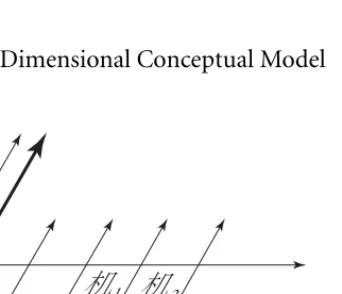
Three-Dimensional Conceptual Model. To develop the explicit rules for unification, a conceptual framework was developed to model the nature of Han ideographic characters. This model expresses written elements in terms of three primary attributes: semantic (meaning, function), abstract shape (general form), and actual shape (instantiated, type-face form). These attributes are graphically represented in three dimensions according to the
X
,Y
, andZ
axes (see Figure 18-3).Figure 18-3.
Three-Dimensional Conceptual Model
Z
(typeface)
X (semantic)
The semantic attribute (represented along the X axis) distinguishes characters by meaning and usage. Distinctions are made between entirely unrelated characters such as > (marsh) and : (machine) as well as extensions or borrowings beyond the original semantic cluster such as ;1 (a phonetic borrowing used as a simplified form of :) and ;2 (table, the orig-inal meaning).
The abstract shape attribute (the Y axis) distinguishes the variant forms of a single charac-ter with a single semantic attribute (that is, a characcharac-ter with a single position on the X axis). The actual shape (typeface) attribute (the Z axis) is for differences of type design (the actual shape used in imaging) of each variant form.
Z-axis typeface and stylistic differences are generally ignored for the purpose of encoding Han ideographs, but can be represented in text by the use of variation sequences; see
Section 23.4, Variation Selectors.
Unification Rules
The following rules were applied during the process of merging Han characters from the different source character sets.
R1 Source Separation Rule. If two ideographs are distinct in a primary source stan-dard, then they are not unified.
• This rule is sometimes called the round-trip rule because its goal is to facilitate a round-trip conversion of character data between an IRG source standard and the Unicode Standard without loss of information.
• This rule was applied only for the work on the original CJK Unified Ideographs block [also known as the Unified Repertoire and Ordering (URO)]. The IRG dropped this rule in 1992 and will not use it in future work.
Figure 18-4 illustrates six variants of the CJK ideograph meaning “sword.”
Each of the six variants in Figure 18-4 is separately encoded in one of the primary source standards—in this case, J0 (JIS X 0208-1990), as shown in Table 18-4.
Because the six sword characters are historically related, they are not subject to disunifica-tion by the Noncognate Rule (R2) and thus would ordinarily have been considered for pos-sible abstract shape-based unification by R3. Under that rule, the fourth and fifth variants would probably have been unified for encoding. However, the Source Separation Rule required that all six variants be separately encoded, precluding them from any
consider-Figure 18-4.
CJK Source Separation
ation of shape-based unification. Further variants of the “sword” ideograph, U+5251 and U+528E, are also separately encoded because of application of the Source Separation Rule—in that case applied to one or more Chinese primary source standards, rather than to the J0 Japanese primary source standard.
R2 Noncognate Rule. In general, if two ideographs are unrelated in historical deriva-tion (noncognate characters), then they are not unified.
For example, the ideographs in Figure 18-5, although visually quite similar, are nevertheless not unified because they are historically unrelated and have distinct meanings.
R3 By means of a two-level classification (described next), the abstract shape of each ideograph is determined. Any two ideographs that possess the same abstract shape are then unified provided that their unification is not disallowed by either the Source Separation Rule or the Noncognate Rule.
Abstract Shape
Two-Level Classification. Using the three-dimensional model, characters are analyzed in a two-level classification. The two-level classification distinguishes characters by abstract shape (Y axis) and actual shape of a particular typeface (Z axis). Variant forms are identi-fied based on the difference of abstract shapes.
To determine differences in abstract shape and actual shape, the structure and features of each component of an ideograph are analyzed as follows.
Ideographic Component Structure. The component structure of each ideograph is exam-ined. A component is a geometrical combination of primitive elements. Various ideo-graphs can be configured with these components used in conjunction with other components. Some components can be combined to make a component more complicated in its structure. Therefore, an ideograph can be defined as a component tree with the entire
Table 18-4.
Source Encoding for Sword Variants
Unicode JIS U+5263 J0-3775 U+528D J0-5178 U+5271 J0-517B U+5294 J0-5179 U+5292 J0-517A U+91FC J0-6E5FFigure 18-5.
Not Cognates, Not Unified
warrior, scholar
earth
ideograph as the root node and with the bottom nodes consisting of primitive elements (see Figure 18-6 and Figure 18-7).
Ideograph Features. The following features of each ideograph to be compared are exam-ined:
• Number of components
• Relative positions of components in each complete ideograph • Structure of a corresponding component
• Treatment in a source character set • Radical contained in a component
Uniqueness or Unification. If one or more of these features are different between the ideo-graphs compared, the ideoideo-graphs are considered to have different abstract shapes and, therefore, are considered unique characters and are not unified. If all of these features are identical between the ideographs, the ideographs are considered to have the same abstract shape and are unified.
Spatial Positioning. Ideographs may exist as a unit or may be a component of more com-plex ideographs. A source standard may describe a requirement for a component with a specific spatial positioning that would be otherwise unified on the principle of having the same abstract shape as an existing full ideograph. Examples of spatial positioning for ideo-graphic components are left half, top half, and so on.
Examples. The examples in Table 18-5 illustrate the reasons for not unifying characters, including typical differences in abstract character shape.
Figure 18-6.
Ideographic Component Structure
Figure 18-7.
The Most Superior Node of an Ideographic Component
vs. vs.
Differences in the actual shapes of ideographs that have been unified are illustrated in
Table 18-6.
Han Ideograph Arrangement
The arrangement of the Unicode Han characters is based on the positions of characters as they are listed in four major dictionaries. The KangXi Zidian was chosen as primary because it contains most of the source characters and because the dictionary itself and the principles of character ordering it employs are commonly used throughout East Asia. The Han ideograph arrangement follows the index (page and position) of the dictionaries listed in Table 18-7 with their priorities.
Table 18-5.
Ideographs Not Unified
Characters Reason5 6
Non-cognate characters3 4
Characters treated as distinct in a source character seta
b
Different number of componentsc
d
Same number of components placed in different relative positionse
f
Same number and same relative position of components, corresponding com-ponents structured differentlyi
j
Characters with different radical in a componentTable 18-6.
Ideographs Unified
Characters Reasonm
n
Different writing sequenceq
r
Differences in overshoot at the stroke terminations
t
Differences in contact of strokesu
v
Differences in protrusion at the folded corner of strokesw
x
Differences in bent strokesy
z
Differences in stroke terminationP
Q
Differences in accent at the stroke initiation~
T
Difference in rooftop modificationo
p
Difference in rotated strokes/dotsaa. These ideographs (having the same abstract shape) would have been unified except for the Source Separation Rule.
When a character is found in the KangXi Zidian, it follows the KangXi Zidian order. When it is not found in the KangXi Zidian and it is found in Dai Kan-Wa Jiten, it is given a posi-tion extrapolated from the KangXi position of the preceding character in Dai Kan-Wa Jiten. When it is not found in either KangXi or Dai Kan-Wa, then the Hanyu Da Zidian and Dae Jaweon dictionaries are consulted in a similar manner.
Ideographs with simplified KangXi radicals are placed in a group following the traditional
KangXi radical from which the simplified radical is derived. For example, characters with the simplified radical + corresponding to KangXi radical /follow the last nonsimplified character having / as a radical. The arrangement for these simplified characters is that of the Hanyu Da Zidian.
The few characters that are not found in any of the four dictionaries are placed following characters with the same KangXi radical and stroke count. The radical-stroke order that results is a culturally neutral order. It does not exactly match the order found in common dictionaries.
Information for sorting all CJK ideographs by the radical-stroke method is found in the Unihan Database (see Unicode Standard Annex #38, “Unicode Han Database (Unihan)”). It should be used if characters from the various blocks containing ideographs (see
Table 18-1) are to be properly interleaved. Note, however, that there is no standard way of ordering characters with the same radical-stroke count; for most purposes, Unicode code point order would be as acceptable as any other way.
Details regarding the form of the online charts for the CJK unified ideographs are discussed in Section 24.2, CJK Ideographs.
Radical-Stroke Indices
To expedite locating specific Han ideographic characters in the code charts, radical-stroke indices are provided on the Unicode web site. An interactive radical-stroke index page enables queries by specific radical numbers and stroke counts. Two fully formatted tradi-tional radical-stroke indices are also posted in PDF format. The larger of those provides a radical-stroke index for all of the Han ideographic characters in the Unicode Standard, including CJK compatibility ideographs. There is also a more compact radical-stroke index limited to the IICore set of 9,810 CJK unified ideographs in common usage. The following text describes how radical-stroke indices work for Han ideographic characters and explains the particular adaptations which have been made for the Unicode radical-stroke indices.
Table 18-7.
Han Ideograph Arrangement
Priority Dictionary City Publisher Version
1 KangXi Zidian Beijing Zhonghua Bookstore, 1989 Seventh edition 2 Dai Kan-Wa Jiten Tokyo Taishuukan Shoten, 1986 Revised edition 3 Hanyu Da Zidian Chengdu Sichuan Cishu Publishing, 1986 First edition 4 Dae Jaweon Seoul Samseong Publishing Co. Ltd, 1988 First edition
Under the traditional radical-stroke system, each Han ideograph is considered to be writ-ten with one of a number of different character elements or radicals and a number of addi-tional strokes. For example, the character @ has the radical $ and seven additional strokes. To find the character @ within a dictionary, one would first locate the section for its radi-cal, $, and then find the subsection for characters with seven additional strokes.
This method is complicated by the fact that there are occasional ambiguities in the count-ing of strokes. Even worse, some characters are considered by different authorities to be written with different radicals; there is not, in fact, universal agreement about which set of radicals to use for certain characters, particularly with the increased use of simplified characters.
The most influential authority for radical-stroke information is the eighteenth-century
KangXi dictionary, which contains 214 radicals. The main problem in using KangXi radi-cals today is that many simplified characters are difficult to classify under any of the 214
KangXi radicals. As a result, various modern radical sets have been introduced. None, how-ever, is in general use, and the 214 KangXi radicals remain the best known. See “CJK and KangXi Radicals” in the following text.
The Unicode radical-stroke charts are based on the KangXi radicals. The Unicode Standard follows a number of different sources for radical-stroke classification. Where two sources are at odds as to radical or stroke count for a given character, the character is shown in both
positions in the radical-stroke charts.
Simplified characters are, as a rule, considered to have the same radical as their traditional forms and are found under the appropriate radical. For example, the character & is found under the same radical, +, as its traditional form (%).
Mappings for Han Ideographs
The mappings defined by the IRG between the ideographs in the Unicode Standard and the IRG sources are specified in the Unihan Database. These mappings are considered to be normative parts of ISO/IEC 10646 and of the Unicode Standard; that is, the characters are
defined to be the targets for conversion of these characters in these character set standards. These mappings have been derived from editions of the source standards provided directly to the IRG by its member bodies, and they may not match mappings derived from the pub-lished editions of these standards. For this reason, developers may choose to use alternative mappings more directly correlated with published editions.
Specialized conversion systems may also choose more sophisticated mapping mecha-nisms—for example, semantic conversion, variant normalization, or conversion between simplified and traditional Chinese.
The Unicode Consortium also provides mapping information that extends beyond the normative mappings defined by the IRG. These additional mappings include mappings to character set standards included in the U source, including duplicate characters from KS C
5601-1987, mappings to portions of character set standards omitted from IRG sources, ref-erences to standard dictionaries, and suggested character/stroke counts.
CJK Unified Ideographs Extension B: U+20000–U+2A6D6
The ideographs in the CJK Unified Ideographs Extension B block represent an additional set of 42,711 unified ideographs beyond the 27,496 included in The Unicode Standard, Ver-sion 3.0. The same principles underlying the selection, organization, and unification of Han ideographs apply to these ideographs.
As with other Han ideograph blocks, the ideographs in the CJK Unified Ideographs Exten-sion B block are derived from verExten-sions of national standards submitted to the IRG by its members. They may in some instances differ slightly from published versions of these stan-dards.
CJK Unified Ideographs Extension C: U+2A700–U+2B734
The ideographs in the CJK Unified Ideographs Extension C block represent an additional 4,908 unified ideographs beyond the 70,229 included in The Unicode Standard, Version 5.0. The same principles underlying the selection, organization, and unification of Han ideo-graphs apply to these ideoideo-graphs.
CJK Unified Ideographs Extension D: U+2B740–U+2B81D
The ideographs in the CJK Unified Ideographs Extension D block represent an additional 222 unified ideographs beyond the 74,394 included in The Unicode Standard, Version 5.2. The same principles underlying the selection, organization, and unification of Han ideo-graphs apply to these ideoideo-graphs.
CJK Unified Ideographs Extension E: U+2B820–U+2CEA1
The ideographs in the CJK Unified Ideographs Extension E block represent an additional 5,762 unified ideographs beyond the 74,617 included in The Unicode Standard, Version 7.0. The same principles underlying the selection, organization, and unification of Han ideo-graphs apply to these ideoideo-graphs.
CJK Compatibility Ideographs: U+F900–U+FAFF
The Korean national standard KS C 5601-1987 (now known as KS X 1001:1998), which served as one of the primary source sets for the Unified CJK Ideograph Repertoire and Ordering, Version 2.0, contains 268 duplicate encodings of identical ideograph forms to denote alternative pronunciations. That is, in certain cases, the standard encodes a single character multiple times to denote different linguistic uses. This approach is like encoding the letter “a” five times to denote the different pronunciations it has in the words hat, able,
art, father, and adrift. Because they are in all ways identical in shape to their nominal coun-terparts, they were excluded by the IRG from its sources. For round-trip conversion with
KS C 5601-1987, they are encoded separately from the primary CJK Unified Ideographs block.
Another 34 ideographs from various regional and industry standards were encoded in this block, primarily to achieve round-trip conversion compatibility. Twelve of these ideo-graphs (U+FA0E, U+FA0F, U+FA11, U+FA13, U+FA14, U+FA1F, U+FA21, U+FA23, U+FA24, U+FA27, U+FA28, and U+FA29) are not encoded in the CJK Unified Ideographs Areas. These 12 characters are not duplicates and should be treated as a small extension to the set of unified ideographs.
Except for the 12 unified ideographs just enumerated, CJK compatibility ideographs from this block are not used in Ideographic Description Sequences.
An additional 59 compatibility ideographs are found from U+FA30 to U+FA6A. They are included in the Unicode Standard to provide full round-trip compatibility with the ideo-graphic repertoire of JIS X 0213:2000 and should not be used for any other purpose. An additional three compatibility ideographs are encoded at the range U+FA6B to U+FA6D. They are included in the Unicode Standard to provide full round-trip compati-bility with the ideographic repertoire of the Japanese television standard, ARIB STD-B24, and should not be used for any other purpose.
An additional 106 compatibility ideographs are encoded at the range U+FA70 to U+FAD9. They are included in the Unicode Standard to provide full round-trip compatibility with the ideographic repertoire of KPS 10721-2000. They should not be used for any other pur-pose.
The names for the compatibility ideographs are also algorithmically derived. Thus the name for the compatibility ideograph U+F900 is cjk compatibility ideograph-f900. All of the compatibility ideographs in this block, except for the 12 unified ideographs, have standardized variation sequences defined in StandardizedVariants.txt. See the discussion in
Section 23.4, Variation Selectors for more details.
CJK Compatibility Supplement: U+2F800–U+2FA1D
The CJK Compatibility Ideographs Supplement block consists of additional compatibility ideographs required for round-trip compatibility with CNS 11643-1992, planes 3, 4, 5, 6, 7, and 15. They should not be used for any other purpose and, in particular, may not be used in Ideographic Description Sequences.
All of the additional compatibility ideographs in this block have standardized variation sequences defined in StandardizedVariants.txt. See the discussion in Section 23.4, Variation Selectors for more details.
Kanbun: U+3190–U+319F
This block contains a set of Kanbun marks used in Japanese texts to indicate the Japanese reading order of classical Chinese texts. These marks are not encoded in any other current
character encoding standards but are widely used in literature. They are typically written in an annotation style to the left of each line of vertically rendered Chinese text. For more details, see JIS X 4051.
Symbols Derived from Han Ideographs
A number of symbols derived from Han ideographs can be found in other blocks. See “Enclosed CJK Letters and Months: U+3200..U+32FF,” “CJK Compatibility: U+3300..
U+33FF,” and “Enclosed Ideographic Supplement” in Section 22.10, Enclosed and Square.
CJK and KangXi Radicals: U+2E80–U+2FD5
East Asian ideographic radicals are ideographs or fragments of ideographs used to index dictionaries and word lists, and as the basis for creating new ideographs. The term radical
comes from the Latin radix, meaning “root,” and refers to the part of the character under which the character is classified in dictionaries. See “Radical-Stroke Indices” earlier in this section for a more detailed discussion of how ideographic radicals are used in indices. There is no single radical set in general use throughout East Asia. However, the set of 214 radicals used in the eighteenth-century KangXi dictionary is universally recognized. The visual appearance of radicals is often very different when they are used as radicals than their appearance when they are stand-alone ideographs. Indeed, many radicals have multi-ple graphic forms when used as parts of characters. A standard exammulti-ple is the water radical, which is written A when an ideograph and generally B when part of an ideograph. The Unicode Standard includes two blocks of encoded radicals: the KangXi Radicals block (U+2F00..U+2FD5), which contains the base forms for the 214 radicals, and the CJK Rad-icals Supplement block (U+2E80..U+2EF3), which contains a set of variant shapes taken by the radicals either when they occur as parts of characters or when they are used for simpli-fied Chinese. These variant shapes are commonly found as independent and distinct char-acters in dictionary indices—such as for the radical-stroke charts in the Unicode Standard. As such, they have not been subject to the usual unification rules used for other characters in the standard.
Most of the characters in the CJK and KangXi Radicals blocks are equivalents of characters in the CJK Unified Ideographs block of the Unicode Standard. Radicals that have one graphic form as an ideograph and another as part of an ideograph are generally encoded in both forms in the CJK Unified Ideographs block (such as U+6C34 and U+6C35 for the water radical).
Standards. CNS 11643-1992 includes a block of radicals separate from its ideograph block. This block includes 212 of the 214 KangXi radicals. These characters are included in the KangXi Radicals block.
Those radicals that are ideographs in their own right have a definite meaning and are usu-ally referred to by that meaning. Accordingly, most of the characters in the KangXi Radicals
block have been assigned names reflecting their meaning. The other radicals have been given names based on their shape.
Semantics. Characters in the CJK and KangXi Radicals blocks should never be used as ideographs. They have different properties and meanings. U+2F00 kangxi radical one is not equivalent to U+4E00 cjk unified ideograph-4e00, for example. The former is to be treated as a symbol, the latter as a word or part of a word.
The characters in the CJK and KangXi Radicals blocks are compatibility characters. Except in cases where it is necessary to make a semantic distinction between a Chinese character in its role as a radical and the same Chinese character in its role as an ideograph, the charac-ters from the Unified Ideographs blocks should be used instead of the compatibility radi-cals. To emphasize this difference, radicals may be given a distinct font style from their ideographic counterparts.
CJK Additions from HKSCS and GB 18030
Several characters have been encoded because of developments in HKSCS-2001 (the Hong Kong Supplementary Character Set) and GB 18030-2000 (the PRC National Standard). Both of these encoding standards were published with mappings to Unicode Private Use Area code points. PUA ideographic characters that could not be remapped to non-PUA CJK ideographs were added to the existing block of CJK Unified Ideographs. Fourteen new ideographs (U+9FA6..U+9FB3) were added from HKSCS, and eight multistroke ideo-graphic components (U+9FB4..U+9FBB) were added from GB 18030.
To complete the mapping to these two Chinese standards, a number of non-ideographic characters were encoded elsewhere in the standard. In particular, two symbol characters from HKSCS were added to the existing Miscellaneous Technical block: U+23DA earth
ground and U+23DB fuse. A new block, CJK Strokes (U+31C0..U+31EF), was created and populated with a number of stroke symbols from HKSCS. Another block, Vertical Forms (U+FE10..U+FE1F), was created for vertical punctuation compatibility characters from GB 18030.
CJK Strokes: U+31C0–U+31EF
Characters in the CJK Strokes block are single-stroke components of CJK ideographs. The first characters assigned to this block were 16 HKSCS–2001 PUA characters that had been excluded from CJK Unified Ideograph Extension B on the grounds that they were not true ideographs. Further additions consist of traditionally defined stroke types attested in the representative forms appearing in the Unicode CJK ideograph code charts or occurring in pre-unification source glyphs.
CJK strokes are used with highly specific semantics (primarily to index ideographs), but they may lack the monosyllabic pronunciations and logographic functions typically associ-ated with independent ideographs. The strokes in this block are single strokes of well-defined types. For more information about these strokes, see Appendix F, Documentation of CJK Strokes.
18.2 Ideographic Description Characters
Ideographic Description: U+2FF0–U+2FFB
Although the Unicode Standard includes more than 75,000 CJK unified ideographs, thou-sands of extremely rare CJK ideographs have nevertheless been left unencoded. Research into cataloging additional ideographs for encoding continues, but it is anticipated that at no point will the entire set of potential, encodable ideographs be completely exhausted. In particular, ideographs continue to be coined and such new coinages will invariably be unencoded.
The 12 characters in the Ideographic Description block provide a mechanism for the stan-dard interchange of text that must reference unencoded ideographs. Unencoded ideo-graphs can be described using these characters and encoded ideoideo-graphs; the reader can then create a mental picture of the ideographs from the description.
This process is different from a formal encoding of an ideograph. There is no canonical description of unencoded ideographs; there is no semantic assigned to described graphs; there is no equivalence defined for described ideographs. Conceptually, ideo-graphic descriptions are more akin to the English phrase “an ‘e’ with an acute accent on it” than to the character sequence <U+0065, U+0301>.
In particular, support for the characters in the Ideographic Description block does not
require the rendering engine to recreate the graphic appearance of the described character. Note also that many of the ideographs that users might represent using the Ideographic Description characters will be formally encoded in future versions of the Unicode Stan-dard.
The Ideographic Description Algorithm depends on the fact that virtually all CJK ideo-graphs can be broken down into smaller pieces that are themselves ideoideo-graphs. The broad coverage of the ideographs already encoded in the Unicode Standard implies that the vast majority of unencoded ideographs can be represented using the Ideographic Description characters.
Although Ideographic Description Sequences are intended primarily to represent unen-coded ideographs and should not be used in data interchange to represent enunen-coded ideo-graphs, they also have pedagogical and analytic uses. A researcher, for example, may choose to represent the character U+86D9 y as “vxw” in a database to provide a link between it and other characters sharing its phonetic, such as U+5A03 z. The IRG is using Ideo-graphic Description Sequences in this fashion to help provide a first-approximation, machine-generated set of unifications for its current work.
Applicability to Other Scripts. The characters in the Ideographic Description block are derived from a Chinese standard and were encoded for use specifically in describing CJK ideographs. As a result, the following detailed description of Ideographic Description Sequences is specified entirely in terms of CJK unified ideographs and CJK radicals. How-ever, there are several large, historic East Asian scripts whose writing systems were heavily
influenced by the Han script. Like the Han script, those siniform historic scripts, which include Tangut, Jurchen, and Khitan, are logographic in nature. Furthermore, they built up characters using radicals and components, and with side-by-side and top-to-bottom stack-ing very similar in structure to the way CJK ideographs are composed. These historic scripts are not yet encoded in Version 7.0 of the Unicode Standard, but it is quite likely that one or more of them will be encoded eventually.
The general usefulness of Ideographic Description Sequences for describing unencoded characters and the applicability of the characters in the Ideographic Description block to description of siniform logographs mean that the syntax for Ideographic Description Sequences can be generalized to extend to additional East Asian logographic scripts.
Ideographic Description Sequences. Ideographic Description Sequences are defined by the following grammar. The list of characters associated with the Ideographic and Radical prop-erties can be found in the Unicode Character Database.
IDS := Ideographic | Radical | CJK_Stroke | Private Use | U+FF1F | IDS_BinaryOperator IDS IDS
| IDS_TrinaryOperatorIDS IDS IDS
CJK_Stroke := U+31C0 | U+31C1 | ... | U+31E3
IDS_BinaryOperator := U+2FF0 | U+2FF1 | U+2FF4 | U+2FF5 | U+2FF6 | U+2FF7 | U+2FF8 | U+2FF9 | U+2FFA | U+2FFB
IDS_TrinaryOperator:= U+2FF2 | U+2FF3
Previous versions of the Unicode standard imposed various limits on the length of a sequence or parts of it, and restricted the use of IDS to Unified CJK Ideographs. Those lim-its and restrictions are no longer imposed by the standard.
The operators indicate the relative graphic positions of the operands running from left to right and from top to bottom. A user wishing to represent an unencoded ideograph will need to analyze its structure to determine how to describe it using an Ideographic Descrip-tion Sequence. As a rule, it is best to use the natural radical-phonetic division for an ideo-graph if it has one and to use as short a description sequence as possible; however, there is no requirement that these rules be followed. Beyond that, the shortest possible Ideographic Description Sequence is preferred.
Figure 18-8 illustrates the use of this grammar to provide descriptions of unencoded ideo-graphs. Examples 9–13 illustrate more complex Ideographic Description Sequences show-ing the use of some of the less common operators.
Equivalence. Many unencoded ideographs can be described in more than one way using this algorithm, either because the pieces of a description can themselves be broken down further (examples 1–3 in Figure 18-8) or because duplications appear within the Unicode Standard (examples 5 and 6 in Figure 18-8).
The Unicode Standard does not define equivalence for two Ideographic Description Sequences that are not identical. Figure 18-8 contains numerous examples illustrating how
different Ideographic Description Sequences might be used to describe the same ideo-graph.
In particular, Ideographic Description Sequences should not be used to provide alternative graphic representations of encoded ideographs in data interchange. Searching, collation, and other content-based text operations would then fail.
Interaction with the Ideographic Variation Mark. As with ideographs proper, the Ideo-graphic Variation Mark (U+303E) may be placed before an IdeoIdeo-graphic Description Sequence to indicate that the description is merely an approximation of the original ideo-graph desired. A sequence of characters that includes an Ideoideo-graphic Variation Mark is not an Ideographic Description Sequence.
Rendering. Ideographic Description characters are visible characters and are not to be treated as control characters. Thus the sequence U+2FF1 U+4E95 U+86D9 must have a distinct appearance from U+4E95 U+86D9.
An implementation may render a valid Ideographic Description Sequence either by render-ing the individual characters separately or by parsrender-ing the Ideographic Description Sequence and drawing the ideograph so described. In the latter case, the Ideographic Description Sequence should be treated as a ligature of the individual characters for pur-poses of hit testing, cursor movement, and other user interface operations. (See
Section 5.11, Editing and Selection.)
Figure 18-8.
Using the Ideographic Description Characters
C
D
E
F
]
8 7 2 I J
: 9 K L K M
N
7 : B 7 O O P Q K R
; S 7 8 T U V
7 _ 8 7 Z ^ \
# T U
S
# T " V W
# T " V # X X
* Z # [ \
Y
7
W
8
e f
7
_
8
e f
7
g
8
e f
7
h
8
e f
2FF1 4E95 86D9 2FF1 4E95 2FF0 866B 572D 2FF1 4E95 2FF0 866B 2FF1 571F 571F 2FF8 5382 2FF1 4ECA 6B62 2FF0 6C34 2FF1 53E3 5DDB 2FF0 6C35 2FF1 53E3 5DDB 2FF0 2F54 2FF1 53E3 5DDB 2FF0 2EA1 2FF1 53E3 5DDB 2FF1 2FF0 9CE5 9F9C 706B 2FF3 2FF2 4E02 5F61 4E02 5F50 76BF2FF0 2FF3 2FFB 2FF0 65E5 65E5 5DE5 7F51 4E02 4E5E 2FF4 56D7 2FF0 2FF1 9E75 51FC 9091 2FF0 6C35 2FF1 2FF0 4FDD 53BD 571F
d
→
→
→
→
→
→
→
→
→
→
→
→
→
Character Boundaries. Ideographic Description characters are not combining characters, and there is no requirement that they affect character or word boundaries. Thus U+2FF1 U+4E95 U+86D9 may be treated as a sequence of three characters or even three words. Implementations of the Unicode Standard may choose to parse Ideographic Description Sequences when calculating word and character boundaries. Note that such a decision will make the algorithms involved significantly more complicated and slower.
Standards. The Ideographic Description characters are found in GBK—an extension to GB 2312-80 that adds all Unicode ideographs not already in GB 2312-80. GBK is defined as a normative annex of GB 13000.1-93.
18.3 Bopomofo
Bopomofo: U+3100–U+312F
Bopomofo constitute a set of characters used to annotate or teach the phonetics of Chinese, primarily the standard Mandarin language. These characters are used in dictionaries and teaching materials, but not in the actual writing of Chinese text. The formal Chinese names for this alphabet are Zhuyin-Zimu (“phonetic alphabet”) and Zhuyin-Fuhao (“phonetic symbols”), but the informal term “Bopomofo” (analogous to “ABCs”) provides a more ser-viceable English name and is also used in China. The Bopomofo were developed as part of a populist literacy campaign following the 1911 revolution; thus they are acceptable to all branches of modern Chinese culture, although in the People’s Republic of China their function has been largely taken over by the Pinyin romanization system.
Bopomofo is a hybrid writing system—part alphabet and part syllabary. The letters of Bopomofo are used to represent either the initial parts or the final parts of a Chinese sylla-ble. The initials are just consonants, as for an alphabet. The finals constitute either simple vowels, vocalic diphthongs, or vowels plus nasal consonant combinations. Because a num-ber of Chinese syllables have no initial consonant, the Bopomofo letters for finals may con-stitute an entire syllable by themselves. More typically, a Chinese syllable is represented by one initial consonant letter, followed by one final letter. In some instances, a third letter is used to indicate a complex vowel nucleus for the syllable. For example, the syllable that would be written luan in Pinyin is segmented l-u-an in Bopomofo—that is, <U+310C, U+3128, U+3122>.
Standards. The standard Mandarin set of Bopomofo is included in the People’s Republic of China standards GB 2312 and GB 18030, and in the Republic of China (Taiwan) standard CNS 11643.
Mandarin Tone Marks. Small modifier letters used to indicate the five Mandarin tones are part of the Bopomofo system. In the Unicode Standard they have been unified into the Modifier Letter range, as shown in Table 18-8.
Standard Mandarin Bopomofo. The order of the Mandarin Bopomofo letters U+3105.. U+3129 is standard worldwide. The code offset of the first letter U+3105 bopomofo
let-ter b from a multiple of 16 is included to match the offset in the ISO-registered standard GB 2312.
Table 18-8.
Mandarin Tone Marks
first tone U+02C9 modifier letter macron second tone U+02CA modifier letter acute accent third tone U+02C7 caronfourth tone U+02CB modifier letter grave accent light tone U+02D9 dot above
Extended Bopomofo. To represent the sounds of Chinese dialects other than Mandarin, the basic Bopomofo set U+3105..U+3129 has been augmented by additional phonetic charac-ters. These extensions are much less broadly recognized than the basic Mandarin set. The three extended Bopomofo characters U+312A..U+312C are cited in some standard refer-ence works, such as the encyclopedia Xin Ci Hai. Another set of 24 extended Bopomofo, encoded at U+31A0..U+31B7, was designed in 1948 to cover additional sounds of the Min-nan and Hakka dialects. The extensions are used together with the main set of Bopomofo characters to provide a complete phonetic orthography for those dialects. There are no standard Bopomofo letters for the phonetics of Cantonese or several other Southern Chi-nese dialects.
The small characters encoded at U+31B4..U+31B7 represent syllable-final consonants not present in standard Mandarin or in Mandarin dialects. They have the same shapes as Bopo-mofo “b”, “d”, “k”, and “h”, respectively, but are rendered in a smaller form than the initial consonants; they are also generally shown close to the syllable medial vowel character. These final letters are encoded separately so that the Minnan and Hakka dialects can be represented unambiguously in plain text without having to resort to subscripting or other fancy text mechanisms to represent the final consonants.
Three Bopomofo letters for sounds found in non-Chinese languages are encoded in the range U+31B8..U+31BA. These characters are used in the Hmu and Ge languages, mem-bers of the Hmong-Mien (or Miao-Yao) language family, spoken primarily in southeastern Guizhou. The characters are part of an obsolete orthography for Hmu and Ge devised by the missionary Maurice Hutton in the 1920s and 1930s. A small group of Hmu Christians are still using a hymnal text written by Hutton that contains these characters.
Extended Bopomofo Tone Marks. In addition to the Mandarin tone marks enumerated in
Table 18-8, other tone marks appropriate for use with the extended Bopomofo transcrip-tions of Minnan and Hakka can be found in the Modifier Letter range, as shown in
Table 18-9. The “departing tone” refers to the qusheng in traditional Chinese tonal analysis, with the yin variant historically derived from voiceless initials and the yang variant from voiced initials. Southern Chinese dialects in general maintain more tonal distinctions than Mandarin does.
Rendering of Bopomofo. Bopomofo is rendered from left to right in horizontal text, but also commonly appears in vertical text. It may be used by itself in either orientation, but typically appears in interlinear annotation of Chinese (Han character) text. Children’s books are often completely annotated with Bopomofo pronunciations for every character. This interlinear annotation is structurally quite similar to the system of Japanese ruby
annotation, but it has additional complications that result from the explicit usage of tone marks with the Bopomofo letters.
Table 18-9.
Minnan and Hakka Tone Marks
yin departing tone U+02EA modifier letter yin departing tone mark yang departing tone U+02EB modifier letter yang departing tone markU+3127 bopomofo letter i has notable variation in rendering in horizontal and vertical layout contexts. In traditional typesetting, the stroke of the glyph was chosen to stand per-pendicular to the writing direction. In that practice, the glyph is shown as a horizontal stroke in vertically set text, and as a vertical stroke in horizontally set text. However, mod-ern digital typography has changed this practice. All modmod-ern fonts use a horizontal stroke glyph for U+3127, and that form is generally used in both horizontal and vertical layout contexts. In the Unicode Standard, the form in the charts follows the modern practice, showing a horizontal stroke for the glyph; the vertical stroke form is considered to be an occasionally occurring variant. Earlier versions of the standard followed traditional typo-graphic practice, and showed a vertical stroke glyph in the charts.
In horizontal interlineation, the Bopomofo is generally placed above the corresponding Han character(s); tone marks, if present, appear at the end of each syllabic group of Bopo-mofo letters. In vertical interlineation, the BopoBopo-mofo is generally placed on the right side of the corresponding Han character(s); tone marks, if present, appear in a separate interlin-ear row to the right side of the vowel letter. When using extended Bopomofo for Minnan and Hakka, the tone marks may also be mixed with European digits 0–9 to express changes in actual tonetic values resulting from juxtaposition of basic tones.