
1
Master of Science (M.Sc.)
Physics
Description of the course modules.
Version 2014/ko
2 Version 2014/ko -Outcome oriented description of the objectives of the course modules.
3
Name of university Heidelberg University
Name of department Physics & Astronomy
Name of subject Physics
Name of degree course* Master of Science (Physics)
Fomat of studies Full time
Type of degree course* Consecutive
Date of version February 11th, 2014
Prescribed period of study
Two years, i.e. four semesters
Establishment of degree course Juli 25th, 2008 Subject-specific assignment Physics Location Heidelberg Total number of creditpoints
One hundred twenty
University places Unlimited
Fees None
4
Preambel: classification and overall view of the curriculum
Following its overall concepts and statute Heidelberg University’s identity as a comprehensive university has grown out of its academic history, its commitment to the present, and its role in shaping the future. The research and educational efforts of the university are devoted to pursuing the central questions confronting humanity, concentrating on fundamental research and its application, and empowering Heidelberg’s students to participate in this scientific and academic endeavour at an early stage. The intricate connection between research and teaching provides for an education that is academic, practical, and continuous.
The research oriented master programme in physics is organised by the Department of Physics and Astronomy. It builds on the bachelor degree and is designed to provide a deeper, more specialised knowledge of a specific field of physics, as well as to provide a general knowledge of methods in physics. Students may, during the course of their master study, also obtain a deeper insight into other neighbouring fields of physics, depending on the choice of modules taken.
In addition, the master degree is designed to prepare students to enter into a doctoral programme. To this end, a comprehensive teaching programme is available in order to enable students to reach this high degree of specialization either in a chosen, specific area of physics, or within an interdisciplinary area of research.
The master degree in physics at the Department of Physics and Astronomy at the University of Heidelberg is in particular noted for the great flexibility and freedom of choice available to students in selecting the direction of study. This enables master students to follow their own specific interests. There are no specialities referring to the structure of the curriculum that limit the usability of the course modules.
5
1. Structure of the curriculum ... 7
Table 1.1: Overview of the master degree programme ... 8
2. Core courses in physics... 9
Table 2.1: Core courses ... 9
3. Specialization courses in physics ... 23
Table 3: Specialization courses, seminars and journal clubs ... 23
3.1 Astronomy and Astrophysics ... 30
Table 3.1.1: Specialization Astronomy and Astrophysics ... 30
Table 3.1.2: Specialised lectures and seminars ... 30
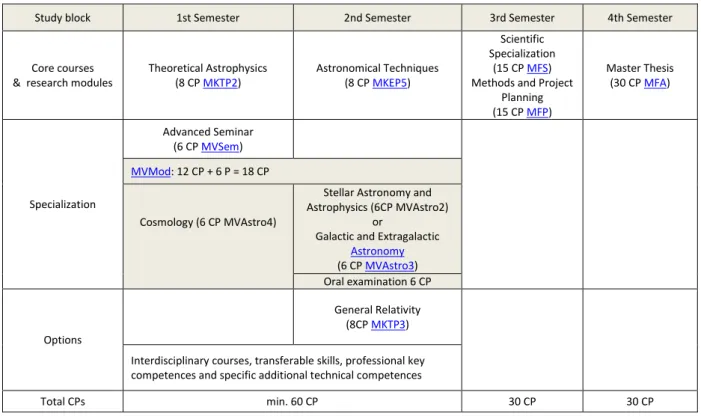
Table 3.1.3 MSc Model study plan “Astronomy/Astrophysics” ... 31
Table 3.1.4 MSc Model study plan “Astronomy/Astrophysics” ... 31
3.2 Atomic, Molecular and Optical Physics ... 41
Table 3.2.3 MSc Model study plan “Atomic, Molecular and Optical Physics” ... 42
Table 3.2.4 MSc Model study plan “Atomic, Molecular and Optical Physics” ... 42
3.3 Biophysics ... 46
Table 3.3.1: Specialization Biophysics ... 46
Table 3.3.2: Specialised lectures and seminars ... 46
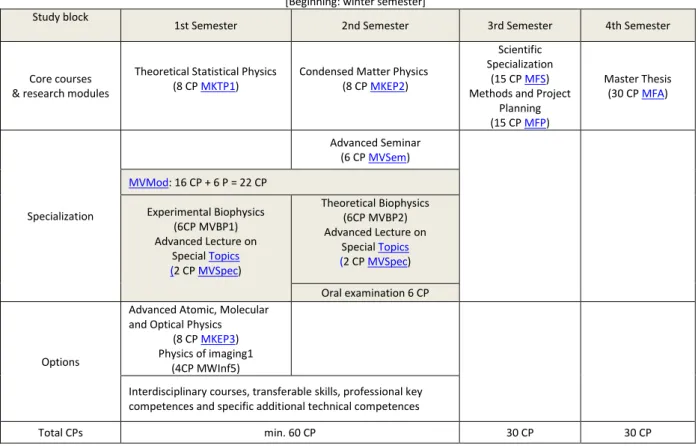
Table 3.3.3 MSc Model study plan “Biophysics” ... 47
Table 3.3.4 MSc Model study plan “Biophysics” ... 47
3.4 Computational Physics ... 51
Table 3.4.1: Specialization Computational Physics ... 51
Table 3.4.2: Specialization Computational Physics; Specialised lectures and seminars ... 51
Table 3.4.3 MSc Model study plan “Computational Physics“ ... 52
Table 3.4.4 MSc Model study plan “Computational Physics“ ... 52
3.5 Condensed Matter Physics ... 55
Table 3.5.1: Specialization Condensed Matter Physics ... 55
Table 3.5.2: Specialised lectures and seminars ... 55
Table 3.5.3 MSc Model study plan “Experimental Condensed Matter Physics“ ... 56
Table 3.5.4 MSc Model study plan “Experimental Condensed Matter Physics“ ... 56
3.6 Environmental Physics... 60
Table 3.6.1: Specialization Environmental Physics ... 60
Table 3.6.2: Specialization Environmental Physics ... 60
Table 3.6.3 MSc Model study plan “Environmental Physics“ ... 61
Table 3.6.4 MSc Model study plan “Environmental Physics “ ... 61
3.7 Medical Physics ... 67
Table 3.7.1: Specialization Medical Physics ... 67
Table 3.7.2: Specialization Medical Physics; Specialised lectures and seminars ... 67
Table 3.7.3 MSc Model study plan “Medical Physics“ ... 68
Table 3.7.4 MSc Model study plan “Medical Physics “ ... 68
3.8 Particle Physics ... 71
Table 3.8.1: Specialization Particle Physics ... 71
Table 3.8.2: Specialization Particle Physics; Specialised lectures and seminars ... 71
Table 3.8.3 MSc Model study plan “Particle Physics“ ... 72
Table 3.8.4 MSc Model study plan “Particle Physics “ ... 72
3.9 Theoretical Physics ... 77
Table 3.9.1: Specialization Theoretical Physics ... 77
Table 3.9.2: Specialization Theoretical Physics; Specialised lectures and seminars ... 77
Table 3.9.3 MSc Model study plan „Theoretical Physics (Particle Physics) “ ... 78
6
4. Options ... 83
Table 4.1: Personal key competences ... 84
Table 4.2: Professional key competences ... 84
Table 4.3: Specific additional technical competences ... 84
Table 4.4: Modules in Computer Science ... 85
5. Mandatory research phase modules ... 86
6. Model study plans ... 90
Table 6.1 MSc Model study plan “Experimental Physics” ... 91
Table 6.2 MSc Model study plan “Experimental Physics” ... 91
7
1. Structure of the curriculum
The first two semesters (first year, specialization phase) of the master programme serve to deepend and extend the education of the student through lectures, seminars and other such schooling events. The second or final year of the master programme is conceived of as a research phase, in which the master’s students independently perform research and gain the capabilities of developing new ideas. In the following chapters, we list the core, specialization and elective (options) courses on offer for the master degree and indicate the number of obligatory credit points (CP) assigned to each of these sectors. One CP corresponds to a work load of 30 hours. During the first year, obligatory core courses totalling 16 CP must be successfully attended; in addition, a further 24 to 28 CP must be gained through successfully completing specialization courses, and 16 to 20 CP must be gained through the successful completion of optional courses (further called Options), i.e. courses that are either close to the field of specialization or of an interdisciplinary nature, and which may be chosen from the wide range of courses on offer by the Department of Physics and Astronomy. The total sum of CP gained during the specialization phase should add-up to 60 CP.
The 24 to 28 CP gained through specialization courses should comprise a “Compulsory Advanced Seminar” on an advanced subject (possibly in the field of specialization) with 6 CP and the “Specialization Module”. The Specialization Module can be freely composed by the students. It should comprise courses (lectures and tutorials) in a single field of specialization of 12 to 16 CP. The courses should be chosen from the specialization programme listed in Section 3. Courses from the core physics programme (see Section 2) are also eligible if they are not already used to fulfil the core course obligation. The Specialization Module will be completed and graded by an oral examination. The comprehensive preparation of the oral examination contributes with further 6 CP to the total credit points (18 to 22 CP) of the Specialization Module.
In the second year or research phase of the master degree, the course points are made up of two compulsory modules, “Scientific Specialization“ and “Methods and Project Planning“, each being assigned 15 CP, as well as the master thesis itself, which counts 30 CP.
During the two years master course a master student is required to successfully pass course modules equivalent to a total of 120 credit points. Further details, in particular on the grading of the modules are laid down by the rules and regulations for master students (Prüfungsordnung).
In Table I, an overview is given of the master programme and the credit points assigned to each course category. The actual modules for different fields of specialization are summarized in the chapters following this. Note that within the core, specialization and options sectors, students have a wide choice available for selecting their modules. As an aid to constructing a sensible and coherent combination, we give examples of model study plans in Chapters 3 and 6 for suitable course programmes.
8
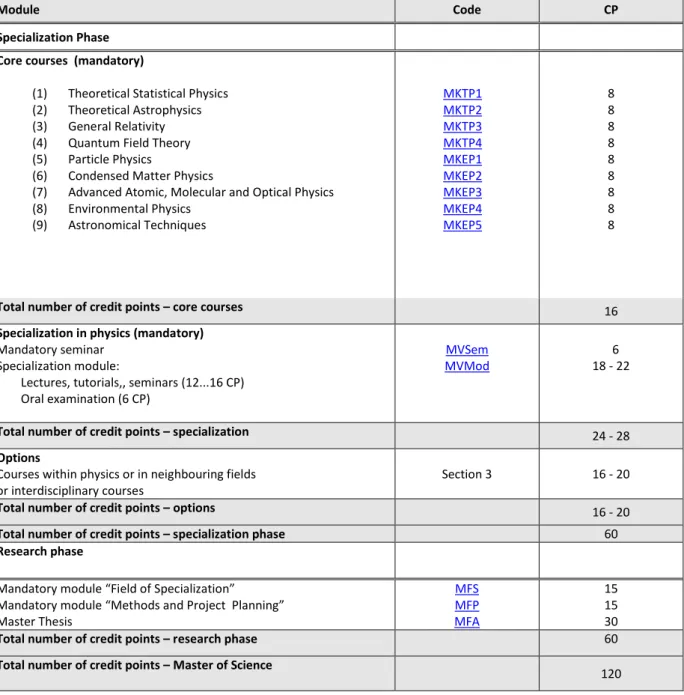
Table 1.1: Overview of the master degree programme
Module Code CP
Specialization Phase Core courses (mandatory)
(1) Theoretical Statistical Physics (2) Theoretical Astrophysics (3) General Relativity (4) Quantum Field Theory (5) Particle Physics
(6) Condensed Matter Physics
(7) Advanced Atomic, Molecular and Optical Physics (8) Environmental Physics (9) Astronomical Techniques MKTP1 MKTP2 MKTP3 MKTP4 MKEP1 MKEP2 MKEP3 MKEP4 MKEP5 8 8 8 8 8 8 8 8 8
Total number of credit points – core courses 16 Specialization in physics (mandatory)
Mandatory seminar Specialization module:
Lectures, tutorials,, seminars (12...16 CP) Oral examination (6 CP)
MVSem
MVMod 18 - 22 6
Total number of credit points – specialization 24 - 28 Options
Courses within physics or in neighbouring fields
or interdisciplinary courses Section 3 16 - 20 Total number of credit points – options 16 - 20 Total number of credit points – specialization phase 60
Research phase
Mandatory module “Field of Specialization” Mandatory module “Methods and Project Planning” Master Thesis MFS MFP MFA 15 15 30 Total number of credit points – research phase 60 Total number of credit points – Master of Science 120
9 During the first two semesters of the master programme two obligatory core courses totalling 16 CP must be attended and successfully passed. The two courses must be chosen from the list of core courses given in Table 2.1. In case one or several courses have already been passed and used to fulfil the point requirement for the bachelor programme the student is required to choose different courses. Core courses of a given field of specialization can also be selected as part of the Specialization Module.
Note that detailed information on the content of these courses is given in the remainder of this chapter. (Further details can be found in the rules and regulations for the master degree in physics.)
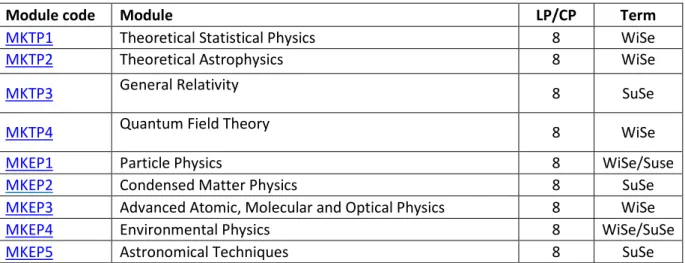
Table 2.1: Core courses
Module code Module LP/CP Term
MKTP1 Theoretical Statistical Physics 8 WiSe
MKTP2 Theoretical Astrophysics 8 WiSe
MKTP3 General Relativity 8 SuSe
MKTP4 Quantum Field Theory 8 WiSe
MKEP1 Particle Physics 8 WiSe/Suse
MKEP2 Condensed Matter Physics 8 SuSe
MKEP3 Advanced Atomic, Molecular and Optical Physics 8 WiSe
MKEP4 Environmental Physics 8 WiSe/SuSe
10
Code: MKTP1 Course title: Theoretical Statistical Physics
Type Lecture with exercises
Language English
Credit points 8
Workload 240 h
Contents • Foundations of statistics, information, entropy • Statistical description of physical systems • Ensembles, density of states
• Irreversibility
• State variables, ideal and real gases, thermodynamic potentials, the fundamental laws of thermodynamics,
• Material constants, equilibrium of phases and chemical equilibrium, law of
mass action, ideal solutions
• Fermi- and Bose-statistics, ideal quantum gases
• Phase transitions, critical phenomena (Ising model)
• Transport theory (linear response, transport equations, master equation,
Boltzmann equation, diffusion)
• The theory of the solid state as an example for a non-relativistic field
theory
• Applications, for example specific heat of solids, thermodynamics of the
early universe etc.
Objectives After completing the course the students
• have a thorough knowledge and understanding of the laws of
thermodynamics and of the description of ensembles in the framework of classical and quantum statistics and there applications to phase transitions, condensed matter, plasma and astrophysics
• have acquired the necessary mathematical knowledge and competence for
an in-depth understanding of this research field,
• have advanced competence in the fields of theoretical physics covered by
this course, i.e. the ability to analyze physical phenomena using the acquired concepts and techniques, to formulate models and find solutions to specific problems, and to interpret the solutions physically and communicate them efficiently,
• are able to broaden their knowledge and competence in this field of
theoretical physics on their own by a systematical study of the literature.
Module parts and
teachings methods • Lecture on “Statistical Physics” (4 hours/week) • Exercise with homework (2 hours/week)
Neccesary and
11
Usability
Form of testing and
examination usually a 2-3 hours written examination.
Term Winter semester
12
Code: MKTP2 Course title: Theoretical Astrophysics
Type Lecture with exercises
Language English
Credit points 8
Workload 240 h
Contents • Radiative processes: Macroscopic radiation measurements; emission,
absorption and scattering, radiative transfer; Bremsstrahlung and synchrotron radiation; ionization and recombination; spectra
• Hydrodynamics: Basics and equations of motion; ideal and viscous fluids
and currents; sound waves, supersonic currents and shock waves; instabilities, convection and turbulence
• Plasma physics: Basics of collision-less plasmas; dielectric tensor;
dispersion relation, longitudinal waves and Landau damping; magneto-hydrodynamic equations; waves in magnetized plasmas; magneto-hydrodynamic waves
• Stellar dynamics: Relaxation; Jeans equations and Jeans theorem;
tensor-virial theorem; equilibrium and stability of self-gravitating systems; dynamical friction; Fokker-Planck approximation
Objectives In this course, students gain a firm understanding of the theoretical concepts of astrophysics, together with their assumptions and limitations. Upon completion of the lecture they are able to apply this knowledge to a wide range of different areas of modern astrophysics and can solve complex problems in this field. They understand the links between different areas of theoretical physics, in particular in view of common techniques and
methods.
Module parts and
teachings methods • Lecture on Theoretical Astrophysics (4 hours/week) • Exercise with homework (2 hours/week)
Neccesary and
useful knowledge • content of PTP1, PTP2, PTP3, PTP4, WPAstro/• to be announced by lecturer MVAstro0
Specialities exercises with homework.
Usability
Form of testing and
examination usually a 2-3 hours written examination
Term Winter semester
13
Code: MKTP3 Course title: General Relativity
Type Lecture with exercises
Language English
Credit points 8
Workload 240 h
Contents • Manifolds
• Geodesics, curvature, Einstein-Hilbert action
• Einstein equations • Cosmology
• Differential forms in General Relativity • The Schwarzschild solution
• Schwarzschild black holes
• More on black holes (Penrose diagrams, charged and rotating black holes) • Unruh effect and hawking radiation
Objectives After completing the course the students
• have a thorough knowledge and understanding of Einstein’s theory of
General Relativity including the necessary tools from differential geometry and applications such as black holes, gravitational radiation and cosmology,
• have acquired the necessary mathematical knowledge and competence for
an in-depth understanding of this research field,
• have advanced competence in the fields of theoretical physics covered by
this course, i.e. the ability to analyze physical phenomena using the acquired concepts and techniques, to formulate models and find solutions to specific problems, and to interpret the solutions physically and communicate them efficiently,
• are able to broaden their knowledge and competence in this field of
theoretical physics on their own by a systematical study of the literature.
Module parts and
teachings methods • Lecture on “General Relativity” (4 hours/week) • Exercise with homework (2 hours/week)
Neccesary and
useful knowledge • content of PTP1, PTP2, PTP3, PTP4• announced by lecturer
Specialities exercises with homework.
Usability
Form of testing and
examination usually a 2-3 hours written examination
Term Summer semester
14
Code: MKTP4 Course title: Quantum Field Theory (QFT1)
Type Lecture with exercises
Language English
Credit points 8
Workload 240 h
Contents • Quantizing covariant field equations
• Interacting fields, S-matrix, LSZ
• Invariant Perturbation Theory • Feynman rules, cross sections • Path integral formulation of QFT • Renormalization of scalar theories • Lorentz group
• Dirac equation • Feynman rules
• Path integral of fermions
Objectives After completing the course the students
• have a thorough knowledge and understanding of relativistic field
equations and the theory of free quantum fields,
• will be able to use Feynman rules to calculate on the tree level scattering
amplitudes and cross sections for Φ4-theory and for simple reactions in
QED,
• have acquired the necessary mathematical knowledge and competence for
an in-depth understanding of this research field,
• have advanced competence in the fields of theoretical physics covered by
this course, i.e. the ability to analyze physical phenomena using the acquired concepts and techniques, to formulate models and find solutions to specific problems, and to interpret the solutions physically and communicate them efficiently,
• are able to broaden their knowledge and competence in this field of
theoretical physics on their own by a systematical study of the literature.
Module parts and
teachings methods • Lecture on “Quantum Field Theory 1” (4 hours/week) • Exercise with homework (2 hours/week)
Neccesary and
useful knowledge • content of PEP3, PTP4, • announced by lecturerMKTP1
Specialities exercises with homework.
Usability
Form of testing and
15
16
Code: MKEP1 Course title: Particle Physics
Type Lecture with exercises
Language English
Credit points 8
Workload 240 h
Contents The focus of the lecture are the experimental tests of the building blocks of matter and their fundamental interactions:
• Test of QED in electron-positron annihilation
• Probing the structure of the nucleon • Strong interaction
• Weak interaction: charged and neutral currents
• Electro-weak unification: The Standard Model
• Flavour oscillations and CP violation • Physics beyond the Standard Model • Particle physics and cosmology
Objectives After completing this course students
• have acquired basic knowledge about the building blocks of matter, the
fundamental interactions and open questions in particle physics,
• can describe experimental methods to probe the structure of matter and
analyse experimental data,
• are able to perform simple calculations to describe particle interactions.
Module parts and
teachings methods • Introductory Lecture on Experimental Particle Physics (4 hours/week) • Exercises with homework (2 hours/week)
Neccesary and
useful knowledge • content of PEP4, PEP5, PTP4• announced by lecturer
Specialities exercises with homework.
Usability
Form of testing and
examination usually a 2-3 hours written examination
Term Winter semester/Summer semester
17
Code: MKEP2 Course title: Condensed Matter Physics
Type Lecture with exercises, seminar
Language English
Credit points 8
Workload 240 h
Contents • Structure of solids in real and reciprocal space • Lattice dynamics and phonon band structure • Thermal properties of insulators
• Electronic properties of metals and semiconductors: band structure and
transport
• Optical properties from microwaves to UV • Magnetism
• Superconductivity
• Defects, surfaces, disorder
(each chapter includes experimental basics)
Objectives After completing the course the students
• have a thorough knowledge and understanding of the fundamentals of
condensed matter physics.
• they understand the principles of formation of condensed matter and have
learnt experimental methods to study structural properties. They are familiar with the reciprocal space.
• they understand fundamental electronic models, become aquainted with
bandstructure and can describe simple crystalline materials as metals, seminconductors, and insulators.
• they can apply the basic concepts to understand optical and magnetic
properties of matter and superconductivity.
• they know the relevant experimental methods for probing structural,
optical, magnetic, and electronic properties of condensed matter and can analyse the experimental results.
• get insight into modern trends in experimental condensed matter physics.
Module parts and
teachings methods • Lecture on Condensed Matter Physics (4 hours/week) • Exercise with homework (2 hours/week)
Neccesary and
useful knowledge • content of PEP1• to be announced by lecturer-PEP5
Specialities exercises with homework.
Usability
Form of testing and
18
19
Code: MKEP3 Course title: Advanced Atomic, Molecular and Optical Physics
Type Lecture with exercises
Language English
Credit points 8
Workload 240 h
Contents • Review of basic quantum mechanics
• Dirac equation and relativistic corrections
• Quantization of the electromagnetic field and consequences
• Many-electron atoms
• Molecular structure
• Interaction with electromagnetic fields
• Time-dependent processes
• Scattering and collisions
• Quantum statistics and quantum gases
• AMO Physics in Heidelberg (with laboratory visits)
Objectives After completing this course the students will be able to
• describe the experimental and theoretical concepts of modern atomic,
molecular and optical physics,
• analyse standard experimental approaches of modern atomic, molecular
and optical physics,
• design simple experimental set-ups in modern atomic, molecular and optical physics,
• apply the theoretical methods to simple practical examples.
Module parts and
teachings methods • Lecture (4 hours/week) • Exercise with homework (2 hours/week)
Neccesary and
useful knowledge PEP1-PEP4, PTP1-PTP4
Specialities Exercises with homework.
Usability
Form of testing and
examination Written examination (2 hours).
Term Winter semester
20
Code: MKEP4 Course title: Environmental Physics
Type Lecture with exercises
Language English
Credit points 8
Workload 240 h
Contents • Molecular basis of transport processes Einstein’s approach to Brownian, Fokker-Planck transport of scalar and vectorial quantities, macroscopic properties
• Fluid dynamics conservation laws (mass, momentum, angular momentum,
energy), dimensionless numbers, approximations, turbulence
• Modelling concepts models, ODE- and PDE-formulations, finite automata,
fundamentals of numerical solutions
• Fundamentals of reaction kinetics mass action law, reaction dynamics,
chemical systems
• System Earth and its workings compartments (atmosphere, oceans, land,
cryosphere), fluxes and cycles (energy, water, carbon), the climate machine
Objectives Students achieve a fundamental understanding of the key physical processes and interactions in the Earth surface system and its compartments, as well as of the human impact on these systems and the related societal
implications. They are able to solve basic problems of environmental physics and interpret the results in the context of fundamental questions regarding the physics of the earth surface environments and the methodologies to observe and study those.
Module parts and
teachings methods • Lecture on “Environmental Physics” (4 hours/week) • Exercise with homework (2 hours/week)
Neccesary and
useful knowledge • content of PEP1• to be announced by lecturer-PEP3
Specialities exercises with homework.
Usability
Form of testing and
examination usually a 2-3 hours written examination
Term Winter semester/Summer semester
21
Code: MKEP5 Course title: Astronomical Techniques
Type Lecture with exercises
Language English
Credit points 8
Workload 240 h
Contents • Optical telescopes: optics and characteristic parameters, telescope types,
diffraction, resolution, aberrations and corrections, applications
• Optical detectors: detector types, semiconductors and CCDs, quantum
efficiency, readout, noise sources, multi-chip cameras, applications
• Imaging: techniques, photometry, data reduction and characterisation,
signal-to-noise
• Atmospheric effects and corrections: extinction, turbulence, seeing, active
and adaptive optics, laser guide stars, applications
• Spectroscopy: types of spectrographs and spectrometers, dispersive
elements, integral field units, data reduction and characterisation, applications
• Infrared astronomy: detectors and techniques, sources, applications
• Radio astronomy: detectors and instrumentation, synthesis techniques,
types of radiation and sources, applications
• Astronomical interferometry: wavelength regimes, instrumentation,
applications
• X-ray and gamma-ray astronomy: detectors and instrumentation, types of radiation and sources, applications
• Astroparticle physics: neutrino and Cherenkov detectors, sources and
acceleration mechanisms of neutrinos and cosmic rays, applications
• Gravitational-wave astronomy: detection, sources, applications.
• In-situ exploration and remote sensing.
Objectives After completing this course, the students have firm insight into the concepts, technologies, and the underlying physical principles and limitations of modern observational techniques along with scientific applications. They have knowledge of basic detector designs for different types of radiation and particles. They understand the environmental influence on astronomical observations. They are able to select and judge the adequate observational technique for studying an astronomical object of interest.
Module parts and
teachings methods • Lecture on “Astronomical Techniques” (4 hours/week) • Exercises with homework (2 hours / week)
Neccesary and
useful knowledge • prerequisites: knowledge of the introductory astronomy lectures (MVAstro0 or WPAstro); basic knowledge of electromagnetic radiation
22 both modules. The Laboratory Course Astrophysics is recommended as complementary to the MKEP5 module.
Usability
Form of testing and
examination usually a 2-3 hours written examination
Term Summer semester
23
3. Specialization courses in physics
The specialization part of the master programme in physics comprises the mandatory Advanced Seminar (MVSem) with 6 CP and the mandatory Specialization Module (MVMod). The latter combines sub-modules (lectures and tutorials) totalling between 12 and 16 CP, and is completed by an oral examination with 6 CP. The sub-modules of the Specialization module should be selected from a single specialization field in physics. They may be chosen from the courses listed in this Section, but may also be selected from the list of core courses given in Section 2. The latter is only possible in case that the selected courses are not used to fulfil the core physics requirement of Section 2 and that the courses were not used to fulfil the bachelor requirements.
Note that the modules listed here can also be selected as courses for the Options discussed in Section 4.
While master students are free to make their course choices as they wish, the Department of Physics and Astronomy does recommend that students choose in accordance with the suggested model study plans. These are intended to enable students to construct a coherent and sensible plan for their studies.
In what follows in this Section, the courses are listed according to their respective research fields. Courses that are offered by the Department on a regular basis have been assigned a module code, such as MVAstro1, and are listed in tables at the beginning of each research field description. Note, however, that not all modules will be offered on a regular basis. In particular, the specialization courses, seminars and journal clubs may vary from semester to semester and field to field. Modules offered on an irregular basis are thus summarized in Table 3 and are assigned unspecific, generic module codes, MVMod, MVSem, MVSpec, MVRS and MVJC. The topics that may be offered are listed in the specific paragraphs devoted to these fields; the Department of Physics and Astronomy does guarantee that in every semester a sufficient number of specialization courses, seminars and journal clubs will be offered. Specific details can be found in the departmental course listing that is made available each semester. The number of credit points assigned to specialization courses (MVSpec) can be seen in tables named “specialised lectures and seminars” found at the beginning of each research field section.
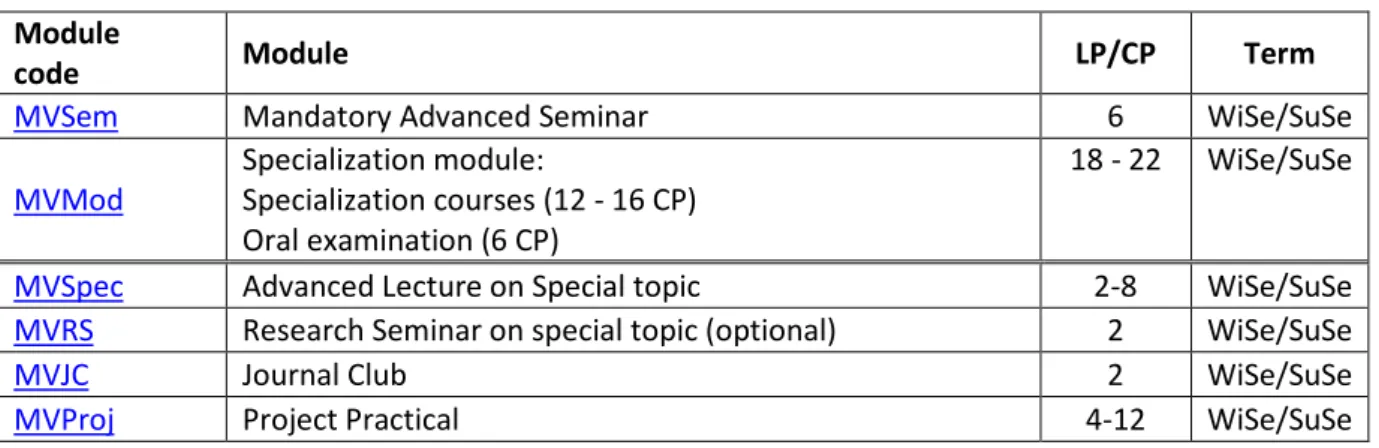
Table 3: Specialization courses, seminars and journal clubs Module
code Module LP/CP Term
MVSem Mandatory Advanced Seminar 6 WiSe/SuSe
MVMod Specialization module: Specialization courses (12 - 16 CP) Oral examination (6 CP)
18 - 22 WiSe/SuSe
MVSpec Advanced Lecture on Special topic 2-8 WiSe/SuSe
MVRS Research Seminar on special topic (optional) 2 WiSe/SuSe
MVJC Journal Club 2 WiSe/SuSe
24
Code: MVSem Course title: Mandatory Advanced Seminar
Type Mandatory Seminar
Language English
Credit points 6
Workload 180 h
Contents • Preparation and presentation of an advanced topic in experimental or
theoretical physics or another physics related area; during the seminar about 12 talks on a specific research field are given and actively discussed by all course participants.
• Beside the oral presentation of the research topic also is write-up of the presented talk is required.
Objectives After completion of this module, the student has a detailed understanding of the intentions and difficulties of modern research in physics or another physics related area. The student has learned how to handle modern literature and how to extract information from present-day physics publications.
Module parts and
teachings methods • Advanced Seminar (mandatory)
Neccesary and
useful knowledge • general knowledge about the research field discussed.• to be announced by lecturer Specialities
Usability
Form of testing and
examination presentation and write-up as well as participation in discussions.
Term Winter semester/Summer semester
25
Code: MVMod Course title: Specialization Module
Type Lectures and tutorials
Language English
Credit points 18 - 22
Workload 540-660 h
Contents Special topics on a particular research area. The exact modules can be chosen freely by the student. It is recommended to follow the selection of the corresponding model study plan.
Objectives After completion of the Specialization Module, the student has gained advanced knowledge about a specific research field. The student also is able to understand the content of the individual modules in a larger context, and he or she is able to transfer some of this knowledge to other fields of physics.
Module parts and
teachings methods • Several modules from a single specialization field selected by the student and totalling between 12 and 16 CP. The courses can be selected from the list of specialization courses in Section 3. Core physics courses are also eligible if they have not already been used.
Neccesary and
useful knowledge • general knowledge about the research field discussed• to be announced by lecturer Specialities
Usability
Form of testing and
examination The single sub-modules have to be passed individually. The complete module is graded by the oral examination after all sub-modules have been passed.
Term Winter semester/Summer semester
26
Code: MVSpec Course title: Advanced Lecture on Special Topic
Type Lecture
Language English
Credit points 2 - 8
Workload 60 - 240 h
Contents Special topics on a particular research area
Objectives The student has gained advanced knowledge about a specific research field.
Module parts and
teachings methods Advanced Lecture on Special Topic
Neccesary and
useful knowledge • general knowledge about the research field discussed.• to be announced by lecturer Specialities
Usability
Form of testing and
examination defined by lecturer before beginning of course
Term Winter semester/Summer semester
27
Code: MVRS Course title: Research Seminar (optional)
Type Seminar
Language English
Credit points 2
Workload 60 h
Contents Preparation and presentation of an advanced topic in experimental or theoretical physics or another physics related area; during the seminar about 12 talks on a specific research field are given and actively discussed by all course participants.
Objectives The student has gained a deeper understanding of the intentions and difficulties of modern research in physics or another physics related area. He or she has learned how to handle modern literature and how to extract information from present-day physics publications.
Module parts and
teachings methods Advanced Seminar
Neccesary and
useful knowledge • general knowledge abo• to be announced by lecturerut the research field discussed Specialities
Usability
Form of testing and
examination presentations and participation in discussions.
Term Winter semester/Summer semester
28
Code: MVJC Course title: Journal Club
Type Seminar
Language English
Credit points 2
Workload 60 h
Contents • Joint reading of current publications on a specific research area in physics
or another physics related area. Papers are introduced by participants of the course who also lead the discussion
• Short introductory lectures on the different topics discussed may be given
by the lecturer(s) of the course.
Objectives The student has achieved a deeper understanding of the intentions and difficulties of modern research in physics or another physics related area, and has trained how to handle modern literature and how to extract information from present-day physics publications.
Module parts and
teachings methods Journal Club
Neccesary and
useful knowledge • general knowledge about the research field • to be announced by lecturer discussed.
Specialities Usability
Form of testing and
examination presentation and participation in discussions.
Term Winter semester/Summer semester
29
Code: MVProj Course title: Project Practical
Type Practice Course
Language English
Credit points 4 - 12
Workload 120 h - 360 h
Contents • Project work on a limited topic or collaboration in ongoing research. • The student will collaborate with members of a research group and pursue
a well-defined project, which can include literature research, experimental work, or theoretical studies.
Objectives After completion of this module
• the student become exposed to scientific conduct,
• he or she has become acquainted with a current research topic,
• he or she has acquired technical skills that will be useful for the later
research phase.
Module parts and
teachings methods • Project practical in a research group. Upon request also internships in nonuniversity research institutions or in industry are possible, if supervised by a -faculty member.
• The duration of a project can be chosen freely. The contact time is
approximately 90 h in a 4 CP project. 12 CP are equal to a work load of about 8 weeks. The module may span across two subsequent semesters.
Neccesary and
useful knowledge • general knowledge about the research field discussed.• to be announced by practical supervisor
Specialities The student can pursue up to three independent research projects with a minimum of 4 CP each and a maximum of 12 CP for all projects together.
Usability
Form of testing and
examination defined by lecturer before beginning of practical, no grades will be given
Term Winter semester/Summer semester
30
3.1 Astronomy and Astrophysics
Table 3.1.1: Specialization Astronomy and Astrophysics
Module code Module LP/CP Term
MVAstro0 Introduction to Astronomy and Astrophysics 8 WiSe
MVAstro1 Astronomical Techniques (compact) 6 WiSe
MVAstro2 Stellar Astronomy and Astrophysics 6 SuSe
MVAstro3 Galactic and Extragalactic Astronomy 6 SuSe
MVAstro4 Cosmology 6 WiSe
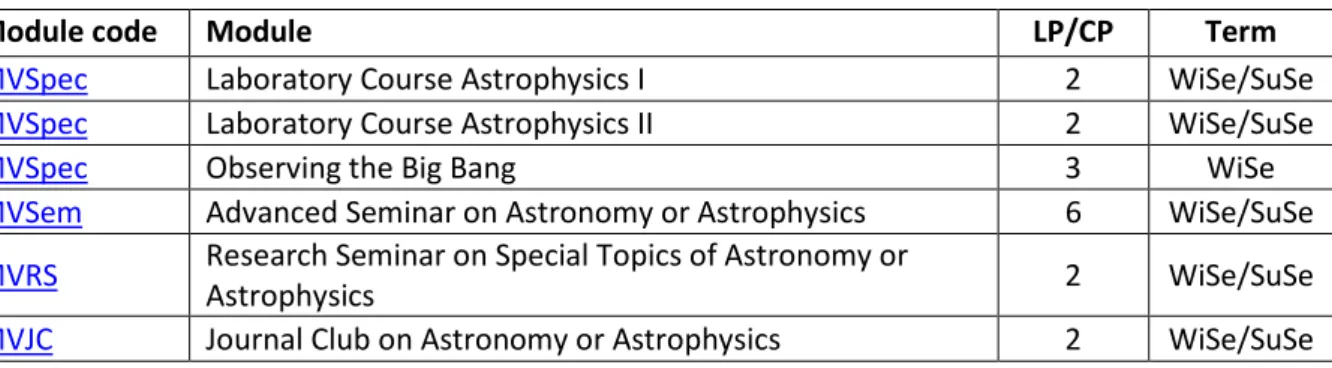
Table 3.1.2: Specialised lectures and seminars
[The lectures and seminars listed here will be offered on an irregular basis]
Module code Module LP/CP Term
MVSpec Laboratory Course Astrophysics I 2 WiSe/SuSe
MVSpec Laboratory Course Astrophysics II 2 WiSe/SuSe
MVSpec
Observing the Big Bang 3 WiSe
MVSem Advanced Seminar on Astronomy or Astrophysics 6 WiSe/SuSe
MVRS Research Seminar on Special Topics of Astronomy or Astrophysics 2 WiSe/SuSe
31 [Beginning: winter semester]
Study block 1st Semester 2nd Semester 3rd Semester 4th Semester
Core courses
& research modules Theoretical Astrophysics (8 CP MKTP2) Astronomical Techniques (8 CP MKEP5)
Scientific Specialization
(15 CP MFS) Methods and Project
Planning (15 CP MFP) Master Thesis (30 CP MFA) Specialization Advanced Seminar (6 CP MVSem) MVMod: 12 CP + 6 P = 18 CP Cosmology (6 CP MVAstro4)
Stellar Astronomy and Astrophysics (6CP MVAstro2)
or Galactic and Extragalactic
Astronomy (6 CP MVAstro3) Oral examination 6 CP Options General Relativity (8CP MKTP3)
Interdisciplinary courses, transferable skills, professional key competences and specific additional technical competences
Total CPs min. 60 CP 30 CP 30 CP
Table 3.1.4 MSc Model study plan “Astronomy/Astrophysics”
[Beginning: summer semester]
Study block 1st Semester 2nd Semester 3rd Semester 4th Semester
Core courses
& research modules Astronomical Techniques (8 CP MKEP5)
Theoretical Astrophysics (8 CP MKTP2)
Scientific Specialization
(15 CP MFS) Methods and Project
Planning (15 CP MFP) Master Thesis (30 CP MFA) Specialization Advanced Seminar (6 CP MVSem) MVMod: 12 CP + 6 P = 18 CP Stellar Astronomy and Astrophysics (6CP MVAstro2)
or
Galactic and Extragalactic Astronomy (6 CP MVAstro3) Cosmology (6 CP MVAstro4) Oral examination 6 CP Options General Relativity (8CP, MKTP3)
Interdisciplinary courses, transferable skills, professional key competences and specific additional technical competences
32
Code: MVAstro0 Course title: Introduction to Astronomy and Astrophysics
Type Lecture with exercises
Language English
Credit points 8
Workload 240 h
Contents Lecture Introduction to "Astronomy and Astrophysics"
• Astronomical basics: astronomical observations, methods and instruments;
orientation at the celestial sphere; fundamental terms of electromagnetic radiation; distance determination, Earth-Moon system; terrestrial and gas planets, small bodies; extra-solar-planets
• Inner structure of stars: state variables, stellar atmospheres and line
spectra; Hertzsprung-Russell diagram; fundamental equations, energy transfer and opacity; nuclear reaction rates and tunnelling; nuclear fusion reactions
• Stellar evolution: Main sequence, giants and late phases; white dwarfs,
Chandrasekhar limit; supernovae, neutron stars, Pulsars and supernova remnants; binaries and multiple systems; star clusters
• Interstellar medium: cold, warm, hot gas phases dust, cosmic rays,
magnetic fields; ionization and recombination, Stroemgren spheres; heating and cooling; star formation, matter cycle, chemical enrichment
• Galaxies: Structure and properties of normal galaxies and the Milky Way;
scaling relations; integrated spectra, luminosity function; cosmological evolution of star formation; Black Holes in galaxies, active galaxies and their properties, unified models
• Galaxy clusters: optical properties and cluster gas; hydrostatic model;
scaling relations; number densities and evolution
• Gravitational lensing: Concepts, mass distribution in galaxies and galaxy
clusters; cosmological lensing effect
• Large scale distribution of galaxies and gas: Structure in the spatial galaxy
distribution; redshift effects; biasing; Lyman-α-forest; Gunn-Peterson effect and cosmic reionization
• Cosmology: Friedmann-Lemaître models, cosmological standard model;
origin and evolution of structures; halos of Dark Matter; Formation of galaxies
Objectives The students have gained basic knowledge and understanding of astronomical objects, measuring units and methods, and the relevant astrophysical processes. They have a firm grasp of the fundamental
interrelations of objects and processes on different scales. They are able to reproduce the basic features of the modern world view including the physical reasoning, and connect astronomical and astrophysical phenomena to previously acquired knowledge in physics.
33
teachings methods hours/day: 3 weeks block course in Sept./Oct.)
Neccesary and
useful knowledge Necessary useful knowledge is basic knowledge in physics and mathematics, especially mechanics, electromagnetic radiation, thermodynamics Recommended literature will be announced by lecturer
Specialities block course, exercises with homework, equivalent to BSc-Module parts WPAstro 1+2.
Usability
Form of testing and
examination defined by lecturer before beginning of course
Term Winter semester
34
Code: MVAstro1 Astronomical Techniques (Compact)
Type Lecture and laboratory course
Language English
Credit points 6
Workload 180 h
Contents Module Part 1: Lecture "Astronomical Techniques (Compact)" (4 CP)
• Signals, optics, atmosphere (3): types of measurable signals, flux,
geometrical optics, optical elements, Rayleigh criterion, atmospheric effects, seeing, refraction, airmass, speckles and lucky imaging, optical aberrations and their correction.
• Telescope design, mounts, observatory engineering (1): types of mounts,
telescope foci, applications, space telescopes, mirror designs, local climate control, site selection criteria.
• Adaptive optics (1): Basics; isoplanatism, guide stars, wave front sensors;
applications.
• Detectors (2): solid-state crystals, types of semiconductors,
photoconductors, MOS capacitors, photomultipliers, photometers, detector characterization, CCDs.
• CCD data processing, photometry, spectroscopy (4): Response function,
preprocessing, combining images, digital photometry, time series, surveys, extinction, transformation to a standard system. Dispersing elements; slitless, slit, fiber, & IFU spectroscopy, applications.
• Other wavelength regions (2): IR, radio, X-ray, and gamma ray detectors
and applications.
• Astroparticle telescopes, gravitational waves, in-situ exploration (2):
Cherenkov and neutrino detectors; gravitational waves; remote sensing, in-situ exploration, examples.
Module Part 2: Astrophysical Laboratory Course II (2 CP)
By means of well-posed astrophysical problems on the following topics advanced astronomical/astrophysical techniques concerning sampling, data bases and statistical methods will be trained:
• Spectroscopic observations: observation, data reduction, astrophysical
interpretation
• optical design: construct a telescope, image errors, corrections for Hubble
space telescope;
• extrasolar planets: Discovering methods, properties and limitations, high
precision photomety;
• Galaxy evolution: Morphological types, statistical properties, biases,
quasar properties;
• Observational cosmology: standard candles, Cosmic microwave
35 concepts, technologies, and the underlying physical principles and
limitations of modern observational techniques along with scientific applications. They have knowledge of basic detector designs for different types of radiation and particles. They have gained practical experience in taking, reducing, and interpreting observational data. They understand the environmental influence on astronomical observations.
Module parts and
teachings methods • Lecture on Observational Methods (2 hours/week) • Exercises (1 hour / week)
• Laboratory Course (1 week block course)
Neccesary and
useful knowledge • Knowledge of the introductory astronomy lectures “Introduction to Astronomy and Astrophysics I and II” (WPAstro or MVAstro0).
• Recommended literature:
- Chromey: To Measure the Sky (CUP).
- Kitchin: Astrophysical Techniques (CRC Press).
Specialities Exercises; laboratory course (a 1 week block course). Credit points can only be obtained for either MVAstro1 or for MKEP5, but not for both due to topical overlap.
Usability
Form of testing and
examination written exam at the end of the course.
Term Winter semester
36
Code: MVAstro2 Course title: Stellar Astronomy and Astrophysics
Type Lecture with exercises, seminar
Language English
Credit points 6
Workload 180 h
Contents - Module Part 1: Lecture “Stellar Astronomy and Astrophysics“ (4 CP)
• Structure and evolution of stars (5): Stellar structure equations, energy
transfer, stellar models; evolution of stars with different masses; stellar pulsations; degenerated equation of state; evolution of binary systems; final stages and supernovae
• Nuclear processes and element formation (3): Fusion processes, cross sections and tunneling; neutrinos as tracers of nuclear fusion processes; production of higher order elements, resonances; r- and s-process
• Stellar atmospheres (5): radiative transfer, grey atmosphere, local
thermodynamic equilibrium. Theory of line spectra; determination of stellar parameters using spectral analysis; stellar winds
• Formation of stars and planets (2): Conditions for star formation, metals,
dust and molecular clouds; early phases of star formation, proto-stellar discs; planet formation, extrasolar planets; enrichment with heavy elements - Module Part 2: Seminar (2 CP)
• Presentations and discussions on actual topics in stellar astronomy and
astrophysics
Objectives After completing this course, the students have a firm grasp of the physical processes determining the inner structure of stars, the observational properties including radiative transfer in the atmosphere, and the
evolutionary states. They have a basic understanding of the star formation process in the interstellar medium, and they are able to reproduce the observational properties of stars in the Hertzsprung-Russell-Diagram.
Module parts and
teachings methods • Lecture on Stellar Astronomy and Astrophysics (2 hours/week) • Exercise (1 hour/week)
• Seminar on Special Topic in Stellar Astronomy and Astrophysics (2
hours/week)
Neccesary and
useful knowledge • content of WPAstro/• to be announced by lecturerMVAstro0, MKTP2
Specialities exercises with homework
Usability
Form of testing and
examination defined by lecturer before beginning of course
Term Summer semester, sometimes the lecture part of this module is offered as block course
38
Code: MVAstro3 Galactic and Extragalactic Astronomy
Type Lecture with exercises, seminar
Language English
Credit points 6
Workload 180 h
Contents Module Part 1: Lecture “Galactic and Extragalactic Astronomy” (4 CP)
• Galaxy types and classification, correlations with physical properties,
stellar populations, population synthesis, chemical evolution concepts and models (2);
• Milky Way (3): halo, bulge / pseudo bulge, central black hole, thin and
thick disk, spiral structure, star clusters, star formation history and chemical enrichment, formation scenarios (e.g., Eggen-Lynden-Bell-Sandage), multi-phase interstellar medium, dust, Galactic fountain, satellites, substructure problem, Local Group;
• Spiral and elliptical galaxies (4): Surface photometry, profiles, origin of
spiral structure, mass measurement methods, rotation / velocity dispersion, Tully-Fisher / Faber-Jackson relation, fundamental plane, super massive black holes, active galaxies;
• Groups and clusters (3): morphology-density relation etc., mass
measurements, gravitational lensing, luminosity functions, interactions; intergalactic gas; dark matter;
• Growth of structure (3): Origin of matter and elements, large
-scale-structure formation, large-scale matter distribution, redshift surveys, weak lensing, galaxy formation and evolution, red / blue sequence, downsizing, scaling relations, Butcher-Oemler effect, cosmic star formation history, Lyman alpha forest, high-redshift universe, reionization, problems in galaxy formation.
Module Part 2: Seminar (2 CP)
• Presentations and discussions on selected topics in Galactic and
extragalactic astronomy
Objectives When successfully completing this course, the students are able to report on the properties of the wide range of galaxy types, understand their origin and evolution, and can elucidate the physical factors governing their evolution. They understand the main physical processes that shape the appearance of galaxies and galaxy clusters. They know about the connection between cosmological structure formation and the populations of visible objects. They have gained experience in applying dimensional and scaling arguments to estimate the relative importance of different physical processes.
Module parts and
teachings methods • Lecture on “Galactic and Extragalactic Astronomy” (2 hours/week)• Exercise (1 hour/week)
• Seminar on selected topics in “Galactic and Extragalactic Astronomy” (2
39
useful knowledge • Recommended literature: Sparke & Gallagher: “Galaxies in the Universe”
(CUP)
Specialities exercises with homework
Usability
Form of testing and
examination defined by lecturer before beginning of course
Term Summer semester, sometimes lecture part is offered as block course
40
Code: MVAstro4 Cosmology
Type Lecture with exercises, seminar
Language English
Credit points 6
Workload 180 h
Contents Module Part 1: Lecture “Cosmology” (4 CP)
• Homogeneous and isotropic cosmology (4): Friedmann-Lemaître models,
geometry, redshift and dynamics; parameters, distance measures and ages; thermal evolution, freezing out of reactions; primordial nucleo-synthesis and recombination
• Inhomogeneities in the universe (5): Evolution of density and velocity
perturbations; power spectra, Zel’dovich approximation and nonlinear evolution; spherical collapse model and extended Press-Schechter formalism
• Early universe (3): Structures in the Cosmic Microwave Background,
simplified theory, power spectrum and interpretation; basics of cosmic inflation; accelerated expansion, dark energy and possible cosmological effects
• Late universe (3): Structures in the evolved universe; large scale gas and
galaxy distribution, power spectrum and interpretation; gravitational lenses, cosmic shearing and amplification; evolution of the galaxy cluster population Module Part 2: Seminar (2 CP)
• Presentations and discussions on current topics in cosmology
Objectives In this course, students gain fundamental understanding of the cosmological standard model and the cosmological evolution, including the impact of the basic observations and the connection to the physical framework. They gain a solid overview of the empirical basis of modern cosmology.
Module parts and
teachings methods • Lecture on “Cosmology” (2 hours/week) • Exercise (1 hour/week)
• Seminar on Special Topic in “Cosmology” (2 hours/week)
Neccesary and
useful knowledge • Necessary knowledge: content of • Literature: to be announced by lecturerWPAstro/MVAstro0, MKTP2
Specialities exercises with homework
Usability
Form of testing and
examination defined by lecturer before beginning of course
Term Winter semester, sometimes also offered as block course
41
3.2 Atomic, Molecular and Optical Physics
Table 3.2.1: Specialization Atomic, Molecular and Optical Physics
Module code Module LP/CP Term
MVAMO1 Experimental Optics and Photonics 4 WiSe
MVAMO2 Advanced Quantum Theory 4 SuSe
MVAMO3 Experimental Methods in Atomic & Molecular Physics 4 SuSe
Table 3.2.2: Specialised lectures and seminars
[The lectures and seminars listed here will be offered on an irregular basis]
Module code Module LP/CP Term
MVSpec Quantum Gases 3 WiSe/SuSe
MVSpec Quantum Information 3 WiSe/SuSe
MVSpec Special Topics in Atomic and Molecular Physics 3 WiSe/SuSe
MVSpec Quantum Dynamics and Control 3 WiSe/SuSe
MVSpec Quantum Electrodynamics 3 WiSe/SuSe
MVSpec Precision Experiments in AMO Physics 3 WiSe/SuSe
MVSpec Atomic and Molecular Spectroscopy 3 WiSe/SuSe
MVSpec Atom Light Interactions 3 WiSe/SuSe
MVSpec Theoretical Quantum Optics 3 WiSe/SuSe
MVSpec Laser Physics 3 WiSe/SuSe
MVSpec Atoms and Molecules in Strong Fields 3 WiSe/SuSe
42 [Beginning: winter semester]
Study block 1st Semester 2nd Semester 3rd Semester 4th Semester
Core courses & research modules
Advanced Atomic, Molecular and Optical Physics
(8 CP MKEP3) Theoretical Statistical Physics
(8 CP MKTP1)
Scientific Specialization
(15 CP MFS) Methods and Project
Planning (15 CP MFP) Master Thesis (30 CP MFA) Specialization Advanced Seminar (6 CP MVSem) MVMod: 12 CP + 6 P = 18 CP
Experimental Optics and Photonics (4CP MVAMO1)
Advanced Quantum Theory (4 CP MVAMO2) Experimental Methods in Atomic, Molecular and optical
Physics (4 CP MVAMO3) Oral examination 6 CP
Options
Condensed Matter Physics (8 CP MKEP2)
Interdisciplinary courses, transferable skills, professional key competences and specific additional technical competences
Total CPs min. 60 CP 30 CP 30 CP
Table 3.2.4 MSc Model study plan “Atomic, Molecular and Optical Physics”
[Beginning: summer semester]
Study block 1st Semester 2nd Semester 3rd Semester 4th Semester
Core courses & research modules
Advanced Atomic, Molecular and Optical Physics
(8 CP MKEP3) Theoretical Statistical Physics
(8 CP MKTP1)
Scientific Specialization
(15 CP MFS) Methods and Project
Planning (15 CP MFP) Master Thesis (30 CP MFA) Specialization Advanced Seminar (6 CP MVSem) MVMod: 12 CP + 6 P = 18 CP Advanced Quantum Theory
(4 CP MVAMO2) Experimental Methods in Atomic, Molecular and optical
Physics (4 CP MVAMO3)
Experimental Optics and Photonics (4CP MVAMO1) Oral examination 6 CP
Options
Condensed Matter Physics (8 CP MKEP2)
Interdisciplinary courses, transferable skills, professional key competences and specific additional technical competences
43
Code: MVAMO1 Course title: Experimental Optics and Photonics
Type Lecture with exercises
Language English
Credit points 4
Workload 120 h
Contents • Ray optics
• Wave optics
• Beam optics, Gaussian optics • Fourier optics
• Interference and coherence • Photons and atoms
• Laser theory and lasertypes
• Ultra-short laser pulses
• Non-linear optics
• Modern applications
Objectives After completing this course the students will be able to
• describe the basic principles and experimental methods of optics and
photonics,
• analyse standard experimental approaches to optics and photonics,
• design experimental set-ups in optics and photonics,
• apply the methods to simple experimental examples.
Module parts and
teachings methods • Lecture (2 hours/week) • Exercise with homework (1 hours/week)
Neccesary and
useful knowledge PEP1-PEP4, PTP1-PTP4
Specialities exercises with homework
Usability
Form of testing and
examination To be defined by lecturer before beginning of course.
Term Winter semester
44
Code: MVAMO2 Course title: Advanced Quantum Theory
Type Lecture with exercises
Language English
Credit points 4
Workload 120 h
Contents Selection out of the topics:
• Quantum theory of matter (Schrödinger equation, bosons and fermions,
spin and statistics)
• Time-dependent quantum phenomena (scattering, atoms and molecules in
external fields)
• Theory of quantum states (system and environment, pure and mixed
states, density operator, entanglement, quantum information)
• Quantum theory of light and matter (quantized fields, interaction with
atoms, quantum optics)
• Open quantum systems (matter and radiation, decoherence, non-equilibrium phenomena)
• Relativistic quantum theory (Dirac equation, relativistic light-matter
interaction)
Objectives After completing this course the students will be able to
• describe the fundamental concepts of quantum physics and the relevant
theoretical methods,
• analyse standard experimental approaches using the relevant theoretical
methods,
• solve problems in quantum physics and quantum optics,
• apply the relevant theoretical methods to model concrete physical
situations.
Module parts and
teachings methods • Lecture (2 hours/week) • Exercise (1 hours/week)
Neccesary and
useful knowledge PEP1-PEP4, PTP1-PTP4
Specialities -
Usability
Form of testing and
examination To be defined by lecturer before beginning of course
Term Summer semester
45
Code: MVAMO3 Course title: Experimental Methods in Atomic, Molecular and Optical Physics
Type Lecture with exercises
Language English
Credit points 4
Workload 120 h
Contents Selection out of the following topics:
• Atom-light interactions
• Spectroscopy and metrology • Matter waves
• Cooling and trapping • Mass measurements
• Single atoms and molecules • Cavity Quantum Electrodynamics • Quantum information
• Quantum gases • Collisions
• Fento- and attosecond processes
Objectives After completing this course the students will be able to
• describe modern aspects of experimental research in atomic, molecular
and optical physics,
• analyse standard experimental approaches of atomic, molecular and
optical physics,
• design simple experimental set-ups in atomic, molecular and optical
physics,
• apply the methods to simple practical examples.
Module parts and
teachings methods • Lecture (2 hours/week) • Exercise (1 hours/week)
Neccesary and
useful knowledge PEP1-PEP4, PTP1-PTP4
Specialities -
Usability
Form of testing and
examination To be defined by lecturer before beginning of course
Term Summer semester
46
3.3 Biophysics
Table 3.3.1: Specialization Biophysics
Module code Module LP/CP Term
MVBP1 Experimental Biophysics 6 WiSe
MVBP2 Theoretical Biophysics 6 SuSe
Table 3.3.2: Specialised lectures and seminars
[The lectures and seminars listed here will be offered on an irregular basis]
Module code Module LP/CP Term
MVSpec Optics in Biophysics 4 WiSe/SuSe
MVSpec Bio-photonics 2 WiSe/SuSe
MVSpec Astrobiophysics III 2 WiSe/SuSe
MVSpec Scientific Visualization 2 WiSe/SuSe
MVSpec Nonlinear Dynamics 2 WiSe/SuSe
MVSpec Stochastic Dynamics 2 WiSe/SuSe
MVSpec Radiation Biophysics 2 WiSe/SuSe
MVSem Advanced Seminar on Biophysics 6 WiSe/SuSe
MVRS Research Seminar on special topics of Biophysics 2 WiSe/SuSe
47 [Beginning: winter semester]
Study block
1st Semester 2nd Semester 3rd Semester 4th Semester
Core courses & research modules
Theoretical Statistical Physics
(8 CP MKTP1) Condensed Matter Physics (8 CP MKEP2)
Scientific Specialization
(15 CP MFS) Methods and Project
Planning (15 CP MFP) Master Thesis (30 CP MFA) Specialization Advanced Seminar (6 CP MVSem) MVMod: 16 CP + 6 P = 22 CP Experimental Biophysics (6CP MVBP1) Advanced Lecture on Special Topics (2 CP MVSpec) Theoretical Biophysics (6CP MVBP2) Advanced Lecture on Special Topics (2 CP MVSpec) Oral examination 6 CP Options
Advanced Atomic, Molecular and Optical Physics
(8 CP MKEP3) Physics of imaging1
(4CP MWInf5)
Interdisciplinary courses, transferable skills, professional key competences and specific additional technical competences
Total CPs min. 60 CP 30 CP 30 CP
Table 3.3.4 MSc Model study plan “Biophysics”
[Beginning: summer semester] Study block
1st Semester 2nd Semester 3rd Semester 4th Semester
Core courses & research
modules
Condensed Matter Physics
(8 CP MKEP2) Statistical Physics Theoretical (8 CP MKTP1) Scientific Specialization (15 CP MFS) Methods and Project Planning (15 CP MFP) Master Thesis (30 CP MFA) Specialization Advanced Seminar (6 CP MVSem) MVMod: 16 CP + 6 P = 22 CP Theoretical Biophysics (6CP MVBP2) Advanced Lecture on Special Topics (2 CP MVSpec) Experimental Biophysics (6CP MVBP1) Advanced Lecture on Special Topics (2 CP MVSpec) Oral examination 6 CP Options Image Processing (7 CP MWInf6) Interdisciplinary courses, transferable skills,
professional key competences and specific additional technical competences.
48
Code: MVBP1 Course title: Experimental Biophysics
Type Lecture with exercises
Language English
Credit points 6
Workload 180 h
Contents • Methods of structural biology (X-Rays, EM, NMR, LM)
• Membranes and biological energy • Measurement of neural activity • Single Molecule Spectroscopy • Imaging of living tissue • Information in living tissue
• Chemo-mechanical coupling
• Catalysis
Objectives After successful finishing of the module
• the students will have advanced knowledge of concepts of experimental
biophysics,
• the students can assess and use current biophysical literature.
Module parts and
teachings methods • Lecture on “Introduction to Biophysics” (4 hours/week) • Exercise (2 hours/week)
Neccesary and
useful knowledge • content of PEP4, UKBio1, UKBio2• to be announced by lecturer
Specialities exercises with homework
Usability
Form of testing and
examination defined by lecturer before beginning of course
Term Winter semester



![Table 3.4.2: Specialization Computational Physics; Specialised lectures and seminars [The lectures and seminars listed here will be offered on an irregular basis]](https://thumb-us.123doks.com/thumbv2/123dok_us/9950097.2889502/51.892.91.789.486.838/specialization-computational-physics-specialised-lectures-seminars-lectures-irregular.webp)
