2. LOSS OF SEAGRASS MEADOWS FROM THE SPANISH
COAST: RESULTS OF THE
PRADERAS
PROJECT
by
Núria Marbà
Mediterranean Institute for Advanced Studies (IMEDEA)
Spanish National Research Council (CSIC)-University of the Balearic Islands (UIB) Esporles, Mallorca, Spain
Rates, Causes and Consequences
Carlos M. Duarte (ed.)Offprint of Chapter
© Fundación BBVA, 2009 www.fbbva.es ISBN: 978-84-96515-84-0
2.1. INTRODUCTION
SEAGRASS MEADOWS CONSTITUTE the dominant ecosystem of shallow sandy
seabeds in all seas, the polar zones excepted, where they fulfill important trophic and structural functions. Since the 1980s, the area of an increasing number of the planet’s seagrass meadows has diminished partially or com-pletely. Strong and intense meteorological perturbations, like hurricanes, and the spread of infections are responsible for some of this decline. However, the main cause of the loss of meadows on a global scale is attributed to perturba-tions of anthropogenic origin, such as coastal eutrophication, arising from the growth and development of the human population. Climate change, as reflect-ed in the increasreflect-ed frequency and intensity of storms and the global warming the planet has experienced in recent decades, may contribute to accelerating seagrass meadow loss. At present, it is difficult to quantify the scale of this loss accurately because the global area occupied by seagrass meadows and the sta-tus of most of them are not known.
In 2006, the BBVA Foundation funded a three-year project as part of its Sec-ond Call for Research Proposals in Conservation Biology titled “Conserva-tion of underwater meadows: the causes of their decreasing size and the effects on ecosystem functions”, known as thePraderas(meadows) project for short. The ultimate aim of this project was to evaluate the conservation status of sea-grass meadows, particularly those of the Spanish littoral zone, to identify the main threats to their conservation, evaluate the relationship between their conservation status and their roles in the ecosystem, and develop management guidelines for their conservation. This chapter presents the results obtained regarding the conservation status ofPosidonia oceanica meadows, describes the principal factors that threaten them, and discusses the future of seagrasses in the light of the global change scenarios predicted for the 21st century.
2.2. SEAGRASS MEADOWS:POSIDONIA OCEANICA
Seagrass meadows are made up of angiosperms, plants with flowers and fruits that can only complete their life cycles in the sea. Four species occur on the Spanish coast:Posidonia oceanica,Cymodocea nodosa,Zostera marina, andZ. noltii. WhileC. nodosa,Z. marina, andZ. noltiiform meadows on the Mediter-ranean and Atlantic coasts, P. oceanica is endemic to the Mediterranean Sea.
P. oceanica meadows occupy some 2,800 km2 of the Spanish Mediterranean
coast at depths between 0 and 45 m, and account for more than 90% of the total area of seagrass meadows along the Spanish coast.
Seagrass landscapes may be continuous or patchy but are usually extensive, composed of apparently identical shoots of a small number of genetically dif-ferentiated individuals, the clones or genets (photo 2.2). Marine angiosperms are clonal plants, whose stems, called rhizomes, spread and ramify across the sediment surface and keep neighboring shoots physiologically connected. Unlike non-clonal plants, in which new individuals arise exclusively by sexu-al reproduction through the germination of seeds, clonsexu-al plants produce most of their new individuals vegetatively by means of rhizomatous spread. This
Photo 2.2: Seagrass meadow ofP. oceanica,Formentera, Balearic Islands. Declared a World Her-itage Site by UNESCO.
form of growth allows marine angiosperms to occupy space with little invest-ment in sexual reproduction. Although sexual reproduction does not con-tribute significantly to the increase or maintenance of shoot abundance in clonal plant populations, it is essential for initiating the formation of new clones and so is also necessary for the development and maintenance of sea-grass beds.
The architectural pattern and growth forms of marine angiosperms are very similar. All species have shoots that are connected to a rhizome fragment from which roots are produced. The flowers or inflorescences sprout from the shoot (photo 2.3.A), and in most marine angiosperm species, includingP. oceanica, they do it laterally, allowing the shoots to survive and grow after flowering. With the exception of one genus (Halophila), all marine angiosperm species have strap-like leaves, with basal meristems. Their great architectural uniformi-ty contrasts with their wide range of sizes and growth rates, which are inverse-ly scaled to species size (Duarte 1991) as a consequence of the greater cost (i.e., carbon and nutrient requirements) of producing bigger modules.P. oceanicais one of the planet’s biggest marine angiosperms, with leaves measuring more than 1 m in length and woody rhizomes of 10 mm diameter (Duarte 1991). The
Photo 2.3.A: Inflorescence ofP. oceanica Photo 2.3.B: Fruits ofP. oceanica,also known as sea olives.
horizontal rhizomes ofP. oceanicagrow between 1 and 6 cm annually and ram-ify once every 25 years on average (Marbà and Duarte 1998). The slow growth ofP. oceanicarhizomes causes a slow radial expansion of its clones.P. oceani-ca, like the rest of its congeneric species growing on the southwest coast of Australia, flowers in the autumn.P. oceanicameadows exhibit scant flowering compared to other marine angiosperm species. Between 1957 and 2004, on average only 17% ofP. oceanicameadows in the western Mediterranean flow-ered in any single year (Díaz-Almela, Marbá, and Duarte 2007a), and in the meadows that did flower an average of only 11% of shoots bore inflorescences. Due to this low flowering intensity and losses of 90% of fruit set (Díaz-Almela, pers. comm.), the rate of formation of newP. oceanica clones is very low, ranging from 0.004 to 0.02 m-2year-1 in years of elevated reproduction
(Díaz-Almela et al. 2008a). The low formation rate of P. oceanica clones is reflected in the genetic structure of seagrass meadows. The genetic study ofP. oceanicameadows demonstrates that genetic diversity, calculated as the num-ber of clones identified with respect to the numnum-ber of shoots sampled, is fairly poor: in an area of 1,600 m2it may vary between 0.1 and 0.75 (Rozenfeld et al.
2007), depending on the meadow. Other genetic research on seagrass meadows shows thatP. oceanicaclones can reach a huge size, and it is not unusual to find genetically identical shoots at locations more than one kilometer apart (Díaz-Almela et al. 2007b). In the seagrass bed of the Es Freus–Ses Salines Marine Reserve (Ibiza–Formentera), a UNESCO World Heritage Site, identical geno-types have even been found in locations 15 km apart (Arnaud-Haond et al., in review).
P. oceanica optimizes its greater investment of resources (carbon and nutri-ents) by producing large modules with very long-lived shoots and clones.P. oceanicahas the longest-living shoots of all marine angiosperms on the plan-et, reaching up to 60 years on average (Marbà et al. 2005). The detection, using molecular techniques, ofP. oceanica clones spreading over dozens of meters and several kilometers of coastline, indicates that they may live for thousands of years. Based on the clonal growth rate of the species and its size, the large
P. oceanicaclone found in Formentera would be between 80,000 and 200,000
years old, making it the oldest organism on the planet (Arnaud-Haond et al., in review). Thousands-of-years-oldP. oceanicameadows have also been iden-tified by measuring the remains of rhizomes and roots in their deepest strata for the quantity of carbon-14 isotope remaining in the tissues (Mateo et al. 1997). Their long life allows the components ofP. oceanicameadows to endure and spread over large areas, despite the species’ low rates of clonal growth and new clone formation.
Due to the slow colonization and growth ofP. oceanicaclones, their meadows take centuries to form. IndeedP. oceanicacolonization times can only be cal-culated using simulation models. From the rules governing the plant’s clonal growth (rate of elongation of the horizontal rhizome, rate and angle of rami-fication, length of the section of rhizome connecting neighboring shoots), it is possible to simulate the spread of individual clones. This exercise reveals that a circular clone ofP. oceanicawould take 100 years to attain a diameter of 8 m (Sintes, Marbà, and Duarte 2006). Models simulating the development of aP.
oceanicameadow composed of several clones growing in accordance with the
species’ growth rules indicate thatP. oceanicawould take 600 years to occupy 60% of the available space (Kendrick, Marbà, and Duarte 2005). The rate of seagrass meadow spread would vary throughout the colonization process. Its coverage would increase much more rapidly during the first 400 years of the meadow’s life than in later years (Kendrick, Marbà, and Duarte 2005), when individuals would have to compete for space. The colonization time of P. oceanica is extremely long and thus its recolonization time in disturbed areas, to the extent that the loss of areas ofP. oceanicais irrecoverable over a human timescale.
2.3. ECOLOGICAL FUNCTIONS OFPOSIDONIA OCEANICA
MEADOWS
P. oceanicameadows perform important ecological functions in the coastal area and on a global scale, over both short and long time periods. The roles of marine angiosperm meadows are described in detail in chapter 3 of this book (Denni-son), and I will confine myself here to describing the long-term importance of P. oceanicabeds, for the invaluable services they provide to the Mediterranean coastal area.P. oceanicameadows sustain a considerable biomass: on average, the leaf biomass of the meadow is 390 g dry weight m-2, and the living biomass of
rhizomes and roots is 1,700 g dry weight m-2(Duarte and Chiscano 1999). The
biomass ofP. oceanicameadows per unit area is similar to that of coral reefs, which ranks them among the marine plant communities that sustain the great-est biomass by area on the planet (Duarte and Chiscano 1999).P. oceanica mead-ows have a three-dimensional structure, forming terraces, channels and barrier reefs that can reach a height of 3-4 m (photo 2.5).P. oceanicameadows accord-ingly modify the seabed topography. This three-dimensional structure arises from the growth of vertical rhizomes and from the fact that spread rates are sim-ilar in an upward and sideways direction (Kendrick, Marbà, and Duarte 2005) and that meadow rhizomes decompose only slowly.
P. oceanicameadows are highly productive systems, fixing 400 g C m-2
annu-ally (Barrón et al. 2006). Although most (80%) of the fixed carbon is respired by the community itself, the net annual production of seagrass meadows is about 72 g C m-2, representing a net carbon fixation 60 times that measured in
coastal marine sediments devoid of vegetation (Barrón et al. 2006). The high productivity of seagrass meadows alters CO2and O2flow rates in the water column. For example, during daytime, the partial pressure of CO2 at the sea–atmosphere interface of Palma Bay (Balearic Islands) is lower in areas with seabeds colonized by seagrass meadows than in areas with seabeds without vegetation (Gazeau et al. 2005).
A large part (42%-62%) of the net carbon fixed in P. oceanica meadows is retained and buried there (Larkum, Orth, and Duarte 2006; photo 2.5). Con-sidering that they occupy an area of 50,000 km2 in the Mediterranean Sea, these meadows bury some 2 Tg C year-1. There are no estimates of the amount
of carbon sequestered in other Mediterranean coastal and oceanic habitats, so it is hard to get an accurate handle on the importance of seagrass meadows as carbon sinks on a basin-wide scale. It must be substantial, however, consider-ing that almost half the carbon sequestered globally in the oceans is buried in coastal plant habitats, and that seagrass species together account for 15% of
the total carbon buried in the ocean (Duarte, Middelburg, and Caraco 2005). HenceP. oceanicameadows absorb and bury a portion of atmospheric CO2, helping with the regulation of the planet’s climate.
P. oceanicameadows prevent coastal erosion. The relief and foliar canopy of the meadows reduce current velocity and, in shallow beds, help calm the swell (Larkum, Orth, and Duarte 2006). P. oceanica barrier reefs, located several meters from the shore, act as a break so the waves reaching the beach are of low intensity. The foliar canopy stimulates the deposition of particles sus-pended in the water through a number of mechanisms. The reduction of water current speed near the foliar canopy enables some suspended particles to be sedimented. Seagrass leaves are surfaces that interrupt the trajectories of sus-pended particles, which consequently end up deposited on top of the sedi-ments (Hendriks et al. 2008). Part of the fauna associated with the meadow, particularly filtering organisms that live on the plant’s leaves, actively trap sus-pended particles. Seagrass meadows retain the deposited particles and sedi-ments that they colonize because the canopy prevents their resuspension, and because they are fixed by the network of rhizomes and roots that form the meadow’s rhizosphere, to a depth of several meters. The effect of seagrass meadows on particle deposition and retention also increases the settling rate of larvae and propagules in this ecosystem. Seagrass meadows, as such, also help to increase marine biodiversity.
Part of a meadow’s net annual production is exported to adjacent systems, among which are emerged beaches and dune systems. After heavy storms in the autumn, whenP. oceanica renews its leaves, leaf litter and rhizome frag-ments pile up on the shore, forming what are known as “banquettes” (photo 2.6). On beaches adjacent to extensive seagrass meadows, these deposits can comprise up to 400 kg dry weight m-1of coastline and amount to 50% of the material produced annually by the adjacent seagrass meadow (Larkum, Orth, and Duarte 2006). This biomass, produced in the meadow, supplies significant quantities of sediment and nutrients to the beach and associated dune system, particularly in regions where sediment production is of biogenic origin, as in the Balearic Islands. Considering that these islands have 100 km of beaches, seagrass meadows provide their sand dune systems with some 100,000 tonnes of biogenic material annually. Furthermore, 10% by weight of the biogenic material deposited on beaches is calcium carbonate originating from the struc-tures of the epiphytic organisms that colonize the leaves and rhizomes of P. oceanica, plus the calcium carbonate precipitated on the leaves (Larkum, Orth, and Duarte 2006; photo 2.7). This suggests that P. oceanica meadows
may provide a substantial amount of the sand on the beaches. Moreover, this P. oceanicadetritus covers the sand of the emerged beach, protecting it from erosion during heavy storms. Some of theP. oceanicadetritus that accumulates on the shore stays in the water, increasing its viscosity and, thereby, reducing the intensity of the swell and also the risk of coastline erosion.
P. oceanicameadows are accordingly a key ecosystem for the functioning of and provision of services to the coastal zone and the Mediterranean basin. Prominent among these services are the burial of atmospheric CO2 and maintenance of beaches, the latter being a vital element for the tourist industry. Conserving these functions and services depends on successfully conserving seagrass meadows.
2.4. THE STATE OF SPANISH COASTAL SEAGRASS MEADOWS: HOW BIG IS THE DECLINE?
Seagrass meadows are extremely vulnerable. Proof is that, since the 1980s, 102 of a total of 176P. oceanicameadows reported in the Mediterranean basin have suffered a decline in the expanse and/or abundance of shoots. More than 50%
Photo 2.7:P. oceanicaleaves colonized by epiphytic organisms with calcium carbonate struc-tures
of the area of 17% of P. oceanica meadows has been lost over this period (Díaz-Almela, unpublished results).
The decline ofP. oceanicameadows tends to be a gradual process. The cause of shrinkage is a progressive loss of shoots, so to prevent losses on a major scale, which are often irretrievable over human timescales, it is crucial to detect the problem at its initial stages. To achieve this means monitoring the state of seagrass meadows, using indicators that can quantify their current status and allow declines to be detected in time. The decline of long-lived seagrass mead-ows, like those of P. oceanica, can be detected early (on a yearly scale) by examining the demographic dynamics of their shoots in permanent plots (Short and Duarte 2001). An annual census of shoots in plots permanently installed in seagrass meadows (photo 2.8) allows to estimate the survival, birth, and death rates of a given population, and thereby its net growth rate, equiv-alent to the difference between birth and death rates. The net growth rate of the population indicates whether the meadow is declining (negative net growth), growing (positive net growth), or stable (net growth = 0).
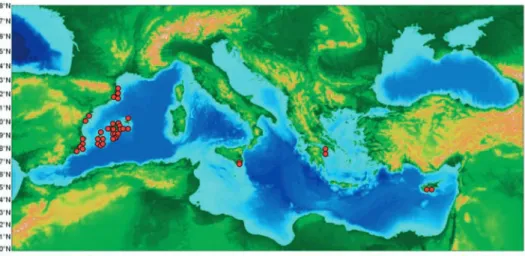
Since the year 2000, the annual demographic balance has been quantified in 46 P. oceanicameadows growing at depths of between 5 and 25 m, 40 of them along the Spanish coast (figure 2.1). The density of their shoots at the beginning of the
Photo 2.8.A: Permanent plots established in a
P. oceanicaseagrass meadow to evaluate the demographic balance of shoots
Photo 2.8.B: Detail of tagged shoots in a P. oceanicatest plot
study varied between 60 and 1,725 shoots m-2. In the last seven years, 67% of
the meadows studied have suffered net losses of shoot density, exceeding 20% in 47% of cases. These losses were observed in seagrass meadows situated not only in coastal areas experiencing strong anthropogenic pressure, but also in protected areas (figure 2.2) like the Cabrera Archipelago National Park (Balearic
Figure 2.1: Distribution of MediterraneanP. oceanicameadows whose demographic status has been evaluated over the past seven years
Figure 2.2: Density of shoots in the seagrass meadow of Es Castell, at a depth of 15 m, Cabrera Archipelago National Park, since the year 2000
Islands), where measures to conserve the marine and terrestrial ecosystems have been in force since 1991. During this period,P. oceanicameadows experienced shoot mortality rates varying between less than 1% year-1(e.g., Es Castell 20 m, Cabrera) and 84% year-1(Pollença Bay, Mallorca), equivalent to absolute shoot mortality rates between 4 and 320 dead shoots m-2year-1(e.g., Es Castell 10 m, Cabrera and La Fossa, Alicante respectively). The mean annual mortality rate in seagrass meadows during the current decade stands at 11%, equivalent to 46 dead shoots m-2year-1. The observed mortality rates indicate thatP. oceanica shoot half-life (i.e., the age to which 50% of a population’s shoots survive) is greater than six years in most meadows, and may even reach 20 years in some sites like Formentera. On the other hand, the annual birth rate of shoots since 2000 has varied from less than 1% (e.g., Es Castell 20 m, Cabrera) to 48% (Pol-lença Bay, Mallorca), resulting in absolute birth rates of less than 2 new shoots m-2year-1(e.g., Es Castell 15 m, Cabrera) and 200 new shoots m-2year-1(Santa María Bay 7 m, Cabrera). In 50% of the seagrass meadows studied, the annual birth rate of shoots during the current decade has been lower than 6% or 25 new shoots m-2year-1. These low shoot birth rates indicate that most P. oceanica populations would take more than a decade to renew their shoots, and more than a century in the case of some off the island of Cabrera. Over the past ten
Photo 2.9:P. oceanicameadow growing on the coastal sea floor along the north coast of Ibiza, Balearic Islands
years, shoot birth rates have lagged mortality rates in most seagrass meadows. Their annual net growth since 2000 has varied between -43% (Pollença Bay, Mallorca) and 46% (e.g., Es Castell 10 m, Cabrera), though most meadows have recorded under -5% annually, equivalent to a net loss of 12 shoots m-2year-1.
Net loss rates also suggest that, if the current environmental conditions persist, seagrass meadows that are in decline will see their shoot density half in less than a decade. In fact, since 2000, some (Pollença Bay, Mallorca; La Fossa, Alicante) have already lost 40% of their shoot density.
These results show that most Spanish coastal seagrass meadows have been declining over the present decade. The rate of decline ofP. oceanicameadows is currently 5% per year, slightly lower than that of corals—the marine ecosystem undergoing the fastest decline—and higher than the global loss rate of marshes and mangrove forests (Duarte et al. 2008). This placesP. oceanica meadows among the most threatened marine ecosystems on the planet. The general decline observed recently in Spanish coastal seagrass meadows may not have begun so recently, however. A retrospective demographic analysis of
27P. oceanicameadows on the Spanish coast showed that 80% of them were
already declining between 1967 and 1992 (Marbà et al. 1996). And the scale of their decline in the present decade is similar to in the past. This suggests that, over the last four decades, either (1) the same pressures have continued bear-ing down on seagrass meadows, or (2) a succession of different pressures have brought about a comparable rate of decline.
2.5. CAUSES OF THE DECLINE IN MEDITERRANEAN SEAGRASS MEADOWS
The current decline of seagrass meadows is due to multiple pressures, princi-pally of anthropogenic origin, that act, frequently simultaneously, on the coastal zone. Most of these pressures also set in train synergistic processes that accelerate the decline when they interact (Duarte 1995). Eutrophication, dis-turbance of sedimentary dynamics, the mechanical destruction of the coastal area, climatic changes such as global warming, and biological perturbations are the main pressures threatening Spanish coastal seagrass meadows.
2.5.1. Eutrophication
The main cause of seagrass meadow decline is eutrophication of the coastal area. This originates from the discharges of agricultural nutrients and
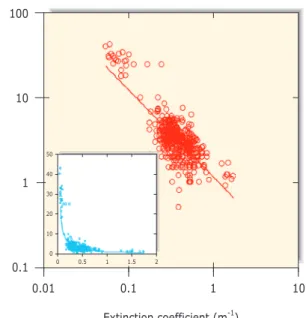
organ-ic matter, waste water from the human population, and aquaculture. Dump-ing nutrients and organic matter into the sea degrades water quality, princi-pally reducing the amount of light reaching the seagrass meadows. Their survival, like that of all aquatic photosynthetic organisms, is conditioned by the amount of light penetrating the water column. Seagrass meadows grow rooted in the sediment, and have their photosynthetic structures (leaves) on the seabed. They thus exhibit the greatest light requirements of all marine photosynthetic organisms (Duarte 1995). The leaves of marine angiosperms absorb three times as much light as do phytoplankton, but the light they absorb per unit weight and their photosynthetic capacity are considerably less (Duarte 1995; Enríquez et al. 1996). In addition, they require far more light to grow than the phytoplankton, because of the high respiration rate needed to maintain their non-photosynthetic parts (roots and rhizomes) (Duarte 1995). Seagrass meadows require environments that receive at least 11% of the surface irradiation in order to survive, while other benthic marine photosynthetic organisms, like corals and macroalgae, can grow on seabeds that receive only 0.02% or 0.0005% respectively (Gattuso et al. 2006). The position of seagrass meadows in the water column and their high demand for light make them extremely vulnerable to any deterioration of water transparency (Duarte 1995). Nutrient supply stimulates the prolifera-tion of phytoplankton in the water column and of macroalgae on the sea-grass meadow’s foliar canopy. The proliferation of both groups of organisms reduces the amount of light that the seagrass meadows receive. Seagrass meadows are most vulnerable to increased water turbidity at their depth limit, and this close relationship allows us to develop predictive models for their lower depth limit based on rates of light extinction in the water column (Duarte et al. 2007; figure 2.3), and therefore to predict the magnitude of meadow depletion as water transparency diminishes.
Eutrophication also causes excessive sediment enrichment by nutrients and organic matter.P. oceanicameadows are very sensitive to deteriorating sedi-ment quality, and their decline accelerates when the amounts of organic mat-ter and phosphorus reaching the sediment exceed 1-2 g dry weight m-2 d-1
and 0.04 g P m-2d-1respectively (Díaz-Almela et al. 2008b). The excess
nutri-ents and organic matter in the sediment stimulate bacterial activity, and con-sequently increase anoxia and the production and concentration of hydrogen sulfide. When the concentration of hydrogen sulfide in the sediment is high and that of oxygen in the plant is low, the hydrogen sulfide in the interstitial water penetrates the seagrass tissues and damages their meristems, thereby reducing their growth and survival (Borum et al. 2005). Hydrogen sulfide
toxicity may be attenuated by the presence of labile iron in the sediment, which can remove hydrogen sulfide from the interstitial water, precipitating it in the form of iron sulfides. Sediments in which little iron is available—a characteristic of the carbonate-rich sediments (Berner 1984) common throughout the Mediterranean—have a very limited capacity to attenuate the toxicity of hydrogen sulfide, making seagrasses more vulnerable to their organic enrichment. In the Balearic Islands, where the labile iron content of sediments is extremely low (Holmer, Duarte, and Marbà 2003), the state of seagrass meadows is conditioned by the supply of iron from external sources. The risk of decline inP. oceanica meadows increases when they receive less than 43 mg Fe m-2d-1(Marbà et al. 2008). Moreover,P. oceanicameadows are acutely sensitive to hydrogen sulfide. While many species of marine angiosperms can grow and survive in sediments with hydrogen sulfide con-centrations up to 100 µM (Terrados et al. 1999),P. oceanicameadows decline more rapidly when its concentration in the interstitial water is greater than 10 µM (Calleja, Marbà, and Duarte 2007; figure 2.4). Once sediments have become contaminated it is very difficult for them to recover, andP. oceanica meadows continue to decline for years after the input of organic matter has ceased (Delgado et al. 1999).
Figure 2.3: Relationship between maximum colonization depth of seagrass meadows of differ-ent species and the light extinction coefficidiffer-ent
2.5.2. Alteration of coastal sediment balance and mechanical perturbations
The disruption of the sediment balance in the coastal area increases the mor-tality of seagrass shoots.P. oceanicashoots have their meristems on the sed-iment surface, and their survival depends on maintaining that position throughout their life.P. oceanica meadows can survive burial rates of up to 4-5 cm year-1, on account of the growth of their vertical rhizomes
(Manza-nera, Pérez, and Romero 1998). When sediment deposition exceeds this threshold, meadow decline accelerates, and depositions of 14 cm produce 100% shoot mortality. Sediment erosion is another cause of greater shoot mortality.
The transformation of our coastline due to the runaway construction of build-ings and seafronts and the damming of rivers diminishes sediment supply to seagrass meadows. In the last 50 years, the amount of sediment reaching the Mediterranean coast has fallen by 90%, and a large part of the area is suffer-ing erosion (Benoit and Comeau 2005). Coastal constructions like breakwa-ters and ports destroy the adjoining marine communities and can alter local sediment dynamics, increasing erosion and deposition of sediments in some zones. Dredging works on the seabed near seagrass meadows can easily destroy areas of meadow by directly pulling up fragments or eroding or
bury-Figure 2.4: Relationship between the net growth rate of the population ofP. oceanicashoots in seagrass meadows and the concentration of hydrogen sulfide in the sediment.Negative net pop-ulation growth rates represent rates of decline. The dotted line indicates the threshold concentration of hydrogen sulfide above which a meadow’s decline is significant.
ing them. These impacts principally affect the upper limit of seagrass mead-ows. Indeed recent studies show that someP. oceanicameadows have retreat-ed 25 meters in 20 years (Besterrechea et al., unpublishretreat-ed results).
Trawling is an important cause of large-scale seagrass meadow destruction, with deep communities the worst affected. Trawling with nets above meadows tears out the shoots and rhizomes at rates between 100,000 and 360,000 per hour-1 (González-Correa et al. 2005), while at the same time resuspending
sediment and increasing water turbidity. The slow seagrass meadow recolo-nization rate means that the impact of trawling can persist for decades (González-Correa et al. 2005).
In coastal areas that receive large numbers of visitors, the anchoring of pleas-ure craft above seagrass meadows causes a significant reduction in shoot den-sity. It is estimated that an average of 34 shoots anchor-1(Francour et al. 1999)
are torn up during an anchoring cycle (lock-in and retrieval).
2.5.3. Rising sea temperature
Recent studies indicate thatP. oceanica meadows are vulnerable to Mediter-ranean warming. Surface water temperature increased by 0.04ºC year-1
between 1980 and 2006 (Díaz-Almela et al. 2007a), and the highest value recorded was in summer 2003. Global warming affects biological processes like reproduction and may alter the stability of plant communities (e.g., Parmesan and Yohe 2003).
In the last 40 years, it has been observed that the number ofP. oceanica mead-ows that flower each year and their flowering intensity (the fraction of a meadow’s shoots that flower) vary interannually, with reproductive peaks every 9-11 years (Díaz-Almela, Marbà, and Duarte 2007a). Temporal fluctua-tions in seagrass meadow reproduction are coupled with sea temperature vari-ations, such that reproduction increases as the temperature climbs. In autumn 2003, one month after the warmest recorded surface temperature in the Mediterranean of the last four decades, there was an episode of mass flower-ing throughout the western Mediterranean that extended to over 90% of sea-grass meadows, representing a flowering intensity twice as high on average as during earlier reproduction peaks (Díaz-Almela, Marbà, and Duarte 2007a; photos 2.10 and 2.11). The relation between increased flowering of seagrass meadows and Mediterranean warming might reflect the plant’s response to thermal stress, as occurs in some terrestrial plant communities (e.g., Peñuelas et al. 2002).
Photo 2.10: Seagrass meadow with inflorescences
Photo 2.11: Raft ofP. oceanicafruits floating on the sea after the mass flowering episode of 2003
The mortality rate of P. oceanica meadows has varied interannually in the last seven years, with the highest shoot mortality recorded after very hot summers (Díaz-Almela et al., in review). This annual variability is related to sea water temperature, whereby the mortality rate rises 3% per year-1 for
each degree of increase in maximum annual temperature (Marbà et al., unpublished results). These observations also suggest thatP. oceanica mead-ows may decline more rapidly when Mediterranean warming produces tem-peratures in excess of 28ºC, since above this threshold the birth rate through clonal growth and sexual reproduction (Díaz-Almela et al., in review) is insufficient to compensate for the increased death rate (Marbà et al., unpub-lished results).
The greater mortality of P. oceanica meadows as a result of the warming occurring in the Mediterranean Sea may not only reflect the effect of temper-ature on the plant’s physiology. The rise in sea tempertemper-ature may stimulate other biological processes in the ecosystem, such as community respiration and microbial activity in sediments, which, acting synergistically, could hasten their decline.
2.5.4. Biological invasions
An increased number of marine species are growing beyond their original bio-geographic distribution limits (Williams 2007). Some introduced species settle and behave as invasive species, causing a deterioration of native habitats. Mar-itime traffic, aquaculture, and the opening of sea-to-sea canals like the Suez Canal are the main vectors of species introduction (e.g., Gollasch 2005). The Mediterranean has the greatest number of exotic species of all European seas and the fastest rate of introductions in the whole of Europe. It is estimated to have 662 exotic taxa, of which 325 can be considered established, while the rate of introduction of new species has been reckoned at one every six weeks since the year 1950. This rate, moreover, has been accelerating since the late 1990s, mainly as a result of increased introductions of benthic macroalgal species (Gollasch 2005). Currently, the Mediterranean is home to around 100 species of introduced macroalgae, six of which live in seagrass meadows (Williams 2007), and 10% of which exhibit invasive behavior (Ballesteros, Cebrián, and Alcoverro 2007).
The impact of biological invasions on seagrass meadow stability has been examined for some species of invasive macroalgae. The best-studied of these exotic species are the macroalgaeCaulerpa taxifoliaand C. racemosa
(pho-tos 2.12 and 2.13).C. taxifoliawas introduced into the Mediterranean from the Monaco aquarium in 1984, while C. racemosa var. turbinata-uvifera, originally from the Red Sea, was introduced in the 1920s, andC. racemosa var.cylindracea, which comes from Australia, was introduced in the 1990s. Both species are clonal green algae, can grow on P. oceanica rhizomes and sediment, and are between six and ten times smaller than its leaves. Cauler-paspecies accordingly find it hard to compete for light withP. oceanicaand do not seem to penetrate dense and healthy seagrass meadows. However, these species grow in organic matter-rich sediments with high hydrogen sul-fide concentrations and stimulate the rate of sulfate reduction in the colo-nized sediment. The proliferation ofCaulerpa species in seagrass meadows could degrade sediment quality (Holmer et al., in press) and, in conjunction with other disruptions (e.g., eutrophication, Chisholm et al. 1997), acceler-ate seagrass decline.
In the last decade, the red macroalga Lophocladia lallemandii, which origi-nates from the Indo-Pacific and entered the Mediterranean Sea through the Suez Canal, has rapidly invaded western Mediterranean seagrass meadows. Its development is seasonal, and it grows forming patches on the leaves and rhi-zomes ofP. oceanica(photo 2.14). The proliferation ofL. lallemandiiin sea-grass meadows increases shoot mortality and halves the density and size of survivingP. oceanicashoots in comparison to non-invaded areas (Ballesteros, Cebrián, and Alcoverro 2007). The amount of light thatP. oceanica receives during the invasion of L. lallemandii is probably insufficient to sustain its metabolic balance.
The red macroalgaAcrothamnion preissii, a species native to the Indo-Pacific region and observed in the Mediterranean since 1969 (Williams 2007), is another invader of P. oceanica meadows. Invasion by this species does not seem to alter meadow stability, but it displaces most of the epiphytic macroal-gae on plant rhizomes, reducing species diversity and habitat complexity (Piazzi and Cinelli 2003).
2.5.5. Pathogenic organisms
Although microorganisms abound in the ocean (e.g., 106 bacteria cells ml-1
and 107virus particles ml-1; Fuhrman 1999; Marie et al. 1999; Azam and Wor-den 2004), little information exists about their role as agents potentially path-ogenic to marine plants. However, there is evidence of massive seagrass mead-ow mortality caused by pathogenic marine organisms. The decline ofZostera
Photo 2.12: The algaCaulerpa taxifoliagrowing in aP. ocean-icameadow
Photo 2.13: Caulerpa race-mosagrowing on a communi-ty of native macroalgae in Portals Vells, Mallorca
Photo 2.14: Sponge ( Sarcotra-gus foetidus) between a Posi-donia oceanica bed and the invasive alga Lophocladia lallemandi.Cala Galiota, Cabrera, Balearic Islands.
marina and Thalassia testudinum meadows respectively along the Atlantic coast (1930s) and in Florida Bay (1980s) is associated with infection by marine protists of the genus Labyrinthula (Muehlstein et al. 1988; Robblee et al. 1991), when these act in combination with other environmental factors caus-ing meadow deterioration (e.g., temperature increase, hypoxia, raised concen-tration of hydrogen sulfide in the sediment).
Recent studies have shown the presence inP. oceanicatissues of bacteria of the genera Vibrio, Marinomonas, and Pseudoalteromonas, and of the protist
Labyrinthula (Marco-Noales et al. 2006; Vergeer and Den Hartog 1994).
Pseudoalteromonasspp.bacteria are more abundant in seagrass meadows with high shoot mortality rates, which suggests that they may be contributing to P. oceanica’s decline (Marco-Noales et al. 2006).Labyrinthulais a widely dis-tributed organism in Spanish coastal seagrass meadows and is observed in more than 70% of those bordering the Balearic coast (18 meadows examined in total, Garcias-Bonet et al. 2008). Experiments infecting healthyP. oceanica shoots with differentLabyrinthula strains suggest that the virulence of this protist varies from one strain to another. However, the majority (71%) of those tested are capable of producing lesions inP. oceanica’s leaves (Garcias-Bonet et al. 2008). Although the presence of pathogenic organisms has not been shown to increase seagrass meadow mortality in the Mediterranean, they could increase the risk of ecosystem decline under conditions of environmen-tal deterioration.
2.6. THE FUTURE OF SEAGRASS MEADOWS
The general decline affecting Mediterranean seagrass meadows is the result of isolated impacts that are hard to pin down, deriving from human population growth along the coast and on a global scale. Currently 40% of the Mediter-ranean coastline is built-up area. In 2000, it had more than 400 million resi-dents, 70 million of them living in cities of over 100,000 inhabitants, and visi-tor numbers exceeding 200 million (Benoit and Comeau 2005). Predictions of human population growth suggest that by 2025, 50% of the coast will be built-up area, Mediterranean coastal cities with more than 100,000 inhabitants will be home to 90 million residents, and the coastal strip will receive more than 300 million tourists (Benoit and Comeau 2005). Not only that, aquacul-tural production in the Mediterranean is expected to double in the next 25 years, maritime freight traffic to almost quadruple, and passenger traffic to likewise double (Benoit and Comeau 2005). Assuming this scale of growth of
human activity, the risk of deterioration of the coastal area, as exemplified by problems of eutrophication, erosion, proliferation of invasive species, and seabed destruction, and, therefore, the risk of seagrass meadow decline, can only increase in the years to come.
The climate change augured for the 21st century, arising from the increased concentration of greenhouse gases in the atmosphere, is a further threat to seagrass meadow conservation. The climate change scenarios managed by the IPPC point to an increase in sea level of between 0.09 and 0.88 m between 1990 and 2100 and an increase of 4ºC in the temperature of the Mediterranean (IPPC 2001). Such a rise in sea level would cause coastal erosion and, there-fore, hasten the decline of seagrass meadows’ upper limit. According to the predictions of climatic warming andP. oceanica’s sensitivity to sea tempera-ture increases, the seagrass meadow mortality rate could be three times its current level by 2100. Although the increased temperature would also stimu-late sexual reproduction, and thus the formation of new clones, this would not be enough to offset death losses of meadows, so the rate of decline could well accelerate.
Reversing the trend of decline in seagrass meadows and conserving them in future will call for the implementation of management measures to minimize
the deterioration of coastal areas. We currently have a European, national, and regional legal framework that, effectively implemented, would facilitate con-servation ofP. oceanicameadows. The European Union, through Agenda 21, requires member states to protect up to 12.2% of their entire territory, which in Mediterranean countries with long coastlines is largely made up ofP. ocean-icameadows, and its fishing regulations prohibit trawling on seagrass mead-ows (Regulation (EC) 1626/94). Likewise, the EU Habitat Directive (Council Directive 92/43 of May 21, 1992) sets forth measures to guarantee biodiversi-ty through the conservation of natural habitats, including seagrass meadows. In Spain, some autonomous communities, such as Valencia and Catalonia, also have regulations in place to protect seagrass meadows, and the Law of Coasts regulates the protection and use of the coastal area. However, measures to control the dumping of urban, industrial, and aquacultural waste in the Mediterranean Sea have still to be fully enforced: in 2002, 60% of urban waste water was still being dumped into the sea untreated, particularly in its south and eastern reaches (Benoit and Comeau 2005). Since 1997, the Mediterranean Action Plan under the direction of UNEP, with 16 countries affiliated, has included a protocol on pollution from land-based sources and a strategic plan to combat it. The European Union’s Water Framework Directive, in force since 2000, defines a set of ambitious objectives to protect the quality of Euro-pean water bodies, including those of the coasts. The United Nations Frame-work Convention on Climate Change, known as the Kyoto Protocol, has the goal of stabilizing greenhouse gas emissions at a level that impedes anthro-pogenic interference in the climate system.
But the conservation of seagrass meadows, their functions, and the services they provide does not just depend on an effective legal framework. It also requires advances in scientific knowledge, the development of technologies to reverse the decline and mitigate impacts, more social awareness around envi-ronmental issues, and coordinated action on a global scale. Only with the col-laboration of science, technology, the legislator and society at large will it be possible to preserve these millennia-old and immensely valuable Mediter-ranean ecosystems.
ACKNOWLEDGEMENTS
This chapter summarizes some of the results obtained and discussions held by thePraderasproject’s team of over twenty researchers, coordinated by Carlos M. Duarte. I am also grateful to Elena Díaz-Almela for her comments and contributions, which have helped improve the quality of the text.
REFERENCES
ARNAUD-HAOND, S., C. M. DUARTE, E. DIAZ-ALMELA, N. MARBÀ, and E. A. SERRÃO.
“Extant Pleistocene clones detected in a threatened seagrass: some ecological and evo-lutionary implications of extreme life span potential in clonal organisms.”BMC Evo-lutionary Biology(in review).
AZAM, F., and A. Z. WORDEN. “Microbes, molecules, and marine ecosystems.”Science303
(2004): 1622-1624.
BALLESTEROS, E., E. CEBRIÁN, and T. ALCOVERRO. “Mortality of shoots of Posidonia
oceanicafollowing meadow invasion by the red algaLophocladia lallemandii.” Botan-ica Marina50 (2007): 8-13.
BARRÓN, C., C. M. DUARTE, M. FRANKIGNOULLE, and A. VIEIRABORGES. “Organic
car-bon metabolism and carcar-bonate dynamics in a Mediterranean seagrass (Posidonia oceanica) meadow.”Estuaries and Coasts29 (2006): 417-426.
BENOIT, G., and A. COMEAU.A Sustainable Future for the Mediterranean: the Blue Plan’s Environment and Development Outlook. London: Earthscan, 2005.
BERNERR. A. “Sedimentary pyrite formation: An update.”Geochimica et Cosmochimica
Acta48 (1984): 605–615.
BORUM, J., O. PEDERSEN, T. M. GREVE, T. A. FRANKOVICH, J. C. ZIEMAN, J.
W. FOURQUREAN, and C. J. MADDEN. “The potential role of plant oxygen and sul-phide dynamics in die-off events of the tropical seagrass,Thalassia testudinum.” Jour-nal of Ecology93 (2005): 148-158.
CALLEJA, M., N. MARBÀ, and C. M. DUARTE. “The relationship between seagrass (
Posido-nia oceanica)decline and porewater sulfide pools in carbonate sediments.”Estuarine, Coastal and Shelf Science73 (2007): 583-588.
CHISHOLM, J. R. M., F. E. FRENEX, D. MATIEU, and J. M. JAUBERT. “Wastewater discharge,
seagrass decline and algal proliferation on the Côte d’Azur.”Marine Pollution Bulletin
34 (1997): 78-84.
DELGADO, O., J. RUIZ, M. PÉREZ, J. ROMERO, and E. BALLESTEROS. “Effects of fish
farm-ing on seagrass (Posidonia oceanica) in a Mediterranean bay: seagrass decline after organic loading cessation.”Oceanologia Acta22 (1999): 109-117.
DIAZ-ALMELA, E., N. MARBÀ, and C. M. DUARTE. “Fingerprints of Mediterranean Sea
warming in seagrass (Posidonia oceanica)flowering records.”Global Change Biology
13 (2007a): 224-235.
DÍAZ-ALMELA, E., S. ARNAUD-HAOND, M. S. VLIET, E. ALVAREZ, N. MARBÀ, C. M. DUARTE, and E.A. SERRAO. “Feed-backs between genetic structure and
perturbation-driven decline in seagrass (Posidonia oceanica) meadows.”Conservation Genetics 8 (2007b): 1377-1391.
DÍAZ-ALMELA, E., N. MARBÀ, E. ÁLVAREZ, R. SANTIAGO, R. MARTÍNEZ, and C. M.
DUARTE. “Patch dynamics of the Mediterranean seagrassPosidonia oceanica:
Implica-tions for recolonisation process.”Aquatic Botany89 (4) (2008a): 397-403.
DÍAZ-ALMELA, E., N. MARBÀ, E. ÁLVAREZ, R. SANTIAGO, M. HOLMER, A. GRAU, S. MIRTO, et al. “Benthic input rates predict seagrass (Posidonia oceanica) fish
farm-induced decline.”Marine Pollution Bulletin56 (7) (2008b): 1332-1342.
DUARTE, C. M. “Allometric scaling of seagrass form and productivity.”Marine Ecology
DUARTE, C. M. “Submerged aquatic vegetation in relation to different nutrient regimes.”
Ophelia41 (1995): 87-112.
DUARTE, C. M., and C. L. CHISCANO. “Seagrass biomass and production: a reassessment.”
Aquatic Botany65 (1999): 159-174.
DUARTE, C. M., W. C. DENNISON, R. J. W. ORTH, and T. J. B. CARRUTHERS. “The charisma of coastal ecosystems.”Estuaries and Coasts(2008): doi 10.1007/s12237-008-9038-7. DUARTE, C. M., N. MARBÀ, D. KRAUS-JENSEN, and M. SÁNCHEZ-CAMACHO. “Testing the
predictive power of seagrass depth limit models.”Estuaries and Coasts30 (2007): 652-656.
DUARTE, C. M., J. J. MIDDELBURGand N. CARACO. “Major role of marine vegetation on
the oceanic carbon cycle.”Biogeosciences2 (2005): 1-8.
ENRÍQUEZ, S., C. M. DUARTE, K. SAND-JENSEN, and S. L. NIELSEN. “Broad scale compar-ison of photosynthetic rates across phototrophic organisms.”Oecologia108 (1996): 197-206.
FRANCOUR, F., A. GANTEAUME, and M. POULAIN. “Effects of boat anchoring inPosidonia oceanicaseagrass beds in the Port-Cros National Park (north-western Mediterranean Sea).”Aquatic Conservation: Marine and Freshwater Ecosystems9 (1999): 391-400. FUHRMAN, J. A. “Marine viruses and their biogeochemical and ecological effects.”Nature
399 (1999): 541-548.
GARCIAS-BONET, N., T. D. SHERMAN, C. M. DUARTE, and N. MARBÀ. “Labyrinthulain
Western Mediterranean seagrass (Posidonia oceanica) meadows: biogeography and pathogenicity.” 2008 Ocean Sciences Conference, Orlando.
GATTUSO, J.-P., B. GENTILI, C. M. DUARTE, J. A. KLEYPAS, J. J. MIDDELBURG, and D.
ANTOINE. “Light availability in the coastal ocean: impact on the distribution of ben-thic photosynthetic organisms and their contribution to primary production.” Biogeo-sciences3 (2006): 489-513.
GAZEAU, F., C. DUARTE, J.-P. GATTUSO, C. BARRÓN, N. NAVARRO, S. RUIZ, Y. T.
PRAIRIE, et al. “Whole-system metabolism and CO2fluxes in a Mediterranean Bay
dominated by seagrass beds (Palma Bay, NW Mediterranean).” Biogeosciences 2 (2005): 43-60.
GIBBS, A., and A. MACKENZIE. “A primer pair for amplifying part of the genome of all
potyvirids by RT-PCR.”Journal of Virological Methods63 (1997): 9-16.
GOLLASCH, S. “Overview on introduced aquatic species in European navigational and
adjacent waters.”Helgoland Marine Research60 (2005): 84-89.
GONZÁLEZ-CORREA, J. M., J. T. BAYLE, J. L. SÁNCHEZ-LIZASO, C. VALLE, P. SÁNCHEZ
-JEREZ, and J. M. RUIZ. “Recovery of deepPosidonia oceanicameadows degraded by
trawling.”Journal of Experimental Marine Biology and Ecology320 (2005): 65-76. HENDRIKS, I. E., T. SINTES, T. J. BOUMA, and C. M. DUARTE. “Experimental assessment
and modeling evaluation of the effects of the seagrassPosidonia oceanicaon flow and particle trapping.”Marine Ecology Progress Series356 (2008): 163-173.
HOLMER, M., C. M. DUARTE, and N. MARBÀ. “Sulfur cycling and seagrass (Posidonia
oceanica) status in carbonate sediments.”Biogeochemistry66 (2003): 223-239. HOLMER, M., N. MARBÀ, M. LAMOTE, and C. M. DUARTE. “Deterioration of sediment
quality in seagrass meadows(Posidonia oceanica) invaded by macroalgae(Caulerpa
IPPC (Intergovernmental Panel on Climate Change).Climate Change 2001. Third Assess-ment Report of the IntergovernAssess-mental Panel on Climate Change. Cambridge: Cam-bridge University Press, 2001.
KENDRICK, G., N. MARBÀ, and C. M. DUARTE. “Modelling formation of complex
topog-raphy by the seagrass Posidonia oceanica.” Estuarine Coastal and Shelf Science 65 (2005): 717-725.
LARKUM, A. W. D., R. J. ORTH, and C. M. DUARTE, eds. “Seagrasses: Biology, Ecology and
Conservation.” Dordrecht: Springer (2006).
MANZANERA, M., M. PÉREZ, and J. ROMERO. “Seagrass mortality due to
oversedimenta-tion: an experimental approach.”Journal of Coastal Conservation4 (1998): 67-70. MARBÀ, N., and C. M. DUARTE. “Rhizome elongation and seagrass clonal growth.”
Marine Ecology Progress Series174 (1998): 269-280.
MARBÀ, N., C. M. DUARTE, J. CEBRIAN, M. E. GALLEGOS, B. OLESEN, and K. SAND
-JENSEN. “Growth and population dynamics of Posidonia oceanica on the Spanish
Mediterranean coast: elucidating seagrass decline.”Marine Ecology Progress Series137 (1996): 203-213.
MARBÀ, N., C. M. DUARTE, E. DÍAZ-ALMELA, J. TERRADOS, E. ÁLVAREZ, R. MARTÍNEZ, R.
SANTIAGO, et al. “Direct evidence of imbalanced seagrass (Posidonia oceanica)shoot
population dynamics along the Spanish Mediterranean.”Estuaries28 (2005): 51-60. MARBÀ, N., C. M. DUARTE, M. HOLMER, M. L. CALLEJA, E. ÁLVAREZ, E. DÍAZ-ALMELA,
and N. GARCIAS-BONET. “Sedimentary iron inputs stimulate seagrass (Posidonia
oceanica) population growth in carbonate sediments.”Estuarine, Coastal and Shelf Science76 (2008): 710-713.
MARCO-NOALES, E., M. ORDAX, A. DELGADO, M. M. LÓPEZ, M. J. SAAVEDRA, A. MARTÍNEZ-MURCIA, N. GARCIAS, et al. “Microbiota associated withPosidonia
ocean-icain Western Mediterranean sea.” In A. Mendez-Vilas, ed.Modern Multidisciplinary Applied Microbiology: exploiting microbes and their interactions. Weinheim: Wiley-VCH, 2006. 114-119.
MARIED., C. P. D. BRUSSAARD, R. THYRHAUG, G. BRATBAK, and D.VAULOT.
“Enumera-tion of marine viruses in culture and natural samples by flow cytometry.”Applied and Environmental Microbiology65 (1999): 45-52.
MATEO, M. A., J. ROMERO, M. PÉREZ, M. M. LITTLER, and D. S. LITTLER. “Dynamics of
millenary organic deposits resulting from the growth of the Mediterranean seagrass
Posidonia oceanica.”Estuarine Coastal and Shelf Science44 (1997): 103-110.
MUEHLSTEIN, L. K., D. PORTER, and F. T. SHORT. “LabyrinthulaSp, a marine slime-mold
producing the symptoms of wasting disease in eelgrass,Zostera marina.”Marine Biol-ogy99 (1988): 465-472.
PARMESAN, C., and G. YOHE. “A globally coherent fingerprint of climate change impacts across natural systems.”Nature421 (2003): 37-42.
PEÑUELAS, J., I. FILELLA, and P. COMAS. “Changed plant and animal life cycles from 1952
to 2000 in the Mediterranean region.”Global Change Biology8 (2002): 531-544. PIAZZI, L., and F. CINELLI. “Evaluation of benthic macroalgal invasion in a harbour area of
the western Mediterranean.”European Journal of Phycology38 (2003): 223-231. ROBBLEE, M. B., T. R. BARBER, P. R. CARLSON, M. J. DURAKO, J. W. FOURQUREAN, L. K.
MUEHLSTEIN, D. PORTER, et. al. “Mass mortality of the tropical seagrassThalassia tes-tudinumin Florida Bay (USA).”Marine Ecology Progress Series71 (1991): 297-299.
ROZENFELD, A. F., S. ARNAUD-HAOND, E. HERNÁNDEZ-GARCÍA, V. M. EGUÍLUZ, M. A.
MATÍAS, E. SERRAO, and C. M. DUARTE. “Spectrum of genetic diversity and networks
of clonal organisms.”Journal of the Royal Society Interface4 (2007): 1093-1102. SHORT, F. T., and C. M. DUARTE. “Methods for the measurement of seagrass growth and
reproduction.” In F. T. Short and R. G. Coles, eds.Global Seagrass Research Methods.
Amsterdam: Elsevier Science B.V., 2001. 155-182.
SINTES, T., N. MARBÀ, and C. M. DUARTE. “Modeling non-linear seagrass clonal growth:
Assessing the efficiency of space occupation across the seagrass flora.”Estuaries and Coasts29 (2006): 72-80.
TERRADOS, J., C. M. DUARTE, L. KAMP-NIELSEN, J. BORUM, N. S. R. AGAWIN, M. D. FORTES, E. GACIA, et al. “Are seagrass growth and survival affected by reducing
con-ditions in the sediment?.”Aquatic Botany65 (1999): 175-197.
VERGEER, L. H. T., and C. DENHARTOG. “Omnipresence of Labyrinthulaceae in
seagrass-es.”Aquatic Botany48 (1994): 1-20.
WILLIAMS, S. L. “Introduced species in seagrass ecosystems: Status and concerns.”Journal of Experimental Marine Biology and Ecology350 (2007): 89-110.
LIST OF PHOTOGRAPHS
Photo 2.1: Spreading rhizomes ofPosidonia oceanicacolonized by epiphytic
organisms. © Juan Carlos Calvín ... 60 Photo 2.2: Seagrass meadow ofP. oceanica,Formentera, Balearic Islands.
© Manu San Félix... 62 Photo 2.3.A: Inflorescence ofP. oceanica. © Elena Díaz-Almela ... 63 Photo 2.3.B: Fruits ofP. oceanica. © Elvira Álvarez ... 63 Photo 2.4: Painted comber (Serranus scriba) in aP. oceanicameadow.
© Ángel M. Fitor/Seaframes... 65 Photo 2.5: Thousand-year-oldP. oceanicareef, Formentera, Balearic Islands.
© Manu San Félix... 66 Photo 2.6: P. oceanicadetritus accumulated on a beach.
© Ángel M. Fitor/Seaframes... 67 Photo 2.7: P. oceanicaleaves colonized by epiphytic organisms with calcium
carbonate structures. © Agustín Catalán ... 69 Photo 2.8.A: Permanent plots established in aP. oceanicaseagrass meadow to
evaluate the demographic balance of shoots. © Jaume Ferrer... 70 Photo 2.8.B: Detail of tagged shoots in aP. oceanicatest plot. © Núria Marbà ... 70 Photo 2.9: P. oceanicameadow growing on the coastal sea floor along the north
coast of Ibiza, Balearic Islands. © Juan Carlos Calvín... 72 Photo 2.10: Seagrass meadow with inflorescences. © Manu San Félix ... 78 Photo 2.11: Raft ofP. oceanicafruits floating on the sea after the mass flowering
episode of 2003. © Elvira Álvarez... 78 Photo 2.12: The algaCaulerpa taxifoliagrowing in aP. oceanicameadow.
© Juan Carlos Calvín... 81 Photo 2.13: Caulerpa racemosagrowing on a community of native macroalgae in
Portals Vells, Mallorca. © Antoni Box... 81 Photo 2.14: Sponge (Sarcotragus foetidus) between aPosidonia oceanicabed and the
invasive algaLophocladia lallemandi. © Iñaki Relanzón/Oceana... 81 Photo 2.15: P. oceanicameadow near Tabarca Island, Alicante, Spain.
© Ángel M. Fitor/Seaframes... 83
LIST OF ILLUSTRATIONS
Figure 2.1: Distribution of MediterraneanP. oceanicameadows whose demographic status has been evaluated over the past seven years ... 71 Figure 2.2: Density of shoots in the seagrass meadow of Es Castell, at a depth of 15 m,
Cabrera Archipelago National Park, since the year 2000 ... 71 Figure 2.3: Relationship between maximum colonization depth of seagrass
meadows of different species and the light extinction coefficient ... 75 Figure 2.4: Relationship between the net growth rate of the population of
P. oceanicashoots in seagrass meadows and the concentration of
Núria Marbà is a scientist for the Spanish National Research Council (CSIC) at the Mediterranean Institute for Advanced Studies (IMEDEA) in Esporles (Mallorca, Spain). Her main research field is the ecology of marine plant populations. She has led and participated in projects on marine ecology, biodiversity, and conservation in European, Australian, Asian, African, and Caribbean coastal regions. Author of around 80 research papers and 2 book chapters, and co-editor of one book, she also sits on the editorial board of the journalMarine Ecology.
e-mail: [email protected] ABOUT THE AUTHOR