I:\CIRC\MSC\01\1497.doc 4 ALBERT EMBANKMENT LONDON SE1 7SR Telephone: +44 (0)20 7735 7611 Fax: +44 (0)20 7587 3210 MSC.1/Circ.1497 16 December 2014
IMO/ILO/UNECE CODE OF PRACTICE FOR PACKING OF CARGO TRANSPORT UNITS (CTU CODE)
1 The Maritime Safety Committee, at its ninety-third session (14 to 23 May 2014), approved the IMO/ILO/UNECE Code of Practice for Packing of Cargo Transport Units (CTU Code), which was prepared by the Group of Experts for the revision of the IMO/ILO/UNECE Guidelines for Packing of Cargo Transport Units, subject to editorial improvements by the UNECE, ILO and IMO Secretariats, if necessary.
2 The Committee, at its ninety-fourth session (17 to 21 November 2014), having noted the concurrent approval of the CTU Code by the Inland Transport Committee of the UNECE, at its seventy-sixth session (25 to 27 February 2014), and the Governing Body of ILO, at its 322nd session (30 October to 13 November 2014), agreed to publish the CTU Code by means of an MSC circular, in cooperation with the UNECE and ILO. In this context, MSC 94 also approved MSC.1/Circ.1498 on Informative material related to the IMO/ILO/UNECE Code of Practice for Packing of Cargo Transport Units (CTU Code), which does not form part of the CTU Code but provides additional information.
3 Member Governments and international organizations are invited to bring the CTU Code, attached hereto, to the attention of all parties concerned*.
4 This circular revokes MSC/Circ.787 (IMO/ILO/UN ECE Guidelines for Packing of Cargo Transport Units).
***
* The text of the CTU Code and the Informative material related to the CTU Code can also be downloaded from the UNECE website at http://www.unece.org/trans/wp24/guidelinespackingctus/intro.html
IMO/ILO/UNECE Code of Practice for Packing of
Cargo Transport Units
Table of contents
Chapter 1. Introduction ... 5
Chapter 2. Definitions ... 9
Chapter 3. Key requirements ...14
Chapter 4. Chains of responsibility and information ...16
Chapter 5. General transport conditions ...21
Chapter 6. CTU properties ...23
Chapter 7. CTU suitability ...29
Chapter 8. Arrival, checking and positioning of CTUs ...32
Chapter 9. Packing cargo into CTUs ...38
Chapter 10. Additional advice on the packing of dangerous goods ...40
Chapter 11. On completion of packing ...43
Chapter 12. Advice on receipt and unpacking of CTUs ...45
Chapter 13. Training in packing of CTUs ...47
Annexes Annex 1 Information flow ...49
Annex 2 Safe handling of CTUs ...51
Annex 3 Prevention of condensation damages ...56
Annex 4 Approval plates ...61
Annex 5 Receiving CTUs ...68
Annex 6 Minimizing the risk of recontamination...83
Annex 7 Packing and securing cargo into CTUs ...92
Appendix 1 Packaging marks ...123
Appendix 2 Friction factors ...128
Appendix 3 Practical methods for the determination of the friction factor µ ...130
Appendix 4 Specific packing and securing calculations ...132
Appendix 5 Practical inclination test for determination of the efficiency of cargo securing arrangements ...137
Annex 8 Access to tank and bulk tops, working at height ...140
Annex 9 Fumigation ...145
Preamble
The use of freight containers, swap bodies, vehicles or other cargo transport units substantially reduces the physical hazards to which cargoes are exposed. However, improper or careless packing of cargoes into/onto such units, or lack of proper blocking, bracing and lashing, may be the cause of personnel injury when they are handled or transported. In addition, serious and costly damage may occur to the cargo or to the equipment.
The types of cargoes carried in freight containers has expanded over many years and innovations such as use of flexitanks and developments allow heavy, bulky items which were traditionally loaded directly into the ships' hold (e.g. stone, steel, wastes and project cargoes), to be carried in cargo transport units.
The person who packs and secures cargo into/onto the cargo transport unit (CTU) may be the last person to look inside the unit until it is opened at its final destination. Consequently, a great many people in the transport chain will rely on the skill of such persons, including:
road vehicle drivers and other road users when the unit is transported by road;
rail workers, and others, when the unit is transported by rail;
crew members of inland waterway vessels when the unit is transported on inland waterways;
handling staff at terminals when the unit is transferred from one transport mode to another;
dock workers when the unit is loaded or unloaded;
crew members of a seagoing ship during the transport operation;
those who have a statutory duty to inspect cargoes; and
those who unpack the unit.
All persons, such as the above, passengers and the public, may be at risk from a poorly packed freight container, swap body or vehicle.
Chapter 1. Introduction
1.1 Scope
1.1.1 The aim of this IMO/ILO/UNECE Code of Practice for Packing of Cargo Transport Units (CTU Code) is to give advice on the safe packing of cargo transport units (CTUs) to those responsible for the packing and securing of the cargo and by those whose task it is to train people to pack such units. The aim is also to outline theoretical details for packing and securing as well as to give practical measures to ensure the safe packing of cargo onto or into CTUs.
1.1.2 In addition to advice to the packer, the CTU Code also provides information and advice for all parties in the supply chain up to and including those involved in unpacking the CTU.
1.1.3 The CTU Code is not intended to conflict with, or to replace or supersede, any existing national or international regulations which may refer to the packing and securing of cargo in CTUs, in particular existing regulations which apply to one mode of transport only, e.g. for transport of cargo in railway wagons by rail only.
1.2 Safety
1.2.1 Improperly packed and secured cargo, the use of unsuitable CTUs and the overloading of CTUs may endanger persons during handling and transport operations. Improper declaration of the cargo may also cause dangerous situations. The misdeclaration of the CTU's gross mass may result in the overloading of a road vehicle or a rail wagon or in the allocation of an unsuitable stowage position on board a ship thus compromising the safety of the ship.
1.2.2 Insufficient control of humidity may cause severe damages to and collapse of the cargo and cause also the loss of the stability of the CTU.
1.3 Security
1.3.1 It is important that all personnel involved in the packing, security sealing, handling, transport and processing of cargo are made aware of the need for vigilance and the diligent application of practical procedures to enhance security, in accordance with national legislation and international agreements.
1.3.2 Guidance on the security aspects of the movement of CTUs intended for carriage by sea may be found in a variety of documents including the International Convention for the Safety of Life at Sea (SOLAS), 1974, as amended; the International Ship and Port Facility Security (ISPS) Code; the ILO/IMO Code of Practice on Security in Ports; and the Standards and the Publicly Available Specifications developed or being developed by the International Organization for Standardization (ISO) to address cargo security management and other aspects of supply chain security. Furthermore, the World Customs Organization (WCO) has developed a SAFE Framework of standards to secure and facilitate global trade.
1.4 How to use the CTU Code
1.4.1 This Code comprises 13 chapters. Most of them refer to one or more annexes which is highlighted in the text where applicable. Further practical guidance and background information are available as informative material1, which does not constitute part of this Code. Table 1 at the end of this chapter provides a summary of contents.
1.4.2 More information on the consequences of improper packing procedures is provided in informative material IM1.
1.4.3 Following the introduction in chapter 1, chapter 2 lists definitions of terms which are used throughout the Code. Chapter 3 provides an overview of basic safety issues related to the packing of CTUs, briefly described as "dos and don'ts". Detailed information on how to comply with these "dos" and how to avoid the "don'ts" are contained in the following chapters and in the related annexes.
1.4.4 Chapter 4 identifies the chains of responsibility and communication for the principle parties in the supply chain and is supplemented with annex 1 on information flow and, particularly for terminal operators, with annex 2 on the safe handling of CTUs. Information on typical documents related to transport may be obtained from informative material IM2.
1.4.5 Chapter 5 (general transport conditions) describes the acceleration forces and the climatic conditions to which a CTU is exposed during transport. Annex 3 provides additional guidance on the prevention of condensation damages.
1.4.6 Chapter 6 (CTU properties), chapter 7 (CTU suitability) and chapter 8 (arrival, checking and positioning of CTUs) should be considered to select the appropriate CTU for the cargo to be carried and to ensure that the CTU is fit for its intended purpose. Additional guidance to these topics is provided in annex 4 (approval plates), annex 5 (receiving CTUs) and annex 6 (minimizing the risk of recontamination). More information on the properties of the various CTU types is provided in informative material IM3, more information on species of concern regarding recontamination may be obtained from informative material IM4.
1.4.7 Chapter 9 (packing cargo into CTUs) is the core chapter of this Code dealing with the actual packing operation. This chapter directs the user to the related provisions in annex 7, where detailed information on load distribution, securing arrangements, capacity of securing devices and methods for the evaluation of the efficiency of a certain securing arrangement are provided. This annex is supplemented with appendices on packaging marks, friction factors and on calculations for load distribution and cargo securing. Guidance for working on the top of tank CTUs or solid bulk CTUs is provided in annex 8. To facilitate the evaluation of the efficiency of cargo securing arrangements, one sound practical tool is the "quick lashing guide" provided in informative material IM5. In addition, very detailed information on intermodal load distribution is provided in informative material IM6. Information on manual handling of cargo is provided in informative material IM7. Information on the transport of perishable cargo is provided in informative material IM8.
1.4.8 Chapter 10 provides additional advice on the packing of dangerous goods. Chapter 11 describes the actions required on the completion of packing. Information on CTU seals is provided in informative material IM9.
1.4.9 Chapter 12 contains advice on the receipt and unpacking of CTUs and is supplemented with annex 5 (receiving CTUs) and annex 9 (fumigation). Additional information on the testing of gases is provided in informative material IM10.
1.4.10 Chapter 13 outlines the required qualification of personnel engaged in the packing of CTUs. The topics for consideration in a training programme are listed in annex 10.
1.5 Standards
Throughout this Code and in its annexes and appendices, any national or regional standards are referenced for information only. Administrations may substitute other standards that are considered equivalent.
Table 1: Summary of contents
Chapter Referenced annexes Related informative material2
1 Introduction IM1 Consequences of improper
packing procedures 2 Definitions
3 Key requirements
4 Chains of responsibility and information
A1 A2
Information flow Safe handling of CTUs
IM2 Typical documents related to transport
5 General transport conditions A3 Prevention of condensation damages
6 CTU properties A4 Approval plates IM3 CTU types 7 CTU suitability A4 Approval plates
8 Arrival, checking and positioning of CTUs A4 A5 A6 Approval plates Receiving CTUs Minimizing the risk of recontamination
IM4 Species of concern regarding recontamination
9 Packing cargo into CTUs A7 A8
Packing and securing cargo into CTUs (supplemented with appendices 1 to 5)
Access to tank and bulk tops, working at height
IM5 IM6 IM7 IM8
Quick lashing guides Intermodal load distribution Manual handling
Transport of perishable cargo 10 Additional advice on the
packing of dangerous goods
11 On completion of packing IM9 CTU seals
12 Advice on receipt and unpacking of CTUs
A5 A9
Receiving CTUs Fumigation
IM10 Testing CTUs for hazardous gases
13 Training in packing of CTUs A10 Topics for consideration in a training programme
Chapter 2. Definitions
For the purpose of this Code, the following is defined:
Absolute humidity of air Actual amount of water vapour in the air, measured in g/m3 or g/kg. Boundary Refers to the edges or walls of the CTU, and surrounds the cargo deck.
Cargo deck The area within the CTU boundaries onto which packages may be placed and secured.
Cargo transport unit (CTU)
A freight container, swap body, vehicle, railway wagon or any other similar unit in particular when used in intermodal transport.
Carrier The party who, in a contract of carriage, undertakes to perform or to procure the performance of carriage by rail, road, sea, inland waterway or by a combination of such modes. Can be further classified as:
Road haulier;
Rail operator;
Shipping line.
Clean CTU A CTU free from:
Any previous cargo residues;
Any securing materials used from previous consignments;
Any marks, placards or signs associated with previous consignments;
Any detritus (waste) that may have accumulated in the CTU;
Visible pests and other living or dead organisms, including any part, gametes, seeds, eggs or propagules of such species that may survive and subsequently reproduce; soil; organic matter;
All other items covered by contamination, infestation and invasive alien species that can be discovered upon visible inspection.
Closed CTU A CTU which totally encloses the contents by permanent structures with complete and rigid surfaces. CTUs with fabric sides or tops are not considered as closed cargo transport units.
Condensation Conversion of water vapour into a liquid state. Condensation usually starts when air is cooled down to its dew point in contact with cold surfaces.
Consignee The party to whom a cargo is consigned under a contract of carriage or a transport document or electronic transport record.
Also known as the receiver.
Consignor The party who prepares a consignment for transport. If the consignor contracts the transport operation with the carrier, the consignor will undertake the function of the shipper and may also be known as:
The shipper (maritime);
The sender (road transport).
Contamination Visible forms of animals, insects or other invertebrates (alive or dead, in any lifecycle stage, including egg casings or rafts), or any organic material of animal origin (including blood, bones, hair, flesh, secretions, excretions); viable or non-viable plants or plant products (including fruit, seeds, leaves, twigs, roots, bark); or other organic material, including fungi; or soil, or water; where such products are not the manifested cargo within the CTU.
Corrosion threshold A relative humidity of 40% or more will lead to an increasing risk of corrosion of ferrous metals.
Crypto climate in the CTU
State of relative humidity of the air in a closed CTU, which depends on the water content of the cargo or materials in the CTU and on the ambient temperature.
CTU Code IMO/ILO/UNECE Code of Practice for Packing of Cargo Transport Units (CTUs).
CTU operator The party who owns or operates the CTU and provides empty CTUs to the consignor/shipper/packer.
Daily temperature variation in the CTU
Rise and fall of temperature in accordance with the times of day and often exaggerated by radiation or other weather influences.
Dew point of air Temperature below the actual temperature at which a given relative humidity would reach 100%.
Flexitank Bladder used for the transport and/or storage of a non-regulated liquid inside a CTU.
Form locking A method for cargo securing and means that the cargo is completely stowed against the boundaries of a CTU. The empty space between the cargo units and between the cargo and the boundaries should be minimized. The boundaries should be strong enough to absorb the normal forces that occur during transport.
Freight container An article of transport equipment that is of a permanent character and accordingly strong enough to be suitable for repeated use; specially designed to facilitate the transport of goods, by one or other modes of transport, without intermediate reloading: designed to be secured and/or readily handled, having fittings for these purposes, and approved in accordance with the International Convention for Safe Containers (CSC), 1972, as amended. The term "freight container" includes neither vehicle nor packaging; however a freight container that is carried on a chassis is included.
Freight forwarder The party who organizes shipments for individuals or other companies and may also act as a carrier. When the freight forwarder is not acting as a carrier, it acts only as an agent, in other words as a third-party logistics provider who dispatches shipments via carriers and that books or otherwise arranges space for these shipments.
Grappler arms Hydraulically operated arms attached to a spreader device or frame that can be used to lift CTUs using specially designed grapple arm sockets built into the base frame of the CTU.
Hygroscopicity of cargo Property of certain cargoes or materials to absorb water vapour (adsorption) or emit water vapour (desorption) depending on the relative humidity of the ambient air.
Infestation Presence in a package or CTU of a visible living pest that may cause harm to the recipient environment. Infestation includes pathogens, (virus, bacterium, prion or fungus) that may cause infection of plants and/or animals and which can be discovered upon visible inspection.
Intermodal operator The party who provides a service to transfer and/or stow CTUs. May be subdivided into:
Maritime terminal operator;
Rail terminal;
Inland waterway port.
Invasive alien species An alien (non-native) species whose introduction and/or spread threatens biological diversity "Alien species" refers to a species, subspecies or lower taxon, introduced outside its natural past or present distribution; includes any part, gametes, seeds, eggs, or propagules of such species that might survive and subsequently reproduce. It includes pests and quarantine pests of non-native origin. Invasive alien species may be carried within and on a wide range of substrates, both organic and inorganic.
Misdeclared cargo A cargo transported in a CTU which is different from that declared on the transport documents.
Misdeclared gross mass A CTU where the combined mass of the cargo and the CTU is different from the mass declared on the transport/shipping documents. See also
overloaded and overweight.
Mould growth threshold A relative humidity of 75% or more will lead to an increasing risk of mould growth on substances of organic origin like foodstuff, textiles, leather, wood, ore substances of non-organic origin such as pottery.
Non-regulated goods Substances and articles that are not covered by the applicable dangerous goods transport regulations.
Overloaded A CTU where the combined mass of the cargo and the CTU is greater than the maximum permitted gross mass.
Overpack An enclosure used by a single shipper to contain one or more packages and to form one unit for convenience of handling and stowage during transport.
Examples of overpacks are a number of packages either:
Placed or stacked on to a load board such as a pallet and secured by strapping, shrink-wrapping, stretch-wrapping or other suitable means; or
Placed in a protective outer packaging such as a box or crate.
Overweight A CTU where the combined mass of the cargo and the CTU is less than the maximum permitted gross mass but exceeds either:
The maximum gross mass shown on the transport/shipping documents; or
The road or rail maximum masses when combined with the tare of the container carrying vehicle.
Package The complete product of the packing operation, consisting of the
packaging and its contents as prepared for transport;
Packaging Receptacles and any other components or materials necessary for the receptacle to perform its containment function.
Packer The party that loads, places or fills the cargo within or on the CTU; the packer may be contracted either by the consignor, by the shipper, by the freight forwarder or by the carrier; if the consignor or the shipper packs a CTU within his own premises, the consignor or the shipper is also the packer.
Packing The placing, loading and filling cargo into and onto a CTU.
Pest Any visible species, strain or biotype of plant, animal or pathogenic agent injurious to plants or plant products.
Quarantine pest A pest of potential economic importance to the area endangered thereby and not yet present there, or present but not widely distributed and being officially approved.
Recontamination The result of pests and other living organisms (including their nests, eggs, egg sacks, and body parts) being found in or on a clean CTU.
Reinforced vehicle body Vehicle body, having a reinforced structure (in Europe, complies with European standard EN 12642, paragraph 5.3).
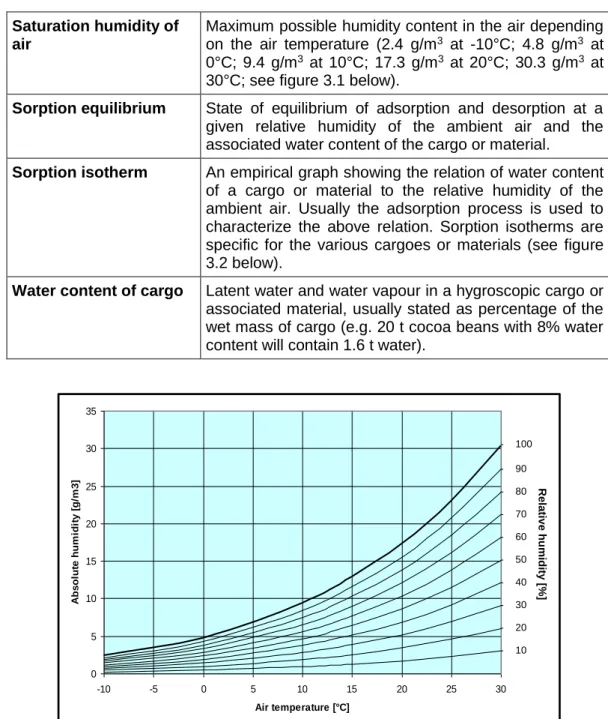
Relative humidity of air Actual absolute humidity expressed as percentage of the saturation humidity at a given temperature.
Roll-on/roll-off ship (ro-ro)
A method of maritime cargo service using a vessel with ramps which allows wheeled vehicles to be loaded and discharged without cranes. Also refers to any specialized vessel designed to carry ro-ro cargo.
Saturation humidity of air
Maximum possible humidity content in the air depending on the air temperature.
Scantling A piece of sawn timber, such as a batten, that has a small cross section.
Set point Temperature setting on the controller of the refrigeration unit.
Shelf life The recommended period that a perishable product may be retained in a saleable condition during which the defined quality of a specified proportion of the goods remains acceptable under expected (or specified) conditions of distribution, storage and display.
Shipper The party named on the bill of lading or waybill as shipper and/or who concludes a contract of carriage (or in whose name or on whose behalf a contract of carriage has been concluded) with a carrier.
Also known as the sender.
Solebar Main beam of a rail wagon/car.
Standard vehicle body Vehicle body, without reinforced structure (in Europe, complies with European standard EN 12642, paragraph 5.2), which, depending on cargo weight and friction, requires additional securing of cargo using lashing equipment.
Storage life The period that the product is kept at the lowest possible temperature starting soonest after picking/harvesting and ending at the time that the product is taken out the refrigerated conditions for delivery to consumers at which time the shelf life period starts.
Unit load Palletized load or prepacked unit with a footprint conforming to pallet dimensions and suitable for loading into an CTU. See also unitized cargo.
Unitized cargo A single item or a number of items packaged, packed, or arranged in a specified manner and capable of being handled as a unit. Unitization may be accomplished by placing the item or items in an overpack or by banding them securely together. Also known as a unit load.
Ventilated container Closed type of container, similar to a general purpose freight container but designed to allow air exchange between its interior and the outside atmosphere. Has a ventilating system designed to accelerate and increase the natural convection of the atmosphere within the container as uniformly as possible, either by non-mechanical vents at both the upper and lower parts of their cargo space, or by internal or external mechanical means.
Water content of cargo Latent water and water vapour in a hygroscopic cargo or associated material, usually stated as percentage of the wet mass of cargo.
Chapter 3. Key requirements
This chapter identify those actions and tasks that are key to the safe packing and transport of cargo.
3.1 General
Do arrange for a safe working environment.
Do use safe handling equipment.
Do use appropriate personal protective equipment.
Do check that the CTU and any cargo securing equipment are in sound condition.
Do not smoke, eat or drink during packing, securing or unpacking.
3.2 Planning
Do select the most suitable CTU type to accommodate the cargo for the intended transport.
Do prepare a packing plan when deemed necessary.
Do select the securing methods best adapted to the characteristics of the cargo, the mode of transport and the properties of the CTU.
Do not exceed the permitted payload limits of the unit or the maximum allowed gross mass according to the CSC3, national road and rail regulations.
3.3 Packing
Do distribute heavy cargo appropriately over the floor area.
Do observe all handling instructions and symbols on packages such as "this side up".
Do load with the centre of gravity correctly located in the CTU.
Donot concentrate heavy cargo on small areas of the floor.
Do not load with eccentric load distribution.
Do not build up irregular layers of packages if it can be avoided.
Do not stow heavy goods on top of light goods.
Do not stow goods with tainting odours together with sensitive merchandise.
Do not pack wet and damp goods if it can be avoided.
Do not use securing or protection equipment which is incompatible with the cargo. 3.4 Packing of dangerous goods
Do check that all packages are properly marked and labelled.
Do pack dangerous goods according to applicable dangerous goods regulations.
Do pack dangerous goods near the door of the CTU where possible.
Do affix required placards, marks and signs on the exterior of the CTU.
Do not pack incompatible goods which should be segregated.
Do not pack damaged packages.
3.5 Securing
Do fill void spaces when necessary.
Do use blocking or lashing or a combination of these methods to prevent the cargo from sliding and tipping in any direction.
Do secure the cargo in a way that forces are distributed over an appropriate area of a unit.
Do secure each single loaded item independently where necessary.
Do use non-slip surface material to refrain packages from sliding where appropriate.
Do use hooks or shackles to fasten lashings where applicable.
Do not secure the cargo with devices overstressing the structure of the CTU or the cargo.
Do not overstress securing devices.
Do not over tighten securing devices so that the packaging or goods are damaged.
Do not fasten web lashings by means of knots. 3.6 On completion of packing
Do determine the correct gross mass of the CTU.
Do affix a seal when required.
Do include the CTU number, the correct gross mass and, when required, the seal number in the appropriate documents.
Do provide a packing certificate when required.
3.7 Unpacking
Do check that the identification number on the CTU and, when the CTU should be sealed, the seal serial number, are as shown on the transport documentation.
Do check the exterior of the CTU for signs of leakage or infestation.
Do use proper equipment to cut the seal if affixed.
Do ensure the CTU is safe to enter. Be aware that the atmosphere in the CTU may be dangerous – ventilate before entering.
Do open the CTU with caution as cargo might fall out.
Do record every package as it is removed noting any markings and damages.
Do remove all securing and protection material for reuse, recycling or disposal.
Do clean the interior of the CTU to remove all traces of the cargo, especially loose powders, grains and noxious materials and fumigants, unless otherwise agreed with the CTU operator.
Do remove all marks, placards and signs regarding the previous consignment from the exterior of the CTU once it has been cleaned.
Chapter 4. Chains of responsibility and information Note: Definitions are given in chapter 2.
4.1 Chain of responsibility
4.1.1 In general, transport operations using CTUs in particular, involve various parties each of whom have a responsibility to ensure that the cargo is transported through the supply chain without incident. Notwithstanding any national legislation or contracts between the involved parties the chain of responsibility discussed below identifies functional responsibilities of the parties involved.
4.1.2 Although the carrier generally, in a contract of carriage is responsible under that contract to deliver the cargo in the same condition as received, it is the shipper who should deliver a cargo which is safe and suitable for transport. Thus, the shipper remains responsible for any deficiency of the CTU that is a result of poor packing and securing. However, when the shipper is neither the packer nor the consignor, the packer and the consignor should fulfil their obligation to the shipper ensuring that the CTU is safe for transport. If not the shipper may hold those parties responsible for any faults or deficiencies that can be attributed to poor packing, securing, handling or reporting procedures.
4.1.3 Within this chain of responsibilities, each party in the chain should comply with their individual responsibilities and in doing so increase safety and reduce the risk of injury to persons involved in the supply chain.
4.1.4 All persons involved in the movement of CTUs also have a duty to ensure, in accordance with their roles and responsibilities in the supply chain, that the CTU is not infested with plants, plant products, insects or other animals, or that the CTU is not carrying illegal goods or immigrants, contraband or undeclared or misdeclared cargoes. 4.1.5 The supply chain is a complex operation and individual modes of transport may
have defined terms for parties within the supply chain which are not consistent with other modes of transport.
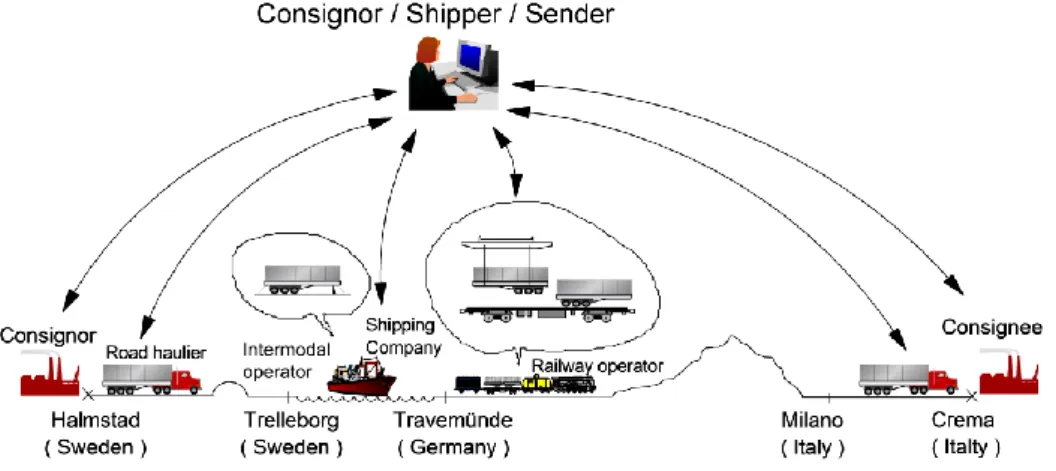
4.1.6 A single entity may undertake one or more of the functions listed below. The flow of information between the functions is discussed further in annex 1.
4.2 Functions within the supply chain
Between the different functions involved in an intermodal transport chain, the tasks are assigned as follows:
4.2.1 The CTU operator is responsible for providing CTUs that:
Are fit for purpose;
Comply with international structural integrity requirements;
Comply with international or national safety regulations;
Are clean, free of cargo residues, noxious materials, plants, plant products and visible pests.
4.2.2 The consignor is responsible for:
Notifying the packer/shipper of any unusual transport parameters of individual packages, for example, the offset of the centre of gravity or transport temperatures which should not be exceeded or undercut;
Ensuring that packages and unit loads are suitable to withstand the stresses which are to be expected under normal transport conditions;
Providing all the information that is required for proper packing;
Ensuring that goods in packages and unit loads are adequately secured to prevent damage during transport;
Ensuring that goods are ventilated so that any noxious or harmful gases are permitted to vent off before packing;
Ensuring that dangerous goods are correctly classified, packed and labelled;
Ensuring the dangerous goods transport document is completed, signed and transmitted to the packer, forwarder, shipper (if not the consignor) and carrier as applicable.
4.2.3 The packer is responsible for:
Ensuring that the CTU is checked before packing and that the condition of the CTU is suitable for the cargo to be transported;
Ensuring that the floor of the CTU is not overstressed during packing operations;
Ensuring that the cargo is correctly distributed in the CTU and properly supported where necessary;
Ensuring that the CTU is not overloaded;
Ensuring that the cargo is sufficiently secured in the CTU;
Ensuring that measures are put in place to prevent the movement of plants, plant products and visible pests, such as closing doors and tarpaulins once packing has started but not taking place and lights that minimize the attraction of insects;
Properly closing the CTU and sealing it, when required, and reporting seal details to the shipper. CTUs used for international transport should be sealed;
Fitting marks and placards to the CTU as required by dangerous goods regulations;
Fitting the fumigation mark if any fumigant has been used as part of the packing process;
Accurately determining the gross mass4 of the CTU and transmitting it to the shipper; Ensuring that no incompatible dangerous goods are packed. Account should be
taken of all dangerous goods legislations during the complete transport chain;
Providing the container/vehicle packing certificate (new document or signed statement in the dangerous goods transport documentation as appropriate) and forwarding any documentation to the shipper.
4 The gross mass of the CTU needs to be verified before any transport operation commences. Incorrect gross masses are a hazard for any mode of transport. Therefore, the gross mass verification should be carried out before the unit leaves the premises of the packer. If a certain transport mode deems it necessary that a reverification has to take place when the CTU is transferred from one mode to another, this is beyond the scope of this Code and may be regulated in the regulations of that mode. Where a cargo is to be transported by road or rail only, the packer need only provide the mass of the cargo and any packing and securing material to the carrier when the tare of the transport vehicle is not known.
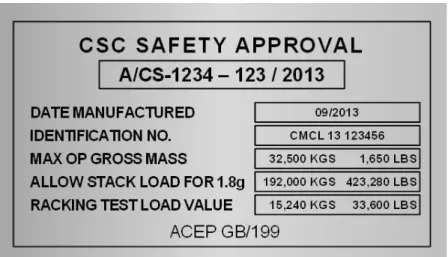
The packer should also pass on information relating to any freight container with a reduced stacking capacity (less than 192,000 kg marked on the CSC safety approval plate)5, to the shipper.
4.2.4 The shipper is responsible for ensuring that:
The work distribution concerning packing and securing is clearly agreed and communicated to the consignor and carrier/carriers;
A suitable CTU is used for the intended cargo for the intended transport;
A CTU is requested which is safe for transport and is clean, free of cargo residues, noxious materials, plants, plant products and visible pests before being supplied to the consignor or packer;
Suitable modes of transport are selected to minimize the risk of accidents and damages for the actual cargo;
All required documents are received from the consignor and from the packer;
The cargo inside the CTU is fully and accurately described;
The gross mass of the CTU is accurately determined;
The accurate description of the cargo6 is communicated to the carrier as early as required by the carrier;
The verified gross mass is communicated to the carrier as early as required by the carrier;
In case of dangerous goods, the transport document and (for sea transport) the packing certificate is transmitted to the carrier before the transport commences respectively as early as required by the carrier;
In the case of temperature controlled goods, the correct temperature set point is entered into the control unit and onto the transport/shipping documents;
Ensuring that a seal, where required, is affixed immediately upon completion of the packing of the CTU;
The seal number, where required, is communicated to the carrier;
Any extraordinary properties such as reduced stacking capacity or out of gauge are communicated to the carrier;
The shipper's declaration is accurate;
Shipping instructions are despatched to the carrier on time and that the CTU meets the outbound delivery window;
The CTU arrives at the terminal before the stated cargo cut off time;
The information concerning the consignment, description of packages and, in the case of freight containers, the verified gross mass is transmitted to the consignee.
5 As of January 1st 2012, all freight containers with reduced stacking or racking strength are required by the International Convention for Safe Containers (CSC) to be marked in accordance with the latest version of ISO 6346: Freight containers – Coding, identification and marking.
6 A description of the cargo should include a description of the goods and the packaging, for example wine in a flexitank, hard frozen hanging beef sides or the number and type of packages. However, national and/or regional regulations may impose additional requirements for the scope and level of detail of cargo descriptions, including usage of Harmonized System (HS) codes.
4.2.5 The road haulier is responsible for:
Confirming that the gross mass, length, width and height of the vehicle are within the national road/highway regulations limits;
Ensuring that the driver is able to get sufficient rest and does not drive when fatigued;
Except when the CTU is a trailer, securing the CTU properly on the trailer or chassis;
Moving the CTU in such a manner that there are no exceptional stresses placed on the CTU or the cargo.
4.2.6 The rail haulier is responsible for:
Handling the CTU in a manner that would not cause damage to the cargo;
Except when the CTU is a rail wagon, securing the CTU properly on the rail wagon.
4.2.7 The intermodal operator is responsible for:
Ensuring that appropriate pest prevention methods are in place, which may include removal of muds and soils from the CTU;
Complying with annex 2.
4.2.8 The carrier is responsible for:
Monitoring agreed temperatures in the CTUs where applicable and reacting to changes as appropriate;
Securing the CTU on the means of transport;
Transporting the CTU in compliance with agreements and all applicable regulations;
Providing trained personnel to deal with all cargo types (break-bulk, bulk wet and dry cargoes, dangerous goods, out of gauge, refrigerated, uncontainerized). 4.2.9 The consignee/receiver of CTUs is responsible for:
Not overstressing the floor of the CTU during unpacking operations;
Correctly ventilating the CTU before entering;
Confirming that the atmosphere within the CTU is not hazardous before permitting persons to enter it;
Detecting any damage to the CTU and to notify the carrier;
Returning the CTU to the CTU operator completely empty and clean, unless otherwise agreed;
Removing all marks, placards or signs regarding the previous consignments.
4.2.10 Shippers of empty CTUs and operators of empty CTUs are encouraged to have practices and arrangements in place to ensure that they are empty.
4.2.11 All parties identified within section 4.2 should minimize the risk of recontamination of CTUs when in their custody. This may include the following:
Implementation of appropriate pest management programs;
Removal of any plants, plant products or visible pests taking into account the roles and responsibilities of each party within the supply chain and, further, the impossibility of inspecting the interior of closed and sealed CTUs for recontamination.
For more information see annex 6.
4.2.12 All parties should ensure that the flow of information is transmitted to parties identified in the transport contract along the supply chain. The information should include:
The identification, in accordance with a risk assessment7, of risks to the integrity of the CTU that may be present for all or some part of the journey;
CTU identification;
Seal number (where required);
Verified gross mass of the CTU;
Accurate description of the cargo carried in the CTU;
The correct description of dangerous goods;
Correct and appropriate transport documentation;
Any information required for safety, security, phytosanitary, veterinary, Customs or other regulatory purposes.
Chapter 5. General transport conditions
5.1 Within the supply transport chain, there are a number of different stresses acting on the cargo. These stresses may be grouped into mechanical and climatic stresses. Mechanical stresses are forces acting on the cargo under specific transport conditions. Climatic stresses are changes of climatic conditions including extremely low or high temperatures.
5.2 During transport various forces will act on the cargo. The force acting on the cargo is the mass of the cargo (m) which is measured in kg or ton, multiplied by the acceleration (a) which is measured in m/s² :
F = m ∙ a
Acceleration considered during transport are the gravitational acceleration (a = g = 9.81 m/s²) and acceleration caused by typical transport conditions such as by the braking or rapid change of traffic lanes by a road vehicle or by the motions of a ship in heavy sea. These accelerations are expressed as product of the gravitational acceleration (g) and a specific acceleration coefficient (c) e.g. a = 0.8 g.
5.3 The following tables provide the applicable acceleration coefficients for the different modes of transport and for the various securing directions. To prevent a cargo from movement, the cargo has to be secured in longitudinal and transverse direction according to the worst combination of horizontal and corresponding vertical accelerations. The securing arrangement has to be designed to withstand the forces due to accelerations in each horizontal direction (longitudinal and transverse) separately (see chapter 9 and annex 7).
Road transport Securing in Acceleration coefficients Longitudinally (cx) Transversely (cy) Minimum vertically down (cz) forward rearward Longitudinal direction 0.8 0.5 - 1.0 Transverse direction - - 0.5 1.0
Rail transport (combined transport)
Securing in Acceleration coefficients Longitudinally (cx) Transversely (cy) Minimum vertically down (cz) forward rearward Longitudinal direction 0.5 (1.0)† 0.5 (1.0)† - 1.0 (0.7)† Transverse direction - - 0.5 1.0 (0.7)†
† The values in brackets apply to shock loads only with short impacts of150 milliseconds
or shorter, and may be used, for example, for the design of packaging.
Sea transport Significant wave height in sea area Securing in Acceleration coefficients Longitudinally (cx) Transversely (cy) Minimum vertically down (cz) A Hs ≤ 8 m Longitudinal direction 0.3 - 0.5 Transverse direction - 0.5 1.0
Sea transport Significant wave height in sea area Securing in Acceleration coefficients Longitudinally (cx) Transversely (cy) Minimum vertically down (cz) B 8 m < Hs ≤ 12 m Longitudinal direction 0.3 - 0.3 Transverse direction - 0.7 1.0 C Hs > 12 m Longitudinal direction 0.4 - 0.2 Transverse direction - 0.8 1.0
5.4 The effect of short term impact or vibrations should always be considered. Therefore, whenever the cargo cannot be secured by blocking, lashing is required to prevent the cargo from being significantly displaced, taking into account the characteristics of the cargo and the mode of transport. The mass of the cargo alone, even when combined with a high friction coefficient (see appendix 2 to annex 7), does not sufficiently secure the cargo as the cargo can move due to vibrations. 5.5 The significant 20-years return wave height (Hs) is the average of the highest
one-third of waves (measured from trough to crest) that is only exceeded once in 20 years. The allocation of geographic sea areas to the respective significant wave heights is shown in the following table:
A B C
Hs ≤ 8 m 8 m < Hs ≤ 12 m Hs > 12 m
Baltic Sea (incl. Kattegat) Mediterranean Sea Black Sea
Red Sea Persian Gulf
Coastal or inter-island voyages in following areas: Central Atlantic Ocean (between 30°N and 35°S) Central Indian Ocean (down to 35°S) Central Pacific Ocean (between 30°N and 35°S) North Sea Skagerak English Channel Sea of Japan Sea of Okhotsk Coastal or inter-island voyages in following areas: South-Central Atlantic Ocean (between 35°S and 40°S) South-Central Indian Ocean (between 35°S and 40°S) South-Central Pacific Ocean (between 35°S and 45°S)
unrestricted
Sources:
The Royal Netherlands Meteorological Institute (KNMI):
The KNMI/ERA-40 Wave Atlas, derived from 45 years of ECMWF reanalysis data (ed. S.Caires, A.Stern, G.Komen and V.Swail), last updated 2011,
Hs 100-yr return values, 1958 – 2000
5.6 During longer voyages, climatic conditions (temperature, humidity) are likely to vary considerably. These may affect the internal conditions in a CTU which may give rise to condensation on cargo or internal surfaces (see annex 3).
5.7 Whenever a specific cargo might be damaged when exposed to high or low temperatures during transport, the use of a CTU specially equipped for keeping the cargo temperature within acceptable limits should be considered (see chapter 7).
Chapter 6. CTU properties
Note: Definitions are given in chapter 2. 6.1 Introduction
6.1.1 When planning a consignment for transport the shipper should ensure that the CTU best suited for the cargo and the probable route is selected. If the shipper is uncertain about which CTU to select, further information can be obtained by contacting the CTU operator.
6.1.2 Packers should acquaint themselves with the characteristics of the CTU with particular reference to:
Net mass capacity;
Flooring strength;
Anchor and securing points;
Thermal capabilities;
Sealing;
Weatherproofness. 6.2 Freight containers
6.2.1 The external and internal dimensions of most freight containers are standardized by ISO.
6.2.2 The maximum gross mass and the permitted payload of a freight container depend on standardized design parameters. The International Convention for Safe Containers requires each freight container to carry a CSC safety approval plate, where the maximum permitted gross mass is specified (see subsection 8.2.1 and annex 4, section 1). Additionally, the tare mass and the payload are marked in painted letters on the door or on the rear end of the freight container.
6.2.3 With the exception of platforms (a container deck without walls), packed freight containers are capable of being stacked. This feature is mainly used in land-based storage areas and on ships during a sea passage. The permissible stacking mass is displayed on the approval plate. Freight containers with a stacking mass equal to or greater than 192,000 kg may be transported without restriction. However, freight containers with a stacking mass value less than 192,000 kg do also exist and require special attention when used for intermodal transport, in particular for the stowage in stacks on seagoing vessels (see subsections 7.3.1 and 8.2.1).
6.2.4 General purpose freight containers are available as closed freight containers, ventilated containers and open top containers. The side walls are capable of withstanding a uniform load equal to 60% of the permitted payload. The front wall and the door end are capable of withstanding 40% of the permitted payload. These limitations are applicable for a homogenous load on the relevant wall area and do not exclude the capability of absorbing higher forces by the framework of the freight container. The container floor is primarily designed to sustain the total payload homogeneously distributed over the bottom structure. This results in limitations for concentrated loads (see annex 7, section 3).
6.2.5 Most general purpose freight containers have a limited number of lashing rings or bars. When lashing rings are fitted, the anchor points at the bottom have a maximum securing load (MSL) of at least 10 kN in any direction. Recently built freight containers have, in many cases, anchor points with a MSL of 20 kN. The lashing points at the top side rails have a MSL of at least 5 kN8.
6.2.6 Floors on freight containers covered by the CSC are only required to withstand an axle load of 5,460 kg or 2,730 kg per wheel9 although they may be built to withstand a greater axle load. The CTU operator can provide more precise information.
6.2.7 Closed freight containers generally have labyrinth protected openings for venting (pressure compensation), but these openings do not measurably support air exchange with the ambient atmosphere. Special type "ventilated containers" have weatherproof ventilation grills built into the top and bottom side rails and the front top rail and bottom sill, through which the natural convection inside the freight container is intensified and a limited exchange of air and humidity with the ambient atmosphere is established.
6.2.8 An open top container is similar to a closed freight container in all respects except that it has no permanent rigid roof. It may have a flexible and movable or removable cover, e.g. of canvas, plastic or reinforced plastic material. The cover is normally supported by movable or removable roof bows. In some cases the removable roof is a compact steel construction suitable to be lifted off in one piece. The header (transverse top rail above the doors) is generally movable or removable (known as swinging headers). The headers are part of the container strength and should be fitted to have full strength of the freight container.
6.2.9 Open side containers have a curtain or canvas on one or both sides, a rigid roof and rear doors. While the strength of the end walls is similar to that of closed freight containers, the side curtain provides limited or no restraint capability. Open side containers are not covered by ISO standards.
6.2.10 Platforms and platform based containers are characterized by having no side superstructure except either fixed or collapsible end walls (flatracks) or are designed without any superstructure (platforms). The benefit of collapsible end walls is that the flatrack may be efficiently stacked when transported in empty condition for repositioning. 6.2.11 Flatracks and platforms have a bottom structure consisting of at least two strong longitudinal H-beam girders, connected by transverse stiffeners and lined by solid wooden boards. For securing of cargo units, strong lashing brackets are welded to the outer sides of the longitudinal bottom girders with a MSL of at least 30 kN according to the standard. In many cases the lashing points have a MSL of 50 kN. Cargo may also be secured in longitudinal direction by shoring to the end walls of flatracks. These end walls may be additionally equipped with lashing points of at least 10 kN MSL.
6.2.12 Thermal containers, commonly referred to as reefer containers, are designed for the transport of cargo under temperature control. Such cargo is generally homogeneously packed and tightly stowed from wall to wall. Therefore, the side and end wall strength is similar to that of general purpose freight containers. However,
8 See ISO 1496-1:2013 Freight containers – Specification and testing – Part 1: General cargo containers for general purposes, Annex C.
thermal containers are generally not equipped with anchor and lashing points. When a cargo needs to be secured by lashings, specific fittings may be affixed to the "T" section gratings, thus providing the required anchor points.
6.2.13 A tank container comprises two basic elements, the tank shell (or shells in case of a multiple-compartment tank container) and the framework. The framework is equipped with corner fittings and renders the tank suitable for intermodal transport. The frame should comply with the requirements of the CSC. If dangerous goods are intended to be carried in the tank, the shell and all fittings such as valves and pressure relief devices should comply with the applicable dangerous goods regulations.
6.2.14 A non-pressurized dry bulk container is a container especially designed for the transport of dry solids, capable of withstanding the loads resulting from filling, transport motions and discharging of non-packaged dry bulk solids, having filling and discharging apertures and fittings. There are freight containers for tipping discharge, having filling and discharge openings and also a door. A variant is the hopper type for horizontal discharge, having filling and discharge openings but no doors. The front and rear end walls of solid bulk containers are reinforced and so constructed to bear a load equal to 60% of the payload. The strength of the side walls is similar to that of general purpose freight containers.
6.3 Regional and domestic containers
Regional and domestic containers are designed and manufactured to meet the needs of local transport operations. They may have the appearance of a freight container, but unless fitted with valid CSC safety approval plates they should not be used in international transport.
6.4 Swap bodies
6.4.1 A swap body is a regional transport containment of a permanent character designed for road and rail transport within Europe and complying with European standards. Swap bodies are generally 2.5 m or 2.55 m wide and are subdivided into three length categories:
Class A: 12.2 to 13.6 m long (maximum gross mass 34 tons);
Class B: 30ft (9.125 m long);
Class C: 7.15, 7.45 or 7.82 m long (maximum gross mass 16 tons).
6.4.2 Swap bodies are fixed and secured to the vehicles with the same devices as freight containers, but owing to the size difference, these fittings are not always located at the swap body corners.
6.4.3 Stackable swap bodies have top fittings enabling the handling with standard freight container handling equipment. Alternatively, the swap body may be handled using grappler arms, inserted into the four recesses in the bottom structure. Swap bodies not suitable for stacking can only be handled with grappler arms. Class C swap bodies can be transferred from the road vehicle to their supporting legs and returned to the vehicle by lowering or raising the carrier vehicle on its wheels.
6.4.4 The standard box type swap body has a roof, side walls and end walls, and a floor and has at least one of its end walls or side walls equipped with doors. Class C swap bodies complying with standard EN 283 have a defined boundary strength: the front and the rear end are capable to withstand a load equal to 40% of the permitted
payload, the sides are capable to withstand 30% of the permitted payload. For a cover-stake body the drop sides are designed to withstand a force equal to 24% of the maximum permitted payload and the remaining part of the side is designed to withstand 6% of the maximum permitted payload. The sides in a curtain sided swap body may not be used for cargo securing unless purposely designed to do so. 6.4.5 Floors of swap bodies are built to withstand corresponding axle loads of 4,400 kg
and wheel loads of 2,200 kg (reference: EN 283). Such axle loads are typical for forklift trucks with a lifting capacity of 2.5 tons.
6.4.6 The curtain-sided swap body is designed similarly to a standard curtain side semi-trailer. It has an enclosed structure with rigid roof and end walls and a floor. The sides consist of removable canvas or plastic material. The side boundary may be enforced by battens.
6.4.7 A thermal swap body is a swap body that has insulating walls, doors, floor and roof. Thermal swap bodies may be insulated, but not necessarily equipped with mechanical device for cooling. A variant is the mechanically refrigerated swap reefer.
6.4.8 A swap tank is a swap body that consists of two basic elements, the tank or tanks, and the framework. The tank shell of a swap tank is not always fully enclosed by the frame work.
6.4.9 A swap bulker is a swap body that consists of the containment for dry solids in bulk without packaging. It may be fitted with one or more round or rectangular loading hatches in the roof and "cat flap" or "letter box" discharge hatches in the rear and/or front ends.
6.5 Roll trailers
6.5.1 Roll trailers are exclusively used for the transport of goods in ro-ro ships and are loaded or unloaded and moved in port areas only. They present a rigid platform with strong securing points at the sides, and occasionally brackets for the attachment of cargo stanchions. The trailer rests on one or two sets of low solid rubber tyres at about one third of the length and on a solid socket at the other end. This end contains a recess for attaching a heavy adapter, the so-called gooseneck. This adapter has the king-pin for coupling the trailer to the fifth wheel of an articulated truck.
6.5.2 The packing of a roll trailer with cargo or cargo units should be planned and conducted under the conception that the cargo should be secured entirely by lashings. However, roll trailers are available equipped with standardized locking devices for the securing of freight containers and swap bodies.
6.6 Road vehicles
6.6.1 Road vehicles are available in a number of different formats and designs.
6.6.2 Most vehicles have a strong front wall integrated into the closed superstructure. Closed superstructures of road vehicles may be provided with arrangements for applying approved seals.
6.6.3 Semi-trailers suitable for combined road/rail transport are generally equipped with standardized recesses for being lifted by suitable cranes, stackers or forklift trucks, to enable the lifting transfer from road to rail or vice versa.
6.6.4 Road vehicles are allocated a specific maximum payload. For road trucks and full trailers the maximum payload is a constant value for a given vehicle and should be documented in the registration papers. However, the maximum allowed gross mass of a semi-trailer may vary to some extent with the carrying capacity of the employed articulated truck as well as in which country it is operating. The total gross combination mass, documented with the articulated truck, should never be exceeded.
6.6.5 The actual permissible payload of any road vehicle depends distinctly on the longitudinal position of the centre of gravity of the cargo carried. In general, the actual payload should be reduced if the centre of gravity of the cargo is conspicuously off the centre of the loading area. The reduction should be determined from the vehicle specific load distribution diagram (see annex 7, subsection 3.1.7). Applicable national regulations on this matter should be observed. In particular closed freight containers transported on semi-trailers with the doors at the rear of the vehicle quite often tend to have their centre of gravity forward of the central position. This may lead to an overloading of the articulated truck if the container is packed toward its full payload.
6.6.6 The boundaries of the loading platform of road vehicles may be designed and made available in a strength that would be sufficient – together with adequate friction – to retain the cargo under the specified external loads of the intended mode of transport. Such advanced boundaries may be specified by national or regional industry standards. However, a large number of road vehicles are equipped with boundaries of less resistivity in longitudinal and transverse direction, so that any loaded cargo should be additionally secured by lashings and/or friction increasing material. The rating of the confinement capacity of such weak boundaries may be improved if the resistance capacity is marked and certified for the distinguished boundary elements of the vehicle.
6.6.7 In Europe, European standard EN 12642 would apply. According to this, there are two levels of requirements of vehicle sides and ends: Code L and Code XL. The strength requirements of the side walls for the Code L vehicles are similar to the requirements for sides of swap bodies according to the standard EN 283 (see paragraph 6.4.4). The side walls of Code XL vehicles are designed to withstand a force equal to 40% of the permitted payload uniformly distributed over the side up to 75% of the height of the side, independently of the type of vehicle. The front wall of Code L vehicles is designed to take up a force equal to 40% of the permitted payload, the maximum however is 50 kN. For Code XL vehicles the front wall is designed to withstand a force equivalent to 50% of the payload without any further limit. The rear wall of Code L vehicles is designed to withstand a force equal to 30% of the permitted payload, the maximum however is 31 kN. For Code XL vehicles the rear wall is designed to withstand a force equivalent to 40% of the payload without any further limit.
6.6.8 Road vehicles are generally equipped with securing points along both sides of the loading platform. These points may consist of flush arranged clamps, securing rails or insertable brackets and should be designed for attaching the hooks of web lashings and chains. The lashing capacity of securing points varies with the maximum gross mass of the vehicle. The majority of vehicles is fitted with points of a lashing capacity (LC) or maximum securing load (MSL) of 20 kN. Another type of variable securing devices are pluck-in posts, which may be inserted into pockets at certain locations for providing intermediate barriers to the cargo. The rating of the lashing capacity of the securing points may be improved if their capacity is marked and certified. Modern vehicles are often equipped with continuous connecting points for lashing bars on each side, thus to enable the affixing of the lashing bars exactly in the required positions to block the cargo against movement towards the rear side.
6.7 Railway wagons
6.7.1 In intermodal transport, railway wagons are used for two different purposes: First, they may be used as carrier unit to transport other CTUs such as freight containers, swap bodies or semi-trailers. Second, they may be used as a CTU themselves which is packed or loaded with cargo and run by rail or by sea on a railway ferry. 6.7.2 The first mentioned purpose is exclusively served by open wagons, which are
specifically fitted with devices for securing freight containers, inland containers and swap bodies or have dedicated bedding devices for accommodating road vehicles, in particular semi-trailers. The second mentioned purpose is served by multifunctional closed or open wagons, or wagons which have special equipment for certain cargoes, e.g. coil hutches, pipe stakes or strong lashing points.
6.7.3 On board ferries the shunting twin hooks are normally used for securing the wagon to the ship's deck. These twin hooks have a limited strength and therefore some wagons are equipped with additional stronger ferry eyes. These external lashing points should never be used for securing cargo to the wagon.
6.7.4 The maximum payload is generally not a fixed value for the distinguished wagon, but allocated case by case by means of the intended track category and the speed category. More details are provided in annex 4, subsection 5.1.5.
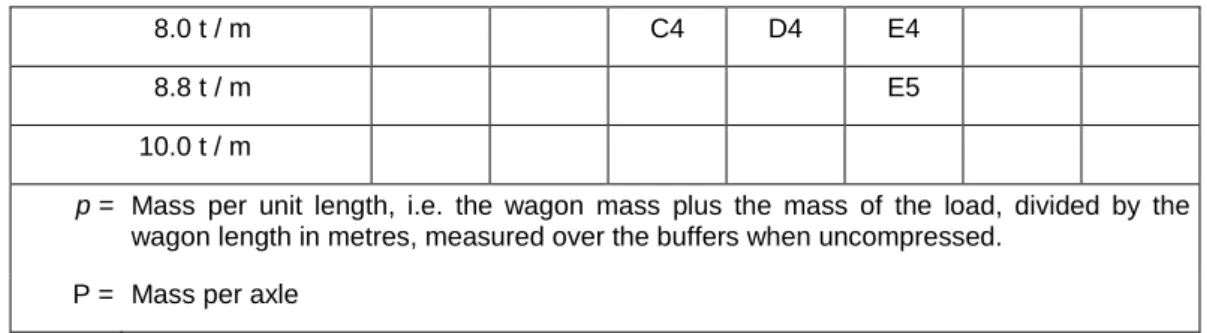
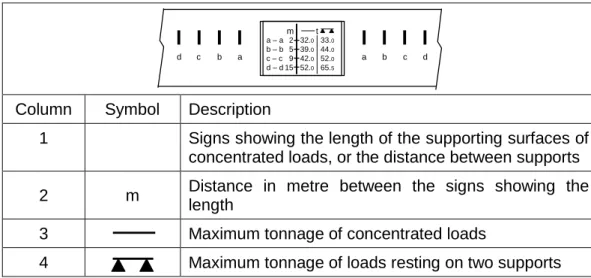
6.7.5 In case of concentrated loads a reduction of the payload is required, which depends on the loaded length and the way of bedding the concentrated load. The applicable load figures are marked on each wagon. Also any longitudinal or transverse eccentricity of concentrated loads is limited by the individual axle load capacity or the wheel load capacity. More details are provided in annex 4, subsection 5.1.6. 6.7.6 Closed railway wagons are designed for the compact stowage of cargo. The
securing of cargo should be accomplished by tight packing or blocking to the boundaries of the wagon. However, wagons equipped with sliding doors should be packed in a way that doors remain operable.
6.7.7 When a railway ferry is operating between railway systems of different gauges, wagons which are capable for changing their wheel sets over from standard gauge to broad gauge or vice versa are employed. Such wagons are identified by the first two figures of the wagon number code.