Resettlement Planning Document
Land Acquisition and Resettlement Plan Document Stage: Final
Project Number: 41121 November 2009
Loan 2503-KAZ: Multitranche Financing Facility for
the CAREC Transport Corridor 1 (Zhambyl Oblast
Section) [Western Europe–Western People's
Republic of China International Transit Corridor]
Investment Program—Project 1
Km 404–Km 483 Road Section
The land acquisition and resettlement plan is a document of the borrower. The views expressed herein do not necessarily represent those of ADB’s Board of Directors, Management, or staff, and may be preliminary in nature.
Prepared by Committee of Roads, Ministry of Transport and Communications (MOTC), Republic of Kazakhstan, for Asian Development Bank.
Currency Unit – Kazakhstan Tenge (KZT) KZT 1.00 = $ 0.007
$ 1.00 = KZT 150.00
ABBREVIATIONS
ADB Asian Development Bank
APs Affected Persons
CAREC Central Asia Regional Economic Cooperation
CR Committee of Roads
EA Environmental Assessment
EMA External Monitoring Agency
FS Feasibility Study
GosNPTsZem Land State Scientific and Production Center for Land Management
IFIs International Financial Institutions
JICA Japan International Cooperation Agency LAR Land Acquisition and Resettlement
LARF Land Acquisition and Resettlement Framework LARP Land Acquisition and Resettlement Plan LARU Land Acquisition and Resettlement Unit MFF Multitranche Financing Facility
MOTC Ministry of Transportation and Communication
PFR Periodic Financing Request
PMC Project Management Consultants
PSC Project Supervision Consultants
RD Roads Department
RK Republic of Kazakhstan
ROW Right of way
TSA Targeted Social Assistance
NOTE
GLOSSARY
Affected Person People, households, or legal entities affected by project related changes in use of land, water, natural resources, or income losses. Compensation Payment in cash or kind to which the affected people are entitled in
order to replace the lost asset, resource or income.
Cut-off-date Date after which people will NOT be considered eligible for compensation i.e. they are not included in the list of APs as defined by the census.
Encroachers People who move into the project area after the cut-off date and are therefore not eligible for compensation or other rehabilitation measures provided by the project or persons who have trespassed government land, adjacent to his/her own land or asset, to which he/she is not entitled, by deriving his/her livelihood there. Such act is called “Encroachment.”
Entitlement Entitlement means the range of measures comprising compensation in cash or kind, relocation cost, income rehabilitation assistance, transfer assistance, income substitution, and business restoration which are due to APs, depending on the type and degree nature of their losses, to restore their social and economic base.
Household Household means all persons living and eating together as a single-family unit and eating from the same kitchen whether or not related to each other. The census used this definition and the data generated by the census forms the basis for identifying the household unit.
Income restoration Income restoration means re-establishing income sources and livelihoods of APs.
Involuntary Resettlement
Any resettlement, which does not involve willingness of the persons being adversely affected, but are forced through an instrument of law. Land acquisition Land acquisition means the process whereby a person is compelled
by a public agency to alienate all or part of the land s/he owns or possesses, to the ownership and possession of that agency, for public purposes in return for fair compensation.
Rehabilitation Assistance provided to affected persons to supplement their income losses in order to improve, or at least achieve full restoration of, their pre-project living standards and quality of life.
TABLE OF CONTENTS List of Abbreviations i Glossary ii Executive Summary Chapter 1 Introduction 1.1 General 1.2 LAR-Related Conditionalities 1.3 The Tranche 1 Project
1 1 1 2 Chapter 2 Impact Assessment
2.1 Data Collection Methodology 2.2 Land Losses
2.3 Crop Losses 2.4 Structure Losses 2.5 Business Losses 2.6 Employment Loss
2.7 Relocation of Structures and Businesses
2.8 Number of Affected Households/Legal Entities and Persons 2.9 Severely Affected APs
2.10 Vulnerable Households
2.11 Perceived Impacts and Suggestions
4 4 4 7 8 8 9 9 10 11 11 12 Chapter 3 Socio Economic Profile
3.1 General Characteristics of the Project Area 3.2 Profile of the Affected Population
13 13 13 Chapter 4 Objectives, Policy Framework and Entitlements
4.1 Kazakhstan Legal Framework and Practice 4.2 ADB Involuntary Resettlement Policy
4.3 Comparison of ADB Resettlement Policy and Kazakhstan’s Legislation
4.4 Actions Made to Address the Gaps
4.5 Policy Framework and Entitlements for this Project
17 17 19 20 20 21 Chapter 5 Consultation and Disclosures
5.1 Consultations 5.2 Disclosure
25 25 27 Chapter 6 Grievance Redress Participation
6.1 Grievance Focal Points, Complaints Reporting, Recording and Monitoring
6.2 Grievance Resolution Process 6.3 Disclosure of the Grievance Process
28 28 29 30 Chapter 7 Compensation, Relocation and Income Restoration
7.1 Compensation for Privately-owned Lands 7.2 Compensation for Leased Lands
31 31 32
7.3 Compensation for Expenses Related to Land Development and Obligations to Third Parties
7.4 Additional Compensation for Severely Affected Households 7.5 Compensation for Affected Structures
7.6 Compensation for Business Losses 7.7 Relocation and Livelihood Restoration
34 36 36 37 37
Chapter 8 Institutional Framework 8.1 Committee of Roads
8.2 Zhambyl Oblast Roads Department
8.3 Akimats (District Local Governments of T. Ryskulov and Baizak) 8.4 Project Management Consultants (PMC)-ADB Unit
8.5 Construction Supervision Consultants 8.6 External Resettlement Monitoring Agency
39 39 39 40 40 40 41
Chapter 9 Resettlement Budget and Financing 42
Chapter 10 Implementation Schedule 44
Chapter 11 Monitoring and Evaluation 11.1 Internal Monitoring 11.2 External Monitoring 47 47 48 Appendices
A Census and Socioeconomic Survey Questionnaires 49
B List of Affected Persons/Legal Entities 58
C Information Brochure on AP Rights/Entitlements 77
D E F
Information Brochure on Temporary Land Acquisition for Local Disclosure
Land Acquisition Process
Draft TOR for External Resettlement Monitoring
92 102 105
EXECUTIVE SUMMARY
1. This updated Land Acquisition and Resettlement Plan (LARP) is prepared by the Committee of Roads (CR) for the rehabilitation and upgrading of road sections in Zhambyl Oblast from km 404 - km 483 covered in Tranche 1 of the Central Asia Regional Economic Cooperation (CAREC) Transport Corridor 1 Investment Program under a Multitranche Financing Facility.
2. The APs for this Project were identified during the preparation of the detailed design which was completed in March 2009. Valuation of affected structures was done by a licensed valuator commissioned by the Design Firm, while land valuation was done by the Zhambyl Land Resources Management Agency. Information on the socio economic profile of the APs was obtained through the census and socio economic surveys conducted in July 2009. Adjustments in valuation was done based additional information and revaluation of assets conducted from August to October 2009.
3. This revised LARP i includes: i) updated number of vulnerable households and cost of relative allowances; ii.) updated information on affected workers and businesses displacement and costs for their compensation; iii.) supplemental information re-valuation of affected assets; and iv) results of consultations in Baizak and v) updated overall costs.
4. The initiation of civil works on the road sections covered by this LARP will be contingent to fulfillment of the following conditions:
a. approval of this LARP by ADB;
b. full disclosure of this LARP to the public; and
c. full implementation of the compensation program described in this LARP including the full delivery of compensation to the APs.
5. A total of 133 parties (108 households, 11 legal entities and 14 village administrations/government reserved lands) will likely to experience various losses/impacts from the implementation of the project. Most affected households and legal entities will lose ownership/access to agricultural lands and the income they derive from it. The census revealed at least 123 workers who may be affected. Total number of affected persons from among the affected households, including 123 affected workers, is 784 persons.
6. Approximately 167.72 hectares of land to be acquired for permanent use. During construction, around 108.2 hectares will also be needed temporarily. Most of the affected lands (54.03%) are agricultural/arable lands. Only 0.29% is used for commercial purposes. Around 45.66% of land is either managed by village administration units for various uses or reserved lands used as pasture land or other uses.
7. Most of the affected lands (129.84 hectares or 47.06%) are leased on a long-term basis (49 years). A total of 88 households and 10 legal entities are long-term leaseholders. Around 18.29 hectares of affected land are leased by ten households on a short-term basis, while 1.753 hectares of affected lands are privately-owned by 9 households and 1 legal entity. One affected household privately owns one plot and leases another plot. None of the affected lands are unregistered.
8. Most of the affected agricultural lands are planted with wheat and barley. Others also plant safflower, onion and lucerna. Some households plant more than one crop. A total of 63
structures will either be partially or fully affected. These structures are owned and used by 13 households and 1 legal entity for various purposes. Structures to be affected include cafes, shops, café-shops, toilet, gas station, fence, house, private water supply/electrical lines and partially completed structures. Four households will have their brick houses affected and will need to relocate.
9. Eight households and 1 legal entity (Shara and C Trading Firm) that will lose their commercial structures also stand to lose their income from their livelihood/business activities. Two households were identified as vulnerable and will be provided with cash assistance equivalent to one month’s minimum wage. A summary of the land acquisition and resettlement impacts is given in Table E-1 below.
Table E-1
Summary Land Acquisition and Resettlement Impacts
No. Description Number/Amount
1 Total number of permanently affected land parcels - privately owned/leased lands
- village administered and reserved lands 68* 17 2 Total number of temporarily affected land parcels 93* 3 Total area of land to be acquired permanently (in hectares) 167.7224 4 Total area of land to be acquired temporarily (in hectares) 108.20 5 Total area of arable land to be acquired permanently (in hectares) 77.27 6 Total area of arable land to be acquired temporarily (in hectares) 89.28 7 Total area of commercial land to be acquired permanently
(in hectares) 0.8124
8 Total area of lands administered by the village or reserved land to be affected permanently (in hectares)
89.64 9 Total area of lands administered by the village or reserved land to be
affected temporarily (in hectares) 18.92
10 Total area of permanently affected privately-owned land 1.754 11 Total area of permanently affected leased land 76.33 12 Total area of temporarily affected leased land 79.17 16 Total number of permanently affected households, legal entities and
village administrations 69
17 Total number of temporarily affected households, legal entities and
village administrations 86
18 Total number of severely affected households and legal entities 12
19 Total number of vulnerable households 2
20 Total number of affected structures 63
21 Total number of households and legal entities losing business 13 22 Total number of affected workers
- workers from affected business establishments
- agricultural workers from affected farms 101 22 23 Total number of APs, including workers in affected establishments 784 * One household in T. Ryskulov will lose portions of both his leased land and privately-owned land. Sixteen
households that will lose portions of their lands permanently will also lose other portions of their plots temporarily
10.
Most AP households (48.8%) have 4-6 members. The average household size is 6.0. However, there are also households (7.0%) with 10 or more members. Majority resides in villages within the T. Ryskulov District. Another 16.3% reside in Baizak District. In terms of ethnic composition, majority of the affected households (96.5%) are Kazakhs. Other ethnic groups are migrants who settled in the area over the past years. None of these ethnic groupsmaintain cultural and social identifies separate from the mainstream Kazakhstan’s society fitting the ADB definition of Indigenous Peoples.
11. Heads of the affected households have a mean age of 49.3. Most are between 40 – 59 years old (60.5%). However, a few household heads (7.5%) are already 70 years old and above. Women household heads are generally older than male household heads. In terms of marital status, 90.7% of the household heads are married. There are also 6 widows, 1 widower and 1 single household head. Majority of the household heads (68.6%) have secondary education. A considerable proportion (30.2%) was able to obtain higher education. On the other hand, one interviewed household head has only completed primary education.
12. Majority of the affected households rely in agriculture as their primary income source of the affected farming households. Only a few rely on trading and non-agricultural activities. Most households have more than 1 income-earning member. Average household monthly income is around 126,200 KZT, while average expense is around 125,000 KZT. Most households have houses made of bricks. Only a few stay in structures made of saman (clay with straw) or wood. 13. A number of consultations with raion (district) akimats and affected persons in the entire road corridor have been conducted by the Committee of Roads since 2007. Initial consultations were with the Akims, Deputy Akims and Land Allocation Offices at the different raions. Consultations related to the preparation of the Environmental Assessment were conducted in Baizak and T. Ryskulov in January 2009.
14. In May 2009, a consultation was again held in Kulan to explain the rights of affected persons, as well as the valuation of losses, grievance redress and procedures in land acquisition. APs and representative from local NGOs participated. A similar consultation was held in Baizak in August 2009. During these consultations, APs were informed on who they can contact or approach at the raion Akimat and at the Zhambyl Roads Department in case of complaints or queries.
15. Efforts will be made to resolve/clarify issues at the level of the raion akimat and at the Zhambyl Roads Department. However, Issues requiring attention or action from the MOTC-Project Management will be forwarded to the MOTC-Project Management Consultant-ADB which provides technical and supervision support to MOTC for the Project. If the case remains unsolved a complaint can be lodged to the court.
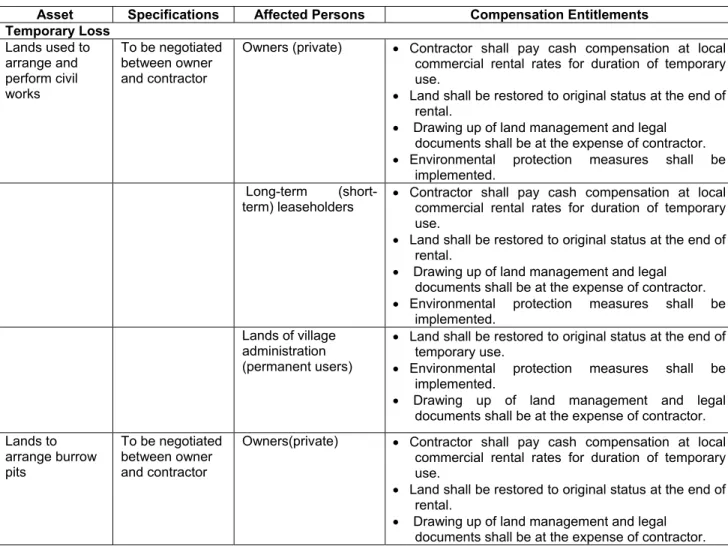
16. Compensation and entitlements for this Project aims to assure that the APs maintain or improve their standard of living after the project. The table below provides a summary of the compensation entitlements for various categories of APs and degrees of impacts related to the Project.
Entitlement and Compensation Framework
Asset Specifications AP* Compensation Entitlements Permanent Loss
Owners
(1 HH) • Cash compensation at replacement cost or through replacement land equal in value/productivity to the plot lost and at location acceptable to APs where feasible. • Cash compensation, market value of one year gross
yield (based on a 3-year average) or renewed lease in an alternative plot
All Land Losses irrespective of severity of impact
Leaseholders
(short-term / long-term)
(43 HH and 3 LE) • Cash compensation at replacement cost or through replacement land equal in value/productivity to the plot lost and at location acceptable to APs where feasible. Arable
Land
Severe Impact— >more than 10% of income/prod- uctive land lost
Owners, leasers
(5 HHs) • Cash compensation equal to market value of two crop years.
Owners
(8 HH and 1 LE) • Cash compensation at replacement cost or through replacement land equal in value/productivity to the plot lost and at location acceptable to APs where feasible.
Commer-cial Lands
Squatters
(4 HH) •• Lease plot on State land; Self-relocation cash allowance option; Buildings and Structures Owners of permanent structures (12 HH and 1 LE)
• Compensation of full market value or, at the owner option, house for house swap
Crops Crops affected All AP including squatters
(87 HH and 10 LE) • Crop compensation in cash at full market rate for 1 year gross harvest — paid to owners and tenants. Business and employ ment Temporary or permanent business/ employment loss
All AP including squatters and workers from affected establishments
(8 HH, 1 LE and
124 APs-workers)
• Owner: if permanent loss, cash compensation equal to one year income (lost profits); if temporary, cash compensation for the period of income loss taking into account the compensation to workers for lost job (forced interruption) due to complete or temporary business cancellation – amounting up to 3-months average wages.
Reloca tion Transport and transitional livelihood costs
All APs affected by relocation
(12 HH and 1 LE)
• Allowance sufficient to cover transport expenses and livelihood expenses for one month due to relocation. Vulnerabi
lity AP with special needs to avail of project benefits (2 HH)
• Special programs providing additional compensation, adjustment allowances or other initiatives, based on social assessment and AP census findings;
Temporary Loss
Land for construct ion sites
and burrow pits Owners (private or public) (69 HH, 7 LE and 14 village administrations)
• Cash compensation at local commercial rental rates for duration of use;
• Land restored to original status at the end of rental.
* HH refers to household, LE refers to legal entity, while AP refers to affected person.
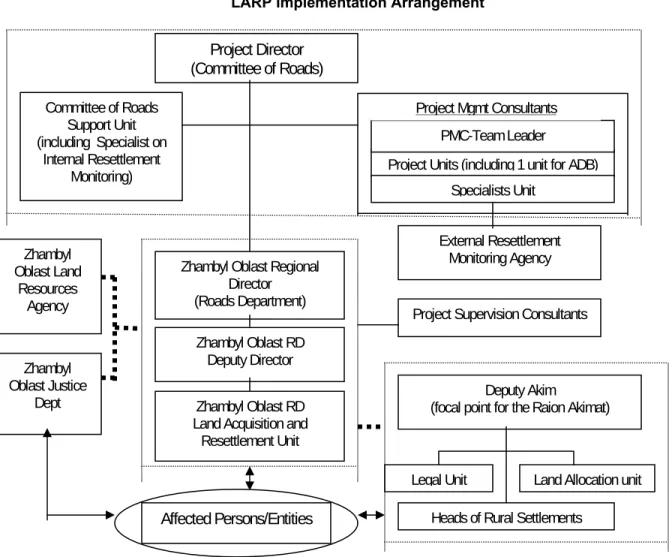
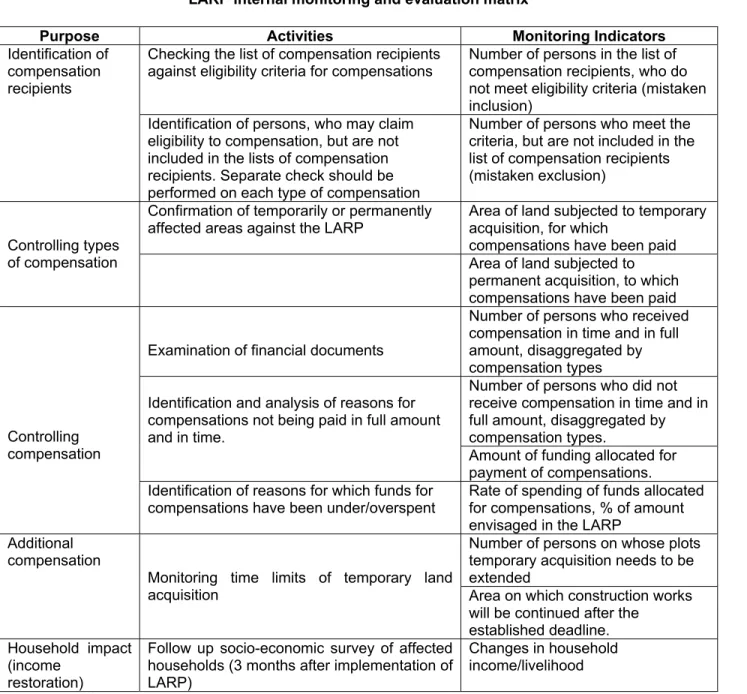
17. The Zhambyl Oblast Roads Department will implement the LARP, with support from the Construction Supervision Consultants, the Zhambyl Land Resource Management Agency and the Akimats of T. Ryskulov and Baizak. Internal resettlement monitoring will be done by the Monitoring Specialists to be designated by the Committee of Roads.
18. An External Resettlement Monitoring Agency will also be engaged to provide an independent assessment of the implementation of land acquisition and resettlement activities in this road section as agreed between the Government of Kazakhstan and ADB.
19. A budget of approximately KZT 1,392,225,251.00 has so far been allocated for all LARP implementation activities in Zhambyl Oblast including KZT 901,739,166.00 for all ADB-financed road sections. This includes the cost for compensation of losses, operations of the Resettlement Unit, land re-registration, as well as resettlement monitoring and evaluation. LARP activities for this section (Km 404-Km 484) is estimated at KZT 715,392,400.
20. Civil works for the Project will be divided into two contracts. One contract will be for the upgrading of km 404 to km 443, and another for km 443 to km 483. Two separate teams will be mobilized to implement the LARP activities for both sections. Depending on which section can be completed first, LARP review can be done separately for each section which will be used as basis for contract awards. It is expected that LARP activities for this Project will be completed by January 2010.
Chapter 1 Introduction
1.1 General
1. The Asian Development Bank (ADB) has agreed to provide the Kazakhstan Government up to $700 million for implementing the Central Asia Regional Economic Cooperation (CAREC) Transport Corridor 1 Program (the Program). The Program entails the rehabilitation, improvement or construction of several road sections along the Western Europe-Western China transit corridor and is financed through a Multitranche Financial Facility (MFF) divided in several tranches (Projects). 2. The first tranche amounting to $340 million which covers the rehabilitation of km 210 – km 260 (Blagoveschenka-Kordai section) and upgrading of road sections between km 404 – km 483 was approved in December 2008. Civil works in these sections were initially assessed as not involving land acquisition and resettlement (LAR) nor create significant environmental impacts. However, during the detailed design it was found out that additional land will be needed for the construction of a four-lane 10-km new bypass in Kulan and the expansion of the existing two-lane road into a four-lane highway from km 414 to km 483.
3. Hence, this updated Land Acquisition and Resettlement (LAR) Plan (LARP) has been prepared by the Committee of Roads (CR) of the Ministry of Transport and Communications (MOTC) in compliance with the Land Acquisition and Resettlement Framework (LARF) agreed between the Government of Kazakhstan and ADB and relevant Kazakhstan laws. Its objective is to assess the Project impacts and plan needed compensation/rehabilitation measures. Its preparation involved: (i) detailed measurement surveys, (ii) asset valuation/documentary research on affected plots, (iii) consultation with raion (district) local governments, and affected parties; (iv) a census of affected households (AHs); (v) a socio-economic surveys of the AHs, and (vi) re-valuation of affected assets based on additional information and surveys.
4. This updated LARP is based on detailed design1 with adjustments made in the count and valuation of a number of affected lands and structures based on additional information and review conducted from August to September 2009 by a valuation team supported by the ADB as requested by the CR.
5. This updated LARP i includes: i) updated number of vulnerable households and cost of relative allowances; ii.) updated information on affected workers and businesses displacement and costs for their compensation; iii.) revised count and re-valuation of affected assets; iv) results of consultations in Baizak and v) updated overall costs.
1.2 LAR-Related Conditionalities2
6. Based on ADB policy and practice, the appraisal of the MFF and each tranche and approval of project implementation will entail the following LAR-related conditions:
(i) MFF/tranche 1 appraisal: conditional to preparation/disclosure of a Land Acquisition and Resettlement Framework (LARF) for the whole MFF acceptable to ADB and the LARPs for all tranche projects requiring LAR.
1 The detailed engineering design from km 404-483 was prepared by Kazdor Proekt and approved by MOTC in June
2009.
(ii) Following tranches PFRs approval: conditional to LARF review/update, and preparation/disclosure of LARPs fitting the updated LARF for roads with LAR.
(iii) Contract awards signing: Conditional to the preparation/disclosure of updated/implementation-ready LARPs approved by ADB and reflecting final impacts, AP lists and official compensation rates.
(iv) Provision of notice to proceed to contractors: Conditional to full implementation of LARP (full delivery of compensation/rehabilitation) for the relevant project. Such a condition will be clearly spelled out in the text of the civil works contract.
7. Based on the above appraisal, signing of contract awards and civil works implementation for this Project are subject to the following conditionalities:
• Contract Awards Signing and LARP implementation: i.) update of the final LARP based on detail design as indicated above (para. 5); ii.) disclosure of the updated LARP to the APs; iii.) mobilization of the External Monitoring Agency (EMA). The LARP should reflect final impacts, final AP lists, final compensation rates and will be readily implementable
• Provision of No objection to initiation of civil works: i.) full implementation of the compensation program described in this LARP including the full delivery of compensation to the APs and ii.) preparation of a compliance report by the EMA. 1.3 The Tranche 1 Project
8. Tranche 1 finances road reconstruction activities in two road sections of the Almaty-Taraz highway, namely km 210 – km 260 and km 404 – km 483. Civil works from km 210 – km 260 will be limited to the reconstruction of the two-lane highway within the existing right-of-way. Only temporary land acquisition during construction is anticipated in this section. On the other hand, the proposed works between km 404 – km 483 involve the expansion of the existing two-lane highway to a four-two-lane (I-B) category road that will involve land acquisition and resettlement. Following is a description of the civil works for km 404 – km 483:
a. upgrading of km 404 – km 443
(length = 40,7433.99 m, including an 11.6 km new bypass)
- structures (replacement of old pipes with 57 reinforced concrete round pipes)
- four highway crossings, including 1 railroad crossing at km 483+082, 1 pipe junction at km 420+864.85, and 2 crossings for agricultural machinery
- 16 abutments and 4 intersections
- road infrastructures (12 bus stops with toilets, 6 parking sites with ramps and toilets, lighting at junctions and populated areas
- rearrangement of pipes and communication lines
b. upgrading of km 443 – km 483
- replacement of 29 old pipes with reinforced concrete round pipes - 3 highway crossings for agricultural machinery
- 24 abutments and 2 intersections
- road infrastructure (10 bus stops with toilets, 3 parking sites with ramps and toilets, and lighting in populated localities)
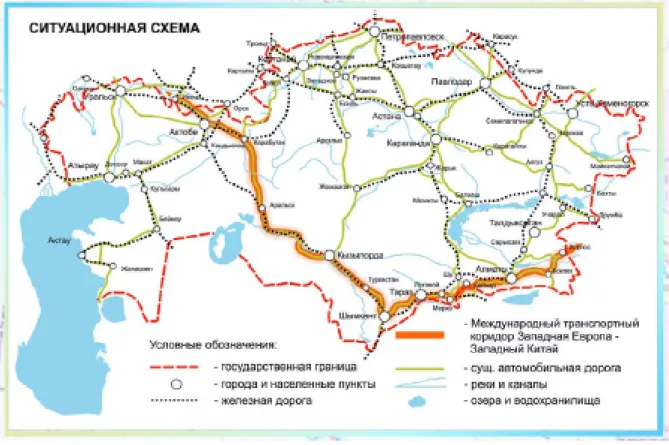
MAP OF THE PROJECT AREA (km 404 – km 483) Route end km 404 Route beginning km 383
Chapter 2 Impact Assessment 2.1 Data Collection Methodology
9. Affected persons and assets were identified at different stages of the Tranche 1 Project preparation. Initial assessment was made during the preparation of the feasibility study in January 2008. More intensive assessments were made between km 404 – km 483 by the Design Firm (Kazdor Proekt) during the preparation of the detailed design. Information on the affected plots was derived by plotting the proposed road alignment into the land cadastre provided by the Zhambyl State Scientific and Production Center for Land Management (GosNPTsZem). The land cadastre was used in identifying the names of the registered landowners/leaseholders/APs with permanent land use rights, land use, size of the affected plots and the proportion of affected land against the total area of the plot.
10. At the Raion (district) level, a committee chaired by the Deputy Akim was formed in T. Ryskulov and Baizak. From August to November 2008, the committees surveyed the affected plots and met with the owners/lessees of these plots to inform them what area of their lands would be affected. Licensed structure valuators were engaged by the Design Firm to assess the market value of structures to be acquired, while GosNPTsZem estimated the values of the affected land plots based on the registered land use and land category.
11. In August 2009, a Work Team was mobilized (through fund support from ADB) to assist the Zhambyl Oblast Roads Department in undertaking the necessary refinements to these valuations prior to negotiation with the APs. Additional information were collected from the raion Statistics Office, Agriculture Department, Justice Department, Tax Committees and the Technical Inventory Bureau. To ensure that all aspects are considered in the valuation and to minimize complaints from the APs, the Work Team developed a self-prepared application form in the collection of supplementary information on affected lands and structures with specific columns for each type of asset. APs were asked to fill in the form, including a request for valuation, and submitted to the Zhambyl Roads Department. An assessment of the impacts from the proposed civil works between km 404 – km 483 is presented in the following sections. 2.2 Land Losses
12. Detailed measurements made at the detailed design stage revealed a total of 275.92 hectares of land will be affected. Of these, 167.72 hectares of land are to be acquired for permanent use. During construction, around 108.20 hectares will also be needed temporarily. Most of the affected lands (54.03%) are agricultural/arable lands. Only 0.29% is used for commercial purposes. Around 45.68% of the affected lands are reserved lands or managed by village administration units for various uses.
13. Forty-eight households, 4 legal entities and 14 village administrations (including portions of government reserved lands) stand to lose portions of their land permanently. Those losing land temporarily include 69 households, 7 legal entities and 10 village administrations. In total, 104 households, 11 legal entities and 14 village administrations will lose portions of their lands either permanently or temporarily. See table 1.
Table 1
Loss of land by land category (km 404 to km 483) A. Affected Households
Land to be acquired
(in hectares) Number of Affected Households Number of Affected Persons Land category Permanently Affected Temporarily Affected Permanently Affected 3 Temporarily Affected 4 Arable land 74.69 55.12 43 69 582 Commercial land 0.2972 9 55 Residential land Sub total (for affected Households) 19.80 55.12 51 69
Sub total (for affected Households without
double counting) 104 631
5
B. Affected Legal Entities
Land to be acquired
(in hectares) Number of Affected Firms/Legal Entities Land category
Permanently
Affected Temporarily Affected Permanently Affected Temporarily Affected 6
Arable land 2.58 16.68 3 7
Commercial land 0.5152 1
Village Administration owned land/reserved land (permanent use)
89.64 36.40 14 10
Sub total
(for affected legal entities
92.7352 53.08 18 17
Sub total (for affected legal entities without double counting)
92.7352 53.08
11 Legal Entities
14 village administration and reserved lands
Total (A and B) 167.7224 108.20 69 86
Total Number of Households and Legal Entities Losing Land (without double counting)
129
3 One household in Ryskulov will lose a long-term leased land (arable) and a privately owned commercial land.
Hence, it is counted only once in the total number of affected households.
4 Sixteen households will temporarily and permanently lose portions of their arable lands and were therefore only
counted once in the total number of affected households.
5 One household with six members will lose both arable land and commercial land. Hence, instead of 637 APs, there
are only 631 APs from the affected households losing land.
6 8 reserved lands and 2 village administrations will temporarily and permanently lose portions of their lands. Hence,
14. Many of the affected areas (129.84 hectares or 47.06%) are leased on a long-term basis (49 years). A total of 88 households and 10 legal entities are long-term leaseholders. Around 18.29 hectares of affected land are leased by nine households on a short-term basis, while 1.753 hectares of affected lands are privately-owned by 8 households and 1 legal entity. Lastly, 126.04 hectares of affected lands (45.66%) are either government reserved lands or managed by the village administration (akimat). One affected household privately owns one plot and leases another plot. None of the affected lands are unregistered. See tables 2 and 3.
Table 2
Affected land by type of ownership/tenurial status of affected households/ legal entities/village administration (km 404 to km 483)
Land to be acquired (in hectares) Number of Affected Households (HHs)/ Legal Entities (LEs)
Ownership/ Tenurial
Status Permanent Loss Temporary Loss Total Permanent Loss 7 Temporary Loss8 without Total Double Counting Privately Owned 1.238 0.516 1.238 0.516 9 HHs 1 LE 9 HHs 1 LE Long-term
lease 65.57 2.58 45.01 16.68 110.5819.26 40 HHs 3 LEs 64 HHs 7 LEs 87 HHs 10 LEs Short-term
lease 8.18 10.11 18.29 4 HHs 5 HHs 9 HHs
Unregistered None None None None
Village owned land/
reserved land 89.64 36.4 126.04 14 10 14 villages and reserved lands Total 167.724 108.20 275.924 51 HHs 4 LEs 14 Villages and reserved lands __ 69 total 69 HHs 7 LEs 10 Villages and reseved lands __ 86 total 104 HHs 11 LEs 14 villages and reserved lands Total (without double counting 167.724 108.20 275.924 129
15. Among the leaseholders, 9 households confirmed in writing that they have not been planting crops on the affected portions of their leased lands for a number of years due to reasons not depending on the Project (i.e. lack of capital, labor force, agricultural machinery and
7 One household will lose one privately owned commercial land and one long-term leased land. Therefore, it is only
counted once in the total number of affected households.
8 16 households, 8 reserved lands, and 2 village administrations will lose permanently and temporarily portions of
equipment or other reasons). These portions of unproductive leased lands have a combined area of 9.72.
Table 3
Privately owned lands subject to acquisition, km 404 – km 483
No. Names of land
owners Land plot purpose
Total area,
in has acquired, Area in has % of area acquired Km 404 – km 469, T. Ryskulov raion Gas station, shop, “Zhanel” café 0.5 0.068 13.6 1 Ryskulov Sh. Gas station 0.024 0.024 100
2 Mukhiyev Е. “Tulpar-3” gas
station 0.146 0.025 17.7
Café, shops 0.1647 0.1647 100
Café, shops 0.1305 0.1305 100
3
General Partnership “Shara and C” and individual
entrepreneurs Café, shops 0.3908 0.22 56.3 4 Maulenkulov S. “Kanagat” shop 0.018 0.01 55.6
Vulcanizing and oil change shop 5 Omarov О.
“Rauan” shop
0.0340 0.03 88.2
6 Azimkhanova Т. Café 0.0229 0.01 43.7
7 Baikuliyev Т. “Ata Zholy” café 0.0232 0.002 8.6 Km 469 – km 483, Baizak raion
8 Akhtamberdiyev Е. Pasture 11.0 0.96 8.7 9 Shakbatyrov S. Gas station, shop
and café 0.5 0.013 2.6
10 Mukhiyev Е. Construction and maintenance of gas station, café, camping, sales outlet
0.3125 0.096 30.7
Total 1.7532
2.3 Crop Losses
16. Leased lands are to be compensated equivalent to the market value of one-year gross yield (based on a 3-year average). Commonly planted crops by the surveyed households are wheat and barley. Others also plant safflower, onion and lucerna. Eight households reportedly plant more than one crop. Income derived from crops varies. Those planting wheat reported earning between 3,000 – 7,000 KZT per centner, while those planting barley reported earning between 2,500 – 4,000 KZT per centner. Onions are sold at 2,500 KZT per centner. Safflowers
are sold between, 4,000 – 7,000 KZT per centner, while lucerna is sold at 4,000 KZT per centner. See table 4.
Table 4
Crops planted by surveyed farm households (n = 86, multiple responses)
Crops Planted Number
of HH Percent Price Per Centner (in KZT)
Wheat 48 55.8 3,000 – 7,000 Barley 26 30.2 2,500 – 4,000 Onion 1 1.2 2,500 Safflower 8 9.3 4,000 – 7,000 Lucerna 1 1.2 4,000 Pastures 1 1.2
Did not indicate/not seeded 3 3.5
2.4 Structure Losses
17. A total of 63 structures will be affected. Majority of which will be fully affected. These structures are owned and used by 13 households and 1 legal entity for various purposes. Structures to be affected include cafes, shops, café-shops, toilet, gas station, fence, booth and well, house, and private water supply/electrical lines and partially completed structures. One legal entity and two households will lose more than one structure. The impact on 4 dwelling units will displace the households who live in these structures. See table 5.
Table 5
Affected structures (Km 404 – Km 483)
Structure Number Total Area (m2) Structure Number Total Area (m2) Gas stations 4 (up to 3750
filling/day) with 11 dispensers
Video surveillance 1
Operator room 4 369 Vulcanizing shop 2 148.7
Shop, café 27 849 Service center 1 156
Shelter 4 533.8 Shed 1 122
Toilet 1 124 Shop 4 205
Yard pavement 3 5,038 Café 2 1,155
Fence 3 1,743rm Watchbox 1 16
Dirt fill 1 0.05 km Residential
houses 4 N/A
2.5 Business Losses
18. Eight households and 1 legal entity (Shara and C Trading Firm) stand to lose their income from their livelihood/business activities. These APs are eligible to be compensated in cash for the income of 1 year based on tax records, or - if these are not available - based on the official monthly minimum salary in the project area (13,470 KZT x 12 months). During the census, efforts were made to determine the income losses from the affected business establishments. Of the interviewed respondents, only seven responded to the question. A
follow-up survey conducted by the Zhambyl Oblast Roads Department showed an average monthly income range between 30,000 KZT to 2,154,000. Business income of the 25 shops and café’s of Shara and C Trading Firm is computed at 34,383,091 KZT. See table 6.
Table 6
APs losing their business, km 404 – km 483 APs losing their
business Business description business Year of commencement Monthly income (according to Zhambyl Roads Department ) in KZT Private owners
Gas station, shop,
“Zhanel” café 1985 1 Ryskulov Sh.
Gas station 2004 788,000
2 Mukhiyev Е. “Tulpar-3” gas station 2006 264,000
3 General Partnership “Shara and C” and individual
entrepreneurs9
Café, shops 1997 34,383,091
4 Maulenkulov S. “Kanagat” shop 2004 82,022
“Rauan” shop 1994 5 Omarov О.
Vulcanizing shop 1995
95,200
6 Azimkhanova Т. Café 13,470
7 Shakbatyrov S. Gas station, shop and
café 2000 2,154,000
Leaseholders
8 Abishev M.Zh. Vulcanizing shop 2004 30,000 9 Bartenev N. Café and consumer
goods kiosk
2001 69,000
2.6 Employment Loss
19. A number of workers may be affected temporarily or permanently by the disruption in the commercial operations of some business establishments. During the census, it was reported that the jobs of at least 22 workers/staff may be affected. Monthly incomes of these workers were reported to range between 14,000–40,000 KZT per month. An additional 101 agricultural workers were identified during the supplemental assessment conducted in August 2009, bringing the total of affected workers to 123. Compensation for agricultural workers was based on their projected income for the remaining agricultural year.
2.7 Relocation of Structures and Businesses
20. The 12 households and 1 legal entity whose structures will be affected will need to dismantle and relocate outside the expanded right-of-way. All of the affected structures can be
9 Data on tax reporting was not provided. The valuation used the coefficient taking into account the income from
relocated/shifted in the remaining area of the APs’ plot or in another plot owned by the APs. All APs prefer to self-relocate. Related to this, a self-relocation/transport allowance will have to be provided to each of these APs.
2.8 Number of Affected Households/Legal Entities and Persons
21. A total of 133 parties (108 households, 11 legal entities and 14 village administrations/government reserved lands) will likely to experience various losses/impacts from the implementation of the project. Most affected households and legal entities will lose ownership/access to agricultural lands and the income they derive from it. The census revealed at least 123 workers who may be affected. Total number of affected persons from among the affected households, including the 123 workers, is 784 persons. See table 7.
Table 7
Details of affected households, legal entities and APs by category (km 404 to km 483) Number of Affected Households (hh)/ Legal Entities (le) AP Category (x impact type) Absolute (Without double counting) Net Number of household APs A. Land
A1. Agricultural land Permanent loss
-owned/leased by households -owned/leased by legal entities Temporary loss
-owned/leased by households -owned/leased by legal entities
43 3 69 3 43 3 53 7 258 324 A2. Commercial land (Permanent loss)
-owned/leased by households -owned/leased by legal entity
9 1
8 1
55
A4. Village-administered lands/reserved lands 14 14 -
Sub-total (A) 142 129 637
B. Crops
. -owners/leaseholders (households) -owners/leaseholders (legal entities) -village administered/reserved lands
87 10 14 - - - - - - Sub-total (crops) 111 - - C. Business/Income Losses
C1. Permanent business losses -owners (household) -owner (legal entity)
8 1 - - - - C2. Wage workers/Employees -rural workers
-wage workers from affected businesses 101 22
Sub-Total (C) 9 - 123
D. Permanent Structures
D1. Commercial Structures -owners (households) -owners (legal entity)
8 1 - - - - D2. Residential Structures 4 4 24 Sub-total (D) 13 4 24 E. Total (A+B+C+D) 275 133 784
2.9 Severely Affected APs
22. Five households with long-term leases to agricultural lands will permanently lose more than 10% of their productive lands. These APs will lose a combined area of 33.66 hectares. See table 8.
Table 8
Severely affected households and legal entity:
households losing 10% of more of leased agricultural lands (km 404 to km 483)
N Land users
Land plot Cadastre
Number, No. and date of Resolution Right to land use Total area, in has Area acquired , in has Impact in % 1 2 3 4 5 6 7 1 Bigaziyev M. 11-040-395 No.922 dated 30.12.2004 Long-term lease for 49 years 34.50 4.47 12.96 2 Kaliakparov A.K. 034-001 No.1-115 dated 13.10.1992 Long-term lease for 49 years 100.00 16.15 16.2 3 Nurpeyissov T. 2-040-b/n No.158 dated 14.02.1998 Long-term lease for 15 years 20.00 3.39 16.95 4 Nurmanbetov S. 2-040-378 No.916 dated 30.12.2004 Long-term lease for 49 years 10.00 4.28 42.80 5 Aigarayev B. 1-040-342 No.717 dated 30.12.2004 Short-term lease for 5 years 10.05 5.37 53.43 Total: 174.55 33.66 2.10 Vulnerable Households
23. In Kazakhstan, families with an average per capita income below the poverty line (defined as 40% of the subsistence minimum) are considered vulnerable and are entitled to the Targeted Social Assistance (TSA) program of the government. As of June 2009, the official subsistence minimum in Kazakhstan is 13,393 KZT per capita. The poverty line therefore is 5,357.2 KZT per capita. TSA for each household is computed as follows: Household income – (poverty line x number of family members). In addition, there are State social benefits, financed from the central budget, that provide monetary transfers to citizens in need due to disability, loss of the family breadwinner, or old age. Local governments (Akimat) are mandated to identify poor and vulnerable households in their area.
24. Efforts were made during the census to identify poor and vulnerable households. Seven affected households can be considered vulnerable as a function of having aged/disabled/widowed household heads, and income. Two households were identified (See table 9 below). Members of vulnerable households will be given priority in project-related jobs.
Table 9
Vulnerable Households Identified During the Survey (km 404 to km 483)
No. Name of Household Head
Age Sex Civil
Status No. of HH Members
Remarks TSA to be
provided (in KZT)
1 Tokbayeva A. 71 Female Widow 7 Disabled 37,716
2 Karmysheva
Aisha 58 Female Widow 3 Sole breadwinner for 2 teenage children (13 & 14 years)
16,164
2.11 Perceived Impacts and Suggestions
25. When asked what they think about the impact of the project to them and their households, 72% of the interviewed APs believe that it will have a positive impact on them, while 17% thinks otherwise. Others are still uncertain. When asked for suggestions on how to address income and property losses, the most common suggestions revolves around payment of the right amount of compensation, provision of adequate crossings and ensuring access to farmlands, minimizing land acquisition and restoring temporarily used lands and ensuring road/environmental safety (See table 10)..
Table 10
Suggestions from APs on how to address adverse impact from the project (km 404 – km 483: multiple responses)
Suggestions Number of
APs
Pay descent/correct amount of compensation and additional assistance to
vulnerable households 33
Provide adequate crossings for agricultural machines and animal herds, as
well as bridges over streams. Maintain access roads to farmers’ fields 22 Minimize land acquisition/restore lands that are used temporarily during
construction.
22 Ensure that the quality of the road meets international standards 22 Make more road signs and ensure environmental safety 20 Money for road reconstruction should be spent properly 8
Provide alternative land for trading 3
Buy construction materials from local producers / create road related jobs for
local people / provide micro-credits with low interest 3
Provide more information of this project 1
Accelerate civil works and finish them in time 1
Don’t force APs to open bank accounts 1
Compensate for remaining unviable portions of the agricultural land. 1 Provide assistance in settling credit incurred for developing farmland 1
Chapter 3
Socio Economic Profile
3.1 General Characteristics of the Project Area
26. The Project is situated within Zhambyl Oblast, which is one of the four oblasts (provinces) in the Southern Region of Kazakhstan. Zhambyl is subdivided into 10 raions (districts), 12 urban settlements and 367 villages. The Project will pass through the raions of Baizak and T. Ryskulov.
27. Zhambyl Oblast covers 144,300 sq. km. The oblast center is Taraz, once a main stop on the Silk Road. The population of Taraz is 336,100 (34 percent of the total oblast population). Most of the villages and urban settlements were constructed as part of the state and collective farm structure. Population in the Oblast in 2007 was a little over 1 million people. Population density is 6.9 persons per sq. km. Almost half of population lives in towns. The urban population is 451,200 (45.1%), while the rural population is 549,900 (54.5%). The population in the oblast is mostly Kazakhs (65%). Russians account to about 18.1%. There are also Uzbeks, Tatars, Ukrainians and other ethnic groups in the area.
28. The poverty situation in Zhambyl has continuously improved over the past years. However, poverty in the oblast is still among the highest in the country. In 2003, the percentage of people in the oblast with incomes below the subsistence minimum was recorded at 30%, next to Atyrau Oblast which registered the highest percentage of people with incomes below subsistence minimum in the country. The rate of unemployment in Zhambyl is one of the highest in the country. Half of those with income sources are self-employed, with majority relying on agriculture.
3.2 Profile of the Affected Population
29. To obtain information on the socio-economic profile and living conditions of the AP households and further assess the impacts of land acquisition on the APs, a sample of 86 affected households (comprising 77% of the 112 affected households) were interviewed. Representatives from five legal entities were also interviewed. Interviews were conducted from July 2 to 9, 2009 using structured questionnaires translated to Kazakh. English versions of the questionnaires are shown in Appendix A.
30. The team of three local interviewers who conducted the socio economic surveys for Tranche 2 APs was again tapped for the surveys. Based on the AP list provided by the Zhambyl Oblast Roads Department, the interviewers coordinated with the heads of the rural settlements in locating the houses of the sample APs. Interviewers visited the APs in their houses for the conduct of face-to-face interviews. Results of the interviews are presented in this chapter.
3.2.1 Number and Membership of Affected Households
31. A total of 112 households will be affected. Of these, the survey covered a total of 86 households with a combined membership of 521 people. Most households (48.8%) have 4-6 members. The average household size is 6.0. However, there are also households (7.0%) with 10 or more members. See table 11.
Table 11
Size of surveyed affected households
Household Size Number Percent
3 and below 11 12.8
4 – 6 42 48.8
7 - 9 27 31.4
10 and above 6 7.0
Total 86 100.0
Mean = 6.0 standard deviation = 2.4 3.2.2 Residence and Ethnic Composition
32. Most of the AH (83.7%) reside in villages within the T. Ryskulov District. Another 16.3% reside in Baizak District. The villages where most of AP households reside are Abzhapar (23.3%), Kumaryk (18.6%), Ornek (14%) and Akyrtobe (8.1%). The rest are distributed in other nearby villages. See table 12.
Table 12
Villages where surveyed affected households reside
Village Number Percent
Abzhapar 20 23.3 Kumaryk 16 18.6 Ornek 12 14.0 Akyrtobe 7 8.1 Kokbasta 4 4.7 Dikhan 3 3.5 Kokdonen 3 3.5 Sarykeme 3 3.5 Taraz 3 3.5 Zhaksyly 3 3.5 Zharlysu 2 2.3 Abay 1 1.2 Kogershi 1 1.2 Kulan 1 1.2 Tegistik 1 1.2 Tuimeken 1 1.2 Zhanatur 1 1.2
Did not indicate 4 4.7
Total 86 100.0
33. In terms of ethnic composition, majority of the affected households (96.5%) are Kazakhs. A few others are Kyrgyz, Nogais and Russians. The Kazakhs constitute the native local population. The other ethnic groups are migrants who settled in the area over the past years. None of these ethnic groups maintain cultural and social identifies separate from the mainstream Kazakhstan’s society fitting the ADB definition of Indigenous Peoples. They have full and equal access to institutions and economic opportunities as the rest of the population. Because of this the Project will not trigger the ADB policy on Indigenous peoples.
3.2.3 Age, Marital Status and Education Level of Household Head
34. Heads of the affected households have a mean age of 49.3. Most are between 40 – 59 years old (60.5%). However, a few household heads (7.5%) are already 70 years old and above. Women household heads are generally older than male household heads. In terms of marital status, 90.7% of the household heads are married. However, there are also 6 widows, 1 widower and 1 single household head. With regard to education, majority of the household heads (68.6%) have secondary education. A considerable proportion (30.2%) was able to obtain higher education. On the other hand, one interviewed household head has completed primary education only. See tables 13 and 14.
Table 13
Age profile of household heads
Men Women Total
Age of Household Head
Number Number Number %
Below 30 3 - 3 3.4 30 – 39 14 - 14 16.3 40 – 49 31 1 32 37.2 50 – 59 15 5 20 23.3 60 – 69 11 - 11 12.8 70 and above 4 2 6 7.0 Total 78 8 86 100.0 Mean age = 48.4 58.0 49.3 Table 14
Education profile of household heads
Education Men Women Total
Number Number Number %
Higher 24 2 26 30.2
Secondary 54 5 59 68.6
Primary - 1 1 1.2
Total 78 8 86 100.0
3.2.5 Household Income and Expenditures
35. Agriculture is the primary income source of the affected farming households. Of the 112 affected households, 100 depend on agriculture. Only 12 households rely on trading and non-agricultural activities. Most households have more than 1 income-earning member. Among households interviewed for the socio-economic survey, 72% have 2 or more income earning members. Income and expenses reported by the affected households vary greatly. A few households earns and spends 50,000 KZT or less per month while other earn and spend more than 130,000 KZT per month. Average household monthly income is around 126,200 KZT, while average expense is around 125,000 KZT. See table 15.
Table 15
Reported monthly household income and expenses of surveyed households
Income Range (in KZT) Household Income (Number) Household Expenses (Number) 50,000 and below 51,000 – 70,000 71,000 – 100,000 101,000 – 130,000 more than 130,000 3 3 4 3 5 1 5 1 5 6 Total 18 18
Mean 126,200 KZT 125,200 KZT SD 101,800 103,800 3.2.6 Living Conditions
36. Almost all of the interviewed households have houses made of bricks. Only a few stay in structures made of saman (clay with straw) or wood. Some were built as early as 1955, while a few were built quite recently. An average house has one floor with 5 rooms and has access to electricity. Less than half have telephone lines, and less than 30% have access to potable water and gas.
Chapter 4
Objectives, Policy Framework, and Entitlements
37. The Land Acquisition and Resettlement Policy Framework (LARF)10 for the Project agreed between the Government and ADB defines the eligibility for compensation and rehabilitation assistance, and details the entitlements for each impact type, as well as procedures for valuation, compensation, grievance redress, consultations and disclosure and monitoring/evaluation. It combines existing legal framework and procedures for land acquisition in Kazakhstan and international good practice as embodied in the policies of ADB.
4.1 Kazakhstan Legal Framework and Practice
38. In Kazakhstan, land is owned by the State but can be transferred, sold or rented to individuals, generally for 49 years. Once land is in private hands, the State can reclaim it only for specific uses, including road construction, and only after compensating the owner for the asset and other losses.
4.1.1 Kazakhstan Constitution
39. Kazakhstan laws and regulations regarding land and land ownership are derived from the Constitution, which states that land (surface and underground) is owned by the State, but can also be privately owned (Article 6.3). Article 26.3 also states that no one may be deprived of property unless stipulated by a court decision. Forcible alienation of property for public use in extraordinary cases stipulated by law may be exercised on condition of its equivalent compensation.
4.1.2 The Land Code of 2003
40. The Land Code of the Republic of Kazakhstan (RK Code No. 442-II of 20 June 2003, amended on 6 July 2007) which covers the reservation of land for State needs stipulates that a plot may be reserved for State needs by way of purchase or by granting an equivalent plot with the consent of the owner or land user (Article 84.1). Road construction is one of several grounds for purchasing private land or terminating long-term leases (Article 84.2.4). In the case of land under lease, the land user is compensated for the full amount of losses and may be granted an alternative plot (Article 84.4). However, the availability of suitable land to swap varies from one location to another.
41. Land owners/users must be notified of the decision to purchase 1 year in advance, unless the owner/user agrees to release the land more quickly (Article 85.2). If part of a plot is acquired and the remainder area cannot be used as before the whole plot must be purchased (Article 86 para 2).
42. The price of a plot purchased for State needs is determined by agreement with the owner or land user (Article 87.1). The payment price includes the market value of a plot or rights to it and of real estate situated on it, as well as all losses caused to the owner/land user due to land loss, including losses due to the premature termination of obligations to third parties (Article
10 Land Acquisition and Resettlement Framework, Central Asia Regional Economic Cooperation (CAREC) Transport
Corridor 1 (Zhambyl Oblast Section) Project, Ministry of Transport and Communications, Republic of Kazakhstan, July 2008
87.2). If the owner or land user agrees, another plot of equal value can be substituted instead of cash compensation (Article 87.3).
43. If an owner disagrees with the decision to purchase (reserve), the price offered or other purchase conditions, the authority issuing the decision to purchase can file an expropriation case in court (Article 88 para 1) after the year of notification has passed (Article 88 para 2). In disputed cases, the land cannot be taken until the court adjudicates a settlement specifying compensation levels and losses (Article 166.7). Compensation must be paid to the owner or user before the reservation is processed by the raion level office of the Land Resources Management Committee and registered at the Registration Service Committee, then allow work to begin on the land.
44. The Land Code of RK does not entitle encroachers to compensation for the right to use the lands they use informally (squatters) or those who have not registered their claims to lands. Moreover, no additional provisions are made for those who are losing a significant portion (10% of more) of their productive assets.
4.1.3 Law on Housing Relations
45. When residences are affected, the Law on Housing Relations also applies. If a house is demolished for State need, the owners can choose either to receive a new residence or receive compensation to the market value of the house. An owner who chooses the replacement option can select a home from a list of available homes. If the value of the selected house is higher than the market value of the building to be demolished, the exchange is completed; if the cost of the selected building is lower than the market value of the one to be demolished, the owner is compensated in cash for the difference. Disagreements over the evaluation are settled in court. 4.1.4 Labor Code
46. Registered workers from affected business establishments/enterprises who lose their work as a result of discontinuation of the operations of the establishment are also entitled to compensation equivalent to their one-month salary as per the Labor Code of RK.
4.1.6 Standard Land Acquisition Practices and Process
47. Land acquisition for public needs in Kazakhstan generally follows the following procedures:
• Proposed alignment and estimates of the amount of land to be acquired permanently or temporarily; as well as estimated cost of acquisition, rental and restoration of affected lands are included in the feasibility study (FS).
• The FS is sent to the oblast and raion levels for review and comments. In the case of Republican Roads, the FS is sent to the Committee of Roads in Astana for review. • Based on the tentative alignment, registered owners/leaseholders are notified initially
that their land will be acquired.
• The detailed design is prepared which firms up the alignment and assessment of land acquisition requirements, including detailed maps and individual landholdings to be affected, ownership data from the cadastre and estimated compensation for acquisition and losses.
• Once the final alignment is agreed with local officials, the agency that requires the land requests the akimat of the raion to call owners together to discuss the LAR process. • The akimat issues a resolution on the land acquisition and registers the resolution with
the oblast Department of Justice. Owners are officially notified of the extent of land acquisition of their properties.
• The raion akimat establishes a valuation commission that includes officials. Inputs are sought from licensed assessors in establishing official compensation amounts.
• Once the official compensation amounts have been established, negotiation between government and the affected persons starts. Signed agreements are again registered with the oblast Department of Justice. Based on the agreements, compensation amounts are processed and delivered to the affected person.
• If agreement cannot be reached, the government agency requiring the land will initiate a court appeal for expropriation after the one-year notification period ends.
• Once the court renders a decision, the compensation amount will be transferred to the account of the affected land user. Land cannot be accessed until compensation is completed and the title is transferred.
4.2 ADB Involuntary Resettlement Policy
48. The Government has agreed to apply the following principles in the acquisition of private land and resettlement of households for investments on the Corridor, which reflect the principles incorporated in the resettlement policies of ADB. The principles apply in case of temporary or permanent impacts resulting from loss of land, structures or other fixed assets; changes in land use or business; restrictions on land use, housing or businesses. The principles apply to AP who experience impacts as the result of LAR for State Needs.
49. Similar to other ADB-assisted projects, this Project will adhere to the following principles (i) avoid or minimize LAR;
(ii) AP are entitled to be compensated at full replacement cost for their lost assets, incomes and businesses, including temporary losses or impacts, without adjustments for depreciation;
(iii) compensation should enable AP to restore their pre-project incomes and standard of living by the end of the project;
(iv) the APs must be consulted and participate in resettlement planning; (v) the APs must be fully informed of their compensation options;
(vi) land-for-land swap is the preferred compensation for lost agricultural land, if it is available, unless the affected person chooses cash compensation;
(vii) costs of transfer of property—purchase or swap—are waived or borne by the investor, including taxes, fees, documentation and court appeals;
(viii) compensation will be made giving equal consideration to women and men; (ix) lack of formal title or use agreement does not bar AP from entitlements or
assistance required to achieve the objectives of the policy;
(x) relocated AP receive relocation and transition subsistence allowances;
(xi) special attention should be given to households headed by women and other vulnerable persons and appropriate assistance provided to assure that their living standards are maintained or improved;
(xii) LAR are executed as part of the project and fully funded; and
(xiii) compensation will be fully provided before land can be entered for civil works or demolition.
4.3 Comparison of ADB Resettlement Policy and Kazakhstan’s Legislation
50. There is congruence between Kazakhstan’s laws and ADB’s Resettlement Policy with regard to the entitlement of persons with legal rights/titles. However, ADB’s Resettlement Policy does not consider the absence of legal rights of affected persons as an impediment to receiving rehabilitation assistance. Likewise, those who experience severe impacts i.e. displacement from housing or losing more than 10% of their productive assets, as well as vulnerable groups are entitled to additional support. ADB Policy also entitles APs to assistance for livelihood restoration. Key differences between ADB Resettlement Policy and Kazakhstan’s Legislation are outlined in Table 16 below.
Table 16
Comparison of Standard Land Acquisition Practice and ADB Resettlement Policy Kazakhstan’s Land Acquisition Practice ADB Involuntary Resettlement Policy
Land compensation only for titled landowners or
leaseholders.. Lack of title should not be a bar to compensation and/or rehabilitation, and non-title-holders are to be rehabilitated.
Crop and tree losses compensated only to registered APs .
Crop compensation to all APs disregarding registration status.
No provision for income/livelihood rehabilitation assistance for severely affected APs/vulnerable groups, or for resettlement costs.
Rehabilitation for income/livelihood, for severe losses and vulnerable APs, and for AP
expenses during the relocation process.
4.4 Actions Made to Address the Gaps
51. In 2008, the Government of Kazakhstan (through the Ministry of Transport and Communication) agreed to adopt a Land Acquisition and Resettlement Framework (LARF) for the Project that incorporates both Kazakhstan’s laws and procedures and the Resettlement Policies of its partner-International Financial Institutions (IFIs) for the Project, including ADB. The Framework applies to all persons whose private land status is affected permanently or temporarily due to the Project, including purchase and temporary use during construction. It also applies to people whose use of state land, sanctioned or not, changes as a result of the investment. The Framework does not apply to State land that is transferred from one authority to another, or used for the reconstruction, unless third parties are adversely affected by the transfer or use.
52. To clarify these issues and reconcile eventual gaps between Kazakhstan’s Land acquisition practice and law and the ADB policy, the Committee of Roads has drafted this LARF for the Project. This document ensures that: (a) compensation is provided at replacement cost of all items,(b) non-titled APs are given livelihood rehabilitation, and (c) the provision of subsidies or allowances for APs suffering business losses or severe impacts and APs who are vulnerable.
4.5 Policy Framework and Entitlements for this Project
4.5.1 Entitlements to Compensation
53. The following groups of affected persons (APs) are included in the LARF and will be addressed in the Land Acquisition and Resettlement Plan (LARP) for this road section: