Transport and Communications
Introduction
Pakistan is blessed with a very unique geo-strategic location posing strength and challenges for its endurance. The opportunities and potential can be realized by exploring its critical connectivity of land routes, coastal lines and pass through air routes which are endowed by the favourable climate. The country offers the most effective, economical and viable transit routes throughout the seasons to the land locked Central Asian Countries and other neighbouring countries providing a very convenient trade corridor. World Bank estimates that poor performance of the transport sector is costing Pakistan about five percent of its GDP. Furthermore thirty percent of agriculture output is currently wasted due to its inefficient farm to market channels, lack of cold storage facilities and an obsolete underpowered trucking fleet.
Government of Pakistan is committed to develop and enhance a modernize transport and logistics sector. Vision 2025 also seeks to establish an efficient and integrated transport system that will facilitate the development of our economy. The targets set forth are to ensure reduction in transport cost, safety, effective connectivity between rural areas and urban areas markets interprovincial high speed connectivity, integrated roads network and transportation corridor connectivity with major regional trade partner countries.
13.1 Road Transport
Topography of the region consists upon hilly mountain areas, far flung agriculture lands and the productive resources scattered all over the country. Roads provide easy and efficient means of transportation. About 61.4 percent of our population lives in villages. Roads network in Pakistan is of crucial importance for the movement of people and goods, integrating the country, facilitating economic growth and in reducing poverty. Total roads network in Pakistan is around 263,775 kms out of which about 70 percent are paved. Road density in Pakistan is 0.32 km/km2 which is low in comparison of neighbouring countries.
This roads network carries over 96 percent of inland freight and 92 percent of passenger traffic and are undoubtedly the backbone of the economy. Table 13.1 shows the details of roads in Pakistan. National Highways consists of 9,324 kms (3.53 percent) and Motorways 2,280 kms (0.87 percent). Strategic roads and Expressways contribute 262 kms and 100 kms respectively that is 0.1 percent. Rest of the roads network contains provincial highways and roads under respective local administration like; Cantonment Boards, Municipal Corporations, Local Development Authorities, etc. About 40.9 percent of total roads lie in province of Punjab, followed by 30.9 percent in Sindh, 16.3 percent in Khyber Pakhtunkhwa and 11.3 percent in Balochistan. Azad Jammu & Kashmir, being mostly hilly area, shows a small proportion of just 0.6 percent, of roads network.
Table 13.1: Estimated Length of Roads in Provinces (kms)
Years Category Punjab Sindh Khyber
Pakhtunkhwa Balochistan GB & AJK TOTAL 2009-10 Total 105,085 81,618 42,765 29,727 1,565 260,760 Low Type 32,179 24,993 13,095 9,103 480 79,850 High Type 72,906 56,625 29,670 20,624 1,085 180,910 2010-11 Total 105,253 80,625 42,550 29,500 1,535 259,463 Low Type 32,147 24,000 13,000 9,000 450 78,597 High Type 73,106 56,625 29,550 20,500 1,085 180,866 2011-12 Total 106,455 80,960 42,975 29,625 1,580 261,595 Low Type 32,590 24,335 13,140 9,125 465 79,655 High Type 73,865 56,625 29,835 20,500 1,115 181,940 2012-13 Total 107,805 81,385 42,980 29,655 1,590 263,415 Low Type 33,090 24,685 13,140 9,130 470 80,515
Table 13.1: Estimated Length of Roads in Provinces (kms)
Years Category Punjab Sindh Khyber
Pakhtunkhwa Balochistan GB & AJK TOTAL High Type 74,715 56,700 29,840 20,525 1,120 182,900 2013-14 Total 107,973 81,493 43,035 29,692 1,592 263,755 Low Type 32,729 24,415 12,996 9,030 465 79,635 High Type 75,214 57,078 30,039 20,662 1,127 184,120
Source: National Transport Research Centre (NTRC) National Highway Authority
National Highway Authority (NHA) is rendering a vital contribution in improving the quality of roads network to bring about qualitative improvement in standard of living. Pakistan is geographically bisected into two halves by River Indus. Eastern segment is historically well developed. To bring the Western segment at par with the Eastern half, NHA is improving East West connectivity through construction of numerous bridges across the river Indus in addition to investing more and paying extra attention towards the development of west.
Present NHA network comprises of 39 national highways, motorways, expressway, and strategic roads. Length of this network is 12,131 kms. NHA existing portfolio consists of 83 development projects costing Rs.615.2 million. GoP allocated Rs.63.04 billion in PSDP 2013-14 for development projects of NHA. This amount includes Rs.30.92 billion foreign currency and Rs.32.12 billion in local currency.
Ongoing Projects of NHA
Some significant ongoing projects are: 1. Faisalabad-Multan motorway (M-4) 2. Sehwan-Ratodero ACW (N-55) 3. Sukkur-Jacobabad (N-65)
4. Re-alignment of Karakorum Highway at Attaabad
5. Flood emergency Rehablitation Project 6. Peshawar Northern Bypass (E-2) 7. Khushalgarh Bridge (N-80)
8. Qazi-Amri Bridge across River Indus
Four projects having length of 320 kms are ongoing in Punjab that has achieved about 60 percent progress. Similarly, five projects of 182 kms length are also ongoing in Sindh for which more than 70 percent progress has been achieved. Six projects having length of 79 kms achieved 60 percent progress in Khyber Pakhtunkhwa, Gilgit-Baltistan and Azad Jammu & Kashmir, four projects in Balochistan having length of 474 kms have achieved
more than 60 percent progress and will be completed by the year 2016.
Completed Projects of NHA
Some major completed projects include the following:
1. Qila Saifullah-Zhob (N-50)
2. Bridge over river Indus at Larkana
3. Head Muhammadwala bridge over river
Chenab
4. Raikot – Khujerab section (335 kms) KKH
5. 6 Interchanges on Inner Ring Road Multan
6. 4-lane underpass at Wah Gate, Taxila
7. Multan-Muzaffargarh (N-70)
8. Larkana-Naudero-Lakhi Road
9. Sakrand-Benazirabad Dual Carriageway
10. Hyderabad-Badin. Road to Mir Wah Sanjar
Chang Road
11. Ghazi and Chuch Interchanges on M-1.
During last five years, NHA has constructed/ rehabilitated about 1151 kms roads all over the country. Province-wise break up is as follows:
Province Kms constructed Punjab 60 Sindh 205 Khyber Pakhtunkhwa 100 Balochistan 786 Total 1151
NHA has completed three major river bridges during last five years, three major bridges on river Indus and one river Ravi and one on river Chenab are ongoing. Five bridges over river Indus and two over river Ravi are also planned to be constructed.
NHA has already constructed three segments of Trans-Pakistan Motorway network viz M-1 (Peshawar-Islamabad), M-2 (Islamabad-Lahore) and M-3 (Pindi Bhattian-Faisalabad) on a virgin corridor bringing remote areas on mainline and boosting economic activities. NHA is now constructing M-4 (Faisalabad-Khanewal-Multan). NHA has planned to embark on various programmes for construction of new roads/bridges and improvement/ rehabilitation of the existing infrastructure, NHA has also
launched some of its projects through Public Private Partnership PPP/ BOT basis and is seeking local as well as foreign firms for investment.
In order to ensure smooth and efficient movement of goods and passengers in healthy environment, NHA has planned to develop approximately 2,395 kms long China-Pak Economic Corridor (CPEC) connecting Gwadar to Kashghar (China) and has also planned Karachi-Lahore Motorway (KLM) 6-lane controlled access. Work is likely to commence on 460 kms section of KKH (Raikot to Islamabad) and KLM to serve initially as Economic Corridor to ensure optimal utilization of existing network. Its strategic objectives also include opening hinder-land areas and will bring more population into the stream of benefits, which in turn will ensure the social uplift of people living around this corridor.
Major Planned Development Projects
Construction of Karachi-Lahore Motorway (1147 kms) (To be constructed on BOT/EPC basis)
Improvement/Up-gradation of Raikot-Islamabad section of KKH (460 Kms) (through credit financing)
Construction of Muzaffarabad-Mirpur-Mangla Expressway (196 Kms)
Construction of Lahore Eastern Bypass (13.5 kms)
Construction of Lower Topa-Kohala 4-lane Expressway (48 Kms)
Improvement and widening of Mingora-Fatehpur section of N-45 (45 Kms)
Construction of highway from Muzaffarabad to Taobult in Neelum Vaelley
Construction of tunnel in Leepah valley
Up-gradation of Jhaglot-Skardu Road, S-1 (163 Kms)
Improvement and widening of N-45 (141 Kms)
Malakand Tunnel
Qilla Saifullah-Loralai-Waigum Rud section of N-70 (124 Kms)
Zhob- Mughalkot section of N-50 (78 Kms)
Approach Roads to New Islamabad International Airport (31.5 Kms)
Rehabilitation and Dualization of Khanewal-Lodhran road (103 Kms)
Dualization of Multan-Muzaffargarh-D.G, Khan section of N-70 (80 Kms) on BOT basis.
Box-1: Rawalpindi–Islamabad Metrobus Project
Islamabad–Rawalpindi Metropolitan area is third largest in Pakistan with a population of over 4.5 million inhabitants. Twin cities Islamabad and Rawalpindi are growing at a rate of more than 4 percent per annum, due to significant migration from all over the country. With present growth trends it is expected that the population would increase upto 7.0 million in next twenty years. Since both cities have grown into each other, significant amount of commuting takes place between the two cities. Currently private transport is the major means of mobility between two cities comprising of Mazda, Toyota Hiace, and Suzuki vans plying on various routes within and between the two cities. At present no organized urban bus transport service is operating in these cities and between cities of Rawalpindi and Islamabad. Level of service offered by the minibuses is far below any acceptable standard. Traffic volumes of over 210,000 vehicles ply on three major corridors connecting two cities carrying around 525,000 passengers. It is estimated that public transport demand of around 153,000 passengers is required to cater daily basis between the two cities. Interestingly this passenger demand is concentrated around a corridor which is of high density and strategically located to provide for a rapid transit system.
Based on studies conducted by Government of the Punjab and Capital Development Authority, a Metro Bus project is required to connect the twin cities and alleviate the traffic congestion on this corridor. In a meeting held in Lahore on 19th January 2014, co-chaired by the Prime Minister of Pakistan and the Chief Minister of Punjab, it was decided that the project shall be funded on 50:50 sharing basis by the Federal government and government of the Punjab. As Punjab government has already completed successfully a similar Metro Bus project in Lahore, Prime Minister of Pakistan decided that provincial government will execute this project through Rawalpindi Development Authority (RDA) as single executing agency for both parts of the project. It will work in close coordination with the Capital Development Authority (CDA) for the Islamabad Part of the project. Punjab Metrobus Authority (PMA) will control the operation & maintenance of the project after its completion.
The project will start from near Flashman Hotel on Mall Road Rawalpindi and follow the existing Murree Road upto Faizabad. It will then turn left into the federal territory and follow I.J.P. road upto 9th Avenue. Thereafter, it will turn right and follow the 9th Avenue in Islamabad then turn right on Jinnah Avenue upto the end of Blue Area. From Blue Area a connection to Secretariat stop will be provided through the open space behind parade ground. It will cross the Constitution Avenue and another couple of main roads through underpasses. However, the remaining length of this
section is also designed on a lower level in an open Trench section keeping in view various security constraints.
The entire length 8.6 km of Metro Bus corridor in Rawalpindi area shall be of elevated structure whereas about 14 km in Islamabad shall be at grant but made signal-free by constructing grade separations at various intersections. Ten stations in the Rawalpindi part and fourteen in the Islamabad part are provided along the corridor. Functional elements at the stations include ticketing booths, concourse level passenger transfer, escalators, platform screen doors turnstiles for automatic fare collection and all other amenities for passenger convenience. A central ITS control room is also included in the project to control the whole operation of Metro Bus system.
Initially provision of a 10 lane underpass (2 Lanes for Metro Bus and 8 Lanes for mix traffic) along the 9th Avenue was proposed at Peshawar morr intersection. Later on, in view of the traffic issues at Peshawar morr intersection, ongoing Widening / Rehabilitation of Kashmir Highway and its link with new Islamabad Airport, it was decided to dovetail the Metro Bus corridor in the interchange already designed by CDA which will cost Rs. 6.75 billion. The same will be executed simultaneously with Metro Bus Project.
Project Cost / Expenditure (Rs. in billion)
Project Segments Length (Km) Cost Expenditure
Upto 16-5-2014
Rawalpindi Part (03 Packages) 8.6 19.37 3.93
Islamabad Part (05 Packages) 13.9 24.84 1.79
Total 22.5 44.21 5.72
The works of Rawalpindi Part (03 Packages) have been awarded and the contractors are mobilized at the site. The works of Islamabad part of five Packages has also been started. Prime Minister inaugurated the project on 23rd March 2014 and work was started from the same day. Metrobus project will be completed in next 10 months.
Infrastructure Projects in Collaboration with China
Infrastructure is both a cause and a consequence of economic growth, that is investment in infrastructure construction fosters the economic activities consequently on completion by using the infrastructure facilities provides means of economic progress of the country. Integrating development of the country with the global economies is only possible by providing transport and telecommunication services throughout the country. Developed infrastructure can also raise the quality of human capital, which is a key factor in achieving
high and sustainable levels of growth. Improvements in the quality and quantity of infrastructure have a positive impact on the poor and thus play a vital role in reducing income inequality. Government gives high priorities in development the infrastructure for uplifting living standards of the masses at par all over the country. In the long term, transport system of Pakistan is likely to experience tremendous improvements with implementation of the National Trade Corridor Programme (NTCP). With this aim to achieve Pakistan government has sought extended collaboration with Chinese government to execute the following programme under China-Pak Economic Corridor (CPEC).
Box-2: China – Pak Economic Corridor (CPEC) High Priority Early Harvest Projects (HPEHPs) of Transport and Communications Sector
China-Pakistan Economic Corridor Long Term Planning
Pakistan and China have agreed on promoting and developing China-Pakistan Economic Corridor (CPEC). This decision was made at the Joint Working Group meetings of CPEC held in January and February, 2014 at Islamabad and Beijing respectively. The two sides reached consensus on implementation of CPEC and on construction projects of roads, railways and ports. To start with Kashgar, Xinjiang, Khunjerab, Islamabad, Lahore, Multan, Sukkur, Karachi and Gwadar are selected as the pivot cities.
To accomplish this, experts will conduct investigation in Southern and Northern Pakistan. Draft Master Plan of CPEC will be prepared, by June 2014 and final master plan by September 2014. A comprehensive feasibility study for technological standards for prioritized projects of Pakistan Railways will be funded by both sides for prioritized projects. Early Harvest Projects (EHP) in Railways will also be completed within six months of approval by the Joint Cooperation Committee (JCC).
Principles, Classification, and list of Prioritized Projects/EHP
It is agreed that there are five guiding principles for the determination of prioritized projects/EHP namely: i. Bilateral connectivity
iii. Mature projects
iv. Relatively good economic returns and
v. Quicker completion time.
Prioritized projects/EHP determined by the 2nd JCC meeting include: Transport Sector
1. Karakorum Highway (phase II) up gradation and reconstruction from Raikot to Islamabad via Mansehra.
2. Karachi-Lahore Motorway; Multan-Sukkur section.
3. Up-gradation/Rehabilitation of ML1 and construction of Havelian Dry Port.
4. Gwadar Port project mainly includes East Bay Expressway, Gwadar International Airport, Construction of
Breakwater, Dredging of berthing areas and channels, Integrated Development of Gwadar city/region and Development of related infrastructure.
5. Orange Line Metro Train Project (Lahore).
Project Financing Arrangement
China Development Bank, the Export-Import Bank of China and other financial institutions will provide financing support of a certain size for construction of CPEC projects. It will include commercial loans, export credit, concessional loans, and non-reimbursable assistance etc. In light of the status of various projects, different financing modalities should be developed, such as grants, interest free loans, preferential loans, syndicated loans, and commercial loans plus concessional loans.
Pakistan has proposed China to consider establishing a low cost Economic Corridor Investment Fund initially of US$20 billion, US$10 billion for energy and $10 billion for infrastructure to support Chinese companies to invest in public and private sector projects under CPEC. With this understanding following projects have been initiated in the infrastructure sector:
S. No.
Name Cost of the Project Start Date Completion date
Highways and Motorways
1. Karakorum Highway (Phase-II)
Raikot to Islamabad (487 Kms)
Rs. 379 billion (including Rs. 6.0
billion for Land Acquisition) Dec. 2014 Dec. 2017
2. Karachi-Lahore Motorway
(Multan-Sukkur Section) (387 Kms)
Rs. 246 billion plus Land Acquisition cost of Rs. 61.0 billion.
Oct. 2014 Dec. 2017
Railways
3. Rehabilitation & Up-gradation of Karachi-Lahore-Peshawar (ML-1) Railway Track (1736 kms)
US$ 3,650 million
July 2015 Dec. 2017
4. Construction of Havelian Dry port
including cargo handling facilities.
US$ 40 million
July 2015 Dec. 2017
5. Orange Line Metro Train Project
in Lahore (27.1 kms)
US $ 1.6 billion, actual cost of the project will be determined once the financial bids are opened
Not yet finalized Not yet finalized Gwadar Port
6. Construction of East-Bay
Expressway, Gwadar Port (18.9 kms) Rs. 11-12 billion 30 Aug. 2014 Sep. 2016 7. Construction of Breakwaters, Gwadar Port Rs. 13.0 billion Oct. 2015 April 2016
8. Dredging of Berthing Areas & Channels, Gwadar Port
Rs. 2.8 billion
Oct. 2015 Jan. 2016
9. Infrastructure Development for
EPZA & GIEDA, Gwadar
Rs. 3.45 billion
Oct. 2015 June 2017
Optical Fibre Cable (OFC)
10. China-Pakistan Optical Fibre
Cable (OFC) Project
US$ 44 million including 15 percent local component through PSDP and 85 percent FEC provided through soft loan by Chinese Ministry of Commerce
2014 2017
13.2 Pakistan Railway
An effective railway system of the country facilitates commerce and trade, reduces transportation costs, and promotes rural development and natural integration. Network of Pakistan Railway comprises of 7,791 route kilometers, 423 Locomotives, 1,700 passengers coaches and 16,179 freight wagons. An overview of Pakistan Railway and Passenger and freight traffic are presented in the following tables:
Table 13.2: Earning of Pakistan Railway
Fiscal Year Earning
(Rs in million) % Change 2007-08 19,973 -- 2008-09 23,160 16.0 2009-10 21,886 -5.5 2010-11 18,740 -14.4 2011-12 15,444 -17.5 2012-13 18,070 17.0 2013-14 (July-March) 17,736 --
Table 13.3: Passenger and Freight Traffic
S. No. Subject 2011-12 2012-13
1. Number of Passenger Carried (million) 41.1 42
2. Passenger Traffic (million kms) 16,093 17,388
3. Freight carried Tonnes (million) 1.3 1.0
4. Freight Tonnes (million kms) 402 419
5. Gross Earning (Rs. million) 15,444 18,070
Pakistan Railway is enduring the worst crisis mainly due to locomotive shortages. Passenger and freight services substantially declined during last five years. This is evident from above table that gross earning of Pakistan Railway has declined during last five years. Due to over aged infrastructure and rolling stock, increase in fuel prices (high speed diesel), escalation of dollar exchange rate and a subsidized railway fare led to an increase in expenditure for sustained train operations. With capping of over draft by government of Pakistan in 2007, the finances required for increased maintenance cost could not be borne by the Pakistan Railway. Finally, sharp increase in salaries and pension led to diversion of all the revenue earnings to this obligatory payment at the cost of operational and maintenance requirements. Finance Division has committed to bear the expenses of salaries and pension thereon along with its impact of increase in future till that crisis is over. Government of Pakistan has allocated 39.366 billion in PSPD for the financial year 2014-15 for the development projects of Pakistan Railway.
New Initiatives
Ministry of Railways is taking following new initiatives to improve performance of Pakistan Railway and achieve tangible results:
i. Performance benchmarking and development of Key Performance Indicators for Pakistan Railway has been launched. It would help management to target right areas for improving service delivery, business processes and financials.
ii. Revival of Railway Board is being actively pursued as part of overall reform agenda. iii. Tariff is being regularly rationalized based on
the market dynamics mainly to improve occupancy and increase revenue of Pakistan Railway.
iv. Right mix of passenger and freight services is key. Passenger service has been kept, for time being, at 96 trains a day and most of the resources are being allocated to freight sector, which has produced encouraging results. v. Improve availability of locomotives through
special repair of existing locomotives and procurement of new locomotives. (From 8 to 25 locomotive per day only for freight thereby resulting in increase of daily freight train from almost nil to three trains ex-Karachi port) vi. HSD Oil reserve remained low (sufficient for
two days), which has been substantially enhanced to 12 days to streamline the train operation.
vii. To improve pension disbursement, automation system for pension payment has been introduced as a pilot project in Lahore and will be expanded to the entire railway system. viii. Encouraging public-private partnership.
Under Public Private Partnership (PPP), Pakistan Railway has started following trains between Lahore and Karachi from 3rd February 2012 to cater the needs of business community and general public.
S. No. Train Route 1. Business Express Train Lahore-Khanewal-Lodhran-Karachi 2. Shalimar Express Train LahoreFaislabad -Multan-Karachi
3. Night coach train LahoreFaislabad
-Multan-Karachi
Pakistan Railway has also involved private sector in the management and operation of terminal facilities including dry ports. Prem Nagar dry port Lahore is the first successful model of joint venture between Pakistan Railway and two private parties.
ix. Real Estate Development & Marketing Company (REDMCO) has been established and registered with Security and Exchange Commission of Pakistan (SECP) with the aim to exploit the potential of railway land. x. A comprehensive policy for disposal of
surplus scrap has been introduced with the aim to improve financials through an open, fair and transparent process.
xi. Investment planning through a system approach rather than functioning in isolation is being pursued. Under this approach, investment in all the components of railways system including infrastructure development, rolling stock availability, business development and governance is being made. The strategy is expected to bring significant improvement in near future. Rationalization of projects by giving priority to implementable projects having visible impact on the performance of Pakistan Railway.
xii. Economic Corridor development and regional connectivity are important initiatives, which are expected to play vital role in national economic growth. Up gradation of Mainline-1 (ML1) and construction of dry port and cargo handling facility have been included, as Early Harvest Projects (EHP) under China-Pakistan Economic Corridor (CPEC) and preparatory work on these projects has been initiated on fast track basis.
Achievements during fiscal year 2013-14 Track
During 2013-14, 63 kms of track was rehabilitated on the Pakistan Railway network besides doubling of 57 kms track.
Rolling Stock
The project for procurement and assembling of 202 passenger coaches is in advance stage. 56 new passenger coaches have been added and material for 146 coaches has been received. Out of which 111 passenger coaches have been assembled till April 2014.
Locomotives
At present more than 300 locomotives are out of service and waiting for major repairs. Following initiatives are under way for rehabilitation of held up locomotives.
i. Rehabilitation of twenty seven held up locomotives (HGMU-30) of 3000 HP is being arranged through PSDP at a cost of Rs.6284.000 million for which an agreement has been signed with M/S Electromotive Division USA. Two locomotives are expected turned out for service by end May, 2014 and one in June, 2014 and thereafter, two locos per month will be rolled out completing project by June, 2015.
ii. Special Repairs of 150 locomotives, to improve their reliability and performance, is also being carried out through PSDP at a cost of Rs.5005.031 million. Fifteen GMU-30 Locomotives have been rolled out with remanufactured traction motors during May, 2013 to October, 2013. Six locomotives have been turned out in 2012-13 and seven locomotives have been turned out in 2013-14. iii. Procurement of 58 locomotives has been
approved by ECNEC and contract awarded to M/s. Ziyang, China in November, 2012. So far 14 locomotives arrived in Pakistan, 29 locomotives will be arrived upto June, 2014 and remaining locomotives would be shipped in September-October, 2014.
iv. Procurement of 75 locomotives has been approved by ECNEC. The project is in tendering process.
v. Pilot project for manufacturing of five 3000 HP DE Locomotives at Locomotive Factory, Risalpur. The contract agreement for manufacturing of five 3000 HP DE Locomotives at Locomotive Factory, Risalpur has been signed with M/s. CSR Ziyang, China and LC established. Assemblies, components and material shipment are expected to complete within two months Manufacturing will be completed by December, 2014.
13.3 Pakistan International Air Lines
Pakistan International Airlines Corporation (PIAC) faced various challenges during the year 2013 and this has been another difficult year for the PIAC. The challenges faced like; ever increasing competition in the aviation market, fleet constraints alongwith the operational issues of the Corporation coupled with economic challenges facing the country and prevailing law & order situation.
Despite these circumstances, the Airline has been involved in taking various steps to reduce costs and improve productivity. These include:
i. Contracts re-negotiation;
ii. Route rationalization by discontinuing loss
making routes like Amsterdam, Frankfurt, Bangkok, Hong Kong, Kandahar and Zahedan; iii. Re-deploying aircraft on more profitable
routes and additional flights on high yield strategic international routes like Toronto, Manchester, Dubai, Kuala Lumpur, Abu Dhabi and Muscat.
iv. Additional flights on primary domestic routes have also been operated after the addition of narrow body aircrafts acquired on lease basis. Main focus of PIAC has been on cost reduction, improvement, expansion in network and revenue yield. PIA has made successful Hajj operations this year and carried 67,350 Hajjis achieving 95 percent flight regularity and punctuality.
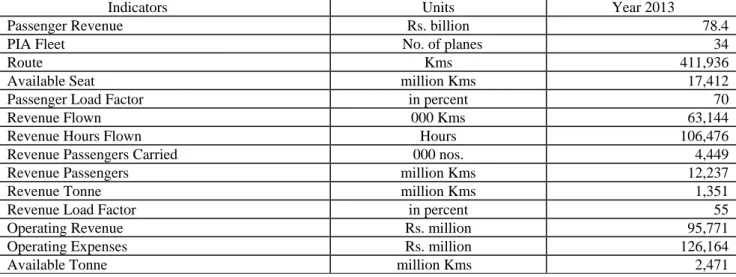
Table 13.4: PIA Performance
Indicators Units Year 2013
Passenger Revenue Rs. billion 78.4
PIA Fleet No. of planes 34
Route Kms 411,936
Available Seat million Kms 17,412
Passenger Load Factor in percent 70
Revenue Flown 000 Kms 63,144
Revenue Hours Flown Hours 106,476
Revenue Passengers Carried 000 nos. 4,449
Revenue Passengers million Kms 12,237
Revenue Tonne million Kms 1,351
Revenue Load Factor in percent 55
Operating Revenue Rs. million 95,771
Operating Expenses Rs. million 126,164
Available Tonne million Kms 2,471
The Airline has also developed a strategic five years Plan which will transform the Airline into a strong, dynamic and vibrant institution, aggressively tackling with the new opportunities and absorbing external shocks. Induction new aircrafts in PIA fleet would be the turning point for the airline as it will be the foundation of being able to deliver cost cutting on fuel and improve punctuality and regularity bringing back the confidence of the customers. These fuel efficient Aircrafts will also help PIA to bring a positive change into overall financial health.
13.4 Ports and Shipping
Pakistan National Shipping Corporation
PNSC fleet comprises of nine vessels of various type and size. Six bulk carriers and three Aframax tankers with a total deadweight capacity (cargo carrying capacity) of 642,207 tonnes against a deadweight capacity of 510,282 tonnes of 48 ships on PNSC’s inception in 1979. Present is the highest ever carrying capacity.
Consolidated revenues of the PNSC group of companies for the nine months of current financial year ended 31stMarch 2014 were Rs.11,368 million as against Rs.8,211 million in the corresponding period last year. This is a 38.5 percent increase in the PNSC group gross income. The earnings per share for the nine months period ended 31stMarch, 2014 were Rs.10.34, as against Rs. 9.09 during the corresponding period last year, an increase of 13.8 percent. Net profit of PNSC after tax was Rs.1,366 million as against Rs.1,200 million last year that is 13.8 percent increase. PNSC’s better operational performance contributed in earning through shipping.
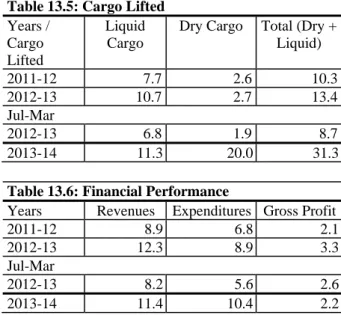
Despite a depressed shipping scenario worldwide, PNSC has improved its profitability. Commercial and Financial performance (un-audited) breakup during nine months July-March 2013-14 is given in the following tables 13.5 and 13.6:
Table 13.5: Cargo Lifted Years / Cargo Lifted Liquid Cargo
Dry Cargo Total (Dry +
Liquid) 2011-12 7.7 2.6 10.3 2012-13 10.7 2.7 13.4 Jul-Mar 2012-13 6.8 1.9 8.7 2013-14 11.3 20.0 31.3
Table 13.6: Financial Performance
Years Revenues Expenditures Gross Profit
2011-12 8.9 6.8 2.1
2012-13 12.3 8.9 3.3
Jul-Mar
2012-13 8.2 5.6 2.6
2013-14 11.4 10.4 2.2
PNSC is providing transportation services for crude oil requirements of the Country. Almost 99 percent of total imports of crude oil is undertaken by PNSC. The Corporation is now actively working on a plan to increase its tanker fleet size, particularly to carry processed fuel like fuel oil, high speed diesel oil, jet fuels, naphtha and gasoline. To meet safe and reliable transportation requirements of Pakistan’s strategic liquid cargo, PNSC presently is in process for acquisition of one Aframax crude oil tanker to cater for most of the requirement of PSO under obligation of long term Contract of Affreightment. This tanker will be in addition to PNSC’s existing tanker fleet of three Aframax tankers.
Karachi Port Trust
The steady and continuous progress made by Karachi Port Trust (KPT) has helped boost the national economy over the years with increasing international trade in the globalized world. Karachi Port Trust consists of two wharves; the East and West Wharf. East wharf has 17 multipurpose berths and West wharf has 13 berths. Each of the wharves has two dedicated container terminal and oil piers to handle liquid cargo. Karachi Port Trust operation comprised upon a 11.5 kilometers long approach channel, a depth of 12 meters and a turning basin of 600 meters, Karachi Port provides safe navigation for vessels up to 75,000 metric tonnes deadweight (DWt.). KPT handled 30.7 million tonnes of cargo during the first nine months of the current fiscal year which is 6.5 percent higher than the corresponding period last year. Data of cargo handled during last five years is given in the following Table 13.16. This shows an increase of 6.5 percent during period July-March 2013-14 against the same period last year.
Table 13.7: Cargo Handled at Karachi Port (000 tonnes)
Period Exports Imports Total
2007-08 11,676 25,517 37,193 2008-09 13,365 25,367 38,732 2009-10 13,528 27,892 41,420 2010-11 12,843 28,589 41,432 2011-12 11,674 26,201 37,875 2012-13 12,150 26,700 38,850 Jul-Mar 2012-13 8,893 19,909 28,802 2013-14 8,452 22,225 30,677
Source: Karachi Port Trust Port Qasim Authority
Port Qasim Authority was established in 1973 as a second deep sea port of Pakistan. Port Qasim caters around 40 percent of sea borne trade of the country. Port Qasim handled 18.971 million tonnes of total cargo during July-March 2013-14 which is 2.2 percent higher than the same period of last year. Volume of import cargo during July-March 2013-14 stood at 13.084 million tonnes. Exports handled 5.887 million tonnes during July-March 2013-14 as compared to 5.111 million tonnes handled during corresponding period of 2012-13, registering an increase of 15.2 percent. Liquid cargo handled 8.138 million tonnes (43 percent), containerized cargo 8.129 million tonnes (43 percent) and remaining 2.704 million tonnes (14 percent), includes miscellaneous types of dry bulk / break bulk cargo. PQA handled 0.632 million TEUs (Twenty Equal Units) of containers traffic in 2013-1, growth in container traffic during the nine months of 2013-14 is 17.5 percent higher by the July-March 2012-13.
Table- 13.8: Cargo Handled at Port Qasim
(in 000 tonnes)
Period Export Import Total
2007-08 4,922 21,502 26,424 2008-09 5,584 19,445 25,030 2009-10 6,380 19,226 25,626 2010-11 6,657 19,511 26,168 2011-12 5,950 18,075 24,025 2012-13 7,047 17,754 24,801 Jul-Mar 2012-13 5,111 13,458 18,569 2013-14 5,887 13,084 18,971
Source: Port Qasim Authority Gwadar Port
Gwadar Port was inaugurated on the 20th March, 2007 and started commercial operation from March 2008. Phase I of Gwadar Port project has been completed. Following facilities are available at Gwadar Port:
Three multipurpose berths, each 200 meter long (total 60.2 meter) dredged 14.5 alongside.
One 100 meter service berth.
4.7 kilometer long approach channel, dredged to 14.4 meter.
Turning basin 450 meter dia, dredged to 13.8 meter.
Port related allied structures like control tower maintenance workshops, security building, GPA head office building etc.
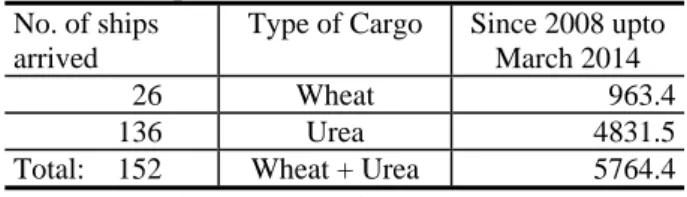
Government has decided to import all bulk cargo comprising of Urea, Wheat and Coal through Gwadar Port. During the period July-March 2013-14 Urea 563.2 tonnes was handled. Total cargo handled at the port from start up till March 2014 is 5764.4 thousand tones against the Cargo handled 5064.8 thousand tonnes up till March 2013 which an increase of 13.8 percent. Detail of ships arrived and cargo handled is given in the following Table:
Table 13.9: Total Import of Cargo at Gwadar Port Since 2008 upto March 2014
No. of ships arrived
Type of Cargo Since 2008 upto
March 2014
26 Wheat 963.4
136 Urea 4831.5
Total: 152 Wheat + Urea 5764.4
Source: Gwadar Port Authority 13.5 Communications Telecom Sector of Pakistan
Telecommunication sector of Pakistan has proved itself versatile and dynamic with adoption of next generation advanced technology. Pakistan Telecommunication Authority (PTA) performs its regulatory duties and responsibilities with professional approach in accordance with the new approaches of Telecom sector in Pakistan. PTA has undertaken a number of significant initiatives for the development of telecom sector and protection of consumers. Some of these initiatives include the Auction of Spectrum for Next Generation Mobile Services (NGMS), deployment of biometric verification system to streamline the SIMs sale procedure, devising the Vision for telecom sector by 2025, blocking of objectionable content on the web,
increasing the efforts to curb illegal telephony, settlement of international call rates, enforcing the decisions made by PTA, protecting consumers from unauthorized call rate changes and monitoring the quality of service of telecom operators.
Next Generation Mobile Services (NGMS) License Auction
Government issued a Policy Directive on 7th October 2013 for the auction of Spectrum standardized for 3rd Generation and 4th Generation of mobile cellular technologies termed as ‘Spectrum Auction for Next Generation Mobile Services’. An Advisory Committee appointed by the Prime Minister headed by the Finance Minister examined and finalized the Policy Directive and oversee the auction process. As per the Policy Directive, PTA hired a consultant of international repute M/s Value Partners Management Consulting Limited. Consultant carried out the market study and Spectrum Valuation, and prepared the Information Memorandum (IM) for the said auction. Consultant also prepared the draft license template and the auction methodology, for two stage auction process valid for a term of 15 years.
Following Spectrum were designated for auction for deployment of Next Generation Mobile Services (NGMS) in Pakistan:
i. 2 x 30 MHz paired Spectrum in 2100 MHz band
ii. 2 x 20 MHz paired Spectrum in 1800 MHz band
iii. 2 x 7.38 MHz paired Spectrum in 850 MHz band (only offered to new entrant)
As bidders demand was greater than Spectrum supply, the Simultaneous Multiple Round Ascending (SMRA) auction was held on 23rd April 2014 publicly in the most transparent and open manner. A large number of participants were invited to attend the auction from print and electronic media, Ministries and Departments. Auction lasted eight rounds and upon commencement of each round, its results were published on PTA’s website. Final outcome of the auction is as under:
Applicant Winner in 2100 MHz
Band
Amount in million $ Winner in 1800 MHz Band CMPak 2x10 MHz $306.9 2x10 MHz ($210.0 million) PMCL (Mobilink) 2x10 MHz $300.9 - PTML (Ufone) 2x5 MHz $147.5 - Telenor 2x5 MHz $147.5 - Total $902.8 $210.0 million
The auctio million. In a have to pay total Aucti remittance GoP from US$1,224.1 and another still in hand Two succe made full p percent of remaining 5 at the rate installments This auction rest of the for the coun spur signific a new wav estimated th new jobs in up to 10 p GDP growth Prime Mini licenses to auspicious occasion Pr of 3G/4G s economic p would pro technologie started prov creating new Telecom Ec Telecom se teledensity Mar-2014, t billion duri investment encourages applications example, m Productive growth of th on generated addition to th y Advance T on winning to FBR. He this auctio 1 million, wh r exclusively d and would ssful bidder ayment whil f the winn 50 percent w e Libor + s over a perio n has brough world which ntry’s Teleco cant econom ve of prosp hat 3G/4G a nto the count percent in ne h by 1.5 to 1 ister has aw the success ceremony h rime Ministe pectrum wou progress of co ovide qualit es”. The in viding 3G/4G w business o conomy ector indicato improved t telecom reve ing the July
reached use of tel s for other mobile bankin use of these he overall ec d an amoun he bid amoun Tax rate at 1 price to P ence the tota on would b hile two lice y kept for n d be auctione rs Zong and le Telenor an ning bid am would be paid 3 percent i od of five ye ht the countr h will not on om Sector bu mic growth an perity for th auction woul try, increase ext three ye .8 percent. warded 3G a ful bidders held on 22-0 er said that “ uld help in e ountry and t ty services ncumbent c G services to pportunities ors showed o 78 percen enues reache y-March 20 US$ 576 lecom based sectors in th ng, e-educat services can conomy. nt of $ 1,1 nts, the oper 10 percent o PTA for on al revenue to be amountin enses one o new entrants ed in due co d Mobilink nd Ufone pai mount and d with a mar in equal an ears. ry at par with nly be benef ut is also goin nd will also u he nation. ld create 900 data penetr ears and incr
and 4G spec companies i 05-2014. On “the introdu expediting so elecom oper through t companies o their custo in the count positive gro nt at the en ed over Rs. 3 013-14 and million. d solutions he economy ion, e-health n greatly enh 112.8 rators of the ward o the ng to f 4G s are ourse. have id 50 the rk-up nnual h the ficial ng to usher It is 0,000 ation rease ctrum in an n this ction ocio-rators these have omers try. owth: nd of 345.5 total PTA and y, for h etc. hance Tele Tele the N year 13, natio Tele Tele amo com oper strea subs offe Percentage *GS Sou Not Lice Adm Cha Oth Rs. in Billio n ecom Contri ecom sector National exc r on average telecom sect onal exchequ ecom Reven ecom revenu ounting to mpetition in t rators have am stable th scribers add rs. -20.0 40.0 60.0 80.0 2009-10 1.6 60.4 2.1 Fixed Local Loop 6 Telecom Secto
ST for the province o urce: Federal Board of
te: PTA's contributio ense Fee, Annual ministrative Fee, USF arges, License Applic hers include custom d
49.35 14.20 9.15 39.30 0 20 40 60 80 100 120 140 160 2008-09 O 112.00 ibution to N is one of th chequer, put e for the last tor contribut uer. ues ues during Ju Rs. 345.5 the market a been able hrough new ition and in 0 2010-11 2011 6 1.6 1 4 64.8 68 1 1.9 1 Teledensit Cellular Mob 68.3 64.1 or Contributio of Punjab is estimate
of Revenue and Pakis
ons comprise of all it Radio Frequency F and R&D Fund Co cation Fee, etc. duties, WH Tax and o
43.97 52.60 6.61 7.18 13.56 11.96 44.91 45.23 2009-10 2010-1 Others 109.05 116.97 National Exc he highest co tting Rs. 119 t five years. ted Rs.124 b uly-March 20 billion. D and low tari to keep th w value add nnovative pa -12 2012-13 20 Ju 1.64 1.9 8.39 71.7 1.70 1.6 ty bile Wireless 71.7 75.2 on to National E
ed for the fiscal year
stan Telecommunicat ts receipts including y Spectrum Fee, A ontributions, APC fo other taxes. 0 57.78 5 7.52 6 14.59 3 53.52 5 11 2011-12 20 PTA'sDeposits 133.41 1 7 chequer ontributor to 9 billion per During FY-billion to the 013-14 were Despite stiff iffs, telecom heir revenue ed services, ackages and 013-14 ul-Mar 1.4 74.9 1.7 Local Loop 78.0 Exchequer r 2012-13 tion Authority.
Initial and Annual Annual Spectrum or USF, Numbering 57.78 27.20 7.52 -5.31 4.85 53.52 34.88 012-13 Jul-Dec 13 124.14 66.93 o r -e e f m e , d
Average Re Owing to industry, A month sligh fiscal year correspondi 217.0 per m users in the price comp lower ARP Table 13.10: Cellular LDI LL WLL Total Telecom Im Total teleco quarters mo imports of cellular mo million duri cellular mo Table 13.11: Cellular Mob Other Teleco Total Teleco Source: State Cellular M Cellular Su Subscribers increased 4 T Figures Jul-M Note: Class V ‐ 50.0 100.0 150.0 200.0 250.0 300.0 350.0 400.0 450.0 Rs. in Billion evenue per U tough mark Average Rev htly decline r 2012-13 ing period o month. Furth e mobile sub petition in th PU during t : Telecom Inv 200 mports om imports h ostly on acco f cellular m obile sets ha
ing the perio obile hands
: Telecom Im
bile sets with b om Apparatus m Imports e Bank of Pak Mobile Servic ubscription s of cellular 5 percent du Telecom Reve Mar 2013-14 are Value Added Ser
2009‐10 2010‐11 355.6 36 User ket competi venue per U ed to Rs. 2 whereas, of the previo her addition bscriber base he market ha the recent m vestment 09-10 908.8 183.1 22.5 23.0 1,137.4 have increase ount of sharp mobile hands ave reached od Jul-Dec 2 sets is on mports battery kistan ces r mobile in uring last fiv
enues (Rs. in b estimated rvices Revenues F 1 2011‐12 2012‐ 67.3 409.2 44 ition in cel User (ARPU) 211.0 during the ARPU ous year was n of low inc e and aggre as contribute months. Cel 2010-11 35 10 1 49 ed during last p increase in sets. Import d above US 013. Deman the rise s 2010-n Pakista2010-n ve years. By billion)
FY-13 are estima
‐13 2013‐14 Jul‐Mar 45.7 345.5 llular ) per g the for s Rs. come ssive ed to llular mob addi serv othe serv able ARP Tele With mob prov inve sign are s Tele fore Duri US$ infra sole mob Inve in n netw Tele 20 58.6 08.7 18.2 7.6 93.1 t two n the ts of $293 nd for since gove bran over and the mob inter partn -11 218.2 548.1 766.3 have y end Mar the c whic ated bile operato itional data vices like mo er associated vices, it is ant e to improv
PUs will rise
ecom Investm h 188 million bile subscri vides enormo estors. Intern nificant prese successfully ecom sector ign investme ing the pe $0.53 billion astructure an ly due to an bile operato estment in te ear future du work up-grad ecom Sector 011-12 211.8 16.2 5.0 7.3 240.3 ernment has nd mobile ha r 136 millio the manufac telecom ma bile sets man
rest to inves nership basis 2011-12 465.3 488.7 954.0 rch 2014 the compared to ch is 15.4 pe
ors can inc revenues obile broadba d offers. W ticipated tha e their data e again in upc ment n population ibers, Pakis ous opportun national tel ence in Pak doing busin of Pakistan ent after the d
eriod July-n have beeJuly-n nd new techn n increase of ors during elecom secto ue to left ov dation. Deta is given in th 2012-13 allowed imp andsets. With on subscribe cturing indus anufacturing nufacturers st in the co s. 2012-3 7 0 se subscribe 118.3 millio ercent increas crease ARPU by offering and, mobile With the lau
at the operato a revenues coming years n and 136 mil stan’s telec nities to forei lecom comp kistan. These ness all over has attracted deregulation March 201 invested in nologies. Thi f investment July-March r is expected ver spectrum ail of the in he following US$ 3 Ju 421.5 1.9 36.7 11.9 472.0 mport of chea h huge teleco ers, telecom try should pu in the coun companies a ountry on pu -13 467.1 451.3 918.4 ers were 136 on as of end se. Us through g non-voice banking and unch of 3G ors would be and thereby s. llion cellular com sector ign and local panies have e companies the country. d substantial n. 13-14, over the telecom is increase is t by cellular h 2013-14. d to increase auction and nvestment in g table: $ million l-Mar 2014 507.0 14.2 5.3 -526.5 aper Chinese om market of m companies ut efforts for ntry. Several are showing ublic private US$ million 2013-14 Jul-Mar 293.1 369.0 662.1 .5 million at March 2013 h e d G e y r r l e s . l r m s r . e d n 0 2 3 - 5 e f s r l g e n 0 t 3
Network Network co increased to Pakistan. D grew by 5 reached 37 compared to Traffic Cellular m promotiona each other b Data and S SMS. Thes business for Both the v FY-13 owin During July SMSs were -20.0 40.0 60.0 80.0 100.0 120.0 140.0 2 Million 28,000 29,000 30,000 31,000 32,000 33,000 34,000 35,000 36,000 37,000 38,000 20 overage of c o 92 percen During FY-1 5.8 percent, 7,169 at the o 35,889 in F mobile ope l strategies f by offering a SMS includi se marketin r companies oice and SM ng to bundle y-March 201 exchanged b 2010-11 2011-108.9 120 Cellular S 010-11 2011-1 31,303 33,9 Cell cellular mob nt of the to 3, the numb total numb e end of M FY-13. rators adop for winning c attractive pac ing free call ng tactics re mainly voic MS traffic h e packages 13-14, a reco by the mobil -12 2012-13 0.2 128.9 Subscribers 12 2012-13 920 35,889 Sites bile operator otal land are ber of cell ber of cell March, 2014 pted aggre competition ckages for V ls and unlim esulted in m ce calls and S has raised du and SMS of ord 221.7 bi e consumers 2013-14 Jul-Mar 136.5 2013-14 Jul-Mar 37,169 r has ea of sites sites 4 as ssive from Voice, mited more SMS. uring ffers. illion s. Basi Loc Subs mill 6.38 base anal incre com this nulli reac 2014 Lon LDI Auth bein telec 1 1 2 2 3 3 Billion 1 2 3 4 5 6 7 Million L ic Telephon al Loop Sub scriber base ion at the en 8 million as e has decrea lysis shows t eased by 2.8 mpared to 3,0 positive p ified by 18. ched to 2,528 4. ng Distance a I services hav hority in pas ng implemen com sector. 0.0 50.0 00.0 50.0 00.0 50.0 00.0 50.0 2010-11 222.3 SMS b -.00 .00 .00 .00 .00 .00 .00 2010-11 3.02 2.70 Local Loop S 6.08 y bscribers of local loop nd of March, of June, 2 ased by 12 that FLL sub 8 percent an 024,288 as o erformance 6 percent d 8,929 total c and Interna ve been the c st few years nted in this 2011-12 3 277.7 Period by Cellular M 2011-12 2.99 2.88 Period Subscribers 5.72 p sector has 2014 as com 013. Overal .2 percent. bscriber base nd stood at 3 of June 2013 of FLL se decline in W connections ational Segm core area of f due to cons s important 2012-13 201 Jul-315.7 Mobile Opera 2012-13 2013 Jul-M 3.03 3.35 W 5.87 6.38 reached 5.7 mpared to the ll subscriber Sector-wise has actually 3,107,719 as 3. However, egment was WLL sector’s as of March ment
focus for the tant reforms segment of 3-14 -Mar 221.7 tors 3-14 Mar 3.1 2.5 WLL FLL 5.60 7 e r e y s , s s h e s f
Total intern stood at 4,2 due to dec internationa traffic on LD quarter as a received by High tariff Approved S on Over the are some incoming in Total inter reported 53 December, carried by destinations the possible usage of OT and other broadband through the influx of lo phones has public to us Broadband Penetration Broadband slow growt percent at th 1.52 percen of 3G/4G m broadband substantially -5,000 10,000 15,000 20,000
Minutes (in Million)
Inte national minu 244 million d cline in bo al traffic. It DI networks a total of 3,18 y LDI opera for calls to Settlement R e Top (OTT) of the key nternational t rnational ou 31 million 2013 where y LDI o s during the s e causes for TT services Smart ph connection ese OTT ch ocally assemb s given mor se such chann d n penetration th despite b he end of Fe nt as of June mobile servic penetration y increased i 2010-11 20 7,737 ernational Inc Operators utes (incomin during Jul-D oth incomin t is evident s is sliding w 84 million m ators during Pakistan du Rate (ASR) services and factors beh traffic. utgoing min minutes du as 717 milli operators t same period this trend co such as Skyp hone applic is required hannels, ther bled and for re awareness nels. in the cou broadband p ebruary 2014 e 2013. With ces, it is expe n in the in the coming 011-12 2012-1 16,212 11,9 Period coming Minu s (Figures in Mi ng and outgo Dec 2013. Th g and outg t that incom with every pas minutes have g Jul-Dec, 2 ue to increas and more tr d illegal chan hind the fa nutes have uring Octobe ion minutes to internat last year. On ould be incre pe, Viber, T ations. Onl to commun refore, the r reign made s s to the gen untry is show penetration 4 as compare h the introdu ected that m country w g years. 3 Jul-Dec 13 995 4,244 utes by LDI illion) oing) his is going ming ssing been 2013. se in raffic nnels all in been er to were ional ne of eased Tango ly a nicate rapid smart neral wing 1.92 ed to ction obile would Sub Broa end of subs duri rate secto of a there than of f num are be h broa Issu PTA new time issue cate Percentage Subscribers bscriber Mix adband subsc of Feb-14 a FY-13. It scribers hav ng last eigh is still abo or. One subs a number of efore, broad n the subscrip four people, mber of broa around 13 m higher than adband are al uance of New A is mandated w operators un e. Following ed to vario gories: 0.55 -0.50 1.00 1.50 2.00 2.50 2010 B 1 -500,000 1,000,000 1,500,000 2,000,000 2,500,000 3,000,000 3,500,000 4,000,000 Br x criber base r s compared is estimate ve joined th ht months. A ove 100 per scription can people in a dband users ption. Taking the broadba adband subsc million. This this as cor lso used by m w Licenses d to issue lic nder various g new licen ous operator 5 0.89 0 2011 P Broadband Pe 1,491,491 2,10 2010-11 2011 Period roadband Su eached 3.4 m to 2.7 millio ed that 71 he broadban Average ann rcent in the n cater broad house/busin are in larg g an average and users, b criptions of s number are rporate subs multiple user censes to the s categories f nses have re rs in differ 1.20 1.52 2012 2013 Period enetration 01,315 2,721,659 -12 2012-13 bscribers million at the on at the end 17,835 new nd platform nual growth e broadband dband needs ness facility; ger numbers e family size based on the 3.4 million e reasonably scriptions of rs. existing and from time to ecently been rent service 1.92 Feb-14 3,439,494 Feb-14 e d w m h d s ; s e e n y f d o n e
Long distance International (LDI) license to CMPak on 19-12-2013
Infrastructure license to Trans World Infrastructure Services (Pvt.) Ltd on 04-11- 2013
Local Loop License in all 14 Telecom regions of Pakistan to CMPak.
Monitoring of sales channels of Cellular Mobile Operators
To assess the ground situation and ensure the compliance by Customer Service Centres (CSCs), franchises and retailers, PTA carried out two surveys in the months of January and July, 2013 focusing on sales channels/retailers of the cellular mobile companies. It was observed that all the CSCs, 16 percent-50 percent of the franchises and 80 percent of the retailers were violating the Standard Operating Procedures for SIM verification and documentation. The common violations among these sale points were related to overlooking to present the original CNIC and SIM sale without proper authorization. PTA took a serious notice of this situation and penalized five CSCs, twelve franchises and seventy three direct sale outlets with fines.
Establishment of Web Blocking Call Centre
PTA blocks blasphemous, pornographic and anti-state websites on a regular basis as reported by Ministry of IT & Telecom or identified by PTA itself. In this regard, a dedicated Web Analysis Cell /Call Center has been established at PTA headquarter for the analysis of blasphemous and pornographic content and blocking of the offending websites through operators. A total of 41,175 websites have been blocked since establishment of web blocking call centre in January 2014.
Biometric Verification System for SIMs Sale
Unprecedented growth in the cellular mobile sector has brought multitude of benefits to the country. However, some elements misuse the cellular platform. In this regard, law enforcement agencies and various Courts of Law have been stressing the need for rationalization of the SIM sales procedure. PTA has undertaken various projects in collaboration with Cellular Mobile Operators (CMOs) to deal with the issue effectively.
Implementation of Biometric Verification System (BVS) at the sale channels of CMOs is a significant landmark, wherein SIMs would be sold and activated only after online verification of purchaser’s thumb impression from NADRA. It is expected that the use of BVS at SIM sales channels of CMOs will eliminate leakages in the
authentication procedure and bring down the illegal use of SIMs by a considerable margin thereby reducing the use of illegal SIMs. The implementation is being carried out in a phased manner starting from CSCs and Franchisees, which has been completed by 20th December 2013 and subsequently, the deployment is now moving towards covering the retail outlets by 31st July 2014.
Efforts to Curb Grey/ Illegal Voice Termination
Grey telephony causes heavy revenue losses to the National Exchequer by bypassing the legal gateways to avoid applicable Taxes and/or Regulatory Fee. PTA has been making best efforts to curb the grey/illegal traffic termination since long and had already taken a number of significant steps to prevent government losses through this menace. As per Standard Operating Procedure, PTA identifies irregular traffic patterns through analysis of heavy callers’ data and monitoring of voice traffic and shares the results with Federal Investigation Agency as per the Act for subsequent raid/legal action under their laws.
PTA established a dedicated 24/7 call centre to receive and process complaints against suspected grey traffic activity, made to the Authority by general public through Toll Free Number (080055055), Telephone (0519207059), Fax (0512878127), E-mail ([email protected]) and dedicated short code 8866 for sending complaints through SMS. This has been advertised in the leading print and electronic media that if a person receives a call from abroad and local number is displayed on his/her mobile phone, that number may be immediately reported to PTA. A total of 157,000 complaints have been received by the Authority so far since the commencement of PTA’s Call Centre in October, 2013.
Approval of Type of Mobile Phones
The infiltration of sub-standard mobile phones, having no or fake IMEI numbers has been a problem for the law enforcing agencies since these handsets can also be used in criminal activities without being traced. Section 29 of the Act mandates PTA to type approve the terminal equipment to be connected directly or indirectly to the public switched network. In pursuance to the Supreme Court Order dated 28th November 2013, PTA has re-started the type approval of mobile phone handsets. In this regard, PTA has prepared SoPs and has published advertisements for type approval of mobile phones in the leading newspaper. Furthermore, an extensive media campaign has also been launched by PTA for awareness of the general public to avoid use of non
standard handsets i.e. without genuine IMEI and PTA’s type approval. Customers have been warned that the use of non standard mobile handsets may lead to legal implications.
Quality of Service of Cellular Mobile
PTA has been entrusted with the responsibility to ensure the provision of high quality telecom services to the people of Pakistan. To monitor the performance standards of the mobile industry, CMOs in compliance with their license terms and conditions are required to carry out the quality of service analysis of their respective networks on quarterly basis and submit detailed reports to PTA,. In this regard, PTA provides continuous guidance to the cellular mobile operators about the methodology, Key Performance Indicators (KPIs) and geographical areas for Quality of Service QoS inspection. During the period July-March 2013-14, cellular mobile operators conducted QoS surveys in 22 cities designated by PTA. The analysis reports were submitted to PTA reviewed thoroughly and resultantly, the operators were directed to improve quality of service where the results were not as per the laid down benchmarks in the license and relevant regulations.
Mobile Banking
State Bank of Pakistan and PTA aim to provide an enabling environment for mobile banking services in the country. During the period under review, both the regulators continued their joint efforts on the regulatory framework for m-banking services. Current m-banking services are being governed by the SBP’s Branchless Banking Regulations 2008, amended in 2011. PTA and SBP are working on mobile banking regulations which will be in line with the above Branchless Banking Regulations, and will facilitate the existing m-banking arrangements. With an enabling regulatory environment, the cellular mobile companies are actively pursuing their mobile banking initiatives in collaboration with the financial institutions. Easy-paisa and Omni are the major agent based mobile banking services in the country and are in operation since 2010 with country-wide network of 30,000 agents. Recently, Mobilink, Ufone, CMPak and warid have also launched their agent based mobile banking services. Mobilink is providing its m-banking services in affiliation with Waseela Microfinance Bank and CMPak has collaboration with Askari Bank. Ufone has launched its m-banking service in collaboration with U Microfinance Bank and Warid launched its m-banking service with Bank Alfalah. Now, overall
m-banking agents network has reached to over 125,000 numbers of Agents.
New players in the m-banking market can expand the existing base of m-banking network if a healthy competition in the market reduces the cost of m-banking transactions and new products and business models are launched while considering the consumer requirements. Internationally, the m-banking model of m-paisa has been widely quoted for its success as it has reached more than 65 percent households in Kenya. However, achieving a similar success in Pakistan with different regulatory frameworks is a challenge. Mobile banking segment of Pakistan has vast potential for growth in the coming years provided that mobile operators and banks keep up with their innovations and the regulators remain proactive to facilitate this process.
13.6 Electronic Media in Pakistan
13.6-a Pakistan Electronic Media Regulatory Authority (PEMRA)
Pakistan Electronic Media Regulatory Authority (PEMRA) is a statutory body established in March 2002 through an Ordinance to facilitate and regulate growth of Electronic Media in the private sector. The law was later revamped as PEMRA Amendment Act-2007. PEMRA is primarily mandated for licensing and regulating the establishment and operation of all broadcast media (satellite TV & FM radio) and distribution services (Cable TV, DTH, IPTV, Mobile TV etc.) in Pakistan. Its mandate further includes:
To improve the standards of information education and entertainment;
Enlarge the choice available to the people of Pakistan in media for news, current affairs, religious knowledge, art, culture, science, technology, economic development, social sector concerns, music, sports, drama and other subjects of public and national interest;
Facilitate the devolution of responsibility and power to the grass roots by improving the access of people to mass media at local and community level;
Ensure accountability, transparency and good governance by optimizing the free flow of information.
Present Status of Private Electronic Media
During last 12 years the country has witnessed a massive spurt in the number of TV channels and FM Radio stations in the private sector which is,
unmatched in the South Asian region and perhaps elsewhere. This boom is owed to the government’s unequivocal commitment to a free media and the proactive role played by PEMRA in facilitating the growth of the electronic media. The unprecedented growth of TV channels, Cable TV and launch of FM
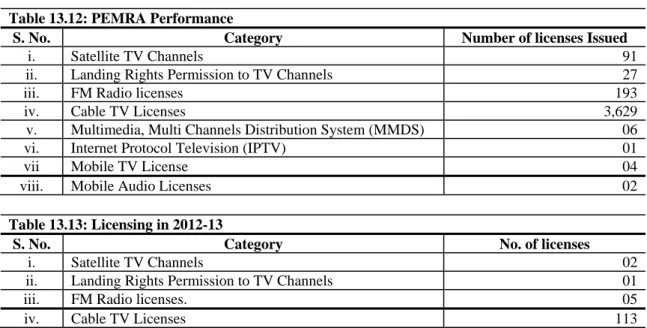
Radio stations has indeed contributed remarkably in raising the standards of public awareness and literacy. A glance at the following facts and figures on licensing of media amply substantiates the massive growth which has taken place in electronic media in the private sector in the last one decade.
Table 13.12: PEMRA Performance
S. No. Category Number of licenses Issued
i. Satellite TV Channels 91
ii. Landing Rights Permission to TV Channels 27
iii. FM Radio licenses 193
iv. Cable TV Licenses 3,629
v. Multimedia, Multi Channels Distribution System (MMDS) 06
vi. Internet Protocol Television (IPTV) 01
vii Mobile TV License 04
viii. Mobile Audio Licenses 02
Table 13.13: Licensing in 2012-13
S. No. Category No. of licenses
i. Satellite TV Channels 02
ii. Landing Rights Permission to TV Channels 01
iii. FM Radio licenses. 05
iv. Cable TV Licenses 113
Economic Contribution
There has been a cumulative investment of approximately US$ 3.5 billion in the electronic media industry in Pakistan. Electronic media sector has generated direct employment for more-than 200,000 people of diversified skills and qualifications. With the current growth rate of more than seven percent per annum, it is estimated that the cumulative investment in the electronic media industry will reach nearly US$ 4.0 billion by the end of the current financial year. This expansion in investment would in turn have a multiplier effect on increasing job opportunities for skilled media personnel and journalists, expanding work of media production houses, advertising agencies and proliferation of the performing arts.
13.6-b Pakistan Television Corporation Limited
Pakistan Television Corporation Limited (PTV) is gradually extending its signals to remote and economically backward areas of the country in order to uplift the socio-economic conditions, to eliminate the existing disparity.
PTV is operating 6 multiple terrestrial channels in the country i.e. PTV Home, PTV News, PTV Bolan, PTV National, PTV Global and PTV Sports.
PTV has launched English News Channel. This is only English News Channel in Pakistan telecasting the information about Pakistan domestically as well
as internationally. Apart from it, a TV Channel has been established in AJK with one TV Centre, and with four Rebroadcast Centers at Kotli, RawalaKot, Bagh and Bhimber.
Nine Projects, comprising, RBS-Neela-But, RBS Besham, RBS Pooran, RBS-Khaplu, RBS- Shigar, RBS- Gahkuch, RBS-Chilas RBS-Kohat, & NNB-Larkana will be ready to inaugurate by 30-06-2014. PTV has planned for Digitalization of PTV Terrestrial network. Government of Pakistan is doing efforts for grant-in-aid from Chinese Government after completion of the project. PTVC would be able to extend Terrestrial coverage of 6 more channels in National Bouquet.
Establishment of TV Rebroadcast Stations (RBS) in following areas is in progress throughout the country during the year 2013-14.
Sindh
RBS at Badin.
Punjab
RBS at Shakargarh, KotliSattian, and MianChannu.
Khyber Pakhtunkah
Balochistan
RBS at Karan, and Barkhan
Northern Areas
RBS at Aliabad/Karimabad, Jaglot, Bunji, and Astore
PTV has installed a State of the Art complete digital studio equipment at all the five TV Centers during 2006-07. Apart from it four Digital Satellite News Gathering System (DSNGS) which are complete mobile satellite transmission units are fully in operational.
13.6-c Pakistan Broadcasting Corporation
Radio is the fastest, mobile and cheapest electronic media which is capable of reaching the masses far and near. PBC is catering to all segments of society through its varied and wide ranging programme. At present, PBC has 64 broadcasting Stations/ Channels, this number is intended increased up to 68 in 2014-15 and up to 76 in 2015-16.
News from the Pakistan Broad Casting Corporation (PBC) is the biggest source of dissemination of news in the country. The main aim of PBC News is to keep the people informed of important happenings at National and International levels with focus on development activities at home, government policies and matters of national importance. PBC News is putting on air 123 News bulletins daily. These include National, Regional, External, and Local News bulletins besides coverage of National Assembly and Senate sessions. PBC in its News bulletins highlights the policies of the elected government especially for the political harmony in the country, awareness on extremism and against sectarianism, extremism as well as projection of Pakistan’s foreign policy. PBC News also projecting Prime Minister’s Youth Business Loan Scheme, various projects of power generation agreements with China & other countries and other development projects. PBC News has a network of news gathering spread all over the country. In addition to the Central Reporting Desk in Islamabad, PBC News has Correspondents at almost all the Radio Stations. District Correspondents are working in remote and far flung areas of the four provinces, Gilgit-Baltistan and FATA. Radio Pakistan is the only government organization that has bilingual website i.e. English and Urdu. Major news bulletins in text and audio form are available at the website. It is active both on twitter and face-book. Radio Pakistan’s twitter account has more than twenty
thousand followers. Radio Pakistan being a public sector broadcaster gives impartial balanced and un-biased coverage to all political in its national and regional bulletins.
PBC throughout its versatile programmes educates people on social issues and problems with broadcast of public service programmes covering health, education, environment, population welfare, agriculture, and rights of children, women, minorities, special persons, human rights, media freedom, tolerance and democratic values through discussions, interviews, talk shows, impressions of community leaders. Further, to educate the people more passionate and concerned for our arts, culture, literature, history and common heritage. Entertain the audience through music programmes, features skits and plays in a creative manner. VoA (Voice of America) programmes are being broadcast for 30 minutes daily in the evening transmission from 14 FM-93 Stations. PBC has signed an agreement with China Radio International (CRI) for 2 hours broadcast from 5 FM stations Islamabad, Multan, Kohat, Lahore and Karachi in English and Urdu languages. Two new FM stations have been established at Karachi and Islamabad. The Karachi station has been made operational while the Islamabad station will be operational shortly.
PBC has an ambitious programme to steps ahead in modern digital, satellite and IT Technology. The newly established Earth Station is a key part of this programme. The main emphasis at this stage is to provide a 24-hours first class signal to the maximum number of people within the country and for our foreign listeners. Earth Station will provide satellite capacity for the transmission of entertainment, news, sports and educational programming for content providers and direct-to-home (DTH) platforms. It also provides value-added services that include managed fiber services, digital encoding of video channels, and addressing programmers’ need for delivering content to multiple distribution channels throughout multiple regions. PBC intends to enhance its coverage up to 98 percent of the country population in the years 2015-16.
PBC has up-graded its two MW transmitters at Peshawar and D. I. Khan. The 400KW MW transmitter at Peshawar and 100KW MW Transmitter at D. I. Khan have commissioned their transmission, which is reaching not only to a vast population within the country, but also to the neighboring countries. PBC is also working to replace decades old MW transmitters at Islamabad and up-grade FM transmitters in different cities in