1568-0266/07 $50.00+.00 © 2007 Bentham Science Publishers Ltd.
Morpholino, siRNA, and S-DNA Compared: Impact of Structure and Mechanism of
Action on Off-Target Effects and Sequence Specificity
James E. Summerton*
Manager & Owner, GENE TOOLS, LLC, One Summerton Way, Philomath, Oregon 97370, USA
Abstract: Generally a gene knockdown agent should achieve high sequence specificity and should lack off-target effects (non-antisense effects due to interactions with structures other than gene transcripts). Three major gene knockdown types are compared with respect to off-target effects and sequence specificities: 1) phosphorothioate-linked DNA (S-DNA); 2) short interfering RNA (siRNA); and, 3) Morpholino. S-DNAs cause multiple off-target effects, largely because their backbone sulfurs bind to many different proteins. S-DNAs also achieve poor sequence specificity because S-DNA/RNA duplexes as short as 7 base-pairs are cleaved by RNase H.
siRNAs cause several off-target effects, but improved designs may soon avoid such effects. siRNAs also provide only limited sequence specificity because their short guide sequences largely determine which gene transcripts will be blocked or cleaved, and those guide sequences appear to recognize insufficient sequence information to uniquely target a selected gene transcript. This specificity limitation is inherent in their mechanism of action and so probably cannot be greatly improved.
Morpholinos are virtually free of off-target effects - probably because they cannot interact electrostatically with proteins. Morpholinos also achieve exquisite sequence specificity - in large part because they must bind at least about 14 to 15 contiguous bases to block a gene transcript, and this constitutes sufficient sequence information to uniquely target a selected gene transcript. Because of their freedom from off-target effects, exquisite sequence specificity, complete stability in biological systems, and highly predictable targeting, Morpholinos dominate the most demanding of all gene knockdown applications, studies in developing embryos.
1. INTRODUCTION
Agents which inhibit the expression of selected genes through a Watson/Crick base-pairing mechanism are commonly referred to as antisense or gene knockdown agents. Initial development of such oligomeric agents (oligos) began in the late 1960s and 1970s [1, 2, 3, 4, 5]. While a number of structural classes and a large number of different structural types within those classes have subsequently been reported, currently only the three classes described below are widely used by the research community.
RNase H-DEPENDENT OLIGOS
The first class to be widely used comprises antisense agents which exploit cellular RNase H to cleave their targeted RNA sequences. Phosphorothioate-linked DNA (S-DNA) is the dominant structural type in this RNase H-dependent class [6]. Figure 1a shows the structure of S-DNA. Note that the only structural change relative to DNA is that a pendant oxygen on each of the phosphate intersubunit linkages of DNA is replaced by a sulfur.
STERIC BLOCK OLIGOS
The next class to gain wide acceptance comprises antisense agents which function solely by a simple steric block mechanism. The most widely used in this class are the Morpholino (shown in Figure 1b) and the Peptide Nucleic Acid (PNA) types. Morpholinos dominate for applications requiring exceptionally high specificity in complex systems, such as in developing embryos, while PNAs dominate where exceptionally high binding affinity is required, such as for invasion of a DNA duplex [7, 8].
RNA INTERFERENCE OLIGOS
In the 1990s it was discovered that double-stranded RNA could be used to silence specific genes. In the last 5 years one intermediate in this natural gene silencing process, short interfering RNA (siRNA), has become widely used in the biological research community [9, 10]. Starting with siRNA, to get to the active form one strand of the siRNA duplex combines with cellular proteins to form the RNA- *Address correspondence to this author at the Manager & Owner, GENE TOOLS, LLC, One Summerton Way, Philomath, Oregon USA 97370; E-mail: [email protected]
induced silencing complex (RISC), which then acts to block translation of partially-complementary RNA sequences and acts to degrade highly-complementary RNA sequences [11, 12]. Figure 1c shows the structure of the core RNA oligo which provides the sequence selectivity for a RISC structure.
2. DEFINITIONS Off-Target Effects
In the heyday of the antisense field (1980s and 1990s) the terms “non-antisense effects” and “off-target effects” were used inter-changeably to describe effects which were not due to Watson/Crick base-pairing between a gene knockdown oligo and RNA sequences. Generally such “off target effects” are a consequence of interactions between the gene knockdown oligo and extracellular, cell-surface, and intracellular proteins. Therefore, to distinguish between effects due to interactions which have nothing to do with Watson/Crick pairing versus effects which are primarily a function of Watson/Crick pairing, in the following sections I use the term “off-target effects” to mean biological effects which are not dependent on Watson/Crick pairing to RNA, but instead are due to interactions between the gene knockdown oligo and extracellular, cell-surface, or intracellular structures via a mechanism other than Watson/Crick base-pairing.
Sequence Specificity
The term “sequence specificity” has long been used in the context of an oligo’s ability to distinguish between its intended target RNA and all other RNAs in the cell. Less commonly, “sequence specificity” has also been used in the narrower sense of an oligo’s ability to distinguish between a normal genetic sequence and a mutant sequence differing from the normal sequence by one or a few bases. Herein I use the term “sequence specificity” to refer to a gene knockdown agent’s ability, via Watson/Crick base-pairing, to block the function of its intended target RNA without also blocking the function of other RNAs in the cell. High sequence specificity means that the oligo only blocks the function of its intended target RNA, while low sequence specificity means that the oligo blocks the function of both the intended target RNA plus a significant number of other RNAs in the cell.
Intended Target Sequence
The particular sequence in the specific target RNA transcript which one intends to block with a selected gene knockdown oligo. Inadvertent Target Sequences
RNA sequences, other than the intended target sequence, whose expression is also blocked by the same selected gene knockdown oligo.
3. KEY STRUCTURAL FEATURES WHICH BEAR ON OFF-TARGET EFFECTS AND SEQUENCE SPECIFICITY S-DNA Structure and Mechanism of Action
Phosphorothioates are nearly iso-structural with DNA - differing only in the conservative replacement of an oxygen atom by a sulfur atom in the phosphate intersubunit linkages of the backbone, as shown in Figure 1a [6, 13]. The principal advantage conferred by this substitution of a sulfur is that S-DNAs are degraded less quickly by nucleases. Thus, bare DNA oligos typically have half-lives of only a few minutes in biological systems, while the half-lives of corresponding S-DNAs are increased to multiple hours. Further, while the sulfur on the backbone phosphates significantly decreases the S-DNA’s affinity for its RNA target sequence [7, 14], nonetheless, because of their very close similarity to DNA, S-DNA oligos are able to exploit cellular RNase H (primarily localized in the nucleus) for cleavage of the targeted RNA strand in S-DNA/RNA duplexes. As a consequence of this RNase H-mediated cleavage mechanism, in short-term experiments S-DNAs can sometimes achieve efficacies nearly as
high as efficacies afforded by the much-stronger-binding Morpholinos [14]. However, in longer-term experiments, because of ongoing degradation of S-DNA by nucleases, S-DNAs must be periodically re-delivered to maintain a reasonable level of activity.
While the sulfurs in S-DNA oligos do slow their degradation by nucleases, those same sulfurs also cause S-DNA oligos to bind to a vary large number of extracellular, cell-surface, and intracellular proteins. It is this protein binding which appears to be largely responsible for many of the off-target effects for which S-DNA oligos are notorious [15, 16, 17].
siRNA Structure and Mechanism of Action
Short interfering RNA comprises a short RNA duplex (typically about 20 to 25 base-pairs) which is processed within cells such that one of the RNA strands is disposed of and the other RNA strand, as shown in Figure 1c, is combined with cellular proteins to form the RISC structure [9, 10]. This RISC structure, located primarily in the cytosol, is then effective to block partially-complementary mRNA sequences and is effective to cleave highly-complementary mRNA sequences. Because both S-DNA and siRNA exploit cellular factors to catalytically degrade their targeted RNA sequences, they can function at substantially lower concentrations than would be the case without that catalytic assist. However, because siRNAs can have a completely natural RNA structure, they can avoid the host of particular off-target effects which plague S-DNAs because of S-DNAs’ un-natural backbone sulfurs.
It appears that siRNAs and the recently-discovered natural microRNAs (miRNA) undergo the same processing by cellular
(a) (b) (c)
Class RNase H-dependent Steric block Interfering RNA
Type Phosphorothioate Morpholino Short Interfering RNA
Subunit structure B= A, C, G, T(U)
deoxyribose ring morpholine ring ribose ring
Backbone structure
S-DNA Morpholino siRNA
Principle sites of action
nucleus nucleus and cytosol cytosol
Fig. (1). Structural types of gene knockdown.
O B O O N O O B O B O O OH O B O O P O B O O O O -OH OH N O O B P O N N O O B O B O O P O B O O O S
-factors, their final forms in the RISC structure appear to be virtually identical, and their final forms appear to function in the same manner [11, 12]. Thus, it seems likely that the only difference is miRNAs and their targets have jointly evolved over the course of eons, while siRNAs are designed by humans - and humans are still in the process of refining their design strategies.
Morpholino Structure and Mechanism of Action
Morpholinos, which I devised in 1985 [18, 19] with a new linkage type added in 1989 [20], constitute a radical redesign of genetic material [7, 14, 21, 22]. Specifically, the 5-membered-ring sugars of the backbones of natural nucleic acids have been replaced by 6-membered morpholine rings. In addition, the negatively-charged phosphate intersubunit linkages of DNA and RNA have been replaced by non-ionic phosphorodiamidate intersubunit linkages in the Morpholino structural type, as shown in Figure 1b. These structural changes provide multiple advantages. 1) Morpholinos appear to be completely stable in biological systems [23]. 2) Relative to S-DNAs, Morpholinos have a much higher affinity for their complementary RNA sequences, and in fact Morpholinos bind RNA with a higher affinity than DNA binds RNA and much higher affinity than S-DNA for RNA [21]. 3) Probably because of their exceptional base stacking properties [24] Morpholinos show excellent solubility in aqueous solution (typically in excess of 100 mg/ml), in sharp contrast to other non-ionic structural types which are generally plagued by poor aqueous solubilities (typically several hundred fold lower than for Morpholinos) [14]. 4) Probably because of their highly unnatural backbone structure and lack of charge on the backbone, Morpholinos appear not to interact to any significant extent with proteins. I postulate that it is this “stealth” property which is largely responsible for their exceptional lack of off-target effects. The lack of a backbone charge also allows simple and efficient delivery of Morpholinos into cultured cells by a non-toxic endocytosis-assisted delivery reagent [25].
4. OFF-TARGET EFFECTS (NON-ANTISENSE EFFECTS) As noted earlier, “off-target effects” is used herein to mean biological effects which are not dependent on Watson/Crick pairing to RNA, but instead are due to interactions between the gene knockdown oligo and other structures via a mechanism other than Watson/Crick base-pairing.
S-DNA Off-Target Effects
As stated earlier, it is the pendant sulfurs on the backbone phosphates of S-DNAs which are largely responsible for the host of off-target effects which plague S-DNAs. It is noteworthy that in the 1990s, after a number of organizations had adopted S-DNAs as their structural type of choice in efforts to develop antisense therapeutics, practically a whole research field grew up around identifying, studying, and attempting to devise means to avoid off-target effects of S-DNAs.
Convulsions and Death Within Minutes
In early animal studies with S-DNAs it was found that intravenous injection of moderate doses of some sequences led to convulsions and death within a few minutes. Further study showed this was due to activation of the complement cascade. This rather undesirable off-target effect of S-DNAs in animals can be minimized by slow infusion of a quite dilute solution (less than about 6 microMolar) over an extended period of time [26].
CpG Effect on Innate Immune System
In early work on the S-DNA therapeutic, Vitravene (ISIS 2922), if multiple interior bases in the oligo were changed so that the oligo could no longer bind its putative RNA target, surprisingly the oligo was found to still show nearly all of its original biological activity.
However, if one base of the CG sequences at one or the other end was changed this led to a substantial reduction in the oligo’s biological activity, and if one base in each of those CG sequences at the ends were changed it completely destroyed the oligo’s biological activity - even though those changes caused only a slight reduction in the oligo’s affinity for its targeted RNA sequence [27]. This and much related work led to the realization that such CG sequences, which are not methylated at the 5 position of the cytosines, act to stimulate the body’s innate immune system for defending against bacterial DNA (which is generally not methylated on CG sequences) [28, 29]. Thus, the widely-touted biological effects reported for a number of S-DNAs containing such non-methylated CG sequences may be primarily off-target effects wherein they are acting outside of cells to stimulate the innate immune system, and it remains a strong possibility that many or all such S-DNAs may only act extracellularly and never actually inhibit their targeted messenger RNAs within cells [30].
G-Quartet Complexes with Multiple Activities
S-DNAs which contain a run of four or more guanines in a row form a 4-stranded complex via a Hoogsteen bonding mechanism, and S-DNAs in such tetraG complexes have a very high affinity for heparin-binding proteins, activate Sp1 transcription factor, and cause a variety of other effects [31].
Binding to Broad Range of Proteins
In addition to the above distinctive off-target effects caused by DNAs, a host of less distinctive effects arise due to binding of S-DNAs to a wide variety of proteins. Specifically, S-S-DNAs have been reported to bind the following: laminin, bFGF, protein kinase C, DNA polymerase, telomerase, fibrinogen, phospholipase A2, HIV gp120, HIV reverse transcriptase, CD4, Taq polymerase, T4-polynucleotide kinase, fibronectin, many tyrosine kinases, and proton-vacuolar ATPase [16]. S-DNAs within cells have also been reported to rapidly induce Sp1 transcription factor [15].
These off-target effects of S-DNAs can result in control oligos exhibiting biological activities on a par with that of the antisense oligos. Because S-DNAs can cause so many different off-target effects, particularly in vivo, it is very difficult to determine if a given biological response has anything to do with selective inhibition of the intended RNA within cells via an antisense mechanism - leading to considerable uncertainty and likely mis-interpretations in experiments utilizing S-DNAs [15].
Efforts to Surmount Off-Target Effects by S-DNAs
One approach used in attempts to obtain valid conclusions in experiments with S-DNAs is to use multiple different test S-DNAs, each targeted against a different sequence in the same RNA transcript one is attempting to knockdown. One then looks for some biological effect which is common for each of the different test S-DNAs, but is not seen with the control S-DNAs. It is then this common effect which is presumed to be the true effect due to knocking down that specific RNA transcript. Other effects which are not seen for all of the test S-DNAs, and/or which are seen in the control S-DNAs are attributed to off-target effects and are ignored. However, a major difficulty with this approach is that most (on the order of 80% to 90%) of S-DNAs prove to be ineffective against their targeted RNA transcript. Probably this low success rate in targeting S-DNAs is because their inherent low affinity for complementary RNA severely limits their ability to invade the moderately-stable base-paired secondary structures which dominate the conformation of RNA transcripts under physiological conditions.
Another more effective approach used to minimize off-target effects of S-DNAs is to prepare oligos with mixed backbones. These have been referred to as chimeras or gapmers. Typically, such chimeras comprise a central sequence about 10 to 14 bases long having an S-DNA type backbone, plus segments of about 3 to 6 bases
on each end having a high-affinity moderately-nuclease-resistant backbone type - typically 2'O-alkylRNA. In such structures the central S-DNA segment serves to retain the capability for RNase H cleavage of the targeted sequence in the RNA transcript, as well as provide some resistance to degradation by nucleases, while the 2'O-alkylRNA ends serve to minimize the number of backbone sulfurs - thereby reducing the sulfur-mediated off-target effects. These higher-affinity ends also provide moderately increased affinity for the targeted RNA transcript, which may provide a modest improvement in the oligo’s ability to invade RNA secondary structures in the targeted RNA transcript. This design strategy has been reported to give oligos which achieve reasonable efficacy, while causing somewhat fewer off-target effects compared to a corresponding all-S-DNA oligo [32, 33]. siRNA Off-Target Effects
When use of siRNA duplexes in mammalian cells was first reported in 2001 [34] there was much optimism that they would be free of off-target effects. In particular, it was believed that they would be too short to activate the interferon response - which is a serious problem for RNA/RNA duplexes longer than about 30 base-pairs. However, by 2003 a number of reports were coming out which suggested that siRNAs might not be nearly as selective for their intended targets as originally believed [35, 36, 37]. In particular, a report by Sledz et al. showed that 21-base-pair siRNAs could indeed cause interferon stimulation by the Jak-Stat pathway and up-regulate a substantial number of interferon-stimulated genes. In addition, it was reported that siRNAs can induce methylation of DNA and histone H3 in human cells [38].
These reports of off-target effects led to major efforts to both identify the causes of the off-target effects and to search for ways to minimize or avoid such effects. To date, efforts to identify the causes of and to avoid off-target effects by siRNAs have been considerably more successful than the analogous efforts in the 1990s to avoid off-target effects by S-DNAs. Specifically, it has been reported that the off-target effects of siRNAs can be reduced by focusing on the most potent siRNAs and only using those most-potent siRNAs at quite low concentrations (about 1 to 2 nanoMolar) [39]. It has also been reported that avoiding a 5'-triphosphate on the siRNA can greatly reduce interferon induction [40]. Still further, changing the two initiating dinucleotides has also been reported to reduce interferon induction in some cases [41]. Certain base sequences have also been reported to be particularly prone to induction of interferon and so should be avoided [42, 43]. It has been reported that liposomal delivery reagents can significantly enhance the siRNAs’ interferon-inducing effects [44], and going to a different delivery reagent can reduce such effects. While much progress has already been made in reducing the off-target effects of siRNAs, I believe a good case can be made that virtually all off-target effects (ie., non-antisense effects) can be avoided. This case is based on the apparent equivalence between siRNAs and the dicer-cleaved duplex-RNA precursors to natural microRNAs. Therefore, since the precursors to natural microRNAs are very likely to be free of significant off-target effects (ie., non-antisense effects) it follows that properly-designed siRNAs should also be virtually free of significant off-target effects. What remains then is to identify the design criteria required for such freedom from off-target effects - and it appears that rapid progress is being made in this regard.
Morpholino Off-Target Effects
Key structural components of all nucleic acids are their anionic phosphate inter-subunit linkages, and most substances, such as proteins, which interact with nucleic acids do so in large part via electrostatic interactions with those anionic phosphates. Therefore, it is reasonable to expect that non-ionic gene knockdown oligos, such as Morpholinos, will not interact significantly with the extracellular and cellular structures which cause the off-target effects that plague the more conventional poly-anionic gene knockdown oligos, such as S-DNAs and siRNAs.
All the evidence gathered to date supports this expectation that Morpholinos are virtually free of off-target effects (ie., non-antisense effects).
Morpholinos do not activate the complement cascade - evidenced by results from AVI BioPharma, Inc. wherein intravenous injection of high concentrations of Morpholinos in animals cause no significant toxicity. In sharp contrast, intravenous injection of the same concentrations of corresponding S-DNAs will cause convulsions and death in a few minutes in all of the treated animals due to activation of the complement cascade by the S-DNAs.
Morpholinos lack immune stimulatory activity even when they contain a CG within a sequence known to be optimal for activation of the innate immune system when that sequence is present in DNA and S-DNA oligos (personal communication from Arthur Krieg).
Morpholinos containing G-quartet sequences exhibit none of the biological effects, such as interactions with heparin-binding proteins, etc., which are seen with S-DNAs containing G-quartets (personal communication from Eric Wickstrom).
Morpholinos exhibit no significant binding to macromolecular components of blood and serum (preliminary results from my unpublished dialysis experiments).
Morpholinos apparently do not activate the interferon system - based on the absence of any reports of interferon induction by any of the tens of thousands of Morpholinos used by thousands of researchers in cultured cells, cultured tissues, many different types of embryos, and higher animals, including humans, over the past 8 years and published in about 1,400 journal articles (see on the web: pubs.gene-tools.com).
Lastly, the fact that Morpholinos are not degraded in biological systems may also contribute to their lack of off-target effects. This is because they have no opportunity to generate degradation products which might be toxic to cells.
5. SEQUENCE SPECIFICITY As Noted Earlier:
“Sequence specificity” is used herein to mean a gene knockdown agent’s ability, via Watson/Crick base-pairing, to block its intended target RNA, but not other RNAs in the cell.
“Intended target sequence” is used herein to mean the particular sequence in the specific target RNA transcript which one intends to block with a selected gene knockdown oligo.
“Inadvertent target sequences” is used herein to mean RNA sequences, other than the intended target sequence, whose expression is also blocked by the same selected gene knockdown oligo.
One of the beauties of working with nucleic acids, and particularly in working with Watson/Crick base-pairing between complementary strands, is it allows one to calculate information content and to estimate expected frequencies of interactions based on that information content. This includes calculating expected frequencies of interactions which determine the sequence specificities of gene knockdown agents. To illustrate, if one knows how many base-pairs are recognized by a selected restriction nuclease it is a simple matter to generate a reasonably accurate estimate of how many sites will be cleaved by that nuclease in a long DNA duplex of known length but unknown sequence.
Similarly, if one knows several key values for a given gene knockdown agent and the system in which it will be used, then it is possible to calculate the approximate number of inadvertent targets which are likely to be inhibited by that agent [7, 21]. Those key values are:
a) Minimum Inhibitory Length (MIL): the shortest length of a gene knockdown oligo that must bind to an RNA transcript in order to inhibit expression of that RNA.
b) Targetable Pool Size (TPS): the fraction of the unique-sequence bases in the cell’s RNA pool which can potentially be targeted by the selected gene knockdown structural type.
c) Length: the number of bases in the gene knockdown oligo which contribute to target recognition.
With these values one can calculate the expected number of inadvertent targets for a given gene knockdown oligo using the following equation.
expected number of inadvertent targets = ( TPS / 4MIL ) ( length - MIL + 1 )
TPS = targetable pool size MIL = minimum inhibitory length
Such calculations give a value which appears to correlate fairly well with experimentally assessed sequence specificities for S-DNAs, PNAs, and Morpholinos [7, 21], but the newer siRNAs have not yet been assessed in this context.
S-DNA Specificity
MIL value: Phosphorothioate-linked DNAs have a minimum inhibitory length (MIL) of about 8 bases [7]. This means that an S-DNA of this length, or a longer S-S-DNA having at least an 8 contiguous base match to a complementary RNA sequence, can form a duplex with its target RNA which serves as a substrate for RNase H - leading to cleavage of the RNA strand and release of the S-DNA oligo.
TPS value: In regard to the targetable pool size (TPS) for S-DNAs, because RNase H is located primarily in the nucleus it is likely that S-DNAs are principally active just in the nucleus - wherein they should have access to full-length pre-spliced RNA transcripts. Further, typically only about 10% to 20% of S-DNAs are found to be reasonably effective against their targeted RNA sequences. Presumably this is because their relatively low inherent affinity for complementary RNA [14, 21] seriously limits their ability to invade RNA secondary structures and/or limits their ability to displace proteins bound to the RNA transcripts.
There are approximately 3 billion base-pairs of DNA in a human cell, and on the order of about 4% of this DNA may be transcribed in any given cell type, giving approximately 120 million bases of unique-sequence RNA in the cell’s pool of pre-spliced RNA transcripts. If an S-DNA has the potential to pair to about 15% of the sequences in that RNA pool then the targetable pool size for an S-DNA is approximately 18 million bases. Thus, for a 20-mer S-DNA: expected number of inadvertent targets = ( 18,000,000 / 48 ) ( 20 - 8 + 1 ) = 3571
Accordingly, one would expect that any given S-DNA 20 nucleotides in length should both inhibit its intended RNA target and also to some extent inhibit another 3,600 inadvertent RNA targets in a human cell. I believe this is rather less sequence specificity than is desirable for most gene knockdown applications.
siRNA Specificity
MIL value: short interfering RNAs, after incorporation of their antisense strand into the RISC structure, require binding to only a limited number of bases in order to inhibit expression of a messenger RNA (mRNA). More specifically, it has been found that most of the target recognition afforded by the siRNA is due to the guide sequence, an 11-base segment near the 5' end (bases 2 - 8 serve for recognition and bases 9 - 12 are important for cleavage of the target RNA), while sequence mis-matches with the target RNA outside of this 11-base guide region often have little effect on whether or not the siRNA cleaves the target mRNA [45, 46].
Typically a perfect match between the 11-base guide sequence and a sequence in the mRNA leads to cleavage of mRNAs which contain this sequence, but recent studies suggest that as few as seven
complementary bases in a target mRNA are sufficient for the siRNA to cleave that mRNA [47]. However, using recent results from an excellent and exhaustive study by scientists at Dharmacon Research and Agilent Technologies [48] I estimate an MIL value of 10 for siRNAs when the mRNA is cleaved by the RISC structure. Such cleavages can be quantitated for tens of thousands of mRNAs in the cellular mRNA pool by gene-expression profiling with oligo microarrays [48].
The foregoing MIL values are for siRNA/mRNA interactions which lead to cleavage of the mRNA. However, the typical MIL value for siRNAs is almost surely less than the value of 10 calculated from the Dharmacon/Agilent results because when there are one or a few mis-matches between the guide sequence and the mRNA the RISC structure can inhibit expression, but not cleave, the mRNA [11, 12]. This latter action closely resembles the case for natural microRNAs (miRNAs). While such blockages-without-cleavage can be readily quantiated for individual mRNAs explicitly designed for this purpose, regrettably such blockage without cleavage is far more difficult to quantitate in large mRNA pools because the high-throughput procedures of expression-profiling with probe microarrays cannot be used.
When the best available information is considered it appears that the minimum inhibitory length (MIL) value for siRNAs is probably 10 when the endpoint is cleavage, and probably in the range of 7 to 9 when the endpoint is inhibition without cleavage. On a statistical basis, inhibition without cleavage is likely to be the more common action for an siRNA, and so an MIL value of 8 or 9 is most likely for siRNAs. For the following calculations I use the optimistic value of 9 for the MIL.
TPS value: In regard to the targetable pool size for siRNAs, because the RISC structures are located primarily in the cytosol the siRNAs function principally in the cytosol where they have access to mature mRNAs. As a reasonable approximation, on average about half of the initial RNA transcript is spliced out in the nucleus as introns, and so the mRNA in the cytosol constitutes roughly half as many bases of unique-sequence RNA as the initial pre-spliced RNA transcript pool in the nucleus. Further, it appears that the RISC complex has a strong preference for sequences in the 3' untranslated region of messenger RNAs (3'UTR), which typically constitutes on the order of about 25% of the mRNA length (excluding polyA tails) in humans [49].
Therefore, of the roughly 3 billion base-pairs of DNA in a human cell, if 4% are transcribed this would give about 120 million bases of unique-sequence pre-spliced RNA in the nucleus, and roughly 60 million bases in the cytosol, of which about 15 million bases constitute 3'UTR sequences. Thus, if the RISC structure is capable of invading RNA secondary structures in mRNAs (the likely case) I estimate that the targetable pool size (TPS) is on the order of 15 million bases. Thus, for an siRNA wherein the 11-base guide sequence is the primary determinant of target recognition:
expected number of inadvertent targets = ( 15,000,000 / 49 ) ( 11 - 9 + 1 ) = 172
Accordingly, one would expect that any given siRNA should both inhibit expression of its intended RNA target and also to some extent inhibit expression of another one hundred to two hundred inadvertent RNA targets in a human cell. It is noteworthy that this is also roughly the typical number of targets which are estimated for the average natural microRNA - though this comparison may not be appropriate because there may have been an eons-long evolutionary selection process for targets of natural miRNAs.
Morpholino Specificity
MIL value: Morpholinos have a minimum inhibitory length (MIL) of about 14 to 15 bases [7]. This means that a Morpholino of this length, or a longer Morpholino having at least a 14 to 15 contiguous base match to a complementary RNA sequence, is effective to inhibit
the expression of its targeted RNA, either via blockage of splicing of the initial RNA transcript in the nucleus or via blockage of translation of the mature mRNA in the cytosol.
TPS value: In regard to the targetable pool size (TPS) for Morpholinos, it has been found that once Morpholinos enter the cytosol of the cell they can pass freely between the cytosol and the nucleus. It has also been found that Morpholinos are fully effective for targeting RNA processing events in the nucleus, particularly by blocking splice donor and/or acceptor sites. Morpholinos are also very effective for blocking translation when they are targeted anywhere from the 5' cap to about +30 in the coding region [21]. However, when they are targeted further down in the amino acid coding region they are ineffective, and the few Morpholinos which have been targeted against sites in the 3'UTR were also ineffective. Presumably their ineffectiveness against the down-stream coding sequences is because the ATP-driven unwindase activity of fully-assembled ribosomes is effective to strip the Morpholino off from its RNA target.
It is noteworthy that Morpholinos from GENE TOOLS (the commercial source for research quantities of Morpholinos) are designed to efficiently invade most secondary structures in mRNAs. This is a consequence of two factors. First, each Morpholino is sufficiently long (25-mer) that it has a high probability of being complementary to some single-stranded segment of the target sequence - and this helps to assure efficient nucleation of pairing in spite of the extensive secondary structures characteristic of RNAs in the cell. Second, Morpholinos have a high affinity for RNA (far higher than the affinity of S-DNA for RNA), and this high affinity allows the Morpholino to efficiently invade any secondary structures which the target sequence might be a part of. Thus, their extended length helps assure effective nucleation of pairing to the target sequence, and their high affinity helps assure that this nucleated pairing progresses to successful invasion of any proximal secondary structures which might be masking the target sequence.
As noted previously, there are approximately 3 billion base-pairs of DNA in a human cell, and on the order of about 4% of this DNA may be transcribed in any given cell type, giving approximately 120 million bases of unique-sequence RNA in the cell’s pool of pre-spliced RNA transcripts. Morpholinos have the potential to block splicing and other nuclear processing sites in the nucleus, and the potential to block from the 5'cap to +30 in the mature RNAs in the cytosol. When these various targetable sections of RNA transcripts are added together I estimate that in human cells about 8.6 million bases of unique-sequence RNA is targetable by Morpholinos. Thus, for a 25-mer Morpholino:
expected number of inadvertent targets = ( 8,600,000 / 414 ) ( 25 - 14 + 1 ) = 0.4
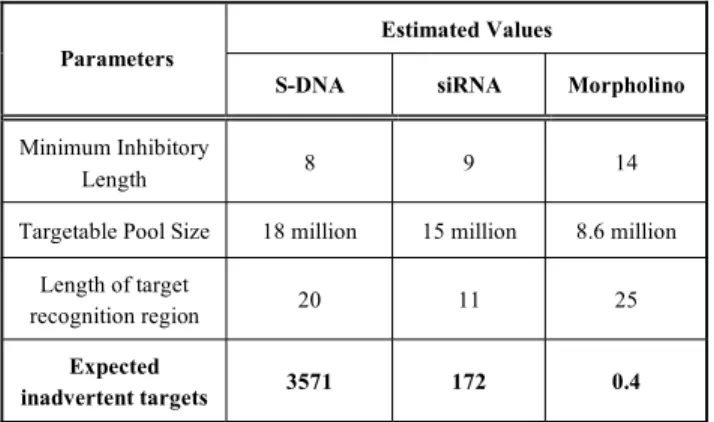
Accordingly, one would expect that any given Morpholino 25 subunits in length should inhibit expression of its intended RNA target, but not inhibit expression of any inadvertent RNA targets in a human cell. This is what I refer to as “exquisite” sequence specificity. Table 1 reiterates these estimated values and expected numbers of inadvertent targets for S-DNA, siRNA, and Morpholino oligos. 6. EXPERIMENTAL COMPARISON OF RELATIVE SELEC-TIVITIES
It should be appreciated that there are considerable uncertainties in these estimated parameters and predicted values for inadvertent targets, particularly for the case of the siRNAs. In such cases it is highly desirable to carry out some sort of empirical test to see if the predicted values reflect reality. Such a test has been carried out for S-DNAs, PNAs, and Morpholinos [7, 21], but not explicitly for the newer siRNAs. Nonetheless, I believe that pertinent experimental information is available which allows at least a qualitative comparison of overall specificities of the three structural types considered herein. Regrettably, this information does not allow one to distinguish between off-target effects and sequence specificity effects.
Table 1. S-DNA, siRNA and Morpholino Compared Estimated Values Parameters
S-DNA siRNA Morpholino
Minimum Inhibitory
Length 8 9 14
Targetable Pool Size 18 million 15 million 8.6 million Length of target
recognition region 20 11 25
Expected
inadvertent targets 3571 172 0.4
Test System
The most demanding of all gene knockdown applications is in developing embryos. This is because over the course of just a few days the rapidly developing embryo expresses most of its entire set of genes in precisely-ordered and critically-timed patterns. An outstanding advantage of gene knockdown studies in developing embryos is that many of the prospective gene targets have already been validated in precisely characterized genetic knockout strains. In such cases one knows beforehand exactly what phenotypic changes are to be expected from knocking down the intended target in a wild-type organism using an appropriately-targeted gene knockdown oligo. In such a demanding test system a gene knockdown agent which exhibits significant off-target effects and/or inadequate sequence specificity will, at best, cause gross anomalies over and above the specific effects due to knocking down its intended target. At worst, a gene knockdown oligo with significant off-target effects and/or inadequate sequence specificity will simply kill the embryo - often at a very early stage of development.
Before the year 2000 a number of developmental biologists had tested various S-DNAs in developing embryos (sea urchins, zebrafish, frogs, etc.). In general this led simply to dead embryos - typically with death at a very early stage. Occasionally the S-DNA just generated gross morphological anomalies, but not the phenotypes to be expected on the basis of precisely characterized genetic knockout strains.
In the year 2000 at the University of Minnesota Janet Heasman tested Morpholinos in frog embryos and Steve Eckker tested Morpholinos in zebrafish embryos. These workers were stunned to see that the Morpholinos repeatedly generated just the morphological changes expected from the previously characterized genetic knockout strains. Thus, for the first time developmental biologists were in a position to generate in a few hours to days an exact morphological phenocopy (for which Eckker coined the term: “Morphant”) of a genetic knockout which typically took many months to several years to generate by genetic means. Developmental biologists also now had a tool which allowed them to study embryo-lethal gene knockdowns which are rather difficult to generate in classical gene knockout strains because such strains cannot be propagated by sexual reproduction. Instead, one needs to generate conditional lethal strains which can be activated at a later point in embryogenesis. Since those initial embryo studies in 2000, Morpholinos have dominated gene knockdown studies in developing embryos [50, 51, 52], primarily because of their freedom from off-target effects, their exquisite sequence specificity, their complete stability in biological systems, and their highly predictable targeting.
From the very large difference between calculated numbers of inadvertent targets for S-DNAs and Morpholinos shown in Table 1 it is expected, and has been found, that Morpholinos should be far more specific than S-DNAs in developing embryos. The question then
arises as to whether Morpholinos are significantly better than siRNAs in this demanding application, as would also be predicted from the calculated values for inadvertent targets in Table 1.
Not surprisingly, siRNAs have been extensively tested in zebrafish embryos. A recent paper by Thomas Tuschl and coworkers [53] summarizes results from such testing and is quoted below.
“In contrast, attempts to explore RNAi mediated gene knockdown in the zebrafish embryo (Danio rerio) yield conflicting results. A number of groups have attempted to establish RNAi mediated gene silencing in zebrafish by injection of dsRNAs into embryos. Two studies report only unspecific effects after injection of either long dsRNA or siRNAs into the embryos. Thus, defects such as a truncated tail, loss of eye and brain structures, enlarged heart cavities and growth retardation were observed after injection of both types of dsRNA regardless of the target genes against which the RNAi was directed. Other groups have used dsRNAs specific for the targets ntl, flh,pax2.1, and Zf-t and pax6. Unspecific effects increased with increasing dsRNA concentrations while documentation of specific effects depended on a statistical intrepretation of the data. Specific silencing of the zebrafish M2 muscarinic acetylcholine receptor was reported in the developing embryo after injection of long dsRNA targeting the M2 mRNA. Silencing of the Duchenne muscular dystrophy gene (dmd) after injection of specific siRNAs into the yolk of two-cell zebrafish embryos was reported, but the phenotypes seen in this study resemble those reported by others as unspecific. Specific downregulation by translational inhibition of target genes in the developing embryo was shown with siRNAs directed against modified 3'UTR regions. These regions normally serve as miRNA target regions. The combined data on RNAi in embryos can be summarized by the statement in a review published this year that after RNAi “the ratio of specific phenotypes was generally low and variable and there have been studies reporting substantial unspecific effects of RNAi on the development of the zebrafish”.
In a discussion of their own work in that same paper [53] Tuschl and coworkers go on to state:
“The unspecific effects of siRNAs on embryonic development seen in this and other studies indicate that siRNAs in the zebrafish have an unspecific effect. Thus currently RNAi is not a useful technique for studying gene function in zebrafish embryos and the morpholino technique where modified oligonucleotides block translation of the corresponding mRNAs is clearly preferable.”
Thus, from gene knockdown studies in zebrafish it appears the experimental results provide qualitative support for the trend suggested by the calculated inadvertent target values in Table 1 - that being that S-DNAs have poor selectivity, siRNAs afford better selectivity, and Morpholinos achieve the best selectivity. Here I am using the term “selectivity” to mean a combination of off-target effects and sequence specificity effects.
Final Note on Specificity in Developing Embryos
Morpholinos were optimized for use at around 37ºC, and when used near that temperature they have a minimum inhibitory length (MIL) of about 14 to 15 and they generally achieve exquisite sequence specificity. However, when used at a temperature far below their 37ºC optimum, such as in frog embryos grown at 18ºC and sea urchin embryos at 15ºC, Morpholinos are reported to occasionally cause non-specific effects [52]. My guess is these occasional non-non-specific effects in low temperature systems are a consequence of the Morpholinos’ normal minimum inhibitory length of about 14 to 15 at 37ºC being reduced in a temperature-dependent manner to well below 14 at the lowest temperatures. As a consequence, at low temperatures some Morpholinos are expected to inhibit expression of a few inadvertent targets - leading to the occasional non-specific effects seen when Morpholinos are used at temperatures well below their 37ºC optimum.
One tactic which should reduce non-specific effects in low-temperature systems is simply to select target sequences lower in G
and C content and higher in A and U content. This will lead to a moderate increase in the MIL value for that Morpholino, thereby reducing the expected number of inadvertent targets. Another tactic which should improve specificity in low-temperature systems is to replace a few strong-binding guanines (which form 3 hydrogen bonds to cytosines) with weaker-binding hypoxanthines (which form 2 hydrogen bonds to cytosines) in the Morpholino structure. This should also serve to increase the MIL value and thereby reduce the expected number of inadvertent targets in low-temperature applications. 7. TARGETING SUCCESS RATE
S-DNA Targeting
In general, the targeting success rate for S-DNAs is only about 10% to 20%. This means only about 10% to 20% of S-DNAs prove to be reasonably effective in knocking down their intended RNA transcripts. This low targeting success rate has commonly been attributed to the low-affinity S-DNAs being incapable of invading the moderately stable RNA structures present in RNA transcripts under physiological conditions. However, when computer-predicted RNA secondary structures have been used to guide targeting of S-DNAs to presumed single-stranded regions in the selected RNA transcript, the targeting success rate for S-DNAs is generally only moderately improved - typically to something like a 20% to 40% success rate. This suggests there are other factors at play, possibly such as RNA binding proteins occluding the target sequences, and the low-affinity S-DNAs being unable to displace said proteins.
In regard to reducing the many off-target effects which plague DNAs, it is a simple matter to select target sequences such that the S-DNA targeted thereto will not activate the complement cascade (due to CG sequences with certain neighboring sequences) and will not affect blood pressure (due to G-quartet sequences). However, reducing other off-target effects is far more difficult and generally requires going to a chimera or gapmer design - and even that affords only modest improvement.
In regard to reducing the number of inadvertent targets for S-DNAs, because of their low MIL value inherent in their RNase H-dependent mechanism of action, it seems unlikely that S-DNAs can ever achieve sequence specificities adequate for routine gene knockdown applications - even with the newer chimera and gapmer designs.
siRNA Targeting
When siRNAs were first used in mammalian cells most such oligos were ineffective - and so commercial suppliers suggested testing about five or more different siRNAs for each gene one wished to knockdown in order to get at least one success. However, in the last couple of years much progress has been made in designing siRNAs with improved targeting success rates [54, 55, 56].
Now that targeting success rates for commercially available siRNAs appear to be approaching about 50% (ie., about half of the siRNAs are reasonably effective against their intended targets) most of the design and targeting focus has shifted to efforts to avoid off-target effects (ie., non-antisense effects) and reduce the number of inadvertent targets blocked by siRNAs.
In regard to the impact of off-target effects of siRNAs on their design and targeting, it appears that induction of the innate immune system has been the principal problem and there is now a small list of sequences which appear to be the primary culprits in this regard [42, 43]. Luckily, these problem sequences should be easily avoidable by proper targeting. Alternatively, it has been reported by commercial suppliers (without full disclosure) that such problem sequences can be chemically altered in such a manner that they lose their interferon-inducing capacity, while retaining their ability to block the expression of their intended target mRNA.
While much progress has been made in devising targeting rules for increased efficacy and reduced off-target effects (ie., non-antisense effects), it turns out that predicting inadvertent targets has proven to be a much tougher challenge. In regard to predicting the cleavage of inadvertent targets, a recent paper out of Dharmacon Research and Agilent Technologies describes an excellent study of inadvertent targets [48]. In this work Birmingham et al. studied the cleavage of inadvertent targets in human cells. They used 12 different siRNAs designed to target three different genes, and then used the Agilent Human 1A (V2) Oligo Microarray to study cleavage of inadvertent targets in the more than 20,000 human genes represented on that microarray. They found that 347 inadvertent targets had been cleaved, giving an average of 29 inadvertent targets cleaved by each siRNA.
When they compared these experimental results with computer-predicted values for inadvertent target cleavages, they found that the computer-predicted values gave a 99% false positive rate and a 93% false negative rate. In their discussion of these results they made the following statement:
“The work presented here demonstrates that with the exception of instances of near-perfect complementarity, the level of overall complementarity between an siRNA and any given mRNA is not associated with off-target identity. Although this approach is limited by its inability to assess the possible synergistic effects of multiple nonadjacent mismatches or secondary structures, these findings reveal that current protocols used to minimize off-target effects (for example, blastn and Smith-Waterman) have little merit aside from eliminating the more obvious off-targets (that is, sequences that have identical or near-identical target sites) and likely discard substantial numbers of functional siRNAs owing to unfounded specificity concerns.”
Thus, it appears clear that current targeting strategies for siRNAs do not allow one to avoid most of the inadvertent targets destined to be cleaved by any particular siRNA. It should be appreciated that for siRNAs their number of inadvertent targets which are cleaved is likely only a small fraction of their total inadvertent targets. The larger number of their inadvertent targets are likely those targets which are blocked – but not cleaved. Taking this further, I postulate that unless a means can be developed to increase the inherent minimum inhibitory length (MIL) of siRNAs, it is unlikely that this sequence specificity limitation can be significantly improved. Further, it seems likely that significantly increasing the MIL value simply may not be possible because that value appears to be inherent in the mechanism of action of the RISC structure through which siRNAs function.
Morpholino Targeting
About 80% of the Morpholinos designed and produced by GENE TOOLS are effective (typically achieving about 70% to 98% knockdown of the expression of their intended targets). This exceptionally high targeting success rate is believed to be a consequence of 2 factors: their extended length (typically 25 subunits) and the inherent high affinity of Morpholinos for complementary RNA sequences. Together these factors allow the Morpholinos to invade even quite stable RNA secondary structures which might be masking their intended target sequences [21].
Selecting a suitable target sequence for gene knockdown by a Morpholino entails picking an appropriate splicing site in the primary RNA transcript or picking a site in the mature mRNA in the region from the 5'cap to +25 in the amino acid coding sequence. Because of the possibility that a selected mRNA contains an internal ribosome entry site, it is generally safest to target the Morpholino on or near the AUG translational start site. To provide a good balance between efficacy and specificity it is desirable to select a target sequence with a G + C content in the range of about 35% to 65%. To assure good solubility one should avoid runs of 4 or more guanines, or a G content over about 36%. Finally, to assure that the Morpholino is fully available for binding to its target, Morpholino sequences should be
avoided if they have more than about 5 contiguous bases of self complementarity.
While these design guidelines are fairly simple and straight forward, they can be somewhat daunting to researchers new to the gene knockdown field. Therefore, GENE TOOLS (the sole commercial supplier of research quantities of Morpholinos) offers a free design service, which requires only that the researcher provide the identity of the gene they wish to knock down. In cases where a selected gene is not in the data banks, the researcher may still utilize this free design service by providing sequence information for the appropriate targetable regions of their selected gene transcript.
In regard to selecting targets which will have reduced off-target effects, this is irrelevant in the case of Morpholinos because they appear to rarely or never cause significant off-target effects.
In regard to selecting intended targets so as to reduce the number of possible inadvertent targets, probably because of the exceptionally large minimum inhibitory length (MIL) of Morpholinos, when used at or near 37ºC they only rarely block inadvertent targets, even when used in very complex systems such as developing embryos. As a consequence, there is generally no need to incorporate into the targeting scheme any complex measures designed to avoid such a problem.
However, in the few cases where a Morpholino is used at a temperature far below its 37ºC optimum, such as in frog embryos maintained at 18ºC and sea urchin embryos maintained at 15ºC, Morpholinos have been reported to cause occasional non-specific effects when used in very complex systems (ie., developing embryos). In such cases it is advisable to try to find an appropriate target sequence which has an unusually high A + U content - in order to further increase the Morpholino’s sequence specificity. However, it should be appreciated that the tradeoff in targeting an exceptionally high A + U target sequence is the Morpholino’s normally-quite-high efficacy may be reduced. Thus, this special “very high A + U” targeting tactic is only recommended for low temperature applications in those occasional cases where non-specific effects have already been encountered in the course of knockdown of one’s selected gene. 8. CHALLENGES AND OPPORTUNITIES
While much has been accomplished over the past 30 years in regard to developing gene knockdown oligos for safe and effective inhibition of intended targets within cells, I believe the last major remaining challenge is to achieve efficient and non-toxic delivery of such oligos into the cytosol/nuclear compartment of cells in a broad range of tissues in animals. Many workers in the gene knockdown field regularly contend that delivery of gene knockdown oligos (particularly S-DNAs) is both effective and routine in vivo, including in patients, and requires no special delivery reagents. In contrast, I believe a close inspection of the matter leads to a rather different conclusion - that being that effective in vivo delivery may be rarely if ever achieved - except in special cases wherein cell permeability barriers are known to be compromised, such as microinjection into eggs [57], or through the use of special delivery moieties linked to the knockdown oligo [58, 59, 60]. I also believe there is good reason to believe that at least for the case of S-DNAs the results commonly reported as being due to gene knockdown in vivo may actually be due to various off-target effects from the S-DNA oligos which are acting outside of cells or at cell surfaces [27, 30].
While it appears some progress is being made toward developing delivery moieties effective for in vivo delivery (59, 60), nonetheless, in my opinion (based on my 32 years of full time effort in the gene knockdown field, including the last 13 years working on the delivery problem [25, 61, 62, 63, 64, 65]) much additional progress is yet needed before delivery of gene knockdown agents becomes safe, efficient, reliable and affordable for use in patients. I further believe that only after this is achieved will the great and long-touted promise of gene knockdown agents finally lead to the long-awaited deluge of
safe and effective therapeutics for viral diseases, cancers, autoimmune diseases, and a host of other currently-intractable diseases. ABBREVIATIONS
CG = Cytosine-guanine
MIL = Minimum inhibitory length
miRNA = microRNA
mRNA = Messenger RNA
PNA = Peptide nucleic acid
RISC = RNA-induced silencing complex S-DNA = Phosphorothioate-linked DNA siRNA = Short interfering RNA
TPS = Targetable pool size
3’-UTR = 3’Untranslated region of mRNA REFERENCES
[1] Belikova, A.; Zarytova, V.; Grineva, N. Synthesis of ribonucleosides and diribonucleosude phosphates containing 2-chloroethylamine and nitrogen mustard residues. Tetrahedron Lett.1967,7, 3557-3562.
[2] Miller, P.; Yano, J.; Yano, E; Carroll, C.; Jayaraman, K.; Ts’o, P. Nonionic nucleic acid analogues: synthesis and characterization of dideoxyribonucleoside methylphosphonates. Biochemistry1979,18, 5134-5142.
[3] Zamecnik, P.; Stephenson, M. Inhibition of Rous sarcoma virus replication and cell transformation by a specific oligodeoxynucleotide. Proc. Natl. Acad. Sci. USA1978,75, 280-284.
[4] Summerton, J.; Bartlett, P. Sequence-specific crosslinking agents for nucleic acids. Use of 6-bromo-5,5-dimethoxyhexanohydrazide for crosslinking cytidine to guanosine and crosslinking RNA to complementary sequences of DNA. J. Mol. Biol.1978,122, 145-162.
[5] Summerton, J. Intracellular inactivation of specific nucleotide sequences: A general approach to the treatment of viral diseases and virally mediated cancers.
J. Theor. Biol. Submitted 1973, published 1979,78, 77-99.
[6] Cohen, J.S. Phosphorothioate Oligodeoxynucleotides. In Antisense Research and Applications; Crooke, S.T.; Lebleu, B; Eds.; CRC Press: Boca Raton, 1993; 205-219.
[7] Summerton, J. Morpholinos and PNAs compared. Lett. Pep. Sci.2004,10, 215-236.
[8] Summerton, J. Morpholinos and PNAs compared. In Peptide Nucleic Acids, Morpholinos and Related Antisense Biomolecules; Janson C.G.; During M.J.; Eds.; Springer: New York, 2006.
[9] Dorsett, Y.; Tuschl, T. siRNAs: applications in functional genomics and potential as therapeutics. Nat. Rev. Drug Discov.2004,3(4), 318-329. [10] Scherer, L.; Rossi J.J. RNAi applications in mammalian cells. Biotechniques,
2004,36(4), 557-561.
[11] Saxena, S.; Jonsson, Z.O.; Dutta, A. Small RNAs with Imperfect Match to Endogenous mRNA Repress Translation: Implications for off-target activity of small inhibitory RNA in mammalian cells. J. Biol. Chem.2003,278(45), 44312-44319.
[12] Zeng, Y.; Yi, R.; Cullen, B.R. MicroRNAs and small interfering RNAs can inhibit mRNA expression by similar mechanisms. Proc Natl Acad Sci U S A.
2003, 100(17), 9779-9784.
[13] Steck, W.J.; Zon, G.; Egan, W.; Stec, B. Automated solid-phase synthesis, separation, and stereochemistry of phosphorothioate analogs of oligodeoxyribonucleotides J. Am. Chem. Soc.1984, 106, 6077.
[14] Summerton, J.; Weller, D. Morpholino Antisense Oligomers: Design, Preparation and Properties. Antisense Nucleic Acid Drug Dev. 1997,7, 187-195.
[15] Kreig, A.; Stein, C.A. Phosphorothioate oligodeoxynucleotides: antisense or anti-protein? Antisense Res. Dev.1995,5, 241.
[16] Stein, C.A.; Kreig, A. Non-antisense effects of oligodeoxynucleotides. In
Antisense Technology a Practical Approach. Lichtenstein C.; Nellen W.; Eds.; IRL Press at Oxford University Press: Oxford, 1984 pp. 241-264. [17] Stein, C.A.; Kreig, A. Problems in interpretation of data derived from in vitro
and in vivo use of antisense oligodeoxynucleotides. Antisense Res. Dev.1994,4, 309.
[18] Summerton, J. Uncharged Nucleic Acid Analogs for Therapeutic and Diagnostic Applications: Oligomers Assembled from Ribose-Derived Subunits. In Advances in Applied Biotechnology Series, Volume 2, Discoveries in Antisense Nucleic Acids. Brakel C.; Ed.; Portfolio Publishing Company, The Woodlands, 1989; pp 71-80.
[19] Stirchak, E.P.; Summerton, J.E.; Weller, D.D. Uncharged stereoregular nucleic acid analogs: 2. Morpholino nucleoside oligomers with carbamate internucleoside linkages. Nucleic Acids Res.1989,17(15), 6129-6141. [20] Summerton, J.E.; Weller, D.D. Uncharged Morpholino-based polymers having
phosphorous containing chiral intersubunit linkages. US Patent 5,185,444, Feb
9, 1993.
[21] Summerton, J. Morpholino Antisense Oligomers: The Case for an RNase-H Independent Structural Type. Biochimica et Biophysica Acta1999,1489, 141-158.
[22] Summerton J. Morpholino Antisense Oligos: Applications in Biopharmaceutical Research. Innovations Pharmaceutical Technology.2005.
[23] Hudziak, R.M.; Barofsky, E.; Barofsky, D.F.; Weller, D.L.; Huang, S.B.; Weller, D.D. Resistance of morpholino phosphorodiamidate oligomers to enzymatic degradation. Antisense Nucleic Acid Drug Dev.1996,6(4), 267-272. [24] Kang, H.; Chou, P.J.; Johnson, W.C. Jr; Weller, D.; Huang, S.B.; Summerton, J.E. Stacking interactions of ApA analogues with modified backbones.
Biopolymers1992,32(10), 1351-1363.
[25] Summerton, J.E. Endo-porter: a novel reagent for safe, effective delivery of substances into cells. Ann. N Y Acad. Sci.2005,1058, 62-75.
[26] Levin, A.A.; A review of the issues in the pharmacokinetics and toxicology of phosphorothioate antisense oligonucleotides. Biochim. Biophys. Acta1999,
1489(1), 69-84.
[27] Azad, R.F.; Driver, V.B.; Tanaka, K.; Crooke, R.M.; Anderson, K.P. Antiviral activity of a phosphorothioate oligonucleotide complementary to RNA of the human cytomegalovirus major immediate-early region. Antimicrob. Agents Chemother.1993,37(9), 1945-1954.
[28] Stein, C.A.; Kreig, A. Non-antisense effects of oligodeoxynucleotides. In
Antisense Technology a Practical Approach. Lichtenstein C.; Nellen W.; Eds.; IRL Press at Oxford University Press: Oxford, 1984 pp. 250-257. [29] Krieg, A.M.; Yi, A.K.; Matson, S.; Waldschmidt, T.J.; Bishop, G.A.; Teasdale,
R.; Koretzky, G.A.; Klinman, D.M. CpG motifs in bacterial DNA trigger direct B-cell activation. Nature1995,374(6522), 546-549.
[30] Gekeler, V.; Gimmnich, P.; Hofmann, H.P.; Grebe, C.; Rommele, M.; Leja, A.; Baudler, M.; Benimetskaya, L.; Gonser, B.; Pieles, U.; Maier, T.; Wagner, T.; Sanders, K.; Beck, J.F.; Hanauer, G.; Stein, C.A. G3139 and other CpG-containing immunostimulatory phosphorothioate oligodeoxynucleotides are potent suppressors of the growth of human tumor xenografts in nude mice.
Oligonucleotides2006,16(1), 83-93.
[31] Yaswen, P.; Stampfer, M.R.; Ghosh, K.; Cohen, J.S. Effects of sequence of thioated oligonucleotides on cultured human mammary epithelial cells.
Antisense Res. Dev. 1993,3(1), 67-77.
[32] Agrawal, S.; Importance of nucleotide sequence and chemical modifications of antisense oligonucleotides. Biochim. Biophys. Acta1999,1489(1), 53-68. [33] Mani, S.; Goel, S.; Nesterova, M.; Martin, R.M.; Grindel, J.M.; Rothenberg,
M.L.; Zhang, R.; Tortora, G.; Cho-Chung, Y.S. Clinical studies in patients with solid tumors using a second-generation antisense oligonucleotide (GEM 231). targeted against protein kinase A type I. Ann. N Y Acad. Sci.2003,1002, 252-262.
[34] Elbashir, S.M.; Harborth, J.; Lendeckel, W.; Yalcin, A.; Weber, K.; Tuschl, T. Duplexes of 21-nucleotide RNAs mediate RNA interference in cultured mammalian cells. Nature2001,411(6836), 494-498.
[35] Sledz, C.A.; Holko, M.; de Veer, M.J.; Silverman, R.H.; Williams, B.R. Activation of the interferon system by short-interfering RNAs. Nat. Cell Biol.
2003, 5(9), 834-839.
[36] Kariko, K.; Bhuyan, P.; Capodici, J.; Weissman, D. Small interfering RNAs mediate sequence-independent gene suppression and induce immune activation by signaling through toll-like receptor 3. J. Immunol.2004,172(11), 6545-6549. [37] Alexopoulou, L.; Holt A.C.; Medzhitov, R.; Flavell, R.A. Recognition of
double-stranded RNA and activation of NF-kappaB by Toll-like receptor 3.
Nature2001, 413(6857), 732-738.
[38] Kawasaki, H.; Taira, K. Induction of DNA methylation and gene silencing by short interfering RNAs in human cells. Nature2004, 431(7005), 211-217. [39] Persengiev, S.P.; Zhu, X.; Green, M.R. Nonspecific, concentration-dependent
stimulation and repression of mammalian gene expression by small interfering RNAs (siRNAs). RNA2004,10(1), 12-18.
[40] Kim, D.H.; Longo, M.; Han, Y.; Lundberg, P.; Cantin, E.; Rossi JJ. Interferon induction by siRNAs and ssRNAs synthesized by phage polymerase. Nat. Biotechnol.2004,22(3), 321-325.
[41] Pebernard, S.; Iggo, R.D. Determinants of interferon-stimulated gene induction by RNAi vectors. Differentiation2004,72(2-3), 103-111.
[42] Marques, J.T.; Williams, B.R. Activation of the mammalian immune system by siRNAs. Nat. Biotechnol.2005,23(11), 1399-1405.
[43] Judge A.D.; Sood V.; Shaw J.R.; Fang, D.; McClintock, K.; MacLachlan, I. Sequence-dependent stimulation of the mammalian innate immune response by synthetic siRNA. Nat. Biotechnol.2005,23(4), 457-462.
[44] Fedorov, Y.; King, A.; Anderson, E.; Karpilow, J.; Ilsley, D.; Marshall, W.; Khvorova, A. Different delivery methods-different expression profiles. Nat. Methods2005,2(4), 241.
[45] Scacheri, P.C.; Rozenblatt-Rosen, O.; Caplen, N.J.; Wolfsberg, T.G.; Umayam, L.; Lee, J.C.; Hughes, C.M.; Shanmugam, K.S.; Bhattacharjee, A.; Meyerson, M.; Collins, F.S. Short interfering RNAs can induce unexpected and divergent changes in the levels of untargeted proteins in mammalian cells. Proc. Natl. Acad. Sci. USA2004,101(7), 1892-1897.
[46] Haley, B.; Zamore, P.D. Kinetic analysis of the RNAi enzyme complex. Nat. Struct. Mol. Biol.2004,11(7), 599-606.
[47] Lin, X.; Ruan, X.; Anderson, M.G.; McDowell, J.A.; Kroeger, P.E.; Fesik, S.W.; Shen, Y. siRNA-mediated off-target gene silencing triggered by a 7 nt complementation. Nucleic Acids Res.2005,33(14); 4527-4535.
[48] Birmingham, A.; Anderson, E.M.; Reynolds, A.; Ilsley-Tyree, D.; Leake, D.; Fedorov, Y.; Baskerville, S.; Maksimova, E.; Robinson, K.; Karpilow, J.;
Marshall, W.S.; Khvorova, A. 3' UTR seed matches, but not overall identity, are associated with RNAi off-targets. Nat. Methods2006,3(3), 199-204. [49] Hesketh, J. 3'-Untranslated regions are important in mRNA localization and
translation: lessons from selenium and metallothionein. Biochem. Soc. Trans.
2004,32(Pt 6), 990-993.
[50] Special Issue: Morpholino Gene Knockdowns. Genesis 2001,30(3) – all 27 papers.
[51] Ekker, S.C. Nonconventional antisense in zebrafish for functional genomics applications. Methods Cell Biol.2004,77, 121-136.
[52] Heasman, J. Morpholino oligos: making sense of antisense? Dev. Biol.2002,
243(2), 209-214.
[53] Gruber, J.; Manninga, H.; Tuschl, T.; Osborn, M.; Weber, K. Specific RNAi mediated gene knockdown in zebrafish cell lines. RNA Biol.2005,2(3), 101-105.
[54] Reynolds, A.; Leake, D.; Boese, Q.; Scaringe, S.; Marshall, W.S.; Khvorova A. Rational siRNA design for RNA interference. Nat. Biotechnol.2004,22(3), 326-330.
[55] Naito, Y.; Yamada, T.; Ui-Tei, K.; Morishita, S.; Saigo, K. siDirect: highly effective, target-specific siRNA design software for mammalian RNA interference. Nucleic Acids Res.2004,32(Web Server issue), W124-129. [56] Mittal, V. Improving the efficiency of RNA interference in mammals. Nat. Rev.
Genet.2004,5(5), 355-365.
[57] Kimmel, C.B.; Law, R.D. Cell lineage of zebrafish blastomeres. I. Cleavage pattern and cytoplasmic bridges between cells. Dev. Biol. 1985,108(1), 78-85. [58] Rasmussen, F.W.; Bendifallah, N.; Zachar, V.; Shiraishi, T.; Fink, T.; Ebbesen, P.; Nielsen, P.E.; Koppelhus, U. Evaluation of transfection protocols for unmodified and modified peptide nucleic acid (PNA) oligomers.
Oligonucleotides2006,16(1), 43-57.
[59] Moulton, H.M.; Nelson, M.H.; Hatlevig, S.A.; Reddy, M.T.; Iversen, P.L. Cellular uptake of antisense morpholino oligomers conjugated to arginine-rich peptides. Bioconjug. Chem.2004,15(2), 290-299.
[60] Kinney, R.M.; Huang, C.Y.; Rose, B.C.; Kroeker, A.D.; Dreher, T.W.; Iversen, P.L.; Stein, D.A. Inhibition of dengue virus serotypes 1 to 4 in vero cell cultures with morpholino oligomers. J. Virol.2005,79(8), 5116-5128.
[61] Partridge, M.; Vincent, A.; Matthews, P.; Puma, J.; Stein, D.; Summerton, J. A simple method for delivering morpholino antisense oligos into the cytoplasm of cells. Antisense Nucleic Acid Drug Dev.1996,6(3), 169-175.
[62] Summerton, J.; Weller, D. Molecular engine for transporting drugs across cell membranes. Nucleosides Nucleotides1997,16, 1785-1788.
[63] Summerton, J.E.; Weller, D.D. Polymer composition for delivering substances in living organisms. US Patent 6,030,941, Feb 29, 2000.
[64] Morcos, P.A.; Summerton, J.E.; Summerton, J.P. Osmotic delivery composition, solution, and method. US Patent 6,228,393, May 8, 2001. [65] Morcos, P.A. Achieving efficient delivery of morpholino oligos in cultured
cells. Genesis2001,30(3), 94-102.