R E S E A R C H A R T I C L E
Open Access
Using the behavior change wheel to
identify barriers to and potential solutions
for primary care clinical guideline use in
four provinces in South Africa
Tamara Kredo
1,2*, Sara Cooper
1,3, Amber Abrams
1, Jocelyn Muller
1, Jimmy Volmink
4and Salla Atkins
5,6Abstract
Background:Clinical practice guidelines risk having little impact on healthcare if not effectively implemented. Theory informed, targeted implementation may maximise their impact. Our study explored barriers to and
facilitators of guideline implementation and use by South African primary care nurses and allied healthcare workers in four provinces in South Africa. We also proposed interventions to address the issues identified.
Methods:We used qualitative research methods, comprising focus group discussions using semi-structured topic guides. Seven focus group discussions were conducted (48 providers) in four South African provinces (Eastern Cape, Western Cape, Kwazulu-Natal, Limpopo). Participants included mostly nurses, dieticians, dentists, and allied health practitioners, from primary care facilities in rural and peri-urban settings. The analysis proceeded in three phases. Firstly, two analysts conducted inductive thematic content analysis to develop themes of data. This was followed by fitting emergent themes to the Theoretical Domains Framework and finally to the associated Behaviour Change Wheel to identify relevant interventions.
Results:Participants are knowledgeable about guidelines, generally trust their credibility and are receptive and motivated to use them. Guidelines are seen by nurses to provide confidence and reassurance, as well as professional authority and independence where doctors are scarce. Barriers to guideline use include: inadequate systems for printed book distribution, insufficient and substandard photocopies, linguistic inappropriateness (e.g. complicated language, lack of summaries, unavailable in local languages), unsupportive auditing procedures, limited involvement of end-users in guideline development, and patchy training that may not filter back to all providers. Future aspirations identified include: improving the design features of guidelines, accessible places to find guidelines, making digitally-formatted versions available, more supplementary materials (e.g. posters) to support patient engagement, accessible clinical support following training, and in-facility training for all professional cadres to ensure fair access, similar levels of capability and interdisciplinary consistency.
Conclusions:South African primary care nurses and allied health practitioners have high levels of motivation to use guidelines, but face many systemic barriers. We used the Behaviour Change Wheel to suggest relevant,
implementable interventions addressing identified barriers. This theory-informed approach may improve clinical guideline implementation and impact healthcare for South Africa.
Keywords:Qualitative research, Clinical practice guidelines, Implementation, Primary care, Focus groups, Theoretical domains framework, Behaviour change, Quality improvement
* Correspondence:[email protected] 1
Cochrane South Africa, South African Medical Research Council, Cape Town, South Africa
2Division of Clinical Pharmacology, Faculty of Medicine and Health Sciences,
Stellenbosch University, Cape Town, South Africa
Full list of author information is available at the end of the article
Background
Internationally, high-quality, evidence-informed clinical practice guidelines (CPGs) are recognised as essential quality improvement tools [1–3]. CPGs have a range of purposes, intended to standardise care, improve its qual-ity and safety, decrease costs, and improve patient out-comes [3, 4]. They offer a‘one-stop shop’for end-users, by providing synthesised information from systematic reviews regarding best practices [5]. However, despite growing availability of CPGs, if not used, they cannot impact on the quality of the care that is delivered.
South Africa has long been developing CPGs, most pronounced during the post-apartheid period when CPGs were considered important tools to redress in-equity, standardise care and promote cost-effective care for all. Many CPG development players have been iden-tified: national government, professional societies, hospi-tals and clinics all contribute according to their needs and agendas [6, 7]. However, despite development and distribution of CPGs, health outcomes remain poor, and generally worse than expected given the per capita health spend relative to other similar middle-income countries [8, 9]. As CPGs aim to optimise care, and yet care appears not to be optimally delivered, it may be helpful to understand the barriers to CPG implementa-tion and use [10,11].
We know there are no ‘magic bullets’ for improving CPG implementation [12, 13]. Systematic reviews sug-gest many potential implementation strategies, such as audit and feedback, outreach education and key opinion leaders [14]. Available evidence suggests that tailored, multi-faceted approaches may do better than generic and single-focused interventions [13,14].
Several pragmatic trials of CPG implementation for lung health, Human Immunodeficiency Virus (HIV) and broader primary care have been conducted in South Africa, finding some improvements when educa-tional outreach is used [15–17]. It is therefore possible that, when used, CPGs may improve health outcomes. If we better understood when and how CPGs are used by South African primary care providers, then CPG devel-opers may design evidence-informed strategies to enhance enablers and overcome barriers.
The Theoretical Domains Framework (TDF) is a useful approach for identifying facilitators of and barriers to be-haviour change, and for developing tailored interventions when implementing CPGs [18]. Understanding how best to enhance healthcare providers’ use of CPGs requires consideration of the complex interplay of clinician and pa-tient behaviours, environmental context and social influ-ences. The TDF intends to integrate theories of behaviour change, and bridge health psychology, organisational the-ory and health services, providing a theoretical basis for implementation research [19]. Several studies have used
the TDF to evaluate healthcare implementation challenges or to design theory-informed implementation strategies. Examples include hand hygiene, children’s health checks, human papilloma virus vaccination, dental infections, and lower back pain [10, 11, 20–22]. Some of these explora-tions further informed the design of complex interven-tions for research or public health programmes [20].
Utilising the TDF, this study aimed to explore primary care healthcare providers’ perspectives regarding the context, potential barriers to and enablers of CPG use in four provinces in South Africa. Based on the findings, and drawing on concepts from the Behaviour Change Wheel (BCW), this study also sought to provide recom-mendations for potential interventions to improve CPG usage and implementation.
Methods
Theoretical framework
We used a qualitative study design, including semi-struc-tured focus group discussions (FGDs). The overarching con-ceptual framework used for this article was the Theoretical Domains Framework (TDF) that also formed part of our analysis process described below. The TDF provides a basis to understand behaviours theoretically and therefore target processes most likely to implement desired change [19,23]. The 14 domains of TDF have been further mapped onto the Capability, Opportunity, Motivation – Behavioural model (COM-B model), a‘behaviour system’model which seeks to encapsulate the conditions internal to individuals and those within their social and physical environment necessary for achieving specified behavioural targets [18]. Three essential conditions: Capability, Opportunity, and Motivation (COM-B) are at the core of this system, which posits that these components interact to generate behaviour, which in turn influences them in a back-and-forth cycle. These com-ponents form the hub of what is termed a‘Behaviour Change Wheel’(BCW), around which are a number of interventions which may be implemented at the individual (e.g. education and training), or policy level (e.g. legislation or fiscal mea-sures) to enable the COM-B elements [18]. The BCW is a practical tool that can be applied in implementation research to move from identifying barriers and enablers to aligning these with tailored interventions [24]. Definitions for the COM-B domains, how they map to the TDF and to the BCW intervention functions are shown (Table1).
Study settings
provincial governments implement CPGs, sometimes after adaptation, to healthcare facilities (from regional, to dis-trict, to community healthcare facilities) [8].
Sampling and recruitment
South Africa is a large and diverse country. We therefore selected four of the nine provinces to represent a
[image:3.595.57.541.97.407.2]spectrum of primary healthcare settings: Western Cape, Kwazulu-Natal, Eastern Cape and Limpopo provinces. Each province is different in terms of population size and density, economic development, healthcare spending and resources, and health outcomes (Table2). While the Western Cape, Eastern Cape and Limpopo have similar population sizes, the Western Cape is better funded, and Table 1Links between COM-B, Theoretical Domains Framework and Behaviour Change Wheel intervention functions
COM-B model Theoretical Domains
Framework
Behaviour Change Wheel Intervention functions
Motivation
Definition:all those cognitive processes that direct behaviour, including habitual processes, emotional responding, as well
as analytical decision-making.
Reflective motivation Professional/ social role and identify
Education, persuasion, modelling
Beliefs about capabilities Education, persuasion, enablement
Optimism Education, persuasion, modelling,
enablement
Beliefs about consequences Education, persuasion, modelling
Intentions Education, persuasion, incentivisation,
coercion, modelling, enablement
Automatic motivation Reinforcement Training, Incentivisation, coercion,
Environmental restructuring
Emotion Persuasion, incentivisation, coercion,
modelling, enablement
Capability
Definition:the individual’s psychological and physical capacity to engage in the activity concerned, and includes having the necessary knowledge and skills.
Physical capability Physical skills Training
Psychological capability Knowledge Education
Cognitive and interpersonal skills
Training
Memory, attention and decision processes
Training, environmental restructuring, Enablement
Behavioral regulation Education, training, modelling, enablement
Opportunity
Definition:all the factors that lie outside the individual that make the behaviour possible or prompt it.
Physical opportunity Environmental context and resources
Training, restriction, environmental, restructuring, enablement
Social opportunity Social influences Restriction, environmental, restructuring, modelling, enablement
Table 2Key health and demographic indicators by South African provincea
Indicator Year Province
WC KZN EC LPP
Area as a % of total area of South Africa 2011 10.6 7.7 13.8 10.3
Population 2016 6,279,730 11,065,240 6,996,976 5,799,090
Population % by province 2016 11.3 19.8 12.6 10.4
GDP per capita (USA) 2010 8.69 4.77 3.65 4259
Education level (% population with no schooling) 2015 1.5 6.7 6.1 9.8
Poverty prevalence (food poverty line) 2011 23.2 37.4 40.5 41.5
Population % dependent on public sector 2016 75.96 88.22 90.13 91.58
Health as % of total expenditure 2000 30.0 26.7 20.9 17.8
Per capita public sector health expenditure 2015 4242.5 3623.1 3304.4 2957.7
Life expectancy at birth 2010 68.0 52.9 53.8 63.6
Adult mortality rate (probability of dying between 15 and 60 years) 2010 26.6 52.8 52.2 37.7
Under 5 mortality rate 2015 23.1 57.8 59.6 36.6
a
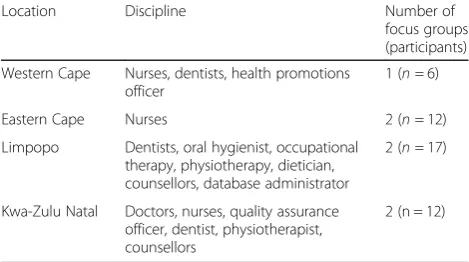
[image:3.595.57.539.528.726.2]has higher educational levels, lower levels of poverty and a higher life expectancy than the others. Kwazulu-Natal has the largest population size, a high poverty prevalence and poor life expectancy, despite health expenditure ap-proaching that of the Western Cape. Other factors be-sides available funds, are likely to play a role in this regard, including high prevalence of infectious diseases, such as HIV [25]. Within each province, we targeted two public sector primary care clinics, one rural and one urban or peri-urban. While we intended to conduct eight FGDs, we completed seven due to delayed access in the Western Cape. To identify clinics, we contacted the provincial research directorates and colleagues work-ing in the provinces for guidance. All healthcare pro-viders working at clinics, regardless of cadre, were invited to participate (Table3).
Data collection and management
The FGDs enabled us to explore collective experiences of CPG use at the frontline of healthcare delivery. This method is suited for exploring complexity surrounding CPG use within the context of lived experiences, in ways that encourage participants to engage actively with the research topic [31,32].
Seven FGDs were held from November 2015 to August 2016. Group sizes ranged from three to eleven participants and lasted from 60 to 90 min. A total of forty-eight pro-viders participated. Primary care propro-viders who took part included nurses, occupational therapists, physiotherapists, dieticians, dentists, oral hygienists and medical doctors.
The FGDs were guided by a semi-structured topic guide which explored the following topics: the context of CPG awareness and use; specific CPGs used (and fre-quency of usage); access to CPGs; general views and ex-periences of using specific CPGs; perceptions of barriers to and enablers of CPG use; and recommendations of strategies that might address current barriers to use. The guide was flexible to ensure that participants could ex-press what was important to them, and so learnings from previous FGDs could be clarified and probed further in subsequent FGDs. The FGD guide was not
based on the TDF, but rather sought to understand nurses’ perceptions about and experiences with using CPGs on their own terms and their own meaning frames. The TDF was used during the analysis stage to help analyse and organise the data as described below. FGD facilitators received training in facilitation techniques. All FGDs were conducted in pairs; mem-bers of the research team (all females) took turns to facilitate.
FGDs were recorded digitally. Reflections and sum-maries were written after FGDs to capture insights. Ini-tial coding and thematic analysis were conducted after each FGD to guide the sampling process and to ensure data saturation.
FGDs were transcribed verbatim, and transcriptions were reviewed for accuracy by the research team (TK, TM). A few participants including a lay counsellor and entry level nurse chose to share their views using their mother tongue which was not English. A research team member assisted to translate these short sections for us to include in the analysis. Data were stored electronically on password-protected computers; a master list and consent forms were stored in a locked cabinet for which only the project lead had access.
Analysis
We used an iterative, thematic content analysis ap-proach [31, 33]. Specifically, two researchers read the transcripts (TK, SA) and agreed on the general mean-ing and central issues presented. One researcher (TK) then read transcripts, performing open coding re-lated to general questions posed, including context, use, barriers to and enablers of CPG use, extracting the related quotes [34]. Quotes were then further ex-amined (TK, SA) for manifest and latent meanings [35]. At this point, we searched for conceptual frame-works that might help us better understand and organize the data. The TDF was considered to pro-vide a useful model in this regard, enabling us to en-capsulate the individual and context factors that facilitate and /or hinder CPG use that we saw emer-ging from the data. The model was also deemed valu-able to facilitate the subsequent translation of our findings into actionable recommendations for inter-ventions which target specific barriers. This model has been used successfully by others to evaluate healthcare implementation challenges and to design theory-informed implementation strategies [20, 21].
[image:4.595.56.291.600.731.2]Having examined individual quotes for manifest and latent meanings, two researchers (TK, SC) then used the TDF to further categorise the data. In particular, specific quotations and their meanings were matched to the 14 domains within the TDF. The two re-searchers performed the matching independently, and Table 3Schedule of Focus Groups
Location Discipline Number of
focus groups (participants)
Western Cape Nurses, dentists, health promotions officer
1 (n= 6)
Eastern Cape Nurses 2 (n= 12)
Limpopo Dentists, oral hygienist, occupational therapy, physiotherapy, dietician, counsellors, database administrator
2 (n= 17)
Kwa-Zulu Natal Doctors, nurses, quality assurance officer, dentist, physiotherapist, counsellors
subsequently discussed these with each other and the third researcher (SA) to reach agreement and resolve uncertainties. Each quotation was coded to at least one TDF domain, but some we felt could be coded into two or three domains. In the case of the latter, judgments were made about which specific domain the quotes should be categorized, in a manner that captured the meaning of individual quotes and fitted with the broader themes that were emerging. Once our findings were aligned with the TDF domains and associated COM-B system, then proceeded to map the findings onto the respective intervention functions to generate recommendations based on the BCW [24]. The process of developing recommendations was informed by the methods used by Michie and col-leagues to link their analysis of the targeted behav-iours to appropriate interventions for controlling tobacco and reducing obesity [18].
Rigour
Credibility was ensured through detailed capturing and description of our approach to sampling, data collection, data management, analysis and interpretation [35]. Con-sideration of issues regarding reflexivity and transferabil-ity were considered throughout the process. Quotations were chosen to provide readers the opportunity to inter-pret data, establish confirmability and to show the rich-ness of the data. Complementary research competencies and experiences among all researchers influenced data interpretation and strengthened study rigour.
Results
Most participants were nurses; two were doctors at one FGD in Kwa-Zulu Natal (Table 3). Although we col-lected limited demographic data, we observed that those in rural facilities had worked for a longer time and lived in the area, whereas at the more urban facilities, partici-pants were generally younger, more recently appointed and potentially more mobile.
In this section we report the potential enablers of and barriers to CPG use in terms of the COM-B domains of
‘Motivation’ (reflective, automatic),‘Capability’ (psycho-logical, social) and ‘Opportunity’ (social, physical) (Table 1) [23], and reflect on and unpack the TDF cat-egories within them.
Motivation–Reflective and automatic
Motivation includes behaviors corresponding to reflective motivation and those that are more automatic or habitual. We report on both reflective and automatic motivation as they include issues of emotion, professional identify, be-liefs about capability and consequences. Strikingly, across all FGDs, the overwhelming majority of participants expressed motivation to use CPGs. CPG use appeared to
evoke a range of positive emotional responses, particularly amongst nurses. Sentiments included‘reassuring’,inspiring
‘confidence’and providing a sense of autonomy or ‘ inde-pendence’. The latter was particularly pronounced in more rural settings, with few doctors:
It makes [allows] us to be in line with the doctors, it makes us doctors ourself [sic], so it means you will be
in-dependent(Nurse_LPP_rural).
Additionally, CPGs were perceived as useful tools to engage the community, share information and protect healthcare providers’ professional integrity, which fur-ther motivated use:
Even if there is a complaint among the community members that we have mismanaged this client, so we say,
I have managed this client…through the guidelines and
we show him the guidelines(Nurse_EC_rural).
Overall, CPGs were perceived as credible sources. Nurses and allied healthcare providers in several clinics described having first-hand experience of CPGs improving patient care. One particularly significant example cited was that of HIV, where CPGs had changed rapidly as the field of HIV care changed in South Africa. Providers described having seen pa-tients transition from dying prior to the availability of HIV CPGs, to patients living with HIV after CPGs were imple-mented. This underscored for them the perceived value that using CPGs bring:
It’s working, because when we want to find out our statistics, people they are now…[HIV] negative…they have got ARV’s [antiretrovirals] and they are fine…
(Nurse_KZN_rural).
Compared to nursing staff, the link between CPGs, professional identity and enablement seemed lesser for doctors, as one doctor suggested:
I must confess, we doctors are not very good at seeing this is what the guidelines says. This is the way I do things and then you go on. It’s not just here but if you go to another place you’ll find the same thing.
(Doctor_KZN_peri-urban).
Capability–Knowledge and skills
would conduct research on something that was so ob-viously part of routine clinical care.
While some participants described using CPGs for
‘each and every patient’, others suggested that they were most likely to use CPGs in particular instances. That is, they tended to use CPGs when faced with an unfamiliar clinical case or a change in the recommendations that sparked curiosity, and required learning:
…what makes me want to read some of them is
because I came across such a patient, and I didn’t know what to do then I go back to read. That is what makes me wanna read, otherwise I don’t think I’ll just sit down and read the guideline
(Oralhealth_LPP_peri-urban).
Despite their own knowledge, participants expressed an important gap in CPG awareness amongst patients and the public. Many felt that increasing public awareness of CPGs was important for successful CPG implementation. That is, a more health-literate and empowered public was perceived to encourage accountability of healthcare pro-viders. Several approaches for raising public awareness were proposed, including engaging journalists, use of radio, television and social media:
Maybe when you’re listening to [the] radio and reading news, they should introduce this change everywhere,
be-cause even [the] patients should know (Oralhealth_LPP_
peri-urban).
Another significant gap identified by participants was training in CPG usage. Training was perceived as an essential tool to ‘keep abreast’ or ‘get up to speed’
with CPG content. It was also considered important for enhancing clinical practice and ensuring that all disciplines‘will be on the same level’and thus prevent-ing a‘clash of information’. While training was unani-mously perceived as necessary for proficient CPG usage, participants were undecided about the setting in which training should take place. Specific feedback about the pros and cons of on-site training and off-site workshops were provided, which are detailed in Additional file 1. Though training was considered key to CPG use, many participants felt that skills building through training was inadequate. Training, regardless of whether providers were from urban or rural settings, was considered insufficient or patchy, not covering all topics and not inclusive of all clinical disciplines. This inadequacy was perceived to result in CPGs which are ‘hard to interpret’and thus staff hav-ing to ‘struggle’ on their own to use CPGs properly.
The management process for deciding who would at-tend workshops was also described as non-transparent and unfair, with ‘no consistency’ surrounding attend-ance. Thus, while participants were categorical about
the need for more training, the issue of how best to do this remains complex.
Opportunity–Social and physical
Opportunity includes both physical opportunity and social opportunity. Social opportunity considers the social influ-ences that may impact CPG use. While this domain did not generate substantial discussion amongst participants, what emerged consistently, particularly in rural facilities, was the value of supportive social and professional systems as enab-ling quality clinical care and CPG use. These systems, in-cluding involvement of non-governmental organisations, and associated cohesive teams and strong leadership, were perceived to enable the culture of CPG use.
So it’s team work that matters, if you are working as a
team you do(Nurse_EC_peri-urban).
Whereas we found generally supportive social and professional environments, the physical environment emerged as a considerable obstacle to CPG use. This do-main generated extensive discussion, with several sub-themes emerging, namely: the need to adapt to local context; health system challenges; access to CPGs; CPG design needs; and digital CPGs. In addition to describing these barriers in great depth, participants from all disci-plines also provided practical recommendations for how these contextual barriers might be addressed.
CPGs being insufficiently adapted to local contexts emerged as a key issue. Given the diversity in a large country like South Africa, the context in which CPGs are used may differ by province. Some CPG recommen-dations were experienced as ‘not practical’and not ap-propriate to local healthcare contexts. Many agreed that for CPGs to become ‘something that can really apply to
us’ and that ‘actually works to suit the PHC [primary
health care]’,healthcare providers should be part of CPG development processes.
Health system challenges emerged as another major barrier to CPG implementation. The ability to operation-alise CPG recommendations was described as signifi-cantly hindered by‘no budget’,‘slow procurement’, or the lack of equipment where staff simply‘don’t have the
ma-chine’. Stock outs of medicines was highlighted as an
issue:
when there is a recommendation and the medication is not there…we are stuck(Nurse_LPP_rural).
Relatedly, primary care clinic pressures were perceived to limit providers’ ability to properly read CPGs. All cadres described that the ‘long queues outside’ and the time needed to ‘page and page’through a CPG was not feasible during a consultation.
suggestions for how these might be improved to en-hance CPG use (Additional file 2). Many spoke about the lengthy nature of CPGs and the ‘big jargon Eng-lish’, which limited understanding and use. They expressed a wish for ‘much more user friendly’ CPGs, including using ‘short directive’ and more simple lan-guage, and incorporating ‘summarised’ versions, more definitions, local vernacular and supplementary tools (e.g. posters) to aid understanding and support pa-tient engagement. A doctor suggested that, as people maybe ‘visual learners’, use of more attractive and ap-pealing formats, such as graphics, charts, and colour, would enhance CPG use. Colour-coding in one of the primary care CPGs (PC101) was described as effect-ive, as one nurse said, it ‘keeps you on the toes’
(EC_peri-urban).
Poor access to good quality and up-to-date CPGs materialised as an especially pertinent physical barrier to CPG usage. Many participants, particularly those in rural settings, provided detailed narratives about how
‘hard to reach’ CPGs were. Many described how they
frequently ‘get them late’ or have access to ‘only one copy’ in their clinics. Others spoke about the way in which CPGs are often stored inaccessibly outside of consulting rooms, while others highlighted the poor systems that exist for CPG version control, ultimately resulting in ‘confusion’ and outdated information. Fur-thermore, it emerged that even when CPGs are avail-able, they are frequently of sub-standard quality:
They make copies and pages are missing, the arrangement of the pages, [it] becomes bulkier and all these things. So that’s a problem, I mean people don’t really get the real thing, a reprint or make a copy and make your own.
(Doctor_KZN_peri-urban).
Numerous participants, both rural and urban, highlighted that many of these barriers around access would be addressed if CPGs were available digitally. They explained that access to digital CPGs would en-able them to read them in their own time, not only during consultations, which would in turn make keep-ing up-to-date easier. They also suggested that it would improve knowledge transfer after workshops, reducing issues related to information sharing. Additionally, many believed that digital CPGs would result in all healthcare providers receiving CPGs in a timely manner and further support in-facility capacity building when new CPGs were disseminated.
Despite general agreement that digital CPGs may fa-cilitate usage, a number of complexities associated with this medium emerged. Some participant wondered whether use of digital CPGs in front of patients would
generate negative patient perceptions, who might believe that healthcare providers are ‘busy on Whatsapp’, acces-sing other nonwork-related content, or that they lack knowledge. At the same time, while some participants had CPGs on their phones, including the CPG app or electronic books, this was a minority, and mostly seen in peri-urban facilities. Most clinics did not have internet access either via computer stations or wireless internet, and healthcare providers did not consistently have smart phones, data and internet access through other means. This was particularly evident in the more rural clinics where in a FGD of 11 staff, one nurse reported having opened a personal email account, and even that was a recent development. Although participants in the West-ern Cape FGD described having personal intWest-ernet access, they suggested that limited phone memory, high data costs and the need to download CPGs at their own ex-pense was a barrier. Thus, use of digital CPGs was de-scribed to come with its own set of access issues, and while evidently desirable, remains aspirational from pro-viders perspectives.
Implications for policy and practice: Theory informed interventions
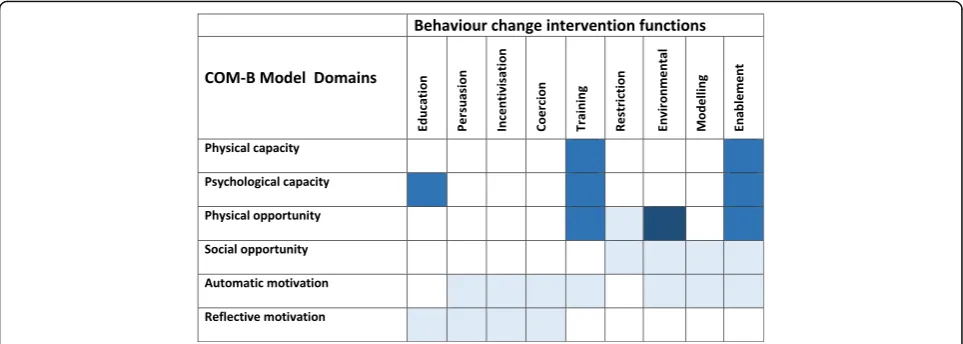
The barriers most often expressed by participants were related to the environmental context, resources and training needs. We thus used the BCW approach to map the most relevant intervention functions to address these specific barriers, as shown in Fig. 1
[18]. In this matrix we provide specific suggestions for possible interventions to increase use of South Af-rican primary care CPGs.
Therefore, from our findings, ‘physical and psycho-logical capacity’, in particular poorly supported training was a barrier to CPG use; and most strikingly, the‘ phys-ical opportunity’, in that the environmental context and available resources were substantial challenges to CPG use. Based on our results, the following intervention functions are suggested that align the COM-B domain, behavioural barriers and possible interventions:
– Training - imparting skills (for example workshops, on site mentoring and supervision, post-training support)
– Education–increasing knowledge or understanding about specific CPG recommendations (e.g.
workshops, post workshop support and clinical support)
– Environmental restructuring–changing the physical environment (e.g. making the CPGs more accessible through different formats, greater design
ensuring supply chain functioning and access to medicines and equipment; building ICT infrastructure and creating digital access)
– Enablement–increasing means and reducing barriers to increase capability or opportunity (for example, this may include audit and feedback, clinical support and team building).
Discussion
This study explored the perspectives of primary care healthcare providers, working in public sector clinics, re-garding the context, potential barriers to and enablers of CPG use in four diverse provinces in South Africa. We investigated these issues through the lens of the TDF, in order to categorise the barriers and enablers in terms of COM-B: Capability, Opportunity, and Motivation.
Enablers–motivation, knowledge and social opportunity. Our findings revealed that primary healthcare nurses and allied health practitioners generally trust the cred-ibility of CPGs and are highly motivated to use them. CPG usage was perceived to be associated with a range of positive emotional and professional consequences, ex-periences that have been described elsewhere as poten-tial benefits of CPGs [3]. In addition, knowledge of CPGs, along with regular use, were reported by most healthcare providers, a finding of importance, given that both knowledge about and positive attitude towards a CPG are factors that have been identified as potentially enhancing CPG implementation [36].
Participants in our study, particularly nursing staff, emphasised the importance of cohesive teams, clinical supervision and strong leadership to enable CPG use.
This corroborates reports from higher income settings, which describe the importance of socio-behavioural fac-tors, such as peer support, to enhance CPG use [36–38]. Studies in South Africa have revealed that support and supervision for healthcare providers are currently inad-equate. For example, a qualitative study in which allied health practitioners and health managers were inter-viewed, found a lack of support for allied health practi-tioners in their practice [39, 40]. Similarly, a recent survey among primary healthcare nurses suggests that many felt unsupported by supervisors to provide best quality clinical care [37, 41]. Against this backdrop, and in light of the findings from our study, enhancing CPG use in South Africa necessitates developing cohesive professional teams and building clinical support for practitioners.
Barriers–Physical capability (skills and training)
Despite apparent knowledge of CPGs and motivation to use them, patchy and non-inclusive training in CPGs emerged as an important barrier to their usage. Lack of requisite skills and self-efficacy are reported barriers to CPG implementation [36]. The participants in our study considered skills building in CPGs essential for enhan-cing proficiency to use CPGs properly, ensuring similar levels of capability and knowledge amongst healthcare providers, and for facilitating standardised use across disciplines.
However, exactly how this training should be delivered emerged as a complex issue, with participants suggesting advantages and disadvantages of both on- or off-site train-ing. Our participants talked about off-site educational meetings, on-site educational outreach and supportive
[image:8.595.57.539.88.260.2]clinical audits as desirable. In an overview of systematic reviews, several skills building strategies for implementing health systems in low- and middle-income settings were reported with varying levels of effectiveness, including practice facilitation, educational outreach, audit and feed-back, educational meetings, and local opinion leaders [14]. In South Africa, there have been several trials of educa-tional outreach for nurse-driven primary care evaluating CPG implementation [15,17]. As such, we have support-ing evidence regardsupport-ing feasibility of this approach for managing co-morbidity, and in some studies, evidence of effectiveness for tuberculosis and HIV CPG implementa-tion [15,17,42,43]. Thus, while this study revealed a clear stated need for increased skills building, the best means of providing this in South African primary care might con-sider using a combination of methods to enable CPG up-take and use.
Barriers - physical opportunity (environmental context and resources)
While other COM-B constructs emerged as enablers of CPG usage, ‘physical opportunity’ materialised as the most substantial barrier, with participants highlighting numerous contextual issues that hinder effective CPG use. These may be further understood as pertaining to two aspects, the CPG itself or the environmental context in which CPGs are implemented.
Regarding the CPG itself, participants perceived that usage of CPGs is hindered significantly when their content is impractical to implement and linguistically inappropri-ate; when CPG design features are not user-friendly; and if there are inadequate CPG supplementary tools (e.g. pic-tures) or no summarised versions. This resonates with a review of different features for ensuring CPG‘ implement-ability’, together with a supporting checklist for CPG de-velopers to consider [44]. These resources suggest that specific features of CPGs are likely to enhance their usage, including structured recommendations; providing con-textual information regarding clinical cases; explicit re-source implications; and supporting algorithms and clinical tools [44,45].
In terms of the physical environment, several factors were identified as critical obstacles to CPG implementa-tion. In particular, a lack of necessary equipment and re-ported budgetary and supply constraints, including stock outs of medicines, were a concern and perceived to be related to poor district or provincial management sys-tems. These health system challenges are well described in the country, including a recent qualitative study in which access to equipment or medicines posed serious challenges to delivery of health services for both users and providers of care [6,9, 26,46,47]. In our study, in-adequate systems for distribution of printed CPGs and
CPG-related circulars, as well as poor CPG version and quality control, appeared to impact upon CPG use. Taken together, this collection of environmental issues was seen by participants to result in CPGs that are fre-quently unavailable, inaccessible, of a suboptimal quality and/or difficult to implement. While these barriers emerged across the different study settings, they ap-peared to be particularly pertinent and heightened in rural areas.
Aspirational enabler - digital access to CPGs
Participants consistently suggested that making digitally-formatted CPGs and associated technologies (e.g. inter-net, computers, laptops) available was a key strategy to increase CPG access and use. Digital CPGs were sug-gested to redress many of the contextual challenges they currently face, such as lack of sufficient CPG hard copies or poor version control. There is growing evidence regarding the role of handheld devices to support CPG use. A systematic review reported that doctors and nurses using a CPG on a handheld device may increase access to information, adherence to a CPG and support for diagnosing conditions, in comparison to peers using paper-based resources [48]. However, despite this promising evidence, results emanate predominantly from high-income settings where access and availability of technologies are different to those in low- and middle-income settings. Therefore, despite interest in this area and fast-growing opportunities in technology, current data costs, lack of infrastructure, internet or devices, particularly in rural settings, present major challenges to this becoming a reality, as revealed in our study.
Implications for policy and practice: Strategic theory informed interventions to overcome barriers
Given the limited resources to invest in CPG implemen-tation in many settings, ensuring that the interventions best match the issues and barriers that emerge is a ra-tional approach. We identified that investment for implementing primary care CPGs should consider envir-onmental restructuring, enablement, and training and education (Fig.1).
and mentoring or team building, may be effective methods to build on the current foundation [17]. Finally, the most substantial barrier, environmental resources, requires considerable resources and planning regarding how best and most cost effectively to restructure the en-vironment to enhance CPG use. Some approaches, such as making more CPG books available or changing the physical appearance of the paper resources enhanced with design features, may be more feasible to achieve short to medium term; however addressing health sys-tem reforms including equipment supplies and infra-structure upgrades are important to have on a government agenda for urgent consideration.
Choosing and implementing these interventions will require government buy-in, priority setting and feasibil-ity assessment. Where possible, interventions already in place could be enhanced while others may need to be initiated. The COM-B model is further complemented by a set of specific criteria that can aid decisions when considering interventions. These criteria include: afford-ability, practicality, effectiveness and cost effectiveness, acceptability, side effects, safety and equity [24]. The relative effectiveness of the priority options should be in-formed by available systematic reviews [14].
Limitations
Our study has several limitations. Given the volume of CPGs and CPG users at play in South Africa, we set out with a very broad topic - exploring perceptions of all pri-mary care CPG users for all available pripri-mary care CPGs. It is likely we would have identified more specific responses had we evaluated a specific CPG and a specific CPG user. However, given the paucity of published work in our set-ting, we considered this research exploratory, and the best approach to understanding the state of CPG use in primary care, guiding us to further define the research and policy needs for CPG implementation. A SAGE linked sub-study explored perspectives of allied health workers, adding to our more specific knowledge [39,40].
Our sample is a fair reflection of the South African public sector primary care, which is predominantly man-aged by nurses [37]. We have sufficient data on nurse and allied health providers perspectives, however, further work with other cadres is required [40]. The two doctors we spoke to stated that doctors generally do not use CPGs, suggesting that this cadre of professionals may hold differing views to nurses and allied health pro-viders. However, given the small number of doctors par-ticipating in our study, it is unclear whether this perspective is widely held by primary care doctors and further exploration is therefore required.
A possible limitation may be the positionality of the researchers in eliciting certain responses [31]. It may be that the presence of researchers asking about CPGs
resulted in more positive responses about CPG use, and thus positive reporting bias. However, to pre-empt this possibility, each interview was facilitated by a social sci-entist, along with a healthcare provider (who understood the clinic context), which we hope brought balance to our interviewing, rather than prompting for specific re-sponses. Given the consistent narratives, regardless of setting, we hope that most participants felt free to pro-vide their true experience and perspective.
We reflected on our choice to use the COM-B and TDF approach, where, following inductive coding, we mapped the codes and themes to the domains of the TDF [18, 23]. We found it assisted us to make sense of the data that emerged, a manner relevant for under-standing this aspect of health services research. How-ever, following open coding, the deductive mapping process was challenging. Several of the constructs were related to each other, and could be categorised under more than one domain, for example, professional iden-tity forms a part of social opportunity, and therefore af-fects motivation. In addition, judgments were required regarding how and where to categorise our findings to best report our understanding of the views of partici-pants. During the process, where items were unclear, we discussed this to resolve discrepancies. In this way, we were able to ensure consistent application of the TDF to our data.
Conclusions
We found that South African primary care nurses and al-lied health practitioners are aware of CPGs and have high levels of motivation to use them, however, they face many systemic barriers to doing so. Strategies addressing the most pertinent identified barriers, including physical access to CPGs, training to use them and the equipment and re-sources to implement CPGs, should build on and enhance processes already in place in South Africa. Prioritising po-tential interventions, including effective training, clinical audit and feedback, and equipment supply, may strengthen primary care and improve CPG implementation ultimately impacting on the health of South Africans.
Additional files
Additional file 1:Training: Advantages and disadvantages of training delivered in-facility or off-site. This file reports on perceptions and sugges-tions of primary care healthcare providers to meet guideline training needs. (DOCX 14 kb)
Additional file 2:Design features for improving use of CPGs. This file reports features that were suggested by participants to improve implementability and use of the available clinical practice guidelines. (DOCX 12 kb)
Abbreviations
group discussion; HIV: Human immunodeficiency virus; KZN: Kwa-Zulu Natal; LPP: Limpopo; PHC: Primary Healthcare; TDF: Theoretical Domains Framework; WC: Western Cape
Acknowledgements
We would like to thank all those who participated in the research, giving us time from their clinical duties and helping us to understand the clinical guideline implementation landscape in South Africa. Many thanks also to several Cochrane South Africa staff and researchers who assisted with the project including, Michelle Galloway, Joy Oliver, Tebogo Mokganyetji. In addition, Tebogo helped with translation of some of the sections of transcripts in which local languages were spoken.
Funding
This research is supported through a grant from the Flagships Awards Project by the South African Medical Research Council (SAMRC-RFA-IFSP-01-2013/ SAGE).
Availability of data and materials
The datasets generated and/or analysed during the current study are not publicly available as this may be linked to specific clinic staff that were interviewed and as such is not available open use data.
Should anyone wish to have access or is interested in further exploration of the data, you may contact the author: [email protected].
Authors’contributions
TK drafted the protocol, with input from AA and JV. TK, JV, SA, SC, JM were involved with data collection and/ or early workshopping of findings. TK drafted the manuscript, with input from all authors. All authors approved the final version of the manuscript.
Ethics approval and consent to participate
The study was approved by the Research Ethics Committees of the South African Medical Research Council (EC002–2/2014) and Stellenbosch University (N14/02/008). The informed-consent form was sent to the facilities prior to the FGDs and was also explained and confirmed at the start of the FGDs. All participants provided individual written informed consent. Partici-pants were advised that information shared in FGDs has the potential to be more widely shared, and therefore we encouraged participants to respect privacy and confidentiality. The names of FGDs have been captured and has restricted access, and any identifying information were redacted from all transcripts.
Consent for publication Not applicable.
Competing interests
TK has contributed evidence to the National Department of Health Essential Drugs List Adult level standard treatment guideline (non-funded); and facilitated workshops and capacity development for under and post-graduate students, researchers, policymakers and practitioners on clinical practice guidelines and evidence-informed practices. JV has been involved in guideline development globally and regionally, he has been on advisory committees for clinical guidelines in the Western province, and has facilitated workshops and capacity development for under and postgraduate students, researchers and practitioners on clinical practice guidelines and evidence-informed practices. SC, SA, AA, and JM have no competing interests to declare.
No financial competing interests to declare for any contributors to this research.
Publisher’s Note
Springer Nature remains neutral with regard to jurisdictional claims in published maps and institutional affiliations.
Author details
1Cochrane South Africa, South African Medical Research Council, Cape Town,
South Africa.2Division of Clinical Pharmacology, Faculty of Medicine and Health Sciences, Stellenbosch University, Cape Town, South Africa.3Division of Social & Behavioural Sciences, School of Public Health and Family Medicine, University of Cape Town, Cape Town, South Africa.4Dean’s office
and Centre for Evidence Based Health Care, Faculty of Medicine and Health Sciences, Stellenbosch University, Cape Town, South Africa.5Department of Public Health Sciences, Karolinska Institutet, Tomtebodavägen 18A, 17177 Stockholm, Sweden.6New Social Research and Faculty of Social Sciences, University of Tampere, PO Box 100, Tampere, Finland.
Received: 21 September 2018 Accepted: 28 November 2018
References
1. Institute of Medicine. Clinical Practice Guidelines We Can Trust. In: Graham R, Mancher M, Wolman DM, Greenfield S, Steinberg E, (eds). Washington, DC: The National Academies Press; 2011. 290 p.
2. World Health Organization. WHO Handbook for guideline development2008 January 2011; (August 2010). Available from:http://apps.who.int/
medicinedocs/documents/s22083en/s22083en.pdf.
3. Woolf SH, Grol R, Hutchinson A, Eccles M, Grimshaw J. Clinical guidelines: potential benefits, limitations, and harms of clinical guidelines. BMJ. 1999; 318(7182):527–30.
4. Turner T, Misso M, Harris C, Green S. Development of evidence-based clinical practice guidelines (CPGs): comparing approaches. Implement Sci. 2008;3:45.
5. Kredo T, Bernhardsson S, Machingaidze S, Young T, Louw Q, Ochodo E, et al. Guide to clinical practice guidelines: the current state of play. Int J Qual Health Care. 2016;28(1):122-8.
6. Kredo T, Abrams A, Young T, Louw Q, Volmink J, Daniels K. Primary care clinical practice guidelines in South Africa: qualitative study exploring perspectives of national stakeholders. BMC Health Serv Res. 2017;17(1):608. 7. Wilkinson M, Wilkinson T, Kredo T, MacQuilkan K, Mudara C, Winch A, et al. South African clinical practice guidelines: a landscape analysis. S Afr Med J. 2017;108(1):23–7.
8. Rispel L. Analysing the progress and fault lines of health sector transformation in South Africa. In: South African health review 2016+ [internet]. Durban: health systems trust; 2016. Available from:http://www. hst.org.za/publications/Pages/South-African-Health-Review-2016.aspx. 9. Coovadia H, Jewkes R, Barron P, Sanders D, McIntyre D. The health and
health system of South Africa: historical roots of current public health challenges. Lancet. 2009;374(9692):817–34.
10. French SD, Green SE, O'Connor DA, McKenzie JE, Francis JJ, Michie S, et al. Developing theory-informed behaviour change interventions to implement evidence into practice: a systematic approach using the theoretical domains framework. Implement Sci. 2012;7:38.
11. Alexander KE, Brijnath B, Mazza D. Barriers and enablers to delivery of the healthy kids check: an analysis informed by the theoretical domains framework and COM-B model. Implement Sci. 2014;9:60. 12. Grol R, Grimshaw J. From best evidence to best practice: effective
implementation of change in patients' care. Lancet. 2003;362(9391):1225–30. 13. Grimshaw J, Thomas R, MacLennan G, Fraser C, Ramsay C. Effectiveness and efficiency of guideline dissemination and implementation strategies. Health Technol Assess. 2004;8(6):84.
14. Pantoja T, Opiyo N, Lewin S, Paulsen E, Ciapponi A, Wiysonge CS, Herrera CA, Rada G, Peñaloza B, Dudley L, Gagnon MP, Garcia Marti S, Oxman AD. Implementation strategies for health systems in low-income countries: an overview of systematic reviews. Cochrane Database Syst Rev 2017, Issue 9. Art. No.: CD011086. DOI:https://doi.org/10.1002/14651858.CD011086.pub2. 15. Fairall LR, Zwarenstein M, Bateman ED, Bachmann M, Lombard C, Majara BP,
et al. Effect of educational outreach to nurses on tuberculosis case detection and primary care of respiratory illness: pragmatic cluster randomised controlled trial. BMJ. 2005;331(7519):750–4.
16. Uebel KE, Fairall LR, van Rensburg DH, Mollentze WF, Bachmann MO, Lewin S, et al. Task shifting and integration of HIV care into primary care in South Africa: the development and content of the streamlining tasks and roles to expand treatment and care for HIV (STRETCH) intervention. Implement Sci. 2011;6:86.
17. Zwarenstein M, Fairall LR, Lombard C, Mayers P, Bheekie A, English RG, et al. Outreach education for integration of HIV/AIDS care, antiretroviral treatment, and tuberculosis care in primary care clinics in South Africa: PALSA PLUS pragmatic cluster randomised trial. BMJ. 2011;342:d2022. 18. Michie S, van Stralen MM, West R. The behaviour change wheel: a new
19. Michie S, Johnston M, Abraham C, Lawton R, Parker D, Walker A. Making psychological theory useful for implementing evidence based practice: a consensus approach. Qual Saf Health Care. 2005;14(1):26–33.
20. French SD, McKenzie JE, O'Connor DA, Grimshaw JM, Mortimer D, Francis JJ, et al. Evaluation of a theory-informed implementation intervention for the management of acute low back pain in general medical practice: the IMPLEMENT cluster randomised trial. PLoS One. 2013;8(6):e65471. 21. Mazza D, Chapman A, Michie S. Barriers to the implementation of
preconception care guidelines as perceived by general practitioners: a qualitative study. BMC Health Serv Res. 2013;13:36.
22. Boscart VM, Fernie GR, Lee JH, Jaglal SB. Using psychological theory to inform methods to optimize the implementation of a hand hygiene intervention. Implement Sci. 2012;7:77.
23. Cane J, O'Connor D, Michie S. Validation of the theoretical domains framework for use in behaviour change and implementation research. Implement Sci. 2012;7:37.
24. Michie S, Atkins L, West R. The Behaviour Change Wheel: a guide to designing interventions. Great Britain: Silverback Publishing; 2014. 25. Statistics South Africa Mid-year population estimates Pretoria, South Africa,
http://www.statssa.gov.za/31 July 2017. Contract No.: P0302.
26. Mayosi BM, Lawn JE, van Niekerk A, Bradshaw D, Abdool Karim SS, Coovadia HM. Health in South Africa: changes and challenges since 2009. Lancet. 2012;380(9858):2029–43.
27. Day C, Gray A. Health and related indicators. In: ABP P, editor. South African Health Review Durban, South Africa: Health Systems Trust; 2017. p. 217–340. 28. Department of Health SA. White Paper for the Transformation of the
Health System in South Africa #17910. In: Department of Health, editor. Pretoria; 1997.
29. Matsoso MP, Fryatt R. National Health Insurance: the first 16 months. S Afr Med J. 2013;103(3):156–8.
30. Department of Health SA. National Health Insurance for South Africa -towards universal health coverage (White Paper). In: Department of Health, editor. Pretoria: Government; 2015.
31. Green J, Thorogood N. Qualitative methods for Health Research. Third ed. Silverman D. London: SAGE; 2004.
32. Kitzinger J. The methodology of focus groups: the importance of interaction between research participants. Soc Health. 1994;16(1):103–21.
33. Graneheim UH, Lundman B. Qualitative content analysis in nursing research: concepts, procedures and measures to achieve trustworthiness. Nurse Educ Today. 2003;24(2):105–12.
34. Saldana J. The coding manual for qualitative researchers. Los Angeles, CA: SAGE; 2009.
35. Malterud K. Qualitative research: standards, challenges, and guidelines. Lancet. 358(9280):483–8.
36. Francke AL, Smit MC, de Veer AJ, Mistiaen P. Factors influencing the implementation of clinical guidelines for health care professionals: a systematic meta-review. BMC Med Inform Decis Mak. 2008;8:38. 37. Munyewende PO, Rispel LC, Chirwa T. Positive practice environments
influence job satisfaction of primary health care clinic nursing managers in two south African provinces. Hum Resour Health. 2014;12:27.
38. Cabana MD, Rand CS, Powe NR, et al. Why don't physicians follow clinical practice guidelines? A framework for improvement. JAMA. 1999; 282(15):1458–65.
39. Dizon JM, Grimmer K, Louw Q, Machingaidze S, Parker H, Pillen H. Barriers and enablers for the development and implementation of allied health clinical practice guidelines in south African primary healthcare settings: a qualitative study. Health Research Policy and Systems. 2017;15(1):79. 40. Dizon JM, Grimmer KA, Machingaidze S, Louw QA, Parker H. South African
primary health care allied health clinical practice guidelines: the big picture. BMC Health Serv Res. 2018;18(1):48.
41. Munyewende PO, Rispel LC. Using diaries to explore the work experiences of primary health care nursing managers in two south African provinces. Glob Health Action. 2014;7:25323.
42. Fairall L, Bachmann MO, Lombard C, Timmerman V, Uebel K, Zwarenstein M, et al. Task shifting of antiretroviral treatment from doctors to primary-care nurses in South Africa (STRETCH): a pragmatic, parallel, cluster-randomised trial. Lancet. 2012;380(9845):889–98.
43. Fairall LR, Folb N, Timmerman V, Lombard C, Steyn K, Bachmann MO, et al. Educational outreach with an integrated clinical tool for nurse-led non-communicable chronic disease Management in Primary Care in South
Africa: a pragmatic cluster randomised controlled trial. PLoS Med. 2016; 13(11):e1002178.
44. Gagliardi AR, Brouwers MC, Palda VA, Lemieux-Charles L, Grimshaw JM. How can we improve guideline use? A conceptual framework of
implementability. Implement Sci. 2011;6:26.
45. Kastner M, Makarski J, Hayden L, Durocher L, Chatterjee A, Brouwers M, et al. Making sense of complex data: a mapping process for analyzing findings of a realist review on guideline implementability. BMC Med Res Methodol. 2013;13:112.
46. Ameh S, Klipstein-Grobusch K, D’ambruoso L, Kahn K, Tollman SM, Gómez-Olivé FX. Quality of integrated chronic disease care in rural South Africa: user and provider perspectives. Health Policy Plan. 2016;32(2):257–66. 47. Department of Health. Ideal Clinic South Africa [Available from:
https://www.idealclinic.org.za.