ADVERTIMENT. La consulta d’aquesta tesi queda condicionada a l’acceptació de les següents condicions d'ús: La difusió d’aquesta tesi per mitjà del servei TDX (www.tesisenxarxa.net) ha estat autoritzada pels titulars dels drets de propietat intel·lectual únicament per a usos privats emmarcats en activitats d’investigació i docència. No s’autoritza la seva reproducció amb finalitats de lucre ni la seva difusió i posada a disposició des d’un lloc aliè al servei TDX. No s’autoritza la presentació del seu contingut en una finestra o marc aliè a TDX (framing). Aquesta reserva de drets afecta tant al resum de presentació de la tesi com als seus continguts. En la utilització o cita de parts de la tesi és obligat indicar el nom de la persona autora.
ADVERTENCIA. La consulta de esta tesis queda condicionada a la aceptación de las siguientes condiciones de uso: La difusión de esta tesis por medio del servicio TDR (www.tesisenred.net) ha sido autorizada por los titulares de los derechos de propiedad intelectual únicamente para usos privados enmarcados en actividades de investigación y docencia. No se autoriza su reproducción con finalidades de lucro ni su difusión y puesta a disposición desde un sitio ajeno al servicio TDR. No se autoriza la presentación de su contenido en una ventana o marco ajeno a TDR (framing). Esta reserva de derechos afecta tanto al resumen de presentación de la tesis como a sus contenidos. En la utilización o cita de partes de la tesis es obligado indicar el nombre de la persona autora.
WARNING. On having consulted this thesis you’re accepting the following use conditions: Spreading this thesis by the TDX (www.tesisenxarxa.net) service has been authorized by the titular of the intellectual property rights only for private uses placed in investigation and teaching activities. Reproduction with lucrative aims is not authorized neither its spreading and availability from a site foreign to the TDX service. Introducing its content in a window or frame foreign to the TDX service is not authorized (framing). This rights affect to the presentation summary of the thesis as well as to its contents. In the using or citation of parts of the thesis it’s obliged to indicate the name of the author
U N I V E R S ITAT
PO LIT È CN I CA
DE
CATA LUNYA
Ph.D. Thesis
Contribution to
Wireless Access Optimization
and Dynamic Enhancement
of WCDMA Networks
Author:
Mario Garc´ıa Lozano
Advisor: Dr. Silvia Ruiz Boqu´
e
Radio Communication Research Group
Department of Signal Theory and Communications
Universitat Polit`
ecnica de Catalunya
The deployment of 3rd and 3.5th Generation (3G/3.5G) cellular networks challenges traditional radio planning and optimization strategies. Unlike Frequency Division Multiple Access (FDMA) based 2nd Generation (2G) systems, coverage and ca-pacity are tightly coupled and must be treated as a whole. Besides new and more sophisticated Radio Resource Management (RRM) algorithms are present along with a more flexible conception of the network with many interdependent parame-ters, whose joint adjustment is not trivial. A new radio planning paradigm appears in which the network is optimized by means of complex algorithms both in a static and a dynamic way.
This Ph.D. thesis provides a contribution to the access network optimization of 3G/3.5G systems. Several issues to improve radio planning have been investigated and new methods, guidelines and strategies of analysis have been proposed with the final objective of enhancing the network performance. Dynamic mechanisms being in the blurred line between radio planning and RRM are also devised and studied. The first part of this dissertation deals with the configuration of Base Stations (BSs). The impact of pilot powers, downtilt of antennas and interactions thereof with soft handover (SHO) parameters are investigated. Effects beyond well-known facts are outlined and new planning guidelines are derived. Given the results, an Automatic Planning strategy is proposed to automate the configuration of these parameters and to find a combination such as traffic is effectively equalized among cells and a higher capacity is achieved. The technique is based on the Simulated Annealing metaheuristic and is able to improve the global performance of the net-work, represented by a cost function containing information on the load factor and subject to constraints on coverage, degradation of the Quality of Service (QoS) and Downlink (DL) power consumption. The importance of Uplink (UL) require-ments, usually missed by existent proposals, has been also included and analytically addressed.
Reconfiguring BSs is not the only means to modify cell shapes, in this sense the study is extended by introducing repeaters, which allow generating distributed coverage areas. This is the context of the second part of the thesis. New effects, not present in FDMA based 2G systems, imply that the radio planning process becomes more complex. Most existent works dealing with repeaters in Wideband
Code Division Multiple Access (WCDMA) networks ignore these effects or claim their irrelevance in that particular study-case. That is why the research work was focused in modeling them, quantifying their impact and deriving radio planning guidelines to enhance the final performance of the radio access network. The new expression for the feasibility condition has been analytically obtained showing a tradeoff between capacity and coverage. This has been analyzed both theoretically and by means of simulations. The adjustment of several parameters with a signif-icant impact is also discussed to derive practical rules of thumb. Variation on the coverage of the donor cell before and after installing repeaters is modeled as well. Subsequently, it is proposed a new methodology to analyze WCDMA networks with repeaters deployment, considering realistically path delays and the behavior of Rake receivers. This allows an enhanced analysis with respect to traditional approaches which, under certain circumstances, tend to provide erroneously optimistic metrics. The final part of the dissertation goes one step further in Automatic Planning and two dynamic mechanisms are proposed and validated so that the network can react and self tune in front of changes in traffic conditions. The first one, based on previous conclusions, aims at detecting if one of the links has capacity problems and if so, favors it to delay congestion control actions. Finally, High Speed Downlink Packet Access (HSDPA) technology is introduced and, after analyzing the resources to be shared with a previous release of the Universal Mobile Telecommunications System (UMTS), it is concluded that an automatic tuning system that dynamically manages the Orthogonal Variable Spreading Factor (OVSF) code tree is desired. A mechanism aiming at maximizing cell throughput while guaranteeing blocking and dropping criteria is proposed and validated.
El despliegue de las redes celulares 3G/3.5G plantea un reto a las estrategias de
planificaci´on y optimizaci´on radio tradicionales. A diferencia de los sistemas 2G
basados en FDMA, cobertura y capacidad est´an estrechamente ligadas y deben
ser tratadas conjuntamente. Adem´as, est´an presentes nuevos y m´as sofisticados
algoritmos de RRM as´ı como una concepci´on de la red m´as flexible, con m´ultiples
par´ametros cuyo ajuste conjunto no es trivial. Un nuevo paradigma de planificaci´on
radio aparece y la red se optimiza mediante complejos algoritmos ya sea est´atica o
din´amicamente.
Esta tesis doctoral supone una contribuci´on a la optimizaci´on de las redes de
acceso radio en sistemas 3G/3.5G. Varios aspectos susceptibles de mejorar la
plani-ficaci´on han sido investigados y nuevos m´etodos, directrices y estrategias de an´alisis
se proponen con el objetivo final de mejorar el rendimiento de las redes. Tambi´en se
han dise˜nado y estudiado mecanismos din´amicos que se encuentran en la frontera
difusa entre la planificaci´on y la RRM.
La primera parte de la tesis trata la configuraci´on de las estaciones base. El
impacto de las potencias piloto, inclinaci´on de antenas y sus interacciones con los
par´ametros de SHO son investigados. Se hace ´enfasis en los efectos que van m´as all´a
de los conocidos y se derivan nuevas gu´ıas de planificaci´on. A partir de los resultados,
se propone una estrategia para su Planificaci´on Autom´atica. El objetivo final es
encontrar una combinaci´on de configuraciones tal que el tr´afico sea ecualizado de
manera efectiva entre las celdas y conseguir una capacidad superior del sistema. La
t´ecnica se basa en la metaheur´ısticaSimulated Annealing y es capaz de mejorar el
rendimiento global de la red, representado por una funci´on de coste que contiene
informaci´on sobre el factor de carga y sujeta a condiciones de cobertura, degradaci´on
de la calidad de servicio y consumo de potencia en el DL. La importancia de los
requisitos que impone el UL, a menudo olvidados en propuestas anteriores, tambi´en
se ha incluido y estudiado anal´ıticamente.
La reconfiguraci´on de las bases no es el ´unico medio para modificar las ´areas de
cobertura de las celdas, en este sentido el estudio se ampl´ıa mediante la introducci´on
de repetidores, que permiten la generaci´on de celdas distribuidas. La planificaci´on
radio con repetidores es m´as compleja debido a la aparici´on de nuevos efectos que
no estaban presentes en las redes cl´asicas 2G basadas en FDMA. La mayor´ıa de
los trabajos que tratan con repetidores tienden a ignorarlos o afirman que no son v
relevantes en su caso de estudio. Por ello, la investigaci´on se centr´o en el modelado
y cuantificaci´on de su impacto as´ı como en derivar directrices de planificaci´on. Se
ha obtenido anal´ıticamente la nueva expresi´on que define la condici´on de viabilidad
as´ı como las regiones de admisi´on. Se concluye que existe un compromiso entre
capacidad y cobertura que ha sido analizado tanto te´oricamente como mediante
simulaci´on. Ciertos par´ametros que presentan un mayor impacto en este compromiso
han sido estudiados y se han derivado reglas pr´acticas para su ajuste. La variaci´on
de cobertura en la celda padre antes y despu´es de la instalaci´on de sus repetidores
tambi´en ha sido modelada. Posteriormente, se propone una nueva metodolog´ıa para
analizar las redes WCDMA con el despliegue de repetidores, teniendo en cuenta de
manera realista los retardos de propagaci´on y el comportamiento del receptor Rake.
Esto permite un an´alisis superior con respecto a los enfoques tradicionales que, en
determinadas circunstancias, tienden a ofrecer cifras err´oneamente optimistas.
La ´ultima parte de la tesis da un paso m´as en la Planificaci´on Autom´atica y se
proponen y validan dos mecanismos din´amicos que permiten a la red reaccionar y
auto-optimizarse frente a cambios en las condiciones del tr´afico. El primero, basado
en conclusiones de la primera parte, persigue detectar si uno de los enlaces presenta problemas de capacidad y, en caso afirmativo, favorecerlo para retrasar los
mecan-ismos de control de congesti´on. Por ´ultimo, se introduce la tecnolog´ıa HSDPA y,
despu´es de analizar los recursos que deben ser compartidos con las versiones
ante-riores de UMTS, se concluye que es deseable un sistema para la gesti´on din´amica
del ´arbol de c´odigos OVSF. Se propone y valida un mecanismo que maximiza el
throughput de las celdas, garantizando al mismo tiempo criterios de bloqueo y drop-ping.
El desplegament de les xarxes cel·lulars 3G/3.5G planteja un repte a les estrat`egies
de planificaci´o i optimitzaci´o r`adio tradicionals. A difer`encia dels sistemes 2G basats
en FDMA, cobertura i capacitat estan estretament lligades i han de ser tractades
conjuntament. A m´es, estan presents nous i m´es sofisticats algorismes de gesti´o de
recursos r`adio (RRM) aix´ı com una concepci´o de la xarxa m´es flexible, amb m´ultiples
par`ametres l’ajustament conjunt dels quals no ´es trivial. Un nou paradigma de
planificaci´o r`adio apareix i la xarxa s’optimitza mitjan¸cant complexos algorismes ja
sigui est`atica o din`amicament.
Aquesta tesi doctoral suposa una contribuci´o a l’optimitzaci´o de les xarxes
d’acc´es r`adio en sistemes 3G/3.5G. Diversos aspectes susceptibles de millorar la
planificaci´o han estat investigats i nous m`etodes, directrius i estrat`egies d’an`alisi es
proposen amb l’objectiu final de millorar el rendiment de les xarxes. Tamb´e s’han
dissenyat i estudiat mecanismes din`amics que es troben en la frontera difusa entre
la planificaci´o i la RRM.
La primera part de la tesi tracta la configuraci´o de les estacions base. L’impacte
de les pot`encies pilot, inclinaci´o d’antenes i les seves interaccions amb els par`ametres
de SHO s´on investigats. Es fa `emfasis en els efectes m´es enll`a dels ja coneguts i es
deriven regles per al seu ajust. A partir dels resultats, es proposa una estrat`egia
per a la seva Planificaci´o Autom`atica. L’objectiu final ´es trobar una combinaci´o de
configuracions tal que el tr`afic sigui equalitzat de manera efectiva entre les cel·les
i aconseguir una capacitat superior del sistema. La t`ecnica es basa en la
meta-heur´ıstica Simulated Annealing i ´es capa¸c de millorar el rendiment global de la
xarxa, representat per una funci´o de cost que cont´e informaci´o sobre el factor de
c`arrega, subjecta a altres condicions de cobertura, degradaci´o de la qualitat de servei
i consum de pot`encia en el DL. La import`ancia dels requisits que imposa el UL,
sovint oblidats en propostes existents, tamb´e s’ha incl`os i estudiat anal´ıticament.
La reconfiguraci´o de les bases no ´es l’´unic mecanisme per a modificar les `arees de
cobertura de les cel·les, en aquest sentit l’estudi s’amplia mitjan¸cant la introducci´o
de repetidors, que permeten la generaci´o de cel·les distribu¨ıdes. En aquest cas la
planificaci´o ´es m´es complexa a causa de l’aparici´o de nous efectes que no es donaven
en les xarxes cl`assiques 2G basades en FDMA. La majoria dels treballs que tracten
amb repetidors tendeixen a ignorar-los. Per aix`o, la investigaci´o es va centrar en el
modelatge i quantificaci´o del seu impacte aix´ı com a derivar directrius de
caci´o. S’ha obtingut anal´ıticament la nova expressi´o que defineix la regi´o d’admissi´o i es conclou que existeix un comprom´ıs entre capacitat i cobertura, analitzat tant
te`oricament com mitjan¸cant simulaci´o. Certs par`ametres presenten un impacte
sig-nificatiu, aquests han estat estudiats i s’han obtingut regles pr`actiques per al seu
ajust. La variaci´o de cobertura en la cel·la pare abans i despr´es de la instal·laci´o de
repetidors tamb´e ha estat modelada. Posteriorment, es proposa una nova
metodolo-gia per a analitzar aquests desplegaments, tenint en compte de manera realista els
retards de propagaci´o i el comportament del receptor Rake. Aix`o permet una an`alisi
superior pel que fa a enfocaments tradicionals que, en determinades circumst`ancies,
tendeixen a oferir xifres err`oniament optimistes.
L’´ultima part de la tesi d´ona un pas m´es en la Planificaci´o Autom`atica i es
proposen i validen dos mecanismes din`amics que permeten a la xarxa reaccionar i
auto-optimitzar-se enfront de canvis en les condicions de tr`afic. El primer, basat en
conclusions anteriors, persegueix detectar si un dels enlla¸cos presenta problemes de
capacitat i, en cas afirmatiu, afavorir-lo per a retardar els mecanismes de control de
congesti´o. Finalment, s’afegeix a l’estudi la tecnologia HSDPA i, despr´es d’analitzar
els recursos que han de ser compartits amb les versions anteriors de UMTS, es
conclou que ´es desitjable un sistema per a la gesti´o din`amica de l’arbre de codis
OVSF. Es proposa i valida un mecanisme que maximitza elthroughputde les cel·les,
Acronyms xiii
List of Tables xvii
List of Figures xix
1 Introduction 1
1.1 Background and Motivation . . . 1
1.2 Scope of the Thesis and Structure . . . 2
1.3 Research Contributions . . . 8
2 Strategies for Enhanced Radio Planning 11 2.1 Introduction. . . 11
2.2 Automatic Planning Strategies . . . 12
2.2.1 Introduction . . . 12
2.2.2 Use of Metaheuristics in Automatic Planning . . . 14
2.2.3 Parameters with an Important Impact on the Network Per-formance . . . 19
2.3 Dynamic Planning and Automatic Tuning . . . 25
2.3.1 Dynamic Planning. . . 27
2.3.2 Automatic Tuning of RRM Parameters . . . 29
3 Base Station Parameter Adjustment 33 3.1 Introduction. . . 33
3.2 Impact of CPICH Power Variations. . . 34
3.2.1 Introduction . . . 34
3.2.2 Quantitative Analysis . . . 36
3.2.3 Impact on System Capacity . . . 44
3.3 Impact of Downtilted Antennas . . . 47
3.3.1 Introduction . . . 47
3.3.2 Effects on Capacity Indicators . . . 49
3.3.3 Considerations on UEs Spatial Distribution . . . 55 ix
3.4 Concluding Remarks . . . 57
4 Automatic Planning Based on Simulated Annealing 61 4.1 Introduction. . . 61
4.2 Problem Statement . . . 62
4.2.1 Comments on Load Balancing. . . 62
4.2.2 Analysis of UL Requirements . . . 63
4.3 Solution Principle. . . 69
4.4 Resolution with Simulated Annealing. . . 70
4.4.1 Determining the Initial Temperature . . . 73
4.4.2 Generation of New Solutions . . . 73
4.4.3 Algorithm Convergence and Cooling Strategy . . . 74
4.5 Results. . . 76
4.5.1 Synthetic Scenario . . . 76
4.5.2 Realistic Scenario. . . 83
4.6 Concluding Remarks . . . 87
5 Effect of Repeaters on WCDMA Radio Network Performance 91 5.1 Introduction. . . 91
5.2 Classification and Definitions . . . 93
5.3 Repeaters in WCDMA Mobile Networks . . . 97
5.4 Feasibility Condition for the UL in a Multiservice Generic System with AC . . . 98
5.4.1 Access Network without Repeaters Deployment . . . 98
5.4.2 Access Network with Repeaters Deployment. . . 100
5.5 Capacity and Coverage Trade-off . . . 107
5.6 Induced Cell Breathing in Donor Cells . . . 112
5.7 Concluding Remarks . . . 117
6 Enhanced Analysis of WCDMA Networks with Repeaters Deploy-ment 119 6.1 Introduction. . . 119 6.2 System Model. . . 120 6.3 SINR Analysis . . . 122 6.3.1 Uplink . . . 122 6.3.2 Downlink . . . 126 6.4 Numerical Results . . . 130 6.5 Concluding Remarks . . . 137
7 Automated UL and DL Capacity Balancing 139 7.1 Introduction. . . 139
7.2 Functional Architecture . . . 140
7.4 Scenario and Simulation Conditions . . . 146
7.5 ATS Description and Results . . . 146
7.5.1 Learning & Memory Stage. . . 146
7.5.2 Monitoring Stage . . . 149
7.5.3 Control Stage . . . 152
7.6 Concluding Remarks . . . 158
8 Performance Improvement of 3G/3.5G Networks through Dynamic Code Tuning 161 8.1 Introduction. . . 161
8.2 HSDPA Overview and Challenges. . . 162
8.3 Scenario and Simulation Conditions . . . 164
8.4 Planning and Deployment Aspects . . . 165
8.4.1 On the Automation of HSDPA Power Allocation . . . 167
8.4.2 On the Automation of HSDPA Code Allocation. . . 170
8.5 ATS Description and Results . . . 171
8.5.1 Learning & Memory Stage. . . 171
8.5.2 Monitoring Stage . . . 182
8.5.3 Control Stage . . . 183
8.6 Concluding Remarks . . . 190
9 Conclusions and Future Works 193 Appendices 205 A Preliminary Estimation of CPICH Powers 205 B Scenarios and Simulation Platform 209 B.1 Synthetic Scenario . . . 209
B.2 Realistic Scenario by Using 2G Measurements . . . 212
B.3 Simulation Platform . . . 214
C Considerations on Scheduling Strategies in HSDPA 219
1G First Generation
1xRTT One Time Radio Transmission Technology
2G Second Generation
3G Third Generation
3GPP Third Generation Partnership Project
AC Admission Control
AGC Automatic Gain Control
AP Access Point
ARQ Automatic Repeat Request
AS Active Set
ATS Automatic Tuning System
B3G Beyond Third Generation
BER Bit Error Rate
BLER BLock Error Rate
BS Base Station
CAPEX CAPital EXpenditure
cdf Cumulative Distribution Function
CDMA Code Division Multiple Access
CIO Cell Individual Offset
CIR Carrier-to-Interference-Ratio
CINR Carrier-to-Interference-plus-Noise-Ratio
CPICH Common PIlot CHannel
CQI Channel Quality Indicator
CS Circuit Switched
DCH Dedicated CHannel
DL DownLink
DPCH Dedicated Physical CHannel
DSCH Downlink Shared CHannel
EDGE Enhanced Data Rates for GSM Evolution
EV-DO Rev B Evolution-Data Optimized Revision B
FACH Forward Access CHannel
FDD Frequency Division Duplex
FDMA Frequency Division Multiple Access
GA Genetic Algorithm
GERAN GSM EDGE Radio Access Network
GPS Global Positioning System
GSM Global System for Mobile Communications
H-ARQ Hybrid Automatic Repeat Request
HSDPA High Speed Downlink Packet Access
HS-DPCCH High Speed Dedicated Physical Control CHannel
HSPA High Speed Packet Access
HS-PDSCH High Speed Physical Downlink Shared CHannel
HS-SCCH High Speed Shared Control CHannel
HSUPA High Speed Uplink Packet Access
IF Intermediate Frequency
IMS IP Multimedia Subsystems
KPI Key Performance Indicator
LOS Line Of Sight
LS Local Search
LTE Long Term Evolution
LUT Look-Up-Table
MAC Medium Access Control
OFDMA Orthogonal Frequency Division Multiple Access
OPEX OPerational EXpenditure
OVSF Orthogonal Variable Spreading Factor
P-CPICH Primary Common Pilot Channel
pdf Probability Density Function
PF Proportional Fair
QAM Quadrature Amplitude Modulation
QPSK Quadrature Phase Shift Keying
RAB Radio Access Bearer
RACH Random Access CHannel
RF Radio Frequency
RNC Radio Network Controller
RoF Radio Over Fiber
RR Round Robin
RRM Radio Resource Management
RSCP Received Signal Code Power
RSSI Received Signal Strength Indicator
SC-FDMA Single Carrier Frequency Division Multiple Access
SCCPCH Secondary Common Control Physical CHannel
SCM SubCarrier Multiplexing
SF Spreading Factor
SHO Soft HandOver
SIR Signal-to-Interference-Ratio
SINR Signal-to-Interference-plus-Noise-Ratio
SSINR Signal-to-Signal-plus-Interference-plus-Noise-Ratio
TDD Time Division Duplex
TDMA Time Division Multiple Access
TF Transport Format
TS Tabu Search
UE User Equipment
UL UpLink
UMTS Universal Mobile Telecommunications System
UTRAN UMTS Terrestrial Radio Access Network
WCDMA Wideband Code Division Multiple Access
2.1 Timeline of most important metaheuristics. . . 15
2.2 Basic SA schema. . . 17
2.3 Basic TS schema. . . 18
2.4 Basic GA schema. . . 19
2.5 Comparison of pilot and tilt static optimization techniques. . . 24
3.1 Number of cells in the AS for different downtilt configurations. . . . 50
4.1 Simulated service mix in the synthetic case. . . 77
4.2 Final CPICH powers and downtilt angles. . . 82
4.3 Changes in SHO areas due to the optimization. . . 82
6.1 Evolution of correctly served users for traditional approaches and different internal delays at the repeater. . . 132
7.1 ATS gains for different service mixes. . . 158
8.1 LUT used by the implemented ATS. . . 185
B.1 Simulation parameters in the synthetic scenario. . . 210
B.2 Features of services. . . 212
B.3 First level probabilitiesP(Si) derived from measurements. . . 214
1.1 Dependence among chapters. . . 4
1.2 Radio network planning process and relationship with chapters. . . . 7
2.1 Comparison of behavior between LS and metaheuristics. . . 16
2.2 Comparison of theoretical and realistic layouts. . . 20
2.3 Open-loop optimization based onAutomatic Planning. . . 26
2.4 Closed-loop optimization. . . 27
3.1 Probability of being included in the AS for different CPICH powers. 37 3.2 Probability of being included in the AS for different CPICH powers and AS (2,2). . . 38
3.3 Number of UEs connected with the central cell for different CPICH powers. . . 39
3.4 Probability that AS contains more than 1 BS for different CPICH powers. . . 40
3.5 UL load factor for different CPICH values.. . . 41
3.6 DL load factor for different CPICH powers. . . 43
3.7 UL maximum capacity for different CPICH powers and AS configu-rations. . . 45
3.8 DL maximum capacity for different CPICH powers and AS configu-rations. . . 45
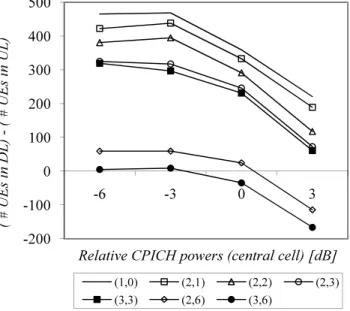
3.9 Difference in number of simultaneous UEs between DL and UL under maximum capacity conditions. . . 46
3.10 DL maximum capacity for asymmetrical service. . . 47
3.11 Coverage variation with a mechanically tilted antenna. . . 48
3.12 Coverage variation with an electrically tilted antenna. . . 48
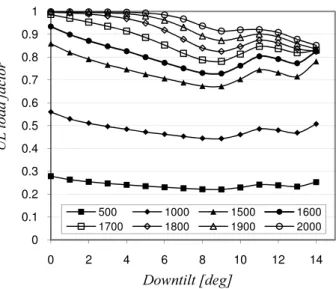
3.13 UL load factor for different number of UEs in the network and down-tilt angles. . . 50
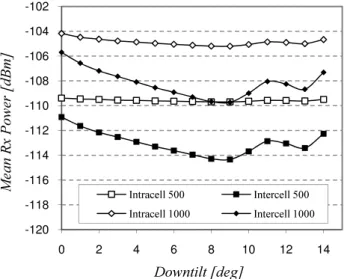
3.14 Intercell and intracell received power for different load conditions and downtilt angles. . . 51
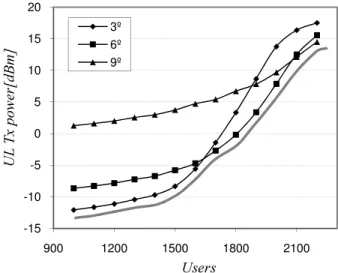
3.15 UL transmitted power for different load conditions, downtilt angles and SHO configurations. . . 52
3.16 Probability of having equal or more than 5% of UEs in degraded mode. 54
3.17 DL transmitted power for different load conditions, downtilt angles
and SHO configurations. . . 54
3.18 Optimal functioning by means of electrical and remotely controlled downtilting. . . 55
3.19 Histogram of UL transmitted power for different downtilt angles. . . 56
3.20 UL transmitted power as a function of the distance between UE and Node-B for different downtilt angles. . . 57
4.1 Quantification of UL load factor effects. . . 64
4.2 Relationship between transmission powers for a system with 2 UEs and 2 BSs.. . . 66
4.3 Maximum load factor that establishes BS 1 as the best option for UE kfor different distances to BS 1 and 2. . . 68
4.4 Minimum distance that establishes BS 1 as the best option for UEk for different load factors measured at BS 1 and 2. . . 69
4.5 Flow charts of SA. . . 72
4.6 Graphical representation of the cooling schema for different values of σn. . . 76
4.7 Density of users for the synthetic scenario. . . 77
4.8 Flow chart of optimization process. . . 78
4.9 UL load factor before and after optimization. . . 79
4.10 Cost evolution for different optimization options. . . 80
4.11 Effect of intelligent local downtilt optimization. . . 80
4.12 DL transmission power before and after optimization. . . 81
4.13 Probability that a cell appears in AS. . . 82
4.14 Gains obtained by SA in the realistic scenario. . . 84
4.15 Histogram of UL load factor for 4 random BSs in the system. . . 85
4.16 Pilot power proposal for realistic scenario. . . 86
4.17 Evolution of SA parameters. . . 87
5.1 Coverage reduction in the donor cell because of repeaters deployment. 93 5.2 On-frequency repeaters. . . 94
5.3 Deployment of remote sectors.. . . 95
5.4 Basic structure of fiber optic repeaters.. . . 96
5.5 Discrete representation of admission regions.. . . 100
5.6 Example of cascaded stages, each one with its own noise figure and gain. . . 101
5.7 Self-oscillations in on-frequency repeaters. . . 103
5.8 Correspondence of admission regions with and without repeaters. . . 106
5.9 ηmaxand equivalent loadsξas a function of the total received power at the donor BS. . . 107
5.11 Probability of CPICH coverage in target area. . . 109
5.12 Average UL transmission power as a function of the distance to the donor BS. . . 110
5.13 Probability of service availability. . . 111
5.14 Capacity degradation when guaranteeing coverage at target area, for different number of repeaters and values ofPRep,max.. . . 111
5.15 Coverage reduction of donor cell. . . 117
6.1 Different reception situations in an environment with repeaters. . . . 121
6.2 UL transmission power as a function of the distance to the donor BS, for traditional approaches and different internal delays at the repeater.131
6.3 DL transmission power of individual connections, comparing the 11µs case with the traditional full MRC approximation. . . 134
6.4 Probability of coverage for internal delay = 11 µs andρ= 0.4. . . . 135
6.5 Probability of coverage for internal delay = 11 µs andρ= 0.6. . . . 136
6.6 Admission region evolution for traditional approaches and different internal delays at the repeater. . . 137
7.1 On-line Automated Tuning System. Functional Architecture. . . 141
7.2 Number of cells included in the AS. . . 146
7.3 Maximum capacity for different configurations of SHO parameters (100% voice UEs.) . . . 147
7.4 Maximum capacity for different configurations of SHO parameters with heterogeneous users distribution. . . 148
7.5 Maximum capacity for different configurations of SHO parameters (80% voice, 20% data UEs.) . . . 149
7.6 Evolution of central cell DL transmission power and % of correctly served users. . . 150
7.7 Distribution of correctly served (grey) and degraded users (black) for three different moments of observation time. . . 151
7.8 Flow chart of the ATS. . . 152
7.9 Central cell DL transmission power for different ATS study cases. . . 154
7.10 Number of UEs with the central cell in its AS and aggregated KPI-B.155
7.11 ATS performance (heterogeneous scenario). . . 156
7.12 Evolution of % of UEs reaching theirEb/N0 target.. . . 157
8.1 HSDPA associated channels in a SHO situation.. . . 163
8.2 Cell throughput for different number of UEs served by HSDPA. . . . 166
8.3 Strategies for HSDPA power allocation. . . 167
8.4 Cell throughput for different % of the maximum power allocated to HSDPA. . . 168
8.5 pdf and cdf of power devoted to HSDPA with a dynamic allocation policy. . . 169
8.7 Throughput for different number of HS-PDSCH. . . 172
8.8 HSDPA power. Snapshot values and evolution of the mean. . . 173
8.9 Cell throughput for different number of HS-PDSCH and scheduling policy. . . 173
8.10 pdf of number of multiplexed UEs for different number of HS-PDSCH.175
8.11 UE throughput pdf and cdf for different geographical distribution. . 176
8.12 Cell throughput for different number of HS-PDSCH and UEs distri-bution. . . 177
8.13 Complete ATS proposal. . . 178
8.14 Blocking probability for Rel’99 and HSDPA users. . . 180
8.15 Evolution of degraded Rel’99 UEs (a) and AS size variation (b). . . 181
8.16 UEs geographical distribution for different moments of the observa-tion time. . . 183
8.17 Evolution of CQI normalized histogram along time.. . . 183
8.18 Averaged throughput for fixed code assignments and optimum com-mutation points. . . 184
8.19 Q1 and number of channelization codes to be assigned to HS-PDSCH.185
8.20 Central cell code allocations along time for different treatment ofQ1. 186
8.21 Final central cell code allocation. Concatenation of running average and time-to-trigger.. . . 187
8.22 ATS results. Comparison against fixed 8 codes allocation. . . 188
8.23 Throughput difference between ATS and fixed allocations. . . 189
B.1 Minimum attenuation level in synthetic layout. . . 210
B.2 Radiation pattern when downtilt is 0o. . . . 211
B.3 Procedure to scatter UEs around the network.. . . 214
Introduction
1.1
Background and Motivation
The demand for data services in wireless environments is currently growing faster than ever. In this sense, Universal Mobile Telecommunications System (UMTS) with High Speed Packet Access (HSPA) technology and its continuous evolution to Beyond Third Generation (B3G) is becoming the primary mobile-broadband solution. Together with the outstanding success of the Global System for Mobile Communications (GSM), both systems are establishing a worldwide dominance.
Several important factors are boosting the adoption of enhanced wireless data services. These include increased user awareness, phones becoming “smart” with enhanced data capabilities, computers with integrated Third Generation (3G) tech-nology and a continuously growing range of applications, including standard net-working applications and those designed for wireless systems, as it is analyzed in [Ris07]. All this covered by the main factor: improved network capability and cov-erage.
In this context of evolution and growth, it is essential that operators deploy spectrally efficient networks with superior performance to meet customer require-ments in terms of capacity, coverage and Quality of Service (QoS). Network planning becomes a key factor to achieve these objectives while minimizing capital and op-erational expenditures (CAPEX and OPEX). Especially because data applications are bound to demand significantly more network resources than traditional voice services.
Radio network planning has not remained constant along time and has evolved with the development of access technologies and the requirements set by those [LWN06]. First mobile communications systems (or generation zero) where charac-terized by high power Base Stations (BSs) located in elevated sites, with omnidi-rectional antennas and extensive coverage areas (50–70 km). These systems used analogical channels for both signalling and traffic. Their capacity was low and they
were mainly planned to provide coverage. With First Generation (1G) systems, the cellular concept was introduced based on frequency reuse policies which permitted a higher capacity. But it was with the evolution of Second Generation (2G) systems, that capacity became a first order issue. Cell radius were reduced, also did frequency reuse distances and trisectorial layouts were deployed to minimize interferences and increase capacity. Radio link budgets were also recalculated to reconsider the initial assumption about most users being vehicular. Propagation models did also evolve to better predict losses in microcellular environments and the theoretical hexagonal network layout was relegated to preliminary estimations and studies.
Not only assumptions on propagation conditions, type of transmitters, antennas, etc. had to be modified, radio planning also progressed towards a more sophisticated process in which simulations and mathematical models became crucial. For instance, as the GSM system evolved, site deployment became so dense that, even though frequency hoping was implemented, investigations on algorithms to solve the fre-quency allocation problem were necessary. In this context, metaheuristic techniques played an important role. With the deployment of UMTS, the situation has become more complex and simulation is now even more present. In Wideband Code Divi-sion Multiple Access (WCDMA) based systems, isolation among cells is paramount because of a frequency reuse factor of 1 and the resulting mutual interference among nearby cells. Furthermore, in GSM systems, coverage and capacity concepts could be treated in a relatively independent manner, but with the deployment of UMTS networks, the situation is more complicated. Coverage and capacity are tightly cou-pled and must be treated as a whole. The use of new and more sophisticated Radio Resource Management (RRM) algorithms along with a more flexible conception of the network imply that planning engineering has to deal with much more interde-pendent parameters, whose joint adjustment is not trivial. A new radio planning paradigm appears in which the network is optimized by means of complex algo-rithms both in a static and a dynamic way.
This Ph.D. dissertation provides a contribution to the radio network optimiza-tion of 3G/3.5G networks. Several issues to improve radio network planning have been investigated and new methods, guidelines and strategies of analysis have been proposed with the final objective of enhancing the wireless access network perfor-mance. Dynamic mechanisms being in the blurred line between radio planning and RRM are also investigated. The specific aspects that have been covered concerning this general objective are detailed in the following section.
1.2
Scope of the Thesis and Structure
The main objective of this Ph.D. dissertation is the design of new and advanced radio network planning techniques so that wireless access performance is optimized in the context of mature 3G/3.5G networks. New methods, guidelines and strategies of analysis have been proposed with the final objective of improving the radio access network performance. For this purpose, challenges an open issues were derived by studying existent literature. The methodology followed during the research has been
a combination of mathematical studies and simulations.
The document is organized in 9 chapters plus 3 appendixes. After this introduc-tion, 7 chapters comprise the core of the dissertation and are closed by the conclu-sions and a description of possible future lines of research. Chapters can be grouped in 3 parts, each one focusing in different though interrelated strategies to optimize the wireless access network of WCDMA based systems, mainly the UMTS Terres-trial Radio Access Network (UTRAN). Unless the contrary is explicitly stated, it is assumed the Frequency Division Duplex (FDD) mode.
The first part of the dissertation, comprised by chapters 2, 3 and 4, addresses
the problem of configuring BSs1, in particular those parameters with an important
impact on capacity and coverage footprint. Capacity maximization goes hand in hand with careful cell size dimensioning to equalize traffic correctly among cells
and anAutomatic Planning strategy based on metaheuristics is proposed to jointly
optimize the target cells. Reconfiguring BSs is not the only means to modify cell shapes, in this sense the study is extended by introducing repeaters, which allow generating distributed cells. This is the context of the second part of the thesis composed of chapters 5 and 6. A novel analytical study is conducted on the par-ticularities of WCDMA networks including repeaters and thus distributed load and coverage. From this study planning guidelines are derived and a new approach for the analysis of these systems is proposed, overcoming shortcomings of traditional
ones. The final part of the dissertation goes one step further inAutomatic Planning
and two dynamic mechanisms are investigated so that the network can react and self tune in front of changes in traffic conditions.
The reading of these different parts may not be sequential, but certain depen-dence among chapters should be respected for a full understanding. These possible
sequences of reading are gathered at Figure1.1.
A summary of each chapter and their main research contributions are indicated next. Publications derived from these results are listed in the following section.
Chapter 2 explains the challenges to optimize WCDMA networks through radio planning. Comparisons among previous contributions are done to detect challenges and potential improvements to be developed in parts 1 and 3. Because of its own
particularities, the state-of-the-art for part 2 is reviewed in Chapters5and6. Thus,
initially, Chapter 2 extendedly revises approaches dealing with the design of
Auto-matic Planningalgorithms and with a particular insight in the use of metaheuristics. Comments on key parameters are also given along with works dealing with their
optimization. Next, the chapter focuses onDynamic Planning strategies and Self
Tuningof RRM parameters. Again, a survey on the state-of-the-art is provided and open issues are detected.
Chapter 3 addresses the problem of adjusting two of the parameters with a more significant impact on the network performance. The power assigned to the primary 1Along the document, the UMTS nomenclature User Equipment (UE) has been used to denote
terminals. Regarding the Node-B, if sectorial layouts are used, it has not a univocal relation with cells. For that reason the denomination Base Station (BS) has been preferred to denote the transceivers that compose a single sector or cell.
Chapter 2. Strategies for Enhanced Radio Planning
Pa
rt
1
Chapter 3. Base Station
Parameter Adjustment WCDMA Radio Network PerformanceChapter 5. Effect of Repeaters on
Pa
rt
1
Chapter 4. Automatic
Planning Based on SA WCDMA Networks with Chapter 6. Enhanced Analysis of
Pa
rt
3 Chapter 7. Automated UL and DL
Capacity Balancing
Chapter 8. Performance Improvement of 3G/3.5G
Dynamic
Chapter 9. Conclusions and Future Work
Chapter 1. Introduction
Chapter 5. Effect of Repeaters on WCDMA Radio Network Performance Pa
rt
2
Chapter 6. Enhanced Analysis of WCDMA Networks with Repeaters
8. Performance Improvement of 3G/3.5G Networks through
Dynamic Code Tuning
Pa
rt
2
Common Pilot Channel (henceforth “CPICH” or “pilot channel”) and tilt of anten-nas. Their impact on the system performance and interactions with other planning and RRM parameters is investigated. Detailed results, beyond well known effects, have been obtained in different scenarios. These results allow deriving guidelines for
an enhanced radio planning and to design effectiveAutomatic Planning algorithms
considering these parameters.
Given the results, Chapter 4 proposes a novel Automatic Planning algorithm
based on the Simulated Annealing metaheuristic so that both CPICH and down-tilt angles are optimally adjusted and the network performance is improved. The problem optimizes all target cells jointly and not in a standard cell by cell manner. Uplink (UL) requirements are fully considered, since previous chapter showed that UEs transfer to alleviate the load of one cell is not always feasible. Results show the convergence of the algorithm towards better configurations. Traffic is correctly equalized among the cells and interference levels are reduced, eventually capacity is increased.
Repeaters are a cost effective option to extend coverage and achieve load bal-ancing by creating distributed cells. This is the context of Chapter 5, which aims at characterizing several particular effects when deploying these devices in WCDMA networks and that are usually missed by existent literature. In this sense, one of the novelties of the chapter is deriving the new analytic expression of the feasibility condition for the UL in a multiservice environment with a general heterogeneous layout. In particular, a compact closed expression for the admission region is pre-sented, suitable for a system where the users belong to an arbitrary number of different service classes. A tradeoff between capacity and coverage arises and it has been analyzed both theoretically and by means of simulations. Different parame-ters are shown to have a major impact and their adjustment is discussed to derive practical rules of thumb to operators. The chapter also generalizes the expression
that relates the coverage of thedonor cell before and after installing repeaters.
Simplifications when analyzing and optimizing radio access networks with re-peaters are explained in Chapter 6. In this framework, it is derived a novel methodol-ogy to evaluate up- and downlink (DL) so that transmission powers and other RRM parameters can be calculated without simplifications. In particular, the real differ-ent path delays, taking into account the repeaters presence and the finite nature of the time window of Rake receivers are considered. This allows an enhanced analysis with respect to traditional approaches from a system level viewpoint. Results show more reliable and accurate predictions on network performance. Not taking into ac-count these effects implies erroneously optimistic metrics. Indeed, some of the most relevant parameters in network performance evaluation are clearly affected.
Results from the first part, showed opposite effects in UL and DL under certain circumstances. In addition, because of variations in traffic patterns, the network may evolve from UL to DL limited situations and viceversa. However, many optimization strategies are focused in one single link, assuming that it is always the limiting one.
Given this, Chapter7 concentrates on the design of an Automatic Tuning System
certain reconfigurations. This implies a new extra margin that permits delaying congestion control mechanisms and a more balanced capacity between both links. In particular, because of the opposing behavior of Soft Handover (SHO) parameters, their dynamic modification is revealed as a feasible option to achieve this objective. Along the chapter, a three block based auto-tuning architecture is described to
adapt parameters to variations in the set of used services (subsequently calledservice
mix) and overcome capacity problems. These blocks have been designed and tested,
showing an effective adaptation to changes in traffic patterns. Significant capacity gains are obtained when the ATS is running. The approach is able to stabilize the network and avoid (or delay) congestion. Three different monitoring cases have been tested and validated the feasibility of the approach.
Finally, High Speed Downlink Packet Access (HSDPA) technology is introduced
in the study in Chapter 8. After analyzing the resources to be shared by both
technologies, the final objective is set to design an algorithm that maximizes the cell throughput while guaranteeing blocking and dropping criteria. In particular, it is proposed a mechanism to dynamically tune the number of codes to allocate for HSDPA when it coexists with UMTS. The optimum code reservation is depen-dent on traffic patterns and mobile geographical locations. Thus, the allocation is tightly coupled with the reported Channel Quality Indicators (CQIs). Results reveal that the proposal succeeds and an optimum number of codes is allocated for each technology. The cell throughput is increased while minimizing both blocking and dropping probabilities below specific thresholds.
All chapters are contextualized in the flowchart in Figure1.2, which summarizes
the standard radio planning process in UMTS networks (the reader is referred to [LWN06;NDA06;CBG+06] for basic theory on UMTS radio planning). Each bubble
Operators Goals •Capacity •Coverage •QoS •Cost Propagation Modeling Propagation Measurements DEM Type of Environment Clutter Dimensioning •Link Budget
•Capacity & coverage
balance
Detailed Planning
•Site location optimization
and HCS design
•BS parameter adjustment
•RRM parameter adjustment
•Capacity & coverage
enhancement strategies
•Rough number of cells
•Preliminary node-B
configuration
•Preliminary site set
selection
•Final site selection
•Node-B configuration •RRM parameters values •Other enhancements O&M •Statistical performance analysis •Drive testing Available site set Other networks co-planning considerations Traffic & Services
Modeling
Traffic & Services Distribution
Ongoing optimization
Long-term optimization & Automatic Planning Short and Mid-term optimization & Dynamic Planning Chapter 3 Chapters 2, 4 Chapters 5, 6 Chapters 7, 8 Chapters 7, 8
INPUTS RADIO ACCESS NETWORK DESIGN OUTPUTS
1.3
Research Contributions
The different novelties of this Ph.D. dissertation have been published in several research contributions, whose details are indicated for each chapter in the following. During the development of this Ph.D. thesis, several contributions to the European COST Actions 273 and 2100 were done and these are also indicated.
The total number of publications is 1 book section, 4 journal papers, 8 conference papers and 8 contributions to COST Actions.
Chapter 3
1 book section. 2 conference papers. 2 COST 273 contributions.
• [Ce06] L.M. Correia (ed.), Mobile Broadband Multimedia Networks.
Tech-niques Models and Tools for 4G, 1st ed. London, UK: Elsevier (Academic
Press), 2006. Section entitled:Base Station Parameter Configuration.
• [GLR04] M. Garc´ıa-Lozano, and S. Ruiz, “Effects of Downtilting on RRM
Parameters,” inProc. of IEEE International Symposium on Personal, Indoor
and Mobile Radio Communications (PIMRC 2004), Barcelona (Spain), Sep. 5–8, 2004.
• [GLRHO04] M. Garc´ıa-Lozano, S. Ruiz, R. Higuero, and J.J. Olmos “UMTS
Network Optimisation: Impact of Donwtilted Antennas,” COST 273, Athens (Greece), Tech. Rep. available as TD(04)033, Jan. 26–28, 2004.
• [GLRS+03] M. Garc´ıa-Lozano, S. Ruiz, O. Sallent, F. Adelantado, R. Agust´ı,
M.A. D´ıaz-Guerra, J. Montero, E. Gago, J.L. Miranda, and F. Castej´on “Analysing
UTRA-FDD Pilot Power and Active Set Configuration in a Real Urban
Sce-nario,” in Proc. of IEEE International Symposium on Personal, Indoor and
Mobile Radio Communications (PIMRC 2003), Beijing (China), Sep. 7–10, 2003.
• [RSA+03] S. Ruiz, O. Sallent, R. Agust´ı, M. Garc´ıa-Lozano, F. Adelantado,
M.A. D´ıaz-Guerra, J. Montero, E. Gago, J.L. Miranda “3G Planning by Using 2G Measurements,” COST 273, Barcelona (Spain), Tech. Rep. available as TD(03)073, Jan. 15–17, 2003.
The author participated in the MORANS (Mobile Radio Access Network
Ref-erence Scenarios) [VB03; VBC+04] initiative. This activity was framed within the
COST 273 Action and aimed at providing common system simulation environments so that research results and proposals from different researchers are comparable. In this context, several results derived from this chapter were also simulated and rechecked in the MORANS realistic scenario of Turin. These results can be found in 2 COST 273 contributions:
• [GLR05] M. Garc´ıa-Lozano, and S. Ruiz, “Effects of Donwtilt on the MORANS Real World Scenario of Turin,” COST 273, Lisbon (Portugal), Tech. Rep. available as TD(05)111, Sep. 10–11, 2005.
• [GLFR05] M. Garc´ıa-Lozano, P. Falavigna, and S. Ruiz, “Detailed UL/DL Analysis of MORANS Torino Scenario under Different Traffic Behaviour,” COST 273, Bologna (Italy), Tech. Rep. available as TD(05)022, Jan. 19–21, 2005.
Chapter 4
1 journal paper. 2 conference papers. 1 COST 273 contribution.
• [GLRO04a] M. Garc´ıa-Lozano, S. Ruiz, and J.J. Olmos, “Optimum Cell
Bal-ancing for UMTS Inhomogeneous Traffic Distribution,” in Proc. of
Interna-tional Symposium on Wireless Personal Multimedia Communications (WPMC 2004), Padova (Italy), Sep. 12–15, 2004.
• [GLRO04b] M. Garc´ıa-Lozano, S. Ruiz, and J.J. Olmos, “UMTS Optimum
Cell Load Balancing for Inhomogeneous Traffic Patterns,” in Proc. of IEEE
Vehicular Technology Conference Fall (VTC 2004 Fall), Los Angeles (USA), Sep. 26–29, 2004.
• [GLRO03b] M. Garc´ıa-Lozano, S. Ruiz, and J.J. Olmos, “CPICH Powers
Op-timization by means of Simulated Annealing in an UTRA-FDD environment,” IEE Electronic Letters, vol. 39, no. 23, pp. 1676–1677, Nov. 2003.
• [GLRO03a] M. Garc´ıa-Lozano, S. Ruiz, and J.J. Olmos, “CPICH Powers
Op-timization by means of Simulated Annealing,” COST 273, Paris (France), Tech. Rep. available as TD(03)103, May 21–23, 2003.
Chapter 5
2 journal papers. 1 conference paper. 1 COST 273 contribution.
• [GLACR07] M. Garc´ıa-Lozano, L. Alonso, F. Casadevall, and S. Ruiz,“Capacity and Coverage Tradeoff in WCDMA Environments with Repeaters
Deploy-ment,” Wireless Personal Communications Journal, vol. 40, no. 2, pp. 329–
342, Feb. 2007.
• [GLACR05a] M. Garc´ıa-Lozano, L. Alonso, F. Casadevall, and S. Ruiz,“Capacity and Coverage Tradeoff in WCDMA Environments with Repeaters
Deploy-ment,” inProc. of International Symposium on Wireless Personal Multimedia
Communications (WPMC 2005), Aalborg (Denmark), Sep. 18–22, 2005.
• [GLACR05b] M. Garc´ıa-Lozano, L. Alonso, F. Casadevall, and S. Ruiz,“Impact of Repeaters Deployment on UMTS Admission Control,” COST 273, Lisbon (Portugal), Tech. Rep. available as TD(05)117, Sep. 10–11, 2005.
• [AGLC05] L. Alonso, M. Garc´ıa-Lozano, and F. Casadevall, “Feasibility Con-dition for the Uplink of a CDMA Multiservice Mobile Communications System
with Repeaters”, IEEE Communications Letters, vol. 9, no. 5, pp. 408–410,
Chapter 6
1 journal paper. 1 conference paper.
• [GLAC+07] M. Garc´ıa-Lozano, L. Alonso, F. Casadevall, S. Ruiz, and L.M.
Correia,“Enhanced Analysis of WCDMA Networks with Repeaters
Deploy-ment,” IEEE Transactions on Wireless Communications, vol. 6, no. 9, pp.
3429–3439, Sep. 2007.
• [GLAC+06] M. Garc´ıa-Lozano, L. Alonso, F. Casadevall, S. Ruiz, and L.M.
Correia, “On the Impact of Repeaters Deployment on WCDMA Networks
Planning,” inProc. of IEEE Vehicular Technology Conference Fall (VTC 2006
Spring), Melbourne (Australia), May 7–10, 2006.
Chapter 7
1 conference paper. 1 COST 2100 contribution.
• [GLSPR+07] M. Garc´ıa-Lozano, O. Sallent, J. P´erez-Romero, S. Ruiz, A.
Gomez, and P.M. d’Orey, “Automated Up- and Downlink Capacity Balancing
in WCDMA Networks,” inProc. of IEEE Vehicular Technology Conference
Fall (VTC 2007 Fall), Baltimore (USA), Sep. 30/Oct. 1, 2007.
• [GLRALOC07] M. Garc´ıa-Lozano, S. Ruiz, A. And´ujar-Linares, and N. Oller-Camaute, “Automatic Tuning of Soft Handover Parameters in UMTS Net-works,” COST 2100, Duisbrug (Germany), Tech. Rep. available as TD(07)344, Sep. 10–12, 2007.
Chapter 8
1 conference paper. 1 COST 2100 contribution.
• [GLSPRR08] M. Garc´ıa-Lozano, O. Sallent, J. P´erez-Romero, and S. Ruiz,“Performance Improvement of HSDPA/UMTS Networks through Dynamic Code Tuning,”
in Proc. of IEEE International Symposium on Personal, Indoor and Mobile Radio Communications (PIMRC 2008), Cannes (France), Sep. 15–18, 2008.
• [GLR08] M. Garc´ıa-Lozano, S. Ruiz, “Study on the Automated Tuning of
HSDPA Code Allocation,” COST 2100, Wroclaw (Poland), Tech. Rep. avail-able as TD(08)410, Feb. 06–08, 2008.
Strategies for Enhanced
Radio Planning
2.1
Introduction
In the previous chapter it was briefly summarized how radio network planning has evolved along with access technologies and the requirements set by those. In the case of UMTS systems, new features appear and change how the problem must be addressed. In the first place, the close relationship between capacity and coverage implies that both must be studied as a whole and not sequentially, as it used to be in Frequency Division Multiple Access (FDMA) based 2G networks. Indeed,
effective coverage areas are inversely proportional to traffic load and the termcell
breathinghas been coined to describe the effect. Secondly, with the use of WCDMA and the implementation of new and very tunable RRM strategies, UMTS networks introduce an increased level of flexibility. A great deal of adjustable parameters allow operators to completely design its network to meet service level agreements. Even though this flexibility can be initially seen as an advantage, this is at the cost of a more complex planning. Operators are able to manage all aspects of the radio network, but several of those parameters simultaneously influence the system performance, they show interdependencies and a joint adjustment is not trivial.
Usually, vendors provide a set of default configurations, however these cannot be optimal for the particularities of operation of each cell. Therefore operators shall optimize them as one of the tasks of the planning process. Human made cell by cell modifications with the help of statistics from the Operation and Maintenance (O&M) subsystem is a usual practice. But achieving the combination of parameters that jointly maximize the network performance requires a more complex analysis. Since efficient network planning is of outmost importance, optimization techniques are mandatory to plan 3G/3.5G networks. These strategies aim at providing auto-matic optimization mechanisms that simplify the task and reduce time and costs.
They are included in what is calledAutomatic Planning orAutomatic Optimization, being the first denomination preferred in this dissertation.
Given this, the chapter is organized in two sections. The first one gives an insight
view on Automatic Planning strategies. This is done along two subsections, one
devoted to the use of metaheuristics in radio network planning and the second one dealing with the parameters with a major impact on the outcome of the planning process itself. A review of the state of the art is done and existent challenges are explained. The second main section is focused on dynamic strategies and again the state of the art is revised in two differentiated points. The first one deals with the
concept ofDynamic Planning and the second one withAutomatic Tuning of RRM
parameters. Open issues and challenges are indicated for both cases.
2.2
Automatic Planning Strategies
2.2.1
Introduction
InAutomatic Planning, human analysis is fully assisted by new mechanized strate-gies. This is an efficient way to keep track of the optimum plan as the network
grows and evolves along time.Automatic Planning permits adapting the radio plan
to long-term, seasonal changes. Opposite to Dynamic Planning, it refers to
emi-nently static mechanisms that aim at obtaining an enhanced network configuration considering its average behavior.
Resolution methods are basically oriented to the optimization of a cost function
Fcost that gathers the operator’s requirements and expresses the global value of a
certain radio planning solution S. For that purpose several goals are defined and
quantified by different sub-functions fcost. The final function to be optimized is
usually a linear combination of those. Since different sub-functions are expressed in different units, a previous normalization is needed to ensure that the sum of values
is meaningful. In addition, by changing the weight coefficients (ωi), the importance
of each indicator can be stressed or reduced according to each particular case: Fcost(S) =
X
i
ωifcost,i(S) (2.1)
For example, a widely used function is the one that relates dropping and block-ing. In this case, the final cost is defined as the weighted sum of their probabilities
(PblockandPdrop respectively), in which dropping is usually adjusted with a higher
weight coefficient value since dropping an existing user is perceived as more detri-mental than blocking a new one.
Fcost(S) =Pblock(S) +ωPdrop(S), ω >1 (2.2)
different sub-functions sequentially. However, this indirectly leads to favoring some functions over others. Of course, a bad choice in the relative weights that define
Fcost can also lead to inappropriate favoring or penalizing different sub-functions.
Another widely used approach is defining and optimizing a simpler cost function but subject to several constraints derived from the other sub-objectives. Continuing with the previous example, a possibility would be:
Minimize Pblock(S) (2.3)
Subject to Pdrop(S)<0.02
Regarding sub-functions most are mainly defined according to coverage and capacity related criteria, but eventually economic aspects must be considered as well. Some examples are given next:
• Percentage of target area that is appropriately covered. This indicator can be
defined in a service by service basis because requirements and Radio Access Bearers (RABs) are different, and so coverage areas differ as well. Furthermore, coverage must be guaranteed in three fronts:
1. Pilot coverageindicates those areas in which the UE is able to detect an appropriate level of the broadcast pilot channel. Further details on
this are given in Section3.2.
2. UL coverage, which is determined by the UE maximum available power. Although link budget calculus aim at balancing UE capabilities with DL and pilot coverage, each cell shows its own particularities in terms of traffic and propagation and unbalance situations can appear.
3. Similar effects can be described forDL coverage, considering that
op-erators limit the maximum power that can be devoted to one single link connection and also that the BS is limited in power. Further informa-tion and analysis on coverage variainforma-tions with capacity and general cell
breathing for both UL and DL can be found in [TYC05].
• The percentage of target area susceptible of suffering pilot pollution is also a
coverage related parameter. This effect is observed in areas where UEs do not have enough RAKE fingers for processing all the received pilot signals. This excess of pilot signals does not contribute to improve coverage, on the contrary it can seriously contribute to degrade the received Signal-to-Interference-Ratio (SIR) due to increased interference.
• The percentage of areas in SHO is also an important metric to evaluate, so
that smooth transitions among cells are guaranteed.
• Regarding capacity, traffic in UMTS Release 99 (Rel’99) systems is usually
quantified in terms of number of users. Each user is assigned a Dedicated Channel (DCH). In this sense, maximum capacity can be defined as the sit-uation when a certain percentage of UEs cannot be served with the required
Eb/N0. This magnitude should be evaluated for both UL and DL since
degra-dation might occur in different links of different connections.
• Another indicator directly derived from the previous one is the percentage of
users consuming more than a certain percentage of its maximum power (in the UL or DL). This measurement permits detecting pre-congestion situations and can be obtained for the whole system or in a cell by cell basis. In this second case, a useful indicator is the number of cells with a certain percentage of users reaching the corresponding threshold.
• In HSDPA systems, since all user traffic is carried through a DL shared
chan-nel, a different dimensioning approach is necessary. In particular the through-put arises as the important dimensioning indicator, for instance the average and peak throughput per user and per cell should be measured.
Due to the soft capacity feature of WCDMA networks, maximizing capacity requires careful load balancing among cells. That is why, network performance is very sensitive to parameters such as the pilot powers, antennas configuration (tilt and azimuth angles, beamwidth, use of null filling mechanisms, etc) and variables that feed to the SHO or the Admission Control (AC) algorithm, among others. All these parameters influence the network in a non-linear manner and finding their optimum combination is a problem of complex resolution.
In this sense, two different approaches exist in the literature to find the optimal combination of planning parameters. First, researchers from the operations research field are frequently focussed on strategies involving mathematical programming. The problem is modeled in terms of (usually) linear equations and thus simplifica-tions or focus on specific aspects are required, some smart examples can be found
in [SY04; SVY07] and in several contributions from the MOMENTUM research
project, which is an Information Society Technologies (IST) Project from the 5h
Framework Program of the European Community, see for example [EFF+03].
Be-cause of non-linearities and dependencies among parameters, this approach is diffi-cult to be applied when all variables in the system are taken into account. Actually, the problem can be considered a combinatorial optimization one with a very high number of solutions. That is why most of electrical engineers and scientists from computer science tend to make use of metaheuristics, which is also the approach chosen in this thesis.
2.2.2
Use of Metaheuristics in Automatic Planning
Along the previous section it was explained that radio planning optimization can be posed as a combinatorial optimization problem. Indeed combinatorial optimization aims at finding the set of parameters that maximizes (or minimizes) an arbitrary cost function, in this case defined by the radio planning engineer. This type of problems are present in many fields of knowledge and heuristic methods have been
Table 2.1: Timeline of most important metaheuristics.
1975 Genetic Algorithms
1983 Simulated Annealing
1986 Tabu Search
1991 Ant Colony Algorithm
1995 Greedy Randomized Adaptive
1995 Particle Swarm Optimization
1997 Cross Entropy Method
2001 Harmony Search
2007 Firefly Algorithm
it was demonstrated that most of these combinatorial problems were in fact NP-complete and so they required time which is exponential in the problem size. Given this, finding efficient and exact procedures to obtain the optimum solution was eliminated as a possibility.
In this sense, the most popular resolution approach was the Local Search (LS), which can be roughly summarized as an iterative search procedure that, starting
from an initial feasible solution S, progressively improves it with a series of
mod-ifications. In particular, the set of new solutions that can be generated from the
current one is the solution neighborhoodN(S) and all the possible solutions
con-form the solutions space. The search terminates when it encounters a solution that cannot be improved with any modification. Thus, with almost every likelihood the algorithm will not reach the best possible solution and will get trapped in a local minimum.
In 1983, Kirkpatrick, Gelatt and Vecchi described in [KGV83] a new heuristic
approach called Simulated Annealing (SA) with the outstanding feature that con-verged to the optimal solution of a combinatorial problem, although infinite com-puting time was required. Nevertheless, the appearance of SA showed that other ways to tackle combinatorial optimization problems were possible and it boosted the interest of the research community. SA is based on an analogy with a physical phenomenon and in the following years many other new approaches appeared also inspired by nature. Genetic Algorithms (GAs), which were previous to SA were also recuperated. All these methods are now collectively known as metaheuristics and
Table2.1shows the timeline of the most important ones.
Metaheuristics also require a procedure to generate a new combination (or solu-tion, state...), usually derived from the current one. This is usually a probabilistic
procedure thatmutates the present solution. In most of them, it is interesting to
note that moves in the space of solutions can be bothuphill or downhill and that
means accepting solutions with a worst cost at particular moments of the search. In fact, this is one of the main differences with respect to LS since it is intended to
LS based methods get easily trapped in local minima
Metaheuristics allow a more efficient exploration of the space of solutions.
Figure 2.1:Comparison of behavior between LS and metaheuristics.
More sophisticated metaheuristics maintain and evaluate more than one solu-tion, and mutation can be generated from the combination of more than one from this pool of possibilities, other algorithms also keep track of previous solutions to avoid closed loops, etc. Along next sections, the main strategies are revised along with its applications in radio planning optimization.
Simulated Annealing
As previously mentioned, SA is one of the algorithms that enjoys more popularity in the resolution of combinatorial optimization problems. The name and inspiration comes from the cooling process of a liquid and its conversion into a solid. At high temperatures, the substance is in a liquid state and molecules have much mobility, but if temperature is decreased at a sufficiently slow rate, they align themselves in a crystalline structure which is the minimum energy state. On the other hand, it has been observed that if the liquid is cooled too rapidly, the outcome is an amorphous solid with a higher internal energy.
SA attempts to mathematically capture this process of controlled cooling and apply it to combinatorial optimization problems. The cooling process is formulated as the search of the solution implying a lower cost (energy). Every new solution is generated by applying a slight perturbation over the current one. Likewise, from a physical viewpoint, there is some non-zero probability of reaching a higher energy state. As a consequence uphill movements are allowed with a certain probability too, which decreases as the temperature is lowered. Thanks to this strategy, the algorithm is able to escape from local minima, especially at the beginning of the optimization and facilitating a more efficient exploration of the solutions space. The
process is summarized in Table2.2, previously defined notationFcost andN(S) has
been used.
The quality of the final solution depends on aspects such as the initial heating or generation of the starting solution, the cooling strategy, the criteria to generate the neighborhood of solutions, etc. In general, a trade-off is always present between the quality of the result and execution time.