Catalyst for Improving the Environment
Evaluation Report
Border 2012 Program Needs to
Improve Program Management to
Ensure Results
Report No. 08-P-0245
GabrielleFekete JeffreyHarris Olga Stein
Abbreviations
EPA U.S. Environmental Protection Agency
FTE Full Time Equivalent
GIS Geographic Information Systems
IBEP Integrated Border Environmental Plan
NGO Non Governmental Organization
NPM National Program Manager
OEI Office of Environmental Information
OIA Office of International Affairs
OIG Office of Inspector General
ORD Office of Research and Development
OSW Office of Solid Waste
RFP Request for Proposal
SEMARNAT Secretariat for the Environment and Natural Resources (Mexico)
Cover photos: From U.S.-Mexico Environmental Program: Border 2012, Implementation and Mid-Term Report: 2007.
At a Glance
Catalyst for Improving the Environment
Why We Did This Review We initiated this review to examine the impact of Border 2012’s program management and organization on its ability to meet the program’s
mission: to protect the
environment and public health in the U.S.-Mexico border region. Specifically, we evaluated whether the program management and organizational structure of Border 2012 impact program outcomes.
Background
The Border 2012 Program emphasizes a bottom-up, regional approach, anticipating that local decision-making, priority-setting, and project implementation will best address environmental issues in the border region. Program goals address water, air, land, environmental health,
chemical exposure, and compliance concerns.
For further information, contact our Office of Congressional and Public Liaison at (202) 566-2391.
To view the full report, click on the following link:
www.epa.gov/oig/reports/2008/ 20080903-08-P-0245.pdf
Border 2012 Program Needs to Improve Program
Management to Ensure Results
What We Found
We found that the current organizational structure of the Border 2012 Program allows it to achieve a collaborative relationship at the U.S.-Mexico border and address environmental and public health issues unique to the border region. The structure also creates opportunities for stakeholder involvement from local, State, and national groups while providing the program with the ability to leverage diverse partners and create an effective convening mechanism to discuss border issues.
However, we found management controls do not ensure that project and program results are documented or that the Border 2012 goals are achieved. Specifically, we found that Border 2012 lacks a systematic roadmap that defines the
relationships between resources, activities, and intended outcomes. We also found a lack of management oversight regarding program progress towards meeting goals and objectives. For example, supporting documentation regarding program accomplishments was not obtained or reviewed by Border 2012 staff. Furthermore, the current performance measures focused on outputs rather than outcomes; several of the performance measures were not assessable. As a consequence of the conditions cited in this report, the Agency is unable to assess the environmental and health benefits actually achieved.
What We Recommend
EPA should strengthen management controls to effectively demonstrate program performance. We recommend the Agency develop a strategic plan, issue
guidance to better support program results, improve performance measures, and develop criteria for determining what constitutes successful completion of program goals. The Agency concurred with all recommendations.
OFFICE OF INSPECTOR GENERAL
September 3, 2008
MEMORANDUM
SUBJECT: Border 2012 Program Needs to Improve Program Management to
Ensure Results
Report No. 08-P-0245
FROM: Wade T. Najjum
Assistant Inspector General for Program Evaluation
TO Scott Fulton, Principal Deputy Assistant Administrator
Office of International Affairs
This is our report on the Border 2012 Program evaluation conducted by the Office of Inspector General (OIG) of the U.S. Environmental Protection Agency (EPA). This report contains findings that describe the problems the OIG has identified and corrective actions the OIG recommends. This report represents the opinion of the OIG and does not necessarily represent the final EPA position. Final determinations on matters in this report will be made by EPA managers in accordance with established audit resolution procedures.
The estimated cost of this report – calculated by multiplying the project’s staff days by the applicable daily full cost billing rates in effect at the time – is $442,794.
Action Required
In accordance with EPA Manual 2750, you are required to provide a written response to this report within 90 calendar days. You should include a corrective actions plan for agreed upon actions, including milestone dates. We have no objections to the further release of this report to the public. If you or your staff has any questions regarding this report, please contact me at 202-566-0827; or Jeffrey Harris, Director of Special Studies, at 202-566-0831 or [email protected].
Table of Contents
Chapters
1 Introduction ... 1 Purpose ... 1 Background ... 1 Noteworthy Achievements... 2Scope and Methodology... 2
Prior Reviews ... 3
2 Unique Organizational Structure Created to Implement Bottom-up Approach... 4
Border 2012 Organizational Structure ... 4
Border 2012 Program and Project Management ... 6
3 Program Management Shortcomings Inhibit Verifying Results ... 7
Border 2012 Lacks Support for Its Claimed Accomplishments ... 7
Some Performance Objectives Are Not Measurable... 8
Outcome Measures Are Being Developed but Challenges Remain ... 9
Systematic Planning for Program Goals Is Lacking ... 10
Conclusion... 11
Recommendations... 12
Agency Comments and OIG Evaluation... 12
Status of Recommendations and Potential Monetary Benefits... .. 14
Appendices
A Evolution of EPA’s U.S.-Mexico Border Program ... 15B Border 2012 Objectives for Goals 3 and 4 ... 16
C Detailed Scope and Methodology... 17
D Border 2012 Guiding Principles... 18
E Logic Model of Border 2012 Goal 3 ... 19
F Logic Model of Border 2012 Goal 4 ... 20
G Agency Comments and OIG Evaluation... 21
H Agency Comments ... 30
Chapter 1
Introduction
Purpose
As part of a U.S. Environmental Protection Agency (EPA) Office of Inspector General (OIG) evaluation agenda to assess new approaches to environmental protection, we initiated this review to examine the impact of Border 2012’s program management and organization on its ability to
meet the program’s mission. That mission is to protect the environment
and public health in the U.S.-Mexico border region, consistent with the principles of sustainable development. Specifically, we sought to evaluate whether the organizational structure and program management of Border 2012 impact program outcomes.
Background
Border 2012 is a joint U.S.-Mexico program organized around the concept of a regional, bottom-up approach. The Border 2012 Program was launched in 2002 as a 10-year joint effort to improve the
environment and protect the health of the nearly 12 million people living along the border.1
The mission of Border 2012 is to protect the environment and public health consistent with the principles of sustainable development.2 Border 2012 has six goals to support the program’s mission:
• Goal 1: Reduce water contamination.
• Goal 2: Reduce air pollution.
• Goal 3: Reduce land contamination.
• Goal 4: Improve environmental health.3
• Goal 5: Reduce exposure to chemicals as a result of accidental chemical releases and/or acts of terrorism.
• Goal 6: Improve environmental performance through
compliance, enforcement, pollution prevention, and promotion of environmental stewardship.
1
See Appendix A for more on the evolution of the U.S.- Mexico Border Program.
2
Sustainable development is defined as conservation-oriented social and economic development that emphasizes protecting and sustaining use of resources, while addressing both current and future needs as well as current and future impacts of human actions.
3
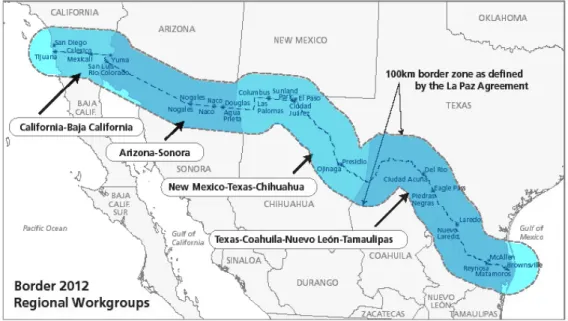
The map below depicts the U.S.-Mexico border region, which extends more than 2,000 miles from the Gulf of Mexico to the Pacific Ocean, and includes over 60 miles on each side of the border, encompassing 10 US and Mexican states.
Figure 1-1: A map of the U.S.-Mexico border region.
Source: EPA Website.
According to Border 2012 management, the program is largely a voluntary (non-regulatory), consensus-driven program. The program takes into account cultural, language, political, economic, legal, jurisdictional, and environmental realities. It uses a collaborative approach, involving a multitude of partners and stakeholders to develop solutions to environmental and health issues affecting the border
communities.
Noteworthy Achievements
The Border 2012 Program emphasizes a bottom-up, regional approach. Border 2012 is a unique EPA program because it is bi-national, and addresses needs on both sides of the border. This program operates as a convening mechanism by bringing together a variety of local, regional, and national stakeholders to address the unique environmental and human health issues along the border.
Scope and Methodology
This review assesses the performance of the Border 2012 Program on the basis of its reported results, and the results and measures culled from the grant program established under Border 2012’s auspices. In
and program management of Border 2012 impact program outcomes?”, we conducted meetings with program staff, regional staff and grant recipients. We also reviewed publicly-available program documents, measures, budgets, and staffing, and requested information on training
requirements and internal program management.4 We examined
management controls as they related to our objective.
We conducted this performance evaluation in accordance with generally accepted government auditing standards. Those standards require that we plan and perform the evaluation to obtain sufficient, appropriate evidence to provide a reasonable basis for our findings and conclusions based on our evaluation objective. We believe that the evidence obtained provides a reasonable basis for our findings and conclusions based on our evaluation objective. We performed our field work from October 2007 through March 2008.
Prior Reviews
The OIG conducted an audit of the U.S.-Mexico border’s water
infrastructure projects. The audit objective was to answer the question, “Does EPA’s U.S.-Mexico Border Program have adequate controls for obligating and using water infrastructure grant funds?”5 The OIG found that from 2005 to 2007, EPA took actions to implement
timeframes for the Border 2012 Program projects, reduce the scope of projects, and reduce unliquidated obligations of projects. However, EPA needed to make additional changes to the process it used to manage the funds Congress appropriates for water infrastructure improvements along the U.S.-Mexico border. The report also stated that border grant work plans did not include sufficient detail such as specific projects, measures, milestones, or costs associated with projects.
The report made several recommendations to improve accountability for projects and funding. With one exception, EPA generally concurred with the OIG’s recommendations. EPA expressed reservations about being able to make changes to the program without all stakeholders agreeing on how projects should be funded
4
Appendix C provides further details on our scope and methodology.
5
Report number 08-P-0121, Improvements Needed to Ensure Grant Funds for U.S.-Mexico Border Water Infrastructure Program Are Spent More Timely, March 31, 2008.
Chapter 2
Unique Organizational Structure Created to
Implement Bottom-up Approach
The Border 2012 Program created a series of interrelated workgroups, forums, and task forces to execute its bottom-up regional approach for decision making, priority setting, and project implementation. EPA Regions 6 and 9 and National Program Offices coordinate soliciting, selecting, ranking, and administering Border 2012 projects, primarily through issuing grants.
Border 2012 Organizational Structure
The Border 2012 Program is structured to involve a variety of internal and external stakeholders, including Federal, State, and local
governments in the United States and Mexico, and U.S. border tribes, and to accommodate input from the U.S.-Mexico border communities. Below, Figure 2-1 depicts the organizational structure of the Border 2012 Program, and the coordinating groups involved.
Figure 2-1: Border 2012 Program Organizational Structure
The national program coordinators in Mexico’s Secretariat for the
Environment and Natural Resources (SEMARNAT) and EPA are the top
level of management in the Border 2012 Program.6 EPA, as one of the
national coordinators, is responsible for implementing the U.S. responsibilities under the La Paz Agreement and the Border 2012
Program.7 The national program coordinators manage overall program
implementation, and ensure cooperation, coordination, and
communication among all Border 2012 groups. The coordinators assist the workgroups in maintaining focus on bi-national and transboundary environmental and public health issues consistent with the program’s 10 guiding principles.8
Under Border 2012, three types of coordinating bodies have been created. These include regional workgroups, border-wide workgroups, and policy forums. The role of the regional workgroups is to identify and document priority regional issues consistent with the goals and objectives of Border 2012. Regional workgroups also identify priority regional issues that affect more than one region for consideration by border-wide workgroups and policy forums.
Border-wide workgroups work closely with regional workgroups and task forces to identify projects to fulfill their respective goal and objectives. Border-wide workgroups leverage internal and external resources to assist regional and task force efforts and projects.
The policy forums include water, air, and hazardous and solid waste. Policy forums identify priority border-wide policy issues that can most effectively be addressed through a federally-led effort. The policy forums rely on the input from regional workgroups.
Each of the three coordinating groups mentioned above has the
opportunity to create task forces to implement projects at the local level and regional level. Task forces address selected and community
identified concerns, implement projects, and make recommendations to Border 2012 coordinating groups. Specifically, task forces develop project proposals and identify potential funding sources.
Regional workgroups, border-wide workgroups, policy forums, and task forces are expected to work on building consensus on program priorities. Additional responsibilities include developing budgets for Border 2012
6
SEMARNAT is a cabinet-level department in Mexico’s executive branch. The national program coordinator for EPA is the Assistant Administrator for the Office of International Affairs. 7
The La Paz Agreement was between the U.S. and the United Mexican States on cooperating to protect
and improve the environment in the border area, signed at La Paz on August 14, 1983. 8
projects, collecting data to monitor progress of activities, and identifying potential resources to achieve program goals.
Border 2012 Program and Project Management
The Border 2012 Program initiates projects primarily through issuing grants. Agency officials explained that EPA’s Office of International Affairs (OIA) receives yearly appropriations to fund projects in the border region to achieve the program goals established in the Border
2012: U.S.-Mexico Environmental Program Framework.9 EPA Regions
6 and 9 are also involved with the grant process. Initially, the regional workgroups assess local and regional priorities and emerging issues by consulting with the task forces, U.S. border tribes, and the Border 2012 regional workgroup State partners. Part of the priority-setting process also includes considering applicable priorities identified by the national coordinators at their annual meeting.
After the OIA priorities are established, requests for proposals (RFPs) are written to balance national, regional, and local priorities. Potential grantees apply by submitting a pre-proposal with their project
description. Pre-proposals are ranked by each region, and the highest rated applicants are asked to complete a full proposal for funding consideration. Criteria used to rank proposals include funding
leveraged, measurability of project results, and advancement of Border 2012 goals and objectives. Upon approval by the region, EPA assigns a project officer and issues grant funds.
EPA’s project officer is responsible for monitoring project progress. Once a project is complete, a final report is prepared by the grantee and submitted to the EPA project officer. The project officer reviews the final report and project accomplishments, and determines whether all EPA grant requirements have been met.
9
Chapter 3
Program Management Shortcomings
Inhibit Verifying Results
Border 2012 does not have a formal process to independently verify results or to review supporting documentation for individual project accomplishments. The program also lacks baseline data, quantifiable measures, or outcome measures which could verify the program’s effectiveness. Furthermore, Border 2012 does not have a strategic plan or similar document that guides the program’s implementation efforts. Nor does the program have a systematic implementation plan to link resources, activities, and intended outcomes. Coupled with the
decentralized structure of the program described in Chapter 2, the result is a lack of accountability and oversight. We were unable to verify the accomplishments reported by the program due to the program’s lack of quantifiable goals, valid measures, or supporting data and documentation.
Border 2012 Lacks Support for its Claimed Accomplishments
Border 2012 reports accomplishments on a national program level. Yet, we found that the program does not obtain or collect supporting
documentation for accomplished objectives. The program does not have a process to independently verify project accomplishments. According to the Border 2012 staff, accomplishments are discussed at program meetings but it has no guidance or process to determine whether objectives have been successfully completed. In addition to issuing grants in support of program objectives, Border 2012 relies on partners to assist in meeting Border 2012 objectives. However, we found Border 2012 has no documented process to assess projects completed by
partners. Also, we found that the Border 2012 Program does not have a process to review results submitted by the grantees, or aggregate project results.
For example, we analyzed support for the one of the objectives with a quantifiable measure:
• Goal 4, Objective 3B: By 2007, reduce pesticide exposure by
training 36,000 farm workers on pesticide risks and safe handling, including ways to minimize exposure for families and children.
We found that the program issued several grants in support of Objective 3B. We requested documentation supporting the successful completion of this objective. In support of this objective, the EPA program staff provided grant final reports that supported training approximately 15,000 farm workers. However, OIA did not maintain copies of these final reports. According to OIA, it does not routinely obtain or review reports from the Agency’s project officers. OIA assumes that grantees and the Agency’s project officers ensure the accuracy of results.
We were advised by program staff that the remainder of the training was conducted by Border 2012 partners and therefore the support is
maintained by outside organizations. According to program staff, Border 2012 partners were responsible for training over 30,000 individuals along the border region. However, the program does not have, nor does it request, any support for the accomplishments claimed by its partners.
Some Performance Objectives Are Not Measurable
We reviewed the goals, objectives, and subobjectives in the Border 2012 framework document and found two of the objectives to be broad in nature and non-measurable. For example, Goal 2, Objective 1 reads:
“By 2012 or sooner, reduce air emissions as much as possible toward
attainment of respective national ambient air quality standards, and reduce exposure in the border region….” We also found objective that include wording “extend efforts.” The wording of these objectives makes them neither clear nor measurable.
We also reviewed the goals and objectives provided in a draft planning document and found that some subobjectives included wording such as “expand current efforts.” According to Border 2012 staff, subobjectives that use the wording “expand current efforts” have already been
accomplished. If the Agency uses these objectives in final planning documents, it will not be able to measure the successful completion of projects when a desired endpoint is not clearly defined. OIA staff also stated that they do not link all projects and subobjectives to a specific measure. Also, grant results are not collected by Border 2012 staff and applied to appropriate measures to show the accomplishment of
Outcome Measures Are Being Developed but Challenges
Remain
We found the program is output-oriented and project-driven; however,
outcome measures are under development.10 Many of the current
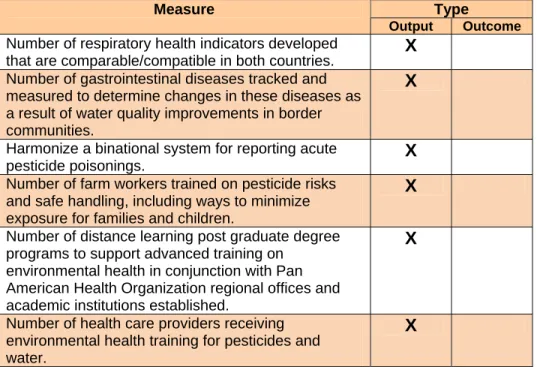
objectives and related measures are output-based. According to OIA staff, the Border 2012 Program was initially developed as an output-based program. While output measures are important and required, they do not fully capture the impact of Border 2012. As an example, Table 3 1 shows the program’s current subobjectives in terms of potential current measures for Goal 4:
Table 3-1: Border 2012 Goal 4 Measures by Type
Measure Type
Output Outcome Number of respiratory health indicators developed
that are comparable/compatible in both countries. X Number of gastrointestinal diseases tracked and
measured to determine changes in these diseases as a result of water quality improvements in border communities.
X
Harmonize a binational system for reporting acute
pesticide poisonings. X Number of farm workers trained on pesticide risks
and safe handling, including ways to minimize exposure for families and children.
X Number of distance learning post graduate degree
programs to support advanced training on environmental health in conjunction with Pan American Health Organization regional offices and academic institutions established.
X
Number of health care providers receiving environmental health training for pesticides and water.
X Source: OIG analysis of Border 2012 Program documents.
Although Border 2012 is measuring its progress using output measures, we found that the program is attempting to move toward using more outcome measures. According to EPA staff, the ability to measure and report environmental outcomes for Border 2012 is hindered by the difficulties encountered in sharing data between the United States and Mexico. Border 2012 created the Indicator Taskforce in 2003 to measure results, address the program’s need for indicators, and serve as a bridge of data between the two nations.
10
Output measures are defined as quantitative or qualitative measures of activities, work products, or actions. Outcome measures encompass the knowledge, behavior, or conditions that result from program activities and are needed to achieve the desired objectives (example: improved human health or
The Taskforce is developing a prototype of an online system known as the Border Environmental Gateway that will be designed to facilitate updating Border 2012’s indicators and progress. The gateway will be a Web-oriented information site with environmental information and indicators for Border 2012. According to EPA staff, the site is not on line due to budget constraints, but could still be used as an internal portal for indicator data.
The Border 2012 Program also faces challenges in collecting baseline data, and some data gaps exist. Within the Border 2012 Program are several objectives where baseline information is needed. For instance, the State of the Border Region Report11 listed data for pesticide use in the Border region “as difficult to collect and often lacking due to reporting practices.” According to several EPA staff, obtaining water quality data is a major challenge for the program. One challenge to obtaining this information is the difficulty in gaining access to the Mexico side of the border. Skepticism from Mexico exists on how the data would be used and how they would be interpreted. Staff also cited problems with tracking the number of people served by the program as a measure under Border 2012. While OIA wants to have measures across the entire border region, local indicators are desired as well. Using local indicators would make it easier to show differences on a smaller scale. This would also allow localities to track their baselines and measures their impact on a local scale.
Systematic Planning for Program Goals Is Lacking
While Border 2012 has identified six goals and related objectives, the program does not have a comprehensive strategy in place to address how these objectives will be met based on the resources available.12 The priorities, goals, and objectives for the program are currently contained in separate plans and documents, including the regions’ RFPs, Region 9’s annual operating plans, and the national coordinators’ communiqués. We found the program lacks an overall roadmap or implementation plan that links resources, activities, and intended outcomes. While Border 2012 has reported accomplishments in several of the program’s goals, it is not clear how these grants’ results are integrated in the overall Border 2012 framework document. Moreover, it is not consistently articulated who is accountable for overseeing individual objectives and monitoring results.
11
U.S. EPA, State of the Border Region Report, Border 2012: U.S.-Mexico Environmental Program
Report, April 2006, EPA-600-R-06-015. 12
Appendices E and F present logic models that illustrate the linkages between program resources, their
We found that some projects are still being conducted even though the subobjective under which they were located may have been declared accomplished. The program has recently conducted a mid-term
assessment in which it reviewed the progress made towards meeting the program’s goals and objectives. However, at the time of the mid-course review, program staff were considering funding priorities that were already listed as accomplished.
As depicted in Figure 3.1, the Border 2012 budget has decreased over the last few years. Considering the program’s declining budget, planning is vital to ensure successful implementation of the Border 2012 Program’s agenda.
Figure 3-1: Border 2012 Budget
Border 2012 Budget FY 06 FY 07 FY 08 FY 09 Fiscal Year
Dollars in the thousands
0 1,000 2,000 3,000 4,000 5,000 6,000 7,000
Source: OIG developed chart based on data provided by Border 2012 staff.
Conclusion
We found the Border 2012 Program’s organizational structure allows for a collaborative relationship at the U.S.-Mexico border. The structure allows the program to address environmental issues unique to the border region. However, management oversight is lacking, regarding program progress towards meeting goals and objectives. It is unclear whether the Border 2012 goals have been achieved. Furthermore, project and
program results are not documented.
Without a strategic plan that links resources, activities, and outcomes, or a process to assess progress towards meeting the intended outcomes, the program can not ensure the activities will address the critical needs of the border region. The strategic plan should include a needs assessment for the border area, strategies for addressing any impediments, and a
statement of measurable goals with intermittent milestones so that progress can be periodically assessed.
Recommendations
To ensure that the Border 2012 Program improves planning,
measurement, and accountability to effectively demonstrate program performance, the Assistant Administrator for the Office of International Affairs should:
3-1 Develop a strategic plan for the Border 2012 Program that
describes how the program will achieve desired results. The plan should include the following components:
• A national set of goals, objectives, and measures. • A list of internal measures used to gauge project and
program success.
• A logic model, or other similar document, that accurately reflects outputs and short-, intermediate-, and long-term outcomes of the program.
• A description of how each component of the Border 2012
Program, including grants, collaborations, and
partnerships, directly contributes to program outcomes.
3-2 Develop guidance that outlines roles and responsibilities
regarding how the Border 2012 Program (a) accomplishes each program goal, objective, and subobjective; (b) obtains and maintains supporting documentation for accomplished measures; (c) develops and monitors criteria for determining what
constitutes their successful completion; and (d) assures quality of data provided by grantees.
3-3 Develop and utilize effective performance measures that are
quantifiable and measurable, particularly human health indicators, to track and report project program outcomes.
Agency Comments and OIG Evaluation
The Agency concurred with our recommendations. The Agency agreed to develop a strategic plan and detailed program guidance by December 2009. Additionally, the Agency agreed to develop and utilize
quantifiable and measurable performance measures by December 2009. The Agency’s written response, as well as our evaluation of Agency comments, is presented in Appendix G. The Agency’s complete written response is presented in Appendix H.
The OIG has incorporated technical corrections and clarifications requested by EPA as appropriate.
Status of Recommendations and
Potential Monetary Benefits
POTENTIAL MONETARY
RECOMMENDATIONS BENEFITS (in $000s) 2
Rec.
No. Page No. Subject Status1 Action Official
Planned Completion
Date Claimed Amount Agreed To Amount
3-1 3-2 3-3 12 12 12
Develop a strategic plan for the Border 2012 Program that describes how the program will achieve desired results. The plan should include the following components:
• A national set of goals, objectives, and measures.
• A list of internal measures used to gauge project and program success.
• A logic model, or other similar document, that accurately reflects outputs and short-, intermediate-, and long-term outcomes of the program.
• A description of how each component of the Border 2012 Program, including grants, collaborations, and partnerships, directly contributes to program outcomes. Develop guidance that outlines roles and responsibilities regarding how the Border 2012 Program (a) accomplishes each program goal, objective, and subobjective; (b) obtains and maintains supporting documentation for accomplished measures; (c) develops and monitors criteria for determining what constitutes their successful completion; and (d) assures quality of data provided by grantees.
Develop and utilize effective performance measures that are quantifiable and measurable, particularly human health indicators to track and report project program outcomes.
O
O
O
Assistant Administrator, Office of International Affairs
Assistant Administrator, Office of International Affairs
Assistant Administrator, Office of International Affairs
12/09
12/09
12/09
1 O = recommendation is open with agreed-to corrective actions pending
C = recommendation is closed with all agreed-to actions completed U = recommendation is undecided with resolution efforts in progress
Appendix A
Evolution of EPA’s U.S.-Mexico Border Program
In 1983, the Federal governments of the United States and Mexico signed the La Paz Agreement to protect, improve, and conserve the environment along the U.S.-Mexico border. In the agreement, the border region was defined as the area within 100 km (about 62.5 miles) on either side of the border separating the two countries. Six workgroups of importance to the two countries were initiated under the La Paz Agreement: air, water, hazardous and solid wastes, pollution prevention, contingency planning and emergency response, and enforcement. The La Paz Agreement called for establishing at least one annual meeting between the two countries addressing
environmental issues addressed. The agreement required both the United States and Mexico, to the fullest extent practical, to adopt the appropriate measures to prevent, reduce, and eliminate sources of pollution in the respective territory which affect the border area of the other and to cooperate in solving environmental problems of mutual concern in the border area.
In 1992, the environmental authorities of the United States and Mexico released the Integrated Border Environmental Plan (IBEP). This plan carried out its activities through the six workgroups identified within the La Paz Agreement. According to EPA, EPA was criticized for its lack of public involvement in developing the IBEP and not being adequately attentive to natural resources and environmental health issues. This concern led to the next phase of binational cooperation, the Border XXI Program. Border XXI, announced in December 1996, was founded on the principles of ensuring public involvement, decentralization, and interagency cooperation. It also added three new workgroups to the original six identified under the La Paz agreement:
environmental health, natural resources, and environmental information resources.
At the conclusion of Border XXI, a new strategic list of goals was formulated which officially became Border 2012 through a series of meetings and community forums with the State and Federal partners from countries, the U.S. tribal governments, and community stakeholders.
Appendix B
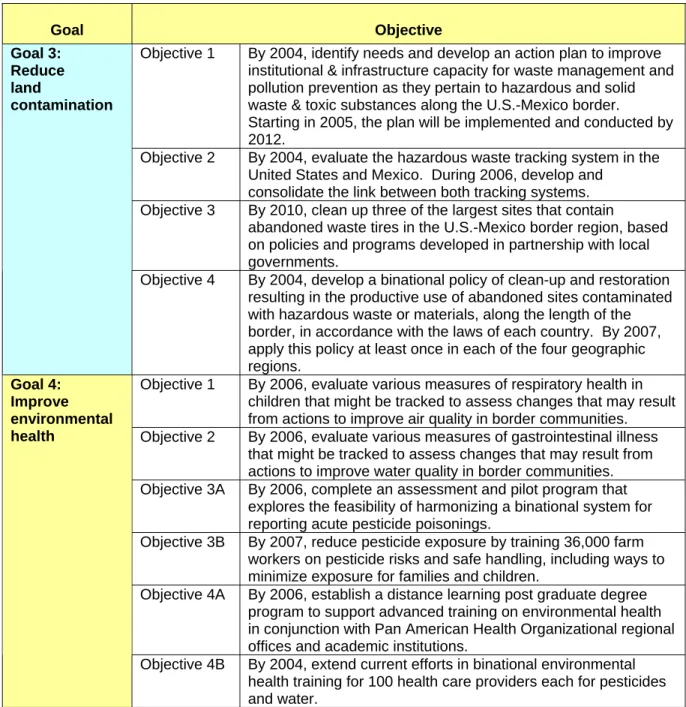
Border 2012 Objectives for Goals 3 and 4
Table B-1: Goals 3 and 4 Objectives.
Goal Objective Goal 3:
Reduce land
contamination
Objective 1 By 2004, identify needs and develop an action plan to improve institutional & infrastructure capacity for waste management and pollution prevention as they pertain to hazardous and solid waste & toxic substances along the U.S.-Mexico border. Starting in 2005, the plan will be implemented and conducted by 2012.
Objective 2 By 2004, evaluate the hazardous waste tracking system in the United States and Mexico. During 2006, develop and
consolidate the link between both tracking systems. Objective 3 By 2010, clean up three of the largest sites that contain
abandoned waste tires in the U.S.-Mexico border region, based on policies and programs developed in partnership with local governments.
Objective 4 By 2004, develop a binational policy of clean-up and restoration resulting in the productive use of abandoned sites contaminated with hazardous waste or materials, along the length of the border, in accordance with the laws of each country. By 2007, apply this policy at least once in each of the four geographic regions.
Goal 4: Improve environmental
Objective 1 By 2006, evaluate various measures of respiratory health in children that might be tracked to assess changes that may result from actions to improve air quality in border communities.
health Objective 2 By 2006, evaluate various measures of gastrointestinal illness that might be tracked to assess changes that may result from actions to improve water quality in border communities. Objective 3A By 2006, complete an assessment and pilot program that
explores the feasibility of harmonizing a binational system for reporting acute pesticide poisonings.
Objective 3B By 2007, reduce pesticide exposure by training 36,000 farm workers on pesticide risks and safe handling, including ways to minimize exposure for families and children.
Objective 4A By 2006, establish a distance learning post graduate degree program to support advanced training on environmental health in conjunction with Pan American Health Organizational regional offices and academic institutions.
Objective 4B By 2004, extend current efforts in binational environmental health training for 100 health care providers each for pesticides and water.
Appendix C
Detailed Scope and Methodology
To determine how Border 2012 met its programmatic goals, we examined the
program’s organizational and management structure. We assessed how various levels within these structures work together to accomplish program goals. We interviewed the U.S. national coordinator, as well as staff from the policy forums, regional workgroups, and task forces. We examined the planning and goal structure of the program. This included a review of the EPA Strategic Plan, the program’s framework document and goals, and the Region 9’s operating plans. We also reviewed Border 2012 background, program management documents, indicator documents, as well as applicable EPA budget and performance documents. In reviewing the organizational structure, we developed program logic model for Goals 3 and 4 with input from Border 2012 staff. (See Appendices D and E.) We also reviewed applicable policies, procedures, and practices.
To examine how the program achieves and measures results at the ground level, we selected a sample of grant projects identified by Border 2012 as accomplishing
objectives. While we assessed all of the Border 2012 goals and objectives in regard to program planning, we chose to limit our case studies to two of the six goals (Goals 3 and 4) due to public data collection limitations. We analyzed a randomly selected sample of six Goal 3 and Goal 4 projects to determine if they achieved their goals, and how this achievement was measured and reported.
To have a representative sample, the projects included those that were completed, past due, and/or ongoing. In addition, these projects were deemed to represent the larger selection of projects within all six goals of the program. We developed and
administered a questionnaire to the project managers for the six grants we reviewed. We met with grant recipients and EPA project officers to further our understanding of the Border 2012 Program and its results over time.
To examine how program accomplishments are assessed and documented, we met with Border 2012 staff and analyzed the supporting documentation for two objectives with quantifiable measures (Goal 4, Objective 3B and Goal 6, Objective 1). We
supplemented our analysis by meeting with Headquarters and regional EPA personnel, as well as recipients of grants under the Border 2012 Program.
Appendix D
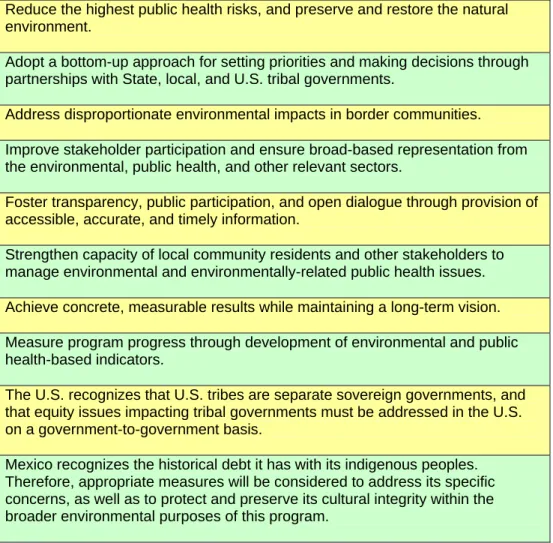
Border 2012 Guiding Principles
Table D-1: Border 2012 Guiding Principles.
Reduce the highest public health risks, and preserve and restore the natural environment.
Adopt a bottom-up approach for setting priorities and making decisions through partnerships with State, local, and U.S. tribal governments.
Address disproportionate environmental impacts in border communities. Improve stakeholder participation and ensure broad-based representation from the environmental, public health, and other relevant sectors.
Foster transparency, public participation, and open dialogue through provision of accessible, accurate, and timely information.
Strengthen capacity of local community residents and other stakeholders to manage environmental and environmentally-related public health issues. Achieve concrete, measurable results while maintaining a long-term vision. Measure program progress through development of environmental and public health-based indicators.
The U.S. recognizes that U.S. tribes are separate sovereign governments, and that equity issues impacting tribal governments must be addressed in the U.S. on a government-to-government basis.
Mexico recognizes the historical debt it has with its indigenous peoples. Therefore, appropriate measures will be considered to address its specific concerns, as well as to protect and preserve its cultural integrity within the broader environmental purposes of this program.
RFP process Priority-setting
Taskforces Policy forums
Appendix E
Figure E-1: Logic Model of Border 2012 Goal 3: Reduce Land Contamination
Inputs Activities Outputs Short Term
Outcomes Intermediate Outcomes Region 6 (grant $/ FTEs) Region 9 (grant $/FTEs) OSW ($/FTEs) OIA ($/FTEs) State Governments Local governments Community members Universities NGOs Industry Mexico NCM Annual performance reporting and review Strategic planning
Tire pile location Cleanup of scrap tires TP action plan development
Partners
Evaluation of US/Mexico hazardous waste tracking system Hazardous waste site identification Policy development Health data collection # TP inventories # Tires located # Tires removed # GIS maps of TP sites Regional workgroups # Scrap tire mgmt. documents produced # Tire management regulations developed # Training sessions held #Training videos distributed Compatible databases
List of priority sites identified in border area
Environmental health database
Increased awareness
about TP development Increased air quality due to decreased TP fires
Decreased mosquito-borne illness due to TPs
Increased management capacity in Mexico Increased effectiveness/ coordination between US and Mexico Improved environment and public health Improved coordination
with local communities
Long Term Outcomes
Appendix F
Figure F-1: Logic Model of Border 2012 Goal 4: Improve Environmental Health
Activities Outputs Intermediate Long Term
Outcomes Outcomes Short Term Outcomes Region 6 (grant $/ FTEs) Region 9 (grant $/FTEs) ORD OIA ($/FTEs) State Governments Local governments Community members Universities NGOs Industry Mexico Policy forums Taskforces Priority-setting RFP process NCM Annual performance reporting and review Strategic planning
Data gathering Training
Harmonized system between the US and Mexico for reporting acute pesticide poisonings Partners Evaluation of air measures Policy development Health data collection # Air measures developed # Farm workers trained on pesticide risks and safe hand-ling, including ways to minimize exposure for families and children Regional workgroups
# Health care provid-ers trained in environ-mental health issues, pesticides and water
# "Distance-learning," post-graduate degree program to support advanced training on environmental health in conjunction with PAHO
# Training sessions held Environmental health database Increased management capacity in Mexico Increased effectiveness/ coordination between US and Mexico Improved coordination with local communities
PAHO
Evaluation of water measures
# Water measures developed
# Models and sensing projects evaluated for future use/applicability
Increased awareness of environmental health issues among health care providers to make proper diagnoses
Decreased concentra-tions of pesticides - chil-dren’s urinary metabolites
Contacts made in
health community # Documents shared
via contacts made in health community # Environmental health curricula developed
Reduced potential for harmful exposure to pesticides by farmworkers Baseline development OEI Inputs Reductions in air-related respiratory diseases Improved environment and public health Reductions in
water-borne illnesses
Reductions in pesticide-related poisonings
Appendix G
Agency Comments and OIG Evaluation
General Comments
The OIG Report fails to acknowledge significant achievements along the U.S.-Mexico Border. The Noteworthy Achievements section acknowledges only one aspect of Border 2012 accomplishments – the binational convening mechanism that brings stakeholders together to address environmental issues along the border. This section, however, fails to recognize the real and concrete achievements of the Border 2012 Program and dismisses actual results as mere “claims.” This is apparently due to an OIG expectation that in order to be valid, the work of Border 2012 project sponsors and program partners must meet data requirements and be “collected or obtained” following a “documented process” and centrally managed by EPA.
Real and substantive accomplishments have been achieved over the past five years along the U.S.-Mexico Border. These accomplishments have resulted in significant
environmental and public health improvements for many communities along the border as reflected in our mid-term and indicators reports. We recommend that OIG consider including some of the key accomplishments listed later in this comment paper.
OIG Response: We could not verify many of the claimed accomplishments. The achievements reported are not all inclusive or definitive of the program. We advised the Agency that we would include additional selected accomplishments in the report if it could provide substantiating evidence. No support for Agency
representations was provided. Noteworthy accomplishments are background information and have no impact on the programmatic issues described in the report.
The OIG Report fails to recognize the complex dynamic within which the Border 2012 Program operates. The draft OIG report and recommendations reflect an
unrealistic expectation or incomplete understanding of the complex binational framework and relationships that must be worked through to accomplish measurable results along the U.S.-Mexico Border. These unacknowledged relationships significantly impact strategic planning, reporting, and accountability in a way that the OIG report fails to recognize.
OIG Response: We believe that Chapters 1 and 2 adequately describe the program and the conditions under which it operates. Appendix A further describes the evolution of and requirements for the Border 2012 Program. The complexity of the program is further reason why it is important to develop a strategic plan that fully describes the components of the program including the collaborations and partners that directly contribute to program outcomes.
In the Border 2012: U.S. – Mexico Environmental Program document, the Mission Statement reads:
“As a result of the partnership among federal, state, local
governments in the United States and Mexico, and with U.S. border tribes, the mission of the Border 2012 program is: To protect the environment and public health in the U.S. - Mexico border region, consistent with the principles of sustainable development.”
The OIG report portrays the Border 2012 Program as if it were “EPA’s Program” whereby projects are primarily implemented through EPA grants. In reality, the Border 2012 Program was greatly informed and shaped by the 10 Border States. The failure to reflect this understanding is a fundamental pitfall in OIG's evaluation since it overlooks the substantial achievements in both projects and capacity building attributable to the efforts and resources of the Border 2012 partners.
OIG Response: We recognize that the Border 2012 Program is a bi-national program that relies on its internal and external partners. However, the partnership elements of the program do not make the Agency less accountable for accomplishing its roles and responsibilities. We revised the report to more explicitly acknowledge the program partners.
Based on the OIG’s premise that the Border 2012 Program belongs primarily to EPA, the OIG apparently determined that it could finalize the report based on the exclusive review by EPA. However, the notion that this draft document with recommendations should be finalized without giving the Border 2012 partners outside EPA an opportunity for review and comment, reflects a critical misunderstanding of the program dynamics or,
alternatively, is dismissive of a prime founding and operating principle. This is problematic if the OIG expects the program partners to embrace the recommendations and be partners in implementing the changes. The recommended “fixes” presume a top-down, EPA-centric, process to “improve” what is essentially a bottom-up partnership-based program.
OIG Response: We evaluated EPA’s responsibility for the program in the context of the large number of stakeholders involved in it. In our scope and methodology, we explain that our review focuses on management controls and organizational structure as implemented and funded on the U.S. side of the border. OIG’s recommendations are directly targeted at EPA, not at program partners.
The OIG Report fails to recognize the rigorous management and accountability mechanisms already in place for the Border 2012 Program. The OIG programmatic evaluation (per the scope and methodology referenced in Appendix C) focused on a limited review of six (of over eighty) grants, and focused on only two of the six Border 2012 goals. Yet, throughout the document, there are references, assumptions, and conclusions that have been applied to the entire program based on this very limited sampling of projects. As an example, one of the OIG findings states that there is a lack of management oversight regarding progress towards meeting goals and objectives.
However, because of the limited scope previously mentioned, the OIG appears to have not been aware of the rigorous internal management and accountability system for tracking progress on various Border 2012 goals and objectives.
OIG Response: We reported on the aspects of Border 2012 related to our scope. As explained in Appendix C, we assessed how various levels within the program’s organizational and management structure work together to accomplish program goals. In conducting this evaluation, we interviewed the national coordinator; staff from the policy forum, regional workgroups, and task forces; and examined the planning and goal
structure of the program. The review also included an examination of EPA’s strategic plan, and the program’s framework document and goals. Our findings regarding the necessity for overarching planning and results measurement in the program result from the entirety of our evaluation.
For example, in coordination with OIA:
• The Region 6 and Region 9 Regional Administrators and National Program Offices
hold quarterly conference calls with EPA’s Deputy Administrator, Marcus Peacock, to discuss progress on a number of Border 2012 measures. These calls are partially designed for program accountability, but more importantly, they are utilized to
showcase best practices and better ways of doing our work along the border, based on actual field examples and experience. These calls are also broadcast throughout EPA via web-based media so that other parts of EPA may also benefit from the innovations and best practice discussions.
• The EPA National Program Offices, Region 6 and 9, the 10 Border States, and 26
U.S. Tribes each devote staff and resources to accomplish the goals and objectives of Border 2012, which are overseen by their respective senior level leadership.
• Some of the Border 2012 measures (in Goal 1 and Goal 3) are EPA Strategic Plan
Measures and OMB PART Measures that are closely monitored and tracked by the Regions, NPMs, OMB, and OCFO; and,
• Each year, Region 9 develops a comprehensive Border Operating Plan that highlights
annual commitments to achieve the Border 2012 goals and objectives. This strategic plan is shared with the NPMs, OIA, Region 6, and State partners so that there is a common understanding of the commitments and intended results.
• As the National Coordinator, OIA works closely with Program partners to coordinate
the above efforts to better manage the program’s results and efforts.
OIG Response: Meetings, phone calls, and assigning staff do not constitute a system of accountability. Our evaluation found deficiencies in the validity and
reliability of the support for the results discussed. Additionally, despite OIG requests, no documentation of the results from the quarterly conference calls (such as action items or follow-up) was provided in the course of the evaluation. Finally, the report does recognize the Region 9 operating plan, in contrast to Region 6 and the overall program.
The OIG Report fails to recognize the strategic framework already undertaken by
“logic model” proposed in Figure E-1 of the report that the projects and efforts
themselves are not being implemented under a strategic framework and that no effort is made to establish links between strategic objectives, activities, outputs, and outcomes. This is incorrect.
The Border 2012 program aims to protect the environment and public health in two countries with a common border and through a collaborative partnership of federal, state, and local governments, and the U.S. border tribes. In this binational, multi-level, and strategic framework (focused on the 6 goals and 23 objectives), which is embraced and accepted by all the partners, we collectively strive to:
• Require the best practicable measurements and outputs or outcomes in the
projects that receive grants, recognizing that there are different laws, ordinances, programs, and reporting requirements implemented across the region;
• Request the best practicable measurements and outputs or outcomes from
voluntary programs, recognizing their voluntary nature;
• Continue to report Border 2012 program accomplishments through updates of the
Implementation Report and to develop best practicable measures through the Indicators Task Force and updates of the Border 2012 Indicators Report.
OIG Response: We found that the program lacks an implementation plan to ensure results. The report appropriately characterizes Border 2012 planning, management, and measurement. No description exists of the implementation framework or connectivity between activities and results. The logic models, developed with OIA’s participation, simply present what is being done.
The OIG Report references outdated draft working documents. We noticed that throughout the document (but especially in Chapter 3), there are references to the Border 2012 mid-course refinement draft working document that EPA shared with OIG as a courtesy copy. This document is a working draft and is currently very different from the original copy that was shared with OIG. The conclusions reached by OIG are thus based on outdated information – we request that all references regarding this mid-course refinement document be removed from the report – it is still a working draft. Until the midcourse refinement effort is completed, the Border 2012: US-Mexico Environmental Program Document and its corresponding guidelines continue to be the primary working framework
OIG Response: OIG has access to all Government records. All data and documents analyzed and reviewed by the OIG team were current as of the end of fieldwork. Where the refinement document is cited, we refer to it as a draft document. Moreover, the OIG would expect that the final Agency document would identify and plan to correct the management deficiencies identified in the interim document.
Specific Comments (Section 1)
Page 2, Noteworthy Achievements: We appreciate the OIG’s acknowledgement of the Border 2012 Program’s success in convening various border stakeholders. However, OIG fails to recognize the significant and real environmental improvements achieved since the Program’s inception. There are many examples that could have been referenced in a section that purports to address achievements. For example, citizens in El Paso who once breathed air that violated standards for ozone and carbon monoxide now breathe air that meets those standards; 100,000 more homes are now served by wastewater service; more than 3 million abandoned tires have been eliminated along the border to reduce the threat of uncontrollable fires or disease vectors; household hazardous waste and waste oil is better managed in Nuevo Laredo, Nogales, and other border cities so that their
wastewater treatment plants experiences fewer upsets; the 15 sister cities along the border now have active emergency preparedness and response plans so that emergency
responders on both sides of the border are able to communicate with each other and cooperate on a response (where once they could not); over 2,500 tons of hazardous waste was removed from an abandoned waste site in Tijuana, eliminating risk to nearby
communities, and so many more. These examples are referenced in the Mid-Term report and the indicators report.
OIG Response: We believe that we have appropriately the characterized Border 2012 Program in the report. During the evaluation we requested that OIA provide additional accomplishments in the form of narrative and support and did not receive these items.
In addition, the OIG report fails to accept the validity of direct observations by program partners, including those documented by photographs that document waste tires which once existed no longer do, having been removed for use as fuel in a cement kiln. The value of removing tire piles in the United States is broadly accepted; an acceptance derived from years of experience in Superfund emergency response and other programs in dealing with tire fires and disease control. Yet, absent additional layers of strategic planning, accountability, and explicit “logic models13,” the OIG report does not seem willing to acknowledge the implicit strategic value of tire removal within the goal of reducing “land contamination” (Goal 3) or the accepted, but difficult to quantify, outcome and outputs from such efforts, notwithstanding the fact that such activities and the performance measurement associated therewith were undertaken in a manner consistent with long standing non-border U.S. tire management programs. In short, the report scarcely pays attention to “Noteworthy Achievements” on page 2, does not acknowledge the program partners and their work, and is fundamentally flawed in this respect.
13
Interestingly, with respect to waste tires, Figure E-1 was apparently developed based on what we are already doing, rather than presenting a new model that can be used to enhance strategic planning, accountability, and outcome measures.
OIG Response: The OIG did not report or conclude that direct observation by program partners (documented by photographs) is unacceptable evidence in support of accomplishments. Although we advised program staff that if examples of
accomplishments were provided along with support, we could include those success stories in the report. We were not provided such pictures or records of direct
observations in support of accomplishments and therefore could not report them as noteworthy accomplishments or incorporate them into the final report.
Specific Comments (Chapter 3)
Page 7, Paragraph 1: The report states that “the program lacks baseline data, quantifiable measures or outcome measures which could verify the program’s effectiveness”. In addition, the report states that “coupled with the decentralized structure of the program, the result is a lack of accountability and oversight”. We disagree with these two statements. First, the program does maintain baseline data for over half of its goals and objectives and is in the process of obtaining data for the remainder (for example, the Border 2012 Program has completed a comprehensive inventory of tire piles along the border to serve as the baseline for future efforts; the baseline for the number of homes connected to drinking water was established at the beginning of the program so that ongoing efforts could be measured against this baseline). Second, as explained in our general comments, the Border 2012 program incorporates mechanisms to enhance accountability and oversight. For example, each year Regional EPA staffs prepare annual Operating Plans that outline the annual priorities and implementation strategy to accomplish the various goals and objectives of Border 2012 (these are reviewed and approved by the Deputy Regional Administrator). In addition, the Regions issue the annual RFP that seeks to further advance completion of the goals and objectives of Border 2012 via projects that include measurable results and that leverage external resources (this process is closely monitored and overseen by the Deputy Regional Administrator). Each year, the National Coordinators convene the program partners to oversee and evaluate progress on the goals and objectives and to issue guidance (as appropriate) for areas that may require additional support or effort. They also issue a joint communiqué that include significant results for the year and new annual priorities for accomplishing the various goals and objectives.
Finally, there is a very rigorous oversight process to document and monitor each and every project that receives EPA grant funding. The oversight includes, among other things, reviewing quarterly progress reports, monitoring of project budgets, and review and approval of final project reports. This process is required by EPA grants policies and procedures for any grant that the agency issues (not just for border grants) and is an on going practice for the U.S.-Mexico Border Program.
We request that OIG consider deleting or modifying the second, fifth, and sixth sentences of this paragraph to reflect the comments above.
OIG Response: Our report demonstrates that the Agency needs to strengthen weaknesses in performance measurement, oversight, and documentation of Border 2012 outcomes and results. We recognize the oversight process built into EPA’s grants funding for the program. However, OIA does not ensure that the results achieved by the projects are linked to overall programmatic goals, nor do they have a system in place to feed any project results back into the program as a whole. Border 2012 lacks mechanisms and accountability for linking projects and program results.
Page 7, second paragraph, sentence 7: The report states that “we found that border 2012 program does not have a process in place to review results submitted by the
grantees”. This statement is incorrect. As previously stated, per EPA grants policies and regulations, each EPA Grant Project Officer is responsible for managing and monitoring each and every project that is funded using EPA funds (including those issued for border projects). EPA grants management guidelines and regulations require that project sponsors certify that they have accomplished the intended results, and EPA makes reasonable efforts to verify these results via site visits and other means.
OIG Response: We do not disagree that an EPA grants management process is in place for reviewing these results. Our findings indicate that Border 2012 as a whole lacks a mechanism to review, verify, document, and incorporate these results into the program.
Page 8, paragraph 4: This paragraph refers to the mid-course refinement document, which is currently a working draft that is expected to be finalized by September, 2008. EPA provided OIG with an early working draft to show that we are working on
improving the measurability of the various goals and objectives. The conclusions reached in this paragraph are based on outdated information. We request that OIG consider deleting this paragraph from the report.
OIG Response: We recognize that the refinement is a living document and
therefore refer to it as draft in the report. All data and documents analyzed and reviewed by the OIG team were current as of the end of fieldwork.
Page 10, paragraph 3: The report states that “the program does not have a
comprehensive strategy in place to address how these objectives will be met based on the resources available”. In addition, the report states that “the program lacks an overall roadmap or implementation plan that links resources….” We disagree with these two statements. The program framework, guiding principles, goals and objectives, and operational guidelines are the collective strategy and roadmap for addressing the
completion of the objectives. In addition, as previously stated, each year Regional EPA staff prepares annual Operating Plans that outline the annual priorities and
implementation strategy to accomplish the various goals and objectives of Border 2012. In addition, the Regions issue the annual RFP that seeks to further advance completion of the goals and objectives of Border 2012 via projects that includes measurable results and that leverage external resources. And finally, each year, the National Coordinators issue a joint communiqué that includes annual priorities for accomplishing the various goals
and objectives. All of the above actions are carried out in coordination with our state and tribal partners and consider the existing resource realities and constraints. We request that OIG consider deleting sentences 1 and 3 from the report.
OIG Response: Our report demonstrates that Border 2012 lacks a comprehensive strategy or implementation plan to draw appropriate connections and conclusions from the program. Our analysis included the documents cited here, including the operating plans completed only by Region 9. We were informed verbally that both regions operating under an annual operating plan. However, when we requested the annual plan for Region 6, it provided us with the Agency’s strategic plan, the RFPs, and the Border 2012
framework document. Region 6 was unable to provide an operating plan.
Page 11, paragraph 1: This paragraph refers to the mid-course refinement document, which is currently a working draft that is expected to be finalized by September, 2008. We provided OIG with this courtesy working draft to show that we are working on improving the measurability of the various goals and objectives. The OIG report refers to internal, place-holder language that is no longer relevant since the document has been revised based on comments received from our Border 2012 partners. The conclusions reached in this paragraph are based on outdated information. We request that OIG consider deleting this paragraph from the report.
OIG Response: We recognize that the refinement is a living document and
therefore refer to it as draft in the report. All data and documents analyzed and reviewed by the OIG team were current as of the end of fieldwork. Moreover, we did not cite conclusions from the report, only a statement of fact that measures need to be specific.
Response to Recommendations
3-1 Develop a strategic plan for the Border 2012 program that describes how the
program will achieve desired results. The plan should include the following components:
o A national set of goals, objectives, and measures.
o A list of internal measures used to gauge project and program success.
o A logic model, or other similar document, that accurately reflects outputs and short-, intermediate-, and long-term outcomes of the program.
o A description of how each component of the Border 2012 program, including grants,
collaborations, and partnerships, directly contributes to program outcomes.
Action Official: Assistant Administrator for International Affairs
Response: We accept the recommendation.
Milestones/Dates: Completion by December 2009.
3-2 Develop guidance that outlines roles and responsibilities regarding how the Border 2012 program (a) accomplishes each program goal, objective, and subobjective; (b) obtains and maintains supporting documentation for accomplished measures; (c) develops and monitors criteria for determining what constitutes their successful completion; and (d) assures quality of data provided by grantees.
Action Official: Assistant Administrator for International Affairs
Response: We accept the recommendation.
Milestones/Dates: Completion by December 2009.
OIG Response: The Agency has accepted this recommendation.
3-3 Develop and utilize effective performance measures that are quantifiable and
measurable, particularly human health indicators to track and report project program outcomes.
Action Official: Assistant Administrator for International Affairs
Response: We accept the recommendation.
Milestones/Dates: Completion by December 2009.