Assessing the Impact of Postoperative Radiation
Therapy for Completely Resected Limited-Stage
Small Cell Lung Cancer Using the National
Cancer Database
Andrew T. Wong, MD,
a,b,*
Justin Rineer, MD,
cDavid Schwartz, MD,
a,bDavid Schreiber, MD
a,baDepartment of Veterans Affairs, New York Harbor Healthcare System, Brooklyn, New York, USA b
State University of New York Downstate Medical Center, Brooklyn, New York, USA
c
University of Florida Health Cancer Center–Orlando Health, Orlando, Florida, USA Received 1 July 2015; accepted 20 October 2015
ABSTRACT
Introduction:Surgical resection is being increasingly used for early-stage small cell lung cancer (SCLC). However, there are sparse data regarding the role of adjuvant therapies, particularly postoperative radiation therapy (PORT). We investigated the impact of PORT on survival after complete surgical resection for SCLC using the National Cancer Database.
Methods:There were 3017 patients diagnosed with non-metastatic SCLC between 1998 and 2011 who underwent R0 sublobar resection, lobectomy, or pneumonectomy. Pa-tients were stratified by the use of PORT, and only those who received a minimum dose of 45 Gy were included. The overall survival (OS) of patients based on PORT use were analyzed by Kaplan–Meier analysis and compared using the log-rank test. Multivariate Cox regression analysis was used to identify factors associated with survival.
Results: For the entire study population, the 5-year OS was significantly poorer with the addition of PORT (33.9% versus 40.6%; p ¼ 0.005). When analyzed by subgroup, patients with pN0 stage had significantly decreased OS with PORT (39.3% versus 46.3%;p¼0.07) and patients with pN2 stage had significantly improved OS with PORT (29.0% versus 18.6%;p <0.001). No dif-ferences in OS were observed in patients with pN1 stage. On multivariate analysis, the hazard ratio for PORT in pN0 disease was 1.36 (95% confidence interval, 1.09–1.70;
p < 0.001) and the hazard ratio for PORT in pN2 disease was 0.60 (95% confidence interval, 0.45–0.80;
p<0.001).
Conclusion:The use of PORT was associated with a dele-terious effect on OS in patients with pN0 disease but significantly improved OS in patients with pN2 disease.
2015 International Association for the Study of Lung Cancer. Published by Elsevier Inc. All rights reserved.
Keywords: National Cancer Database; Postoperative radia-tion therapy; Small cell lung cancer
Introduction
There are an estimated 221,200 new cases of lung cancer diagnosed annually in the United States.1 Small cell lung cancer (SCLC) represents approxi-mately 15% of cases, of which roughly 30% are nonmetastatic.2 Multimodality therapy is essential in the management of this disease because of its pro-pensity for both local and distant progression. Two phase III trials have failed to show a benefit with the addition of surgery to multimodality treatment.3,4 However, more recent studies have suggested that surgical resection may be considered in patients with early-stage disease.5,6 Consequently, national guidelines currently support the use of surgical management for patients with clinical stage T1–2, N0 SCLC.7
*Corresponding author.
Disclosure: The authors declare no conflicts of interest.
Address for correspondence: Andrew T. Wong, MD, SUNY Downstate Medical Center, Department of Radiation Oncology, 450 Clarkson Ave, Box 1211, Brooklyn, NY 11203. E-mail:[email protected] ª 2015 International Association for the Study of Lung Cancer. Published by Elsevier Inc. All rights reserved.
ISSN: 1556-0864
http://dx.doi.org/10.1016/j.jtho.2015.10.011
Even in clinical stage I patients, there is substantial pathologic upstaging after surgery,8 and locoregional failure remains high even after complete resection.4,8The indications for adjuvant postoperative radiation therapy (PORT) are currently not well-defined because there are few studies specifically addressing the issue. A subset analysis from a Surveillance, Epidemiology, and End Re-sults (SEER) database study noted a survival benefit associated with PORT for pN2 disease,5 and a small retrospective review of patients treated with complete surgical resection found that PORT significantly improved both locoregional control and overall survival for patients with pathological node-positive disease.9 Given the paucity of data in the current literature examining the role of PORT, we analyzed the National Cancer Database (NCDB) to determine the impact of PORT on overall sur-vival (OS) after complete resection of limited-stage SCLC (LS-SCLC) in a large cohort of patients.
Methods
The NCDB is a joint project of the American Cancer Society and the Commission on Cancer of the American College of Surgeons. It is estimated that 70% of all diagnosed malignancies in the United States are captured by facilities participating in this registry and are reported to the NCDB. The Commission on Cancer’s NCDB and the hospitals participating in the NCDB are the source of the deidentified data used in this study. However, they have not verified and are not responsible for the statistical validity or conclusions reached by the authors of this study. Exemption was obtained from the New York Harbor Veterans Affairs Committee for Research and Development before this study began.
Adult patients with nonmetastatic SCLC who were treated with surgery consisting of sublobar resection, lobectomy, or pneumonectomy from between 1998 and 2011 were included. All included patients had negative margins and a pathological nodal stage of N0 to N2. For patients who received PORT, they had to be treated with external beam radiation to the lung and received a minimum dose of4500 cGy. We also excluded those for whom laterality and chemotherapy use were not iden-tified. We identified 3581 patients who met the study criteria. In order to account for immortal time bias,10we also excluded 564 patients who survived <4 months, resulting in a cohort of 3017 patients.
Clinical, pathological, and demographic details were compared between patients who received PORT and those who did not using the chi square, Fisher’s exact, and Mann–Whitney tests where appropriate. The pri-mary objective of this study was to determine whether the delivery of PORT impacts OS. Kaplan–Meier analyses of OS were performed comparing patients who received PORT with those who did not. Because immortal time
bias has been proposed to potentially impact survival outcomes, we also repeated the analyses for patients who survived<7 months to confirm that there were not significant differences in ourfindings. Separate Kaplan– Meier analyses were performed, stratifying patients by pathologic N stage. This was performed because nodal stage was noted to be a significant metric in identifying appropriate candidates for postoperative radiation in the non-SCLC (NSCLC) setting.11–13 Multivariate Cox regression was also stratified by N group in order to determine the effect of covariates on survival. The variables measured included the selection of PORT, age group, race, sex, receipt of chemotherapy, year of diagnosis, T grouping, and surgery type. The year of diagnosis was included to account for the potential benefit of improved conformal radiation techniques. Because the encoding of intensity-modulated radiation (IMRT) wasfirst initiated in 2005 in the NCDB, we used 1998–2004 and 2005–2011 as the year of diagnosis cutoff points. Data regarding local control and cause of death are not available in the NCDB. Significant values were defined as p<0.05. Statistical analysis was per-formed using SPSS software (version 21; IBM Inc, Armonk, NY).
Results
Patient Characteristics
There were 3017 patients who met the inclusion criteria. The most common surgical procedure was lo-bectomy (70%) followed by sublobar resection (25%). The median number of days from diagnosis to definitive surgery was 20 days. Chemotherapy was delivered to 61.2% of patients at a median of 57 days from diagnosis. With regard to PORT, 448 patients (14.8%) received PORT to a median dose of 54 Gy. The median number of days from diagnosis until receipt of radiation was 91 days. The median age was 68 years and the median follow-up was 28.6 months. At last contact, 63.4% of patients were dead. Additional details regarding patient characteristics and comparisons between those who did or did not receive PORT are available inTable 1.
Survival
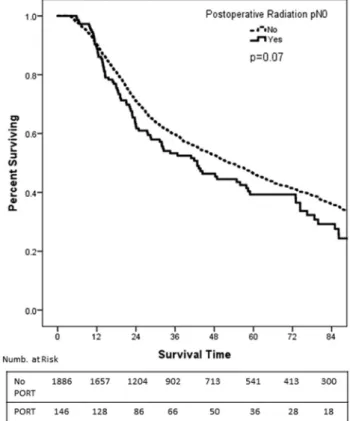
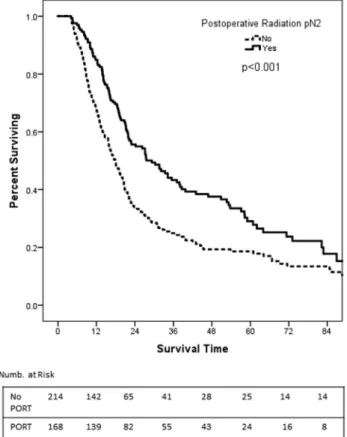
Analyzing the entire cohort, OS was poorer in pa-tients who received PORT (5-year OS 33.9% versus 40.6%;p¼0.005). However, when analyzed by N stage subgroup, differences emerged. The 5-year OS for path-ologic N0 was 39.3% versus 46.3% (p¼0.07;Fig. 1). For pathologic N1 disease, the 5-year OS was 33.3% for PORT versus 27.7% for no PORT (p ¼ 0.22; Fig. 2). However, for pathologic N2 disease, the 5-year OS was improved with the use of PORT (29.0% versus 18.6%;
Multivariate Analysis
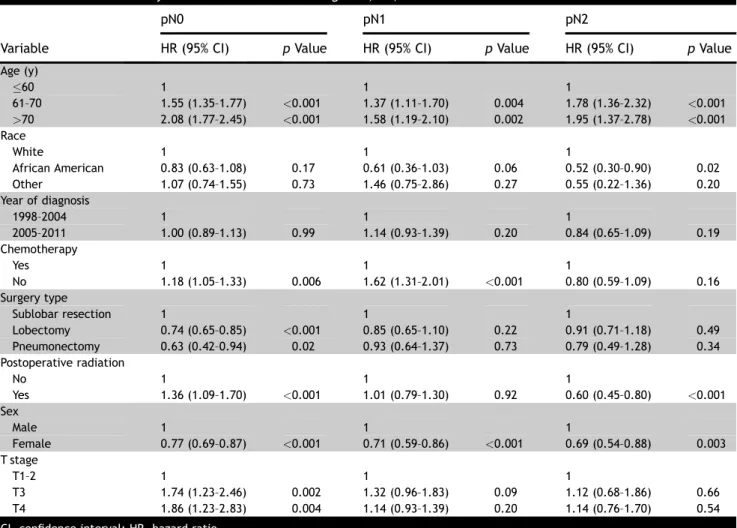
On multivariate analysis, age was a significant pre-dictor for decreased survival for all pathologic N stages (Table 2). For N0 disease, lack of chemotherapy (hazard ratio [HR]¼ 1.18 [95% confidence interval {CI}, 1.05– 1.33];p¼0.006) and PORT (HR¼1.36 [95% CI, 1.09– 1.70];p<0.001) were associated with poorer survival. Female sex (HR¼0.77 [95% CI, 0.69–0.87];p<0.001) and surgery with lobectomy or pneumonectomy were associated with improved survival. For pathologic N1 disease, lack of chemotherapy administration was asso-ciated with poorer survival (HR ¼1.62 [95% CI, 1.31– 2.01]; p < 0.001). PORT was not associated with any survival differences (HR¼1.01 [95% CI, 0.79–1.30];p¼
0.73). However, female sex was again strongly associated with improved survival (HR¼0.71 [95% CI, 0.59–0.86];
p<0.001). For N2 disease, PORT was strongly associ-ated with improved survival (HR¼0.60 [95% CI, 0.45– 0.80];p <0.001) and female sex (HR¼0.69 [95% CI, 0.54–0.88];p¼0.003. Additional details are available in
Table 2.
Discussion
In this large population-based analysis, we found that the addition of PORT was overall detrimental to SCLC
patients who underwent complete surgical resection, particularly in the large subgroup of patients with pathologic N0 disease. However, in patients with path-ologic N2 disease, PORT significantly improved the ab-solute 5-year OS by 10.4% from 18.6% to 29.0%, and this advantage retained significance on multivariable analysis. There was no difference in survival detected with or without PORT for patients with pathologic N1 disease.
Because of the rarity of patients presenting with clinical stage T1–2, N0 disease, there are scarce data regarding the optimal management of patients with early-stage disease. Two older randomized trials did not
find a benefit to the addition of surgery to multimodality management for LS-SCLC.3,4 However, patients with early-stage disease were underrepresented in these tri-als. Findings from single-institution series have sug-gested that surgery for select patients is efficacious, with 5-year OS ranging from 52% to 58% for stage I dis-ease.6,14–18 Analyses of population-based datasets have provided additional support for the use of operative management. An analysis of the SEER database con-ducted by our group reported a 5-year OS of 52.6% in patients with stage I disease who underwent lobectomy.5 A separate SEER study by Yu et al.16 reported a com-parable 5-year OS of 50% for these patients. Although
Figure 1.Kaplan–Meier curves for overall survival with and without postoperative radiation therapy (PORT) for patients with pathologic N0 disease (pN0).
Table 1.Patient Characteristics and Comparison Between Those Receiving or Not Receiving Postoperative Radiation
No PORT PORT pValue
Age, y (median) 69 65 <0.001 Sex, n (%) 0.15 Male 1183 (46.0) 223 (49.8) Female 1386 (54) 225 (50.2) Race, n (%) 0.15 White 2363 (92) 422 (94.2) African American 142 (5.5) 21 (4.7) Other 64 (2.5) 5 (1.1) Laterality, n (%) 0.14 Right 1431 (55.7) 232 (53.0) Left 1138 (44.3) 216 (47.0) Surgical procedure, n (%) <0.001 Sublobar resection 599 (23.3) 156 (34.8) Lobectomy 1834 (71.4) 278 (62.1) Pneumonectomy 136 (5.3) 14 (3.1) Chemotherapy, n (%) <0.001 Yes 1415 (55.1) 431 (96.2) No 1154 (44.9) 17 (3.8) Pathologic N stage, n (%) <0.001 N0 1886 (73.4) 146 (32.6) N1 469 (18.3) 134 (29.9) N2 214 (8.3) 168 (37.5) Pathologic T stage, n (%) <0.001 T1–2 2408 (93.7) 397 (88.6) T3 71 (2.8) 26 (5.8) T4 90 (3.5) 25 (5.6)
surgical resection is not a standard treatment option for SCLC, National Comprehensive Cancer Network (NCCN) guidelines support the use of lobectomy with medias-tinal lymph node evaluation as a treatment option for patients with clinical stage T1–2, N0 disease7based on these data.
To our knowledge, there are no prospective studies addressing the role of PORT in patients with surgically resected SCLC. In the aforementioned SEER analysis by Yu et al.,16 the authors reported a nonsignificant trend toward improved survival with the use of PORT after lobectomy (5-year OS 57.1% with PORT versus 49.1% without PORT;p¼0.09). Conversely, a SEER analysis by Varlotto et al.17 found a nonsignificant decrease in sur-vival with the use of adjuvant PORT after lobectomy (median survival 37 months with PORT versus 50 months without PORT; p ¼ 0.201) and after sublobar resection (median survival 28 months with PORT versus 30 months without PORT; p ¼ 0.585). These findings indicate that PORT is likely not beneficial for all patients receiving surgical resection.
However, several groups have further analyzed PORT outcomes based on the extent of nodal disease. In the SEER analysis by Schreiber et al.,5the authors found that while there was no significant difference in OS with or
without PORT in patients with pathologic N0 or N1 disease, there was a significant improvement in survival with the addition of PORT in the subgroup of patients with pathologic N2 disease (median survival 22 months with PORT versus 16 months without PORT;p¼0.011). Liu et al.9 recently conducted a single-institution retro-spective review of 143 patients with completely resected SCLC. For the entire cohort, PORT had no significant impact on survival, with a median survival of 40 months in patients with PORT versus 27 months without PORT (p¼0.26). On subgroup analysis, PORT led to significant improvements in both OS and locoregional control in patients with pathologic node-positive disease. For pa-tients with N1 disease, the median survival was 40 months with PORT and 14 months without PORT (p¼
0.032). For patients with N2 disease, the median survival was 35 months with PORT and 17 months without PORT (p¼0.04).
In this study from the NCDB, we found that PORT led to a survival detriment on multivariate analysis in pa-tients with pathologic N0 disease (5-year OS 34.5% with PORT versus 44.1% without PORT;p¼0.07; HR¼1.36 [95% CI, 1.09–1.70];p<0.001). There were no survival difference in those with pathologic N1 disease (5-year OS 33.3% with PORT versus 27.7% without PORT;
Figure 3.Kaplan–Meier curves for overall survival with and without postoperative radiation therapy (PORT) for patients with pathologic N2 disease (pN2).
Figure 2.Kaplan–Meier curves for overall survival with and without postoperative radiation therapy (PORT) for patients with pathologic N1 disease (pN1).
p¼ 0.22). However, there was a survival benefit asso-ciated with PORT in patients with pathologic N2 disease (5-year OS 29.0% with PORT versus 18.6% without PORT; p < 0.001). These findings are similar to the SEER-based analysis by our group and interestingly, parallel the more robust NSCLC literature on PORT. In their most recent meta-analysis, the PORT Meta-analysis Trialists Group reported a deleterious effect of PORT for NSCLC patients with pathologic N0–1 disease, whereas there was no significant impact for patients with pathologic N2 disease.11A secondary analysis of the Adjuvant Navelbine International Trialist Association randomized study of adjuvant chemotherapy found a survival detriment for PORT in patients with pathologic N1 disease who were receiving adjuvant chemo-therapy.12 However, PORT significantly improved sur-vival in patients with pathologic N1 disease who were not receiving adjuvant chemotherapy and in all patients with pathologic N2 disease, regardless of receipt of chemotherapy. A recently published NCDB analysis confirmed a survival benefit for PORT in pathologic N2 NSCLC patients treated with adjuvant chemotherapy
(5-year OS 39.3% with PORT versus 34.8% without PORT;p¼0.014).13
We noted several other interesting findings on multivariate analysis. First, we found that more exten-sive resection was associated with improved survival for patients with pathologic N0 disease (HR ¼ 0.74, p <
0.001 for lobectomy versus sublobar resection and HR¼ 0.63, p ¼ 0.02 for pneumonectomy versus sublobar resection). In a SEER analysis of patients with stage I/II SCLC, Weksler et al.18similarly reported that lobectomy was associated with improved survival compared to wedge resection (HR ¼ 0.799, p ¼ 0.038). When considered together, thesefindings suggest that sublobar resection may be inadequate treatment.
We also found that lack of chemotherapy receipt was associated with poorer survival for patients with path-ologic N0 (HR ¼ 1.18 [95% CI, 1.05–1.33]; p¼0.006) and N1 patients (HR ¼ 1.62 [95% CI, 1.31–2.01];p <
0.001), but there was no clear impact on survival for patients with pathologic N2 disease (HR ¼ 0.80, p ¼
0.16). This may suggest the greater impact of locore-gional control on survival in patients with N2 disease.
Table 2.Multivariate Analysis for Patients with Pathologic N0, N1, and N2 Disease
Variable
pN0 pN1 pN2
HR (95% CI) pValue HR (95% CI) pValue HR (95% CI) pValue
Age (y) 60 1 1 1 61–70 1.55 (1.35–1.77) <0.001 1.37 (1.11–1.70) 0.004 1.78 (1.36–2.32) <0.001 >70 2.08 (1.77–2.45) <0.001 1.58 (1.19–2.10) 0.002 1.95 (1.37–2.78) <0.001 Race White 1 1 1 African American 0.83 (0.63–1.08) 0.17 0.61 (0.36–1.03) 0.06 0.52 (0.30–0.90) 0.02 Other 1.07 (0.74–1.55) 0.73 1.46 (0.75–2.86) 0.27 0.55 (0.22–1.36) 0.20 Year of diagnosis 1998–2004 1 1 1 2005–2011 1.00 (0.89–1.13) 0.99 1.14 (0.93–1.39) 0.20 0.84 (0.65–1.09) 0.19 Chemotherapy Yes 1 1 1 No 1.18 (1.05–1.33) 0.006 1.62 (1.31–2.01) <0.001 0.80 (0.59–1.09) 0.16 Surgery type Sublobar resection 1 1 1 Lobectomy 0.74 (0.65–0.85) <0.001 0.85 (0.65–1.10) 0.22 0.91 (0.71–1.18) 0.49 Pneumonectomy 0.63 (0.42–0.94) 0.02 0.93 (0.64–1.37) 0.73 0.79 (0.49–1.28) 0.34 Postoperative radiation No 1 1 1 Yes 1.36 (1.09–1.70) <0.001 1.01 (0.79–1.30) 0.92 0.60 (0.45–0.80) <0.001 Sex Male 1 1 1 Female 0.77 (0.69–0.87) <0.001 0.71 (0.59–0.86) <0.001 0.69 (0.54–0.88) 0.003 T stage T1–2 1 1 1 T3 1.74 (1.23–2.46) 0.002 1.32 (0.96–1.83) 0.09 1.12 (0.68–1.86) 0.66 T4 1.86 (1.23–2.83) 0.004 1.14 (0.93–1.39) 0.20 1.14 (0.76–1.70) 0.54
Liu et al.9 reported a larger absolute benefit in locore-gional control with the addition of PORT in patients with N2 disease compared to N1 disease (3-year locoregional relapse 0% with PORT versus 14.3% without PORT for N1 patients and 4.2% with PORT versus 56.6% without PORT). Unfortunately, data on locoregional control are not available in the NCDB, and these findings cannot be confirmed in our analysis. In addition, our analysis may have been underpowered to detect a survival difference because there were few patients with N2 disease that did not receive chemotherapy. It should also be noted that thesefindings may be related to a selection bias that is unmeasured with the NCDB. For example, we found that while only 55.1% of patients not receiving PORT received chemotherapy, nearly all (96.1%) patients who received PORT also received chemotherapy. It is unclear what underlying factors determined whether or not adjuvant therapy was given, but it is clear that the clinicopathologic concerns that led to the delivery of PORT also influenced chemotherapy use, which may have led to a skewed study cohort when analyzing the impact of chemotherapy on survival.
We also found that female sex was strongly associ-ated with improved survival across all N stage sub-groups, which is in agreement with findings from previously published studies. A single-institution review by Videtic et al.19 reported that women had better sur-vival than men (5-year OS 12.5% versus 2.5%;p¼0.07), independent of other treatment variables, including smoking cessation and radiation treatment in-terruptions. The authors postulated that the mechanism for improved survival in women involves inherent dif-ferences in either tumor biology or the hormonal milieu rather than behavioral differences. Additional studies are needed to fully elucidate the underlying mechanism of this observation.
Because the NCDB did not begin encoding the use of IMRT until 2005, we stratified patients by the year of diagnosis using 2005 as a cutoff as a surrogate to assess the potential impact of conformal radiation techniques on survival within our study population. On multivariate analysis, the year of diagnosis had no significant impact on survival. Previous studies have shown a dosimetric advantage of IMRT over conventional radiation in reducing the lung V20 (volume of lung receiving at least 20 Gy), potentially reducing toxicity.20 Previous population-based studies have suggested that this dosi-metric benefit translates into improvements in clinical outcomes for patients with locally advanced NSCLC.21,22 Whether this benefit exists for patients with SCLC or in the postoperative setting remains unknown.
A major limitation of this study is the lack of cancer-specific survival data. Although most patients with SCLC are likely to die from their disease, other-cause mortality
may be a factor, particularly for older patients with other comorbidities. A second limitation is the detailed infor-mation regarding chemotherapeutic agents used as well as the sequencing of therapy. The median number of days from diagnosis to surgery (19 days), chemotherapy (56 days), and radiation therapy (89.5 days) suggest that most patients underwent surgery first followed sequentially by chemotherapy and PORT. A third limi-tation is the lack of central pathologic review in the current analysis. Because of this lack of central patho-logic confirmation, we are unable to ascertain whether some of the patients included in this study were mis-identified as having SCLC or whether they may have had a tumor with mixed small cell and NSCLC components, which might exhibit better outcomes than a confirmed diagnosis of pure SCLC. Fourth, the NCDB does not encode data on postoperative complications, which could potentially impact survival and the receipt of adjuvant therapies. A large number of patients (n¼564) were excluded from this study to account for immortal time bias and its impact on the receipt of PORT and the survival outcomes. However, we were unable to assess whether these patients died from early progression or from complications related to their surgery. Finally, because of the limitations of our dataset, it is unclear if there were any selection biases in patients receiving surgery, PORT, or chemotherapy in regards to perfor-mance status, access to health care, or other health-related issues.
In conclusion, this study is the largest to date specif-ically addressing the role of PORT in limited-stage SCLC patients undergoing complete surgical resection. We report that PORT appears to adversely affect survival in patients with pathologic N0 disease, has no impact on survival in patients with pathologic N1 disease, and significantly improves survival in patients with pathologic N2 disease. These findings support a role for adjuvant PORT only in patients with pathologic N2 disease.
References
1. Siegel R, Miller KD, Jemal A. Cancer statistics, 2015.CA Cancer J Clin. 2015;65:5–29.
2. National Cancer Institute website. Small cell lung cancer treatment for heald professionals. http://www.cancer. gov/cancertopics/pdq/treatment/small-cell-lung/health professional/page1. Accessed May 14, 2015.
3. Fox W, Scadding JG. Medical Research Council compar-ative trial of surgery and radiotherapy for primary treatment of small-celled or oat-celled carcinoma of bronchus: ten-year follow-up.Lancet. 1973;2:63–65. 4. Lad T, Piantadosi S, Thomas P, et al. A prospective
ran-domized trial to determine the benefit of surgical resection of residual disease following response of small cell lung cancer to combination chemotherapy. Chest. 1994;106:320S–323S.
5. Schreiber D, Rineer J, Weedon J, et al. Survival out-comes with the use of survival in limited-stage small cell lung cancer: should its role be re-evaluated? Cancer. 2010;116:1350–1357.
6. Brock MV, Hooker CM, Syphard JE, et al. Surgical resec-tion of limited disease small cell lung cancer in the new era of platinum chemotherapy: its time has come.
J Thorac Cardiovasc Surg. 2005;129:64–72.
7. National Comprehensive Cancer Network website. Na-tional Comprehensive Cancer Network Guidelines for small cell lung cancer version 1.2016.http://www.nccn. org/professionals/physician_gls/pdf/sclc.pdf. Accessed June 1, 2015.
8. Rea F, Callegaro D, Favaretto A, et al. Long term results of surgery and chemotherapy in small cell lung cancer.
Eur J Cardiothorac Surg. 1998;14:398–402.
9. Liu WS, Zhao LJ, Wang S, et al. Benefits of postoperative radiotherapy in multimodality treatment of resected small-cell lung cancer with lymph node metastasis.Eur J Surg Oncol. 2014;40:1156–1162.
10. Park HS, Gross CP, Makarov DV, Yu JB. Immortal time bias: a frequently unrecognized threat to validity in the evaluation of postoperative radiotherapy. Int J Radiat Oncol Biol Phys. 2012;83:1365–1373.
11. PORT Meta-analysis Trialists Group. Postoperative radiotherapy for non-small cell lung cancer. http:// onlinelibrary.wiley.com/doi/10.1002/14651858.CD002142. pub2/abstract. 2010. Accessed June 10, 2015.
12. Douillard JY, Rosell R, De Lena M, et al. Impact of postoperative radiation therapy on survival in patients with complete resection and stage I, II, or IIIA non-small-cell lung cancer treated with adjuvant chemotherapy: The Adjuvant Navelbine International Trialist Association (ANITA) randomized trial.Int J Radiat Oncol Biol Phys. 2008;72:695–701.
13. Robinson CG, Patel AP, Bradley JD, et al. Postoperative radiotherapy for pathologic N2 non-small-cell lung can-cer treated with adjuvant chemotherapy: a review of
the National Cancer Data Base. J Clin Oncol. 2015;33: 870–876.
14. Hanagiri T, Sugio K, Baba T, et al. Results of surgical treatment for patients with small cell lung cancer.
J Thorac Oncol. 2009;4:964–968.
15. Lim E, Belcher E, Yap YK, et al. The role of surgery in the treatment of limited disease small cell lung cancer: time to reevaluate.J Thorac Oncol. 2008;3:1267–1271. 16. Yu JB, Decker RH, Detterbeck FC, Wilson LD.
Surveil-lance Epidemiology and End Results evaluation of the role of surgery for stage I small cell lung cancer.J Thorac Oncol. 2010;5:215–219.
17. Varlotto JM, Recht A, Flickinger JC, et al. Lobectomy leads to optimal survival in early-stage small cell lung cancer: a retrospective analysis. J Thorac Cardiovasc Surg. 2011;142:538–546.
18. Weksler B, Nason KS, Shende M, et al. Surgical resection should be considered for stage I and II small cell carci-noma of the lung.Ann Thorac Surg. 2012;94:889–894. 19. Videtic GM, Truong PT, Ash RB, et al. Does sex influence
the impact that smoking, treatment interruption and impaired pulmonary function have on outcomes in limited stage small cell lung cancer treatment? Can Respir J. 2005;12:245–250.
20. Price A. Intensity-modulated radiotherapy, not 3 dimensional conformal, is the preferred technique for treating locally advanced disease with high-dose radio-therapy: the argument against. Semin Radiat Oncol. 2015;25:117–121.
21. Sher DJ, Koshy M, Liptay MJ, et al. Influence of conformal radiotherapy technique on survival after chemoradiotherapy for patients with stage III non-small cell lung cancer in the National Cancer Data Base. Can-cer. 2014;120:2060–2068.
22. Harris JP, Murphy JD, Hanlon AL, et al. A population-based comparative effectiveness study of radiation therapy techniques in stage III non–small cell lung can-cer.Int J Radiat Oncol Biol Phys. 2014;88:872–884.