Translating Research into New Instructional Technologies for Higher Education: The Active Ingredient Process
Richard E. Clark
Center for Cognitive Technology Rossier School of Education University of Southern California
To appear in The Journal of Computing in Higher Education, 1(1) Version: January 22, 2009
Keywords: Research and Development Cycle; Research design; Intervention Design; Instructional Technology Development; External Validity
Abstract
This article describes a research-based approach for developing new instructional technologies for higher education. The argument is made that the most common instructional methods used by faculty and educational technology in colleges and universities are based on adult learning theories that have not been supported in the past half-century of research. A four-stage process is offered to guide the analysis of research on adult learning and motivation in order to increase the effectiveness of classroom, lecture hall and media delivered higher education instruction. The process emphasizes the identification and application of the “active ingredients” of effective instructional methods and a strategy for translating active ingredients into the most effective instructional technologies for diverse higher education organizational and individual cultural orientations.
Introduction
The purpose of this article is to describe a promising approach that may permit us to more quickly develop, test and implement evidence- based solutions to the instructional technology challenges and opportunities faced by colleges and universities. In the discussion that follows, technology is defined as the application of research and best practice to provide a cost-effective solution to a practical problem, in this case instructional problems in higher education (Clark and Estes, 2008). Instructional technologies include strategies for designing, presenting and evaluating teaching as well as the use of media for delivering instruction to students. Developing or updating these technologies requires a survey of research in a variety of areas including adult learning, motivation, instructional design, individual and group differences, advanced expertise, multi media, and economics. This article will describe a method of classifying different types of research and conducting reviews in a way that permits us to identify the active ingredients that have been found to increase learning and/or motivation and then translate these ingredients to fit the culture and expectations of different learners and higher education organizations. The goal of this effort is to develop and test new evidence-based instructional technologies that are tailored for diverse learners and organizations.
Three Factors Influencing the Need for New Instructional Technologies
Many colleges and universities are attempting to provide more effective, student-centered instruction, find creative and cost-effective ways to deliver courses outside of the classroom and lecture hall and motivate students in order to decrease dropout from classes and degree programs. Colleges and universities are also attempting to do a better job of supporting the learning of underserved minorities.
Evidence of Instructional Probems: Many of the most popular classroom and technology-based, adult instructional strategies used in higher education appear to be much less effective (and sometimes destructive) when their impact is examined carefully (Mayer, 2004; Merrill, 1983; 2002; 2006; Kirschner, Sweller and Clark, 2006; Sweller, Kirschner and Clark, 2007; Clark, In Press); Clark, Yates, Earli and Moulton, In Press). In addition, blue-ribbon scientific groups including the National Academy of Sciences and the National Research Council have given failing grades to many of the most popular instructional management and organizational support technologies employed by universities (for example, Druckman, Singer and Van Cott, 1998). Equally distressing is the evidence that when we analyze the designs used to evaluate the results of instruction in higher education and other contexts, the more positive results tend to be associated with the least adequate evaluation designs (Clark & Estes, 2008). As the rigor of evaluation
increases, the positive results from instruction and management interventions decrease and/or show unintended negative side effects. Thus, universities may not only be failing to do an adequate job of instruction but may also be unintentionally hiding the fact with inadequate evaluation. A common assumption in higher education is that faculties who are experts in their own fields can teach novice students to become experts even if those faculties have little or no expertise at instruction. Student ratings of the instructional skills of faculty are the most common measure of teaching expertise. This practice continues in universities despite clear evidence that student ratings do not reflect their learning and in many cases may be negatively correlated with learning. This produces the ironic situation where in some cases, courses or instructors that are highly rated actually produce less learning than those with lower ratings (Clark, 1982; Clark and Estes, 2008; Clark, In Press). As a result, it is easy to share the puzzlement of Handelsman et al. (2004) who ask how university faculty, particularly: “…outstanding scientists who demand rigorous proof for scientific assertions in their research continue to use and, indeed defend on the bias of intuition alone, teaching methods that are not the most effective?” (p. 521). And it is also easy to agree with Mayer’s (2004) recommendation that we “…move educational reform efforts from the fuzzy and unproductive world of ideology … to the sharp and productive world of theory-based research on how people learn” (p. 18).
Research to Practice Is Not A Linear Path: The second reason the research to practice question is important comes from evidence that the transfer of research and evaluation results to practice is not at all straightforward. We have learned that a research-based theory about what influences events that interest us cannot be directly translated into an intervention that will produce the desired event. In fact we know that the attempt to directly transfer theory to practice can
sometimes backfire. A current example in higher education instruction is the widespread use of constructivist, problem-based and discovery learning approaches. Mayer (2004) makes a
compelling case for the argument that attempts to apply learning research directly to instruction has provided faulty support for “discovery learning”. Mayer points out that many adult learning
theories suggest that most students construct what they learn by drawing on their own prior experience to understand new knowledge. While there is widespread agreement with this
description of learning, it does not follow that the best way to teach is to ask students to struggle with problems and discover or construct a method for solving them. So-called “minimally guided” instruction (Kirschner, Sweller and Clark, 2006; Clark, In Press; Clark, Yates, Earli and Moulton, In Press) is ineffective for nearly all students and yet many adult educators recommend the use of collaborative problem-solving for most higher education courses. Mayer (2005) cautions that over a half-century of research has indicated that asking novice students to engage in discovery learning, alone or in collaborative teams, is not an effective way to teach. The evidence on this issue is unequivocal – unguided or minimally guided discovery and constructivist learning programs simply do not work for more than a very small percentage of advanced students and subject matter experts. Kirschner, Sweller and Clark, (2006; Sweller, Kirschner and Clark, 2007 and Clark, In Press; Clark, Yates, Earli and Moulton, In Press) reviewed the use of these minimally guided instructional
methods for the teaching of a discipline (mathematics) and a profession (medicine). They present compelling evidence that more strongly guided methods that involve demonstrations of problem solving strategies accompanied by hands on practice exercises with authentic problems and immediate feedback on mistakes are necessary to maximize the learning of most students. Mayer (2004; 2005) has also argued that the multimedia programs being developed for large enrollment courses in science, technology, engineering and science (STEM) most often include entertainment elements that distract and mentally overload most students with irrelevant and distracting
information. Cognitive Load Theory has been developed recently to help with the more effective development of multimedia instruction (Sweller, 2006).
Isolation and Fragmentation of Higher Education Research: A third factor that adds to the difficulty we face when trying to solve this problem is the increased specialization and
fragmentation in educational research and theory over the past half century (Winthrop, 1963; Ravitch & Vitaretti, 2001; Clark, In Press) and a growing fragmentation among various
sub-specializations in educational research. One result of this phenomenon is that researchers who favor a specific adult learning theory or point of view about instruction in higher education tend to isolate themselves and limit their research, reading and collaboration to the journals and professional associations or divisions of associations that emphasize their perspective. Any process that supports the development of new instructional technologies should therefore encourage dialogues between the diverse groups who are concerned with adult instruction and learning to help bridge the gaps, resolve important disagreements and promote collaboration (Clark, In press). Related to the fragmentation issue is the fact that very few of the higher education programs for training
instructional technologists provide adequate breadth and depth of training on the design, evaluation and interpretation of learning and performance research (Clark, 1989; Clark & Estes, 2008). As a result, widespread misunderstanding exists about the role and place of different research methods and philosophies in the development of new technologies. The goal of this discussion is to describe a technology development cycle that draws on the philosophy of science and attempts to include the contribution of many different types of research in the development of new higher education
instructional technologies.
The development of a new instructional technology begins with a clear statement of the problem to be solved. One of the greatest challenges to the development of new instructional technologies happens at this point. All too often higher education researchers give in to the temptation to believe that they know the solution to a problem and therefore their job is to seek
evidence that will persuade administrators to implement their solution. While seeking support and agreement is a valid concern, it is seldom the goal in new technology development. The “problem in search of a solution” approach almost always wastes time and scarce resources because it makes the unwarranted assumption that any technology is useful apart from a careful analysis of the problem it is designed to solve (Clark and Estes, 2008). We must begin with a concrete description of the problem or opportunity we hope to solve, a measure our current progress toward our objective and an agreement about how we will know we’ve arrived at our goal. Some have called this process “gap analysis” because it is an attempt to find research-based strategies for closing the gap between a current condition and a future goal state. Armed with an analysis of our objective, we are prepared to review all of the relevant research in studies that have attempted to solve our type of problem or achieve our specific goal.
A Four-Stage Research and Development Cycle
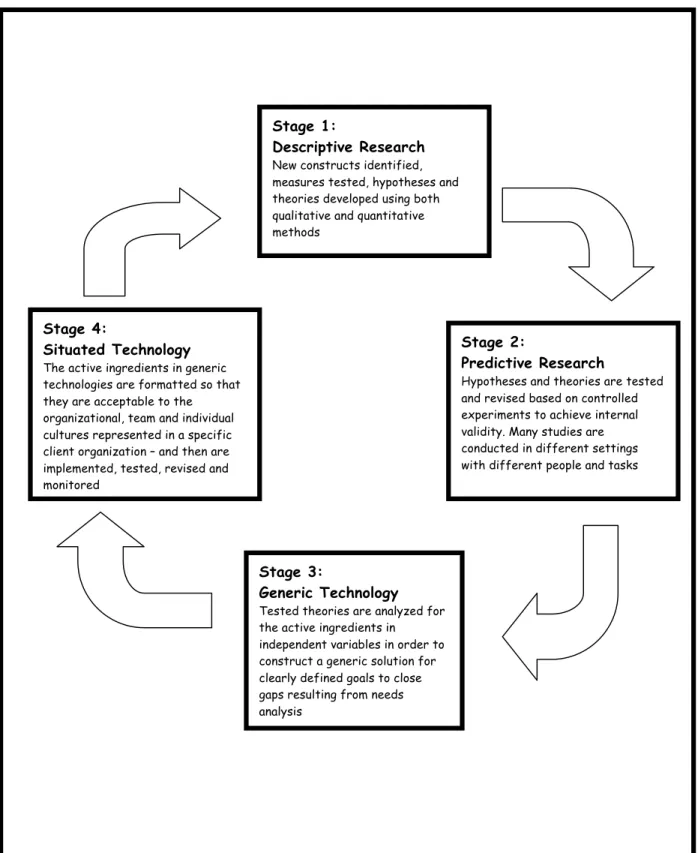
Research on most questions occurs in one or both of two stages. In the initial “descriptive” stage new constructs are described, defined and measured and sometimes hypotheses are generated. The second stage is where hypotheses are linked to theories and the theories are tested and revised based on data from controlled laboratory and field studies. These two stages are described at length in most university courses on research design and so in this discussion will be described only briefly. The third and fourth stages in the technology development cycle are seldom discussed and yet are critical to the application of research and so will be discussed in more detail. The model depicted in Figure 1 is used to summarize the entire R&D process. It serves as a graphic organizer for the discussion that follows. It begins with descriptive research that is most often the beginning of new research initiatives and new technologies.
R&D Stage 1: Descriptive Research:
New ideas, constructs or hypotheses for research can be generated from flashes of insight,
experience and/or from previous research. Descriptive methods range from historical analysis, to survey, interview and observation or from armchair analysis of a problem to very complex analytical procedures such as content analysis of communication. The participants in descriptive work do not have to
understand or accept scientific method. Formative work is often a mix of qualitative and quantitative methodologies and is driven by social needs, organizational goals and individual values. Its purpose is to develop new insights about complex events through defining, measuring and analyzing new
phenomena connected with problems or opportunities. At the descriptive stage, problems lead to the construction of surveys or interviews to describe people’s views. New constructs related to unsolved problems are generated, defined, measured and hypotheses are generated for testing at the next stage in the cycle. The purpose of descriptive research is the generation of hypotheses that can be tested under controlled conditions. Descriptive work must begin with a clear analysis of the problem that must be solved.
Determine what problem needs to be solved: When using research to achieve better practice, it is critical to analyze and validate the problem being solved. The pitfall here is the all-too-common error of advocating solutions and looking for problems they will solve. The approach we must adopt is to begin with an adequate analysis of the problem that needs to be solved – for example, the causes of the gap between our current progress and our goals. Most instructional technologists have learned to specialize in technology-based solutions such as multimedia, computer-based instruction, virtual reality and distance learning programs. Few specialize in “front end” performance problem analysis. The first stage in the development of a new instructional technology begins with a review of descriptive research
on the problem that needs to be solved including different definitions and measures of the problem. A careful review of learning problems would uncover the fact that there are many different types of learning and ways to define and measure learning that have been investigated and not all of them are relevant to the type of learning emphasized or desired in higher education instruction (see for example a review of different kinds of complex knowledge by Clark and Elen, 2006).
Conduct Front End Problem Analysis: Although the necessity to analyze and validate the performance problems we must solve seems obvious, Rossett and Czech (1998) surveyed their instructional technology graduates to ask if they were using front-end analysis in their jobs and found distressing evidence that not much analysis actually occurs, even in higher education. The reasons most often given for avoiding front end analysis in their study were “not enough time” and “lack of
management support.” There is no need to recount here the very important reasons for problem analysis or the hit-or-miss nature (and possible negative effects) when we implement solutions without careful analysis. The reader will find examples of this issue in Rossett (1999) who describes how to perform front-end analysis and problem definition in “Internet time” and Clark and Estes (2008) who describe a 25/75 system for quick analysis and the benefits of investing the effort before trying to solve a learning or motivation problem.
Avoid Conclusions At This Stage: It is vital to note that formative research cannot lead directly to conclusions about the cause of a problem. The only area where descriptive work is the end of a cycle is in cases where something is only being described. If for example, we were trying to find a better way to teach introductory history, we could not select an approach based on survey of faculty and/or
students. Yet if we wanted a quantified description of people’s beliefs about history instruction, the results of an adequately designed survey would most likely end the search. Most insights gained at this stage of the R&D cycle are most often translated into hypotheses for testing at the next stage. The research conducted at this state is most often impressionistic and suggestive.
The historical example of how descriptive research is conducted and why it is only seldom the end of an inquiry extends back to the 1850's when a Viennese physician named Semmelweis noticed that many more women died of symptoms called “childbirth fever” in a birth clinic staffed by physicians than in a similar clinic staffed by midwives. He could not identify the cause of the increased deaths in the physician’s clinic until a physician friend scratched himself with a knife he had used for dissecting cadavers and died of symptoms identical to childbirth fever. Semmelweis connected these two events and reasoned that since physicians who delivered babies in their clinic had often been dissecting cadavers just before the delivery, he hypothesized that “cadaverous matter” may have been causing the deaths through transmission by the physicians (a description of a process and a hypothesis). He moved to the next stage in the R&D cycle and planned an experiment to validate his descriptive observation. He asked physicians to wash their hands and instruments after working with cadavers and moving to the childbirth clinic. Subsequent deaths in the physician’s clinic fell to the level of the midwife’s clinic. This early, dramatic experiment was an eloquent example of science that begins with problem analysis (what was causing the disproportionate number of childbirth deaths in the physicians clinic) and descriptive work (in this case, different mortality rates in two clinics and the accident with a knife) leading to an experiment at the next stage – theory-testing predictive research.
Thus the goal of this first stage is to identify the operational definition of a goal (e.g. increasing the speed and accuracy of the learning of complex declarative knowledge or decreasing the drop out of women and minority students from mathematics courses and degree programs). We then must identify the measures that are the most reliable and valid indicators of our goal as well as the measures of all
treatments that appear to be correlated with our goal. Finally, we hope to have captured some of the hypotheses that were developed in robust descriptive theories and, armed with this information we proceed to examine relevant experiments at stage two.
INSERT FIGURE 1 ABOUT HERE
R&D Stage 2: Predictive, Theory Testing Research:
The goal at Stage 1 was to develop definitions, measures and hypotheses about instructional technology related problems and challenges. Our review of stage one studies has the goal of choosing among the many ways that outcomes we want to achieve with our new technology are defined and measured to select those that are optimal for the setting where we are operating. When the descriptive stage is
finished research progresses to a “predictive” stage where hypotheses related to the factors that influence out outcome have been tested and linked together into theories. People who conduct research at this stage generally accept the assumptions about causality that lead to empirical studies that test theories. In general, they accept the three most common tests for determining causality including: 1) that the cause precedes the effect; 2) that co-variation exists between cause and effect and 3) that the cause is the most compelling explanation of the effect (Campbell and Stanley, 1996). Since the third test is the most difficult to satisfy, the most dependable theories result from experiments that have examined many plausible alternative explanations for positive outcomes and conducted experiments where adequate controls are implemented to tease out and eliminate confounding factors.
We must have one major consideration at this stage. We must select the most comprehensive, experimentally verified theory or set of experiments that predict the outcomes we identified in the front-end problem analysis we performed at the start of this process. The goal of the front-front-end analysis was to describe the performance gaps that need to be closed and how we will measure results and determine that the gap has been closed. The goal at stage two is to select the theory and/or experiments that have been most rigorously tested in the widest range of situations, tasks and people. The supporting research at this stage should have eliminated the most compelling rival hypotheses challenging the theory we choose for application.
Choose the Best Experimental Evidence Related to the Problem Being Solved: In choosing a theory, we must go beyond the views that we developed during our formal education and/or theories that fit our personal observations or assumptions. It is useful to look at theories tested in very different populations and settings. For example in higher education our problems most often involve adults so theories based on research with children only are often rejected when they may be very relevant. If the problem exists in a university setting, research conducted in business, military or K-12 school settings are often rejected. The key to deciding which research applies to the problem we are trying to solve is the ability to identify common underlying structural features of the problem in different contexts, even if the surface features differ. Experts who are successful at solving problems in specific domains tend to look beyond obvious features of problems and focus on the principles that govern the problems. For example, when participants in a classic study of problem-solving in physics were asked to classify physics problems as similar or different from each other (Chi, Feltovich & Glaser, 1981), novices classified problems according to surface features, such as grouping problems that involved inclined planes in one group and problems with pulleys in another. Experts, on the other hand, classified the problems according to the basic principles involved in solving them, such as the problems based on Newton’s first law. An example of structural features in instructional technology can be found in the various analyses of learning from media. Clark (2001) for example claimed that the cause of the
learning benefits of new media in existing comparisons with live classroom instruction was not the media that delivered the instruction but instead the more effective instructional methods embedded in the media as a result of more intensive instructional design efforts. Media are examples of obvious surface features of instruction and instructional methods such as demonstrations, examples and feedback are examples of the structural features of the same treatments. Sweller, Kirschner and Clark (2007) make the argument that we only find structural features when single factors are varied in successive experiments that often extend over years.
Avoid the Temptation to Confirm A Bias or Belief: At this stage we must avoid the temptation to confirm our bias or validate our past experiences or beliefs. We must be willing to change our minds if well-designed experiments fail to confirm our prejudices or our experience. Sometimes theories are so fragmented and specialized that it is wise to accept all of them and try to organize them according to the outcomes they address. For example, Prochaska, Norcross, and DiClemente (1994) who were trying to increase the effectiveness of drug addiction recovery programs made the decision to accept all major theories about changing addictive behaviors. They reasoned that different theories might actually be addressing different outcomes connected with the recovery problem. So at stage one they first looked for the type of outcomes being measured by each theory and grouped them according to common outcomes. They found six very different outcomes that roughly corresponded to a sequence that addicts went
through when they tried to recover from their addiction. For example, theories at their first level tried to get people who are addicted to consider that they might have a problem. At the second level, theories attempted to predict the most effective ways to get addicts to decide to change. At the third level, theories addressed different ways to help change addictive behaviors, and so on. They considered all theories that addressed the same outcome measure as “similar”. This way Prochaska and his colleagues did not have to discard many powerful theories; they merely used them in the limited way they had been developed – to solve part but not all of the addiction recovery problem. They then extended their very effective approach to changing different types of organizations (Prochaska, Prochaska, J. O. and Levesque, 2001). This same approach to grouping theories by similar dependent measures has been followed by both Pintrich and Schunk (2002) and Colquitt, LePine, and Noe (2000) for their analysis of learning motivation research and theory and by Clark (2009) in an analysis of the research on factors that influence personal and organizational change strategies.
Most formal discussions of research and development end at this second, experimental stage. The next stage in the R&D cycle is less well understood and developed and so our greatest opportunity for contributions lie in what we do after we review a solid body of theory-based experimental work on what influences the outcome we have chosen. After we choose a theory or set of theories to form the basis for the interventions we want to develop we go to the next stage where we analyze the “active ingredients” in the treatments that were manipulated during the experimental tests of our chosen theory or theories to develop a general (or generic) picture of an intervention.
Stage 3: Identify Active Ingredients and Design a Generic Intervention.
The third stage in the application of research to practice is both novel and critical. Rather than attempting to implement what appears to be the best treatments] found in the best research, we must look more deeply. Effective intervention design requires identifying the “active ingredients” or the key structural elements of the interventions or research treatments have been found in stage two experiments to influence our chosen outcomes. Analyzing the treatments, interventions and/or independent variables that were used in successful experiments that verified the theory being adopted helps identify active ingredients. There are no clear rules yet for conducting this kind of analysis but it is clear that we must
look beyond the labels researchers give to their treatments in published articles and analyze the operations they implemented and their presumed impact on people and organizations. For example, when selecting the most effective and least expensive aspirin from among the many brands and varieties found in drug stores many people naturally perform an active ingredients analysis. The active ingredient in aspirin is an acid compound called acetylsalicic acid. This ingredient is available in all brands and types of aspirin carried in a variety of media such as gum, tablets, skin patches or liquid suspensions. Thus, all aspirin products that contain the required amount of the active ingredient have a more or less equal biological impact, but at very different cost. For most purposes, the least expensive aspirin product is as effective as the most expensive.
Analyzing learning and motivation studies to determine the active ingredients of treatments that produce larger performance gains in higher education courses can become very complex. Part of the complexity is the tendency of researchers and journal editors to accept very vague descriptions of the elements of instructional treatments. Three decades ago Cronbach and Snow (1977) complained that, “taxonomies of instructional treatments … are almost totally lacking…we (need) to identify the
significant underlying dimensions along which complex treatments vary” (pp. 164-165). Three decades later we continue to lack a systematic way to describe differences between the varieties of instructional support activities examined in research and used in practice. They also complained that researchers tended to use the same name to describe very different types of instructional interventions and that different names were used for operationally similar methods. Their complaints are still valid more than thirty years later.
Active ingredients can be identified by grouping together the operational descriptions of the experimental treatments that have led to desirable changes in the outcomes we are seeking to influence. Caution must be exercised so that we do not simply group the treatments that share the same name. For example, Cronbach and Snow (1977) found at least nine different types of treatments were all called “programmed instruction”. Kirschner, Sweller and Clark (2006) have argued that very similar treatments are often called by many different names including discovery learning, problem-based learning, constructivist learning, and inquiry learning all of which seem to recommend minimal guidance during instruction. Insights about active ingredients are often available in meta-analysis reviews of similar studies. For example, Sitzman, Kraiger, Stewart and Wisher (2006) meta analyzed hundreds of studies comparing distance and classroom instruction and concluded that the learning benefits of both were equal when the similar instructional methods were used in each medium. Clark (2001) and Clark and Estes (2008) have described other examples of active ingredients in motivation and learning research for distance and classroom delivery.
Analyzing Research Treatments and Tasks: The active ingredients we need as the core of a new technology are the causal agents in the experiments that were surveyed in stage two. We have evidence that these ingredients influence the problems we want to solve at the deepest structural level and so they must be the centerpieces in a solution. Only stage three technologies can be applied to organizations, people and tasks. Researchers call this process the determination of “external validity” (Campbell and Stanley, 1996) and understand it as the study of the transfer of research findings to different people (and cultures), contexts (work settings and organizations) and times. The difficulty for researchers is that they must overcome their training. We were taught that the solution to generalizability problems is to
completely randomize the selection of subjects. Yet it nearly impossible to select and study randomized samples of the huge diversity of beliefs and experience that characterize the cultures and aptitudes of students in higher education. And even if we could randomize people, we cannot easily randomize types of higher education organizations and/or learning tasks. Every experiment would have to include nearly
all people in all higher education organizations conducting nearly all kinds of instruction. There is another alternative but it requires careful and effortful analysis of treatments. We need (but do not have) taxonomy of tasks and higher education organizational types to completely understand the ingredients of interventions that will influence learning from instruction and motivation to learn and persist. Insightful discussions about this issue in training and intervention design have been provided by Reigeluth (1983), Gage (1985) and Landa (1983) and in Campbell and Stanley’s (1996) discussion of reasoning about causality.
Examples of Active Ingredient Analysis for Motivational Outcomes: A popular solution for motivational problems in many educational and work settings is to provide “empowerment” and move decision-making about how to achieve learning or work goals closer to individuals. In some work settings these empowered teams have been very successful, in other settings and with some people they have failed miserably and expensively. Issues about influence and choice in motivation have been the subject of many motivation theories (see the discussion by Clark, 2005 and Clark and Estes, 2008). An “active ingredient” analysis of the empowerment intervention suggests that when it succeeds, it does so because those applying it feel that they will gain significant control and so become more successful. Yet when people in some work cultures are permitted to make decisions about one’s job they reject the opportunity in favor of working with skilled managers who make decisions. In this type of organization, being empowered to make task level decisions is rejected in favor of external direction. Thus it appears that in some work cultures people trust their own decisions and believe that they will be more effective if they can decide for themselves. In other work cultures people trust skilled managers and want them to make decisions. One might expect that the same process would exist in higher education organizations. So the active ingredient in different cultures could be called “control or effectiveness beliefs and values”. The work control strategy which people believe will make them effective is the one that is the most motivating. This implies that “empowerment” strategies would be different for different people and cultures – and that in order to implement such a plan, we would have to determine the different types of control beliefs and values in any organization. Many additional examples of active ingredient analysis have been described by Clark and Estes (1998; 1999). Determining the specific conditions that exist in a specific client organization, collaborative groups and individuals takes us to the final stage in the research to practice cycle.
R&D Stage 4: Situated Technology Development.
In stage four, the active ingredient based generic intervention designed at stage three is translated or “situated” for the culture, beliefs, values, habits, expectations experiences and knowledge that exist in specific higher education settings where diverse people attempt to learn to solve a variety of problems and perform different tasks. A technology that is acceptable and effective in North American
universities may not be acceptable in Chilean or French universities. And an effective technology for community colleges might not be workable in a doctoral granting institution. The successful children’s television series “Sesame Street” was developed through a systematic R&D process similar to the one described here and eventually adopted for use in over 80 nations. In many of those national settings however, the program was modified to accommodate cultural differences over issues such as the original focus of the program on “cognitive skills” and an absence of “social skills” education. In other countries, the scripts had to be edited and new versions of the program were produced to change elements such as gender roles, situations, relationships, dress and songs to make them culturally acceptable. These are the kinds of cultural translation activities emphasized at this final stage (Cook et al, 1975).
We know very little about the critical elements of, for example, instructional presentations that must change in order to accommodate different organizations and audiences. Elements we often
consider changing include our choice of the specific examples and analogies used to illustrate concepts. We also must consider the specific values, beliefs and expectations of different groups. Should we include humor or will it be rejected as “frivolous”? Much more work remains to be done at stage four to insure adequate translation of generic technologies so that they in a form that is acceptable to different client organizations.
Translating stage three “generic” technologies into stage four situated applications obviously requires a great deal of experience with the culture and expectations in the client setting. A careful search of the literature on cultural differences does not yield a clear direction or set of questions. A very promising approach has been suggested by Hoftede (2001; Hofstede and McRaye, 2004) who
recommends the analysis of organizational, professional and discipline cultures on the basis of factors such as: 1) Power distribution; 2) Tolerance for uncertainty; 3) individualism to collectivism; and, 4) Masculinity to femininity. Hofstede and McRaye analyzed the four dimensions more extensively and established, for example, that they correlated highly with the American Psychological Associations “big five” personality factors. When translating generic technologies for different organizations these four factors might be important indicators for ways to implement active ingredients. In the empowerment example above, it may be that some of the organizations adopting empowerment technologies had cultures that were more collective than individual with a more masculine, lower tolerance for
uncertainty and unequal power distribution culture. These factors led the students in those cultures to resist individual empowerment because they believe that control can be achieved best with a more, collective, hierarchical, centralized approach. Other cultures have implemented empowerment strategies in a more individual, equitable, distributed approach. The same active ingredient – increased motivation as a function of acting in a way that achieves more control over outcomes – is achieved in what seems to be almost diametrically different ways in the two different cultures. A slightly different but compatible approach to cultural analysis is suggested by Clark and Estes (2008) who list a number of questions that performance technologists should ask themselves about the values, beliefs and attitudes of the setting where they wish to implement a generic technology. Yet, there appears to be no definitive science or technology that tells us how to conduct cultural analysis. Most of the approaches for this kind of analysis are stuck at the descriptive stage and so are fruitful questions to ask at stage two. Until we have solid theory and research at stage two, we are unlikely to develop solid generic technologies and so we need to rely on existing stage one craft, a systems approach and on “trial and revise” correction cycles.
Summary andConclusion
In the past we have often made the incorrect assumption that experimental research is useless for practice or, that our theories or research about performance and leaning can be
applied directly and immediately to improve practice. Neither assumption seems to be supported by the best evidence. In order to achieve the learning and performance gains for Higher
Education similar to those achieved in the professions of engineering or medicine we must adopt a more systematic approach to the research and development cycle. A four stage “active
ingredient” cycle is recommended. It includes two research stages and two development stages. At the first Stage we begin the process with a clear definition and way to measure the problem to be solved and the conditions we are trying to change. At this stage we review descriptive
research publications to locate the best definition and measurement of both our problems and the treatments that are hypothesized to solve them. We then proceed to stage two where we review predictive research – experiments that test the hypotheses and theories we identified at stage one.
The goal at this stage is to find and examine the treatments tested in the most robust theory and/or experiments. When we have identified treatments that demonstrated promise at stage two, we move to stage three where we identify the active ingredients” that have produced the changes in outcomes. At this stage we sketch out a description of a “generic technology. The description includes the most powerful ingredients tested in experiments. The active ingredient analysis yields a recipe for constructing an intervention that reflects the critical elements of the intervention that worked under controlled conditions. During stage four, the generic solutions containing the active ingredients identified at stage three are translated or “situated” to reflect the culture, experience, values, expectations and knowledge in a specific client organization. The “situated intervention” is then developed, implemented and evaluated for effectiveness and efficiency. The result of the evaluation loops back to provide corrections to the previous stages and the cycle continues
References:
Campbell, D. T., & Stanley, J. C. (1966). Experimental and quasi-experimental designs for research. Chicago: Rand McNally.
Chi, M. T. H., Feltovich, P.J., & Glaser, R. (1981). Categorization and representation of physics problems by experts and novices. Cognitive Science, 5, 121-152.
Clark, R. E. (1982) Antagonism Between Achievement and Enjoyment in ATI Studies. Educational Psychologist, 17(2). 92 – 101.
Clark, R. E. (1989) Questions and designs for Research in Instructional Technology. Educational Technology Research and Development. 1(1). 27 – 36.
Clark, R. E. (2001). Learning from Media: Arguments, Analysis and Evidence. Greenwich, Conn: Information Age Publishers. ISBN 1-930608-77-2
Clark, R. E. (2005). Motivating Individuals, Teams and Organizations. In Pershing, J. (Ed.). Handbook of Human Performance Improvement. Third Edition. San Francisco: Jossey-Bass Pfeiffer. 268-286. Clark, R. E. (January 2005) Five Research-Tested Group Motivation Strategies. Performance Improvement Journal. 13-17.
Clark, R. E. (2009). Resistance to change: Unconscious knowledge and the challenge of
unlearning. In, Berliner, D. C. and Kupermintz, H. (Eds.). Changing Institutions, Environments and People. New York: Routledge, 75-94.
Clark, R. E. (In press), How much and what type of guidance is optimal for learning from instruction? In Tobias, S. and Duffy, T. M. (Eds.) Constructivist Theory Applied to Instruction: Success or Failure? New York: Routledge, Taylor and Francis.
Clark, R. E. and Elen, J. (2006). When Less is More: Research and Theory Insights about Instruction for Complex Learning, in Elen, J. and Clark, R. (Eds). Handling Complexity in Learning Environments: Research and Theory. Oxford: Elsevier Science Limited. 283-297.
Clark R. E. & Estes, F. (1998) Technology or Craft: What are we doing? Educational Technology, 38(5), 5-11.
Clark, R. E. & Estes, F. (1999) The Development of Authentic Educational Technologies, Educational Technology, 37(2) 5 - 16.
Clark, R. E. and Estes, F. (2008). Turning Research into Results: A guide to selecting the right performance Solutions. Second Edition.
Clark, R. E., Yates, K., Early, S. & Moulton, K. (In Press). An Analysis of the Failure of Electronic Media and Discovery-based learning: Evidence for the performance benefits of Guided Training Methods. In Silber, K. H. & Foshay, R. (Eds.). Handbook of Training and Improving Workplace Performance, Volume I: Instructional Design and Training Delivery. International Society for Performance Improvement.
Cook, T. D., Appleton, H., Conner, R. F., Shaffer, A., Tamkin, G., & Weber, S. J. (1975). “Sesame Street” revisited. New York: Russell Sage Foundation.
Colquitte, J. A., LePine, A. A. and Noe, R. A. (2000). Toward an integrative theory of training motivation: A meta-analytic path analysis of the past 20 years of research. Journal of Applied Psychology, 85(5), 678-707.
Cronbach, L. J., & Snow, R. E. (1977). Aptitudes and instructional methods: A handbook for research on interactions. New York: Irvington Publishers.
Druckman, D., Singer, J. E., and Van Cott, H., (eds. ) (1997). Enhancingorganizational performance. Washington, D.C.: National Academy Press.
Gage, N. (1985). Hard gains in the soft sciences: The case of pedagogy. Phi Delta Kappa, Center on Evaluation, Development and Research, Bloomington, Indiana.
Handelsman, J., Egert-May, D., Beichner, R., Bruns, P., Change, A., DeHaan, R., Gentile, J., Lauffer, S., Stewart, J., Tilghman, S., & Wood, W. B. (2004). Scientific teaching. Science, 304, 521-522. Hofstede, G. (2001). Culture’s Consequences (2nd ed.): Comparing values, behaviors, institutions and organizations across nations. Thousand Oaks, CA: Sage.
Hofstede, G. and McCrae, R. R. (2004). Personality and culture revisited: Linking traits and dimensions of culture. Cross-Cultural Research, 38(1), 52-88.
Kirschner, P., Sweller, J. and Clark, R. E. (2006). Why minimally guided learning does not work: An analysis of the failure of discovery learning, problem-based learning, experiential learning and inquiry-based learning. Educational Psychologist. 41(1).
Landa, L. N. (1983). The algo-heuristic theory of instruction. In C. Reigeluth (Ed.) Instructional design theories and models, Hillsdale, NJ: Lawrence Erlbaum Publishers. 163 - 211.
Mayer, R. (2004). Should there be a three-strikes rule against pure discovery learning? The case for guided methods of instruction. American Psychologist, 59(1), 14-19.
Mayer, R. (Ed.) (2005) Cambridge Handbook of Multimedia Learning. Cambridge: Cambridge University Press.
Merrill, M. D. (1983) Component Display Theory. Merrill, In C. Reigeluth (Ed.), Instructional design theories and models (pp. 279-333). Hillsdale, NJ: Erlbaum.
Merrill, M. D. (2002). First principles of instruction. Educational Technology Research and Development, 50 (3), 43-59.
Merrill, M. D. (2006) Hypothesized Performance on Complex Tasks as a Function of Scaled Instructional Strategies. In Elen, J. and Clark, R. (Eds). Handling Complexity in Learning Environments: Research and Theory. Oxford: Elsevier Science Limited. 265 – 282.
Pintrich, P. R. and Schunk, D. H. (2002). Motivation in Education: Theory, Research and Applications (2nd Ed.). Englewood Cliffs, NJ: Prentice Hall.
Prochaska, J. M., Norcross, J. and C. DiClemente, C. (1994) Changing for Good. Avon Press: New York.
Prochaska, J. M., Prochaska, J. O. and Levesque, D.A. (2001) A transtheoretical approach to changing organizations. Administration and Policy in Mental Health. 28(4), 247-261.
Ravitch, D., and Viteritti, J. P. (2001) Making good citizens: Education and Civil Society. Yale University Press.
Rossett, A. (1999). First things fast: A handbook for performance analysis. SF: Jossey Bass. Reigeluth, C. M. (1983). Instructional design, what is it and why is it? In C. Reigeluth (Ed.) Instructional design theories and models. Hillsdale, NJ: Lawrence Erlbaum Publishers. 4 – 31.
Rossett, A., & Czech, C. (1996). They really wanna but...The aftermath of professional preparation in performance technology. Performance Improvement Quarterly, 8(4), 114-132.
Winthrop, H. (1963). Some considerations concerning the status of phenomenology. Journal of General Psychology, 68, 127-140.
Sitzman, T., Kraiger, K., Stewart, D. and Wisher, R. (2006). The comparative effectictiveness of web—based and classroom instruction: A meta-analysis. Personnel psychology, 59, 623-664. Sweller, J. (2006). How the human cognitive system deals with complexity. In Elen, J. and Clark, R. E. (2006) Handling Complexity in Learning Environments: Research and Theory. Oxford, GB: Elsevier Science Ltd. 13 – 26.
Sweller, J., Kirschner, P. A. and Clark, R. E. (2007) Why Minimally Guided Teaching Techniques Do Not Work: A Reply to Commentaries. Educational Psychologist, 42(2), 115-121.
Winthrop, H. (1963). Some considerations concerning the status of phenomenology. Journal of General Psychology, 68, 127-140.
Figure 1: The Research and Development Cycle for Turning Research into Successful Practice
Stage 1:
Descriptive Research
New constructs identified, measures tested, hypotheses and theories developed using both qualitative and quantitative methods
Stage 2:
Predictive Research
Hypotheses and theories are tested and revised based on controlled experiments to achieve internal validity. Many studies are conducted in different settings with different people and tasks
Stage 3:
Generic Technology
Tested theories are analyzed for the active ingredients in independent variables in order to construct a generic solution for clearly defined goals to close gaps resulting from needs analysis
Stage 4:
Situated Technology
The active ingredients in generic technologies are formatted so that they are acceptable to the organizational, team and individual cultures represented in a specific client organization – and then are implemented, tested, revised and monitored