Retail Banking Tune Up: Integrate the
Channels, Tablet the Branches
Prepared for:
TABLE OF CONTENTS
EXECUTIVE SUMMARY ... 3
INTRODUCTION ... 4
METHODOLOGY ... 4
RETAIL BANKING CHANNELS ... 5
SATISFACTION ... 7
GOALS ... 8
SPENDING FORECAST ... 8
ACTION ITEMS ... 9
TAKEAWAYS ... 9
INSIGHTS FOR BANK TECHNOLOGY ROADMAPPING ... 10
MULTICHANNEL INTEGRATION ... 11
IN-BRANCH TABLET-BASED BANKING ... 12
CONCLUSION ... 14
ABOUT AITE GROUP... 15
AUTHOR INFORMATION ... 15
CONTACT ... 15
LIST OF FIGURES
FIGURE 1: SPENDING ON RETAIL BANKING CHANNEL TECHNOLOGY (1/2) ... 6FIGURE 2: SPENDING ON RETAIL BANKING CHANNEL TECHNOLOGY (2/2) ... 7
FIGURE 3: BANKS' SATISFACTION AND DIRECTION OF SPEND FOR THE EXAMINED TECHNOLOGIES ... 11
LIST OF TABLES
TABLE A: SPECIFIC AREAS EXAMINED ... 5EXECUTIVE SUMMARY
Retail Banking Tune Up: Integrate the Channels, Tablet the Branches, commissioned by Kofax and produced by Aite Group, explores global banks' retail operations by examining the satisfaction levels, goals, and spend directions for the capabilities on which retail banking operations rely. Key takeaways from the study include the following:
Retail banking technologies invoke high levels of satisfaction yet hold investment opportunities for banks seeking to reduce costs or enhance the customer experience.
Multichannel integration is a notable exception to bankers' satisfaction levels with retail banking. Aite Group finds that 48% of respondent banks are dissatisfied with their capabilities in this area, while 54% of banks want to be stellar, and 56% of banks plan an upward direction of spend.
In-branch tablet-based banking is also a source of disappointment for banks. Just 29% of banks are satisfied with this capability, while 46% of banks lack a deployment of it and 48% of banks plan an upward direction of spend.
Aite Group finds senior managers at large banks disappointed with their capabilities in data management, analytics, and the customer experience, placing them in a position to benefit from the deployment of both tablet-based branch banking and multichannel integration.
Benefits available to banks that deploy tablets at their branches include increased productivity, better data capture, improved customer service, and downstream benefits related to better data quality.
Benefits available to banks that deploy multichannel integration capabilities include increased productivity for in-house developers and improved data aggregation that advances outcomes from deployments of business intelligence, performance management, and big data, all capabilities that invoke high levels of dissatisfaction among senior managers at large banks.
INTRODUCTION
In their retail channels, banks find more challenges than opportunities. Branches, the backbone of the retail presence, are experiencing falling foot traffic and increasing costs; both cause falling return on investment for this maturing channel. Across other retail channels, including call centers, online banking, and mobile banking, banks are finding it difficult to cost effectively improve the customer experience, deter threats of disintermediation, and aggregate the valuable data accumulated over these interaction channels.
It is in this context—this mixture of costly but moderately mature channels capable of competitive deterrence and significant data capture—that Aite Group takes a close look at its retail banking survey data by examining two technologies closely related to retail banking: multichannel integration and tablet-based branch banking. Senior managers in retail banking operations can use this white paper to learn about both commonly experienced operational pain points and the technological capabilities that can overcome these challenges.
M E T H O D O LO GY
In Q1 2014, Aite Group conducted a survey of senior IT executives at large banks around the world. Surveys were conducted either by telephone or online, depending on the respondent's region. One hundred and forty-one senior IT executives at 100 banks provided responses to our survey; of those, a core group of 91 banks participated in the entire survey, for which
participants qualified if they both work for an institution that completes banking transactions and have knowledge about their firm's IT priorities and strategies for the next two years. The data, therefore, provide a good directional indication of the conditions within the market, and in particular for the 52 specific areas for which we collected more granular information (Table A). All banks have over US$10 billion in assets, with three exceptions: These exceptions represent institutions in the Philippines, Pakistan, and Sweden that, due to their size within their local market or reputation, warranted inclusion in the study and representation of markets lacking large financial institutions. Of the banks surveyed, 57% have US$100 billion or more in total assets, 2% have less than US$10 billion in assets, and the remainder have between US$10 billion and US$100 billion in assets. Of the 141 banks represented by respondents, referred to as "banks" in this white paper, 56 are headquartered in North America, 59 in Europe and the Middle East, and 26 in the Asia-Pacific.
This white paper is based largely on excerpts from a recent Aite Group report on the survey.1
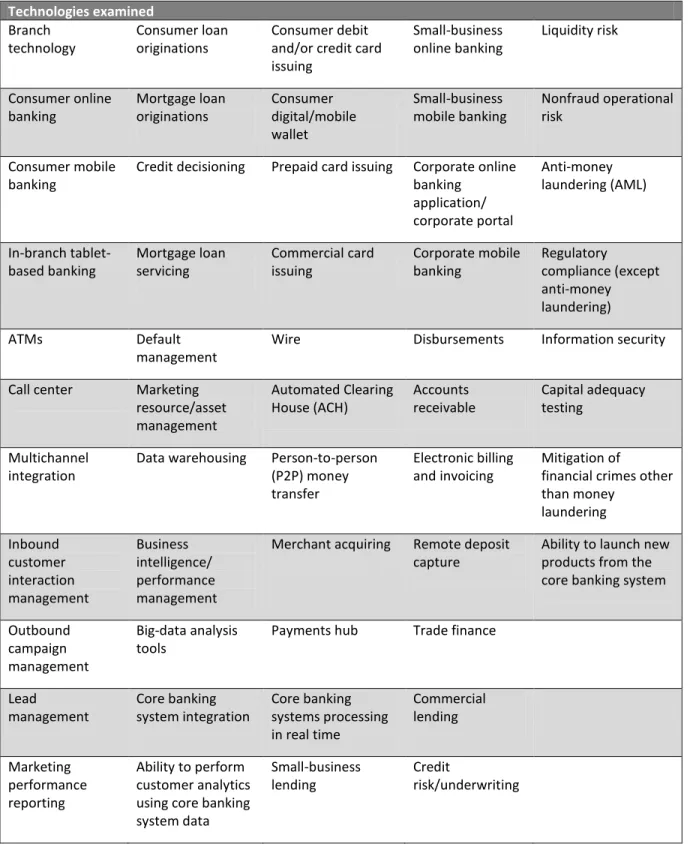
Table A: Specific Areas Examined Technologies examined Branch technology Consumer loan originations Consumer debit and/or credit card issuing Small-business online banking Liquidity risk Consumer online banking Mortgage loan originations Consumer digital/mobile wallet Small-business mobile banking Nonfraud operational risk Consumer mobile banking
Credit decisioning Prepaid card issuing Corporate online banking application/ corporate portal Anti-money laundering (AML) In-branch tablet-based banking Mortgage loan servicing Commercial card issuing Corporate mobile banking Regulatory compliance (except anti-money laundering) ATMs Default management
Wire Disbursements Information security
Call center Marketing resource/asset management Automated Clearing House (ACH) Accounts receivable Capital adequacy testing Multichannel integration
Data warehousing Person-to-person (P2P) money transfer
Electronic billing and invoicing
Mitigation of
financial crimes other than money laundering Inbound customer interaction management Business intelligence/ performance management
Merchant acquiring Remote deposit capture
Ability to launch new products from the core banking system
Outbound campaign management
Big-data analysis tools
Payments hub Trade finance
Lead management Core banking system integration Core banking systems processing in real time Commercial lending Marketing performance reporting Ability to perform customer analytics using core banking system data
Small-business lending
Credit
risk/underwriting
Source: Aite Group
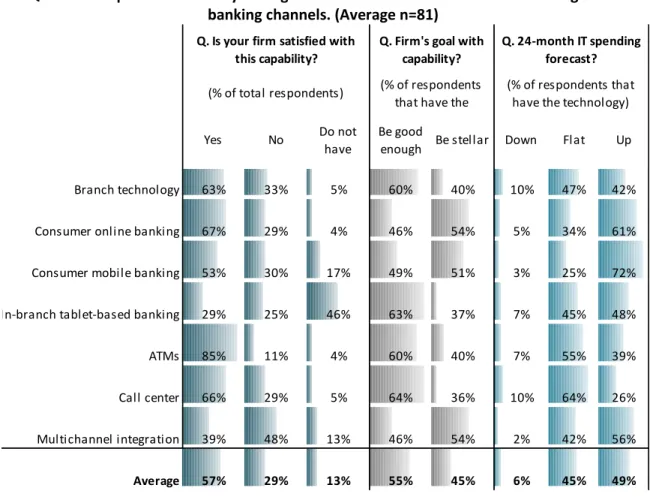
In retail banking channels (Figure 1 and Figure 2), Aite Group sees relatively mature technologies that invoke high levels of satisfaction yet hold investment opportunities for banks seeking to reduce costs or enhance the customer experience.
Figure 1: Spending on Retail Banking Channel Technology (1/2)
Q. Please help us understand your organization's IT initiatives with the following retail banking channels. (Average n=81)
Source: Aite Group's global survey of 141 large banking institutions, Q1 2014
Yes No Do not
have
Be good
enough Be stellar Down Flat Up
Branch technology 63% 33% 5% 60% 40% 10% 47% 42%
Consumer online banking 67% 29% 4% 46% 54% 5% 34% 61%
Consumer mobile banking 53% 30% 17% 49% 51% 3% 25% 72%
In-branch tablet-based banking 29% 25% 46% 63% 37% 7% 45% 48%
ATMs 85% 11% 4% 60% 40% 7% 55% 39%
Call center 66% 29% 5% 64% 36% 10% 64% 26%
Multichannel integration 39% 48% 13% 46% 54% 2% 42% 56%
Average 57% 29% 13% 55% 45% 6% 45% 49%
(% of total respondents) (% of respondents that have the
(% of respondents that have the technology)
Q. Is your firm satisfied with this capability?
Q. Firm's goal with capability?
Q. 24-month IT spending forecast?
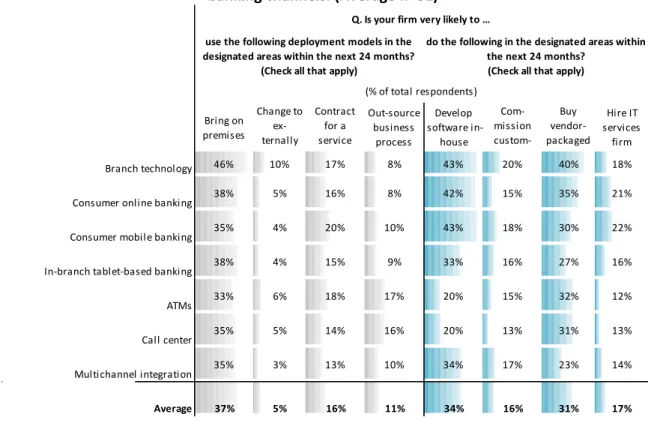
Figure 2: Spending on Retail Banking Channel Technology (2/2)
Q. Please help us understand your organization's IT initiatives with the following retail banking channels. (Average n=81)
Source: Aite Group's global survey of 141 large banking institutions, Q1 2014
S A T I S F A C T I O N
Retail banking channels are fairly mature and deliver limited competitive advantage, and 57% of banks on average view retail banking channels as satisfactory, considerably higher than the 29% that indicate they are not satisfied. The remaining 13% are commercial banks that lack a retail presence. Banks are most satisfied with ATMs, a technology for which there are few remaining opportunities to improve the customer experience and which, due to their maturity, present few opportunities for improvements to uptime, performance, or scope of capabilities.
Three technologies possess similar qualities yet present opportunities for technology updates or additional capabilities, and therefore see moderately lower levels of satisfaction. Call centers are viewed as satisfactory by 66% of banks, compared with 29% that are not satisfied. Consumer online banking invokes satisfaction among 67% of banks, compared to the 29% of banks that are not satisfied. Similarly, 63% of banks are satisfied with their branch technology, far higher than the 33% that are not satisfied.
Satisfaction levels are ambiguous only for in-branch tablet-based banking, a relatively new technology that enables a broader in-branch experience for customers and higher productivity for branch employees. This capability meets with satisfaction at 29% of banks and dissatisfaction at 25%. A substantial 46% currently lack this capability. Though this lack of adoption is partially explained by a lack of retail presence for a small portion of the participating banks, Aite Group sees a significant opportunity for vendors to sell branch-focused mobile capabilities.
Bring on premises Change to ex-ternally hosted Contract for a service provision Out-source business process Develop software in-house Com-mission custom-built Buy vendor-packaged software Hire IT services firm Branch technology 46% 10% 17% 8% 43% 20% 40% 18% Consumer online banking 38% 5% 16% 8% 42% 15% 35% 21% Consumer mobile banking 35% 4% 20% 10% 43% 18% 30% 22% In-branch tablet-based banking 38% 4% 15% 9% 33% 16% 27% 16% ATMs 33% 6% 18% 17% 20% 15% 32% 12% Call center 35% 5% 14% 16% 20% 13% 31% 13% Multichannel integration 35% 3% 13% 10% 34% 17% 23% 14%
Average 37% 5% 16% 11% 34% 16% 31% 17%
Q. Is your firm very likely to … use the following deployment models in the
designated areas within the next 24 months? (Check all that apply)
do the following in the designated areas within
the next 24 months? (Check all that apply)
Aite Group also sees an important pocket of dissatisfaction in multichannel integration, a capability with which just 39% of banks are satisfied and 48% of banks are dissatisfied, and 13% have not adopted. Key to the analysis and completion of transactions occurring over banks' various distribution and interaction capabilities, multichannel integration enables banks to provide a variety of customers with better service and higher cross-sell rates. Looking at the lack of satisfaction and low rates of adoption for this technology, Aite Group sees plentiful
opportunities for banks that can handle this complex challenge and for vendors that provide related capabilities.
G O A L S
Banks have limited goals for their retail banking channels, with 45% intending to have "stellar" capabilities and 55% seeking capabilities that are "good enough." Ambitions are lowest for the channels and capabilities that are the most mature, have been eclipsed by other channels, or present limited opportunity for innovation. Only 36% of banks want to have stellar call center capabilities, far lower than the 64% that want to be good enough. Similarly, while 40% of banks seek stellar ATM capabilities, a far larger 60% seek only to be good enough.
S P E N D I N G F O R E C A S T
Despite the relative maturity of many retail banking channels, Aite Group has identified four pockets of expected spend by banks:
Consumer mobile banking is one area where increased investments can be
expected. Here, 72% of banks expect an upward level of spend, far higher than the 25% that expect flat spend and the 3% that expect downward spend. Having successfully deployed consumer-facing mobile applications that mirror their online presence, many banks now seek expansions to their mobile apps that take
advantage of the unique ways in which consumers use their mobile phones. For example, banks can be expected to adopt camera-based capabilities that enable consumers to use their phones to onboard new billers and pay bills. Many banks will likely adopt geolocation, another phone-based capability, so that customers can receive information about the nearest branch or location where they can redeem points on their bank-based credit cards.
Multichannel integration is another area where banks expect to make additional investments. Seeking to raise customer satisfaction and revenue by learning more about customers and their transactions—especially those that are multichannel and in-process—banks are expected to develop capabilities for integrating both the data sets and applications separately dedicated to individual delivery channels. Here, 56% expect an upward direction of spend, 42% expect flat spend, and only 2% expect downward spend.
Consumer online banking, a capability with which 67% of banks are satisfied, is nonetheless an area for increased spend by banks; 61% plan an upward direction of spend, far higher than the 34% that plan a flat level of spend and the 5% that expect a downward level of spend. Here, Aite Group expects investments to address both higher transaction volume and the increasingly mission-critical nature of online
banking. With more than 50% of demand deposit account activity originating in online sessions, as well as a dramatic increase in the number of concurrent sessions, online banking systems have become both a primary customer touch point and a strained capacity. New investments are required to optimize the user experience and protect banks' brands from frustrating system outages.
Branch banking, a capability with which 63% of banks are satisfied and for which only 40% of banks want to be stellar, is nonetheless slated for an increasing level of spend at 42% of banks. Here, banks are addressing a difficult dilemma: how to maximize the yield on their most mature channel despite a significant drop in consumers' usage of this costly, brick-and-mortar-based asset. With the goal of increasing branch-staff productivity, banks can be expected to invest in technologies that accelerate transactions and administrative processes. Technologies for
wirelessly capturing key transaction artifacts such as signatures or drivers' licenses are examples of such productivity-enhancing capabilities. Among bigger banks, investments can be expected in video tellers and kiosks that both increase the level of interaction with branch visitors and offload activities from tellers.
ATMs, a capability with which 85% of banks are satisfied and for which only 40% have the goal of being stellar, will nonetheless be the recipient of flat—rather than downward—spending at 55% of banks as a result of maintenance issues. Many of the computers within banks' ATMs operate on Windows XP, which Microsoft no longer supports. Aite Group sees the resulting unit
replacement and upgrades as a driver of the flat level of spend for this relatively mature
technology. To a lesser degree, planned flat spending is also the result of continual churn within banks' ATM fleets, a portion of which regularly wear out or become technologically stale.
A C T I O N I T E M S
The primary venues through which consumers experience a bank's brand, retail banking channels will be supported by technologies capable of tight bank control and governance. Among banks planning investments in or replacements of retail banking capabilities, 37% will use on-premises deployments, 5% will turn to hosted deployments, 16% will use Software as a Service, and 11% will turn to business process outsourcers (BPO). Seeking to minimize software costs yet wanting to enhance their brands and competitive advantage, banks will turn to a combination of internal and external software development. Vendor-packaged software, a method of avoiding costs in technology creation, will be the technology-acquisition route for 31% of banks. In order to both integrate their channel-related capabilities and adequately customize them to accommodate their own brands and strategies, banks will also commission custom-built software and hire IT services firms―14% and 16% of banks, respectively.
T A K E A W A Y S
While 57% of banks are satisfied with their retail banking channel technology, and only 45% want to be stellar in this area, banks are nonetheless spending on these technologies; 49% will increase spending over the next 24 months, 45% will have flat spending, and only 6% will decrease spending. In this high level of investment for technologies that are relatively mature and invoke high levels of satisfaction, Aite Group sees two forces at work:
First, banks are dedicating resources to the channels most favored by consumers— mobile and online. Mobile capabilities, still only moderately mature for banks and in just their first or second iterations, are yet to be enhanced to embrace the unique ways in which consumers use mobile phones. Consumer online banking, which is more mature and has achieved a critical mass of volume that may challenge
capacity, also requires investments in order to maintain adequate levels of customer service.
Second, banks are seeking ways to increase the returns on their investments in
these channels. Higher returns will be sought at the branches with new ways to interact with customers as well as technologies that improve staff productivity. Investment in channel integration, largely a challenge of aggregating and reporting on data from customers' various interactions with different channels, is banks' most difficult mandate in the retail banking arena. Investments here are likely to be multiyear in nature, with intangible benefits—such as the fabled 360-degree view of the customer—that will be difficult to both achieve and monetize.
I N SIG H T S FO R BA N K T E C H N O LO GY R OA D M A P PI N G
In banks' broader challenges and opportunities, Aite Group sees opportunities for banks to generate significant value from two technologies retail technologies: in-branch tablet-based banking and multichannel integration.
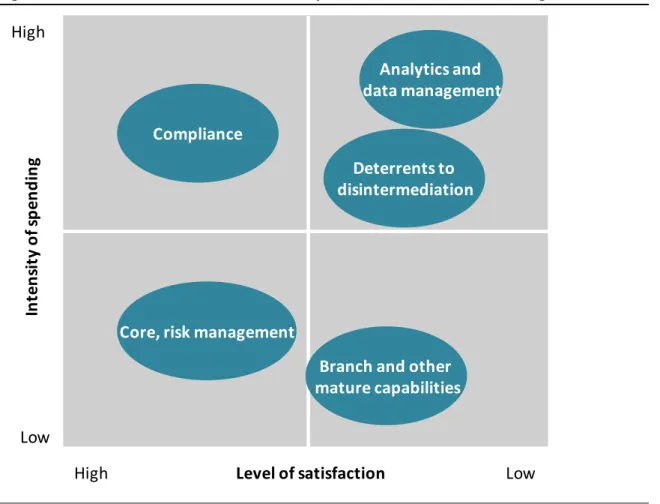
At a high level, several trends are apparent when the 52 technologies Aite Group examined in its survey are plotted according to banks' satisfaction level and spend probability (Figure 3
summarizes the types of technologies):
Banks are struggling to aggregate and analyze data. Technologies for the aggregation, storage, and analysis of data all appear in the upper right quadrant, characterized by high dissatisfaction and high likelihood for upward direction of spend.
These data-related technologies are closely related. Banks are likely dissatisfied with their abilities in multichannel integration, data warehousing, and data management, because these capabilities must be in place for a bank to perform business intelligence, performance management, and big data—technologies with which banks are also relatively dissatisfied and for which they are more likely to have an upward direction of planned spend.
Banks are concerned with deterring disintermediation and improving the customer
Figure 3: Banks' Satisfaction and Direction of Spend for the Examined Technologies
Source: Aite Group's global survey of 141 large banking institutions, Q1 2014
In banks' need to better deter disintermediation, aggregate data, and analyze it, Aite Group sees significant opportunities for multichannel integration and tablet-based branch banking.
M U L T I C H A N N E L I N T E G R A T I O N
Banks have many channels over which to sell services, extend credit, and accumulate data; these include online banking, mobile banking, call centers, and customer-facing loan officers. But Aite Group finds that banks are far better at building and utilizing these channels than they are at aggregating the data sets that are rapidly growing within these operations. Primary among the antidotes to the proliferation of poorly integrated data sets and capabilities, multichannel integration capabilities enable banks to combine disparate data sets so that analysts and
customer-facing employees have fuller pictures of their clients as both customers and creditors. Aite Group sees to benefits for banks that better use technology to aggregate data from different channels:
Improved productivity: Many banks achieve a moderate but insufficient level of multichannel integration by tasking in-house developers to develop custom code. Such custom code is used to aggregate data, warehouse it, and manage the
metadata (data about data), that enables various forms of analytics. Labor intensive,
High
Low
Low
High
Level of satisfaction
In
te
n
si
ty
o
f s
p
en
d
in
g
Analytics and
data management
Deterrents to
disintermediation
Compliance
Core, risk management
Branch and other
mature capabilities
error prone, and difficult to maintain over time, custom code is costly and brittle. Over time, new channels arise and old channels rapidly evolve; the more they are connected with custom code, the more slowly they will adapt to new opportunities and competitive challenges. Conversely, when automation is used to aggregate these data sets, or integration is baked into off-the-shelf prebuilt capabilities, banks will be able to reduce developer costs for the management and analysis of their data.
Better analytics: The more automated a bank's aggregation of multichannel data sets is, the better its analytics will be. After all, the proliferation of channel-related data sets is not just a problem of productivity; it's also a problem of visibility. The more automated multichannel integration is, the shorter the cycle times for
analytics deployments, and the broader the underlying data sets. Broader data sets exposed through analytics such as business intelligence, performance management, and big data allow for a fuller picture of a bank's customers and borrowers. And fuller pictures of customers are more than just business requirements for the analytics crowd—when underwriters have a fuller picture of their borrowers, they mitigate risk better, and when customer-facing staffers know more about their clients, upselling, cross-selling, and retention can all be improved.
I N - B R A N C H T A B L E T - B A S E D B A N K I N G
Although rapidly maturing and increasingly eclipsed by the Web and mobile devices, branches are still important to banks. Branches provide banks a venue in which to complete physical transactions that require hard copies of documents or the physical presence of a banker or customer. Branches are also a primary way for banks to enhance their brand and acquire new customers. Unfortunately, the economics of branch operations have become drastically more challenging: Although ATMs, mobile devices, and Web presences have reduced customer branch visits, these facilities still incur relatively unchanged levels of costs related to rent, maintenance, IT, and staffing, meaning that bankers must increasingly use every employee and square foot of real estate in a branch. To meet this need, Aite Group sees an important role for tablets and four attendant benefits for banks:
Increased branch utilization: In the absence of costly renovations, branches have a fixed number of offices and teller windows available for bank transactions.
Inherently fixed in their footprint and design, bank branches present few
opportunities for higher levels of productivity or revenue generation. Wireless and mobile, tablets can make branches far more flexible. Much like the staff roaming an Apple store, branch-based bankers with tablets can roam the branch, completing transactions in seating areas not originally designated for transactions and reducing wait times by increasing teller throughput. By rendering a branch's operations more flexible and increasing utilization rates, tablets enable bankers to increase branch earnings and returns on investment in this costly and maturing channel.
Enhanced customer experience: By bringing the banker to the customer, rather than
tablets make the customer feel more central and valued, a critical success factor when threatened with disintermediation.
Reduced abandonment: One of the biggest challenges in retail banking is process abandonment—the fatigue-induced stoppage of lengthy tasks such as account opening or credit applications. By bringing more modes of data capture, such as digital signatures and camera-based images, to bankers and their customers, tablets accelerate the many lengthy processes required to onboard customers and provide service. The easier such tasks are, the less they'll be abandoned … and the higher the rates of cross-sell and upsell branch personnel will achieve.
Better data: Aite Group expects tablet-based banking to deliver photo-based, structured, and digital data that is stronger than traditional means of data gathering, delivering bankers two benefits:
Improvements in accuracy: Long used for digital capture of check and bill data, tablets will also readily be used for customer onboarding and transaction administration. Such a change will eliminate many human processes that introduce errors into data sets.
Improvements in structure: By governing the acquisition of data in forms both photographic and digital, tablets will make data acquired at the branch more structured, leading to better integration of branch-generated data sets with information from other channels. As previously stated, the better a bank's multichannel integration, the better its views of customers, borrowers, sales opportunities, and credit risks.
CONCLUSION
Concerned with threats of disintermediation and dissatisfied with the management and analysis of their data, banks have an attractive opportunity to improve their retail operations'
investments in tablets and multichannel integration. To achieve these benefits, banks must keep the following in mind:
Seize the budget. Banks are dissatisfied with and planning to spend on both branch-based tablet banking and multichannel integration. As sources of pain and
destinations for funds, these technologies are ripe for championing by bankers who understand their potential benefits.
Make the business case. Capable of automating processes that are manual,
error-prone, and costly, both tablet-based branch banking and multichannel integration are capable of generating productivity benefits that should be used to justify their adoption.
Understand the strategic benefits of tablets. In addition to valuable productivity benefits, in-branch tablet-based banking is capable of delivering strategic benefits that are valuable to senior management. By making branch staff more mobile and reducing wait times, tablets enable branch bankers to improve the retail customer experience, always a goal of senior management and an effective tool in fending off banks' many threats of disintermediation. By improving the quality of data acquired at the branch, tablets also improve bank data management, analytics, and customer visibility.
Embrace the strategic benefits of multichannel integration. By enabling better aggregation of disparate data sets, multichannel integration enables banks to improve outcomes in five areas found by Aite Group to evoke disappointment in senior bankers: data management, data integration, business intelligence,
performance management, and big data. These technologies are sought by senior management not for their own sake but for their ability to generate full pictures of a bank's customers, borrowers, opportunities, and risks.
ABOUT AITE GROUP
Aite Group is an independent research and advisory firm focused on business, technology, and regulatory issues and their impact on the financial services industry. With expertise in banking, payments, securities & investments, and insurance, Aite Group’s analysts deliver comprehensive, actionable advice to key market participants in financial services. Headquartered in Boston with a presence in Chicago, New York, San Francisco, London, and Milan, Aite Group works with its clients as a partner, advisor, and catalyst, challenging their basic assumptions and ensuring they remain at the forefront of industry trends.
AUT H O R I N FO R MAT IO N
David O'Connell+617.338.6001
C O N TAC T
For more information on research and consulting services, please contact:
Aite Group Sales
+1.617.338.6050
For all press and conference inquiries, please contact:
Aite Group PR
+44.(0)207.092.8137
For all other inquiries, please contact: