Characterizing Approximate-Matching Dependencies in
Formal Concept Analysis with Pattern Structures
Jaume Baixeriesa , Victor Codocedoc, Mehdi Kaytouec,dand Amedeo Napolib
aDepartament de Ci`encies de la Computaci´o. Universitat Polit`ecnica de
Catalunya. 08032 Barcelona. Catalonia;
bLORIA (CNRS – Inria Nancy Grand-Est – Universit´e de Lorraine) B.P. 239,
54506 Vandœuvre-l`es-Nancy, France;
cUniversit´e de Lyon. CNRS, INSA-Lyon, LIRIS. UMR5205, F-69621, France dInfologic, 99 Avenue de Lyon, F-26500, Bourg-l`es-Valence, France
Abstract
Functional dependencies (FDs) provide valuable knowledge on the relations be-tween attributes of a data table. A functional dependency holds when the values of an attribute can be determined by another. It has been shown that FDs can be expressed in terms of partitions of tuples that are in agreement w.r.t. the values taken by some subsets of attributes. To extend the use of FDs, several generalizations have been proposed. In this work, we study approximate-matching dependencies that generalize FDs by relaxing the constraints on the attributes, i.e. agreement is based on a similarity relation rather than on equal-ity. Such dependencies are attracting attention in the database field since they allow uncrisping the basic notion of FDs extending its application to many dif-ferent fields, such as data quality, data mining, behavior analysis, data cleaning or data partition, among others. We show that these dependencies can be for-malized in the framework of Formal Concept Analysis (FCA) using a previous formalization introduced for standard FDs. Our new results state that, start-ing from the conceptual structure of a pattern structure, and generalizstart-ing the notion of relation between tuples, approximate-matching dependencies can be characterized as implications in a pattern concept lattice. We finally show how to use basic FCA algorithms to construct a pattern concept lattice that entails these dependencies after a slight and tractable binarization of the original data. Keywords: functional dependencies, similarity, tolerance relation, formal concept analysis, pattern structures, attribute implications.
1. Introduction
In the relational database model, functional dependencies (FDs) are among the most popular types of dependencies since they indicate a functional relation
between sets of attributes [1, 2, 3]: the values of a set of attributes are deter-mined by the values of another set of attributes. Such FDs can be used to check
5
the consistency and the quality of a database [4], but also to guide the database design [5].
However, the definition of FDs is too strict for several useful tasks, for in-stance when dealing with data imprecision i.e. errors and uncertainty in real-world data. To overcome this problem, different generalizations of FDs have
10
been defined. These generalizations can be classified according to the criteria by which they relax the equality condition of FDs [6]. According to this classi-fication, two main strategies are presented: “extent relaxation” and “attribute relaxation” (in agreement with the terminology introduced in [6]).
Characterizing and computing FDs are two tasks strongly related to lattice
15
theory. For example, lattice characterizations of a set of FDs are studied in [7, 8, 9, 10]. Following the same line, a characterization of FDs within Formal Concept Analysis (FCA) is proposed in [11]. In the latter case, FDs are shown to be in one-to-one correspondence with the set of implications of a formal context (binary table) generated from a database. However, such a formal context has
20
a quadratic number of objects w.r.t. the tuples of the original database. To avoid this, [12] and [13] show how to use pattern structures, introduced by [14] as an extension of FCA. Moreover, in [15] it is shown how this framework can be extended to Similarity Dependencies, another generalization of FDs.
Besides FCA and implications, there are many similarities between
associ-25
ation rules in data mining and FDs. This is discussed further in the present paper and as well in [16]. In the latter, a unifying framework in which any “well-formed” semantics for rules may be integrated is introduced. Similarly, this is also what we try to define in this paper for generalizations of FDs in the framework of FCA and Pattern Structures.
30
This paper presents an extended and updated version of [15] and its main objective is to give a characterization of FDs relaxing the attribute comparison within FCA thanks to the formalism of Pattern Structures. While our previ-ous work considered similarity dependencies, we extend the characterization to the family of approximate-matching dependencies using pattern structures and
35
tolerance relations [17, 18]. Furthermore, we show that the classical FCA al-gorithms can be –almost directly– applied to compute approximate-matching dependencies.
This paper is organized as follows. In Section 2 we introduce our notations and the definition of FDs. We present other kinds of generalization of FDs
40
in Section 3. In Section 4, we introduce tolerance relations and we show how the dependencies that are enumerated in Section 3 are based on tolerance re-lations. In Section 5 we propose a generic characterization and computation of approximate-matching dependencies in terms of Pattern Structures. In Sec-tion 6 we present a set of experiments to test the feasibility and scalability of
45
2. Notation and Functional Dependencies
We deal with datasets which are sets of tuples. LetU be a set of attributes andDom be a set of values (a domain). For the sake of simplicity, we assume thatDom is a numerical set. A tupletis a function t:U 7→Domand a table
50
T is a set of tuplesT ⊆Dom|U |. Sometimes the set notation is omitted and we writeabinstead of{a, b}.
Given a tuplet∈T andX ={x1, x2, . . . , xn} ⊆ U, we have: t[X] =ht(x1), t(x2), . . . , t(xn)i
t[X] is called theprojection ofX ontot. In Example 1, we havet2[{a, c}] =
ht2(a), t2(c)i = h6,6i. The definition can also be extended to a set of tuples. Given a set of tuplesS⊆T andX⊆ U, we have:
S[X] ={t[X]|t∈S}
Example 1. Table with tuplesT ={t1, t2, t3, t4}and attributesU ={a, b, c, d}. id a b c d
t1 3 5 6 3
t2 6 5 6 5
t3 3 10 6 3
t4 6 5 9 5
We now formally introduce functional dependencies [3].
55
Definition 1. Let T be a set of tuples (or a data table), and X, Y ⊆ U. A functional dependency (FD)X →Y holds in T if:
∀t, t0∈T :t[X] =t0[X]⇒t[Y] =t0[Y]
For example, the functional dependenciesa→dandd→ahold in the table of Example 1, whereas the functional dependency a → c does not hold since
t2(a) =t4(a) butt2(c)6=t4(c).
3. Generalizations of Functional Dependencies
Functional dependencies tell us which attributes are determined by other
60
attributes. As such, FDs are mainly used in databases to determine which attributes are thekeys of a dataset, i.e. the minimal sets of attributes (if any) determining all other attributes. This information is necessary for maintaining the consistency of the whole database. Moreover, this information can also be useful in data analysis or in data classification, because of the the semantics
65
attached to the “determined by” relationship.
However, in practical applications we usually have datasets that contain im-precise or uncertain information. Here, we do not meanfalse information, but
information that may contain errors. For example, let us consider a dataset containing information about the name and social security number (SSN) of
70
citizens. Although SSN is supposed to be unique for each individual, it appears that sometimes SSN is shared by more than one individual. In such a case, the FD‘‘social security number → name, surname’’would not hold, al-though we know that SSNdoes determine an individual. This is a case where FDs reveal inconsistencies or errors in a database. Actually, here we rely on
75
prior domain knowledge on the dataset, i.e. SSN is attached to a unique indi-vidual. Without this previous assumption, the fact that a FD such as‘‘social security number → name, surname’’does not hold, would not give us any relevant information.
In some other cases, FDs may fail to capture interesting relations among
80
attributes. For example, let us consider a dataset containing information about which brand of beer and TV sitcom are preferred by customers, involving at-tributes such as customer id, beer brand, tv sitcom. Now, assume that people preferring a specific brand of beer, saybeer X, also prefer sitcom Yin an overwhelming 95% of cases. This means that there are 5% of the cases in
85
which a customer preferringbeer X will prefer sitcom Z for example. These few cases prevent the FD beer brand → sitcom from holding, even if this dependency holds in a very large majority of the cases in the dataset.
To overcome the limitations of FDs, several generalizations have been intro-duced. These generalizations can be divided into two main groups, depending
90
on the strategy to relax the semantics of FDs [6]. These two categories are (1) “extent-relaxing dependencies” and (2) “attribute-relaxing dependencies”. Extent-relaxing dependencies relax the conditions on their extents and can be likened toassociation rules in data mining [19]. Attribute-relaxing dependen-cies relax the conditions on the equality condition of attributes. Here we are
95
more interested in attribute-relaxing dependencies.
More precisely, relaxation is applied to the equality condition t[X] =t0[X] and t[Y] = t0[Y] in the definition of FDs, which is replaced with a less con-strained condition. For example, we may replace the condition t[X] = t0[X] with a condition where botht[X] andt0[X] need to besufficiently close
accord-100
ing to a set of attributesX. Such a condition still induces a relation among the set of tuples as for FDs.
Then two categories of attribute-relaxing dependencies can be distinguished. Firstly “approximate-matching dependencies” are such that the attribute com-parison is computed by an approximation function, e.g. a distance function
105
among the values appearing in the dataset. Secondly, “order-like dependencies” are such that two values must be ordered instead of beingsomehow similar or close.
Hereafter we propose an extensive study of approximate-matching depen-dencies.
4. Characterization of Approximate-Matching Dependencies
Below we propose a minimal characterization of approximate-matching de-pendencies. This characterization will be sufficient for representing attribute-relaxing dependencies within the formalism of Pattern Structures.
4.1. Tolerance Relations
115
Firstly, we define a tolerance relation in a set T and then the associated blocks of tolerance. Tolerance relations are often used in the formalization of similarity [17, 18].
Definition 2. A tolerance relation θ ⊆ T ×T on a set T is a reflexive (i.e.
∀t∈T :tθt) and symmetric (i.e. ∀ti, tj∈T :tiθtj ⇐⇒ tjθti) relation. 120
Example 2. An often used tolerance relation is the similarity that can be defined within a set of integer values. Given two integer valuesv1, v2and a user-defined threshold: v1θv2⇐⇒ |v1−v2| ≤.
Practically, let t(M onth) denotes the value of attribute M onth for tuple t. The function∆M onth(m1, m2)defines the tolerance relationθM onth such as:
∆M onth(m1, m2) =min(|m1−m2|, min(m1, m2) + 12−max(m1, m2))
tiθM onthtj ⇐⇒ ∆M onth(ti(M onth), tj(M onth))≤4
ThenθM onthis the tolerance relation that considers two tuples similar if they
have values within 4 months of distance.
125
In [15] we usedtolerance relations to compare attribute values. In the fol-lowing, we continue in the same way and we introduce blocks of tolerance and operations on these blocks that will allow us to make precise the notion of “approximate-matching dependency”.
4.2. Blocks of Tolerance
130
A tolerance relation inducesblocks of tolerance as follows.
Definition 3. Given a setT, a subsetK⊆Tand a tolerance relationθ⊆T×T.
K is a block of tolerance ofθ if:
1. ∀ti, tj∈K:tiθtj (pairwise correspondence)
2. ∀ti6∈K,∃tj ∈K:¬(tiθtj)(maximality) 135
Given a set of tuples T and a set of attributesU, for each attributex∈ U, we define a tolerance relationθxon the values ofx. The set of tolerance blocks
induced byθx is denoted byT /θx.
Example 3. For example, whenT = {1,2,3,4,5},θ is defined as above, i.e.
v1θv2 ⇐⇒ |v1−v2| ≤, and = 2, then T /θ ={{1,2,3},{2,3,4},{3,4,5}}.
140
All of the tuples in a tolerance blockK∈T /θxare pairwisesimilaraccording
to their values w.r.t. x. Thus we have:
Property 1. ∀Ki, Kj ∈T /θ:Ki *Kj andKj *Ki for alli6=j
We can define a partial ordering on the set of all possible tolerance relations
145
in a setT as follows:
Definition 4. Let θ1 andθ2 two tolerance relations in the set T. We say that
θ1≤θ2 if and only if ∀Ki∈T /θ1: ∃Kj∈T /θ2:Ki⊆Kj
This relation is a partial ordering and induces a lattice classifying tolerance relations, or, equivalently, blocks of tolerance. Given two tolerance relations,θ1
150
andθ2, the meet and the join operations in this lattice are:
Definition 5. Let θ1 andθ2 two tolerance relations in the setT.
θ1∧θ2=θ1∩θ2= maxT({Ki∩Kj |Ki∈T /θ1, Kj ∈T /θ2})
θ1∨θ2=θ1∪θ2= maxT(T /θ1∪T /θ2)
wheremaxT(.)returns the set of maximal subsets w.r.t. inclusion. 155
Example 4. Based on Example 1, let us define the tolerance relationθmw.r.t.
an attributem∈ {a, b, c, d} as follows: tiθmtj ⇐⇒ |ti(m)−tj(m)| ≤. Then,
assuming that= 1, we have:
T /θa={{t1, t3},{t2, t4}} T /θb={{t1, t2, t4},{t3}}
T /θc ={{t1, t2, t3},{t4}} T /θd={{t1, t3},{t2, t4}} We can check the following meet and join operations:
θa∧θb={{t1},{t2, t4},{t3}} θa∨θb={{t1, t2, t3, t4}}
θa∧θc={{t1, t3},{t2},{t4}} θa∨θc={{t1, t2, t3, t4}}
θb∧θc={{t1, t2},{t3},{t4}} θb∨θc={{t1, t2, t3, t4}}
We can also extend the definition of a similarity relation on a single attribute to a similarity relation on sets of attributes. GivenX ⊆ U, the similarity relation
θX is defined as follows:
(ti, tj)∈θX ⇐⇒ ∀x∈X : (ti, tj)∈θx
Two tuples are similar w.r.t. a set of attributes X if and only if they are similar w.r.t. each attribute inX.
4.3. The definition of Approximate-Matching Dependencies
Definition 6. Let X, Y ⊆ U: X →Y be an approximate-matching dependency if and only if: ∀ti, tj∈T :tiθXtj→tiθYtj
160
While an FD X → Y is based on equality of values, an approximate-matching dependency X → Y holds if and only if, each pair of tuples having related values w.r.t. attributes inX hasrelated values w.r.t. attributes inY.
Example 5. Recalling again Example 1, we define the tolerance relation:
tiθmtj ⇐⇒ |ti(m)−tj(m)| ≤2
Then the following approximate-matching dependencies hold:
• a→d, ab→d, abc→d, ac→d, b→d, bc→d, c→d.
165
• It is interesting to notice that b →d is an approximate-matching depen-dency but not a functional dependepen-dency, ast1(b) =t2(b)andt1(d)6=t2(d).
• Because of the same pair of tuples, the approximate-matching dependency
bcd → a does not hold, as we have t1θbcdt2 but we do not have t1θat2,
since|t1(a)−t2(a)|2.
170
• By contrast, the functional dependency bcd→a holds because there is no pair of tuplesti, tj such that ti(bcd) =tj(bcd).
5. Approximate-Matching Dependencies in FCA
5.1. A Brief Introduction to Pattern Structures in FCA
A “Pattern Structure” allows a direct application of FCA over non-binary
175
and complex data [14]. Formally, letGbe a set of objects, let (D,u) be a meet-semi-lattice of potential object descriptions and letδ : G →D be a mapping associating each object with its description. Then (G,(D,u), δ) is a pattern structure. Elements ofD are patterns and are ordered thanks to a subsumption relationv, i.e. ∀c, d∈D,cvd⇐⇒cud=c.
180
A pattern structure (G,(D,u), δ) is based on two derivation operators de-noted as (·). ForA⊆Gandd∈D:
A= l
g∈A
δ(g) d ={g∈G|dvδ(g)}.
These operators form a Galois connection between (℘(G),∩) and (D,u), where℘(G) is the powerset ofG. Pattern concepts of (G,(D,u), δ) are pairs of the form (A, d),A ⊆G,d∈D, such thatA =dandA =d. For a pattern
185
concept (A, d),dis a pattern intent and is the common description of all objects inA, the pattern extent.
When partially ordered by (A1, d1) ≤(A2, d2) ⇔ A1 ⊆ A2 (⇔ d2 v d1), the set of all concepts forms a complete lattice called pattern concept lattice. 5.2. Characterization of Dependencies within Pattern Structures
190
Thanks to the formalism of pattern structures, approximate-matching de-pendencies can be characterized and computed in an elegant manner. A dataset can be represented as a pattern structure (U,(D,u), δ) where U is the set of original attributes, and (D,u) is the set of sets of tolerance blocks over the set of tuplesT provided with the meet operation introduced in Definition 5. The
195
description of an attributex∈ U is given byδ(x) =T /θx which is given by the
Example 6. An example of concept formation in the pattern structure is given as follows. Consider the table in Example 1. Starting from the set{a, c} ⊆ U
and assuming thattiθxtj ⇐⇒ |ti(x)−tj(x)| ≤2 for all attributes: 200
{a, c}=δ(a)uδ(c) = {{t
1, t3},{t2, t4}} u {{t1, t2, t3},{t4}} = {{t1, t3},{t2},{t4}}
{{t1, t3},{t2},{t4}} = {x∈ U |{{t1, t3},{t2},{t4}} vδ(x)}={a, c} Hence,({a, c},{{t1, t3},{t2},{t4}})is a pattern concept.
Then the pattern concept lattice allows us to characterize all approximate-matching dependencies holding inU:
Proposition 1. An approximate-matching dependencyX →Y holds in a table
T if and only if: {X}={X, Y} in the pattern structure(U,(D,u), δ).
205
Proof. First of all, it should be noticed that (t, t0) ∈ {X} if and only if
t(X)θXt0(X), or, equivalently,∀x∈X :t(x)θxt0(x).
Moreover, we also have that {X, Y} ⊆ {X} and that {X, Y} ⊆ {Y}
because of the anti-monotonicity of (.).
We first prove that if X → Y holds in T, then, {X} ={X, Y}, and in
210
particular that {X} ⊆ {X, Y}. We take an arbitrary pair (t, t0) ∈ {X},
i.e. t(X)θXt0(X). SinceX→Y holds, thent(X)θXt0(X)−→t(Y)θYt0(Y), and
thus (t, t0)∈ {Y}. This finally implies that (t, t0)∈ {X, Y}.
Conversely, suppose now that {X} = {X, Y}. Then, when t, t0 ∈ T is such that (t, t0) ∈ {X} (i.e. t(X)θXt0(X)), it comes that (t, t0) ∈ {X, Y}.
215
As{X, Y}⊆ {Y}, we can infer that (t, t0) ∈ {Y} and thus,t(Y)θYt0(Y). Then we can conclude thatX →Y holds inT.
This proposition is structurally the same as the one used in [13] to prove the characterization of functional dependencies with pattern structures. In this case, we have changed andrelaxedthe equality condition by the tolerance relationθ.
220
5.3. Characterization of Dependencies with Binarization in FCA
In [12] it is shown how the binarization of a tabular dataset can be per-formed. Binarization is also defined in [2] and [5] asagree sets, which are pairs of tuples that agree in all the values of a given set of attributes. The binarization procedure can be formalized as follows.
225
For a given table with tuples T and a set of attributes U, we define a bi-nary context K = (P air(T),U, I), where P air(T) = {ti, tj | i < j} and
((ti, tj), x) ∈ I (for all x ∈ U) if and only if ti(x) = tj(x). We
general-ize this notion of binarization to include a tolerance relation θ. To accom-plish this it suffices to define the formal contextKθ = (P air(T),U, Iθ) where 230
((ti, tj), x)∈Iθ ⇐⇒ tiθxtj.
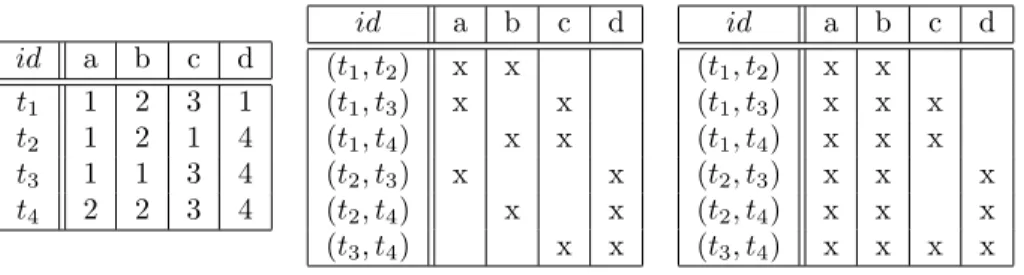
Figure 1 shows an example of a dataset T (left) and its associate clas-sical binarization K = (P air(T),U, I) (middle). The formal context Kθ =
id a b c d t1 1 2 3 1 t2 1 2 1 4 t3 1 1 3 4 t4 2 2 3 4 id a b c d (t1, t2) x x (t1, t3) x x (t1, t4) x x (t2, t3) x x (t2, t4) x x (t3, t4) x x id a b c d (t1, t2) x x (t1, t3) x x x (t1, t4) x x x (t2, t3) x x x (t2, t4) x x x (t3, t4) x x x x
Figure 1: A data table T (left) with associated binarized formal context (P air(T),U, I) (middle), and the generalization of the binarized formal context (P air(T),U, Iθ) taking tiθxtj ⇐⇒ |ti(x)−tj(x)|≤1.
(P air(T),U, Iθ) in Figure 1 (right) is obtained when defining tiθxtj ⇐⇒
|ti(x)−tj(x)| ≤1. 235
It turns out that the same relationship existing between implications and functional dependencies, also exists between approximate-matching dependen-cies and implications in this new generalization of a binarized formal context as shown in the following main result:
Proposition 2. Let T be a set of tuples, and U a set of attributes. The
240
approximate-matching dependencyX →Y (X, Y ⊆ U) holds inT if and only if the implicationX →Y holds in the formal contextKθ= (P air(T),U, Iθ).
Proof. The approximate-matching dependencies X→Y holds inT if and only if for all pairs of tuples ti, tj, we have that ∀x∈ X :tiθxtj implies that ∀y ∈ Y :tiθytj. The former occurs if and only if∀x∈X : ((ti, tj), x)∈Iθ, while the 245
latter occurs if and only if ∀y ∈ Y : ((ti, tj), y) ∈Iθ. It follows that X → Y
holds inKθ.
6. Experiments
Characterizations of approximate-matching dependencies through partition pattern structures [12] (Section 5.2), and through standard FCA by the
bina-250
rization of a dataset (Section 5.3) are said to be “equivalent” as they yield isomorphic concept lattices.
In this section, we experiment with both methods to highlight their strengths and weaknesses. Experiments were performed over an Intel Xeon machine with 6 cores running at 2.27GHz and 32GB of RAM machines. All algorithms were
255
implemented in C++ and compiled with the−O3 optimization. 6.1. Dataset Description and Experimental Settings
Experiments were performed over 3 datasets from the UCI machine learning repository and 3 datasets from the JASA data archive, namely thediagnosis1,
contraceptive2,servo3,caulkins4,hughes-r5, andpglw006datasets, described in
260
Table 2.
For thecaulkins dataset we did not considered the columns with redundant information about the weight of the entry –there were two columns indicating this weight, one with the original information and another with its correspon-dent gram representation; we used the gram representation– and the column
265
containing the value “gram” for every object. For the hughes-r dataset we added four binary values encoding metadata for the first three columns. Addi-tionally, we modeled negative values as “missing data” which in our case means that two tuples are considered dissimilar if they both have “missing data” for a given attribute. Changes to other datasets are just related to the conversion of
270
categorical entries represented with a string to a number.
Datasets are binarized by generating a formal context with|T|2objects and
|U | attributes. An object in the formal context represents two tuples and its attributes are those for which both tuples havesimilar values. Formal contexts are also clarified by fusing objects with the same attributes [11]. Clarification
275
has no effect on the calculation of dependencies but can significantly reduce the size of the formal context. We report results for both non-clarified and clarified formal contexts. Formal concepts were calculated using an implementation of theAddIntent7 algorithm [20] from which approximate-matching dependencies can be characterized.
280
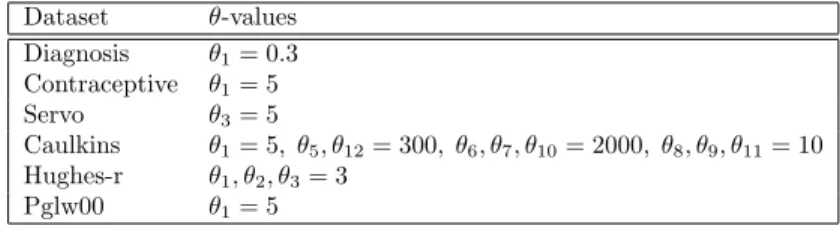
Pattern structures are generated from each dataset by considering a set of similarity parameters θx for each attribute x ∈ U. Binary and categorical
attributes were considered as numerical attributes provided with aθvalue of 0. Table 1 shows the different values taken byθfor all datasets. These values were selected arbitrarily.
285
In order to be fair with the comparison of both approaches, we have modified the sameAddIntentimplementation to process pattern structures. This modifi-cation consisted in overriding the computation of description intersections and the subsumption test for any two descriptions. Both operations require |T|2 operations in the worst case scenario. For the sake of efficiency, we used striped
290
descriptions, i.e. we do not keep in memory tolerance blocks that are singletons as in [9] and [12].
6.2. Experimental Results
Table 2 reports on the execution times for building the concept lattices for both, the binarization approach (non-clarified and clarified), and pattern
295
structures. For non-clarified and clarified formal contexts, execution times are reported as a sum of a preprocessing time (binarization/clarification) and the
2http://archive.ics.uci.edu/ml/datasets/Contraceptive+Method+Choice 3 http://archive.ics.uci.edu/ml/datasets/Servo 4http://lib.stat.cmu.edu/jasadata/caulkins-p 5http://lib.stat.cmu.edu/jasadata/hughes-r 6http://lib.stat.cmu.edu/jasadata/pglw00.zip 7https://github.com/codocedo/sephirot/
Dataset θ-values Diagnosis θ1= 0.3 Contraceptive θ1= 5 Servo θ3= 5 Caulkins θ1= 5, θ5, θ12= 300, θ6, θ7, θ10= 2000, θ8, θ9, θ11= 10 Hughes-r θ1, θ2, θ3= 3 Pglw00 θ1= 5
Table 1: Similarity parameters (theta values) for each dataset. Parameters not reported are set to zero.
Pattern structures(M,(D,u), δ)
Dataset |M| |T|=|G| #Con. Num. Cat. Exec. Time [s]
Diagnosis 8 120 98 1 7 0.81 Contraceptive 10 1473 1024 1 9 734.2 Servo 5 167 28 1 4 1.30 Caulkins 12 1685 2704 9 3 19783.3 Hughes-r 12 401 754 3 9 24.35 Pglw00 6 17995 64 1 5 55.84 Formal context(B2(G), M, I)
Dataset |G| |M| #Con. Num. Cat. Exec. Time [s]
Diagnosis 7082 8 98 1 7 0.32 + 0.09 Contraceptive 1082307 10 1024 1 9 120.46 + 47.6 Servo 13688 5 28 1 4 0.54 + 0.1 Caulkins 1412827 12 2704 9 3 168.19 + 102.249 Hughes-r 80200 12 754 3 9 5.11 + 3.85 Pglw00 161892017 6 64 1 5
-Formal context(B2(G), M, I)clarified
Dataset |G| |M| #Con. Num. Cat. Exec. Time [s]
Diagnosis 50 8 98 1 7 0.32 + 0.02 Contraceptive 1017 10 1024 1 9 120.46 + 0.089 Servo 25 5 28 1 4 0.54 + 0.006 Caulkins 1146 12 2704 9 3 168.19 + 0.169 Hughes-r 1054 12 754 3 9 5.11 + 0.063 Pglw00 - 6 64 1 5
-Table 2: Datasets and execution times (Con. : Concepts. Num. : # Numerical attributes. Cat. : # Categorical attributes. The symbol ”-” indicates that the value could not be obtained by computational limitations.
execution time of the AddIntent algorithm, respectively. Clarification is per-formed using a linear hashing approach during the binarization process, thus the pre-processing time for both cases is the same. For pattern structures,
ex-300
ecution times consider the time needed for the transformation of the numerical dataset into a pattern structure as well as the calculation of the concept lattice. For all datasets, with the exception of pglw00 using binarization showed more efficient than processing the equivalent pattern structure.
An interesting exception occurs with the dataset pglw00. Since the dataset
305
contains around 104 tuples, its binarization should yield a formal context with more than 108objects (roughly 161 millions). This sheer size of elements makes prohibitive the calculation of the concept lattice derived from both the formal
context and the clarified formal context. To illustrate this fact consider that if each object could be represented by only a single integer variable with size
310
8 bytes, then the whole formal context would have a size of around 1 GB of memory (this would be the best case scenario). This is particularly interesting considering that the formal context contains only 6 attributes, meaning that the concept lattice can contain up to 64 formal concepts.
6.3. Synthesis
315
Under the evidence shown by the experimental results, we can conclude that the use of pattern structures is of critical importance for mining approximate-matching dependencies in medium-large datasets, where binarization and clar-ification are not possible due to computational limitations. Nevertheless, for sufficiently small datasets, the evidence shows that using standard FCA is a
320
better option. The scripts and binaries necessary to replicate the experiments are freely available on-line8.
7. Related Work and Discussion
Dependency theory has been an important subject of database theory for more than thirty years. Several types of dependencies have been proposed,
325
capturing different semantics useful for different applications such as query op-timization, normalization, data cleaning, error detection, among others.
FDs are first class citizens for checking the consistency and the quality of a database [21, 4, 22], and as well for guiding the database design [5]. In partic-ular, when considering the web of data and RDF triples, FDs can be used for
330
checking completeness and quality of the data. In [23, 24], authors are studying information integration in the web of data with varying degrees of quality. FDs are used for detecting triples which are erroneous w.r.t. domain knowledge. In the same way, in [25], authors are interested in using implications derived from RDF data, i.e. a special kind of FDs, for checking data completeness in
DBpe-335
dia. The transformation of RDF data into a pattern structure and the following extraction of implications and their inverse are the basis of this research work. Actually, approximate-matching dependencies could be used for extending this research as they would be very well adapted for dealing with imperfect RDF data. This line of research work in RDF data points out the growing importance
340
of FDs for complex data such as RDF triples and graphs [26].
As already discussed above, standard functional dependencies are not al-ways suitable for managing several tasks and data settings. Accordingly, many generalizations have been proposed over the last decades, which were recently and exhaustively reviewed and classified in [6]. This classification separates (i)
345
extent relaxationsfrom (ii)attribute-comparison relaxations. In the former, FDs are relaxed on their coverage, e.g. a functional dependency only holds in a sub-set of the data. In the latter, the notion of agreement between two tuples for a
Example 7. An example based on “Average Daily Temperature Archive” show-ing the monthly average temperatures for different cities [31].
id Month Year Av. Temp. City
t1 1 1995 36.4 Milan t2 1 1996 33.8 Milan t3 5 1996 63.1 Rome t4 5 1997 59.6 Rome t5 1 1998 41.4 Dallas t6 1 1999 46.8 Dallas t7 5 1996 84.5 Houston t8 5 1998 80.2 Houston
given attribute is revisited leading to two main subtypes of dependencies. The equality between two values is relaxed for approximate-matching dependencies
350
while an ordering between values must be respected for ordered dependencies. The general assumption for extent relaxations is that a FD does not neces-sarily hold in the whole dataset. A FDX →Y holds in a tableTif and only if it holds “for all” pairs of tuples inT. This is precisely this “for all” condition that should be relaxed, i.e. the extent of the table in which this condition must hold.
355
There are several ways to relax the universal condition. A threshold can be given as a percentage such as “Approximate Dependencies” [27], as an impurity function such as “Purity Dependencies” [28], as a minimal number of tuples for each attribute such as “Numerical Dependencies” [29], or as a probability such as “Probabilistic functional dependencies” [30].
360
For example, considering the dependency Month→Av.Temp in Example 7, we can check that 6 tuples should be removed before verifying the dependency: we keep only one tuple forMonth 1 and one tuple for Month 5 (actually just as if we remove “duplicates”). Then, if the threshold is equal to or larger than 75%,Month→Av.Temp is a valid approximate dependency.
365
Attribute-comparison relaxations include “Attribute-Relaxing Dependencies” and form the second main group of generalizations of FDs. Here, the relaxation holds on the equality condition, which is replaced with a less constrained con-dition, e.g. “sufficiently close” according to a set of attributes. Then it is pos-sible to distinguish “approximate-matching dependencies” where the attribute
370
comparison is computed thanks to an approximation function, e.g. a distance function, and “order-like dependencies” where values must be ordered instead of being similar.
In this way, “Neighborhood Dependencies” are defined to express regularities in datasets [32]. Given a FDX →Y and a tuplet, the value oft[X]determines
375
the value oft[Y]. Then the value oft[Y] is determined not only by the value of
t[X] but also by theneighbor values oft[X].
functionsθM onth andθAv.T emp.as follows:
θM onth(m1, m2) = 1−
min(|m1−m2|, min(m1, m2) + 12−max(m1, m2)) 12
θAv.T emp.(t1, t2) = 1−
|t1−t2|
max(Av.T emp.)−min(Av.T emp)
These functions can be extended into a predicate such as: θM onth(m1, m2)≥ 0.5 andθAv.T emp.(t1, t2)≥0.5. Then we can define a neighborhood dependency as follows: θM onth →θAv.T emp. If the values of the attributeM onth in a pair 380
of tuples areclose enough, then, the values of the attributeAv.T empare also close.
Furthermore, “Differential Dependencies” are defined to extend the notion of equality in FDs [33] They are used to detect violations or inconsistencies in datasets, to optimize queries, to partition data in parts that are somehow
385
similar or detect duplicates in datasets. They are based on a metric distance where each attribute is associated with a different metric distance depending on the nature of the attribute values. Specific constraints can also be attached to some particular attributes w.r.t. domain knowledge.
For example, a differential function over an attribute x∈X and a pair of
390
tuples t, t0 can be defined as a Boolean function that evaluates true when a constraint on the valuesθ(t[X], t0[X]) holds. Such a constraint can be specified thanks to comparison operators, i.e. {=, <, >,≤,≥}, and a threshold δ, e.g.
θ(t[x], t0[x])≤δ. Then each attribute has a metric distanceθand an associated constraint, as for neighborhood dependencies. The differential functionθ also
395
induces a relation among the set of tuples according to a set of attributesX ⊆ U
as θM onth(m1, m2) and θAv.T emp.(t1, t2) were defined above for neighborhood dependencies.
Going back to FCA, we have used tolerance relations for computing FDs in [18, 13]. Tolerance relations provide an elegant support for characterizing
400
FDs and approximate-matching dependencies as well. Actually, implications in a formal context exactly correspond to the set of FDs as discussed in [11, 34]. In addition, the relations with conditional FDs, association rules and FCA are also studied in [35, 36].
Moreover, order-like dependencies are studied in the framework of FCA in
405
[37]. They cannot be directly handled in the present framework, as not only blocks of tolerances should be considered, but also the ordering of the objects in each block should coincide as well [38, 6]. Actually, searching for these ordered dependencies is related to the mining of closed gradual itemsets [39]. A first FCA characterization of such a mining problem is provided in a “kind of” pattern
410
structure of sequential patterns [40].
8. Conclusion
In this paper, we have presented a generalization of functional dependen-cies, namely approximate-matching dependendependen-cies, which accounts for “uncrisp
dependencies” in the sense that two attribute values are considered as “equal” as
415
soon as they belong to a given interval, i.e. small variations over attribute values are allowed. We discussed how this family of functional dependencies is relevant and share a main basic feature, i.e. a similarity measure depending on the se-mantics of each attribute. In addition, we have presented a characterization of this family of dependencies using the formalism of pattern structures extending
420
from previous results that frames functional dependencies in the framework of formal concept analysis. This provides an efficient computational framework acknowledged by a series of experimental studies.
Our major result shows that the underlying model for all approximate-matching dependencies can be formalized using tolerance relations for
compar-425
ing values between tuple attributes, just as equivalence relations –or equivalently partitions– gives the underlying model for standard functional dependencies.
In our future research work, we will be mainly interested in ordered depen-dencies and in the use of approximate-matching dependepen-dencies in classifying the RDF triples in the web of data.
430
Acknowledgments. This research work has been supported by the SGR2014-890 (MACDA) project of the Generalitat de Catalunya, and MINECO project APCOM (TIN2014-57226-P) and partially funded by the French National Project FUI AAP 14 Tracaverre 2012-2016.
References 435
[1] D. Maier, The Theory of Relational Databases, Computer Science Press, 1983.
[2] C. Beeri, M. Dowd, R. Fagin, R. Statman, On the Structure of Armstrong Relations for Functional Dependencies, Journal of the ACM 31 (1) (1984) 30–46.
440
[3] J. Ullman, Principles of Database Systems and Knowledge-Based Systems, volumes 1–2, Computer Science Press, Rockville (MD), USA, 1989. [4] W. Fan, F. Geerts, Foundations of Data Quality Management, Synthesis
Lectures on Data Management, Morgan & Claypool Publishers, 2012. [5] H. Mannila, K.-J. R¨aih¨a, The Design of Relational Databases,
Addison--445
Wesley, Reading (MA), USA, 1992.
[6] L. Caruccio, V. Deufemia, G. Polese, Relaxed Functional Dependencies – A Survey of Approaches, IEEE Transactions on Knowledge and Data Engineering 28 (1) (2016) 147–165.
[7] A. Day, The lattice theory of fonctionnal dependencies and normal
decom-450
positions, International Journal of Algebra and Computation 02 (04) (1992) 409–431.
[8] J. Demetrovics, G. Hencsey, L. Libkin, I. B. Muchnik, Normal Form Re-lation Schemes: A New Characterization, Acta Cybernetica 10 (3) (1992) 141–153.
455
[9] S. Lopes, J.-M. Petit, L. Lakhal, Functional and Approximate Dependency Mining: Database and FCA Points of View, Journal of Experimental and Theoretical Artificial Intelligence 14 (2-3) (2002) 93–114.
[10] N. Caspard, B. Monjardet, The Lattices of Closure Systems, Closure Op-erators, and Implicational Systems on a Finite Set: A Survey, Discrete
460
Applied Mathematics 127 (2) (2003) 241–269.
[11] B. Ganter, R. Wille, Formal Concept Analysis, Springer, Berlin, 1999. [12] J. Baixeries, M. Kaytoue, A. Napoli, Computing Functional Dependencies
with Pattern Structures, in: L. Szathmary, U. Priss (Eds.), Concept Lat-tices and Applications, CLA, Vol. 972 of CEUR Workshop Proceedings,
465
CEUR-WS.org, 2012, pp. 175–186.
[13] J. Baixeries, M. Kaytoue, A. Napoli, Characterizing Functional Depen-dencies in Formal Concept Analysis with Pattern Structures, Annals of Mathematics and Artificial Intelligence 72 (1–2) (2014) 129–149.
[14] B. Ganter, S. O. Kuznetsov, Pattern Structures and Their Projections, in:
470
H. S. Delugach, G. Stumme (Eds.), Conceptual Structures: Broadening the Base, Proceedings of the 9th International Conference on Conceptual Structures (ICCS 2001), LNCS 2120, Springer, 2001, pp. 129–142.
[15] J. Baixeries, M. Kaytoue, A. Napoli, Computing Similarity Dependencies with Pattern Structures, in: M. Ojeda-Aciego, J. Outrata (Eds.), Concept
475
Lattices and Applications, CLA, Vol. 1062 of CEUR Workshop Proceed-ings, CEUR-WS.org, 2013, pp. 33–44.
[16] M. Agier, J. Petit, E. Suzuki, Unifying Framework for Rule Semantics: Application to Gene Expression Data, Fundamenta Informaticae 78 (4) (2007) 543–559.
480
[17] S. O. Kuznetsov, Galois Connections in Data Analysis: Contributions from the Soviet Era and Modern Russian Research, in: B. Ganter, G. Stumme, R. Wille (Eds.), Formal Concept Analysis, Foundations and Applications, Lecture Notes in Computer Science 3626, Springer, 2005, pp. 196–225. [18] M. Kaytoue, Z. Assaghir, A. Napoli, S. O. Kuznetsov, Embedding tolerance
485
relations in formal concept analysis: an application in information fusion, in: CIKM, ACM, 2010, pp. 1689–1692.
[19] R. Agrawal, H. Mannila, R. Srikant, H. Toivonen, A. I. Verkamo, Fast Discovery of Association Rules, in: Advances in Knowledge Discovery and Data Mining, AAAI/MIT Press, 1996, pp. 307–328.
[20] S. O. Kuznetsov, S. A. Obiedkov, Comparing performance of algorithms for generating concept lattices, Journal of Experimental and Theoretical Artificial Intelligence 14 (2–3) (2002) 189–216.
[21] W. Fan, Dependencies revisited for improving data quality, in: M. Lenz-erini, D. Lembo (Eds.), Proceedings of the Twenty-Seventh ACM
495
SIGMOD-SIGACT-SIGART Symposium on Principles of Database Sys-tems, PODS 2008, June 9-11, 2008, Vancouver, BC, Canada, ACM, 2008, pp. 159–170.
[22] W. Fan, Data quality: From theory to practice, SIGMOD Rec. 44 (3) (2015) 7–18.
500
[23] Y. Yu, J. Heflin, Extending functional dependency to detect abnormal data in RDF graphs, in: L. Aroyo, C. Welty, H. Alani, J. Taylor, A. Bernstein, L. Kagal, N. F. Noy, E. Blomqvist (Eds.), The Semantic Web - ISWC 2011 - 10th International Semantic Web Conference, Bonn, Germany, October 23-27, 2011, Proceedings, Part I, Vol. 7031 of Lecture Notes in Computer
505
Science, Springer, 2011, pp. 794–809.
[24] Y. Yu, Y. Li, J. Heflin, Detecting abnormal semantic web data using seman-tic dependency, in: Proceedings of the 5th IEEE International Conference on Semantic Computing (ICSC 2011), Palo Alto, CA, USA, September 18-21, 2011, 2011, pp. 154–157.
510
[25] M. Alam, A. Buzmakov, V. Codocedo, A. Napoli, Mining definitions from RDF annotations using formal concept analysis, in: Q. Yang, M. Wooldridge (Eds.), Proceedings of the Twenty-Fourth International Joint Conference on Artificial Intelligence, IJCAI 2015, Buenos Aires, Ar-gentina, July 25-31, 2015, AAAI Press, 2015, pp. 823–829.
515
[26] W. Fan, Y. Wu, J. Xu, Functional dependencies for graphs, in: F. ¨Ozcan, G. Koutrika, S. Madden (Eds.), Proceedings of the 2016 International Con-ference on Management of Data, SIGMOD ConCon-ference 2016, San Francisco, CA, USA, June 26 - July 01, 2016, ACM, 2016, pp. 1843–1857.
[27] Y. Huhtala, J. K¨arkk¨ainen, P. Porkka, H. Toivonen, TANE: An Efficient
Al-520
gorithm for Discovering Functional and Approximate Dependencies, Com-puter Journal 42 (2) (1999) 100–111.
[28] D. A. Simovici, D. Cristofor, L. Cristofor, Impurity measures in databases, Acta Informatica 38 (5) (2002) 307–324.
[29] J. Grant, J. Minker, Normalization and axiomatization for numerical
de-525
pendencies, Information and Control 65 (1) (1985) 1 – 17.
[30] 12th International Workshop on the Web and Databases, WebDB 2009, Providence, Rhode Island, USA, June 28, 2009.
[31] U. of Dayton, Environmental Protection Agency Average Daily Tempera-ture Archive.
530
[32] R. Basse, J. Wijsen, Neighborhood Dependencies for Prediction, in: D. Cheung, G. Williams, Q. Li (Eds.), Advances in Knowledge Discov-ery and Data Mining, Vol. 2035 of Lecture Notes in Computer Science, Springer Berlin Heidelberg, 2001, pp. 562–567.
[33] S. Song, L. Chen, Differential Dependencies: Reasoning and Discovery,
535
ACM Transactions on Database Systems 36 (3) (2011) 16:1–16:41.
[34] J. Baixeries, Lattice Characterization of Armstrong and Symmetric Depen-dencies (PhD Thesis), Universitat Polit`ecnica de Catalunya, 2007.
[35] R. Medina, L. Nourine, A Unified Hierarchy for Functional Dependencies, Conditional Functional Dependencies and Association Rules, in: S. Ferr´e,
540
S. Rudolph (Eds.), International Conference on Formal Concept Analysis, ICFCA, Vol. 5548 of Lecture Notes in Computer Science, Springer, 2009, pp. 98–113.
[36] R. Medina, L. Nourine, Conditional Functional Dependencies: An FCA Point of View, in: L. Kwuida, B. Sertkaya (Eds.), International
Confer-545
ence on Formal Concept Analysis, ICFCA, Vol. 5986 of Lecture Notes in Computer Science, Springer, 2010, pp. 161–176.
[37] V. Codocedo, J. Baixeries, M. Kaytoue, A. Napoli, Characterization of Order-like Dependencies with Formal Concept Analysis, in: M. Huchard, S. Kuznetsov (Eds.), Proceedings of the Thirteenth International
Confer-550
ence on Concept Lattices and Their Applications, CLA 2016, Moscow, Russia, July 18-22., Vol. 1624 of CEUR Workshop Proceedings, CEUR-WS.org, 2016, pp. 123–134.
[38] W. Ng, Ordered functional dependencies in relational databases, Informa-tion Systems 24 (7) (1999) 535 – 554.
555
[39] T. D. T. Do, A. Termier, A. Laurent, B. N´egrevergne, B. O. Tehrani, S. Amer-Yahia, PGLCM: efficient parallel mining of closed frequent gradual itemsets, Knowledge and Information Systems 43 (3) (2015) 497–527. [40] S. Ayouni, A. Laurent, S. B. Yahia, P. Poncelet, Mining Closed Gradual
Patterns, in: L. Rutkowski, R. Scherer, R. Tadeusiewicz, L. A. Zadeh,
560
J. M. Zurada (Eds.), Artificial Intelligence and Soft Computing, 10th In-ternational Conference, ICAISC 2010, Zakopane, Poland, June 13-17, 2010, Part I, Vol. 6113 of Lecture Notes in Computer Science, Springer, 2010, pp. 267–274.