Combining OCR Outputs for Logical Document Structure Markup
Technical Background to the ACL 2012 Contributed Task
Ulrich Schäfer Benjamin Weitz
DFKI Language Technology Lab
Campus D 31, D-66123 Saarbrücken, Germany
{ulrich.schaefer|benjamin.weitz}@dfki.de
Abstract
We describe howpaperXML, a logical docu-ment structure markup for scholarly articles, is generated on the basis of OCR tool out-puts. PaperXMLhas been initially developed for the ACL Anthology Searchbench. The main purpose was to robustly provide uni-form access to sentences in ACL Anthology papers from the past 46 years, ranging from scanned, typewriter-written conference and workshop proceedings papers, up to recent high-quality typeset, born-digital journal arti-cles, with varying layouts.PaperXMLmarkup includes information on page and paragraph breaks, section headings, footnotes, tables, captions, boldface and italics character styles as well as bibliographic and publication meta-data. The role ofpaperXMLin the ACL Con-tributed TaskRediscovering 50 Years of Dis-coveriesis to serve as fall-back source (1) for older, scanned papers (mostly published be-fore the year 2000), for which born-digital PDF sources are not available, (2) for born-digital PDF papers on which thePDFExtract method failed, (3) for document parts where PDFExtract does not output useful markup such as currently for tables. We sketch trans-formation of paperXML into the ACL Con-tributed Task’s TEI P5 XML.
1 Introduction
Work on the ACL Anthology Searchbench started in 2009. The goal was to provide combined sentence-semantic, full-text and bibliographic search in the complete ACL Anthology (Schäfer et al., 2011), and a graphical citation browser with citation sentence context information (Weitz & Schäfer, 2012). Since
the ACL-HLT 2011 conference, the Searchbench is available as a free, public service1.
A fixed subset of the Anthology, the ACL An-thology Reference Corpus2 (ACL-ARC), contains various representations of the papers such as PDF, bitmap and text files. The latter were generated with PDFBox3 and OCR (Omnipage4), applied to the PDF files or bitmap versions thereof. Its static nature as infrequently released reference corpus and low character recognition quality especially of older, badly scanned papers, made us to look for alterna-tives. For quick, automatic updates of the Search-bench index, a robust method for getting the text from old and new incoming PDF files was needed.
After a thorough comparison of different PDF-to-text extraction tools, a decision was made to process every PDF paper in the Anthology with ABBYY PDF Transformer5, for various reasons. It ran stably and delivered good character recognition rates on both scanned, typewriter-typeset proceeding papers as well as on born-digital PDF of various sources, even on papers where PDFbox failed to extract (us-able) text. Reading order recovery, table recognition and output rendering (HTML) was impressive and de-hyphenation for English text worked reasonably well. All in all, ABBYY did not deliver perfect re-sults, but at that time was the best and quickest so-lution to get most of the millions of sentences from the papers of 46 years.
The role of this OCR-based approach in the ACL
1http://aclasb.dfki.de
2http://acl-arc.comp.nus.edu.sg 3http://pdfbox.apache.org 4http://www.nuance.com/omnipage 5http://www.abbyy.com
Contributed TaskRediscovering 50 Years of Discov-eries (Schäfer et al., 2012) is to serve as fall-back source when the more precise PDFExtract method (Berg et al., 2012) is not applicable.
2 Target Format
The focus of the Searchbench text extraction process was to retrieve NLP-parsable sentences from scien-tific papers. Hence distinguishing running text from section headings, figure and table captions or foot-notes was an important intermediate task.
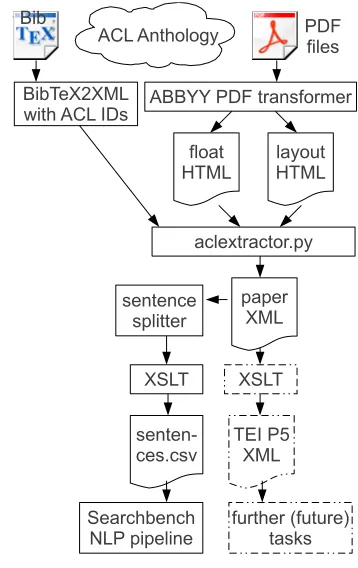
PaperXML is a simple logical document markup structure we specifically designed for scientific pa-pers. It features tags for section headings (with spe-cial treatment of abstract and references), footnotes, figure and table captions. The full DTD is listed in the Appendix. A sample document automatically generated by our extraction tool is displayed in Fig-ure 2 on the next page. In paperXML, figures are ignored, but table layouts and character style infor-mation such as boldface or italics are preserved.
3 Algorithm
Volk et al. (2010) used two different OCR prod-ucts (the above mentioned Omnipage and ABBYY) and tried to improve the overall recognition accuracy on scanned text by merging their outputs. This ap-proach adds the challenge of having to decide which version to trust in case of discrepancy. Unlike them, we use a single OCR tool, ABBYY, but with two dif-ferent output variants,layoutandfloat, that in parts contain complementary information. As no direct XML output mode exists, we rely on HTML output that can also be used to render PDF text extraction results in a Web browser.
3.1 Core rich text and document structure extraction
Our algorithm uses the layout variant as primary source. Layout tries to render the extracted text as closely as possible to the original layout. It pre-serves page breaks and the two-column formatting that most ACL Anthology papers (except the CL Journal and some older proceedings) share.
In the floatvariant, page and line breaks as well as multiple column layout are removed in favour of a running text in reading order which is indispensable
for our purposes. However, some important layout-specific information such as page breaks is not avail-able in thefloatformat. Both variants preserve table layouts and character style information such as bold-face or italics. Reading order in both variants may differ. A special code part ensures that nothing is lost when aligning the variants.
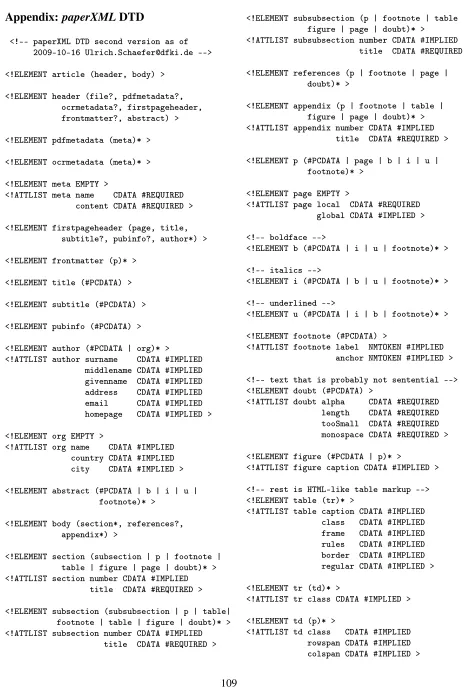
[image:2.612.339.518.230.514.2]We implemented a Python6 module that reads both HTML variants and generates a consolidated XML condensate, paperXML. It interprets textual content, font and position information to identify the logical structure of a scientific paper.
Figure 1: PDF-to-paperXMLworkflow
Figure 1 depicts the overall workflow. In addi-tion to the two HTML variants, the code also reads BIBTEX metadata in XML format of each paper.
A rather large part in the document header of the generatedpaperXML addresses frontpage and bib-liographic metadata. Section 3.2 explains why and how this information is extracted and processed.
Using XSLT7,paperXMLis then transformed into a tab-separated text file that basically contains one sentence per line plus additional sentence-related
<?xmlversion="1.0"encoding="UTF-8"?> <article>
<header>
<firstpageheader>
<pagelocal="1"global="46"/>
<title>Task-oriented Evaluation of Syntactic Parsers and Their Representations</title>
<pubinfo>Proceedings ofACL-08: HLT,pages 46-54, Columbus, Ohio, USA, June 2008. ©2008 Association [...]</pubinfo> <authorsurname="Miyao"givenname="Yusuke">
<orgname="University of Tokyo"country="Japan"city="Tokyo"/> </author>
[...]
</firstpageheader> <frontmatter>
<p><b>Task-oriented Evaluation of Syntactic Parsers and Their Representations</b></p>
<p><b>Yusuke Miyao<footnoteanchor="1"/>" Rune Saetre<footnoteanchor="1"/>" Kenji Sagae
<footnoteanchor="1"/>" Takuya Matsuzaki<footnoteanchor="1"/>" Jun’ichi Tsujii<footnoteanchor="1"/>"**</b> ^Department of Computer Science, University of Tokyo, Japan * School of Computer Science, University of Manchester, UK *National Center for Text Mining, UK</p>
<p>{yusuke,rune.saetre,sagae,matuzaki,tsujii}@is.s.u-tokyo.ac.jp</p> </frontmatter>
<abstract>This paper presents a comparative evaluation of several state-of-the-art English parsers [...]</abstract> </header>
<body>
<sectionnumber="1"title="Introduction">
<p>Parsing technologies have improved considerably in the past few years, and high-performance syntactic parsers are no longer limited to PCFG-based frameworks (Charniak, 2000; [...]</p>
</section>
<sectionnumber="2"title="Syntactic Parsers and Their Representations">
<p>This paper focuses on eight representative parsers that are classified into three parsing frameworks: <i>dependency parsing, phrase structure parsing,</i>and<i>deep parsing.</i>[...]</p>
<subsectionnumber="2.1"title="Dependency parsing">
<p>Because the shared tasks of CoNLL-2006 and CoNLL-2007 focused [...]</p>
<p><b>mst</b>McDonald and Pereira (2006)’s dependency parser,<footnoteanchor="1"/>based on the Eisner algorithm for projective dependency parsing (Eisner, 1996) with the second-order factorization.</p>
<footnotelabel="1">http://sourceforge.net/projects/mstparser</footnote> <figurecaption="Figure 1: CoNLL-X dependency tree"/>
</subsection> [...]
<subsectionnumber="4.2"title="Comparison of accuracy improvements"> <p>Tables 1 and 2 show the accuracy [...]</p>
[...]
<p>While the accuracy level of PPI extraction is the similar for the different parsers, parsing speed differs significantly. <pagelocal="7"global="52"/>The dependency parsers are much faster than the other parsers, [...]</p>
<tablecaption="Table 1: Accuracy on the PPI task with WSJ-trained
parsers (precision/recall/f-score)"class="main"frame="box"rules="all"border="1"regular="False"> <trclass="row">[...]
</table>
<sectiontitle="Acknowledgments">
<p>This work was partially supported by Grant-in-Aid for Specially Promoted Research (MEXT, Japan) [...]</p> </section>
<references>
<p>D. M. Bikel. 2004. Intricacies of Collins’ parsing model.<i>Computational Linguistics,</i>30(4):479-511.</p> <p>T. Briscoe and J. Carroll. 2006. Evaluating the accuracy of an unlexicalized statistical parser on the PARC [...]</p>
[image:3.612.78.532.41.694.2][...] </references> </body> </article>
characteristics such as type (paragraph text, head-ing, footnote, caption etc.) page and offset. This output format is used to feed NLP components such as taggers, parsers or term extraction for the Search-bench’s index generation. On the right hand side of the diagram, we sketch a potentional transformation ofpaperXMLinto TEI P5 for the Constributed Task. It will be discussed in Section 4.
The extraction algorithm initially computes the main font of a paper based on the number of char-acters with the same style. Based on this, heuris-tics allow to infer styles for headings, footnotes etc. While headings typically are typeset in boldface in recent publications, old publications styles e.g. use uppercase letters with or without boldface.
On the basis of this information, special section headings such as abstract, and references are inferred. Similarly, formatting properties in com-bination with regular expressions and Levenshtein distance (Levenshtein, 1966) are used to identify
footnotes,figureandtable captions etc. and generate corresponding markup.
A specialdoubtelement is inserted for text frag-ments that do not look like normal, running text.
3.2 Bibliographic metadata and author affiliations
Conference or publication information can often be found on the first page footer or header or (in case of the CL journal) on every page. Our code recognizes and moves it to dedicated XML elements. The aim is not to interrupt running text by such ‘noise’.
Publication authors, title and conference informa-tion as well as page number and PDF URL is com-monly named bibliographic metadata. Because this information was partly missing in the ACL Anthol-ogy, special care was taken to extract it from the papers. In the paperXML generation code, author affiliations from the title page are mapped to au-thor names using gazetteers, position information, heuristics etc. as part of the paperXMLgeneration process. This experimental approach is imperfect, leads to errors and would definitely require ual correction. A solution would be to use man-ually corrected author affiliation information from the ACL Anthology Reference Corpus (Bird et al., 2008). This information, however, is not immedi-ately available for recent proceedings or journal
ar-ticles. Therefore, we developed a tool with a graph-ical user interface that assists quick, manual correc-tion of author affiliacorrec-tion informacorrec-tion inferred from previous publications of the same author in the An-thology by means of the ACL ARC data.
Independently from the paperXML extraction process, bibliographic metadata for each paper in the ACL Anthology has been extracted from BIBTEX
files and, where BIBTEX was missing, the
An-thology index web pages. We semi-automatically corrected encoding errors and generated easy-to-convert BIBTEXML8 files for each paper. Using the page number information extracted during the
paperXML generation process, our code enriches BIBTEXML files with page number ranges where
missing in the ACL Anthology’s metadata. This is of course only possible for papers that contain page numbers in the header or footer. The resulting BIBTEXML metadata are available at DFKI’s
pub-lic SubVersioN repository9along with the affiliation correction tool.
4 Transformation to TEI P5
The ACL Contributed TaskRediscovering 50 Years of Discoveries(Schäfer et al., 2012) proposes to use TEI P510 as an open standard for document struc-ture markup. The overall strucstruc-ture of paperXML
is largely isomorphic to TEI P5, with minor differ-ences such as in the position of page break markup. InpaperXML, page break markup is inserted after the sentence that starts before the page break, while in TEI P5, it appears exactly where it was in the orig-inal text, even within a hyphenated word.
The Python code that generatespaperXMLcould be modified to make its output conforming to TEI. Alternatively, transformation ofpaperXMLinto the TEI format could be performed using XSLT. Ta-ble 1 summarizes mapping of important markup ele-ments. Details of the element and attribute structure differ, which makes a real mapping more compli-cated than it may seem from the table.
8http://bibtexml.sourceforge.net 9http://aclbib.opendfki.de
TEI element paperXMLelement
TEI article teiHeader header
author(unstructured) author(structured)
title title div type="abs" abstract
front header/abstract body body
back (no correspondance)
div type="ack" section title= "Acknowledgments" div type="bib" references
p p
head section title="..." hi rend="italic" i
hi rend="bold" b hi rend="underline" u
del type="lb" -(Unicode soft hyphen)
pb n="52" page local="7" global="52" table table
row tr cell td
Table 1: Element and attribute mapping (incomplete) be-tweenpaperXMLand TEI P5
5 Summary and Outlook
We have described a pragmatic and robust solu-tion for generating logical document markup from scholarly papers in PDF format. It is meant as an OCR-based fall-back solution in the ACL Con-tributed TaskRediscovering 50 Years of Discoveries
(Schäfer et al., 2012) when the more precise PDFEx-tract method (Berg et al., 2012) is not applicable because it can only handle born-digital PDF docu-ments. Moreover, the approach can serve as fall-back solution where PDFExtract fails or does not produce markup (e.g. currently tables). Our solution has been shown to work even on typewriter-typeset, scanned papers from the 60ies. Correctness of the produced markup is limited by heuristics that are necessary to select at markup and layout borders, re-construct reading order, etc. Levenshtein distance is used at several places in order to cope with variants such as those induced by character recognition er-rors. The approach is implemented to produce XML documents conforming to thepaperXMLDTD that in turn could be transformed to TEI P5 using XSLT.
Acknowledgments
This work has been funded by the German Fed-eral Ministry of Education and Research, projects TAKE (FKZ 01IW08003) and Deependance (FKZ 01IW11003).
References
Berg, Ø. R., Oepen, S., & Read, J. (2012). To-wards high-quality text stream extraction from PDF. Technical background to the ACL 2012 Contributed Task. In Proceedings of the ACL-2012 main conference workshop on Rediscover-ing 50 Years of Discoveries. Jeju, Republic of Korea.
Bird, S., Dale, R., Dorr, B., Gibson, B., Joseph, M., Kan, M.-Y., Lee, D., Powley, B., Radev, D., & Tan, Y. F. (2008). The ACL Anthology Reference Corpus: A reference dataset for bibliographic re-search in computational linguistics. In Proceed-ings of the sixth international conference on lan-guage resources and evaluation (LREC-08). Mar-rakech, Morocco.
Levenshtein, V. I. (1966). Binary codes capable of correcting deletions, insertions, and reversals.
Soviet Physics Doklady,10(8), 707—710.
Schäfer, U., Kiefer, B., Spurk, C., Steffen, J., & Wang, R. (2011). The ACL Anthology Search-bench. InProceedings of the ACL-HLT 2011 sys-tem demonstrations(pp. 7–13). Portland, OR.
Schäfer, U., Read, J., & Oepen, S. (2012). Towards an ACL Anthology corpus with logical document structure. An overview of the ACL 2012 con-tributed task. In Proceedings of the ACL-2012 main conference workshop on Rediscovering 50 Years of Discoveries. Jeju, Republic of Korea.
Volk, M., Marek, T., & Sennrich, R. (2010). Reduc-ing OCR errors by combinReduc-ing two OCR systems. InECAI-2010 workshop on language technology for cultural heritage, social sciences, and human-ities(pp. 61–65). Lisbon, Portugal.
Appendix: paperXMLDTD
<!-- paperXML DTD second version as of 2009-10-16 [email protected] -->
<!ELEMENT article (header, body) >
<!ELEMENT header (file?, pdfmetadata?, ocrmetadata?, firstpageheader, frontmatter?, abstract) >
<!ELEMENT pdfmetadata (meta)* >
<!ELEMENT ocrmetadata (meta)* >
<!ELEMENT meta EMPTY >
<!ATTLIST meta name CDATA #REQUIRED content CDATA #REQUIRED >
<!ELEMENT firstpageheader (page, title, subtitle?, pubinfo?, author*) >
<!ELEMENT frontmatter (p)* >
<!ELEMENT title (#PCDATA) >
<!ELEMENT subtitle (#PCDATA) >
<!ELEMENT pubinfo (#PCDATA) >
<!ELEMENT author (#PCDATA | org)* > <!ATTLIST author surname CDATA #IMPLIED
middlename CDATA #IMPLIED givenname CDATA #IMPLIED address CDATA #IMPLIED email CDATA #IMPLIED homepage CDATA #IMPLIED >
<!ELEMENT org EMPTY >
<!ATTLIST org name CDATA #IMPLIED country CDATA #IMPLIED city CDATA #IMPLIED >
<!ELEMENT abstract (#PCDATA | b | i | u | footnote)* >
<!ELEMENT body (section*, references?, appendix*) >
<!ELEMENT section (subsection | p | footnote | table | figure | page | doubt)* > <!ATTLIST section number CDATA #IMPLIED
title CDATA #REQUIRED >
<!ELEMENT subsection (subsubsection | p | table| footnote | table | figure | doubt)* > <!ATTLIST subsection number CDATA #IMPLIED
title CDATA #REQUIRED >
[image:6.612.67.531.48.741.2]<!ELEMENT subsubsection (p | footnote | table | figure | page | doubt)* >
<!ATTLIST subsubsection number CDATA #IMPLIED title CDATA #REQUIRED >
<!ELEMENT references (p | footnote | page | doubt)* >
<!ELEMENT appendix (p | footnote | table | figure | page | doubt)* > <!ATTLIST appendix number CDATA #IMPLIED
title CDATA #REQUIRED >
<!ELEMENT p (#PCDATA | page | b | i | u | footnote)* >
<!ELEMENT page EMPTY >
<!ATTLIST page local CDATA #REQUIRED global CDATA #IMPLIED >
<!-- boldface -->
<!ELEMENT b (#PCDATA | i | u | footnote)* >
<!-- italics -->
<!ELEMENT i (#PCDATA | b | u | footnote)* >
<!-- underlined -->
<!ELEMENT u (#PCDATA | i | b | footnote)* >
<!ELEMENT footnote (#PCDATA) >
<!ATTLIST footnote label NMTOKEN #IMPLIED anchor NMTOKEN #IMPLIED >
<!-- text that is probably not sentential --> <!ELEMENT doubt (#PCDATA) >
<!ATTLIST doubt alpha CDATA #REQUIRED length CDATA #REQUIRED tooSmall CDATA #REQUIRED monospace CDATA #REQUIRED >
<!ELEMENT figure (#PCDATA | p)* >
<!ATTLIST figure caption CDATA #IMPLIED >
<!-- rest is HTML-like table markup --> <!ELEMENT table (tr)* >
<!ATTLIST table caption CDATA #IMPLIED class CDATA #IMPLIED frame CDATA #IMPLIED rules CDATA #IMPLIED border CDATA #IMPLIED regular CDATA #IMPLIED >
<!ELEMENT tr (td)* >
<!ATTLIST tr class CDATA #IMPLIED >
<!ELEMENT td (p)* >
![Figure 2: An example of an automatically generated paperXML version of the ACL Anthology document P08-1006.Parts are truncated ([...]) and some elements are imbalanced for brevity.](https://thumb-us.123doks.com/thumbv2/123dok_us/220654.521356/3.612.78.532.41.694/automatically-generated-paperxml-anthology-document-truncated-elements-imbalanced.webp)