Title Finding optimal alternatives based on efficient comparative preference inference
Author(s) Trabelsi, Walid Publication date 2013
Original citation Trabelsi, W. 2013. Finding optimal alternatives based on efficient comparative preference inference. PhD Thesis, University College Cork. Type of publication Doctoral thesis
Rights © 2013. Walid Trabelsi
http://creativecommons.org/licenses/by-nc-nd/3.0/
Embargo information No embargo required Item downloaded
from http://hdl.handle.net/10468/1113 Downloaded on 2017-02-12T13:14:57Z
' $
Finding Optimal Alternatives based on Efficient Comparative
Preference Inference
Walid Trabelsi
A thesis submitted to the National University of Ireland, Cork in fulfilment of the requirements for the degree of
Doctor of Philosophy in the Faculty of Science May 2013
Dr Nic Wilson Supervisor
Dr Derek Bridge Co-Supervisor
Prof Barry O’Sullivan Head of Department
Department of Computer Science, National University of Ireland, Cork.
Contents
Abstract viii Acknowledgements x Dedication xi Declaration xii 1 Introduction 1 1.1 Background . . . 1 1.1.1 Preference representation . . . 1 1.1.2 Recommender systems . . . 21.1.3 Conversational recommender systems . . . 3
1.1.4 Constrained optimisation . . . 4
1.2 Problem Statement . . . 5
1.3 Research Goals and Objectives . . . 6
1.4 Contributions . . . 7
1.5 Publications . . . 9
1.6 Structure of the Thesis . . . 9
2 Literature Review and Related Work 11 2.1 Introduction . . . 11 2.2 Preferences: Description . . . 12 2.2.1 The concept . . . 12 2.2.2 Elicitation . . . 13 2.3 Decision Theory . . . 14 2.3.1 Rationale . . . 14
2.3.2 Need for preferences in decision making . . . 14
2.3.3 Different decision-making approaches . . . 15
2.3.3.1 Normative decision-making . . . 16
Contents
2.4 Representing Preferences . . . 16
2.4.1 Multi-attribute preferences . . . 17
2.4.2 Graphical models of preferences . . . 17
2.5 Preference Representation in Decision-Making . . . 18
2.5.1 Utility-based assessment . . . 19
2.5.2 Pairwise comparison-based assessment . . . 20
2.6 Comparative Preference Languages . . . 20
2.6.1 Lexicographic preference models . . . 21
2.6.2 Preferences with other features held constant . . . 23
2.6.3 CP-nets: overview . . . 23
2.6.4 Some extensions of CP-nets . . . 26
2.7 Even More Expressive Languages . . . 26
2.8 Preferences-Based Systems . . . 28
2.8.1 Individual decision aiding . . . 28
2.8.2 Collective decision aiding . . . 29
2.8.3 Preferences-based database requests . . . 30
2.9 Recommender Systems . . . 30
2.9.1 The task . . . 31
2.9.2 Human computer interaction . . . 32
2.9.3 Different techniques of recommendation . . . 33
2.9.4 Case-based recommender systems . . . 35
2.9.4.1 Single-shot recommender systems . . . 36
2.9.4.2 Conversational recommender systems . . . 36
2.10 Preference Handling Methods in Conversational Recommender Sys-tems . . . 38
2.10.1 Critiquing . . . 38
2.10.2 Some approaches for conversational recommender systems . 39 2.10.2.1 FindMe . . . 39
2.10.2.2 More Like This & Partial More Like This . . . 40
2.10.2.3 Information Recommendation . . . 40
2.10.3 Some applications of conversational recommender systems . 41 2.10.3.1 Travel planning advisors . . . 41
2.10.3.2 Restaurant advisors . . . 44
2.10.3.3 Music advisor . . . 45
2.10.3.4 Other applications . . . 45
2.11 Constraint Satisfaction Problem . . . 46
2.11.1 Definitions . . . 46
2.11.2 CSP solution methods . . . 48
2.12.1 Constrained optimisation problems: different solution methods 51
2.12.1.1 Complete search . . . 51
2.12.1.1.1 Exact methods . . . 51
2.12.1.1.2 Search heuristics . . . 52
2.12.1.2 Incomplete search . . . 52
2.12.2 Constrained optimisation: coupled and decoupled approaches 53 2.12.3 Branch and bound . . . 53
2.12.4 Preference-based complete search . . . 54
2.12.5 Conditional preferences-based constrained optimisation . . . 55
2.12.5.1 CP-net-based constrained optimisation . . . 55
2.12.5.2 Hard and optimality constraints-based constrained optimisation . . . 57
2.12.5.3 Constrained CP-net-based constrained optimisation 57 2.12.5.4 Constrained FCP-net-based constrained optimisation 58 2.12.5.5 CP-net-based formulation for constrained optimi-sation . . . 59
2.12.5.6 Polynomial constrained optimisation for partial acyclic CP-net . . . 59
2.12.5.7 Comparative preference theories-based constrained optimisation . . . 60
2.13 Conclusion . . . 60
3 Dominance for Comparative Preferences 62 3.1 Introduction . . . 62
3.2 Preference Relations . . . 62
3.2.1 Preference relations properties . . . 63
3.2.2 Preference relations application . . . 64
3.3 A Comparative Preference Language . . . 65
3.3.1 Conditional preference theories-like statements . . . 65
3.3.2 CP-nets-like statements . . . 66
3.3.3 TCP-nets-like statements . . . 66
3.4 Total Pre-orders-Based Dominance: Formal Semantics . . . 66
3.4.1 Total pre-orders-based semantics . . . 67
3.4.2 CP-tree-based semantics . . . 68
3.4.2.1 Description of a cp-tree . . . 68
3.4.2.2 CP-tree: variable and value orderings . . . 69
3.4.2.3 Comparing two outcomes . . . 70
3.4.2.4 Generation of a compatible ordering of outcomes . 71 3.5 CP-Tree-Based Preference Computation . . . 72
Contents
3.6 Other Preferential Semantics . . . 76
3.7 Summary . . . 79
4 Preferences Deduction for Conversational Recommender Systems 80 4.1 Introduction . . . 80
4.2 The Case Study: Information Recommendation . . . 82
4.2.1 The advisor . . . 83
4.2.2 The queries . . . 86
4.2.3 The dialogue . . . 86
4.2.4 The user . . . 89
4.3 A Framework for Preference Dominance . . . 90
4.3.1 Ultimate goal: inference . . . 90
4.3.2 Logical settings . . . 91
4.3.3 Application . . . 93
4.4 Sum of weights-Model Approach . . . 94
4.4.1 Models . . . 94
4.4.2 Constraint language . . . 94
4.4.3 Dominance relation . . . 95
4.4.4 Dominance computation . . . 95
4.5 CP-tree Model Approach . . . 97
4.5.1 Models . . . 97
4.5.2 Constraint language . . . 99
4.5.3 Dominance relation . . . 100
4.5.4 Dominance computation . . . 100
4.6 Induction of Constraints on Preferences Within the Framework . . . 101
4.6.1 Inducing constraints in the sum of weights model . . . 101
4.6.2 Inducing constraints in the cp-tree model . . . 103
4.7 Experimentation and Comparative Study . . . 105
4.7.1 Settings . . . 106
4.7.1.1 Offline experiments . . . 106
4.7.1.2 Products . . . 106
4.7.1.3 The initial query . . . 107
4.7.1.4 User Modeling . . . 107
4.7.1.5 System runs . . . 109
4.7.1.6 The pruning . . . 109
4.7.2 Comparative study . . . 110
4.7.2.1 Representing true preferences in the sum of weights model . . . 111 4.7.2.2 Representing true preferences in the cp-tree model 114
4.8 Generalization for Non-Boolean Features . . . 115
4.9 Other Kinds of Models of Preferences . . . 119
4.9.1 Larger sets of models . . . 119
4.9.2 Towards a stronger pruning . . . 120
4.9.3 Lexicographic inference . . . 121
4.9.4 Application to group recommender systems . . . 122
4.9.5 Application to other forms of conversations in recommender systems . . . 124
4.10 Conclusions . . . 125
5 Constrained Optimisation for Comparative Preferences 126 5.1 Introduction . . . 126
5.2 Personalized Branch And Bound . . . 128
5.2.1 Model of the search tree . . . 128
5.2.2 Preference relation for optimisation . . . 129
5.2.3 Preference-based branch and bound . . . 129
5.3 Dominance Pruning Rules . . . 130
5.3.1 The root-dominates rule . . . 131
5.3.2 The deciding-node dominance rule . . . 133
5.3.3 Projection-dominance condition . . . 135
5.4 p(Γ): A sufficient Condition for Dominance based on Unsound Dom-inance Relation . . . 136
5.5 Non-Dominance Pruning Rules . . . 137
5.6 Example: Computer Configuration Problem . . . 138
5.6.1 Computer configuration problem . . . 139
5.6.2 Example . . . 139
5.7 Implementation Issues . . . 142
5.7.1 The search tree . . . 144
5.7.2 Relevant undominated solutions . . . 146
5.7.3 TheReduceprocedure . . . 147
5.7.4 The dominanceTest procedure . . . 148
5.7.5 The CPOptimizer procedure . . . 148
5.8 Experimental Testing . . . 149
5.8.1 Experimental setup . . . 149
5.8.2 Discussion of results . . . 154
5.8.3 Synthesis of discussion . . . 158
Contents
6 Conclusion 160
6.1 Summary . . . 160 6.2 Future directions . . . 161
Abstract
C
hoosing the right or the best option is often a demanding and challenging task for the user (e.g., a customer in an online retailer) when there are many available alternatives. In fact, the user rarely knows which offering will provide the highest value.To reduce the complexity of the choice process, automated recommender systems gen-erate personalized recommendations. These recommendations take into account the pref-erences collected from the user in an explicit (e.g., letting users express their opinion about items) or implicit (e.g., studying some behavioral features) way. Such systems are widespread; research indicates that they increase the customers’ satisfaction and lead to higher sales. Preference handling is one of the core issues in the design of every recommender system. This kind of system often aims at guiding users in a personalized way to interesting or use-ful options in a large space of possible options. Therefore, it is important for them to catch and model the user’s preferences as accurately as possible.
In this thesis, we develop a comparative preference-based user model to represent the user’s preferences in conversational recommender systems. This type of user model al-lows the recommender system to capture several preference nuances from the user’s feed-back. We show that, when applied to conversational recommender systems, the comparative preference-based model is able to guide the user towards the best option while the system is interacting with her. We empirically test and validate the suitability and the practical computational aspects of the comparative preference-based user model and the related pref-erence relations by comparing them to a sum of weights-based user model and the related preference relations.
Product configuration, scheduling a meeting and the construction of autonomous agents are among several artificial intelligence tasks that involve a process of constrained optimisa-tion, that is, optimisation of behavior or options subject to given constraints with regards to a set of preferences. When solving a constrained optimisation problem, pruning techniques, such as the branch and bound technique, point at directing the search towards the best as-signments, thus allowing the bounding functions to prune more branches in the search tree. Several constrained optimisation problems may exhibit dominance relations. These domi-nance relations can be particularly useful in constrained optimisation problems as they can instigate new ways (rules) of pruning non optimal solutions. Such pruning methods can achieve dramatic reductions in the search space while looking for optimal solutions.
Contents
A number of constrained optimisation problems can model the user’s preferences using the comparative preferences. In this thesis, we develop a set of pruning rules used in the branch and bound technique to efficiently solve this kind of optimisation problem. More specifically, we show how to generate newly defined pruning rules from a dominance algo-rithm that refers to a set of comparative preferences. These rules include pruning approaches (and combinations of them) which can drastically prune the search space. They mainly re-duce the number of (expensive) pairwise comparisons performed during the search while guiding constrained optimisation algorithms to find optimal solutions. Our experimental re-sults show that the pruning rules that we have developed and their different combinations have varying impact on the performance of the branch and bound technique.
Acknowledgements
The time for carrying out this research has been hugely enjoyable, valuable and inspiring since the outset. This research would have not been possible without the tremendous amount of unconditional support that was received from various sources. I would like to seize this opportunity to express my sincere gratitude and would like to thank some of them in particular.
I would like to express my deep appreciation and gratitude to my supervisor Nic Wilson for his intellectual guidance, constructive critiques and continuous encour-agement which ensure the successful completion of this thesis. I am also extremely grateful to my second supervisor Derek Bridge who contributed to my work with his continuous collaboration and valuable suggestions. Their patience and kindness, as well as their academic experience, have been invaluable to me.
My sincere thanks must also go to the exam committee: Professor Barry O’Sullivan, as my internal examiner, and Professor Francesca Rossi, as my external examiner. Their constructive criticism helped me develop a broader perspective to my thesis.
I would like to show my gratitude to the Science Foundation Ireland which made this work possible by funding it under Grant No. 08/PI/I1912.
I greatly appreciate the company of all current and previous members of the Cork Constraint Computation Centre (4C). Also, the laboratory administrative staff (Eleanor O’Riordan, Catriona Walsh, Linda O’Sullivan and Olivia Frawley) and tech-nical staff (Peter MacHale and Joe Scanlon) for their professional guidance through-out the complex administrative procedures. They made the lab a friendly environ-ment for working. Special regards go to Barry O’Sullivan whose attitude to people and research has been inspiring for me. His advices and insight were invaluable to me.
I owe my parents and friends a debt of gratitude for their permanent moral sup-port and prayers. Undoubtedly this work would have not been completed without their unconditional help.
I would like to express my appreciation to my brother Brahim Douar and my nephew Ali Douar for their constant support in so many ways. Without question, their moral support and availability were crucial at any stage of this research.
Contents
Dedication
To my parents, Abdelkader Trabelsi and Hadhria Ziadi, my mum Chadlia Miladi, and my sisters, Yosra and Emna.
Declaration
No portion of the work referred to in this thesis has been submitted in support of an application for another degree or qualification of this or any other university or other in-stitution of learning.
Signed:
List of Tables
List of Tables
2.1 Laptop components. . . 25 2.2 CPT for TCP-netN. . . 27 2.3 Movie’s features. . . 28 3.1 Laptop components. . . 724.1 Two databases of hotels . . . 107
4.2 The pruning rates (true preferences represented in sum of weights model) . . . 111
4.3 The average number of steps per dialogue (true preferences repre-sented in weights vector model) . . . 112
4.4 The same final query rate (true preferences represented in weights vector model) . . . 112
4.5 The average shortfalls (true preferences represented in weights vec-tor model) . . . 113
4.6 The computation time (true preferences represented in weights vec-tor model) in millisecond (ms) . . . 113
4.7 The pruning rates (true preferences represented in cp-tree model) . . 114
4.8 The computation time (true preferences represented in cp-tree model) in millisecond (ms) . . . 115
4.9 Recapitulative table of results (users as weights vectors) . . . 118
4.10 Recapitulative table of results with lexicographic models (users as weights vectors) . . . 119
4.11 The pruning rates (true preferences represented in cp-tree model) . . 122
4.12 The average normalized shortfalls (users as cp-trees) . . . 123
4.13 The execution time (users as cp-trees) . . . 123
5.2 Mean number of optimal solutions for each preference family, and CPU time (ms), number of visited nodes and number of dominance checks atend nodesfor each preference family and each method. The CSPs averaged around 500 solutions. . . 155 5.3 Mean number of optimal solutions for each preference family, and
running times (ms) for each family and each method. . . 155 5.4 CPU time (Time), mean number of optimal solutions (#sol), number
of visited nodes (#nd), ratio, standard deviation from the average time (SDTime) and frac-sol for CP-nets family and each method. The
CSPs averaged around 500 solutions. . . 155 5.5 Mean number of optimal solutions for each preference family, and
CPU time (ms), the ratio (Time/#sol), the frac-sol (#sol/#sol for Basic) and SDTime (standard deviation from the average time) forRand-W familyand each method. The CSPs averaged around 500 solutions. . 156 5.6 Mean number of optimal solutions for each preference family, and
CPU time (ms), the ratio (Time/#sol), the frac-sol (#sol/#sol for Ba-sic) and SDTime (standard deviation from the average time) forLex familyand each method. The CSPs averaged around 500 solutions. . 156
5.7 Mean number of optimal solutions for each preference family, and CPU time (ms), the ratio (Time/#sol), the frac-sol (#sol/#sol for Basic) and SDTime (standard deviation from the average time) for CPn-to familyand each method. The CSPs averaged around 500 solutions. . 156
List of Figures
List of Figures
2.1 A CP-net for laptop configuration. . . 25
2.2 The induced preference graph for laptop configuration. . . 25
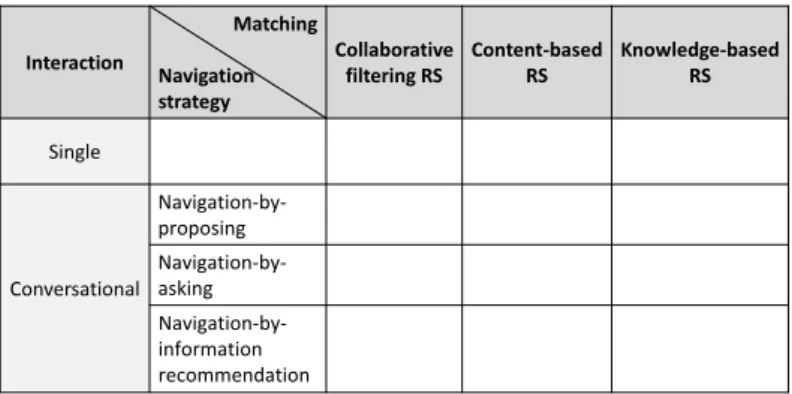
2.3 Classification of recommender systems. . . 33
2.4 Search tree example . . . 50
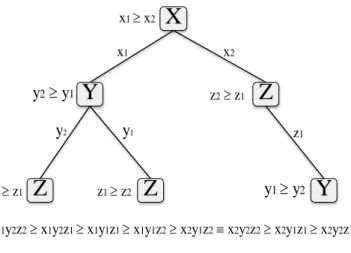
3.1 A cp-treeσ, along with its associated ordering<σ on outcomes, with γ = 1(i.e., with at most one variable associated with a node) . . . 69
3.2 A cp-tree σ, along with its associated ordering <σ on laptop out-comes, withγ = 1(i.e., with a single variable associated with a node) 72 3.3 A cp-tree σ, along with its associated ordering <σ on laptop out-comes, withγ = 2(i.e., with at most two variables associated with a node) . . . 73
4.1 A single-shot recommendation scenario . . . 82
4.2 A conversational recommendation scenario . . . 83
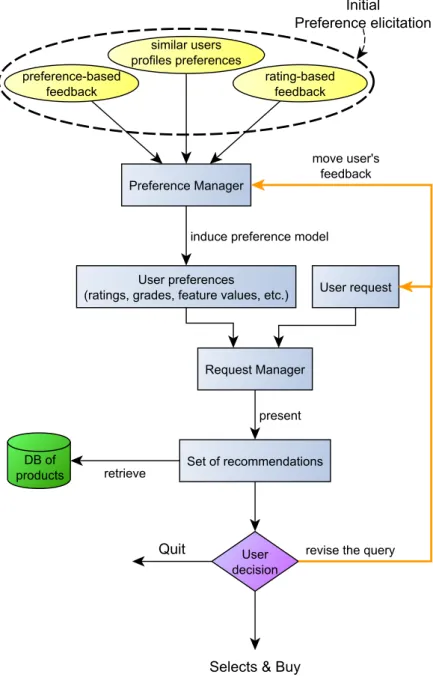
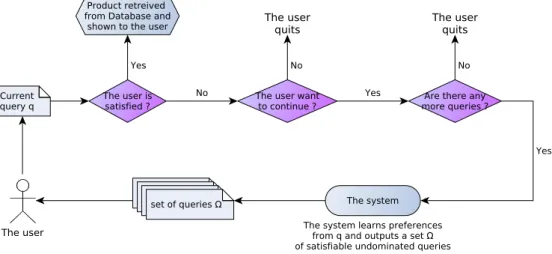
4.3 Interaction model of the user with the recommender. . . 90
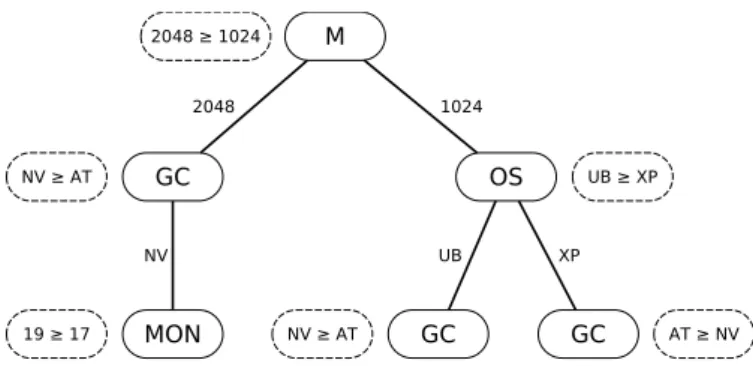
4.4 A cp-tree σ with γ = 1, along with its associated ordering <σ on configurations . . . 98
4.5 A cp-tree σ with γ = 2, along with its associated ordering <σ on configurations . . . 99
4.6 A preference dominance framework . . . 105
5.1 Search trees using basic approach . . . 143
5.2 Search trees using deciding-node-dominance rule . . . 143
5.3 Example of a search tree . . . 146
5.4 Model of transferring the set of undominated solutions between nodes in the search tree . . . 148
5.5 Running time(ms) for each family of preferences forn= 10,15, . . . ,40
variables (having 3 values each). Each CSP has approximately 1000 solutions. . . 157
1
Introduction
The goal of this dissertation is to develop a comparative preferences approach for eliciting and reasoning with preferences in Recommender Systems (RSs) and con-straint optimisation-based systems.
1.1
Background
1.1.1
Preference representation
Choosing the colour of a car or choosing among different mortgage loans are ex-amples in which preferences can direct humans from simple to very important de-cisions. Preferences are a multi-disciplinary topic that has been extensively stud-ied in economics, psychology, philosophy, logics and other human-centered disci-plines. Nevertheless, it is a relatively new topic in Artificial Intelligence (AI) (Kaci 2011, Domshlak et al. 2011) and has become of great interest for the development of reasoning mechanisms in intelligent systems (Brafman & Domshlak 2009, Chen & Pu 2004).
The preference relation, which is used to specify the preferred alternatives, is often defined over a very large set, so we cannot afford to explicitly represent it, but needs a compact implicit representation. Such approaches have been developed in the AI literature. The above concern has fostered the study of compact preference
1.1. Background
representation languages (Benferhat et al. 2001, Brewka et al. 2003, Brewka, Benfer-hat & Berre 2004, Boutilier et al. 2004a, Brewka, Niemelä & Syrjänen 2004, Kärger et al. 2008). Generally speaking, these specifications define a preference model in a compact way and a preference relation to rank the outcomes of the model.
The way in which preferences are encoded and the ranking is obtained mainly depends on the specifications used. Preference representation languages can be cat-egorized into:
• Approaches which extend classical logic such as Qualitative Choice Logic (QCL) (Brewka, Benferhat & Berre 2004) and Possibilistic Logic (Benferhat et al. 2001); • Approaches based on Conditional Preference Networks (CP-nets) (Boutilier et al. 2004a) and CP-nets extensions such as TCP-nets (Brafman, Domshlak & Shimony 2006), CP-theories (Wilson 2004b), Conditional Importance Net-works (CI-nets) (Bouveret et al. 2009a), and comparative preference theories (Wilson 2009b);
• Approaches based on logic programming such as logic programs with ordered disjunction (LPOD) (Brewka 2002, Brewka, Niemelä & Syrjänen 2002), Answer Set Optimisation (ASO) programs (Brewka et al. 2003), Logic Programs with Ordered and Unordered Disjunction (DLPODs) (Kärger et al. 2008), CRProlog with Ordered Disjunction (Balduccini & Mellarkod 2003), and Resourced An-swer Set Programming (ASP) (Costantini & Formisano 2009).
1.1.2
Recommender systems
People increasingly face the difficult task of having to select the best option from a large set of multi-attribute alternatives. An online electronic catalog system might provide access to large numbers of items, such as apartments to rent, notebook com-puters to buy, or financial products in which to invest. The user has to navigate through the catalog to find the most suitable one. RSs are tools that help people find their most desired items based on a model of their preferences.
Research and development of RSs has been an exciting and vibrant field for over a decade, having produced proven methods for preference-aware computing. The purpose of a RS is to help users identify interesting, personalized items or content from a large search space. For example, recommenders have successfully helped users find books and media of interest from a massive inventory base, e.g., (Amazon 2012), and personalized movie suggestions, e.g., (netflix2012,Movielens 2012). A RS can be considered as an information agent that provides suggestions for items which are likely to be of interest to the user (McGinty & Reilly 2011).
These systems infer user preferences from data gathered either explicitly, e.g., in the form of product ratings, or implicitly by observing user behaviour. These preferences help them make predictions for products not yet assessed (e.g., rated) by the user. The prediction algorithms used within RSs include collaborative filter-ing, content-based filtering and case-based reasonfilter-ing, and various hybrid approaches that combine these (Adomavicius & Tuzhilin 2005, Anand & Mobasher 2005, Bridge et al. 2006). However, these classical approaches have typically supported only a simple “single-shot” form of human-computer interaction, where a user who has previously supplied a set of ratings, identifies herself to the system and is then given a set of product recommendations.
1.1.3
Conversational recommender systems
Regardless the quality of RSs, they are unlikely to be sufficiently prescient that their first set of recommendations always satisfies the user. Indeed, users arerarely sat-isfied with the first set of recommendations (Bridge et al. 2006); they usually want to see more options and they exploit the initial recommendations to refine their preferences and articulate new requests. In fact, they are usually not very familiar with the available products and their characteristics. Thus, their preferences are not well established, but constructed while learning about the available products (Payne et al. 1993).
Conversational RSs allow for this, and recognise that their users may be willing and able to reveal more of their constraints and preferences, over a short dialogue, thereby moving away from “single-shot” interaction. This is also an opportunity for the RS to guide the user by asking questions, giving advice, displaying candidate products, and giving explanations (Reilly et al. 2004, McSherry 2005, Bridge et al. 2006, Ricci et al. 2006, Schmitt 2002a, Thompson et al. 2004b, Pu et al. 2006).
Conversational RSs typically involve iteratively showing the user a small set of options (e.g., products) for them to choose between. To select an appropriate set to display at each stage, from a much larger collection of options, the recommender needs information regarding which options are likely to be preferred to others by the user, based on previous responses the user has given in the dialogue; if one assumes that the user has some kind of preference relation over products, this amounts to determining if certain products are dominated (less preferred than other products) according to this preference relation.
Pruning less optimal items, with regards to the user preferences, is a key task for RSs. This was confirmed and validated by experiences from fielded applications with conversational RS described by (Felfernig et al. 2006, Felfernig & Gula 2006) based on user questionnaires after using systems. The results showed that interactive
1.1. Background
recommenders help users to better steer themselves when being confronted with large sets of choices.
Furthermore, solutions are characterized by a set of attributes in classical deci-sion theory (Keeney & Raiffa 1976). As utility theory provides a solid mathematical foundation for recommendations (Keeney & Raiffa 1976), users might express their preferences by the relative weights they give to attributes or combinations of at-tributes. Such approaches are described for example in (Keeney 1992). An example of its application in a decision aid system is the Personal Computer (PC) selection tool of IBM described in (Schiex 1992), where users can adjust the weights of differ-ent criteria and interactively see how differdiffer-ent PC models rank according to these weights.
However, there are many practical situations where the space of possible crite-ria is so large that stating a numerical preference model for all of them would be cognitively impossible (Faltings, Torrens & Pu 2004). In fact, such situations assume the supply of a large amount of information from the user and it implies complex preference models that cannot be obtained in e-commerce scenarios because people are not willing to go through lengthy preference elicitation processes (Brafman & Domshlak 2008). The user may wish to state simple comparisons. She may want to make no explicit quantification of preference or utility, leaving the preference purely qualitative. This could be the case for example in a travel problem, where there is a large number of possible attributes involving times, means of transportation, lo-cations, that vary from one user to another. In such a case, the user may want to say that she likes to travel to a country during the summer in that country whatever the country is, all other attributes being equal. The user will then avoid having to communicate an accurate numerical model. It has also been claimed that the qualita-tive specification of preferences (e.g., pairwise comparisons between tuples) is more general than the quantitative one, as not all preference relations can be expressed by scoring functions (Stefanidis et al. 2011).
1.1.4
Constrained optimisation
Several tasks, like configuring products for an online shopper or scheduling meet-ings for a busy executive officer, require balancing the user’s desires with hard con-straints. Intelligent automated agents that perform such tasks are driven by several established optimisation algorithms whose aim is to significantly improve their abil-ity to traverse through the constrained space. Constrained optimisation is searching for optimal solutions, which are solutions that are feasible regarding hard constraints and that best meet the user’s preferences. Computational approaches for solving constrained optimisation problems consist of mainly two fundamental principles:
exploring a large solution space toward a desired solution while trying to eliminate sub-parts of the solution space which are guaranteed not to have a better solution (Kadioglu 2012). This guarantees that constrained optimisation algorithms perform some pruning that will aid the search for optimal solutions, without missing any potentially optimal solution.
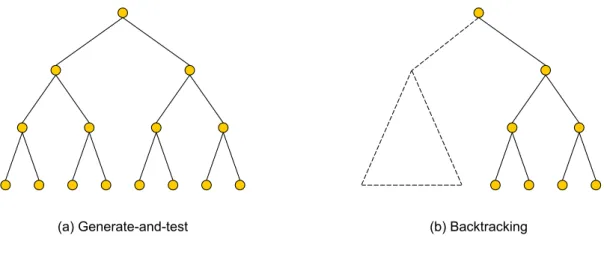
Branch and Bound (B & B) is a common technique for solving constrained opti-mization problems (COPs) using backtracking search. The B & B technique consists of splitting the original problem recursively into subproblems which become sooner or later easy to solve. It allows one to reduce the feasible region to several parts by exploiting properties of the problem (e.g., user’s preferences). One of the main advantages of pruning away subspaces from the search space is the reduction of the number of pairwise comparisons performed during the search. Optimality in sev-eral constrained optimisation approaches can refer to a preference relation. Thus, progress made on preference approaches may contribute in the development and expansion of the constrained optimisation approaches.
1.2
Problem Statement
Preferences are a crucial notion guiding our choices and actions. Intelligent systems require a concise and processable representation of preference information in order to enable them to act autonomously and to intelligently support users. In several de-cision making problems (e.g., in planning or in scheduling), there is a concern about which alternative(s) to choose. Alternatives involve multiple attributes and so de-fined in terms of a number of variables. These alternatives can be represented by a set of combinations that are depicted explicitly (e.g., as database of outcomes), or im-plicitly (e.g., a mathematical programming model which describes a set of outcomes). Choosing the best alternative(s) in such settings implies the need for a preference re-lation that is used to compare two solutions based on preferences expressed over the attributes of these solutions.
With regards to RSs, providing personalized recommendations to users requires the modeling of their preferences and needs. Eliciting and representing users’ pref-erences is a crucial task for such automated systems to successfully accomplish their task. It is usually too complex to get a complete and accurate model of the users’ preferences, especially regarding the tradeoffs between different attributes (Faltings, Torrens & Pu 2004).
Conversational RSs belong to a category of RSs that provides challenges for more elaborate formalisms that represent the user’s preferences while conversing with her. Conversational RSs would be more reliable and efficient if provided with adapted and suitable preference formalisms in order to model and reason with the user’s
1.3. Research Goals and Objectives
preferences. Therefore, it would be interesting to look for supporting this process by integrating recently developed preference formalisms, e.g., (Wilson 2004b, Wilson 2009b). These formalisms would enable conversational RSs to manage a variety of types of user feedback without losing an efficient pruning capability.
Besides, researchers are investigating clever and new mechanisms to be inte-grated with constrained optimisation algorithms to efficiently produce optimal so-lutions. A number of COPs use comparative preferences to express the user prefer-ences. One way to find solutions for these COPs is to extend the B & B technique with the related preference relation. Then, we will be able to solve COPs in which preferences are expressed as comparative preferences. The integration of new meth-ods which are based on general preference formalisms and enriched with a compu-tationally efficient dominance operation can offer flexibility to the B & B technique and expand the set of COPs that can be tackled by B & B.
1.3
Research Goals and Objectives
One goal of this thesis is to integrate pairwise comparisons-based preference mod-els that represent the users’ preferences into a conversational RS. The preference model would express the user’s preferences as accurately as possible and needs to offer key comparison operations (e.g., dominance) that give more efficiency and flex-ibility to the pruning engine of the RS. We need to effectively evaluate the com-parative preferences-based preference models and the dominance for comcom-parative preferences and its practical computational aspects. One way to do this is to ex-perimentally compare them to another preference model supported by a dominance operation which is based, for instance, on utility-based preferences (e.g., importance weights).
A second goal of this thesis is to enrich the B & B technique by the integration of new comparative preference-based pruning rules that can be used to ease the search for optimal solutions for COPs where preferences are expressed as comparative pref-erences. Thus, this will widen the range of problems the B & B technique can deal with and solve.
Our objectives in this thesis can be summarised as follows:
• To integrate such a preference model in an existing conversational Recom-mender System (RS).
• To accomplish relevant computations with the preference model in a practical way.
• To perform, within offline experiments, an effective evaluation of two pref-erence dominance approaches: weights vector-based approach and compara-tive preferences-based approach where the (simulated) user is modeled as a weights vector (Balabanovic 1998, Shen 2007, Kim et al. 2011, Shen et al. 2005) or as a cp-tree (Wilson 2009b). Experiments with different user models al-low for examining whether the matching or the mismatching of the way the simulated users’ preferences are represented and the model of the users’ pref-erences induced from the system can have an influence on the performance of the pruning method.
• To define new pruning rules associated with the B & B technique for constraint optimisation for comparative preferences.
• To perform an evaluation of the pruning methods with a number of binary constraint satisfaction problem (CSP) instances by comparing their pruning power and efficiency regarding other measures (e.g., time).
1.4
Contributions
The contributions being claimed by this dissertation are twofold:
• A novel use of a formalism for preference elicitation in conversational RSs. This formalism is based on comparative preferences.
In fact, we consider a framework of preference dominance and its rationale. This framework is illustrated through two instances. One fundamental step in the process of recommending, which is preferences induction, is then pre-sented in the two instances. We have developed the second instance that we have implemented, experimentally tested and compared it with the first in-stance. We report the experimentations and a comparative study of the two instances.
The first instance is based on a simple quantitative preference formalism, in-volving a weights vector-based user model, with an associated language of linear inequalities. This is a very commonly used model for preference repre-sentation, specifically, in multi-attribute utility theory (MAUT) (Figueira et al. 2005). The second instance of the framework is a qualitative preference for-malism, where models adopt a kind of generalised lexicographic order (i.e., cp-trees), and constraints are expressed as comparative preference statements in a language generalising CP-nets (Boutilier et al. 2004a).
To the best of our knowledge, this is the first time that the type of comparative preferences that we use in the second instance has been deployed with RSs.
1.4. Contributions
We show that comparative preference theories are able to give freedom and flexibility to the system to handle the user’s preferences by allowing the sys-tem to capture preference nuances and various forms of preferences without giving up the attractive computational properties of the preference dominance relation.
We also prove that the comparative preferences-based dominance algorithm that we select and use to compare outcomes works efficiently for a range of comparative preference statements when checking dominance between two outcomesαandβ. We verify and validate the suitability and attractiveness of the comparative preference theories-based approach for RSs through several experiments that include repeated scenarios with simulated users represented by models that are based on different semantics (e.g., weights vector vs cp-tree).
• New comparative preferences-based pruning rules that extend the B & B tech-nique for comparative preferences.
We have developed a first group of newly defined sufficient conditions that help the constrained optimisation algorithm locate the extra spurious data and remove it from the solution space. During search, we use the previously found solutions to bound the search space up to the point that either there is an optimal solution that dominates the subspace or there is no such solution. One of the main advantages of pruning away subspaces from the search space is the reduction of the number of pairwise comparisons performed during the search.
Another way of eliminating useless comparisons is to avoid involving any op-timal solution that is unable to better any extension (complete assignment) in a sub-space. In other words, an optimal solutionα, which was already found, might be unable to dominate any outcome that extends the partial assignment obtained so far in the search tree. If we prove, through a pruning method, that this is the case then we do not need to involveαin any dominance check below the current node. Thus, we have also developed a second category of pruning rules which temporarily disengage any subset of optimal solutions below some node of the search tree from playing a role in the comparisons performed in the sub-space newly created. This pruning rule checks whether any optimal solution already found is unable to dominate any other possible assignment in the considered sub-space below the current node. If the condi-tion is checked to be true for one solucondi-tionα, thenα is no longer involved in eventual comparisons below the current node in the search tree.
In order to assess the efficiency of the developed pruning rules in practice, we performed experiments and discuss the results that we found.
1.5
Publications
The work presented in this thesis has been developed via a collaboration with Nic Wilson, Derek Bridge and Francesco Ricci. Part of it has been published in the pro-ceedings of international conferences, and a peer reviewed journal as we describe below.
• Pruning Rules for Constrained Optimisation for Conditional Preferences, Nic Wilson and Walid Trabelsi, in Proceedings of the 17th International Confer-ence on Principles and Practice of Constraint Programming (CP-2011).
• Preference Dominance Reasoning for Conversational Recommender Systems: a Comparison between a Comparative Preferences and a Sum of Weights Ap-proach, Walid Trabelsi, Nic Wilson, Derek Bridge and Francesco Ricci, in the International Journal of Artificial Intelligence Tools (IJAIT) volume 20 number 4.
• Comparing Approaches to Preference Dominance for Conversational Recom-menders, Walid Trabelsi, Nic Wilson, Derek Bridge and Francesco Ricci, in Proceedings of the 22nd International Conference on Tools with Artificial In-telligence (ICTAI-2010).
• Preference Dominance Approaches for Conversational Recommender Systems, Walid Trabelsi, Nic Wilson, Derek Bridge and Francesco Ricci, in Proceedings of the 5th Multidisciplinary Workshop on Advances in Preference Handling (MPREF-2010).
1.6
Structure of the Thesis
The thesis is organized as follows: • Chapter 2:
Conversational RSs are found at the intersection of RSs research, dialogue sys-tem and preference handling. In this chapter, we present the background ma-terial and literature review related to conversational RSs and preference han-dling, which are the two primary research domains of our thesis work.
1.6. Structure of the Thesis
• Chapter 3:
Dominance testing represents a key operation when looking for the most pre-ferred set of alternatives among a set of possible alternatives with regards to the user’s preferences. In this chapter, we present the preference language, and the dominance semantics and computation we are using in this thesis. The chapter also presents other dominance approaches that adopt different seman-tics of the dominance relation. In this chapter, we also detail the algorithms and data structures that we use in the key operations in the dominance testing. • Chapter 4:
In this chapter, we mainly define a novel use of a formalism for preference elic-itation based on comparative preferences and integrate it into a conversational RS. We carefully assess two approaches based on a sum of weights-based dom-inance relation and comparative preference theories-based domdom-inance relation through several experiments. We conduct these experiments with simulated users and performed a comparative study between these two approaches. • Chapter 5:
In this chapter, we propose new methods for finding non-dominated solutions of a CSP with respect to a set of comparative preferences. We derive these pruning rules from a dominance algorithm that refers to a set of comparative preferences theories, that represent the user’s desires, in an attempt to guide constrained optimisation algorithm to find optimal solutions. To make the presentation concrete, we apply the new methods to random CSPs of different sizes.
2
Literature Review and Related Work
2.1
Introduction
Preferences handling in conversational RSs and constrained optimisation are two among the main research streams that are studied in this dissertation. In this chap-ter, we present the background knowledge and the literature review related to the domains we are concerned with in this thesis.
The topic of preferences has recently attracted considerable attention in AI re-search and plays an increasingly important role in several AI-related fields. Several AI applications, including expert systems, autonomous agents, decision support sys-tems (DSSs), RSs, configuration software, and constrained optimisation applications, rely on the ability to make decisions regarding the user’s preferences (D’Ambrosio & Birmingham 1995, Junker 2001, Chajewska et al. 2000, Mura & Shoham 1999, Nguyen & Haddawy 1999). In Section 2.2 we present the concept of preferences. We will talk about decision making in Section 2.3. Section 2.4 presents examples of formalisms devoted to represent preference relations (Domshlak et al. 2011).
In Section 2.5, we present two categories of preference representation in decision-making. A group of languages, which is used to express and reason with preferences in these applications, is presented in Section 2.6. Section 2.7 recalls some expressive preference languages. A large spectrum of AI applications need preferences to be expressed and reasoned with to make decisions. These applications are presented in Section 2.8. Section 2.9 is devoted to giving a description of a group of RSs. The
2.2. Preferences: Description
concept of CSP and the corresponding solution methods are presented in Section 2.11. Section 2.12 presents COPs and different solution methods for these problems.
2.2
Preferences: Description
A crucial concept in modeling user preferences is that of preference relation. This approach is related to the concept of similarity/dissimilarity between values/items (Stahl 2002) and is extensively used in the RSs field (McSherry 2002, Stahl 2006). In this section, we will talk about the concept of preference relations. We will also present a key challenge in preference handling: preference elicitation.
2.2.1
The concept
Preferences are modeled to guide the choices made by a decision-making entity. In AI, an artificial agent can be a decision-making entity. The agent generally acts on behalf of another physical or moral entity, a user for instance. The degrees of desirability, inherent to preferences, are represented, most commonly, quantitatively by means of utility functions for instance, or qualitatively by means of pairwise comparisons. Given a set of options, a rational agent chooses the one that maximizes its expected usefulness, that is the one that most probably leads to the outcome it prefers the most, according to the preferences of the user or organization it acts for.
Preferences over some set of possible options order them so that a more attractive option precedes a less desirable one. Examples of sets of possible options could be possible flights, vacation packages or cameras.
Thus, the notion of preference aims at bringing a natural and effective way of coming to the most appropriate solutions among a large number of choices. In e-commerce, the user preferences are used to evaluate the alternatives so that the most preferred products are most likely to be selected by a customer (Stolze 2000). Mc-Sherry and Aha suggested a model for a RSs where four types of preferences are identified (McSherry & Aha 2007).
In their words, Assumed preferences illustrate the fact that consumer prefer-ences for particular attributes can be assumed to be consistent among all decision makers based on the characteristics of an attribute, also referred to asLess-is-Better (McSherry 2003) orcost type attribute (Xu 2007). For example, preference for Price attribute is typically to minimize the value of the price.
Explicit preferences are directly stated by a decision maker. Typically explicitly stated preferences need to be taken into account since the consumer is not willing to accept any compromise on the value. Then, any generated outcome has to comply with all the preferences.
Implicitpreferences are indirectly discovered from the available information about the consumer. There are RSs which are based on example critiquing which is one interaction model that allows users to build their preferences by examining or re-viewing (we also call it critiquing) examples shown to her by the system (Burke et al. 1996, Burke et al. 1997a). Each time the user reviews a product, the system induces some preferences. This technique is explained in Section 2.10.1 of Chapter 2. For example, during a dialog in a critiquing-based system, when a user indicates her critique (i.e., review) on the presented values, the attributes’ values she is not critiquing can be assumed to be suitable. Thus, these values will be regarded as the user’s implicit preferences.
Predictedpreferences appear when a history of previous decisions, or preference discovery dialogs are available, allowing some preferences may be predicted with reasonable accuracy. For example, in progressive critiquing RSs (Bridge et al. 2005), the preferred value of an attribute can be predicted as the nearest available value that satisfies the recent critique on the value of an attribute in the presented item (Ricci, Mirzadeh & Venturini 2002).
2.2.2
Elicitation
One key challenge in preference handling is usually the elicitation of the preference information from users. Decision-makers have a limited capacity for information processing (Bettman et al. 1998). Decision-makers tend to build their preferences when they are prompted to express evaluative judgment or to make a decision (Payne et al. 1992). When alternatives are described with a number of decision attributes, decision makers typically do not have specific predefined strategies of the selection of attribute importance and tradeoffs they are ready to make (Häubl & Murray 2001). Preference elicitation methods aim at easing the cognitive burden of ordering a set of outcomes, or finding an optimal item. Preference elicitation considers ques-tions such as how best to query the user about her preference model (e.g., utility val-ues) and how much information is needed. These methods range from approaches based on the utility function (Savage 1954, Fishburn 1967, C. 1968, Fishburn 1970, Fishburn 1974, Fishburn 1999), which conveys the user’s preferences on a particular option, to computer-aided elicitation approaches (e.g., critiquing, collaborative filter-ing, etc). Work on the latter approaches indicates that the process of preference elic-itation needs to be sophisticated as it involves, in addition to conventional assump-tions about the user’s preferences, a number of relevant elements related to human-computer interaction (Faltings, Pu, Torrens & Viappiani 2004, Pu & Faltings 2004).
2.3. Decision Theory
2.3
Decision Theory
2.3.1
Rationale
Decision making is a daily activity. We all make decisions constantly, from the sim-plest “which shoes should I wear today?” or “should I take my umbrella?” (Poole 1992) to the more complex “how should we deal with the deforestation?” (P. Journee & Vanderpooten 1998). These decisions are made at all levels such as organisa-tional (“how do we schedule the crew shifts?” (A. Caprara & Fischetti 1998), inter-organisational (“which trace (or route) for the highway?”) (Ostanello & Tsoukiàs 1993). Quite often, we cannot make decisions by ourselves. Indeed, during deci-sion processes, we normally ask for help, advice or support from friends, experts or consulting companies for instance.
Decision problems are often complex (Alexander 1977). They can involve large volumes of information that have to be managed, by means of filtering or mining for instance, to come out with a critical decision that might have serious consequences. Inappropriate decisions can have heavy consequences (e.g., air traffic and aerospace accidents). The need for decision support is felt when decisions start to be more dif-ficult or critical. This was one of the main objectives the decision support techniques were developed for.
In order to help the decision maker, DSSs need to embrace a reasoning model that is similar to the way people would normally behave. This makes the proposed actions natural as much as possible. In recent decades, there has been a growing interest in “behavioural decision theory” (von Winterfeldt & Edwards 1996) which has contributed to what rational decision-making requires (Tsoukiàs 2008).
The current scientific study of decision making originated from the form of oper-ational research during the World War II era as a response to the need for optimal so-lutions to complex military planning and decision making problems (Tsoukiàs 2008). The practical application of decision theory aims at finding tools, methodologies and software to help people make better decisions. Systematic and comprehensive software tools developed in this way are called decision support systems (DSSs). The representation of the decision maker’s preferences allows DSSs to operate effectively on her behalf. This preference representation is then a key element in the success of such applications.
2.3.2
Need for preferences in decision making
Stefanidis et al. stated that preferences guide human decision making from early childhood (e.g., “which ice cream flavor do you prefer?”) up to complex professional and organizational decisions (e.g., “which investment funds to choose?”) (Stefanidis
et al. 2011). Furthermore, Visser et al. claimed that there are no intelligent DSSs without knowing the preferences of the user (Visser et al. 2009). We can then infer that the representation of preferences is a central topic in decision making.
Therefore, extensive research has been conducted to study the fundamental struc-tures on which decision aiding models rely: the structure of preference relations (Dushnik & Miller 1941, Luce 1956, Scott & Suppes. 1958a), which are described in Section 3.2 in Chapter 3, and the functions that represent them (Fishburn 1970, Koopman 1956). A survey of preference models was carried out in (Öztürk et al. 2004). This survey presented the representations that were conceived to express our preferences for the purpose of automated decision making. The survey considered a broad spectrum of representations ranging from qualitative to quantitative; and simple to complex. Representations employed in existing decision making tools are considered in addition to those describing preferences in a form suitable for manip-ulation by an automated process.
Several preference representations, includingceteris paribus-based preference lan-guages such as Conditional Preference Networks (CP-nets) and their extensions, were described in (Boutilier et al. 2004a, Brafman & Domshlak 2002, Bouveret et al. 2009b). Other examples of preference representations are the “prototypical” pref-erence logic presented in (Bienvenu et al. 2010), the temporal prefpref-erence represen-tation described in (Bienvenu et al. 2011), and prioritized goals, which have been used by (Sardiña & Shapiro 2003) and (Benferhat et al. 1993) in decision making, and preference formulae described by (Delgrande et al. 2007) as a logical combination of queries.
2.3.3
Different decision-making approaches
The way people can and do make decisions varies considerably. For decades, research focused on the way the user makes decisions in practice and the way she should theoretically behave when a decision situation is presented to her. Then, an array of decision making models, depending on their methodological foundations, have emerged.
Tsoukiàs presented and discussed different decision aiding approaches that were introduced during the last six decades of existence of the decision theory including the normative and descriptive approaches (Tsoukiàs 2008). The author explained the differences among these approaches by examining the origin of their specific “models of rationality” (Savage 1954) which is a key concept in decision aiding.
The idea of rational choice is a central idea: people tend to compare the costs and benefits of certain actions, and choices will be made by decision makers as they try to maximize their benefits and minimize their costs. Tsoukiàs (Tsoukiàs 2008)
2.4. Representing Preferences
considered a rational model as a tool that enables the interpretation of informal in-formation and its conversion to a formal representation which will be used as an input in the decision making process. Thus, choices and preference information are expressed in the rational model, and the system then comes up with a set of optimal choices.
2.3.3.1 Normative decision-making
Normative methods are based on the belief that there is an ideal standard of rational-ity that should guide our choices. They are called normative because they use norms. A prominent approach within this class of decision making is the expected utility theory (Neumann & Morgenstern 1944). According to this theory, the behaviour of a rational decision maker adheres to a set of axioms that govern the nature of its preferences (Savage 1954). A rational decision maker in this setting is one that makes decisions which maximise its expected utility, that is, the sum of the utilities of possible decision outcomes multiplied by the probability of their occurrence.
2.3.3.2 Descriptive decision-making
Enforcing a model of ideal rationality, which is a theory of how we should make de-cisions, is often at odds with real human decision-making. A contrasting branch of research is the study of descriptive decision-making (Bell et al. 1988). Descriptive ap-proaches analyze human decision-making behaviour with the goal of understanding or replicating it. Kahneman and Tversky described the Prospect theory as a model of decision-making amongst risky alternatives, which are choices, the outcome of which occurs with a given probability (Kahneman & Tversky 1979). Through exper-iment, the two authors found that a real decision maker often violates the principles of expected utility theory.
2.4
Representing Preferences
Effective representations for preferences play a key role in the success of many AI applications (Boutilier et al. 2001). A targeted preference representation is one which captures intuitive statements, that can be for instance easily evaluated by users, and enables a compact representation of the description of the problem, without having to enumerate a prohibitive number of alternatives. There are several formalisms devoted to represent preference relations (Domshlak et al. 2011). In the remainder of the section, we present examples such as utility-based formalisms (a function giving scores to the alternatives) and ordinal preference-based formalisms (a binary relation over the pairs of alternatives).
2.4.1
Multi-attribute preferences
Clearly, it is difficult for humans to compare outcomes over multiple dimensions. It is also complicated for machines to store and analyze preferences over a number of outcomes that is exponential in the number of attributes. It is, therefore, impor-tant for multi-attribute decision theory to study, through mathematical methods for instance, the decomposition of utility (preference) functions into combinations of subfunctions that correspond to different attributes or sets of attributes.
Multi-attribute decision theory adopted some assumptions about the user’s pref-erences structures (e.g., additive independence (Keeney & Raiffa 1976)). This theory presented theorems that allow inferences about several forms of independence of attributes from the subfunctions that make up an overall preference theorem (see, for example, (Hansson 1989, von Stengel 1988, Wellman & Doyle 1992)). Structural properties of preferences help automated systems reduce the burden of preference elicitation (Engel 2008).
2.4.2
Graphical models of preferences
One key technique in achieving a considerable simplification of the task of elicitation is the use of graphical models that usually take advantage of the independence for preference (utility) functions in a multi-attribute space (Bacchus & Grove 1995, Gon-zales et al. 2008). They also speed up computing and reasoning (Lang 2010). Besides and more generally, graphical languages are a powerful way of expressing prefer-ences in combinatorial domains (Lang 2010).
For combinatorial domains, we need languages that allow a compact preference representation. A significant number of these languages have been studied in the AI research community. They consist of a graphical component describing preferen-tial dependencies between variables, together with a collection of local preferences on single variables or small subsets of variables, compatible with the dependence structure.
Part of the motivation (and also inspiration) for graphical modeling of multi-attribute preferences is driven by the success of Bayesian Networks (BNs) (Pearl 1988) in achieving compact representation and graphical reasoning algorithms for probabilities, based on conditional independence concepts (Pearl & Paz 1986, Pearl 1988). Therefore, researchers explored the conceptual similarities between probabil-ity and preferences, and examined the opportunprobabil-ity to transfer ideas from one field to another.
The extension of influence diagrams by (Howard & Matheson 2005) in order to decompose value functions into sums and products of multiple value nodes was prob-ably one of the first tendencies to exploit separable preferences in a graphical model.
2.5. Preference Representation in Decision-Making
Bacchus and Grove (Bacchus & Grove 1995) had developed a graphical model based on the conditional independence structure (Engel & Wellman 2008). They pro-posed an undirected graph that captures conditional additive utility independencies. The presented models are called generalized additive independence (GAI) models, and they enable efficient dominance testing, i.e., for determining whether a possible outcome has higher utility than another (Engel & Wellman 2008). They introduced GAI-networks, which are similar to the junction graphs in BNs. Dominance relations and semantics for comparative preferences are described in Chapter 3.
(Boutilier et al. 2004a) initiated another stream of work by introducing CP-nets that use a particularly simple graphical model which captures users’ qualitative con-ditional preferences over objects. CP-nets are similar to BNs from a syntactical point of view. But, they differ with respect to their semantics. CP-nets received a consid-erable amount of study in subsequent literature (Kristensen et al. 2005, Purrington & Durfee 2007, Domshlak et al. 2006, Brafman & Dimopoulos 2004a), and various graphical models of preferences were developed. Examples are TCP-nets (Brafman & Domshlak 2002), FCP-nets (Gavanelli & Pini 2008a), CI-nets (Bouveret et al. 2009b) and UCP-nets (Boutilier et al. 2001). Each graphical model of these tried to extend the applicability of graphical models. For instance, UCP-nets (Boutilier et al. 2001) found a way to take the advantages of both GAI-models and CP-nets by combining qualitative and quantitative preferences.
2.5
Preference Representation in Decision-Making
Preferences aim at offering the user the ability to express her relative or absolute sat-isfaction when faced with a choice between different options (Chevaleyre et al. 2006). Preferences are modeled in such a way that it is possible to derive a final recom-mendation for the decision maker. In the vast landscape of literature on prefer-ence handling, two distinguishing labels are used to classify representations; Del-grande, Schaub and Tompits distinguished two forms of preference representation: absolute (describing the desirability of a particular state-of-affairs) and compara-tive (describing the desirability of one state-of-affairs relacompara-tive to others) (Delgrande et al. 2007). Similar distinctions were made throughout the literature on preference - often referring to absolute representations as monadic and comparatives as dyadic (Hansson 2001).
Similarly, according to (Tsoukiàs 2008), multiple criteria decision aiding methods could be grouped in two categories, based on how the set of the potential alternatives is explored:
• the use of pairwise comparison procedures and majority principles for estab-lishing a final recommendation.
2.5.1
Utility-based assessment
The model of preference representation within economics and early decision theory has been the (absolute) expected utility function (Neumann & Morgenstern 1944). When applied to a choice, this function returns a numeric evaluation of its desirabil-ity or interest. The choice is then given a score. A choiceAis preferred over another choiceBif and only if its score is higher than the score ofB. The maximisation of this function determines which is the best choice according to the standard prescription of rationality as recommended by (Savage 1954).
As traditional decision-theoretic approaches were growing, a variety of tech-niques for the elicitation of utility functions from clients or users emerged (Keeney & Raiffa 1976), (Saaty 1980), (Keeney 1982), (Farquhar 1984) and (Wakker & Deneffe 1996). Several authors (Farquhar 1984, Wakker & Deneffe 1996, Öztürk et al. 2004) argued that a utility function can be used to obtain an intelligible preference rela-tion that can be axiomatically justified. Tsoukias claimed that the construcrela-tion of a utility function is restrictive, since it needs a number of conditions to be fulfilled (Tsoukiàs 2008). Domshlak et al. argued that a utility function requires a consid-erable cognitive effort on the part of the decision makers as they would need to determine a value function for a large number of alternatives described by multiple attributes (Domshlak et al. 2011). Thus, they are not often willing to express their preferences directly in terms of a value function (Domshlak et al. 2011). To express liking one option exactly twice as much as an alternative option for instance is not that intuitive and natural (Visser et al. 2009).
(Brafman & Domshlak 2008) described the difficulties inherent in the elicitation of a utility function and explained the burden of this process, as it requires the sup-ply of a large amount of information from the user. These issues were discussed in Chapter 6 of (Bouyssou et al. 2000) and Chapters 4, 5 and 6 of (Bouyssou et al. 2006). These discussions concluded that the associated cognitive burden of ordering a set of outcomes or finding the best outcome makes such approaches not entirely conve-nient for supporting complex scenarios where the set of possible decisions tends to be either too large to be described explicitly or the information is incomplete (Öztürk et al. 2004).
2.6. Comparative Preference Languages
2.5.2
Pairwise comparison-based assessment
A decision maker may wish to state simple comparisons. She may want to make no explicit quantification of preference or utility, leaving the preference purely qualita-tive. She may want to say, that other things being equal, she likes to stay in a hotel with a swimming pool rather than in a hotel without a swimming pool. Wellman and Doyle assert that humans place value on compact representations of informa-tion “that directly entail the most important conclusions” (Wellman & Doyle 1994). Superlatives (such as “fastest”, “cheapest”, and “largest”) and comparatives (such as “faster”, “tastier”, and “happier”) are recognised as being common ways in which humans describe their preferences (Domshlak 2008). They represent examples of how human try to express their knowledge compactly. Comparisons of objects along some dimension suppose a linear scale which is used to measure to which extent humans exhibit their preferences. For instance, a superlative statement expressed for one object allows it to hold maximal degree in the assumed scale (Wellman & Doyle 1994).
To have the ability of expressing preferences and in response to the limitations of utility functions and variants claimed in the previous section, a wide range of quali-tative forms of preference expression have been developed. Methods for qualiquali-tative decision-making are discussed in depth in (Roy 1991), (Vincke 1992) and (Roy 1996). A category of these qualitative methods are based on the Ceteris Paribus princi-ple (Wellman & Doyle 1991, Wellman & Doyle 1994, Boutilier et al. 2004a) which is described in Section 2.6.2. Among these methods, we cite CP-nets (Boutilier et al. 2004a) described in Section 2.6.3 and their various extensions such as Tradeoff-Conditional Preference Networks (TCP-nets) (Brafman & Domshlak 2002) which are described in Section 2.6.4, FCP-nets (Gavanelli & Pini 2008a) and CI-nets (Bouveret et al. 2009b).
2.6
Comparative Preference Languages
Many decision problems are defined over large multi-attribute domains. This raises a key challenge in preference research which is to develop preference representa-tion languages that support user-friendly elicitarepresenta-tion techniques and have reasoning capabilities. These capabilities are needed to cope with the exponential size of the outcome space which often has a combinatorial structure. In fact, an appropriate preference formalism would include a preference representation that captures state-ments that are natural for users to assess, and a reasoning engine that supports effective inference. The selection of a language for representing preferences requires one to look at a number of characteristics, among others: expressive power which
should be high, relative compactness, complexity which should be low, elicitation-friendliness, and cognitive appropriateness (Chevaleyre et al. 2008).
In order to make decisions, the decision maker may need to determine the pref-erence relation: a ranking of all outcomes determined by her own prefpref-erences. A simple and unsophisticated idea would consist in revealing explicitly the user’s pref-erences: simply by stating the possible options tagged by their respective utilities (in the case of cardinal preferences) or listing all different pairwise preferences among the possible options (in the case of ordinal preferences). This approach is too simplis-tic and not realissimplis-tic when the set of alternatives has a combinatorial structure which would make the process potentially infeasible (Rossi et al. 2011). It can be problem-atic for machines to store and analyze preferences over a number of outcomes that is exponential in the number of attributes (Engel & Wellman 2010).
Because of this, the automated systems adopted some assumptions about the user’s preference structures to optimize the process by having less complicated and more manageable preferences elicitation methods. Such assumptions include condi-tional preferential independence (Boutilier et al. 2004a). Several compact preference languages emerged and were studied in the AI research community. We should note that comprehending user preferences and finding the way to a suitable representa-tion of them in order to perform meaningful inferences are real challenges (Stefanidis et al. 2011). One way to express preferences is to consider preferences over some sub-set of attributes, considering the rest of the attributes held fixed. Such a statement is also often referred to as a ceteris paribus preference statement (described in Sec-tion 2.6.2). A second approach is to give an importance ranking to the attributes and consider first (or give priority to) the most important attributes when comparing outcomes. This ranking adopts a so called Lexicographic model (described in Section 2.6.1).
Work on several real-world decision problems has taken advantage from the progress made in preference representation (Vig et al. 2011, Brush et al. 2010, Kon-stan & Riedl 2012, Chen & Pu 2010, Mahmood & Ricci 2009, Pu et al. 2008, Jan-nach et al. 2011). One example is the recommenders who have successfully helped users find their targets (e.g., books (Amazon2012), news (Hurley & Tewksbury 2012), movies (netflix2012), Movielens (Movielens2012)). We will present RSs in more de-tails in Section 2.9.
2.6.1
Lexicographic preference models
A well-known kind of preference model is the lexicographic preference ordering (see e.g., (Fishburn 1974, Schiex et al. 1995, Brewka 2004b, Freuder et al. 2010)). The