W&M ScholarWorks
W&M ScholarWorks
Dissertations, Theses, and Masters Projects Theses, Dissertations, & Master Projects
2004
Structural model checking
Structural model checking
Radu SiminiceanuCollege of William & Mary - Arts & Sciences
Follow this and additional works at: https://scholarworks.wm.edu/etd
Part of the Computer Sciences Commons
Recommended Citation Recommended Citation
Siminiceanu, Radu, "Structural model checking" (2004). Dissertations, Theses, and Masters Projects. Paper 1539623441.
https://dx.doi.org/doi:10.21220/s2-8tcm-na84
This Dissertation is brought to you for free and open access by the Theses, Dissertations, & Master Projects at W&M ScholarWorks. It has been accepted for inclusion in Dissertations, Theses, and Masters Projects by an authorized administrator of W&M ScholarWorks. For more information, please contact [email protected].
A Dissertation Prcsent;ed to
The Facnlty of the Depn.rtment of Computer Science The College of Willia.rn and Mary in Virginia.
In Partial PulfiUmcnt
Of the Requirements for the Degree of Doctor of Philosophy
by
Ra.du Siminicean11
2008
APPROVAL SHEErr
This dissertation is Hnbr.nitted in partial fuHlllmenli of tlu~ requirenwnts for the degr<·)e of
Doctor of P.l:tilosophy
H.adu Siminir.ea.nu
Approved by the Committee, December 200:~
~~-·----~---~-~L-~
..
~-BenedettO L. Di Vito
NASA Langley HJ:sean:h Center
u gen
Department of Computer Science, UniverRity of York, UK ll
Table of Contents
Acknowledgments List of Tables List of Figures Abstract 1 Introduction1.1 Overview of Formal Methods
1.2 1.3 1.1.1 1.1.2 Speeification Verifiea.tion . 1.1.2.1 1.1.2.2 1.1.2.il Contribution Organ.izatiort Simulation Theorem Proving Model Checking
2 State Space Construction
lV ix X xiii xiv 2 5 5 () (i 7 8 10 11 12
2J. 2.2 2.8 2.4 2.5 2.6
Discrete :;tate systmns . . . . 2.1.1 Modeling with Petri Nd.s
State spa.ces . . . . Explidt st:a.te-spa.c.e gf:'nera.t.ion
The state space explosion problem Explicit 1nethods .
Syn1bolie methods
2.().1 Sytnbolie encoding of states
2.6.2
2.().3
2.6.Ll Binary decision diagrams 2.fLl.2 Multi-w<w decision <.Hagra.ms
1\H):Os and structured systems . . . . Symbolic encoding of next-state functions
3 The Road to Saturation 3.1 3.2 3.4
3.6
:t7
:~.8 :3.9Breadth-first symbolic state-space generation Kronecker encoding of the next-state function . An identity crisis
Event locality . . In-plaee updates The saturation strategy
Correctness . . . . Implernentation issues .H.esults . . . . l:J
14
16 17 18 1922
ao
38 :18 t13 4648
5053
5!) 61 624 Saturation Urd:wund.
4.1 Loca.ll'lt;<tte spaces with unknown bounds .
72
4.2 IDxa.ruple . . .
75
4.:3 Irnplomnntatio11 issues 82
4.a.1 Da1;a, structures for the next-state function 8. ') .,
UneonHnned vs. confirmed stat.es 83
4.:.ta
Storing MDD nodes . . . . 854.:~A MDD nodes of variable si:t.e 86
4.3.5 Garbage collection .. 88
4 .. :l.6 Overflow of potential local Btate spaces . !)0
1.4 Resuli.s . . . . 91
5 Structural CTL Model Checking 93
5.1 Temporal logic . . . . !>4
5.1.1 Linear time, branching time . 95
5.1.2 The CTL
*,
CTL, and LTL temporal logics . 975.1.3 Computing CTL operators . . . 102
5.2 Saturation-based CTL Model Checking.
104
5.2.1 Tho EX operator . 104
5.2.2 The Eli' operator . 105
5.2.:l The ElJ operator . 105
6.2.1.1 The EG operator . 109
5.:~ H.esults . . . . 111
6 Count<::n·<:~xa.mples and Witnesses 115
The <lil'tanee function . . .
11()
tLl.l li~xplicil; decision diagram eneodin~~ of st.a.te distances . 117
6.1.2 Syrnbolic eneodiug of st<tf;e distances 119
().2 }.,. new approach
121
(i.2.1 J<Jdge-·vahwd l\1DDs . 121
(L2.2 Ca.nonicity of gv+MDDs
6.:3 Operations with EV+MDDs . . .
125
o.a.1
S~' ""'t"' "'•)''('(' .H""' t'\;:-;;'~\",t (At,-'.~(,, 'lTI'i (}1' '" . ~Jr "'tar•('(' • ,J, ' J b'""·-·'-'""'·('~ <r"l''»"•t·l·(.)l'l l . 1'· CJ 1"'1.11" b ]:<'V+M'l')D~ ,_; V ,o , ~"' ., ~ • • • - • • .128. ..Tt:a.ce generation using EV+.MDDs
:un
6.4 R.esults . . . .
7 Application: the Runway Safety Monitor
137
7.1
The Runway Ineursion Prevention System137
7.2 The Sl\41\HT model of RSM
140
7.2.1 State variables . .
140
7.2.2 Modeling the state transitious .
7.2.2.1 The 3-D motion of targets
144
7.2.2.2 Sta.tus definitions 145
7.2.:3 State-space measurements
147
7.2.4 Setting the alarm . 14.8
7.3
1<[odel Clwcking RSM . . 15:3Analysi!'l of tho transition tlmt ca.usm.; losH of separation
'l.a.3 A ~t:ronger safoty property . . . . 157
7.a.a.l
Couuterexan1ples for strong saf{~ty!57
7.:~.4 Conclusions . . . 1!)1
8 Future Researeh
164
A Overview of ~Wt:l'
169
B Benchmark of Examples
177
B. l Dining philosopher!-! . 177
B.2 A flexible manufa.during system 17H
B.a
Slotted ring . . . . 181B.4
A
Kanban system . 182B.5 H.andomized leader election protocol 184
B.6 A round ·robin rnutua.l exclusion protocol 18!)
Bibliography
192
Vita 203
ACKNO'\:VLEDGJV1ENTS
lowe my thanks to 1na.ny people who h:w1~ supported me during my studies. From the v<~ry beginning~ this work would not !mve been possible without the guidanee of my <:tdviser, Dr. Gianfranco Ciardo. His constant striV<) f()r excellnnce1 im.pec<:tthle work ethic and
bril--liant ideas h<Wtl made it easier for me to achieve my goals. His tmdeniable meut.oring skills are reflected in the way every student Um'; worked wit:h him grew from <1 just good student into a go()d researcher.
I am gra,t;eful to Dr. Gerald Liittgen i~)r my in.itiation in the finld of Fbruta,l Methods and for the internship t.ha.t. he entrusted me with so early in my studios. I truly adrninJ his resea,reh attitude and wrHing skillH. I a,rn equa!Iy grateful to the people a.t NA.S.A Langley Research Center, especially to Dr. Ben Di Vito, for f()stering our research idea.s and pro-viding us with many opportunities, most importantly through their finandal support.
I would like to thank my comnlittf~e, f{n· supporting ruy work and providing valuable comments, and the eollea.gues that I collaborated with: Andrew Miner, for jurnp-starting this whole body of work and whose design and implementation of SM'\J{f have made it. easy to pnt my ideus in pr<~.etice, und Robert Mannorstein, who provided figun~s and comnwnts for one of the chapters in this thesis. Speda! thanks go t;o Zvezdan Pet.kovic, who was always there for me with a. good advice on everything from technical support, to the myriad of every day life problems that I faced. I also am grateful to Carol Conner, Sandra, David, and the entire Wagoner family for t.heir magnanimous help in making a home away from home in America.
On a personal note, my endeavor would not have been possible without the affectionat,e support of my whole family. My deepest gratitude goes to my parents, Lizeta and Ilie, whom I simply owe everything I am, and to my sister, Laura, who endured an ocean apart of dista.nee between us.
Last, bnt not. least, my thoughts and love go to my sweet and generous wife, Valentina, who brings out the best in rne and makes lifo a.ll worth it.
List of Tables
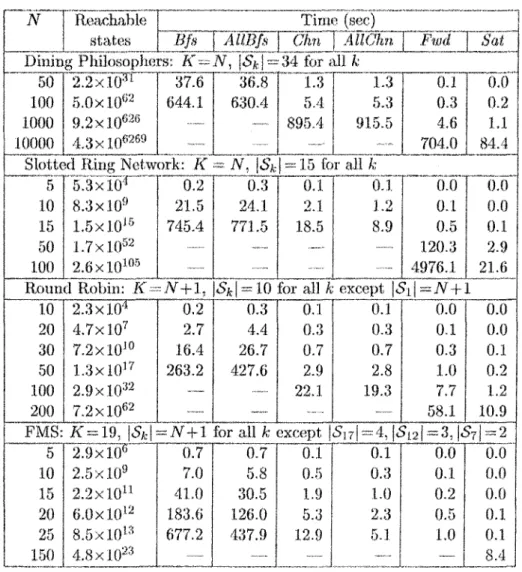
3.1 rrime for St(J,t(H'Jpace generation algorithms in S%'\H'T. . . 64
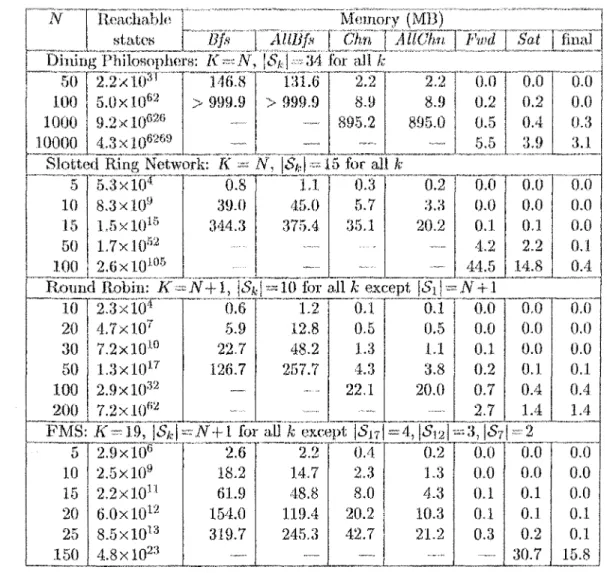
:3.2 M.mnory consumption fiJr stnt(H:lpa.ee generation algorithms in
gvwrr.
65a.:1 llesults for the saturation algorithm. . . 67
4.1 Generation of the state spa.<.:e: On-the-fly vs. pregeneration vs. NuSMV ~n
5.1 Experimental results for computing EF aud EU: Sl\1'\RI' vs. NuSMV. 112 5.2 Experimental resuUs for cornpuliing EG: Sl\¥\RI' vs. NuSMV. . . 11~~
6.1 Experimental results for computing the distance funetion. . . Ul4
7.1 7.2 7.3
The state to-state transition matrix for RSM.
State space measurements for RSM: number of states.
State-space construc:tion time for RSM (in seeonds). .
147 148
lt±9
7.4 State-space generation rnem.ory consumption for RSM (in Megabytes). 149
7.5 H.SM protoeol: alarm R<~tting crit•~ria. . . . 150
A.l l'v:Iodel checking functions in SM!\f(['. . . 175
List of
Fig11res
1.1 Tho "m.ap" of Formal MethodB . . . 5
2.1
2.2
2.4 2.5 2.6 2.72.8
2.9 3.4 :3.5A small Petri net exautplo.
'I'lw underlying discrete state model of tho Petri net in Fignro 2.1 . Algorithm for oxplidt state space exploration ..
A BD D encoding of a boolean function . . . . . The effect of variable ordering over the BDD size The algorithm for binary operations on BDDs. An example MDD . . . .
The algorithm for the union of MDDs. Image computation with MDDs. . . .
'I'wo symbolic breadth-first generation algoritluns.
Algorithm for symbolic bn;adU1-first search with chaining. .A produeer-comnnner model and its snbmodels. . . . The local sta.tes of subrnodels in the producer-consumer modeL I<.roneckor cucodin.g of
N
fhr the producer-consunwr rnodd. . .15 1() 18 24 26 28 :32 :~.4 36 ;~g 4.0 41 4fj
l(ronecker vunms MDD encoding of the next st:I.te function.
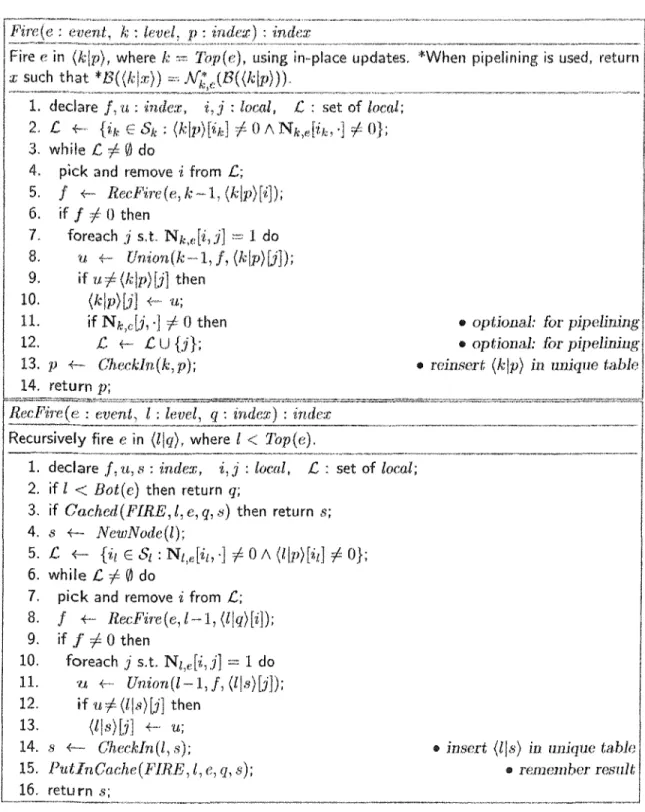
Algorithm for firing owmi;s with in-pla.ce npda.tf!S . . . . , The vs(mdocode for the Genm·at:e) Sat?tm.te algorithtns .. a.10 The pseudocode for SatP·ire and So.tRecP£1·e.
4.1 4.2 4.3 4.4
·t6
4.7Local st.a.te spaces built in i1<olatiou. . . . The Confirm procedurfJ for saturation on-the-fly.
Sa.turat.ion by exarnple (part 1) .. SaJ.ura.tio.n by example (part. 2) ..
Saturation by exampln (part a) ..
Storage for t;he matrix nodes. . . Node and arc storage for MDDs.
The hnplidt index 1 in reduced vs. qw1Si-redueed MDDs.
4.9 .Example of potential, but not actual, overflow of a local state space.
5.1 The eight bask CTL opcratorH
5.2
The four basic fll'L operators .5.3 The traditional algorithm to compute EU.
5.-1 'The satura.tion-ba.'led algorithm to compute EU.
Gl
57
58 7274
76
77
78 8386
87 90 100 101106
1075.5 Comparing BFS and saturation order: distance vs. unsafe distance. . 1 Of~ 5.6 'I':raditional and Hatatration-ba!-md EG algorHlnns. . . 110
6.1
6.2
Storing the distance function: ADD vs. forests of MDDs. Canonical and non canonical gvBDDs.
xii
118 120
6.a
Storing total and partial arithnwtic functio1w with EV+MDDs. 6.4 The Union.t\:fin aJ.gorithm f(,r EV+MDDs.6Jj 6.6 ti.7 7.1 7.2 7.~~ 7.4 7.5
7.6
An exa.mple of the Unionlvlin operator f(u: EV'1Jv1DDB. The pseudocode for B·!tildDistance, BVSatnmte a.nd EVfi'i1'e
The pseudo-eode for B VRecPiTe. . . .
The llnnwa.y Safety Monitor flow cha.rt. . . . . RSM: missed alarm seena.rio 11 at ground lovd.
RSM: missed ala.nn scenario 21 airborne. . . . .
RSM: missed alarm scena.rio
:3,
at; ground level. RSM: missed alarm scenario 4, at ground level. RSM: missed alarrn scenario 5, aircraft vs vt~hide ..B.l The dining philosopl.ters, ith subnct..
B.2 A flexible manufacturing system. B.3 Slotted ring model, ith subnet..
B.4 A kanban system . . . .
B.5 Statechart for the leader election protoeol. 13.6 The round robin mutual exclusion protocol.
125
127 129 l:JO 13!l 154 .156 158 159 161 177 179 181 18:) 185190
ABSTitACT
Tho introduction of symbolic approadws, based on Binary Decision Dia.gra.ms (BD.D), to Model Chc~cking has led to signifleaut im.proverrwuts in Fbnna.l Verification) by allowing the analysis of very la.rge Ryst.emH, such as cmnplex drcuit d<•signB. These were previously
beyond the reach of traditional, explidt. n1ethods, dtte to the :;tate spac(~ e;cplosion
phe-nommwn. However, <:tfter the initial success, the BDD tedrnology has peaked, dm: to a, similar problmn, the lJDD explosion.
We preseut a new approach to symbolic Model Checking t.hat. is ba::;od ou exploiting the systHm structure. 'I'his technique is eharact.ori:r,ed by several unique fbatures, including an (mcoding of sta.tes with Multiway Decision Diagrams (MDD) and of transitions with
hoole;:m Kt·ouceker ma.t;rices. Tbis approach na.turally eaptureH the property of event loeal~ ity, inherently present in the dass of globaJly asynchronous/locally synchronous system.s.
The m.ost imporl;ant contribution of our work is the sa,tnr·ation a.lgoritJnn f()r state space const.ruetion. Using saturation, the peak si;~,e of the MDD during the exploration is dras-tically reduced, ofhm to sizes equal or C:O!llpa.mble to the fiual MDD size, which makes it. optimal in those terms. Subsequently, saturation can achieve similar reductions in run-times. When co:mpa.red t;o the leading state-of-tho art t;ools based on traditional symbolic approaches, saturation is up to 100,000 times faster and uses up to 1,000 times less Jnernory. This enables our approaeh t;o !:ltudy mudtla.rger systen1s than ever considered. J:i'ollowing the success in state space exploration, we extend the applicability of the satura.tion algorithm to CTL Model Checking, a.nd also to efficient generation of shortest. length counterexamples for safety properties, with similar resnlt;s.
This approach to autorna.tic verification is implemented in the tool SMART. We test the new tnodel ehecker on a real life, industrial size application: the NASA Runway Safety Monitor (RSM). The analyRis exposes a number of potential problems with the decision procedure designed to signal all hazardous situations during takeoff and landing procedures on runways. Attempts to verifY RSM with other .model checkers (NuSMV, SPIN) fail duo to excessive n1emory consumption, showing that our structural method is superior to existing symbolic approaches.
Chapter
1
Introduction
.Johann Wolfgang von Goetlw (17•19-18~Y2) Today's hardware and software systems grow in size and complexity at, a. very fast pace. Unfortu:ruttely, t.he rapid adva.nce in technology sophistication is not ma.tched by the advnnce in the degree of certification of the deployed dcvi<:es. Therefixe, with every leap fi:>rwa.nl in technology, the risk for small and subtle errors to escn.pe undeteded in the process of design and verification with low-cost ernpirica.I methods increases substantially. At. the same time, 1111 exhaustive verification process takeH considerable amounts of resources, in terms of time, human expertise, and money. The major obstadc in using computerized tools to verifying modern protocols is usually the state-space e:rplosion phenomenon. As the complexity of a systern increases, the memory and time required to store its combinatorially expanding state space ean easily beeome excessive. On the other hand, if appropriat.e measures are not take.n, the cost of errors eventually occurring during; opf'~ration can he enormous. There is a nmnber of (in)famous examples already 011 record:
• The Pentium I proceHsor division bug [57], caused by a drcuit; design error, eost.ed Intel half a billion dollars in 1994. The discovery of the error was credited to Prof. Thoma.s Nicely, a mathematics professor at the nearby Lynchburg College in Virginia;
GHAPTBH .1. fNTBODUC:TlON
• The explosion of the Arinne [) rocket during lift.ol:f, on .June 4 ln!W, due to rt Hon,t;ing point. conversion mTot' in a. software control moduk: (55], caused the Ji~uropeau Space
Agency 1:1.11 nstin1ated los:; of seven billi.on dolln,rs rmd hm ynan; of development efforts;
• Thn loss of the Ma.rs Polar I ... ander exploration probe in Deemriber 1!>99, due in pa,rt
to an allcgr~d object initi<tliza,tion error in Uw touchdown sensing; software, whieh was
not; eorred:ly t.est;ed [86], harl a. price tag of 120 million dolhus in equipment and set
back au e:~ntire research program at the :Jet Propulsion Laboratory;
• Tlu~ Y2K hug seare [71], whieh can be blam.ed on the eomput:er software iudnstry as a colleetivo, whose prevention eostt:~ worldwide are yet to be qua.nt.ificd, hut are estimated between. 500 billion and 5 trill.ion dollars;
But most critical is the prospect of oven more ca,i,astrophic events, where human life is
at stake, such as aireraft collisions or malfunetioning of 11ndear plant surveillance. Safety-critical systems, such as flight guidance, collision avoidance, and early warning syst;erns, require a. high degree of as:mmnce of design correctness [2:.~]. Existing techniques for verifying safety properties still rely heavily on testing and simulation, which examine only a portion
of the behaviors of the system. Sinee flaws can hide in the unexamined portious of the system, engineers need reliable means to design and operate increasingly large systems, despite their vast emnplexit.y.
The field of .F'orrnal Methods is onn way to achieve this goal, by using rigorous
mnthe-mat.iea1 t.<:)chniques for tl1e s[JeciJication a.lHl ve1·~fica.tion of hardware a,nd software systems .
. Model Checking is one direction in .Formal .Methods, concerned with the tasks of
CHAPTBH .1. JNT.HODUGT'!ON
of this automaton s<:tHHfioH a tern:poml logic statement [lHJ]. l'vfodel Checking ha.s ga.itHld increasing attention since the developtnent of .symboli<: techniqmm, based on liina:ry da;iiJion
diagnzms (BDDs)
[:t
7]. Sym.bolic Model Checking [21] if' known to be eficet.ive for a nurnherof l'imple ten.tporal logics, such a.s CTL ( ComJmtation 'Jlrcc Logic) and UI'L (Linear
1'ern-poml LO[Jic)
unL
ail it allows :(()[ the eflicient stora.g<~ and .manipulation of the laJ·ge S€~ts ofstates corresponding to t;emporallogie formulae. However, pra.etica.llimitat.ions t,o symbolic Model Checking still exist.
• First, memory <md tirne roquirmmmts might; be excessive when tackling real systcn:.ts. This is especially true sinee the Hize (in number of nodes) of t:he BDD encoding the set of states eorresponding to a CTL fonnula. is usually much .larger dv,r·ing the
fixed-point itemLions than upon convergence. This phenomenon can bo vi«e~wcd as the reincarnation of the state space explosion in the form of BDD e:cplotJion. This has spurred work ill two major dired.ions. Distributed and parallel algorithms for BDD manipulation [106, 137] attempt to alleviate the problem by corralling the tesources of multiple workstations. However, the parallelization of BDD algorithms iH notoriously
innffect,ive, and the resulting algorithms ha.ve very little if any speed-up. Another direetion ha.s concentrated on verification techniques that try to reduce the number of expensive BDD computations in a.n attempt l;o avoid the rit;k of BDD expansion. This indudE)S the work in [24, 111, 126] that reduce the number of iteration steps needed to explore the sta,te space syrnbolica,lly, a.nd also the heuristics to better guide the exploration of states [12, 121].
CHAPTBH. 1. IN'I'.HODUCTION
but software) JU particular dist.ributed Hoftwarc, }u.ts HO n.ll' been COnsiderPd bnyond
rf:;a.ch. This is boeause the state space of soft.wn.re is much larger, but also because of
tlw widely-held belief tha.t syrnbolic t.echniqucs work well only in synchronous s!"ttiugs.
In this work, w<~ attempt to dispel these myths by showing t.hat symbolic tvf.od('l Ch+~ek-ing based on H!(l model st1"1.t<~t~J.re copes wdl with a. .. •;;ynchronous brJhavior and even benofitn
from it. Furthermore, the techniques we introduce exeel a.t redndng the ·pcnk rncrnor·u
con-1w.rnption. in the fixed~point iterations, t;hus directly addrcs::dng t;lw issue of BDD explosion.
1.1
Overview of Formal Methods
As mentioned before, the field of Formal Methods indude~:; two areas, .'lpcc~{t:cation and
verification, which we briefly overview next. The map of Formal Methods is sketcll.tlCl in the diagram of Figure l.l a .. '! a tree and our work is situat(')d along the highlighted path.
Specification
_______
VerWCI'Ition,
______
Simulation Mode! Checking Theorem Proving
/ '
Automata Temporal Logic
/ " - .
Explicit Symbolic
F.igure 1.1: The "map" of Formal Methods
1.1.1
Specifkation
Specification (and/or rnodding) is the process of describing a re<.d~life syst.ern and it~; dei'irod propnrth)s in a formal way, by using a. specification langnage. The properties that need t.o
GHAPTEH 1. JNTRODUCTTON
he cxpresst~d tnay ra.uge fro.m fnnctiona.l behavior, tinting behavior, h1t:eru::d ~t;ructu.rx~1 t.o performance ehara.et;erist;ics.
Z [128] a.u.d VDM [85] are the most popular langua.ges t{)r sp<~d(ying the 8equenUal
behavior of state-ba.'led systems. States an~ described by means of rich structures sueh a .. s sets, relations, and fnn<:tions. The tnJ.nsitions bctwEmn st;;tt.e!l are given in terms of pre-conditions aud post,~conditions logic fonuulae.
Other rmrt;hods, like CSP [78], CCS [lOG], state-cha.rts [74), and I/0 a.ulicnnata. [102]
foeus on specifying the behavior of concurTent systems.
1.1.2 Verification
Verification goes one step beyond modeling, by analy.·dng the spedfication of th(~ syst,em tor
desired properties. The verification can be partial or exhaustive. Simulat;ion and test ease generation fall in the former category, while Model Checking and Theorem Proving are in the latter category.
1.1.2.1 Simulation
Excluded nowadays by purists, but widely used in practice, simulation and tesi, case gener-a.tion were the only means of test.ing and validating hardware and software in the early days of syHte:rn design. Tho two rnethods are similar in that t.lwy attempt to cover, with a set of
inputs, as many execution paths in the systern as posHible, mostly the ones that. prmmrna.bly
contain errors. The difference lies in the fa.ct that simulation runs on a tlworetieaJ lilodol of the systern, while testing nms on a physieal prototype of the system itself.
CHAPTEH- 1. INTHO.DUC'T10N
ht.mee t;he risk of miwsing llllwanted events that occur with very small probability. Good simulations are difficult to bnild and t:ime consuming. Their eff(ldiveness Hharply drops in thn late sta.ges of the dm;ign, when the muuber of errors is considerably diutinished. Tho
time nece:;;sa.ry to discover bugs in the late phases h.ICrt!ases dramat:iea1ly.
The sheer Hize of nwdem syste.rns is gradually making t;he tradH;ional m.othodK obsolete, as at t,he end of a simulation session. one is rwver fully sure of the validity of the modeL A suggestive example is the TCAS li systnm [G(}j for which t,he Feder<:IJ Aviation Admin~ istration has contract~K! th(~ Rannoch company to build scenarios for the aireraJt collision avoidance protocoL The (llld-produet of Rannoch comprised ::>00 encounter scenarios. Put in the light oft he a.ct.ua.l sta.te~spaee shr.e ( tl.w.t; the tool S.M V fails to completely build within 1 Gigabyte of memory, n:fter constructing over 1020 possible states)~ the number of tested scenarioH is alarmingly small. The more so a._<; the system is a.ln;rul:IJ installed on all US
eomrnercia1 aircraft as of .January 199"1 (and a worldwide extension, ACAS II, is promoted for equipping all aircraft by .January 2005).
1.1.2.2 Theorem Proving
Theorem Proving is the most powerful formal verification approach, in which both the system and its desired properti(~S are expressed as formulae in some mathematical logic, given as a set of axioms a.nd a set of inference rules to rnake deductions. The! process of finding a proof f()r a property starts fron1 the axiorns and t;hen uses the inference rules (and
possibly derived definitions ;:tnd intennediate lemmas) t.o vH.lidate the init.ial assertions. Proofs ca.n be eonstructed by hand, but ma.chine-assisted proving has lJecorne more a.nd more powerful) although not; fully automated, remaining mainly interactive.
GIIAPTBH J. JNTHOJJUGTJON 8
ln e(mtr::tst to .Model Checking, 'I'lwore.m Proving can deal with infinit<~ systmns, since it relies 011 more powerfttl kclmiques, like st;ructural indu<.~tion. Ilowevet\ the int;era.etion with a us<Jr results in a slow and sometin1e:-; error-prone pnlcess. DeiHmding on the degree of automation~ theorem provers can be classified iu t,hree grfmps:
LP [f.i5], and ACL2 [8~)] a.re guided by user input, which is a scquenee of lemrm"'"' hut eac;h theorem is prowm automatically; usin~~ built-in heuristics. The m.ilcsto1te in this ea,togory has been the proof of G<idel's first ineomplctmmss theon:rn in Nqhtm by
Boyer and Moore
(J.1]i
• Proof checkers: LCF [70], Nuprl [46], HOL [09], .LEGO [lOlj, and Coq ['18] are used
t;o :l(mnaJize and verify problems in Mathematics and Program Verifkationi
• Combination provers: PVS [110], AnaJytica [43), and STeP [10] eombine Theorem Proving with symbolic algebra) Model Checking, and interactive proof to verify a variety of probleins ranging from number theory to hardware design and fault-tolerant algorithms.
1.1.2.3 Model Checking
Model Checking is the formal v~~rification approach that relim; on building a finite nwdd
of a system an.d exluutstively searching its state space to chock the desired properties. In principle, tJHJ syst,mna.t;ic search is guaranteed to end, as tho rnodd is fiuite. The practical limitations are, obviously, tht~ amount of available memory (on one or multiple processors) <1nd the running times of the required algorithms. Therefore, the challenge in Model
Cheek-CHA P'l'E.l"t .l. .lNTROD UGTlO N
ing is devising a.lgorithms and d11ta 11truet.ures t:hat emd>lc handlin[~ of very large st,nt:e~sp:1,ee~; in a rca,sonablo amount: of time.
In practice thern arc.~ two maiu apprmu:hes in Model Checking: (;ernporal and aut<mmta~ based. The ternpoml Jvfod(d Checking was cl<weloped independently in the 1980s hy Clarko
;.md Emerson [:37] in the U.S. and quiell<; and Sifakis [11 !J) in. France. In this 11pproad1, systems are modeled a,,s finite state transition systems, and spedfieatious are expressed In
a temporal .logic.
In tllt) seeond approaeh, the specificat-ion i::~ given a .. "! an Uilttomaton. Then~ !;he syst;(:m whid1 is modeled aR an automa.ton itself is eompa.red to tho spedtimt;ion to determine whether it sa.tisties the required properties. The condusion can be drawn via l::mguage inclusion, refinement orderings, or observa.tiona.l equivalence. Va.rdi and Wolper showed how to translate temporal logic Model Checking in terms of automata, thus rna.king t;he connection between the two approaches
[la:3].
Model Checking is fully automated and fast. Its main asset is the delivery of witnesses (and counterexamples) that show how stat;es where the desired property does (or does not) hold can be reached. Its major challenge is represented by the state-space explosion problem. This task has been addressed by the introduction of BDDs, partial order reductions, and semantic rninimi:tations. All of these methods either reduce the size the of tht~ .model by eliminating nnnceessary states, or compress the state-space representation itself.
There are numerous Model Checking tools innse, the best knowu are listed below: • 'I'em.porallogic model chec.k.ers: EMC [87] and Caesar (lHJ], SMV [104] · · thtl firs!. to
use symbolic tedtniqtHlS (BDDs), SPIN [81] ··· based on partia1 order reductions, Mur-phi [54], tho Concurrency Workbench [45] -· baoed on p-ealculus, SVE
[<HJ,
FORMATCJIAl:"l'B.n 1. lNTlU)DUC'I:fON 10
[50], and CV [5::5] for hn.nlware verification, HyTedt
[t)]
for hybrid syHtc•n\H, a.nd:\.ronos t t
I . ['"'""] f()r roal-t;ime syst,eins.
• Combined checkers: Berkeley's HS!S [80] combines model checking with language in·· elusion, Stanf(ml's STeP [10] usns deductive u1ethods, VIS [Hi] employs logk synthesis, PVS [11 0] is a. t;hcorem prover with 'Niodd Checking a.bilitiet-~ :for ;H:aJeulus, while the METAFrn,me envirornnent. [12H] supports Model Checking in the entire softwa1·e clc·
velopment process.
1.2 Contribution
This work contributes with a series of novel technique::; to the area of temporal logic Model
(Jhecking. We have designed a new model checker, integrated in the ~:Joftware tool SJVW{I' [25] at the College of William and Mary, which features:
• Multiway Decision Diagmms (MDD) [87] for compressed state storage of stnwttm:d discrete-state systems;
• K1·oru.xker· rnatrix [6] storage f()r efficient representation of the tra.nsition rda.t;ion between states, based on a decomposition of the model into subrnodels;
• Sat'ltmtion [27L a revolutionary iteration strategy for exploring state spaces and com-puting fixed-point model checking; operators;
e An on-the-fly algorithm (;bat performs an exact computation of local stat<l spacos of
(}HAPTEH 1. IN'I'HDDUCTJON 11
tion thai, helps buildinf~ shortest; p:l.ths in readmbility graphs, with direct iluplicnt;ions in providing shortest. length cotmter(~xa,mples for ::Jafety properties In Model Checking.
We call this new approach Stn.tctum,l Morlt'l Checking [31].
1.3 Organization
The renu::tindf~r of this docunumt is organized as follows. Chapter 2 introduces 1.he hasie eon-ccpts in discrete state rnodding and presenl;s various a.ltenmtivos to addressing the problern of efficient state space eonstruetion. Chapter :3 deseribes our eontributiom; and improve-ments to the problem of state spaeo construction, lea.di.ng to our nws1, a.dva.need algorithm, based on the idea of .•wtumtion. An extension of the algorithm in a less restrictive context is presented in Chapter 4, where we also eompare t;he performance of onr algorithm irnple-rnented in Sl\W{r with another st;ate-of-the-art model checker, NuSMV. Chapters 5 and 6
further expand the scope of our saturation strategy to other areas of Model Checking, such
&"l the effident computR.tion of temporal logic operators and the generation of
counterex-amples, along with the corresponding experimental results. Chapter 7 presents our findings regarding the performance and a.pplieability of our model checker to a. real-life example: the Runway Saf~>.ty Monitor. We eondnde by discussing ftthue rescareh plans in Chapter 8.
Chapter
2
State Space Constructior1
In this eha.pter, we first, look at the models most; frequently tmed in pradice and e:xamine their eommon ehara.cteristics. Wo then proceed with defining the 8tate space of a model,
discussing t.Jw various existing t;edmiques to eoustruet H, and the 1najor d1a.llenges in un-dergoing this task.
Since thE~ introduction of automated verification tools in industry, the most popular systems to be analyzed were digital circuits, concurrent programs, distributed protocols, and reaetive systems. When talking about behavior, one should capture in one way or another the notion of t.ime nnd evolution. Therefore, the basic entities that all the 1nodels have to be built on are states and tr-ansitions (between states). The stal;es should be seen as
snapshots of the parameters of the system at specific moments in time, while the transitions are a set of rules that describe the changes in the system state when an event occurs.
Several frameworks have been proposed for modeling systems. We adopt tho following terminology.
CHAPTBH 2. STATE SPAG11; CONBTUUCTION
2.1
Discrete
stat(:~ systc~rnsDefinition 2.1.1 A. discr·ete-state 1rwdel is a tr·iplc lv.f ;::::: (S)-s,.l\1}, wher-e
• S
the set of potential states of the model,, specifying the at:IJ1H~ '' of the stnf:es.We indicate states with lowerca.sF bolt~{aee lett en;, i, j ...
• s E
S
·i..~ the initial state of the ·model.• N :
lf
··+
28 ·iH the rwxt-stat(~ funetion Hpecif:ying th1o state.'/ macha.ble fmm each st(1.tf~ 'in a single .step.There exist a munber of variations to the abov(~ deHnitiou. One of them assumes a more general ease of a, t;et of init.iaJ states, So. This can be easily integrated in our definition by
adding a, unique initial states and defining
N(s)
=So.The :next-state function
N
is sometimes defined as a binary relationN
~S
xS,
sueh that (i,j) EN
if and only if i can transition to j. In this ea.'le,N
is called the transition r-elation.Another variation is the partitioning of
N
into a union of next-state functions [20]: N(i) = UecEJV;~(i), where£ is the (finite) set of events in the model. Then,Ne
is the next-state fimction a.':lsociated with event e, i.e., Ne(i) is the set of states the system canenter when e ocenrs, or jiTe8, iu state i. An event e is said t.o be diBabled in i if Nf:(i) "-'~ 0; otherwis<~, it is ena.bled.
Diserete-stat:e syst;erns are usually described in a fonnalism that allows the specilka ..
-t.ion of its states and transitions. Low-·level for-malisms explicitly define the entire set of
CHAPTBH. 2. SJ:4TJi;
SPACE
C'ONSTTUJC'liONconvenient. a.pproadt is to use a high·lwuel fonnali:nn that recurs t.o n1or() sophist:katod math~ em.atical objeds t;o define the behavior of t.he system. 'I'his is dono by describing rules th::1t
characterize gnnq>s of states :tnd <"vmlt;s togetlwr.
2.1.1
Modeling with Petri Nets
Introduced by C.A.Petri in 1!)62 [118], Petri nets are a.n elegant high-level rnathHmatic:a.I
for.malisn1 that. lms been well studied and has Hince becom.e popular due to some of its
practical properties.
Definition 2.1.2 A Petr·i net N is a qu.intnple (P, T, D , J)l , p .. 0), where
• .P i8 a finite tu~t of places; places can hold a. rw·rHU?fJldive number of tokens; an
assi[Jnment fl. ; P
->
N of places wah token.s ·is called a marking;• T ·is n finite .set of transitions (or· events), which 'ttJHla.tc the number of token8 in places;
• Po : P -t N is an initial marking of places with tokens;
• JJ+, D_, : P x T
-+
N, descr·ibe the nt.le.s to a.dd and 1·ernove tokens fmrn places by firing tmn.sitions;Note tha.t a Petri net defines a bipa.rtil.e directed gntph, where the sots of nodes are P
and T, and the set. of arcs A ~;. (P x T) U (T x P) is uniquely det,ermined by the two fundions
lJ+ and lJ'". There is a.n are from place p t;o tram;ition t if and ouly if D' (p, t)
>
0 andCBAP'l'BH 2. STAT!!! SPACB CONS:I'HUCJ'TJON
15
u
Figure 2.1: A small Petri net; example.
/\.. transition /: is said to be enabled in a n~tu:king p. if and only if Hs input pla.ees cont.ain at lca.st as rn<1ny tokens as the corresponding arc can finalities, '7p E P : p.(p) ~ D ·· (p, i:).
Enabled transitions rna.y fire by removing the number of tokens indicated by tho .input are cardinality, and adding to each of th.e output places the number of tokens indicated by t.he output a:rc ea.rdinality. lienee, the .firing of au E:mablcd transition t changes a marking p. to
a. marking ttl> whore w(p) = 11.(p)
+
D4 (p, t) D ··· (p, t). The firing is sometitmls written as Figure 2.1 displays a small Petri uet, with places P ={p,q,r},
transitions 1' ::::.~{t,u.,v},
and arcs A= {(q,t),(t,p),(p,u),(·u.,q),(q,v),('11,'r)}. Ir- and J)+ take the va.ltw 1 for all existing arcs, and f.Lo(p) ::::.~ 2, !J·o(q) -::::.: 0, fl·o(r·) = 0. For a. more concise representaJ.ion, we will also use the superscript notation for markings: p0 = p2q0r0•
Although there is a connection between the places and transitions of a Petri net, and the states and events in a model, it is now dear that the discrete state model that a Petri net defines does not coiudde with the net itself. In Fignre 2.1 for exarnple, the Petri net has three places and three t.nulSitions, while its discrete state model has six possible states and nino t;ransitions, aH shown in Figure 2.2.
In tho urHierlying state model, the states are represented by a set; of markings, C NP,
CHA.P1'Bn 2. STA'l'B BPACEJ ()()NSTHJJ()TfON Hi
p2 pq
q2
Figure 2.2: Tho underlying discnlte state modd of the Petri net in Figure 2. I
. t 'Ll I . . t . l /,
ex1s;:;; an ena.u.ec trans1t.um · m ll·h an< /tl'""t/1·2·
There are several extensions of ordinary Petri nets, sueh as inhibitor arcs, gua.l'ds, IW.u:k~ ing dependent are c:n.rdinalities (self n1odi(ying nets), firing times (St.ochastie Petri Nets, or SPNs), Colored Petri nets, and Hierarchical Petri Net:s [109].
Besides providing a modeling formalism, Petri nets ha.vtl also been studied as a. corn-putation model, by means of their associated language [112]. The class of stamla.rd Petri not languages is a strict suporsct of regular languages and a subset of context-sensitive Ian-gua.ges. Inhibitor arcs, marking dt~pendent are cardinalities and firing times add expressive power to ordinary Petri nets. In fact these generalizations have the same expressive power a.s Turing ma,chines [112] (they are Turing-equivalent).
2.2
State spaces
Given a discret-e state modellkf = (
g,
s,N),
Uw state srw.ce S <;;, is defined as the smalleHt set containing s and dosed with respect to .M:S
{s} uN(s) uN(N(s)) u · · · ,.-:-, N*(s),
Cl:lAP'l'l!iR 2. S'I:·~TB SPACE (}0N8TlUJC'J'JON 17
application of
N
is ('xtendod tf> sets of statt~s: N(A:') U~c,1
.N(8).An oquivalont ·way to defineS is as the smallel:lt fixed point of the equation
S '"'"' fs}
u
N(S).Starting J~1rm tlH~Hf~ definitions, there are several algodthn1s to construct tho sta.te spaee of a system. They a:re distinguished by two ll.Hpects: tbe iter-ation .<Jtmtegy a.ud Uw data
st1·uct'1J.r·es nsed to st:ore states.
The iteration strategy sp~c)dfit~s a systematic mechanism to rliAcover reachable states) start.ing from Uw initial state a.nd firing events
N,.,
in a, specific order. A funda.menta.l ro:ml.twas established in [uti], by showing that, the state spaee can be constructed by firing the individual events in an ar·bitmr-y order, as long as each event is considered often enough.
from the st;;tte storage point of view, state space generation algorithms can be classified in two categories: explicit and implicit. (or symbolic). Explicit techniques store each state individually, hence the space needed to store some representation of the state-space is at least linear in the number of constructed states. Symbolic techniques instead repres<mt states itnplidtly, using advnnced data structures to compactly encode and manipulate entire sets of states at. once.
2.3 Explicit state-space generatio:n
Iu traditional <:1xplidt stat<~-lipace generation approaches, st.at:eH are discovered ouo by OIW.
Figure
2.a
shows a geneml algorithm that storm; the unexplored states in ft set. U. If U is rnana,ged as a. qneue, the exploration is breadth-fi.rst. If U is managed as a stack, theCHAPTBR ;?. 87~<\'I'B SPJ1CB C<)NSTRUGTJON 18
exploration h; depth-first. Stat.(mH:mt 11 .is perf(Jrrrwd as Ht<).n:y t..irnns as Uwre are r:;tatn-t;o-state t;ransitifms betwe('m reachable st.ates1 thus an effkkmt search data structure, such a::;
a ha.sh table or a :;;eardt tree, must be use!l to organize the sta.tes in S.
Eaeh st;at.e requires a number of bytes for Hs storage, so it is effidm11; to -inde:c st;a.tes witlu.dunctimu/' :
S
-">
NU {null} sueh that '1/J(i) """ i E: { 0, ... ,181--l}
ific:
Sand '1/;(i) ""' null if i (/:. S. A na.tural definition f!:.n· ·tjy is to assign increasing indices to new states in the orderthey are f<nmd, starting from 1j;(s) = 0, <u> shown in Figure 2.:3. : .~tateset Compute 8 <;::;§starting from s by repeatedly applying
.N.
··--·-·-~---···---..
·----
..-1. declare S,U:sta.teset, 'ljJ:stateset-tNU{null}.
2. S
+-
{s};3. U .:- {s};
4. ·lj;(s) <· .. - 0; 5. while U
#
0
do6. choose a state i in U;
7. if N(i) has been exhausted
8.
U *-U\{i}
9. else
10. j f- next element in .N(i)
11. if j (/:. S then 12. ·~;(j) *-
lSI;
13. 8 {-s
u
{j}; 14.u {- u
u
{j}; 15. return S;- - -
.. -• known statel'l• urwxplorod known st;;:tl;es • 0 is t;}w index of t;lw first state
• still sta.t;es t;o explom
• remove i from U
• if j is a. new state .. .
• ... assign the next index to
it, .. .
• ... add it; t;o S, a.nd .. .
• ... remember to explore it la.t;er
Figure 2.3: Algorithm for explicit state space exploration.
2.4 The state space explosion proble1n
The size of the state space S is a. fa.dor t.ha.t influnuces in a. r:adieal measnre not only the efiicim1ey of verification, but also the very feasibility of the whole process.
GliAPTEJR 2. S~1:4TB SPACE CONS'lTHIC:TION 10
For exatnpl<1, if the coinpmHmts of n, system are "loosely eoupkd" i.e., t.hoy can evolve independently in an asyw:hronons fa.shion the n1nnber of possible global :-Jtates is given
by the number of possiblf~ comhinat;ions of loca.l states f()r m1.d.t emupnuent. If there are J<
subcomponents, each taking up to ni values, for 1 :::; i :;:~ :K, there could be as many as n1 · n2 · ... • ng different combinations of va.hJCA. This number ean ea."lily become t.oo large t.o handle. The st.a.t<:J.·spaee growth is t.ltcrdiJre exponential, 1:1s for a. system that; is regular (i.e., ni ·=-"" n, for all i) and sca.la.ble by K, the upper bound of
lSI
is nK. It i::; then utterly justified to call this phenomenon state-space c;cplosion.Using unsophisticated algorithms that; represent the model with explicit storage for states and transitions, each state consuming a n1.unbor of bits, orw will only rna.nag{~ t.o deal with very snu:~ll systems. As thf) models cannot exceed in size the memory capadty of a eomputerjrwtwork of workstations) this usually means the maximum. Htat.e space Hize that ean be handled is of the order of millions of states (107 ·- lOR). Therefore, only systems
with just a. handful of (not very complex) subcomponents can be analyzed.
The question that naturally arises is bow to deal with larger and more complex systeins? In the following we enumerate the most important methods devised to cope with state space explosion [ 41].
2. 5 Explicit 1nethods
Partial order reduetion. 'rhe lJJethod eonsistH of constructing a reduced version of the state space [82]. It is most suitable for concurrent systems where events rua.y be independent, hence tho order in whkh these events are considenxl may be irrelevant to the evaluation of
Cli.APTBR 2. S'J)1TJ~; SPA.OB CONS'l'IHlCTION
20
properties. For exa1nph), if a. soqmJuce ofn
tntnHitio:ns has t:lw smne offed when pxeeuted in any order, the total number of possible interleaving;:; \.hat ha.ve to be considered isri!,
whiktlH:) number of intennedia.t.e states i::l 2n. If i l; were po:>:>iblt:1 to choose ow• representa,t;ive of a.ll
int;erleav ings, then w·e havt>, to consider jnst 1 pnrrnutatiou <:u1d n
·+·
1 stfl,(;()S. Th(~ eondit.iousunder which thE~ rednction is applicu.ble axe thnJ, the transitions involved eormnnf.(:l a.nd do not disa,ble ea.ch oth.or [~1, 67, 82, 1a2, l~l4], a.nd t;his is somet,imes quitn n!Htriet:ivl3.
Structural equivalences. This technique is dl:~signed to replace large portions of the sta.te-spacc with smaller struetures that ha:ve the exact same properties with respoct to f(wmulae that are checked. To achieve t.his goal, a. notion of equivalence between two structures is introduced, namely the bisim·ulation relation [45]. The most challenging task in exploiting the structural equivalences is searching for those structures that m.ay he bisim-ula.ted by smaller st;ructures. In partknlar, it is often desirable to find a minimal equivalent of a (sub )model. Tho algorithm that checks for the largest bisinmlation relation bet;ween two structures is inspired from checking the equivalence between languages. In many eases, however, the maximal equivalence is found to be the identity, hence the original model cannot be reduced.
Syrrtmetry. A similar approach is targeted at exploiting the internal symmetry of certain ntodels. If there is some symmetry in a. model, an equivalence relation can be iutrodncQd between groups of states. The rest of the verification is performod ou the quotient. rnodel induced by fhat; equ.iva.lenee
[a8].
As in the previous eases, the qnotienting is not allowed to change the behavior of the original system. A typical class of examples are Uw token-ring-like syst.m.ns. Tbese consist of a set; of behaviorally equivalent ''cells" arrangedOliAPTEH 2. S'J~4TE SPA(i.l'J CON8'1'1W(J:ff()N 21
in a drcle and tnunbr~red modulo
n.
Then, mw st<1tc in each cell orbits through the whole ring, hence the qnot;ient. model may be .reduced by a f~H.:tor of n in the nlunber of fltates.Cor.npositioual reasoning. The strategy is to check local proportios nsi:ng only the part of the system they actually a.fti::ct.. Th(:m, a (;omposition step follows in which the local propt>,dies are put t;ogethm:. At, any time, only a. portion of the global systmn is consider(~d.
The a.sHetnbling must lead to ~.n equivalent spedfica.t;ion of the original model ['12, 75, 97]. A rdated approach is compositionaJ minimi:r.ation. The state~space of a eoncurront
system h:; built stepwise, one parallel component tlt a time, and the space is minimized at
Hvery intermediate step aceording to behavioral congruences [72].
Abstraction. Thh; approad1 is dfeetiv<~ at; the system description level, hence hef()re
the model is even constructed. Then::f()re, it avoids the generation of large, unreduced rnodels from the very beginning. There are two well~known techniques based on abstraction: the eone of influence reduction and data abstractiou [7, ·17].
The cone of infinence ·re(htetion attempts to reduce the number of variables tha.t are taken into consideration from the original model. Starting from the variables that a.re directly referred to in the specification and going backwards through a chain of dependeneies, all the variables than remain outside the chain can be disearded from the model, a.s they have no .infiuenee on the outcome of the verification part. This approach is straightforward, but in rr1any Cl.t.<Jes it rnay find very few or oven uo redundant variables ai. all, hence little reduction is possible.
Data abstro.ction targets the doma.ins of the variables. The size of a dorna.in may be redw:ed by mapping it. t;o a smaller (abstra.et) domain that cortta.ins only those values t.hat
CHAPTBH 2. STATJ•J SPAGB CONST'HUCTTON
are significa.nt: t;o eiitahlish a pn>p<~rty. For e:xau.tpln, an integer varit:1hle v nw,y tak~1 any vH.hw
from the domain 'D.l' '"'~ ;z:; """ { ... , 1,0,1, ... }. But, if the specification o.~creH only a.bout the sign of v, the domain Dv can be simply changed to tlw abstract dornain 1J.;~1
{·u . ,
·o0 , v+ },via the mapping o. : 'Du --+
TJ;;
1:The origim~l model is then collapsed into a reduced, abstract; rnodel t:hat simulates the
original om!, and is much smaller. As a result, whatever properties eau be establi8hed f(n· the original model they will also be valid in the abstract modeL Note that; by using this method, only formulan over the abstract set of propositions can be cheeked, so the user has to make sure in advance tha.t it is possible to express properties of the original model in the abstract form
[51].
Induction. The induction t;edmique allows for reasoning on infinite families of finite-state systen1s. The most typical examples are the systems pm:ameterized with a "free" variable. Finding an invariant reduces the verification process to one, arbitrary, me1.nher
of the infinite family. To extend the validity to all the systems, au inductive a.rgunwnt is considered acceptable.
2.6
Sytnbolic tnethods
The eomnwn characteristic of all explicit apprcm.ehes is they att:e.t.npt, to reduee tlu~ number of states that need to be explored fi)r veri(ying or invalidating a certain property. An
OJJAPTEH 2. 8'1:4.'1'1D SPACB CONSTIUJCT'ION
reduce the sizf~ of Uw representation of the st;atm:L By using n. eompad, sub"lhH!ar encodin.g of large sets of st,ates with advanced da.ta-strudures, such aB Binary Dedsion Di11.grmns,
symbolic: techniques rna,ke it; a.fforclablc to store the e.ntin~ state space very dficiently. Binary Deeit:;ion Dia,grams (BIJD) have taken I\:1odol C~heeking by storm, ever since their rediscovery in the mid 19808, thanks to a. pap~;:n· by It Bry<mt [16]. BDDs have b(~On previously used iu boolean logic to efficiently store function!'>
[:3, 98].
But so i.mportantwas the impact of BDDs in M.odel Chcddng, that they luwc uow hc<m ('borrowed" by dozens other fielch;. A. simple seareh for the keyword BDD on several on-line refenmcn sites produced more than 2000 W.les, in over 50 different journaJs and conf(~rcnces, in the last decade only. At, the Sf:tme time, Bryant's paper on BDDs is now the most c:ited paper in all Computer Science, with more than 1300 references, according to the webt:dte Cif:eseer
(http:
I
I ci teseer. nj .nee. com/cs).What made BDDs so sueeessful is that they work at a low level, on the storage scheme of states themselves. They exploit the internal structure, symmetries and common properties of the co:mpouents of the system by default, without additional analysis or prior knowledge of the syst.em. Hence, no heuristic is needed to reduce the number of states and in some eases sets of the order of 101000 states can be stored effi.eiHntly in as little as a few megabytes
of memol'Y· Moreover, sinee partial order reduetion, equivalences, a.nd abstraetion are
com-pletely o:rthogonal to the actual representation of the states, any of the above may Htill be
applied to an already efficiently stored state-space.
To 8y:rn.bolically represent; a modd, one needs a, scheme t;o store it.s states, and another scheme to store its transition relation.
CHAPTEH .2, STAT'l.~ SJ>AGE (70NSTRUCT'JON
24
() () (l () () 0 I 0 0 0 0 0 1 l l 0 () () 1 () l 0 (l J I (a) (b) (c) (d)Figure 2.4: A BDD encoding of a boolean function
2.6.1
Symbolic encoding of states
2.6.1.1 Binary decision diagrams
Description. A binary decision diagram represents a boolean funetion of n binary vari-ables,
f :
{0, l}n -+ {false, tr'ne}, as a directed acyclic graph (DAG), with a unique rootnode and two terminal nodes corresponding t.o the boolean values false c~nd true (or 0 and 1
f(lr simplicity), Non-terminal nodes are labeled with variable names Xi, 1 ::; i ::; n, and have
two outgoing arcs, kft and right, corresponding to IJw two possible values of the boolean
W!Tiablc, 0 and 1, To fJvaJuate a function for a givnn input, one f.oHows the path fi:·om t;he root to a, terminal node corresponding to the truth assignrnent of variables to 0 and 1. The termimd. node indic<\.tes the value of the function for t.he given trnth as::lig;nmcnL
GHAP'JT£R 2. Sl'ATB SPACB CONSTHUCTlON
25
with identical children (1,}'() calJed dvplieate or no·n··lmiqtH:. rrho <:On1pact:n\.)8S of the HD.D
repn~sentat.ion is aehiev~Jd by merging duplicate nodm; into a single copy. and diminat;ing redundant uodes.
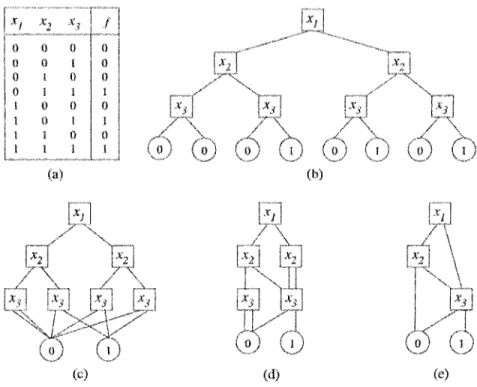
Figure 2.4 shows the transfornw.tion of Ut<~ function
f
('c1 , :J:2 , :x:;'i.) '='' (xi:r:2+
xl):r~l gi vona,,c;; a truth. t.a.ble into several hltcnnf•dia.te formi'l lm:1ding to a, redueed ordered BDD, by a sm-ies of reductions: (b) is the initial ordered binary tree, the non-uniquo tm:mhmls and uon-terrninals an~ merged in (e) and (d) respectively, and redundant nodns a.re dirnin<.t!i<~d in (e).
There is a dear relationship between the set of BDDs with nodes labeled with identifiers
:r:,i, l
S
is
n (call it BDD11 ) and the set of 'rH:H'Y boolean functions, {0, l}n-+
{0, 1}. Ana.rbilirary DAG frcnn BDDn truly n~presents a fundion only jf there a.re no t.wo distinct; paths labeled with tho same truth assignment of variables and leading to different terminal nodes.
To make the relationship biunivocal, a canonical representation is needed. That is, two boolean functions that are logica1ly equivalent should be represent;E~d by isomorphic BDDs. This can be achieved by imposing three restrictions on a BDD:
(BDDl) Th.ere is a total order over the set of identifiers a;1
<
:r-2< ...
x11 , such that the labels along every path are conforming t;o this order;(BDD2) There are no duplicate nodes (terminal or nm1.-terminal); duplicates arc merged into
OlH; single eopy of all such nodes;
CHA .. P'l'BH. 2. 8'"1:!'\TB SPAOB CO.N8THUCT10N
26
(a) (b)
Figure 2.5: The eHi:~et of variable ordering over the BDD si:t;c
The abow~ restrictions also give a simp!<~ algorithm that transforms an initial binary tree into a reduced and ordered bina.ry dceision dingram (ROBDD), which is a canonical form
for representing functions. In Figure 2.4, the fiual stage (e) is a ROBDD.
If rostriction (BDDa) is dropped from t;lw requirement list and replaced with the con-straint (BDD:J') t.ha.t all arcs connect 1wdes on consecutive levels, the decision di;;tgrams are called qttasi-rcrbu:ed (QOBDD) [98]. In our example this corresponds to the intermediate
step (d). It is easy to see that this form is also canonical. QOBDDs may contain redundant nodes (which are additional nodes compared to the ROBDD form). On the other hand QOBDDs possess a handy property: every node has its successors labeled with the same variable name, henee the whole diagram is structured in n "levels", with arcs connecting
only nodes on adjaeont levels. In the reduced version, arcs may skip levels.
The step from storing functions to storing set.:,; is st;raight.forward, as the characteristic function of a set U ~ {0, l}n is au n-ary boolean function: xu(:c) = 1 if and only if ::r: E U.
Most·, of our discussion ou decision dingra.tus will be concerned with representing sets.
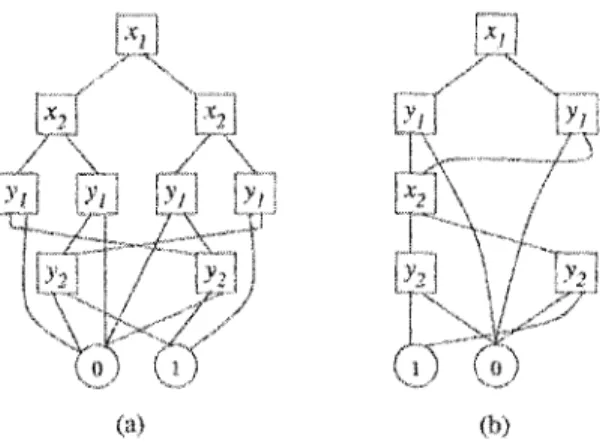
The variable ordering is a critieal factor in reducing th.e size of a BDD. A compelling case is the class of n-bit-eompamtors. For n = 2, the analytical forrn is
f
(:c1, :r2, :Y1, Y2) :=OIIAPTEJH 2. S'.l.WFE SP.4C'B CONSTHUCT£0N 2'l
(?c{· ·
m·
·+·
:x:1 • yJ)(:i:~;· ·Yi
·+
:t:z · Y2)· As shown iu Figure 2.5, f(lr the ordering :~:1 :~;z<
~11<
'!12 (a.) the BDD lu~n'! nine nm.t--termina.l node1-1, while for the ordnriug a:: 1<.
1/l<
:c2<
1/2 {b)the number of uon-tennina.ls is jnst six. In faet, f(lr the gt~neral east~ with n bit:s, the first; ordering produces
a
(2n -· 1) non-terruinahl and the secondan,
a logarith.rnie reduction in size.Finding an optimal variable ordering is au hlt;raetahl~) problem. gven dHl(~king l:hat a particular ordering is optirnal is NP .. complete [::~]. Pnrtr1ennore, certain da.ssfm of hmetio.us
have exponential size for an:IJ variable ordering [17].
Thn only solution in such situations is to look for a, "good" ordering. 'I'he intuition behind most heuristics is that, variables that cl<~peud on eaeh other should be placed in dose vicinity (62,
6a].
When no obvious rule e:::u1 be <:.tssessod about a. good ordering, a dynmnicr-eonlering teehnique [124] which periodically rearranges the variables to reduce the number
of nodes can give reasonably good results.
Operations with BDDs. We next explain how to perform various logical opera.tions using BDDs. The basis for combining two BDDs is the Testriction operator: in an n-ary booloa.n function
f,
if the variable :r;i is bound (restricted) to the constant b E {0, 1 }, we obtainGive.n the ROBDD for
f,
thE1 ROBDD for the restrid:ion can bo obtained by redirncting all the a.rcs that; point t.o nodes labeled Xi to the b·deseendant of that node. Tlwn, sttlp (BDD3) of the definition is perforrued to eliJninatc a.ny newly introd.ueed redundant nodes.G.HAPTB.H 2.
STATIG
SPt\CE OONSTHUCTTON28
The resulting BDD has mw vari<tble less than the original, as :x:1: wa.s elimirmtnd.
The reverse operation is called (Shannon) e:cpansion:
Based on t.hls divi(h~·a.nd~eonquer-like technique, one Cctn write a. n:cnrslve algorit;hm to build the BDD f(n· a.ny binary operation
f
*
g [16], as listed in Figure 2.(). Note that, f()r QOBDDs, the test :.c '"' :y in line 7 ho.lds in every recursive ea.ll for BDDs of the same height defined over the Harne ordered set of varia.b.les.BDD
a,pp.~!{ (~_:_?l!.:~(~~::~::.L.:~~~~!:dL:
..
~.r,~r.D
...
:~~.(~'~"·-···-·~··-·-·~···-···"•"''''"''''''""-'''
The recursive algorithm to compute a generic
f
*
g1. let ;r; and
u
be the variables corresponding to the roots off and g2. if both ::r: and 11 represent terminal nodes
3. return val(:x:)
*
va.l(y)4. else
5. fo ~- f!xf-0;
h
-0--.fl:c,·-1;
6. go +- flyHl; f/1 +- flu<-1;7. if :x = y then
8. return x · BDDa,pply (*, fo,go)
+
x · BDDar1ply (*, !J,gJ);9. else if x
<
y10. return J; · BDDapply (*, fo,g) +a;· BDDapply
(*,
h,
g);11. else
12. return
y ·
BDDapply (*•
f,
go)+
y · BDDapply ( *,f,
g1);-Figure 2.6: The algorithm for binary operations on BODs.
Since each caU to BDDapply may generate two other recursive calls, the algorithm <ts
shown ha.<; exponential titne complexity. By using a.n auxiliary data structure, called cache
to store all thn a.nsw<~rs to already computed subprohl~:1ms, the eom.plexit;y is reduced to polynmnial time. Indeed, the number of distinct pairs that ean be f<.1rmed with roots of
CIL4P'J'IiJR. 2. ST'l(l'B SPACJIE CONSTWJO'liON
subdiagrams from
f
and g is t:ll8 product of tho mnnber of nodes in ea,eh BDD[17].
Extensions. There exists a multitude of I3DD gmwraJiza.tions
[r)fi]:
• By using dm:omposition rules other than S1mnnon's to obtain Ordered Functional Dedsiou Diagn1ms (OFDDs): exautples an~ t.he positive and nega,t.ive Da.vio df:com-position [52]. All thn throe rulos (the two Davio and Shannon) may thon be combirwd in the I\.roneeker functional decision (Uagranls (OKF'DDs), which allow di!fort~nt ch~ eompositions at; different n<J<ieH. A canonical fi:mn of OKF'DDs ean be obtained by fixing the rule for each variable.
• By relaxing t;he ordering eondition: these are the Free BDDl-l.
• By representing arithmetic functions instead of boolean fnuctions:
Multi-terminal BDDs (MTBDDs) [8, :$f)], are extensions of lJDDs used to represent binary functions of the type f: {O,l}K--+ {O,l, ... ,m, -1}. MTBDDs have rn
terminal nodes, corresponding to the rn possible values of the function. This definition can be further extended to arithmetic functions, where eaeh variable may take a finite set of inl;eger values, instead of binary values: f: {0, ... , n1 -1} x {0, ... ,
nz
-1} ... x {0, ... ,nK -1} --7 {0, ... ,m -1}. The resuH.ing form is called Multi-wa;y Decision Diagrams (MDDs). They arc presented in detail in the next section.• By introducing edge labeling, t;o obta.ht the Bdge Valued BDDs (EVBDDs) [~H]: in this category also fall the Binary Momnnt, Diagrams (BMD), Multiplicative BMDs (~BMDs) (18], and Zero Supressod BDDs (ZBDDs) [83].
GIJAP7'BH 2. S'J.'A.TB SPA(}ID CONSTlUJOTlON
ao
2.6.1.2 1\IIulti-wa.y decision diagrams
The very first symbolic model dw<:ker, caHed SMV [104], W<ts successfully employed in
the vm:ifieation of digital drcnit.s, as BDDs :u·e suitable for modeling this type of sysl:ems. Signals are naturally represented by boolna.n variables and the con1binatiou of gates in the circuit can be encoded as a large boolean function.
However, for a.rbitrary asynchronous systerns, BDDs .have rnany difficulties espedally in n~present:iug integer fundions. A variable Xk that takes nk values, ca.n be encoded using ['log2 nA:l binary variables. However, the height of the dia.gra.m may heem:ne very large,
and therefore hampers the eHideney of diagram manipulation, a.'! tht.~ complexit;y of BDD
operations depends on the number of BDD nodes.
One way to cope with this problem is to use Multi~wa.y Decision Diagrams to efficiently encode functions of the type
f: Sg X ... 82 X St
-+
{0, 1}
where Sk = {0, ... ,nk 1}, for 1 ~ k ~ K.
Originally introduced in [87), MDDs are natural extensions of BODs, more suitable for modeling complex asynchronous systems, since they allow discrete variables to take values over arbitrary finite sets instead of requi.ring boolean variables. The quasi-reduced version of MDDs we now deflne is a naturaJ eomhination of the multi~ way extension with the quasi-reduced ca.uonkal format introduced f(:n· BDDs in [90].
Formally:
aJ
• Nodes an~ organized into K -1- J. levels. VVe 'WTile (kiJ>) to denote a node at level li:,
where .fJ i.'J a u.niqtte index for that h"oel.
• Level K contains a single non-terminaJ node (.K lr), the root, whereas levels K --1
throngh l cont:a.in one or mon: non-terminal nodes.
• Level 0 con8ists of t:wo terminal node.'!, (OjO) and (Oil).
• A non-terminal node (kip) har;; nk arcs po·inting to node.<; allt;vel k -· L {f lhe ·ith (L1'C,
for· 1: E Sk, is to node
(k--llq),
we write(klp)[iJ
== q. Duplicate nodes an; not allowed but, unlike red·nced order·ed Jv!D D.s, redundant: node.<; wher·e a.ll ar·cs point to the sam.enode are allowed (both versions are canonical).
Notiee the inverse indexing of levels, from K down to l. This is justified by the conven-tion that the terminal nodes should always be at level 0.
Given the above definition, we can extend our are notation to paths. The index of the node at levell- 1 reached from a node (kip) through a sequence (ik, ... , it) E Sk X··· X 81,
for K
2
k>
l2
1, is recursively defined <l..<;The substatos encode<:! by, or "below", (A:Ip) are then