Generalization of Motor and Sensory Changes in Motor Learning
AHMED MOSTAFA
A DISSERTATION SUBMITTED TO
THE FACULTY OF GRADUATE STUDIES
IN PARTIAL FULFILLMENT OF THE REQUIREMENTS
FOR THE DEGREE OF DOCTOR OF PHILOSOPHY
Graduate Program in
KINESIOLOGY AND HEALTH SCIENCE
York University
Toronto, Ontario
APRIL 2019
Abstract
This dissertation examines the generalization of motor and sensory changes in motor learning. Chapter two describes the process of intermanual transfer of reach adaptation and proprioceptive recalibration. We exposed participants to a laterally translated cursor while reaching with one hand to three targets, and then we measured reach aftereffects and changes in felt hand position for the trained and untrained hand. We found reach adaptation transfer from right to left hand and no transfer of proprioceptive recalibration. This suggests that the intermanual transfer for motor adaptation is hand-dependant, and proprioceptive recalibration is specific to the trained hand. Chapter three describes the generalization patterns of reach adaptation and proprioceptive recalibration across different distances. Reach aftereffects and changes in estimates of hand position were measured following reach-training with a rotated visual feedback of the hand to a single target distance. We found that reach adaptation and proprioceptive recalibration transfer across near and far novel distances. However, proprioceptive recalibration generalization was significantly smaller at far novel locations. This suggests that, unlike motor adaptation, the extent of sensory changes generalization is distance-dependent. Chapter four describes the contribution of proprioceptive recalibration and updated efference-based sensory predictions in motor adaptation and changes in hand localization. We exposed our participants to only visual-proprioceptive discrepancy by removing volitional movements and having a robot move their hand passively. Then, we examined changes in hand localization in two hand movement conditions, i.e., active (self-generated) and passive (robot-generated). Results showed no significant difference in hand localization changes between active and passive conditions. This suggests changes in hand localization reflect mainly proprioceptive recalibration of the hand rather than updates in efference-based sensory
predictions, and entirely on proprioceptive recalibration when training does not include any volitional movements. Additionally, in Chapter four, we examined how reach adaptation and proprioceptive recalibration generalized across different directions in the workspace. We found that reach aftereffects generalized to neighboring novel targets in a pattern similar to proprioceptive recalibration generalization pattern. This suggests that some of the reach adaptation reflect proprioceptive changes. Our findings provide insight into the characteristics of proprioceptive recalibration and how this process influences motor learning. This should be taken into consideration when designing motor adaptation/learning paradigms, teaching a motor skill or designing a movement rehabilitation protocol.
For my Dad and Mom إ ﻰﻟ بﺎﺤﺻأ ﻞﺑﺎﻘﻣ ﻼﺑ ءﺎﻄﻌﻟاو ﻞﻀﻔﻟا ﻲﺑأ و ﻲﻣأ لدﺎﻋ يﺮﺒﺻ و ﺎﯾﺮﺛ ﺪﯿﻌﺴﻟا ﻮﻋدأ ﺎﻤﻜﻟ اﻟﻠﮫ ماوﺪﺑ ﺔﯿﻓﺎﻌﻟاو ﺔﺤﺼﻟا
ACKNOWLEDGEMENT
I would like to truly thank my supervisor Dr. Denise Henriques. My research would have been impossible without the aid and support of you. You are a wonderful person, a great manager and an excellent professor. From my day one in Canada I have noticed your kindness and thoughtful care for others. Your support in many situations is unforgettable. I really appreciate all what you have done for me to achieve my goal.
I must also thank my exam committee, Drs. Lauren Sergio, Rob Alison and Mazyar Fallah. You are talented professors and have your own brilliant and creative way to simply explain and teach a sophisticated piece of knowledge. I really appreciate your guidance, time and feedback.
I want to say my sincere thanks to Dr. Luc Tremblay, this was my first time to see you in person and I am very glad to know such a respectful and smart professor like you. Many thanks for your time and feedback.
I would also like to thank Dr. Erin Cressman, you are a very nice person and I learned a lot from you. Also, many thanks to all my lab mates, especially, Holly, Steven and Dr. Marius. All of you have been helping me over the past years; I really appreciate your help and feedback.
To my lovely wife Aya for everything she did to help me to accomplish my goals, I am truly thankful. To my little boy Adel who brings the joy to my life every time I see him.
Finally, many thanks to my brother Mostafa, and my sisters Amina, Khokha and Nadia. You are the best.
Table of Contents ABSTRACT..……….…………...………...II DEDICATION……….……….……...IV ACKNOWLEDGMENT……….………...……...V Table of contents...………...…....VI List of figures…….………..………...IX CHAPTER ONE ... 1 1.1 BACKGROUND ... 2 1.2 PROPRIOCEPTION ... 5
1.2.1 Hand and Arm Localization ... 9
1.3 REACH ADAPTATION ... 12
1.4 PROPRIOCEPTIVE RECALIBRATION ... 16
1.5 GENERALIZATION OF REACH ADAPTATION ... 19
1.5.1 Intermanual transfer ... 19
1.5.2 Workspace-generalization ... 21
1.6 GENERALIZATION OF PROPRIOCEPTIVE RECALIBRATION ... 23
1.7 OBJECTIVES ... 24 CHAPTER TWO ... 25 2.1 ABSTRACT ... 26 2.2 INTRODUCTION ... 27 2.3 METHODS ... 31 2.3.1 Subjects ... 31
2.3.2 General experimental setup ... 31
2.3.3 Procedure ... 33 2.3.4 Data Analysis ... 37 2.4 RESULTS ... 39 2.4.1 Visuomotor Adaptation ... 39 2.4.2 Proprioceptive Recalibration... 43 2.5 DISCUSSION ... 46
2.5.1 Motor Transfer and Arm Asymmetry ... 47
2.5.2 Proprioceptive Transfer and Arm Symmetry ... 49
CHAPTER THREE ... 53
3.1 ABSTRACT ... 54
3.2 INTRODUCTION ... 55
3.3 METHODS ... 59
3.3.2 General experimental setup ... 59
3.3.3 Procedure ... 60
3.3.4 Data Analysis ... 64
3.4 RESULTS ... 66
3.4.1 Reach adaptation generalizes to different target distances ... 66
3.4.2 Proprioceptive recalibration generalizes to a lesser extent at far distances... 68
3.5 DISCUSSION ... 70
3.5.1 Generalization of motor adaptation... 70
3.5.2 Proprioceptive acuity across the workspace ... 73
3.5.3 Generalization of proprioceptive recalibration ... 74
3.5.4 Different generalization patterns for reach adaptation and proprioceptive recalibration ... 75 CHAPTER FOUR ... 77 4.1 ABSTRACT ... 78 4.2 INTRODUCTION ... 79 4.3 METHODS ... 81 4.3.1 Participants ... 81 4.3.2 Setup ... 82 4.3.3 Procedure ... 82 4.4 ANALYSES ... 86 4.4.1 Localization... 87 4.4.2 Reach aftereffects ... 87 4.5 RESULTS ... 88 4.5.1 Localization... 89 4.5.2 Reach aftereffects ... 92 4.6 DISCUSSION ... 95 4.6.1 Generalization... 99 4.7 CONCLUSION ... 100 CHAPTER FIVE ... 101 5.1 INTERMANUAL GENERALIZATION ... 102 5.2 WORKSPACE GENERALIZATION ... 105
5.3 VISUAL-PROPRIOCEPTIVE DISCREPANCY AND HAND LOCALIZATION ... 109
5.4 VISUAL-PROPRIOCEPTIVE DISCREPANCY AND GENERALIZATION ... 114
5.5 CONCLUSION ... 115
CHAPTER SIX ... 117
6.1 REFERENCES ... 118
APPENDIX B: INFORMED CONSENT FORM (FOR UNPAID PARTICIPANTS) ... 133 APPENDIX C: PUBLISHED PAPER REFERENCES ... 134
Table of Figures
FIGURE 1.1MAMMALIAN MUSCLE SPINDLE. ... 6
FIGURE 1.2DORSAL COLUMN-MEDIAL LEMNISCUS PATHWAY. ... 8
FIGURE 1.3INTERNAL MODELS ... 15
FIGURE 2.1EXPERIMENTAL SETUP AND DESIGN ... 32
FIGURE 2.2BREAKDOWN OF THE TESTING SESSIONS ... 34
FIGURE 2.3MEAN ENDPOINT AFTEREFFECTS ... 40
FIGURE 2.4PROPRIOCEPTIVE ESTIMATES ... 44
FIGURE 2.5MAGNITUDE OF THE UNCERTAINTY RANGES ... 46
FIGURE 3.1EXPERIMENTAL SETUP AND DESIGN. ... 60
FIGURE 3.2SCHEMATIC OF TASKS ORDER ... 61
FIGURE 3.3REACH AFTEREFFECTS ... 67
FIGURE 3.4PROPRIOCEPTIVE BIASES ... 69
FIGURE 4.1EXPERIMENTAL SETUP AND DESIGN ... 83
FIGURE 4.2CHANGES IN HAND LOCALIZATION ... 90
FIGURE 4.3CHANGES OF THE ANGLE OF REACH ENDPOINTS IN THE NO-CURSOR TASKS. ... 93
CHAPTER ONE
1.1 Background
Giving the constant changes in our body and the surrounding environment, the ability to adapt to such changes is a key process. Motor adaptation is a type of motor learning which involves remapping the relationship between sensory information (visual and proprioceptive) and motor commands following perturbations (Tanaka, 2010). Motor adaptation is very crucial to the motor system for maintaining stability and control of everyday movements. The central nervous system (CNS) evolved this kind of plasticity to deal with both body-growth changes and variability in the surrounding world. Studies of motor adaptation have a long history, spanning for more than a century. Stratton (1897) investigated how inverted vision, obtained by wearing prism glasses, could be remapped with body movements over time. In one of his experiments, for eight days, he wore prism glasses that inverted the visual field vertically. It was strange and difficult for him to move during the first four days, but, on day five he started to be able to move normally while vision was inverted. Even for complex movements, such as riding a bicycle, participants were able to adapt and ride a bicycle within 30 days of wearing prism goggles. For smaller prism displacements, such as those that shift the visual field by 11.3 degrees, adaptation to reaching or throwing movements is much quicker and can occur within an hour of training (Redding, Rossetti, & Wallace, 2005). To date, many laboratories have further showed the elegant ability of humans to adapt their movements to a wide range of visuomotor alterations.
In the past couple of decades, researchers have been investigating motor (or reach) adaptation, using virtual reality setups, by kinematically altering the visual feedback of the hand (a cursor that represents the hand), while participants reach to visual targets in the workspace. In this method, the cursor could be either rotated or translated relative to the hidden, trained hand, to introduce a small discrepancy between the visual feedback of the hand and the actual hand. In this way, unlike prism adaptation, only the visual motion of the hand is affected and not the
background nor target location (Krakauer, Ghilardi, & Ghez, 1999). Typically, during this type of training, participants adapt their reaches in order to get the cursor on the target while the actual hidden hand is directed off-target. Reach adaptation during these tasks can be represented by a learning curve, which shows the gradual adjustments to reach trajectories and reach-errors reduction behavior until the end of training. Additionally, after sufficient training, the reaches continue to deviate after the cursor (and thus any vision of the hand) is removed entirely or if the perturbation is removed. These persistent reach deviations are known as reach aftereffects. In this dissertation, we will examine motor adaptation by measuring reach aftereffects following training with a variety of perturbations.
Visuomotor adaptation also produce consistent, although sometimes limited, generalization. That is, adaptation while training with one hand and to one location in the workspace can transfer partially to the opposite hand or generalize to other novel locations across the workspace (Imamizu, Uno, & Kawato, 1995; Krakauer, Pine, Ghilardi, & Ghez, 2000; Pearson, Krakauer, & Mazzoni, 2010; Wang & Sainburg, 2005). Intermanual transfer depends on which hand is trained. Some studies have shown symmetric transfer between hands while others have shown that transfer occurs from one hand to another but not vice versa. Generalization of visuomotor adaptation across different locations on the workspace has shown to be influenced by the type of introduced distortion (i.e., cursor gain or rotation) and the coordinates of the targets in the workspace (i.e., target distances and directions relative to the start position and trained target). For instance, reach adaptation to a cursor rotation to a single target leads to a local or narrow generalization pattern across novel-untrained directions, while adaptation to a cursor gain leads to wider generalization (Krakauer et al., 2000).
Studies have shown that visuomotor adaptation leads not only to motor changes, but also to changes in the felt position of the hand, i.e., proprioceptive recalibration (Cameron, Franks, Inglis, & Chua, 2012; Cressman & Henriques, 2010, 2011; Cressman & Henriques, 2009). When participants are asked to localize the position of their unseen hand following visuomotor training, they estimate their hand to be partially shifted in the direction of the perturbed visual feedback of the hand. To date, proprioceptive recalibration has been observed consistently following different types of distortions (i.e., rotation vs. lateral displacement of hand cursor, Cameron, Franks, Inglis, & Chua, 2012; Cressman & Henriques, 2009), both when the distortion is introduced gradually or abruptly (Salomonczyk, Henriques, & Cressman, 2012), for large as well as small distortions ( Salomonczyk, Cressman, & Henriques, 2011), and for younger as well as older adults (Cressman, Salomonczyk, & Henriques, 2010). Furthermore, this change in proprioception has been found to emerge quite quickly; after a dozen reach training trials (Ruttle, Cressman, ’t Hart, & Henriques, 2016). This perceptual change, or sensory plasticity, has been found to be different in size and in patterns of changes from motor output (such as reach aftereffects). Moreover, even when training with a visual-proprioceptive discrepancy of the hand that occurs without volitional movements, as when the robot moves the hand passively, hand proprioception shifts by a similar amount to that produced when the reaching is generated by the participant (Cressman & Henriques, 2010). In addition, reach aftereffects also emerge, and resemble proprioceptive shifts, following this passive-exposure training. This suggests that proprioceptive recalibration plays an important role in sensorimotor learning.
Much remains to be understood about the proprioceptive recalibration process and its characteristics. The purpose of the current dissertation is to examine how both motor and sensory changes generalize between hands and across the workspace following visuomotor adaptation.
Additionally, here I investigate visually-induced changes in hand localization based on efferent signals, as well as proprioceptive signals. The findings will provide insight into how changes in estimates of hand motion emerge and contribute to motor learning and generalization.
This Chapter will provide the reader with some background information that will help to understand the experiments in later Chapters. Proprioception, its neural mechanisms and how it is measured will be explained. Error-based learning and the use of error signals in motor adaptation will then be introduced, with an emphasis placed on the role of proprioceptive recalibration in motor learning. The generalization process of reach adaptation and relevant research findings will then be discussed. Finally, the objectives and rationales of dissertation experiments will be stated.
1.2 Proprioception
To perceive and interact with the environment, our brain processes sensory inputs from several senses. Sherrington (1907) suggested the terms exteroceptors, interoceptors, and proprioceptors to refer to sense organs that provide sensory information, about our body and/or the surrounding world, to the CNS. The exteroceptors were defined as the organs which detect information originating out of the body and included the eyes, ears, mouth, and skin. These organs are designed to extract different types of perceptible energy from the environment (e.g., visible light waves, audible sound waves, etc) and transduce them to electrical signals that are conducted by neurons, through specific neural pathways, and projected to specific cortical areas in the brain. Interoceptors, convey the internal state of the body (such as blood pressure and oxygen concentrations) to the CNS. Proprioceptors are sensory receptors that provide detailed and continuous information to the CNS about the position and motion of the limbs or other segments of the body. This ability to sense position and motion of body segments is known as
proprioception. The main proprioceptors for sensing limb motion include muscle spindles, Golgi tendon organs, and joint receptors. Muscle spindles appear to play the dominant role in informing body position and movement, as illustrated by illusions produced by tendon vibration, and deficits produced after loss of sensory neurons bringing input into the CNS, known as deafferentation (reviewed here, Proske & Gandevia, 2012). Proprioception is also facilitated by cutaneous information.
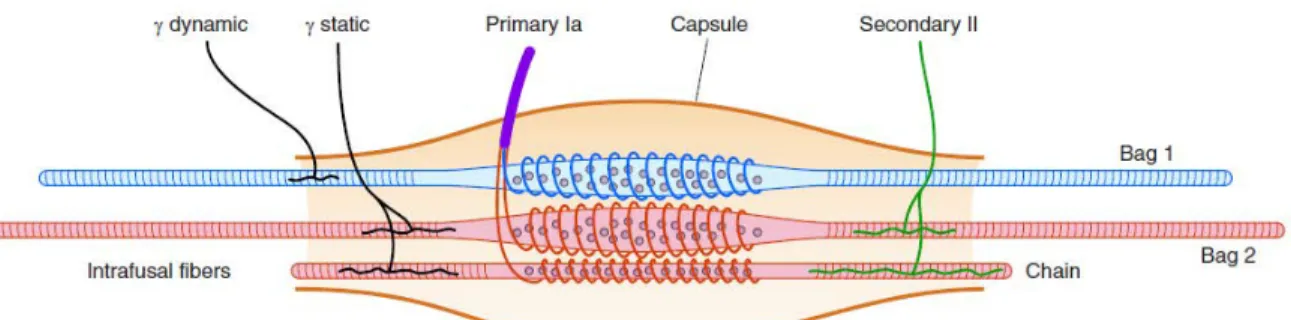
Muscle spindles are composed of numerous intrafusal muscle fibers (Figure 1.1) that are located within the muscle body and change in length along with extrafusal muscle fibers that generate limb movements. As depicted in the figure, an intrafusal muscle fiber is divided into nuclear chain and nuclear bag fibers (1 and 2). Dynamic and static gamma motoneurons innervate nuclear bag 1 fibers, and nuclear chain and nuclear bag 2 fibers, respectively. Afferent information is transmitted from muscle spindles to the CNS by primary Ia and secondary II afferent neurons (Matthews, 1977).
Figure 1.1 Mammalian muscle spindle. The intrafusal fibers include the large nuclear bag 1 and bag 2 fibers together with the smaller nuclear chain fibers. Primary endings, Ia afferent fibers, make terminations around the three intrafusal fiber types. II afferent fibers terminate as secondary endings, supply bag 2 and chain fibers. Gamma static motor neurons innervate bag 2 and chain fibers, while gamma dynamic motor neurons innervate bag 1 fibers (copied from (Proske & Gandevia, 2012))
Golgi tendon organs are encapsulated structures and found in muscle tendons of striated extrafusal muscles, they are also proprioceptive sensory receptors that provide information about muscle tension to the CNS. Golgi tendon organs capsule contain collagen fibers that are
connected to a group of muscle fibers. A single Ib afferent fiber innervates one capsule and branches inside into several fine endings that are weaved through collagen fibers. When Golgi organ is stretched the collagen fibers become straightened, thus compressing the Ib nerve endings and causing them to fire (Gilman, 2002).
Sensory inputs from proprioceptors, as cutaneous or tactile, receptors are conveyed by ascending sensory tracts to CNS via the dorsal column (Figure 1.2). Unconscious proprioception pathways primarily terminate in the ipsilateral cerebellum. Conscious proprioception, however, is communicated by the dorsal column-medial lemniscus pathway to the cerebrum, particularly to the somatosensory cortex. These sensory pathways are important for transmitting proprioceptive information necessary for coordinating and performing smooth movements as well as maintaining normal muscle tone and posture. The dorsal column-medial lemniscus pathway begins with proprioceptors (and cutaneous receptors) entering the spinal cord via the dorsal roots, and then project onto neurons within the dorsal root of the spinal cord which axons ascend to the medulla where they synapse onto the second order neurons in the nucleus cuneatus (for upper body) and nucleus gracilis (for lower body). The axons of these neurons (which make up the medial lemniscus) cross the midline and travel to the thalamus, where they synapse onto neurons in the ventral posterolateral nucleus (VPL). This third order neuron relays afferent signals to the postcentral gyrus (i.e., the somatosensory cortex). The somatosensory cortex is arranged in a somatotopic manner.
Figure 1.2 Dorsal column-medial lemniscus pathway: first-order neuron enters the spinal cord via the dorsal roots then ascends to medulla level where the second order neuron decussates the midline and ascends to the thalamus where it synapses onto third order neuron that relays afferent signals to the primary somatosensory cortex. Image reprinted from https://anatomy-library.com/img/anatomy-dorsal-column-1.html.
Different areas in primary somatosensory cortex (SI), area 3a, 3b, 1 and 2, receive proprioceptive and tactile input from the body. Area 3a receives proprioceptive input from muscles and joints through the ventral posterior superior nucleus. Area 3b receives tactile input from the skin, which is then sent to area 1 and 2 for further processing. Area 2 also plays a role in perceiving size and shape involved with proprioception. Information from SI is sent directly to M1, SII, and somatosensory association cortices. Brodmann’s area 5 integrates proprioceptive and haptic information. Brodmann’s area 7 integrates proprioceptive and visual spatial
information to facilitate localizing objects relative to the body (Debowy, Ghosh, Ro, & Gardner, 2001; Murray & Mishkin, 1984).
Proprioceptive information is also directly and indirectly conveyed to the cerebellum for unconscious use in postural control, coordination and maintaining muscle tone. The main pathways for upper-limb proprioception include spinocerebellar tracts, which transmit afferent inputs from proprioceptors that innervate the lower cervical and upper lumbar spinal levels (dorsal) and lower lumbar and thoracic spinal cord (ventral). That primarily terminate in two topographic maps in the spinocerebellum (anterior lobe and paramedian lobule). A third proprioceptive pathway is the cuneocerebellar tract, which conveys proprioceptive inputs from the upper-limb. Afferent nerve fibers ascend from the lateral cuneate nucleus and terminate topographically in the cerebellum through the ipsilateral inferior cerebellar peduncle.
1.2.1 Hand and Arm Localization
How well can we use proprioceptive information described above to locate our arm or hand? While vision tends to provide more accurate and precise estimate of hand position (Ernst & Banks, 2002; Jones, Cressman, & Henriques, 2010; Sober & Sabes, 2003) than just proprioception, people are still able to locate their unseen hand with a fair amount of accuracy and precision (in the order of a few centimeters, (Jones, Cressman, & Henriques, 2010)), although this depends partly on the tasks and which part of the “limb’ is being assessed. Behavioural tasks used to measure proprioception (in the absence of vision) required participants to either match the position of one hand or arm to the other, localize one hand using the opposite hand, or estimate hand location relative to a reference marker. In this dissertation, we used two of these methods which we describe in detail below.
One task, which we call “hand localization” or “proprioceptive-guided reaching”, assesses how well people can accurately and precisely locate their hidden hand using their opposite hand, or in some labs, a cursor (Izawa, Criscimagna-Hemminger, & Shadmehr, 2012; Jones et al., 2010; Jones, Fiehler, & Henriques, 2012; Sarlegna & Sainburg, 2007; Synofzik, Lindner, & Thier, 2008; van Beers, Sittig, & van der Gon, 1998; van Beers, Sittig, & van der Gon, 1999). Here people are usually accurate within several centimeters, but with most producing consistent misestimates contingent on the hand tested, such that the left hand is misestimated as being more left and the right hand as being more right than the real hand location (Haggard, Newman, Blundell, & Andrew, 2000; Jones et al., 2010; Sarlegna & Sainburg, 2007, 2009; van Beers et al., 1998, 1999). Moreover, some studies find that locating the left hand is more precise than the right hand, although this could be due to the precision of the indicating hand, and thus may reflect the precision of the reaching/moving hand and not proprioceptive localization ability per se. Indeed, Jones et al (2012) and Jones & Henriques (2010) found that proprioceptive tasks that didn’t involve proprioceptive-guided reaching (see below for more detail) show no significant differences in precision when estimating the left vs right unseen hand location, and only small differences in precision when proprioceptive-guided reaching was used (note: in their study, the reaching hand was dimly lit to reduce these reaching errors). However, they did continue to find a hand-dependent systematic bias as mentioned above: the left hand was judged to be located more left and the right hand more right (each by 1-3 cm of directional error). The results above suggest that hand proprioception is relatively accurate although with a systematic, lateral, hand-dependent bias, but with little difference in proprioceptive precision between the two hands.
The other main task used in the studies by Jones et al. involves a perceptual judgment task to measure the proprioceptive estimate of hand location (what Jones and we sometimes call proprioceptive estimation). The advantage of this method is that it does not require involving the other hand, possibly for a less confounded estimate of hand proprioception. This perceptual judgment task was originally developed by Cressman and Henriques (2009) and it involves asking participants to estimate their hand position relative to visual and proprioceptive reference markers (without planning a reach). The location of the unseen hand (moved or guided by a robot manipulandum) relative to the reference markers varied from trial to trial, using an adaptive staircase algorithm. Once the hand moved to its final position, the reference marker would appear or sound, and participants indicated whether their hand is to the right or left of the reference marker using two-alternative forced choice responses (the right or left arrow keys on a keyboard). Each reference location was tested across 50 trials, and the responses were fitted by logistic function to get the locations at which participants felt their hand to be aligned with the reference markers (see Figure 2.1 for an illustration). For each logistic function, the bias (a measure of accuracy, the point of 50% probability) and uncertainty (a measure of precision, the difference between the values at which the response probability was 25 and 75%) was calculated. Jones and Henriques (2010) and Jones et al. (2012) compared this perceptual task with the proprioceptive-guided reaching tasks and found that estimates using this perceptual task were similar to those for proprioceptive-guided reaches, although less accurate than a task where participants merely reproduced the location of the hand (in all tasks, the robot guided the hand into position). As mentioned above, in both guided reaches and proprioceptive-estimation tasks, the authors found that participants perceived their left and right hands to be biased leftward and rightward, respectively.
In the studies in this dissertation, we used both proprioceptive methods to measure the lateral location of felt hand position before and after adapting the target-hand (and the opposite hand in Chapter 2) to a visuomotor distortion. In Chapter 2 and 3, we used the perceptual tasks while in Chapter 4 we used proprioceptive-guided reaching for reasons described later in this Chapter.
1.3 Reach adaptation
While there are many types of motor learning, in this dissertation we are interested in motor adaptation, which involves modifying a movement that is already well learned, like reaching. Adaptation involves forming a novel, context-dependent remapping between a sensory input and a motor output. The process of motor adaptation can be defined as “an error-reduction process that occurs when systematic errors are introduced in body movements by certain internal or external factors” (Tanaka, 2010).
Under laboratory settings, systematic errors can be introduced by using different perturbations which can be dynamic, like a force field, or kinematic, like false visual feedback of the hand (Wolpert, Diedrichsen, & Flanagan, 2011). In force field experiments, a robotic manipulandum is used to apply forces to a participant’s hand. Direction and magnitude of these forces usually depend on the state of the hand (i.e., its position and velocity). The participant’s reaches are initially displaced laterally (the hand path is curved) when the force field is applied as they move to the target. However, they quickly adapt their reaches to move directly to the target (straight path) as they do for normal, unperturbed reaches. In visuomotor adaptation training, as I mentioned earlier, participants are asked to reach to one or more targets with a cursor that misrepresents their unseen hand position. That is, during training, a misalignment is introduced between the actual hand movement and the cursor motion (by rotating the path of the
cursor either CW or CCW relative to the hand) so that cursor deviates away from the target direction at the beginning of training. By 20 or so reaches (per target, Krakauer et al., 2000) for a small cursor rotation (like 45 degrees), participants learn to redirect their unseen hand movements to get the cursor directly to the target. For both types of perturbations, error or reach deviations are initially quite large, but reduce quite quickly in an exponential manner. That is, improvement is large and fast at the beginning of training, followed by slower improvements of performance until they return to pre-perturbation (baseline) levels.
Following reach training with perturbations, reaches continue to deviate after the perturbation is removed, by making the cursor invisible or by realigning it with the hand. These reach aftereffects provide another measure of reach adaptation. When reach adaptation occurs, participants show reach aftereffects in the opposite direction of the introduced rotation when reaching without a cursor. Reach aftereffects for visuomotor adaptation emerge quickly during training, within a dozen reach-training trials (Ruttle et al., 2016), and after training, are usually around 50% of the introduced distortion in size, regardless of the type (rotated or translated), size or direction of the introduced cursor-misalignment, or whether the cursor is continuously visible during reaches or only shown at the end of the movement (Abeele & Bock, 2001; Criscimagna-Hemminger, Bastian, & Shadmehr, 2003; Krakauer et al., 2000; Salomonczyk, Cressman, & Henriques, 2011). As an example, in their experiments, Cressman and Henriques (2009) trained their participants to reach to visual targets with a visuomotor distortion where the cursor was rotated 30° or laterally-shifted 4-cm. The authors found that regardless of the type of visuomotor distortion (rotated vs. translated), reach adaptation occurred to a similar extent, with reach aftereffects of ~ 18° on average relative to hand starting position. Interestingly, reach aftereffects were found to be robust enough to be retained up to 24 hours following training (Nourouzpour,
Salomonczyk, Cressman, & Henriques, 2014). Reach aftereffects are large for open-loop reaches produced to the trained target locations, and decrease in magnitude as the location of novel targets are farther from the trained direction (explained in more details below). Thus, reach aftereffects not only provide measures of adaptation, but also of how this adaptation generalizes.
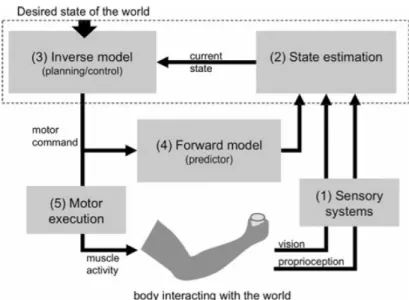
Most theories of motor learning hold that adaptation is driven by a mismatch between actual and predicted consequences of hand movement (Wolpert et al., 2011) and training with a perturbation leads to updates or modifications in these predictions, which in turn lead to the resulting modifications of the movement. Such predictions are produced every time we make a movement and are based on an efference copy of the outgoing movements. The predictions or simulations are produced by what is conceptually known as a forward internal model. The role of forward model is illustrated in Figure 1.3; it receives a copy of selected motor commands which allows it to predict the motor commands’ sensory outcome. Based on this efference copy, a comparison between predicted and actual sensory input of the selected motor command takes place. If there is a mismatch between the two, then the motor command must be adjusted and a new internal model be formed. In motor adaptation studies, reach aftereffects have been proposed to reflect an establishment of a new internal model which is associated with the novel sensorimotor transformation (e.g., Haith & Krakauer, 2013;Wang & Lei, 2015; Wolpert, Ghahramani, & Jordan, 1995). Despite the crucial role that these updates in predictions play in adaptation, it is not clear how much these changes in efference-based estimates of hand position contribute to hand localization when compared with those of purely sensory-based estimates.
Figure 1.3 Vision and proprioception provide information to estimate the position of the hand and cup location. A motor command is sent to the hand to reach a cup and an efference copy of this motor command is sent to a forward model. Forward model predicts the sensory consequences of the motor command and compares it with the actual sensory feedback (Gowen & Hamilton, 2013)
In visuomotor adaptation training, the sensorimotor or prediction errors described above are not the only errors that can drive adaptation. Our lab has shown that even cross-sensory exposure training, where there are no volitional movements are performed throughout training, leads to reach adaptation (Cressman & Henriques, 2010). In their study, Cressman & Henriques (2010) showed that participants produce reach aftereffects even without any volitional movements and therefore no efference-based predictions. During training, the participant’s hand was passively moved and gradually rotated while the visual feedback always indicated that the cursor (which represents hand movement) was heading to the target with no visual reach errors. They refer to this type of training as cross-sensory exposure training, because it involves exposing participants only to the visual-proprioceptive discrepancy. After training, participants adapted their subsequent open-loop reaches in the direction of the introduced visual feedback, similar to reach aftereffects observed following classical visuomotor training albeit smaller in size. This suggests that training with visual-proprioceptive discrepancy influences reach adaptation.
In classical visuomotor adaption training tasks, participants are exposed to two types of error signals; a) sensorimotor or prediction error signal, generally known as an error-based signals (Haith & Krakauer, 2013), b) visual-proprioceptive discrepancy signal, i.e., mismatch between the seen and felt hand position. If prediction error is the driving force for reach adaptation, then participants should not adapt their reaches if they do not experience prediction errors during training. However, this is not the case as mentioned above in Cressman and Henriuques (2010) and in other studies where it is shown that cross-sensory exposure training leads to motor changes, even though no volitional movements are performed throughout training (Cameron et al., 2012; Sakamoto & Kondo, 2015). These findings suggest that two different types of error signals drive reach adaptation and both need to be taken into account when interpreting empirical results.
1.4 Proprioceptive recalibration
There is emerging evidence from behavioral studies that motor adaptation involves not only changes in movement but also perceptual changes in estimates of hand position and motion. These perceptual changes have been shown to occur after adaptation to various perturbations including visuomotor adaptation, prism adaptation, and force-field adaptation (for a review, (Ostry & Gribble, 2016)). Using visuomotor adaptation training paradigms, our lab has shown that, in addition to motor changes, visuomotor adaptation training leads to changes in the felt hand position toward the previously introduced visual feedback; a process we call proprioceptive recalibration (e.g., Cressman & Henriques, 2011; Cressman & Henriques, 2009). In their experiments, Cressman and Henriques (2009) measured this proprioceptive change following visuomotor rotation and lateral translation training using a perceptual testing task (proprioceptive estimation task, introduced above). Specifically, they used a 30° rotation and a 4-cm shift in the
training tasks (the 4-cm shift corresponded to the average horizontal shift achieved across the workspace as 30° rotation). They measured people’s estimates of their unseen hand’s position, both before and following training. They did so using one of the methods described in Section 1.2, in brief, by having participants make a forced-choice judgment (left or right) of the position of their unseen hand relative to a visual or proprioceptive (a non-visual, i.e., body midline) reference marker. The authors were able to find that regardless of the introduced visuomotor distortion (rotated vs. translated) and how the hand was moved to its tested location (either displaced by the robot, passive displacement, or constrained by the robot, active displacement), proprioception was recalibrated to a similar extent in all conditions. The size of this proprioceptive recalibration was 6° following rotation training and 0.8 cm following lateral translation training. The magnitude of proprioceptive recalibration was found to be more than one third of the size of aftereffects in several studies (for a review, Henriques & Cressman, 2012). This recalibration magnitude found to increase proportionally if the introduced rotation increases. For example, Salomonczyk et al. (2011) exposed participants to visual feedback rotated by a 30°, 50°, 70°, as the distortion increased the resulting hand proprioceptive recalibration also increased. Nonetheless, the shift was proportional (about 20%) to the magnitude of the introduced rotation. Moreover, following visuomotor adaptation proprioceptive recalibration was found to be similar in extent in older healthy adults and young adults, although older adults had higher uncertainty (Cressman, Salomonczyk, & Henriques, 2010; for a complete review see, Henriques & Cressman, 2012). These findings show that visuomotor adaptation training induces a robust shift in felt hand position in addition to motor changes.
In accordance with our findings, force field adaption studies report a similar proprioceptive shift following training. For example, Ostry and colleagues (2010) examined changes in felt hand motion following force field adaptation training by having participants estimate the direction by which their hand deviates along a specified path. They found a significant change in felt hand motion to the opposite direction of the introduced force field. Additionally, this shift was durable and lasted for 24 hours. It is noteworthy that, in force field adaptation, there is no mismatch between felt hand motion and visual feedback of the hand, but, motor adaptation is accompanied by felt hand position changes. Moreover, following prism adaptation both vision and felt arm position were found to be spatially shifted. Harris (1963) interpreted the shift in open-loop or straight ahead pointing as proprioceptive realignment. Of note, when assessing hand proprioception using open-loop reaching or pointing any proprioceptive shifts might be confounded by motor effects. However, this fact does not suggest that a proprioceptive shift does not occur following prism adaptation training. In another prism adaptation study, participants were able to retain this proprioceptive shift up to 7 days following training (Hatada, Rossetti, & Miall, 2006). Combined these findings suggest that a shift in felt estimates of hand position and motion occurs as a result of adaption training.
Proprioceptive recalibration has important implications in movement control and learning, given that any changes in estimating hand position will affect the integration process of visual and proprioceptive information that the brain uses in order to plan and execute an accurate reach towards a given target. Studying proprioceptive recalibration will help in understanding the contributions of sensory plasticity in motor learning. The first two studies in this dissertation were designed to examining the extent by which motor changes and changes in hand proprioception generalize between hands and across the work space.
1.5 Generalization of reach adaptation
Learning is not only restricted to the training context but can partly transfer, or generalize, to other similar contexts. The extent and pattern of generalization can provide insights into how the brain interprets performance errors in order to adapt. To answer some questions such as what mechanisms underlie generalization of motor adaptation and how neural information is stored and updated, several studies have investigated whether and how motor adaptation transfers (1) between limbs and (2) across the workspace.
1.5.1 Intermanual transfer
Intermanual transfer has been measured using a variety of learning tasks such as finger tapping (Laszlo, Baguley, & Bairstow, 1970), reaching with prisms (Taub & Goldberg, 1973), figure drawing (Thut et al., 1996), grasping objects (Chang, Flanagan, & Goodale, 2007), and reaching in force fields (Dizio & Lackner, 1995; Wang & Sainburg, 2003). Intermanual transfer for motor adaptation has been tested by asking participants, following visuomotor rotation training, to reach using the untrained hand to the trained targets with perturbed feedback of the hand or without visual feedback of the hand (Sainburg & Wang, 2002; Salomonczyk et al., 2012). Accordingly, any observed improvements or changes when subjects reach to the trained targets with the untrained hand, can be attributed to motor adaptation having been transferred from the trained to the untrained hand. For example, in a case where someone adapts the left hand-reach in response to a rotated cursor, transfer would mean that when the right-hand then reaches with the same rotated cursor, it should learn faster and perhaps show smaller initial errors compared to a group who did not train with their left hand prior to reaching with their right hand. Previous intermanual transfer studies have found different results; some suggest that transfer partially occurs (some benefits to the second hand) and others suggest that it does not occur at all. With regard to the direction of transfer, some studies have documented asymmetric
transfer from the non-dominant to the dominant hand (Wang & Sainburg, 2004), while others have found that motor changes transfer from the dominant to the non-dominant hand (Balitsky Thompson, & Henriques, 2010; Taylor, Wojaczynski, & Ivry, 2011). Other studies have shown that intermanual transfer of specific variables occurs in both directions, that is, final-position information transfers from the dominant to non-dominant hand, and direction information transfers from the non-dominant to dominant hand (Sainburg & Wang, 2002; Wang & Sainburg, 2003). Of note in all the above mentioned studies, the amount of observed intermanual transfer was proportional to the total amount of adaptation in the trained hand.
Theoretically, three different models have been proposed as an explanation to these reports: the “callosal access model” which argues that when training with one hand, regardless of the hand used, a single memory is stored in the dominant hand hemisphere, so that the dominant hand benefits from the non-dominant hand training (Taylor & Heilman, 1980). Second, the “cross-activation model” posits that only training with the dominant hand stores a weaker copy of memory in the non-dominant hand hemisphere, which influences the non-dominant hand performance; finally the “modified access model”, which posits that information stored during learning with either arm controller can subsequently be accessed by its contralateral homolog (Sainburg & Wang, 2002).
Previous work in our lab has found asymmetrical intermanual transfer of motor adaptation following reach training with rotated visual feedback. Specifically, two groups of subjects performed a reaching task using one hand, each with two different viewing conditions (i.e., a 45° and 75° CCW rotated cursor or rotated view of their actual hand). After adaptation, subjects reached with the opposite hand to the same targets (under the same viewing conditions). Equivalent amounts of intermanual transfer were found across the different magnitudes of
rotation. However, asymmetric transfer from the dominant to non-dominant hand was observed (Balitsky, Thompson, & Henriques, 2010). The authors have suggested that these results are due to symmetrically lateralized limb control but asymmetrical spatial mapping, where the right limb is represented in both hemispheres, while the left limb is represented only in the right hemisphere. However, more recently, another more computational explanation has been offered by Berniker and Kording (2008) where generalization is based on how the brain interprets the source of the observed error. If the CNS attributes error in reaches to some impairment or changes of limb properties, then using the same arm, the adapted reaching movements should apply to different locations along the workspace, but not to the opposite to arm. But to the extent that some of the error is attributed to external sources or the environment, (like a defective hammer), then generalization to that extent should transfer to the opposite arm. Their model also explains asymmetries in transfer between the two arms, such that reach errors by the non-dominant arm will be assigned mainly to the arm and not the environment, which may result in no or little transfer of learning to the opposite dominant arm.
1.5.2 Workspace-generalization
Generalization designs have been widely investigated in visuomotor adaptation studies (e.g., Ghahramani, Wolpert, & Jordan, 1996; Krakauer et al., 2000). The patterns of generalization across workspace have provided insight about how goal-directed reaches are computed and updated during adaptation (Krakauer et al., 2000). Typically, the way motor adaptation generalizes across the workspace has been tested by asking subjects to reach, following visuomotor training, to untrained directions or distances from different or same starting locations (e.g., Krakauer et al., 2000; Wu & Smith, 2013). Findings have shown that adaptation to a single target leads to a narrow or local generalization pattern across
novel-untrained directions such that generalization is found to be greatest at novel targets near the training target direction and decays at novel targets further away from it. That is, generalization across different movement directions tends to be “local”; largest near the trained direction. However, the pattern of generalization across novel-untrained distances have shown to be broad such that similar amount of motor adaptation is observed at novel targets in the same direction but at different distances (relative to training target). In one seminal paper on this topic, Krakauer et al. (2000) found that reach training to a single target with a cursor rotated 30° CW resulted in the generalization of ~80% of motor adaptation to novel targets that deviated by 22.5° from the trained direction, and only ~25% to novel targets that deviated by 45°. However, subjects successfully adapted their reaches to a similar extent when they reached to novel targets at different distances (2.4, 4.8, and 9.6 cm) from the starting position, but in the same direction as the trained target. The same generalization patterns for motor adaptation have been documented by several other studies (e.g., Neva & Henriques, 2013; Shabbott & Sainburg, 2010; Wu & Smith, 2013). Paz et al. (2003) showed that monkeys adapted their reaches and showed a similar “local” generalization curve as humans. The authors recorded the activity of neurons in M1 while monkeys reached to trained and untrained directions and found no change in activity when reaches were made to directions more than 30° right or left of the trained direction. These findings show evidence for a strong relation between the patterns of generalization for visuomotor adaptation, and the properties of neurons in the motor system, i.e., their directional tuning. Given that the learning-induced changes tend to be direction-specific, it may not be surprising that movements made in the same direction but at different amplitude would still benefit from learning and hence explain why generalization of adaptation to different movement amplitude is not so narrow. This is consistent with the interpretation by Goodbody and Wolpert
(1998), they explained that scaling a movement, either temporally or in amplitude after adapting to novel dynamics of a force field, could involve the same population of neurons that were involved in the learning process, broadly activated at a different level.
1.6 Generalization of proprioceptive recalibration
As introduced above, several visuomotor adaptation studies have focused on examining how reach adaptation generalizes across limbs, and different directions or distances in the workspace. However, very few studies have explored how sensory changes generalize with adaptation. As mentioned previously, our lab and others have shown that visuomotor adaptation leads not only to motor changes, but also to proprioceptive recalibration (e.g., Cressman & Henriques, 2011; Cressman & Henriques, 2009). A recent study in our lab has shown that the generalization patterns of proprioceptive recalibration and reach adaptation are different. Specifically, Cressman and Henriques (2015) showed that independent of reach adaptation, which showed a similar localized generalization pattern as seen in Krakauer et al. (2000), proprioceptive recalibration generalized across novel directions. It is yet unclear, however, whether proprioceptive recalibration will broadly generalize, like motor adaptation, to different distances in the workspace. Moreover, intermanual transfer of proprioceptive recalibration has not been investigated previously. In Chapter two we examined how proprioceptive recalibration transfers between the two hands.
Indeed, proprioceptive recalibration is of great interest, given that any changes in estimating hand position will affect the integration process of visual and proprioceptive information that the brain uses in order to plan and execute an accurate reach towards a given target. Studying proprioceptive recalibration can help in understanding the contributions of sensory plasticity in motor learning. Furthermore, it can help explain some observed results in
motor learning literature, such as the incomplete transfer of motor adaptation to the untrained hand. If visuomotor adaptation with one hand does not lead to changes in the opposite hand’s proprioception, then we can conclude that proprioceptive recalibration, unlike motor adaptation, is specific to the exposed hand because both processes occur after visuomotor training. Differences between the way sensory and motor changes generalize may suggest that the two processes are somehow independent and may arise from independent error signals. The first goal in this dissertation is to examine the extent by which the motor changes and changes in hand proprioception transfer to the opposite hand.
1.7 Objectives
This dissertation specifically examines the characteristics of reach adaptation and proprioceptive recalibration. Chapter two examines if proprioceptive recalibration transfers intermanually following training with translated visual feedback of the hand and if this transfer is symmetrical between hands. Chapter three examines how proprioceptive changes generalize to different distances following visuomotor adaptation, and investigates the correlation between motor and sensory changes. Chapter four examines how sensory prediction and proprioception contribute to reach aftereffects and changes in hand localization following adaptation, and examines the pattern of generalization across different directions for reach adaptation and proprioceptive recalibration following cross-sensory exposure training. In each Chapter, the rationale, hypotheses, methods, results and discussion of findings will be articulated in detail.
CHAPTER TWO
INTERMANUAL TRANSFER AND PROPRIOCEPTIVE RECALIBRATION FOLLOWING TRAINING WITH TRANSLATED VISUAL FEEDBACK OF THE HAND
Ahmed A. Mostafa, Erin K. Cressman & Denise Y. P. Henriques
2.1 Abstract
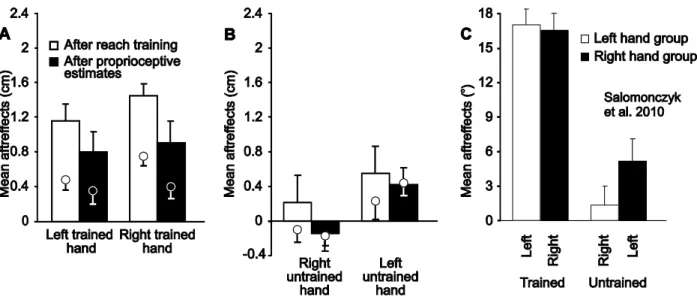
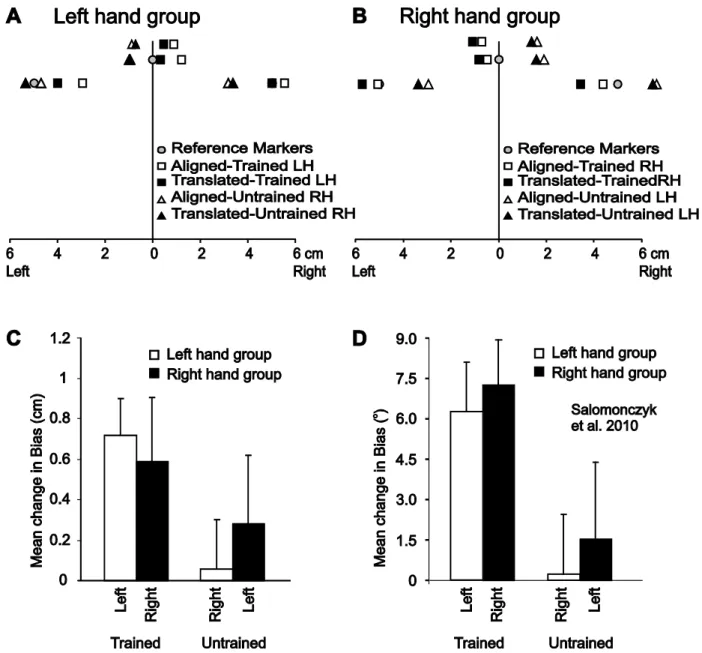
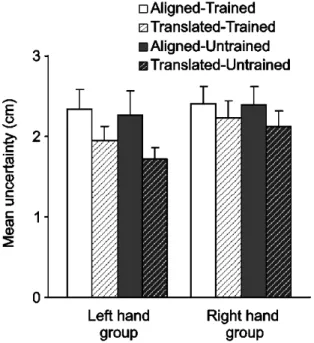
Reaching with visual feedback that is misaligned with respect to the actual hand’s location leads to changes in reach trajectories (i.e., visuomotor adaptation). Previous studies have also demonstrated that when training to reach with misaligned visual feedback of the hand, the opposite hand also partially adapts, providing evidence of intermanual transfer. Moreover, our lab has shown that visuomotor adaptation to a misaligned hand cursor, either translated or rotated relative to the hand, also leads to changes in felt hand position (what we call proprioceptive recalibration), such that subjects’ estimate of felt hand position relative to both visual and non-visual reference markers (e.g., body midline), shifts in the direction of the visuomotor distortion. In the present study, we first determined the extent that motor adaptation to a translated cursor leads to transfer to the opposite hand, and whether this transfer differs across the dominant and non-dominant hands. Second, we looked to establish whether changes in hand proprioception that occur with the trained hand following adaptation also transfer to the untrained hand. We found intermanual motor transfer to the left untrained (non-dominant) hand after subjects trained their right (dominant) hand to reach with translated visual feedback of their hand. Motor transfer from the left trained to the right untrained hand was not observed. Despite finding changes in felt hand position in both trained hands, we did not find similar evidence of proprioceptive recalibration in the right or left untrained hands. Taken together, our results suggest that unlike visuomotor adaptation, proprioceptive recalibration does not transfer between hands and is specific only to the arm exposed to the distortion.
2.2 Introduction
Moving the hand while its visual feedback is distorted leads to a mismatch of vision and action that results in sensorimotor remapping and adaptation. For example, when subjects first reach to a target with distorted visual feedback (e.g., a cursor that is rotated or translated relative to the hand’s actual motion), the cursor-reaches are initially deviated but are then gradually adjusted or adapted across trials so that later reaches bring the cursor more directly to the target (Krakauer et al. 1999; Sainburg and Wang 2002; Simani et al. 2007). This visuomotor adaptation has also been shown to transfer across arms, which is referred to as intermanual transfer. In such cases, learning with one hand facilitates subsequent performance with the opposite, untrained hand. Intermanual transfer has been observed in such tasks as drawing (Thut et al. 1996), grasping (Chang et al. 2008), pointing and tracking (Abeele and Bock 2003). More importantly for the current study, intermanual transfer also occurs after adapting reaching movements to displacing prisms (Hamilton and Bossom 1964), force perturbations (Dizio and Lackner 1995), mirror-reversed visual feedback (Dionne and Henriques 2008) and rotated visual feedback of the hand or cursor (Wang and Sainburg 2003; 2004; 2006; 2007; Balitsky, Thompson, & Henriques 2010).Typically intermanual transfer of adaptation to these various perturbations is assessed by testing the untrained hand to the same perturbation that the trained hand has adapted to. Transfer is said to occur when initial errors in response to the perturbation are smaller and/or the learning rate is faster for the untrained hand following training of the opposite hand compared to when there is no initial adaptation in the opposite hand.
The pattern of intermanual transfer is not necessary the same across the two hands. In a series of experiments by Sainburg and Wang (2002; 2003), they found that when subjects adapted one of their hands to a rotated cursor (visuomotor rotation), the transfer of this learning
to the opposite arm was asymmetric, in that the size and types of intermanual transfer depended on the hand trained. Specifically, they found that final position accuracy transferred from the dominant (right) to the non-dominant (left) hand, while initial directional accuracy measured as the error at peak velocity transferred from the non-dominant to the dominant hand. They proposed that this intermanual transfer pattern reflects basic differences in or specialization of the two arm controllers, such that the initial direction information transferred to the right arm controller from the non-dominant arm. However, the endpoint configuration of the limb, but not the initial direction, transferred to the left arm controller from the dominant arm. In contrast, Balitsky, Thompson, and Henriques (2010) found intermanual transfer occurred only from the dominant right hand to the left hand, but not from the non-dominant left hand to the right hand, and this was the case when subjects adapted to a rotated cursor or to a rotated video image of the hands (based on angular deviations at peak velocity when the untrained hand reached with the same altered visual feedback). Other motor adaptation studies where subjects adapted to velocity-dependent force fields (Criscimagna-Hemminger et al., 2003), also measuring deviations at peak velocity during training with the previously untrained hand) and displacing prisms (Redding and Wallace 2008), measuring reach endpoint deviations of the opposite arm without the prisms; e.g., aftereffects), have shown a similar asymmetry, training with the dominant hand leads to facilitation with the non-dominant hand.
In the current study, our first goal was to investigate the nature and extent of intermanual transfer after adaptation to a translated cursor. We used a translated cursor (i.e., the cursor appeared rightward of the actual position of the hand and it moved parallel with the hand) as our perturbation rather than the usual rotated cursor (i.e., while the subject moves his/her hand forward, the cursor heads off on a directional angle relative to the hand) since previous results
from our lab suggest that proportional changes in reaches measured by the resulting aftereffects (relative to the magnitude of the distortion), are greater after adaptation to a translated cursor than to a rotated cursor (Cressman and Henriques 2009). In fact, previous studies by Ghahramani et al. (1996) and Vetter et al. (1999) suggest that adapting to a shifted or translated cursor may also lead to greater generalization across the workspace compared to adapting to a rotated cursor (Krakauer et al. 2000). This difference in both generalization and size of aftereffects following adaptation to a translated cursor compared to a rotated cursor makes sense in that the translated feedback of the hand resembles the kind of visual perturbation one may experience in everyday life, like refracted light from submerging our hand in water, or using a tool that extends or shifts our end-effector. Even a computer mouse resembles a translated shift of the hand more than a rotated shift. In contrast, a rotation perturbation is something we would not experience in everyday life and hence may be more difficult to adapt to. Thus, we used a translated cursor for adapting the hand to provide the greatest possibility of observing intermanual transfer, which is a type of generalization, and one that has not been studied before following translated-cursor adaptation. We assessed the extent and pattern of this intermanual transfer of reach adaptation by using a no-cursor (open-loop) reaching task to measure aftereffects of both the trained and untrained hand. We also examined whether this transfer differed across the dominant and non-dominant hands. Given the previous studies mentioned above and those in our lab (Balitsky Thompson and Henriques 2010; Salomonczyk et al. 2010) demonstrating that intermanual transfer occurs asymmetrically depending upon the trained hand, in the current study, we hypothesized a similar asymmetry after training with a translated cursor.
In addition to examining intermanual transfer of reach adaptation, we investigated whether changes in felt hand position (i.e., proprioceptive recalibration) also transferred between limbs (what we will call intermanual sensory transfer). Recent studies have shown that visuomotor adaptation leads not only to changes in trajectory of the trained hand, but that the felt position of the hand is also modified (Cressman and Henriques 2009; 2010; Cressman et al. 2010; Ostry et al. 2010; Cressman and Henriques 2011; Salomonczyk et al. 2011). In our own lab, we have found that adapting to either a rotated or translated cursor leads to changes in hand proprioception, such that people perceived their unseen hand as being shifted in the direction of the visual distortion (Cressman and Henriques 2009; 2010). To determine changes in felt hand position we have subjects estimate the location of their unseen hand relative to a visual or proprioceptive (body midline) reference marker both before and following visuomotor adaptation (Cressman and Henriques 2009; 2010). To date, it has been shown that this proprioceptive recalibration is robust in that it occurs under various task constraints (i.e., adapting to a visuomotor distortion or velocity dependent force field) (Cressman and Henriques 2009; 2010; Ostry et al. 2010), regardless of how the hand is displaced during this proprioceptive estimation task (passive arm displacement vs. active reaching movements) (Cressman and Henriques 2009; 2010), the modality of the reference markers (visual vs. proprioceptive) and the age of the patients (young vs. older adults) (Cressman and Henriques 2009; 2010).
Previous studies examining proprioceptive recalibration have focused on assessing shifts in felt right-hand position following motor learning of the right arm in right-handed individuals. It is currently unclear whether, like motor adaptation, such sensory changes transfer to the opposite untrained hand as well. Thus, after establishing the nature and extent of intermanual motor
transfer, the second goal of this study was to test whether proprioceptive recalibration transfers from the trained (right or left) hand to the untrained (left or right) hand following adaptation to a visuomotor distortion, and whether this transfer occurs asymmetrically depending upon the hand trained.
2.3 Methods 2.3.1 Subjects
In total, 35 right-handed subjects (mean age=22.9, SD=5.62, 11 male) were randomly assigned to either the left hand (n= 17) or right hand (n= 18) training groups. All subjects had normal or corrected-to-normal vision. Subjects were pre-screened verbally for self-reported handedness and any history of visual, neurological, and/or motor dysfunction. All subjects provided informed consent in accordance with the ethical guidelines set by the York Human Participants Review Subcommittee, and received credit towards an undergraduate psychology course.
2.3.2 General experimental setup
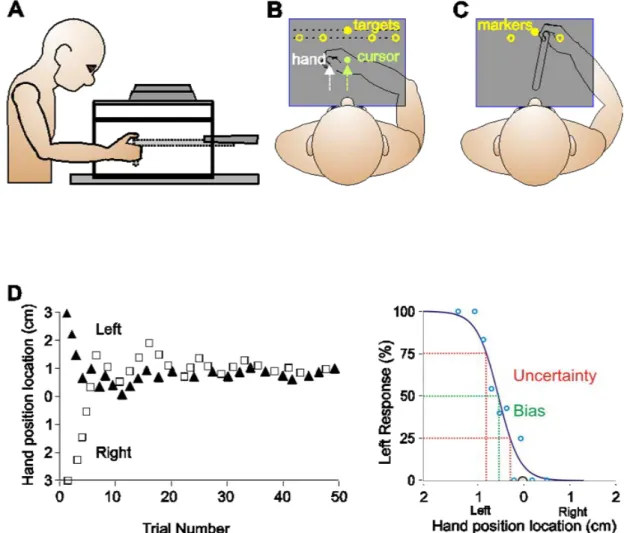
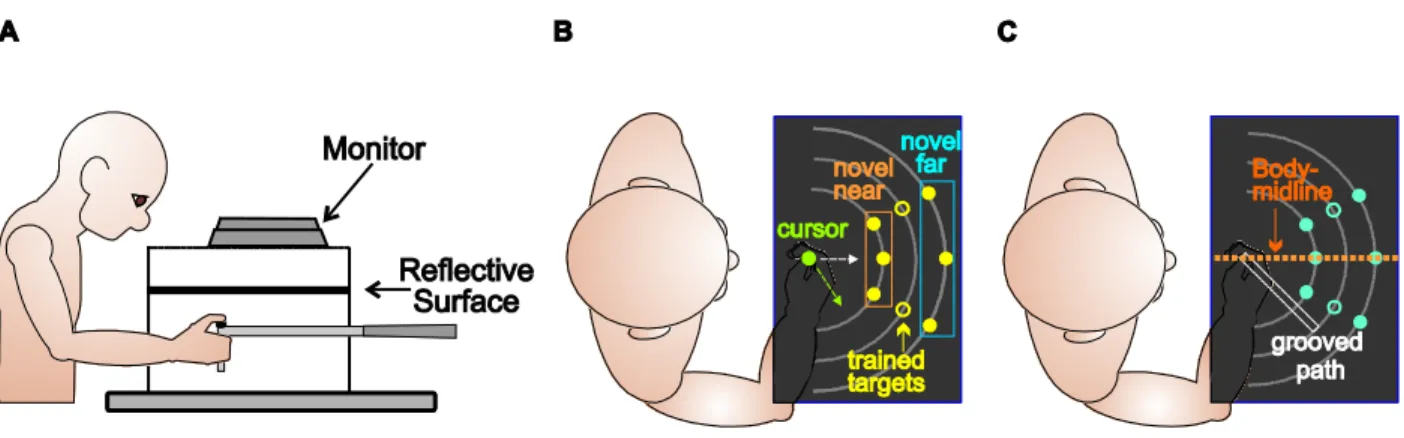
The experimental setup is illustrated in Fig. 2.1A. Subjects were seated in a chair and the height of the chair was adjusted to ensure that they could easily see all of the targets presented on a reflected screen and comfortably reach to target locations. Subjects were asked to hold on (either with their right or left hand) to the vertical handle on a two-joint robot manipulandum (Interactive Motion Technologies Inc., Cambridge, MA) so that their thumb rested on top of the handle. The reflective screen was mounted horizontally 8.5 cm above the robot manipulandum. A monitor (Samsung 510 N, refresh rate 72Hz) located 17 cm above the robotic handle projected visual stimuli, such that images displayed on the monitor appeared to lie in the same horizontal
plane as the robotic handle. The room lights were dimmed and the subjects’ view of their own hand was blocked by the reflective surface, as well as a black cloth draped over their shoulders.
Figure 2.1 Experimental setup and design. A Side view of the experimental setup. B Top view of experimental setup visible to subjects in the reaching tasks. The center home position was represented by a 1-cm green circle and was located about 20 cm in front of subjects’ chests, aligned with the body midline, this position was not illuminated, and visual feedback was provided only when the hand had travelled 4 cm outwards from the home position. Five targets were located along 2 lines; one target was located 10 cm directly in front of the home position and was represented by a yellow circle 1 cm in diameter. Four additional targets were located 5 and 7.5 cm to the left and right of the center target, 8.66 cm in front of the home position. The visuomotor distortion was introduced gradually until the cursor was translated 4 cm rightward with respect to the hand. This shift ensured that the green cursor
(representing the hand) appeared to come from a central position. C Top view of experimental surface visible to subjects in the proprioceptive estimates tasks. One reference marker was located 10 cm directly in front of the home position and was represented visually by a yellow disk, 1 cm in diameter or proprioceptively (body midline). Two additional reference markers were located 5 cm to the left and right of the center reference marker, 8.66 cm in front of the home position. D Staircase and uncertainty range for the data of one subject for one reference marker. For the left panel, the staircase depicted with triangles illustrated the adjusted hand position across trials for the staircase starting at 3 cm leftward of the reference marker, while the squares illustrate the staircase starting 3 cm rightward. In the right panel, circles represent the mean percentage of responses by which the subject reported the hand was left of the visual reference marker across various hand locations. The green line intersecting the x-axis shows the bias (the
point at which the probability of responding left was 50 %), while the red lines depict the uncertainty range (the difference between the values at which the probability of responding left was 25 and 75 %)
2.3.3 Procedure
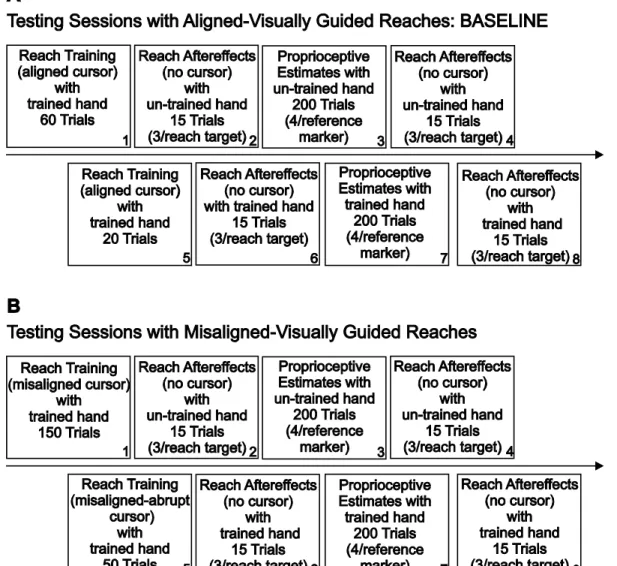
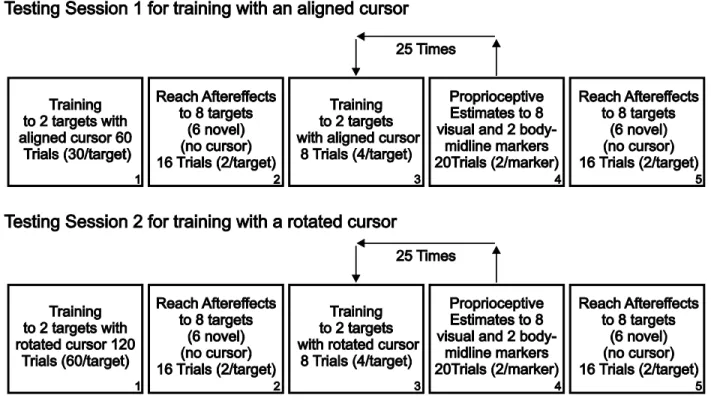
The experiment consisted of 2 test sessions run on 2 separate days. Each test session consisted of 8 tasks (see Fig 2.2). The first session had subjects reach to visual targets, after training to reach with a cursor that was aligned with either their right or left hand’s position. The second session, however, had subjects complete the same reach trials after the right or left hand reached with a cursor that was misaligned from their hand’s position. The misaligned cursor was translated 4 cm to the right of their actual hand position, with this translation being introduced gradually (as described below).
2.3.3.1 Aligned reach training task:
The first testing session included aligned reach training (boxes 1 and 5 in Fig 2.2), where subjects were asked to reach to one of five targets with their right or left hand, hidden from view, but represented by a cursor (green circle, 1.4 cm in diameter, Fig 2.1B) located above their thumb. In front of the home position, which was approximately 20 cm in front of subjects’ chests, there were 5 reach targets represented by 1 cm diameter yellow circles, located along two lines, 8.66 or 10 cm above the home position. One reach target was located 10 cm directly in front of the home position. Four additional visual reach targets were located 5 and 7.5 cm to the left and right of the center reach target, 8.66 cm in front of the home position. The reach trial was considered complete when the center of the cursor had moved to within 0.5 cm of the target’s center. At that point, both the target and cursor were removed and the robot was locked to a grooved path. This grooved path guided subjects back to the home position by a direct linear route in the absence of visual feedback. If subjects attempted to move outside of the established path, a resistance force [proportional to the depth of penetration with a stiffness of 2 N/mm and a