DOI 10.1007/s00182-016-0560-8
O R I G I NA L PA P E R
Coordination games on graphs
Krzysztof R. Apt1 · Bart de Keijzer1 ·Mona Rahn1 · Guido Schäfer1,2 · Sunil Simon3
Accepted: 14 November 2016
© Springer-Verlag Berlin Heidelberg 2016
Abstract We introduce natural strategic games on graphs, which capture the idea of coordination in a local setting. We study the existence of equilibria that are resilient to coalitional deviations of unbounded and bounded size (i.e.,strong equilibriaand k-equilibriarespectively). We show that pure Nash equilibria and 2-equilibria exist, and give an example in which no 3-equilibrium exists. Moreover, we prove that strong equilibria exist for various special cases. We also study the price of anarchy (PoA) and price of stability (PoS) for these solution concepts. We show that the PoS for strong equilibria is 1 in almost all of the special cases for which we have proven strong equilibria to exist. The PoA for pure Nash equilbria turns out to be unbounded, even when we fix the graph on which the coordination game is to be played. For the PoA fork-equilibria, we show that the price of anarchy is between 2(n−1)/(k−1)−1 and 2(n−1)/(k−1). The latter upper bound is tight fork=n(i.e., strong equilibria). Finally, we consider the problems of computing strong equilibria and of determining whether a joint strategy is ak-equilibrium or strong equilibrium. We prove that, given a coordination game, a joint strategys, and a numberkas input, it is co-NP complete to determine whethersis ak-equilibrium. On the positive side, we give polynomial time algorithms to compute strong equilibria for various special cases.
An extended abstract of this paper appeared asApt et al.(2014). Part of this research has been carried out while the second author was a post-doctoral researcher at Sapienza University of Rome, Italy.
B
Sunil Simon [email protected]1 Centrum Wiskunde & Informatica (CWI), Networks and Optimization Group, Amsterdam, The Netherlands
2 Department of Econometrics and Operations Research, Vrije Universiteit Amsterdam, Amsterdam, The Netherlands
Keywords Coordination games·Graphs·Nash equilibria·Strong equilibria·Price of anarchy·Price of stability
1 Introduction
In game theory, coordination games are used to model situations in which players are rewarded for agreeing on a common strategy, e.g., by deciding on a common technological or societal standard. In this paper we introduce and study a very simple class of coordination games, which we callcoordination games on graphs:
We are given a finite (undirected) graph, of which the nodes correspond to the players of the game. Each player chooses a color from a set of colors available to her. The payoff of a player is the number of neighbors who choose the same color.
Our main motivation for studying these games is that they constitute a natural class of strategic games that capture the following three key characteristics:
1. Join the crowd property(Simon and Apt 2015) The payoff of each player weakly increases when more players choose her strategy.
2. Asymmetric strategy sets Players may have different strategy sets.
3. Local dependency The payoff of each player depends only on the choices made by certain groups of players (i.e., neighbors in the given graph).
The above characteristics are inherent to many applications. As a concrete example, consider a situation in which several clients have to choose between multiple compet-ing providers offercompet-ing the same service (or product), such as peer-to-peer networks, social networks, photo sharing platforms, and mobile phone providers. Here the bene-fit of a client for subscribing to a specific provider increases with the number of clients who opt for this provider. Also, each client typically cares only about the subscriptions of certain other clients (e.g., friends, relatives, etc.).
In coordination games on graphs it is beneficial for each player to align her choices with the ones of her neighbors. As a consequence, the players may attempt to increase their payoffs by coordinating their choices in groups (also calledcoalitions). In our studies we therefore focus on equilibrium concepts that are resilient to deviations of groups; more specifically we studystrong equilibria(Aumann 1959) andk-equilibria (also known ask-strong equilibria) of coordination games on graphs. Recall that in a strong equilibrium no coalition of players can profitably deviate in the sense that every player of the coalition strictly improves her payoff. Similarly, in ak-equilibrium withk∈ {1, . . . ,n}, wherenis the number of players, no coalition of players of size at mostkcan profitably deviate.
Our contributions The focus of this paper is on the existence, inefficiency and com-putability of strong equilibria andk-equilibria of coordination games on graphs. Our main contributions are as follows:
1. ExistenceWe show that Nash equilibria and 2-equilibria always exist. On the other hand,k-equilibria fork≥3 do not need to exist. We therefore derive a complete characterization of the values ofkfor whichk-equilibria exist in our games.
We also show that strong equilibria exist if only two colors are available. Fur-ther, we identify several graph structural properties that guarantee the existence of strong equilibria: in particular they exist if the underlying graph is a pseudoforest,1 and when every pair of cycles in the graph is edge-disjoint. Also, they exist if the graph iscolor complete, i.e., if for each available colorxthe components of the subgraph induced by the nodes having colorxare complete. Moreover, existence of strong equilibria is guaranteed in case the coordination game is played on a color forest, i.e., for every color, the subgraph induced by the players who can choose that color is a forest.
We also address the following question. Given a coordination game denote its transition valueas the value ofkfor which ak-equilibrium exists but a(k+1) -equilibrium does not. The question then is to determine for which values ofka game with transition valuekexists. We exhibit a game with transition value 4. In all our proofs the existence of strong equilibria is established by showing a stronger result, namely that the game has thecoalitional finite improvement prop-erty, i.e., every sequence of profitable joint deviations is finite (see Sect.2for a formal definition).
2. Inefficiency We also study theinefficiencyof equilibria. In our context, thesocial welfare of a joint strategy is defined as the sum of the payoffs of all players. Thek-price of anarchy(Andelman et al. 2009) (resp.k-price of stability) refers to the ratio between the social welfare of an optimal outcome and the minimum (resp. maximum) social welfare of ak-equilibrium.2
We show that the price of anarchy is unbounded, independently of the underlying graph structure, and the strong price of anarchy is 2. In general, for thek-price of anarchy withk∈ {2, . . . ,n−1}we derive almost matching lower and upper bounds of 2nk−−11−1 and 2nk−−11, respectively (given a coordination game that has ak-equilibrium). We also prove that the strong price of stability is 1 for the cases that there are only two colors, or the graph is a pseudoforest or color forest. Our results thus show that as the coalition sizekincreases, the worst-case ineffi-ciency ofk-equilibria decreases from∞to 2. In particular, we obtain a constant k-price of anarchy fork=Ω(n).
3. Complexity We also address several computational complexity issues. Given a coordination game, a joint strategys, and a numberkas input, it is co-NP complete to determine whethersis ak-equilibrium. However, we show that this problem can be solved in polynomial time in case the graph is a color forest. We also give polynomial time algorithms to compute strong equilibria for the cases of color forests, color complete graphs, and pseudoforests.
1 Recall that in a pseudoforest each connected component has at most one cycle. 2 Thek-price of anarchy is also commonly known as thek-strong price of anarchy.
Related work Our coordination games on graphs are related to various well-studied types of games. We outline some connections below.
First, coordination games on graphs arepolymatrix games. Recall that a polyma-trix game (seeHowson 1972;Janovskaya 1968) is a finite strategic game in which the payoff for each player is the sum of the payoffs obtained from the individual games the player plays with each other player separately.Cai and Daskalakis(2011) considered a special class of polymatrix games which they callcoordination-only polymatrix games. These games are identical to coordination games on graphs with edge weights. They showed that pure Nash equilibria exist and that finding one is PLS-complete. The proof of the latter result crucially exploits that the edge weights can be negative. Note that negative edge weights can be used to enforce that players anti-coordinate. Our coordi-nation games do not exhibit this characteristic and are therefore different from theirs. Second, our coordination games are related toadditively separable hedonic games (ASHG)(Banerjee Konishi 2001;Bogomolnaia and Jackson 2002), which were orig-inally proposed in a cooperative game theory setting. Here the players are the nodes of an edge weighted graph and form coalitions. The payoff of a node is defined as the total weight of all edges to neighbors that are in the same coalition. If the edge weights are symmetric, the corresponding ASHG is said to besymmetric. Recently, a lot of work focused on computational issues of these games (see, e.g.,Aziz et al.
2010,2011;Gairing and Savani 2010).Aziz and Brandt(2012) studied the existence
of strong equilibria in these games. The PLS-hardness result established inGairing
and Savani(2010) does not carry over to our coordination games because it makes
use of negative edge weights, which we do not allow in our model. Note also that in ASHGs every player can choose to enter every coalition which is not necessarily the case in our coordination games. Such restrictions can be imposed by the use of negative edge weights (see alsoGairing and Savani 2010) and our coordination games therefore constitute a special case of symmetric ASHGs witharbitraryedge weights. Third, our coordination games on graphs are related tocongestion games(Rosenthal 1973). In particular, they are isomorphic to a special case of congestion games with weakly decreasing cost functions (assuming that each player wants to minimize her cost).Rozenfeld and Tennenholtz(2006) derived a structural characterization of strat-egy sets that ensure the existence of strong equilibria in such games. By applying their characterization to our (transformed) games one obtains that strong equilibria exist if the underlying graph of the coordination game is a matching or complete (both results also follow trivially from our studies).Bilò et al.(2011) studied congestion games where the players are embedded in a (possibly directed)influence graph(describing how the players delay each other). They analyzed the existence and inefficiency of pure Nash equilibria in these games. However, because the delay functions are assumed to be linearly increasing in the number of players, these games do not cover the games we study here.
Further, coordination games on graphs are special cases of thesocial network games introduced and analyzed inApt and Simon(2013) (if one uses in them thresholds equal to 0). These are games associated with a threshold model of a social network introduced
inApt and Markakis(2011) which is based on weighted graphs with thresholds.
Coordination games are also related to the problem of clustering, where the task is to partition the nodes of a graph in a meaningful manner. If we view the strategies as
possible cluster names, then a Nash equilibrium of our coordination game on a graph corresponds to a “satisfactory” clustering of the underlying graph. Hoefer (2007) studied clustering games that are also polymatrix games based on graphs. Each player plays one of two possible base games depending on whether the opponent is a neighbor in the given graph or not. Another more recent approach to clustering through game theory is byFeldman et al.(2015). In this paper both a fixed clustering of points lying in a metric space and a correlation clustering (in which the distance is in [0,1] and each point has a weight denoting its ‘influence’) is viewed as a strategic hedonic game. However, in both references each player has the same set of strategies, so the resulting games are not comparable with ours.
Strategic games that involve coloring of the vertices of a graph have also been studied in the context of the vertex coloring problem. These games are motivated by the question of finding the chromatic number of a graph. As in our games, the players are nodes in a graph that choose colors. However, the payoff function differs from the one we consider here: it is 0 if a neighbor chooses the same color and it is the number of nodes that chose the same color otherwise.Panagopoulou and Spirakis(2008) showed that an efficient local search algorithm can be used to compute a good vertex coloring.
Escoffier et al.(2012) extended this work by analyzing socially optimal outcomes and
strong equilibria.Chatzigiannakis et al.(2010) studied the vertex coloring problem in a distributed setting and showed that under certain restrictions a good coloring can be reached in polynomial time.
Strong andk-equilibria in strategic games on graphs were also studied inGourvès
and Monnot (2009) andGourvès and Monnot(2010). These games are related to,
respectively, theMAX-CUTandMAX-k-CUTproblems. However, they do not satisfy the join the crowd property, so, again, the results are not comparable with ours.
To summarize, in spite of these close connections, our coordination games on graphs are different from all classes of games mentioned above. Notably, this is due to the fact that our games combine the three properties mentioned above, i.e., join the crowd, asymmetric strategy sets and local dependencies modeled by means of an undirected graph.
Research reported here was recently followed in two different directions. InApt
et al.(2015) andSimon and Wojtczak(2016) coordination games on directed graphs
were considered, while inRahn and Schäfer(2015) coordination games on weighted undirected graphs were analyzed. Both setups lead to substantially different results that are discussed in the final section. Finally,Feldman and Friedler(2015) studied the strong price of anarchy for a general class of strategic games that, in particular, include as special cases our games and theMAX-CUTgames mentioned above.
As a final remark, let us mention that the coordination games on graphs are examples of games on networks, a vast research area surveyed inJackson and Zenou(2012). Our techniques Most of our existence results are derived through the application of one technical key lemma. This lemma relates the change in social welfare caused by a profitable deviation of a coalition to the size of a minimum feedback edge set
of the subgraph induced by the coalition.3This lemma holds for arbitrary graphs and provides a tight bound on the maximum decrease in social welfare caused by profitable deviations. Using it, we prove our existence results by means of a generalized ordinal potential function argument. In particular, this enables us to show that every sequence of profitable joint deviations is finite. Further, we use the generalized ordinal potential function to prove that the strong price of anarchy is 1 and that strong equilibria can be computed efficiently for certain graph classes.
The non-existence proof of 3-equilibria is based on an instance whose graph essen-tially corresponds to the skeleton of an octahedron and whose strategy sets are set up in such a way that at most one facet of the octahedron can be unicolored. We then use the symmetry of this instance to prove our non-existence result.
The upper bound on the k-price of anarchy is derived through a combinatorial argument. We first fix an arbitrary coalition of sizekand relate the social welfare of a k-equilibrium to the social welfare of an optimum within this coalition. We then extrap-olate this bound by summing over all coalitions of size at mostk. We believe that this approach might also prove useful to analyze thek-price of anarchy in other contexts.
2 Preliminaries
Astrategic gameG:=(N, (Si)i∈N, (pi)i∈N)consists of a setN := {1, . . . ,n}ofn>
1 players, a non-empty setSiofstrategies, and apayoff function pi :S1×· · ·×Sn→R
for each playeri ∈N. We denoteS1× · · · ×SnbyS, call each elements∈ Sajoint
strategy, and abbreviate the sequence(sj)j=i tos−i. Occasionally we write(si,s−i)
instead ofs.
We call a non-empty subset K := {k1, . . . ,km}of N acoalition. Given a joint strategy s we abbreviate the sequence(sk1, . . . ,skm)of strategies tosK andSk1 × · · · ×Skm toSK. We also write(sK,s−K)instead ofs. If there is a strategyxsuch that
si =xfor all playersi∈ K, we also write(xK,s−K)fors.
Given two joint strategiessandsand a coalitionK, we say thatsis adeviation of the players in K fromsifK = {i ∈ N |si =si}. We denote this bys
K →s. If in addition pi(s) > pi(s)holds for alli ∈ K, we say that the deviations fromsis
profitable. Further, we say that the players inK can profitably deviate from sif there exists a profitable deviation of these players froms.
Next, we call a joint strategysak-equilibrium, wherek∈ {1, . . . ,n}, if no coalition of at mostkplayers can profitably deviate froms. Using this definition, aNash equilib-riumis a 1-equilibrium and astrong equilibrium(Aumann 1959) is ann-equilibrium. Given a joint strategys, we call the sumSW(s)=i∈N pi(s)thesocial welfare
ofs. When the social welfare ofsis maximal, we callsasocial optimum. Given a finite game that has ak-equilibrium, itsk-price of anarchy (resp. stability)is the ratio SW(s)/SW(s), wheresis a social optimum andsis ak-equilibrium with the lowest (resp. highest) social welfare.4The(strong) price of anarchyrefers to thek-price of anarchy withk=1 (k=n). The(strong) price of stabilityis defined analogously. 3 Recall that afeedback edge setis a set of edges whose removal makes the graph acyclic.
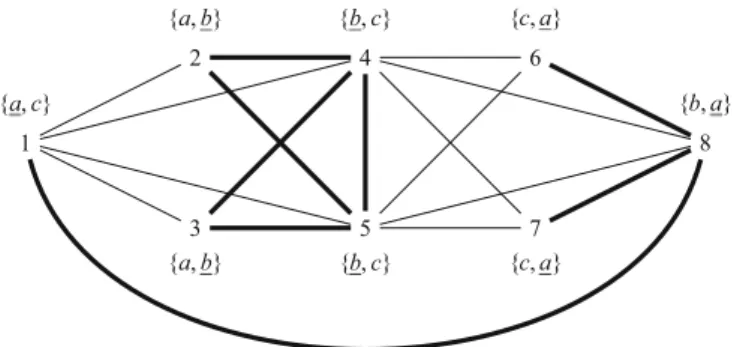
1 {a,c} 2 {a,b} 3 {a,b} 4 {b,c} 5 {b,c} 6 {c,a} 7 {c,a} 8 {b,a}
Fig. 1 A graph with acolorset assignment. Thebold edgesindicate pairs of players choosing the same
color
A coalitional improvement path, in short a c-improvement path, is a maximal sequence(s1,s2, . . . )of joint strategies such that for everyk>1 there is a coalition K such thatsk is a profitable deviation of the players in K fromsk−1. Clearly, if a c-improvement path is finite, its last element is a strong equilibrium. We say thatG has thefinite c-improvement property(c-FIP) if every c-improvement path is finite. So ifGhas the c-FIP, then it has a strong equilibrium. Further, we say that the function P : S → A(where Ais any set) is ageneralized ordinal c-potentialforGif there exists a strict partial orderingon the setAsuch that ifs→Ksis a profitable deviation, thenP(s)P(s). A generalized ordinal potential is also called ageneralized strong potential(Harks et al. 2013;Holzman and Law-Yone 1997). It is easy to see that if a finite game admits a generalized ordinal c-potential then the game has the c-FIP. The converse also holds: a finite game that has the c-FIP admits a generalized ordinal c-potential. The latter fact is folklore; we give a self-contained proof in the Appendix. Note that in the definition of a profitable deviation of a coalition, we insisted that all members of the coalition change their strategies. This requirement is irrelevant for the definitions of thek-equilibrium and the c-FIP, but it makes some arguments slightly simpler.
3 Coordination games on graphs
We now introduce the games we are interested in. Throughout the paper, we fix a finite set of colorsM of sizem, an undirected graphG=(V,E)without self-loops, and a color assignment A. The latter is a function that assigns to each nodeia non-empty set Ai ⊆M. A node j∈ V is aneighborof the nodei ∈V if{i,j} ∈E. LetNi denote
the set of all neighbors of nodei. We define a strategic gameG(G,A)as follows:
• the players are identified with the nodes, i.e.,N =V,
• the set of strategies of playeri isAi,
• the payoff function of playeriispi(s):= | {j ∈ Ni|si =sj} |.
So each node simultaneously chooses a color from the set available to her and the payoff to the node is the number of neighbors who chose the same color. We call these gamescoordination games on graphs, from now on justcoordination games.
Example 1 Consider the graph and the color assignment depicted in Fig.1. Take the joint strategy that consists of the underlined strategies. Then the payoffs are as follows:
• 1 for the nodes 1, 6, 7,
• 2 for the nodes 2, 3,
• 3 for the nodes 4, 5, 8.
It is easy to see that the above joint strategy is a Nash equilibrium. However, it is not a strong equilibrium because the coalition K = {1,4,5,6,7}can profitably deviate
by choosing colorc.
We now recall some notation and introduce some terminology. LetG=(V,E)be a graph. Given a set of nodesK, we denote byG[K]the subgraph ofGinduced byKand byE[K]the set of edges inEthat have both endpoints inK. SoG[K] =(K,E[K]). Further,δ(K)denotes the set of edges that have one node in K and the other node outside ofK. Also, given a subgraphCofGwe useV(C)andE(C)to refer to the set of nodes and the set of edges ofC, respectively.
Furthermore, we defineSWK(s):=
i∈K pi(s). Given a joint strategyswe denote
byEs+the set of edges{i,j} ∈ E such thatsi =sj. We call these edgesunicolored
in s. (In Fig.1, these are the bold edges.) Note thatSW(s)=2|E+s |. Finally, we call a subgraphunicolored in sif all its nodes have the same color ins.
4 Existence of strong equilibria
We begin by studying the existence of strong equilibria andk-equilibria of coordination games. We first prove our key lemma and then show how it can be applied to derive several existence results.
4.1 Key lemma
Recall that an edge setF ⊆E is afeedback edge setof the graphG=(V,E)if the graph(V,E\F)is acyclic.
Lemma 1 (Key lemma)Suppose s→Ksis a profitable deviation. Let F be a feedback edge set of G[K]. Denote SW(s)−SW(s)by ΔSW and for a coalition L denote SWL(s)−SWL(s)byΔSWL. Then
ΔSW=2(ΔSWK− |Es+ ∩E[K]| + |Es+∩E[K]|) (1)
and
ΔSW>2(|F∩Es+| − |F∩Es+|). (2)
Proof LetNKdenote the set of neighbors of nodes inKthat are not inK. Abbreviate
SW(s)−SW(s)toΔSW, and analogously, for a coalitionL, letΔSWL =SWL(s)−
SWL(s). The change in the social welfare can be written as ΔSW=ΔSWK+ΔSWNK +ΔSWV\(K∪NK).
We have
SWK(s)=2|Es+∩E[K]| + |Es+∩δ(K)|
and analogously fors. Thus
ΔSWK =2(|Es+ ∩E[K]| − |Es+∩E[K]|)+ |Es+ ∩δ(K)| − |E+s ∩δ(K)|.
It follows that
ΔSWNK = |Es+ ∩δ(K)| − |Es+∩δ(K)|
=ΔSWK−2(|Es+ ∩E[K]| − |Es+∩E[K]|).
Furthermore, the payoff of the players that are neither inKnor inNKdoes not change
and henceΔSWV\(K∪NK)=0.Putting these equalities together, we obtain (1).
LetFc=E[K]\F. Then
|Es+∩E[K]| − |Es+ ∩E[K]| = |Es+∩F| − |Es+ ∩F| + |Es+∩Fc| − |Es+ ∩F c|.
We know that(K,Fc)is a forest becauseF is a feedback edge set. So|Fc| <|K|. Hence
|Es+∩Fc| − |Es+ ∩F c| ≥ −|
Fc|>−|K|.
Furthermore, each player in K improves his payoff when switching tosand hence
ΔSWK ≥ |K|.So, plugging in these inequalities in (1) we get
ΔSW>2(|K| + |Es+∩F| − |E+s ∩F| − |K|)=2(|Es+∩F| − |Es+ ∩F|),
which proves (2).
Letτ(K)be the size of a minimal feedback edge set ofG[K], i.e.,
τ(K)=min{|F| |G[K]\Fis acyclic}. (3) Equation (2) then yields thatSW(s)−SW(s) > −2τ(K). The following example shows that this bound is tight.
Example 2 We define a graphG=(V,E)and a color assignment as follows. Consider a clique onlnodes and letKbe the set of nodes. Everyi ∈Kcan choose between two colors{ci,x}, whereci =cjfor every j =i. Further, every nodei ∈Kis adjacent to (l−2)additional nodes of degree one, each of which has the color set{ci}. Note that
when defining a joint strategys, it is sufficient to specifysi for everyi ∈ K because
the remaining nodes have only one color to choose from. Lets :=(ci)i∈K ands :=(x)i∈K. Thens
K
→sis a profitable deviation because every node inK increases its payoff from(l−2)to(l−1).Also|E+s | =l(l−2)and
|Es+| = l(l−21), so |E+s | − |E+s| =l l−2−l−1 2 =l l−1 2 −1 .
Furthermore, each tree on|K|nodes has|K| −1 edges. Thus τ(K)= |E[K]| −(|K| −1)=l(l−1) 2 −(l−1)=l l−1 2 −1 +1. SoSW(s)−SW(s)=2(|E+s| − |E+s |)= −2τ(K)+2. Tightness follows because
the left hand side is always even.
4.2 Color forests and pseudoforests
We use our key lemma to show that coordination games on pseudoforests admit strong equilibria. Recall that apseudoforestis a graph in which every connected component contains at most one cycle. For a colorx∈M let
Vx = {i ∈V |x∈ Ai}
be the set of nodes that can choosex.IfG[Vx]is a forest for allx ∈ M, we callG
acolor forest(with respect to A). Note that, in particular, a forest constitutes a color forest. Given a joint strategys, we call a subgraphGofG completely non-unicolored in sif none of its edges is unicolored ins.
We first derive some corollaries from our key lemma. Throughout this section, we consider a profitable deviations→Ksand letΔSW=SW(s)−SW(s).
Corollary 1 IfΔSW ≤ 0, then there is a cycle C in G[K]that is completely non-unicolored in s and non-unicolored in s.
Proof Assume that the claim does not hold. Then for all cyclesCinG[K], we can pick an edge eC ∈ E[C]that is unicolored in s or non-unicolored ins. Let F = {eC|Cis a cycle inG[K]}.This is a feedback edge set satisfyingF∩Es+ ⊆F∩Es+.
Hence by (2),ΔSW>2(|E+s ∩F| − |E+s ∩F|)≥0,which is a contradiction.
The next statement follows immediately from Corollary1because unicolored cycles cannot exist in color forests. Note that forests are a special case.
Theorem 1 Suppose that G[K]is a color forest. ThenΔSW>0.Hence every coor-dination game on a color forest has the c-FIP. Corollary 2 If G[K]is a graph with at most one cycle, thenΔSW≥0.
Proof IfG[K]is a connected graph with exactly one cycle, then there is a feedback edge set of size 1. HenceΔSW>−2. Because the left hand side is even, this implies
ΔSW≥0.
Using Corollaries1and2, we now establish the following result. Theorem 2 Every coordination game on a pseudoforest has the c-FIP.
Proof Associate with each joint strategysthe pair
P(s):=(SW(s), | {C|Cis a unicolored cycle ins} |).
We now claim thatP :S→R2is a generalized ordinal c-potential when we take for the strict partial orderingonP(S)the lexicographic ordering.
Consider a profitable deviations→Ks. By partitioningKinto the subsets of different connected components we can decompose this deviation into a sequence of profitable deviations such that each deviating coalition induces a subgraph of a connected graph with at most one cycle. By Corollary2the social welfare in each of these profitable deviations weakly increases. SoSW(s)≥SW(s).
IfSW(s) >SW(s)then P(s) P(s). IfSW(s)=SW(s), then by Corollary1
each of these profitable deviations is by a coalition that induces a connected graph with exactly one cycle. Moreover, this cycle becomes unicolored ins. ThusP(s) P(s).
4.3 Further applications
The following corollary is an immediate consequence of Corollary1.
Corollary 3 In every coordination game, every sequence of profitable deviations of coalitions of size at most two is finite. Hence Nash equilibria and 2-equilibria always exist.
Corollary 4 Every coordination game in which at most two colors are used has the c-FIP.
Proof Lets→Ksbe a profitable deviation. By assumption, all players inKthen deviate to their other option. As a consequence, every edge inE[K]is unicolored insif and only if it is unicolored ins. Hence each cycle inG[K]that is unicolored insis also unicolored ins.It follows from Corollary1thatSW(s) >SW(s). This shows thatSW
is a generalized ordinal c-potential.
The existence of strong equilibria for coordination games with two colors and sym-metric strategy sets follows from Proposition 2.2 inKonishi et al.(1997). Corollary3
shows that a stronger result holds, namely that these games have the c-FIP. This implies that arbitrary coalitional improvement paths always converge to a strong equilibrium. We next derive an existence result ofk-equilibria in graphs in which every pair of cycles is edge-disjoint. We call an edgeeof a graphprivateif it belongs to a cycle and is node-disjoint from all other cycles.
Lemma 2 Let G be a graph in which every pair of cycles is edge-disjoint. Then there exists a private edge.
Proof Given a cycleC, we call a nodev ∈ V(C)ananchor pointofC ifv can be reached from a nodev∈V(C)of another cycleC=Cwithout traversing an edge inE(C). First we show that there always exists a cycle with at most one anchor point.
Assume that the claim does not hold. Then every cycleC ofGcontains at least two distinct anchor points. Fix an arbitrary cycleCofGand letvC1 andvC2 be two anchor points ofC. Start fromvC1 and traverse the edges ofC to reachvC2. Then follow a shortest path Pthat connectsv2Cto a nodevC1 ∈V(C)of another cycleC=C; P must exist becausevC2 is an anchor point.
Note thatC andC share at most one node because all cycles are edge-disjoint; in particular, P might have length zero and consist of a single node only. Because we choose a shortest path connectingCandC, vC1 must be an anchor point ofC. By assumption,C has another anchor pointvC2. Repeat the above procedure with cycleCand anchor pointsvC1andvC2. Continuing this way, we construct a path that
traverses cycles ofG. Eventually, this path must return to a previously visited cycle. So this path contains a cycle and this cycle shares at least one edge with one of the visited cycles. This contradicts the assumption that all cycles ofGare pairwise edge-disjoint. Now, letCbe a cycle with at most one anchor pointv(if no such node exists, any edge inE(C)is private). Then any edgee∈E(C)such thatvis not an endpoint ofe
is private.
Theorem 3 Consider a coordination game on a graph G in which every pair of cycles is edge-disjoint. Let k be the minimum length of a cycle in G. Then every sequence of profitable deviations of coalitions of size at most k is finite. In particular, the game has a 3-equilibrium.
Proof We proceed by induction on the numberzof cycles. Ifz =1, then the claim follows by Theorem2.
Now, letz>1. Lets→Ksbe a profitable deviation such that|K| ≤k. From (1) we infer that
ΔSW=2(ΔSWK− |Es+ ∩E[K]| + |Es+∩E[K]|)≥2(ΔSWK− |E[K]|)
because|Es+ ∩E[K]| ≤ |E[K]|. Becausekis the minimum length of a cycle inG and|K| ≤k, we have|E[K]| ≤ |K|.SoΔSW≥0.
Consider a sequence of profitable deviations s1
K1 →s2
K2
→s3. . . We show that it is finite. Because the social welfare cannot decrease and is upper bounded there is an index l ≥ 1 such that for alli ≥ l,SW(si) = SW(sl). We can assume without
loss of generality thatl = 1. By Corollary1, for eachi ≥ 1 there is a cycleCi in
G[Ki]suchCi is completely non-unicolored insi and unicolored insi+1.Note that k≤ |V(Ci)| ≤ |Ki| ≤kand henceKi =V(Ci).
By Lemma2, there is a cycleCwith a private edgee= {u1,u2} ∈E(C). We claim thatC =Cifor at most onei.Assume otherwise and leti1,i2such thatC =Ci1 =Ci2 andC = Ci fori1 < i <i2. BecauseC =Ci1,eis unicolored insi1+1. We know thatC is the only cycle containinguj for j =1,2 by choice ofe. Souj ∈/ Ki for
i1 < i < i2and henceeis still unicolored ini2. ButC switches from completely non-unicolored insi2 to unicolored insi2+1, a contradiction.
SinceC is the only cycle containinguj for j =1,2, it follows that eachuj can
for alli > l. Hence if we removeeand call the new graphG, then for alli >l, si
Ki
→si+1is a profitable deviation inG. BecauseGhas one cycle less thanG, we can apply the induction hypothesis and conclude that the considered sequence of profitable
deviations is finite.
4.4 Uniform coordination games
Next, we establish the c-FIP property for some additional classes of coordination games. We call a coordination game on a graphG uniformif for every joint strategy sand for every edge{i,j} ∈E it holds that ifsi =sj thenpi(s)= pj(s).
Theorem 4 Every uniform coordination game has the c-FIP.
Proof Given a sequenceθ ∈ Rn of reals we denote byθ∗ its reordering from the largest to the smallest element. Associate with each joint strategy s the sequence
(p1(s), . . . ,pn(s))∗that we abbreviate to p∗(s). We now claim that p∗:S →Rnis a generalized ordinal c-potential when we take for the partial orderingonp∗(S)the lexicographic ordering on the sequences of reals.
Suppose that some coalition K profitably deviates from the joint strategy s to s=(sK,s−K). We claim that thenp∗(s) p∗(s).
Assume this does not hold. Rename the players such that p∗(s) =(p1(s), . . . , pn(s)). Letibe the smallest value for whichpi(s) < pi(s). By assumption such ani
exists. By the choice ofifor allj <iwe havepj(s)≥ pj(s)and alsopj(s)≥ pi(s).
Now, pi(s) < pi(s)implies thati∈/ K and hence we can writes=(si,s−i). By
the definition of the payoff functions, it follows that there exists some neighbor jofi withsj =siandsj =sj. Thus,j ∈K. By the uniformity property,pi(s)= pj(s). So
pj(s) > pj(s)= pi(s). Consequently, by the choice ofi, we havep∗(s) p∗(s),
which is a contradiction.
We can capture by Theorem4the following class of coordination games: We say thatGiscolor complete(with respect to A) if for everyx ∈ M each component of G[Vx]is complete. (Recall thatVx= {i∈V |x∈ Ai}.)
Corollary 5 Every coordination game on a color complete graph has the c-FIP. In particular, every coordination game on a complete graph has the c-FIP.
The existence of strong equilibria for color complete graphs also follows from a result byRozenfeld and Tennenholtz(2006) and the following lemma.
Lemma 3 Coordination games on color complete graphs are a special case of monotone increasing congestion games in which all strategies are singletons. Proof We can assume without loss of generality that for each colorx,G[Vx]is
con-nected (otherwise, we replacex with a new respective color for each component of G[Vx]). Then we can identify x with a singleton resource, along with the payoff functionvx :N→Rsuch thatvx(k)=k−1. Now, if a playerichoosessi =xthen
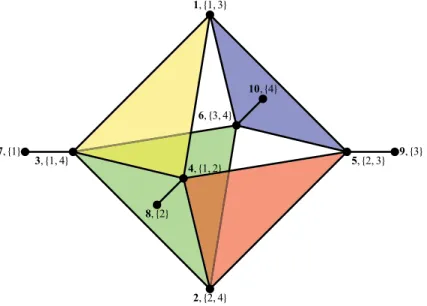
Fig. 2 Three-dimensional illustration of the coordination game used to show that 3-equilibria do not exist (Theorem5). Thecolored facetsindicate thetrianglesthat can beunicolored. The identity of the players is displayed inboldface. The strategy sets of the players are stated betweencurly braces
so the payoff in the coordination game coincides with the payoff in the associated
congestion game.
Rozenfeld and Tennenholtz (2006) show that monotone increasing congestion
games in which all strategies are singletons admit strong equilibria. Note, however, that our result above is stronger because we show that these games have the c-FIP. 4.5 Non-existence of 3-equilibria and existence thresholds
We next prove that 3-equilibria do not exist in general. Recall that 2-equilibria always exist by Corollary3.
Theorem 5 There exists a coordination game that does not have a3-equilibrium. Proof We define a coordination gameG(G,A)as indicated in Fig.2: There aren=10 players and 4 colors. The strategy sets are as follows:A1= {1,3},A2= {2,4},A3=
{1,4},A4= {1,2},A5= {2,3},A6= {3,4},A7= {1},A8= {2},A9= {3},A10=
{4}. There are 16 edges, defined as follows: Players 1 and 2 are both connected to players 3,4,5, and 6, accounting for 8 of the edges. There is aditionally a cycle
(3,4,5,6,3), accounting for four more edges. Lastly, players 7,8,9, and 10 all have a single edge attached to them and are connected to players 3,4,5, and 6, respectively. As can be seen from Fig.2, the graph on which the game is played is essentially the skeleton of an octahedron: 12 of the edges and 6 of the nodes of the graph belong to this skeleton, and the four remaining edges are connected to four remaining nodes that aredummyplayers (i.e., they have only one strategy that they can play).
Observe that there are eight triangles in the graph, which correspond to the eight facets of the octahedron. The strategy sets are defined such that only four out of the eight triangles of the octahedron can be unicolored. Also, this game is constructed such that if one triangle is unicolored, then the other three triangles are necessarily not unicolored.
We prove the theorem by showing that for every strategy profile ofG, there exists a profitable deviation of a set of at most 3 players. To simplify the proof, we make use of the many symmetries inG, which are apparent from Fig.2. Letsbe an arbitrary strategy profile ofG. We distinguish two cases:
– If there is a triangle that is unicolored unders, we may assume without loss of generality that this triangle is the one corresponding to players{1,3,4}(because of symmetry), i.e.,s1=s3=s4=1. Observe thatp4(s)=2. We distinguish two cases:
– p5(s)=2. Thens5 =s6=3. Ifs2 =4 then player 6 can deviate profitably to 4. Ifs2=2 then the coalition{2,6}can deviate profitably to 4.
– p5(s)≤ 1. Ifs2 = 2 ands5 = 2, then player 4 can deviate profitably to 2. Ifs2 = 2 ands5 =3 then the coalition{4,5}can deviate profitably to 2. If s2=4, thens5=3, and coalition{2,4,5}can deviate profitably to 2. – If there is no triangle that is unicolored unders, we distinguish again two cases.
By symmetry we may assume thats1=1.
– s3 =4. Then p3(s)≤ 1, so player 3 can profitably deviate by changing his color to 1.
– s3 = 1. Thens4 = 2. If p4(s) =1 then player 4 can profitably deviate by changing his color to 1. Otherwise, p4(s)=2 and either(s2,s5)=(2,3)or
(s2,s5)=(4,2).
• If (s2,s5) = (2,3), then if also p5(s) = 2 it holds that s6 = 3 and therefore player 1 can profitably deviate to 3. If p5(s)=1, then player 5 can profitably deviate to 2.
• If(s2,s5)=(4,2), then p2(s)≤1, so player 2 can profitably deviate to 2.
Note that each profitable deviation given above consists of at most three players.
This concludes the proof.
The coordination game given in Fig. 2 is an example of a game that does not have a 3-equilibrium but admits a 2-equilibrium. We define thetransition valueof a coordination game as the value ofkfor which ak-equilibrium exists but a(k+1) -equilibrium does not. Clearly, the instance in Fig.2has an transition value ofk=2. An interesting question is whether one can identify instances of coordination games with a non-trivial transition valuek≥3.
We next show that the coordination game given in Fig.1is an instance with transition valuek=4.
Theorem 6 There is a coordination game that has a transition value of4.
Proof Consider the coordination game discussed in Example1(see Fig.1). We first argue that it does not admit a 5-equilibrium. Assume for the sake of a contradiction thatsis a strong equilibrium of this game.
Consider players 4 and 5. Leti,j ∈ {4,5},i = j be such that pi(s) ≤ pj(s).
Note that the neighbors ofiand j (excluding j andi, respectively) are the same. As a consequence, ifsi =sj, then playerican profitably deviate to player j’s color, i.e.,
si=sj. Thus players 4 and 5 have the same color ins, says4=s5=b. (Because of the symmetry of the instance, the cases4=s5=cfollows analogously.)
Assume there exists a playeri ∈ {2,3}withsi =b. Theni can profitably deviate
by choosingsi=b. It follows that players 2 and 3 have colors2=s3=b.
Next, consider player 8 and supposes8=b. Then his payoff is p8(s)=2. Further, the payoff of each of the players 1, 6 and 7 is 0 because all their neighbors have color b. But then the coalitionK = {1,6,7,8}can profitably deviate by choosing colora. We conclude thats8=a.
As a consequence, for players 1, 6, and 7 we haves1=s6=s7=a as otherwise any such player could profitably deviate by choosinga.
Thus, the only remaining possible configuration forsis the one indicted in Fig.1
(by the underlined strategies). But this is not a strong equilibrium because the coali-tion K = {1,4,5,6,7}can profitably deviate by choosing color c. This yields a contradiction and proves the non-existence of 5-equilibria.
On the other hand, it is easy to see that the strategy profile indicated in Fig. 1
constitutes a 4-equilibrium. This concludes the proof. In general, we leave open the question for whichk ≥ 2 there exist coordination games with transition valuek.
The above example can be adapted to show that there are coordination games that do not have the c-FIP but arec-weakly acyclic. Recall that a gameGisc-weakly acyclic if for every joint strategy there exists a finite c-improvement path that starts at it. Note that a c-weakly acyclic game admits a strong equilibrium.
Corollary 6 There is a coordination game that does not have the c-FIP but is c-weakly acyclic.
Proof Take the coordination game from Example1and modify it by adding to each color set a new, common colord. Then the joint strategysin which each player selects d is a strong equilibrium. Moreover, for each player her payoff insis strictly higher than in any joint strategy in which she chooses another color. Soscan be reached from each joint strategy in just one profitable deviation, by a coalition of the players who all switch tod. On the other hand, the argument presented in Example1shows that
this game does not have the c-FIP.
5 Inefficiency of
k
-equilibria
We first summarize some results concerning the strong price of stability of coordination games.
Theorem 7 The strong price of stability is 1 in each of the following cases:
• G is a pseudoforest;
• G is a color forest;
Proof IfGis a pseudoforest, a maximum of Pin the lexicographic ordering defined in the proof of Theorem2is a strong equilibrium and a social optimum. In the other two cases, the social welfare functionSWis a generalized ordinal c-potential. So in both cases each social optimum is a strong equilibrium. We next study thek-price of anarchy of our coordination games. It is easy to see that the price of anarchy is infinite. In fact, this holds independently of the graph structure, as the next theorem shows.
Theorem 8 For every graph there exists strategy sets for the players such that the price of anarchy of the resulting coordination game is infinite.
Proof LetG =(V,E)be an arbitrary graph. We assign to each nodei ∈ V a color set Ai = {xi,c}, where xi is a private color, i.e., xi = xj for every j = i, andc
is a common color. The joint strategys in which every player chooses her private color constitutes a Nash equilibrium withSW(s) = 0. On the other hand, the joint strategys in which every player chooses the common colorcis a social optimum
withSW(s)=2|E|.
We now determine thek-price of anarchy and the strong price of anarchy. We define for every j ∈N andK ⊆Nand joint strategys,
NKj (s)= {{i,j} ∈E |i∈ K,si =sj}.
Intuitively,|NKj (s)|is the payoff j derives from players inK unders.
Theorem 9 The k-price of anarchy of coordination games is between2nk−−11−1and 2nk−−11 for every k∈ {2, . . . ,n}. Furthermore, the strong price of anarchy is exactly2. Proof We first prove the upper bound. By the definition of the payoff function for all joint strategiessandσ, we have|NjK(σ)| ≤pj(σK,s−K).
Suppose that the considered game has ak-equilibrium, says, and letσ be a social optimum. By the definition of ak-equilibrium, for all coalitionsK of size at mostk there exists some j ∈ K such that pj(σK,s−K) ≤ pj(s)and hence by the above |NjK(σ)| ≤pj(s).
Fix a coalitionK = {v1, . . . , vk}of sizek. We know that there is some j ∈K such that|NKj (σ)| ≤ pj(s). Rename the nodes so that j =vk. Further, there is a node j
such that N{v1,...,vk−1} j (σ) ≤ pj(s).
Again we rename the nodes so that j =vk−1. Continuing this way we obtain that for alli∈ {1, . . . ,k}it holds that|N{v1,...,vi}
vi (σ)| ≤ pvi(s).Hence pvi(σ)=N{v1,...,vi} vi (σ)+NviV\{v1,...,vi}(σ)≤ pvi(s)+NV\{v1,...,vi} vi (σ) = pvi(s)+NK\{v1,...,vi} vi (σ)+NviV\K(σ).
Summing over all players inKwe obtain SWK(σ)≤SWK(s)+ k i=1 NK\{v1,...,vi} vi (σ)+NviV\K(σ) . (4) But k i=1 NK\{v1,...,vi} vi (σ)= k i=1 |{j >i : {vi, vj} ∈Eσ+}| = |Eσ+∩E[K]|
andki=1|NviV\K(σ)| = |Eσ+∩δ(K)|.Hence rewriting (4) yields SWK(σ)≤SWK(s)+ |Eσ+∩E[K]| + |Eσ+∩δ(K)|.
It also holds thatSWK(σ)=2|Eσ+∩E[K]| + |Eσ+∩δ(K)|. So we get
SWK(σ)≤SWK(s)+ 1 2SWK(σ)+ 1 2|E + σ ∩δ(K)|,
which implies that
SWK(σ)≤2SWK(s)+ |Eσ+∩δ(K)|. (5)
Now we sum over all coalitionsKof sizek. Each playeriappears in nk−−11of such sets because it is possible to choosek−1 out ofn−1 remaining players to form a setK of sizekthat containsi. Hence,
K:|K|=k SWK(σ)= n i=1 K:Ki pi(σ)= n i=1 n−1 k−1 pi(σ)= n−1 k−1 SW(σ).
We obtain an analogous expression for the joint strategys.
Furthermore, for each edgee= {u, v} ∈E+σ, we can choose 2 kn−−21setsK of size ksuch thate∈δ(K). Indeed, assuming thatu ∈K andv /∈K, we can choosek−1 out ofn−2 remaining players to completeK and hence there exist nk−−21of those sets. Reversing the roles ofuandvand summing up yields 2 nk−−21. Hence
K:|K|=k |E+σ ∩δ(K)| =2 n−2 k−1 |Eσ+| = n−2 k−1 SW(σ).
By summing over all coalitionsK of sizek, Eq. (5) yields
n−1 k−1 SW(σ)≤2 n−1 k−1 SW(s)+ n−2 k−1 SW(σ).
It follows that thek-price of anarchy is at most 2 nk−−11 n−1 k−1 − n−2 k−1 =2n−1 k−1. This concludes the proof of the upper bound.
The claimed lower bounds follow from Examples3and4given below. The following example establishes a lower bound on thek-price of anarchy. Example 3 Fixnandk∈ {2, . . . ,n}. LetV(G)consist of two setsV1andV2of size kandn−k, respectively, and define
E[G] = {{u, v} |u ∈V1, v∈V1∪V2}.
Fix three colorsa,bandc. Forv∈V1, letA(v)= {a,c}. Forv∈V2, letA(v)= {b,c}. Then the color assignmentσ in which each player chooses the common colorcis a social optimum. The social welfare is
SW(σ)=SWV1(σ)+SWV2(σ)=k(n−1)+(n−k)k.
Next we show that the color assignmentsin which every node in V1 choosesa and every node inV2choosesbis ak-equilibrium. Assume that there is a profitable deviations→Kssuch that|K| ≤k. Then all nodes inK switch tocand also all nodes that choosecinsare inK. Hence for allv ∈ K, pv(s)= |Nv∩K|.So there is a nodev∈V1∩Kbecause otherwise the payoff of all nodes inKwould remain 0. But thenpv(s)= |Nv∩K| ≤k= pv(s), which yields a contradiction.
Note thatSW(s)=k(k−1).It follows that thek-price of anarchy is at least SW(σ) SW(s) = k(n−1)+(n−k)k k(k−1) = 2(n−1)−(k−1) k−1 =2 n−1 k−1 −1.
The following example shows that the upper bound of 2 on the strong price of anarchy (k=n) of Theorem9is tight.
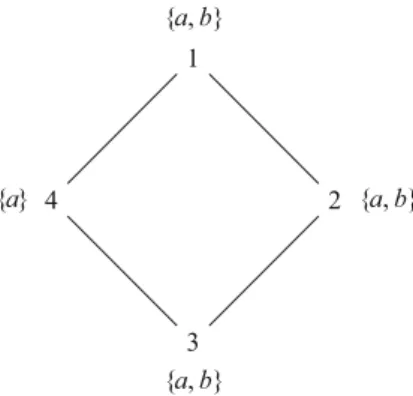
Example 4 Consider the graph and the color assignment depicted in Fig. 3. Here
(a,a,a,a)is a social optimum with the social welfare 8, while(b,b,b,a)is a strong equilibrium with the lowest social welfare, 4. So the strong price of anarchy is 2 in this example of 4 players. By duplicating the graphl times, we can draw the same
conclusion for the case of 4lplayers.
6 Complexity
1 {a,b} 2 {a,b} 3 {a,b} 4 {a}
Fig. 3 A coordination game showing that the strong price of anarchy is at least 2 6.1 Verification
First, we show that in general it is hard to decide whether a given joint strategy is a k-equilibrium.
Letk-Equilibrium denote the problem to decide, given a coordination game with a joint strategysandk∈ {1, . . . ,n}, whethersis ak-equilibrium.
Theorem 10 k-Equilibriumis co-NP-complete.
Proof It is easy to verify thatk-Equilibriumis in co-NP: a certificate of a NO-instance is a profitable deviation of a coalition of size at mostk.
We show the hardness by reduction of the complement ofClique, which is a co-NP-complete problem. Let(G,k)be an instance thereof. We construct an instance of k-Equilibrium as follows. Forv ∈ V let Av = {xv,y}, where color yand all colorsxv, v∈V are distinct. Furthermore, for every nodev∈V we addk−2 nodes u1v, . . . ,ukv−2and edges{v,uiv}fori=1, . . . ,k−2. These additional nodes can only choose the colorxv.Letsbe the joint strategy in which every nodev∈V choosesxv. We claim that this is ak-equilibrium if and only ifGhas no clique of sizek.
SupposeGhas a cliqueKof sizek. Then jointly deviating toyyields to each node inK a payoff ofk−1, whereas every node has a payoff ofk−2 ins. So this is a profitable deviation. For the other direction, suppose that there is a profitable deviation s→Ksby a coalitionKof size at mostk. Then every node inKdeviates toyand hence belongs toV.Since every node inK has a payoff ofk−2 ins,pv(s)≥k−1 for all
v∈ K.Sovis connected to at leastk−1 nodes inK. This implies thatK is a clique
of sizek.
We next show that for color forests the decision problem is in P. First we show that we can focus on certain profitable deviations which we callsimple: Fix a joint strategy sand a coalitionK. We callK connectedifG[K]is connected. A deviations→Ksis simpleifKis connected ands=(xK,s−K)for some colorx.
Lemma 4 Let s be a joint strategy in a coordination game. If there is a profitable deviation by a coalition of size at most k, then there is also a simple profitable deviation by a coalition of size at most k.
Proof Lets→Ksbe a profitable deviation with|K| ≤k. Pick an arbitraryv∈ K and letx=sv. LetLconsist of those nodesu ∈ K for whichsu =xandu is reachable inG[K]fromv.Lets=(xL,s−L). Then the deviation tosis simple. For all nodes
u ∈ L, we haveNuK(s)= NuL(s)= NuL(s)by the definition of L. Furthermore, NuV\K(s)⊆NuV\L(s)⊆NuV\L(s).Hence
pu(s)=NuK(s)+NuV\K(s)≤NuL(s)+N V\L
u (s)=pu(s),
which implies that the deviation tosis profitable foru. Theorem 11 Consider a coordination game on a color forest. Then there exists a polynomial-time algorithm that decides whether a given joint strategy is a k-equilibrium and, if this is not the case, outputs a profitable deviation of a coalition of size at most k.
Proof For a statementPwe write below[[P]]to denote the variable that is 1 if Pis true and 0 otherwise. For a function f :V →RandU⊆V, letf(U)=v∈U f(v). For a functionF :V →2V letF(U)=v∈U F(v).
Letsbe a joint strategy. By Lemma4it is sufficient to check for the existence of simpleprofitable deviations by coalitions of size at mostk. Thus, we letx∈ Mand we search for simple profitable deviations in which the coalition deviates tox. Because a coalition in a simple deviation is connected, we can check each connected component ofG[Vx]separately. Assume without loss of generality thatG[Vx]itself is connected,
i.e., is a tree. Pick an arbitrary rootrofG[Vx]and define for each node thechildren,
parent, androoted subtreein the usual way (with respect tor). For each nodev∈Vx
letCv⊆Vx denote the set of children ofvand letPv∈Vx denote the parent ofv(if v =r). Finally, letTvdenote the subtree ofG[Vx]rooted atv. For each nodev, we
defineU(v),D(v),Up(v), andDp(v)as follows.
• U(v)is a connected coalitionK ⊆Tvof minimum size such thatv∈ K and the deviation to(xK,s−K)is profitable for all nodes inK (if such a coalition exists).
We denote the properties it has to satisfy by (∗).
• D(v)= |U(v)|ifU(v)exists and∞otherwise.
• Up(v)is a connected coalitionL ⊆T
vof minimum size such thatv∈ Land the deviation to(xL,s−L)is profitable for all nodes inL, whereL:=L∪ {Pv}(if
such a coalition exists). We denote the properties it has to satisfy by (∗∗). (Note that the deviation is not required to be profitable forPveven thoughPv∈L.)
• Dp(v)= |Up(v)|ifUp(v)exists and∞otherwise.
We can computeD,Dp,UandUpusing a dynamic program as follows. Letv∈Vx
and suppose we found these objects for all children ofv. LetU ⊆CvminimizeDp(U) among all setsU⊆Cvthat satisfyDp(U) <∞and
|U| + [[sPv =x]]> pv(s) (6)
if such a set exists. In this case setU(v)= {v}∪Up(U)andD(v)= |U(v)|. Otherwise, we set it to∞.
We first prove thatK :=U(v)satisfies (∗) ifU(v)exists. The setK is connected because v ∈ K and all sets Up(u)are connected, foru ∈ Cv. It is profitable for
v to deviate tox because of (6). The deviation is profitable for nodes u ∈ K\{v} becauseUp(u)⊆K,P(u)∈K (by the connectivity ofK) andUp(u)satisfies (∗∗).
Furthermore,Kis of minimal size amongst all coalitions that satisfy (∗). Indeed, ifKis another such coalition, thenU:=K∩Cvsatisfies (6) because it is profitable to deviate toxforv.It is profitable foru∈Uto deviate toxand hence|K ∩T(u)| ≥Dp(u), which implies|K| ≥1+Dp(U).Therefore|K| ≥1+Dp(U)by the minimality ofU. But|K| = |{v} ∪Up(U)| =1+Dp(U), which shows that|K| ≥ |K|.
Similarly, forv ∈Vx\{r}, letW ⊆CvminimizeDp(W)among all setsW⊆Cv
that satisfyDp(W) <∞and
|W| +1>pv(s) (7)
if such a set exists. In this case setUp(v) = {v} ∪Up(W)and Dp(v) = |Up(v)|. Otherwise, we setDp(v)= ∞.Similar arguments as before show that ifUp(v)exists then it indeed satisfies (∗∗).
Note that we can computeU(v)in polynomial time by sorting the nodesu ∈ Cv in increasing order ofDp(u)and then successively adding nodes toU(v)until (6) is satisfied. Similarly, we can computeUp(v)efficiently. This shows that the algorithm runs in polynomial time.
Now, lets→Ksbe a simple profitable deviation toxsuch that|K| ≤ k. Letvbe the root ofG[K]according to our previously fixed ordering. By the properties of the functionD, we know thatD(v)≤ |K| ≤k. Conversely, ifD(v)≤kfor some node
v, thenU(v)of sizeD(v)≤kis the coalition we are looking for. 6.2 Computing strong equilibria
Next we focus on the problem of actually computing a strong equilibrium. As we show below, this is possible for certain graph classes.
Corollary 7 Consider a coordination game on a color forest. Then a strong equilib-rium can be computed in polynomial time.
Proof We begin with an arbitrary initial joint strategys. Puttingk=n, by Theorem
11there is an algorithm that decides whethersis a strong equilibrium and, if this is not the case, outputs a profitable deviations→Ks.In the first case, we outputs; in the second case, we repeat the procedure withs. We know that SW(s)is a natural number andSW(s) >SW(s)by Corollary1, so at most maxs∈SSW(s)≤2|E|steps
are necessary to reach a strong equilibrium.
Theorem 12 Consider a coordination game on a color complete graph. Then a strong equilibrium can be computed in polynomial time.
Proof This follows from Lemma3and the corresponding result for monotone increas-ing congestion games in which all strategies are sincreas-ingletons, established inRozenfeld
Theorem 13 Consider a coordination game on a pseudoforest. Then a strong equi-librium can be computed in polynomial time.
Proof We first show that for a tree, a strong equilibrium can be computed efficiently via dynamic programming. By Corollary1it suffices to compute a social optimum. LetT be a tree and root it at an arbitrary noder ∈ V(T). Given a nodei ∈ V(T), letTi denote the subtree ofT that is rooted atiand letCi be the set of children ofi.
Given a colorsi ∈Si, definedi(si)as the maximum social welfare achievable by the
nodes inTi if nodeichooses colorsi. Note that for each leafi ∈V(T)ofT we have
di(si)=0 for allsi ∈Si. Consider a nodei ∈V(T)that is not a leaf and assume we
computed all valuesdj(sj)for every j ∈Ciandsj ∈ Sj. Define[[sj =si]]to be 1 if
sj =si and 0 otherwise. We can then computedi(si)for everysi ∈Sias follows:
di(si)= j∈Ci max sj∈Sj (dj(sj)+2[[sj =si]]).
The intuition here is that we account for every child j ∈Ci ofi for the maximum
social welfare achievable inTj plus an additional contribution of 2 ifi and j choose
the same color.
Computing di(si)for allsi ∈ Si takes time at mostO(m2|Ci|), where m is the
number of colors. Thus, it takes time O(m2|V(T)|)to compute all valuesdr(sr)for
sr ∈ Sr of the root noder. The optimal social welfare of the treeT is thenSW(T)=
maxsr∈Sr dr(sr). The corresponding optimal joint strategys∗Tcan be determined using
some standard bookkeeping.
Next suppose thatT is a pseudotree. LetC =(i1, . . . ,ik)be the unique cycle in
T. Note that it might no longer be sufficient to simply compute a social optimum for T. Instead, the idea is to compute a social optimumsT∗ ofT such that, if possible,C is unicolored.
Note that if such a social optimum does not exist, then there is an edge inC that is not unicolored. LetSW(j), j ∈ {1, . . . ,k}, be the maximum social welfare of the tree that one obtains fromT by removing edge{ij,ij+1}fromC(where we define ik+1=i1). Note that we can efficiently computeSW(j)by using the dynamic program for trees described above.5LetSW
1=maxj=1,...,kSW(j). ComputingSW1takes time O(k·m2|V(T)|)=O(nm2|V(T)|).
Next assume a social optimum exists in which all nodes of C are unicolored. Note that if we remove the edges on C from T then T decomposes into k trees, rooted ati1, . . . ,ik. We can computedij(·)for every rootij as described above. Let
R= ∩kj=1Sij be the set of common colors of the nodes inC. If all nodes inCchoose
colorc∈Rthen we obtain a social welfare of
SW(c)=2k+
k
j=1 dij(c).
5 Observe that we do not enforce that the endpoints of the removed edge{i
j,ij+1}obtain different colors in the optimal solution. In fact, subsequently it will become clear that we do not have to do so.