SORT 35 (2) July-December 2011, 83-102 c Institut d’Estad´ıstica de CatalunyaOperations ResearchTransactions [email protected] ISSN: 1696-2281
eISSN: 2013-8830 www.idescat.cat/sort/
A simulation study on some confidence
intervals for the population standard deviation
Moustafa Omar Ahmed Abu-Shawiesh1, Shipra Banik2 and B. M. Golam Kibria3
Abstract
In this paper a robust estimator against outliers along with some other existing interval estimators are considered for estimating the population standard deviation. An extensive simulation study has been conducted to compare and evaluate the performance of the interval estimators. The exact and the proposed robust method are easy to calculate and are not overly computer-intensive. It appears that the proposed robust method is performing better than other confidence intervals for estimating the population standard deviation, specifically in the presence of outliers and/or data are from a skewed distribution. Some real-life examples are considered to illustrate the application of the proposed confidence intervals, which also supported the simulation study to some extent.
MSC: 62F10, 62F40
Keywords: Breakdown point, bootstrapping, confidence interval, coverage probability, standard deviation,Qnestimator, robust estimator, outlier, scale estimator.
1. Introduction
Point estimates are of limited value, since we cannot attach to them statements regarding the amount of confidence that they have estimated the unknown parameter. Of great value is an interval estimate, an estimate about which we can make statements of confidence (Daniel, 1990). The confidence interval is defined as an estimated range of values that is likely to include an unknown population parameter. If independent samples
1Department of Mathematics, Faculty of Science, Hashemite University, Zarqa 13115, Jordan, [email protected]
2School of Engineering and Computer Science, Independent University, Bangladesh, Dhaka 1229, Bangladesh, [email protected]
3Department of Mathematics and Statistics, Florida International University, Modesto A. Maidique Campus, Miami, FL 33199, USA, [email protected]
Received: February 2011 Accepted: May 2011
are take repeatedly from the same population, and the confidence interval is calculated for each sample, then a certain percentage, called the confidence level of the interval, will include the unknown population parameter.
Scale estimators are very important in many statistical applications. The sample standard deviation is the most common scale estimator that provides a logical point estimate of the population standard deviation,σ. Unfortunately, the sample standard
deviation, S, is very sensitive to the presence of outliers in the data. Furthermore,
S is not necessarily the most efficient or meaningful estimator of scale in skewed and leptokurtic distributions and it is notable that it is not robust to slight deviations from normality (Tukey, 1960). S has a good efficiency in platykurtic and moderately leptokurtic distributions but the classic inferential methods for it may perform poorly in realistically non-normal distributions (Bonett, 2006). Also, according to Gorard (2004), S has no obvious intuitive meaning because squaring before summing and then taking the square root makes the resulting figure difficult to understand, which restricts any subsequent intuitive interpretation. Nevertheless,Sis the most efficient scale estimator for the normal distribution often used to construct the 100(1−α)% confidence interval
forσ. The standard error of S is a scale multiple of the actual parameter being estimated.
In this paper, we are looking for a scale estimator which is robust, has a closed form, and easy to compute as an alternative to S. The Rousseeuw-Croux estimator,Qnmight be a more meaningful measure of variation and may be preferred to S. It is the most efficient scale estimator for the normal distribution often used to construct the 100(1−α)%
confidence interval forσ.
The exact 100(1−α)% confidence interval for the population standard deviation, σ, is based on the assumption that the underlying distribution of the data is normal
with no outliers, but what would happen if the data are not from a normal distribution instead of heavier tails or from a skewed distribution. The statistical literature shows that robust methods might give more meaningful measures of scale and are indeed more resistant to departures from normality and presence of outliers thanS. Therefore, the need for alternatives to the exact 100(1−α)% confidence interval forσcomes to play.
The statistical literature is full of robust confidence intervals for the mean, for example Tukey and McLaughlin (1963); Huber (1964); Dixon and Tukey (1968); De Wet and van Wyk (1979); Gross (1973, 1976); Bickel and Doksum (1977, p. 375); Kim (1992) and Clark (1994). For small-sample inference about variance and its transformations we refer to Longford (2010) among others. The problem of constructing robust confidence interval for the population standard deviation,σ, has received much less attention. Here,
by a robust confidence interval, we mean that its actual coverage probability is close to the specified confidence level (1−α) with a short length of the confidence interval.
In this paper, an approximate confidence interval for the population standard devia-tion,σ, for one sample problems that is much less sensitive to the presence of outliers
and/or to departure from normality is proposed. The proposed method provides an alter-native to the exact 100(1−α)% confidence interval forσbased onQn. The performance
on various evaluation criteria such as coverage probability, average width and standard deviation of the width. The coverage probability naturally varies from distribution to dis-tribution for a given procedure, but a good procedure should keep this variation small. Furthermore, we want a confidence interval whose endpoints are generally close to-gether, thus a small average width is good (Gross, 1976). A set of real data is employed to illustrate the results given in the paper.
The organization of the paper is as follows. In Section 2, we presented Rousseeuw-Croux estimator,Qn, for estimatingσ, and discussed outliers. The proposed confidence
intervals forσare presented in Section 3. A Monte Carlo simulation study is conducted
in Section 4. Some real life data are analyzed in Section 5. Finally, some concluding remarks based on simulation and numerical examples are given in Section 6.
2. Rousseeuw-Croux estimator,QnQnQnand outliers 2.1. The Rousseeuw-Croux estimator
Rousseeuw and Croux (1993) proposed two robust estimators for scale, theSnandQn estimators. They can be used as initial or ancillary scale estimators in the same way as the median absolute deviation (MAD) but they are more efficient and not biased towards symmetric distributions. The breakdown point of theSnestimator is 50% and its efficiency is 58%, while Qn has the same breakdown point but its efficiency at normal distributions is very high, about 82%. Due to its high efficiency and other good properties, the Qn estimator is considered in this paper. Mosteller and Tukey (1977) define two types of robustness as follows:
1. Resistance: This means that changing a small part even by a large amount of the data does not cause a large change in the estimate.
2. Robustness of efficiency: This means that the statistic has high efficiency in a variety of situations rather than in any one situation. Efficiency means that the estimate is close to the optimal estimate given that the distribution of the data is known.
Many statistics have one of these properties. However, it can be difficult to find statistics that have both resistance and robustness of efficiency. The most common estimate of scale, S is the most efficient estimate of scale if the data come from a normal distribution. However, S is not robust in the sense that changing even one value can dramatically change the computed value ofS; that is, it has poor resistance. In addition, it does not have robustness or efficiency for non-normal data. MAD and the inter-quartile range (IQR) are the two most commonly used robust alternatives to S. MAD in particular is a very robust scale estimator. However, MAD does not have
particularly high efficiency for data (37% for normal data) and also MAD has an implicit assumption of symmetry, that is it measures the distance from a measure of central location (the median). Rousseeuw and Croux (1993) proposed theQnestimate of scale as an alternative to MAD. It shares desirable robustness properties with MAD (50% breakdown point, bounded influence function). In addition, it has significantly better normal efficiency (82%) and it does not depend on symmetry.
2.1.1. Definition ofQn
The estimatorQnfor a random sampleX1,X2,. . .,Xnwith model distributionFis defined
as:
Qn=2.2219{|Xi−Xj|;i< j ;i=1, 2, 3 ,. . .,n ; j=1, 2, 3,. . .,n}{g} (1)
where g= h2 n2/4 and h=n 2
+1 (i.e., roughly half the number of observations). Here the symbol(.)represents the combination and the symbol[.]is used to take only the integer part of a fraction. TheQnestimator is theg-thorder statistic of the n2 inter-point distances. The value 2.2219 is chosen to makeQna consistent estimator of scale for normal data. Rousseeuw and Croux (1993) have derived the unbiasing factordnso thatdn×Qnbecomes an unbiased estimator of σfor the case of normal distribution.
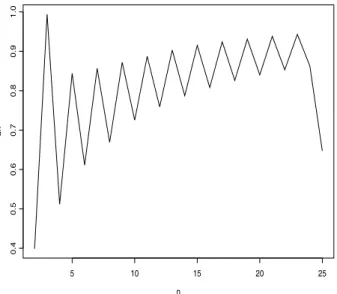
These values ofdn are provided here in Table 2.1 as a function of n. The scatterplot betweennanddnis presented in Figure 2.1. We can observe from both Table 2.1 and Figure 2.1 thatdnis sensitive to the sample sizes.
Table 2.1: The values of the unbiasing factor dn. n dn n dn 12 0.399 14 0.787 13 0.994 15 0.915 14 0.512 16 0.808 15 0.844 17 0.924 16 0.611 18 0.826 17 0.857 19 0.931 18 0.669 20 0.840 19 0.872 21 0.938 10 0.725 22 0.853 11 0.887 23 0.943 12 0.759 24 0.863 13 0.903 25 0.647 n dn 5 10 15 20 25 0.4 0.5 0.6 0.7 0.8 0.9 1.0
An approximation result ofdnfor larger values ofnis given by Croux and Rousseeuw (1992) as follows: dn= n
n+1.4 for odd values ofn n
n+3.8 for even values ofn
(2)
2.1.2. Properties ofQn
The Qn estimator has a simple and explicit formula, which is equally suitable for asymmetric distributions. The main properties of the Qn estimator investigated by Rousseeuw and Croux (1993) are given below:
1. For any sampleX ={X1,X2,. . .,Xn} in which no two points coincide, the
break-down point of the scale estimatorQnis given byǫ∗(Qn,X) =
hn
2 i
n .
2. ForF =Φ, whereΦ(x) is the standard normal distribution function, the value of
d is given byd= 1
√ 2Φ−1
5 8
=2.2219.With this constantd,Qnhas bias in small samples.
3. The influence function ofQnestimator is smooth and unbalanced (see Rousseeuw and Croux, 1993). For a model distributionF which has a density f, the influence function ofQnis given by
IF(x;Q,F) =d
1
4−FR(x+d−1) +F(x−d−1)
f(y+d−1)f(y)dy
4. The gross-error sensitivity of theQnestimator is larger than those of MAD andSn estimators and its value isγ∗(Q,Φ) =sup
x |
IF(x;Q,Φ)|=2.069.
5. The asymptotic variance of Qn in the case of normal distribution is given by V(Q,Φ) =0.6077 and this yields an efficiency of 82.27%. This is very high relative to the MAD estimator whose efficiency at normal distribution is only 36.74% andSnwhose efficiency is 58.23%. Using a simulation study, Rousseeuw (1991) concluded that the estimator Qn is more efficient than MAD and Sn estimators. However,Qnloses some of its efficiency for small sample sizes. 6. The square of theQnestimator, that is, (Qn)2, can be used as an estimate ofσ2.
Even though bothQnand (Qn)2 are biased estimators ofσandσ2 respectively,
2.2. Estimators and outliers
The presence of outliers in the data set is one of the most important topics in statistical inference. An outlier can be defined as observations which appear to be inconsistent with the remaining set of data. Outliers can be contaminants, i.e. arising from other distributions or can be typical observations generated from the assumed model (Barnett, 1988). Therefore, outliers need very special attention because a small departure from the assumed model can have strong negative effects on the efficiency of classical estimators for location and scale (Tukey, 1960). In this section, a simple numerical example taken from Rousseeuw (1991) is given to show the effect of outliers onSandQnestimators. Suppose we have five measurements of a concentration without outliers given as follows:
5.59, 5.66, 5.63, 5.57, 5.60
Let us now suppose that one of these concentrations has been wrongly recorded so that the data have an outlier value and become as follows:
5.59, 5.66, 5.63, 55.7, 5.60
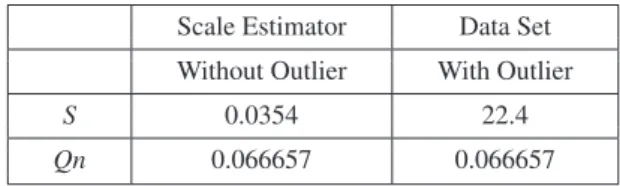
Based on these two data sets, the values of the two estimators are calculated and given in Table 2.2.
Table 2.2: Values of the estimators for the example.
Scale Estimator Data Set Without Outlier With Outlier
S 0.0354 22.4
Qn 0.066657 0.066657
From Table 2.2, we notice that the value of the single outlier has changed the value ofS, which becomes very large. The robustness of theQnestimator is clear where the value of it is the same for the two data sets.
3. Proposed robust confidence interval forσ
3.1. Exact confidence interval forσ
LetX1,X2,. . .,Xnbe a random sample of size n from the normal distribution, i.e.,Xi∼
N(µ,σ2)for alli, then(n−1)S
2 σ2 = 1 σ2∑ n i=1(Xi−X)2∼χn2−1whereS2=n−11∑ni=1(Xi−X¯)2
is the sample variance. The exact 100(1−α)%confidence interval for a population
P (n−1)S 2 χ(2α 2,n−1) <σ2 < (n−1)S 2 χ(21−α 2,n−1) ! =1−α (3) whereχ2α 2 andχ 2 1−α 2are the( α 2) th and (1 −α 2)
thpercentile points of the
χ2distribution
with(n−1)degrees of freedom. Taking the square root of the endpoints of equation (3) gives a 100(1−α)% confidence interval forσas follows:
s (n−1)S2 χ(2α 2,n−1) , s (n−1)S2 χ(21−α 2,n−1) ! (4)
The exact confidence interval forσ2in (3) is hypersensitive to minor violations of the
normality assumption. Scheffe (1959, p. 336) show that (3) has an asymptotic coverage probability of about 76, 63, 60 and 51 for the Logistic, the Student t(7), the Laplace and Student t(5) distributions respectively. The result is disturbing because these symmetric distributions are not easily distinguished from a normal distribution unless the sample size is large. Also, the exact confidence interval forσ2in (3) as demonstrated by Lehman
(1986, p. 206) is highly sensitive to the presence of outliers and / or to departure from normality. However, as pointed out by Lehman, the sample sizenmay have to be rather large for the asymptotic result to give a good approximation.
3.2. Robust confidence intervals
In this section, we will propose the new robust confidence interval for estimating the population standard deviationσ. Instead of assumingXi∼N(µ,σ2), letX1,X2,. . .,Xn
are the random samples of size n from a continuous, independent and identically distributed random variable. The random variableT is defined as the ratio,
T =dnQn
σ (5)
where the expressiondnQnacts as an unbiased estimator ofσso that E(T)=1 for normal
distribution. Based on Rousseeuw and Croux(1993), for larger values ofn, the following asymptotic result can be used:
T =dnQn σ ∼N 1, 1 1.65n (6)
The following approximation result can be obtained:
dnQn∼N σ, 1 1.65nσ 2 (7)
Therefore from (7), we can get the following pivotal quantity: dnQn−σ
1 1.28√nσ
∼N(0, 1) (8)
Now, using the above pivotal quantity, we can derive the 100(1−α)% robust confidence
interval forσas follows:
P q1< dnQn−σ 1 1.28√nσ <q2 =1−α ⇒P q1 1.28√n+1< dnQn σ < q2 1.28√n+1 =1−α ⇒P 1.28√n∗dnQn q1+1.28√n < σ< 1.28 √ n∗dnQn q2+1.28√n =1−α whereq1=Zα
2andq2=Z1−α2 are the( α
2)
thand(1
−α
2)
thpercentile points of the standard
normal distribution so that the length is minimum. Therefore, the 100(1−α)% robust
confidence interval forσ, is as follows: 1.28√ n∗dnQn Zα 2 +1.28 √ n , 1.28√n∗dnQn Z1−α 2+1.28 √ n = D Qn Zα 2+D1 , D Qn Z1−α 2+D1 (9)
where the values of the factorsD=1.28√n∗dnandD1=1.28√n.
An approximation result ofDfor larger values ofncan be calculated as follows:
D= (1.28√n) n n+1.4
, for odd values ofn
(1.28√n)
n n+3.8
, for even values ofn
(10)
The squaring of the endpoints of equation (9) gives a 100(1−α)%confidence interval
forσ2.
3.3. Bonett confidence interval
LetX1,X2,. . .,Xn be a random sample of size n from the normal distribution, that is,
does not have an asymptotic coverage probability for non-normal distributions. Bonett (2006) proposed the following (1-α)100% confidence interval (CI) forσas
LCL=expln(cσˆ2)−Zα/2se and UCL=expln(cσˆ2) +Zα/2se
where Zα/2 is two-sided critical z-value, se = c[{γˆ4(n −3)/n}/(n − 1)]
1/2,
c=n/(n−Zα/2)and ˆγ4=n∑i(Yi−µˆ)4/(∑i(Yi−µˆ)2)2.
3.4. Cojbasic and Tomovic (CT) CI
Based ont-statistic, Cojbasic and Tomovic (2007) proposed the following nonparamet-ric bootstraptCI:
Iboot=S2−tˆ(α) q
c
var(S2)
whereS2= 1
n−1∑i(Xi−X¯)2 is the sample variance, ˆt(α)is aαpercentile ofT∗defined
asT∗=√S2∗−S2
c
var(S2∗),S
2∗is a bootstrap replication of statisticS2andvarc(S2)is a consistent
estimator of the variance, defined by 2σ4/(n−1).
3.5. Some bootstrap CIs
Let X(*) =X1(∗),X2(∗), . . . ,Xn(∗), where thei-th sample is denoted byX(i)fori=1, 2,. . .,B
andBis the number of bootstrap samples. We proposed the following bootstrap CIs for the sampleσ:
Non-parametric bootstrap CI
Computeσfor all bootstrap samples and then order the sample SDs of each bootstrap
samples as follows: S∗(1)≤S∗(2)≤S∗(3)··· ≤S∗(B) CI for populationσ: LCL=S∗[(α/2)B] and UCL=S∗[(1−α/2)B] CI for populationσ: LCL=S q (n−1)/χ∗2 α/2,(n−1) and UCL=S q (n−1)/χ1∗−2 α/2,(n−1)
whereχ∗2
α/2andχ
∗2
1−α/2are the (α/2)-th and(1−α/2)-th sample quantiles ofχ
2=(n−1)S2 ˆ σ2B and ˆσB= q 1 B−1∑ B
i=1(x¯∗i−x¯¯)2and ¯x∗i is thei-th bootstrap sample mean, ¯¯xis the bootstrap
mean and ˆσBis the bootstrap standard deviation.
Bootstrap robust CI CI for populationσ: LCL= D Qn Z∗ α/2+D1 and UCL= D Qn Z1∗− α/2+D1
whereZα∗/2andZ∗1−α/2are the(α/2)th and(1−α/2)th sample quantiles of the bootstrap
test statistic,Zi∗=(x¯∗i−x¯¯) ˆ σB
.
We note that all proposed confidence intervals except exact and Bonett do not require any distributional assumptions. However, bootstrap methods are computer intensive, where as others are very easy to compute. The exact method works better for any sample size when the data are from the normal distribution.
4. Simulation study
Our basic objective is to investigate some efficient estimators ofσby a simulation study.
Since a theoretical comparison among the intervals is not possible, a simulation study has been made to compare the performance of the estimators.
4.1. Simulation technique
The flowchart of our simulation is as follows:
1. We use sample sizesn= 5, 10, 20, 30, 50, 70 and 100.
2. Random samples are generated from symmetric and skewed distributions:
(a) Normal distribution with mean 3 and SD 1.
(b) Chi-square distribution with df 1.
(c) Lognormal distribution with mean 1 and SD 0.80.
We used 5000 simulation replications and 1500 bootstrap samples for eachn. The most common 95% confidence interval (α=0.05) for the confidence coefficient is used.
It is well known that if the data are from a symmetric distribution (ornis large), the coverage probability will be exact or close to(1−α). So the coverage probability is a
the confidence interval. A shorter length width gives a better confidence interval. It is obvious that when coverage probability is the same, a smaller width indicates that the method is appropriate for the specific sample. In order to compare the performance of the various intervals, the following criteria are considered: coverage probabilities (below, cover and above), mean and SD of the widths of the resulting confidence intervals. The
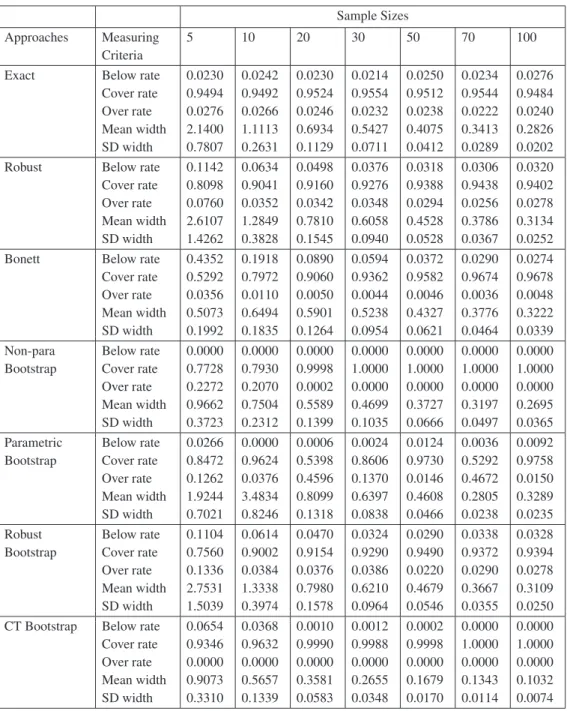
Table 4.1: Coverage properties for N(3,1) distribution with skewness 0. Sample Sizes
Approaches Measuring Criteria
5 10 20 30 50 70 100
Exact Below rate Cover rate Over rate Mean width SD width 0.0230 0.9494 0.0276 2.1400 0.7807 0.0242 0.9492 0.0266 1.1113 0.2631 0.0230 0.9524 0.0246 0.6934 0.1129 0.0214 0.9554 0.0232 0.5427 0.0711 0.0250 0.9512 0.0238 0.4075 0.0412 0.0234 0.9544 0.0222 0.3413 0.0289 0.0276 0.9484 0.0240 0.2826 0.0202 Robust Below rate
Cover rate Over rate Mean width SD width 0.1142 0.8098 0.0760 2.6107 1.4262 0.0634 0.9041 0.0352 1.2849 0.3828 0.0498 0.9160 0.0342 0.7810 0.1545 0.0376 0.9276 0.0348 0.6058 0.0940 0.0318 0.9388 0.0294 0.4528 0.0528 0.0306 0.9438 0.0256 0.3786 0.0367 0.0320 0.9402 0.0278 0.3134 0.0252 Bonett Below rate
Cover rate Over rate Mean width SD width 0.4352 0.5292 0.0356 0.5073 0.1992 0.1918 0.7972 0.0110 0.6494 0.1835 0.0890 0.9060 0.0050 0.5901 0.1264 0.0594 0.9362 0.0044 0.5238 0.0954 0.0372 0.9582 0.0046 0.4327 0.0621 0.0290 0.9674 0.0036 0.3776 0.0464 0.0274 0.9678 0.0048 0.3222 0.0339 Non-para Bootstrap Below rate Cover rate Over rate Mean width SD width 0.0000 0.7728 0.2272 0.9662 0.3723 0.0000 0.7930 0.2070 0.7504 0.2312 0.0000 0.9998 0.0002 0.5589 0.1399 0.0000 1.0000 0.0000 0.4699 0.1035 0.0000 1.0000 0.0000 0.3727 0.0666 0.0000 1.0000 0.0000 0.3197 0.0497 0.0000 1.0000 0.0000 0.2695 0.0365 Parametric Bootstrap Below rate Cover rate Over rate Mean width SD width 0.0266 0.8472 0.1262 1.9244 0.7021 0.0000 0.9624 0.0376 3.4834 0.8246 0.0006 0.5398 0.4596 0.8099 0.1318 0.0024 0.8606 0.1370 0.6397 0.0838 0.0124 0.9730 0.0146 0.4608 0.0466 0.0036 0.5292 0.4672 0.2805 0.0238 0.0092 0.9758 0.0150 0.3289 0.0235 Robust Bootstrap Below rate Cover rate Over rate Mean width SD width 0.1104 0.7560 0.1336 2.7531 1.5039 0.0614 0.9002 0.0384 1.3338 0.3974 0.0470 0.9154 0.0376 0.7980 0.1578 0.0324 0.9290 0.0386 0.6210 0.0964 0.0290 0.9490 0.0220 0.4679 0.0546 0.0338 0.9372 0.0290 0.3667 0.0355 0.0328 0.9394 0.0278 0.3109 0.0250 CT Bootstrap Below rate
Cover rate Over rate Mean width SD width 0.0654 0.9346 0.0000 0.9073 0.3310 0.0368 0.9632 0.0000 0.5657 0.1339 0.0010 0.9990 0.0000 0.3581 0.0583 0.0012 0.9988 0.0000 0.2655 0.0348 0.0002 0.9998 0.0000 0.1679 0.0170 0.0000 1.0000 0.0000 0.1343 0.0114 0.0000 1.0000 0.0000 0.1032 0.0074
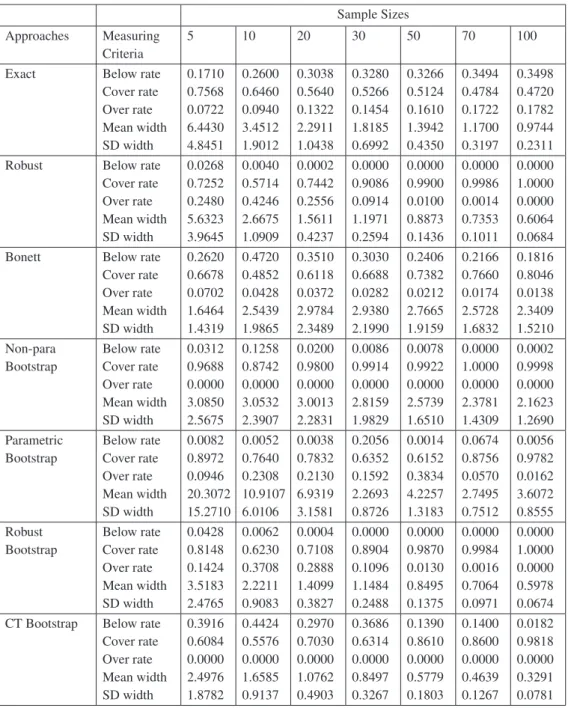
below and above rates of a confidence interval is the fraction out of 5000 samples that resulted in an interval that lies entirely above and below the true value of the population mean. The coverage probability is found as the sum of the lower rate and upper rate and then subtracted from total probability 1. Simulation results are tabulated in Tables 4.1, 4.2 and 4.3 for normal, chi-square and log-normal distributions respectively. For
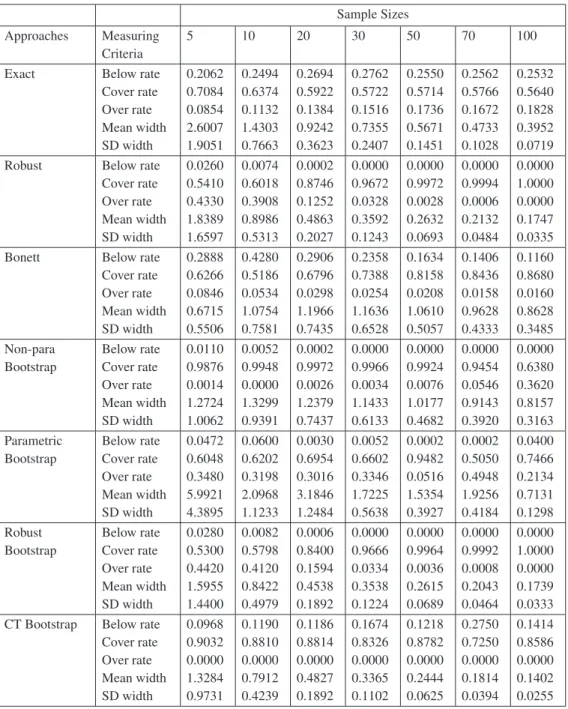
Table 4.2: Coverage properties forχ12distribution with skewness 2.83. Sample Sizes
Approaches Measuring Criteria
5 10 20 30 50 70 100
Exact Below rate Cover rate Over rate Mean width SD width 0.2062 0.7084 0.0854 2.6007 1.9051 0.2494 0.6374 0.1132 1.4303 0.7663 0.2694 0.5922 0.1384 0.9242 0.3623 0.2762 0.5722 0.1516 0.7355 0.2407 0.2550 0.5714 0.1736 0.5671 0.1451 0.2562 0.5766 0.1672 0.4733 0.1028 0.2532 0.5640 0.1828 0.3952 0.0719 Robust Below rate
Cover rate Over rate Mean width SD width 0.0260 0.5410 0.4330 1.8389 1.6597 0.0074 0.6018 0.3908 0.8986 0.5313 0.0002 0.8746 0.1252 0.4863 0.2027 0.0000 0.9672 0.0328 0.3592 0.1243 0.0000 0.9972 0.0028 0.2632 0.0693 0.0000 0.9994 0.0006 0.2132 0.0484 0.0000 1.0000 0.0000 0.1747 0.0335 Bonett Below rate
Cover rate Over rate Mean width SD width 0.2888 0.6266 0.0846 0.6715 0.5506 0.4280 0.5186 0.0534 1.0754 0.7581 0.2906 0.6796 0.0298 1.1966 0.7435 0.2358 0.7388 0.0254 1.1636 0.6528 0.1634 0.8158 0.0208 1.0610 0.5057 0.1406 0.8436 0.0158 0.9628 0.4333 0.1160 0.8680 0.0160 0.8628 0.3485 Non-para Bootstrap Below rate Cover rate Over rate Mean width SD width 0.0110 0.9876 0.0014 1.2724 1.0062 0.0052 0.9948 0.0000 1.3299 0.9391 0.0002 0.9972 0.0026 1.2379 0.7437 0.0000 0.9966 0.0034 1.1433 0.6133 0.0000 0.9924 0.0076 1.0177 0.4682 0.0000 0.9454 0.0546 0.9143 0.3920 0.0000 0.6380 0.3620 0.8157 0.3163 Parametric Bootstrap Below rate Cover rate Over rate Mean width SD width 0.0472 0.6048 0.3480 5.9921 4.3895 0.0600 0.6202 0.3198 2.0968 1.1233 0.0030 0.6954 0.3016 3.1846 1.2484 0.0052 0.6602 0.3346 1.7225 0.5638 0.0002 0.9482 0.0516 1.5354 0.3927 0.0002 0.5050 0.4948 1.9256 0.4184 0.0400 0.7466 0.2134 0.7131 0.1298 Robust Bootstrap Below rate Cover rate Over rate Mean width SD width 0.0280 0.5300 0.4420 1.5955 1.4400 0.0082 0.5798 0.4120 0.8422 0.4979 0.0006 0.8400 0.1594 0.4538 0.1892 0.0000 0.9666 0.0334 0.3538 0.1224 0.0000 0.9964 0.0036 0.2615 0.0689 0.0000 0.9992 0.0008 0.2043 0.0464 0.0000 1.0000 0.0000 0.1739 0.0333 CT Bootstrap Below rate
Cover rate Over rate Mean width SD width 0.0968 0.9032 0.0000 1.3284 0.9731 0.1190 0.8810 0.0000 0.7912 0.4239 0.1186 0.8814 0.0000 0.4827 0.1892 0.1674 0.8326 0.0000 0.3365 0.1102 0.1218 0.8782 0.0000 0.2444 0.0625 0.2750 0.7250 0.0000 0.1814 0.0394 0.1414 0.8586 0.0000 0.1402 0.0255
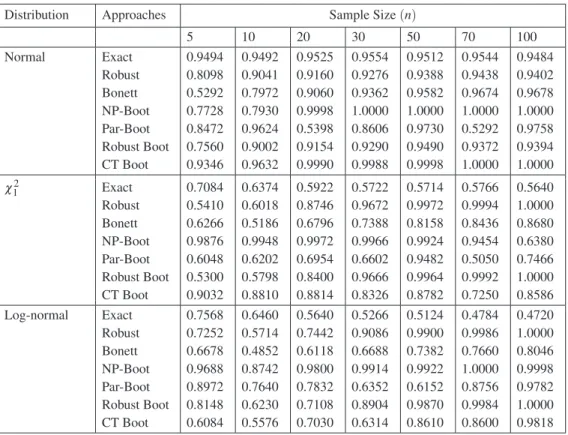
all simulated distributions, we also provided the coverage probabilites in Table 4.4. For more on the simulation techniques, we refer Baklizi and Kibria (2009) and Banik and Kibria (2010a,b) and references therein.
Table 4.3: Coverage properties for the Lognormal (1.0,0.80) distribution with skewness 3.69. Sample Sizes
Approaches Measuring Criteria
5 10 20 30 50 70 100
Exact Below rate Cover rate Over rate Mean width SD width 0.1710 0.7568 0.0722 6.4430 4.8451 0.2600 0.6460 0.0940 3.4512 1.9012 0.3038 0.5640 0.1322 2.2911 1.0438 0.3280 0.5266 0.1454 1.8185 0.6992 0.3266 0.5124 0.1610 1.3942 0.4350 0.3494 0.4784 0.1722 1.1700 0.3197 0.3498 0.4720 0.1782 0.9744 0.2311 Robust Below rate
Cover rate Over rate Mean width SD width 0.0268 0.7252 0.2480 5.6323 3.9645 0.0040 0.5714 0.4246 2.6675 1.0909 0.0002 0.7442 0.2556 1.5611 0.4237 0.0000 0.9086 0.0914 1.1971 0.2594 0.0000 0.9900 0.0100 0.8873 0.1436 0.0000 0.9986 0.0014 0.7353 0.1011 0.0000 1.0000 0.0000 0.6064 0.0684 Bonett Below rate
Cover rate Over rate Mean width SD width 0.2620 0.6678 0.0702 1.6464 1.4319 0.4720 0.4852 0.0428 2.5439 1.9865 0.3510 0.6118 0.0372 2.9784 2.3489 0.3030 0.6688 0.0282 2.9380 2.1990 0.2406 0.7382 0.0212 2.7665 1.9159 0.2166 0.7660 0.0174 2.5728 1.6832 0.1816 0.8046 0.0138 2.3409 1.5210 Non-para Bootstrap Below rate Cover rate Over rate Mean width SD width 0.0312 0.9688 0.0000 3.0850 2.5675 0.1258 0.8742 0.0000 3.0532 2.3907 0.0200 0.9800 0.0000 3.0013 2.2831 0.0086 0.9914 0.0000 2.8159 1.9829 0.0078 0.9922 0.0000 2.5739 1.6510 0.0000 1.0000 0.0000 2.3781 1.4309 0.0002 0.9998 0.0000 2.1623 1.2690 Parametric Bootstrap Below rate Cover rate Over rate Mean width SD width 0.0082 0.8972 0.0946 20.3072 15.2710 0.0052 0.7640 0.2308 10.9107 6.0106 0.0038 0.7832 0.2130 6.9319 3.1581 0.2056 0.6352 0.1592 2.2693 0.8726 0.0014 0.6152 0.3834 4.2257 1.3183 0.0674 0.8756 0.0570 2.7495 0.7512 0.0056 0.9782 0.0162 3.6072 0.8555 Robust Bootstrap Below rate Cover rate Over rate Mean width SD width 0.0428 0.8148 0.1424 3.5183 2.4765 0.0062 0.6230 0.3708 2.2211 0.9083 0.0004 0.7108 0.2888 1.4099 0.3827 0.0000 0.8904 0.1096 1.1484 0.2488 0.0000 0.9870 0.0130 0.8495 0.1375 0.0000 0.9984 0.0016 0.7064 0.0971 0.0000 1.0000 0.0000 0.5978 0.0674 CT Bootstrap Below rate
Cover rate Over rate Mean width SD width 0.3916 0.6084 0.0000 2.4976 1.8782 0.4424 0.5576 0.0000 1.6585 0.9137 0.2970 0.7030 0.0000 1.0762 0.4903 0.3686 0.6314 0.0000 0.8497 0.3267 0.1390 0.8610 0.0000 0.5779 0.1803 0.1400 0.8600 0.0000 0.4639 0.1267 0.0182 0.9818 0.0000 0.3291 0.0781
Table 4.4: Coverage Probabilities for All Approaches and Distributions.
Distribution Approaches Sample Size(n)
5 10 20 30 50 70 100 Normal Exact Robust Bonett NP-Boot Par-Boot Robust Boot CT Boot 0.9494 0.8098 0.5292 0.7728 0.8472 0.7560 0.9346 0.9492 0.9041 0.7972 0.7930 0.9624 0.9002 0.9632 0.9525 0.9160 0.9060 0.9998 0.5398 0.9154 0.9990 0.9554 0.9276 0.9362 1.0000 0.8606 0.9290 0.9988 0.9512 0.9388 0.9582 1.0000 0.9730 0.9490 0.9998 0.9544 0.9438 0.9674 1.0000 0.5292 0.9372 1.0000 0.9484 0.9402 0.9678 1.0000 0.9758 0.9394 1.0000 χ12 Exact Robust Bonett NP-Boot Par-Boot Robust Boot CT Boot 0.7084 0.5410 0.6266 0.9876 0.6048 0.5300 0.9032 0.6374 0.6018 0.5186 0.9948 0.6202 0.5798 0.8810 0.5922 0.8746 0.6796 0.9972 0.6954 0.8400 0.8814 0.5722 0.9672 0.7388 0.9966 0.6602 0.9666 0.8326 0.5714 0.9972 0.8158 0.9924 0.9482 0.9964 0.8782 0.5766 0.9994 0.8436 0.9454 0.5050 0.9992 0.7250 0.5640 1.0000 0.8680 0.6380 0.7466 1.0000 0.8586 Log-normal Exact Robust Bonett NP-Boot Par-Boot Robust Boot CT Boot 0.7568 0.7252 0.6678 0.9688 0.8972 0.8148 0.6084 0.6460 0.5714 0.4852 0.8742 0.7640 0.6230 0.5576 0.5640 0.7442 0.6118 0.9800 0.7832 0.7108 0.7030 0.5266 0.9086 0.6688 0.9914 0.6352 0.8904 0.6314 0.5124 0.9900 0.7382 0.9922 0.6152 0.9870 0.8610 0.4784 0.9986 0.7660 1.0000 0.8756 0.9984 0.8600 0.4720 1.0000 0.8046 0.9998 0.9782 1.0000 0.9818 4.2. Results discussion
The MATLAB programming language was used to run the simulation and to make the necessary tables. The performance of the selected techniques in Section 3 for normal distribution is examined first and the simulated results are tabulated in Table 4.1.
The results in Table 4.1 suggested that when sampling from a normal distribution, the performance of the estimators do not differ greatly. However, for small sample sizes, the exact method has coverage probability close to 0.95, followed by CT Bootstrap, the proposed robust method, the robust bootstrap method and Bonnet performed the worse. The parametric bootstrap method performed better than the non-parametric bootstrap method for all sample sizes. When measuring criterion is average width, it is observed that the CT bootstrap interval performed well as compare to others, followed by Bonett and the non-parametric interval. The average width of the exact method is observed closed to the proposed robust method.
The next simulation compares the performance of the proposed intervals for a variety of non-normal distributions. Results are depicted for chi-square and log-normal in Tables 4.2 and 4.3 respectively. The results in Table 4.2 and Table 4.3 suggested that when sampling from a skewed distribution, the proposed robust method,
Non-parametric bootstrap, robust bootstrap performed better compared to others in the sense of coverage probability and average width. It is clear that the proposed robust method is superior to the exact method when the data are from a non-normal population.
When the data are from normal distributions or sample sizes are large, the exact method would be considered as it is easy to compute and has coverage probability close to the nominal size compared to the rest. Since in real life the distributions of the data are unknown or do not follow the normality assumption for most of the cases, our proposed robust confidence interval would be recommended, as it does not required any distributional assumption and is easy to compute compared to the bootstrap methods. Even though some of the bootstrap methods are as good as our proposed robust method, it is not advisable to use them as they are very computer intensive. However, for a computer expert researcher, the non-parametric bootstrap method can be recommended.
5. Applications to real data
In this section, we will present some real life examples to illustrate the application and the performance of the selected intervals.
5.1. Example 1
This example is taken from Hogg and Tanis (2001, page 359). The data set represents the amount of butterfat in pounds produced by a typical cow during a 305-day milk production period between her first and second calves. The butterfat production for a random sample of sizen =20 cows measured by a farmer yielding the following observations:
481, 537, 513, 583, 453, 510, 570, 500, 457, 555 618, 327, 350, 643, 499, 421, 505, 637, 599, 392
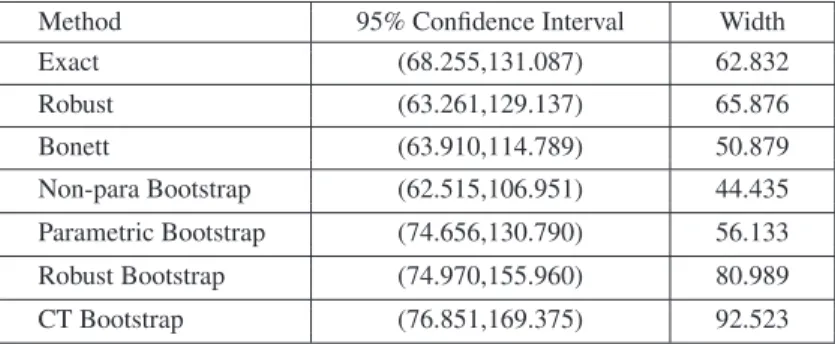
The sample mean, standard deviation and skewness of data are 507.5, 89.75 and −0.3804 and respectively. Shapiro-Wilk Normality Test (W = 0.9667,p-value = 0.6834) suggested that the data follow a normal distribution. The resulting 95% confidence intervals for different methods and the corresponding confidence widths are given in Table 5.1.
From Table 5.1, we observed that when the data under consideration has a normal distribution, the confidence intervals widths for both exact and robust methods are approximately the same, but as expected, the exact method provided the shortest intervals widths among the two methods. From the above Table, we observed that the non-parametric bootstrap interval has the narrowest width followed by the Bonett interval. It is noted that the CT bootstrap has the widest width.
Table 5.1: The 95% Confidence Intervals for the Butterfat Data.
Method 95% Confidence Interval Width
Exact (68.255,131.087) 62.832 Robust (63.261,129.137) 65.876 Bonett (63.910,114.789) 50.879 Non-para Bootstrap (62.515,106.951) 44.435 Parametric Bootstrap (74.656,130.790) 56.133 Robust Bootstrap (74.970,155.960) 80.989 CT Bootstrap (76.851,169.375) 92.523 5.2. Example 2
This example is taken from Weiss (2002, page 291). The data set represents the last year’s chicken consumption in pounds for people on USA published by the USA Department of Agriculture in Food Consumption, Prices, and Expenditures. The last year’s chicken consumption, in pounds, for a random sample of size n=17 people yielded the following observations:
47, 39, 62, 49, 50, 70, 59, 53, 55, 0, 65, 63, 53, 51, 50, 72, 45
The sample mean, standard deviation and skewness of these data are 51.94, 16.08 and−2.11 respectively. Shapiro-Wilk Normality Test (W =0.8013, p-value = 0.0021) suggested that the data do not follow a normal distribution. The zero value may be a recording error or due to a person in the random sample who does not eat chicken for some reason (e.g., a vegetarian) and may be considered as an outlier. Now, if we remove the outlier 0 pound from the sample data, the sample mean, standard deviation and skewness of data are 55.19, 9.21 and 0.33 respectively. Shapiro-Wilk Normality Test (W =0.9651, p-value = 0.7539) suggested that the data follow a normal distribution. The resulting 95% confidence intervals for different methods and the corresponding confidence widths based on the two types of data are given in Table 5.2.
From Table 5.2, we observed that the non-parametric bootstrap interval has the narrowest width followed by the Bonett interval. It is also noted that the CT bootstrap has the widest width than others. From Table 5.2 it is also observed that when the outlier is removed from the data, then the confidence interval for exact and robust methods are very similar and approximately have the same interval width, although the robust interval width is slightly shorter. The value of the outlier does not affect so much the proposed robust confidence interval and therefore the exact confidence interval for the population standard deviation,σ, should be avoided in the presence of
outliers. In general, an outlier should not be removed without careful consideration. Simply removing an outlier because it is an outlier is unacceptable statistical practice.
Table 5.2
Method 95% Confidence Interval Width
Original Data Abridged Data Original Data Abridged Data Exact (11.978 , 24.478) (7.485 , 16.330) 12.50 8.845 Robust (6.804, 14.255) (5.193, 11.635) 7.451 6.442 Bonett (8.798,26.362) (6.396,11.813) 17.564 5.416 Non-para Bootstrap (6.789,23.977) (6.158,11.470) 17.188 5.311 Parametric Bootstrap (10.676,37.332) (7.506,13.971) 26.655 6.464 Robust Bootstrap (7.800,17.840) (6.398,13.991) 10.040 7.593 CT Bootstrap (16.374,40.284) (9.737, 18.698) 23.910 8.961
Also, our result if we had blindly finding a confidence interval without first examining the data would have been invalid and misleading. In this case we can use the proposed robust confidence interval which is resistant to outliers.
6. Concluding remarks
This paper proposes an approximate confidence interval for estimating the population standard deviation, σ, based on a robust estimator and compares its performance
with other proposed intervals. A simulation study has been conducted to compare the performance of the estimators, and shows that the proposed robust confidence interval for all distributions considered performs well and had a good coverage probability compared to the exact method especially for non-normal distributions. It appears that the sample size (n) has significant effect on the proposed confidence interval. We observed that if the population is really normal, the exact confidence interval for the population standard deviation, σ, performs slightly better than the proposed robust method. If
the distribution is highly skewed, the coverage probability of the proposed robust method becomes close to 1−α and improves as the sample size increases. Actually,
if the population is really non-normal, the exact confidence interval for the population standard deviation, σ, can be arbitrarily bad. A single outlier makes it worse than
useless. To illustrate the findings of the paper we considered some real life examples which also supported the simulation study to some extent. Finally, among all proposed intervals, the robust, exact, non-parametric boot strap and CT bootstrap intervals are promising and can be recommended for the practitioners. However, both exact and proposed robust intervals are easy to compute and are not computer intensive.
Acknowledgements
The authors are thankful to the referees and editor of the journal for their valuable and constructive comments which certainly improved the quality and presentation of the paper. This paper was completed while Dr. B. M. Golam Kibia was on sabbatical leave (2010-2011). He is grateful to Florida International University for awarding him the sabbatical leave, which gave him excellent research facilities.
References
Baklizi, A. and Kibria, B. M. G. (2009). One and two sample confidence intervals for estimating the mean of skewed populations: an empirical comparative study.Journal of Applied Statistics, 36, 601–609. Banik, S. and Kibria, B. M. G. (2010a). Comparison of some parametric and nonparametric type one sample
confidence intervals for estimating the mean of a positively skewed distribution.Communications in Statistics-Simulation and Computation, 39, 361–389.
Banik, S. and Kibria, B. M. G. (2010b). Comparison of some test statistics for testing the mean of a right skewed distribution.Journal of Statistical Theory and Applications, 9, 77–90.
Barnett, V. (1988). Outliers and order statistics.Communication in Statistics: Theory and Methods, 17, 2109–2118.
Bickel, P. J. and Doksum, K. A. (1977).Mathematical Statistics: Basic Ideas and Selected Topics. Holden Day, San Francisco, USA.
Bonett, D. G. (2006). Approximate confidence interval for standard deviation of nonnormal distributions.
Computational Statistics and Data Analysis, 50, 775–782.
Clark, B. R. (1994). Empirical evidence for adaptive confidence interval and identification of outliers using methods of trimming,Australian Journal of Statistics, 36(1): 45–58.
Cojbasic, V. and Tomovic, A. (2007). Nonparametric confidence intervals for population variance of one sample and the difference of variances of two samples,Computational Statistics & Data Analysis, 51, 5562–5578.
Croux, C. and P. J. Rousseeuw (1992). Time efficient algorithms for two highly robust estimators of scale. Computational Statistics, Volume 1, eds. Y. Dodge and J. Whittaker, Heidelberg: Physika-Verlag, 411–428.
Daniel, W. W. (1990).Applied Nonparametric Statistics, second edition, Duxbury, USA.
De Wet, T. and van Wyk, W.J. (1979). Efficiency and robustness of Hogg’s adaptive trimmed means.
Communications in Statistics, Theory and Methods, 8, 117–128.
Dixon, W. J. and Tukey, J. W. (1968). Approximate behavior of the distribution of winsorized t (trim-ming/winsorizing 2),Technometrics, 10, 83–93.
Gorard, S. (2004). Revisiting a 90-year-old debate: the advantages of the mean deviation.Paper presented at the British Educational Research Association Annual Conference. University of Manchester, UK. Gross, A. M. (1973). A Monte Carlo swindle for estimators of locations.Applied Statistics, 22, 347–353. Gross, A. M. (1976). Confidence interval robustness with long-tailed symmetric distributions,American
Statistical Associations, 71, 409–416.
Hogg, R. V. and E. A. Tanis (2001).Probability and Statistical Inference. Sixth edition, Prentice-Hall Inc., Upper Saddle River, New Jersey, USA.
Huber, P. J. (1964). Estimation of a location parameter,The Annals of Mathematical Statistics, 35, 73–101. Kim, Seong-Ju (1992). The metrically trimmed mean as a robust estimator of location,The Annals of
Lehman, E. L. (1986).Testing Statistical Hypothesis, John Wiley, New York.
Longford, N. T. (2010). Small-sample inference about variance and its transformations,SORT, 34, 1, 3–20. Mosteller and Tukey (1977). Data Analysis and Regression: A Second Course in Statistics.
Addison-Wesley, USA.
Rousseuw, P. J. (1991). Tutorial to robust statistics.Journal of Chemometrics, 5, 1–20.
Rousseuw, P. J. and C. Croux (1993). Alternatives to the median absolute deviation.Journal of the American Statistical Association, 88, 1273–1283.
Scheffe, H. (1959).The Analysis of Variance. Wiley, New York.
Tukey, J. W. (1960). A survey of sampling from contaminated distributions. In Olkin, I.,et al. (Eds.) Contributions to Probability and Statistics, Essays in Honor of Harold Hotelling. Stanford: Stanford University Press. 448–485.
Tukey, J. W. and McLaughlin, D. H. (1963). Less confidence and significance procedures for location based on a single sample: trimming / winsorizing 1,Sankhya A, 25, 331–352.