DATA SHEET
Product specification
File under Integrated Circuits, IC11
1998 Oct 27
TDA5145TS
FEATURES
• Full-wave commutation (using push-pull drivers at the output stages) without position sensors
• Built-in start-up circuitry • Three push-pull outputs:
– Output current 2.0 A (typ.) – Built-in current limiter
– Soft-switching outputs for low Electromagnetic Interference (EMI).
• Thermal protection • Flyback diodes • Motor brake facility • Direction control input • Reset function.
APPLICATIONS
• General purpose spindle driver e.g.: – Hard disk drive
– Tape drive – Optical disk drive.
GENERAL DESCRIPTION
The TDA5145TS is a bipolar integrated circuit used to drive 3-phase brushless DC motors in full-wave mode. The device is sensorless (saving of 3 hall-sensors) using the back EMF sensing technique to sense the rotor position. It includes bidirectional control, brake function and has a special circuit built-in to reduce the EMI (soft-switching output stages).
QUICK REFERENCE DATA
Measured over full voltage and temperature range.
Notes
1. An unstabilized supply can be used. 2. VVMOT= VP; all outputs Io= 0 mA.
ORDERING INFORMATION
SYMBOL PARAMETER CONDITIONS MIN. TYP. MAX. UNIT
VP supply voltage note 1 4 − 18 V
Vi(VMOT) input voltage to the output driver stages
note 2 1.7 − 16 V
VDO drop-out output voltage Io= 100 mA − 0.90 1.05 V
ILIM current limiting VVMOT= 10 V; Ro= 1.2Ω 1.8 2.0 2.5 A
TYPE NUMBER
PACKAGE
NAME DESCRIPTION VERSION
TDA5145TS SSOP24 plastic shrink small outline package; 24 leads; body width 5.3 mm
BLOCK DIAGRAM
handbook, full pagewidth
MGR391 START-UP OSCILLATOR PUSH/PULL FLYBACK OUTPUT DRIVER STAGE 1 1, 2 MOT1 8 18 6, 7 VMOT 4, 5 MOT2 ADAPTIVE COMMUTATION DELAY COMMUTATION LOGIC TIMING THERMAL PROTECTION DL DH OUTPUT DRIVER STAGE 2 20, 21 MOT3 OUTPUT DRIVER STAGE 3 EMF COMPARATORS 22 MOT0 RESET RESET BRAKE BRAKE 10 11 GND2 23, 24 GND1 VP 15 CAP-TI CAP-CD 3 TEST 12 CAP-DC CAP-ST 13 14 DIRECTION CONTROL DIR 9 TDA5145TS
PINNING
SYMBOL PIN DESCRIPTION
MOT1 1 driver output 1
MOT1 2 driver output 1
TEST 3 test input/output
MOT2 4 driver output 2
MOT2 5 driver output 2
VMOT 6 input voltage for the output driver stages
VMOT 7 input voltage for the output driver stages
BRAKE 8 brake input; this pin may not be left floating, a LOW-level voltage must be applied to disable this function DIR 9 direction control input; this pin may
not be left floating
GND2 10 ground supply return for control circuits
VP 11 supply voltage
CAP-CD 12 external capacitor connection for adaptive communication delay timing
CAP-DC 13 external capacitor connection for adaptive communication delay timing copy
CAP-ST 14 external capacitor connection for start-up oscillator
CAP-TI 15 external capacitor connection for timing
n.c. 16 not connected
n.c. 17 not connected
RESET 18 reset input; this pin may not be left floating, a LOW-level voltage must be applied to disable this function
n.c. 19 not connected
MOT3 20 driver output 3
MOT3 21 driver output 3
MOT0 22 input from the star point of the motor coils
GND1 23 ground (0 V) motor supply return for output stages
GND1 24 ground (0 V) motor supply return for output stages
FUNCTIONAL DESCRIPTION
The TDA5145TS offers a sensorless 3-phase motor drive function. It is unique in its combination of sensorless motor drive and full-wave drive. The TDA5145TS offers
protected outputs capable of handling high currents and can be used with star or delta connected motors. It can easily be adapted for different motors and applications. The TDA5145TS offers the following features:
• Sensorless commutation by using the motor EMF • Built-in start-up circuit
• Optimum commutation, independent of motor type or motor loading
• Built-in flyback diodes • Three phase full-wave drive • High output current (2.0 A)
• Outputs protected by current limiting and thermal protection of each output transistor
• Low current consumption by adaptive base-drive • Soft-switching pulse output for low radiation • Direction of rotation controlled by one pin • Brake function.
Fig.2 Pin configuration.
handbook, halfpage MOT1 MOT1 TEST MOT2 MOT2 VMOT VMOT BRAKE DIR GND2 VP CAP-CD GND1 GND1 MOT0 MOT3 n.c. RESET MOT3 n.c. n.c. CAP-TI CAP-ST CAP-DC 1 2 3 4 5 6 7 8 9 10 11 12 24 23 22 21 20 19 18 17 16 15 14 13 TDA5145TS MGR392
LIMITING VALUES
In accordance with the Absolute Maximum Rating System (IEC 134).
HANDLING
Every pin withstands the ESD test according to“MIL-STD-883C class 2”. Method 3015 (HBM 1500Ω; 100 pF) 3 pulses positive and 3 pulses negative on each pin referenced to ground.
SYMBOL PARAMETER CONDITIONS MIN. MAX. UNIT
VP supply voltage − 18 V
VI(n) input voltage; all pins except VMOT
VI< 18 V −0.3 VP+ 0.5 V
VI(VMOT) VMOT input voltage −0.5 +17 V
VO output voltage MOT0, MOT1, MOT2 and MOT3
−1 VVMOT+ VdFD V
VI(n1) input voltage CAP-ST, CAP-TI, CAP-CD and CAP-DC
− 2.5 V
Tstg storage temperature −55 +150 °C
Tamb operating ambient temperature 0 +70 °C
Ptot total power dissipation see Fig. 3 − − W
Ves electrostatic handling see Chapter “Handling” − 2000 V
Fig.3 Power derating curve.
handbook, halfpage −50 2 0 0 200 MGL529 50 100 150 Ptot (W) Tamb (°C) 1.00 0.57 70 1
CHARACTERISTICS
VP= 14.5 V; Tamb= 25°C; unless otherwise specified.
SYMBOL PARAMETER CONDITIONS MIN. TYP. MAX. UNIT
Supply
VP supply voltage note 1 4 − 18 V
IP supply current note 2 − 6.8 7.8 mA
Vi(VMOT) input voltage to the output driver stages
see Fig.1 1.7 − 16 V
Thermal protection
TSD local temperature at temperature sensor causing shut-down
130 140 150 °C
∆T reduction in temperature before switch-on
after shut-down − TSD−30 − K
MOT0; centre tap
Vi input voltage −0.5 − VVMOT V
Ibias input bias current 0.5 V < Vi< VVMOT−1.5 V −10 − − µA
VCSW comparator switching level note 3 ±20 ±25 ±30 mV
∆VCSW variation in comparator switching levels
− − 3 mV
Vhys comparator input hysteresis − 75 − µV
MOT1, MOT2 and MOT3; see Fig.4
VDO drop-out output voltage Io= 100 mA − 0.9 1.05 V
Io= 1000 mA − 1.6 1.85 V
∆Vsat(lt) variation in saturation voltage between lower transistors
Io= 100 mA − − 180 mV
∆Vsat(ut) variation in saturation voltage between upper transistors
Io=−100 mA − − 180 mV
ILIM current limiting VVMOT= 10 V; Ro= 1.2Ω 1.8 2.0 2.5 A
tr rise time switching output VVMOT= 15 V; see Fig.5 5 10 15 µs
tf fall time switching output VVMOT= 15 V; see Fig.5 10 15 20 µs
VdF(DH) diode forward voltage (diode DH) Io=−500 mA;
notes 4 and 5; see Fig.1
− − 1.5 V
VdF(DL) diode forward voltage (diode DL) Io= 500 mA;
notes 4 and 5; see Fig.1
−1.5 − − V
IdM peak diode current note 5 − − 2.5 A
DIR
VIH HIGH-level input voltage 4 V < VP< 18 V 2.0 − − V
VIL LOW-level input voltage 4 V < VP< 18 V − − 0.8 V
IIL LOW-level input current − −20 − µA
RESET
VIH HIGH-level input voltage reset mode;
4 V < VP< 18 V
2.0 − − V
VIL LOW-level input voltage normal mode;
4 V < VP< 18 V
− − 0.8 V
IIL LOW-level input current Vi= 2.0 V − −20 − µA
IIH HIGH-level input current Vi= 0.8 V − 20 − µA
BRAKE
VIH HIGH-level input voltage brake mode;
4 V < VP< 18 V
2.0 − − V
VIL LOW-level input voltage normal mode;
4 V < VP< 18 V
− − 0.8 V
IIL LOW-level input current Vi= 2.0 V − −20 − µA
IIH HIGH-level input current Vi= 0.8 V − 20 − µA
CAP-ST
Io(sink) output sink current 1.5 2.0 2.5 µA
Io(source) output source current −2.5 −2.0 −1.5 µA
VswL LOW-level switching voltage − 0.20 − V
VswH HIGH-level switching voltage − 2.20 − V
CAP-TI
Io(sink) output sink current − 28 − µA
Io(source) output source current 0.2 V < VCAP-TI< 0.3 V − −57 − µA
0.3 V < VCAP-TI< 2.2 V − −5 − µA
VswL LOW-level switching voltage − 50 − mV
VswM MIDDLE-level switching voltage − 0.30 − V
VswH HIGH-level switching voltage − 2.20 − V
CAP-CD
Io(sink) output sink current 10.6 16.2 22 µA
Io(source) output source current −5.3 −8.1 −11 µA
Isink/Isource ratio of sink to source current 1.85 2.05 2.25
VIL LOW-level input voltage 850 875 900 mV
VIH HIGH-level input voltage 2.3 2.4 2.55 V
CAP-DC
Io(sink) output sink current 10.1 15.5 20.9 µA
Io(source) output source current −20.9 −15.5 −10.1 µA
Isink/Isource ratio of sink to source current 0.9 1.025 1.15
VIL LOW-level input voltage 850 875 900 mV
VIH HIGH-level input voltage 2.3 2.4 2.55 V
Notes
1. An unstabilized supply can be used.
2. VVMOT= VP, all other inputs at 0 V; all outputs at VP; Io= 0 mA. 3. Switching levels with respect to MOT1, MOT2 and MOT3. 4. Drivers are in the high-impedance OFF-state.
5. The outputs are short-circuit protected by limiting the current and the IC temperature.
Fig.4 Switching levels with respect to MOT1, MOT2 and MOT3.
handbook, full pagewidth MGR381
MOT1, MOT2 and MOT3 comparator threshold voltages hysteresis 75 µV typ. VMOT0 VCSW VCSW back EMF signal
Fig.5 Output transition time measurement.
handbook, halfpage 12.5 V 2.0 V MGR382 12.5 V 2.0 V tr tf
APPLICATION INFORMATION
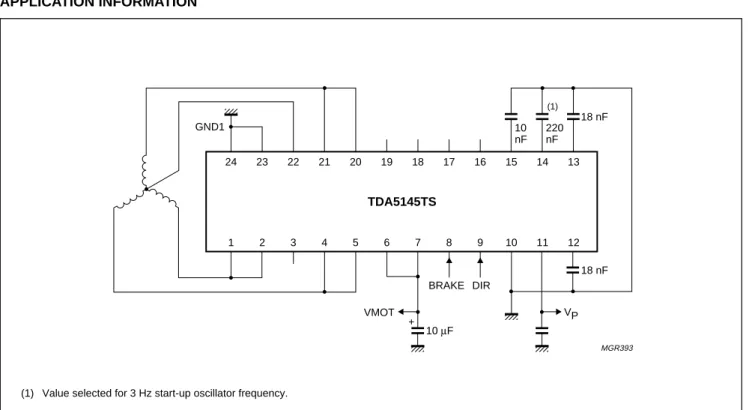
(1) Value selected for 3 Hz start-up oscillator frequency.
Fig.6 Application diagram.
handbook, full pagewidth
MGR393 220 nF 24 GND1 23 22 21 20 19 18 17 16 15 14 13 (1) 18 nF 18 nF 10 µF VMOT VP 10 nF 1 2 3 4 5 6 7 8 9 10 11 BRAKE DIR 12 TDA5145TS
Introduction (see Fig.7)
Full-wave driving of a three phase motor requires three push-pull output stages. In each of the six possible states two outputs are active, one sourcing (H) and one sinking (L). The third output presents a high impedance (Z) to the motor, which enables measurement of the motor back EMF in the corresponding motor coil by the EMF comparator at each output. The commutation logic is responsible for control of the output transistors and selection of the correct EMF comparator. The sequence of the six possible states of the outputs is given in Table 1. The zero-crossing in the motor EMF (detected by the comparator selected by the commutation logic) is used to calculate the correct moment for the next commutation, that is, the change to the next output state. The delay is calculated (depending on the motor loading) by the adaptive commutation delay block.
Because of high inductive loading the output stages contain flyback diodes. The output stages are also protected by a current limiting circuit and by thermal protection of the six output transistors.
Table 1 Output states; note 1
Note
1. H = HIGH state; L = LOW state; Z = high-impedance OFF-state.
The system will only function when the EMF voltage from the motor is present. Therefore, a start oscillator is provided that will generate commutation pulses when no zero-crossings in the motor voltage are available. A timing function is incorporated into the device for internal timing and for timing of the reverse rotation detection.
STATE MOT1 MOT2 MOT3
1 Z L H 2 H L Z 3 H Z L 4 Z H L 5 L H Z 6 L Z H
The TDA5145TS is designed for systems with low current consumption: use of I2L logic, adaptive base drive for the output transistors (patented).
Adjustments
The system has been designed in such a way that the tolerances of the application components are not critical. However, the approximate values of the following components must still be determined:
• The start capacitor; this determines the frequency of the start oscillator.
• The two capacitors in the adaptive commutation delay circuit; these are important in determining the optimum moment for commutation, depending on the type and loading of the motor.
• The timing capacitor; this provides the system with its timing signals.
THE START CAPACITOR(CAP-ST)
This capacitor determines the frequency of the start oscillator. It is charged and discharged, with a current of 2µA, from 0.05 to 2.2 V and back to 0.05 V. The time taken to complete one cycle is given by:
tstart= (2.15×C) s (with C inµF)
The start oscillator is reset by a commutation pulse and so is only active when the system is in the start-up mode. A pulse from the start oscillator will cause the outputs to change to the next state (torque in the motor). If the movement of the motor generates enough EMF the TDA5145TS will run the motor. If the amount of EMF generated is insufficient, then the motor will move one step only and will oscillate in its new position. The amplitude of the oscillation must decrease sufficiently before the arrival of the next start pulse, to prevent the pulse arriving during the wrong phase of the oscillation. The oscillation of the motor is given by:
where:
Kt= torque constant (N.m/A) I = current (A)
p = number of magnetic pole-pairs J = inertia J (kg.m2)
Example: J = 72×10−6kg.m2, K
t= 25×10−3N.m/A, p = 6 and I = 0.5 A; this gives fosc= 5 Hz.
fosc 1 2π Kt×I×p J --- ---=
If the damping is high then a start frequency of 2 Hz can be chosen or t = 500 ms, thus C = 0.5/2 = 0.25µF
(choose 220 nF).
THE ADAPTIVE COMMUTATION DELAY(CAP-CDAND
CAP-DC)
In this circuit, capacitor CAP-CD is charged during one commutation period, with an interruption of the charging current during the diode pulse. During the next
commutation period this capacitor (CAP-CD) is discharged at twice the charging current. The charging current is 8.1µA and the discharging current 16.2µA; the voltage range is from 0.9 to 2.2 V. The voltage must stay within this range at the lowest commutation frequency of interest, fC1:
(C in nF)
If the frequency is lower, then a constant commutation delay after the zero-crossing is generated by the discharge from 2.2 to 0.9 V at 16.2µA; maximum
delay = (0.076×C) ms (with C in nF)
Example: nominal commutation frequency = 900 Hz and the lowest usable frequency = 400 Hz; thus:
(choose 18 nF)
The other capacitor, CAP-DC, is used to repeat the same delay by charging and discharging with 15.5µA. The same value can be chosen as for CAP-CD. Figure 8 illustrates typical voltage waveforms.
C 8.1 10 6 – × f×1.3 --- 6231 fC1 ---= = CAP-CD 6231 400 --- 15.6 = =
Fig.7 Typical application of the TDA5145TS as a scanner driver.
handbook, full pagewidth
MGR394 D D TP TN TN 22 20, 21 4, 5 1, 2 EMF COMPARATORS D D TP TN TN D D TP 8 13 12 3 15 10 14 TN TEST TN START-UP OSCILLATOR BRAKE GND1 DIR TDA5145TS 18 6, 7 23, 24 RESET
BRAKE RESET VMOT
DIRECTION CONTROL GND2 VP THERMAL PROTECTION TIMING ADAPTIVE COMMUNICATION DELAY COMMUNICATION LOGIC MOTOR 11 9 220 nF 18 nF 18 nF 10 nF
Fig.8 CAP-CD and CAP-DC typical voltage waveforms in normal running mode.
handbook, full pagewidth
MGH317 voltage on CAP-CD voltage on CAP-DC t
THE TIMING CAPACITOR(CAP-TI)
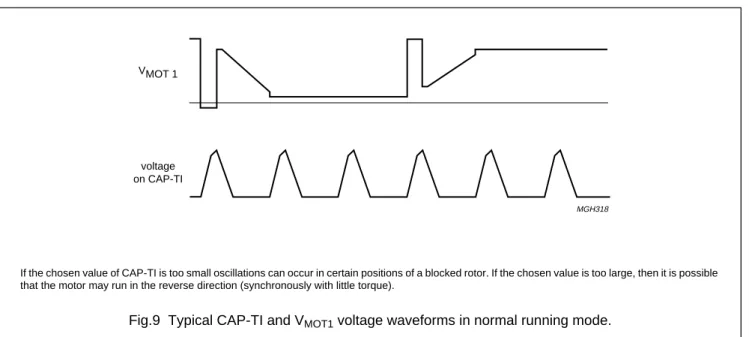
Capacitor CAP-TI is used for timing the successive steps within one commutation period; these steps include some internal delays.
The most important function is the watchdog time in which the motor EMF has to recover from a negative diode pulse back to a positive EMF voltage (or vice versa). A watchdog timer is a guarding function that only becomes active when the expected event does not occur within a predetermined time.
The EMF usually recovers within a short time if the motor is running normally (<<ms). However, if the motor is motionless or rotating in the reverse direction, then the time can be longer (>>ms).
A watchdog time must be chosen so that it is long enough for a motor without EMF (still) and eddy currents that may stretch the voltage in a motor winding; however, it must be short enough to detect reverse rotation. If the watchdog time is made too long, then the motor may run in the wrong direction (with little torque).
The capacitor is charged with a current of 57µA, from 0.2 to 0.3 V. Above this level it is charged with a current of 5µA, up to 2.2 V only if the selected motor EMF remains in the wrong polarity (watchdog function). At the end, or, if the motor voltage becomes positive, the capacitor is discharged with a current of 28µA. The watchdog time is the time taken to charge the capacitor with a current of 5µA, from 0.3 to 2.2 V.
To ensure that the internal delays are covered CAP-TI must have a minimum value of 2 nF. For the watchdog function a value of 10 nF for CAP-TI is recommended. To ensure a good start-up and commutation, care must be taken that no oscillations occur at the trailing edge of the flyback pulse. Snubber networks at the outputs should be critically damped.
Fig.9 Typical CAP-TI and VMOT1 voltage waveforms in normal running mode.
If the chosen value of CAP-TI is too small oscillations can occur in certain positions of a blocked rotor. If the chosen value is too large, then it is possible that the motor may run in the reverse direction (synchronously with little torque).
handbook, full pagewidth
MGH318
VMOT 1
voltage on CAP-TI
Other design aspects
There are other design aspects concerning the application of the TDA5145TS besides the commutation function. They are:
• Direction function • Brake function • Reliability. DIRECTION FUNCTION
If the voltage at pin 9 is less than 0.8 V, the motor is running in one direction (depending on the motor connections). If the voltage at pin 9 is greater than 2.0 V, the motor is running in the opposite direction.
BRAKEFUNCTION
If the voltage at pin 8 is greater than 2.0 V, the motor brakes. In that condition, the 3 outputs MOT1, MOT2 and MOT3 are forced to a LOW voltage level and the current limitation is performed internally by the sink drivers.
RESETFUNCTION
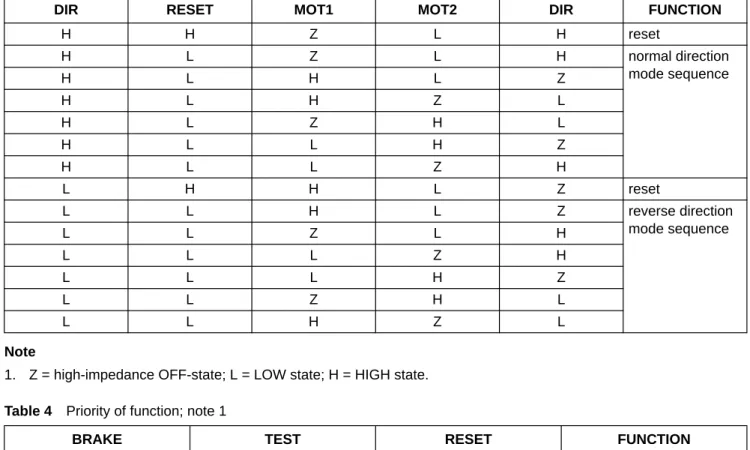
If the voltage at pin 18 is greater than 2.0 V, the output states are shown in Table 2.
Table 2 Output states if VRESET> 2.0 V
Note
1. Z = high-impedance OFF-state; L = LOW state; H = HIGH state.
DRIVER OUTPUT STATE(1)
MOT1 Z
MOT2 L
Table 3 Switching sequence after a reset pulse; note 1
Note
1. Z = high-impedance OFF-state; L = LOW state; H = HIGH state.
Table 4 Priority of function; note 1
Note
1. L = LOW state; H = HIGH state.
RELIABILITY
It is necessary to protect high current circuits and the output stages are protected in two ways:
• Current limiting of the ‘lower’ output transistors. The ‘upper’ output transistors use the same base current as the conducting ‘lower’ transistor (+15%). This means that the current to and from the output stages is limited.
• Thermal protection of the six output transistors is achieved by each transistor having a thermal sensor that is active when the transistor is switched on. The transistors are switched off when the ambient temperature becomes too high.
DIR RESET MOT1 MOT2 DIR FUNCTION
H H Z L H reset H L Z L H normal direction mode sequence H L H L Z H L H Z L H L Z H L H L L H Z H L L Z H L H H L Z reset L L H L Z reverse direction mode sequence L L Z L H L L L Z H L L L H Z L L Z H L L L H Z L
BRAKE TEST RESET FUNCTION
L L L normal L L H reset L H L test L H H test H L L brake H L H brake H H L brake H H H brake
PACKAGE OUTLINE UNIT A1 A2 A3 bp c D(1) E(1) e HE L Lp Q v w y Z(1) θ REFERENCES OUTLINE VERSION EUROPEAN
PROJECTION ISSUE DATE
IEC JEDEC EIAJ
mm 0.21 0.05 1.80 1.65 0.38 0.25 0.20 0.09 8.4 8.0 5.4 5.2 0.65 1.25 7.9 7.6 0.9 0.7 0.8 0.4 8 0 o o 0.13 0.1 0.2
DIMENSIONS (mm are the original dimensions)
Note
1. Plastic or metal protrusions of 0.20 mm maximum per side are not included.
1.03 0.63 X w M θ A A1 A2 bp D HE Lp Q detail X E Z e c L v M A (A )3 A 1 12 24 13 0.25 y pin 1 index 0 2.5 5 mm scale
SSOP24: plastic shrink small outline package; 24 leads; body width 5.3 mm SOT340-1
A max.
SOLDERING Introduction
There is no soldering method that is ideal for all IC packages. Wave soldering is often preferred when through-hole and surface mounted components are mixed on one printed-circuit board. However, wave soldering is not always suitable for surface mounted ICs, or for printed-circuits with high population densities. In these situations reflow soldering is often used.
This text gives a very brief insight to a complex technology. A more in-depth account of soldering ICs can be found in our“Data Handbook IC26; Integrated Circuit Packages” (order code 9398 652 90011).
Reflow soldering
Reflow soldering techniques are suitable for all SSOP packages.
Reflow soldering requires solder paste (a suspension of fine solder particles, flux and binding agent) to be applied to the printed-circuit board by screen printing, stencilling or pressure-syringe dispensing before package placement. Several techniques exist for reflowing; for example, thermal conduction by heated belt. Dwell times vary between 50 and 300 seconds depending on heating method. Typical reflow temperatures range from 215 to 250°C.
Preheating is necessary to dry the paste and evaporate the binding agent. Preheating duration: 45 minutes at 45°C.
Wave soldering
Wave soldering is not recommended for SSOP packages. This is because of the likelihood of solder bridging due to closely-spaced leads and the possibility of incomplete solder penetration in multi-lead devices.
If wave soldering cannot be avoided, the following conditions must be observed:
• A double-wave (a turbulent wave with high upward
pressure followed by a smooth laminar wave) soldering technique should be used.
• The longitudinal axis of the package footprint must
be parallel to the solder flow and must incorporate solder thieves at the downstream end.
Even with these conditions, only consider wave soldering SSOP packages that have a body width of 4.4 mm, that is SSOP16 (SOT369-1) or
SSOP20 (SOT266-1).
During placement and before soldering, the package must be fixed with a droplet of adhesive. The adhesive can be applied by screen printing, pin transfer or syringe dispensing. The package can be soldered after the adhesive is cured.
Maximum permissible solder temperature is 260°C, and maximum duration of package immersion in solder is 10 seconds, if cooled to less than 150°C within 6 seconds. Typical dwell time is 4 seconds at 250°C. A mildly-activated flux will eliminate the need for removal of corrosive residues in most applications.
Repairing soldered joints
Fix the component by first soldering two diagonally-opposite end leads. Use only a low voltage soldering iron (less than 24 V) applied to the flat part of the lead. Contact time must be limited to 10 seconds at up to 300°C. When using a dedicated tool, all other leads can be soldered in one operation within 2 to 5 seconds between
DEFINITIONS
LIFE SUPPORT APPLICATIONS
These products are not designed for use in life support appliances, devices, or systems where malfunction of these products can reasonably be expected to result in personal injury. Philips customers using or selling these products for use in such applications do so at their own risk and agree to fully indemnify Philips for any damages resulting from such improper use or sale.
Data sheet status
Objective specification This data sheet contains target or goal specifications for product development. Preliminary specification This data sheet contains preliminary data; supplementary data may be published later. Product specification This data sheet contains final product specifications.
Limiting values
Limiting values given are in accordance with the Absolute Maximum Rating System (IEC 134). Stress above one or more of the limiting values may cause permanent damage to the device. These are stress ratings only and operation of the device at these or at any other conditions above those given in the Characteristics sections of the specification is not implied. Exposure to limiting values for extended periods may affect device reliability.
Application information
Internet: http://www.semiconductors.philips.com
© Philips Electronics N.V. 1998 SCA60
All rights are reserved. Reproduction in whole or in part is prohibited without the prior written consent of the copyright owner.
The information presented in this document does not form part of any quotation or contract, is believed to be accurate and reliable and may be changed without notice. No liability will be accepted by the publisher for any consequence of its use. Publication thereof does not convey nor imply any license under patent- or other industrial or intellectual property rights.
New Zealand: 2 Wagener Place, C.P.O. Box 1041, AUCKLAND,
Tel. +64 9 849 4160, Fax. +64 9 849 7811
Norway: Box 1, Manglerud 0612, OSLO,
Tel. +47 22 74 8000, Fax. +47 22 74 8341
Pakistan: see Singapore
Philippines: Philips Semiconductors Philippines Inc.,
106 Valero St. Salcedo Village, P.O. Box 2108 MCC, MAKATI, Metro MANILA, Tel. +63 2 816 6380, Fax. +63 2 817 3474
Poland: Ul. Lukiska 10, PL 04-123 WARSZAWA,
Tel. +48 22 612 2831, Fax. +48 22 612 2327
Portugal: see Spain Romania: see Italy
Russia: Philips Russia, Ul. Usatcheva 35A, 119048 MOSCOW,
Tel. +7 095 755 6918, Fax. +7 095 755 6919
Singapore: Lorong 1, Toa Payoh, SINGAPORE 319762,
Tel. +65 350 2538, Fax. +65 251 6500
Slovakia: see Austria Slovenia: see Italy
South Africa: S.A. PHILIPS Pty Ltd., 195-215 Main Road Martindale,
2092 JOHANNESBURG, P.O. Box 7430 Johannesburg 2000, Tel. +27 11 470 5911, Fax. +27 11 470 5494
South America: Al. Vicente Pinzon, 173, 6th floor,
04547-130 SÃO PAULO, SP, Brazil, Tel. +55 11 821 2333, Fax. +55 11 821 2382
Spain: Balmes 22, 08007 BARCELONA,
Tel. +34 93 301 6312, Fax. +34 93 301 4107
Sweden: Kottbygatan 7, Akalla, S-16485 STOCKHOLM,
Tel. +46 8 5985 2000, Fax. +46 8 5985 2745
Switzerland: Allmendstrasse 140, CH-8027 ZÜRICH,
Tel. +41 1 488 2741 Fax. +41 1 488 3263
Taiwan: Philips Semiconductors, 6F, No. 96, Chien Kuo N. Rd., Sec. 1,
TAIPEI, Taiwan Tel. +886 2 2134 2865, Fax. +886 2 2134 2874
Thailand: PHILIPS ELECTRONICS (THAILAND) Ltd.,
209/2 Sanpavuth-Bangna Road Prakanong, BANGKOK 10260, Tel. +66 2 745 4090, Fax. +66 2 398 0793
Turkey: Talatpasa Cad. No. 5, 80640 GÜLTEPE/ISTANBUL,
Tel. +90 212 279 2770, Fax. +90 212 282 6707
Ukraine: PHILIPS UKRAINE, 4 Patrice Lumumba str., Building B, Floor 7,
252042 KIEV, Tel. +380 44 264 2776, Fax. +380 44 268 0461
United Kingdom: Philips Semiconductors Ltd., 276 Bath Road, Hayes,
MIDDLESEX UB3 5BX, Tel. +44 181 730 5000, Fax. +44 181 754 8421
United States: 811 East Arques Avenue, SUNNYVALE, CA 94088-3409,
Tel. +1 800 234 7381
Uruguay: see South America Vietnam: see Singapore
Yugoslavia: PHILIPS, Trg N. Pasica 5/v, 11000 BEOGRAD,
Tel. +381 11 625 344, Fax.+381 11 635 777
For all other countries apply to: Philips Semiconductors,
International Marketing & Sales Communications, Building BE-p, P.O. Box 218, 5600 MD EINDHOVEN, The Netherlands, Fax. +31 40 27 24825
Austria: Computerstr. 6, A-1101 WIEN, P.O. Box 213, Tel. +43 160 1010,
Fax. +43 160 101 1210
Belarus: Hotel Minsk Business Center, Bld. 3, r. 1211, Volodarski Str. 6,
220050 MINSK, Tel. +375 172 200 733, Fax. +375 172 200 773
Belgium: see The Netherlands Brazil: see South America
Bulgaria: Philips Bulgaria Ltd., Energoproject, 15th floor,
51 James Bourchier Blvd., 1407 SOFIA, Tel. +359 2 689 211, Fax. +359 2 689 102
Canada: PHILIPS SEMICONDUCTORS/COMPONENTS,
Tel. +1 800 234 7381
China/Hong Kong: 501 Hong Kong Industrial Technology Centre,
72 Tat Chee Avenue, Kowloon Tong, HONG KONG, Tel. +852 2319 7888, Fax. +852 2319 7700
Colombia: see South America Czech Republic: see Austria
Denmark: Prags Boulevard 80, PB 1919, DK-2300 COPENHAGEN S,
Tel. +45 32 88 2636, Fax. +45 31 57 0044
Finland: Sinikalliontie 3, FIN-02630 ESPOO,
Tel. +358 9 615800, Fax. +358 9 61580920
France: 51 Rue Carnot, BP317, 92156 SURESNES Cedex,
Tel. +33 1 40 99 6161, Fax. +33 1 40 99 6427
Germany: Hammerbrookstraße 69, D-20097 HAMBURG,
Tel. +49 40 23 53 60, Fax. +49 40 23 536 300
Greece: No. 15, 25th March Street, GR 17778 TAVROS/ATHENS,
Tel. +30 1 4894 339/239, Fax. +30 1 4814 240
Hungary: see Austria
India: Philips INDIA Ltd, Band Box Building, 2nd floor,
254-D, Dr. Annie Besant Road, Worli, MUMBAI 400 025, Tel. +91 22 493 8541, Fax. +91 22 493 0966
Indonesia: PT Philips Development Corporation, Semiconductors Division,
Gedung Philips, Jl. Buncit Raya Kav.99-100, JAKARTA 12510, Tel. +62 21 794 0040 ext. 2501, Fax. +62 21 794 0080
Ireland: Newstead, Clonskeagh, DUBLIN 14,
Tel. +353 1 7640 000, Fax. +353 1 7640 200
Israel: RAPAC Electronics, 7 Kehilat Saloniki St, PO Box 18053,
TEL AVIV 61180, Tel. +972 3 645 0444, Fax. +972 3 649 1007
Italy: PHILIPS SEMICONDUCTORS, Piazza IV Novembre 3,
20124 MILANO, Tel. +39 2 6752 2531, Fax. +39 2 6752 2557
Japan: Philips Bldg 13-37, Kohnan 2-chome, Minato-ku,
TOKYO 108-8507, Tel. +81 3 3740 5130, Fax. +81 3 3740 5077
Korea: Philips House, 260-199 Itaewon-dong, Yongsan-ku, SEOUL,
Tel. +82 2 709 1412, Fax. +82 2 709 1415
Malaysia: No. 76 Jalan Universiti, 46200 PETALING JAYA, SELANGOR,
Tel. +60 3 750 5214, Fax. +60 3 757 4880
Mexico: 5900 Gateway East, Suite 200, EL PASO, TEXAS 79905,
Tel. +9-5 800 234 7381