Combining Theorem Proving with Static Analysis for
Data Structure Consistency
Karen Zee, Patrick Lam, Viktor Kuncak, and Martin Rinard Computer Science and Artificial Intelligence Laboratory
Massachusetts Institute of Technology Cambridge, MA 02139, USA
{kkz,plam,vkuncak,rinard}@csail.mit.edu
Abstract
We describe an approach for combining theorem proving techniques with static analysis to analyze data structure consistency for programs that ma-nipulate heterogeneous data structures. Our sys-tem uses interactive theorem proving and shape analysis to verify that data structure implementa-tions conform to set interfaces. A simpler static analysis then uses the verified set interfaces to ver-ify properties that characterize how shared objects participate in multiple data structures. We have successfully applied this technique to several pro-grams and found that theorem proving within cir-cumscribed regions of the program combined with static analysis enables the verification of large-scale program properties.
1 Introduction
A data structure is consistent if it satisfies the in-variants necessary for the normal operation of the program. Data structure consistency is important for successful program execution—if an error cor-rupts a program’s data structures, the program can quickly exhibit unacceptable behavior and may crash. Motivated by the importance of this prob-lem, researchers have developed algorithms for ver-ifying that programs preserve important consis-tency properties [2, 10, 12, 27, 33, 35].
∗This research was supported in part by the
Singapore-MIT Alliance, DARPA award FA8750-04-2-0254, and NSF grants CCR00-86154, CCR00-63513, CCR00-73513, CCR-0209075, CCR-0341620, and CCR-0325283.
Ensuring data structure consistency in general is a very difficult problem, because each class of data structures potentially requires reasoning tech-niques specific to that class. As a result, systems for reasoning about data structure consistency face a perpetual tradeoff between generality and au-tomation.
On the one hand, static analysis techniques have proven to be successful in achieving high levels of automation for verifying the consistency of some important classes of data structures such as linked lists, trees, and graphs [12, 14, 27, 33]. Unfortu-nately, while effective for data structures within their targeted class, these tools are necessarily ei-ther incomplete or unsound for many oei-ther data structures. Data structure diversity presents a real problem for verifying data structure consistency of non-trivial applications, which typically contain a range of different kinds of data structures.
On the other hand, theorem proving techniques can in principle verify arbitrarily complicated con-sistency properties; this statement especially ap-plies to interactive theorem provers such as Is-abelle [31] and Athena [1] that allow writing general mathematical statements about program state. The difficulty in using theorem proving tools is that their application may require manual effort and familiarity with their behavior. Because man-ual effort is expensive, theorem proving is effective only if it is focused on relevant parts of a program; the assumptions used during theorem proving must be guaranteed by the rest of the program. In this paper we show how our system enables such fo-cused application of theorem proving.
The Hob project. Our Hob project [21–25] ad-dresses the difficulties of verifying programs with heterogeneous data structures by applying differ-ent verification techniques to differdiffer-ent regions of the program. Each verification technique is im-plemented in an analysis plugin; the Hob system applies a plugin to the appropriate region of the program to verify that it conforms to its interface. The verified interface information enables the dif-ferent analyses to share information and effectively interoperate. This approach enables us to apply the most expensive analyses, such as interactive theorem proving and shape analysis, to only the most intricate sections of the program, with more automated techniques verifying the rest of the pro-gram.
The Hob system currently contains three anal-ysis plugins: 1) the flags plugin, which analyzes modules that use object flag fields to indicate the typestate of the objects that they manipulate; 2) the PALE plugin, which analyzes linked data struc-tures by interfacing to the PALE tool [27]; and 3) the theorem proving plugin, which verifies arbi-trary data structures specified in higher-order logic using the Isabelle theorem prover [31].
We used Hob to analyze several programs. Our experience shows that Hob can effectively 1) ver-ify the consistency of data structures encapsulated within a module and 2) combine analysis results from different analysis plugins to verify properties involving objects shared by multiple modules ana-lyzed by different analyses.
Theorem proving plugin. The focus of this pa-per is our expa-perience with using the theorem prov-ing plugin in conjunction with other plugins. We identified data structures that implement dynami-cally changing sets as good candidates upon which to focus theorem proving effort. Using the ideas of data refinement [8, 16], we can naturally specify the preconditions and postconditions on such data structures using formulas in the boolean algebra of sets. We can verify once and for all that the data structure implementation conforms to its in-terface; we then use the abstract characterization of data structure operations, represented by their set interfaces, to reason about data structures in
the context of a larger program. In this way, our analysis system hides internal data structure com-plexity from data structure clients, and amortizes the verification effort over all programs that use the data structure.
Our theorem proving plugin generates verifica-tion condiverifica-tions in classical higher-order logic and uses the Isabelle theorem prover [31] to discharge these verification conditions. Using this technique, we verified implementations of a set in terms of a linear array, as well as a partial specification of a priority queue (heap) implemented as a bi-nary search tree stored in an array. We found that many of the verification conditions arising in these examples are discharged automatically us-ing Isabelle’s built-in simplification tactics; other verification conditions require manual intervention. We found the underlying language of the theo-rem prover to be close to the mathematical lan-guage used in informal reasoning and therefore con-venient for formalizing fundamental properties of data structures. In addition to verifying particu-lar data structures, we found the theorem proving plugin to be useful in identifying formal reasoning patterns that can lead to the construction of future specialized and more automated plugins.
Paper structure. The rest of this paper is or-ganized as follows. Section 2 introduces the exam-ple of a process scheduler that manipulates a pri-ority queue data structure and a linked list data structure. Section 3 outlines the key components of the Hob system. Section 4 presents the theo-rem proving plugin, and Section 5 summarizes our static analysis plugins. Section 6 presents our ex-perience in using the theorem proving plugins for verifying consistency of data structures using our system. Section 7 presents related work and Sec-tion 8 presents concluding remarks.
2 Example
We next present an example program that illus-trates how we guarantee data structure consistency properties. Our example program is a process scheduler that maintains a list of running processes and a priority queue of suspended processes. The
wakeUpFirstprocedure selects a process from the priority queue and moves it to the running list; the suspend procedure removes the process from the running list and inserts it back into the queue. Our example contains three modules: the running list module, the priority queue module, and the sched-uler module. The schedsched-uler module invokes proce-dures in the running list and priority queue mod-ules; its analysis therefore harnesses the power of the PALE and theorem prover plugins, while using a less powerful (and hence more scalable) analysis to verify scheduler properties.
2.1 Suspended Queue Module
The priority queue module implements a priority queue of suspended processes using a binary heap [7].
Figure 1 presents the skeleton of the SuspendedQueue implementation module. This module introduces one field into the Process format, namely the p field indicating the priority of each process object. The priority queue con-tains three public procedures and several private procedures. Theinitprocedure creates the back-ing array for the queue. The insert procedure inserts its parameter n as a node into the binary heap with the given priorityp1. The extractMax procedure removes the highest-priority element from the heap. Together with the private helper procedures, these procedures implement a stan-dard priority queue; we omit the implementation details.
Figure 2 presents the specification of the SuspendedQueue module. The specification sum-marizes priority queue procedures in terms of the set InQueue, which is the set of all Process ob-jects stored in the queue: init initializes the set to the empty set; insert(n)inserts object n into the set; and extractMax removes an object from the set and returns it as the result. The specifi-cation of each procedures contains: 1) arequires clause, which specifies the procedure precondition necessary for correct operation of the procedure; 2) amodifiesclause, which lists the abstract compo-nents of the state changed by the procedure; and 3) an ensures clause, which describes the effect of the procedure as a relation between the initial
impl module SuspendedQueue { format Process { p:int; } var c:Process[];
var s:int;
proc init() { ... }
proc insert(n:PQEntry;p1:int) { ... } proc extractMax() returns n:PQEntry { ... } proc isEmpty() returns b:bool { ... } private proc swap(a:int; b:int) { ... } private proc bubbleDown(i:int) { ... } }
Figure 1: Skeleton of the Priority Queue Imple-mentation Module
spec module SuspendedQueue { format Process;
sets InQueue : Process; proc init()
requires true modifies InQueue ensures InQueue’ = {}; proc insert(n:Process; p1:int)
requires not (n in InQueue) modifies InQueue
ensures InQueue’ = InQueue + n; proc isEmpty() returns b:bool
ensures b <=> (InQueue = {}); proc extractMax() returns n:Process
requires InQueue != {} modifies InQueue
ensures (n in InQueue) & (card(n)=1) & (InQueue’ = InQueue - n); }
Figure 2: Priority Queue Specification Module abst module SuspendedQueue {
use plugin "vcgen"; InQueue = { x : Process |
"exists j. 1 <= j & j <= s & x = c[j]"}; invariant "0 <= s";
invariant "forall i. (forall j.
((1 <= i) & (i <= s) & (1 <= j) & (j <= s) & (c[i] = c[j])) --> (i = j))"; }
and the final state of the procedure. The notation InQueue’denotes the new version ofInQueueafter the procedure executes; the unprimedInQueue de-notes the initial version of the variable, before the procedure executes. We use sets with at most one element to describe the values of references: a sin-gleton set{x}indicates a reference to objectx, an empty set ∅indicates a nullreference. The nota-tioncard(n)indicates cardinality, i.e., the number of elements in set n, so card(n)=1 indicates that the variablenis not null.
Figure 3 presents the abstraction module that establishes the connection between the implemen-tation and the specification of the priority queue by defining the set InQueue as the set of all objects
x contained in the array c between indices 1 and
s. Our analysis verifies that the implementation of each procedure 1) preserves the priority queue data structure consistency properties, and 2) has the specified effect on the set InQueue defined by the abstraction function.
The Hob analysis system enables the applica-tion of an appropriate analysis to verify that the priority queue implementation satisfies its specifi-cation. Other modules subsequently use the prior-ity queue specification to reason about the effects of calls to that queue, because all specifications are written in a common specification language. We use the Isabelle theorem prover to show that the priority queue implementation conforms to its specification; Section 6.1 presents our experience in constructing the conformance proof in our system.
2.2 Running List Module
Figure 4 presents the specification module for our scheduler’s list of running processes. The specifica-tion has a single abstract set, InList, which con-tains all of theProcessobjects in the running list. Therequiresclause of the specification of theadd procedure requires the parameterpto not already be inInList. The ensures clause states that ef-fect of theadd procedure is to add the parameter p to InList. The modifies clause indicates that the procedure modifies theInListset only.
The list of running processes is implemented as a linked list; we omit the implementation and ab-straction modules. Our system uses the PALE
plu-spec module RunningList { format Process; sets InList : Process; proc add(p : Process)
requires not (p in InList) modifies InList
ensures InList’ = InList + p; proc remove(p : Process)
requires p in InList modifies InList
ensures InList’ = InList - p; }
Figure 4: Running List Specification Module gin [23] to verify the conformance of the linked list to the set interface in Figure 4.
2.3 Scheduler Module
Figure 5 presents the Scheduler implementation module. This module contributes a status field to Process objects; this field is 1 if the process is suspended and 2 if the processes is running, thus encoding the conceptual state of each process (ei-ther running or suspended) and enabling the mod-ule to quickly determine the status of a process. The implementation of theSchedulermodule uses theRunningListandSuspendedQueuemodules to actually store sets of running and suspended pro-cesses. Section 2.4 explains how Hob uses thescope construct to verify that the set of processes stored in theRunningListandSuspendedQueuemodules coincides with the sets of processes withstatusset to 2 or 1, respectively.
The specification module in Figure 6 declares two abstract sets: the Running set of running processes and the Suspended set of suspended processes. These sets correspond to the con-ceptual states that Process objects can be in. The specifications of the procedures (suspend, hasSuspended, and wakeUpFirst) therefore re-flect the movement of objects between the various states.
The abstraction module in Figure 7 uses the statusflag to define the Running and Suspended sets. The flag plugin [23] uses this abstraction func-tion to verify that the scheduler implementafunc-tion correctly implements its specification. We designed the flag plugin to be scalable and to operate fully
impl module Scheduler {
format Process { status : int; }
proc suspend(p : Process; priority : int) { p.status = 1;
RunningList.remove(p);
SuspendedQueue.insert(p, priority); }
proc hasSuspended() returns b : bool { b = !SuspendedQueue.isEmpty(); } proc wakeUpFirst() { Process p = SuspendedQueue.extractMax(); p.status = 2; RunningList.add(p); } }
Figure 5: Scheduler Implementation Module spec module Scheduler {
format Process;
sets Running, Suspended;
proc suspend(p : Process; priority : int) requires (p in Running) & (card(p)=1) modifies Running, Suspended,
RunningList.InList, SuspendedQueue.InQueue calls RunningList, SuspendedQueue
ensures (Suspended’ = Suspended + p) & (Running’ = Running - p); proc hasSuspended() returns b : boolean
calls SuspendedQueue
ensures b <=> (Suspended!={}); proc wakeUpFirst()
requires Suspended != {} modifies Running, Suspended
RunningList.InList, SuspendedQueue.InQueue calls SuspendedQueue, RunningList
ensures exists p:Process. (p in Suspended) &
(Suspended’ = Suspended - p) & (Running’ = Running + p); }
Figure 6: Scheduler Specification Module abst module Scheduler {
use plugin "flags";
Suspended = {x : Process | "x.status=1"}; Running = {x : Process | "x.status=2"}; }
Figure 7: Scheduler Abstraction Module
automatically; we target it towards modules which coordinate the actions of worker modules.
When verifying the conformance of thesuspend procedure, the flag plugin must take into account the effects of the RunningList.extractMax and SuspendedQueue.insertprocedures, which are lo-cated in modules outside the Scheduler mod-ule. It turns out that the relevant modules, RunningList and SuspendedQueue, are analyzed using entirely different plugins (the PALE plu-gin and the theorem proving pluplu-gin, respectively). Nevertheless, our flag plugin can take into account the effect of these procedures using their specifica-tions, because these specifications are expressed in the common specification language based on sets.
2.4 Scope Invariants
The process scheduler should satisfy several prop-erties that involve data structures in multiple mod-ules. Specifically, theRunning set from the sched-uler module should contain the same objects as the running list, theSuspendedset should contain the same objects as the priority queue, and the Running and Suspendedsets should be disjoint.
Note that these properties are legitimately (but temporarily) violated when the scheduler is run-ning as it assigns the statusflag and calls proce-dures in the running list and priority queue mod-ules. Note also that there must be some mechanism to prevent external modules from calling running list and priority queue procedures directly without going through the scheduler module — such un-coordinated calls could cause the scheduler data structures to fall out of sync with each other, vio-lating the three properties listed above.
We address these issues with analysis scopes; Figure 8 presents the analysis scope for our exam-ple. In general, scopes are a collection of modules and invariants; each scope may have private mod-ules and exported modmod-ules. The purpose of scopes is to specify invariants that involve multiple mod-ules, specify a policy on when the invariants should hold, and control access to module procedures from outside the scope.
Our exampleProcessSchedulerscope contains an invariant with three clauses that together ex-press the set equality and disjointness properties
scope ProcessScheduler {
modules Scheduler, RunningList, SuspendedQueue; exports Scheduler;
invariant
(Scheduler.Running = RunningList.InList) & (Scheduler.Suspended = SuspendedQueue.InQueue) & disjoint(Scheduler.Running, Scheduler.Suspended); }
Figure 8: Scope Declarations
discussed above. It also identifies a list of mod-ules within which the invariant may be violated (these include the Scheduler, RunningList, and SuspendedQueue modules). Finally, it exports only the Scheduler module, indicating that the RunningList and SuspendedQueue modules can be called only from within the other modules in the scope. Schedulerprocedures, on the other hand, can be invoked from outside the scope. The flag analysis of theSchedulermodule assumes that the invariant holds at the start of each procedure and must show that it holds at the exit of the proce-dure.
Note that the flag analysis uses the specifica-tions of the SuspendedQueue and RunningList modules (which are expressed in terms of abstract sets) to verify the invariant. By encapsulating the complexity of the internal data structure properties inside the relevant modules, our technique enables the use of expensive analyses in those modules that require them, while allowing the use of simpler and faster analyses in the remainder of the program.
3 The Hob Analysis System
We next discuss the basic strategy that we ex-pect analysis plugins to implement, and discuss the tasks that they must perform to verify that each implementation section correctly implements its specification. In general, an analysis plugin must ensure that the implementation of a module conforms to its specification, and that any calls originating in the module it is analyzing satisfy their preconditions.
3.1 Implementation Language
Implementation sections for modules in our system are written in a standard memory-safe imperative
language supporting arrays and the dynamic allo-cation of objects.1 Analysis plugins use our sys-tem’s core libraries to easily manipulate abstract syntax trees for this imperative language. Using these libraries, we have implemented an interpreter for our language; it would also be straightforward to write a compiler.
We point out one special feature of our imper-ative language, which we call formats. Formats aid modular reasoning about shared objects by en-capsulating fields while allowing modules to share objects. When the program creates an object with format T, the newly-created object contains the fields contributed to format T by all modules in the program [6]. A simple type checker for the im-plementation language statically ensures that each module accesses only fields that it has contributed to an object. Note that no analysis plugin needs the full layout of an object; it will only need the fields which the module under analysis has con-tributed to that object.
The implementation language supports (but does not require) assertions and loop invariants, which enable fine-grained communication with the analysis plugin. The syntax of assertions is specific to the analysis plugin used to analyze the module. Assertions are ignored by the implementation lan-guage interpreter; once statically verified, they do not affect the run-time behavior of the program.
3.2 Specification Language
Figure 9 presents the syntax for the module spec-ification language. A specification section con-tains a list of set definitions and procedure spec-ifications, and lists the names of formats used in set definitions and procedure specifications. Set declarations identify the module’s abstract sets, while boolean variable declarations identify the module’s abstract boolean variables. Each proce-dure specification contains arequires,modifies, and ensures clause. Themodifies clause identi-fies sets whose membership may change as a re-sult of executing the procedure. The requires 1A formal context-free grammar for our language can be downloaded from our publicly-readable Subversion source code repository at http://plam.csail.mit.edu/svn/ repos/trunk/module-language/formatlanguage.sablecc.
M ::= spec modulem{F∗D∗I∗P V∗P∗} F ::= formatt∗; P V ::= predvarb∗; I ::= invariantB; D ::= setsS∗:t; P ::= procpn(p1:t1, . . . , pn:tn)[returnsr:t] [requiresB] [modifiesS∗] [callsm∗] ensuresB
B ::= SE1=SE2|SE1⊆SE2|pinSE | B∧B|B∨B| ¬B| ∃S.B|card(SE)=k
SE ::= ∅ |[m.]S |[m.]S′
| SE1∪SE2|SE1∩SE2|SE1\SE2
Figure 9: Syntax of Module Specification Lan-guage
clause identifies the precondition that the proce-dure requires to execute correctly; the ensures clauses identifies the postcondition that the pro-cedure ensures when called in program states that satisfy the requires condition. Both requires and ensures clauses use arbitrary first-order for-mulas B in the language of boolean algebras ex-tended with cardinality constraints. Specification sections may also contain invariants in the same language; these invariants are automatically con-joined withrequiresand ensuresclauses of pro-cedures in that module. Free variables of these for-mulas denote abstract sets declared in specification sections. The expressive power of such formulas is the first-order theory of boolean algebras, which is decidable [19, 26]. The decidability of the specifi-cation language ensures that analysis plugins can precisely propagate the specified relations between the abstract sets.
3.3 Analysis Overview
The analysis of a module M is performed by the analysis plugin specified in the abstraction section of module M. The abstraction section of module
M establishes the connection between the specifi-cation and implementation sections of moduleM. Each analysis plugin augments the generic syntax of abstraction sections with a plugin-specificplugin annotation language. The plugin annotation lan-guage is used to define the mapping between the concrete and abstract representations of sets. The
abstraction section of moduleM may additionally state representation invariants for the data struc-ture implementing the abstract sets. The respon-sibility of each plugin is to guarantee that each procedure satisfies its specification; it may do so by any means practical. The specification of a procedure is derived from the abstract requires, modifies, and ensures clauses using the defini-tions of abstract sets as well as the representation invariants [21]. We also require that a procedure never violate the preconditions of its callees.
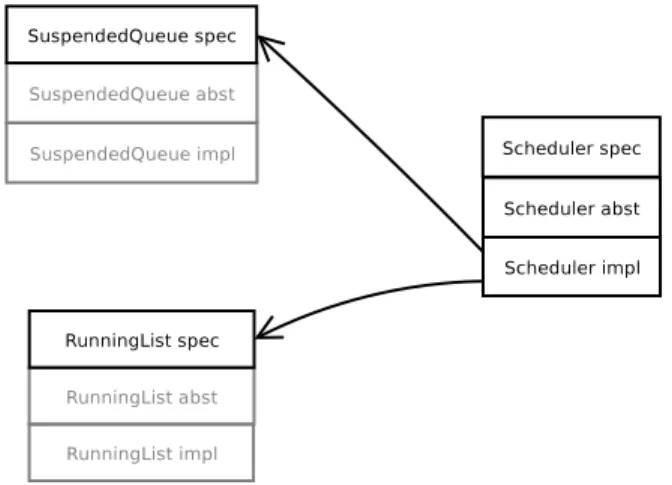
Figure 10 illustrates our analysis of the Scheduler module from our example: to ensure that Scheduler meets its specification, the flag plugin needs to read the implementation, abstrac-tion and specificaabstrac-tion secabstrac-tions of the Scheduler module and only the specifications from the SuspendedQueueand RunningListmodules.
We have implemented three plugins in our anal-ysis framework: a flags plugin, which assigns set membership based on field values, a PALE plu-gin, which assigns set membership based on heap reachability, and a theorem proving plugin, which can use theorem proving techniques to verify ar-bitrary implementations of sets. In Section 4 we describe the theorem proving plugin at the core of this paper; in Section 5 we briefly discuss the other two plugins in our system.
Figure 10: Checking process scheduler implemen-tation
4 The Theorem Proving Plugin
The theorem proving plugin generates verification conditions using weakest precondition computa-tion and discharges them using the Isabelle the-orem prover. This technique is applicable for veri-fying arbitrarily complicated data structure imple-mentations. The logic for specifying abstraction functions is based on classical higher-order logic and proof obligations can be discharged using au-tomated theorem proving or a proof checker for manually generated proofs. As a result, there is no a priori bound on the complexity of the data structures (and data structure consistency prop-erties) that can be verified. In our current imple-mentation we have explored this technique for data structures that implement sets by storing objects in global arrays. For example, we have verified the operations on abstract setContentgiven by an ab-straction function
Content={x|∃j.0≤j∧j < s∧x6=null∧x=d[j]} where d is a global array of objects and s is an integer variable indicating the currently used part of the array (see Section 6).
Our theorem proving plugin analyzes each pro-cedure independently, showing that it conforms to its specification using the following phases:
1. Concretization: Conjoin each postcondition with the frame condition derived from modi-fies clauses. Apply the definitions of sets from the abstraction section to preconditions and postconditions in the specification sections, as well as loop invariants and assertions. The results are conditions expressed in terms of the concrete data structure state. For exam-ple, the postcondition Content′ =Content−e translates into the formula
{x| ∃j.0≤j∧j < s′ ∧ x6=null∧x=d′[j]}=
{x| ∃j.0≤j∧j < s ∧ x=6 null∧x=d[j]} − {e}
2. Representation invariants: Conjoin both pre-condition and postpre-condition with representa-tion invariants specified in the abstracrepresenta-tion sec-tion. In our example we need a representation invariant 0≤s.
3. Statement desugaring: translate statements into a loop-free guarded command language (e.g. [13]).
4. Verification condition generation: using weak-est precondition semantics, create the formula whose validity implies the conformance of the procedure with respect to its specification. 5. Separation: Separate the verification
condi-tion into as many conjuncts as possible by per-forming a simple non-backtracking natural-deduction search through connectives ∀, ⇒, ∧.
6. Verification: Attempt to verify each conjunct in turn. Verify if the conjunct is in the li-brary of proved lemmas; if not, attempt to discharge it using the proof hint supplied in procedure code; if no hint is supplied, invoke the Isabelle’s built-in simplifier and classical reasoner with array axioms.
In our example, most of the generated verification-condition conjuncts are discharged automatically using array axioms. For the remaining conjuncts, the fully automated verification fails and they are printed as “not known to be true”. After interac-tively proving these difficult cases in Isabelle, our system stores these cases in its library of verified lemmas and subsequent verification attempts pass successfully without assistance. Our system com-pares conjuncts against the library of proved lem-mas by comparing abstract syntax trees of formu-las, taking into account some basic properties of logical operations. This enables the reuse of exist-ing lemmas even when the verification conditions have changed slightly.
5 Static Analysis Plugins
This section summarizes two static analysis plug-ins currently available in the Hob analysis system: theflag analysis plugin and thePALE plugin (see the report [23] for additional details). These plug-ins are more automated than the theorem proving plugin, but are limited in the class of modules that they can verify. The flag analysis plugin verifies typestate properties determined by object field val-ues and coordinates the work done by other
mod-ules, whereas the PALE plugin uses the PALE off-the-shelf shape analysis tool to verify consistency properties of linked heap data structures.
The flag analysis plugin verifies that modules implement set specifications in which integer or boolean flags indicate abstract set membership. The developer uses abstraction functions to specify the correspondence between the concrete flag val-ues and the abstract sets from the specification, as well as the correspondence between the concrete and abstract boolean variables. The flag analy-sis plugin then carries out a dataflow analyanaly-sis over boolean formulas for each procedure, updating set contents after procedure calls and flag field mu-tations. The flag plugin uses the MONA decision procedure [18] as well as a range of formula simplifi-cations [23] to perform operations on these boolean formulas.
The PALE analysis plugin [27] implements a shape analysis that can verify detailed properties of complex linked data structures. We incorporated the PALE analysis system into our pluggable anal-ysis framework by 1) using abstraction sections to translate our common set-based specifications into PALE specifications, 2) translating statements into the imperative language accepted by PALE, and 3) translating loop invariants into PALE loop invari-ants.
By combining the PALE plugin with the scal-able flag analysis plugin and the powerful theorem proving plugin, the Hob system can analyze pro-grams that simultaneously use heterogeneous data structures; we report on our experience with Hob in Section 6.
6 Experience
This section presents our experience in using the Hob system to verify non-trivial data structure consistency in two examples. Section 6.1 presents our experience with the process scheduler exam-ple, which we have already introduced in Sec-tion 2. SecSec-tion 6.2 presents our experience with the minesweeper game implementation. In addition to these examples, we ran our analysis on computa-tional patterns from scientific computations, air-traffic control, and program transformation passes with data structures such as singly and doubly
linked lists, trees, set iterators, queues, stacks, and priority queues.2
The examples we present below illustrate the strengths and the typical usage scenarios of the currently available Hob plugins. The theorem proving plugin successfully analyzed sets defined using membership in an array, which requires ab-straction functions that are not expressible in ei-ther of the oei-ther two plugins. The PALE plugin successfully analyzed linked data structures, which are beyond the reach of the flag analysis mod-ule, and which contain heap reachability properties that would likely require many inductive proofs in the theorem proving plugin. Finally, the flag analysis plugin effectively discharged many veri-fication conditions about abstract data structure inclusion, disjointness and equality properties on shared objects, which fall outside the restrictions on the memory model placed by the PALE plugin.
6.1 Process Scheduler and the Priority Queue
Our process scheduler example introduced in Sec-tion 2 uses a priority queue implemented as a bi-nary heap [7]. Recall the implementation (Fig-ure 1), specification (Fig(Fig-ure 2), and abstraction (Figure 3) modules of the priority queue data structure.
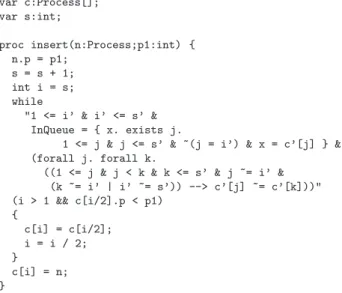
We illustrate the verification of the priority queue through the example of the insert operation in Figure 11. Our theorem proving plugin uses the abstraction function in Figure 3 to concretize the specifications in Figure 2, which are expressed in terms of sets. The plugin conjoins the result-ing concrete preconditions and postconditions with the data structure representation invariants in Fig-ure 3, and uses them along with the loop invariant to generate a guarded command language state-ment.
Computing the weakest precondition of the re-sulting guarded command statement yields a veri-fication condition, which our system splits into 11 conjuncts. Out of these conjuncts, Isabelle dis-charges 5 automatically. We proved the remaining 2Full source code for the Hob implementation, example programs, and our revision control repository are available fromhttp://cag.csail.mit.edu/∼plam/mpa.
6 conjuncts by hand. We found the proofs to be mostly straightforward, given an intuitive under-standing of how the insert operation works. Most of the manual intervention involved specifying the appropriate case splits. Several verification con-dition conjuncts required showing the equality of set expressions containing set comprehensions. We used the built-in Isabelle tactic (auto) to reduce such expressions to quantifier-free formulas involv-ing array accesses that are discharged usinvolv-ing simpli-fication with array axioms. In some cases, it was necessary to indicate instantiations of existential quantifiers in the goal. The proofs also required some basic properties of integer arithmetic such as monotonicity of integer division.
In the verification process we discovered a bor-derline behavior of the bubbleDown procedure on queues containing one element, where the proce-dure is called on a non-existing element. By ruling out such boundary cases by an appropriate pre-condition, we simplified the reasoning about the correctness of bubbleDown and extractMax oper-ations.
We similarly verified several other procedures in the priority queue implementation; we found that the fraction of verification condition conjuncts that must be manually discharged is generally much lower than for the insert procedure.
While the most time-consuming part of the veri-fication was discharging the veriveri-fication conditions, the most challenging aspect was coming up with appropriate loop invariants. (In that respect, it would be useful to consider techniques for auto-mated loop invariant inference that are applica-ble to data structures implemented in an array.) On the other hand, we found it relatively straight-forward to identify data structure representation invariants. Nevertheless, to control the scope of the verification task, it was important to iden-tify which invariants were necessary for proving the conformance of the implementation with re-spect to the set interface. For example, the cor-rectness of theinsertprocedure by itself only re-quires nothing but the simple representation in-variant 0 ≤s. However, verifying the partial cor-rectness of extractMax requires the array injec-tivity invariant stating that all array elements are
distinct; this invariant must then be preserved by insert as well. Note that the heap ordering con-dition is not necessary for verifying conformance with respect to the set interface. Although there is no reason why the heap ordering property could not be verified in the theorem proving plugin, it would require more effort to do so. This example illustrates how partial specifications can be useful in showing important data structure consistency properties while reducing the necessary verification effort.
Another way in which our approach simplifies reasoning about data structures is the use of strong enough preconditions. For example, our imple-mentation maintains an invariant that the set of all elements in the array is distinct, which allows the extractMax operation to ensure that the re-moved element is not contained in the resulting set. To preserve this representation invariant, our im-plementation requires the argument of theinsert procedure not to be contained in the array. While it may appear difficult to ensure such precondition, our scheduler example in Section 2 successfully en-sures precisely this precondition by using a flag field that indicates the membership of an object in the priority queue data structure, and maintaining a global invariant that implies the equality of the set of objects with the particular value of the flag and the set of objects stored in the array. Note that the global invariant is maintained outside the theorem proving plugin, using a more automated flag analysis plugin based on the first-order theory of boolean algebras of sets [23], which illustrates another benefit of the approach of combining anal-yses in the Hob system.
6.2 Minesweeper
As another example, we implemented and verified the popular minesweeper game in our system. Our minesweeper implementation has several modules (see Figure 12): a game board module (which rep-resents the game state), a controller module (which responds to user input), a view module (which pro-duces the game’s output), an exposed cell module (which stores the exposed cells in an array), and an unexposed cell module (which stores the un-exposed cells in an instantiated linked list). We
format Process { p:int; } var c:Process[]; var s:int; proc insert(n:Process;p1:int) { n.p = p1; s = s + 1; int i = s; while
"1 <= i’ & i’ <= s’ & InQueue = { x. exists j.
1 <= j & j <= s’ & ~(j = i’) & x = c’[j] } & (forall j. forall k.
((1 <= j & j < k & k <= s’ & j ~= i’ & (k ~= i’ | i’ ~= s’)) --> c’[j] ~= c’[k]))" (i > 1 && c[i/2].p < p1) { c[i] = c[i/2]; i = i / 2; } c[i] = n; }
Figure 11: Implementation and Loop Invariant for Priority Queue Insertion
created a Modelscope containing the game board and the exposed and unexposed cell modules; this scope encapsulates both the concrete and abstract states of the game board. There are 750 non-blank lines of implementation code in the 6 implemen-tation sections of minesweeper, and 236 non-blank lines in its specification and abstraction sections; the array set accounts for 77 lines of implementa-tion and 35 lines of specificaimplementa-tion.
Figure 12: Modules in Minesweeper implementa-tion
The Hob system verifies that our implementa-tion has the following properties (among others):
• Unless the game is over, the set of mined cells is disjoint from the set of exposed cells. • The sets of exposed and unexposed cells are
disjoint.
• At the end of the game, all cells are revealed; i.e. the set of unexposed cells is empty. • The set of unexposed cells maintained in the
Board module is identical to the set of unex-posed cells maintained in theUnexposedList list.
• The set of exposed cells maintained in the Boardmodule is identical to the set of exposed cells maintained in the ExposedSetarray. Note that the truth of several of these proper-ties depends on information obtained from multiple analysis plugins. Here we focus on theExposedSet module, which implements a set of exposed cells us-ing an array; we checked the validity of this module using the theorem prover plugin.
Array Set Specification and Implementa-tion. Figure 13 is our specification module for the set encapsulated in the Arrayset module. The set interface includes procedures init, add and remove. The initprocedure guarantees that the set is initialized (represented by the setInit boolean predicate) and that the Content set is empty upon successful completion. Theadd proce-dure ensures that theContentset contains the ele-menteafter its execution, while theremove proce-dure ensures that theContentset does not contain e in the post-state. These specifications allow the clients of the array set to reason about the content of the array in terms of the stored elements, with-out worrying abwith-out the complexity of array index dereferencing.
Figure 15 presents the implementation of the array set data structures in terms of a set, using one global array and an integer indicating the used part of the array. Our implementation of the re-move procedure rere-moves all occurrences of the el-ement from the array by replacing them with null values. Figure 14 presents the abstraction module that specifies the connection between the specifi-cation and the implementation: the content of the set is given by all non-null elements stored in the array.
The theorem proving plugin applies the abstrac-tion funcabstrac-tion to map the abstract pre and
post-conditions into concrete pre and postpost-conditions, and conjoins the precondition and the postcondi-tion with the representapostcondi-tion invariant, which states that the size of the array is non-negative. These preconditions and postconditions allow the plugin to generate a verification condition that is split into 18 conjuncts that correspond to showing the validity of the loop invariant and the postcondi-tion. Out of these 18 conjuncts, Isabelle discharges 15 fully automatically using the built-in simplifier. We discharged the three remaining conjuncts using a manually constructed sequence of invocations of Isabelle tactics. We similarly proved the correct-ness of the remaining procedures.
7 Related Work
We survey related work in shape analysis, program checking tools, theorem provers, and combining de-cision procedures.
Shape Analysis. The goal of shape analysis is to verify that programs preserve consistency prop-erties of (potentially-recursive) linked data struc-tures. Researchers have developed many shape analyses and the field remains one of the most ac-tive areas in program analysis today [20, 27, 33]. These analyses focus on extracting or verifying detailed consistency properties of individual data structures. These analyses are very precise on their domain of applicability, but are forced to make con-servative assumptions on programs outside their domain. The Hob framework enables the use of shape analysis techniques in conjunction with the-orem proving techniques: using our framework, the developer can select the most appropriate tech-nique for guaranteeing data structure consistency on a per-module basis.
Program Checking Tools. ESC/Java [12] is a program checking tool whose purpose is to identify common errors in programs using program spec-ifications in a subset of the Java Modelling Lan-guage [4]. ESC/Java sacrifices soundness in that it does not model all details of the program heap, but can detect some common programming errors. Other tools focus on verifying properties of concur-rent programs [3, 5] or device drivers [2, 15]. One important difference between this research and our
spec module Arrayset { format Node;
predvar setInit; sets Content : Node; proc init()
requires true
modifies Content, setInit
ensures setInit’ & card(Content’) = 0; proc add(e:Node)
requires setInit & card(e) = 1 modifies Content
ensures (Content’ = Content + e); proc remove(e:Node)
requires setInit modifies Content
ensures (Content’ = Content - e); proc contains(e:Node) returns b:bool
requires setInit & card(e)=1 ensures b <=> (e in Content); }
Figure 13: Array Set Specification Module abst module Arrayset {
use plugin "vcgen";
Content = { x : Node | "x ~= nullObj &
(exists j. (0 <= j) & (j < s) & x = d[j])"}; predvar setInit;
invariant "0 <= s"; }
Figure 14: Array Set Abstraction Module impl module Arrayset {
format Node {}
var d : Node[]; /* array */ var s : int; /* array size */ var setInit : bool;
...
proc remove(e:Node) { int i = 0;
while "0 <= i’ & i’ <= s &
(forall j. (i’ <= j & j < s) --> d’[j]=d[j]) & ({x. (exists j. 0 <= j & j < i’ & x = d’[j])} = {x. (exists j. 0 <= j & j < i’ & x = d [j])} - e)" (i < s) {
if (d[i] == e) d[i] = null; i = i + 1;
} } }
research is that our research is designed not to develop a single new analysis algorithm or tech-nique, but rather to enable the application of mul-tiple analyses that check arbitrarily complicated data structure consistency properties within a sin-gle program.
Theorem Provers. We use the Isabelle inter-active theorem prover [31] to discharge the verifi-cation conditions generated by our analysis plu-gin. Other interactive theorem provers include Athena [1] and HOL [30]. The ACL2 [17] sys-tem can apply theorem-proving and term rewriting techniques to verify properties of large-scale sys-tems, among them software systems [28].
Combinations of Decidable Theories. One possible alternative to combining analyses is to use a single analysis engine and combine the decision procedures for different properties using Nelson-Oppen techniques [29,32] and their generalizations such as [36–38]. Theorem provers based on these principles include Simplify [9], Verifun [11], and CVC [34]. Our system can take advantage of com-bined decision procedures, but also allows special-ized analyses that use customspecial-ized internal repre-sentations of dataflow facts.
8 Concluding Remarks
In this paper, we presented our Hob analysis sys-tem, focusing on how Hob combines theorem prov-ing techniques with static analysis. Hob guaran-tees data structure consistency in programs that manipulate heterogeneous data structures by ap-plying different verification techniques to different regions of the program. We described our experi-ence in using the theorem proving plugin for ver-ifying array-based data structures. The Hob sys-tem enabled us to prove meaningful data structure properties in the context of a larger program. Note that we did not have to use theorem proving tech-niques for the entire program: Hob’s static analy-sis plugins were able to step in and guarantee data structure consistency for most parts of our example programs.
In verifying data structures using the theorem proving plugin we observed that partial specifica-tions of insert operaspecifica-tions require few data structure
invariants and can be verified without assuming the usual ordering properties inherent to data struc-tures. In contrast, removal from a data structure often requires the invariant that the data structure elements be distinct (if not ordered), and therefore complicates the verification effort. In some cases, object flags can be attached to objects to indicate the membership in data structures, provided that the appropriate global invariants are verified. In other cases, detecting membership requires knowl-edge of ordering properties. Even so, many data structure invariants such as balancing affect only the performance, not the correctness, of data struc-ture operations, which simplifies the verification task.
In the future we expect to add more automation to the theorem proving plugin using Nelson-Oppen decision procedures, [9,34] while exploiting the spe-cial structure of specifications that arise by apply-ing abstraction functions for sets to eliminate sets from verification conditions. We are also working on incorporating additional analysis plugins into Hob, and using further examples to evaluate the ef-fectiveness of our techniques. Furthermore, we are considering the applicability of our system towards more-automatic verification of file system models. We have previously proved file system model cor-rectness exclusively using theorem provers [1], and our experience suggests that the use of Hob would greatly simplify the file system verification task.
References
[1] K. Arkoudas, K. Zee, V. Kuncak, and M. Rinard. Verifying a file system implementation. InSixth International Conference on Formal Engineering
Methods (ICFEM’04), volume 3308 ofLNCS, Seattle,
Nov 8-12, 2004 2004.
[2] T. Ball, R. Majumdar, T. Millstein, and S. K. Rajamani. Automatic predicate abstraction of C programs. InProc. ACM PLDI, 2001.
[3] N. Bjørner, A. Browne, E. Chang, M. Col´on, A. Kapur, Z. Manna, H. B. Sipma, and T. E. Uribe. STeP: Deductive-algorithmic verification of reactive and real-time systems. In8th CAV, volume 1102, pages 415–418, 1996.
[4] L. Burdy, Y. Cheon, D. Cok, M. D. Ernst, J. Kiniry, G. T. Leavens, K. R. M. Leino, and E. Poll. An overview of JML tools and applications. Technical Report NII-R0309, Computing Science Institute, Univ. of Nijmegen, March 2003.
[5] S. Chaki, S. K. Rajamani, and J. Rehof. Types as models: model checking message-passing programs. In
29th ACM SIGPLAN-SIGACT POPL, pages 45–57.
ACM Press, 2002.
[6] D. R. Cheriton and M. E. Wolf. Extensions for multi-module records in conventional programming languages. InProceedings of the 14th ACM SIGACT-SIGPLAN symposium on Principles of
programming languages, pages 296–306. ACM Press,
1987.
[7] T. H. Cormen, C. E. Leiserson, R. L. Rivest, and C. Stein. Introduction to Algorithms (Second Edition). MIT Press and McGraw-Hill, 2001.
[8] W.-P. de Roever and K. Engelhardt. Data
Refinement: Model-oriented proof methods and their
comparison. Cambridge University Press, 1998.
[9] D. Detlefs, G. Nelson, and J. B. Saxe. Simplify: A theorem prover for program checking. Technical Report HPL-2003-148, HP Laboratories Palo Alto, 2003.
[10] D. L. Detlefs, K. R. M. Leino, G. Nelson, and J. B. Saxe. Extended static checking. Technical Report 159, COMPAQ Systems Research Center, 1998. [11] C. Flanagan, R. Joshi, X. Ou, and J. B. Saxe.
Theorem proving using lazy proof explication. In CAV, pages 355–367, 2003.
[12] C. Flanagan, K. R. M. Leino, M. Lilibridge,
G. Nelson, J. B. Saxe, and R. Stata. Extended Static Checking for Java. InProc. ACM PLDI, 2002. [13] C. Flanagan and J. B. Saxe. Avoiding exponential
explosion: Generating compact verification conditions.
InProc. 28th ACM POPL, 2001.
[14] P. Fradet and D. L. M´etayer. Shape types. InProc.
24th ACM POPL, 1997.
[15] T. A. Henzinger, R. Jhala, R. Majumdar, and K. L. McMillan. Abstractions from proofs. In31st POPL, 2004.
[16] H. Jifeng, C. A. R. Hoare, and J. W. Sanders. Data refinement refined. InESOP’86, volume 213 ofLNCS, 1986.
[17] M. Kaufmann, P. Manolios, and J. S. Moore, editors.
Computer-Aided Reasoning: ACL2 Case Studies.
Kluwer Academic Publishers, 2000.
[18] N. Klarlund and A. Møller. MONA Version 1.4 User
Manual. BRICS Notes Series NS-01-1, Department of
Computer Science, University of Aarhus, January 2001.
[19] D. Kozen. Complexity of boolean algebras.
Theoretical Computer Science, 10:221–247, 1980.
[20] V. Kuncak, P. Lam, and M. Rinard. Role analysis. In
Proc. 29th POPL, 2002.
[21] P. Lam, V. Kuncak, and M. Rinard. On modular pluggable analyses using set interfaces. Technical Report 933, MIT CSAIL, December 2003.
[22] P. Lam, V. Kuncak, and M. Rinard. Generalized typestate checking using set interfaces and pluggable analyses. SIGPLAN Notices, 39:46–55, March 2004. [23] P. Lam, V. Kuncak, and M. Rinard. On our
experience with modular pluggable analyses. Technical Report 965, MIT CSAIL, September 2004. [24] P. Lam, V. Kuncak, and M. Rinard. Verifying set
interfaces based on object field values. In6th VMCAI, 2005.
[25] P. Lam, V. Kuncak, K. Zee, and M. Rinard. The Hob project web page.
http://catfish.csail.mit.edu/∼plam/hob/, 2004. [26] L. Loewenheim. ¨Uber m¨ogligkeiten im relativkalk¨ul.
Math. Annalen, 76:228–251, 1915.
[27] A. Møller and M. I. Schwartzbach. The Pointer Assertion Logic Engine. InProc. ACM PLDI, 2001. [28] J. S. Moore. Proving theorems about Java and the
JVM with ACL2, 2002.
[29] G. Nelson. Techniques for program verification. Technical report, XEROX Palo Alto Research Center, 1981.
[30] T. Nipkow, L. C. Paulson, and M. Wenzel. Isabelle/HOL: A Proof Assistant for Higher-Order
Logic, volume 2283 ofLNCS. Springer-Verlag, 2002.
[31] L. C. Paulson. Isabelle: A Generic Theorem Prover. Number 828 in LNCS. Springer-Verlag, 1994.
[32] H. Ruess and N. Shankar. Deconstructing shostak. In
Proc. 16th IEEE LICS, 2001.
[33] M. Sagiv, T. Reps, and R. Wilhelm. Parametric shape analysis via 3-valued logic. ACM TOPLAS,
24(3):217–298, 2002.
[34] A. Stump, C. Barrett, and D. Dill. CVC: a
Cooperating Validity Checker. In14th International
Conference on Computer-Aided Verification, 2002.
[35] G. Yorsh. Logical characterizations of heap abstractions. Master’s thesis, Tel-Aviv University, March 2003.
[36] C. G. Zarba. The Combination Problem in Automated
Reasoning. PhD thesis, Stanford University, 2004.
[37] C. G. Zarba. Combining sets with elements. In N. Dershowitz, editor,Verification: Theory and
Practice, volume 2772 ofLecture Notes in Computer
Science, pages 762–782. Springer, 2004.
[38] C. G. Zarba. A quantifier elimination algorithm for a fragment of set theory involving the cardinality operator. In18th International Workshop on