MANAGING THE FRONT-END OF PROJECTS –
A BIBLIOGRAPHICAL GUIDE
Research fellow Ola Lædre Research fellow Nils Olsson Assistant professor Olav Torp Researcher Ole-Petter Hansen
Professor Knut Samset
Norwegian University of Science and Technology Department of Civil and Transport Engineering
N-7491 TRONDHEIM NORWAY
e-mail: [email protected] Abstract:
This paper focuses on status and trends in the field of front-end management of projects. The front-end of a project is defined as the period from an idea is conceived to the final decision to finance the project is made. It is followed by the detailed planning phase. The purpose of front-end management is to produce thorough and credible project concepts for evaluation before a final decision to finance the project or not is made.
The results presented are based on a review of literature and a state-of-the-art study performed in connection with the research programme Concept, which the Norwegian Ministry of
Finance initiated early in 2001.
Research has shown that efforts in the detailed planning phase pay back in the implementation phase of projects. Unfortunately, it is less known that the largest profit possibilities are
represented by activities in the front-end phase.
Most of the crucial decisions in projects are made in the front-end. In this phase both negative and positive uncertainty is at its highest, and the possibility for making amendments and reducing consequences of potential negative impacts is at its highest.
The paper describes key issues and approaches related to five main stages in front-end management. An overall conclusion is that the field of front-end management still is
neglected in both practice and research. The literature references presented at the end of the paper are of interest for academics and practitioners who want to understand front-end management better.
Keywords:
Introduction
There is a growing understanding of the importance of front-end assessment in projects in fulfilling objectives and ensuring stakeholder satisfaction. This paper focuses on know-how of front-end management as it is described in existing literature. It provides references to key publications that deal with front-end management, and suggests some issues for future research in this field.
The paper is the result of a review of literature and a state-of-the-art study carried out under the research programme “Concept”1. It includes an introductory presentation of terms and definitions, a general description of key issues and approaches related to five main stages in front-end management. The literature references presented at the end of this paper are believed to be of interest for both academics and practitioners in this field.
Methodology
We have done an extensive review of literature combined with a parallel study of state of the art within the field of front-end management. The studied literature was picked out on basis of a search in library databases for journals and other publications, our former experiences and external recommendations. The result is this article, which refers to the literature from the authors we consider to be the most important within the field of front-end management. It is possible that we failed to register articles or books when picking out what we considered to be most significant. We tried to be as thorough as our time allowed us to be. However, the qualitative results from a literature study will always be influenced by subjective perception.
Terms and Definitions
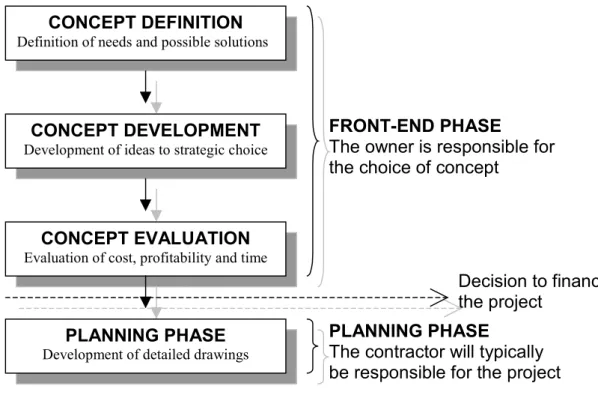
The front-end phase of a project commences when the project idea is conceived - and it ends when the final decision to finance the project is made. The front-end phase represents the initiation of a project.
1 The research programme Concept (www.ivt.ntnu.no/batek/forskning/concept)
The programme was initiated in 2001 by the Norwegian University of Science and Technology. It is an interdisciplinary programme aimed at improving front-end assessments of major public projects, and at generating and disseminating know-how of front-end management of projects in Norway. It is funded by the Norwegian Ministry of Finance with a time-frame of six years and a budget the equivalent to USD 3.5 million. Research is conducted jointly with the University of Oslo, consulting companies and research institutions in Norway and abroad.
Figure 1 The front-end phase precedes the detailed planning phase, which is followed by the project implementation phase.
CONCEPT DEFINITION Definition of needs and possible solutions
CONCEPT DEVELOPMENT Development of ideas to strategic choice
CONCEPT EVALUATION Evaluation of cost, profitability and time
PLANNING PHASE Development of detailed drawings
FRONT-END PHASE
The owner is responsible for the choice of concept
PLANNING PHASE
The contractor will typically be responsible for the project
Decision to finance the project
Front-end management is management of the projects in the front-end phase, and includes front-end assessments. A front-end assessment is an evaluation of the project in its earliest phase. The purpose of front-end assessment is to produce thorough and credible project concepts for evaluation before final decision to finance the project or not is made.
Value Management is a style of management, particularly dedicated to motivating people, developing skills and promoting synergies and innovation with the aim of maximising the overall performance of an organisation (CEN 2000). Various authors frequently stress the importance of value management in projects (Fong and Shen 2000, Thiry 2002). Value Management focus on final satisfaction of all stakeholders in projects, and is applied throughout the whole project period.
A number of research reports conclude that unsatisfactory project results often are caused by insufficient or inadequate use of resources in the front-end phase, and that there is a need for improved project management in public investment projects (Berg 1999, Kharbanda and Pinto 1996, Morris and Hough 1991, Torp 2001).
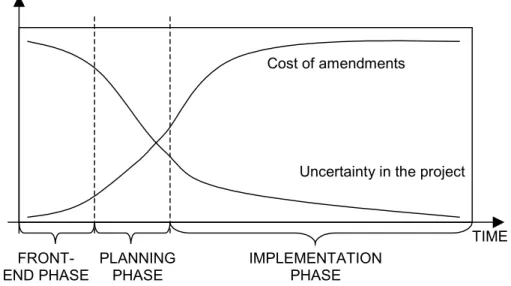
A general view is that uncertainty affecting a project decreases during implementation. With time, the possibility to implement amendments in the project decreases. Similarly, the cost of amendments increases as the project progresses. The uncertainty is at its highest and the cost of amendments at its lowest in the front-end phase.
Figure 2 Anticipated correlation between cost of changes and uncertainty in a project before and during its implementation.
Cost of amendments
Uncertainty in the project
TIME
FRONT-END PHASE PLANNINGPHASE IMPLEMENTATIONPHASE
The uncertainty of a decision in a project can be described by the gap between the information needed to make a decision that is entirely consistent with the actual outcome - and the
information available at the moment of decision making (Galbraith 2001). It follows from what has been mentioned above that the potential savings in the
implementation phase are more marginal than those in the front-end phase. It is therefore a paradox that the curriculum of project management, as it is lectured in universities, generally focuses on the implementation phase. Little has been done to develop know-how and
methodology for front-end management.
Challenges in Front-End Management of Projects
A tendency in front-end management is to rush to one specific project concept. The decisions made in the concept definition phase of the project are the ones with largest impact on the final project results. All the project conditions are laid down in this phase.
The challenge is to analyse the project’s purpose and goal. Before choosing project concept the project’s purpose and goal must be known. A project can be viewed from different perspectives, and whether a project is a failure or not often depends on who is talking. One excellent example of a project which apparently was a failure as far as cost and time overruns were concerned, is the Sydney Opera House. The Construction project was an economic catastrophe, with total costs 15 times higher than the original budget. Still, with the current position of the Sydney Opera House in mind, it can be said that the project was a success. It serves as a landmark and a tourist attraction in addition to be a functional Opera House, and has contributed with a lot of positive effects to the Australian society (Kharbanda and Pinto 1996).
After completing the literature study we concluded that in order to legitimately characterise a project as a success, both the owner, the user and the society as a whole must be satisfied.
Much of the challenge in front-end management lies in formulating realistic project results, purposes and goals.
Key Issues in Front-End Management of Projects
Most discussions on front-end management of projects have focused on the choice of methods together with the scope and quality of information needed as the basis for decisions. Clearly, front-end management involves a broader range of issues.
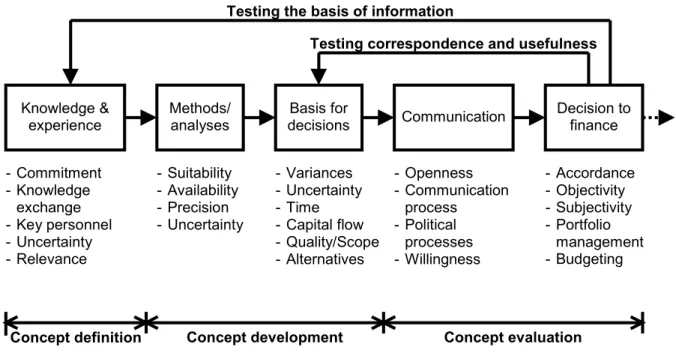
A front-end assessment typically starts with a search for relevant information. An important source of information could be knowledge transferred from earlier projects. Methods are then selected and applied. Thus a basis for decisions is established. The assessment carries on with communication of the results and eventually a final decision of whether or not to finance the project.
Project alternatives need to be evaluated before the final decision to finance. Too often, front-end assessments have concentrated on evaluating one single project alternative, and not on identifing and comparing several relevant alternatives. Good project alternatives may not even be considered, or they are turned down before a thorough evaluation is carried out.
The essential knowledge that will subsequently be the basis for decisions, is collected during the concept definition phase. The information is analysed, and the resulting outcome provides the basis for the development of the concept as well as the final decision to finance.
Well performed front-end assessments involve a consistent focus on the original decisions made in the concept definition phase of the project. This will provide the project’s
stakeholders with a common framework when the project subsequently is planned and implemented.
Figure 3 The main stages of front-end management of projects, and some key terms used in this paper. - Commitment - Knowledge exchange - Key personnel - Uncertainty - Relevance - Suitability - Availability - Precision - Uncertainty - Variances - Uncertainty - Time - Capital flow - Quality/Scope - Alternatives - Openness - Communication process - Political processes - Willingness - Accordance - Objectivity - Subjectivity - Portfolio management - Budgeting
Testing correspondence and usefulness Testing the basis of information
Concept definition Concept development Concept evaluation
Knowledge &
experience Methods/analyses decisionsBasis for Communication Decision tofinance
Knowledge and Experience
According to Oakland (1999), organisations that benefit significantly from implementing a quality assurance system are often characterised by top management commitment and a good foundation of quality drive in the organisation. Organisations that are dragged into for
example an ISO900x-certification process are not likely to benefit to the same extent. A thorough front-end assessment of a project will tend to motivate management to focus on front-end issues and thus be of considerable benefit. For this to happen, there is a need for a feeling of ownership. Ideally, organisations should carry out the front-end assessment
voluntarily, and not because they are forced to do it. The prerequisite is a common awareness about the importance of front-end assessment in the organisation.
One aspect of systematic front-end assessment is its potential for knowledge and experience transfer between projects that could subsequently facilitate systematic improvements in an organisation. Knowledge and experience can come from internal or external sources. The consequence of continuous transfer of knowledge and experience is a general increase in the competence of project participants (Bosler 1999, Elvenes 1987, Isaac 1995).
Lack of information will result in decisions burdened with uncertainty (Wright and Ayton 1987). If key personnel actively strive to generate lessons of a generic nature from the project start to its finish, they will contribute to the process of keeping vital information known in the organisation. Generally, the chance of making the right decisions increases as uncertainty decreases.
The robustness of the front-end assessment will depend on the quality of the information available in the project organisation. If the input to a front-end assessment consists of
irrelevant and partly erroneous information, the output will be worthless (Austeng and Torp 2001).
Discussions about what method is best suited for front-end assessments regularly conclude that it is the quality of the input to the method that counts. The choice of methods and the level of analysis sophistication tend to be irrelevant if the quality of in-data are inferior. It is better to be almost right than precisely wrong (Hartmann 2000).
Figure 4 The quality of an analytic process depends both on the quality of
information and the choice of method. Using sophisticated analysis methods will not help if the information input is inadequate or erroneous.
Information Input
Method
Information Output
Methods and Analyses
The choice of methods is nevertheless essential in front-end assessment. Methods might be characterised as either qualitative or quantitative, and are typically used to analyse aspects related to time, capital flow, scope or uncertainty.
Many different methods exist for use in front-end assessment studies. Some are suited for concept definition, some for concept evaluation and some for concept development. Using the appropriate methods in each phase is essential, as well as to follow up the results later in the project (Grey 1995, Hulett 2001, Husby et.al 1999, Samset 2001).
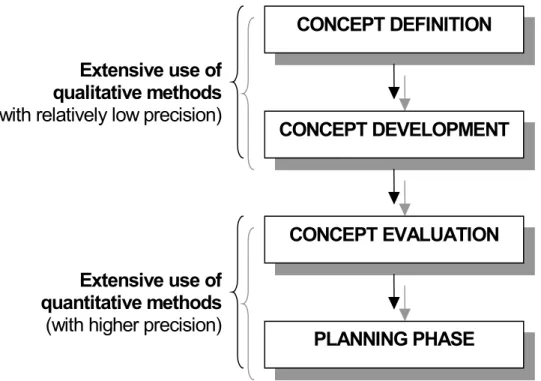
Qualitative methods are seemingly most used for concept definition and concept
development. Quantitative methods are commonly used in concept evaluations and detailed planning. Use of quantitative methods demands data which will be easier available in the phases for concept evaluation and detailed planning.
Figure 5 Use of methods in front-end assessment. Typically, precision increases as the project is progressing.
Extensive use of qualitative methods
(with relatively low precision)
Extensive use of quantitative methods
(with higher precision)
CONCEPT DEFINITION
CONCEPT DEVELOPMENT
CONCEPT EVALUATION
PLANNING PHASE
There is a wealth of literature available on quantitative methods in project management (Gido and Clements 1999, Raz and Michael 1999, Remer and Nieto 1995, Rolstadås 2001). The availability of literature that deals with uncertainty analyses is good (Austeng and Torp 2001, Chapman and Ward 2000, Chong and Brown 2000, Lichtenberg 2000, Pedersen et.al. 2001, Schuyler 2001, Wallace et.al. 2000). Also, some excellent bibliographies exist with overviews from the field of risk management (Edwards and Bowen, 1998, Uher and Toakley 1999, Williams 1995).
Quantitative methods are used extensively in economical analyses. Clearly, income as well as expenditure have an impact on the profitability of projects. A weakness in front-end
management is that profitability not always gets the same attention as costs (Lædre 2001). Obviously, the total cash flows need to be considered when preparing the basis for decisions. On qualitative methods less literature is available. Literature on strategic planning and methods such as the Logical Framework Approach (LFA) represents an exception (Samset 1996).
The Basis for Decisions
There is no common terminology or agreement on which methods to use in the field of front-end management. Current variations may have a disturbing and confusing effect on decision makers, and even make comparisons of essentially similar projects difficult (Klakegg 2001, Paulsen 1996).
In order to make alternative project concepts comparable, the basis for decisions needs to include a set of key parameters. Such parameters commonly involve the capital flow, time, scope and uncertainty.
Figure 6 Key parameters in the basis for decisions commonly include capital flow, time, scope and uncertainty.
Capital Flow
Scope
Time
Uncertainty
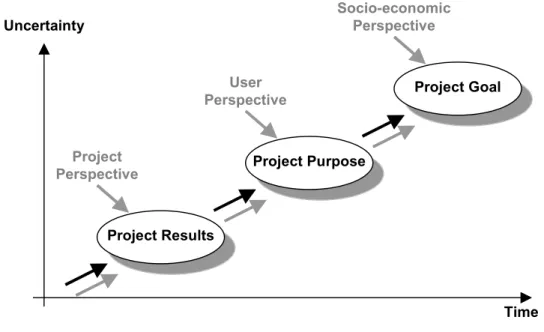
Furthermore, it is important to assess the range of parameters that have to be considered in a consistent way (Chicken 1994, Samset 2001). The basis for decisions needs to include an evaluation of the overall purpose and the goal of the project, and not only the project results. The project’s purpose is directly related to user satisfaction and is best evaluated from a user perspective – while the project’s goal is related to the socio-economic benefits of the project, and will have to be considered in a broader socio-economic perspective.
Figure 7 A thorough evaluation of a project will involve not only the project results, but
Time Uncertainty Project Results Project Purpose Project Goal Project Perspective User Perspective Socio-economic Perspective
projects where economic viability is the main concern. Public investments such as
infrastructure projects may take a broader perspective. However, both types of projects need to be assessed in a broader perspective where the longer term impact on the users and society at large are considered. In order to provide the best possible basis for decision in the earliest phase, the uncertainties that are likely to affect the project performance need to be scrutinised. Project objectives and key strategic determinants such as the user requirements are commonly established in the front-end phase of projects. Both academics and practitioners have an increasing awareness of the importance of stakeholder satisfaction. One example is the Construction Industry Institute (CII) in Austin, USA. In the past, the institute focused primarily on the implementation phase, but today has broadened its focus to include all project phases (CII 1995).
Communication
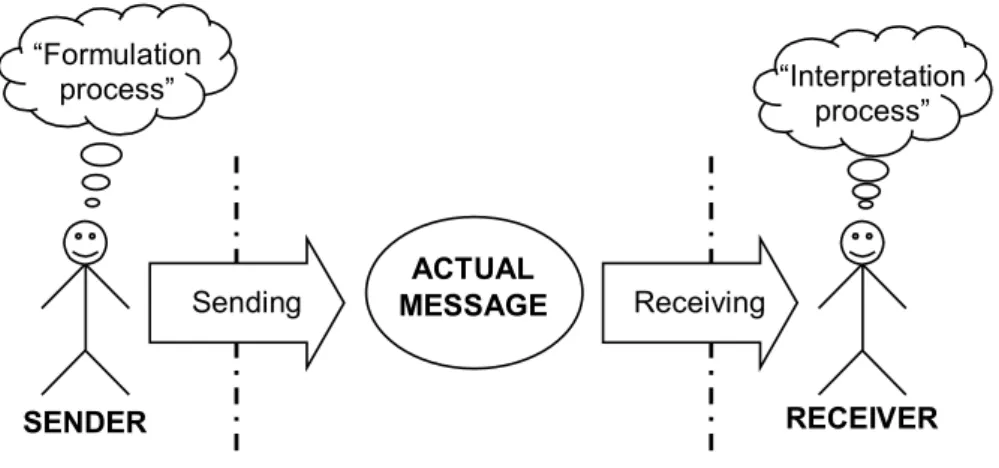
The information that forms the basis for decisions must be clearly communicated to decision makers (Harrison 1995, Goodwin and Wright 1991, Lewis 1997). Communication is essential for success in the earliest phase of a project. A communication process has, as a minimum, a sender, a message and a receiver. The message formed in the mind of the sender is easily distorted before it reaches the mind of the receiver. Important data or vital nuances can be lost in the communication process.
Figure 8 A message easily gets distorted in a communication process.
ACTUAL MESSAGE “Formulation process” Sending Receiving SENDER RECEIVER “Interpretation process”
Clear communication is important in all respects. The cost and viability of a new project are of prime interest to the financing party. In reality, not all decision makers want all project alternatives to be thoroughly evaluated. Key stakeholders may often wish to create support for one particular project alternative. In a political and cultural setting, a thorough front-end assessment might represent a potential threat to some stakeholders since a properly executed front-end assessment should give a fair evaluation of all relevant project alternatives, and not be influenced by the interests of particular stakeholders. Communication in the light of stakeholders’ differing priorities is an important issue in front-end management of projects. However, the availability of literature on communication in the earliest phase of projects is limited.
Decisions to Finance
Decisions are made on the basis of both biased and unbiased information. A front-end
assessment needs to take an impartial view in order to be able to provide the most appropriate information basis for the final decision to finance a project.
It is of great value to verify what was the basis for collection of information in the concept definition phase. This will help explain the fundamental choices that were made initially and during the process when the project concept was developed. Different organisations may come up with entirely different decisions, even when they have the same information and are seeking the decision with the maximum value added. One reason might be that there are entirely different attitudes to uncertainty in the organisations. Another reason might be that interpretation of information about the uncertainty differs. Finally, definitions of success differ and uncertainty is therefore evaluated differently in similar situations (Baldry 1998, Lam 1999).
In management of project portfolios, organisations need to base their portfolios on a
systematic and pro-active analysis of their attitude and understanding of uncertainty, together with their definitions of success. Usually, a project portfolio is defined as a cluster of projects with the same owner, where the projects not necessarily share a common objective or have the same profitability requirements. The number of projects in the portfolio needs to be restricted, and the associated uncertainty must not be too extensive, because that will restrict the freedom of manoeuvre (Artto et.al. 2001, Buttrick 2000, Gareis 2000, Ghasemzadeh and Archer 1999, Lund 1997, Sandvold 1999, Thune 2001).
Experience indicates that the available resources in a project, including the known reserves, often will be spent (Galbraith 2001). For project-based organisations this can be unnecessarily expensive. In some projects the initial budget is increased in order to avoid future overruns. An alternative is to reduce the initial project budget with the intention of lowering total costs. The effects of either increasing or reducing the original budgets are complex, and probably not fully understood.
In some organisations with large portfolios, project budgets are deliberately set low, but for each project a reserve is added to a common fund. Project managers can apply for additional resources from the fund in case of budget overruns. The added reserves and the management of the reserves must be appropriate, so that under- and over-expenditure in projects balance within the portfolio and the fund remains constant (Austeng and Steenberg 2001, Stamelos and Angelis 2001). The field of project portfolio management is not covered extensively in literature and appears to be highly relevant for future research.
Conclusions
This paper focuses on the importance, current status and trends in the field of front-end management of projects. It is based on a review of literature and a state-of-the-art study. An overall conclusion is that the field of front-end management has been neglected in both
Basically, there are two important success criteria that need to be fulfilled in order to succeed in front-end management of projects. Firstly, top management must be committed to
evaluating different alternatives and to open-mindedly address the uncertainty associated with the key parameters involved. Secondly, the organisation must be able to correctly generate and analyse the necessary information.
Collection of knowledge and experience in the concept definition phase deserves more attention. The existing literature focuses relatively more on the actual analytical methods applied than on the collection of input information, even though the latter might be more decisive for the results than the choice of methods.
The quality of input data in the front-end phase of a project typically has a lower precision than some of the quantitative methods used in front-end assessment. Focus should be on improving information, but also on avoiding the most sophisticated methods since these might confuse rather than clarify. Qualitative methods are neither sufficiently developed nor well enough implemented. This is a relevant area for future research.
Common terminology and standardised formats for presenting project concepts should help improve decision making. Decision makers need to get a correct understanding of the uncertainty associated with the key parameters constituting the different concepts. Apparently, the communication of actual and anticipated uncertainties associated with different project alternatives deserves more attention from researchers.
Before the final decision to finance a project is made, the basis for decisions need to be tested against the knowledge and experience originally used as input in the concept definition phase. Similarly the correspondence between the basis for decisions and the decision to finance should be tested.
Figure 9 Requirements for improving existing practices in front-end management.
Knowledge &
experience Methods/analyses decisionsBasis for Communication Decision tofinance
Testing correspondence and usefullness
Concept definition Concept development Concept evaluation
Improvement
of input quality methods, complexityReduced focus on and precision Quality assurance of decision criteria Improved and standardised communication Reality check of former processes
Testing the basis of information
#5
In addition to project results, the project purpose and project goal should be settled in the front-end. It is not possible to succeed if not all stakeholder interests are known before the detailed planning starts. Both practitioners and researchers must prioritise front-end management in the future.
References
American Institute of Chemical Engineers (2000). Guidelines for Chemical Process Quantitative Risk Analysis. Center for Chemical Process Safety, 2nd ed., USA.
Artto K.A., J.M. Lehtonen and J. Saranen (2001). Managing projects front-end: incorporating a strategic early view to project management with simulation. International Journal of Project Management, 5, 255-264.
Artto K.A., M. Martinsuo and T. Aalto (2001). Project Portfolio Management - Strategic Management through Projects. PMA, Finland.
Austeng K. and G. Steenberg (2001). Gjennomgang av risikoanalyser. NTNU/CONCEPT Research Programme, NORWAY.
Austeng K. and O. Torp (2001). Usikkerhetsanalyse i prosjekt - mer enn tallbehandling og s-kurver. Prosjektledelse, 2, 27-30.
Austeng K., B.O. Elvenes, H. Hynne, O.J. Klakegg, and T. Skjønhals (1998).
Gjennomføringsmodeller og kontraktsstrategier. NTNU/PS2000 Research Programme, Norway.
Baldry D. (1998). The Evaluation of Risk Management in Public Sector Capital Projects.
International Journal of Project Management, 1, 35-41.
Berg P. (1999). Styring av statlige investeringer. The Norwegian Ministry of Finance, Norway.
Bosler C.W. (1999). Risk Management, the Corporate ”Board Game”. PMI, Project Management Seminars and Symposium, USA.
Buttrick R. (2000). The Interactive Project Workout. Pearson Education Limited, UK. Chapman C. and S. Ward (1997). Project Risk Management; Processes, Techniques and Insights. John Wiley & Sons, UK.
Chapman C. and S. Ward (2000). Estimation and Evaluation of Uncertainty: a Minimalist First Pass Approach. International Journal of Project Management, 6, 369-383.
Chicken J.C. (1994). Managing Risks and Decisions in Major Projects. Chapman and Hall, UK.
Chong Y.Y. and E. M. Brown (2000). Managing Project Risk - Business Risk Management for Project Leaders. Pearson Education Limited, UK.
Christensen S. and K. Kreiner (1991). Prosjektledelse under usikkerhet. Universitetsforlaget A/S, Norway.
Construction Industry Institute (CII) (1995). Pre Project Planning Handbook. University of Texas at Austin, USA.
Construction Industry Institute (CII) (1999). PDRI, Project Definition Rating Index for Building Projects. University of Texas at Austin, USA.
Elvenes B.O. (1987). Prosjektadministrasjon og erfaringsoverføring. En sammenlignende undersøkelse i 4 organisasjoner som gjennomfører store prosjekter. NTNU, Doctoral Thesis, Norway.
Eppen G.D. and F.J. Gould (1985). Quantitative Concepts for Management – Decision Making Without Algorithms. Prentice-Hall, USA.
Fong P.S. and Q. Shen (2000). Is the Hong Kong construction industry ready for value management? International Journal of Project Management, 5, 317-326.
Galbraith J.R. (2001). Designing Organizations: An Executive Guide to Strategy, Structure, and Process. Jossey-Bass, 2nd ed., San Fransisco.
Gareis R. (2000). Managing the Project Start. In: Turner J.R. and S.J. Simister (editors) (2000). The Gower Handbook of Project Management. Gower Pub Co, UK.
Gerosa S., M. Cencetti and M. Sarno (1999). Methods and Applications of Risk Management in Space Programs. PMI, Project Management Seminars and Symposium, USA.
Ghasemzadeh F. and N.P. Archer (1999). An Integrated Framework for Project Portfolio Selection. International Journal of Project Management, 4, 207-216.
Gido J. and J.P. Clements (1999). Successful Project Management. South-Western College Publishing, USA.
Goodwin P. and G. Wright (1991). Decision Analysis for Management Judge. John Wiley & Sons, Scotland.
Grey S. P(1995). Practical Risk Assessment for Project Management. John Wiley & Sons, UK.
Hamilton A. (2002). Considering value during early project development: a product case study. International Journal of Project Management, 2, 131-136.
Hitt M.A., R.D. Middlemist and R.L. Mathis(1989). Management – Concepts and Effective Practice. West Publishing Company, 3rd ed., USA.
Harrison E.F. (1995). The managerial decision-making process. Houghton Mifflin, 4th ed., USA.
Hartman G. (2000). Risk is Still a Four Letter Word. Stoddart Publishing Co. Limited, Canada.
Hobbs B. and B. Andersen (2001). Different alliance relationships for project design and execution. International Journal of Project Management, 8, 465-469.
Holm F.H. (1983). Økonomi i byggesaker. Universitetsforlaget, Norway.
Hulett D.T. (2001). Key Characteristics of a Mature Risk Management Process. PMI Europe, Fourth European Project Management Conference, UK.
Husby O., H. Kilde, O.J. Klakegg , O. Torp, S. Berntsen and K. Samset (1999). Styring av usikkerhet i prosjekter. NTNU/PS2000 Research Programme, Norway.
Isaac I. (1995). Training in risk management. International Journal of Project Management,
4, 225-229.
Kharbanda O.P. and J.K. Pinto (1996). What Made Gertie Gallop? Lessons from Project Failures. Van Nostrand Reinhold, New York.
Kindinger J.P. (1999). Use of Probabilistic Cost and Schedule Analysis Results for Project Budgeting and Contingency Analysis at Los Alamos National Laboratory. PMI, Project Management Seminars and Symposium, USA.
Klakegg O.J. (2001). Felles begrepsapparat for kvalitetssikring av kostnadsoverslag. NTNU/CONCEPT Research programme, Norway.
Klein M.R. and L.B. Methlie. Knowledge-based Decision Support Systems With applications in Business. John Wiley & Sons, 2nd ed., USA.
Lam P.T.I. (1999). A Sectoral Review of Risks Associated with Major Infrastructure Projects. International Journal of Project Management, 2, 77-87.
Lewis H.W. (1997). Why Flip a Coin? The Art and Science of Good Decisions. John Wiley & Sons, USA.
Lichtenberg S. (2000). Proactive Management of Uncertainty using the Successive Principle. Polyteknisk Press, Denmark.
Lund M.W. (1997). The Value of Flexibility in Offshore Oil Field Development Projects. NTNU/Doctoral thesis, Norway.
Lædre O. (2001). State of the Art-Tidligfasevurderinger av prosjekt. NTNU/Concept Research Programme, Norway.
Maylor H. (1999). Project Management. Bath School of Management, UK.
Miller R. and S. Floricel (2001). Strategizing for Anticipated Risks and Turbulence in Large-Scale Engineering Projects. International Journal of Project Management, 8, 445-455. Mintzberg H. (1994). The Rise and Fall of Strategic Planning. Free Press, USA.
Morris P.W.G. and G.H. Hough (1991). The Anatomy of Major Projects. A Study of the Reality of Project Management. John Wiley & Sons, England.
Nobelius D. and L. Trygg (2002). Stop chasing the Front End process ¯¯ management of the
early phases in product development projects. International Journal of Project Management,
5, 331-340.
Oakland J.S. (1999). Total Quality Management. Butterworth-Heinemann Ltd, Oxford. Patrick F. (2001). Critical Chain Scheduling and Buffer Management . . .Getting Out From Between Parkinson's Rock and Murphy's Hard Place. PMI, PM Network, USA.
Paulsen K.S. (1996). Felles terminologi innen prosjektstyring. NTNU/PS2000 Research Programme, Norway.
Pedersen F.B., D. Grimstad, H. Nyrønning and M. Solem (2001). Technical Report DEMO 2000 - Standardized Method for Multidisciplinary Uncertainty Analysis CTR no B5. Det Norske Veritas, Internal report, Norway.
PMI Standards Committee (2000). A Guide to The Project Management Body of Knowledge. Project Management Institute, USA.
Ragsdale C.T. (1998). Spreadsheet Modelling and Decision Analysis - A Practical Introduction to Management Science. South Western College Publishing, 3rd ed., USA. Raz T. and E. Michael (1999). Benchmarking the Use of Project Risk Management Tools.
PMI, Project Management Seminars and Symposium, USA.
Remer D.S. and A.P. Nieto (1995). A Compendium and Comparison of 25 Project Evaluation Techniques. International Journal of Production Economics, 1, 79-97.
Remer D.S., S.B. Stokdyk and M. Driel (1993). Survey of Project Evaluation Techniques Currently Used in Industry. International Journal of Production Economics, 1, 103-115. Rolstadås A. (2001). Praktisk prosjektstyring. Tapir Akademisk Forlag, 3rd ed., Norway. Samset K. (1996). The Logical Framework Approach (LFA). Norwegian Agency for Development Cooperation, Norway.
Samset K. (2001). Prosjektvurdering i tidligfasen. Tapir akademisk forlag, Norway. Sandvold Ø. (1999). Programstyring: Implementering av strategiske endringer. Tano Aschehoug, Norway.
Schuyler J.R. (2001). Risk and Decision Analysis in Projects, Second Edition. PMI, USA. Scott F.H. and S.E. LeBlanc (1995). Strategies for Creative Problem Solving. Prentice Hall PTR, USA.
Stamelos I. and L. Angelis (2001). Managing Uncertainty in Project Portfolio Cost Estimation. Information and Software Technology, 15, 759-768.
The Norwegian Ministry of Foreign Affairs (1993). Evaluering og resultatvurdering i bistanden - Håndbok for utøvere og beslutningstakere. Hestholms Boktrykkeri, Norway. Thiry M. (2002). Combining value and project management into an effective programme management model. International Journal of Project Management, 3, 221-227.
Thune T. (2001). Management by Projects - et litteraturstudie gjennomført som en del av prosjektet Management by Projects. Norwegian Center for Project Management (NSP), Norway.
Torp O. (2001). Litteraturstudium innen tidligfasevurderinger av prosjekter. NTNU/Concept Research Programme, Norway.
Uher T.E. and A.R. Toakley (1999). Risk Management in the Conceptual Phase of a Project,
International Journal of Project Management, 3, 161-169.
Wallace S., M. Myrtveit and M. Saleh (2000). Optimization Under Uncertainty in System Dynamics. The 18th International Conference of the System Dynamics Society, Norway. Williams T. (1995). A Classified Bibliography of Recent Research Relating to Project Risk Management. European Journal of Operational Research, 1, 18-38.
Wright G. and P. Ayton (1987). Judgmental Forecasting. John Wiley & Sons, UK.