The Provision of a Resettlement Mentoring Service for
Prisoners serving an Indeterminate Sentence for Public
Protection (IPP) released to Kent, East/West Sussex, Brighton
and Hove
Contract Management Guide
Mentoring Services to IPP Prisoners Contract Management Guide – V 1
2
CONTENTS
Contract Management Overview
Background to the requirement Contract management process
Contract Management Guide Section 1
1.1 Introduction to contract management
1.2 Purpose of the contract management guide
Section 2
2.1 Scope and key aspects of the Contract
Section 3
3.1 Contract management roles & responsibilities 3.2 Contract meetings
3.3 Reporting
3.4 Complaints and escalation procedure
3.5 Dispute resolution
Section 4
4.1 Audit
4.2 Document management 4.3 Publicity
Section 5
5.1 Contract variation process
Section 6
6.1 Communication 6.2 Relationships
Mentoring Services to IPP Prisoners Contract Management Guide – V 1
3
Section 8
7.1 Contract expenditure 7.2 Reconciliation
7.3 Invoicing
Annexes
Annex A Meeting agenda
Annex B Monthly Contractor meeting minutes Annex C Meeting action points
Annex D Monthly Contractor report
Annex E Quarterly staffing level and expenditure report Annex F Escalation procedure
Annex G Areas covered by audit Annex H Contract variation process Annex I Variation to Contract form Annex J Contract Manager Details Annex K Sample Purchase Order Annex L Contractor Insurance Details Annex M Confidentiality Undertaking
Contract Management Overview
Aim
The Contract Management process will enable the National Offender Manager Service (NOMS) to work in partnership with the Contractor - Catch 22 - to deliver a mentoring service to IPP prisoners being released in the Kent and Sussex area.
Background to the requirement
It is recognised that the successful re-integration of IPP prisoners into the community is not as effective as those for traditional life sentenced prisoners. Indeed the recall of IPP prisoners is at a significantly higher rating that for traditional life sentenced prisoners. The requirement for the service being provided by Catch 22 was driven from a review undertaken in February 2012. This reviews suggested that the offending history and background of IPP prisoners required enhanced support. This review also recognised the support needed for IPP prisoners in the open prison estate leading up to, and beyond, their release into the community, and their subsequent supervision by the Probation Service. The service is aimed to achieve meaningful results in tackling reoffending rates, types of re-offending, and recall to custody rates. A key outcome for this requirement is the identification and engagement of IPP prisoners with resettlement needs and, where relevant, onward referral to other beneficial support services such as housing, employment and further education/training. Also to support the maintenance of family ties with the aim of assisting IPP prisoners resettlement back into the community.
The Authority and Catch 22 aims to use this service, and the volunteers that will underpin it, as a way of promoting a more joined up approach between all agencies responsible for IPP prisoners including, as in this case, the 3rd sector.
Delivery will:
Build on the principles of effective support in custody and upon release; and Demonstrate linkages, and add value to supporting Offender Supervisors in
custody and Offender Managers upon release; and
Build on current resources rather than duplicate or displace; and
Provide a high degree of collaborative and partnership working for the benefit the prisoner; and
Assist the protection of the public by providing additional support to this cohort
Contract management process The contract management process will:
Ensure contractual performance in accordance with the Specification by providing continuous and robust contract management which supports both parties.
Support a co-operative two way relationship. Ensure delivery of best value.
Provide a consistent approach across the prison estate and in the community that is auditable and measurable.
Offer flexibility to respond to changing needs and external influences (political/strategic etc).
Support continual development and evolution of better practice and innovation including publicising any ‘good news/success stories’.
Encourage effective and regular communication; underpinned by clear communication protocols.
Demonstrate clear roles and lines of accountability. Provide effective management of commercial risk.
Contract Management Guide Section 1
1.1 Introduction to contract management
Contract management is the process which ensures that both parties to a Contract fully understand their respective obligations and that these are fulfilled as efficiently and effectively as possible to provide best value for money.
All contracts require careful management if they are to continue to develop, maximise their service delivery, and offer value for money.
Effective Contract Management involves: Re-affirming exact requirements.
Effective communication between both parties.
Monitoring the delivery and ensuring no barriers on both sides. Identifying and resolving problems and shortcomings.
Both parties working continuously with each other to develop and improve.
Financial management. Change management.
1.2 Purpose of the contract management guide
This document is designed to provide effective contract management guidance for the mentoring of IPP prisoner’s requirement. The guide underpins and supports the Contract between the Authority and the Contractor in delivering the requirement. The Contract provides information about the outcomes, local arrangements and facilities, contact points and Services to be delivered as defined in the Specification. This guide provides information about:
The scope and key aspects of the Contract. Contract management roles and responsibilities. Contract meetings.
Escalation process. Audit.
Communication.
Management information requirements. Finance processes.
Contract variation process. Staffing.
Section 2
2.1 Scope & key aspects of the Contract
To ensure that Contracts are managed effectively, it is essential that Contract Managers fully understand the scope of the Contract in terms of what the expected deliverables should be. The Specification is attached separately with the Contract at Schedule A.
Section 3
3.1 Contract management – roles & responsibilities
ROLE RESPONSIBILITIES
Procurement Directorate & Contract management
Procurement Directorate is responsible for putting in place commercial arrangements and at the same time responsible for monitoring and managing such commercial risks such as, authorising any variations to ensure accountable use of taxpayers’ money.
o Negotiate and oversee the contractual commercial and legal arrangements.
o Escalation route for Contractors to resolve issues.
o Provide contractual support to Commissioners.
o Support and advise service Contractors. o Attend contract review and Regional
meetings.
o Manage, authorise and execute variations to Contract.
o Application of Terms & Conditions and remedies, as required.
o Market awareness through benchmarking.
o General awareness of service
requirements and key deliverables. o Promote commercial best practice.
o Provide advice on overall best value for money.
o Facilitate Contractor & Stakeholders relationships.
o Maintain audit trail.
o Liaison with all stakeholders.
o Respect commercial confidentiality.
Contract manager
Is responsible for the local management of MoJ Contracts to ensure that the level of service delivered is in accordance with the Specification and Terms and Conditions and provides value for money for MoJ.
o Ensure Contractor meets its contractual obligations as stipulated in the contract. o Routinely monitor/manage contract and
sign-off reporting data.
o First point for resolution of issues prior to escalating via the agreed hierarchy.
o Ensure prompt and accurate payment to Contractor within the required timescale. Contractor
To deliver services in accordance with the Specification.
o Obligation to deliver services as specified in the Contract.
o Communicate difficulties or obstacles in delivery to the Contract Manager.
o Work with the Authority to maximise effective delivery of the service.
o Maintain effective Stakeholder relationships.
o Respond to requests for ongoing management and performance monitoring information.
o Communicate information on best practice.
o Attend contractual review meetings.
o Robustly manage sub-contractors (if applicable) and/or partners to ensure delivery of the Specification and outcomes.
3.2 Contract meetings
Formal monthly Contract meetings will be held between the Authority and the Contractor to review the quality and delivery of the Contract. The purpose of the meetings is to ensure effective delivery against the Contract including audit requirements, problem-solving and/or to escalate any concerns. Table 1 summarises the attendees and purpose of the monthly meeting.
The monthly meetings will take place in week three of each month, with preparation of minutes and following up of action points taking place in week four.
Table 1
Monthly Contractor Contract meeting
Level Who Purpose of
meeting Frequency Purpose attending for meeting
Region/Area
(Contractual) Contractor Contract Manager (CM)
To ensure effective delivery against contract including audit requirements. Problem solve or escalate.
Monthly. Required by
Governance *Escalation point
Quarterly Contract review meetings will also be held between the Authority and the Contractor. The quarterly meetings will take place once every fourth month from the date of contract commencement. The purpose of these meetings is to ensure effective delivery against the Contract, including audit requirements, quarterly finance reconciliations, Commissioning project feedback, problem-solving, staffing level and expenditure report (section 3.3 refers) and/or to escalate any concerns. Table 2 summarises the attendees and purpose of the quarterly meeting.
Table 2
Quarterly Contractor Contract Meeting
Level Who Purpose of
meeting Frequency Purpose attending for meeting
Region/Area
(Contractual) Contractor CM Finance Manager Xxxredacted textxxx
To ensure effective delivery against contract including audit requirements. Quarterly Finance Reconciliation. Quarterly staffing template.
Problem solve or escalate.
Quarterly. Required by Governance *Escalation point
In addition, to the above, the Authority will seek to hold Contractor forums to discuss issues such as sharing of good practice and providing detail of policy or MoJ internal developments.
From time to time it may be necessary to involve other Stakeholders, Contractors and Procurement Directorate management staff.
All meetings will be chaired by either the Contract Manager or other appointed NOMS representative and, unless otherwise agreed, will be held on the Authority’s premises. An agenda will be issued by the Authority one week prior to the meeting to provide an opportunity for either the Contractor or other attendees to add additional agenda items if required.
The Contract Manager or other appointed MoJ representative is responsible for ensuring that the Contract Meetings are minuted and action points distributed to all attendees. The action points should include a summary identifying who will be responsible for taking these forward, and the required timescale for completion. The minutes and action points should be reviewed for progress at the following Contract meeting. Copies may be forwarded to the IPP Regional Team and Procurement for information.
Annexes A – C contain templates that will be utilised for the review meetings; these may be subject to change as and when necessary.
3.3 Reporting
The Contractor shall produce a monthly report to include an overview of events and achievement of targets during the reporting period. Annex D contains the monthly Contractor report template, which may be subject to change as and when necessary. The Contractor shall also be required to submit, on a quarterly basis, a completed staffing level and expenditure reporting template as attached at Annex E. The Contractor should also include any supporting information that they consider relevant to underpin the factors identified, for example staffing sheets.
The quarterly staffing level and expenditure report shall be applied as a ‘soft measure’ by the Authority. The purpose of the staffing report is to enable the Authority to monitor the planned (as detailed in the Contractor’s Tender) versus actual staffing levels and associated expenditure and is designed to capture the reasons/factors for any variances.
The template should detail all factors that have impacted the planned staffing level and expenditure for the reporting period. Factors may include relief factors (i.e. those factors or events that prevent the ability of staff to attend work, for example, approved annual leave, jury service and English Bank Holidays). Relief factors shall also include security clearance delays that occur after the following time periods from point of submitting a correct and complete application:
• Enhanced clearance – 3 weeks • Counter Terrorism Check – 4 weeks.
Factors may also include mitigating factors (i.e. those factors or events that minimise the impact of relief factors, for example, over-time to cover any absences). These shall also include where the staffing profile has changed due to a change of roles and responsibilities and/or substitution of skill types (e.g. utilising more highly skilled employees in order to achieve higher outcomes).
The Contract Manager shall review the completed template and confirm their response to the submitted factors and cost-benefit analysis. The cost-benefit analysis should demonstrate to the Authority that any variances offer value for money and enable achievement of the specified targets.
3.4 Complaints and escalation procedure
In the event that a problem arises in relation to the Services, the issue should be relayed in the first instance to the Contract Manager who shall record details of the nature and classification of the complaint.
Annex F outlines the escalation procedure that will be applied for this Contract. The purpose of the procedure is to ensure that, as far as possible, any identified contractual and operational issues are resolved locally between the Contractor and the local Contract Manager.
In the event that issues cannot be resolved at the local level, the escalation procedure will be followed which may result in a formal Action Plan being raised. The Action Plan will then be monitored by the Contract Manager and Deputy Director of Custody or their nominated representative on a regular basis.
3.5 Dispute resolution
The Authority and the Contractor shall attempt in good faith to negotiate a settlement to any dispute that may arise between them in relation to the Contract within twenty (20) Working Days of either Party notifying the other of the dispute. Such efforts shall involve the escalation of the dispute to the Senior Procurement Category Manager, Reducing Reoffending (or equivalent) of each Party.
If the dispute cannot be resolved directly by the Parties then resolution by mediation or arbitration may be applied.
Any reference of a dispute to mediation or arbitration shall not prevent the Authority or the Contractor from complying fully with the requirements of the Contract at all times.
Section 4
4.1 Audit
All contracted provision may be subject to the Authority’s audit processes. Audit visits may be applied to both the Contractor and sub-contractors (where applicable), as appropriate and will be based on the specified requirements within the Contract, including the Contractor’s tender.
The Contractor may be subject to a programme of audit visits at which their costs, claims and adherence to the Contract will be reviewed by the Authority. The Contractor will be informed by the Authority at a review meeting of a forthcoming audit. At this meeting terms of reference will be discussed and agreed.
The audit may cover the following and is not exhaustive:
Procurement – including the Contractor’s relationship with their sub-contractors (where applicable).
Operational procedures – including the Contractor’s performance management systems for their sub-contractors (where applicable) especially how they are measuring quality of provision and managing risks.
Contractor claims. Document retention.
Annex G outlines some of the specific areas covered by the audit visits.
Following an audit an action plan will be put in place, if required, by the Contract Manager and/or other appointed MoJ representative giving the Contractor reasonable time as agreed to improve on the affected area of the service delivery and report back on the measures taken to prevent any re-occurrence within a specified time (Annex F, Escalation procedure refers).
4.2 Document Management
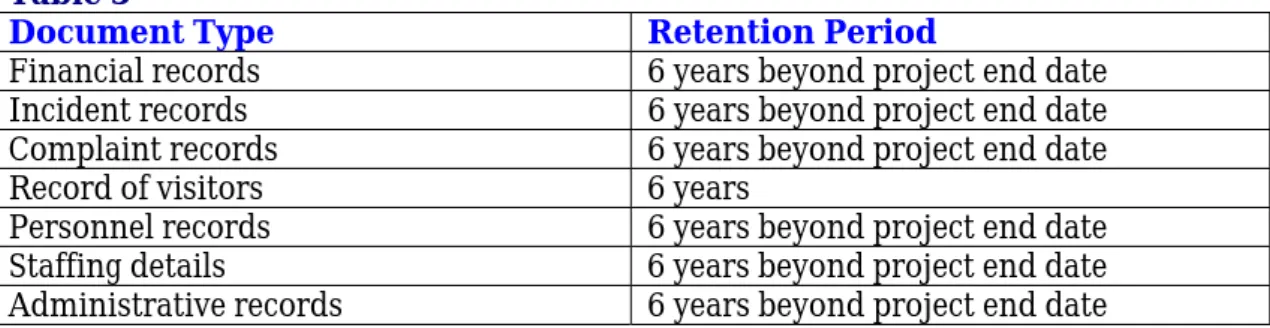
Table 3 below details the minimum period for which the Contractor shall retain Documentation. The retention periods are on a rolling basis.
Table 3
Document Type Retention Period
Financial records 6 years beyond project end date Incident records 6 years beyond project end date Complaint records 6 years beyond project end date
Record of visitors 6 years
Personnel records 6 years beyond project end date Staffing details 6 years beyond project end date Administrative records 6 years beyond project end date
4.3 Publicity
The mentoring of IPP prisoner’s service requires positive promotion, and the agreement of the Authority and Contractor to support effective publicity for this service where necessary and appropriate.
Section 5
5.1 Contract variation process
The Contract between the Authority and the Contractor incorporates mechanisms for changes to elements of the service provision.
It is the responsibility of Procurement Directorate to manage this process via the Contract Manager and all requests for variations to Contract must be escalated to Procurement Directorate to authorise and execute. (Section 9 of the Contract Administrative Instructions refers)
If a Contractor requires a change to Contract, this should be discussed with the Contract Manager in the first instance. It is then the responsibility of the Contract Manager to apply the Contract variation process, as required.
It is Procurement Directorate’s responsibility to ensure that the principle of value for money and commercial and legal propriety is maintained. Procurement Directorate will, therefore, work with all Parties during the variation process.
The process for managing Contract variations is outlined in Annex H of this Guide and the variation to Contract form is attached at Annex I.
Section 6
6.1 Communication
Good communication plays a very important part in managing any Contract and is fundamental to the development of a successful relationship between all parties.
6.2 Relationships
Good open communication, whether written or verbal, will provide the following benefits:
A clearer understanding of requirements and objectives.
A clearer understanding of NOMS Commissioning policy and initiatives. Resolution of issues as quickly as possible at the lowest possible level to
prevent needless escalation.
The potential to identify opportunities for development. Prevention of operational/contract failures.
Shared assessment of risk.
A mutually pro-active approach to embrace and facilitate enhancement of service delivery where benefits can be achieved for both Parties.
Approval to share any commercially restricted information or budgetary/ financial information must be obtained, by both Parties, from Procurement Directorate.
6.3 Written Communication
Clear and concise written Communication is essential to: Maintain a transparent audit trail.
Ensure both parties fully understand requirements, and what is expected. Inform proposed changes or cancellation of an existing element of the service. Confirm any verbal discussions/agreements that may have taken place.
Maintain standardisation of documentation.
Section 7
7.1 Contract expenditure
The contract cost is the total funding allocation for the service delivery and the costs are split 90/10. 90% is allocated to the operating costs, 10% allocated to outcome payments.
Operating costs are the Contractor’s agreed costs for the lifetime of the Contract. The 90% allocated to the operating costs will be split as follows:
£xxxredacted textxxx flat profiled payments over 36 months.
10% of the Contract costs are allocated to Outcomes (as agreed by the Authority and the Contractor). For the first three months of Contract operation, Performance shall be deemed to be 100% with a reconciliation taking place in the first month of the 2nd quarter. Reconciliation will continue quarterly for the outcome payment.
The 10% allocated to outcome payments will be split as follows: £xxxredacted textxxx flat profiled payments over 36 months.
Outcome payments will be measured against the outcome targets agreed at Annex N. The Authority may, at its discretion, extend the contract for a further 1-year period, upon expiry of the initial 3-year contract term. The Authority will formally communicate such intentions by giving the Contractor 3 months notice prior to the contract expiry date. Any agreement between the Parties to proceed with the extension period will be managed via formal variation (section 5 refers).
Monitoring contract expenditure against budget is an important part of the role of the Finance function. Suitable systems are established for recording expenditure in order to make comparisons with the allocated budget profile, and ensure the funding provision remains within budget. It is important that the costs submitted by the Contractor are:
Presented in the correct invoice format. Appropriate for the type of service delivered.
Correctly charged and calculated at the applicable contract rates. Are supported by specified auditable evidence of delivery.
7.2 Reconciliation
The Authority will undertake reconciliations on a quarterly basis of the Services supplied by the Contractor in accordance with the Specification.
The purpose of the reconciliations shall be to inform the Authority of operating costs and output payments made against actual outcomes achieved in that quarter, and shall inform the Authority’s decision as to whether to re-profile and reclaim monies from the Contractor where there is consistent under-spend and/or underperformance.
The Contractor shall be required to provide the Authority with any reconciliation information requested in an agreed format.
7.3 Invoicing
A Standard Scheduled Purchase Order (SSPO) will be raised by the Authority upon Contract award. The SSPO will detail the payment split and monthly totals and the Contractor must ensure that the Purchase Order is quoted on the respective invoice. Invoices should be sent to the Shared Service Centre for payment at the following address:
Accounts Payable
NOMS Shared Service Centre
Phoenix House
Spooner Close
Coedkernew
Gwent
NP10 8FZ
A copy invoice, together with any agreed supporting documentation, should simultaneously be sent to the specified Contract Manager(s) specified in Annex J.
Annex A – Meeting agenda
MEETING AGENDA
LOCATION
DATE
TIME
REASON
NAME
ORGANISATION/ ROLE ETC
Agenda Items
1
Apologies
2
Agree minutes from previous meeting
3
Performance Update / Issues arising: Threats to targets
4
Action Plan Update if Required
5
Staffing Issues
6
Staff Training
7
Finance / Contracts
8
Diversity / Cross Cutting Issues
10
Contract Monitoring Feedback
11
Complaints
12
Recent NOMS/prison Bulletins – if relevant
Annex B – Monthly Contractor meeting minutes
Monthly Contractor Meeting Minutes Purpose:
To monitor and evaluate the performance of project, and implement corrective action to ensure compliance where necessary.
Conduct of meeting:
1. If a designated member is not available, a briefed deputy will attend.
2. Notes will have an action column. Members named for task will update the meeting on the progress of the work allocated. Copies of the notes will be distributed to all members prior to the next meeting.
Service Delivery Area: Date:
Venue: Present: Apologies:
Agree minutes from previous meeting: Standing Agenda Items:
COMMENTS:
Numbers engaged on service:
Recall and/or reoffending:
Lessons learned:
Signposting (Referrals) and follow up:
Stakeholder/ other partner engagement :
Client satisfaction:
Threats to targets:
Staffing Issues:
Staff Training:
Finance / Contracts:
Publicity / Good Practice:
Mentoring Feedback:
Complaints:
Any Other Business:
Date of Next Meeting:
Minutes agreed by (On behalf of Contractor): Print Name:
Role: Date:
Minutes agreed by
(On Behalf of the Authority): Print Name:
Role: Date:
Annex C – Meeting action points
MEETING ACTION POINTS
Annex D – Monthly Contractor report
Monthly Contractor Report Organisation
Region Date:
Month: Cumulative:
Actual Target Actual Target Percentage of Target Achieved Minimum of 3 prisoners
per month taken onto the service
Prisoners on service to be seen at least monthly during their time on the service
Prisoners on the service to be seen at least weekly in the month following release
80% of prisoners on the serve to complete the programme (1 year – 6months pre & ) 80% of prisoners on the service have no more than one mentor for the duration of their time on the service
All prisoners on the service will have an action plan which is updated at least monthly The Authority shall receive a report by the 14th of each month setting
out the following information on the preceding months performance:-
Data on feedback from service users Data on any focus
groups Breakdown on
prisoners involved in scheme including age, ethnicity, location and home address Outcomes for each
prisoner on the project outlining figures for those entering employment, training, education and housing whilst on the programme Staffing hours
completed Staff sickness and
cover provided Staff vacancies Data and time spent
with prisoners Any good news
stories
Any evidence of good practises
Training provided for mentors
Issues/concerns
Payments £ Profiled
Payment
Actual in mth 1
Actual in
mth 2 Actual in mth 3 Comments 90%:
10%:
Payment
PLEASE NOTE: The figures above are subject to audit and reconciliation and therefore may change. Issues arising:
Threats to targets:
Action Plan Updates:
Staffing Issues or Issues emanating from the Authority side: Any required Staff Training:
Finance / Contracts: Complaints:
Recent NOMS Bulletins:
Report prepared by:
Role:
Annex E – Quarterly staffing level and expenditure report
Staffing level and expenditure – quarterly reporting template 1. To be completed by the Contractor:
Complete one template per reporting period
Complete this template as concisely as possible Contractor:
Region: Assessed by: Checked by: Contract manager: Period of reporting: Planned staffing level (Full
Time Equivalents – FTEs) as detailed in Section (vii), Contractor’s Tender
Planned staffing level expenditure, as detailed in Section (vii), Contractor’s Tender
Cumulative planned staffing level expenditure, as detailed in Section (iv), Contractor’s Tender
Actual staffing level (FTEs) for
reporting period Actual staffing level expenditure for reporting period
Cumulative actual staffing level expenditure for reporting period
Variance of planned vs. actual staffing level expenditure for reporting period
Variance of planned vs. actual
cumulative actual staffing level expenditure for reporting period
Details of supporting information attached Factors for variance between
planned and actual staffing levels and expenditure
Relief factors:
Other factors:
Measures/actions taken in
relation to factors identified Mitigating factors – measures/actions taken: Other measures/actions taken:
Any other information/comments
2. To be completed by the Authority Reviewed by: Supporting information
submitted Yes
Factors agreed Relief factors:
Mitigating factors:
Other factors:
Factors requiring further
clarification/discussion Relief factors: Mitigating factors:
Other factors:
Assessment of measures/actions taken
Assessment of cost-benefit analysis Approved by:
Annex G – Areas covered by audit
Procurement
The Contractor shall have a robust contracting model (i.e. Prime Contractor, consortium or partnership proposals) detailing key roles and purpose.
The Contractor shall also be required to demonstrate the engagement and commitment with the partner(s) and / or sub-Contractor organisation and the structure (i.e. reporting lines) that have been established for the Contract.
The Contractor shall be required to ensure partnership and / or sub-contracting relationships are robustly monitored and managed to ensure successful delivery of this Contract, and ensure that robust contingency arrangements exist to mitigate the risk of any partner and / or sub-Contractor failing to engage post award of the Contract.
Operational procedures (quality)
The Contractor shall have and maintain appropriate internal and / or external quality management systems and procedures that will be deployed in support of each area of delivery.
The Contractor shall provide details of any external accreditation in support of these quality systems and procedures.
Contractors and sub-contractors shall collect, analyse and action participant feedback and complaints.
Risk management
The Contractor shall be required to have risk management policies and processes in place that adequately address key risks related to this project including, but not limited to:
- Risk of non-delivery;
- Risks associated with resource issues (e.g. having adequate staff cover for planned and unplanned absences);
- Risk of non-compliance with the Contract; - Risk of health and safety requirements - Risk associated with data security
- Risk associated with maintenance of professional boundaries and ethical walls - Risk of under-performance by a sub-contractor;
- Security clearance/vetting.
The Contractor’s risk management policies and processes should also address the risk review arrangements in place and specific actions for mitigation and management of any risks identified.
Contractor claims
The Contractor shall detail the process for checking its sub-contractor’s (if applicable) claims includes accuracy of calculation and validity of claim against supporting documentation. This includes supporting documentation for the quarterly Contractor staffing level template.
Annex H – Contract variation process
TO
Authority or Contractor identifies a need for a variation to the existing service
Procurement Directorate or Contractor raises a Change Notice setting out the proposed change in
sufficient detail.
Contractor and Contract Manager discuss any implications of the Change Notice.
If required, any change to the Contract price is submitted to the Authority.
Procurement Directorate review any proposals and liaise with Contractor and other Stakeholders, as required.
Procurement Directorate prepare and issue to the Contractor the variation to Contract form (Annex I refers) for any approved changes.
Contractor endorses variation to Contract form and returns to Procurement Directorate.
Procurement Directorate endorse the returned variation to Contract form and issue a copy to the Contractor.
Procurement Directorate notify the relevant functions of approved changes.
Annex I – Sample Variation to Contract form
Variation to Contract Form
Contract Title :
Contract Reference :
Variation Number :
Date Effective From :
Between:
The Secretary of State for Justice, represented by The Ministry of Justice Procurement Directorate
(hereinafter called "the Authority”) & [insert name of Contractor] (hereinafter called "the Contractor")
1. The Contract is varied as follows:
2. Words and expressions in this Variation shall have the meanings given to them in the
Contract.
3. The Contract, including any previous Variations, shall remain effective and unaltered
except as amended by this Variation.
Signed:
For the Authority For the Contractor
Signature :……… Signature :………
Name :……… Name :………
Title :… ……… Title :………
Annex J – Contract Manager details
Deputy Director for Custody with oversight function – Name: xxxredacted textxxx
Email: xxxredacted [email protected] Tel:
Prison/address Contract
Mgr
Tel
HMP Swaleside
xxxredacted
textxxx
Xxxredacted
[email protected]
Annex L– Contractor Insurance Details
INSURANCE
In accordance with Condition 24 of the Conditions of Contract, please detail
below relevant Insurances held by your company, showing Insurance
Company. Type of Insurances, Sums Insured and Expiry Date:
Annex M –
CONFIDENTIALITY UNDERTAKING
Confidentiality Undertaking
In connection with a contract between Catch 22 and the Secretary
of State for Justice for the provision of an IPP mentoring service by
Catch 22.
To be signed by persons employed in providing the services before
being given access to information relating to the Ministry of Justice
or being admitted to the Ministry of Justice premises.
I am employed by Catch 22. I have been informed that I may be required to
work for my employer in providing services to the Ministry of Justice. I
understand that information in the possession of the Ministry of Justice must
be treated as confidential.
I hereby give a formal undertaking, as a solemn promise to my employer and
to the Ministry of Justice, that:
1.
I will not communicate any of that information, or any other knowledge
I acquire in the course of my work about the Ministry of Justice or
about any person who is in the legal custody of the Ministry of Justice,
to anyone who is not authorised to receive it in connection with that
work.
2.
I will not make use of any of that information or knowledge for any
purpose outside that work.
I acknowledge that this applies to all information which is not already a
matter of public knowledge and that it applies to both written and oral
information.
I also acknowledge that this undertaking will continue to apply at all times in
the future, even when the work has finished and when I have left my
employment.
I have also been informed that I will be bound by the provisions of the Official
Secrets Acts of 1911 and 1989. I am aware that under those provisions it is a
criminal offence for any person employed by a Government Contractor to
disclose any document or information which is likely to result in an offence
being committed, or which might provide assistance in an escape from legal
custody or any other act affecting the detention of people in legal custody. I
have read and been given a copy of the extracts from the Official Secrets Act
1989 attached to this Confidentiality Undertaking. I am aware that serious
consequences may follow from any breach of that Act.
Signed: __________________________________
Date of Signature: __________________________________
Surname:
__________________________________
Forename(s)
__________________________________
Contractor’s Name: __________________________________
Contract Ref No:
__________________________________
Annex M
Extract From The Official Secrets Act 1989
Section 4: Crime and Special Investigation Powers
4(1) A person who is or has been a Crown Servant or Government
Contractor is guilty of an offence if, without lawful authority, he discloses any
information, document or other article to which this section applies and which
is or has been in his possession by virtue of his position as such.
4(2) This section applies to any information, document or other article
a.
the disclosure of which
i.
results in the commission of an offence; or
ii.
facilitates an escape from legal custody or the doing of
any other act prejudicial to the safekeeping of persons in
legal custody; or
iii.
impedes the prevention or detection of offences or the
apprehension or prosecution of suspected offenders; or
b.
which is such that its unauthorised disclosure would be
likely to have any of those effects.
Section 8: Safeguarding of Information
8(1) Where a Crown Servant or Government Contractor, by virtue of his
position as such, has in his possession or under his control any
document or other article which it would be an offence under any of the
foregoing provisions of this Act for him to disclose without lawful
authority he is guilty of an offence if –
a.
being a Crown Servant, he retains the document or article
contrary to his official duty; or
b.
being a Government Contractor, he fails to comply with an
official direction for the return or disposal of the document or
article, or if he fails to take such care to prevent the
unauthorised disclosure of the document or article as a person in his
position may reasonably be expected to take.
8(6) A person is guilty of an offence if he discloses any official information,
document or other article which can be used for the purpose of
obtaining access to any information, document or other article
protected against disclosure by the foregoing provisions of this Act and
the circumstances in which it is disclosed are such that it would be
reasonable to expect that it might be used for that purpose without
authority.
Annex M
Meaning of ‘Government Contractor’ and ‘disclose’:
By Section 12 (2) ‘Government Contractor’ means any person who provides, or
is employed in the provision of, goods or services for the purposes of any
Minister of the Crown. By Section 13 (1) ‘disclose’ (in relation to a document
or other article) includes parting with possession of it.
Annex N
Targets and information for the management of the IPP Project Targets
1. To take up a minimum of 3 IPP prisoners per month up to a minimum of 30 per year
2. All prisoners on the project to be seen at least monthly for the duration of the programme with a minimum weekly meetings in the month following release 3. 80% of prisoners on the project to complete the programme the duration of
which will be 26 weeks pre and 26 weeks post release
4. 80% of prisoners will have no more that one mentor through the duration of a full programme
5. All prisoners on the programme will have an individual mentoring action plan which will have outcomes recorded against that action plan. Copies of these to be provided to the Authority with the monthly report provided referred to below
6. The Authority shall receive a report by the 14th of each month setting out the following information on the preceding months performance:-
Data on feedback from service users Data on any focus groups
Breakdown on prisoners involved in scheme including age, ethnicity, location and home address
Outcomes for each prisoner on the project outlining figures for those entering employment, training, education and housing whilst on the programme
Staffing hours completed
Staff sickness and cover provided Data and time spent with prisoners Any good news stories
Any evidence of good practises Training provided for mentors Issues/concerns
Year 1 – Shadow target
The success of the contract will be evident from the reduction in the recall to custody for the cohort on the programme. Consideration will be given to introducing a target for reduction in recall to custody in yrs 2 & 3 subject to agreement and statistical information that will be necessary to underpin the target. The Authority will be provided with information on the recall to custody of the cohort setting out the following information:-
Date of release
Releasing establishment Date of recall to custody Reasons for recall to custody Lessons learned