University of Massachusetts Boston
ScholarWorks at UMass Boston
Graduate Doctoral Dissertations Doctoral Dissertations and Masters Theses
5-31-2017
Transition to the Academy: The Influence of
Working-Class Culture for First-Generation
Students
LaDonna L. Bridges
University of Massachusetts Boston
Follow this and additional works at:https://scholarworks.umb.edu/doctoral_dissertations
Part of theHigher Education Commons
This Open Access Dissertation is brought to you for free and open access by the Doctoral Dissertations and Masters Theses at ScholarWorks at UMass Boston. It has been accepted for inclusion in Graduate Doctoral Dissertations by an authorized administrator of ScholarWorks at UMass Boston. For more information, please [email protected].
Recommended Citation
Bridges, LaDonna L., "Transition to the Academy: The Influence of Working-Class Culture for First-Generation Students" (2017). Graduate Doctoral Dissertations. 318.
TRANSITION TO THE ACADEMY: THE INFLUENCE
OF WORKING-CLASS CULTURE FOR FIRST-GENERATION STUDENTS
A Dissertation Presented By
LaDonna L. Bridges
Submitted to the Office of Graduate Studies, University of Massachusetts Boston,
In partial fulfillment of the requirements for the degree of
DOCTOR OF PHILOSOPHY
May 2017
© 2017 by LaDonna L. Bridges All rights reserved
TRANSITION TO THE ACADEMY: THE INFLUENCE
OF WORKING-CLASS CULTURE FOR FIRST-GENERATION STUDENTS
A Dissertation Presented by
LADONNA L. BRIDGES
Approved as to style and content by:
_________________________________________________ Dwight E. Giles, Jr., Professor
Chairperson of Committee
_________________________________________________ Katalin Szelényi, Associate Professor
Member
_________________________________________________ Jarrett Gupton, Assistant Professor
University of Minnesota, Minneapolis Member
____________________________________ Dr. Jay Dee, Program Director
Leadership in Higher Education Program ____________________________________ Dr. Tara Parker, Chairperson
iv ABSTRACT
TRANSITION TO THE ACADEMY: THE INFLUENCE
OF WORKING-CLASS CULTURE FOR FIRST-GENERATION STUDENTS
May 2017
LaDonna L. Bridges, B.S.J., Northwestern University M.Ed., Springfield College
Ph.D., University of Massachusetts Boston Directed by Professor Dwight E. Giles, Jr., Ph.D.
This dissertation addresses the influence of working class culture on transition to college for first-generation, low-income students. Transition to the dominant culture of college often leaves first-generation students living in two worlds, creating cultural dissonance and leading to lower retention and persistence. Through narrative inquiry, this study explores the lived experiences of students of color, including recent immigrants, at both private and public universities during the first semester of college. Focusing specifically on how habitus and social class shape academic and social experiences for this
population, this qualitative study employs virtual go-alongs or walking interviews as a methodology to supplement formal interviews. Using common geospatial technologies,
v
virtual go-alongs are a modification of the go-along ethnographic research tool and allow for greater exploration of habitus and transition to college. This inquiry advances an understanding of the heterogeneity of this student population and provides insight into how a working class background shapes expectations, attitudes and aspirations for college, first-generation identity, and cultural transition; the imperative to interrogate further the intersectionality of race, ethnicity and social class emerged as an outcome of this study. Recommendations for practice include using the virtual go-along as a tool for advisors, faculty and other higher education professionals to advance knowledge of first-generation students from working class backgrounds.
vi
This dissertation is dedicated to my beautiful and brilliant daughters, Caitlin Elizabeth and Taylor Christine.
vii
ACKNOWLEDGEMENTS
So many influences and factors have led me to this place, and it is impossible to list or acknowledge all of them. Suffice it to say I could not have done this without the tireless support, welcomed guidance and abundant love from so many people in my life. Caitlin Elizabeth and Taylor Christine, you are my heart and soul. Of all I have to be thankful for, you two are the greatest blessings by far. You honor me each day with the adults you have become. Your sense of fairness and social justice makes me so incredibly proud. Thank you for putting up with my incessant worry and obsession about this
doctoral work (and everything else), and thank you for always believing I would make it through. And thank you for letting me enjoy, to the greatest extent possible, your lives. I am grateful for Josh, who embraces all the craziness that is the three of us. I hope I have shown you that learning is truly life long and hard work is a virtue. Most importantly, I hope you know how much I love and adore you.
Although my mom is no longer alive, she is due much praise and thanks. She would have no concept of the dissertation process, but she would know it was an achievement and she would be proud. My mother had no more than a high school diploma, but she was wise and she loved me unconditionally. She always said her job was to give me wings, and that she did. Although we lived in two very different worlds, I loved going “home” to the Ozarks and re-entering her space. I miss you mom and I fully expect a Godwink at the end of this journey. To the Bridges of Hamilton County, I love and cherish each of you; to my family who remains in the Ozarks, thank you for embodying all I love about my rural home and upbringing. To my Aunt Connie Long, thank you for always being curious about my work and about what it might mean to others, such as your “Sumpa.” My dear cohort sisters, the lovelies, you have become an extended family that completes me. With all I’ve gained during these last few years, this sisterhood has been the most personally rewarding. Liza, late night Facetime while writing papers or preparing
presentations only served to lay the foundation for countless dissertation writing dates at UMB South. You have and continue to inspire me personally and professionally; I would not be here without your love and belief in me. I love you like a …. Well, you know the rest. Asabe, your brilliance has made me better at every turn -- as a scholar, as a
practitioner, as a friend, and as a person. I am so honored to be in your world. I cannot wait to nudge someone next to me, point and say, she is my sister, for greatness surely awaits you. Tammy, you are such a lovely surprise. Your perseverance is remarkable, and your generosity is unparalleled. I have watched your confidence grow and, when you let your genius shine, wow. There is no stopping you. Lori, your experience as a first-generation, working-class woman who attended an elite college often mirrored my own, and your narrative helped me give voice to my story. Your intelligence and discernment were often my catalyst to deeper learning. And last but certainly not least, Lyssa. You are
viii
a gift, plain and simple. Your insight and perspective always take me to a different place, generally one of peace and contemplation. Your laugh is among my most favorite things ever, and your generosity of spirit is boundless. How blessed I am that all “the lovelies” are now my family, and I am theirs.
To my “Framily,” I could not have done this without your collective amazingness. From the many Fridays when Vikky Angelico and Ally Chisholm carried the load to the endless support from my faculty friends and colleagues too numerous to mention, I always felt as if I had an army behind me. Paul Welch, you are an amazing listener and dear friend; Glenn Cochran, watching you move from practitioner to scholar practitioner inspired me, and the phone calls when panic set in surely saved me; Mark Nicholas, your brilliance and encouragement during our writing dates kept me knowing I could “do better;” and Melinda Stoops, you gave me the space to not only be a doctoral student but also to apply my scholarship to our daily work. Fear of disappointing any of you kept me going. To all the wonderful staff at CASA, you inspire me to be a better leader, a better scholar and a better practitioner, and I thank you for that.
To the faculty in the Higher Education Leadership program, thank you for giving me the opportunity to be transformed through learning. Your dedication to the growth and development of each student is remarkable, and I am fortunate to have been in your spheres. You challenged me not only to become a scholar but also to become a leader of social justice in higher education. My worldview and my practice have been forever altered for the better.
To my dissertation committee, Dr. Dwight E. Giles, Dr. Katalin Szelenyi, and Dr. Jarrett Gupton, thank you is inadequate. Dr. Gupton, from the moment I read your dissertation in a qualitative research methods class and we spoke with you via Skype, I aspired to tell a story that moved others the way your work moved me. I credit you with leading me to discover a methodology capable of generating a sense of place for my participants. I recall during my proposal hearing when you suggested I find a way to “see” what my participants saw as they navigated between home and college. Little did I know that this seemingly small recommendation would lead me to the power of virtual go-alongs. Undoubtedly it is one of the most significant ah-ha moments in my dissertation process.
Dr. Szelenyi, you inspire me. It is no secret that I suffer from the “imposter syndrome” prevalent among those who are first in their family to attend college. I will not forget the day you told me I was a good writer and storyteller, and you followed the remark with a pause and “Really” because you knew I didn’t believe it. You always made learning a collaborative experience; you were not above letting us know when you had learned something from us. Your intelligent, gentle guidance coupled with your compassion are a rare commodity, and I am thankful to be the beneficiary of both.
Dr. Giles, anything I write will fall short of communicating all that you mean to me. When I was without an advisor at a critical time, you agreed to “take me on,” and then
ix
you kept me all the way through the dissertation process. I am honored to be among the last of those who are fortunate enough to call you their dissertation chair. I have been on the receiving end of your wisdom, intelligence, good counsel and compassion for nearly five years. I am not convinced I would have persisted without your genuine care and concern. With much personal loss for me over these years, you cared about my heart as much as my scholarship, and you gently steered me back on course on more than one occasion. Your listening is an art form, exceeded only by your masterful storytelling. I have recorded many of your sayings, but your choice of Chaucer is the most fitting: Gladly would he learn and gladly teach. I hold a most special place in my heart for you.
Finally, to the canines (Zach, Lucy and now Ellie) and the feline (BSM) who have been at my feet or on my lap throughout this journey, who comforted me when I was coming undone, and who brought me great joy when I was overwhelmed, thank you for keeping me sane and offering no editorial comments.
x
TABLE OF CONTENTS
ACKNOWLEDGMENTS ... vii
LIST OF FIGURES AND TABLES ... xii
CHAPTER Page 1. INTRODUCTION ... 1
My Story ... 1
Background ... 7
Problem Statement ... 12
Significance of the Problem ... 13
Research Questions ... 18
Definition of Key Terms ... 19
2. REVIEW OF LITERATURE ... 25
Experiences and Outcomes for First-Generation Students ... 26
Working-Class Culture of Origin and Dominant Campus Culture ... 36
Theoretical and Conceptual Framework ... 58
3. METHODOLOGY ... 76
Research Approach and Perspective ... 77
Research Design ... 83 Limitations ... 95 4. NARRATIVES ... 99 Jay ... 100 Anna ... 115 Mackenzie ... 122 Michelle ... 133 Kimberlye ... 147 Karley ... 157 Fili ... 167 Neymar ... 175
xi
5. DISCUSSION AND IMPLICATIONS ... 181
Discussion ... 182
Conclusion ... 225
Implications for Practice and Research ... 245
Epilogue ... 250
APPENDIX A. DEMOGRAPHIC SURVEY ... 253
B. INTERVIEW QUESTIONS (ROUND 1) ... 254
C. INTERVIEW QUESTIONS (ROUND 2) ... 256
D. INTERVIEW CONSENT FORM ... 257
E. AUDIORECORDING CONSENT FORM ... 259
F. TYPICAL CLASS PATTERNS ... 260
G. PARTICIPANT DEMOGRAPHIC PROFILE ... 261
H. YOSSO’S CULTURAL WEALTH MODEL ... 262
I. CODES AND SUBCODES ... 264
xii
LIST OF FIGURES AND TABLES
Figures Page
1. Kusenbach’s Five Environmental Themes………. 227
2. Bronfenbrenner’s Developmental Ecology Model………. 237
Tables
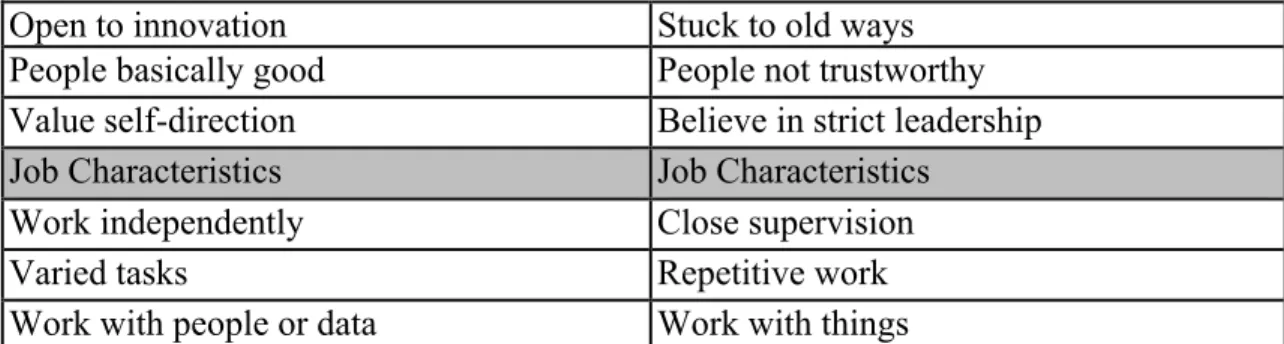
1. Typical Class Patterns in Parental Values and Occupations……… 42
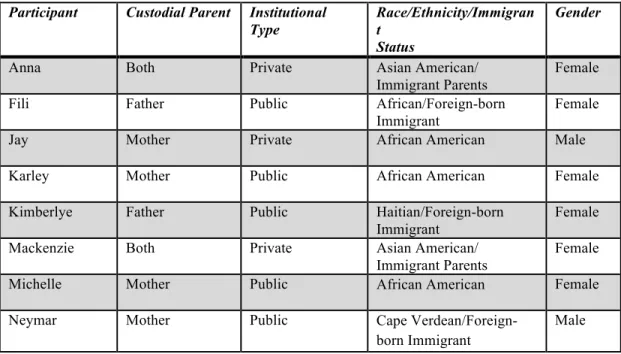
2. Study Participants’ Demographic Profiles……… 87
1 CHAPTER 1 INTRODUCTION
First-generation college students face multiple barriers on the road to degree attainment in higher education. Much of the existing research on the challenges first-generation students face has considered this population from a deficit framework, examining what students lack in terms of academic preparedness or parental knowledge of college. Few studies have addressed specifically the role social class plays in the transition to higher education for first-generation students from working-class
backgrounds. As college is widely considered to be the path to a better life or upward mobility, it is important to understand how a working-class background shapes the academic and social experiences of first-generation students during the college transition process.
My Story
I am a first-generation, low-income college student, an identity I held long before this subpopulation became a focus in higher education research. It was not until the first few weeks of my doctoral studies that I began to fully make sense of my own experience and to articulate for the first time the impact of this identity on my personal and
2
Blue-Collar Roots, White-Collar Dreams (2004), and the pieces of my own story began to tumble together as a cohesive narrative.
I grew up in a small Missouri town in the Ozarks, closer to the Arkansas border than to any city. I was the third of four children and the first to attend college. My father was an auto mechanic, who claimed to have a high school diploma although there was never evidence of such; my mother had a high school diploma but never worked outside the home, providing in-home childcare instead to local families. Neither my maternal nor paternal grandparents had high school diplomas, although my maternal grandparents owned and operated a country market, gas station and garage for many years, living comfortably enough to buy a new Cadillac every decade and take my brothers and me on vacations around the country.
I was a high-achieving student throughout my elementary and secondary education. By my senior year of high school, I held positions of editor of the yearbook and editor of the school newspaper, and I participated in speech and debate, winning championships in extemporaneous speaking throughout Missouri. I finished in the top 3 percent of my class of nearly 200, and although I worked hard, it seemed academic success came easily to me. After attending both the Democratic and Republican presidential nominating conventions as a junior reporter, I decided journalism was my life’s calling. With little help from my high school guidance counselor (or anyone else), I used a book to find the country’s top three schools for journalism – Columbia University, Northwestern University, and University of Missouri. When I learned Columbia
3
schools. This was the extent of my college selection process. My parents offered no guidance, and I had no one to consult, emulate or model.
I was accepted to both Northwestern and Missouri universities. My grandparents drove me to Northwestern for an interview and tour for prospective students, and I thought I would die if I didn’t get to go to this beautiful school on the shores of Lake Michigan. I began Northwestern with high hopes, boundless pride, and immense naivety. Mike Rose in Lives on the Boundary (1989) eloquently expresses what soon came to define my Northwestern experience:
You are finally sitting in the lecture hall you have been preparing to sit in for years. You have been the good student, perhaps even the star – you are to be the engineer, the lawyer, the doctor. Your parents have knocked themselves out for you. And you can’t get what some man is saying in an introductory course. You’re not what you thought you were. The alien voice of the lecturer is telling you that something central to your being is, after all, a wish spun in the night, a ruse, and the mist and vapor of sleep. (p. 174)
I was totally and completely unprepared for Northwestern in every respect – academically, socially or financially. I was a full-ride scholarship kid with a suitcase of homemade clothing. I had never heard of Dean sweaters, Sperry topsiders, Lanz
nightgowns, or East Coast boarding schools. I bought my clothes at JC Penney twice a year; my typewriter was the most expensive thing ever bought just for me. I remember my mom and dad driving me to Chicago that first fall. After unpacking the car, we started to say our goodbyes. My dad, never one for many words, said: “I wouldn’t trade my 40
4
acres of farmland for this whole mess up here. But if this is what you’ve got to do, this is what you’ve got to do.”
And so it began -- the bifurcated and bicultural existence of a country girl in an elite educational institution. I didn’t develop into the academic I hoped to become, and I’ve reflected over and over again about why this was the case. I felt inadequate in the classroom. While speech and debate tournaments had given me confidence in high school, this soon dissipated in the classrooms of Northwestern. Everybody seemed more academically prepared than I. The vocabulary of learning was overwhelming, and I did not know how to admit that nor did I know how to solve it. I seldom visited a professor’s office, fearful of being exposed as not worthy of being there; I took courses with
renowned scholars and experts in their field of research or practice, never taking
advantage of access to such individuals. For example, I took astronomy with a professor who was famous for work with UFOs and a consultant to the classic movie Close Encounters of the Third Kind. I was captivated by his lectures, and I was aware of the magnitude of being taught by him, but that’s where I left it. I never engaged with my professors or coursework on a deeper level. I shied away from academic clubs or activities, and I skated by with mostly B’s, a few A’s and a few C’s. I completed my “teaching newspaper” requirement by living away for a semester and working in a newsroom. Certainly high school taught me that I could work hard and read and write well, yet I had no context for what to expect of college. All the accomplishments in high school had done little to help me understand the true rigors of classroom learning.
5
The learning outside the classroom was equally consuming. I began to realize that I was poor, not even middle class. My mom was babysitting children in our home to pay for my educational expenses beyond tuition and board paid through my full-ride
scholarship. I had work-study, and I soon realized that labeled you as a student with significant financial need. I began to feel ashamed of my background, and that
confounded me. Everyone’s parents were educated, or so it seemed, and I couldn’t bring myself to tell the girl whose dad was chair of the General Mills’ coffee division that my dad was an auto mechanic. I vacillated between missing home and avoiding talking about home, and I became adept at listening to people while not sharing my story. I could be self-effacing about coming from Mayberry RFD, as my friends called my hometown, and I could be funny as the girl who said “pee-in” instead of “pen” for a writing utensil.
Subconsciously I must have determined that fitting in socially was easier than fitting in academically. Perhaps I even hoped that one would lead to the other; if I belonged, everything else would fall into place. I engaged in the ritual of sorority rush, pledging one of the most popular houses on campus. Sorority and fraternity houses at Northwestern are located on campus, nestled among the residence halls in beautiful quads, and the Greek system at the time was large (for a school with a total
undergraduate population of 3,000) and very active. In many respects, sororities and fraternities provided an outlet to counterbalance the academic rigor of the school. There were no bars or local haunts in Evanston, a dry town that was home to the Women’s Christian Temperance Union and its lasting and memorable slogan, “lips that touch liquor shall never touch mine.” I had no predisposition or opinion about sororities and
6
fraternities; they were housing and social networks to me. I became an officer and leader within that group, and I developed a sense of belonging that I so desperately needed. I enjoyed tailgate parties, Big 10 football games and trips into the city; I never tired of the beauty of the campus and Lake Michigan.
I entered Northwestern with much confidence and even more naivety; I left with little self-assurance and a huge dose of reality. My dreams of becoming a television reporter and anchor were overshadowed by my fear of failure. My bravado was gone, replaced by this feeling that I was an imposter. All those achievements and awards in high school were just luck or the result of being a big fish in a little pond. They certainly didn’t mean anything once I left the Ozarks. Instead of validating me as a learner, Northwestern left me questioning my worth and my intelligence; the overachiever label no longer applied to me. Of course I could not articulate this at that time, but I knew something significant had occurred because everything shifted. I began to make safe decisions; I chose public relations instead of journalism. I was afraid of rejection and, more importantly, I was afraid that others would find out I was an imposter. There was a presumption that those who attended Northwestern were smart, destined for achievement. What if it was discovered that I was a marginal student at Northwestern or that I really hadn’t belonged there. I was uncomfortable with the expectations of a graduate of the Medill School of Journalism at Northwestern; I was simultaneously aware of the privilege automatically granted to a graduate of an elite educational institution.
It has taken me years to process my own college experience and to take pride in my working-class background. I am keenly aware of the social class boundary I crossed
7
through education, yet in many ways I continue to struggle to reconcile my bifurcated existence. As hooks (2000) wrote,
When I chose to attend a “fancy” college rather than a state school close to home, I was compelled to confront class differences in new and different ways. Like many working-class parents, my folks were often wary of the new ideas I brought into their lives from ideas learned at school or from books. They were afraid these fancy ides like the fancy schools I wanted to attend would ruin me for living in the real world. At the time I did not understand that they were also afraid of me becoming a different person – someone who did not speak their language, hold on to their beliefs and their ways. They were working people. To them a good life was one where you worked hard, created a family, worshiped God, had the occasional good time, and lived day to day. (p. 143)
There are many qualities that my working-class culture of origin has bestowed upon me. I do not shy away from hard work, and a strong work ethic remains one of my greatest assets. I have strong love for family and community, and I appreciate the
simplicity of a rural existence. I am more often than not resilient in the face of challenge, and I move easily within different social classes. There is no denying that a college degree changed me but not my foundation, my roots. Ultimately, telling the stories of first-year college students from working-class backgrounds as they experience the transition to college allows me to be the researcher, the observer and the participant.
Background
first-8
time freshmen enrolled from 1994-2008 and another 17 percent increase anticipated by 2019 (Hussar & Bailey, 2009). First-generation college students, commonly defined as those whose parents have no formal education beyond high school, comprise
approximately 24 percent of all undergraduate college students. According to Engle and Tinto (2008), 4.5 million first-generation, low-income college students were enrolled in higher education in 2008. Data from the 1995-1996 Beginning Postsecondary Study show that first-generation students comprise 47 percent of all entering college students, with 73 percent of those choosing to attend two-year institutions. At four-year colleges, 34
percent of the entering student population is first-generation (Choy, 2001; Engle, 2007). Regardless of the increase in participation in higher education, first-generation students earn degrees at a lower rate than continuing-generation students. Although various definitions of first-generation students in the literature make it difficult to report consistent numbers, persistence to degree completion is a major focus in first-generation research. First-generation, low-income (family income below $25,000) students are nearly four times, 26 percent versus 7 percent, more likely to leave college after the first year when compared to those students who are not first-generation and low-income (Engle & Tinto, 2008); within six years, 43 percent of the low-income, first-generation students leave college without a degree, compared to 20 percent of continuing-generation students. At four-year institutions, 29 percent leave without a degree, compared to 13 percent of continuing-generation students. Ishitani (2006) found that students whose parents had no college experience were 8.5 times more likely to leave college than continuing-generation students.
9
Researchers have considered many issues that contribute to the lack of persistence to degree attainment, including pre-college characteristics as well as in-college
experiences for first-generation students. Among pre-college characteristics, Engle (2007) cites lack of academic preparation, lower educational aspirations, less parental encouragement and support to attend college, less knowledge about the college application process, and fewer financial resources as factors that impact decisions to attend and prepare first-generation students for college. Regarding in-college
experiences, Pascarella, Pierson, Wolniak, and Terenzini (2004) posit “being a first-generation student confers its greatest liability in adjustment to, and survival in, postsecondary education” (p. 429). Academic and social integration, long considered important for adjustment to college, poses specific difficulties for first-generation students (Bui, 2002; Engle, 2007; Pascarella, Wolniak, Pierson & Terenzini, 2003; Terenzini, Springer, Yaeger, Pascarella & Nora, 1996). Baker and Velez (1996) define academic integration as the ability to meet academic demands and participate in formal academic structures of an institution; social integration refers to the way in which students become involved in the formal and informal social systems of a campus, including extracurricular activities and residential housing.
Challenges associated with academic and social integration may be symptomatic of a much larger cultural adaptation barrier for first-generation students hoping to integrate into the campus (Berger, 2000; Engle, 2007; Kuh & Love, 2000; Lehmann, 2007). Billson and Terry (1982) describe the transition to college as more difficult for first-generation students, suggesting that first-generation students “are making a longer
10
jump from the social status of their parents than are second-generation students” (p. 18). With a disproportionate share coming from lower socioeconomic backgrounds (Saenz, Hurtado, Barrera, Wolf & Yeung, 2007), first-generation, low-income students struggle to reconcile the difference in the culture (norms, beliefs, values, and expectations) of their working-class heritage with the pervasive middle-class culture on a college campus (Engle, 2007; Kuh & Love, 2000; Lehmann, 2007; Nunez & Cuccaro-Alamin, 1998). Lehmann (2007), in a study of social class and first-generation students, noted that working-class status forces students “into position of cultural outsiders with problems connecting to their wealthy peers and integrating into university life, which ultimately leads to crises in competency and fears of academic inadequacy” (p. 91).
The relatively small amount of research on social class and higher education suggests that first-generation students, many of whom come from working-class backgrounds, encounter considerable difficulty through the transition experience to the college culture (Lehmann, 2007). Kuh and Love (2000) describe college culture as the widely accepted ways of doing things that shape how people think and behave and that others must adopt the norms and attitudes of. Given the complexity of campus culture, it is important to consider the many ways in which culture is demonstrated on a college campus (Museus, 2007). According to Jayakumar and Museus (2012), “the norms, values, practices, beliefs, and assumptions that comprise a campus’s culture manifest symbolically in various institutional missions, traditions, language, physical structures, artwork, media representations, interactions and other artifacts” (p. 7).
11
The significant disparity between the working-class culture of first-generation students and the college culture can produce cultural discontinuity and dissonance fraught with uncertainty, risk, and complexity (Lehmann, 2004; Lehmann, 2007). Richardson and Skinner (1992) contend first-generation students found this “exposure to campus as a shock that took them years to overcome” (p. 33). Engle (2007) and Terenzini et al. (1996) suggest the pressures and conflicts of transitioning to the dominant campus culture cause intense feelings of isolation, estrangement, confusion, guilt, and anguish for
first-generation students. Researchers have considered the incongruence resulting from a student’s cultural norms and the college’s cultural norms among students of color (Jayakumar & Museus, 2012; Museus, Lam, Huang, Kem & Tan, 2012; Nunez & Cuccaro-Alamin, 1998) and have identified cultural dissonance, or tension, that is inversely related to the likelihood of success. Rendon (1992), in her own narrative as a first-generation minority student, described the debilitating effects of this cultural navigation or transition as intense conflicts and problems “that arise from [living] simultaneously in two vastly different worlds while being fully accepted in neither” (p. 56).
While the above research has considered the transition experience for students of color, similar cultural challenges and related dissonance are relevant to first-generation students, many of whom come from working-class backgrounds. LaFromboise, Coleman and Gerton (1993) suggest that those living in two cultures can experience a “divided self” (p. 395). Park (1928) and Stonequist (1935) posit that those who live in two cultures are marginal people. The marginal human theory, as it is known, suggests that bridging
12
two cultures is a complex proposition that leads to “ambiguity, identity confusion, and normlessness” (LaFromboise et al., 1993, p. 395).
Problem Statement
The transition to the dominant culture of a college campus often leaves first-generation students from working-class backgrounds living in two worlds. Early theories regarding college transition advance the premise that successful integration, albeit a desired outcome, can only be realized when students abandon their culture of origin, viewing it as a limitation to be overcome. Tinto (1987, 1993) places culture at the center of integration, suggesting that students must separate from their culture of origin,
transition to the dominant culture of campus, and assimilate or establish membership in campus subcultures to succeed (Museus et al., 2012). The dominant culture of college, however, is “built and organized according to taken for granted middle- and upper-class cultural norms, unwritten codes, or ‘rules of the game’” (Stephens, Fryberg, Markus, Johnson & Covarrubias, 2012, p. 1178) that are foreign to working-class culture of origin inherent in many first-generation students.
Much of the existing literature on first-generation college students mirrors Tinto’s theory and is grounded in a deficit approach, blaming the student for not having the necessary pre-college characteristics, for lacking cultural and social capital, and for not integrating sufficiently into the dominant campus culture (Engle, 2007; Kuh & Love, 2000; Lehmann, 2007; Nunez & Cuccaro-Alamin, 1998). Although research exists broadly regarding the academic, social and cultural transition to college (Bui, 2002; Engle, 2007; Pascarella et al., 2003; Terenzini et al., 1996) little has been done to
13
examine the transition process for first-generation students navigating between a
working-class culture of origin and the more privileged middle-class culture of campus. Studies have shown that cultural dissonance is inversely related to the likelihood of success for students of color (Jayakumar & Museus, 2012; Museus et al., 2012; Nunez & Cuccaro-Alamin, 1998). Cultural mismatch, or the tension created when a student’s culture of origin and the new culture of college clash (Stephens et al., 2012), also is inversely related to high retention and persistence for first-generation students from working-class backgrounds. The cultural mismatch as a result of social class background is often overlooked by colleges and universities when creating programs and developing tools aimed at student transition (Stephens et al., 2012; Ward, Siegel & Davenport, 2012).
Significance of the Problem
U.S. higher education boasts one of the greatest participation rates in the world (Engle & Tinto, 2008), and the number of students from historically underrepresented populations, including low-income, first-generation, continues to increase. Despite greater access to higher education, degree attainment for first-generation students
continues to lag behind, particularly since the likelihood of attending and graduating from college is strongly correlated with parental education (Engle & Tinto, 2008; Pascarella et al., 2004; Saenz et al., 2007). Calling this a “critical population of students to study” (p. 1), Saenz et al. (2007) cite poorer academic preparation, different motivations for enrolling in college, varying levels of parental support and involvement, different
expectations of their college experience, and significant obstacles relative to retention and academic success as reasons why first-generation students face unique challenges in
14
higher education (McDonough, Korn, & Yamasaki, 1997; Pascarella et al., 2004; Thayer, 2000).
This topic is significant not only because it concerns first-generation students but also because it reframes transition from a problem of pre-college characteristics to a problem of cultural transition. Theories of cultural transition have been applied to various populations associated with underrepresentation and lower persistence rates in higher education, but little research has applied these principles to the unique circumstances of first-generation college students (Lohfink & Paulsen, 2005; Walpole, 2003). Kuh and Love (2000) advocate for a deeper examination into how cultural forces such as families, neighborhoods, ethnic and racial groups, social classes, churches and schools influence decisions to leave higher education. As higher education operates in an environment demanding greater accountability for student completion outcomes, institutions will need to identify ways to facilitate the cultural transition of first-generation students, a
population expected to top 10 million by 2018 (Hussar & Bailey, 2009).
Scholars have challenged Tinto’s (1987, 1993) theory of retention on many levels, primarily in the context of cultural integration and assimilation by racial and ethnic groups into the dominant culture inherent in most higher education institutions. Such scholarship has provided greater understanding of institutional barriers that preclude full participation by these students, and the research continues to evolve and inform practice for students of color. Understanding the cultural challenges for first-generation students, who come from working-class backgrounds and who may have intersecting identities with students of color, also will add to an understanding of institutional barriers as well as
15
inform practice. The absence of social and cultural capital has been associated with the lack of persistence among first-generation students, blaming the individual and
reinforcing a deficit-minded approach to explain the lower levels of degree attainment by this student population.
Musoba and Baez (2009) contest the way in which cultural and social capital are depicted in higher education research, positing these concepts are used may be a
misrepresentation of Bourdieu’s work concerning economic, social and cultural capital and Coleman’s work regarding social capital. Conflating these theories into a single reference suggests that cultural and social capital are items to be given to students, and, once given, students will survive and thrive (Musoba and Baez, 2009). This conflation also presumes individual agency by students, or lack thereof, and fails to account for structural barriers associated with social class that are embedded in Bourdieu’s theory (Musoba & Baez, 2009). Musoba and Baez (2009) argue:
The translation of a theory of classes into one of individuals hides more than it tells, and does more than it wants, for it obscures the ways in which class structures get formed and reformed in the United States, as well as how
individuals, while not completely determined by such structures, are nevertheless constrained by them. (p. 153)
Considering cultural and social capital as individual deficiencies rather than a result of social class obscures the problem of class structures and struggles (Musoba & Baez, 2009).
16
An examination of working-class culture as a factor that impacts transition to college has yet to be explored with any depth within U.S. higher education, in part because discourse on social class is not as prevalent as that on income, race or ethnicity. Working-class culture of origin is not synonymous with income; studies that consider the experience of students from low-income backgrounds, while important, are not wholly representative of this cultural problem. According to Stevens, Armstrong and Arum (2008), education has long-been associated with stratification in society. Rather than providing the espoused upward mobility, it acts as a “social sieve” both constraining and facilitating social opportunity along social class lines. Despite the positive correlation between college completion and occupational attainment, the significant differences in college completion among first-generations students reinforces the premise that
“attainment itself was greatly, though not entirely, determined by family background” (Stevens et al., 2008, p. 129). Access to college, Stevens et al. (2008) further contend, is not enough: “Acquiring appropriate cultural accouterments requires time and money, both of which are often in short supply among first-generation college students” (p. 133).
Cultural dissonance, or the bifurcated experiences of first-generation students who reside in two vastly different cultures, has increasingly entered into the discourse.
Although creating culturally responsive college environments is crucial, Kuh (2002) contends, it is not the structural or organizational properties that lead to premature departure; it is the student’s meaning making of those systems. Meaning making is defined by three tenets: values, assumptions and beliefs about what to expect from college; the role of being a college student; and the value of a college degree. Those with
17
less informed meaning making systems will likely have vague or inaccurate notions of college (Kuh, 2002). Students try to understand this new environment using an
interpretive scheme or sense-making system developed through experiences in their cultures of origin. According to Kuh (2002),
For some students the cultural distance is negligible because college going was stitched into the fabric of their cultures of origin. That is, their cultures of origin effectively prepared them to expect and deal with the institutions’ values, attitudes, beliefs, assumptions, and expectations. Other students must travel a great distance, an experience that can be arduous, threatening, and intimidating. (p. 204)
This shifting between the culture of origin and the institution’s culture creates stress and is believed to contribute to the decision to depart (Kuh, 2002).
Broadly, the role of culture in transition has entered the lexicon for higher education research among students of color. A greater understanding of the cultural transition for first-generation students from working-class backgrounds also may illuminate ways to decrease cultural dissonance for this group and, thereby, increase persistence to degree attainment. Studies of transition as a non-linear, developmental process that involves renegotiation of roles and relationships (Anderson, Goodman & Schlossberg, 2011; Evans, Forney, Guido, Patton & Renn, 2010) are scant in the higher education literature. Kralik (2002) and Kralik, Visentin and van Loon (2006) portray the transition process not as one of steps but as a cyclical and recurring process that involves meaning making. Kuh (2002), in advocating for greater attention to cultural transition,
18
asked how much institutions should expect students to change their values, attitudes, perspectives, and beliefs. For some students, only minor adjustments allow them to fit into an organization’s culture; for others, “the magnitude of adjustment is substantial and threatens to cut them off from their cultures of origin” (Kuh, 2002, p. 209).
First-generation students enter college with the knowledge that a degree – regardless of how desired – changes them, makes them different from their families.
This study intends to add new considerations to the body of knowledge
surrounding social class in higher education. Specifically, the study explores the ways in which first-generation students from working-class backgrounds experience the college transition process. To accomplish this, my research examines the ways in which first-generation students perceive their working-class backgrounds, or cultures of origin; the ways in which these students experience the academic and social environments of college; and the ways in which they begin to navigate two distinct cultures. Drawing from literature on transition and biculturalism, defined as possessing or existing in two cultures, this study investigates the ways in which first-generation students from
working-class backgrounds make meaning of the college transition experience in relation to their social class.
Research Questions
The purpose of this qualitative study is to explore the ways in which working-class culture shapes the college transition process for low-income, first-generation students at a four-year public and a four-year private institution. For purposes of this research, first-generation is defined as those students whose parents or guardians have a
19
high school diploma or less education, and working-class will be characterized by the same parental education level; low-income will be defined as Pell Grant eligible. All definitions are explored in more depth later in this section.
Primary research question:
How do first-generation, low-income students from working-class backgrounds experience the cultural transition to college?
Sub-questions:
● In what ways do first-generation students perceive their working-class backgrounds?
● In what ways do first-generation students from working-class backgrounds
experience the academic environments of college?
● In what ways do first-generation students from working-class backgrounds
experience the social environments of college?
● In what ways do the academic and social college experiences of first-generation students from working-class backgrounds shape their academic and social transition process?
● In what ways do first-generation students from working-class backgrounds make
meaning of the transition process?
Definition of Key Terms
One of the problems inherent to research on first-generation students is the complexity or even impossibility of identifying a universally accepted definition of who is a generation college student (Davis, 2010). Many researchers define
first-20
generation as a student for whom neither parent has any higher education experience (Lohfink & Paulsen, 2005); others define first-generation as students with neither parent earning a bachelor’s degree (Davis, 2010; Nunez, 2005; Martinez, Sher, Krull & Wood, 2009). The National Education Longitudinal Study (NELS:88), which is referenced by many researchers conducting quantitative studies on first-generation students, divided students into three categories: those whose parents had a high school diploma or less; those whose parents had some college; and those with at least one parent with a bachelor’s degree or higher.
Davis (2010) advocates for a straightforward definition of first-generation as those students for whom neither parent nor guardian has obtained a bachelor’s degree. He further contends the lack of a consistent definition leaves higher education with an
incomplete picture of first-generation students, resulting is less advocacy for this group overall. According to Davis (2010),
First-generation student status is not about the number of years a parent attended college or the number of academic units that a parent accumulated. It is about being competent and comfortable navigating the higher-education landscape, about growing up in a home environment that promotes the college and university culture. The latter perspective is what non-first generation students have when they begin their postsecondary education. In other words, the absence of the non-first-generation student experience is what non-first-generation student status is all about. (p. 4)
21
unverifiable, Davis (2010) posits that identification of first-generation status is as significant as ethnic-minority status -- also reliant on self-disclosure -- to institutional programming and support initiatives.
Ward et al. (2012), while acknowledging the complexity of defining first-generation, support the more narrow definition of first first-generation, or those students whose parents or guardians have no education beyond high school. Although this definition may deflate the actual number of students who qualify as first-generation college students, Ward et al. (2012) contend these are the students in most need of specific attention as they enter college. While the trend is to define first-generation narrowly as Ward et al. (2012), my study will adhere to the less strict definition of first-generation as presented by Davis (2010), that neither parent has earned a bachelor’s degree.
Despite the complexity of defining first-generation, the National Center for Education Statistics (NCES) along with other higher education scholars have continued to use large data sets to create a profile of generation students. Generally, first-generation students are more likely to be female (Chen, 2005; Ishitani, 2003); an ethnic minority (Choy, 2001; Ishitani, 2006; Bui, 2002); from lower-income families (Chen, 2005; Bui, 2002; Housel & Harvey, 2010); and speak a language other than English at home (Bui, 2002). Additionally, much of the research on first-generation college students has been derived from analysis of large datasets and has been focused in one of three areas: comparing the pre-college characteristics of first-generation to
22
from high school to college; and exploring various other factors related to persistence and graduation rates (Pascarella et al., 2004). Research into the cultural experience of first-generation students also has begun to emerge through qualitative research.
Finally, low-income and first-generation are not interchangeable terms, although they are often used together in studies comparing outcomes to students who are neither first-generation nor low-income (Has-Vaughn, 2004; Davis, 2010). According to Davis (2010), some first-generation students are low-income (below $25,000), some are students of color, and some are White. Nunez and Cuccaro-Alamin (1998), through an analysis of data from National Center for Education Statistics (NCES), reported that 18 percent of first-generation students had family incomes from the lowest quartile while 2.2 percent of continuing-generation students identified with the lowest income quartile. Although this is a considerable difference, it is important to note that nearly 57 percent of first-generation students reported family income in the two middle quartiles, and 25 percent reported family income in the highest quartile (Nunez & Cuccaro-Alamin, 1998). Hahs-Vaughn (2004), acknowledging that first-generation families report less income overall, noted that low-income, first-generation students face different challenges and barriers than do first-generation students who are not low-income (Lohfink & Paulsen, 2005). Similarly, Gupton, Castelo-Rodriguez, Martinez and Quintanar (2009) report many working poor families have experiences akin to first-generation students although these are not homogenous groups. Throughout this literature review, studies directed specifically at first-generation, low-income will be identified as such; studies limited to the broad category of first-generation students will be thusly noted along with the study’s
23
definition of first-generation. For purposes of my research, students will be low-income, first-generation. Low-income will be defined by eligibility for a Pell Grant, or by meeting the federal standards for need-based financial aid that does not need to be repaid.
Defining working class and, subsequently, working-class culture is equally complex. Socioeconomic status (SES) and social class are often used interchangeably as ways to distinguish social groupings (APA, 2006). While social class has often been associated with boundaries established from birth, SES is a broader measurement of education, occupation, and income, all of which determine social standing or class (APA, 2006; Cohen, 2009; Coleman, 1983). The distinctions between SES and class are
complex and dynamic. Although individuals may achieve different SES over a lifetime, particularly through educational attainment, the relations among social classes remain constant (APA, 2006; Coleman, 1983). Gilbert (2011) contends SES is reliant on prestige of occupation and social standing while social class is a group of equal rank but differentiated from others by characteristics such as occupation, prestige or wealth.
Although education, occupation and income are associated with both SES and class, educational attainment is often used as the most common distinction between social classes, according to Stephens, Markus and Townsend (2007). In the simplest of
definitions, working-class individuals do not have a four-year bachelor’s degree; middle-class and above do (Stephens et al., 2007). Vander Putten (2001), drawing from literature around social class and higher education, proffered the following description of working-class students:
24
Both parents possess an education level of high school or less; the student had low-income status during childhood and through their undergraduate college years; parent(s) work in blue-collar occupations, e.g. farmer, maid, coal miner, factory worker, manual laborer; parent(s) and student did not participate fully in a middle-class lifestyle; the student feels distance from the middle-class lifestyle; and the student identifies with the concept of the working class. (p. 17)
The task of choosing definitions for this study was complicated as both generation and working-class are defined inconsistently in the literature. For first-generation, this challenge is due in part to the reliance on self-report; for working-class, this inconsistency is the lack of broad discussion about social class in this country. The presidential election of 2016 brought greater attention to how working class is defined, and this scrutiny led to distinctions between working class and working poor (Williams, 2016). This study did not attempt to recognize the difference between working class and working poor, although participants would fall into both categories. For purposes of this study, first-generation will be defined as having parents with no bachelor’s degree, and working class will be defined by income and type of job held by parents.
25 CHAPTER 2
REVIEW OF LITERATURE
First-generation college students comprise a growing number of those entering higher education, yet these students continue to lag behind second- or continuing-generation students in their degree attainment. A considerable amount of the existing research on the experiences and outcomes of first-generation college students explores the social and cultural transition to higher education from a deficit standpoint and presumes that a successful transition is a precursor to persistence and degree attainment (Engle & Tinto, 2008). While much of the extant literature addresses the lack of cultural and social capital as reasons for this gap in degree completion, recent research has begun to explore more deeply and specifically the role of social class as a factor in hindering degree attainment. An overview of class and socioeconomic status in relation to culture of origin opens the second literature area of this review. The norms, values and beliefs that embody working-class culture will be explored to provide greater understanding of this cultural frame and its influence on transition to college for first-generation students. Similarly, the campus culture and what is privileged within will be examined to identify factors that may preclude an inclusive and successful transition for first-generation students. A deeper examination of transition as it relates to home culture in contrast to campus culture should illuminate the unique challenges faced and cultural dissonance
26
encountered by first-generation students. This literature review concludes with an examination of the conceptual framework for the proposed study. By aligning elements from three theoretical frames – habitus as presented by Bourdieu, transition as a meaning-making process, and biculturalism as a desired outcome of successful transition – the foundation for this research will be established.
Experiences and Outcomes for First-Generation Students
Transition to college presents unique and difficult challenges for first-generation students, and no single theory provides the template through which to view their
transition. Much of the recent research on first-generation college students has been focused in one of three areas: comparing the pre-college characteristics of first-generation to other college students; understanding the transition experience from high school to college; and exploring factors related to persistence and graduation rates (Pascarella et al., 2004). Despite these categorizations, much crossover remains within the existing literature on first-generation college students, leaving little research focused exclusively on one of these categories and leaving much room for additional research on the
experiences of first-generation students. Additionally, much of the research has analyzed large datasets to glean information; fewer qualitative studies have been undertaken to explore the experiences of first-generation students. Emerging research, however, focuses less on characteristics of first-generation students and more on interventions intended to impact retention and persistence.
Pre-College Characteristics and Comparisons to Others
27
first-generation college students. They are more likely to be female (Chen, 2005; Ishitani, 2006); to be a member of an ethnic minority (Bui, 2002; Choy, 2001; Ishitani, 2006); to be from a lower socioeconomic status (Bui, 2002; Chen, 2005); and to speak language other than English at home (Bui, 2002). Thayer (2000) and Chen (2005) found these students were more underprepared for college; more than half, or 55 percent, needed remedial coursework, compared to 27 percent of continuing-generation students (Chen, 2005). Furthermore, Chen (2005) further found that first-generation students scored lower on standardized tests and, overall, fewer (59 percent vs. 29 percent) took standardized admission tests, such as SAT and ACT. In addition to enrolling more frequently in two-year institutions (Chen, 2005), first-generation students who enroll in four-year institutions tend to choose less selective institutions (Pascarella et al., 2004).
Lower aspirations among first-generation students may be responsible for this failure to pursue a post-secondary education. Engle (2007) found that only 53 percent of the first-generation students expected to earn a bachelor’s degree compared to 90 percent of the continuing-generation students. Similarly, 91 percent of continuing-generation students planned to enroll in college immediately after high school while only 68 percent of first-generation students planned to go straight to college. According to Engle (2007), even among academically qualified first-generation students, 25 percent fail to enroll in college two years after high school graduation, compared to 5 percent of continuing-generation students who fail to enroll within two years.
Lower aspirations among first-generation students who attend and complete college are often associated with or attributed to differences in family support (London,
28
1989; Nunez, 2005). Hossler, Schmit and Vesper (1999) distinguished between parental encouragement, or how often parents talked to their children about college, and parental support, or how often parents became involved in the college search and admissions process. First-generation students reported much less encouragement and support – both factors associated with college aspirations (Hossler et al., 1999; Engle, 2007). Vargas (2004) defines encouragement and support as a form of “college knowledge,” or
“information and advice about college preparation, financial aid, and planning” (p. 3). A recent report reviewing 35 years of data collected through the Cooperative Institutional Research Program, the Higher Education Research Institute at UCLA, offers a slightly different assessment of parental support. Saenz et al. (2007) contend that since 1971, the number of first-generation students who claim parental encouragement as a reason for attending college has more than doubled.
Vargas (2004) notes that a lack of college knowledge is prevalent among minority, low-income and first-generation college students -- populations that need intensive guidance to navigate the higher education process. Continuing-generation college students receive this knowledge from their parents, putting them at a distinct advantage and positively impacting their aspirations for college (Vargas, 2004). Parents who have never gone to college may not understand the benefits of attending college and may be fearful of the associated costs and financial aid, thereby discouraging the process (Engle, 2007; Vargas, 2004). Misinformation about college costs and financial aid is considered one of the most significant barriers to college aspirations for first-generation, low-income and students of color (Engle, 2007; Vargas, 2004). Even with knowledge of
29
financial aid and admissions procedures, Vargas (2004) suggests these students often find it difficult to manage deadlines and paperwork required to gain admission to college.
Transition to College Experience
Once enrolled in college, first-generation students continue to face obstacles when integrating their background with the new college culture. London (1989), through a qualitative study examining the role of family in the experience of first-generation students in the Boston area, sought to understand “what is at stake – what is lost, gained, fought for, and given to compromise – when, for the first time in the history of a family, one of its members partakes of higher education” (p. 145). Many first-generation students described guilt and internal and external conflict with the process of breaking away from their families to attend college and form their own identities (London, 1989). Rendon (1992) recounted her own experience as a first-generation college student and the accompanying anguish of living in two worlds:
Subconsciously, I must have felt that the language of college did not belong in my family life. The two were separate and incompatible. Reflecting on new learning while at the same time coping with the feeling of not belonging made me more introverted (p. 58). Rather than blame first-generation students for this lack of integration, Rendon (1992) placed responsibility on institutions to acknowledge that academic success is not dependent on a total disconnect from the past for students who find themselves in the bifurcated experience through the transition to college.
In one of the earlier studies to examine transition, Terenzini, Rendon, Upcraft, Millar, Allison, Gregg and Jalomo (1994) held focus groups with132 diverse first-year
30
students at four different institution types. Although the experience of first-generation students was not the primary focus of the study, findings about this population were reported. Overall, first-generation students had a more difficult time adjusting to college than continuing-generation students, in part due to incongruence between their
expectations of themselves and their families’ expectations for them. Terenzini et al. (1994) suggested that academic, social and cultural transitions to college for
first-generation students are different from those of other students, although practices at most colleges and universities assumed little difference in students. Consequently, first-generation college students could benefit from specific types of support both inside and outside the classroom to help with this transition (Terenzini et al., 1994).
In an analysis of the National Study of Student Learning data, collected from over 4,000 and continuing-generation students, Terenzini et al. (1996) reported that first-generation students expected to take longer to graduate and received less encouragement from families to attend college. Once enrolled, first-generation students took fewer courses their first year, studied fewer hours, and took fewer humanities or fine art courses. Terenzini et al. (1996) recommended that institutions identify ways to link first-generation students with faculty and staff who could validate the students’ beliefs that they were “competent learners, that they can succeed, that they have a rightful place in the academic community, and that their background and past experiences are sources of knowledge and pride, not something to be devalued” (p. 17).
Pascarella et al. (2004) examined data from 2,500 first- and continuing-generation students who participated over a two-year period in the National Study of Student
31
Learning and concluded that the role of cultural capital is significant. “First generation students as a group have a more difficult transition from secondary school to college than their peers. Not only do first-generation students confront all the anxieties, dislocations and difficulties of any college student, their experiences often involved substantial cultural as well as social and academic transitions” (p. 250).
Nunez (2005), in a qualitative study of nine first-generation students at a large research institution, sought to understand further the role of social and cultural capital in transition. Through a variety of methods, including interviews, observation and review of journals of students in a first-year academic success course, Nunez (2005) reported that first-generation students in her study found it necessary to renegotiate their relationships with their families rather than separate from them. Students reported the importance of having resources on campus to help them navigate and acquire the bureaucratic
knowledge of college – how to register for courses, how to study, how to approach faculty. Peer advisors and mentors were considered effective mediators of social and cultural capital for generation students (Nunez, 2005). Accessible support for first-generation students as well as family orientation were two ways in which institutions could help students with the transition to the culture of college (Nunez, 2005).
Retention and Persistence
It is likely that difficulty with transition may, in part, be reflected in lower
retention and persistence rates for first-generation students, an area of increasing attention and study. Although study purposes and methodologies vary widely, research findings consistently point to lower persistence for first-generation students (Chen, 2005; Choy,
32
2001; Horn & Nunez, 2000; Lohfink & Paulsen, 2005; Nunez & Cuccaro-Alamin, 1998). Chen (2005), after examining transcripts of students who participated in the National Educational Longitudinal Study of 1988, noted that first-generation students were more likely to leave without a degree than continuing-generation students, 43 percent and 20 percent, respectively. Other indicators associated with retention and persistence
differences between first- and second-generation students included: greater need for remedial coursework during the first year, 55 percent versus 27 percent; fewer credit hours earned during the first year, 18 versus 25 credits; lower cumulative grade point averages, 2.6 versus 2.9; and increased likelihood of withdrawing from or repeating courses, 12 percent versus 7 percent (Chen, 2005). Choy (2001) reported that first-generation students were more apt to leave after the first year than were continuing-generation students. However, first-continuing-generation students who attended private institutions were more likely to persist than their counterparts at public institutions (Lohfink & Paulsen, 2005).
Adelman (2006) reported that college students overall were less likely to persist if they earned fewer than 20 credits during their first year or if they repeated or withdrew from courses. Ishitani (2003), in a longitudinal study of students at a large Midwestern university, noted that attrition occurred over time, indicating that first-generation students face risk of withdrawal throughout their college experience. Through an examination of longitudinal data from the Postsecondary Education Transcript Study of 4,427 students who initially enrolled in college 1991-1994, Ishitani (2006) further investigated the attrition among first-generation college students, paying specific attention to the timing of
33
both withdrawal and graduation rates. First-generation students were 51 percent less likely to graduate from college in four years and 32 percent less likely to graduate in five years than their continuing-generation peers; students whose parents had no college experience were 8.5 times more likely to drop out than second-generation students (Ishitani, 2006). Ishitani (2006) identified the second year of college as the time when attrition was highest among first-generation students, noting that the drop out rate continued to be higher overall for first-generation compared to continuing-generation students when considering six-year graduation rates.
While lower levels of social and academic integration among first-generation students are attributed to many factors, including demographic ones described previously (academic preparation, aspirations, and family support), socioeconomic status and lack of financial resources that plays a significant role in the persistence of first-generation students. According to Chen (2005), half (50 percent) of first-generation students report family incomes of less than $25,000, compared to 7 percent of continuing-generation students. Declining financial aid and federal work-study funding, combined with a shift toward merit-based over need-based scholarship and grant funding, force many low-income, first-generation students to work while in college (Engle, 2007; Billson & Terry, 1982). Overall, first-generation students are “more likely to identify with and to be integrated into the world of work, they are more likely to put work over their studies when a conflict arises, and they are more likely to leave college before earning a degree to take a full-time job” (Engle, 2007 p. 34-35).
34
According to Engle (2007), unmet financial need increases the work burden for first-generation students, thereby limiting their academic and social integration. Lohfink and Paulsen (2005) found a positive correlation between retention and federal work-study, citing greater connections to campus faculty and staff as a by-product of on-campus work for first-generation students. Further, Lohfink and Paulsen (2005) determined that increases in financial aid (grants and federal-work study) positively impact persistence while increases in loan debt negatively impact persistence among first-generation students. Shouldering this financial burden renders first-generation students more likely to live and work off campus or to take classes part-time while working full-time (Chen, 2005, Choy, 2001; Lohfink & Paulsen, 2005). Pascarella et al. (2004) found that first-generation students who work while attending college experience stronger negative implications than continuing-generation peers, citing a direct
correlation between number of hours worked and persistence. Specifically, students who worked 1-20 hours a week persisted at higher rates than students who worked 21 or more hours a week (Pascarella et al., 2004). The downward trend of available federal student aid is unlikely to reverse, and paying for college will continue to place first-generation students from low-income backgrounds at a disadvantage.
Engle and Tinto (2008) drew upon data from three national datasets (National Postsecondary Student Aid Study, Beginning Postsecondary Students Study, and Baccalaureate and Beyond Study) to examine 4.5 million first-generation, low-income (below $25,000) students. First-generation, low-income students were more four times more likely to leave after their first year than their peers. After six years, 43 percent of