Transportation Research Procedia 14 ( 2016 ) 685 – 693
2352-1465 © 2016 The Authors. Published by Elsevier B.V. This is an open access article under the CC BY-NC-ND license (http://creativecommons.org/licenses/by-nc-nd/4.0/).
Peer-review under responsibility of Road and Bridge Research Institute (IBDiM) doi: 10.1016/j.trpro.2016.05.333
ScienceDirect
6th Transport Research Arena April 18-21, 2016
Marshall stability and flow of lime-modified asphalt concrete
Olumide Moses Ogundipe
a,*
a
Civil Engineering Department, Ekiti State University, Ado-Ekiti, Nigeria
Abstract
The purpose of highway pavement is to provide smooth surface over which vehicles can move safely from one place to another. The two major types of pavement (flexible and rigid) have been mostly selected for the highway pavement to fulfil this function and they must be capable of transferring the wheel load to the subgrade such that its bearing capacity is not exceeded. However, the flexible pavements normally show defects like rutting, fatigue failure, low skid resistance and so on, causing the pavement to fail before its design life. Therefore, it is important to modify the asphalt concrete to make it more resistant to rutting and fatigue failure. Lime-modified asphalt has been observed to have better resistance to rutting, cracking and stripping, as well as having improved aging behavior. Therefore, this study looks at the Marshall properties of hydrated lime-modified asphalt mixture and the conventional asphalt. The conventional asphalt mixture was made using 10% mineral filler while for the lime-modified asphalt, the mineral filler was replaced with hydrated lime. The bitumen with penetration grade 60/70 was used and the content varied from 5.0 to 7.5%. Marshall stability and flow tests were carried out on the samples. The results show that the Marshall stability for the asphalt concrete with mineral filler ranges from 5.89 – 7.90 kN while that with hydrated lime ranges from 5.9 to 8.2 kN. The flow values for the asphalt concrete with mineral filler range from 2.3 mm – 3.3 mm, while that with hydrated lime range from 2.4 – 3.4 mm. The optimum bitumen content for both mixtures was found to be 6.5%. The stability and flow for the mixture with mineral filler were 7.9 kN and 3.3 mm, respectively, while for the mixtures with hydrated lime they were 8.2 kN and 3.4 mm, respectively. This indicates the replacement of the mineral filler with lime improves the stability of the mixtures, while there was slight increase in the flow of the mixture with hydrated lime. The slight increase in stability and flow values may be attributed to the complete replacement of the mineral filler with lime and the high lime content used in the study. More studies are being carried out to evaluate the Marshall properties for mixture with the mineral filler partially replaced with lime and for varying proportions of the lime content in the asphalt mixture.
* Corresponding author. Tel.: Tel.: +234-810-782-5001.
© 2016The Authors. Published by Elsevier B.V..
Peer-review under responsibility of Road and Bridge Research Institute (IBDiM). Keywords:Pavement; asphalt concrete; lime; stability; flow
1. Introduction
The two principal modes of failure in pavements are fatigue cracking and permanent deformation. Engineers seek to hold these forms of failure to acceptable limits within a pavement design life. Fatigue resistance of an asphalt mixture is the ability of the mixture to withstand repeated bending without fracture. It is one of the common forms of distress in asphalt pavements and manifests itself in the form of cracking under repeated traffic loading or a series of temperature fluctuations/variation in the pavement. Fatigue cracking initiates at the bottom of asphalt base and appears on the pavement surface as interconnected tracks of different forms and it may also start at the surface and grow downwards as is the case for thermal (fatigue) cracking. Some forms of fatigue cracking include longitudinal cracking, transverse cracking, and block cracking. The published studies on fatigue resistance indicate that hydrated lime improves the fatigue resistance of asphalt mixtures in 77% of the cases (EuLA, 2010).
Permanent deformation and rutting are used interchangeably. Permanent deformation is caused by gradual build-up of irrecoverable strains under repeated loading which develop into a measurable rut (permanent depression along the wheel path). These strains are due to the visco-elastic response of bituminous materials to dynamic loading. Figure 1 shows the visco-elastic response to millions of wheel loadings. Rutting causes hydroplaning and safety concern for road users. It can develop into potholes/structural failure of the pavement if not corrected. In the past, subgrade deformation was considered to be the primary cause of rutting and many pavement design methods applied limiting criteria on vertical strain at the subgrade level also. However recent research indicates that most of the rutting occurs in the upper part of the asphalt surfacing layer. According to Brown (1997), a common misconception is that the subgrade strain criterion only refers to permanent deformation in the subgrade.
Fig. 1. Accumulated Plastic strains in Pavements (Asphalt Institute, 1996).
Eisemann and Hilmar (1987) studied asphalt pavement deformation phenomenon using wheel tracking device. They measured the average rut depth as well as the volume of displaced materials below the tyres and in the upheaval zones adjacent to them and found that, at the initial stages of trafficking, the increase of irreversible deformation below the tyre is distinctly greater than the increase in the upheaval zones and concluded that at the initial phase, traffic compaction or densification is the primary mechanism of rut development (See Figure 2a), while after the initial stage, the volume decrease below the tyre is approximately equal to the volume increase in the adjacent upheaval zones, which implies that most of the compaction under traffic is completed and further rutting is caused essentially by shear deformation, i.e., distortion without volume change (See Figure 2b). Thus, they concluded that, shear deformation is considered to be the primary mechanism of rutting for the greater part of the lifetime of the pavement.
© 2016 The Authors. Published by Elsevier B.V. This is an open access article under the CC BY-NC-ND license (http://creativecommons.org/licenses/by-nc-nd/4.0/).
(a) (b)
Fig. 2. (a) Rutting due to Densification (b) Rutting due to Shear Failure (Khan, 2008).
There are two major causes of permanent deformation, which are the use of weak asphalt and weak subgrade. The focus of this paper is on failure resulting from weak asphalt. Rutting resulting from accumulation of permanent deformation in the asphalt layer is now considered to be the principal component of flexible pavement rutting (Garba, 2002). In Nigeria, the trucks/tankers are relied on for the movement of freight (oil and gas products, finished products, raw materials etc). The increase in truck tyre pressures and axle loads put the asphalt mixtures under increasingly high stresses. Some of the factors that cause weak asphalt mixture include aggregates gradation, aggregate surface texture, voids in the asphalt mixture, air voids and the voids in the aggregate skeleton filled with bitumen, type of binder and temperature.
The problems of fatigue cracking and permanent deformation have been addressed using different approaches. These include the use of harder bitumen, better design method like the superpave mix design, the use polymer modified asphalt, the use of grouted asphalt, and the use of lime-modified asphalt, which is the main thrust of this paper.
Lime acts as active filler, anti-oxidant, and as an additive that reacts with clay fines in asphalt. These mechanisms create multiple benefits for pavements: (1) Hydrated lime acts as mineral filler, stiffening the asphalt binder and asphalt. (2) It improves resistance to fracture growth at low temperatures. (3) It favorably alters oxidation kinetics and interacts with products of oxidation to reduce their deleterious effects. (4) It alters the plastic properties of clay fines to improve moisture stability and durability. The filler effect of the lime in the asphalt reduces the potential of the asphalt to deform at high temperatures, especially during its early life when it is most susceptible to permanent deformation. The hydrated lime filler actually stiffens the asphalt film and reinforces it. It makes the asphalt less sensitive to moisture effects by improving the aggregate-asphalt bond, which improves rut resistance (Little and Epps, 2001).
The results of laboratory wheel tracking tests conducted by Collins et al., (1997) indicate that hydrated lime increases resistance to rutting and permanent deformation. LMA (2004) carried out a test to determine the dynamic modulus of lime-modified and unmodified asphalt. The comparison of lime-modified and unmodified HMA mixtures indicates that the addition of lime increases the overall dynamic modulus by about 25% Higher modulus asphalt layers reduces the irrecoverable deformation in the foundation layers because of reduced vertical stresses, resulting in less rutting in the lower layers. Kok and Yilmaz (2009) studied the effects of SBS and lime as mineral filler in hot mix asphalt. They found that the stability of unconditioned lime treated mixtures was approximately 8% higher than those of the unconditioned control mixture. However this value increased up to 21% for the conditioned mixtures. According to retained Marshall stability, they concluded that the addition of only 2% lime had approximately same effect with addition of 6% SBS with regard to moisture damage.
Mohan and Obaid (2014) investigated the effect of adding hydrated lime on the moisture damage resistance of asphalt concrete mixtures. In their study, they observed that the Marshall stability increased with increasing lime content, with rate equal to (40%) for (2.5%) hydrated lime content. Also, they reported that the air voids decreased with increasing hydrated lime content, especially at the optimum content (2%) hydrated lime. This study examines
the Marshall stability and flow of asphalt concrete with crushed stone dust (CSD) as filler and with the CSD completely replaced with hydrated lime.
2. Materials and Methods
2.1. Materials
The materials used for the research include coarse aggregates, fine aggregates, River sand, crushed stone dust (CSD), hydrated lime (HL) and bitumen. The coarse and fine aggregates were collected from Hajaig Quarry at Ikole Ekiti, Ekiti State, Nigeria The river sand was collected from Are-Afao river, Ekiti State, Nigeria. The mineral fillers used are the crushed stone dust (CSD) and hydrated lime (HL). The 60/70 penetration grade bitumen was chosen for the study.
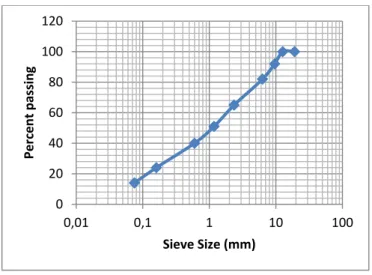
The particle size distribution curve of the blend of aggregates CSD or HL is shown in Figure 3. The dry sieving was carried out in accordance with BSI (1997).
Fig. 3. Particle size distribution for the blend of aggregates. 2.2. Methods
This study evaluates the effect of lime on the Marshall stability and flow of asphalt concrete (AC). This was achieved by preparing asphalt mixtures with CSD and another with HL and subjecting them to Marshall test. The mix composition of the asphalt concrete with hydrated lime and mineral filler is shown in Table 1.
Table 1. Mix composition for the asphalt concrete.
Material AC with lime/mineral filler
12mm aggregates 18
10mm aggregates 18
Fine aggregates 25
River sand 29
Hydrated lime (HL)/Crushed stone dust (CSD) 10 0 20 40 60 80 100 120 0,01 0,1 1 10 100 Percent pa ssing Sieve Size (mm)
2.2.1. Marshal stability and flow tests procedure
For each specimen 1200 g of the dry blended aggregates was measured. The blended aggregates were heated to 160 °C. The heated aggregate was placed in a pan and mixed thoroughly. A crater was formed in the aggregate and the 60/70 penetration grade bitumen heated to 160 °C was added. The aggregates and the bitumen were mixed thoroughly until the aggregates were well coated. The thoroughly cleaned specimen mold assembly and the compaction hammer were heated to 160 °C.
A filter paper was placed in the bottom of the mold and the mixture was placed in the mold, and spade with a heated spatula around the perimeter. The collar was removed and the surface of the mix was smoothened with a trowel to a slightly rounded shape. Temperature of the mixture immediately prior to compaction was maintained at 150°C. The collar was replaced, and the mold assembly was placed on the compaction pedestal in the mold holder, and the top of the specimen was given 75 blows. The baseplate and the collar were removed and the sample was inverted and the mold reassembled. The inverted face was also given 75 blows. After compaction, the base plate was removed and the mold containing the specimen was immersed in cool water for 2 minutes. The specimen was removed from the mold by means of sample extractor and a suitable jack and frame arrangement. The specimen was placed on a smooth, flat surface and allowed to cool at room temperature.
Density determination:The specimen was weighed in air and in clean water at room temperature. The difference between the two weights in grams was used to determine the volume.
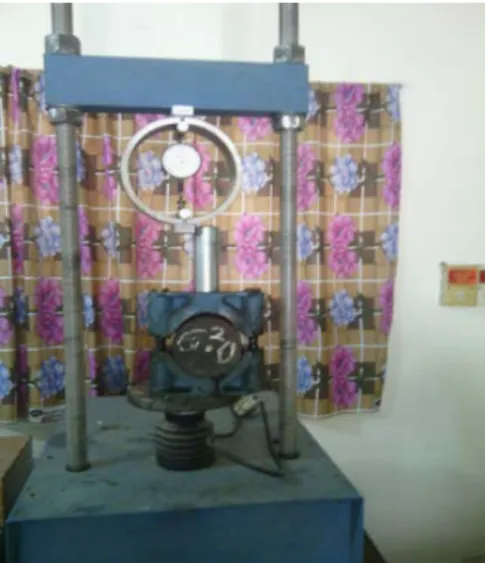
Stability and flow determination:The specimen was brought to test temperature by immersing in water bath for 20 to 40 minutes. The guide rods and the inside surfaces of the test heads were thoroughly cleaned. The guide rod was lubricated so that the upper test head slides freely over them. The specimen from the water bath was placed in the lower segment of the breaking head. The upper segment of the breaking head was placed on the specimen and the complete assembly was placed in position on the testing machine. The flowmeter was placed in position over of the guide rods and the sleeve was held firmly against the upper segment of the breaking head while the load was applied. The flow meter was adjusted to zero prior to the start of the test. The load was applied to the specimen at the rate of 50 mm per minute until the maximum load was reached and load began to decrease. The maximum load was recorded and the flowmeter was removed from its position over the guide rod the instant the load began to decrease. The flow value was read and recorded. The elapsed time for the test from removal of the sample from the water bath to the maximum load determination did not exceed 30 seconds. The Marshall stability machine with the specimen in place is shown in Figure 4.
3. Results and discussion
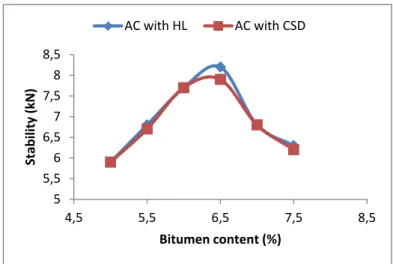
The stability test results are shown in Figure 5. The results show that the stability increases with increasing bitumen content up to the optimum bitumen content and thereafter decreases. The optimum bitumen content was found to be 6.5%. The stability of the mix with hydrated lime as the filler was found to be slightly greater than the one with crushed stone dust. The stability values of the mixtures with hydrated lime and crushed stone dust as filler at optimum bitumen content of 6.5% were 8.2 kN and 7.9 kN, respectively. It can be seen that the stability values for both mixtures met the Federal Government of Nigeria specification of not less than 3.5 kN. The results indicate that the asphalt mixture with hydrated lime has better stability than that with crushed stone dust. The increase in stability can be attributed to improved adhesion between the aggregate and bitumen. However, more tests like the indirect tensile fatigue test, four point bending test, etc, would be carried out in future studies to confirm this.
The flow values of the both asphalt mixtures against bitumen content are shown in Figure 6. It can be seen from the results that the flow increases with increasing bitumen content. At the optimum binder content of 6.5%, the flow value of the mix with hydrated lime was 3.4 mm, while that with crushed stone dust was 3. 3mm. The slight increase in flow value shows may be due to the quantity of the lime used in the mixture. However, both mixtures met the specification of the Federal Government of Nigeria for roads. It has to be said that the flow value is not a true reflection of the permanent deformation resistance of the asphalt mixtures. More tests like the repeated load axial test (RLAT), wheel tracking test etc that can evaluate the permanent deformation resistant of asphalt mixtures better would be carried out in future studies. The increase in the flow value may also be attributed to the use of hydrated lime as the only filler in the mixture. Previous studies have reported optimum value of 1.5% filler replacement with lime (EuLA, 2010).
Figure 7 shows the voids in the total mix against the bitumen content. It can be seen that at the optimum binder content, the asphalt with hydrated lime has less voids than that with the crushed stone dust. Although, hydrated lime has a higher ridgen voids than crushed stone filler, the lower voids in the mix with hydrated lime may be attributed to the improved bonding achieved as a result of asphalt surface modification and the stiffening effect. Figure 8 shows the void filled with bitumen against the bitumen content. Generally, it can be seen that the voids filled with bitumen increases with increasing bitumen content for both mixtures. Also, at the optimum bitumen content, more percentage of the voids was filled with bitumen for the asphalt mixtures with hydrated lime than that with crushed stone dust. This is expected as the mixtures with the hydrated lime has lower void in the total mix. Figure 9 shows that the bulk density increases with increasing bitumen content.
Fig. 5. Stability of the asphalt mixtures. 5 5,5 6 6,5 7 7,5 8 8,5 4,5 5,5 6,5 7,5 8,5 Stability (kN) Bitumen content (%) AC with HL AC with CSD
Fig. 6. Flow of the asphalt mixtures.
Fig. 7. Air voids in the asphalt mixtures.
2 2,5 3 3,5 4 4,5 5 5,5 4,5 5 5,5 6 6,5 7 7,5 8 Flow (mm) Bitumen content (%) AC with HL AC with CSD 1 2 3 4 5 6 7 8 9 4,5 5 5,5 6 6,5 7 7,5 8 Air voids (%) Bitumen Content (%) AC with HL AC with CSD
Fig. 8. Void filled with bitumen of the asphalt mixtures.
Fig. 9. Bulk density of the asphalt mixtures.
4. Conclusions
The study looks at the Marshall properties of asphalt mixtures with crushed stone dust and hydrated lime as filler. The objective of using hydrated lime as whole replacement for the crushed stone filler is to evaluate the effect on stability and flow used in the design of asphalt mixtures in Nigeria. It was found that the optimum bitumen content for both mixtures is 6.5%. The asphalt mixture with hydrated lime had slightly greater stability than the mixture with crushed stone dust. Also the flow value of the mixture with hydrated lime was slightly less than the one with crushed stone dust. This indicates that the hydrated lime improves the stability of the mixture while the the flow increases slightly. However, the use of the lime will have a long time effect on stability by reducing ageing of the binder.
The paper identified that the Marshall stability and flow were not sufficient to examine the fatigue and permanent deformation resistance of asphalt mixture. Therefore, future studies will consider four point bending test and RLAT
50 60 70 80 90 100 4,5 5,5 6,5 7,5 8,5 Voids filled with bitumen (%) Bitument content (%) AC with HL AC with CSD 2,3 2,31 2,32 2,33 2,34 2,35 2,36 2,37 2,38 4,5 5,5 6,5 7,5 8,5 B u lk d e n si ty ( g/ m l) Bitumen content (%) AC with HL AC with CSD
test for fatigue and permanent deformation resistance, respectively. Also further studies are being carried out to examine the use of different percentages of lime as partial replacement of the crushed stone filler.
References
Asphalt Institute, 1996. Superpave TM Mix Design. Superpave Series SP-2, Lexington, Kentucky, USA.
Brown S.F., 1997. Achievements and Challenges in Asphalt Pavement Engineering. ISAP 8th International Conference on Asphalt Pavements, Seattle, USA.
BSI, 1997. Tests for Geometrical Properties of Aggregates- Determination of Particle Size Distribution (Sieving Method). British Standard Institution, London, UK (BS EN 933-1:1997).
Collins, R., Johnson, A., Wu, Y. and Lai, J., (1997): Evaluation of Moisture Susceptibility of Compacted Asphalt Pavement Analyzer, TRB, January 12-16
Eisenmann, J. and Hilmar, A., 1987. Influence of Wheel Load and Inflation Pressure on The Rutting Effect of Asphalt Pavements - Experiments and Theoretical Investigations, Proceedings of the Sixth International Conference on Structural Design of Asphalt Pavements, Vol. 1, Ann Arbor, Michigan.
EuLA, 2010. Hydrated Lime: A Proven Additive for Durable Asphalt Pavements. European Lime Association.
Garba R., 2002. Permanent Deformation Properties of Asphalt Concrete Mixtures. Ph.D Thesis, Norwegian University of Science and Technology, Norway.
Khan K. M., 2008. Impact of Superpave Mix Design Method on Rutting Behaviour of Flexible Pavements. Ph.D Thesis, University Of Engineering and Technology Taxila
Kok B.V. and Yilmaz M., 2009. The effects of using lime and styrene–butadiene–styrene on moisture sensitivity resistance of hot mix asphalt. Construction and Building Materials 23 : 1999-2006
Little N.D. and Epps J.A., 2001. The Benefits of Hydrated Lime In Hot Mix Asphalt. National Lime Association, USA.
LMA, 2004. Using New Pavement Design Procedures for Hot Mix Asphalt Mixtures Modified with Hydrated Lime. Technical Brief.
Mohan H.M. and Obaid H.A. (2014) . Laboratory Examination For The Effect Of Adding Hydrated Lime On The Moisture Damage Resistance Of Asphalt Concrete Mixtures. Kufa Journal of Engineering 5 (2) 1-12.,