University of New Hampshire
University of New Hampshire Scholars' Repository
Master's Theses and Capstones
Student Scholarship
Spring 2007
Simple authentication and security layer
incorporating extensible authentication protocol
Myung-Sun Kim
University of New Hampshire, Durham
Follow this and additional works at:
https://scholars.unh.edu/thesis
Recommended Citation
Kim, Myung-Sun, "Simple authentication and security layer incorporating extensible authentication protocol" (2007).Master's Theses and Capstones. 270.
SIMPLE AUTHENTICATION AND SECURITY LAYER INCORPORATING EXTENSIBLE AUTHENTICATION PROTOCOL
BY
MYUNG-SUN KIM
B.S., University o f New Hampshire, 2005 B.A., University o f New Hampshire, 2005
THESIS
Submitted to the University o f New Hampshire in Partial Fulfillment o f
the Requirements for the Degree o f
Master o f Science In
Computer Science
UMI Number: 1443612
INFORMATION TO USERS
The quality of this reproduction is dependent upon the quality of the copy submitted. Broken or indistinct print, colored or poor quality illustrations and photographs, print bleed-through, substandard margins, and improper alignment can adversely affect reproduction.
In the unlikely event that the author did not send a complete manuscript and there are missing pages, these will be noted. Also, if unauthorized copyright material had to be removed, a note will indicate the deletion.
®
UMI
UMI Microform 1443612
Copyright 2007 by ProQuest Information and Learning Company. All rights reserved. This microform edition is protected against
unauthorized copying under Title 17, United States Code.
ProQuest Information and Learning Company 300 North Zeeb Road
P.O. Box 1346 Ann Arbor, Ml 48106-1346
This thesis has been examined and approved.
Thesis Director, Dr. Radim Bartos Associate Professor o f Computer Science
Scott A. Valcourt
Research Project Manager o f Computer Science
Dr. Ted M. Sparr
Professor o f Computer Science
W
\ < ~ — 73 .
DEDICATION
To my father, Young-Joo Kim to my mother, Ae-Ja Kim to my sister, Min-Sun Kim to my brother-in-law, Jong-Seog Jung
to my nephew, Sae-Jun Jung and to my wife, Sissy Kim.
ACKNOWLEDGEMENT
I would like to express my appreciation to all those who made it possible for me to finish my master thesis here at UNH.
I would like to thank my advisor, Dr. Radim Bartos, and my Research Project Manager, Mr. Scott A. Valcourt for their support, time, and helpful feedback during my master studies as well as my undergraduate studies. Their patience and their guidance throughout my whole master thesis gave me a great experience here at UNH. I also wish to thank my thesis committee, Dr. Ted M. Sparr, for his time and consideration.
Lastly, I would like to express my gratitude to the Meetinghouse Data Communication, Inc. (now part o f Cisco Systems, Inc.) and the National Institute of Justice; Datacasting Project for Project54™, for funding my graduate work.
TABLE OF CONTENTS
DEDICATION... iii
ACKNOW LEDGEM ENTS...iv
LIST OF TA B LES...vii
LIST OF FIG U R E S ... viii
ABSTRACT...ix
1 INTRODUCTION...1
2 BA CK G R O U ND ...5
2.1 Terminology... 5
2.2 Simple Authentication and Security Layer (SASL)... 7
2.3 Extensible Authentication Protocol (E A P )...9
2.4 EAP-Pre-Shared Key (EA P-PSK )... 12
2.5 EAP-Transport Layer Security-PSK (E A P-TLS-PSK )... 12
2.6 Motivations and G oals...13
3 EXTENSIBLE AUTHENTICATION PROTOCOL - ADVANCED ENCRYPTION STANDARD - PRE-SHARED KEY (EAP-AES-PSK ) 15 3.1 A pproach... 16
3.2 EAP-AES-PSK Message Flows and Packet Form at...18
3.4.1 Fragm entation... 25
3.4.2 Channel B in d in g... 26
3.4.3 Fast Reconnection...26
3.4.4 Key Strength...27
3.4.5 Number o f Message Exchanges...28
3.4.6 Tunnel Support... 28
3.5 Protections against Security R isks...28
3.5.1 Dictionary A ttack...29
3.5.2 Replay Attack... 30
3.5.3 Man-In-The-Middle (MITM) A ttack... 30
3.5.4 R e-K eying...32
3.5.5 Data E ncryption...32
4 V ERIFIC A TIO N S... 33
4.1 O utcom es... 33
4.2 E valuation... 34
4.2.1 Verification o f Functionality o f a SASL Application incorporating E A P ... 34
4.2.2 Performance Evaluation...40
5 C O N C LU SIO N ... 47
BIBLIO G RAPH Y...49
A PPENDICES... 51
APPENDIX A ABBREVIATION AND A C R O N Y M S... 52
APPENDIX B EXPERIM ENTS/USER G UIDES... 53
B . 1 Cyrus Installation... 53
B.2 Cyrus usage o f ANONYMOUS mechanism with file transfer... 54
B.3 Cyrus Password Setup (using sasldb)...54
LIST OF TABLES
2-1 Terminology... 5
3-1 Features o f Pre- Shared Key M ethods... 24
4-1 Configuration o f EAP-AES-PSK...35
4-2 95% Confidence Level Authentication Time for each M ethod...42
4-3 95% Confidence Level Completion Time in the Controlled E nvironm ent... 46
LIST OF FIGURES
1 -1 SASL Incorporating EAP Abstract Layer...4
2-1 SASL Abstract Layer...7
2-2 Authentication P ro to co ls... 9
2-3 (a) EAP Message Exchange without AAA, (b) EAP Message Exchange...11
2-4 EAP Packet F o rm at... 12
3-1 Key Setup Algorithm in EAP-AES-PSK... 17
3-2 Key Derive Algorithm in EAP-AES-PSK... 17
3-3 EAP-AES-PSK Packet Form at... 19
3-4 EAP-AES-PSK Authentication Message Exchanges...20
3-5 Dictionary A ttack...29
3-6 M an-In-The-Middle (MITM) A ttack...31
4-1 Authentication Time for each M ethod...42
4-2 (a) Server Completion Time in the Controlled Environment, (b) Client Completion Time in the Controlled Environm ent... 44
4-3 (a) Server Completion Time in the Un-Controlled Environment, (b) Client Completion Time in the Un-Controlled Environment... 45
ABSTRACT
SIMPLE AUTHENTICATION AND SECURITY LAYER
INCORPORATING EXTENSIBLE AUTHENTICATION PROTOCOL
byMyung-Sun Kim
University o f New Hampshire, May, 2007
There are many methods that support user authentication and access control, important roles in the establishment o f secure communication. Particularly, we examine Simple Authentication and Security Layer (SASL) and Extensible Authentication Protocol (EAP) and propose EAP-Advanced Encryption Standard-Pre-Shared-Key (EAP- AES-PSK). SASL is an authentication framework in connection-oriented protocols. EAP is an authentication framework providing multiple authentication methods. SASL is vulnerable to the dictionary attack, replay attack, and Man-In-The-Middle attack as well as the re-keying issue. We propose to incorporate EAP into SASL to enhance the security o f SASL and to provide a pathway for easy incorporation o f future EAP enhancements into SASL. Standalone EAP still faces some common attacks. We propose EAP-AES- PSK, a new EAP method, to provide strong authentication and we implement this method on the Cyrus SASL implementation: one o f the publicly available SASL implementations. This project is evaluated through the verification o f functionality o f a SASL application incorporating EAP. Further, we argue how the common security risks associated with SASL are addressed, and we complete a performance evaluation o f the new method
CHAPTER 1
INTRODUCTION
Authentication and access control o f users are important functions in the establishment o f secure communication. Both senders and receivers should be able to verify the identity the other party. However, successful authentication does not always occur over insecure network connections. One o f the commonly used authentication approaches is to authenticate via user identification (ID) and user password, or via host IP address. These methods are subject to the risks o f insecure communication when an intruder gains physical access o f the communication medium between users and hosts, such as what occurs in the dictionary attack, replay attack, and Man-In-The-Middle (MITM) attack. Therefore, software developers must consider network security when they design and develop network enabled software programs.
Simple Authentication and Secure Layer (SASL) [17] protocol provides a straightforward solution for the software developer without a deep understanding o f network security. SASL provides an authentication framework in connection-oriented
protocols and a secure data transportation m echanism betw een a server and a client that is
detached from existing application protocols. The SASL framework allows either new applications to reuse existing authentication protocol mechanisms or allows old applications to use new authentication protocols without requiring any modifications o f
the SASL library [17]. SASL has been incorporated into a few widely used protocols such as the Lightweight Directory Access Protocol (LDAP), Post Office Protocol 3 (POP3), the Internet Message Access Protocol (IMAP), and Telnet to enable pluggable authentication [23], Currently, there are two publicly available SASL libraries: the Cyrus SASL library from Carnegie Mellon University and the GNU SASL library.
Even though SASL provides a standardized framework for an application supporting multiple authentication methods, the SASL authentication methods are vulnerable to many common attacks, such as dictionary attack, replay attack, and Man- In-The-Middle (MITM) attack, in addition to insecure data transportation. Therefore, we propose a method to protect against these attacks by integrating Extensible Authentication Protocol (EAP) [2] into SASL.
EAP is an authentication framework providing multiple authentication methods. Since EAP is not a specific authentication mechanism, the exact authentication type is chosen by negotiating between a peer and an authenticator. EAP runs over data link layers where the Internet Protocol (IP) is not required, e.g., Point-to-Point Protocol (PPP) [21] or Institute o f Electrical and Electronics Engineers (IEEE) 802 standard protocols. Currently, there exist over 40 different EAP methods [2] to provide strong authentication services and secure data transmission.
This document outlines the benefits and the problems in standalone SASL, followed by the advantages we will gain by combining EAP and SASL. Further, we present details on how to integrate EAP into SASL, so that SASL incorporating EAP addresses the existing weaknesses in SASL. This work builds upon a new EAP method, EAP - Advanced Encryption Standard - Pre-Shared Key (EAP-AES-PSK) that is an
updated version o f EAP - Transport Layer Security-Pre - Shared-Key (EAP-TLS-PSK) [14].
Cyrus SASL implementation, randomly chosen for this project, incorporates several types o f plugins: mechanism plugins, user canonization plugins, and auxiliary property plugins. M echanism plugins are for authentication methods. User canonization plugins are used to differ the ways o f canonizing authentication and authorization IDs. Auxiliary property plugins enable auxiliary properties about user credentials to be accessible, such as Authentication, Authorization and Accounting (AAA) services [18].
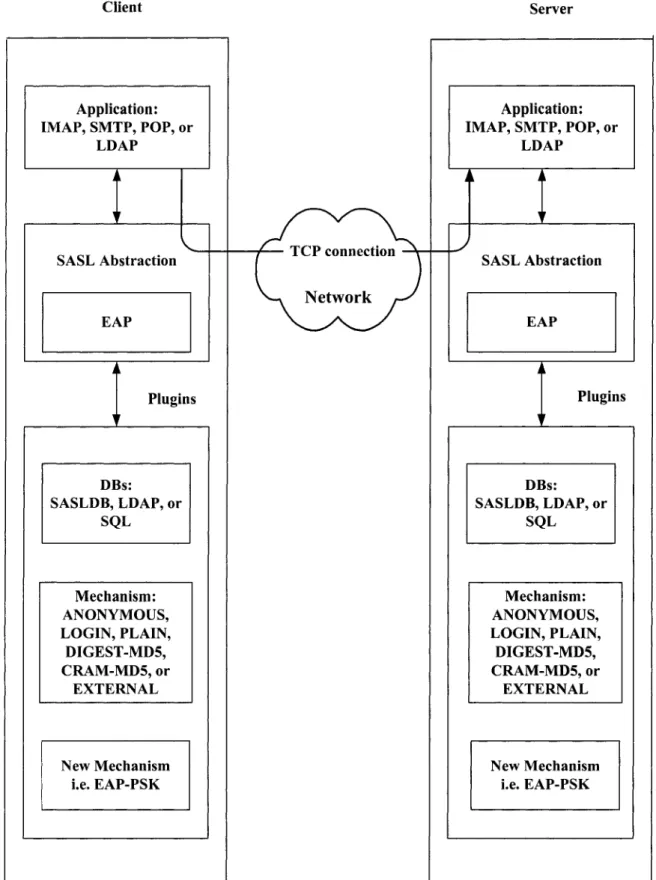
This project proposes to incorporate EAP into SASL to enhance security o f SASL and to provide a pathway for easy incorporation o f future EAP enhancements into SASL as well as to update and to implement EAP-AES-PSK. SASL incorporating EAP typically works by placing the EAP interface into the SASL library. The EAP interface not only bridges between the SASL library and existing SASL authentication methods, but also links the SASL library and future EAP authentication methods.
Figure 1-1 illustrates the architecture o f SASL incorporating EAP including where the EAP interface is located in the SASL library directory and how the EAP interface connects SASL with legacy and future authentication methods. A more detailed explanation is presented in Chapter 2.
Client Server Application: IMAP, SMTP, POP, or LDAP SASLDB, LDAP, or Mechanism: ANONYMOUS, LOGIN, PLAIN, DIGEST-MD5, CRAM-MD5, or EXTERNAL New Mechanism i.e. EAP-PSK Application: IMAP, SMTP, POP, or LDAP TCP connection N e tw o r k
SASL Abstraction SASL Abstraction
Plugins Plugins SASLDB, LDAP, or Mechanism: ANONYMOUS, LOGIN, PLAIN, DIGEST-MD5, CRAM-MD5, or EXTERNAL New Mechanism i.e. EAP-PSK
CHAPTER 2
BACKGROUND
We present background details o f Simple Authentication and Security Layer (SASL), Extensible Authentication Protocol (EAP), EAP-Pre-Shared Key (EAP-PSK), and EAP-Transport Layer Security-PSK (EAP-TLS-PSK).
2.1
Terminology
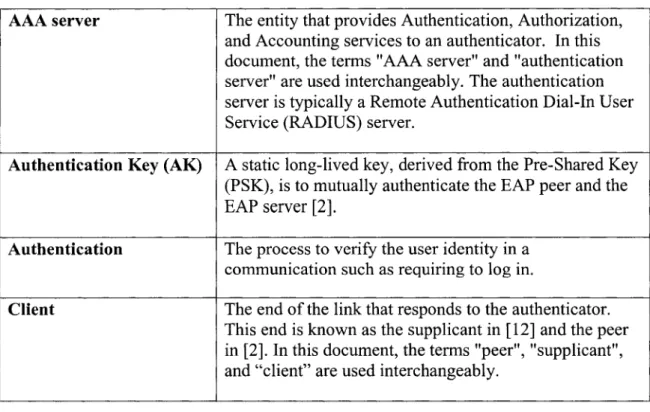
This document frequently uses the following terms:
Table 2-1: Terminology
AAA server The entity that provides Authentication, Authorization,
and Accounting services to an authenticator. In this document, the terms "AAA server" and "authentication server" are used interchangeably. The authentication server is typically a Remote Authentication Dial-In User Service (RADIUS) server.
Authentication Key (AK) A static long-lived key, derived from the Pre-Shared Key
(PSK), is to mutually authenticate the EAP peer and the EAP server [2].
Authentication The process to verify the user identity in a
communication such as requiring to log in.
Client The end o f the link that responds to the authenticator.
This end is known as the supplicant in [12] and the peer in [2]. In this document, the terms "peer", "supplicant", and “client” are used interchangeably.
Table 2-1 Continued Extended Master Session
Key (EMSK)
Additional keying material derived between the EAP client and server that is exported by the EAP method. The EMSK is at least 64 octets in length. The EM SK is not shared with the authenticator or any other third party. The EMSK is reserved for future uses that are not yet defined. Key Derivation Key
(KDK)
A static long-lived key, derived from the Pre-Shared Key (PSK), is to derive session keys [2].
Master Session Key (MSK)
Master Keying material that is derived between the EAP peer and server and exported by the EAP method. The MSK is at least 64 octets in length. In existing
implementations, an AAA server acting as an EAP server transports the MSK to the authenticator.
Nonce A number used once, such as a random number.
Pre-Shared Key (PSK) A key in symmetric cryptography that is installed/sent to
the opposite side o f the connection in advance, or that is distributed by third party.
Server The entity that terminates the EAP authentication method
with the peer. In the case where no backend
authentication server is used, the EAP server is part of the authenticator. In the case where the authenticator operates in pass-through mode, the EAP server is located on the backend authentication server.
Successful Authentication In this document, "successful authentication" is involved
both authentication and authorization; even though the peer may pass authentication to the server, the peer may not have access to the server due to policy reasons [2], For instance, the peer has a basic services right on a server and the peer tries to access a premium services on the server. The peer successfully authenticates to the authenticator, but is not able to access to the server.
2.2
Simple Authentication and Security Layer (SASL)
SASL is a framework to incorporate authentication in connection-oriented protocols and secure data transportation between a server and client that is detached from application protocols.
The SASL framework allows either new applications to reuse existing authentication protocol mechanisms, or allows old applications to use new authentication protocols without requiring any modifications to the SASL library [17].
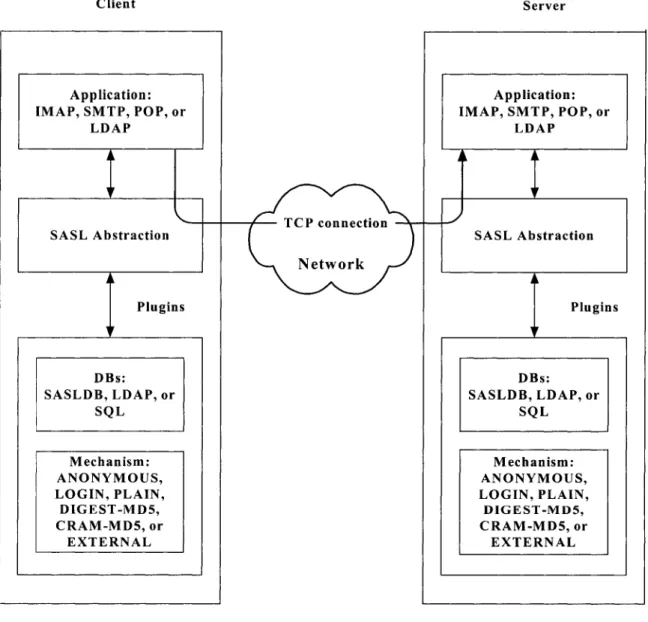
C lien t S erver T C P con n ection N e tw o r k P lu gin s P lugins D Bs: S A S L D B , L D A P , or SQ L D Bs: S A S L D B , L D A P , or SQ L SA S L A b straction SA S L A b straction A p p lication : IM A P , S M T P , P O P , or L D A P A p p lica tio n : IM A P , S M T P , P O P , or LD A P M ech an ism : A N O N Y M O U S , L O G IN , P L A IN , D IG E S T -M D 5 , C R A M -M D 5 , or E X T E R N A L M ech an ism : A N O N Y M O U S , L O G IN , P L A IN , D I G E S T - M D 5 , C R A M -M D 5 , or E X T E R N A L
Figure 2-1 illustrates the SASL abstract layer. Both client and server sides in the figure have three parts: an application, the SASL abstraction, and various plugins. The application is generally some connection-oriented protocol, such as Internet Message Access Protocol (IMAP), Simple Mail Transfer Protocol (SMTP), Post Office Protocol (POP), or Lightweight Directory Access Protocol (LDAP). Plugins contain database system and authentication protocol mechanisms. The SASL abstraction in the client and the server communicate to authenticate and authorize the connection, while the SASL abstraction monitors its application and plugins.
Both client and server sides in Figure 2-1 are symmetric; however, it is not required. For example, in the client side, database system SASL is not necessary because only the server side maintains user credential information within database systems. The client does not need to have all o f the authentication methods that the server has available or vice-versa. When a client has only ANONYMOUS SASL method [24] that does not require authentication for guest access, SASL works fine if a server provides the ANONYMOUS SASL method with other authentication methods. However, if the server does not support the ANONYMOUS SASL method, the server will not authenticate the client. In order to access a server, a client must have one o f the authentication methods supported by the server.
GNU and Cyrus SASL libraries support the applications: LDAP, IMAP, SMTP, and POP, and provide several authentication methods such as ANONYMOUS (for unauthenticated guest access), PLAIN (a simple clear text password mechanism), LOGIN (a simple password mechanism), CRAM-MD5 (a simple challenge-response scheme
based on HMAC-MD5 [7]), and EXTERNAL (for where authentication is implicit in the context).
Although SASL has many advantages, standalone SASL is vulnerable to many common attacks and insecure data transportation, in addition to re-keying issues, because many existing SASL mechanisms are vulnerable to these attacks and do not provide secure data encryption. Many o f these attacks are addressed further in this chapter.
2.3
Extensible Authentication Protocol (EAP)
EAP was originally developed for the extensible usage o f authentication protocols defined in Point-to-Point Protocol (PPP) [21], such as Password Authentication Protocol (PAP) [RFC 1334] and Challenge Handshake Authentication Protocol (CHAP) [22]. Figure 2-2 describes authentication protocols hierarchy [4],
Password Authentication Protocol (PAP)
MD5 - Challenge
Authentication Protocols Challenge-Handshake
Authentication Protocol (CHAP)
Extensible Authentication Protocol (EAP)
Generic Token Card (GTC) One Time Password (OTP)
EAP is an authentication framework providing multiple authentication methods. Since EAP is not a specific authentication mechanism, the exact authentication type is chosen by negotiation between a peer and an authenticator. EAP provides its own support for avoiding duplication and retransmission, but not fragmentation. However, standalone EAP is not secure enough to authenticate and has various vulnerabilities [2],
Since all traffic within EAP methods is exposed to attackers, user identities are visible. EAP is vulnerable to replaying packets, dictionary attack, disrupting negotiation, as well as other vulnerabilities described in [2]. Even though standalone EAP methods are not acceptable over wireless networks or Virtual Private Networks (VPNs) due to those attacks, EAP is widely used in wired networks and Point-to-Point connections because EAP is an authentication framework, not a specific authentication mechanism. EAP provides a negotiation o f the desired authentication mechanism [9]. A stronger authentication mechanism protects against the collection o f vulnerable attacks while standalone EAP does not.
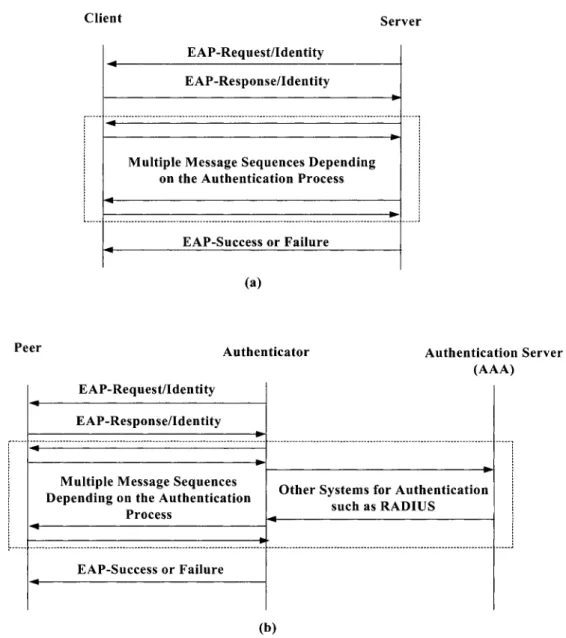
Figure 2-3 demonstrates an EAP message exchange. In EAP message exchanges, an EAP server requests user identity information from an EAP client and the client responds with the requested information back to the server. After the server obtains user identity information, more messages will be exchanged depending on the authentication process. The EAP server finally sends a message indicating whether the user authentication succeeds or fails.
In Figure 2-3 (b) including Authentication, Authorization, and Accounting (AAA), the authentication server provides AAA services designed for ease in tracking usage for
credentials to the authentication server and the authentication server authenticates the user based on the provided credentials. The authentication server can be viewed as a kind o f database and controller for usage billing and for network traffic management. However, this project mainly focuses on SASL and EAP, not on AAA services that the authentication server provides. Figure 2-3 (a) illustrates the EAP message exchange without AAA.
C lient Server
EA P-R equest/Identity EA P-R esponse/Identity
M ultiple M essage Sequences D epending on the A uthentication Process
EA P-Success or Failure
Peer
(a)
A uthenticator A uthentication Server (AAA)
EA P-R equest/Identity E A P-R esponse/Identity
M ultiple M essage Sequences D epending on the Authentication
Process
EA P-Success or Failure
O ther System s for A uthentication such as RADIUS
(b)
Figure 2-3: (a) EAP Message Exchange without AAA,
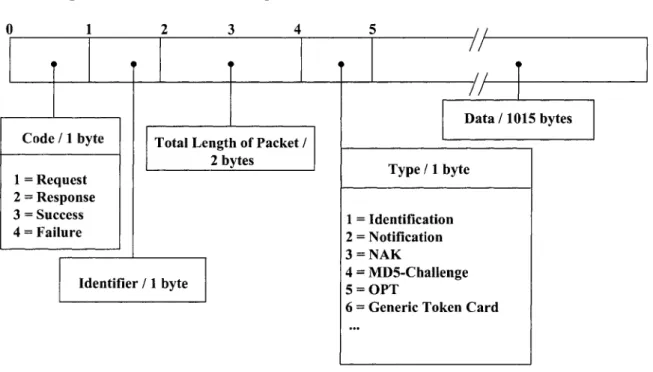
Figure 2-4 describes an EAP packet format. T yp e / 1 byte 1 = Identification 2 = N otification 3 = N A K 4 = M D 5-C hallenge 5 = O PT
6 = G eneric Token C ard
D ata /1 0 1 5 bytes
Id entifier / 1 byte
T otal Length o f Packet / 2 bytes 1 = R equest 2 = R esponse 3 = Success 4 = Failure C ode / 1 byte
F ig u re 2-4: EAP Packet Format [2]
2.4
Extensible Authentication Protocol - Pre-Shared Key (EAP-PSK)
A Pre-Shared Key EAP method (EAP-PSK) is one o f the EAP methods that use PSK for mutual authentication and session key derivation. While EAP is a framework to authenticate, EAP-PSK is an actual authentication mechanism that utilizes PSK upon the EAP framework. EAP-PSK normally exchanges four messages in the authentication process between a client and a server. Once the authentication is successful, EAP-PSK provides a protected communication channel [5],
2.5
Extensible Authentication Protocol Transport Layer Security
-P re-S h ared K ey (E A -P -T L S--P SK )
EAP-TLS-PSK [14] is a new authentication method, EAP-PSK with TLS [6] tunneling support, as an EAP protocol that extends EAP-PSK, one o f the authentication
TLS handshake to exchange authentication-related information between a client and a server, while EAP-PSK simply uses pre-shared keys to mutually authenticate. Authentication not based on certificates allows a reduced cost o f management with fewer message exchanges between client and server.
EAP-TLS-PSK [14] consists o f two primary phases: Transport Layer Security (TLS) Handshake Phase and TLS Tunnel Phase. The TLS Handshake Phase is similar to the EAP-TLS [8] handshake Phase. Rather than using the EAP server to generate a required certificate, the process uses the EAP-PSK scheme to authenticate mutually and to establish the secure protected channel necessary for further connectivity.
In the TLS Tunnel Phase, further authentication takes place in the initially- established secure tunnel from the TLS Handshake Phase. EAP-PSK with tunneling employs the EAP-Type Length Value (EAP-TLV) method [11], allowing richer communication between client and server, to further authenticate EAP identity. At the conclusion o f the TLS Tunnel Phase, M SK is derived using the TLS Pseudo Random Function (PRF) [8] from inner authentications that are mixed with the inner secret Key- Derivation Key (KDK) [5] from the TLS Handshake Phase and the TLS client and server random numbers to protect subsequent data.
2.6
Motivations and Goals
This project merges two technologies, SASL and EAP, to make the network more secure and introduces EAP-AES-PSK to provide strong authentication that is a new EAP method and will be built on SASL.
SASL provides key security services to a number o f application protocols such as e-mail protocols, so that software engineers can have a handy security tool. Software developers focus on only their application level, not communication security issues. Currently publicly available SASL libraries are the Cyrus SASL library by Carnegie Mellon University and the GNU SASL library. Both SASL libraries are used in IMAP, LDAP, POP, and SMTP to provide secure authentication.
EAP is widely being deployed in environments such as wireless networks and used over the Internet to support multiple authentication methods, such as token cards, one-time passwords, Kerberos (a network authentication protocol using secret-key cryptography) [13], and certificates. EAP-AES-PSK, described in Chapter 3, is a new strong authentication method that will be built on the SASL implementation.
SASL incorporating EAP typically works by locating the EAP interface in SASL plugins. The EAP interface not only bridges between the SASL library and existing SASL authentication methods, but also links the SASL library and future EAP authentication methods, still allowing future authentication methods to use existing SASL mechanisms if necessary.
We recall that Figure 1-1 illustrates the architecture o f SASL incorporating EAP including where the EAP interface is located in the SASL library directory and how the EAP interface connects SASL with legacy and future EAP authentication methods. This
project proposes to incorporate EAP into SASL to enhance security o f SASL and to provide a pathway for easy incorporation o f future EAP enhancements into SASL.
CHAPTER 3
EXTENSIBLE AUTHENTICATION
PROTOCOL - ADVANCED ENCRYPTION
STANDARD - PRE-SHARED KEY
(EAP-AES-PSK)
We propose a new EAP method: EAP - Advanced Encryption Standard - Pre- Shared Key (EAP-AES-PSK) that is modified from EAP - Transport Layer Security - PSK (EAP-TLS-PSK) for two primary reasons: to reduce the number o f message exchanges between the authenticator and the peer, and to ease the implementation and management o f Simple Authentication and Security Layer (SASL) while maintaining the same security level that EAP-TLS-PSK provides.
TLS is a cryptographic protocol that provides many security algorithms. A peer negotiates for an algorithm that TLS supports. However, TLS specifies that no data must be sent when TLS initiates. Therefore, if we want to continue to use TLS, we must modify the TLS implementation to be able to carry data in the initialization. We decided not to use TLS in order to ease the implementation and management, and the AES used in EAP-AES-PSK is one o f the symmetric ciphers that TLS provides. As a benefit, there is no notoriously known attack in AES.
At first glance, it may appear that EAP-AES-PSK is the same as EAP-PSK. EAP- AES-PSK is similar to EAP-PSK, but is not the same. EAP-AES-PSK intends to authenticate twice (in Phase 1 and Phase 2) to allow the use o f password-based legacy EAP methods in Phase 2 o f EAP-AES-PSK, as well as to provide more security. At the end o f each phase, the end points generate an outer Master Session Key (MSK) and an inner MSK. From the outer and inner MSKs, EAP-AES-PSK derives a MSK to protect subsequent data. EAP-AES-PSK supports fragmentation and reassembly.
This chapter explains the details o f EAP-AES-PSK and discusses the possible attacks and insecure data exchanges in the currently available Simple Authentication and Security Layer (SASL) mechanisms, which lead to the motivation for the study o f this area.
3.1
Approach
EAP-AES-PSK, similar to other current EAP outer methods, consists o f two primary phases. Phase 1 is similar to the EAP-PSK method. Rather than using the EAP server to generate a required certificate, the process uses the EAP-PSK scheme to authenticate mutually, generating a Transient EAP Key (TEK), to establish the secure protected channel necessary for further connectivity. At the beginning o f Phase 1, a server and a client derive the Authentication Key (AK) and the Key Derivation Key (KDK) from PSK [5] such as following pseudo code in Figure 3-1. Note that actual implementation should be more efficient since this pseudo code is to provide straightforward explanation.
k e y s e t u p ( p s k , ...) { c o u t n e r = 0 s e t a k [ 1 6 ] w i t h Os s e t k d k [ 16] w i t h Os a e s 1 2 8 ( p s k , a k , ...) a e s 128 ( p s k , k d k , ...) a k A= c o u n t e r + + k d k A= c o u n t e r a e s 128 ( p s k , a k , ...) a e s 128 ( p s k , k d k , ...) }
Figure 3-1: Key Setup Algorithm in EAP-AES-PSK [5]
Both AK and KDK are 16 bytes. AK is used to mutually authenticate the EAP peer and the EAP server and KDK is used to derive other necessary keys. At the end o f Phase 1, the outer master session key (MSK) derived from the KDK, peer nonce, and more such as o u t e r M S K = k e y _ d e r i v e (KDK, RAND_P, ...) in Figure 3-2. The outer MSK will be used as one o f these inputs for deriving M SK after a successful authentication is made.
All MSKs o f EAP-AES-PSK must be derived in the algorithm in Figure 3-2.
k e y d e r i v e ( k d k , r a n d p , .. ) { h a s h [ 16] c o u n t e r = 1 a e s 1 2 8 ( k d k , r a n d p , h a s h , ...) h a s h A= c o u n t e r a e s 128 ( k d k , h a s h , ...) h a s h A= c o u n t e r + + f o r i = 0 t o 3 h a s h A= c o u n t e r a e s 1 2 8 ( k d k , h a s h , m s k [ i * 1 6 ] , h a s h A= c o u n t e r + + }
Phase 2 performs further authentication in the initially-established AES secure tunnel from Phase 1. Unlike EAP-TLS-PSK, EAP-AES-PSK does not employ the EAP- TLV method to further authenticate EAP identity. At the conclusion o f Phase 2, inner MSK is derived from KDK, peer secret (i.e., password), and more such i n n e r M S K =
k e y _ d e r i v e (KDK, p a s s w o r d , ...). After successful authentication is made,
MSK is derived from KDK, the concatenation o f the first 8 bytes o f outer and inner
MSKs, and more such as MSK = k e y _ d e r i v e (KDK, o u t e r M S K [ 0 . . 7 ] | |
i n n e r M S K [ 0 . . 7 ] , ...). MSK is to protect subsequent data. For more secure
communication, MSK is needed to update in timely manner. For instance, every round trip both the server and the client renew the MSK to protect subsequent data.
3.2
EAP-AES-PSK Message Flows and Packet Format
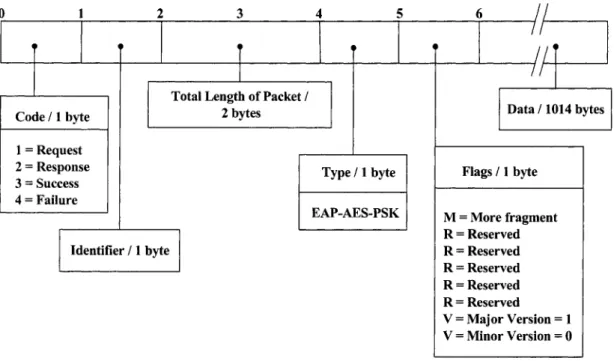
The typical packet format o f the EAP-AES-PSK messages would have the appearance as is described in Figure 3-3. The first byte o f the EAP-AES-PSK packet indicates Request, Response, Success, or Failure. The second byte indicates message identifier for each round trip between a server and a peer. A fter each round trip, the identifier should be updated to the next available identifier from 0 to 255. The next two bytes contain the total length o f the EAP-AES-PSK packet. The next byte is for the EAP type field. EAP-AES-PSK should set this value to 255 as this is an experimental EAP method. The next byte is for flags. The subsequent bytes are for data. Thus, EAP-AES- PSK needs at least 6 bytes for the header.
Code / 1 byte 1 = Request 2 = Response 3 = Success 4 = Failure
Total Length of Packet / 2 bytes Identifier / 1 byte Type / 1 byte EAP-AES-PSK 11} I f Data /1014 bytes Flags / 1 byte M = More fragment R = Reserved R = Reserved R = Reserved R = Reserved R = Reserved V = Major Version = 1 V = Minor Version = 0
Figure 3-3: EAP-AES-PSK Packet Format
EAP-AES-PSK, as described in Section 3.1, may consist o f two primary phases o f message flows. EAP-AES-PSK standard authentication is comprised o f four messages, i.e., two round trips; see Figure 3-4. EAP-AES-PSK assumes that the pre-shared key (PSK) is already known only to the EAP peer and EAP sever and that the distribution of the PSK is outside o f the scope o f the EAP-AES-PSK mechanism. Note that ‘||’ within Figure 3-4 means concatenation.
C lient F \ P - R e i | i i e s t . P S k l (1 lags| R A M ) S| II) S | . i A P - R e s p o n s e P S K 2 (M a g s | R A M ) S | i \ lA t P | l l ) P) F A P - H e i|u e s l. P S K 3 (F lags| R A M ) S |P t H A N M t l . S) F A P - R e s p o u s e P S K 4 ( H a g s | R A M ) S PC I I A N M ’.L P) P h a se 2 F A I ' - R e q u e s t C. IX ( p r o m p t u s e r ill & p a s s w o r d ) F A P - K c s p o n s e . t i I t ' ( u s e r ill & p a s s w o r d ) ► F A P - S u c c e s s o r F a ilu r e ■M K A P - S u e e e s s o r F a ilu re
Figure 3-4: EAP-AES-PSK Authentication Message Exchanges
In the EAP-AES-PSK method, the first message sent by the server to the peer
contains:
• An EAP-Request with EAP-Type=EAP-AES-PSK; . Flags : MRRRRRVV;
- M = More fragments
- R = Reserved (must be zero) - R = Reserved (must be zero) - R = Reserved (must be zero) - R = Reserved (must be zero) - R = Reserved (must be zero) - V = 1 (major version) - V = 0 (minor version)
• The stated server identity (ID_S); and
• A server 16-byte random challenge (RAND_S). The second message is sent by the peer to the server containing:
• An EAP-Response with EAP-Type=EAP-AES-PSK; • Flags: MRRRRRVV (major version = 1);
• A notice that it will authenticate to the server by proving that it is able to compute a particular Message Authentication Code (MAC_P), which is a function o f the two challenges and AK:
MAC_P = CMAC- AES- 128( AK, I D _ P | | I D _ S | | R A N D _ S | | RAND_P) ;
• A peer 16-byte random challenge (RAND P); and • The stated peer identity (ID_P).
Like EAP-PSK [5], Authentication Key (AK) is used to mutually authenticate the EAP peer and the EAP server. AK is a static long-lived key derived from the PSK. Elowever, AK is not a session key.
The third message is sent by the server to the peer containing: • An EAP-Request packet with EAP-Type=EAP-AES-PSK; • Flags: MRRRRRVV (major version = 1);
• A notice that it will authenticate to the peer by proving that it is able to compute another MAC (MAC_S), which is a function o f the peer’s
challenge and AK: MAC_S = CMAC-AES-128 (AK, I D_S | |
RAND_P) ; and
• An established protected channel (PCHANNEL_S) to:
- Confirm that it has derived session keys (at least the TEK); and - Give a protected result indication o f the authentication.
PCHANNEL_S is an encrypted message by AES encryption with TEK that contains information about Phase 1 authentication result. If the client is able to decrypt PCHANNEL_S, the server verifies the client’s identity since TEK is derived directly from PSK and never transported over the Internet.
The fourth message is sent by the peer to the server containing: • An EAP-Response packet with EAP-Type=EAP-AES-PSK; • Flags: MRRRRRVV (major version = 1); and
• A notice that the establishment o f the protected channel
(PCHANNEL P) is complete to:
- Confirm that it has derived session keys (at least the TEK); and - Give a protected result indication o f the authentication.
PCHANNEL_P is an encrypted message by AES encryption with TEK that contains information about Phase 1 authentication result. If the server is able to decrypt PCHANNEL_P, the client verifies the server’s identity since TEK is derived directly from PSK and never transported over the Internet.
The internal method (in Phase 2) can be any other EAP method, such as EAP- GTC, and will allow for devices to establish safe authentication using the EAP-AES-PSK method. For instance, the internal method is encrypted by AES 128 encryption.
Figure 3-4 shows messages 5 through 8 are engaged in the exchange o f user credentials using EAP-Generic Token Card (EAP-GTC) [2] exchanges. EAP-GTC has a data field in the Request includes a displayable message and a length o f the packet of EAP-GTC is determined by adding message length to EAP-GTC header length. A Response must reply to the Request. We assume message 5 through 6 contain typical EAP header in Figure 3-3 with an EAP-Response packet with EAP-Type=EAP-AES- PSK.
The fifth message is sent by the server to the peer containing: • An EAP-Request packet with EAP-Type=EAP-GTC; and • A displayable message that prompts user id and password.
The sixth message is sent by the peer to the server containing: • An EAP-Response packet with EAP-Type=EAP-GTC; and • A response to the Request.
Both the seventh and eighth messages are sent by the server to the peer containing:
• An EAP-Success or Failure with no data.
Even though the seventh and eighth messages are exactly the same packets, we still need to send the eighth message to satisfy the definition o f successful authentication. Successful authentication is defined in this document as involving both authentication
and authorization; even though the peer may pass authentication to the server, the peer may not access the server due to policy reasons. Thus, we need to send the eighth message although the message is a repeat o f the previous seventh message. For instance, a peer has a basic service right on a server and the peer tries to access a premium service on the server. The peer probably passes the authentication, but not the authorization. In the case, the server sends EAP-Success within seventh message and EAP-Failure within eighth message.
While the EAP-AES-PSK method appears to offer 8 message exchanges at the minimum, both the outer and inner EAP methods are established using PSK and AES. This speedier method is expected to minimize message exchange latency that is found in other methods, while maximizing the feature set o f this method.
3.3
Features of EAP-AES-PSK
Table 3-1 summarizes the features that EAP-TLS-PSK and EAP-AES-PSK provides. Both EAP methods propose tunneling support within EAP-PSK. The last column shows that EAP-AES-PSK brings fewer message exchanges between the client and server as compared to the EAP-TLS-PSK method. Details o f the features are shown in Section 3.4.
Table 3-1: Features o f Pre-Shared Key Methods
E A P-T L S-PSK [14] EA P-A ES-PSK (proposed)
F r a g m en ta tio n /
Reassembly
Yes
By use o f TL V Flags ‘More
Fragment’ bit
Yes
E A P -A E S -P S K flags contain ‘More Fragment’ bit
Channel Binding Yes
Inherited from E A P-PSK
Yes
Table 3-1 Continued
Fast Reconnection Yes Yes
Key Strength 128 bit 128 bit
Inherited from EAP-PSK Inherited from EAP-PSK
Minimum # of 11 8
Messages Exchanges Phase 1 (4) + Phase 2 (7) Phase 1 (4) + Phase 2 (4)
Tunnel Support Yes Yes
TLS tunnel AES tunnel
Difficulty of Implementation
Harder than EAP-AES-PSK Easier than EAP-TLS-PSK
3.4
EAP-AES-PSK Supporting Aspects
This section explains details o f EAP-AES-PSK supporting aspects such as fragmentation, channel binding, fast reconnection, key strength, number o f message exchanges, and tunnel support.
3.4.1 Fragmentation
The ideal EAP method supports fragmentation and reassembly. As RFC3748 states, EAP methods should support fragmentation and reassembly if EAP packets can exceed the minimum Maximum Transmission Unit (MTU) o f 1020 bytes [2], Fragmentation in EAP-TLS-PSK can be done through the use o f flags within the TLV in Phase 2 only.
EAP-AES-PSK has its own 1 byte flags field such as M RRRRRVV in Figure 3-3. If the M bit is 1 in the received EAP packet, there will be more data. If following the size o f the data is larger than the minimum MTU, M in the flags is set to 1. However
fragmentation and reassembly may be needed only in Phase 2 o f EAP-AES-PSK. Since Phase 1 o f EAP-AES-PSK is defined to support fragmentation and reassembly in its definition, MTU sizes o f EAP-AES-PSK packets will not exceed 1020 bytes when normally transmitted in a network.
3.4.2 Channel Binding
The verification within an EAP method o f integrity-protected channel properties is the process o f channel binding. For instance, endpoint identifiers within an EAP method can be compared to stored values (in AAA service systems).
EAP-AES-PSK uses an EAX mode o f operation, an authenticated-encryption with associated data mode o f operation for block ciphers, to provide channel binding as stated in Section 2.2.3 o f EAP-PSK [5]. We explained earlier how EAP-AES-PSK achieves channel binding in Section 3.2.
3.4.3 Fast Reconnection
The ability to create a new or refreshed security association, in the case where a security association has been previously established, in a more efficient manner or in a smaller number o f round-trips is the goal o f fast reconnection. Fast reconnection is optional in EAP-AES-PSK since, by having fast reconnection, EAP-AES-PSK saves one message round trip.
The server and peer must minimally cache the server and peer nonces, but not master secret, in order to have fast reconnection within EAP-AES-PSK. The master secret will be regenerated from the pre-shared key, server and peer nonce, and AES ciphersuite. The peer attempts to resume a session by sending an encrypted message
along with peer nonce from a previous session. The message should be encrypted using Transient EAP Key (TEK) derived from the pre-shared key and the AES ciphersuite. If the server has a matched peer nonce and is able to decrypt the message, the server will respond by sending an encrypted message to inform the peer o f the server’s successful verification o f the peer. Then, EAP-AES-PSK Authentication Phase 1 establishes a secure tunnel and the conversation continues on to Phase 2. An example o f fast reconnection message exchanges is shown in Section 4.2 that presents verification o f EAP-AES-PSK functionality.
3.4.4 Key Strength
Following RFC3748 directives, if the method derives keys, then the effective key strength must be estimated. This estimate is meant for potential users o f the method to determine if the keys produced are strong enough for the intended application. Since the keys within EAP-AES-PSK are derived by AES 128 ciphersuite like the EAP-PSK method, EAP-AES-PSK has the same key strength as EAP-PSK, which is 128 bit. However, the key strength o f EAP-AES-PSK can be upgraded to 196 or 256 bit by replacing AES algorithm function. No one can be able to tell how long any cryptographic algorithm including the AES algorithm will last secure regardless key strength. As following National Institute o f Standards and Technology (NIST) [1], AES algorithm
- JO C*7
approximately has 3.4 x 10 possible 128-bit keys, 6.2 x 10 possible 192-bit keys, and 1.1 x 1077 possible 256-bit keys.
3.4.5 Number o f Message Exchanges
This indicates the number o f message exchanges between a client and a server. EAP-AES-PSK has 8 message exchanges required in a normal configuration, while EAP- TLS-PSK needs 11 message exchanges to establish a proper secure connection. Both EAP-AES-PSK and EAP-TLS-PSK need 4 message exchanges in Phase 1, but EAP- AES-PSK requires only 4 message exchanges in Phase 2 while EAP-TLS-PSK requires 7 message exchanges. Since EAP-AES-PSK does not require using Type Length Value (TLV) for crypto-binding in Phase 2, EAP-AES-PSK has 3 less message exchanges than EAP-TLS-PSK has.
3.4.6 Tunnel Support
Unlike EAP-TLS-PSK, EAP-AES-PSK uses Advanced Encryption Standard (AES) [1] instead o f Transport Layer Security (TLS). AES published by the NIST, is known to provide strong encryption and authentication. EAP-AES-PSK supports strong encryption to prevent eavesdropping and mutual authentication and to guarantee that user credentials are transmitted over legitimate networks. In the EAP-AES-PSK method, the fifth to the seventh exchanged messages are protected by AES encryption tunnel support. Section 3.2 explains how this works and Section 4.2 illustrates an example o f actual messages in communication.
3.5
Protections Against Security Risks
Typical attacks on Simple Authentication and Security Layer (SASL) mechanisms include the dictionary attack, replay attack, and Man-In-The-Middle (MITM) attack as well as re-keying issues. Extensible Authentication Protocols (EAP)
such as EAP-AES-PSK in SASL provides greater protection against the protections against those previously listed attacks based on the designs o f both SASL and EAP and their combined usage.
3.5.1 Dictionary Attack
A dictionary attack is a technique used to get around an authentication mechanism for accessing a computer system by guessing typical passwords. In many cases, the credential exchanges are open to attacks, such as dictionary attacks, on a password. This attack could occur in SASL mechanisms that authenticate users by user ID and password. For instance, in Figure 3-5, the intruder guesses on B ob’s password that matches with B ob’s ID to gain access to A lice’s system.
/ K flcflSflsssffR S SR S a l a iS fA
Alice
N etw ork
Gutessing passwords
Intruder
Figure 3-5: Dictionary Attack
EAP methods in SASL create a secured Advanced Encryption Standard (AES) tunnel between the client and the authentication server first. Some legacy SASL mechanisms, such as password based-authentication methods, could be used to
authenticate a client. Since user credential data transmission is performed only within a protected tunnel, SASL incorporating EAP methods is safe from the dictionary attack.
3.5.2 Replay Attack
Attackers could obtain a message from a legitimate user with accesses into a network and replay that message later. This attack is called the replay attack. Replay attack causes unauthorized authentication or denial o f service (DoS) [19].
The authentication process in EAP-AES-PSK is based not only on Pre-Shared key (PSK), but also on nonces such as server and client random numbers. EAP-AES-PSK server and clients exchange their nonces by including within the first and second messages o f EAP-AES-PSK. Thus, the intruder will not gain successful authentication even if the intruder captures a message and resends to the server during the authentication process. The current server nonce will be not same as the server nonce from the last authentication process. Therefore, SASL incorporating EAP methods are safe from the replay attack.
3.5.3 Man-In-The-M iddle (MITM) Attack
Some mechanisms in SASL define authentication as a one-way action, such as a simple clear text password mechanism, PLAIN, although Generic Security Services Application Program Interface (GSSAPI [16]) [18], an application programming interface for programs to obtain security services [10], provide mutual authentication that uses Kerberos V. For example, when a client logs onto a network, only the server requires the client authentication. Because o f one-way authentication, an attacker who resides between a client and a server can participate in the login exchange without the knowledge
o f the client or the server (see Figure 3-6). This attack is known as the Man-In-The- Middle [3] attack.
I
MITM
Figure 3-6: Man-In-The-Middle (MITM) Attack
Typically MITM attack happens when mutual authentication is not performed. However, SASL incorporating EAP methods do mutual authentication between a client and a server. For instance, EAP-AES-PSK authenticates mutually via sending and receiving message 3 and 4 that contain PCHANNEL_S and PCHANNEL_P, encrypted messages by Advance Encryption Standard (AES) encryption. If the client is able to decrypt PCHANNEL_S message from the server, the server achieves verifying the client’s identity because TEK, a key to encrypt or decrypt a message, is derived directly from PSK and never transported over the Internet. If the server is able to decrypt PCHANNEL P, the client achieves verifying the client’s identity. Thus, SASL incorporating EAP methods could protect against MITM attacks.
N etw ork Client
3.5.4 Re-keying
The SASL framework does not provide re-keying services. Thus, cryptographic keys age and become insecure as they are used and as time goes by [9]. EAP generates keying materials, such as Master Session Key (MSK) and Extended Master Session Key (EMSK), during the authentication process. MSK, which is at least 64 octets in length, is a keying material that is derived between the client and the server and carried by the EAP method. The EM SK is extended from MSK and is reserved for future uses that are not yet defined [2]. Secure EAP methods such as EAP-AES-PSK renew MSK in time manner. For instance, EAP-AES-PSK updates keys every round trip between a server and a peer.
If SASL uses EAP keying services, future re-keying services o f EAP will be automatically extended into the SASL mechanism and allow SASL incorporating EAP methods to support stronger cryptographic keys.
3.5.5 Data Encryption
Existing SASL, as defined, does not strongly encrypt messages in a communication between a client and a server. Standalone SASL only provides a 64 bit encryption scheme. Thus, attackers could easily sniff messages in the communication by using network protocol analyzers.
EAP in SASL solves the data encryption issue. Data in EAP-AES-PSK is
encrypted by AES 128 ciphersuite or higher. EAP generates M SK after a successful
authentication thus the M SK is used in A E S 128 ciphersuite to encrypt data. Therefore, SASL incorporating EAP provides secure data transfer.
CHAPTER 4
VERIFICATIONS
Currently, there are two publicly available Simple Authentication and Secure Layer (SASL) libraries available: Cyrus SASL library from Carnegie Mellon University and the GNU SASL library. In this project, Cyrus SASL library was selected randomly and used as part o f the implementation as well as Hostapd and Wi-Fi Protected Access (WPA) supplicant [15] for SASL and EAP frames respectively. In Chapter 3 we proposed a new Extensible Authentication Protocol (EAP) method, EAP - Advanced Encryption Standard - Pre-Shared Key (EAP-AES-PSK). EAP-AES-PSK is successfully built on the SASL library and used for simple file transfer. This chapter details the project outcomes and evaluates the result.
4.1
Outcomes
This project proposes to incorporate EAP into SASL to enhance the security o f SASL and to provide a pathway for the easy incorporation o f future EAP enhancements into SASL. The practical details on how to merge EAP into a SASL application source code library is stated in Appendix B, including documentation about SASL incorporating
EAP such as implementation o f SASL incorporating EAP: EAP interface,
incorporating EAP-AES-PSK, SASL Application: basic file transfer application requiring authentication, and a general SASL installation user guide, and a basic file transfer SASL application user guide.
4.2
Evaluation
Evaluation o f this project contains three parts: verification o f functionality o f a SASL application incorporating EAP, arguments to show how common security risks are addressed, and a performance evaluation. In Section 3.5, we already argue that SASL incorporating EAP will reduce or prevent the considerable security risks such as the dictionary attack, replay attack, and Man-In-The-Middle (MITM) attack as well as re keying issues.
4.2.1 Verification o f Functionality o f a SASL Application incorporating EAP
The outcomes specified in Section 4.1 above are performed for functionalities and secure data encryption by using network protocol analyzers. The network protocol analyzer examined transmissions to verify that the messages in the communication are secure. For instance, captured messages between a client and a server in a SASL application was compared with a result that we expect what the captured messages should be.
The configuration o f EAP-AES-PSK must be preplanned before we use EAP- AES-PSK. Table 4-1 is a configuration example o f EAP-AES-PSK. Both a server and a client must set the Pre-Shared Key and ID respectively to be “thisistemporarykey” and “EAP-AES-PSK_server/ EAP-AES-PSK_client.” The client needs to provide a user ID
and a user password for Phase 2 that will be used in the inner method, i.e., “u s e rl” and “p a ssl.”
Table 4-1: Configuration o f EAP-AES-PSK
Server Client
Pre-Shared Key Thisistemporarykey
ID EAP-AES-PSK_server EAP-AES-PSK_client
User ID for Phase2 N/A userl
User Password for Phase2 N/A passl
The following boxed messages in octet form were captured during a SASL incorporating EAP-AES-PSK communicated. Each line starts with a 7 digit line number in octet form followed by 16 bytes, such as ‘o d - x ’ format, in UNIX-like machine format. Note that ‘||’ means concatenation and ‘n ’ (in ‘[n]’) represents a number o f byte(s), i.e., [3] means 3 bytes.
When EAP-AES-PSK is initialized, both the server and the client derive Authentication Key (AK) and Key Derivation Key (KDK) from the MSK above.
AK [16]:
0 0 0 0 0 0 0 e b 6 9 f 5 e C 5 9 d c l c d 8 2 f l l c d 3 6 6 f 2 9 3 f d 3
KDK [16]:
First message (server -> client):
(EAP-Request [1] || identifier [1] || Total Length [2] || EAP-AES-PSK [1] || flags [1] RAND S [16] || ID S [18]):
0 0 0 0 0 0 0 0 1 0 1 0 0 2 8 f f 02 2 d a 5 f 99 e f c l 8 1 6 2 b 2 a d d
0 0 0 0 0 2 0 5 5 3 4 7 b a 5 f 8 8 d 4 5 4 1 5 0 2 d 4 1 4 5 5 3 2 d 5 0 5 3
0 0 0 0 0 4 0 4 b 5 f 7 3 6 5 7 2 7 6 657 2
EAP-Request, EAP-Response, EAP-Success, and EAP-Failure are defined to values 1, 2, 3, and 4, respectively.
Second message (client -> server):
(EAP-Response [1] || identifier [1] || Total Length [2] || EAP-AES-PSK [1] || flags [1] RAND S [16] || RAND P [16] || MAC_P [16] || ID_P [18]):
0 0 0 0 0 0 0 0 2 0 1 0 0 4 8 f f 02 2 d a 5 f 9 9 e f c l 8 1 6 2 b 2 a d d
0 0 0 0 0 2 0 5 5 3 4 7 b a 5 f 8 8 d l a 4 c b 3 3 d 8 f 83 5 4 0 d l e 9 6
0 0 0 0 0 4 0 0 7 7 b e e 3 a 2 d f a aObe d f f e e 5 4 3 8 2 1 a c d d d
0 0 0 0 0 6 0 c a 9 c 0 c 5 2 5 a 3 4 4 5 4 1 5 0 2 d 4 1 4 5 5 3 2 d 5 0 5 3
0 0 0 0 0 8 0 4 b 5 f 63 6c 6 9 6 5 6e 7 4
Third message (server client):
(EAP-Request [1] || identifier [1] || Total Length [2] || EAP-AES-PSK [1] || flags [1] RAND S [16] || MAC S [16] || PCHANNEL S):
0 0 0 0 0 0 0 0 1 0 2 0 0 3 b f f 02 2 d a 5 f 9 9 e f c l 8 1 6 2 b 2 a d d
0 0 0 0 0 2 0 5 5 3 4 7 b a 5 f 8 8 d 3 3 0 6 7 a 2 c 5 2 f e 7 2 d f 3 3 d 0
0 0 0 0 0 4 0 e 8 0 9 d 8 3 d e 8 d a 0 0 0 0 0 0 0 0 c 7 3 d 0 4 d c c 8 0 7
0 0 0 0 0 6 0 I f 9c 6 e 5 9 0 e 6 0 9 c d c 1 3 a e e d
Fourth message (client server):
(EAP-Request [1] || identifier [1] || Total Length [2] || EAP-AES-PSK [1] || flags [1] RAND S [16] || PCHANNEL P ):
0 0 0 0 0 0 0 0 2 0 2 0 0 2 b f f 02 2 d a 5 f 9 9 e f c l 8 1 6 2 b 2 a d d
0 0 0 0 0 2 0 5 5 3 4 7 b a 5 f 8 8 d 0 0 0 0 0 0 0 1 4 d 5 9 d 5 c l 0 3 6 2
0 0 0 0 0 4 0 0 8 1 7 7 c 6 8 c 0 5 3 4 a 2 b e 4 7 2 b b
Fifth message (server client):
(EAP-Request [1] || identifier [1] || Total Length [2] || EAP-AES-PSK [1] || flags [1] nonce [4] || tag [16] || EAP-Request [1] || identifier [1] || Length [2] || EAP-GTC [1] “UserID? Password?”):
0 0 0 0 0 0 0 0 1 0 3 0 0 3 2 f f 02 0 0 0 0 0 0 0 0 2 a 4 f e c 4 a e b 7 3
0 0 0 0 0 2 0 7 1 2 3 e a f 3 9 0 7 3 7 0 1 e 0 4 a e 6 c b e c 0 a 4 4 8 f e
0 0 0 0 0 4 0 c 8 a 3 8 a 2 c 64d2 b b 4 0 9 c b a d e b 8 a 6 8 0 7 5 8 3
0 0 0 0 0 6 0 c 8 6b
Nonce and tag are needed to establish the AES tunnel. Nonce should be 16 bytes. The first 12 bytes are set to be zeros and only the last 4 bytes are to be defined. Thus,
from the second EAP-Request o f the fifth message is where the inner EAP method starts encryption.
Sixth message (client server):
(EAP-Response [1] || identifier [1] || Total Length [2] || EAP-AES-PSK [1] || flags [1] || nonce [4] || tag [16] || EAP-Response [1] || identifier [1] || Length [2] || EAP-GTC [1] || “u se rl/p a ssl”):
0 0 0 0 0 0 0 0 2 0 3 0 0 2 b f f 02 0 0 0 0 0 0 0 1 0 a 0 7 c l c c 67 f b
0 0 0 0 0 2 0 b 4 7 c 0 0 0 a 3 c 4 5 e 5 0 0 b 2 0 0 3 9 3e 8 2 c d 2 c d 7
0 0 0 0 0 4 0 2 d b a 4 1 d 7 c d l O 7 3 2 7 b 8 2 6 75
Seventh message (server -> client):
(EAP-Response [1] || identifier [1] || Total Length [2] || EAP-AES-PSK [1] || flags [1]): 0 0 0 0 0 0 0 0 3 0 4 0 0 0 6 f f 0 2
EAP-AES-PSK needs 8 message exchanges. However EAP-AES-PSK within the SASL framework does not require the eighth message, which is exactly the same as the seventh message. We may send the seventh message again for the last message, but it wastes time and is unnecessary because the SASL framework is required to send “ S A S L O K ”, indicating successful authentication is made, and that can replace the
eighth m essage o f E A P-A E S-PSK in the EAP framework.
After successful authentication in SASL incorporating EAP (using EAP-AES- PSK), the Master Session Key (MSK) is derived to protect subsequent data from manipulating the outer and inner MSKs using KDK.
Outer MSK [64]: 0 0 0 0 0 0 0 3 3 d 8 4 4 8 0 e 8 d a 64 4 f eO 90 7 8 c 6 0 a 5 d 9 7 c 6 0 0 0 0 0 2 0 534 f b 7 a 7 d8 99 6 a f d 6 2 c 8 5 9 3 d 7 6e 0 3 6 3 5 0 0 0 0 0 4 0 8 8 9 6 8 f I f 9 d a a b4 63 6 d b c 7 f f 0 f 3 68 2 d 5 2 0 0 0 0 0 6 0 c d d b e ! 4 6 5 9 f e e 8 4 d f e d d 3 f e d 1 5 e 4 6 d 4 d Inner MSK [64]: 0 0 0 0 0 0 0 0 4 4 0 e f 7 6 6652 9b2 9 4 2 a 8 cbdO 4 9 4 6 5 8 9 1 0 0 0 0 0 2 0 8 7 2 2 f 10 9 0 2 e f 50 6 2 0 b 6 0 8 8 5 9 4 a d e 4 6 c 5 0 0 0 0 0 4 0 2 b d b 0 2 a 0 a 8 7 a d2 4 2 e 6 d 8 3 4 2 1 0 c 8 2 b 4 3 a 0 0 0 0 0 6 0 4 d e f 7 6 1 2 a 6 b d 0 8 5 0 d e e 2 2 4 a d b27D f b 3 2 MSK [64]: 0 0 0 0 0 0 0 c a 9 9 f Oec 8 a l 3 c 9 0 8 a f f 9 6 8 f 5 2 4 c b 9 e b l 0 0 0 0 0 2 0 4 4 0 c d 4 0 a 7 7 b 0 3 3 7 3 c f Oe 2 2 d d 8 3 5 3 5 3 0 c 0 0 0 0 0 4 0 7 e 9 2 9 6 1 1 3 5 4 3 8 8 f 8 f 90 b 2 0 7 7 9 1 9 3 0 e 7 7 0 0 0 0 0 6 0 5 f 87 65 6 1 c c d l 4 8 1 b e d 5 8 c a e 5 e 9 a l d 3 1 c
The following two extra messages are from fast reconnection, described in Section 3.4, after the successful authentication above. Both the server and the client saved their nonces.
First message in fast reconnection (client server):
(EAP-Request [1] || identifier [1] || Total Length [2] || EAP-AES-PSK [1] || flags [1] || RAND P [16] || PCHANNEL P):
0 0 0 0 0 0 0 01 0 7 0 0 2 b f f 02 l a 4 c b 3 3 d 8 f 83 54 Od l e 9 6
0 0 0 0 0 2 0 0 7 7 b e e 3 a 2 d f a 0 0 0 0 0 0 0 0 c7 3 d 0 4 d c c 8 0 7
0 0 0 0 0 4 0 I f 9c 6 e 5 9 0 e 6 0 9 c d c 1 3 a e e d
Second message in fast reconnection (server -> client):
(EAP-Request [1] || identifier [1] || Total Length [2] || EAP-AES-PSK [1] || flags [1] RAND S [16] || PCHANNEL S):
0 0 0 0 0 0 0 0 2 0 7 0 0 2 b f f 02 2 d a 5 f 9 9e f c l 8 1 6 2 b 2 a d d
0 0 0 0 0 2 0 5 5 3 4 7 b a 5 f 8 8 d 0 0 0 0 0 0 0 1 4 d 5 9 d 5 c l 0 3 6 2
0 0 0 0 0 4 0 0 8 1 7 7 c 6 8 c 0 5 3 4 a 2 b e 4 7 2 b b
If the server and the client are able to decrypt the message that is encrypted by each other, then EAP-AES-PSK Authentication Phase 1 establishes a secure tunnel and the conversation continues on to Phase 2. Otherwise, both the server and the client start normal authentication.
4.2.2 Performance Evaluation
Authentication Time Test (Access Time Test):
The authentication time test was executed on the SASL only-application (i.e., ANONYMOUS), SASL using EAP-PSK method, and SASL EAP-AES-PSK. Figure 4-1
and Table 4-2 show the amount o f tim e needed to perform authentication in ANONYMOUS, EAP-PSK, and EAP-AES-PSK. Note that all performance tests were executed on machines with 500 MHz CPU/256 MB memory and 700 MHz CPU/256 MB memory for the server side and the client side respectively.
The server is always running and waiting for a client connection. Thus, server authentication time is measured from the time a new client connects to the time the client disconnects. Client authentication time is measured from the time the client initializes to the time the client ends.
The authentication time for the each method are measured in both the controlled environment and the un-controlled environment. Figure 4-1 and Table 4-2 shows both the results from both the controlled experiment and the uncontrolled experiment. The controlled environment is a test setup such as using two machines and a router in home network (or private network). In the controlled environment, the messages are never transported over Internet or public network. Thus, we can minimize the chance o f un wanted variants affect on the authentication time. Internet is one o f the un-controlled environments where we cannot have all controls to maximize and to accurate test results. The test in the un-controlled environment was executed on one machine (a server), is at University o f New Hampshire (UNH) and another machine (a client), is in Epsom, NH where is about 27 miles away from UNH over Internet.
500 --*//////, S / / / / / / s ' / / / / / / , '//////, '//////, ' / / / / / / , 7777777. / / / / / / / . ///////. / / / / / / / . ///////. ' / / / / / / / ' / / / / / / / '/////// '/////// 5 '/////// A AN O N YM O U S EAP-PSK EAP-AES-PSK Authentication Method
□ Server in the Controlled Experim ent E2 Client in the Controlled Experim ent □ Server in the Un-Controlled Experim ent B C lie n t in the Un-Controlled Experim ent
Figure 4-1: Authentication Time for Each Method
Table 4-2: 95% Confidence Level Authentication Time for each Method
Authentication Time [ms] \Method
ANONYMOUS EAP-PSK EAP-AES-PSK
Controlled Experiments Server 88.5±0.5 101±0.5 113±0.7 Client 27.7±0.4 38.1±0.4 40.4±0.4 Un-Controlled Experiments Server 290±6 450±27 467±16 Client 227±3 386±26 395±8
The authentication time in EAP-PSK and EAP-AES-PSK took longer compared to the time in ANONYMOUS because ANONYMOUS only needs 2 message exchanges while EAP-PSK and EAP-AES-PSK requires 4 and 7 message exchanges along with AES encryption.
AES E n cry p tio n Tim e Test:
We need to know how much AES encryption time affects on the performance o f SASL incorporating EAP-AES-PSK. EAP-AES-PSK, the new proposed EAP method,

![Figure 2-2 describes authentication protocols hierarchy [4],](https://thumb-us.123doks.com/thumbv2/123dok_us/10972146.2985285/20.915.184.837.576.1000/figure-describes-authentication-protocols-hierarchy.webp)
![Figure 3-1: Key Setup Algorithm in EAP-AES-PSK [5]](https://thumb-us.123doks.com/thumbv2/123dok_us/10972146.2985285/28.915.207.766.101.380/figure-key-setup-algorithm-in-eap-aes-psk.webp)