Munich Personal RePEc Archive
A Pareto-metaheuristic for a bi-objective
winner determination problem in a
combinatorial reverse auction
Buer, Tobias and Kopfer, Herbert
Chair of Logistics, University of Bremen
19 January 2012
Online at
https://mpra.ub.uni-muenchen.de/36062/
Editor
Prof. Dr.-Ing. Herbert Kopfer
Faculty 7: Business Studies & Economics
A Pareto-metaheuristic for a bi-objective winner determination problem
in a combinatorial reverse auction
Tobias Buer and Herbert Kopfer
Working Paper No. 2
All rights reserved by the authors
Prof. Dr.-Ing. H. Kopfer
Chair of Logistics
Faculty 7: Business Studies & Economics
University of Bremen
P.O. Box 33 04 40
28334 Bremen
Germany
Tel.
+49 421 218 66921
Fax
+49 421 218 66922
[email protected]
A Pareto-metaheuristic for a bi-objective winner determination problem in a
combinatorial reverse auction
Tobias Buer∗, Herbert Kopfer
Chair of Logistics, University of Bremen, P.O. Box 330440, 28334 Bremen, Germany
Abstract
The bi-objective winner determination problem (2WDP-SC) of a combinatorial procurement auction for transport
contracts comes up to a multi-criteria set covering problem. We are given a setBof bundle bids. A bundle bidb∈B
consists of a bidding carriercb, a bid price pb, and a setτb of transport contracts which is a subset of the setT of
tendered transport contracts. Additionally, the transport qualityqt,cbis given which is expected to be realized when a
transport contracttis executed by a carriercb. The task of the auctioneer is to find a setXof winning bids (X ⊆B),
such that each transport contract is part of at least one winning bid, the total procurement costs are minimized, and
the total transport quality is maximized. This article presents a metaheuristic approach for the 2WDP-SC which
integrates the greedy randomized adaptive search procedure, large neighborhood search, and self-adaptive parameter
setting in order to find a competitive set of non-dominated solutions. The procedure outperforms existing heuristics.
Computational experiments performed on a set of benchmark instances show that, for small instances, the presented
procedure is the sole approach that succeeds to find all Pareto-optimal solutions. For each of the large benchmark
instances, according to common multi-criteria quality indicators of the literature, it attains new best-known solution
sets.
Keywords: Pareto optimization, multi-criteria winner determination, combinatorial auction, GRASP, LNS
1. Introduction and literature review
Combinatorial auctions are applied when bidders are interested in multiple heterogenous items and when the
bidders valuations of these items are non-additive. This is for example the case with the procurement of transport
services which often are highly interdependent. We focus on these kinds of items in the following. In a combinatorial
transport auction, a shipper wants to procure transport services from many freight carriers. Items of a transport auction
are denoted as transport contracts. Such a contract is a framework agreement with a duration of about one to three
years, that defines an origin location and a destination location between which a certain volume of goods has to be
regularly carried (usually on the road) while a specified service level has to be satisfied.
∗Corresponding author
Combinatorial transport auctions allow freight carriers (bidders) to submit bundle bids. Abundle bid is an all-or-nothing bid on any subset of the set of tendered transport contracts. In particular, a freight carrier can bid on
combinations of transport contracts that exhibit strong synergies ([1], [2], [3]). With this, the shipper strives to
reduces his or her total transport costs.
Real-world applications of combinatorial auctions for the procurement of transport service are described by
Led-yard et al. [4], Elmaghraby and Keskinocak [5], for example. Caplice and Sheffi[6, 7] discuss real-world issues of
combinatorial transport auctions and report, among other things, that practical transport auctions studied handle an
average annual procurement volume of 150 million US-dollar. The whole auction process is complex and can last a
few months [6].
After bidding is completed, the shipper (auctioneer) has to decide which of the received bundle bids should be
accepted as winning bids. This problem is known as the winner determination problem which is usually modeled as a
combinatorial optimization problem (for a review see [8]). For combinatorial auctions which are used for selling items,
the set packing problem is used to maximize the total revenue (compare [9, 10], for a review see [11]). Conversely,
the winner determination problem of combinatorial procurement auctions like transport auctions are often modeled
based on the set covering problem or the set partitioning problem and the total procurement costs are minimized.
In practice, shippers usually also want to ensure or improve service quality of the procured transport contracts
(’transport quality’) and therefore do not exploit their full potential for cost savings [3]. Models of winner
deter-mination problems of combinatorial auctions that try to integrate quality aspects in the decision making process are
described in [6], [7], [12], [13]. Primarily, these approaches try to integrate quality aspects as some kind of side
constraint or they use penalty costs to disadvantage low quality carriers or bundle bids, respectively. However, this
requires preference information of the shipper with respect to the desired trade-offbetween transport costs and
trans-port quality. As Caplice and Sheffi [6] state, identifying the desired trade-offis one of the most challenging tasks
in the procurement of transport contracts for a shipper. Therefore, Buer and Pankratz [14] introduced an additional,
second objective function for maximizing the transport quality within a winner determination problem. The resulting
bi-objective model, denoted as 2WDP-SC, seems helpful, if the desired trade-offbetween transport costs and transport
quality is a priori unknown to the shipper.
This paper presents a new heuristic for a bi-objective winner determination problem. The presented heuristic
outperforms previous methods for that optimization problem [14, 15, 16]. The article is organized as follows. Section
2 introduces the studied bi-objective winner determination problem. To solve it, we present a new Pareto metaheuristic
called PNS (Section 3). The performance of PNS is evaluated by means of a benchmark study (Section 4) whose
2. The bi-objective winner determination problem
The bi-objective winner determination problem of a combinatorial transport procurement auction based on a set
covering formulation (2WDP-SC) has been introduced by Buer and Pankratz [14]. We are given a setT of transport contracts offered by a single shipper (decision maker) and a setBof bundle bids which have been submitted by a setCof carriers. A bundle bidb ∈ Bis composed of a carriercb ∈C, a bid price pb ∈ R+, and a subsetτb of the
offered transport contractsT. With the bundle bidb, the carriercb ∈ Cexpresses the intention to execute the set of
transport contractsτb ⊆ T, if he gets paid the price pb by the shipper. Letatb =1 ift ∈ τb andatb =0 otherwise
(∀t∈T,∀b∈B). Ifatb =1, we sayb covers t. Furthermore, we are given parametersqt,cb∈N(∀t∈T,c∈C) which
indicate the achieved transport quality if transport contracttis executed by carriercwho submitted bundle bidb∈B. The shipper prefers higher values ofqt,cb.
The optimization task of the shipper is to determine a set of winning bidsX(X⊆B). The binary decision variable
xbindicates, whether bundle bidb∈Bis accepted as winning bid (xb=1 ⇔b∈X) or not. The 2WDP-SC asks for
the set of winning bidsXthat covers all transport contractsT and at the same time strives to do both, to minimize the total procurement costs and to maximize the total transport quality. The 2WDP-SC is defined by the expressions (1) –
(4).
minf1(X)=
X
b∈B
pb·xb, (1)
minf2(X)=(−1)
X
t∈T
max
b∈B{qt,cb·atb·xb}, (2)
s. t. X
b∈B
atb·xb≥1, ∀t∈T, (3)
xb∈ {0,1}, ∀b∈B. (4)
Objective function f1 (1) minimizes the total procurement costs of the shipper. That is, the sum of the prices of the
winning bids. Objective function f2(2) maximizes the total transport quality of the procured transport contracts. For
ease of notation used later, we minimize the negative total transport quality to obtain a pure minimization problem.
Constraint set (3) guarantees, that each transport contract is covered byat least onewinning bid. Finally, expression (4) ensures, that each bundle bid is an all-or-nothing bid, that is, partial acceptance of a bundle bid is prohibited.
The formulation of the objective function f2 is influenced by the set covering inequality (3). Because of (3), a
transport contracttmay be covered by multiple winning bids although it must be executed only once (this is possible due to the free disposal assumption). Therefore, the maximum function in f2 makes sure, that for each transport
contract t only the highest transport quality valueqt,cb for the given the set of winning bids is summed up once.
Note, that using the set partitioning equality with a strict equal sign instead of (3) would avoid this issue – however,
unwanted by the shipper (using set covering or set partitioning variant in this context is discussed in more detail by
Buer and Pankratz [15, p. 195f]).
The expressions (1), (3), and (4) define the well-known NP-hard set covering problem [17]. If a single objective
decision problem withfk,k=1 is NP-complete, then the corresponding multi objective decision variant with fk,k>1
is also NP-complete [18]. Therefore, the 2WDP-SC is NP-hard.
Finally, we introduce the notation of solution dominance. Let k be the number of objective functions of a minimization problem and let X1,X2 be two feasible solutions. X1 weakly dominates X2, written X1 X2, if
fi(X1)≤ fi(X2),i =1, . . . ,k. X1dominates X2, writtenX1 ≺X2, if fi(X1)≤ fi(X2),i =1, . . . ,kand fi(X1)< fi(X2)
holds at least for onek. An approximation set is a set of feasible solutions which do not≺-dominate each other. The approximation set which contains those feasible solutions which are not weakly dominated by any other feasible
solution is called Pareto-optimal set.
3. A Pareto metaheuristic based on GRASP and adaptive LNS
The developed metaheuristic procedure is denoted as Pareto neighborhood search (PNS). It integrates search
techniques known from the metaheuristics greedy randomized adaptive search procedures (GRASP) and large
neigh-borhood search (LNS). With respect to the multicriteria situation, the search uses dominance-based and
criterion-individual search techniques (cf. Talbi [19, p. 323ff]). Dominance-based search means that values of both objective
functions are used to control the search process, while criterion individual search means that only a single objective
criterion is used and the other is temporarily neglected. An overview of PNS is given in Alg. 1.
Algorithm 1:Pareto neighborhood search (PNS)
Input: problem data: B; parameters:r,dmax,ds Output: approximation setA
A←❞♦♠✐♥❛♥❝❡❇❛s❡❞❈♦♥str✉❝t✐♦♥(B,r,dmax)
A←❧♦❝❛❧❙❡❛r❝❤(B,ds,A)
3.1. Construction Phase (DRC)
A set of non-dominated solutions is constructed with a method calleddominance-based randomized construction
(DRC, cf. Alg. 2). DRC is a multi start procedure that iteratively constructs feasible solutions to obtain a good
approximation set. The termination of the multi start procedure is controlled by the parameterdmax∈N. That is, DRC
terminates ifdmaxsolutions are constructed successional without finding a new non-dominated solution.
Algorithm 2:DRC
Input: set of bundle bidsB, no. sectorsr,dmax Output: approximation setA
d←1
repeat ✴✴ r❡st❛rt ❧♦♦♣
k←0
X← ∅
B′←B
whileX infeasibledo
CL← ∅
R1 foreachb∈B\Xdo
if g(b,X)=∞then B←B\ {b}
else
R2 CL←CL⊎ {b}
end
end
b′←s❡❝t♦r❈❛♥❞❙❡❧❡❝t✐♦♥(CL,k,r)
X←X∪ {b′}
k←k+1
end
if(∄X′∈A|X′≺X)then A←A⊎ {X}
d←1
else
d←d+1
end
B←B′ untild=dmax
In thefirst stage, a set of candidate bids, also denoted as candidate listCL ⊂ B\X, is determined. Bids inCL
are potential candidates to be added to the current solutionX. Therefore, we use the vector-valued greedy function
g(b,X)=(P(b,X),Q(b,X)) to rate every bundle bid which was also used by Buer and Pankratz [15]. The elements of
ofg(b,X).
The first rating functionP(b,X) measures the ability of a bundle bidb< Xto makeXa feasible solution and to improve f1(X). Lower values ofP(b,X) are considered as better. P(b,X) calculates the average additional costs for
those contracts inbwhich are not yet covered byX(cf. Chvátal [20]). Letτ(X) denote the set of contracts covered byX, i.e. τ(X)=S
b∈Xτ(b). If all transport contractsτ(b) of a bundle bidbare already covered byX, thenbcannot
contribute to reach feasibility ofXand thereforeP(b,X) is set to+∞.P(b,X) is defined according to (5).
P(b,X)=
pb
|τ(b)\τ(X)| ifτ(b)\τ(X),∅,
+∞ otherwise.
(5)
The second rating functionQ(b,X) measures the ability of a bundle bidb<Xto improve f2(X). By accepting an
additional bundle bidbas winning bid the transport quality f2 either remains stationary or increases, i.e.,∆f2(X) =
f2(X∪ {b})−f2(X)≥0. In contrast to f1, the value of f2cannot worsen by accepting an additional bid. The increment
in transport quality∆f2(X) is divided by the total number of contracts covered by each individual bid inX∪ {b}, that
isP
b′∈X∪{b}|τ(b′)|. By this, covering a contract by several bids is penalized. Finally, this value is multiplied by−1, so that smaller values ofQ(b,X) represent better bids (in consistence withP(b,X)). If∆f2(X)=0,bdoes not improve
f2andQ(b,X) assigns a rating of+∞.Q(b,X) is defined according to (6).
Q(b,X)=
−P ∆f2(X)
b′∈X∪{b}|τ(b′)|
if∆f2(X)>0,
+∞ otherwise.
(6)
By means of the vector-valued rating function g(b,X) the candidate list is constructed during the foreach-loop of
DRC (cf. remark R1 of Alg. 2). As long as the constructed solutionXis infeasible, the following steps are performed: Each bundle bidb ∈ B\Xis rated according to g(b,X). If the rated bundle bidb is not dominated by any of the
bundle bids inCL, thenbis added toCLand those bundle bids inCLwhich are dominated bybare removed. This is symbolized by the operator⊎(cf. remark R2 of Alg. 2). On the other hand, ifg(b,X)=(+∞,+∞) thenbis not able
to contribute to the constructed solutionXand can be disregarded in future ratings of the same solution.
After all bundle bids inB\Xhave been rated and the set of candidate bidsCLis available, a bundle bid has to be selected fromCLand added toXat random. This is done in thesecond stageof the two-stage candidate bid selection procedure.
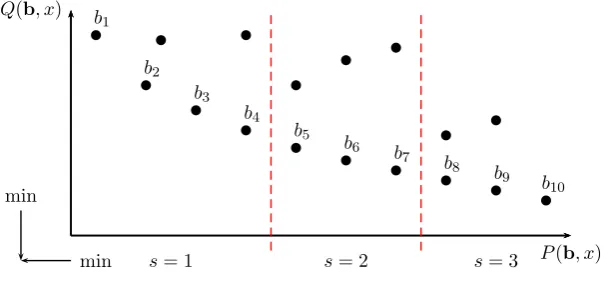
In the second stage, the proceduresectorCandSelect(cf. Alg. 3) selects a particular bundle bidb∈CLthat should be added to the infeasible solutionX. The proceduresectorCandSelectrequires as input the candidate listCL ⊆B, the number of up to now constructed solutionsk∈N, and the external parameterr∈N.
First, the bundle bids of the given candidate listCLare partitioned intorsubsetsCLs⊂CLwhich are denoted as
P(b, x)
Q(b, x)
min min
b1
b2
b3
b4
b5
b6
b7
b8
b9
b10
[image:10.595.147.453.111.252.2]s= 1 s= 2 s= 3
Figure 1: Organization of candidate list
bundle bidbis randomly chosen with probability 1/|CLs|.
Algorithm 3:sectorCandSelction
Input: candidate listCL, mult start counterk, no. sectorsr Output: a selected bundle bidb,b∈CL
n← |CL|
ifr>nthenr←n
mj← ⌊n/r⌋ ✴✴ ❝❛r❞✐♥❛❧✐t② ♦❢ CLj,1< j<r
m1 ←n−mj·(r−1) ✴✴ ❝❛r❞✐♥❛❧✐t② ♦❢ CL1
sort elements ofCLin increasing order ofP(b,X)
6 s←kmodr+1 ✴✴ ❞❡t❡r♠✐♥❡ s❡❝t♦r
ifs=1then
CLs←CL[1,m1]
else
CLs←CL[m1+mj·(s−2)+1,m1+mj·(s−1)]
end
select a bidb∈CLswith probability 1/|CLs|
returnb
Each sectorCsshould contain an equal number of bundle bids. If an equal division of bids to sectors is not possible
(|CL| modr>0), then the remaining bids are assigned to the first sectorCL1. Therefore,|CL1| ≥ |CL2|=. . .=|CLr|.
In the example of Fig. 1, the candidate listCLis made up of ten non-dominated bundle bidsb1, . . . ,b10. These are
divided intor=3 sectors. SectorCL1contains four bids and sectorsCL2andCL3contain three bids, respectively.
From the sector CLs, a bundle bid is chosen randomly with equal probability. The sectorCLs is determined
from sectorCL2and so forth.
The idea of segmenting the bundle bids into sectors, is to steer the search process into certain dimensions of the
bicriteria objective space. The options to choose a bundle bid in each construction step are reduced and the pressure
to steer into a certain part of the objective space is increased. Without any segmentation (r=1), decisions made in the later stage of constructing a solution might conflict previous decisions. For example, first some bundle bids are chosen
which might result in a good solution with respect to the first objective, later some other bundle bids are chose which
are in favor of the second objective function; sometimes this will lead to good compromise solution but sometimes
the solution quality will be poor in both objective functions.
3.2. Improvement phase
The improvement phase (cf. Alg. 4) is inspired by the metaheuristic large neighborhood search. Basically,
solutions from the approximation setAare destroyed randomly according to a destroy rate and after that rebuilt by means of a greedy single-criterion method. The actual destroy rate and the actual choice of one of the two greedy
rating functionsP(b,X) andQ(b,X) are decided during the improvement phase by setting parameters self-adaptive. The main criterion for the self-adaptive parameter setting, that is the choice of a destroy rate as well as a greedy
rating function, is the number of failed attempts to improveX∈A. This measure for ’success’ of a certain destroy rate and a certain greedy rating function is tracked on a local level for each solution and not on a global level for the entire
approximation set. With this focus on individual solutions inA, the improvement phase is able to better account for structural differences between non-dominated solutions. Structural differences on the decision space level may occur
for solutions that lie in very different areas of the objective space but are nevertheless Pareto optimal. For example, a
solutionXwith a high value for f1(X) and a low value for f2(X) versus a solutionX′with a low value for f1(X′) and a
high value for f2(X′).
The improvement phase (cf. Alg. 4) requires as input an approximation set and a destroy strategy. A destroy
strategydsis a sequencehds1, . . . ,dsniof destroy rates (∀dsi >0). The notationsfail[X].P andfail[X].Q in Alg. 4
denote the number of failed attempts to improve the solutionX with the greedy rating functionP(.,X) and Q(.,X), respectively. Furthermore, the approximation setAis implemented as a first-in, first-out list structure. To remove a solution fromA, the solution on the first position is chosen (cf. remark R1); a new non dominated solutionXis inserted at the back ofA. At the same time, solutions inAwhich are dominated byXare deleted (cf. remark R2). With this first-in, first-out approximation list, the computational effort to improve solutions inAis approximately equally distributed among all regions of the approximation front.
The proceduredestroySol(cf. Alg. 5) destroys a given solution X. This is done by removing bundle bids from
X randomly with a destroy rate (removal probability) of dsi percent. The destroy ratedsi depends on the destroy
Algorithm 4:Improvement phase
Input: approximation setA,ds
repeat
R1 select and remove the first solutionXofA
reinsertXat back ofA
Xd←❞❡str♦②❙♦❧✭X,fail[X].P,fail[X].Q,ds✮
Xr←r❡♣❛✐r❙♦❧✭Xd,fail[X].P,fail[X].Q✮
if∄Xa∈A|XaXrthen
R2 A←A⊎ {Xr} ✴✴ ✐♥s❡rt ❛t ❜❛❝❦ ♦❢ A
fail[Xr].P←0
fail[Xr].Q←0
else iffail[X].P<fail[X].Qthen
fail[X].P←fail[X].P+1
else
fail[X].Q←fail[X].Q+1
end
untiltime limit reached returnA
X′⊆Xwhich is probably infeasible.
Algorithm 5:destroySol
Input: X,fail_P,fail_Q,ds
Output:X′⊆X
X′←X
R1 i←min(fail_P,fail_Q) mod|ds|
foreachb∈Xddo
ifrand(1,100)≤dsithenX′←X′\ {b}
end
returnX′
The destroyed solutionX′is passed to the procedurerepairSol(cf. Alg. 6). Furthermore, the procedurerepairSol gets the numbers of failed attemptsfail.P andfail.Q to improveX ⊇X′by using rating functionP(.,X) andQ(.,X), respectively. A new feasible solution is searched for via a a single-criterion greedy heuristic. The heuristic chooses
non-dominated solution (cf. Alg. 6, remark R1). During the while-loop, the solutionX′is repaired by consecutively adding bids toX′ in a greedy fashion. If the greedy rating function returns +∞for a bundle bid, this bid cannot improve the solution and therefore must not be considered in further iterations (cf. Alg. 6, remark R2).
Algorithm 6:repairSol
Input: infeasible solutionX′,fail.P,fail.Q
Output: feasible solutionX⊃X′
R1 iffail.P<fail.Qthen g(., .)←P(., .)
elseg(., .)←Q(., .)
whileX′infeasibledo
z∗← ∞
b∗← ∅ ✴✴ ♠♦st ❣r❡❡❞② ❜✐❞
foreachb∈B\Xdo ifg(b,X′)<z∗then
z∗←g(b,X′)
b∗←b
R2 else ifg(b,X′)=∞thenB←B\ {b}
end
X←X∪ {b∗}
end
returnX
The improvement phase terminates, after reaching a preset time limit.
3.3. Note on a Mathheuristic Extension
Buer and Pankratz [14] introduced an exact branch-and-bound method based on the epsilon constraint approach
for the 2WDP-SC. This approach, denoted asǫLBB, was successfully used in Buer and Pankratz [15] to hybridize the path-relinking phase of a GRASP method for the 2WDP-SC. Obviously, we therefore also tried to further improve the
solution quality of PNS by integratingǫLBBin three ways: 1) hybridizingǫLBB anddominanceBasedConstruction
(Alg. 2), 2) hybridizingǫLBB andlocalSearch-Phase (Alg. 2), and 3) usingǫLBB in both phases. All in all, given the same computing time, the three hybridized approaches led to inferior results compared to PNS. Therefore, we do
4. Design of computational study
The performance of the proposed heuristic is measured by means of a computational study. This section gives
remarks on the test procedure, presents the used benchmark instances, and introduces measures from the literature for
the quality of an approximation set.
4.1. General remarks and test procedure
The computational evaluation is done by means of artificial benchmark instances. All algorithms were
imple-mented in Java (JDK 6, Update 23). All tests were executed on the same type of personal computer (CPU Intel core
i5-750, four cores a 2.66 GHz). This also includes those heuristics that were published previously (cf. Sect. 5.3), that
is, previous computational experiments were repeated if necessary. Up to four independent computational test runs
were executed in parallel, however, the implementation of the evaluated heuristics uses no parallelization.
We first evaluate some main design choices of the method PNS. At the same time, we work out reasonable values
for the three external parameters of the method PNS. Finally, the new method PNS is compared to three other heuristics
from the literature.
4.2. Benchmark instances
The 37 benchmark instances for the 2WDP-SC introduced by Buer and Pankratz [14] are used. These instances
take into account some specific features of the transportation scenario at hand. In particular, the instance generation
procedure creates bundle bids that satisfy the free disposal assumption. This is important, as this assumption was
required to model the 2WDP-SC with set covering constraints (instead of set partitioning constraints).
For seven instances, all Pareto optimal solutions are known. These instances are denoted as small instances
(instance group S). The small instances feature up to 80 bundle bids. For the remaining thirty instances, the set of
Pareto optimal solutions is unknown. These instances are denoted aslarge instances. These instances are divided into different classes by means of different groups classifying instances according to their number of bundles or their
number of contracts. There are three groups A, B, and C which contain instances with 500, 1000, and 2000 bundle
bids, respectively. The groups a, b, c denote instances with 125, 250, and 500 transport contracts, respectively.
Consequently, the class Cb for example contains those instances with 2000 bundle bids and 250 transport contracts.
This notation is used in Tab. 4, Tab. 5, and Tab. 6.
4.3. Quality indicators for approximation sets
The assessment of the quality of an approximation set is a nontrivial task. An intensive examination of different
approaches is given by Zitzler et al. [21]. The evaluation of algorithms in view of the obtained solution quality is
usually more complex in the multiple objective case than in the single objective case. In the single objective case,
performance statements are naturally made by comparing the objective function values of solutions generated by
each other. Given two approximation setsAandBwith solutions inAthat dominate solutions inBand the other way round (a≺banda′≺b′fora,a′∈Aandb,b′∈B) makes performance comparisons difficult.
One way to measure approximation set quality is the usage of quality indicators which should narrow down
the comparison of two approximation sets to the comparison of two real-valued numbers. Roughly speaking, a
quality indicator is a function that assigns to one or more approximation sets a scalar value. This always goes along
with a loss of information intrinsic to the approximation sets. Hence, it is advisable to use more than one quality
indicator to balance the individual strengths and weaknesses of indicators (which are discussed e.g. by Zitzler et al.
[21]). Therefore, we use three different quality indicators for the computational study, the hypervolume indicator,
the multiplicative epsilon indicator, and the coverage indicator. Those quality indicators seem to be among the most
readily accepted in the literature.
4.3.1. Hypervolume indicator IHV
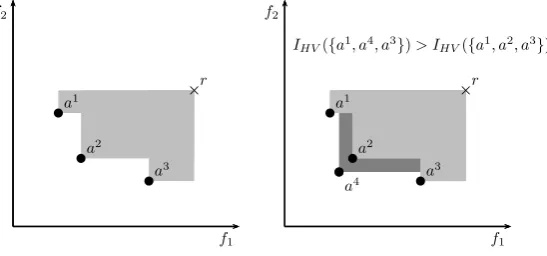
The hypervolume indicatorIHV(A) measures the volume of the objective subspace that is weakly dominated by
the solutions of a given approximation setAand bounded by a reference pointr[22, 23]. The reference pointrhas to be weakly dominated by each solution. Higher indicator values imply a better approximation set. Fig. 2 (left)
shows three non-dominated solutionsa1,a2,a3. The part of the objective space that is dominated by these solutions and bounded by the reference pointris shaded in gray. The volume of the gray area is the value ofIHV({a1,a2,a3}).
In Fig. 2 (right) the new non-dominated solutiona4is added and the hypervolume is increased by the volume of the area shaded in dark gray. Apparently, every new non-dominated solution increases the value ofIHV.
f1 f2 f2 f1 ba 1 ba 2 ba 3 ×r bc a4 ba 1 ba 2 ba 3 ×r
[image:15.595.162.436.449.577.2]IHV({a1, a4, a3})> IHV({a1, a2, a3})
Figure 2: Principle of hypervolume indicatorIHV.
Following earlier studies on the 2WDP-SC [14, 15], the reference pointris defined asr1= f1(B) andr2=0. The
values of the objective functions f1and f2 differ in several orders of magnitude (using the benchmark instances of
Section 4.2). Therefore they are normalized prior to calculatingIHV according to equation (7).
fi′(X)= fi(X)−f
min i
ri−fimin
with i∈ {1,2} (7)
andfmin
1 :=0, f
min
4.3.2. Epsilon indicator Iǫ
The multiplicative epsilon indicatorIǫ(A,B) introduced by Zitzler et al. [21, p. 122] compares two approximation
setsAandBand is based on the epsilon dominance relationǫ. It is defined as follows:
f(a)ǫ f(b)⇔ ∀i∈ {1, . . .m}: fi(a)≤ǫ· fi(b). (8)
Iǫ(A,B) is the minimum factor, by which the value of the objective function of each solution in B has to be
multiplied, such that each solution inBis epsilon dominated by at least one solution inA.
Iǫ(A,B)=inf
ǫ∈R{∀b∈B, ∃a∈A: f(a)ǫ f(b)}. (9)
Lower values ofIǫ(A,B) imply a higher quality ofA. By definition, it holds that Iǫ(A,B)≥1. ForIǫ(A,B)=1,
each solution inBis weakly dominated by a solution inA. In general,Iǫ(A,B),Iǫ(B,A) holds.
Iǫ(A,B) is a binary indicator. In case that more than two approximation sets should be compared, a pairwise
comparison of the involved approximation sets is required. To simplify the comparison, in this study, we use the
unary epsilon indicator [24, S. 12]:
Iǫ(A) :=Iǫ(A,AR). (10)
AR is denoted as reference approximation set. AR is the set union of the approximation sets A′to be compared without any dominated solutions.
4.3.3. Coverage indicator IC
Zitzler and Thiele [22, S. 297] introduced the binary coverage indicator. The coverage indicatorIC(A,B) indicates
the fraction of solutions in the approximation setB, that are dominated by at least one solution in the approximation setA.
IC(A,B)=
|{b|∃a∈A: f(a) f(b)}|
|B| . (11)
In general,Iǫ(A,B),Iǫ(B,A) holds. Higher values ofIC(A,B) imply a higher quality ofA. The range of values is
0≤IC(A,B)≤1, whereIC(A,B)=1 indicates, that each solution inBis dominated by at least one solution inA. Like
Iǫ(A,B),IC(A,B) is again a binary indicator and we only use the unary variant by means of a reference approximation
5. Results and discussion
5.1. Contribution of two-stage candidate bid selection
We evaluate, whether the quality of the approximation sets generated by the two-stage candidate bid selection
procedure is improved in comparison to a traditional single-stage bid selection procedure. For this, only the
construc-tion procedure DRC (cf. Alg. 2) is studied. The single-stage selecconstruc-tion procedure is realized by setting the number of
sectorsrto 1. The two-stage procedure is realized by using multiple sectors (r>1).
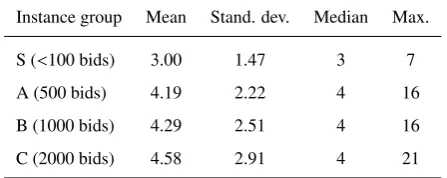
We try to receive an impression of the actual size of the candidate list to identify a reasonable number of sectors
[image:17.595.186.410.394.483.2]r. Each of the 37 instances was solved 500 times by the heuristic DRC (cf. Alg. 2). Immediately prior to each call of the methodsectorCandSelection(CL,k,r)in DRC, the size of the candidate listCLwas measured. Tab. 1 shows the aggregated results. The average size of the candidate listCLgrows slightly with increasing numbers of bundle bids per instance. Nevertheless, even for the largest instances with 2000 bids, the median of|CL|is only 4 and the maximum size is 21. To avoid an insufficient small number of bids per sector, we use three sectors (r = 3) in the two-stage bid selection approach.
Table 1: Size of the candidate listCLduring construction phase.
Instance group Mean Stand. dev. Median Max.
S (<100 bids) 3.00 1.47 3 7
A (500 bids) 4.19 2.22 4 16
B (1000 bids) 4.29 2.51 4 16
C (2000 bids) 4.58 2.91 4 21
Construction of 500 solutions for each instance.
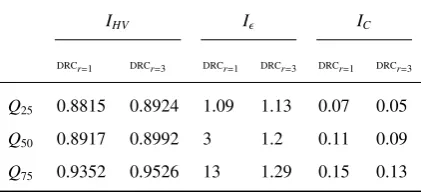
The construction heuristic with a single-stage bid selection is denoted as DRCr=1and the two-stage bid selection
heuristic is denoted as DRCr=3. In contrast to Alg. 2, both heuristics terminate after 1000 constructed solutions (and
dmax=∞). For each of the thirty large instances five test runs with different random seeds were performed. A test run
is the one-time solution of an instance with both heuristics DRCr=1and DRCr=3. The results for the quality indicators
IHV,Iǫ, andICare shown in Tab. 2. Note that approximation setARwas calculated on a per test run basis and not over
all five test runs per instance.
Applying the Wilcoxon signed rank test to the results, the null hypothesis (’the quality indicator median values
of the different algorithms possess the same probability distribution’) can be rejected for each of the three quality
indicators. The p-values forIHV,Iǫ, andICare≤0.0001,≤0.0001, and 0.0028, respectively. The results are statistically
significant even for very tight levels of significance of one percent or lower. Therefore, it is highly likely, that the
observed quality differences of the obtained approximation sets can be attributed to the usage of the two-stage bid
Table 2: One-stage versus two-stage selection of bids from the candidate list with DRCr=1and DRCr=3.
IHV Iǫ IC
DRCr=1 DRCr=3 DRCr=1 DRCr=3 DRCr=1 DRCr=3
Q25 0.8815 0.8924 1.09 1.13 0.07 0.05
Q50 0.8917 0.8992 3 1.2 0.11 0.09
Q75 0.9352 0.9526 13 1.29 0.15 0.13
Regarding the median values of the quality indicatorsIHV andIǫ, the two-stage approach DRCr=3clearly
outper-forms the one-stage heuristic DRCr=1. In contrast, the median values ofICsuggest an opposite interpretation. Looking
at the generated approximation sets, the two-stage heuristic seems to discover better extreme solutions thanDRCr=1,
especially with respect to f1. On the other hand, DRCr=1 seems to generate more and better compromise solutions
with balanced f1and f2values. This might explain the slightly better values ofICin Tab. 2 for the algorithm DRCr=1.
All in all, the two-stage candidate bid selection approach clearly increases the quality of the calculated approximation
sets.
5.2. Contribution of dynamic destroy rates in improvement phase
The goal of this experiment is twofold. On the one hand, we want to check if the proposed dynamic destroy rates
in the solution phase improve approximation set quality. On the other hand, a proper destroy strategy is searched for.
A destroy strategy is a sequencehds1, . . . ,dsniof destroy rates. 17 different destroy strategies are compared, Tab. 3
shows the results. Each of the 17 different destroy strategies is used to compute the thirty large instances twice. These
17 strategies include the five non-dynamic strategiesh3i,h6i,h9i,h12i,h15iwith an a priori fixed destroy rate which is unchangeable. We also experimented with larger destroy rates between 20 and 40 percent, however, these seem
clearly inferior to the smaller destroy rates shown in Tab. 3. Column two to four of Tab. 3 show the median of the
appropriate quality indicator over 60 runs of the destroy strategy. The runtime for each run was fixed to five minutes.
The best median values are bold.
The strategiesh3i, which is static, andh3,6,9,2,4i achieve the best median values for two quality indicators, respectively. We use both strategies to compute each of the large instances five times. Applying the Wilcoxon signed
rank test to the results, the null hypothesis (’the quality indicator median values of the different algorithms possess
the same probability distribution’) can be rejected for two of the three quality indicators on a level of significance of
less than three percent. The p-values forIHV,Iǫ, andIC are≤0.0001, 0.0216, and 0.4231, respectively. The dynamic
strategy clearly outperforms the static strategy by means of the hypervolume indicator while the observed difference
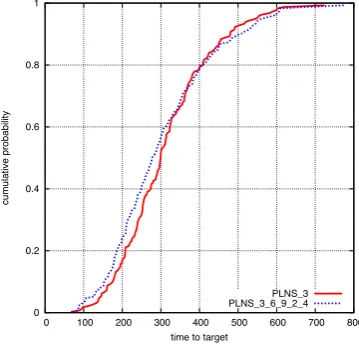
by means of the coverage indicator is not significant. We conclude, that the dynamic strategyh3,6,9,2,4iworks best. Fig. A.3 in the appendix depicts three runtime distributions which indicate that this strategy usually obtains a given
Table 3: Results for 17 different destroy strategies for PLNS.
strategy IHV Iǫ IC
h3,6,9i 0.9095 1.01 0.01
h6,12,18i 0.9093 1.02 0.00
h9,18,27i 0.9089 1.03 0.00
h9,6,3i 0.9097 1.015 0.01
h18,12,6i 0.9096 1.02 0.00
h27,18,9i 0.9093 1.03 0.00
h3i 0.9096 1.01 0.07
h6i 0.9096 1.02 0.02
h9i 0.9096 1.02 0.00
h12i 0.9092 1.025 0.00
h15i 0.9092 1.03 0.00
h5,15,7i 0.9096 1.02 0.00
h7,19,9i 0.9093 1.02 0.00
h15,5,10i 0.9094 1.02 0.00
h19,7,14i 0.9095 1.02 0.00
h3,6,9,2,4i 0.9097 1.01 0.05
h6,12,18,5,10i 0.9096 1.02 0.00
5.3. Comparison with other heuristics
To benchmark the new method PNS by means of approximation set quality the three heuristics SPEA2A,
P-GRASPP+HPR, and PGRASPQ+HPR are used. The method SPEA2A is based on theStrength Pareto Evolutionary
Algorithm 2 introduced by Zitzler et al. [25]. This generic multi objective genetic algorithm wasadapted by ge-netic operators specific to the 2WDP-SC in [14]. In that paper the method was called A8. PGRASPP+HPR, and
PGRASPQ+HPR were proposed in [15]. Both methods are multi objective GRASP whose path-relinking phase was
hybridized with the exact branch-and-bound methodǫLBBby [14]. Another hybridized heuristic for the 2WDP-SC was discussed in [16] (see also 3.3) which is, however, not included in our comparison, as it does not clearly
outperform the mentioned heuristics on the majority of instances.
For the benchmark, the parameters of PNS are set as follows. The number of sectionsrare set to 3, the vector destroy probabilities is set to (3,6,9,2,4), and the termination criterion of the construction phase is set todmax =92.
While the configuration of the first two values were justified in Sections 5.1 and 5.2, the value of the termination
criteriondmaxwas determined as follows: for each large instance, 1000 solutions were generated with DRC (cf. Alg.
2). The experimental distribution of the number of unsuccessful improvement tries was recorded (median 6, mean 20,
standard deviation 42) anddmaxwas set to the value of the ninety-five percent quantile, which is 92.
The runtime of each heuristic was five minutes (300s). All heuristics solved all instances on the same type of
computer. Please note, wedo not citethe computational results of the experiments in [14, 15] but solve all instances again on the same (and faster) computer.
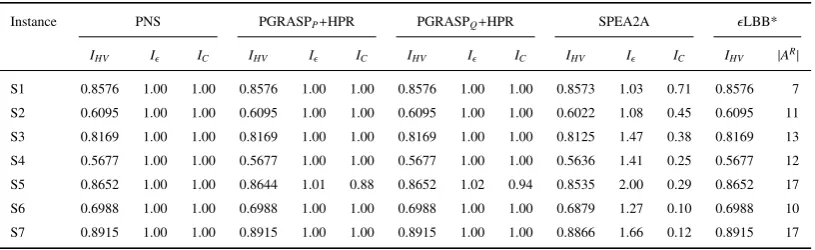
The results for the small instances with known Pareto optimal solution sets are shown in Tab. 4. The two rightmost
columns show the Pareto optimal hypervolume values and the cardinality of the reference approximation setAR(here,
it is identical to the Pareto optimum solution set). These optimal results haven been obtained by the bicriteria
branch-and-bound methodǫLBBintroduced in [14].
Algorithm PNS is able to solve all seven small instances to Pareto optimality, that is the whole Pareto optimal
solution set is found. In contrast, the procedures PGRASPP+HPR and PGRASPQ+HPR are able to solve six out of
seven instances to Pareto optimality. In [15], only four instances could be solved to Pareto optimality. The method
SPEA2A is able to find some Pareto optimal solutions for six instances (S1 – S5, S7), but never the complete set.
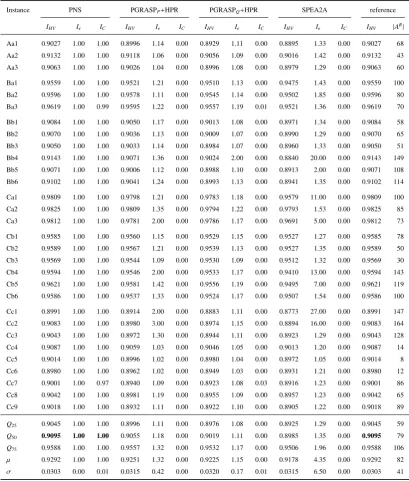
The results for the large instances without known Pareto optimum solution are shown in Tab. 5. This time, the
reference approximation setAR(cf. two rightmost columns) is generated by merging the approximation sets of PNS, PGRASPP+HPR, PGRASPQ+HPR, and SPEA2A and removing the dominated solutions. The last five rows of Tab.
5 show the 25 percent quantile, the median, the 75 percent quantile, the mean, and the standard deviation for each
heuristic and each quality indicator.
The heuristic PNS finds new best approximation sets in terms of IHV andIǫ for all thirty instances. Therefore,
PNS clearly outperforms the existing approaches in terms of approximation set quality. Furthermore, from the values
ofICfollows that the approximation sets computed by PNS are even equal to the reference approximation setAR in
Table 4: Comparison of solution approaches by means of small instances (instance group S).
Instance PNS PGRASPP+HPR PGRASPQ+HPR SPEA2A ǫLBB*
IHV Iǫ IC IHV Iǫ IC IHV Iǫ IC IHV Iǫ IC IHV |AR|
S1 0.8576 1.00 1.00 0.8576 1.00 1.00 0.8576 1.00 1.00 0.8573 1.03 0.71 0.8576 7
S2 0.6095 1.00 1.00 0.6095 1.00 1.00 0.6095 1.00 1.00 0.6022 1.08 0.45 0.6095 11
S3 0.8169 1.00 1.00 0.8169 1.00 1.00 0.8169 1.00 1.00 0.8125 1.47 0.38 0.8169 13
S4 0.5677 1.00 1.00 0.5677 1.00 1.00 0.5677 1.00 1.00 0.5636 1.41 0.25 0.5677 12
S5 0.8652 1.00 1.00 0.8644 1.01 0.88 0.8652 1.02 0.94 0.8535 2.00 0.29 0.8652 17
S6 0.6988 1.00 1.00 0.6988 1.00 1.00 0.6988 1.00 1.00 0.6879 1.27 0.10 0.6988 10
S7 0.8915 1.00 1.00 0.8915 1.00 1.00 0.8915 1.00 1.00 0.8866 1.66 0.12 0.8915 17
*The methodǫLBB calculates always Pareto-optimal solutions.
by PNS. Consequently, the solution approach PNS obtains for all three quality indicators the best median indicator
values at the same time.
5.4. Runtime behavior
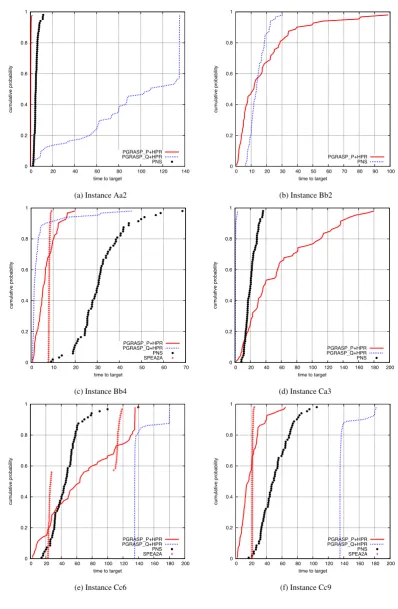
To compare the runtime of the three heuristics from the literature with the new method PNS, a target hypvervolume
value is defined for each instance. The runtime needed to achieve the target value is measured.
The target value is defined as the lowestIHVvalue per instance shown in Tab. 4 and Tab. 5. Therefore, we are sure
that each heuristic has been able to reach the target value at least once. The best known hypervolume value seems not
to be a qualified target value because this target value will probably not be reached by most heuristics, which limits
the value of the experiment. Following, each instance is solved by each heuristic 75 times and the time to target is
measured. The total runtime per heuristic was limited to three minutes (180s). Note, if an algorithm could not reach
the target value within 180s, then a runtime of 180s is reported anyway. Therefore, an algorithm might appear faster
than it actually is. However, this behavior occurred only with the heuristic SPEA2A and never with the heuristic PNS.
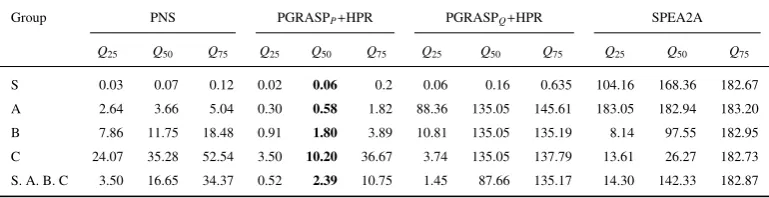
The aggregated results are reported in Tab. 6. According to the reported median values for the 37 instances, the
new heuristic PNS ranks second. The fastest method is PGRASPP+HPR, third place goes to PGRASPQ+HPR, and
fourth place goes to SPEA2A. The median runtime of the method PGRASPQ+HPR for the larger instances is around
135s, which can be explained by a switch from the neighborhood search phase towards the path relinking phase, which
is time dependent. Furthermore, although SPEA2A can repeatedly not achieve the target value in the predefined 180s
(cf.Q75in Tab. 6), for some of the larger instances SPEA2A seems competitive (cf.Q25andQ50).
To give more insights into the runtime behavior of the heuristics, Fig. A.4(a)-(f) show the experimental runtime
distribution for selected instances. The method SPEA2A is missing on some figures, as this procedure is sometimes
Table 5: Comparison of solution approaches by means of large instances (instance groups A, B, and C).
Instance PNS PGRASPP+HPR PGRASPQ+HPR SPEA2A reference
IHV Iǫ IC IHV Iǫ IC IHV Iǫ IC IHV Iǫ IC IHV |AR|
Aa1 0.9027 1.00 1.00 0.8996 1.14 0.00 0.8929 1.11 0.00 0.8895 1.33 0.00 0.9027 68
Aa2 0.9132 1.00 1.00 0.9118 1.06 0.00 0.9056 1.09 0.00 0.9016 1.42 0.00 0.9132 43
Aa3 0.9063 1.00 1.00 0.9026 1.04 0.00 0.8996 1.08 0.00 0.8979 1.29 0.00 0.9063 60
Ba1 0.9559 1.00 1.00 0.9521 1.21 0.00 0.9510 1.13 0.00 0.9475 1.43 0.00 0.9559 100
Ba2 0.9596 1.00 1.00 0.9578 1.11 0.00 0.9545 1.14 0.00 0.9502 1.85 0.00 0.9596 80
Ba3 0.9619 1.00 0.99 0.9595 1.22 0.00 0.9557 1.19 0.01 0.9521 1.36 0.00 0.9619 70
Bb1 0.9084 1.00 1.00 0.9050 1.17 0.00 0.9013 1.08 0.00 0.8971 1.34 0.00 0.9084 58
Bb2 0.9070 1.00 1.00 0.9036 1.13 0.00 0.9009 1.07 0.00 0.8990 1.29 0.00 0.9070 65
Bb3 0.9050 1.00 1.00 0.9033 1.14 0.00 0.8984 1.07 0.00 0.8960 1.33 0.00 0.9050 51
Bb4 0.9143 1.00 1.00 0.9071 1.36 0.00 0.9024 2.00 0.00 0.8840 20.00 0.00 0.9143 149
Bb5 0.9071 1.00 1.00 0.9006 1.12 0.00 0.8988 1.10 0.00 0.8913 2.00 0.00 0.9071 108
Bb6 0.9102 1.00 1.00 0.9041 1.24 0.00 0.8993 1.13 0.00 0.8941 1.35 0.00 0.9102 114
Ca1 0.9809 1.00 1.00 0.9798 1.21 0.00 0.9783 1.18 0.00 0.9579 11.00 0.00 0.9809 100
Ca2 0.9825 1.00 1.00 0.9809 1.35 0.00 0.9794 1.22 0.00 0.9793 1.53 0.00 0.9825 85
Ca3 0.9812 1.00 1.00 0.9781 2.00 0.00 0.9786 1.17 0.00 0.9691 5.00 0.00 0.9812 73
Cb1 0.9585 1.00 1.00 0.9560 1.15 0.00 0.9529 1.15 0.00 0.9527 1.27 0.00 0.9585 78
Cb2 0.9589 1.00 1.00 0.9567 1.21 0.00 0.9539 1.13 0.00 0.9527 1.35 0.00 0.9589 50
Cb3 0.9569 1.00 1.00 0.9544 1.09 0.00 0.9530 1.09 0.00 0.9512 1.32 0.00 0.9569 30
Cb4 0.9594 1.00 1.00 0.9546 2.00 0.00 0.9533 1.17 0.00 0.9410 13.00 0.00 0.9594 143
Cb5 0.9621 1.00 1.00 0.9581 1.42 0.00 0.9556 1.19 0.00 0.9495 7.00 0.00 0.9621 119
Cb6 0.9586 1.00 1.00 0.9537 1.33 0.00 0.9524 1.17 0.00 0.9507 1.54 0.00 0.9586 100
Cc1 0.8991 1.00 1.00 0.8914 2.00 0.00 0.8883 1.11 0.00 0.8773 27.00 0.00 0.8991 147
Cc2 0.9083 1.00 1.00 0.8980 3.00 0.00 0.8974 1.15 0.00 0.8894 16.00 0.00 0.9083 164
Cc3 0.9043 1.00 1.00 0.8972 1.30 0.00 0.8944 1.11 0.00 0.8923 1.29 0.00 0.9043 128
Cc4 0.9087 1.00 1.00 0.9059 1.03 0.00 0.9046 1.05 0.00 0.9013 1.20 0.00 0.9087 14
Cc5 0.9014 1.00 1.00 0.8996 1.02 0.00 0.8980 1.04 0.00 0.8972 1.05 0.00 0.9014 8
Cc6 0.8980 1.00 1.00 0.8962 1.02 0.00 0.8949 1.03 0.00 0.8931 1.21 0.00 0.8980 12
Cc7 0.9001 1.00 0.97 0.8940 1.09 0.00 0.8923 1.08 0.03 0.8916 1.23 0.00 0.9001 86
Cc8 0.9042 1.00 1.00 0.8981 1.19 0.00 0.8955 1.09 0.00 0.8957 1.23 0.00 0.9042 65
Cc9 0.9018 1.00 1.00 0.8932 1.11 0.00 0.8922 1.10 0.00 0.8905 1.22 0.00 0.9018 89
Q25 0.9045 1.00 1.00 0.8996 1.11 0.00 0.8976 1.08 0.00 0.8925 1.29 0.00 0.9045 59
Q50 0.9095 1.00 1.00 0.9055 1.18 0.00 0.9019 1.11 0.00 0.8985 1.35 0.00 0.9095 79
Q75 0.9588 1.00 1.00 0.9557 1.32 0.00 0.9532 1.17 0.00 0.9506 1.96 0.00 0.9588 106
µ 0.9292 1.00 1.00 0.9251 1.32 0.00 0.9225 1.15 0.00 0.9178 4.35 0.00 0.9292 82
σ 0.0303 0.00 0.01 0.0315 0.42 0.00 0.0320 0.17 0.01 0.0315 6.50 0.00 0.0303 41
Q50denotes the median. The best median-values are bold.Q25andQ75denote the lower and upper quartile, respectively.
Table 6: Comparison of the runtime (s) of the four heuristics for instance groups S, A, B, and C.
Group PNS PGRASPP+HPR PGRASPQ+HPR SPEA2A
Q25 Q50 Q75 Q25 Q50 Q75 Q25 Q50 Q75 Q25 Q50 Q75 S 0.03 0.07 0.12 0.02 0.06 0.2 0.06 0.16 0.635 104.16 168.36 182.67
A 2.64 3.66 5.04 0.30 0.58 1.82 88.36 135.05 145.61 183.05 182.94 183.20
B 7.86 11.75 18.48 0.91 1.80 3.89 10.81 135.05 135.19 8.14 97.55 182.95
C 24.07 35.28 52.54 3.50 10.20 36.67 3.74 135.05 137.79 13.61 26.27 182.73
S. A. B. C 3.50 16.65 34.37 0.52 2.39 10.75 1.45 87.66 135.17 14.30 142.33 182.87
6. Conclusion
Considering quality aspects during winner determination in a combinatorial reverse auction for transport contracts
is of practical importance. In this paper, we studied a bi-objective winner determination problem that is based on the
set covering problem and minimizes the total transport costs and the total transport quality simultaneously. To solve
this problem, the heuristic PNS was developed. PNS is inspired by the metaheuristics GRASP and LNS. To construct
an initial set of non dominated solutions, PNS applies a dominance-based randomized greedy heuristic which uses
a two-stage candidate bid selection procedure. The initial solutions are improved by means of a search in large
neighborhoods which switches the applied parameters (removal probability of bids and greedy rating function) in a
self-adaptive manner. Self-adaptive configurations depend on individual solutions and not on the entire approximation
set. PNS was tested by means of 37 benchmark instances. In terms of approximation set quality, PNS outperforms
all known heuristics on each of the 37 benchmark instances. Furthermore, PNS is the second fastest method tested.
Subject of our future research will be the development of solution approaches for bi-objective winner determination
problems which take into account additional business constraints proposed e.g. by Caplice and Sheffi[6].
Appendix A. Time-to-Target plots
Hoos and Stützle [26] as well as Ribeiro et al. [27] discuss the evaluation of algorithms by runtime distributions.
Time to targetplots were introduced by Feo et al. [28]. To draw the plots presented in this appendix the programm of Aiex et al. [29] was used.
References
[1] Kopfer H, Pankratz G. Das Groupage-Problem kooperierender Verkehrsträger. In: Kall P, Lüthi HJ, editors. Operations Research Proceedings
1998. Berlin: Springer; 1999, p. 453–62.
[2] Pankratz G. Analyse kombinatorischer Auktionen für ein Multi-Agentensystem zur Lösung des Groupage-Problems kooperierender
Spedi-tionen. In: Inderfurth K, Schwödiauer G, Domschke W, Juhnke F, Kleinschmidt P, Wäscher G, editors. Operations Research Proceedings
1999. Berlin: Springer; 2000, p. 443–8.
0 0.2 0.4 0.6 0.8 1
0 100 200 300 400 500 600 700 800 900 1000
cumulative probability
time to target
PLNS_3 PLNS_3_6_9_2_4
(a) Instance Aa2, target valueIHV=0.9131
0 0.2 0.4 0.6 0.8 1
0 100 200 300 400 500 600 700 800 900 1000
cumulative probability
time to target
PLNS_3 PLNS_3_6_9_2_4
(b) Instance Bb6, target valueIHV=0.9097
0 0.2 0.4 0.6 0.8 1
0 100 200 300 400 500 600 700 800
cumulative probability
time to target
PLNS_3 PLNS_3_6_9_2_4
[image:24.595.206.386.416.590.2](c) Instance Cc5, target valueIHV=0.9046
0 0.2 0.4 0.6 0.8 1
0 20 40 60 80 100 120 140
cumulative probability
time to target
PGRASP_P+HPR PGRASP_Q+HPR PNS
(a) Instance Aa2
0 0.2 0.4 0.6 0.8 1
0 10 20 30 40 50 60 70 80 90 100
cumulative probability
time to target
PGRASP_P+HPR PNS
(b) Instance Bb2
0 0.2 0.4 0.6 0.8 1
0 10 20 30 40 50 60 70
cumulative probability
time to target
PGRASP_P+HPR PGRASP_Q+HPR PNS SPEA2A
(c) Instance Bb4
0 0.2 0.4 0.6 0.8 1
0 20 40 60 80 100 120 140 160 180 200
cumulative probability
time to target
PGRASP_P+HPR PGRASP_Q+HPR PNS
(d) Instance Ca3
0 0.2 0.4 0.6 0.8 1
0 20 40 60 80 100 120 140 160 180 200
cumulative probability
time to target
PGRASP_P+HPR PGRASP_Q+HPR PNS SPEA2A
(e) Instance Cc6
0 0.2 0.4 0.6 0.8 1
0 20 40 60 80 100 120 140 160 180 200
cumulative probability
time to target
PGRASP_P+HPR PGRASP_Q+HPR PNS SPEA2A
[image:25.595.94.493.106.716.2](f) Instance Cc9
[4] Ledyard JO, Olson M, Porter D, Swanson JA, Torma DP. The first use of a combined-value auction for transportation services. Interfaces
2002;32(5):4–12.
[5] Elmaghraby W, Keskinocak P. Combinatorial auctions in procurement. In: Harrison T, Lee H, Neale J, editors. The Practice of Supply Chain
Management: Where Theory and Application Converge. New York: Springer-Verlag; 2004, p. 245–58.
[6] Caplice C, SheffiY. Combinatorial auctions for truckload transportation. In: Cramton P, Shoaham Y, Steinberg R, editors. Combinatorial
Auctions. Cambridge, MA: MIT Press; 2006, p. 539–71.
[7] Caplice C, SheffiY. Optimization-based procurement for transportation services. Journal of Business Logistics 2003;24(2):109–28.
[8] Abrache J, Crainic T, Gendreau M, Rekik M. Combinatorial auctions. Annals of Operations Research 2007;153(34):131–64.
[9] Goossens D, Spieksma F. Exact algorithms for the matrix bid auction. Computers & Operations Research 2009;36(4):1090 –109.
[10] Yang S, Segre AM, Codenotti B. An optimal multiprocessor combinatorial auction solver. Computers & Operations Research 2009;36(1):149
–66.
[11] de Vries S, Vohra RV. Combinatorial auctions: A survey. INFORMS Journal on Computing 2003;15(3):284–309.
[12] Catalán J, Epstein R, Guajardo M, Yung D, Martínez C. Solving multiple scenarios in a combinatorial auction. Computers & Operations
Research 2009;36(10):2752 –8.
[13] Chen RLY, AhmadBeygi S, Cohn A, Beil DR, Sinha A. Solving truckload procurement auctions over an exponential number of bundles.
Transportation Science 2009;43(4):493–510.
[14] Buer T, Pankratz G. Solving a bi-objective winner determination problem in a transportation procurement auction. Logistics Research
2010;2(2):65–78.
[15] Buer T, Pankratz G. Grasp with hybrid path relinking for bi-objective winner determination in combinatorial transportation auctions. Business
Research 2010;3(2):192–213.
[16] Buer T, Kopfer H. Shipper decision support for the acceptance of bids during the procurement of transport services. In: Böse J, Hu H, Jahn
C, Shi X, Stahlbock R, Voß S, editors. Proceedings of the 2nd International Conference on Computational Logistics (ICCL’11); vol. 6971 of
LNCS. Springer; 2011, p. 18–28.
[17] Karp RM. Reducibility among combinatorial problems. In: Miller RE, Thatcher JW, editors. Complexit of Computer Computations. New
York: Plenum Press; 1972, p. 85–103.
[18] Serafini P. Some considerations about computational complexity for multi objective combinatorial problems. In: Jahn J, Krabs W, editors.
Recent advances and historical development of vector optimization; vol. 294 ofLecture Notes in Economics and Mathematical Systems.
Berlin, Germany.: Springer-Verlag; 1986, p. 222–32.
[19] Talbi EG. Metaheuristics – From Desing to Implementation. Hoboken, New Jersey, USA: Wiley-Verlag; 2009.
[20] Chvátal V. A greedy heuristic for the set-covering problem. Mathematics of Operations Research 1979;4(3):233–5.
[21] Zitzler E, Thiele L, Laumanns M, Fonseca CM, da Fonseca VG. Performance assessment of multiobjective optimizers: An analysis and
review. IEEE Transactons on Evolutionary Computation 2003;7:117–32.
[22] Zitzler E, Thiele L. Multiobjective optimization using evolutionary algorithms - a comparative case study. In: Eiben A, Bäck T, Schoenauer
M, Schwefel HP, editors. Parallel Problem Solving from Nature – PPSN V; vol. 1498 ofLNCS. Springer Berlin/Heidelberg; 1998, p.
292–301.
[23] Zitzler E, Thiele L. Multiobjective evolutionary algorithms: A comparative case study and the strength Pareto approach. IEEE Transactions
on Evolutionary Computation 1999;3(4):257–71.
[24] Knowles JD, Thiele L, Zitzler E. A tutorial on the performance assessment of stochastic multiobjective optimizers. TIK-Report 214;
Computer Engineering and Networks Laboratory, ETH Zurich; 2006.
[25] Zitzler E, Laumanns M, Thiele L. SPEA2: Improving the strength Pareto evolutionary algorithm. TIK-Report 103; Federal Institute of
Technology (ETH) Zurich, Zurich (2001); 2001.
[26] Hoos HH, Stützle T. Towards a characterisation of the behaviour of stochastic local search algorithms for SAT. Artificial Intelligence
[27] Ribeiro C, Rosseti I, Vallejos R. On the use of run time distributions to evaluate and compare stochastic local search algorithms. In: Stützle T,
Birattari M, Hoos H, editors. Engineering Stochastic Local Search Algorithms. Designing, Implementing and Analyzing Effective Heuristics;
vol. 5752 ofLNCS. Springer-Verlag; 2009, p. 16–30.
[28] Feo TA, Resende MG, Smith SH. A greedy randomized adaptive search procedure for maximum independent set. Operations Research
1994;42(5):860–78.