Open Research Online
The Open University’s repository of research publications
and other research outputs
Professional identities in transition : the perceptions of
in-service trainee PCE teachers undertaking an initial
PCE teacher-training course
Thesis
How to cite:
Mattock, Edwina Dorothy (2013). Professional identities in transition : the perceptions of in-service trainee PCE teachers undertaking an initial PCE teacher-training course. PhD thesis The Open University.
For guidance on citations see FAQs.
c
2010 The Author Version: Version of Record
Copyright and Moral Rights for the articles on this site are retained by the individual authors and/or other copyright owners. For more information on Open Research Online’s data policy on reuse of materials please consult the policies page.
31siJanuary 2013
THE OPEN UNIVERSITY
PROFESSIONAL IDENTITIES IN TRANSITION:
THE PERCEPTIONS OF IN-SERVICE TRAINEE PCE TEACHERS
UNDERTAKING AN INITIAL PCE TEACHER-TRAINING COURSE
Author: Edwina Dorothy Mattock BSC(Hons) MSc
A thesis submitted to the Open University in partial fulfilment of their requirements for the degree of Doctor of Education
Submitted for examination in
.January
2010
Date
oJ Sub~<SStOh:
21b
JGtIWOtJ
2olt)
Personal identifier (PI): W449916X
.·· i ··(·. "Affiliated Research Centre (ARC) (if applicable):
Department: Education
The$is title: Professional Identities in Transition: The perceptions Of in-service trainee PCE teachers undertaking an initial PCE teacher-training course
I confirm that Iam willing for my thesis to be made available to readers by The Open University Library, and that it may be photocopied, subject to the
discretion of the Librarian
.
(Dvt1dtcA
Signed: ; .
Print name: Edwina D Mattock
httO:/fWWw ....
.OOEiil.ac.Ukll'Elsearch/research-deareeslOffer-packs.phP 2
I
Date: 05/03/03 DD/MM/V)'The Open University has agreed that a copy of your thesis can bemade
available on loan to the British Library Thesis Service on a voluntary basis. The British Library may make the thesis available online. Please indicate your preference below:
!ZII
am willing for The Open University to loan the British Library a copy of mythesis OR
o
I do not wish The Open University to loan the British Library a copy of my31stJanuary 2013
Professional Identities in Transition:
The perceptions of in~servicetrainee PCE teachers
undertaking an initial PCE teacher-training course
ABSTRACT
A change in government policy and perception regarding the importance of the Post Compulsory Education (PCE) sector to the economy has led to an increase in the professionalisation of the sector as a whole. This in tum has led to changes in training for teachers who work in PCE - the latest of these changes took place in September 2007 and required all those working as teachers in the sector to acquire a licence to practice and work towards qualified teacher status (QTLS) through continuous professional development (CPD).
This study focuses on in-service trainee teachers undertaking a PCE initial teacher-training course and explores the transition from trainee to professional teacher. Using participant produced drawings and stories, and follow-up interviews, trainee teachers voice their own interpretations and perceptions of teacher-training, teachers and teaching. In addition, interview data from four participants designated as experts (experienced teachers who were working, or had worked, on teacher-training programmes) were included to add insight into policy change from the teacher-educator viewpoint.
The aim of this study was to highlight individual perceptions of a lived experience - how trainee teachers saw the role of teachers and experienced the teacher-training process. The acquisition of teaching qualifications was seen by the trainees in this study as an important progression in their professional development because they were an acknowledgement of professional competence. This was also seen as a necessary part of acquiring a teacher identity in that it raised the status of the trainees and recognised their professional approach to -their practice. For some of the trainees accepting their capabilities to perform the teaching role was easier than accepting an identity change - they considered themselves to be works in progress. Data provided by the trainees also showed that personal qualities were as equally valuable in the development of a professional teacher an idea not given emphasis in the new teacher-training course.
31stJanuary 2013 CONTENTS Chapter Page
1
Introduction1
2
Literature Review6
3
Methodology32
4
Findings and Analysis61
5 Discussion
97
6
Conclusion111
References
122
Appendices
131
A Blank copy of questionnaire and accompanying instructions plus the
132
questions used in the interviews and ethical considerations.
B Biography of Participants - Raw Data.
139
C The Pilot Study - the drawings, the interview questions and the
140
questionnaire questions.
31stJanuary 2013 Chapter 4 3 4 5
FIGURES AND TABLES
Figures
Figure 1 Set 1 - Past Experiences where the drawings depicted teachers from the past educational experiences of the participants.
Figure 2 Set 2 - Present Perceptions where drawings depicted the participants themselves or teachers currently known to the participants.
Figure 3 Set 3 - Future Aspirations where drawings depicted the characteristics of good teachers and the aspirations of the participants.
3.1 - All trainees by age and gender
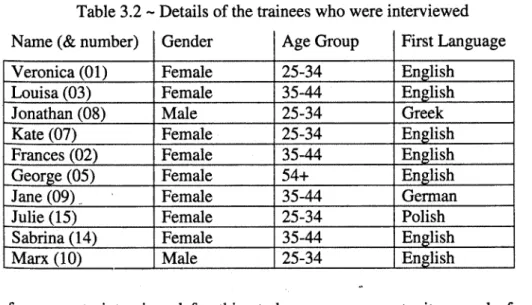
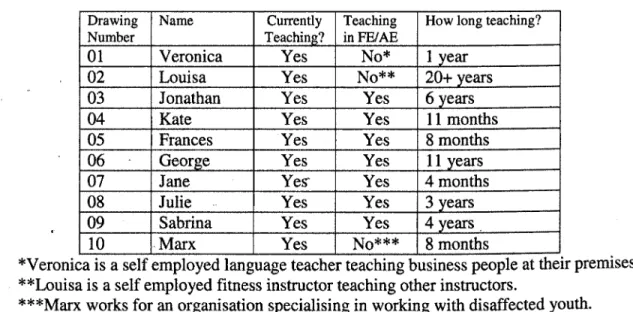
3.2 - Details of the trainees who were interviewed 3.3- Questions asked of the drawings and stories 3.4 - Three themes of the drawings and stories
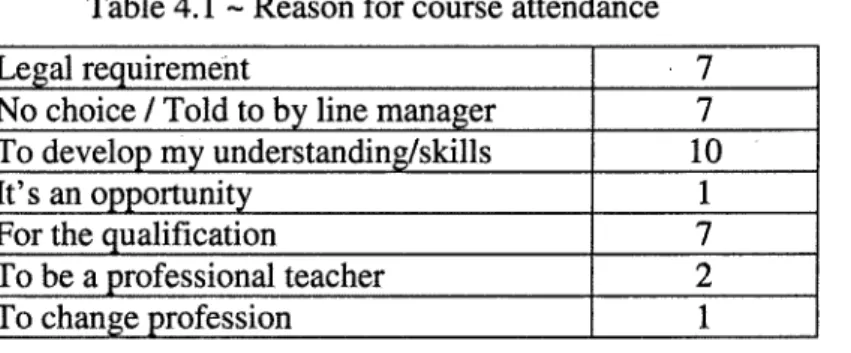
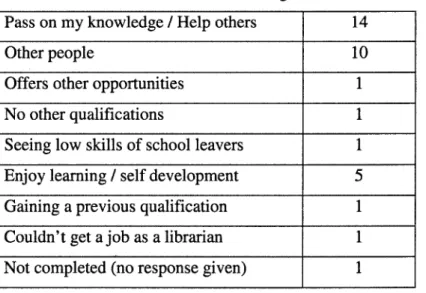
4.1 - Reason for course attendance 4.2 - Reasons for becoming a teacher
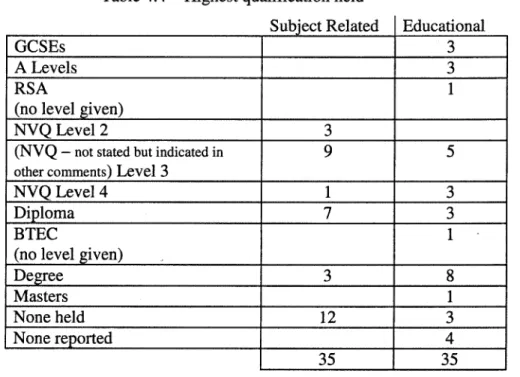
4.3 - Responses to Question 5 'Have you always wanted to be a teacher?' 4.4 - Highest qualification held
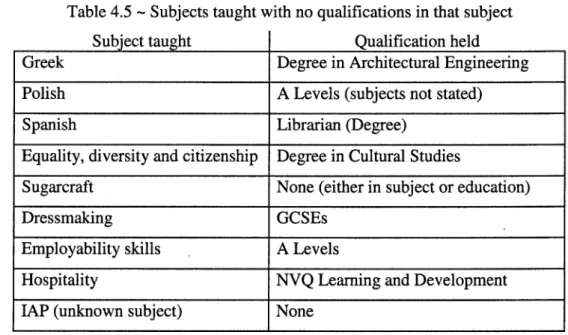
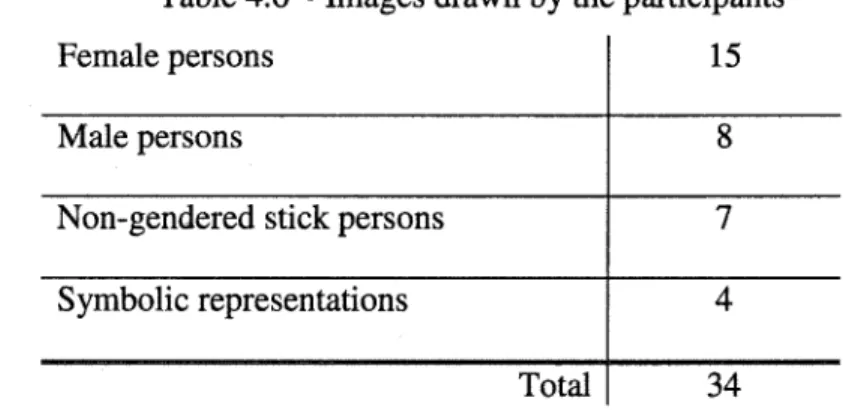
4.5 - Subjects taught with no qualifications in that subject 4.6 - Images drawn by the participants
4.7 - Category of drawings by age and gender 4.8 - Participant who did not draw
4.9 - Drawings of traditional teachers
4.10 - Symbols drawn by the trainees and their meanings 4.11 - What the textboxes said the drawings depicted 4.12 - Details of trainees interviewed
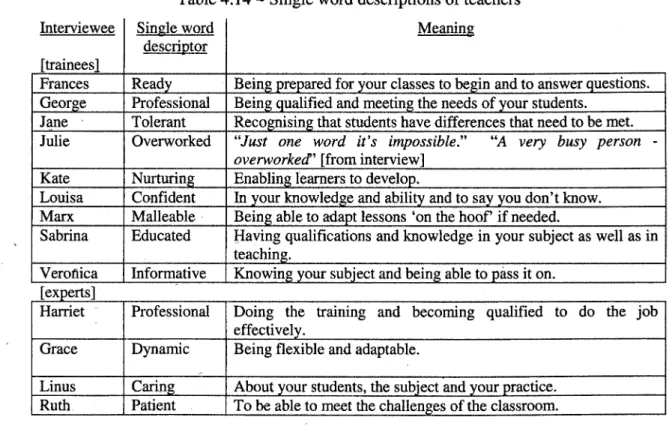
4.13 - Division of interview questions 4.14 - Single word descriptions of teachers
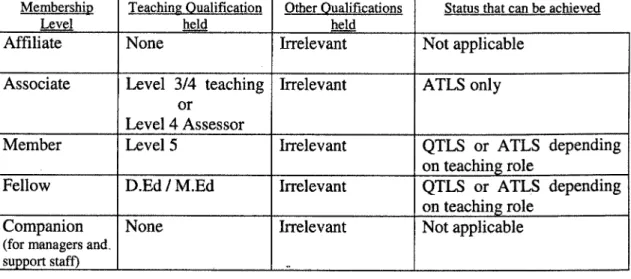
5.1 - ItL membership distinctions
Page 74 i-vii viii-xiii xiv-xvi 49 51 53 54 62 63 63 67 68 71 72 73
75
76 77 80 8190
104Chapter 1-INTRODUCTION
I shall be telling this with a sigh Somewhere ages and ages hence: Two roads diverged in a wood, and I -I took the one less travelled by,
And that has made all the difference.
[Robert Frost: 'The Road Not Taken']
Becoming a teacher in the Post Compulsory Education (PCE) sector was, for me, a journey down a road "less travelled" as I was unfamiliar with it other than as a user of its services. I did not know any PCE teachers or anyone who had made PCE a first career choice and for me it was less an active career choice and more a serendipitous event. I began working in PCE after giving a short talk to Access students at a Further Education (FE) college about the experience of being a mature student at university who had gone through the Access route to get there. I had given up a well paid job in business to undertake an Access course as a means of changing the direction of my working life but had no intention of teaching - I did not know what I wanted to do but did know there had to be change. I was approached after I had finished my talk by a member of the college management team and asked if I would be willing to take on some night class teaching on a temporary basis as the college was short of a Psychology teacher. I agreed despite having no teaching qualifications - my degree specialisms of Sociology and Psychology were deemed to be sufficient, at that time, for me to teach. I was given the A Level and GCSE specifications and my first classes began three days later.
This experience and subsequent contact with other PCE teachers led me to believe that this 'baptism of fire' was (and perhaps remains) a common occurrence. However, in -September 2007, policy changes to teacher-training f~! the PCE sector made it a mandatory requirement for those new to teaching in PCE to hold, or be working towards, a tea~hing qualification.with a view to the achievement of professional recognition and qualified teacher status (Lifelong Learning UK, 2007, Office of Public Sector Information, 2007). Existing PCE teachers were also subject to the mandatory requirements of September 2007 and expected to gain teaching qualifications, if they did not have them, and to engage in continuous professional development (CPD) to maintain Qualified Teacher Learning and Skills status (QTLS). I feel that this meant not only a redefinition of the training PCE teachers received but also their identity, status and skills.
For those who consider themselves to be a professional in their occupation the notion of being professional may be part of their self-identity and a reflection of their skills and perceived competency. Their skills and competency are related to their professional knowledge and practice and it is their expertise that attracts PCE to them as potential teachers in the sector. For unqualified PCE teachers tensions may arise since they may perceive new requirements for their jobs to be threats to their current expertise and hence their professional identity. For trainee PCE teachers the transition from novice (amateur) to expert (professional) in the field of teaching can be a period of tension as they incorporate new knowledge into their prior occupational identity and adapt their skills to their developing competency in teaching. This duality, of being a novice in one field (teaching) and expert in another (prior occupation), raised questions for me about the concepts and ideas held by trainee PCE teachers about teachers and teaching. Italso raised questions about whether or not the training process affects their perceptions of themselves as developing teachers and as professionals in their original occupations.
As I have said above, it was not my intention to teach in PCE - it just happened. I believed teaching to be beyond my capabilities and to be 'thrown in at the deep end' and expected to teach was a shock to the system. Itwas also a shock to my existing professionalism in that having worked all my life in the business world, and continuing to do so whilst doing my degree and first teaching job, there was conflict between how I was used to working and how PCE worked. At that time, in my view, things happened more slowly in PCE and in
a
less efficient way than I usually experienced; for example, photocopying.In
business I was used to being able to reproduce any number of documents at short notice but in a number of collegesI found there were administrative systems which meant photocopying took several days and I was limited in how much I was able to photocopy. I felt that each delay threatened my efficiency and effectiveness as a teacher so I bought my own photocopier. Not only did this lessen my frustration it also bolstered my own feelings of being professional in my practice; This example is a simple one but illustrates how my existing identity as a professional and competent worker was challenged in my new work environment as I adapted to a different and new way of being.My prior business experience was my foundation for adapting to the world of PCE and this gave rise to personal feelings of inadequacy and conflict. My prior identity as a competent professional was threatened by my new employment in which I was an untrained amateur.
I had past experience of teachers from being a student but no knowledge of the role I had undertaken and no awareness of having a 'teacher' identity. Over the years that I have been a PCE professional my identity has crystallised to a point where I now identify with, and wear, the label of 'teacher' with confidence and proficiency. It has thus taken time, experience and training for me to become comfortable in my teaching role and identity.
The realisation that my identity included 'PCE teacher' created a concern for me not only to understand "Why didn't I do this before?" but also how others entering PCE for the first time manage the same issues. One response to this question then and now may be that PCE teaching is perhaps not proffered as a first career choice. Teaching is often still considered to refer to working in schools with children and many of my colleagues had been school teachers prior to becoming PCE teachers. However, tension may still occur as teaching adults is different to teaching children. Trainee PCE teachers travel 'an unfamiliar road' as they undertake the training required to become teachers of adults.
My own experience suggests that the transition from being a professional in an occupation to being a professional PCE teacher requires a shift in perspective. Experienced and qualified plumbers, for example, who become PCE teachers of plumbing, are likely to hold their identity as a plumber more strongly than their identity as a teacher of plumbing. In the same way subject specialists (historians, sociologists and so on) may also hold strong allegiances to their subjects and foreground that identity over and above that of subject teacher. To effect the possibility of change in this emphasis requires training in the art of teaching as well as some recognition by the individual of potential change in occupational status and identity. These are important research interests and issues for me and are central to the research conducted by me and reported herein.
My training and teaching qualification (PCE Certificate of Education) was undertaken after I had been teaching for several months at another FE college to that where I had first begun my teaching career. For this college gaining a teaching qualification was part of the pre-requisites for being employed. My teacher-training was done in-service (on the job) as is the usual experience in PCE rather than pre-service training as experienced by school teachers. The training was delivered by colleagues in the college which again seems to be a common experience for PCE. At the time of this study I was teaching Part One of the new (2007) training courses (City and Guilds Preparing to Teach in the Lifelong Learning Sector or PTLLS) and had taught other teacher-training programmes namely City and
Guilds initial teacher-training courses 7302 and 7407. My teaching qualification allows me to teach adults and my experience includes teaching courses from GCSE to first year degree but I have no qualifications in the training of teachers.
There is a general understanding of what teachers do because we have all, for the most part, attended school and seen teachers in the classroom. However, such general views of teachers and teaching are limited as they are based on surface observations - a stereotype created by the voice of society to enable a general understanding of what is a complex social role. As a Social Scientist and a Teacher I regret the loss of individual voices within general definitions so embarking on this small scale inquiry gave me an opportunity to allow a few individual voices to be heard.
The over-riding aim of this study was to hear from individuals about their experiences and views relating to teachers, teaching and training to become a teacher in the post-compulsory education sector. Inthis way the teacher stereotype, as it relates to PCE, might be explored. Ontologically, given the differing pressures and experiences of the students, it might also make a difference to PCE teachers involved in the study because their voices are being heard and considered.
My second aim for this inquiry was to understand the immediate effects of engaging in the process of teacher education via prescribed teacher-training courses. Governments and ins~tutions can dictate and plan for delivery of teacher-training but this does not necessarily mean that at the end of training 'a teacher' will emerge. Between directive and delivery are many subjective interpretations of what becoming a teacher entails and these subjectivities include the trainee teachers' own interpretations of their experiences as well as the sturdiness or openness of their self-identity. This transitory phase between trainee and trained teacher is the area under discussion in this study ...
Consequently, leading from my own interests and experiences, the following research questions will be explored:
• How do trainee PCE teachers see themselves?
• What are trainee PCE teachers' views and experiences of the training process?
• What are the views of trainee PCE teachers on the 2007 changes to PCE teacher-training and PCE teaching in general?
• What are the views of experienced PCE teachers on the 2007 changes to PCE teacher-training and PCE teaching in general?
These questions informed my study and led to the exploration of not only the experiences of the trainee PCE teachers but also, because I was their teacher, my own teaching practice.
The foregoing has been a rationale for undertaking the research and in the following chapters a literature review is presented with a discussion of the methodology forming the third chapter. Chapter four reports the findings and their analysis and chapter five is a discussion of the findings as they relate to the literature review and the research questions. Finally, chapter six concludes the report.
Chapter 2 - LITERATURE REVIEW
We may be sure that adult education will never be dominated by a caste of professional teachers. There will always be ample opportunity and indeed a paramount need for the enthusiastic amateur who is half
teacher half missionary. (Wiltshire et.al. 1980 p.140)
The quote above is from the 1919 Report on Adult Education which emphasised the importance of not only educating adults but also of maintaining high standards of training for their teachers. The report recognised the value in having professional people teaching adults to ensure the best results for students and demonstrates that questions about the professionalism of workers in adult education have been around for a long time. Whilst the PCE sector, is not yet "dominated by a caste of professional teachers" the 2007 changes to PCE teacher-training sought to raise the professional status of PCE teachers and confine the idea of the "enthusiastic amateur", or untrained and perhaps by implication less professional teacher, to past experience.
The aim of this chapter is to explore the literature that discusses what is meant by being a professional and how, in the course of transition from unqualified to qualified status, the professional identities of PCE teachers may change. The underlying research questions are:
• How do trainee PCE teachers see themselves?
• What are trainee PCE teachers' views and experiences of the training process?
Harre's Positioning Theory (Harre and van Langenhove, 1999) will be utilised to inform the discussion because it proffers a way of exploring the meanings individuals give to their actions and the actions of others within a single context. Positioning theory seeks to
understand
behaviour from the viewpoint of the actors taking part in it, how they view""
themselves and where within the resultant context they position themselves and others.
The main concept arising from the first two research questions concerns professional .identity and its formation. but also within this, because of the nature of the participant group, is the concept of professionalism. Successive policy changes, including the 2007 changes to PCE teacher-training, have created a continuing state of flux for the PCE sector where it is moving towards a more professionalised status for its workforce and thereby itself. Arising from this are the research questions:
• What are the views of trainee PCE teachers on the 2007 changes to PCE teacher-training and PCE teaching in general?
• What are the views of experienced PCE teachers on the 2007 changes to PCE teacher-training and PCE teaching in general?
These questions lead to a discussion of professionalisation in relation to the PCE teaching workforce to give an overview of the PCE sector at this juncture.
Given that working and training at the same time can create tension for trainee PCE teachers, there is little research in this area (Orr and Simmons, 2010), or into becoming and being a teacher in PCE (Jephcote et.al., 2008). Clow (2005) believed that her research was the first to capture the working life of full-time PCE practitioners but teacher-training was not part of her exploration. There is a body of research exploring pre-service teacher-training (Avis, Bathmaker and Parsons 2002; Avis and Bathmaker, 2006, 2009; Bathmaker and Avis, 2005) and PCE teacher-training in general terms (Noel, 2006; Thompson and Robinson, 2008) but Orr and Simmons (2010) appears to be the only example of research with in-service trainee peE teachers as in this study. As Holloway (2009, p184) observes there is a paucity of literature exploring the PCE sector and the experiences of its practitioners. Considering the amount of recent change experienced by PCE (see Lucas, 2004; Nasta, 2007; Thompson and Robinson, 2008 for a discussion of the many policy changes that have affected PCE up to 2007) it is surprising that research is limited.
This chapter is organised to provide some background to PCE teacher-training followed by a discussion of Positioning Theory which informs this study. An exploration of Professional Identity and being a professional follows which leads to an account of PCE practitioners and the PCE sector.
BACKGROUND
""
Prior to 2001 there was no requirement for PCE teachers to be trained or have professional teaching qualifications (Lucas, 2004; Edward et.al. 2007; Nasta, 2007; Orr and Simmons, 2010) and there was little culture, or awareness, of professional development in PCE . teaching (Orr and Simmons, 2010). Thompson and Robinson (2008, p.162) note that the most influence on the lack of development of PCE teacher-training has been PCE's foundations in the provision of technical education observing that "The nature of this provision meant that technical expertise was accepted, no doubt pragmatically, as the key determinant of employability as a teacher. Teaching skills were seen as something to be
'picked up' through experience, and professional knowledge, when valued at all, was equated with subject expertise."
The assumption was made that if you knew your subject you could teach it. Around 90% of PCE teachers undertake their training on a part-time, in-service basis (Orr and Simmons, 2010) because employment in PCE has almost always preceded training to teach in PCE. Teacher-training in PCE is mostly delivered by PCE practitioners who work in the same institution as the trainees and this is a continuing practice (Noel, 2006; Nasta, 2007) that gives a context where colleagues train colleagues. The effects of this type of training are not explored in this study because the focus is on the trainees' experiences of the training and not how the training is delivered.
The shift in government focus of the last decade or so has brought PCE into the spotlight as the means by which the government's skills agenda could be delivered and also for its contribution to aiding social inclusion. The emphasis on the importance of PCE to the economy and social inclusion (Lucas, 2004; Jephcote et.al. 2008; Orr and Simmons, 2010) has meant a succession of policy changes for the sector for several years (Nasta, 2007; Edward et.al. 2007; Orr and Simmons, 2010) some of which have affected the training of PCE teachers. These changes are situated in a broader context highlighted in the White Paper 'Further Education; Raising Skills, Improving Life Chances' (Department for Education and Skills, 2006). This report states that the economic future of the nation depends on improving its skills base to enable the workforce to compete in the global market. Improvement in skills was to be undertaken through the PCE sector whose central role was "...equipping young people and adults with the skills for a productive, sustainable
employment in a modern economy" (DfES, 2006, p.l). The link between a poorly
performing economy and low skill levels was clearly established in the White Paper and the responsibility for changing this was laid at the door of PCE with its history of vocational education and training.
Increasingly the PCE sector has become "...mainstreamed within a national learning and
skills sector" (Gleeson et.al. 2005, p.448) where it is no longer a marginalised sector
somewhere between school and university but a part of government policy for ensuring a skilied workforce capable of meeting the needs of an increasingly global economy. Lucas (2004, p.35) uses the metaphor "FENTO Fandango" to represent what he calls the somewhat "bewildering changes" experienced by PCE teachers and the varying "dances"
to be performed for the different regulating bodies overseeing the peE sector because of the changes. Indeed, peE has become increasingly regulated by the State (Keep, 2006) and the content of peE teacher-training courses is now prescribed by government agencies (Orr and Simmons, 2010). Lucas (2004, p.49) questions the balance between regulation of the sector and the need to raise the quality of teaching practice noting that "...while there is much to be welcomed in recent developments, there is a danger of over-regulation in a sector where one of its strengths is the diversity of practice to meet the diversity of context and learner need".
With peE becoming part of the mainstream it provides a means of meeting a wider range of education and employability needs because of its foundations, and thereby its diversity, in skills provision. peE teachers, therefore, have to be more than subject specialists because they teach over a broad range of areas requiring skills that are transferable between these areas (Lucas, 2007; Noel, 2006) such as basic literacy, numeracy and information technology. These basic skills are a cross-curricula requirement forming the core skills element within most vocational programmes needing to be monitored and appraised as part of the employability agenda.
Periods of change, such as the introduction of mandatory peE teacher-training in 2007, may affect the personal and professional identity of the individual because of the emotional attachment he/she has to the teaching role (Beauchamp and Thomas, 2009). As a perceived 'caring profession' teaching holds an emotionally charged element perhaps leading to a less than pragmatic response to change from individual teachers; that is, there may be tension for some teachers in accepting a change in the identity of teaching because of potential consequences to their own identities meaning a reluctant compliance (Edward et.al. 2007) with change rather than a commitment to it. This has the potential to position policy initiatives and their subsequent changes in a lower position of priority than perhaps the policy makers intended.
POSITIONING THEORY
Positioning theory (Harre and van Langenhove, 1999) is concerned with social action and what. it is. that influences individuals to respond to each other in particular ways within different contexts and how this affects the story or storyline of the individuals. In this study the social action in question is undertaking the newly introduced peE teacher-training course and the resultant responses of the participants to it as they develop their storylines to include that of trained peE teacher. Harre and van Langenhove (1999, p.17)
describe the act of positioning as "...the assignment of fluid 'parts' or 'roles' to speakers in the discursive construction of personal stories that make a person's actions intelligible
and relatively determinate as social acts." Positions exist within the understanding of the
pertinent social group (Harre and Moghaddam, 2003); for example, the relationship between teacher and student within the context of the classroom is understood by all those who have attended school.
Positioning is a social event within which the rights and duties of attending school (for example), if not already known, are learned and are similar for all teachers and students. The rights and duties of the position limit the possible actions available to the individual or the group (Harre and van Langenhove, 1999) because of the context in which the event is occurring - the classroom context means teachers teach and do not run around the room screaming and neither do students if they want to remain within the context and continue learning. The participants in this study were positioned, not only by themselves as trainee PCE teachers, but also by agencies with responsibility for PCE who initiated policy changes that led to the 2007 changes in PCE teacher-training. The positioning of the participants put them in conversation with those who could provide the training within a context where both sides held a tacit understanding of their relationship.
Positioning Theory can also show where in the story the self is situated in relation to others who inhabit the same storyline. Storylines are dynamic and, therefore, positions will shift and, be re-positioned as the context changes and evolves but storylines are also subject to the willingness of those involved to position or be positioned. Alongside this is the issue of whether or not individuals have the power or capacity to position themselves and others in a continuation of the storyline (Harre and van Langenhove, 1999). For example, the Participants in this study are trainee PCE teachers and as such, within the context of the
.
'training course, cannot position themselves other than as trainees if they want to learn what is needed for them to achieve a teaching qualification that moves them further on in the storyline of becoming a-qualified PCE teacher. As Harre et.al. (2009, p.8) observe
"If we take the view that life unfolds as a narrative, with multiple,
contemporaneous interlinking story-lines, the significance of the
actions that people carry out, including speech acts, is partly
determined by the then-and-there positions of the actors.
In
attempting to understand the behaviour of an individual and/or group then the context in which the action occurs has significance. As trainee teachers' move between identitiesfrom untrained to trained teacher they seek confirmation from others that they know what they are doing. This confirmation is not only received in the successful completion of course assignments but also sought from their fellow students, from colleagues with whom they may work, and from others they see as experts. Inother words, they engage in the positioning of themselves and others so that they can learn who and what they are within the context ofpeEpractice as they develop their professional teaching skills.
BEING A PROFESSIONAL
Professional as a concept is dynamic, contested and socially constructed varying with time, context and place (Robson, 2006; Gleeson and Knights, 2006). However, Robson (2006) suggests that the notion of 'being a professional person' holds within it a set of ideas that form a symbol of aspiration rather than a description of an occupation. Robson (1998) also notes that a professional identity carries not only self-perception as a professional relating to acquired knowledge and skills but also the perceived relationship to significant others in the particular professional group. Professional is, therefore, a combined measure of how you see yourself and how you perceive you are seen by others. I use the concept of professional within this study as being both an internal and external perception; that is, an expression of the value you perceive your knowledge and skills to have for yourself and others to enable you to be called a professional.
The concept of professional focuses on three central ideas - specialised knowledge which is beyond the reach of the lay-person and supported by research and theoretical modelling;
professional autonomy which is the making of decisions by the professional for the good of
others; and professional responsibility which is accepting that the 'right' decisions are made using knowledge and professional values (Furlong et.al. 2000). However, Robson (2006) maintains that peEpractitioners have never really been autonomous because they 'York to the prescribed learning programmes of others - they have autonomy over their classrooms but not in the learning they deliver. She also notes that the specialised knowledge of peEpra~titioners is currently stated in terms of competency making. them subject specific and therefore separate from pedagogy. Professional responsibility is tied . to notions of trust in, and care of, others and in schools the demarcation lines are clearer than in peEwhere it is not usually parents to whom peEpractitioners are answerable but employers and organisations (Robson, 2006). This means a wider range of interests have to be taken into account when making decisions about the right thing to do but these may be impacted by the positioning of students needs first.
The specialised, professional knowledge in PCE is wide ranging and encompasses more than knowing how to teach (Clow 2001, 200S; Gleeson and James, 2007). Italso embraces the notion ofdual professionalism (Robson, 1998); that is, those who teach professionally are also professionals in the subjects they teach. For example, they might be highly qualified plumbers belonging to a professional body in relation to plumbing requiring they maintain their CPD; or they might be qualified linguists teaching a modem language whilst constantly updating their linguistic skills and knowledge. Tension can be created between meeting the needs of a desire to belong to a profession and the requirements of the profession for members to present the right behaviour for the profession. The latter is often dictated by a code of practice and rules of membership of the professional body (as with the Institute for Learning (IfL) and PCE), that oversees the profession but this will be tempered by the individual approach of the person as he/she explores what it means to them on a personal level to be a professional.
The PCE sector has been subjected to the assumption that its practitioners are amateurs who play at teaching because of its association with leisure or skills-based learning (McKenzie, 2001). However, the majority of those teaching in PCE are professionals in their own fields before they become teachers. Itis usually because of their professional skills, knowledge and expertise that they have been asked to become teachers in PCE (Bathmaker and Avis 200S; Clow, 2001). As Gleeson et.al. (200S, p.449) note "Entering FE is, for many, less a career choice or pathway than an opportunity at a particular
moment in time". They are not necessarily career practitioners but are acquiring a new set
of skills to give them an opportunity to be employable in another profession. The move into teaching is often begun whilst still employed in their original work. In essence, they become teachers in the sector by accident more than design (Noel, 2006; Gleeson and James, 2007; Avis and Bathmaker, '2009).
A casual and flexible. approach to recruitment is characteristic of the sector "Such 'eruryism' into FE teaching is not new and reflects FE's voluntaristic and entrepreneurial
legacy" (Gleeson et.al. 200S, p.4S0). Whilst some potential practitioners experience a
rigorous application process for others their route into PCE involves a more flexible approach such as being introduced by an existing teacher (Gleeson and James, 2007). Few of these practitioners would be likely to lay claim to the status of professional teacher
because of their self-perceived lack of educational theory expertise (Jarvis, 1985). Their expertise is in their individual fields not in education.
Robson (2006) discusses the view that the term professional holds a certain amount of self-interest for some professions as they guide their identities towards their own definition of the term. This self-interest creates an insider-outsider perception for the profession (that is, you can be an insider if you meet the right criteria) and maintains a specific identity for the group andlor individuals within the group. Randle and Brady (1997) suggest a view of the professional teacher that has individual autonomy to the fore but Crawley (2005, p.138) observes that "The widespread use of institutional targets and performance measures, coupled with systems and procedures aiming to improve quality, leaves little space for the
autonomous teacher." The definition of professional Randle and Brady (1997) use in
relation to practitioners in the PCE sector is characterised as having apublic service ethic
where the emphasis is on meeting the needs of students. Managerial values like targets and performance measures do not sit comfortably within a public service definition of professional because students are seen as units of activity and not as people needing support in their learning.
Lucas (2000, p.239) states "When 'professional' is used in FE it refers more to competence
in a technical, compliant sense, with discussions about pedagogy and wider
professionalism marginalized." He is referring to the traditional allegiance held by PCE
practitioners to their subject specialisms where they viewed their professionalism to be and
"just teaching" was not considered to have as great a value (Clow, 2005). This allegiance
inhibits a response to PCE teaching as a career of choice rather than an accidental arrival; that is, a second career rather than a first. The assumption was that if you were proficient in your subject then you would be able to pass on your knowledge andlor skills to others
. .
and thereby pedagogy was given a secondary position to ..the skills to be taught. The diversity of practitioners, and practices, arising from this also inhibited the attainment of a singl~ identity not only for them as professional teachers but also for the sector as a teaching profession
"If
you are not agreed about the kind of professional you are it isdifficult to organise as a body and move towards consensus" (Clow, 2001, p.417).
Subject specific skills in industry, business, or academia have usually been acquired before potential teachers enter the PCE sector and strong allegiances are held to these backgrounds. These are the sites of their first occupational identities and as Robson (1998,
p.596) notes "...this identity is what gives them credibility (as well as knowledge and skill)
and it is therefore understandable that much value attaches to it." She goes on to observe
that it is because of their successful 'socialisation' into these first occupations that they have come to PCE in order to pass on their knowledge and expertise. However, the transition process from one occupation to another is not easy and involves more than acquiring skills and knowledge to do the new job. Existing practices, no matter how professional, may not be appropriate to the new setting (Robson, 1998). Time and reflection are needed to enable the transition from professional subject specialist who teaches to professional teacher of a specialist subject. The opportunity to engage in the teacher-training process may also give the trainee teacher the time he/she needs to change their professional allegiances and acquire dual professionalism.
Lucas (2007) notes that initial teacher-training in peE is a combination of specialist knowledge and learning on the job. He acknowledges that what trainee PCE teachers learn is unpredictable because of their existing knowledge and how this influences newly acquired knowledge. If they already teach, trainee PCE teachers have a diversity of experience from their practice, and from their prior working lives. Marrying this knowledge to new learning so that their training is applicable to their practice can be problematic but then "Knowledge creation does not mean so much the uncovering of
hidden truth as the construction of new perceptions" (Rogers, 1996, p.l04). Trainee PCE
teachers need to learn new ways of seeing teaching practice and also to change their self-per~eption from skilled professional who teaches to professional teacher with a skill to be taught. How far the perceptions and knowledge of the trainee teachers in this study have developed towards becoming PCE teachers was explored and is reported herein.
Robson (2006, p.19) states "To the extent that it exists, the professional knowledge of teachers in post-compulsory education ... appears to be fragmented, resisted and tending to
be obscured by.shifting and multiple realities." She also notes that differing theories and
ideas have tried to evaluate the teaching knowledge held by PCE practitioners but' have fallen sfiort of giving a generalised description that can be applicable to all contexts of practice (ibid). This may be because in PCE there has been little development of a CPD culture (Orr and Simmons, 2010) and therefore PCE may be less open to standardisation due' to its diversity meaning a more individualised approach to teaching. The existing professional knowledge and qualifications of PCE practitioners revolve around the subjects they teach, in which they perceive they are skilled, and which are updated as required.
However, their existing knowledge (if any) relative to teaching and learning may not be generalised to a wider generic framework but individual to their own specific needs and interpretation. The opposite may also be in evidence in that they hold a generic idea of teaching and learning but cannot readily apply it to their specialism and thus cannot see the relevance of knowing what teaching and learning are. Ineither case, we have tutors who are specialists in their subject areas but amateurs in the areas of teaching and learning.
Gleeson et.al. (2005) observe that the flexibility and adaptability of the PCE sector has meant an ability to absorb change more readily as part of a practitioner's working life. They go on to discuss the view that integrated into a practitioner's role are, on one side, frustrations regarding the structure of his/her work, and on the other the compensations of enabling and witnessing learner achievement. The authors explain that the compensations are the elements that directly relate to the internal desire to teach within professional commitment and engagement. Edwards et.al. (2001) note that flexibility and work done outside of the contracted hours are part of the make-up of many PCE practitioners' experiences. However, Gleeson et.al. (2005) also say that an emphasis on inclusion of all those who want to learn has meant adding an element of understanding the learner personally as part of being a professional practitioner which goes beyond the traditional role and boundaries of a teacher in the PCE sector and as Edward et.al. (2007, p.170) observe "Commitment to the learners may not be enough to help staff cope with the
pressures offurther waves of change". Bolton (2005) speaks of "minding the gap" the gap
bei~g the space where one role ends and another starts - the gap between the personal and the professional where boundaries can sometimes become blurred and create uncertainty about how to proceed.
The process of training not only offers professional development of skills but is also a good starting point for creating an awareness of the need for. a professional identity and the changes that might be experienced (Beauchamp and Thomas, 2009). The trainee PCE teacher is positioned within a context in which there are not only experts teaching him/her but also experts surrounding him/her and who all have differing backgrounds and practice skills. This diversity means a multi-faceted experience from which the trainee can draw to develop his/her competency as a teacher and aid development of an awareness of good and bad practice. In this current study the participants were familiar with using reflection throughout the training course as an element of achieving the qualification and in their
practice as part of their Cl'D as required by IfL. This study provided a further opportunity for reflection used in the data gathering process as described in the next chapter.
Many PCE practitioners begin their careers in the PCE sector with no pre-service training or insight into being teachers - they become PCE teachers because of their first career knowledge and skills and may continue to be more loyal to their prior professions than to teaching. Being professional has obligations and responsibilities but being autonomous is limited for PCE practitioners to being able to adapt to change and be flexible in their practice so as to meet the needs of a changing context. Between the top-down regulation of the PCE sector and bottom-up mechanisms for consumer choice/voice is " ...the idea of the professional as simply someone who does a thorough job exactly in line with the sort of
specification associated with service agreements" (Gleeson and James, 2007, p.460). PCE
practitioners do more than service clients and, whilst much of what they do is prescribed for them by others, their existing identities as professionals in their fields may influence their responses to their development of a professional teaching identity because being a professional person is already part of their identity.
PROFESSIONAL IDENTITY
The multi-faceted and complex nature of teachers' professional identity is acknowledged within existing literature along with the difficulty of providing a concise and precise definition. Beijaard et.al. (2004), in a meta-analysis of the literature, concluded that where definitions were given they lacked clarity as a variety of definitions were given and in
some reports were not given at all. Hetherington (1998, p.15) states that "Identity is about
both correspondence and dissimilarity" to others with whom we interact and this includes
those people from whom we learn the skills and knowledge that feed into professional identity.
Being a professional is part of the self-identity of any skilled and competent worker and is related to professional knowledge and professional practice (Watson, 2006). However,
"The relationship between professional identity and practice is not a simple unidirectional . one in which some essential core of self, a stable entity comprising who we think we are,
determines how we act in a given situation" (ibid. p.525). Identity is not fixed but dynamic
and is multi-facetted changing as the individual develops both personally and professionally with the acquisition of new qualifications and skills that may lead to a perceived higher level of professionalism. Beauchamp and Thomas (2009, p.177)
comment that "Within a teacher's professional identity are sub-identities which may be more or less central to the overall identity and must be balanced to avoid conflict across
them". For trainee PCE teachers the transition from novice to expert, from amateur to
professional, from untrained to trained PCE teacher, can be a period of tension and/or conflict as they incorporate new knowledge into their existing practices in the pursuit of qualifications that give a tangible professional identity. However, according to Watson (2006) the importance of a professional identity lies in its close relationship with professional knowledge and the enactment of that knowledge in practice "professional
action is doing professional identity" (ibid. p.510). Individuals have multiple identities but
in this study the focus is on the developing professional identities of trainee PCE teachers.
Harre and Moghaddam (2003, p.3) believe that "An important feature of social behaviour is the collaborative construction of social reality and the mutual upholding of particular
interpretations of the world." According to their view, understanding who you are and
where you fit in society would seem to be important features in professional identity formation especially forthose in transition from one identity to another as was the case for the trainee PCE teachers in this study. Managing this transition is complicated by being both trainee teacher and teacher at the same time (Orr and Simmons, 2010) because what is learned in the training-room may be at odds with the experienced reality of what happens in the teaching-room; that is, the training course and everyday practice may be separated and exist in parallel rather than as extensions of each other, creating an identity conflict for the trainee between the perceived ideal self and the self in reality.
A similar notion to the idea of dual professionalism (Robson, 1998) is that of dual identity
as proposed by Orr and Simmons (2010). This is where, as a result of in-service rather than pre-service training, trainee PCE teachers are positioned as both trainees and teachers simultaneously. This 'idea is not explored as a concept within this research but is acknowledgedas an influence on the development of a professional identity. A similar duality was discussed .by Cortazzi (1993) and was thought to be almost natural in that whilst managing the learning context teachers separate the professional from the personal selves they project to maintain an image of competence for their students. Inpractice this may not be as straightforward as suggested because the boundaries between the professional and the personal may not be distinct.
Beauchamp and Thomas (2009, p.178) commenting on professional identity say that "A teacher's identity is shaped and reshaped in interaction with others in a professional
context" which alludes to the importance of the environment in which professional
identities are formed. For those taking part in this study, the training course (as the context or environment) itself may offer the opportunity for professional identity development because they are mixing with a diverse group of their peers. As Robson (2006, p.43) notes
"In the context of a discussion about their training and development, the peer group may
afford opportunities for enrichment, for the sharing of perspectives and for making
personal and professional changes in a relatively safe environment." The comparison of
experiences or storylines (Harre and van Langenhove, 1999) between trainees proffers new ideas and experiences from which to learn about their practice and identity. Burkitt (2008, p.SS) comments that "How we make sense of our self depends on how we contribute to the world and make a difference, no matter how small, to social life in general or to the lives
of others we interact with." The correspondence and similarity we have to others impacts
on personal and professional identity development as does individual difference.
Bradley (1996, p.212) observes that "Identities are not free floating. The lived relations in
which each of US is located put constraints and limits upon the possible range of
identifications, though within those limits we can work creatively with the potentialities at
hand." The 'lived relations' of class, ethnicity and gender (along with disability and age)
help to inform the identities people create for themselves and this includes their professional identity. The prescribed curriculae of their lived experiences help them to reconstruct an identity from within their own cultural and social identities; as Bruner (cited in Moon and Murphy, 1999, p.1S7) states "Nothing is culture free but neither are
individuals simply mirrors of their culture"; that is, identity is both ascribed (given by
others) and acquired by the individual's actions and experiences. Therefore, the identity of teachers is ascribed by the social construction of 'teacher' as a concept through the definitions of "others and acquired from the individual's interactions and personal interpretations of what :teacher' means to them. Both the ascribed and acquired elements of their identities happens within a cultural context created by social interaction and the resultant positioning of the individual by himselflherself in an attempt to understand how they might fit within the social world and thus continue their storyline (Harre and van Langenhove, 1999).
It is suggested by Avis and Bathmaker (2006, p.183) that "...teaching identities are formed in continuity with the past and through a process in which their development is mediated
by current conditions". Ifthe idea of professional, as it relates to teaching, is not made
transparent within the training process then the bridge between the past and present occupation may be weak. This may mean the transition process will be slower and longer as individuals strive to connect past and present skills and achieve a stable identity. Ball and Goodson (1985, p.18) observe "The ways in which teachers achieve, maintain and develop their identity, their sense of self, in and through a career, are of vital significance
in understanding the actions and commitments of teachers in their work." To be secure in
the skills and professional identity of a PCE teacher takes time, training and the experience of living the role.
Watson (2006) suggests that 'professional identity' is linked to the ideas of Giddens (1991) concerning self-identity as a 'reflexive project' - we constantly update and renew our identities to enable us to achieve a state where our identity feels natural when we enact our professions. Giddens (1991, p.52) observed that self-identity is created and "...sustained
in the reflexive activities of the individual" having a continuity with the past but a sense of
development through interaction. As individuals we draw on a variety of sources (both positive and negative) to construct our identities; work is just one source and one part of the story of our lives. However, Jephcote et.al. (2008, p.166) observed in their research with PCE teachers that the development of teacher identities (and ideas about teaching and learning) was greatly influenced by past experiences with learning "... and often underpinned how they distinguished between 'good' and 'bad' teachers or 'good' and
'bad' learning and teaching." How their participants saw and understood themselves was
coloured with stories of other teachers and learners. This notion is explored in this study.
Part of the story of a 't~acher' is how slhe identifies her/his, self with what being a teacher means. We all 'know' what a teacher is, or at least believe that we do, because of our exposure to education within our own experience. "People tend to teach, or in a few cases to avoid teaching, in a similar manner to that in which they themselves were taught"
(Eraut, 1994, p.60) and therefore the trainee teachers in this study already had implicit ideas of what it means to be a teacher before they started their training courses. Their understanding was an aggregate of their experiences relating to teaching and learning whether through imagery, literature or first-hand personal experience. Weber and Mitchell (1995) explored a variety of existing texts and images, drawn from. films, television, books
and so on, as well as images drawn by children and teachers, to form an analysis of what 'a teacher' is and does. They posited that images and texts are multi-layered communicative devices that can reveal aspects of personal and social knowledge; that is, the socially constructed knowledge of a phenomenon - the phenomenon in their research being teachers and teaching.
There are a wide variety of images and texts offering opportunities for the development of a self identity that in turn have drawn on existing knowledge for their construction and this includes a teacher identity. However, as Usher et.al. (1997, p.14) note "Knowledge is
exchanged on the basis of the performative value it has for the consumer". This means
that a new identity, or additional one, has to be worth the effort of developing it and, in terms of trainee PCE teachers, training courses need to engage them in the acquisition of new skills that they can perceive to be of benefit to their practice and CPD as they develop both their skills and identities. Nasta (2007) in his research on national standards for PCE noted that PCE teachers were more interested in how knowledge can be used in improving their practice than in the theoretical reality of that knowledge. Orr and Simmons (2010) observed that, for their in-service trainee PCE teacher participants, pedagogy existed as an ideal in the training room (where they saw themselves as trainees) and not in their real everyday practice (where they were seen by themselves and others as teachers) coping with a full workload and where their "... developing identity as teachers was shaped primarily
by expediency" (ibid. p.86). It seems that for some practitioners doing the job takes
precedence over theories underlying the job and perhaps this is related to the professional identity of PCE teachers being closely aligned with their subject specialisms and the culture within PCE where teacher-training was secondary to professional skills.
To develop a unique identity we need the participation and interaction of others to assess and evaluate who we are; we are not determined by others..but informed by their attitudes and actions towards us (Burkitt, 2008). Through the conversations and resultant positioning of ourselves and others we learn who and where we are within the context of the conversation (Harre and van Langenhove, 1999). We are all hybrids and monsters
(Bradley, 1996) made up of parts of different identities (including a professional identity) 'borrowed' from a variety of sources and explored within different frameworks as we differentiate ourselves as individuals. For trainee PCE teachers, like those in this study, developing a professional teaching identity may be complicated by being both teacher and trainee at the same time as well as holding allegiance to former professional identities.
Chan and Schwind (2006) used their own reflexive stories, of being nurses and nurse-educators, to speak about the acquisition of a nursing identity, and how personal biographies can influence the profession of nursing. They posit that the exploration of what people bring from their personal lives into their professional lives has a bearing on the development of a profession and on the professional development of the person. They discuss the view that knowing who you are personally has an impact on understanding your professional identity as does having access to a mentor, or experienced professional, as a role model. The researchers also observe that there can be conflict for individuals in letting go of their individual identity to acquire a professional identity and that " ...the greater the gap between the individual's personal and professional values and beliefs the
lesser the chance of assimilation into that profession" (Chan and Schwind, 2006, p.309).
They also note that nursing has struggled since its inception to acquire its own professional identity and conclude that " ... constant expansion of nursing knowledge is supported by
learning more about ourselves through stories of personal and professional life
experiences" (ibid. p.312). For the authors becoming part of the nursing community was
like '....being initiated into a new tribe" (ibid. p.3lO). This insightful discussion of attaining a professional identity helped me to see that PCE and its practitioners were not alone in the struggle for a professional identity and that this study could contribute to the understanding of the transition for the sector and its teachers.
PROFESSIONALISATION OF THE PCE WORKFORCE
For many occupations 'professionalisation' is defined through a requirement for initial training and acquiring qualifications before being able to practice and then further training to achieve certification as a professional practitioner (Hillier, 2005). Practitioners are usually required to become members of the relevant professional body as it is this body .which bestow the licence to practice. As Hillier (2005, p.215) notes "Professional practice is therefore seen to be practice that has met threshold standards, is continually developed
and takes account of new research and development in the field." Professional bodies also
<
support research and dissemination of knowledge to inform practitioners of current issues and best practice (Hillier, 2003).
The professionalisation of the PCE sector continued in September 2001 when it became a requirement for all newly appointed teaching staff in PCE to hold, or obtain within a set time period, a recognised teaching qualification. Existing unqualified PCE teachers were
also expected to acquire a teaching qualification but existing qualified teachers were given credit for their qualifications and up-skilled where necessary (the same condition applies for the 2007 qualifications). These qualifications were aligned to the Further Education National Training Organisation (FENTO) Standards which were set out in the Government Green Paper 'The Learning Age' (Department for Education and Employment, 1998) which stipulated that all PCE practitioners should be qualified to an appropriate level. Despite the 2001 changes to PCE teacher-training, in 2004 less than 45% of PCE sector teaching staff held teaching qualifications (Thompson and Robinson, 2008). Lucas (2004, p.36) states that whilst teaching qualifications were seen as desirable by employers
"... there was little political or public concern about the actual nature or the uneven
development of teacher training in the sector" and that the PCE sector suffered from the
'benign neglect' of government.
The Institute for Learning (ItL), as the PCE professional body, is a new and significant move towards providing support for those in the PCE sector to be recognised as professionals. However, belonging to the ItL is not a choice for PCE practitioners it is compulsory and in instances where practitioners have delayed joining, the application has been made by their employer on their behalf (Jones, 2008). According to the ItL website belonging to the ItL will help the creation of a professional identity for both the sector and the practitioner (www.ifl.ac.uk ) but it does not say how. The ItL is also firmly aligned with the employer led Lifelong Learning UK (LLUK) set up by government to replace FENTO and to develop new professional standards and a code of professional practice (Holloway, 2009).
The setting up of ItL was proposed in 'Equipping our Teachers for the Future: Reforming
Initial Teacher Training for the Learning and Skills Sector' (DfES Standards Unit, 2004)
as a body to monitor a~d regulate the 'new' professionalism within the PCE sector. ItL defines the concept of professional via a code.of professional practice that came into force in April 2008. The. code defines the professionalism expected from its members througnout their professional careers "in the public interest" and is made up of six core principles which are "expected behaviours" (Lifelong Learning UK, 2007 ) to be enacted by members.· These behaviours include: professional integrity, respect for colleagues and learners, reasonable care of learners in terms of health, safety and welfare, continual professional development, criminal offence disclosure, responsibilities during ItL investigations (of alleged misconduct), and responsibilities to ItL regarding conditions of
membership (Institute for Learning, 2008). All those who work as teachers in the PCE sector are required to be members of IfL and to comply with the code of practice.
Tummons (2007) notes that whilst in general there is a tacit understanding of what professional means it can be elusive to pin down because it is not used in a homogenous way and because of changes over time to incorporate new ideas into the definition. He says that a code of practice is " ...a reflection of what is deemed to be best practice at the
time of its creation" (ibid. p.30). Codes of practice cannot control a profession but they
can express the views of a professional body in terms of if you are going to work within this profession, then this is what professional means and this is what you should strive to achieve in your practice. The fact that IfL can investigate claims of misconduct made against practitioners and, if found 'guilty', strike off practitioners from the register (Lifelong Learning UK, 2007) demonstrates that IfL take seriously the idea of professional and want their members to do the same. As with doctors, being struck off the IfL register prevents the practitioner from working in PCE.
Codes of practice are not meant to be statements of truth about a profession, or to be too rigid so that they become inoperable (Tummons, 2007). However, they can lessen the importance of complex issues, for example, where do teachers responsibilities to learners, colleagues and employers start and end (Tummons, 2007). Gleeson (2005) in summarising research into learning in PCE from the 'Transforming Learning Culture in FE Project' uses the. term underground working as a means of identifying those tasks undertaken by practitioners beyond their job descriptions. These tasks are where students' interests are placed, for example, above the needs of the system and practitioners; for example, tutorials given in practitioners' own time because there is no more time available on the timetable, or supplying students with materiel because of a lack of resources. There is also what the author calls emotional labour where practitioners give mqre of themselves than the role requires; for example, providing counselling.. Whether or not 'underground working' is con~idered to be part of the practitioners' professionalism is open to debate but as Clow (2005) found it does form part of the usual practice of many PCE practitioners.
Codes of practice may also privilege some ideas and knowledge at the expense of others because of the influence of people with possibly differing agendas having input into the creation of the code. For example, in recent times there has been what McKenzie (2001) calls atechnical drift visible in education where the technicalities of what you do becomes
more important than the content and where competence is measured by outcomes achieved. This kind of influence on a code of practice could mean that the definition of professional provided by it might not be an interpretation to which all members of the profession can relate (Tummons, 2007) as for some teachers there is the idea of vocation embedded within the concept of being professional that a competence based definition excludes. In this sense vocation refers to a need to engage in a worthwhile activity incorporating a notion of giving something back (Collins, 1991) not a romanticised view of teaching as a mission from a higher power but a profession with an ethical dimension where "Vocation stresses personal responsibility on the part of the practitioner that cannot be abrogated by technicist prescriptions and preconceived formulations characterizing a
cult of efficiency" (Collins, 1991, p.42).
Bleakley (2001) speaks of vocation in terms of 'Lifelong Teaching'. He says
Lifelong teaching focuses us not only upon the nature of what we do, how
we do it, but also why we do it at all. Lifelong teaching confirms the
vocation, the calling, and then demands an ongoing reflexive interrogation
of the nature of this calling. (Bleakley, 2001, p.1l5).
He is emphasising the need for practitioners to engage with their profession to understand it as a means of professional development and as Hillier (2003) echoes practitioners need to be able to think critically about their practice to be fully engaged with their professional responsibilities. Ifwe are all to be lifelong learners then we are going to need lifelong teachers who do not see teaching as just another job. They need commitment to the profession as much as to the students and this needs to begin with the training process.
Professionalisation is usually driven by the desire of those within the particular occupation to be seen as professionals (Tummons, 2007). In the PCE sector, as in other sectors, 'professionalisation seems to have been process driven by the desire of policy makers (rather than the sector) who initiated changes that led to the adoption of managerial techniques to run the 'sector as a business in the interests of economic competitiveness. Creating a professional workforce was deemed to be a necessary development for the same purpose but. this created a tension between a managerial ethos where students are cO~odities to be serviced and measured, and an ethos of professionalism where meeting students needs is central (Tummons, 2007). As Jameson and Hillier (2003, p.3) point out
"Being ·large, a bit rambling and very diverse, the sector has for years faced considerable
PCE sector that has become the focus of government attention as a means of securing economic competitiveness and social inclusion (Lucas, 2004). As Edward et al. (2007, p.169) observe "To implement change in any sector or organization requires staffwith the time, capacity, energy and motivation to make it work".
Gleeson et.al. (2005) suggest that far from being professional teachers, the expectation is that PCE teachers will be 'Jacks of all trades' and the issue for professionalism here
... relates to uncertainties about losing a sense of professional identity
and status, as practitioners move from being accredited, subject
specialists with expertise such as 'an economist', through higher order
teaching - 'a lecturer' - followed by what some see as a slow
downgrading of their professional status as it changes to being 'a teacher' of lower status courses, towards a welfare or 'key skills'
function (Gleeson et.al. 2005, p.453).
What the authors are saying is that the expanding role of the practitioner is eroding their status as not only professionals in their specialist areas but also as teachers. The diversity of skills and knowledge in PCE is seen to be narrowing to meet the political desire of others; that is, increased emphasis on employability skills, to meet the needs of the skills agenda, may be leading to less choice in the type of courses available and potentially, less need for the skills of some subject specialists. However, "Teaching is worth more than just delivering someone else's agenda, although it should always be accountable"
(Crawley, 2005, p.139). Professions and professionals are not passive acceptors of the dictates of others but act to interpret change and adapt to it in the best interests of those for whom the change has an impact.
Changes in any profession are a reflection of changes in the wider society to meet ~hanging social and political needs. For PCE practitioners it is more than the choice between compliance and non-compliance with change be~~use they mediate the learning Context to achieve the best outcome for students (Gleeson and James, 2007). Jarvis {2006,
.
p.23'7) .observes "Teaching has not dropped the old in the face of the new, merelyincorporated the new into. the old and adapted to all the changes that are occurring." The
national focus on skills and economic performance has meant a re-emphasis on the transmission skills of teachers especially in PCE whose past history (related to its links with employers for the delivery of vocational courses), has meant its identification as an 'expert' in the transmission of employability skills. The model adopted for the training of