Irida Hoti “Luigj Gurakuqi” University. Faculty of Social Sciences. Department of Linguistics. Shkoder, Albania.
Orjeta Baja “Luigj Gurakuqi” University. Faculty of Social Sciences. Department of Linguistics. Shkoder, Albania.
Language teaching is a very important process in forming the personality of the pupils and extending their knowledge in different fields. Teaching process, formal or informal, leads to the achievement of the subject/theme objectives according to standards and the most important in the integration of the theory and practice for a better spoken, written and understanding of the language. The organization of school and further education has long been associated with the idea of a curriculum. Language curriculum includes theory and practice, because they go ahead together fulfilling each – other, by interconnecting four components: reading, speaking writing and grammar. Language teaching through this integrated process is also based on Herbart’s theory “The practice without theory passes in routine, otherwise the theory without practice goes through the mist of abstraction.” A pupil can achieve the theory to serve the practice, and the teacher must find a connection between theoretical value and pedagogic utility. This study shows how useful is the integration of the theory and practice in language teaching by emphasizing language learning/teaching at school, language curriculum sustained and leaded by the teacher’s role.
Introduction
Language teaching is a very important process in forming the personality of the pupils and extending their knowledge in different fields. “Learning should not only take us somewhere; it should allow us later to go further more easily…The more fundamental or basic is the idea, the greater will be its breath of applicability to new problems.”4 The importance of child‘s knowledge taken through the process of language learning, is based on the integration process: theory and practice.
This article tends to emphasize the importance of the integration process of theory and practice, how can language teaching be achieved through theory and practice.
For the treatment of this theme are used these resources: school programs, schoolbooks and several didactic literature.
1. Language learning at school
Language learning at school creates the basement of a person’s good language cognition “The term “language”, used in everyday speech includes unclear social – political – and normative factors. Evidently we can’t give a coherent explanation for the manner how in reality this term is used. This is not a problem for the ordinary usage of the language. Its conditions only search that its usage to be clear in a sufficient manner for usual aims.” 5
Therefore, it is much more important to speak it correctly, the speech to have sense and logical order than to think first
4
Judith Howard, Curriculum development, Elon University, 2007, p.1.
5
Noam Chomsky, Gjuha dhe problemet e njohjes, Tiranë, 2007, f.37. Language Teaching Through the Integrated
Process of Theory and Practice
Linguistics
Keywords: language teaching, theory, practice, grammar, speaking, writing.
of the grammatical rules, because sometimes it happens that the child being afraid of making mistakes in spoken, hesitate speaking and expressing his own ideas, and risks of being unheard. “The language communicate our whole experience, for the reality in the meaning that it is a common regulator for all the speakers of a community.”6
The language, at school isn’t only learned through grammar but also by writing speaking and reading.
reading
writing speaking
A pupil, who reads well, understands what he reads, reflects on it, able to judge it and to use the knowledge for its own purposes. “Language learning is probably the most cognitively (mentally) challenging task a person goes through. But whereas the grammar of a language is largely in place by the time a child is 10 years old the vocabulary continues to be learned through one’s lifetime. This is because the grammar of a language is made up of a limited set of rules, but a person is unlikely to ever run out of words to learn.”7
When the child begins the school he doesn’t know grammar rules, but he may speak correctly. This is different in different individuals, depending on social and innate factors.
1.1. Theory and practice in language learning
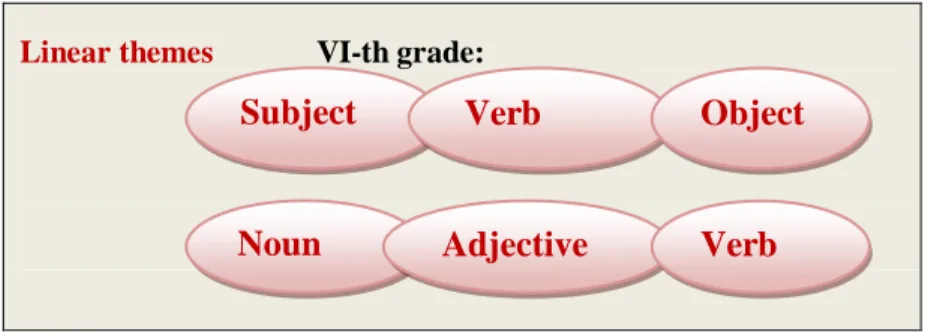
The linguist’s task is to collect the appropriate data needed to test the theory, the argument of course being that the more studies are carried out and produce significant results, the stronger becomes the likelihood that the theory is well founded. In our language curriculum language knowledge are built in linear and chronological order, that means that in elementary isn’t taught grammar, but is gone through it, by examples and situations given in language school books. The grammar rules are simple, just to make clear the meaning of a grammatical class. So, for example: In chronological order there are grammatical lessons of the Noun from the 2-nd grade until 9-th grade, which means that the knowledge begin in a simple way by rising from grade to grade. (Table.1.). In linear order there are grammatical concepts one after another but related to each – other and at the same language field. For example, At morphology, The noun is followed by adjective and verb themes. (Table, 2.)
Table 1. Concentric themes in language textbook
Concentric themes
Noun, II – IX-th grade
Subject, III – IX-th grade
6
Shezai Rrokaj, Hyrje në gjuhësinë e përgjithshme, Shblu, Tiranë, 2005, f. 61. 7
Norbert Schmitt, Vocabulary in language teaching, Cambridge University Press, 2000, p. 4. Language learning
Language learning Grammar Morphology Syntax
Table 2. Linear themes in language textbook
2. What is a curricula and how might it be conceptualized?
The organization of school and further education has long been associated with the idea of
a curriculum. “The term ‘curriculum’ is used in its widest sense to include purpose and objectives
as well as content and method. An explicit curriculum can be seen as a statement of the means by which a set of objectives is to be achieved and at the same time an operational definition of how we should understand those objectives.”8
According to us the curricula must be conceptualized integrated with theory (grammar rules) and practice. (see: graphic 1.)
Graph 1. Curriculum integrated with theory and practice
Owhotu states that “The curriculum is not simply a set of plans to be implemented, but rather is constituted through active process in which planning, acting and evaluating are all reciprocally related and integrated into the process…At its centre is praxis, informed, committed action.. The selected experiences that follow are driven by praxis, and the role of empirical research in understanding phenomena cannot be overemphasized .9” He also adds that curriculum can be seen:
8
Alan Davies, An introduction to applied linguistics. From practice to theory, Second edition, Edinburg University Press, 2007, p. 35.
9
Victor Owhotu, Understanding applied linguistics, An Inaugural Lecture Delivered at the University of Lagos Main Auditorium, University of Lagos, Akoka, Yaba – Lagos, Nigeria, 2007, p.11.
Linear themes VI-th grade:
Noun Adjective Verb
- As a body of knowledge to be transmitted,
- As an attempt to achieve certain ends in students - product;
- As process, - As practice.
The question that comes immediately: If the centre is practice, what’s the role of theory in language learning? Let’s argue each of them in language teaching going through the school curriculum.
As a body of knowledge to be transmitted, means not only theory, transmitted in linear and chronological order, but also practical knowledge taken associated to theory.
Example:
If we explain the orthography rules except the definitions, (The set of consonants mb,ng, nd, ngj are written the same in every position of the word)10, the teacher has to illustrate with examples to be clear the grammatical rules, and to be understood and easy to use correctly (mbaj, dhëmbët, humb).
(Gjuha shqipe 7, f. 278.)
As an attempt to achieve certain ends in students – product. In this case, it is important to underline that in language learning it is not only teacher’s work and methodology, on which will vary every types of learners, but the most important is, the pupil’s desire and efforts to assimilate the knowledge and to use the language correctly in spoken and in written form.
Example:
In the 5-th grade, which in our school curriculum is the end of the elementary school structure in the rubric: Invitation forReading, is the theme “Me and reading” (Gjuha shqipe 5, f. 2.). In this lesson it isn’t sufficient only teacher’s effort, but everything is depended on child’s ability11
to give the product, to express his own ideas related to the questions in the text:
- Do you like reading?,
- How many books do you read in a year?
- Do you recommend to your friends the books you read? etc.
As process
The whole language learning is a process which has a beginning and an end, increasing the knowledge from grade to grade.
10
That’s an orthography rule in Albanian grammar. That rule is defined in a language schoolbook, 7-th grade.
Example:
The knowledge for the noun and its grammatical rules begin from the 2-nd grade until the 9-th grade. It’s a process that begins with simple grammatical rules by rising from grade to grade.
As practice. If we return once again to Owhuto statements about the curriculum “At its centre is praxis, informed, committed action. The selected experiences that follow are driven by praxis, and the role of empirical research in understanding phenomena cannot be overemphasized” we canalso add that the practice can do without the other components (grammatical rules, reading, speaking, writing and listening) but it is in the centre of grammar rules, reading, speaking and writing.
CURRICULUM
Graph 2. Practice in the centre of grammar rules, reading, speaking and writing
3. Language teaching through the integrated process theory and practice
“Applied linguistics is about the relationship between knowledge, theory and practice in the field of language.”12 Teacher’s task is not to impart that knowledge and theory to the pupil, but to mediate it and use it to inform a very practical task: teaching this typical, stumbling but basically willing learner to play and enjoy lesson. If we have a look on the language textbooks13 we can surely see that mostly we have to do with theory and its application through speaking, writing etc.
Through albanian language textbook II-IX-th grade, the pupils assimilate knowledge in lexicology, morphology, syntax, and orthography and apply these knowledge in writing and speaking. In the graphics below is given the raport grammar-writing-speaking-reading.14
12 Michael McCarthy,
Issues in applied linguistics, Cambridge University Press , 2001.
13 In the whole article, we are referring to Albanian Language Text, that are actually used in Albania. 14
Irida Hoti, Gjuhësia e zbatuar përmes kurrikulës së gjuhës shqipe, Shtëpia Botuese “Progresi”, Shkodër, 2013, f. 99-102.
Table 3. Grammar - Speaking – Writing – Reading
Grade Grammar Reading Speaking Writing
II 82 120 60 30 30 III 60 90 40 15 25 IV 45 52 52 26 26 V 55 65 30 15 15 VI 65 70 30 14 16 VII 60 70 30 14 16 VIII 42 66 41 15 26 IX 50 65 35 13 22
Table 4. Grammar - Speaking – Writing Grade Grammar Speaking Writing II 82 60 30 30 III 60 40 15 25 IV 45 52 26 26 V 55 30 15 15 VI 65 30 14 16 VII 60 30 14 16 VIII 42 41 15 26 IX 50 35 13 22
Graph 3.Grammar – Speaking - Writing
0 10 20 30 40 50 60 70 80 90
Gramatike Te flasim Te shkruajme
klasa II klasa III klasa IV klasa V klasa VI klasa VII klasa VIII klasa IX
Graph 4.Grammar- Speaking /Writing 0 10 20 30 40 50 60 70 80 90
Grammar Speaking/ Writing
klasa II klasa III klasa IV klasa V klasa VI klasa VV klasa VIII klasa IX
These graphics show that the grammar knowledge are closely related to writing and speaking, but surely on a high percentage of hours. If we see in total, a pupil gets 459 grammar knowledge, and applies them in 176 witing and 142 speaking hours from grade II to IX.
Grammar to writing and
speaking ( II-IX)
Grammar Writing Speaking 59% 41% 0% 0%Grammar to writing and speaking together (II-IX)
Grammar
Speaking/ Writing
If language learning included only grammar, without learning, reading and writing, so without application, it wouldn’t be learned and practiced in the way our pupils do now, on the
other side, language learning can’ t stay without grammar rules, because “The prove of good
theory is its ability to lead the practice. From the other part the good practice sustain the theory”15
15 Orstein, A., Hunkins, F,
Conclusion
From Herbart’s theory “The practice without theory passes in routine, otherwise the
theory without practice goes through the mist of abstraction.” 16 we can conclude that a pupil can achieve the theory to serve the practice, and the teacher must find a connection between theoretical value and pedagogic utility. What is theoretically valid may have little pedagogic utility and what has pedagogic utility may have little or no theoretical value.
The theory related to practice, makes that the knowledge well achieved in every field of study, but especially in language learning, because the pupil knowing to speak and write, sometimes doesn’t care about grammatical rules.
The curriculum must play an important role to the language learning, because it must always face the developments and it is also important that the teacher to be responsible and willing of teaching, because we must have better pupils than us in the future as Leonardo da Vinci said “It doesn’t have value a student who doesn’t pass to his teacher.”
References
1.Bachman L.F., & Palmer A.S. (1996). Language testing in practice. Oxford: Oxford University Press.
2. Baddeley, A. (1990). Human memory: Theory and practice. Needham Heights, Ma: Allyn and Bacon.
3. Chomsky, N. (2007). Gjuha dhe problemet e njohjes, Tiranë. 4. Collard, F. (1920). Histoire de la Pedagogie, Bruxelles.
5. Davies, A. (2007). An introduction to applied linguistics. From practice to theory, Second edition, Edinburg University Press.
6. Davis, G.B. (2009). Tools for teaching, Sec ed, by John Wiley & sons.
7. Hadumond, B.(1996). Routledge Dictionary of language and linguistics, London and New York, Routledge.
8. Gjokutaj, M. (2005). Gjuha shqipe 5, 7, Shtëpia Botuese “Morava”, Tiranë. 9. Gjokutaj, M. (2009). Didaktika e gjuhës shqipe, SHBLU, Tiranë.
10. Hoti, I., & Baja. O. (Sptember, 2010). The Process of Integration of Theory and Practice (Scholar Curriculum), VI-th Conference on English Language and Literature Studies, Facing the other in the absence of theory, Faculty of Philosophy, Niksic.
11. Hoti, I., & Kazazi, Nj. (2009). Didaktikë e gjuhës shqipe, SHBLU, Tiranë.
12. Hoti, I. (2013). Gjuhësia e zbatuar përmes kurrikulës së gjuhës shqipe, Shtëpia Botuese “Progresi”, Shkodër.
13. McCarthy, M. (2001). Issues in applied linguistics, Cambridge University Press.
14. Murati, R., & Baja, O. (2010). Vështrim mbi altertekstin “Gjuha shqipe dhe letërsia 10„, Buletin shkencor, Seria e shkencave Didaktike, Shkodër.
15. Navarro, Cruz, Tovera dhe Lucido, (1998). Principles of teaching and instructional technology, Katha Publishing Co. Inc.
16. Orstein, A., & Hunkins, F, (2003). Kurrikula, bazat, parimet dhe problemet, ISP, Tiranë. 17. Owhotu, V. (2007). Understanding applied linguistics, An Inaugural Lecture Delivered at the University of Lagos Main Auditorium, University of Lagos, Akoka, Yaba – Lagos, Nigeria.
18. Schmitt, N. (2000). Vocabulary in language teaching, Cambridge University Press.
16 Collard, F.,