185 *Corresponding author: Molecular Biology Research
en-ter, Baqiyatallah University of Medical Sciences, Tehran, Iran.
Tel: +98-2188039883
E-mail: [email protected]
Development of a loop-mediated isothermal amplification assay for
rapid detection of
Yersinia enterocolitica via targeting a
conserved locus
Reza Ranjbar, Davoud Afshar*
Molecular Biology Research Center, Baqiyatallah University of Medical Sciences, Tehran, Iran.
Received: June 2015, Accepted: July 2015
ABSTRACT
Background and Objectives: Loop-mediated isothermal amplification is a novel nucleic acid amplification assay providing as a simple diagnostic tool for rapid identification of microbial diseases in developing countries. In this study, a LAMP assay was established for Yersinia enterocolitica, a leading cause of acute enterocolitis in young children.
Materials and Methods: LAMP assay was established with four primers targeting a specific locus for the detection of Y. enterocolitica. The assay was conducted at 65°C in thermo block for 90min. The sensitivity of LAMP was evaluated in com
-parison to conventional PCR using pTZ57R containing the target locus. Finally, specificity was assessed using DNA from common enteropathogenic bacteria.
Results: Results showed that the sensitivity of LAMP assay was 44-copy number, which was 10-fold higher than that of PCR. No cross-reactivity was observed when testing against other enteropathogenic pathogens.
Conclusion: This study showed that LAMP assay is an alternative molecular diagnostic tool for infections with Y. enteroco-litica. In addition, this method may be useful in diagnosis at field or in laboratories without PCR machine.
Keywords:Yersinia enterocolitica; Loop-mediated isothermal amplification (LAMP), specific locus
mitted via fecal-oral route most often by consumption of contaminated food or water (3). Immunological manifestations have also been reported in addition to abdominal symptoms. Reactive arthritis due to this organism is well recognized in Northern Europe, and presents with fever and swollen joints (4). Routine methods for identification of Y. enterocolitica include
culture, serology and molecular assays (5, 6). The cul-ture has been considered as gold standard method
-for isolation of bacterium from stool specimens, -for which Cefsulodin-Irgasan-Novobiocin agar (CIN) is
the selective medium. The use of enrichment
tech-niques such as cold enrichment and alkali treatment
of specimens has resulted in improved recovery of
this bacterium (7). However, these techniques are
time consuming and not cost-effective. In contrast to conventional techniques, molecular assays are
dependent upon amplification of DNA or RNA and do not require high microbial load or presence of
ORIGINAL
AR
TICLE
INTRODUCTION
Yersinia enterocolitica is an important
gastroin-testinal pathogen belonging to enterobacteriaceae family. The bacterium has six biogroups and several
serotypes, some of which are related with yersiniosis
in humans and animals (1). The serotypes of O3, O8 and O9 have been frequently reported from many
countries in the world. Yersiniosis due to Y. entero-colitica presents with acute enterocolitis with main
symptoms of bloody diarrhea, abdominal pain, vom
-active viable organisms (8). Moreover, the molecular assays can be used for several organisms that cannot be grown or grow very slowly in culture (9). Ad -vances in molecular assays have led to
introduc-tion of new molecular assays with high specific -ity and sensitiv-ity. Loop-Mediated Isothermal
Amplification (LAMP) assay is a technique that amplifies DNA under isothermal conditions. In this assay, a set of four specific primers are used that anneal to six distinct regions within the target se
-quence. The use of four primers (F3, B3, FIP and BIP) results in high specificity and efficiency (10). Adding the loop primers enhances the performance and rapidity of LAMP assay (11). Using the loop primers also can reduce the amplification time to less than 30 minutes. After a short amplification time, a
white precipitate is produced due to production of
magnesium pyrophosphate as a by-product. There
-fore, it can be observed by naked eye without any special processing or electrophoresis (12). Moreover, LAMP assay is not relatively affected by inhibitors remaining in DNA extraction step. Thus, relative
-ly simple DNA extraction assays (e.g. boiling) can
be used for DNA extraction instead of commercial DNA extraction kits (13). These features have result
-ed in the use of LAMP assay in identification of sev
-eral pathogenic bacterial infections (14-17).
The objective of this study was development a Loop-Mediated Isothermal Amplification (LAMP)
assay for detection of Y. enterocolitica based on a specific locus.
MATERIALS AND METHODS
Primer design. In this study, to identify a
con-served locus, a whole genome BLAST analysis was
conducted against Yersinia enterocolitica complete
genomes (Accession No: CP002246.1, FR729477.2, AM286415.1, HF571988.1 and CP007448.1). The BLAST results revealed a specific sequence en
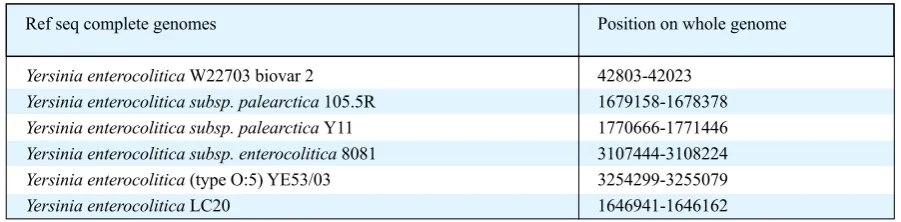
-coding a hypothetical protein (Table1). This locus was selected for primer design. Four primers were designed using PrimerexplorerV4 (https://primerex
-plorer.jp/lamp4) based on software default settings. All of the primer sequences are shown in Table 2.
Table 1.Yersinia enterocolitica complete genomes and positition of the considered locus
Ref seq complete genomes
Yersinia enterocolitica W22703 biovar 2
Yersinia enterocolitica subsp. palearctica 105.5R
Yersinia enterocolitica subsp. palearctica Y11
Yersinia enterocolitica subsp. enterocolitica 8081
Yersinia enterocolitica (type O:5) YE53/03
Yersinia enterocolitica LC20
Position on whole genome
42803-42023 1679158-1678378 1770666-1771446 3107444-3108224 3254299-3255079 1646941-1646162
Table 2. Primers used in LAMP assay
Primer F3
B3
FIP BIP
Sequence(5'->3')
CCATCTGCTGCTAATTGGGT AAAACTGGACGGTGCAAGA
http://ijm.tums.ac.ir
Bacterial strains and DNA extraction. A stan
-dard (ATCC 23715) and six clinical strains of Y. enterocolitica were cultured on LB broth at 37°C for 24 hours. DNA extraction was conducted using DNA extraction kit (Promega Wizard Genomic DNA purification kit, Madison, WII, USA) accord
-ing to the manufacturer's instructions. Purity of ex
-tracted DNA was determined based on measurement of OD260 nm/280 nm using Nano Drop instrument (Thermo Scientific), and calculated to be 1.8.
Optimization of LAMP assay. LAMP reaction
mixture was prepared with a total volume of 25 µl, containing 2.5 µL of 10X ThermoPol Buffer (New England Biolabs, Massachusetts, USA), 0.2 pmol each of F3 and B3 primers, 0.8 pmol each of FIP and BIP primers, different concentrations of dNTPs (0.4 mM, 0.6 mM, 0.8 mM; 1 mM and 1.2 mM), differ
-ent conc-entrations of MgSO4 (3 mM, 4 mM, 5 mM and 6 mM), 8 U Bst DNA polymerase large frag
-ment (New England Biolabs, Massachusetts, USA) and different concentrations of DNA template. The reaction mixture was incubated in a Thermoblock at several temperatures for different minutes, and final -ly the products were electrophoresed on 1% agarose gel.
Specificity of LAMP primers. The specificity of
LAMP assay was evaluated using enteric pathogens,
including Shigella sonnei, Salmonella enteritidis,
Escherichia coli O157H7, Aeromonas hydrophila,
Vibrio cholera and Campylobacter jejuni. The
LAMP product was analyzed by gel electrophoresis.
Determination of sensitivity of LAMP assay Cloning of the considered locus in pTZ57R
vector: TA cloning procedure was done using
CloneJET™ PCR cloning kit (Thermo Scientific) according to the manufacturer's instructions. The ligation reaction mixture was prepared at a PCR product/pTZ57R ratio of 5:1, and was incubated over -night at 8°C. The ligated product was transformed into competent E. coli DH5α cells, plated on LB agar plates with ampicillin (100 μg/ml) and incubated overnight at 37°C. Positive colonies were screened with colony PCR using F3 and B3 primers, and the recombinant plasmid was extracted from a single
positive colony. The constructed plasmid was used
to determine the detection limit of LAMP assay. For this reason, DNA concentration was measured using
NanoDrop (Thermo Scientific), and gene copy num
-ber was calculated using the following formula (18): (Mass [in grams] × Avogadro's number)/ (average molecular weight of base × template length) = mole
-cules (gene copies) of DNA.
A 10-fold serial dilution of the constructed pTZ57R was prepared in sterile water, and LAMP assay and PCR (using F3 and B3 primers) were carried out using different DNA concentrations.
RESULTS
Polymerase chain reaction using outer primers.
The PCR using outer primers (F3 & B3) produced the expected size of amplicon in all Y. enterocolitica
strains tested. Fig. 1 shows the specific 232bp band obtained from standard and clinical strains.
Optimization of LAMP assay. To optimize and
find an optimal incubation temperature for LAMP
assay, a standard reaction was conducted with four
temperatures (60-66°C) for 90 min. Maximum ampli
-fication was obtained at 64°C. Therefore, the optimal temperature for LAMP assay was established at 64°C and applied for all the subsequent applications. To optimize a best time for LAMP reaction amplifica
-tion to yield enough observable products, four differ
-ent times were applied for LAMP reaction, and good results were obtained at 90 min. Different MgSO4 concentrations, which is important factor in LAMP reaction, were tested and the best result was obtained at 6 mM. As expected, the LAMP reaction failed in the absence of MgSO4. Different concentrations of dNTPs were also tested in LAMP reactions, and maximum amplification was established at 1mM.
Specificity of LAMP and PCR assay. The specific
-ity of PCR and LAMP assays was tested using DNA
samples from Shigella sonnei, Salmonella enteritidis,
Escherichia coli O157H7, Aeromonas hydrophila, V.cholera and Campylobacter jejuni. As shown in Fig. 2, no non-specific amplifications were observed when using DNA from the above-mentioned species.
Detection limit of assay. In order to determine the
lower detection limit of LAMP and PCR (using F3and B3 primers), a 10-fold serial dilution (ranging from
10−1 to 10−8 of constructed plasmid) was provided. The
results of amplification (Fig.3) showed that minimum
DISCUSSION
In the present study, we successfully designed a
LAMP assay targeting a conserved locus of Y.entero-colitica. This bacterium has many genes involved in pathogenicity, but there are limited studies targeting
the virulence genes in molecular diagnosis of Y.en-terocolitica (19; 20). However, in several researches,
other genes such as outL, ail, phoP and gyrB were
used for primer design (21-23). In the present study,
we found an appropriate target using whole genome
blast analysis. The results showed that the FR729477 locus has 1311bp and is conserved in all Y.entero-colitica complete genomes submitted in GenBank;
therefore, the designed primers had 100% similarity to all representative Y.enterocolitica strains but no
other species of Yersinia. In addition, the absence of
a similar sequence in other relative species enhances Fig. 2. Specificity of the LAMP assay. LAMP amplification
products were electrophoresed on %2 agaros gel. Lane M,
1500bp DNA ladder (Sinaclon, Tehran, Iran); Lane 1, Y.en-terocolitica; lane 2-7, Shigella sonnei, V.cholera; Salmonella enteritidis, Escherichia coli o157H7,Aeromonas hydroph-ila and Campylobacter jejuni, respectively; lane NC, neg -ative control.
Fig. 1. Detection of Y.enterocolitica strains using LAMP outer primers. Lane M, 1500bp DNA ladder (Sinaclon, Teh
-ran, Iran); Lane 1, Y.enterocolitica ATCC23715; Lane 2-7,
Y.enterocolitica clinical isolates; NC, negative control.
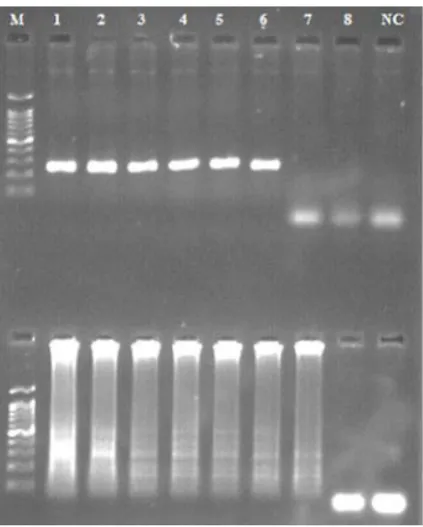
copy number of DNA detectable by LAMP and PCR assays was 44 and 440, respectively.
Fig. 3. Sensitivity of PCR (above) and LAMP (below) assays. Agarose gel electrophoresis of LAMP products from 10-fold serially diluted construct plasmid PTZ57R. Lane M, 1500bp DNA ladder (Sinaclon, Tehran, Iran); lane 1,
dilution of 10−1; lane 2, dilution of 10−2; lane3, dilution of
10−3; lane 4, dilution of 10−4; lane 5, dilution of 10−5; lane 6,
dilution of 10−6; lane 7, dilution of 10−7; lane 8, dilution of
http://ijm.tums.ac.ir
the specificity of primer. To our knowledge, there are no published reports on the use of the FR729477 locus
for molecular detection of Y.enterocolitica.
We applied a new modification in the beginning of
procedure according to strand-displacement activity of
Bst polymerase to improve it. In this way, before add
-ing Bst polymerase to LAMP mixture, a pre-heat-ing temperature (80°C) was carried out and immediately cooled down over an ice bath. The results revealed that this step considerably increases the reaction rate. The LAMP assay targeting the FR729477 locus was 100-fold more sensitive than conventional PCR, and
was in the similar ranges as in a forementioned reports.
The detection limit of LAMP assay was determined to be 44 copy number, which was 10-fold more sensi
-tive than the conventional PCR using B3&F3 primers. Xu et al. described a LAMP assay for detection of Y. enterocolitica and compared it to conventional PCR. Their results showed that the LAMP assay is capable to detect 97 fg of genomic DNA (equivalent to 37 genome copies) of Y. enterocolitica, which is 100-fold
more sensitive than PCR (24). Gao et al. developed a LAMP assay for the detection of Y. enterocolitica
bioserotypes with primers targeting the gyrB. The
latter LAMP assay was able to identify four differ
-ent bioserotypes of Y. enterocolitica with a
sensitiv-ity about 31.6 fg DNA/reaction and specificsensitiv-ity of 65 CFU/mL (25).
The amplification time of LAMP commonly varies from 60-120 min (26). The rate of amplification also accelerates using loop primers (LB&LF), which has been reported in the previous studies. However, in our study, the amplification period was 90 minutes with
-out using LF and LB primers, indicating no noticeable
difference in rate of reaction.
There are contradictory reports about the effect of betaine on LAMP amplification (27). A study by Njiru showed that the efficacy of LAMP amplification was enhanced using betaine with a concentration of 0.8 M (28). However, some reports state that betaine has no useful effect on LAMP amplification (29), and conse
-quently Zhou et al. showed that betaine was not nec -essary when amplifying non-GC-rich target sequences
(30). Due to reduction of base stacking, betaine reduc -es the formation of secondary structure in GC-rich
regions (31).
When LAMP assay is correctly proceeded, an opal
-escent color changing is created, which can be visu
-alized by the naked eye as turbidity. However, some modifications have been applied to accelerate the vol
-atilization of LAMP reaction. Recently, Zhou et al.
reported a simple visual detection method in which calcein and Mn2+ were used before the reaction (30). Moreover, using SYBER Green dye before adding LAMP reaction mixtures has been common in many studies (32; 33). In contrast to the above studies, in
present research, only the opacity of reaction was con-sidered.
In conclusion, this established LAMP assay is a quick and cost-effective approach and it can be used for diagnostic purposes in laboratories with limited
equipment.
ACKNOWLEDGMENTS
The authors thank all members of the molecular biology center of Baqyatallah University of medical
sciences for their assistance in this study.
REFERENCES
1. Bialas N, Kasperkiewicz K, Radziejewska-Lebrecht J, Skurnik M. Bacterial cell surface structures in Yersin-ia enterocolitica. Arch Immunol Ther Exp (Warsz )
2012; 60:199-209.
2. Marks MI, Pai CH, Lafleur L, Lackman L, Hammer
-berg O. Yersinia enterocolitica gastroenteritis: a
pro-spective study of clinical, bacteriologic, and epidemio -logic features. J Pediatr 1980; 96:26-31.
3. Fabrega A, Vila J. Yersinia enterocolitica:
pathogen-esis, virulence and antimicrobial resistance. Enferm Infecc Microbiol Clin 2012; 30:24-32.
4. Taccetti G, Trapani S, Ermini M, Falcini F. Reactive arthritis triggered by Yersinia enterocolitica: a review of 18 pediatric cases. Clin Exp Rheumatol 1994; 12:681-684.
5. Bottone EJ, Sheehan DJ. Yersinia enterocolitica: guidelines for serologic diagnosis of human infections.
Rev Infect Dis 1983; 5:898-906.
6. Ye YW, Ling N, Han YJ, Wu QP. Detection and preva -lence of pathogenic Yersinia enterocolitica in
refriger-ated and frozen dairy products by duplex PCR and dot hybridization targeting the virF and ail genes. J Dairy Sci 2014.
7. Kachoris M, Ruoff KL, Welch K, Kallas W, Ferraro
MJ. Routine culture of stool specimens for Yersinia enterocolitica is not a cost-effective procedure. J Clin
Microbiol 1988; 26:582-583.
8. Khardori N. Future of diagnostic microbiology. Indian J Med Microbiol 2014; 32:371-377.
9. Burd EM. Validation of laboratory-developed molecu -lar assays for infectious diseases. Clin Microbiol Rev
2010; 23:550-576.
10. Notomi T, Okayama H, Masubuchi H et al. Loop-me
-diated isothermal amplification of DNA. Nucleic Acids Res 2000; 28:E63.
11. Nagamine K, Hase T, Notomi T Accelerated reaction by loop-mediated isothermal amplification using loop
primers. Mol Cell Probes 2002; 16:223-229.
12. Ushikubo H. [Principle of LAMP method--a simple and rapid gene amplification method]. Uirusu 2004; 54:107-112.
13. Dong HJ, Cho AR, Hahn TW, Cho S et al. Develop
-ment of a Loop-Mediated Isothermal Amplification Assay for Rapid, Sensitive Detection of Campylo-bacter jejuni in Cattle Farm Samples. J Food Prot
2014; 77:1593-1598.
14. Duarte C, Salm E, Dorvel B, Reddy B, Jr, Bashir R. On-chip parallel detection of foodborne pathogens us
-ing loop-mediated isothermal amplification. Biomed Microdevices 2013; 15:821-830.
15. Yang Q, Chen S, Ge B Detecting Salmonella serovars in shell eggs by loop-mediated isothermal amplifica -tion. J Food Prot 2013; 76:1790-1796.
16. Wang F, Jiang L, Yang Q, Prinyawiwatkul W, Ge B. Rapid and specific detection of escherichia coli sero
-groups O26, O45, O103, O111, O121, O145, and O157 in ground beef, beef trim, and produce by loop-medi
-ated isothermal amplification. Appl Environ Microbiol
2012; 78:2727-2736.
17. Wang F, Yang Q, Qu Y, Meng J, Ge B. Evaluation of a loop-mediated isothermal amplification suite for the rapid, reliable, and robust detection of Shiga toxin-pro -ducing Escherichia coli in produce. Appl Environ Mi-crobiol 2014; 80:2516-2525.
18. Oliwa-Stasiak K, Kolaj-Robin O, Adley CC. Devel
-opment of real-time PCR assays for detection and quantification of Bacillus cereus group species: dif-ferentiation of B. weihenstephanensis and rhizoid B. pseudomycoides isolates from milk. Appl Environ Microbiol 2011; 77:80-88.
19. Thoerner P, Bin Kingombe CI, Bogli-Stuber K, Bis
-sig-Choisat B, Wassenaar TM, Frey J, et al. PCR de -tection of virulence genes in Yersinia enterocolitica
and Yersinia pseudotuberculosis and investigation of
virulence gene distribution. Appl Environ Microbiol
2003; 69:1810-1816.
20. Arnold T, Neubauer H, Ganter M, Nikolaou K, Roesler U, Truyen U, et al. Prevalence of Yersinia enterocoliti-ca in goat herds from Northern Germany. J Vet Med B Infect Dis Vet Public Health 2006; 53:382-386.
21. Xu YM, Liu XL, Ma J, Li YS, Hu P, Zou DY, et al. Simple, specific, sensitive and rapid loop-mediated
method for detecting Yersinia enterocolitica. South-east Asian J Trop Med Public Health 2014; 45:670-679. 22. Li Y, Jiang M, Liu W, Zhang L, Zhang S, Zhao X,
et al. Loop-mediated isothermal amplification meth
-od targets to the phoP gene for detection of Yersinia enterocolitica. Mol Cell Probes 2010; 24:68-71. 23. Gao H, Lei Z, Jia J, Wang S, Chen Y, Sun M, et al.
Application of loop-mediated isothermal amplification
for detection of Yersinia enterocolitica in pork meat. J Microbiol Methods 2009; 77:198-201.
24. Xu YM, Liu XL, Ma J, Li YS, Hu P, Zou DY, et al. Simple, specific, sensitive and rapid loop-mediated
method for detecting Yersinia enterocolitica. South-east Asian J Trop Med Public Health 2014; 45:670-679. 25. Gao H, Lei Z, Jia J, Wang S, Chen Y, Sun M, et al.
Application of loop-mediated isothermal amplification
for detection of Yersinia enterocolitica in pork meat. J Microbiol Methods 2009; 77:198-201.
26. Francois P, Tangomo M, Hibbs J, Bonetti EJ, Boehme CC, Notomi T, et al. Robustness of a loop-mediated isothermal amplification reaction for diagnostic appli -cations. FEMS Immunol Med Microbiol 2011; 62:41-48.
27. Nagamine K, Hase T, Notomi T. Accelerated reaction by loop-mediated isothermal amplification using loop
primers. Mol Cell Probes 2002; 16:223-229.
28. Njiru ZK. Rapid and sensitive detection of human Af
-rican trypanosomiasis by loop-mediated isothermal amplification combined with a lateral-flow dipstick.
Diagn Microbiol Infect Dis 2011; 69:205-209.
29. Chen S, Wang F, Beaulieu JC, Stein RE, Ge B. Rapid detection of viable salmonellae in produce by coupling
propidium monoazide with loop-mediated isothermal
amplification. Appl Environ Microbiol 2011; 77:4008-4016.
30. ZhouD, JGuo, L Xu, SGao, Q Lin, Q Wu, et al. Es
-tablishment and application of a loop-mediated iso
-thermal amplification (LAMP) system for detection of cry1Ac transgenic sugarcane. Sci Rep 2014; 4:4912. 31. Henke W, Herdel K, Jung K, Schnorr D, Loening SA.
Betaine improves the PCR amplification of GC-rich DNA sequences. Nucleic Acids Res 1997;
25:3957-3958.
32. Bista BR, Ishwad C, Wadowsky RM, Manna P, Rand
-hawa PS, Gupta G, et al. Development of a loop-medi
-ated isothermal amplification assay for rapid detection of BK virus. J Clin Microbiol 2007; 45:1581-1587. 33. Iwamoto T, Sonobe T, Hayashi K. Loop-mediated iso
-thermal amplification for direct detection of Mycobac-terium tuberculosis complex, M. avium, and M. intra-cellulare in sputum samples. J Clin Microbiol 2003;