Applying standards to systematize
learning analytics in serious games
Ángel Serrano-Lagunaa, Iván Martínez-Ortiza, Jason Haagb, Damon Reganb, Andy Johnsonb, Baltasar Fernández-Manjóna
a Department of Software Engineering and Artificial Intelligence, Complutense University of Madrid, Madrid, Spain b Advanced Distributed Learning Initiative
Abstract
Learning Analytics is an emerging field focused on analyzing learners’ interactions with educational content. One of the key open issues in learning analytics is the standardization of the data collected. This is a particularly challenging issue in serious games, which generate a diverse range of data. This paper reviews the current state of learning analytics, data
standards and serious games, studying how serious games are tracking the interactions from their players and the metrics that can be distilled from them. Based on this review, we propose an interaction model that establishes a basis for applying Learning Analytics into serious games. This paper then analyzes the current standards and specifications used in the field. Finally, it presents an implementation of the model with one of the most promising
specifications: Experience API (xAPI). The Experience API relies on Communities of Practice developing profiles that cover different use cases in specific domains. This paper presents the Serious Games xAPI Profile: a profile developed to align with the most common use cases in the serious games domain. The profile is applied to a case study (a demo game), which explores the technical practicalities of standardizing data acquisition in serious games. In summary, the paper presents a new interaction model to track serious games and their implementation with the xAPI specification.
Keywords: serious games, learning analytics, standards, xAPI
1. Introduction
A serious game is a video game designed with a purpose other than pure entertainment [1]. Serious games have been proven to be effective educational tools in many domains, such as mathematics, physics, engineering, medicine, economics, history and literature [2]–[5]. The methods used to measure their effectiveness vary from study to study (some standard guidelines are starting to arise [6]). However, a large number of serious games research studies primarily depend on data from surveys and questionnaires [7].
Meanwhile, data-driven approaches that rely on collecting and analyzing data from learners’ on-line activity are a current trend in the e-learning community. Disciplines such as Learning Analytics (LA) [8] and Educational Data Mining (EDM) [9] are studying the way learners perform online activities within Virtual Learning Environments (VLE). Their main goal is to better understand educational processes to find ways to improve them and assure an accurate assessment of the student. LA applications vary from identifying students at risk of failing a course [10] to recommending additional educational materials for those students who might need them [11]. As the number of LA applications increases, there is a growing interest in which educational standards can be used to share and exploit data, easing the collaboration between LA tools and VLEs.
The interactive nature of serious games makes them a good source of LA data. Tracking the learner’s interaction within a serious game and storing it provides multiple benefits for all the stakeholders involved in the learning process. For instance, teachers could follow a student’s progression while the student plays, and could take action on any identified learning problem in real-time. In addition, researchers can now harvest and store activity data in a centralized location, and can more easily conduct a deeper analysis for understanding consistent student behaviors and performance in serious games.
Current research shows that questionnaires, which are outside the game context, are the most common method to collect data in formal experiments with serious games [7]. This heavily contrasts with the practices in non-formal environments. For instance, commercial videogames have been relying on Game Analytics (GA) to learn from their users for years [12]. GA researchers use
questionnaires to assess game mechanics or gameplay [13], but their main source of data is the non-disruptive tracking embedded in their games (usually called telemetry [14]). They can track all types of interactions with different purposes: from predicting revenue to measuring engagement.
Serious games can greatly benefit from GA techniques (and non-disruptive tracking) to improve their analysis and, through the use of standards, to ease their integration and increase their usefulness inside VLEs. Using GA techniques poses some challenges, though. The video game industry is very protective with their GA practices and usually relies on proprietary systems. Consequently, there are no standardized formats to represent players’ interactions. Another limitation is that GA and LA goals differ: while GA aims to increase engagement (trying to maximize the time a player stays in the “flow” state [15]) and monetization, LA seeks to analyze and measure players’ learning outcomes [16]. Some serious games track their learners’ interactions, but use custom formats (Section 2 below shows a detailed review). These custom formats hinder support for serious games in educational tools (particularly VLEs) and the use of general tools to process and analyze the data. This is natural due to the immaturity of the field, however, there are enough case studies that identify common interactions tracked by serious games to start defining tracking models, which eventually can be standardized. This paper aggregates these case studies to infer an interaction model candidate for standardization, joining other proposals to track LA observables in a standard way [17]. The standardization will also help the creation of supporting infrastructure and decrease the cost of applying LA (e.g., the cost of integrating the game in a VLE) [18].
In this paper, we perform a review to detect the common interactions tracked in serious games found in the literature. We use that review to infer an aggregated interaction model. Then, we analyze the current LA standards and their suitability to represent the model. Finally, we present a reference implementation using the xAPI specification [21], along with a case study.
The rest of the paper is structured as follows: Section 2 presents a review of the interactions tracked in formal experiments with serious games; Section 3 shows the interaction model inferred from findings in Section 2; Section 4 analyzes current LA standards; Section 5 presents the xAPI
implementation of the interaction model along with a case study; and Section 6 discusses the results, limitations, and future work.
2. Interactions tracked in serious games
In this paper we build upon a previous review by Calderon and Ruiz on serious games and evaluation [7]. They identified a total of 120 papers using key search terms such as “evaluation / validation / assessment” combined with “serious games / simulation games”. We were looking for serious games
that contained any type of tracking for assessment, and this review was additionally valuable for finding relevant serious games, and it was recent enough to provide a quite complete list. We reviewed the 120 papers and found 14 serious games tracking the players’ in-game interactions. We analyzed them to infer the types of interactions most commonly tracked, and present the results below.
In general, video games use two interaction strategies: a) event-based, where the game logs pre-specified events when they occur; and b) state-based, where the game repeatedly sends game state at a specific frequency [22]. Each of the 14 serious games in our review opted for the events-based strategy. Most of the events include at least two attributes: a timestamp, representing the moment the event is generated, and a user id, identifying the player that originates the event. This basic data enable researchers to obtain metrics such as number of players, the number of times players accessed the game, or time played [23]–[26].
The serious games reviewed track the completion (binary value, yes or no) or the level of completion achieved (percentage) by the players. Some serious games just track whether the game was fully completed, and others have a more fine-grained level of detail, tracking completion in each of the levels within the game [23], [27], [28]. This type of interaction relies on the notion that a player completing the game or parts of the game is also progressing towards a learning goal. Common metrics extracted from these events are the quantity of completed levels/scenarios/scenes and the time it took to complete each one.
Many serious games also track the in-game choices performed by players in a given context. These choices most commonly involve questions with multiple answers [23], [24], [29]. These questions can be either presented directly to the player during the game or integrated in a dialog with a non-playable character (NPC). Some serious games also track general choices where the player must select an action among several options [25], [26]. In many cases, when a player makes a choice in a serious game, he would need to apply specific knowledge to make the right decision. This feature makes the choice interesting for future assessment. Common metrics obtained from these interactions are: the time spent to make decisions and the rightness/wrongness ratio when selections can be scored positively or negatively (questions with a correct answer).
The serious games that were reviewed often rely on meaningful measurable variables to calculate players’ learning outcomes [25], [27], [28]. The most common variables are scores, number of in-game deaths and kills or coins collected. All these variables are linked to the player’s performance in the game, and can reveal the level of success in the learning goals involved. For instance, a final high score in a serious game can indicate good performance towards the game’s learning goals. The most common metrics extracted from this interaction are the game’s final high score value and the ratios that can be obtained combining several of them collected from different game attempts.
Finally, we need to highlight that several serious games tracked events that were specific to those games. For instance, Hauge [29] collected chat logs from their multiplayer game, Qudrat-Ullah [26] tracked the number of times a player asked for in-game help, and Buttussi [30] and Cowley [31] collected biometric information using several external devices. This leads us to conclude that, although we can identify common events and interactions, the use of game-specific interactions is also necessary to assess user performance in serious games.
3. Interaction model
The previous section covers how learner’s interactions are tracked in serious games. This section presents an interaction model, derived from the previous analysis, to represent the most common interactions found in the analyzed serious games.
The proposed model uses events to represent the players’ individual interactions within the game, since event-based tracking is the most widespread strategy among serious games. The vast majority of interactions are characterized by two attributes: an action and a target that receives the action. Sometimes, an additional value is necessary to quantify the result of the interaction (e.g., in the interaction “achieved 50% of Level 1”, the action is “achieved”, the target is “Level 1” and the value is “50%”). Finally, all interactions identify who generated them and when.
Thus, we define an interaction event with the following attributes: 1) a timestamp, representing the instant the event was generated in the game; 2) a user id, identifying the player that generated the event; 3) an action, representing the type of interaction performed by the player; 4) a target, representing a game element that is the objective of the player’s action; and 5) an optional value, representing the parameters of the action. All attributes are required except value, which will only appear for those actions that need parameters to quantify their results.
Below, we present all the types of targets (i.e., the objective of the player’s action) identified in Section 2 along with their related actions.
3.1. Completables
The target type completable deals with the player’s level of progress in a serious game. A
completable is something a player can start, progress on and complete within a serious game (even several times). It is a unit of progress inside the game, and can have different scopes. Some examples of completables are: game, game session, level, quest, world, stage, and race.
The action start marks when a player begins the fulfillment of a completable. No value is associated to this action. The action progress updates the total advance of a player in a completable. The
associated value must be a decimal number, between 0.0 and 1.0, where 0.0 means the player has not made any progress towards the completable and 1.0 means the player fully satisfied the completable. The action complete marks when a player finishes a completable. No value is associated with this action. Considering these actions, we could calculate the following metrics per player and per completable: level of completeness, times completed, and time to complete.
3.2. Alternatives
The target type alternative deals with each of the in-game decisions a player performs during a gameplay. An alternative is a set of options among which the player has to choose at a given point in the game. The player can only choose one option, and some of the options can be unavailable (locked). Some examples of alternatives are: questions, menus, paths, and dialog tree (in a conversation with a non-playable character).
The action select marks when a player selects an option in an alternative. The associated value must be a string identifying the selected option. The action unlock marks when a player unlocks an option in an alternative. The associated value must be a string identifying the unlocked option. Considering these actions, we could calculate the following metrics per player and alternative: options selected and options unlocked.
3.3. Meaningful variables
The target type meaningful variable deals with each of the values that represent something
meaningful in gameplay (e.g., a score). A meaningful variable is a value inside the game world with a special significance. Meaningful variables are usually numeric, but they could also be other data types, for instance, text, binary values (true or false), or simple structures (e.g., positions). The player can set a variable’s value. Some examples of meaningful variables are: score, currency (e.g., coins, rings, and money), health, and the player’s position.
The action set marks when the game sets a particular value in a meaningful variable after some player interaction. The associated value must be the new value. Considering these actions, we could calculate the following metrics per player and variable: final value and value’s evolution.
3.4. Custom interactions
There are serious games and educational scenarios that will benefit from tracking very specific player interactions with great detail, for example, to facilitate a manual subjective analysis of the interaction. If the serious game needs to track some event that is not able to be represented by the events defined above, the model can always be extended with new types of targets and a set of associated actions. For instance, when a serious game tracks chat logs [29], we could create a type of target called “chat message” (at the same level as completables, alternatives, and meaningful variables) with the action send to represent when a player sends a text message in a chat, where the value would be the message content.
However, if too much use is made of these extensions, then the result may be a loss of the automatic or semi-automatic processes that the standard is intended to support, hence requiring the extension of analysis tools or manually processing the interactions. The model presented in this section is a first step to cover the interactions most commonly found in serious games, settling down a common semantic for both serious games developers and analytics tool providers and allowing them to innovate and work without restrictive dependencies. The model can be extended with custom
interactions that can be generalized and shared across many serious games (e.g., events for concrete game mechanics), along with the automatic processes to analyze them.
4. Learning Analytics standards
In the previous section, we have defined the targets and actions presented in our interaction model for serious games. Now we need a real notation to represent the model. As we discussed in the
introductory section, we can take advantage of standardization efforts currently underway in the field of LA in order to represent serious games analytics. Therefore, we need to find an appropriate standard to represent our interaction model.
LA specifications and standards can deal with many types of data in educational contexts. Several authors [32] classify data handled by learning analytics into two categories: static (data that barely changes over time) and dynamic (data that is updated more often). These data can proceed from several sources: people, resources, services, learning activities, objectives, and assessments [33]. In our particular situation, we are looking for a standard that deals with dynamic data (interactions) inside a learning activity (serious game).
Some standards in the dynamic category focus on capturing achievements derived from users’ interactions. For instance, Mozilla Open Badge Initiative (OBI) [34] is oriented towards the issuing of badges that represents the knowledge or skills gained by individual learners that can be checked by third parties, while IMS Basic Outcomes [35] offers the possibility to set a grade for the activity. Within this category, SCORM deserves a special mention, since it is one of the most widespread standards used in the deployment and communication of education resources [36], and has been used in the past to track results of serious games [37]. SCORM supports communication of completion status, success status, score, and progress. It also provides some extra fields to report events from the educational activity: comments, in free text forms; interactions, to track questionnaires and other educational items, and objectives, to track sub-goals with score, status, and completion variables.
The main limitation of SCORM and the other standards we have mentioned, is that their principal design goal is to capture results. Some of them allow for interactions during the activity to be captured, but many tools and VLEs do not make these data available for analysis, hence the
educational content behaves as a “black box” [37]: we know the results of the activity but we have no information about how the activity was actually carried out. New approaches in LA are advocating for the “white box” model [37], in which educational content provides more granularity for user interaction data, allowing more insights into educational results.
Efforts being made towards this model include standards dedicated to tracking activities and
interactions inside educational resources (dynamic data about learning activities), usually in the form of a log. For instance, PSLC DataShop Tutor Message Format (DataShop) [38] is used to log activity in tutoring applications; Contextualized Attention Metadata (CAM) [39] is used to log user interactions in learning environments.
Another relevant specification for this task is Activity Streams [40]. This specification is able to represent sequences of actions performed by users in a specific context. Each action is represented by an “activity,” whose main attributes are an actor (who performs the action), a verb (what action is performed), and an object (the target of the action). A sequence of activities is a stream, and represents the actions from a set of users. This is a general purpose specification, although it was initially based on the interactions given inside social networks. Its structure is a good fit to represent our model interactions.
ADL Experience API (xAPI) and IMS Caliper are two specifications greatly inspired by Activity
Streams. Both are mainly used in educational contexts, so they are an even better fit to represent our interaction model. Below, we analyze each of them separately.
4.1. IMS Caliper
Caliper Analytics is a framework developed by the IMS Global Consortium [41], whose main goal is to establish a way to capture and obtain measures from a set of learning activities.
Each learning activity has one or several associated metric profiles. A metric profile defines the information model that shapes the types of events emitted by the learning activity. It also provides a semantic for later analysis. Some metric profiles are designed to track raw user activity (e.g., page views in an eBook) and others to track user learning outcomes (e.g., the score in an assessment) [42].
The Sensor API defines the standard representation of the events in each metric profile. The event structure derives from Activity Streams and contains, among other attributes, an actor, an action, and an object. The first version of IMS Caliper [43] does not provide a way to extend the vocabulary used by events to fit other learning activities (such as serious games). Some sort of extension can be accomplished through the extensions attribute present in events, although this would not be enough as our interaction model needs to define a whole set of new vocabulary.
A new metric profile would be necessary to represent serious games as learning activities in IMS Caliper. The profile should define as actions all interactions described in Section 3, and as objects all the targets. The task is technically accomplishable but it would require direct collaboration with IMS, since, to date, they fully control the development of new metric profiles.
4.2. Experience API
Experience API (xAPI) is a specification developed by an open community lead by the Advanced Distributed Learning Initiative (ADL) [21]. The specification’s objective is to define a data and communication model to track user activities within learning environments.
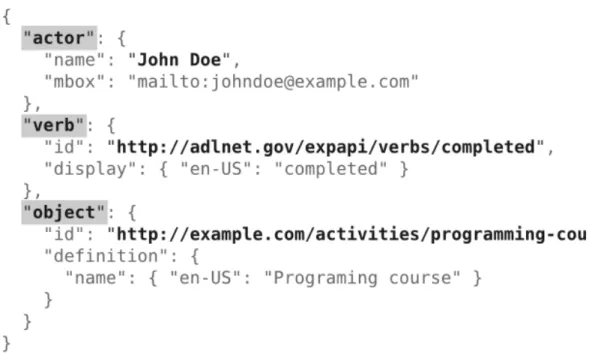
xAPI defines each event tracked in a learning activity as a Statement. The format also derives from Activity Streams, and the main attributes in a Statement are actor, verb (action), and object. Figure 1 illustrates its structure.
Figure 1. An xAPI Statement representing a learning activity. Specifically, that “John Doe completed a Programming Course”.
The statements can contain additional attributes with more information about the experience: result, containing the outcomes of the statement; context, representing the learning environment; or authority, specifying who assures the truthfulness of the statement.
All xAPI statements are sent to a Learning Record Store (LRS), a database that holds all the statements in sequential order. The LRS can be later queried to perform statements analysis.
Unlike IMS Caliper, xAPI does not set any constraints on the vocabulary that can be used in the statements. Practitioners can create their own verbs and activity types to define domain specific vocabularies. Additionally, xAPI allows extensions to expand the specification and fulfill new or unique requirements. The definition of new vocabularies along with these extensions is denominated a “xAPI profile”. These profiles are usually developed through an xAPI Community of Practice (e.g., some groups have created vocabulary for eBooks or videos) [44], but other third parties are also developing vocabularies to fit their own needs [45].
In summary, the xAPI specification is designed to represent sequences of interactions, is widely adopted in the educational community, and it allows for the creation of domain specific vocabularies to fit new types of learning activities. These features pose it as one of the best candidates to use in the representation of our interaction model for serious games. In the next section, we present how our model can be implemented using xAPI.
5. Experience API implementation
A full version of a Serious Games xAPI Profile has been developed by the RAGE project in collaboration with ADL [46]. In this section, we detail the process followed to convert the simple events structure of the proposed model presented in section 3 to full xAPI statements.
First, we create a mapping between event fields and Statement properties as an initial approach to the conversion and present the initial vocabulary of the profile. Then, we explore the use and semantics of xAPI attributes to create richer statements, specifically, the use of result to log game state variables and the use of extensions to add additional semantics useful for analysis. Finally, we present a case study that uses this implementation and present some statement examples.
5.1. Event fields to Statement properties
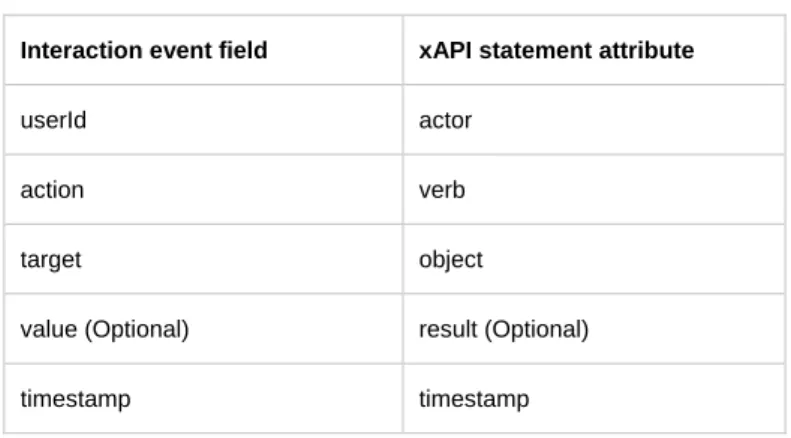
Table 1 shows the mapping of schema fields to xAPI Statement properties. Below, we summarize the considerations and adjustments made to each field in the proposed implementation.
The userId maps to actor. The VLE hosting the learning activity is responsible for communicating the value of actor to the client (the serious game). This communication is done during the activity launch, after an authentication process.
The action maps to verb. xAPI identifies a verb with a unique internationalized resource identifier (IRI). IRIs are usually URIs that, if resolved, are intended to return the verb definition in a machine-readable format. xAPI does not define any particular verb by default (with the exception of a reserved verb, voided) and suggests that verbs defined by the community should be reused. If the community does not provide a verb that represents what is needed, a new verb with a new IRI should be created. The target maps to object. xAPI also identifies objects with IRIs, but in this case the IRIs identify specific objects of the activity, and should not be reused outside its context. However, the object can specify a type that defines its class. The IRIs for this attribute follow the same guidelines as verbs’ IRIs.
The value maps to result. The result attribute holds all the outcomes associated with the statement, and it contains a set of predefined properties: score, success, completion, response, duration, and extensions. The proposed implementation will try to map the value field to these attributes. In cases
where the semantics of the value disallow it, it will use the extensions attribute, which allow the definition of custom outcomes (see Section 5.2. below).
Finally, the timestamp maps directly to the xAPI statement timestamp.
Interaction event field xAPI statement attribute
userId actor action verb target object
value (Optional) result (Optional) timestamp timestamp
Table 1. Mapping of interactions event fields to xAPI statement attributes.
5.2. xAPI profile vocabulary
This section presents the xAPI vocabulary needed to represent the types of events presented in Section 3. Table 2 shows the mapping of actions to xAPI verbs, Table 3 shows the activity types for common targets in serious games. Note that this new vocabulary is also based on our previous work and experience applying e-learning standards to serious games [19], [37].
This vocabulary conceptualizes the most used concepts found in serious games. Note that the goal of this xAPI vocabulary (and profile) is to establish a basis for the application of LA standards to serious games. Once that is done, the Serious Games Community of Practice can extend this vocabulary to capture interactions from more specific game mechanics. For instance, it could add the verbs jumped, killed or picked to represent typical interactions in a platform game.
Action Verb Definition
start http://adlnet.gov/expapi/verbs/initialized Indicates the activity provider has determined that the actor successfully started an activity. progress http://adlnet.gov/expapi/verbs/progressed Indicates a value of how much an actor has advanced or moved through an activity. complete http://adlnet.gov/expapi/verbs/completed Indicates the actor finished or concluded the activity successfully. unlock https://w3id.org/xapi/seriousgames/verbs/unlocked Indicates the actor unlocked an option previously unavailable. select https://w3id.org/xapi/adb/verbs/selected Indicates the selected choices, favored options or settings of an actor in relation to an object or activity.
Table 2. Mapping of event actions to xAPI verbs.
Target Activity Type Definition
serious game https://w3id.org/xapi/seriousgames/activities/serious-game
A game designed for a primary purpose other than pure entertainment. For instance, an educational game or a game-like simulation
level https://w3id.org/xapi/seriousgames/activities/level A level of a game or of a gamified learning platform. mission https://w3id.org/xapi/seriousgames/activities/mission An accomplishable mission or challenge presented inside a gamified activity.
question http://adlnet.gov/expapi/activities/question
A question is typically part of an assessment and requires a response from the learner, a response that is then evaluated for correctness.
menu https://w3id.org/xapi/seriousgames/activities/menu A menu with several options whose selection produces different effects. dialog tree https://w3id.org/xapi/seriousgames/activities/dialog-tree An alternative presented during a conversation with a non-playable character.
Table 3. Mapping of target types to xAPI activities’ types.
5.3. Game variables in result
The interaction model presented in Section 3 (also building on our earlier work [19], [20]) proposes to generate a new event with the action set each time a game variable is updated (e.g., the score increased, the health bar decreased, the coins was set to a value…). This design decision presents a drawback: the primary action that generated the update gets lost. That is, if the player gets a score of 500 points because he completed a level, two events are generated: one with the level completion and one with the score update. Thus, it is necessary to analyze previous events to obtain the triggering action of the score update.
xAPI enables the problem to be solved through the use of the attribute result. This attribute allows the ability to specify any outcome related to the statement. Thus, the variable updates can be contained by the interaction that generated them instead of being in a separate statement. So, instead of generating two statements when a player completes a level and obtains 500 points, the xAPI tracker only generates one, containing the level completion as the main interaction and the score update in the result.
5.4. Analysis’ semantics with extensions
A common problem in any type of analysis based on user-generated logs is to establish the semantics of each action in the log. xAPI solves this problem for statements by giving strong semantics to the vocabulary it defines. For instance, if the semantics of the verb completed and the activity type exam are fully defined, whenever a statement declaring that “a student completed an exam” is found, its interpretation for analysis will be unequivocal.
The verbs and activities definitions are fundamental to the analysis of statements. Additionally, xAPI defines extensions properties to establish further semantics whenever verbs and activity types are not enough. For instance, the attribute result contains an extensions property to add additional outcomes of the statement.
Table 4 shows the result extensions defined for the Serious Games xAPI Profile. For instance, the extension progress measures the level of achievement during an activity, health determines the current level of health of the player and position localizes the player inside the game world (with coordinates, x, y, and z).
These extensions represent common concepts found in serious games. Along with their definitions, they establish clear semantics for their analysis (e.g., a level of health near to 0 would indicate that the player is in danger of losing a life or attempt). As with verbs and activity types, the Serious Games Community of Practice can leverage extensions to capture more specific game mechanics.
progress https://w3id.org/xapi/seriousgames/extensions/serious-game
A decimal number (3 significant figures with 2 figures following the decimal point) between 0 and 1 (inclusive) to indicate the value of progress in an activity.
currency https://w3id.org/xapi/seriousgames/extensions/currency A variable indicating the count of and spendable currency within a game: coins, rings, diamonds, dollars… health https://w3id.org/xapi/seriousgames/extensions/health
A decimal number (3 significant figures with 2 figures following the decimal point) between 0 and 1 (inclusive) to indicate the remaining health in an activity.
position https://w3id.org/xapi/seriousgames/extensions/position An object, with attributes x, y and z, indicating the position of the player in the game world.
Table 4. Extensions defined for the serious game profile.
5.5. Case study: The Countrix Game
This section presents Countrix, a serious game that implements the Serious Games xAPI profile to represent and communicate learners’ interactions. The game is a case study developed to
demonstrate the use of the Serious Games xAPI profile. It is fully implemented and available for download1. The goals of this case study are two: 1) illustrate the use of the profile with a real serious
game and 2) analyze the technicalities involved in the xAPI communication.
Countrix is a timed Q&A about Geography (countries, capitals, flags and continents). The player has a fixed amount of time to answer the greatest number of questions. When the player chooses a correct answer the score increases by one. If the player fails, the time to answer questions decreases (Figure 2). The game uses a simple game mechanic to illustrate more clearly the statements generated.
Figure 2. Screen captures of Countrix. The game presents consecutive questions with 3 possible answers. The remaining time is represented by a blue bar at the top.
Figure 3 shows a statement generated right after starting the game. The statement uses the verb initialized to specify that the activity (of the serious game type) has just started. Figure 4 shows a statement generated after the player selects an incorrect answer. The statement uses the verb selected, and an activity of type question. The result contains the variable that changes with the interaction. In this case, the value health (remaining time to answer questions) decreases with the
1 Download from https://play.google.com/store/apps/details?id=com.anserran.countrix (Last accessed September, 2016)
error and its value is transmitted. The game also contains an xAPI viewer that allows the player to watch the statement being generated in real time.
Figure 3.xAPI statement generated every time the player launches the game.
Figure 4.xAPI statement generated after the player selected an incorrect answer.
The Countrix game is connected to a Learning Analytics framework that contains an LRS [18]–[20]. When the player starts the game, the game requests an authorization to the LA framework to start sending xAPI statements. If the framework grants it, it responds, in JSON format, with the LRS endpoint, an actor identifying the user and an activity id. The client tracker uses the returned data to start sending xAPI statements.
This initialization and authorization process is out of the xAPI specification scope, so it was necessary to design and develop it from scratch. The rest of the communication with the LRS is fully described by the xAPI specification. In this case, the framework uses an open source LRS to store the statements.
Finally, the game contains an xAPI tracker, developed and integrated in such a way that it emitted the statements at the appropriate moments.
6. Discussion, conclusions and future work
In this paper, we reviewed 14 serious games that track learners’ gameplay. This review allowed us to build an interaction model that can lay the foundation for a more systematic application of learning analytics in serious games. The model includes several types of events common in serious games and proposes some associated metrics. The model can be implemented with standards or
specifications designed to track users’ activity in the form of sequential streams (i.e., Activity Stream and its derivatives) and can decrease the cost of implementing LA for serious games. It sets a basis to start performing analysis in serious games methodologically, using the semantics concepts it contains: completable, alternatives, and variables.
However, this is just a first step in systematizing LA in serious games. The proposed interaction model and its associated metrics cover only the general aspects of learning in a serious game. The model can be extended by adding elements that represent the nuances of concrete game mechanics, which are usually correlative to the way players learn. It can also take elements from Game Analytics, since many of their insights can help to make serious games into better (e.g., more engaging) video games. These extensions will enable new types of analysis that will help to better understand the learning process inside serious games.
We wanted to explore the technical practicalities of using the proposed model, so this paper also presents a full implementation using the xAPI specification. The specification’s flexibility enabled the full interaction model to be described, creating a new set of vocabulary along with an xAPI serious games profile. Using xAPI enables the integration with compatible VLEs, as well as the use of some basic report tools developed by the xAPI community. The Countrix serious game was presented as an example of use of the Serious Games xAPI profile to improve the understanding of the approach. We did encounter some limitations. The xAPI specification is fully based on the notion of a self-contained statement: each statement emitted from an educational activity should have enough data to make sense on its own. These extra data include attributes such as context (the activity where the statement was generated) or authority (who assures the statement is valid and true), which are redundant across a sequence of statements belonging to the same gameplay session. Although these properties are optional, in some cases highly dense statements can create bandwidth problems for highly interactive activities that produce a substantial number of statements, as in the case of video games. This can be tackled by simplifying the content of the statement, for instance, sending only the minimum required attributes of the statement (namely, identifiers for actors, verbs and objects and values for results), and leaving to the receiving LRS (database) the task of filling the missing attributes. Another approach would be to send and store events in a compressed non-xAPI format, and enable the compressed data store to serve xAPI statements through a converter in response to queries. In addition to verbosity, the JSON data format might not be the most efficient representation regarding both bandwidth and CPU cycles metrics, an issue that is particularly relevant for mobile devices which are commonly used gaming devices. We are exploring the use of an xAPI gateway that can receive a more efficient representation (binary) and then transform it into the standard (and full) JSON statement representation.
The great flexibility of xAPI also presents some risks. Although the specification sets a common ground for the data format, it leaves to the communities of practice the development and agreement on common vocabularies for specific domains. The basic analysis tools available for xAPI are too
general to analyze the semantics behind these specific vocabularies, so the development of analysis tools targeting their specific semantics is also necessary to extract the full potential of the
specification. Thus, the success of an xAPI profile as an open standard requires a minimum number of adopters from different areas (business, education, research…) working together on tools they can develop and share. This can be a complex task in an area that is evolving so fast.
This paper is an exploration of the current issues in the application of LA standards to serious games. We consider that the interaction model that we have presented, together with the Serious Games xAPI Profile, can establish some basic principles and open new research paths for serious game analysis.
7. Acknowledgments
We would like to thank Ana Rus Cano Moreno for her detailed review and suggestions on the paper. This research has been partially financed by the Ministry of Education, Culture and Sport of Spain, through their FPU Programme [grant FPU12/04310], by the Regional Government of Madrid [eMadrid S2013/ICE-2715], by the Ministry of Education [TIN2013-46149-C2-1-R], by the RIURE Network [CYTED 513RT0471] and by the European Commission [RAGE H2020-ICT-2014-1-644187, BEACONING H2020-ICT-2015-687676].
8. References
[1] D. Djaouti, J. Alvarez, and J.-P. Jessel, “Classifying serious games: The G/P/S model,” Handb. Res. Improv. Learn. Motiv. through Educ. games Multidiscip. approaches, no. 2005, pp. 118– 136, 2011.
[2] M. J. Mayo, “Video Games: A Route to Large-Scale STEM Education?,” Science (80-. )., vol. 323, no. 5910, pp. 79–82, Jan. 2009.
[3] B. Manero, C. Fernández-Vara, and B. Fernández-Manjón, “E-learning takes the stage: From La Dama Boba to a serious game,” Rev. Iberoam. Tecnol. del Aprendiz., vol. 8, no. 4, pp. 197– 204, 2013.
[4] K. H. Evans, W. Daines, J. Tsui, M. Strehlow, P. Maggio, and L. Shieh, “Septris: a novel, mobile, online, simulation game that improves sepsis recognition and management.,” Acad. Med., vol. 90, no. 2, pp. 180–4, Feb. 2015.
[5] K. Squire, M. Barnett, J. M. Grant, and T. Higginbotham, “Electromagnetism supercharged!: learning physics with digital simulation games,” in International Conference on Learning Sciences, 2004, pp. 513–520.
[6] A. All, E. P. Nuñez Castellar, and J. Van Looy, “Assessing the effectiveness of digital game-based learning: Best practices,” Comput. Educ., vol. 92–93, pp. 90–103, Jan. 2016.
[7] A. Calderón and M. Ruiz, “A systematic literature review on serious games evaluation: An application to software project management,” Comput. Educ., vol. 87, pp. 396–422, Sep. 2015. [8] T. Elias, “Learning Analytics : Definitions , Processes and Potential,” Learning, p. 23, 2011. [9] C. Romero and S. Ventura, Educational Data Mining: A Review of the State of the Art, vol. 40,
no. 6. IEEE, 2010, pp. 601–618.
[10] K. E. Arnold and M. D. Pistilli, “Course signals at Purdue,” in Proceedings of the 2nd International Conference on Learning Analytics and Knowledge - LAK ’12, 2012, p. 267. [11] V. Caputi and A. Garrido, “Student-oriented planning of e-learning contents for Moodle,” J.
Netw. Comput. Appl., vol. 53, pp. 115–127, 2015.
[12] M. S. El-Nasr, A. Drachen, and A. Canossa, Game Analytics: Maximizing the Value of Player Data. Springer, 2013.
[13] B. Weedon, “Game Metrics Through Questionnaires,” in Game Analytics, London: Springer London, 2013, pp. 515–537.
[14] S. Santhosh and M. Vaden, “Telemetry and Analytics Best Practices and Lessons Learned,” in Game Analytics: Maximizing the Value of Player Data, 2013, pp. 85–109.
[16] C. S. Loh, Y. Sheng, and D. Ifenthaler, “Serious Games Analytics: Theoretical Framework,” in Serious Games Analytics, Cham: Springer International Publishing, 2015, pp. 3–29.
[17] A. Cooper, “Learning Analytics Interoperability - a survey of current literature and candidate standards,” Cetis, 2013. [Online]. Available:
http://blogs.cetis.org.uk/adam/wp-content/uploads/sites/23/2013/05/learning-analytics-interoperability-v1p1.pdf.
[18] P. Hollins, W. Westera, and B. Manero, “Amplifying applied game development and uptake,” Oct. 2015.
[19] Á. Serrano, E. J. Marchiori, Á. del Blanco, J. Torrente, and B. Fernández-Manjón, “A
framework to improve evaluation in educational games,” in IEEE Global Engineering Education Conference (EDUCON’12), 2012, pp. 1–8.
[20] Á. Serrano-Laguna, J. Torrente, P. Moreno-Ger, and B. F. Manjón, “Tracing a little for big improvements: Application of learning analytics and videogames for student assessment,” in Procedia Computer Science, 2012, vol. 15, pp. 203–209.
[21] ADL Initiative, “xAPI Specification,” 2016. [Online]. Available: https://github.com/adlnet/xAPI-Spec/blob/master/xAPI.md. [Accessed: 01-Apr-2016].
[22] A. Drachen, M. Seif El-Nasr, and A. Canossa, “Game Analytics – The Basics,” in Game Analytics, London: Springer London, 2013, pp. 13–40.
[23] N. Adamo-Villani, T. Haley-Hermiz, and R. Cutler, “Using a serious game approach to teach ‘operator precedence’ to introductory programming students,” in Proceedings of the
International Conference on Information Visualisation, 2013, pp. 523–526.
[24] M. Dudzinski, D. Greenhill, R. Kayyali, S. Nabhani, N. Philip, H. Caton, S. Ishtiaq, and F. Gatsinzi, “The Design and Evaluation of a Multiplayer Serious Game for Pharmacy Students,” in Proceedings of the 7th European Conference on Games Based Learning, Vols 1 and 2, 2013, vol. 1, pp. 140–148.
[25] Á. López-Martínez, S. Santiago-Ramajo, A. Caracuel, C. Valls-Serrano, M. J. Hornos, and M. J. Rodríguez-Fortiz, “Game of gifts purchase: Computer-based training of executive functions for the elderly,” in 2011 IEEE 1st International Conference on Serious Games and Applications for Health, SeGAH 2011, 2011.
[26] H. Qudrat-Ullah, “Perceptions of the Effectiveness of System Dynamics-Based Interactive Learning Environments: An Empirical Study,” Comput. Educ., vol. 55, pp. 1277–1286, 2010. [27] S. Berkovsky, M. Coombe, J. Freyne, D. Bhandari, and N. Baghaei, “Physical Activity
Motivating Games : Virtual Rewards for Real Activity,” CHI 2010 Games Play., pp. 243–252, 2010.
[28] N. A. . Zin, W. S. Yue, and A. Jaafar, “Digital game-based learning (DGBL) model and development methodology for teaching history,” WSEAS Trans. Comput., vol. 8, no. 2, pp. 322–333, 2009.
[29] J. B. Hauge and J. C. K. H. Riedel, “Evaluation of Simulation Games for Teaching Engineering and Manufacturing,” Procedia Comput. Sci., vol. 15, pp. 210–220, 2012.
[30] F. Buttussi and L. Chittaro, “Smarter phones for healthier lifestyles: An adaptive fitness game,” IEEE Pervasive Comput., vol. 9, no. 4, pp. 51–57, 2010.
[31] B. Cowley, M. Fantato, C. Jennett, M. Ruskov, and N. Ravaja, “Learning When Serious: Psychophysiological Evaluation of a Technology- Enhanced Learning Game,” Educ. Technol. Soc., vol. 17, no. 1, pp. 3–16, 2014.
[32] D. Griffiths, T. Hoel, and A. Cooper, “Learning Analytics Interoperability: Requirements, Specifications and Adoption,” 2016.
[33] A. Cooper, “Learning Analytics Interoperability - The Big Picture In Brief,” Learn. Anal. Community Exch., 2014.
[34] Mozilla, “Open Badges for Lifelong Learning,” White Pap., pp. 1–14, 2011.
[35] J. Fontenla, R. Pérez, and M. Caeiro, “Using IMS basic LTI to integrate games in LMSs Lessons from GamėTel,” in 2011 IEEE Global Engineering Education Conference, EDUCON 2011, 2011, pp. 299–306.
[36] W. Capone, “SCORM Sharable Content Object Reference Model,” Info, 2004.
[37] Á. del Blanco, E. J. Marchiori, J. Torrente, I. Martínez-Ortiz, and B. Fernández-Manjón, “Using e-learning standards in educational video games,” Comput. Stand. Interfaces, vol. 36, no. 1, pp. 178–187, Nov. 2013.
[38] K. R. Koedinger, R. S. J. Baker, K. Cunningham, and A. Skogsholm, “A Data Repository for the EDM community : The PSLC DataShop,” Handb. Educ. Data Min., pp. 43–55, 2010. [39] H.-C. Schmitz, M. Wolpers, U. Kirschenmann, and K. Niemann, “Contextualized Attention
[40] J. Snell, M. Atkins, W. Norris, C. Messina, M. Wilkinson, and R. Dolin, “JSON Activity Streams 1.0,” Act. Streams Work. Gr., vol. 22, no. 8, p. 2013, 2011.
[41] IMS Global Consortium, “Caliper Analytics,” 2016. [Online]. Available: http://www.imsglobal.org/activity/caliperram. [Accessed: 01-Apr-2016].
[42] IMS Global Consortium, “IMS Caliper Best Practices Guide,” 2016. [Online]. Available: http://www.imsglobal.org/caliper/caliperv1p0/ims-caliper-analytics-best-practice-guide. [Accessed: 01-Apr-2016].
[43] IMS Global Consortium, “IMS Caliper Analytics Implementation Guide,” 2015. . [44] ADL Initiative, “xAPI Community of Practice,” 2016. [Online]. Available:
https://www.adlnet.gov/adl-research/performance-tracking-analysis/experience-api/xapi-community-of-practice-cop/. [Accessed: 01-Apr-2016].
[45] M. Manso Vázquez, M. Caeiro Rodríguez, and M. Llamas Nistal, “Development of a xAPI application profile for self-regulated learning requirements for capturing SRL related data,” in IEEE Global Engineering Education Conference, EDUCON, 2015, vol. 2015–April, pp. 358– 365.
[46] eUCM Research Group, “xAPI Serious Games Profile,” 2016. [Online]. Available: http://w3id.org/xapi/seriousgames. [Accessed: 01-Jun-2016].