
Durham Research Online
Deposited in DRO:
29 August 2017
Version of attached le:
Accepted VersionPeer-review status of attached le:
Peer-reviewedCitation for published item:
Karagiannis, Georgios and Konomi, Bledar A. and Lin, Guang (2017) 'On the Bayesian calibration of expensive computer models with input dependent parameters.', Spatial statistics. .
Further information on publisher's website:
https://doi.org/10.1016/j.spasta.2017.08.002Publisher's copyright statement: c
2017 This manuscript version is made available under the CC-BY-NC-ND 4.0 license
http://creativecommons.org/licenses/by-nc-nd/4.0/ Additional information:
Use policy
The full-text may be used and/or reproduced, and given to third parties in any format or medium, without prior permission or charge, for personal research or study, educational, or not-for-prot purposes provided that:
• a full bibliographic reference is made to the original source • alinkis made to the metadata record in DRO
• the full-text is not changed in any way
The full-text must not be sold in any format or medium without the formal permission of the copyright holders. Please consult thefull DRO policyfor further details.
On the Bayesian calibration of expensive computer models with
input dependent parameters
Georgios Karagiannis
Department of Mathematical Sciences
Durham University
Durham, DH1 3LE, UK
[email protected], [email protected]
Bledar A. Konomi
Department of Mathematical Sciences
University of Cincinnati
Cincinnati OH 45221, USA
[email protected]
Guang Lin
Department of Mathematics and School of Mechanical Engineering
Purdue University
West Lafayette, IN 47907-2067, USA
[email protected]
August 27, 2017
Abstract
Computer models, aiming at simulating a complex real system, are often calibrated in the light of data to improve performance. Standard calibration methods assume that the optimal values of calibration parameters are invariant to the model inputs. In several real world applications where models involve complex parametrizations whose optimal values depend on the model inputs, such an assumption can be too restrictive and may lead to misleading results. We propose a fully Bayesian methodology that produces input dependent optimal values for the calibration parameters, as well as it characterizes the associated uncertainties via posterior distributions. Central to methodology is the idea of formulating the calibration parameter as a step function whose uncertain structure is modeled properly via a binary treed process. Our method is particularly suitable to address problems where the computer model requires the selection of a sub-model from a set of competing ones, but the choice of the ‘best’ sub-model may change with the input values. The method produces a selection probability for each sub-model given the input. We propose suitable reversible jump operations to facilitate the challenging computations. We assess the performance of our method against benchmark examples, and use it to analyze a real world application with a large-scale climate model.
1
Introduction
Computer experiments often use computer models to simulate the behavior of a complex system under con-sideration. Often they include a set of additional uncertain model parameters, called calibration parameters, that do not exist in the complex system. For instance, they can be tunable coefficients, switches indicating different competing sub-models, uncertain inputs, etc. In such cases, computer models are calibrated in the light of limited data to better simulate the complex system. An important goal of model calibration is to discover optimal values for the calibration parameters such that the output of the computer model using these optimal values can approximate the output of the complex system adequately enough.
Kennedy and O’Hagan (2001a) proposed an effective Bayesian computer model calibration to address such cases. Briefly, the experimental observations are represented as a sum of three functional terms: the computer model output, a systematic discrepancy, and an observational error. These functional terms are modeled as Gaussian processes (O’Hagan and Kingman, 1978; Rasmussen and Williams, 2005), when the computer models are computationally expensive, and available training data are limited. Literature includes several variations of model calibration able to handle different issues; e.g. discontinuity/non-stationarity in the outputs Konomi et al. (2017), discrete inputs (Storlie et al., 2014), calibration in the frequentest context (Wong et al., 2014), high-dimensional outputs (Higdon et al., 2008), dynamic discrepancy (Bhat et al., 2014), large number of inputs and outputs (Higdon et al., 2013), etc. These developments assume that the optimal values of the model parameters are invariant to the inputs; however such an assumption can be too restrictive and give misleading results. In many real world problems, computer models consist of several complex parametrizations which are sensitive to the model inputs, such that their optimal settings may depend on the input values. In such cases, it is preferable for the calibration procedure to allow the discovery of different optimal values for the calibration parameters at different input values.
In many problems, computer models require the selection of a sub-model (often called ‘best’ sub-model) from a set of competing ones. In principle, Bayesian calibration framework can address such problems by treating the distinct sub-models as levels of a categorical calibration parameter. Often, different sub-models are based on different theories (or physics) which may be suitable for different input sub-regions. In such cases, the selection of the ‘best’ sub-model may be different at different input sub-regions. Along those lines, interest may lie in finding the sub-regions of the input values that each sub-model is the ‘best’ choice. Often the number and boundaries of these sub-regions are unknown. Standard model calibration implementations, e.g., (Storlie et al., 2014), cannot address such questions, because they select a single best sub-model for the whole input space, and hence ignore that the ‘best’ sub-model may change with the input values. As a result, there is need to develop a calibration procedure able to discover different ‘best’ sub-models at different input sub-regions as well as identify such sub-regions.
The motivation for addressing the aforesaid problem raises from the Weather Research and Forecasting (WRF) regional climate model (Skamarock et al., 2008). WRF allows for different parametrization suits,
physics schemes, or resolutions, which in principle can constitute different models. Here the available sub-models consist of different radiation schemes, (i.e., Rapid Radiative Transfer Model for General Circulation Models (Pincus et al., 2003), and Community Atmosphere Model 3.0 (Collins et al., 2004)) that describe different physics. It is uncertain which radiation scheme leads to more accurate simulations. WRF is employed with the Kain Fritsch (KF) convective parametrization scheme (CPS) (Kain, 2004). For climate models, it is important to better understand and constrain the convective parametrization, and hence interest lies in quantifying and reducing the uncertainties regarding of those parameters. Yan et al. (2014) discuss that the choice of the radiation scheme (sub-model) and values of the CPS parameter (other tunable model parameters) may depend on the geographical regions (input values), however a quantitative analysis of this important scientific question has not been performed due to the lack of suitable statistical tools. To address such questions, we develop a Bayesian method that can be used to identify such input sub-regions, choose the ‘best’ radiation scheme, and discover optimal values for CPS at each of these sub-regions.
In this article, we propose the input dependent Bayesian model calibration (IDBC) procedure, a fully Bayesian methodology that flexibly models input dependent optimal values for calibration parameters, and performs Bayesian inference on them. In problems with competing sub-models, a highlight of the proposed method is that it allows the selection of different ‘best’ sub-models at different sub-regions of the input, as well as the identification of such sub-regions. Due to its Bayesian nature, the proposed method is able to characterize the uncertainties about the unknown ‘best’ sub-models and optimal parameter values through posterior distributions conditional to the inputs. The method, relies on representing the uncertain calibration parameters, and sub-model labels, as step functions whose input domain is partitioned according to a binary tree partition. We present two variations of the method: the joint partition scheme (IDBC-JPS) assuming that calibration parameters share the same partition, and the separate partition scheme (IDBC-SPS) allowing them to have different partitions. To account for the unknown structure of the function we specify a suitable Bayesian hierarchical model that utilizes a recursive partitioning based on binary treed process priors. We design a RJ-MCMC algorithm to facilitate the challenging Bayesian computations of the proposed method. In particular, we propose grow and prune RJ operations utilizing birth & death and split & merge dimension matching type of proposals. The proposed method also produces an emulator for the real system. If different sub-models are available, the resulting emulator is able to combine different sub-models and therefore aggregate different physics associated with them.
The article is organized as follows. In Section 2, we briefly present a standard Bayesian model calibration framework. In Section 3, we present the proposed method IDBC-JPS. In Section 4, we explain how the method can be used in problems involving sub-models. In Section 5, we assess the performance of the method on a benchmark example, and a pollution computer model. We also use the method on a real world climate modeling application that involves the WRF. In Section 6, we conclude. In the Appendix, we include the IDBC-SPS.
2
A standard Bayesian model calibration
We briefly revise the standard Bayesian model calibration method of Kennedy and O’Hagan (2001a). We assume there is available a computer modelS that aims at simulating the same real system Z.
2.1
Bayesian model calibration
We assume there is available a collection of experimental data tpyi, xiquni“1, namely observations tyiuni“1
generated from the real systemZ at n input settingstxiuni“1. The experimental observations are usually
contaminated by unknown errors. As a result, the data generation process is assumed to be described according to tyi “ ζpxiq `y,iuni“1, where ζpxiq denotes the response of the real system and y,i denotes
observation errors at input pointsxi, fori“1, ..., n. Finally, the errors are assumed to be random noise with
unknown scale;y,i„Np0, σy2q. Let us denotey“ py1, ..., ynq|. It is worth mentioning that, the assumption
of normality may require a transformation of the raw data.
We consider the case that the computational demands of the computer model are so large that only a limited number of runs can be performed. We assume that there is available a set of simulated data
tpηi, xi, tiqumi“1 generated by recording the outputηi “Spxi, tiq `η,i of the computer model run at input
settingsxi, and parameter valueti, fori“1, ..., miterations. Here, Sp¨,¨qdenotes the expected output of
the computer modelS, and η,i denotes a potential random error with unknown variance η,i „Np0, σ2ηq.
The inclusion of termη as random error is necessary whenS is stochastic, as well as beneficial, in terms
of the stability of the statistical model, whenS is deterministic as discussed by Gramacy and Lee (2012). The central idea of the model calibration is associated with the assumption that the noise free system outputζpxqcan be modeled with respect to the noise free computer model outputSpx, θqrun at an optimal calibration valueθPΘaccording to the formulation
ζpxq “Spx, θq `δpxq,
for anyxPX. The discrepancy functionδpxqrefers to a potential systematic disagreement between the real process outputζp¨qand the computer model outputSp¨, θqat the ideal parameter values, e.g. due to ‘missed’ or ‘missrepresented’ physical properties. The discrepancy term can be ignored if the simulator is reliable enough, however careless omission ofδpxqmay give misleading results (Brynjarsdóttir and O’Hagan, 2014). In order to account for the uncertainty about the unknown optimal parameter valueθPΘ,θ is assumed to follow a priori a distribution
θ„πpdθq. (1)
2.2
Using surrogate models
We consider the realistic scenario where the available computer modelS is computationally expensive, and hence its output value is practically unknown for every input value.
To account for the uncertainty about the unknown output function Sp¨,¨q, we assign Gaussian process (GP) prior asSp¨,¨q „GPpµSp¨,¨|βSq, cSp¨,¨|φSqwhereµS :XˆΘÑRis the mean function of the GPs, and
cS :XˆΘˆXˆΘÑR`is the covariance function fully specifying the GP. The mean function is specified
as a linear expansionµSp¨,¨|βSq “hSp¨,¨qβS where hS :X ˆΘÑRdβ,S is a vector of basis functions, such
as polynomial bases (Wan and Karniadakis, 2006), or wavelets (Le Maıtre et al., 2004), andβS is a vector of
unknown coefficients withβS PRdβ,S. The covariance functions can be specified according to the separable
covariance function family (Sacks et al., 1989; Linkletter et al., 2006) as
cSppx, tq,px1, t1qq “τS q ź l“1 φ4|xl´x1l|2 S,x,l p ź l“1 φ4|tl´t1l|2 S,t,l , (2)
whereτS ą0,τδ ą0control the marginal variances;tφS,x,lP p0,1qu,tφS,t,lP p0,1qu, control the dependence
strength in each of the component directions of xand t. More intricate covariance functions, such as the stationary ones from the Matérn family (Cressie, 1993; Rasmussen and Williams, 2005), the non-stationary ones of Paciorek and Schervish (2004), or the compact support (combined via tapering) ones (Wendland, 2004, Chapter 9) can also be used in this set-up.
The discrepancy function δp¨q, when considered as unknown, has to be modeled carefully. To account for the uncertainty about δp¨q, we specify a GP prior δp¨q „ GPpµδp¨|βδq, cδp¨,¨|φδqq with mean function
µδp¨|βδq “hδp¨q|βδ and covariance functioncδpx, x1|φδq. A remedy to avoid issues such as non-identifiability,
bias, or overconfident inference is to incorporate ‘realistic’ informative priors onδp¨qthrough the covariance function or the mean parameters (Brynjarsdóttir and O’Hagan, 2014). Realistic information refers to the information that can be extracted from the modelers believe regarding what physics are missing from the computer model. For more details, we direct the interested reader to (Brynjarsdóttir and O’Hagan, 2014).
The (marginal) likelihood function of the complete data z“ py|, η|q|, marginalized with respect to the
GP priors oftSpkq p¨quandδp¨q, is fpz|β, ϕ, θq “p2πq´12n|detpΣzq|´12expp´1 2pz´µzq |Σ´1 z pz´µzqq, (3)
where µz :“µzpβ, θqis the n-dimension vector of means, and Σz :“Σzpϕ, θqis the nˆndata covariance
matrix such that
µz“Hzβ“ » – HS,y Hδ 9 HS,η 0 fi fl » – βS βδ fi fl; Σz“ » – Σy Σ|η,y Ση,y Ση fi fl,
respectively. Here, ϕ :“ pτS, φS, τδ, φδq is used as a shortcut for the joint vector of the parameters of the
covariance functions cSp¨,¨q and cδp¨,¨q. Here, trHS,ysi,: “ h|Spxi, θq;i “ 1, ..., nu, trHδsi,: “ h|δpxiq;i “
1, ..., nu,trHS,ηsi,:“hS|pxi, tiq;i“1, ..., mu, and
rΣysi,j “cSppxi, θq,pxj, θqq `cδpxi, xjq `σy210pi´jq, i“1, ..., n;j“1, ..., n; rΣη,ysi,j “cSppxi, tiq,pxj, θqq, i“1, ..., m;j“1, ..., n; rΣηsi,j “cSppxi, tiq,pxj, tjqq `ση210pi´jq, i“1, ..., m; j“1, ..., m.
The Bayesian model is completed by specifying prior distributions for the linear term coefficients β and the covariance function parametersϕq. The prior modelπpθ, β, ϕqis updated to the posterior model given the dataz through the Bayes theorem, i.e.,πpθ, β, ϕ|zq9fpz|β, ϕ, θqπpθ, β, ϕq. Inference and predictions are made based on the posterior distribution which is approximated by MCMC methods.
3
The proposed methodology
3.1
The Bayesian hierarchical model
The proposed method allows the optimal value of the calibration parameter θ to depend on the inputs x. Hence, we model the calibration parameter as a function θx “θpxqwhere the lower index ¨x denotes this
dependence. Recall that θx may refer to unknown tunable parameters, model switches indicating different
sub-models, other unobserved inputs, etc. We define xto be a vector of inputs which may refer to space, time, etc. The computer model under considerationS is linked to the real systemZ via the formulation
ζpxq “Spx, θxq `δpxq, xPX, (4)
however more general formulations can be considered.
Let P “ tX`uL`“1 be a partition of the input space X , which consists ofLą0 sub-regions X` indexed
by ` such as X “ ŤL`“1X` and X`
Ş
X`1 “ Hfor ` ‰`1. Assume that the calibration parameter is equal
to ϑp`qPΘwhen the input value xlies inside the sub-regionX
`, i.e.,xPX`, for`“1, ..., L. We will refer
to tϑp`quas calibration coefficients, andϑ:“ pϑp`q;`“1, ..., Lq as the vector of calibration coefficients. We
define the functional (input dependent) calibration parameter, as a step function
θpx;ϑ,Pq “ L ÿ `“1 ϑp`q1px PX`q. (5)
To easy the notation, we useθx:“θpx;ϑ,Pq.
can address various applications where the optimal calibration parameter values may change throughout the input space. The rational for (5) is as follows. It allows the calibration parameters to change with respect to the input space forLą1, as well as it covers cases that they are invariant to input values forL“1. As we discuss later, in the Bayesian framework, the specification of a suitable prior model for the hyper-parameters of (5) allows the recovery of the input dependent calibration parameters by using a parsimonious number of sub-regions and calibration coefficients.
Prior model Following the Bayesian paradigm, we assign a prior model on the unknown parameters
pβ, φ, σ2, ϑ,T
q; that is the linear term coefficients β “ pβS, βδq, the covariance functions coefficients φ “ pφS, φδq, the outputs covariance matrixσ2“ pσ2y, ση2q, and the unknown functional model parameterθx.
Regarding the statistical parameterspβ, φ, σ2q, we consider standard proper priors
βS „NpbS, ξ´1Σβ,Sq; βδ „Npbδ, ξ´1Σβ,δq; σ2y „IGpaσ,y, bσ,yq; ση2 „IGpaσ,η, bσ,ηq; φS „πpdφSq; φδ „πpdφδq; , / / . / / -(6)
where bS, Σβ,S, bδ, Σβ,δ, ξS , ξδ, aσ,y, bσ,y , aσ,η, and bσ,η, are fixed hyper-parameters defined by the
researcher. If no a priori information fortβSpkquandβδ is available, we can letξÑ0, so that ultimately β
are a priori completely unknown (O’Hagan and Kingman, 1978). The proper priors πpφSq, and πpφδq are
left unspecified in order to cover a range of potential covariance functions.
Regarding calibration parameter θx, uncertainty is caused by the unknown partition and coefficients
of the step function (5). We define a prior to account for the uncertainty of the unknown P, (i.e. the number and the boundaries oftX`uL`“1), and calibration coefficientstϑp`quL`“1. We modelPas a binary treed
partition, determined by a binary treeT such that each sub-region ofP corresponds to one external node of
T; i.e. P :“PpTq. To account for the uncertainty about the partition, we assign the binary treed process prior of (Chipman et al., 1998) as
πpTq “πrulepρ|ξ,Tqź ξiPI πsplitpξi,Tq ź ξiPE p1´πsplitpξj,Tqq,
where I and E denote the internal and external nodes of T. Briefly, starting with a null tree (case that L “ 1, X1 ” X) a leaf node ξ P T, representing a sub-region of the input space, splits with probability
πsplitpρ|ξ,Tq “ ap1`dξq´b, where dξ is the depth of ξ P T, a controls the balance of the shape of the
tree, andb controls the size of the of the tree. The splitting ruleρ“ tω, suinvolves choosing randomly the splitting dimensionω and the splitting locationsas described byπrulepρ|ξ,Tq. The binary treed prior has been shown to produce reasonable results and require feasible computational demands compared to other competitors in higher dimensions, such as Voronoi tessellation (Kim et al., 2005; Green, 1995).
Priors of calibration coefficients tϑp`qu are specified similarly to those of the calibration parameters of the
standard Bayesian model calibration (1) because they have similar interpretation at a given input value. They are problem dependent and specified based on the domain scientist’s knowledge. Often the range of the possible values of the calibration parameters are a priori known, and hence the calibration parameters are re-parametrized in the statistical model (4) so thatΘ“ r0,1sdθ. In such cases, a convenient way to specify
the priors is the independent Beta modeltϑpj`q|T „Bepaϑ, bϑqudj“1θ wherejand`indicate the sub-region and
dimension parameter. The prior independence assumed among calibration coefficients associated to different sub-regions or dimensions can be relaxed, if available information exists.
In our framework, the specified prior (1) of standard Bayesian calibration is now replaced by the marginal prior distribution of the calibration parameterθx that is
πpdθxq “ ż T r LpTq ÿ `“1 πpdϑ`|Tq1X`pTqpxqsπpdTq. (7)
The prior expected calibration parameter θx is not necessarily a step function due to the integration with
respect to the joint priorπpϑ,Tq; i.e. Epθxq “
ş ş
θxπpϑ|TqπpTqdϑdT. Because the density of (7) is usually
intractable, here we work with the augmented prior specification πpϑ,Tq “ πpϑ|TqπpTq, instead of (7) directly, in order to facilitate the Bayesian computations.
Posterior model The joint posterior distribution results by combining the likelihood with the suggested
prior model according to the Bayes theorem; i.e. πpϑ,T, β, ϕ|zq9fpz|θx, β, ϕqπpϑ,Tqπpϕqπpβq. It can be
factorized as
πpϑ,T, β, ϕ|zq “πpβ|z, ϑ,T, ϕqπpϑ,T, ϕ|zq (8)
where for the first termβ|z, ϑ,T, ϕ„Npβ,ˆ Wˆqwith meanβˆ“WˆpH|
zΣ´1z z`ξΣ ´1
β bβqand covariance matrix
ˆ
W “ pH|
zΣ´1z Hz`ξΣ´1β q´1,Σβ“diagpΣβ,S,Σβ,δq, and for the second term
πpϑ,T, ϕ|zq9fpz|ϕ, θxqπpϑ,Tqπpϕq, (9) fpz|ϕ, θx,Tq9|detpWˆq| 1 2|detpΣzq|´ 1 2expp´1 2z |Σ´1 z z` 1 2 ˆ β|Wˆ´1βˆq. (10)
In realistic scenarios, the joint posterior density (8) is intractable but known up to a normalizing constant. Hence, one can resort to Markov chain Monte Carlo (MCMC) in order to perform the computations required for inference and prediction.
The aforesaid statistical model specification assumes that all the dimensions of the calibration parameter share the same partition, and hence we call this formulation as the joint partition scheme (JPS). In Appendix A, we present the separate partition scheme (SPS) which relaxes this assumption by allowing different
calibration parameters to be associated to different partitions.
Remark. The proposed IDBC procedure uses the binary treed partition in order to model the optimal values of the calibration parameters which is part of the model input; this is different than the Bayesian treed calibration procedure (Konomi et al., 2017) which uses a similar tool to model the output of the computer model.
3.2
Bayesian computations
The Bayesian computations are facilitated via MCMC methods which require sampling from (8). This can be performed by sampling first from the marginal posterior πpϑ,T, ϕ|zq , and subsequently from the conditional πpβ|z, ϑ,T, ϕq. Sampling from the posterior of pϑ,T, ϕ|zq can be performed by simulating an MCMC transition probability targeting πpϑ,T, ϕ|zq because direct sampling is not feasible. The MCMC sampling algorithm is a recursion of a random scan of blocks updating: (i.) the error variancerσ2
|z...s, (ii) the parameters of the covariance functionrϕ|z, ...s, (iii.) the model parameter step functionrϑ,T|z, ...s.
Standard Metropolis-Hastings within Gibbs algorithms can be used for the transitions (i.) and (ii.). Our experience suggests that simple random walk Metropolis (Roberts et al., 1997) and hit-and-run Metropolis-Hastings (Bélisle et al., 1993) algorithms combined with an adaptive scheme (Andrieu and Thoms, 2008) usually perform sufficient exploration of the sampling space.
Reversible jump (RJ) algorithms (Green, 1995) can be used to perform transitions (iii.) involving changes in the dimensionality of sampling space. Careless choice of the RJ proposals may result in poor performance, or even prevent the algorithm to converge. We propose grow & prune RJ operations, suitable for the IDBC statistical model, which utilize birth & death, and split and merge dimension matching type of proposals. To facilitate the presentation, at first we show the grow & prune operations using the birth & death proposals only, and then using the split & merge proposals only. Finally, we show the general grow & prune operation using both proposals.
Grow & prune operation with birth & death only The grow with birth (or just birth) operation
pϑ,Tq Ñ pϑ1,T1qperforms as follows: randomly choose an external nodev
0 representing sub-regionX0 and
coefficientsϑ0, and propose to add children nodes v1 and v2 below v0, which now becomes a parent node,
according to the splitting rulePsplitfrom the prior. This is equivalent to splittingX0intoX1andX2. Assume
that the new split istω, s˚uwhere the splitting location is in the range of values ofX0 in ω-th dimension.
Letϑpv1qandϑpv2qdenote the proposed coefficients that correspond to nodesv
1andv2respectively. Perform
a random selection between nodesv1 andv2; (e.g., node v1). For the selected node, (e.g.,v1), set the value
of the associated coefficient equal to that of its parent node (e.g., ϑpv1q“ϑpv0q); while for the other node
(e.g.,v2), set the value of it coefficient by generating a fresh value from a proposal distributionϑp˚q„Qpd¨q;
choose randomly to remove two external nodes v1 and v2 with common parent v0, select randomly one of
the parent nodes (e.g.,v1) and setϑpv0qequal to the value of the coefficient of the randomly selected parent
(e.g.,ϑpv0q“ϑpv1q).
The acceptance probability is minp1, RBDqfor grow operation, andminp1,1{RBDqfor prune operation,
where RBD“ fpz|ϕ, θ1 x,T1q fpz|ϕ, θx,Tq ap1`dv0q ´b p1´ap2`dv0q ´b q2 1´ap1`dv0q´ b πpϑpv1q|T1qπpϑpv2q|T1q πpϑpv0q|Tq nG nP 1 Qpϑp˚qq, (11)
dv0 denotes the depth of node v0, andnG and nPdenote the number of growable nodes ofT and prunable
nodes ofT1, respectively. A convenient choice forQ
p¨q, that we will use by default, is the prior distribution because it leads to a simpler acceptance probability.
Grow & prune operation with split & merge only This type of proposals aim at proposing more
local transitions by using information from the current state. The grow with split (or split) operation
pϑ,Tq Ñ pϑ1,T1
qperforms as follows: Consider that the growing node has been randomly chosen as in the birth & death case above. Let ϑpv1qand ϑpv2q denote the proposed coefficients that correspond to nodesv
1
andv2 respectively. In order to generate proposed values forϑpv1q andϑpv2q, we allow perturbations
gpϑpv2qq ´gpϑpv1qq “u, u„sBepa, a, q, (12)
and impose the condition
gpϑpv2q
j qps2´s˚q `gpϑpv1qqps˚´s1q “gpϑpv0qqps2´s1q. (13)
The link functiong : ΘÑRis an 1´1 function aiming to keep the proposed coefficients in spaceΘ. Let sBepα, β, qdenote the Beta distribution with parameters αand β in the range r´, s. Yet, s1 and s2 are
the minimum and maximum cut-off values for s˚ according to the ancestry path of node v0. In addition,
α, β, ą 0 control the proposed distance between ϑpv2q, ϑpv1q; in our examples, α“ β “ 2 seems to be a
reasonable choice. The prune with merge (or merge)pϑ1,T1q Ñ pϑ,Tqis the reverse counterpart of the grow
with split such that the detailed balance condition is satisfied.
The acceptance probability isminp1, RSMqfor split, and minp1,1{RSMqfor merge, where
RSM “ fpz|ϕ, θ1 x,T1q fpz|ϕ, θx,Tq ap1`dv0q ´b p1´ap2`dv0q ´b q2 1´ap1`dv0q´ b πpϑpv1q|T1qπpϑpv2q|T1q πpϑpv0q|Tq nP nG |J| sBepu|α, β, q; (14) J “ d dxg ´1 pxq ˇ ˇ ˇ ˇ x“gjpϑpv1qq ˆ d dxg ´1 pxq ˇ ˇ ˇ ˇ x“gpϑpv2qq ˆ d dxgpxq ˇ ˇ ˇ ˇ x“ϑpv0q , (15)
transfor-Space Functiongpxq Functiong´1pxq Jacobian term|J|
Unbounded R x x 1
Lower bounded p0,8q logpxq exppxq ϑ1ϑ2
ϑ0
Upper bounded p´8,0q logp´xq ´exppxq ϑ1ϑ2
ϑ0
Bounded p0,1q logitpxq 1`exppexppxqxq ϑ1ϑ2
ϑ0
p1´ϑ1qp1´ϑ2q p1´ϑ0q
Table 1: Link functions for the most common cases. Linear transformations can be applied to re-scale the limits of the spaces.
mation in (13). Although the Jacobian term looks messy it leads to simple expressions. For instance, we present some choices ofgp¨qthat lead to convenient formulations in Table 1.
The split is designed so that ϑpv1q and ϑpv2q recognize that the current coefficient ϑpv0q on the union
X0 “ X1YX2 is typically well-supported in the posterior distribution, and therefore they should not be
rejected easily. Considering the step-wise nature of (5), the proposedϑpv1qandϑpv2qare perturbed in either
directions aroundϑpv0q, so thatϑpv0qis a compromise between them. This perturbation is controlled through
(12). The merge is possible to generate acceptable proposals because the proposed coefficientϑpv0qis a form
of a weighted average ofϑpv1q,ϑpv2q.
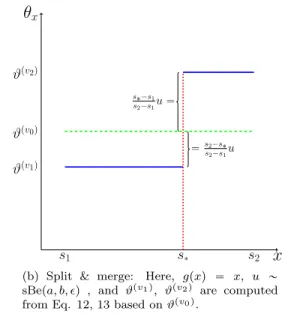
An illustrative example for the birth & death, and split & merge is given in Figure 1, in the case θx:RÑR(1D unbounded space). We observe that in the birth case, the proposed change ofθxis crucially
determined by the prior. Hence, birth & death can work well when the prior is calibrated against the data; however it can also be inefficient, i.e. lead to high rejection rate, when the prior is vague because then it will tend to blindly propose drastic changes. On the other hand, split & merge can propose more conservative local changes, controlled throughαandβ, and hence it is easier to prevent prohibitively high rejection rates. Therefore, split & merge is preferable than birth & death when the prior ofϑis vague. The split & merge can be applied on continuous calibration coefficients only, while the birth & death does not meet such a restriction.
Grow & prune operation This operation addresses more general cases that involve several calibration
parameters; i.e, the vector of calibration coefficient is such thatdθě1. Precisely, after the selection of the
nodes to be grown (or pruned), a pre-specified set of calibration coefficients are perturbed according to the split & merge proposals; while the rest of them are perturbed according to the birth & death. Let GSM
and GBD denote the sets of calibration coefficient dimensions perturbed by the split & merge and birth
x
s1 s˚ s2θ
x ϑpv0q ϑpv1q ϑpv2q “ϑpv0q “ϑpv1q„πpdϑq(a) Birth & death: ϑpv2q is chosen randomly
to inherit the value ofϑpv0q, andϑpv1qis gen-erated from the prior.
x
s1 s˚ s2θ
x ϑpv0q ϑpv1q ϑpv2q s˚´s1 s2´s1u“ “s2´s˚ s2´s1u(b) Split & merge: Here, gpxq “ x, u „
sBepa, b, q , and ϑpv1q, ϑpv2q are computed from Eq. 12, 13 based onϑpv0q.
Figure 1: Illustrative example of the split & merge and birth & death operations. Here,θxis such that
θx : RÑR (1D unbounded space). Parameter θx after split/birth and after merge/death is denoted
with a blue line (—) and the green dashed line (- - -) correspondingly, while the cutting point is denoted by a red dotted line (¨ ¨ ¨).
minp1,1{RGPqfor prune operation, where
RGP “ fpz|ϕ, θ1 x,T1q fpz|ϕ, θx,Tq ap1`dv0q ´b p1´ap2`dv0q ´b q2 1´ap1`dv0q ´b πpϑpv1q|T1qπpϑpv2q|T1q πpϑpv0q|Tq ˆnP nG ˆ ź jPGBD 1 Qpϑp˚qj q ź jPGSM |Jj| sBepuj|α, β, jq .
Grow & prune operations can be used in cases where the calibration coefficient vector consists of both categorical and continuous dimensions, such that the birth & death proposals are used for the categorical dimensions and the split & merge ones are used for the continuous. This includes problems which involve computer models with sub-models and other continuous tuning model parameters (discussed in Section 4).
These operations perform acceptably in our numerical experiments (Section 5), however we do not claim that they are optimal. To improve mixing of the MCMC, it is recommended to use fixed dimension updates which do not change the size of the sampling space. These operations are: (i) Metropolis random walk update proposing changes only in the calibration coefficientsϑ (ii.) the change operation (Chipman et al., 1998); (iii.) the swap operation (Chipman et al., 1998); and (iv.) the rotate operation (Gramacy and Lee, 2012). Rotate operation helps the chain escape from local minima by providing a more dynamic set of candidate nodes for pruning. The aforesaid grow & prune operations can be extended to generate more acceptable proposals by using the RJ scheme of Karagiannis and Andrieu (2013); however such a development is out of the scope of this article.
3.3
Calibration, and predictions
The specification of the Bayesian model and design of the MCMC sampler allows one to perform inference, calibration, and prediction based on the proposed framework. LetSN “ tpϑpiq,Tpiq, βpiq, ϕpiqq; i“1, ..., Nu
be a MCMC sample drawn from (8). The posterior distributions of the statistical parameterspβ, ϕ, σ2 q, and their functions can be recovered fromSN via standard MCMC methods (Robert and Casella, 2004). Here,
we focus on providing a guide to perform inference onθx and design an emulator for prediction.
Regarding calibration, the quadratic loss estimator of the calibration parameterθxis the posterior mean
Epθx|zq “ ż T ż ϑ θpx;ϑ,Tqπpdϑ,dT|zq, (16)
and can be approximated via MCMC as
ˆ θx“ 1 N N ÿ i“1 θpxiq, (17)
with standard error s.e.pθˆxq “
a
vθxρθ{N, where vθx and %θx denoting the variance and integrated
auto-correlation time of the Markov chain tθpxiquNi“1, withθ piq
x “ θpx;ϑpiq,Tpiqq, for a given input value x. We
observe that the estimator (16) is not necessarily a step function because of the integration with respect to the posterior distribution. This is a desirable property because it takes into account the uncertainty about the structure of θx. It can mitigate any undesired bias which may have been introduced due to the step
form of the calibration parameter in (5) and the binary treed form of the partition; both assumed a priori. Alternatively, the maximum a posteriori (MAP) estimator can be computed as the mode of the marginal posterior distribution ofθx that can be approximated by the MCMC approximation
ˆ πpdθx|zq “ 1 N N ÿ i“1 δθpiq x pdθxq, (18)
where δ denotes the Dirac measure. The plug-in estimator of θx, that results by replacing the unknown
quantities in (5) with the mode ofπpdϑ,dT|zq, can be used in the special case thatθxis known to be a step
function because it preserves this step form –however, this case is out of our scope.
Bayesian inference on the partition of the input space can be performed if interest lies in the boundaries of the input sub-regions where the optimal values of the calibration parameter change. The procedure allows the evaluation of the MAP estimate TMAP, which essentially defines the partition of these sub-regions, by
using the MCMC approximationπˆpdT|zq “ N1 řNi“1δTpiqpdTqofπpT|zq.
The proposed method allows to perform prediction of the real system output at any input value. The full conditional predictive distribution ofζpxq|z, ϑ, β, ϕintegrated out with respect toπpβ|z, ϑ,T, ϕqis denoted
asfpζp¨q|z, ϑ,T, ϕq. It is a Gaussian process, with mean and covariance functions µζpx|z, θx, ϕq “hpx, θxqβˆ`vpx, θxq|Σ´1z pz´Hβˆq; (19) cζpx, x1|z, θx, ϕq “cSppx, θxq,px1, θx1qq `cδpx, x1q ´vpx, θxq|Σ´1z vpx1, θx1q ` rhpx, θxq ´Hz|Σ ´1 z vpx, θxqs|Wˆrhpx1, θx1q ´Hz|Σ´1z vpx1, θx1qs (20) correspondingly, where hpx, θxq “ rhSpx, θxq|, hδpxq|s|, andvpx, θxq “ » – pcSppx, θxq,pxi, θxqq `cδpx, xiq; i“1 :nq| pcSppx, θxq,pxi, tiqq; i“1 :mq| fi fl. MCMC
ap-proximations of the marginal predictive distribution of the real system output and its surrogate model can be computed via the CLT asfˆpζpxq|zq “ N1 řNt“1fpζpxq|z, θ
piq x , ϕpiqq, andµˆζpx|zq “ N1 ř N t“1µζpx|z, θp iq x , ϕq,
correspondingly. The proposed method is expected to produce more accurate emulators than that of the standard Bayesian calibration, because the calibration values used to derive the predictive distribution are suitably adjusted the specific input region. Eq. 19, 20, are similar to those of the standard Bayesian calibration, and hence existing code can be used for their implementation.
Uncertainty analysis, and sensitivity analysis can be performed along the same lines of (Kennedy and O’Hagan, 2001a; O’Hagan et al., 1999; Kennedy and O’Hagan, 2001b) and (Marrel et al., 2009; Le Gratiet et al., 2014) by using the MCMC approximation of the predictive distribution.
4
Computer models with sub-models
Computer models often require the specification of a sub-model that can be selected from a set competing ones. We will call this sub-model as ‘best’ sub-model. This can be addressed via Bayesian model calibra-tion by considering a categorical calibracalibra-tion parameter whose levels indicate different sub-models. In many scenarios, the selection of the ‘best’ sub-model may be different at different input sub-regions. The IDBC framework allows the selection of different ‘best’ sub-models at different input sub-regions, as well as the identification of these sub-regions, based on a sub-model selection probability. Conventional Bayesian cali-bration implementations are constrained to select a single sub-model throughout the input space, and hence cannot address the aforementioned scenarios.
We briefly give guidelines on how the proposed method can address cases with competing sub-models. For the shake of presentation, we consider that there areM competing sub-models available, and ignore other possible calibration parameters. The sub-models are coded as categorical calibration parameters of 0´1
orthogonal contrasts in the statistical model (3). According to the0´1coding, the calibration parameter (5) will beθx“ pθx,1, ...θx,M´1q, with calibration coefficientstϑ
p`q j u
L ;M´1
`“1;j“1 whereϑp
`qP t0,1uM´1. This allows
the use of the standard covariance functions (2). To specify the prior ofϑp`q“ pϑp`q 1 , ..., ϑ
p`q
M´1q, a convenient
that can be specified based on the researcher’s prior knowledge. Alternatively, one can code the competing sub-models directly as a categorical parameter with M levels, and use more sophisticated GP priors (e.g., Storlie et al. (2014)); such an implementation is straightforward but out of this scope of the article.
For the Bayesian computations, the grow and prune operations, and the fixed dimensional operations discussed in Section 3.2, are suitable MCMC updates to perform the computations. In the general case where the calibration parameter consists of both sub-models (categorical) and model parameters (continuous), the birth & death dimension matching proposals can be used for the sub-models.
The posterior mean (16) can be used as an estimator of the sub-model selection probability, e.g.,tPjpxq “
Epθx,j|zqujM“1´1 and PMpxq “ 1´
řM´1
j“1 Pjpxq. The sub-model probabilities tPjpxquMj“1 are labeled by the
input, which allows the selection of different ‘best’ sub-models at different input values. Selection probabilities can be computed as MCMC approximate (17), namely the proportion of the times that the Markov chain has visited each sub-model.
5
Examples
We assess the performance of the proposed method against benchmark examples. The proposed method is used to analyze a real world application with a large-scale climate model. We use acronyms: SBC for the standard Bayesian calibration of Kennedy and O’Hagan (2001a), IDBC-JPS (Section 3.1) for the input dependent Bayesian calibration using the joint partition scheme, and IDBC-SPS (Appendix A) for the input dependent Bayesian calibration using the separate partition scheme.
5.1
A benchmark example
We consider there is available a computer model with output function
Spx;ξq “ $ ’ & ’ % 5ˆexpp´0.5px1´ξ1q2{0.062q ˆexpp´0.5px2´ξ2q2{0.062q , ξ3“1 4.5ˆ p1`0.5px1´ξ1q2{0.062q´1.5ˆ p1`0.5px2´ξ2q2{0.062q´1.5 , ξ3“2
whereX “ r0,1s2,ξ“ pξ1, ξ2, ξ3q P p0,1q2ˆ t1,2u,ξ1andξ2are continue location parameters, andξ3P t1,2u
is a categorical parameter. In real applications ξ3 can be considered as an indicator variable to a set of
x (1st dimension) 0.0 0.2 0.4 0.6 0.8 1.0 x (2nd dimension) 0.0 0.2 0.4 0.6 0.8 1.0 Output function 0 1 2 3 Real system
(a) Real system output function
x (1st dimension) 0.0 0.2 0.4 0.6 0.8 1.0 x (2nd dimension) 0.0 0.2 0.4 0.6 0.8 1.0 Output function 0 1 2 3
Calibrated comp. model
(b) Calibrated computer model
x (1st dimension) 0.0 0.2 0.4 0.6 0.8 1.0 x (2nd dimension) 0.0 0.2 0.4 0.6 0.8 1.0 Discrepancy function −0.1 0.0 0.1 Discrepancy (c) Discrepancy
Figure 2: [Example 1] The output functions of the formulationζpxq “Spx, θxq `δpxq
discrepancy functionδpxq “0.2 sinp2πx1qcosp2πx2q, and optimal value for the calibration parameter
θx“ $ ’ ’ ’ ’ ’ ’ ’ ’ ’ ’ ’ & ’ ’ ’ ’ ’ ’ ’ ’ ’ ’ ’ % p1{6,1{2,1q| , x1ă2{6 p3{6,1{4,2q| ,2{6ďx1ă4{6, x2ă0.5 p3{6,3{4,2q| ,2{6ďx1ă4{6,0.5ďx2 p1{6,1{4,1q| ,4{6ďx1, x2ă0.5 p1{6,3{4,1q| ,4{6ďx1, 0.5ďx2 . (21)
The output of the real function is presented in Figure 2a. We generate a training data-set that consists of n “50 measurements from the real system and m “ 120 simulations from the computer model. For the observations, we generated randomly the input values, computed the corresponding system output values, and contaminated with random noise with varianceσy“0.02. For the simulations, we randomly selected values
for the input and model parameters through Latin hybercube sampling (LHS), computed corresponding the computer model output, and contaminated with noise with varianceση “0.01. For the IDBC-JPS,ξ1, ξ2,
and ξ3 share the same partition. For the IDBC-SPS, we consider thatξ2 and ξ3 share the same partition,
whileξ1is associated with different partition. We use uniform priors on the calibration coefficients. The
RJ-MCMC samplers consist of the grow & prune operations and the fixed dimensional operations as discussed in Section 3.2. Regarding the grow & prune operations, we used split & merge forξ1 andξ2 , and birth &
death forξ3. The MCMC for each procedure ran for2ˆ104iterations, and the first104ones were discarded
as burn in.
The statistical methods under comparison are the standard Bayesian model calibration SBC, the IDBC-JPS with the joint partition scheme, and the IDBC-SPS with separate partition scheme. In Figures 3a, 3b, and 3c, we present histograms and trace plots of the generated MCMC samples of θ1,x at input point
x0 “ p0.5,0.4q. We observe that SBC produces a rather flat posterior distribution, and hence it is unable
to reduce uncertainty aboutθ1,x0. The IDBC-JPS and IDBC-SPS have produced posteriors forθ1,x0 whose
main density is around the optimal valueθ1,x0 “0.5. In particular, for posterior mode, mean and standard
deviation estimates are0.56,0.53and0.29for SBC;0.47,0.41and0.16for IDBC-JPS; and0.46and0.14for IDBC-SPS. Although the three posterior modes and means seem to be close, the standard deviation showing the spread of the distribution is significantly smaller for IDBC-JPS and IDBC-SPS than what is for SBC. This indicates that unlike SBC, the proposed IDBC-JPS and IDBC-SPS methods have managed to reduce uncertainty about the unknown calibration parameter atx0. We observe that the IDBC-SPS has produced a
posterior density which is slightly more concentrated around the mode than that of IDBC-JPS, however this difference may be observed due to the variation of the MCMC approximation. In Figure 3d, we present the estimated sub-model selection probability of each sub-model at input pointx0“ p0.5,0.4q. By construction
the best sub-model is ξ3 “ 2. The selection probability estimate and standard error for ξ3 “ 2 at input
pointx0was0.48(0.004) for SBC, 0.55(0.004) for IDBC-SPS, and0.56(0.004) for IDBC-JPS. We observe
that IDBC-JPS and IDBC-SPS have generated sub-model selection probabilities which suggest sub-model θ3,x0 “2as the ‘best’ choice. On the other hand, SBC does not indicate which sub-model is preferable.
In Figure 4, we present the RMSPE, as functions of the input, produced from the procedures SBC, IDBC-JPS, and IDBC-SPS. At each case, the root mean squared predictive error (RMSPE) was computed as the average of 10 realizations of the corresponding procedure. We observe that the proposed IDBC-JPS and IDBC-SPS have produced smaller RMSPE than SBC, which indicates that the proposed methods produced better emulators than SBC.
We observe that IDBC-JPS and IDBC-SPS outperform SBC in the scenario of input dependent calibration parameters, however we cannot observe a significant difference between the performance of IDBC-JPS and IDBC-SPS.
5.2
A case study on a pollution computer model
We test the proposed method against the 2-D groundwater flow and solute transport model (Zhang et al., 2017). The study addresses the case that, under steady state water flow conditions, some amount of con-taminant is released from a known source during the time interval 0rTs - 18rTs. The transient saturated flow was considered in a10rLs ˆ16rLsdomain uniformly discretized into41ˆ41grids. The upper and lower boundaries are no-flow, while the left and right boundaries are constant head boundaries with prescribed pressure heads of 16rLs and 10rLs, respectively. It is assumed that there are20 measurement locations to collect data every0.6rTsfrom0rTsup to18rTstime step, as shown in Figure 5d.
In the 2-D groundwater flow and solute transport model (Zhang et al., 2017), it is assumed that the uncertainty only stems from the connectivity field. The log conductivity fieldZ was modeled as a spatially correlated Gaussian random field with a specific separable exponential correlation form (Zhang et al., 2017).
2.0 0.5 0 2000 6000 10000 0.2 0.4 0.6 0.8 θ1, x=(0.5,0.4) iteration (a) IDBC-JPS 3.0 1.0 0 2000 6000 10000 0.2 0.4 0.6 0.8 θ1, x=(0.5,0.4) iteration (b) IDBC-SPS 1.0 0.2 0.0 0 2000 6000 10000 0.2 0.4 0.6 0.8 1.0 θ1 iteration (c) SBC SBC IDBC−JPS IDBC−SPS Marginal probability of θ3, x=(0.5,0.4) Probability 0.0 0.2 0.4 0.6 0.8 1.0 sub−model ξ3=1 ξ3=2
(d) Sub-model selection probability
Figure 3: [Example 5.1] Histograms of the posterior densities and trace plot of the MCMC samples for the generated optimal values for model parameters θ1 at input x0 “ p0.5,0.4q. Sub-model
selec-tion probabilities coded in θ3 at input x0 “ p0.5,0.4q, and the associated error bars. The procedures
considered are SBC, IDBC-JPS, and IDBC-SPS.
0.0 0.1 0.2 0.3 0.4 0.5 0.0 0.2 0.4 0.6 0.8 1.0 0.0 0.2 0.4 0.6 0.8 1.0 x (dimension 1) x (dimension 2) (a) SBC 0.0 0.1 0.2 0.3 0.4 0.5 0.0 0.2 0.4 0.6 0.8 1.0 0.0 0.2 0.4 0.6 0.8 1.0 x (dimension 1) x (dimension 2) (b) IDBC-JPS 0.0 0.1 0.2 0.3 0.4 0.5 0.0 0.2 0.4 0.6 0.8 1.0 0.0 0.2 0.4 0.6 0.8 1.0 x (dimension 1) x (dimension 2) (c) IDBC-SPS
Figure 4: [Example 5.1] RMSPE as a function of inputxas produced by SBC, JPS and IDBC-SPS. The RMSPE was computed by re-running each procedure 10times. The average RMSPE is (a):
Then the log conductivity field was parametrized through a Karhunen-Loève (KL) expansion, for dimension reduction reasons, as Zps|ξiq «Z¯psq ` d ÿ i“1 ξi a λifipsq,
wheres“ ps1, s2qare spatial coordinates,Z¯psq “0 is the mean component,tξiuare independent standard
Gaussian random variables,tλiuand tfipsqu are eigenvalues and eigenfunctions of the covariance function
specifed. Here, we focus on calibratingξ1, and hence we consider it as an uncertain calibration parameter.
The inputs are the spatial coordinates s and the time χ, hence x“ ps1, s2, χq. The quantity of interest,
according to which the model parameters are calibrated, is the concentration of the contaminant source which is an important index in pollution control; and hence it is the outputypxq. Calibratingξis important because it determines the conductivity field which can be used to locate the contamination source.
For the purpose of the example, we artificially introduce an input dependence to the optimal model pa-rameter values. Precisely, ifCspx, ξqis the concentration with respect to inputs and parameters as described
in (Zhang et al., 2017), then the computer model output is assumed to beSpx, tq:“Cspx|ξ“ pξ0`θxq ´tq,
where θx“ $ ’ ’ ’ ’ & ’ ’ ’ ’ % 0 , x1ă10, 2 , x1ą10, x2ă4.5 ´2 , x1ą10, x2ą4.5 . (22)
This artificially introduces input dependence on the optimal model parameter values, and obviouslyζpxq “
Spx, t“θxq. Note that in (22), the calibration parameters are invariant to the time step.
We consider, that there is available a sample of 500 points; precisely 50 model evaluations at 10 time steps. The experimental training data were generated such thatξ0“0.5 from the original model of Zhang
et al. (2017). We wish to recover an estimate for (22), as well as to produce an emulator for the concentration. We compare the proposed procedure IDBC-JPS with SBC. In the statistical model (4), the discrepancy term is set to zero as assumed by the example. We use the prior model in (6), and we assign uniform priors on the calibration coefficients in the ranger´10,10s.
The RJ-MCMC samplers consist of the grow & prune operations and the fixed dimensional operations as discussed in Section 3.2. In particular, we include two distinct RJ updates one is the grow & prune operation with split & merge, and the other is the grow & prune operation with birth & death. Regarding the split & merge, we used gpϑq “ logitp0.05pϑ´10qq which is a re-scaled version of (Table 1; 4th line); and the auxiliary proposal was generated from u„sBe(2,2,2). The birth & death operation is used in the default form (Section 3.2). The MCMC samplers for each procedure ran for2ˆ104iterations, and the first104ones were discarded as burn in. The split & merge produced more acceptable RJ transitions than the birth & death ones. The estimated expected acceptance probability was8% for split & merge, and5%for birth & death. Possibly birth & death produced higher a rejection rate than the split & merge because of the vague
0 2000 6000 10000 −4 −2 0 2 4 θx=(7,5,*) iterations (a) IDBC atx“ p7,5,˚q 0 2000 6000 10000 −4 −2 0 2 4 θx=(13,6.5,*) iterations (b) IDBC atx“ p13,6.5,˚q 0 2000 6000 10000 −4 −2 0 2 4 θx=(13,3,*) iterations (c) IDBC atx“ p13,3,˚q Posterior mode, θx x (dimension 1) x (dimension 2) −1.5 −1 −0.5 0 0.5 1 6 8 10 12 14 2 3 4 5 6 7 8
(d) IDBC (MAP estimate)
0 2000 6000 10000 −4 −2 0 2 4 θ iterations (e) SBC
Figure 5: [Example 5.2] Estimates of the optimal values of the model parameter at input pointsp13,3,˚q,
p13,6.5,˚q, p7,5,˚q. The˚ indicates that the estimate refers to any time step. The methods presented are the IDBC-JPS, and SBC. The red lines indicate the boundaries of the real partition. The red crosses denote the 20measurement locations assumed. The estimated optimal values are θpIDBCqx“p7,5,˚q “ ´0.04, θpIDBCqx“p13,6.5,˚q“ ´1.58,θxpIDBCq“p13,3,˚q“1.69, andθpSBCq“3.1.
prior of the calibration coefficient which causes the former to propose randomly large changes.
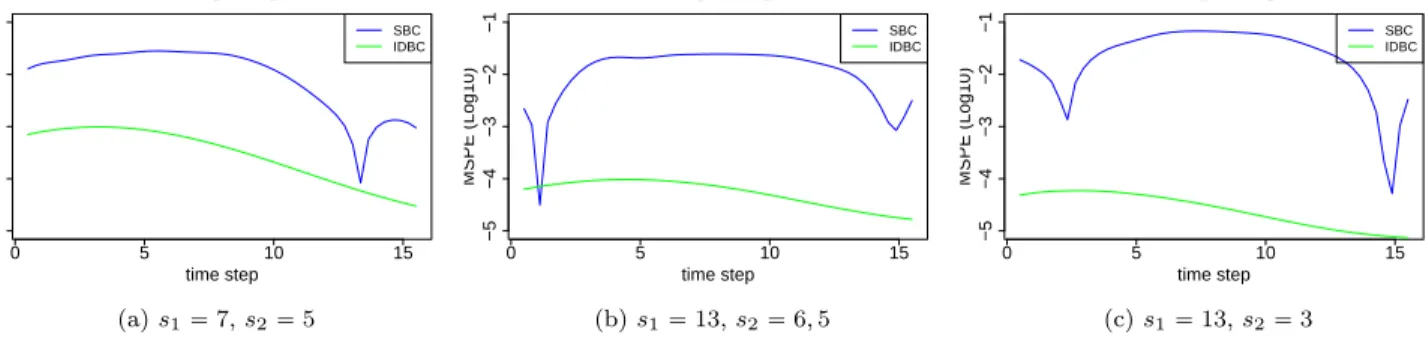
In Figures 5, we present histograms and trace plots for calibration parameters produced by the proposed IDBC method at three different locations (input points), as well as those produced by the SBC. We observe that, at the three input points, the posterior densities of the calibration parameters produced by IDBC are concentrated above areas around the ideal values. We observe that the SBC concentrates the posterior density around value 3, which is far from the ideal values. Therefore, we observe that, unlike SBC, IDBC manages to reduce uncertainty about the optimal values of the calibration parameters. In Figure 6, we present the RMSPE produced by the proposed IDBC and the standard SBC, as function of the time step, at three different locations. We observe that RMSPE produced by IDBC is smaller than that produced by SBC , and hence IDBC has produced more accurate predictions than the standard SBC.
5.3
Application to large-scale climate modeling
We consider the Advanced Research Weather Research and Forecasting Version 3.2.1 (WRF Version 3.2.1) climate model (Skamarock et al., 2008) constrained in the geographical domain 25˝–44˝N and112˝–90˝W
0 5 10 15 −5 −4 −3 −2 −1 location s1= 7, s2 = 5 time step MSPE (Log10) SBC IDBC (a)s1“7,s2“5 0 5 10 15 −5 −4 −3 −2 −1 location s1= 13, s2 = 6.5 time step MSPE (Log10) SBC IDBC (b)s1“13,s2“6,5 0 5 10 15 −5 −4 −3 −2 −1 location s1= 13, s2 = 3 time step MSPE (Log10) SBC IDBC (c)s1“13,s2“3
Figure 6: RMSPE (in Log10 scale) of the contamination produced by IDBC and SBC, at three different locations, as function of time. The average RMSPE is (in Log10 scale) (a): ´3.19for IDBC,´1.83for SBC; (b): ´3.84for IDBC,´1.76for SBC; (c): ´3.84for IDBC,´1.41for SBC.
over the Southern Great Plains (SGP) region, and we concentrate on the average monthly precipitation response. Here, we briefly discuss the application, however more details can be found in (Yang et al., 2012; Karagiannis and Lin, 2017).
WRF is employed with the Kain-Fritsch convective parametrisation scheme (KF CPS) (Kain, 2004) as in (Yang et al., 2012). The 5 most critical parameters (Yang et al., 2012) of the KF scheme are: the coefficient related to downdraft mass flux ratePd that takes values in ranger´1,1s; the coefficient related
to entrainment mass flux ratePe that takes values in ranger´1,1s; the maximum turbulent kinetic energy
in sub-cloud layer (m2s´2) P
t that takes values in range r3,12s; the starting height of downdraft above
updraft source layer (hPa) Ph that takes values in range r50,350s; and the average consumption time of
convective available potential energy Pc that takes values in range r900,7200s. The ranges of the KF CPS
parameters are quite wide and hence cause higher uncertainties in climate simulations due to the non linear interactions and compensating errors of the parameters (Gilmore et al., 2004; Murphy et al., 2007; Yang et al., 2012). We consider two different radiation schemes, the Rapid Radiative Transfer Model (RRTMG) for General Circulation Models (Mlawer et al., 1997), and the Community Atmosphere Model 3.0 (CAM) (Collins et al., 2004). Which radiation scheme is suitable to use in the computer model may depend on the input coordinates Yan et al. (2014).
The available sub-models are the two radiation schemes RRTMG and CAM. The sub-models are coded as0-1 orthogonal contrasts, and considered as levels of a categorical calibration parameter. The5KF CPS parameters are considered as standard continuous calibration parameters. The output is the monthly average precipitation (inlog mm) and the input are the coordinates in SGP region.
Experimental data consist of 404measurements from stations in the geographical domain25˝–44˝N and
112˝–90˝W over the SGP region, and represent monthly average precipitation (in mm) in June2007. The
data-set is available from the U.S. Historical Climatological Network repository1 (Karl et al., 1990). The
simulation data consist of a simple random sample of size 1000 from the original data-set generated by Yan et al. (2014). We analyze the problem by using the proposed IDBC. We use the GP statistical model described in Section 2.2 with mean functions and tapering covariance functions used in (Karagiannis and Lin, 2017). The MCMC sampler consists of the grown & prune operations, and the fixed dimensional updates discussed in the Section 3.2. In particular, regarding the grow & prune operations, we used the birth & death for the sub-models, and split & merge for the KF CPS parameters. The MCMC samplers ran for
10000where the first half iterations where discarded as burn-in.
In our analysis, the uncertainty of the model to convective parameterization, as well as that of the choice of the ‘best’ radiation scheme, is quantified with respect to the geographical coordinates. In Figures 7a-7e, we present the estimates of the calibration parameters with respect to the input space, as computed by the MAP estimator (posterior mode). Regarding the KF CPS parameters, we observe that they slightly change in value throughout the SGP region. In Figure 7f, we observe that the CAM sub-model can be considered as a ‘best’ choice to run at regions like Nebraska and Iowa, while the RRTMG is ‘better’ to be used in the WRF model at regions like Texas and Arizona. The results produced by the proposed method are consistent to the results in (Karagiannis and Lin, 2017) and the discussion in presented in a different context.
6
Discussion
We proposed a new fully Bayesian method for the calibration of computer models with uncertain parameters whose optimal values may depend on the inputs. The proposed method provides optimal model parameter values as functions of the input, as well as the associated posterior distribution that characterizes their uncertainty. The proposed method is especially useful in cases that running the computer model requires the choice of a sub-model from a set of available ones, but this ‘best’ choice may be different at different input regions. The method produces a sub-model selection probability that indicates which sub-model is the ‘best’ choice at a given input. We provided two variations of the method: the IDBC-JPS assuming that all the dimensions of the calibration parameter share the same partition of the input domain, and IDBC-SPS (in Appendix A) allowing them to be associated to different partitions. In order to address the challenging computations, we proposed reversible jump operations suitable to the proposed method.
The performance of the IDBC was assessed against benchmark examples, and compared to the standard Bayesian calibration method. We observed that in scenarios where the optimal calibration parameter values or the choice of the ‘best’ sub-model depends on the model inputs, the proposed method tends to produce more accurate results. We observed that, the proposed method, produces more accurate emulators (predictive models) that the standard Bayesian model calibration. In our comparable example, JPS and IDBC-SPS presented similar performance; hence IDBC-IDBC-SPS should be mainly used when there is need to obtain simpler partitions for interpretation reasons. The proposed method was utilized to analyze a real world problem that involves the calibration of the WRF computer model with two competing sub-models.
0.75 0.80 0.85 0.90 110°W 105°W 100°W 95°W 90°W 25°N 30°N 35°N 40°N 110°W 105°W 100°W 95°W 90°W 0 200 400 km scale approx 1:19,000,000 (a)Pd −0.95 −0.90 −0.85 −0.80 −0.75 −0.70 110°W 105°W 100°W 95°W 90°W 25°N 30°N 35°N 40°N 110°W 105°W 100°W 95°W 90°W 0 200 400 km scale approx 1:19,000,000 (b)Pe 4 5 6 7 8 110°W 105°W 100°W 95°W 90°W 25°N 30°N 35°N 40°N 110°W 105°W 100°W 95°W 90°W 0 200 400 km scale approx 1:19,000,000 (c)Pt 270 280 290 300 310 320 330 340 110°W 105°W 100°W 95°W 90°W 25°N 30°N 35°N 40°N 110°W 105°W 100°W 95°W 90°W 0 200 400 km scale approx 1:19,000,000 (d)Ph 3500 3600 3700 3800 110°W 105°W 100°W 95°W 90°W 25°N 30°N 35°N 40°N 110°W 105°W 100°W 95°W 90°W 0 200 400 km scale approx 1:19,000,000 (e)Pc 0.35 0.40 0.45 0.50 0.55 0.60 110°W 105°W 100°W 95°W 90°W 25°N 30°N 35°N 40°N 110°W 105°W 100°W 95°W 90°W 0 200 400 km scale approx 1:19,000,000
(f) Sub-model selection probability of RRTM
Figure 7: [Example 3] MAP estimates of the calibration parameters produced from IDBC. Figures (a)-(e): the MAP estimates of the optimal values for KF CPS parameters. Figure (f): the probability of RRTMG to be the ‘best’ radiation scheme.
Up to our knowledge, the proposed method is a first of its kind, where the calibration parameters are modeled as functions of input sub-regions, and hence it creates new directions for research. At this stage, the proposed method has been developed to calibrate computer models with univariate outputs only. Hence, IDBC can be extended to address problems with computer models producing multivariate outputs with dependent dimensions as in (Bilionis and Zabaras, 2012). The computational cost of the current IDBC implementation can be very expensive in cases with many input dimensions (e.g., 50). To address such cases, the method can possibly be coupled with ideas from (Linkletter et al., 2006), and (Higdon et al., 2008). In another extension, sequential Monte Carlo ideas can be used as in (Taddy et al., 2011) to alleviate the cost of Bayesian computations. These topics are ongoing projects and their results will be presented in future publications.
References
Andrieu, C. and J. Thoms (2008). A tutorial on adaptive MCMC.Statistics and Computing 18(4), 343–373. Bélisle, C. J., H. E. Romeijn, and R. L. Smith (1993). Hit-and-run algorithms for generating multivariate
distributions. Mathematics of Operations Research 18(2), 255–266.
Bhat, K. S., D. S. Mebane, C. B. Storlie, and P. Mahapatra (2014). Upscaling uncertainty with dynamic discrepancy for a multi-scale carbon capture system. arXiv preprint arXiv:1411.2578.
Bilionis, I. and N. Zabaras (2012). Multi-output local gaussian process regression: Applications to uncertainty quantification. Journal of Computational Physics 231(17), 5718 – 5746.
Brynjarsdóttir, J. and A. O’Hagan (2014). Learning about physical parameters: The importance of model discrepancy. Inverse Problems 30(11), 114007.
Chipman, H. A., E. I. George, and R. E. McCulloch (1998). Bayesian cart model search. Journal of the American Statistical Association 93(443), 935–948.
Collins, W. D., P. J. Rasch, B. A. Boville, J. J. Hack, J. R. McCaa, D. L. Williamson, J. T. Kiehl, B. Briegleb, C. Bitz, S. Lin, et al. (2004). Description of the ncar community atmosphere model (cam 3.0).
Cressie, N. (1993). Statistics for Spatial Data: Wiley Series in Probability and Statistics. Wiley: New York, NY, USA.
Gilmore, M. S., J. M. Straka, and E. N. Rasmussen (2004). Precipitation uncertainty due to variations in precipitation particle parameters within a simple microphysics scheme. Monthly weather review 132(11), 2610–2627.
Gramacy, R. B. and H. K. Lee (2012). Cases for the nugget in modeling computer experiments. Statistics and Computing 22(3), 713–722.
Green, P. (1995). Reversible jump Markov chain Monte Carlo computation and Bayesian model determina-tion. Biometrika 82(4), 711–732.
Higdon, D., J. Gattiker, E. Lawrence, C. Jackson, M. Tobis, M. Pratola, S. Habib, K. Heitmann, and S. Price (2013). Computer model calibration using the ensemble kalman filter. Technometrics 55(4), 488–500. Higdon, D., J. Gattiker, B. Williams, and M. Rightley (2008). Computer model calibration using
high-dimensional output. Journal of the American Statistical Association 103(482).
Kain, J. S. (2004). The kain-fritsch convective parameterization: an update. Journal of Applied Meteorol-ogy 43(1), 170–181.
Karagiannis, G. and C. Andrieu (2013). Annealed importance sampling reversible jump MCMC algorithms.
Journal of Computational and Graphical Statistics 22(3), 623–648.
Karagiannis, G. and G. Lin (2017). On the bayesian calibration of computer model mixtures through experimental data, and the design of predictive models. Journal of Computational Physics 342, 139–160. Karl, T., C. Williams, F. Quinlan, and T. Boden (1990). United states historical climatology network (hcn) serial temperature and precipitation data, environmental science division, publication no. 3404. Technical report, Carbon Dioxide Information and Analysis Center, Oak Ridge National Laboratory, Oak Ridge, TN, 389 pp.
Kennedy, M. C. and A. O’Hagan (2001a). Bayesian calibration of computer models. Journal of the Royal Statistical Society: Series B (Statistical Methodology) 63(3), 425–464.
Kennedy, M. C. and A. O’Hagan (2001b). Supplementary details on bayesian calibration of computer models. Technical report, Internal Report. URL http://www. shef. ac. uk/˜ st1ao/ps/calsup. ps.
Kim, H.-M., B. K. Mallick, and C. Holmes (2005). Analyzing nonstationary spatial data using piecewise gaussian processes. Journal of the American Statistical Association 100(470), 653–668.
Konomi, B. A., G. Karagiannis, K. Lai, and G. Lin (2017). Bayesian treed calibration: an application to carbon capture with ax sorbent. Journal of the American Statistical Association 112(517), 37–53. Le Gratiet, L., C. Cannamela, and B. Iooss (2014). A bayesian approach for global sensitivity analysis of
(multifidelity) computer codes. SIAM/ASA Journal on Uncertainty Quantification 2(1), 336–363. Le Maıtre, O., O. Knio, H. Najm, and R. Ghanem (2004). Uncertainty propagation using wiener–haar
Linkletter, C., D. Bingham, N. Hengartner, D. Higdon, and Q. Y. Kenny (2006). Variable selection for gaussian process models in computer experiments. Technometrics 48(4).
Marrel, A., B. Iooss, B. Laurent, and O. Roustant (2009). Calculations of sobol indices for the gaussian process metamodel. Reliability Engineering & System Safety 94(3), 742–751.
Mlawer, E. J., S. J. Taubman, P. D. Brown, M. J. Iacono, and S. A. Clough (1997). Radiative transfer for inhomogeneous atmospheres: Rrtm, a validated correlated-k model for the longwave. Journal of Geophysical Research: Atmospheres (1984–2012) 102(D14), 16663–16682.
Murphy, J. M., B. B. Booth, M. Collins, G. R. Harris, D. M. Sexton, and M. J. Webb (2007). A method-ology for probabilistic predictions of regional climate change from perturbed physics ensembles. Philo-sophical Transactions of the Royal Society of London A: Mathematical, Physical and Engineering Sci-ences 365(1857), 1993–2028.
O’Hagan, A., J. M. Bernardo, J. O. Berger, A. P. Dawid, A. F. M. e. Smith, M. C. Kennedy, and J. E. Oakley (1999). Uncertainty Analysis and other Inference Tools for Complex Computer Codes (with discussion). Oxford: Oxford University Press.
O’Hagan, A. and J. Kingman (1978). Curve fitting and optimal design for prediction. Journal of the Royal Statistical Society. Series B (Methodological), 1–42.
Paciorek, C. and M. Schervish (2004). Nonstationary covariance functions for gaussian process regression.
Advances in neural information processing systems 16, 273–280.
Pincus, R., H. W. Barker, and J.-J. Morcrette (2003). A fast, flexible, approximate technique for computing radiative transfer in inhomogeneous cloud fields. Journal of Geophysical Research: Atmospheres (1984– 2012) 108(D13).
Rasmussen, C. E. and C. K. I. Williams (2005). Gaussian Processes for Machine Learning (Adaptive Com-putation and Machine Learning). The MIT Press.
Robert, C. P. and G. Casella (2004, July). Monte Carlo Statistical Methods (2nd ed.). Springer.
Roberts, G. O., A. Gelman, and W. R. Gilks (1997). Weak convergence and optimal scaling of random walk metropolis algorithms. The annals of applied probability 7(1), 110–120.
Sacks, J., W. J. Welch, T. J. Mitchell, and H. P. Wynn (1989). Design and analysis of computer experiments.
Statistical science, 409–423.
Skamarock, W. C., J. B. Klemp, J. Dudhia, D. O. Gill, M. Barker, K. G. Duda, X. Y. Huang, W. Wang, and J. G. Powers (2008). A description of the Advanced Research WRF Version 3. Technical report, National Center for Atmospheric Research.
![Figure 2: [Example 1] The output functions of the formulation ζpxq “ Spx, θ x q ` δpxq](https://thumb-us.123doks.com/thumbv2/123dok_us/9336973.2812157/17.918.144.773.147.376/figure-example-output-functions-formulation-ζpxq-spx-δpxq.webp)
![Figure 3: [Example 5.1] Histograms of the posterior densities and trace plot of the MCMC samples for the generated optimal values for model parameters θ 1 at input x 0 “ p0.5, 0.4q](https://thumb-us.123doks.com/thumbv2/123dok_us/9336973.2812157/19.918.132.687.150.576/figure-example-histograms-posterior-densities-samples-generated-parameters.webp)
![Figure 5: [Example 5.2] Estimates of the optimal values of the model parameter at input points p13, 3, ˚q, p13, 6.5, ˚q, p7, 5, ˚q](https://thumb-us.123doks.com/thumbv2/123dok_us/9336973.2812157/21.918.115.826.136.504/figure-example-estimates-optimal-values-model-parameter-points.webp)
![Figure 7: [Example 3] MAP estimates of the calibration parameters produced from IDBC. Figures (a)- (a)-(e): the MAP estimates of the optimal values for KF CPS parameters](https://thumb-us.123doks.com/thumbv2/123dok_us/9336973.2812157/24.918.140.783.303.802/example-estimates-calibration-parameters-produced-figures-estimates-parameters.webp)
