Entity Search/Match in Relational Databases
Minlue Wang
1, Valeriia Haberland
1, Andrew Martin
1, John Howroyd
1, and John Mark Bishop
1 The Centre for Intelligent Data Analytics (TCIDA), Goldsmiths, University of London, SE14 6NW, London, U.K.{m.wang, v.haberland, a.martin, j.howroyd, m.bishop}@gold.ac.uk
Keywords: Entity Search, Relational Databases, Query Annotation, Semantic Search
Abstract: We study anentity search/matchproblem that requires retrieved tuples match to an inputentityquery. We assume the input queries are of the same type as the tuples in a materialised relational table. Existing keyword search over relational databases focuses on assembling tuples from a variety of relational tables in order to respond to a keyword query. Theentityqueries in this work differ from thekeywordqueries in two ways: (i) an entity query roughly refers to an entity that contains a number of attribute values, i.e. a product entity or an address entity; (ii) there might be redundant or incorrect information in the entity queries that could lead to misinterpretations of the queries. In this paper, we propose a transformation that first converts an unstructured entity query into amulti-valued structuredquery, and two retrieval methods are proposed to generate a set of candidate tuples from the database. The retrieval methods essentially formulate SQL queries against the database given the multi-valued structured query. The results of a comprehensive evaluation of a large-scale database (more than 29 millions tuples) and two real-world datasets showed that our methods have a good trade-off between generating correct candidates and the retrieval time compared to baseline approaches.
1
INTRODUCTION
Unstructured queries became important with the invention of the World Wide Web. Users that are un-aware of the underlying data structure may request in-formation, expressed in their own words. Then these queries have to be interpreted and associated with available information which is often structured (e.g. relational databases) or semi-structured (e.g. XML-documents) (Simitsis et al., 2008).
In keyword search over relational databases (RDBs) (Yu et al., 2010), the “best” answer usually needs to assemble tuples from a variety of relations. However, most of the query models of the keyword search can only handle short queries with AND/OR semantics. TheANDsemantics of the query (Hristidis and Papakonstantinou, 2002; Agrawal et al., 2002) re-quires the candidate answers to contain all keywords, which assumes every keyword from the queries can be found in the database. In contrast,ORsemantic of the query (Hristidis et al., 2003; Liu et al., 2006; Golen-berg et al., 2008) requires the candidate answers to contain at least one keyword, which would be ineffi-cient when searching over a large-scale database.
Entity-Oriented Search (EOS) (Balog et al., 2012), on the other hand, requires the answers to be entities. There are two main research directions in
EOS: one is to identify entities in the query, e.g. ex-tracting Wikipedia entities from the queries (Ferrag-ina and Scaiella, 2010); the other is to design entity-based ranking/scoring strategies (Blanco et al., 2011) so that the entities can be retrieved and ranked.
In this work, we focus on entity search over RDBs, where each tuple on the database corresponds to a real-world entity. Furthermore, the retrieved tuples need to match to the same entity as the input text query. In other words, we assume the scenario where an user, who is familiar with the domain, but has no knowledge of the schema of the database. Note that matching two records is referred as Entity Resolution or Record Linkage (Talburt, 2011) in literature.
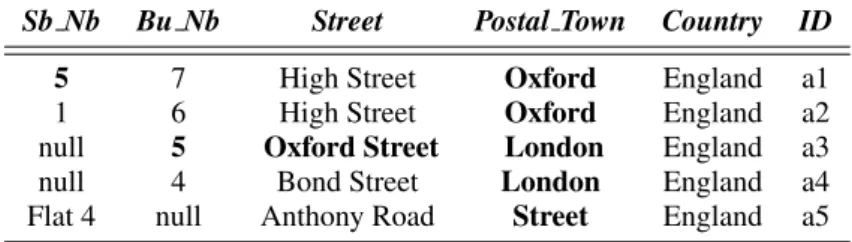
To further motivate the problem, we start with a running example. Table 1 shows a sample list of UK addresses1, and each tuple refers to an address en-tity. Given an entity query“5 Oxford Street London Englad”, we would like to find tuples in the Table 1 that refer to the same entity as the input query. Tu-ple a3 is the best answer and should be returned. If the input query is treated as a set of keywords, AND semantic of the query would fail to return any tuples from the Table 1, because the keyword “Englad” is misspelled and cannot be found anywhere in the table; on the other hand,ORsemantic of the query could po-1Street is a postal town in the county of Somerset, UK.
Table 1: An example list of UK addresses in a materialised relational table. The columns are sub-building number, building number, street name, postal town, country and primary ID respectively.
Sb Nb Bu Nb Street Postal Town Country ID
5 7 High Street Oxford England a1
1 6 High Street Oxford England a2
null 5 Oxford Street London England a3 null 4 Bond Street London England a4 Flat 4 null Anthony Road Street England a5
tentially return all tuples from Table 1, because each tuple has at least one matching keyword, which would be inefficient when aplied to large-scaled tables. The approach in this paper tries to make a good trade-off between returning matching tuples and retrieval time. In Table 1, text values that are sub-strings of the input query are marked with bold. The main issue is how to combine the columns with multiple values so that all the tuples from the table that are matched to the input query can be returned. This is achieved in two stages: an attribute extraction process (Section 4) that converts a free-text entity query into a valued structured query, which still maintains multi-ple interpretations of the query; a retrieval model that can construct SQL queries dynamically based on the structured query.
The reminder of the paper is organized as follows. Section 2 describes several related works. Section 3 discusses the problem of entity search/match in rela-tional databases. Section 4 shows a method to convert a free-text query into a multi-valued structured query. In Section 5 we discuss how to construct SQL from the converted query in order to generate candidate tu-ples from the database. We conducted extensive ex-periments using a large-scale database and two real-world datasets and the results are shown in Section 6. Finally, we conclude our work in Section 7.
2
RELATED WORK
Much research (Hristidis and Papakonstantinou, 2002; Agrawal et al., 2002; Hristidis et al., 2003; Liu et al., 2006; Golenberg et al., 2008) has been conducted forkeyword searchover RDBs where text queries are often presented as a bag of words con-nected through AND and/or OR logical operators, and the answers usually combine tuples from multiple re-lational tables. The goal of the work in this paper has a rather different focus from a traditional keyword search as it tries to identify tuples from a single table that match to the same entity as the input query. We do not focus on the exploration of the interconnected
tuple structure as in keyword search over RDBs, in-stead, we assume that the tables have been joined into one materialised view and argue that a single large-scale table is already a complex problem in the con-text of entity search/match.
Kim et al. (Kim et al., 2009) presents an anno-tation method to assign each query keyword into a table column with a probability, which is computed as the number of occurrences of the keyword in the column divided by the total number of terms in the column. The mapping probability is then used as a weight in their retrieval model. However, they implic-itly assume AND semantic of the keywords. When a term is mapped 100% to an incorrect column (or columns), no result would be returned. For example, when searching over a residential address database, consider an address query that mistakenly includes a recipient name. Suppose the tokens of the name are mapped to a column for building name, AND se-mantic of the query is not able to return any valid address where building name equals to the recipient name along with some other correct information.
The queries we consider in this work are more similar to web queries, where users seek informa-tion in the open world and issue queries without prior knowledge of the data source (Sarkas et al., 2010). The work in (Sarkas et al., 2010) considers mapping query terms to a list of structured tables and their at-tributes, the challenge is aboutintent disambiguation: given a list of the tables, which table best describes a web user’s intent of the query. The work in this pa-per does not focus on intent disambiguation, i.e. the input queries always have the same intended type as the tuples in the table, but focus on how to retrieve candidates from the table effectively and efficiently.
Commercial relational database management sys-tems (RDBMSs) provide free-text search using state-of-the-art information retrieval (IR) relevance rank-ing strategies, such as the SQL predicatecontain (at-tribute,keyword). However, it requires queries specify the exact column against which keywords are to be matched. An user with no prior knowledge about the schema of the database and the representation of the data would not be able to construct such queries.
3
PROBLEM DEFINITION
We useR to denote a relational entity table that contains collections ofheterogeneousdata with non-ID columns C={c1,c2, . . . ,ck}. Column and at-tribute are used interchangeably in this paper. Each columncican take a text valuevfrom a domain de-noted as range(ci), and we use range(R) to repre-sent the set of allduplicate-freevalues of the tableR, which is also referred as the Closed Language Model of the tableR, i.e.CLM(R)(Sarkas et al., 2010). Val-ues that are not from CLM are denoted as Open lan-guage model (OLM). A text value will have at least one word, which is defined as a sequence of charac-ters not including white space. Note that numerical at-tributes are also treated as categorical atat-tributes in this work and we do not assume the ranges of the columns are mutually exclusive. Each tuple from the entity ta-bleRcan be viewed as an entity withkattributes and an attribute value of an entity could be empty, i.e. null values as in the Table 1.
Definition 3.1. Given a relational entity tableR, the problem ofentity search/matchoverRis to find all tuples inRthat refer to the same entity denoted by the free-text input queryq, which is represented as a list of words(w1,w2, . . .wn).
The assumption here is that the entity denoted by the input query is of the same type as the tuple inR. According to Pound et al. (Pound et al., 2010), the in-put query in this work can be categorised as anEntity Query, where the intention of the query is to find a particular entity in anAd-hoc Object Retrieval (AOR) task.
There are three main challenges for the entity search/match over RDBs:
• The heterogeneity of the data means there could be many representations even for the same en-tity, and each attribute value could also have a varieties of forms. The complexity of the entity query grows exponentially to the number of the attributes of the entity.
• Two different attributes could have a large over-lap of values, which means the same word or words from the query could be mapped to multi-ple attributes at the same time. This characteristic has also been discussed in (Kim et al., 2009). • A real-world entity query might contain
redun-dantorincorrectinformation, that results in mis-interpretation of the query.
For example, given a product database where each tuple refers to a product entity, consider two in-put queries “iphone 7” and “iphone 7 cover”. First query refers to a “phone” with product name equal to
“iphone 7”. The second query refers to a “cover” that is used with an “iphone 7”. Thus, the value “iphone 7” in the first query should be mapped to a ‘product name’ attribute, and the same value “iphone 7” in the second query should be mapped to an ‘applicable’ at-tribute. In this paper, we argue and exploit the fact that mapping between values and attributes are not in-dependent of each other.
4
ATTRIBUTE EXTRACTIONS
In this section, we show how to perform a simple but effective attribute value extraction for an input en-tity query. We start by reviewing the query annotation model in (Sarkas et al., 2010).
Definition 4.1. Anannotated valueof a queryqfor a table R is a pairAV= (v,c)of a valuevfromqand a columncinR, such thatv∈range(c). Note that a valuevcould be a single wordwior a sequence of the words(wi, . . . ,wj)from the query.
In the example of Table 1, consider the input query “5 Oxford Street London Englad”, the anno-tated value AV=(Oxford Street, Street) denotes that “Oxford Street” is a possible value for the column “Street”. Intuitively, an annotated value AV decides which column a value should be mapped to.
Sarkas et al. proceed to define asegmentationof the query as a sequence of non-overlapping values that cover the entire query, and astructured annota-tionof the query is a set of annotated values such that the values from a segmentation of the query. When a wordwfrom the query does not belong to the range of the database, i.e. w∈/ range(R), AV = (w,OLM)
can be used to denote the word is from the OLM. For example, there are 4 different structured annotations for the input query “5 Oxford Street London Englad”, which are shown as follows:
S1=((5, Sb Nb), (Oxford Street, Street), (London,
Postal Town), (Englad, OLM))
S2=((5, Sb Nb), (Oxford, Postal Town), (Street,
Postal Town), (London, Postal Town), (Englad, OLM))
S3=((5, Bu Nb), (Oxford Street, Street), (London,
Postal Town),(Englad, OLM))
S4=((5, Bu Nb), (Oxford, Postal Town), (Street,
Postal Town), (London, Postal Town), (Englad, OLM))
Intuitively, each structured annotation of the query is a possible interpretation of the query and every word from the query is mapped to a single column in the database. For the running example, structured
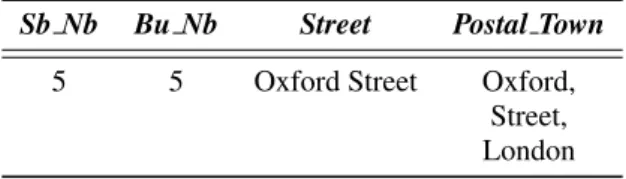
Table 2: Transformed Multi-Valued Structured Query ˆq. Sb Nb Bu Nb Street Postal Town
5 5 Oxford Street Oxford, Street, London
annotation S3 is the “correct” interpretation of the
query, because the word “5” in this case belongs to the building number, “Oxford Street” is the street name and “London” is the postal town. Note that some columns could have multiple values, such as column “Postal Town” inS2andS4, this is because each word
is mapped to the best column independently.
However, there are two major drawbacks for the structured annotation method: (i) the number of the possible structured annotations is exponential to the number of the words in the query; (ii) there is an im-plicit assumption that the “true” interpretation of the query comes from the set of all possible structured annotations, which is not always the case.
In this work, instead of selecting the best struc-tured annotation, we consider all possible annotated values at the same time. For the running example, there are only 5 different annotated values, i.e. (5, SB Nb), (5, Bu Nb), (Oxford Street, Street), (Ox-ford, Postal Town), (Street, Postal Town) and (Lon-don, Postal Town). The process of generating all an-notated values is a fast lookup process as each column can be kept in a hash table. All annotated values now can be arranged into amulti-valued structuredquery
ˆ
q, which is shown in Table 2.
The structured query now has three possible val-ues for the column Postal Town:{“Oxford”, “Street”, “London”} and one possible value for the column Street: {”Oxford Street”}. The token “5” is mapped to both columns Sb Nb or Bu Nb because of the over-lapping content. This extraction process can be seen as converting an unstructured query q into a multi-valued structuredquery ˆqwithoverlappingvalues.
The transformed structured query ˆqstill has a lot of ambiguities: (i) there could be more than one value for the same column, such as three possible values in the Postal Town; (ii) there could be overlapping val-ues between columns, such as token “5” mapped to both columns Sb and Bu Nb and the token “Oxford” appearing in both columns Street and Postal Town. The terms that are not in the range of the database will not be found in the structured query ˆq. We are not aiming to find the best annotation for the query in this process, but rather to generate possible values for each attribute and consider how to formulate SQL queries from ambiguous queries in order to effectively and efficiently perform entity search/match over the
relational databases.
5
CANDIDATES GENERATION
In this section, we present two retrieval models that can effectively and efficiently generate candidates given an input query q and a converted structured query ˆq. There are two competing goals for the candi-date generation process: one isCompleteness, which measures whether the returned set of the tuples con-tains all matched tuples; the other one is average num-ber of retrieved tuples, which measures the efficiency of the method.
Given a multi-valued query ˆq(as in Table 2), for each multi-valued column c, a predicate in is suffi-cient to retrieve all records with the value inc match-ing to one of the values. We then show two naive algorithms using AND/OR semantic s to combine the columns in a structured multi-valued query ˆq. Using theORoperator this results in the SQL-query:
SELECT * FROM R WHERE
Sb_Nb in (’5’) OR Bu_Nb in (’5’) OR Street in (’Oxford Street’) OR Postal_Town
in (’Oxford’, ’Street’, ’London’)
This returns all the tuples with at least one match-ing value in any of the mentioned columns, i.e., all the addresses with the sub-building number “5”, all the addresses with the building number “5”, all the addresses with the street name “Oxford street” and all the addresses in the three different postal towns. Al-though a high completeness can be achieved, it simply returns too many unnecessary candidate tuples for the input query.
The same query but connected withANDreturns the records, which have at least one matching value in every mentioned column, i.e., all the addresses in three different postal towns with sub-building num-ber and building numnum-ber “5”, and street name “Ox-ford street”. The query is actually a Conjunctive Normal Form (CNF): Sb Nb=“5”∧ Bu Nb=“5’ ∧ Street=“Oxford Street”∧ (Postal Town =“Oxford”∨ Postal Town=“Street”∨Postal Town=“London”).
The CNF above returns an empty set because there is no such tuple from Table 1 that satisfies this condition. There are two main reasons why using ANDoperator to combine all corresponding columns could impose too many constraints to retrieve candi-dates. Firstly, some columns from the database might have many overlapping values, when transforming an unstructured query into a multi-valued query, the shared values are likely to be used to populate both
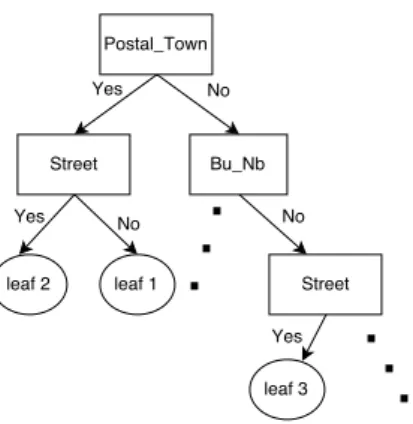
Figure 1: A toy example of search tree. Non-leaf nodes correspond to the columns in the database. Leaf nodes are clusters of the input queries.
columns. The second reason is that some columns from a database might have a much wider range of the values compared to others so that they are more likely to get populated (possible incorrectly). Both naive solutions are the baselines in the experiment.
Algorithm 1Recursive Learning A Search Tree 1: INPUT: Training Data D, Visited Columns VC
and a databaseR;
2: OUTPUT:SearchTreeNode nd 3: functionLEARNTREE(D, VC, R) 4: ifAveNumCand(D,VC, R)≤αthen 5: Returnnull
6: BestC =argmaxc∈C\VCComp(D, c∪VC,R) 7: ifComp(D, BestColumn∪VC,R)≥βthen 8: TreeNode nd = Node(BestColumn) 9: Dm←containValues(D,BestC,R) 10: Dum←D\Dm .Unmatched Set 11: nd.left = learnTree(Dm, BestC∪VC,R) 12: nd.right = learnTree(Dum, BestC∪VC,R) 13: else Returnnull
14: Returnnd
Since a CNF of all columns is too aggressive, we present two algorithms that can retrieve candidates more dynamically compared to the naive AND ap-proach. The idea is that some attributes are more likely to have the correct values compared to other attributes, e.g.
homogeneous attribute values, it is better to firstly re-trieve candidates based on reliable attributes rather than try to generate all candidates from a single SQL query.
A Search Tree Algorithm
Instead of constructing a CNF from all populated columns for each query, we try to learn a hierarchical search tree that can form a CNF with the best
combi-nations of the columns accordingly.
Definition 5.1. A Search Tree ST = (N,L,E) for a relational entity tableRis composed of abinarytree with the non-leaf nodesN, leaf nodesLand edgesE. Each non-leaf noden∈Ncorresponds to a columnc inR. A left or right edge of the non-leaf noden de-notes whether the node should be used to construct the CNF or not. Given a multi-valued query ˆq, it travels from a root node to a leaf nodel∈L, and all the leaf node’s ancestor nodes withleftedges are considered for the final CNF.
Now let us consider how to traverse in a search tree. Given a tabular query, it travels to the left edge of a nodenonly when the CNF of the node and all its ancestor nodes with left edges can retrieve a positive number of candidates from the database. For instance, Figure 1 shows an example of a search tree. Suppose a structured multi-valued query ˆqhas at least one value in the column Postal Town, then it will definitely travel to the left edge of the root nodePostal Town, because there is no other ancestor nodes at this stage. If the query ˆqdoes not have any value in the column Street, it then travels to the right edge of the node Street (leaf node 1); if the query ˆq does have some values for the columnStreet, it travels to the left edge of the nodeStreet(leaf node 2) only when the combi-nation of the columnPostal TownandStreet returns a non-empty set of the candidates, otherwise, it also travels to the right edge of the nodeStreet. This is to make sure the final CNF can always return a positive number of the candidates even when some values are not correctly populated.
Intuitively, each leaf node from the search tree corresponds to a set of queries with the same choices of the columns to form the CNF, for example, queries that terminate at leaf 1 will only use column Postal Town to retrieve candidates, while queries in leaf 3 will only use column Street to retrieve can-didates, because there is no matching values for the other two ancestor nodes Postal Town and Bu Nb. One thing worth noting here is that the maximum depth of the search tree is the total number of the columns in the database.
Now we present a recursive greedy algorithm (shown in Alg 1) to learn a search tree from a set of labelled queries. Each query in the training set is labelled with a set of candidates that refer to the same entity as the input query. The current best col-umn is selected to maximise the completeness (line 6). There are two termination conditions of the node expansion before it reaches the maximum depth of the search tree, one is when the average number of candidates (AveNumCand) is less than a pre-defined thresholdα(line 4), because there is no need to
per-form node expansion when the average number of candidates is already quite small; the other is when the current best column has a completeness score less than another pre-defined thresholdβ(line 7) so that a
minimal completeness can be guaranteed at each step of node expansion. If none of the early termination conditions is satisfied, the current training dataDis then split into two separate sets depending on how the queries follow the edges as we explained before.
Back to our running example in Section 3, given the search tree in Figure 1, the query ˆq in Table 2 will first travel to the left edge of the root node Postal Townbecause it has three possible values for the columnPostal Town. After constructing a SQL query with bothPostal TownandStreet:
SELECT * FROM R WHERE
AND Street in (’Oxford Street’) AND Postal_Town
in (’Oxford’, ’Street’, ’London’)
it returns the third record as the final result.
A MaxMatched Algorithm
We present another effective and efficient retrieval algorithm,MaxMatched, that can retrieve candidates that match to the input queries. Instead of choosing a number of columns to form a CNF query as shown before, the idea of the MaxMatched is to find the best column to generate a list of candidates and then cal-culate a similarity between each candidate tuple and the original input queryq.
The complete MaxMatched algorithm is shown in Alg 2. An unstructured queryqand the transformed structured query ˆq are both required as input for the MaxMatched algorithm.
We first generate an ordered list of the columns of the database based on the completeness score from the training data (line 4) using the same function Comp as in line 6 of Alg 1. Out of all populated columns, we choose the one with the best complete-ness (highest rank) in line 5 to retrieve the first set of the candidates from the database. The second step is to calculate the similarity score between all retrieved records and the unstructured queryq.
The degree of similarity between the queryqand a candidate tuple is calculated by counting the number of values from the tuple that can be found in the un-structured query (line 9-16). Note that the maximum number of the matching values is the total number of the columns in the table. The whole process can be seen as a two-stage algorithm , where the best-rank column generate candidates at the first stage and the tuples with maximum number of matching values are returned at the second stage.
As for the example query “5 Oxford Street Lon-don Englad”, we assume that the columnPostal town
Algorithm 2MaxMatched Algorithm
1: INPUT:A free-form queryq, a tabular query ˆq, a database R and training data D;
2: OUTPUT:Candidates T
3: functionMAXMATCHED(q, ˆq, R, D) 4: OC = OrderedColumns(R, D),T=0/ 5: BestC = FirstColumnNotEmpty(OC, ˆq, R) 6: ifBestC6=nullthen
7: maxMatched←0
8: for eachr∈Rand r.BestC∈qˆ.BestCdo
9: numMatched←countMatched(r,q) 10: ifnumMatched>maxMatchedthen
11: Empty T
12: maxM←numMatched
13: T = T∪r .Add current record r 14: else ifnumMatched=maxMthen
15: T←T∪r
16: ReturnT 17: else Return0/
from Table 2 has the best completeness score so that it is used to retrieve the first set of the candidates, which are all five of them. Out of all tuples from Table 2, the third record will then be returned as the final out-put, because there are three values from the third tuple that can be exactly found in the input query, i.e., “5”, “Oxford Street” and “London”. The tuplea1has only
two values, i.e., “5” and “Oxford”, that can be found in the query, while the tuplesa2,a4anda5only have
one value that can be found in the query, namely “Ox-ford”, “London” and “Street” respectively.
The MaxMatched algorithm is more flexible than choosing a fixed number of columns as in the SearchTree algorithm, however, it relies on the best ranked column to retrieve the first set of the candi-dates.
6
EXPERIMENTS
We tested effectiveness and efficiency of our sys-tem on an official UK address database called Post-code Address File (PAF, 2017) provided by the UK Royal Mail. The PAF database maintains over 29 millionresidentialandcommercialaddresses, where there are 12 columns in the main table. Column co nameis used to store company names, and the rest of the columns are responsible for addresses. Three columnspc dist(first part of post code),pc sffx (sec-ond part of post code) anddp sffx(deliver point) form an unique ID for each address. Columns, such as road name Rd Nm and sub-road nameSb Rd, share a large vocabulary, more specifically, most of the
val-Table 3: Number of tokens and free tokens per query. Datasets # of Tokens # of Free Tokens
YellowPage 13.82 4.35
Company 12.13 3.68
ues from the columnSb Rdcan be found in the col-umnRd Nm. Another thing worth noting is that col-umn building nameBu Nmhas a much wider range of values compared to the other address columns, i.e., the number of distinct values of the columnBu Nm is 1,048,576 while the second largest columnRd Nm has only 320,017 distinct values.
Two real-world datasets, each of which contains a list of UK company records, are used as the input entity queries. One contains 100 furniture company records extracted from the UK Yellow Pages web-site (YellowPage, 2017) and the other is aCompany dataset which contains 200 UK company records from a private company database. The datasets are split equally into training and test sets. The goal is to search for the tuples in the PAF database that refer to the same entity as the input query.
As shown in Table 3, the average numbers of to-kens per query for our entity search/match evaluation are significantly larger compared to the ones in key-word search literature (usually less than 6). Also web and commercial data is often not standardised and will differ in structure when compared to reference sources such the PAF dataset. Table 3 shows nearly a quarter of the tokens for each query could not be mapped to any of the columns in the database.
As said in Section 5, the effectiveness of the algo-rithm is measured by completeness, which determines whether the returned set of the tuplesT cover all cor-rect tuplesT∗, which is manually decided by our do-main expert. For each query, the completeness is 1 if T∗⊂T. We then computed the fraction of queries that have full completeness. The efficiency is measured by the average number of returned tuples.
There are three main baseline approaches used here. As explained in Section 4, the structured an-notation method first converts a text query intomany structured queries, where each structured query has non-overlapping values that cover the entire input query. Each structured query is then connected with OR semantic. On the other hand, NaiveAnd and NaiveOr methods, which are described in Section 5, rely on a single structured query with potentially over-lapping values between columns.
The comparison results of different methods are shown in Tables 4 and 5. For the SearchTree algo-rithm, the two hyper-parametersα andβ are set to
be 30 and 0.85 respectively, which shows good
per-Table 4: Comparison results for the Yellow Pages dataset. Completeness #Cand NaiveAnd 0 0 NaiveOr 1.0 491694 Structured Annotation 0.24 1.07 SearchTree 0.92 9 MaxMatched 1.0 7
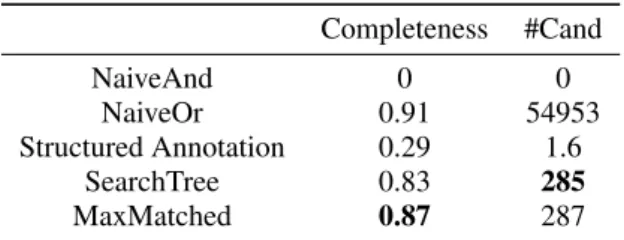
Table 5: Comparison results for the company dataset. Completeness #Cand NaiveAnd 0 0 NaiveOr 0.91 54953 Structured Annotation 0.29 1.6 SearchTree 0.83 285 MaxMatched 0.87 287
formance for both datasets. The NaiveAnd method returns an empty set for both datasets, which shows that it is too restrictive to consider all columns from the structured queries. The NaiveOr method, on the other hand, achieved the best completeness for both datasets, but also returned a large number of can-didates. As shown in Table 4, the average num-ber of candidates of the NaiveOr method is hun-dreds of thousands for the Yellow Pages dataset, but the SearchTree and MaxMatched methods only re-turn less than 10 candidates per query. The com-pleteness rates of the structured annotation method are only 24% and 29% for the two datasets, which are significantly smaller compared to the SearchTree and MaxMatched algorithms. This is due to the fact that some tokens from the query are wrongly mapped to the columns, resulting in none of the structured an-notations of the query being a possible interpretation of the query.
There are more candidates generated per query for the Yellow Pages dataset compared to the com-pany dataset when applying the NaiveOr method, be-cause the data from the Yellow Pages has much less noise than the company dataset, which means more matching values appear in the structured queries. In summary, both SearchTree and MaxMatched meth-ods dramatically reduce the number of candidates as compared to NaiveOr approach while still maintain-ing a competitive completeness.
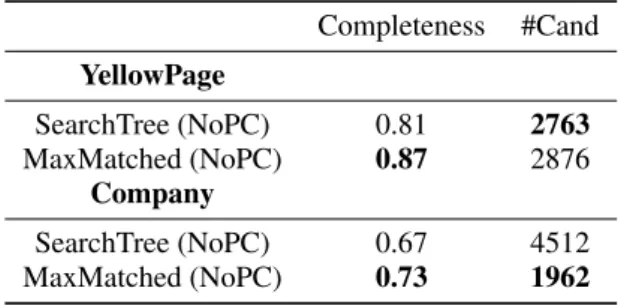
As the columnspc distandpc sffxare part of the unique identifier for an address entity, we also tested our methods without considering these two ID-like columns. Table 6 shows that a much larger number of candidates were returned and completeness was
re-Table 6: Results without columnspc distandpc sffx. Completeness #Cand YellowPage SearchTree (NoPC) 0.81 2763 MaxMatched (NoPC) 0.87 2876 Company SearchTree (NoPC) 0.67 4512 MaxMatched (NoPC) 0.73 1962
Table 7: Average Execution time.
Yellow Page (s) Company (s)
NaiveAnd 0.11 0.28
NaiveeOr 239.36 300.57
SA 13.7 1.05
SearchTree 2.51 4.67
MaxMatched 0.82 0.68
duced compared to the case where all columns are considered.
Finally, the average execution times per query for the different algorithms are shown in Table 7. As expected, NaiveOr has the largest retrieval time be-cause of the large number of possible candidates. The SearchTree method generally takes more time to re-trieve candidates than the MaxMatched, because it has to decide which branch to follow at each non-leaf node by checking whether the current combina-tion of the ancestor nodes can generate a non-empty set, while the MaxMatched method only has to enu-merate all candidates constrained by the best column.
7
CONCLUSIONS
We have presented an effective and efficient ap-proach to address the problem of entity search/match over RDBs. We showed that structured annotation of the query is not suitable when there is redundant information in the input queries that could mislead the interpretations. Two supervised retrieval methods were proposed to retrieve candidate tuples based on a multi-valued structured query. The results of the com-prehensive evaluation for the large-scale database and two real-world datasets showed that our methods can achieve a good trade-off between generating correctly matching candidate and the retrieval time.
REFERENCES
Agrawal, S., Chaudhuri, S., and Das, G. (2002). DBX-plorer: A System for Keyword-Based Search over Re-lational Databases. InProceedings of the 18th Inter-national Conference on Data Engineering.
Balog, K., de Vries, A. P., Serdyukov, P., and Wen, J.-R. (2012). The first international workshop on entity-oriented search (eos). In ACM SIGIR Forum, vol-ume 45, pages 43–50. ACM.
Blanco, R., Mika, P., and Vigna, S. (2011). Effective and Efficient Entity Search in RDF data. InProceedings of International Semantic Web Conference.
Ferragina, P. and Scaiella, U. (2010). TAGME: On-the-fly Annotation of Short Text Fragments (by Wikipedia Entities). In Proceedings of the 19th ACM interna-tional conference on Information and knowledge man-agement. ACM.
Golenberg, K., Kimelfeld, B., and Sagiv, Y. (2008). Key-word Proximity Search in Complex Data Graphs. In Proceedings of the SIGMOD international conference on Management of Data. ACM.
Hristidis, V., Gravano, L., and Papakonstantinou, Y. (2003). Efficient IR-style keyword search over relational databases. InProceedings of the 29th International Conference on Very Large Data Bases.
Hristidis, V. and Papakonstantinou, Y. (2002). Discover: Keyword search in relational databases. In Proceed-ings of the 28th International Conference on Very Large Data Bases, VLDB ’02. VLDB Endowment. Kim, J., Xue, X., and Croft, W. B. (2009). A Probabilistic
Retrieval Model for Semistructured Data. In Euro-pean Conference on Information Retrieval. Springer. Liu, F., Yu, C., Meng, W., and Chowdhury, A. (2006).
Ef-fective Keyword Search in Relational Databases. In Proceedings of the International Conference on Man-agement of Data. ACM.
PAF (2017). Royal mail postcode address file. https://www.poweredbypaf.com/.
Pound, J., Mika, P., and Zaragoza, H. (2010). Ad-hoc Ob-ject Retrieval in the Web of Data. InProceedings of the 19th international conference on World Wide Web. Sarkas, N., Paparizos, S., and Tsaparas, P. (2010). Struc-tured Annotations of Web Queries. InProceedings of the International Conference on Management of data. ACM.
Simitsis, A., Koutrika, G., and Ioannidis, Y. (2008). Pr´ecis: From unstructured keywords as queries to structured databases as answers.The VLDB Journal, 17(1). Talburt, J. R. (2011). Entity Resolution and Information
Quality. Elsevier.
YellowPage (2017). UK yellow page website. https://www.yell.com/.
Yu, J. X., Qin, L., and Chang, L. (2010). Keyword Search in Relational Databases: A Survey. IEEE Data Engi-neering Bulletin, 33(1).