Worcester Polytechnic Institute
Digital WPI
Masters Theses (All Theses, All Years) Electronic Theses and Dissertations
2013-01-02
High Performance Analytics in Complex Event
Processing
Yingmei Qi
Worcester Polytechnic Institute
Follow this and additional works at:https://digitalcommons.wpi.edu/etd-theses
This thesis is brought to you for free and open access byDigital WPI. It has been accepted for inclusion in Masters Theses (All Theses, All Years) by an authorized administrator of Digital WPI. For more information, please [email protected].
Repository Citation
Qi, Yingmei, "High Performance Analytics in Complex Event Processing" (2013).Masters Theses (All Theses, All Years). 2.
High Performance Analytics in Complex Event Processing
by Yingmei Qi
A Thesis
Submitted to the Faculty of the
WORCESTER POLYTECHNIC INSTITUTE In partial fulfillment of the requirements for the
Degree of Master of Science in
Computer Science by
Jan 2013 APPROVED:
Professor Elke A. Rundensteiner, Thesis Advisor Professor Mohamed Eltabakh, Thesis Reader Professor Craig Wills, Department Head
Abstract
Complex Event Processing (CEP) is the technical choice for high performance analyt-ics in time-critical decision-making applications. Although current CEP systems support sequence pattern detection on continuous event streams, they do not support the computa-tion of aggregated values over the matched sequences of a query pattern. Instead, aggre-gation is typically applied as a post processing step after CEP pattern detection, leading to an extremely inefficient solution for sequence aggregation. Meanwhile, the state-of-art aggregation techniques over traditional stream data are not directly applicable in the context of the sequence-semantics of CEP. In this paper, we propose an approach, called
A-Seq, that successfully pushes the aggregation computation into the sequence pattern
detection process. A-Seqsucceeds to compute aggregation online by dynamically record-ing compact partial sequence aggregation without ever constructrecord-ing the to-be-aggregated matched sequences. Techniques are devised to tackle all the key CEP-specific challenges for aggregation, including sliding window semantics, event purging, as well as sequence negation. For scalability, we further introduce the Chop-Connect methodology, that en-ables sequence aggregation sharing among queries with arbitrary substring relationships. Lastly, our cost-driven optimizer selects a shared execution plan for effectively process-ing a workload of CEP aggregation queries. Our experimental study usprocess-ing real data sets demonstrates over four orders of magnitude efficiency improvement for a wide range of tested scenarios of our proposed A-Seq approach compared to the state-of-art solutions, thus achieving high-performance CEP aggregation analytics.
Acknowledgements
I would like to express my gratitude to my advisor professor Elke Rundensteiner. Thank for her continuous support for my research and thesis work. Thank for her time on revising my thesis again and again, to make it perfect. I really appreciate her patient guide, encouragement, as well as immense knowledge, which help me to continuously grow and improve during my master study.
My thanks also go to my thesis reader professor Mohamed Eltabakh, for his valuable advises on my thesis work, which helps me to improve the quality of this thesis.
I also thank the researchers from HP labs: Song Wang, Chetan Gupta, Ismail Ari, for all the inspirations and feedbacks on my research work.
I thank all my lab-mates in WPI DSRG: Lei Cao, Chuan Lei, Mo Liu, Di Yang, Medhabi Ray, Xika Lin, for all the feedbacks and discussion on my work; Cheng Cheng, Kenneth Loomis, for their hard work on the implementation. I also want to thank my best friend at WPI Yumeng Qiu, for all the fun we have during the last two and half years.
Lastly, I want to thank my whole family: my parents Wansong Qi and Jianhua Zhou; my fiance Jing Yang; and my sisters Yingli Qi and Yingjin Qi. Thank for giving me tremendous support for no matter my life or study.
Contents
1 Introduction 1
1.1 Motivation . . . 1
1.1.1 Running Example . . . 2
1.2 State-of-art Limitations . . . 3
1.3 Challenges & Proposed Solution . . . 4
1.4 Contributions . . . 6
2 CEP Basics 8 2.1 Basic Concepts . . . 8
2.2 Language Specification . . . 9
2.3 Stack-Based Pattern Evaluation . . . 10
3 A-Seq Single Query Strategy 12 3.1 Basic Approach:Dynamic Prefix Counting . . . 12
3.2 Sliding Window Support for A-Seq . . . 17
3.3 Negation Support for A-Seq . . . 22
3.4 Predicates Support for A-Seq . . . 25
4 A-Seq Multi Query Strategy 27 4.1 The Prefix Sharing Strategy . . . 28
4.2 The Arbitrary Sub-pattern Sharing Mechanism: Chop-Connect . . . 29
4.3 Sharing Plan Selection . . . 36
4.3.1 Apriori for finding all potential sharing candidates . . . 37
4.3.2 Cost-Based Benefit Model . . . 38
4.3.3 Mapping to the Maximum Independent Set Problem . . . 42
5 Performance Evaluation 46 5.1 Experimental Setup . . . 46
5.2 Single Query Evaluation . . . 48
5.3 Multi Query Evaluation . . . 52
6 Related Work 57
List of Figures
2.1 Stack Based Pattern Evaluation . . . 11
3.1 Sequence Form Process . . . 13
3.2 Prefix Pattern Count Update Process . . . 15
3.3 DPCComputation Process for Sequence Pattern (A,B,C,D) . . . 16
3.4 BasicA-SeqAlgorithm . . . 17
3.5 Pushing Windows Down into A-Seq Using SEM . . . 20
3.6 SEM A-Seq Algorithm . . . 21
3.7 Pushing Negation Down to Sequence Detection Process . . . 23
3.8 Hashed Prefix Counter (HPC) . . . 26
4.1 PreTree Structure . . . 28
4.2 Connect Counts of Two Substrings . . . 31
4.3 SnapShot Maintenance . . . 33
4.4 Snapshot Computation of Multi-connect . . . 35
4.5 Mapping to Maximum Independent Set Problem . . . 44
4.6 A-Seq Optimizer Greedy Search Algorithm . . . 45
5.1 (a)(b) Single A-Seq Performance by Varying Pattern Length . . . 49
5.2 (a)(b) Single A-Seq Performance by Varying Window Size . . . 50
5.4 (a)(b)Chop-Connect Performance Evaluation by Varying Connect Event Frequency . . . 53 5.5 (a)(b)Chop-Connect Performance Evaluation by Varying Shared Length
and Shared Query Number . . . 53 5.6 (a)(b)Comparisons between Multi-query Optimizers in terms of Running
List of Tables
Chapter 1
Introduction
Complex Event Processing (CEP) systems detect complex sequence patterns over high speed event streams. As more applications from stock market analysis to seismic motion monitoring require time-critical decision-making support, enhancing the performance of CEP systems has drawn increased attention recently [15, 17, 25].
1.1
Motivation
Current research in CEP focuses on how to efficiently detect time-valued correlated se-quence patterns [4, 17, 25]. Yet the processing of CEP aggregation, which is critical for high-performance analytics, has largely been overlooked. CEP aggregation queries focus on asking questions from an overall statistic view point, such as how frequently a cer-tain sequence pattern happens over some period of time or what is the maximum value of event attributes in a pattern among all matched sequences. In fact, CEP aggregation queries are prevalent in every aspect of our digital daily life and business world alike. For example, in fraud detection, a susceptible credit card fraud might be defined as a partic-ular online purchase pattern repeatedly arising with respect to the same credit card with
the total value over $10,000 in the last 60 minutes. In seismic monitoring, geologists de-fine abnormal seismic motion patterns. Once the occurrence of those patterns surpassed a given threshold frequency, an alert must be issued.
As the above examples demonstrate, a timely response is of paramount importance when processing CEP aggregation queries. For applications, even a one-second delay may lead to a loss of huge amounts of money or even perhaps human lives. Thus, high-performance support for processing CEP aggregation queries is the central challenge tack-led in this paper.
1.1.1
Running Example
Using a running example in E-Commerce, we now briefly introduce the state-of-art tech-nique in CEP aggregation processing. In online shopping, customer shopping habits are crucial for optimally timing targeted promotions, product recommendations, and cus-tomized display layout on webpages. For example, consider the web click sequence pat-tern(ViewKindle, BuyKindle, ViewCase, BuyCase)(in shortVK, BK, VC, andBC) that cor-responds to a purchase pattern revealing that a customer purchases a Kindle case shortly after they purchased a Kindle. If this pattern is extremely frequent, then it implies that customers prefer to buy a case to protect their E-Reader. Given this insight, merchants would want to adjust their market strategies such as displaying Kindles and cases on the same webpage when customers search for either product, recommending cases when cus-tomers view a Kindle webpage, as well as bundling a Kindle and a matching case together as a package with a promotion price.
For large E-Commerce companies, such as Amazon and eBay, a huge amount of web-click data is generated continuously every single second. Suppose the merchant asks for the total occurrence of the web-click pattern (VK, BK,VC, BC), where the Kindle model is ”touch” within the last 10 minutes. In current CEP systems [4, 17, 25], this query will
be processed using a two-step aggregation process, namely, first theSequence Detection
and Construction (SDC)and then theAggregation Computation Process (AGG). The
SDC firstly finds all event instances that match the CEP pattern such as (VK, BK,VC, BC) sequencing along with predicates such as ”touch” model and constructs sequence results (see Chapter 2 for details). As the last AGGstep, the aggregation function, such as COUNT, is applied to count the number of all matched sequences constructed in the SDC step.
1.2
State-of-art Limitations
This two-step aggregation process suffers from serious performance bottlenecks, includ-ing:
Expensive CPU Costs. CPU resources are spent on compute-intensive tasks, namely,
first to maintain the ordering occurrence information among continuous incoming events when detecting each sequence match. Second, to construct each individual matched event sequence. However, these result sequences will be thrown away after they have been constructed, as what the query asks for is only the aggregated result: a simple number.
Huge Memory Storage. To detect and construct each full sequence match, memory
resources must be dedicated to store all incoming event instances. In addition, the tempo-ral sequence results must also be stored for a later negation check (if any) and subsequent aggregation computation (see step 2 above).
No research work to date has focused on this critical aggregation performance prob-lem in the CEP context. In most current CEP systems [4, 17, 25], the above two-step aggregation process would thus be applied to process such queries. This points to the opportunity to greatly improve performance if aggregation could be obtained instanta-neously as part of the sequence detection process itself, namely, without having to first
construct all matched sequences.
However, existing aggregation techniques in the literature do not tackle this challenge. On the one hand, most aggregation techniques in streaming environments are designed for independent data records [11, 13], i.e., they tend to have set-based semantics rather than sequence or pattern semantics. That is, they collect a set of independent data records irre-spective of their time-order and then aggregate them. The time-order constraint between data items that are to be aggregated as in our context now clearly complicates the prob-lem as we cannot accumulate the aggregation result with the arrival of event instances. On the other hand, techniques proposed for aggregation in traditional sequence databases assume data is static and given apriori [16, 19, 21]. A lot of techniques such as indexing is exploited to efficiently search for the data sequences that match the required pattern, however, for aggregation, they still apply the two-step post aggregation approach.
In addition, in the streaming context, the problems caused by sliding window seman-tics are non-negligible, as a high-performance re-computation and purging mechanism must be supported to correctly update the aggregation results due to data expiration. Other challenges specific to CEP include negation of a pattern are not tackled in static sequence databases. Therefore, a customized high-performance approach for processing sequence pattern-based aggregation over stream must be developed to fill this void.
1.3
Challenges & Proposed Solution
First, a light-weight technique must be designed to overcome the performance bottle-neck of state-of-art methods both in terms of CPU resource consumption and memory utilization. To achieve this goal, we devise theA-Seqmethodology that correctly pushes aggregation computation into the sequence detection process itself by dynamically calcu-lating partial aggregation result without first having to detect each full sequence match.
As additional benefit, the actual sequence construction process is completely eliminated. Our preemptiveDynamic Prefix Counting (DPC)algorithm supports the computation of partial aggregation instantly upon the arrival of each event instance, while our compact data structurePrefix Countermaintains the relevant ordering semantics of event instances for a sequence match identification, but without storing individual event instances.
Second, achieving a light-weight aggregation solution is complicated by the fact that the aggregation result needs to be continuously updated with the expiration of event in-stances from the current window. The design of such an expiration mechanism is chal-lenging, as one event expiration might cause an arbitrary number of sequence matches to become invalid. For this, we propose an effective expiration mechanism that is not only sequence-aware to detect invalid sequence matches, but also light-weight maintain-ing only aggregated results, instead of all raw event instances or worst yet all sequence matches. Furthermore, our algorithm also supports pattern queries with negation, namely, the occurrence of an event instance matching a negated expression within a sequence pat-tern may lead some detected sequence matches to be invalid. In addition, this mechanism is agile to efficiently function over high-speed streams with high expiration frequency.
Third, applications often process many similar queries over the same popular data stream [5, 11, 15]. The sharing of computations among queries in a workload has been shown to be vital for scalability in the literature [16, 28], yet these work focus either on non-sequence based queries [11, 24] or on the computation sharing of sequence construc-tion process [15]. Given that A-Seqapproach avoids the construction of sequences, we now set out to obtain the aggregation result of a full query pattern by stitching together aggregations of sub-patterns. However, this leads to the paradox that keeping the time implicit order semantics among sub-patterns to ensure correctness would prevent us from exploiting the key merit of our givenA-Seq approach. We overcome this challenge and design a computation method that leverage the aggregate meta information maintained by
our A-Seqtechnology to successfully stitch aggregation results of different sub-patterns together This method makes the selectively sharing aggregation computations over arbi-trarily sub-patterns within multi queries possible.
Fourth, we show that the selection of a good sharing plan for a given query workload is an NP-Complete problem (Section 4.3.3). We devise a cost-based optimizer that is practical in spite of the complexity of this search space. The optimizer applies a hill-climbing search strategy, which is shown to be efficient to produce a good sharing plan close to the optimal solution in terms of its quality by our experimental studies in Section 5.3.
1.4
Contributions
In our A-Seq approach, we successfully tackle all challenges outlined above. Contribu-tions of our work on solving this real time CEP query aggregation problem include:
• The A-Seq Methodology. We design a dynamic computation algorithm and a
com-pact data structure for processing the aggregation of sequence pattern queries, A-Seqsucceeds to conduct sequence detection and aggregates computation simultane-ously in an extreme efficient manner, which overcomes the performance shortcom-ing of the state-of-art two-step aggregation method, greatly enhancshortcom-ing both CPU costs and memory utilization by several orders of magnitude (See Section 5.2).
• CEP Featured Problems Solution. We propose a set of techniques to cope with
the core CEP specific problems. For instance, an agile mechanism is proposed to update the aggregation result timely with the event expiration that caused by sliding window constraint. For negated patterns, an recounting principle is plugged into the sequence detection process which enables the on-the-fly negation check.
• Multi-query Sharing Strategy. To support effective aggregation computation shar-ing of arbitrary sub-patterns among a given set of queries. Ourmulti A-Seqstrategy chops queries into sub-pattern and reuses the aggregation results of sub-patterns among multi queries that share them. Effective data structures and sophisticated computation algorithm are devised to support the arbitrary sub-pattern sharing.
• Cost-based Multi A-Seq Optimizer. We design a cost-driven algorithm (A-Seq
optimizer) to constructs the a good sharing plan for a given query workload. A-Seq optimizer employs several well-known algorithm to simplify the sharing plan search problem from NP-hard complexity to guaranteed polynomial running time. Complete complexity analysis of both exhaustive and optimized search algorithm is given. The practicability and accuracy ofA-Seqoptimizer is demonstrated in our experimental study (Section 5.3).
• Experimental Evaluation. We conducted extensive experiments over real world
data streams validating the effectiveness of our proposed methods. The experimen-tal study compares the performances with state-of-art approaches, demonstrating over four orders of magnitude efficiency improvement for a wide range of tested scenarios of our proposedA-Seqapproach.
The rest of the paper is organized as follows. Chpater 2 gives a brief introduction of the preliminary knowledge about CEP. The A-Seq approach for single query is op-timization introduced in Chapter 3, the multi-query solution is presented in Chapter 4. Experimental results are analyzed in Chapter 5. Chapter 6 covers related work, while Chapter 7 concludes the whole paper.
Chapter 2
CEP Basics
2.1
Basic Concepts
Anevent instanceis an occurrence of interest denoted by lower-case letters (e.g.,‘e’). We
useei.tsto denote the time-stamp when ei arrives to system. For compactness, the time
of occurrence of an event instance is denoted by its subscripti.
Anevent typeE of an instanceei describes the essential features associated with the
event instanceei, and is denoted byei.type. For the example in Section 1.1.1, clicks on a
page to view a Kindle are Clicks on a page to view a Kindle, denoted asvki, are instances
of event typeV iewKindle, that is,vki.type =V iewKindle.
Sequence Pattern Query. We focus on sequential pattern queries denoted by SEQ
operator below, a core feature of most event processing systems [4, 25].
Definition 1 A SEQ operator specifies an order on the time-stamps in which the
SEQ(E1, E2, ..., En) ={< e1, e2, ..., en>|e1.ts < e2.ts <
... < en.ts∧(e1.type =E1)∧(e2.type =E2)∧...∧(en.type =En)}.
(2.1) The symbol ”!” before an event typeEi indicates that the instance of typeEi is not
allowed to appear within the specified position in the stream [25]. We call such Ei a
negative event type. Consequently, when an event type Ei is used in a SEQ construct
without “!”, we call it apositiveevent type.
SEQ(E1,!Ei, En) = {< ej, ek >|(ej.ts ≤ej.te < ek.ts≤ek.te) ∧(ej.type=E1)∧(ek.type =En)
∧(¬∃ef where(ef.type =Ei)∧(ej.te < ef.ts ≤ef.te < ek.ts))}.
(2.2) Beyond Equation 2.2, negative event types can also exist in the beginning or the end in a SEQ operator. For details see [25]. Other pattern operators such as conjunction (AND) and disjunction (OR) can be defined in a similar manner [17]. But henceforth, we focus on ordered sequence patterns.
2.2
Language Specification
We adopt a CEP query language commonly used in the literature [14, 15, 25], which has the following structure:
PATTERN <event pattern> [WHERE <qualification>]
[AGG <aggregation function>] [WITHIN <window>]
The PATTERN clause composed of the SEQ operator specifies sequence and nega-tion constraints has been explained above. The WHERE clause contains predicates on attributes of the events, such as the E-Reader’s model, etc. The AGG clause specifies an aggregation function such as COUNT the number of matched sequence result. The WITHIN clause ensures that the time difference between the first to the last event in-stances matched by a pattern query falls within the window constraint.
The query example in Section 1.1.1 can thus be represented as:
Pattern SEQ <VK, BK,VC, BC> Where VK.model=BK.model=
VC.model=BC.model="touch" Agg COUNT
Within 10 mins
2.3
Stack-Based Pattern Evaluation
First, each pattern query qi is compiled into a query plan. A window sequence
opera-tor, denoted by WinSeq(E1 ,..., En, window) extracts all matches of instances within the
sliding window as specified in query qi. Queries with negative event types, denoted by
WinSeq(E1 ,. . . , !Ei ,...,En, window), verify that no event instances of negative
compo-nents such asEiexist in the indicated location among the positive instance matches.
An indexing data structure namedSeqStateassociates a stack with each event typeE
in the query. Each new event instance ofe.type = E is appended to the end of its
facilitate locating related events in other stacks during result construction. When an event instance en of the last event typeEn of a queryqi arrives, the compute function ofqi is
initiated1. The result construction proceeds in a depth-first search along instance pointers
ptrirooted at that last arrived instanceen. Each path composed of edges ”reachable” from
this rootento a leaf corresponds to one matched event sequence returned forqi.
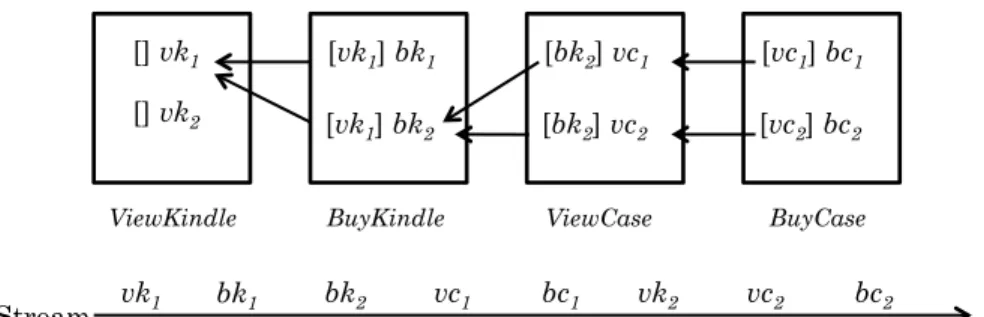
Example 1 Figure 2.1 depicts the event instance stacks for the patternQ=SEQ(V K, BK,
V C, BC). In each stack, its instances are sorted from top to bottom by their timestamps. When bc2 of type BuyCase arrives, the most recent instancevc2 is the last event event
in V iewCase stack. The pointer ofbc2 thus points to vc2, as shown in the parenthesis
preceding bc2. AsBuyCase is the last event type inQ, bc2 triggers result construction.
Two results<vk1,bk1,vc2,bc2>and<vk1,bk2,vc2,bc2>are constructed involvingbc2.
Stream vk1 bk1 bk2 vc1 bc1 vk2 vc2 bc2 [] vk1 [] vk2 [vk1] bk1 [vk1] bk2 [bk2] vc1 [bk2] vc2 [vc1] bc1 [vc2] bc2
ViewKindle BuyKindle ViewCase BuyCase
Figure 2.1: Stack Based Pattern Evaluation
Example 1 illustrates the Sequence Detection and Construction (SDC) step dis-cussed in Section 1.1.1. For aggregation computation, the aggregation function will be applied to the sequence results once they have all been constructed. The performance bottleneck of this tow-step aggregation process has been discussed in Section 1.2.
1if the last event typeE
nin queryqiis a negative event type, postponed sequence evaluation is applied.
Chapter 3
A-Seq Single Query Strategy
We now introduce our A-Seq methodology that computes aggregation on-the-fly. Here we first focuses on COUNT computation, which is one of the most popular aggregation operation in the context of sequence analysis (see Sections 1.1 and 1.1.1). In fact, most research related to sequence aggregation focuses on the COUNT operation from data mining, frequent sequence mining, to statistics [16, 20, 23]. Henceforth, we thus explain our strategies using the COUNT aggregation function in the rest of the paper.
3.1
Basic Approach: Dynamic Prefix Counting
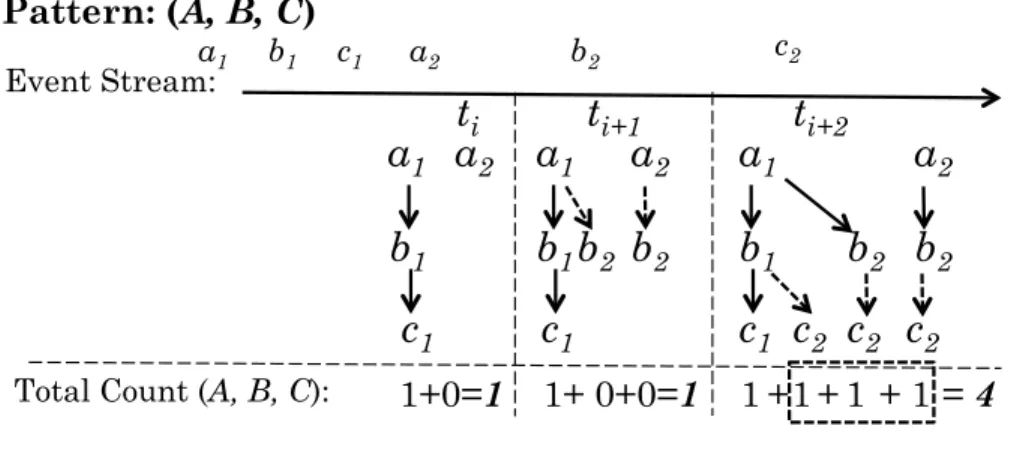
Next, we introduce the key idea of pushing the aggregation computation into the sequence detection process, named theDynamic Prefix Counting (DPC)method. To better under-stand how DPC works, let’s start by examining the sequence match formation process using the concrete example of pattern (A, B, C)as in Figure 3.1. At timeti, one match
(a1, b1, c1)has been found, whilea2 is waiting for further event instances that can
partic-ipate in the formation of new matches.
Event Stream: Pattern: (A, B, C) Total Count (A, B, C): 1+0=1 1+ 0+0=1 1 1 1 + + + 1 = 4 a1 b1 c1 a2 b2 c2
a
1t
it
i+1t
i+2b
1c
1b
2c
2b
1b
1c
1c
1b
2b
2c
2c
2a
1a
2a
2a
2a
1b
2Figure 3.1: Sequence Form Process
(a1, b2)and(a2, b2). Whenc2, the instance of last event type to form sequence(A, B, C),
arrives at time ti+2, we append it to subsequences (a1, b1), (a1, b2)and (a2, b2) to form
3 new (A, B, C)sequences. Thus, the total count of sequences constructed that match pattern (A, B, C)at ti+2 is 4, including the 3 newly formed sequences and one formed
earlier. From this process, we observe that when eachci arrives, we can obtain the count
of pattern (A, B, C)by adding counts of two patterns, namely, 1) the count of sub-pattern (A, B), to whichci will be able to append to form new (A, B, C) matches, and
2) the count of the previously detected pattern(A, B, C). Generalizing this observation, when eventEnarrives atti, the count of a sequence pattern (E1, E2, ..., En)can be
com-puted from the count of its Longest Prefix Pattern (LP P) (E1, E2, ..., En−1) atti−1, in
the following manner:
Count(E1, E2, ..., En)ti =Count(E1, E2, ..., En−1)ti−1+
Count(E1, E2, ..., En)ti−1
(3.1) Thus, for pattern (A, B, C), we recursively compute the count from the singleton prefix (A), until we get count of the full pattern (A,B,C). Given this recursive structure,
our problem can be solved through dynamic programming. That is, to get the count of the whole pattern (the final problem), we count all its prefix patterns (sub-problems) incrementally and stored those counts. Moreover, in the streaming context, the counts of these respective prefix patterns will be updated correspondingly upon the arrival of new events to continuously reflect real-time changes.
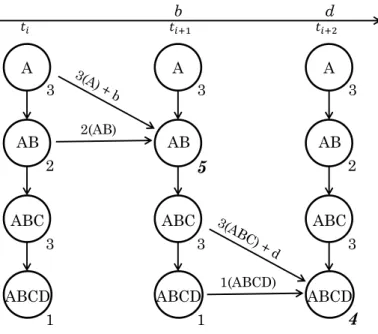
Example 2 Figure 3.2 depicts the prefix count update process based on the computation
rule given above when a new instance of a particular type arrives. The number at the
lower right corner of each circle represents the count of this prefix pattern at the
respec-tive moment in time indicated at top of each column. When event instancebarrives at time
ti+1, new matches of the prefix pattern that end inBwill be triggered, namely,(A, B)For
this, we simply add the existing counts of (A)= 3 and(A, B) = 2 to get the new count of(A, B)= 5. The counts of all other prefix patterns remain unchanged. Similarly, when the instancedarrives, the same update process is applied to compute the new count of its corresponding pattern(A, B, C, D).
IIn general, the rules for a pattern (E1, E2, ..., Ei, ..., En) when an event instanceei
arrives at timetj, can be formulated as below:
Update Rules: ei.type ∈E1 : i. C(E1)tj =C(E1)tj−1 + 1, ei.type ∈Ei,(1< i <=n) : ii. C(E1, ..., Ei)tj =C(E1, ..., Ei−1)tj−1+C(E1, ..., Ei)tj−1,
We classify event types of a sequence pattern(E1, E2, ..., Ei, ..., En) into three
cate-gories based on the different operations that event instances of this type must trigger:
A AB ABC ABCD 3 2 3 1 A AB ABC ABCD 3 5 3 1 A AB ABC ABCD 3 2 3 ݐ ݐାଵ ݐାଶ b d 2(AB) 1(ABCD) 4
Figure 3.2: Prefix Pattern Count Update Process
When a STARTinstance arrives, we increase the count of(E1)by 1 since there is
no prefix pattern prior to it.
• Update Event Type (UPD). All other event types except START in a sequence
pattern (E1,E2, ...,En). When a UPD instance arrives, the count of the prefix
pattern it triggers (ending with thisUPD type) will be updated. For example, the count of(A, B, C)should be updated when aCinstance arrives.
• Trigger Event Type (TRIG).The last event typeEnin a sequence pattern(E1, E2, ...,En).
It not only performs the UPDupdate operation, but also represents the completion of the full pattern. Thus, the just generated aggregation result will be returned to the user.
An example of thisDPCmethod is illustrated in Figure 3.3.
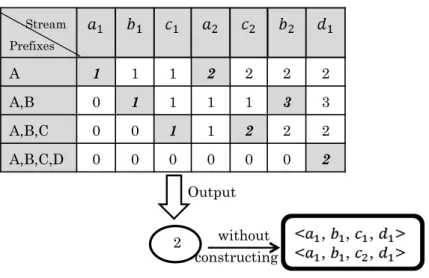
Example 3 In Figure 3.3, whena1arrives, as it is an START instance, the count of(A)is
Stream Prefixes A 1 1 1 2 2 2 2 A,B 0 1 1 1 1 3 3 A,B,C 0 0 1 1 2 2 2 A,B,C,D 0 0 0 0 0 0 2 Output 2 without constructing
Figure 3.3: DPCComputation Process for Sequence Pattern (A,B,C,D)
Similarly, count of(A, B, C)is updated to 1 whenc1arrives. Continuing whenever a new
event instance arrives, the count of the prefix pattern that ending with this instance type
will be updated. Finally, whend1 arrives, we output result 2 to the user.
As we can see from Figure 3.3,A-Seqis a lightweight approach. From the CPU view, only one ”ADD” calculation is required for each new event instance. From the memory view, we do not store any event instances. Rather, instances are immediately discarded upon their arrival and instantaneous processing. Since the count update only depends on the counts at the previous time point, it is sufficient to only store one single time slice
copy of the data. Namely, only the counts for all the prefix patterns in the most recent
column, instead of the whole update table depicted in Figure 3.3 are kept. We call this one column data structure thePrefix Counter (PreCntr).
The pseudocode for our basicA-Seq algorithm for a single query is given in Figure 3.4.
Basic A-Seq
(Input: pattern query qi, stream S)ei: an event instance
ei.cat: event category ei falls in (START, UPD, TRIG)
Lq: the number of event types in qi
1. initialize a PreCntr of size Lq
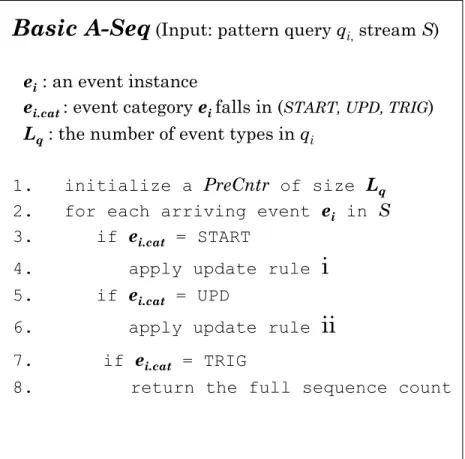
2. for each arriving event ei in S
3. if ei.cat = START
4. apply update rule
i
5. if ei.cat = UPD
6. apply update rule
ii
7.
if ei.cat = TRIG
8. return the full sequence count
Figure 3.4: BasicA-SeqAlgorithm
3.2
Sliding Window Support for A-Seq
Sliding Window Problem. In the sliding window scenario [3], a continuous CEP
aggre-gation queryQ(S, win, slide, Agg)returns the result of sequence aggregationAgg com-puted over the content in the query windowWion the data streamS. Here we assume the
window semantics in CQL [3], namely, the query window has a fixed window sizeQ.win
and aQ.slidethat slides fromWi toWi+1 whenever a new event instance arrives.1 When
the window slides, the events which have fallen out of the window should no longer par-ticipate in any future CEP sequence construction. Thus, they can be purged. However, for
1With the tuple-driven sliding window type becoming among the most commonly used window type for
CEP pattern detection query [4, 15, 25], we similarly use these semantics here. Otherwise, our technique could be easily extended to support other sliding window types.
CEP sequence aggregation, purging only the expired events is not sufficient. With events get expired, any sequence match that contain expired events would also become invalid. Thus, the partial aggregation results maintained by ourA-Seqmethod would at that point account for many potentially invalid sequence matches. Thus, we must design a solution to correct the erroneous counts when events expire.
Event Marking Strategy. The Window-ID (WID) approach [13] introduced for
pro-cessing non-CEP aggregation CQL queries, provides insights into how to tackle this event purging and result updating challenge. Namely, for our tuple-driven sliding window type, it marks each tuple with its life span, which reflects how long this instance will stay ac-tive. Only currently active tuples will be considered in the aggregation when ever the window slides. However, this technique, being designed for set-based aggregation, would now require us to keep all instances in the stacks, and then force us to repeat the fully computation over and over for each new event. This is incompatible with the core prin-ciple of ourA-Seqmethod of keeping compact counts instead of recounting aggregation from scratch for each window. We now consider how to adapt the key principles of this strategy to our CEP time-order semantics.
First, we compute and mark the life span, namely, the timestamp when each partic-ular event instance expire. Second, we record the count for each event instance, which indicates how many sequence matches would contain this event instance. For example, in Figure 3.1, the count information fora1 is 2 (two sequences containa1), while fora2it is
0. We notice that this count keeps changing. As future events arrive, more sequences will be formed based on this event. Lastly, when an event instance expires, we must purge it and the count attached to this event should not be considered as part of the final total result.
However, this modified WID approach seriously complicates our coreA-Seqsolution. As we can see, we would now have to 1) store information about all incoming event
instances including their life span and sequence count contribution, 2) continuously mod-ify the sequence counts formed on each active event instance within the window. This maintenance process greatly degrades the overall performance, rendering our solution in-effective. A more in-depth examination reveals that it is not necessary to store the above information for all event instances. The earliest time a sequence match becomes invalid would exactly be the time when the first event in this sequence (STARTinstance) expires. Thus, we obtain an important observation that:
Lemma 1 For a pattern query qi = (E1, E2, ..., En), once an instanceei withei.type ∈
Ei expires, all sequence instances matches ofqi that contain thisei should
correspond-ingly be expired.
Therefore, we now propose that recording the life span and sequence count informa-tion on eachSTARTinstance is sufficient. The expiration of all other event type instances are shown to make no impact on the result update process. Thus, we can continue to discard them immediately as in the basic A-Seq approach. Thus, our core idea here is to compute the counts built on eachSTARTinstance separately to avoid undue impact of expiredSTARTinstances on output results.
Start Event Marking (SEM) Solution. Based on this idea, we now propose a
Start Event Marking (SEM) technique.SEMmarks eachSTARTinstance with its lifespan, namely, the expiration time-stamp. The general process is composed of the following steps:
1. When aSTARTinstance arrives, aPreCntris created for it to record the number of sequence matches formed using this START instance.
2. When aUPD instance arrives, the same update process as in our basicA-Seq ap-proach is applied. However, this update is now applied to the prefix counters of all activeSTARTinstances.
3. When a TRIG instance arrives, counts on all active prefix counters are summed together and output as aggregation result. Expired counters are ignored.
4. When the window slides, any expiredSTARTevent with its correspondingPreCntr
are removed. If output result is required, then the count on this PreCntr will be simply subtracted from the total count result.
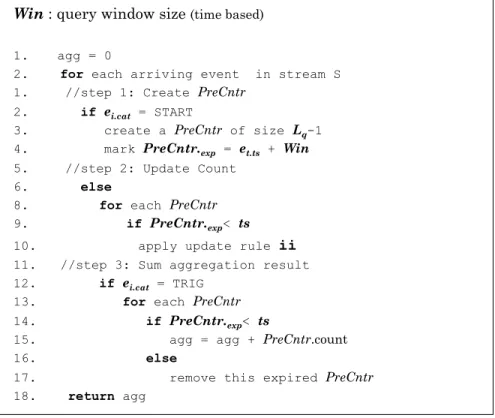
ThisSEMcomputation process is illustrated in Figure 3.5. Figure 3.6 gives the pseu-docode of the revisedA-Seqalgorithm withSEM.
Q: Pattern SEQ <A, B, C, D> Within 7s Stream a1 1s b1 2s c1 3s a2 4s c2 5s b2 6s d1 7s c3 8s a3 9s d2 10s PC AB 1 1 1 1 2 2 Exp:8s ABC 0 1 1 2 2 2 ABCD 0 0 0 0 0 2 PC AB 0 1 1 1 1 1 Exp:11s ABC 0 0 0 1 1 1 ABCD 0 0 0 0 0 1 PC AB 0 Exp:15s ABC 0 ABCD 0 Output: 2 Output: 1
Figure 3.5: Pushing Windows Down into A-Seq Using SEM
Example 4 In Figure 3.5, whena1arrives at timet= 1s, we first calculate its expiration
timestamp (Exp), where Exp = arrT ime+Q.win. Thus, a1.Exp = 1s+ 7s = 8s,
that is, a1 and its aggregation result will become invalid at t = 8s. Then we create a
PreCntr for a1. There is no count for prefix (A)in each PreCntr, as we have separated
SEM A-Seq
ei.ts: arrival timestamp of ei
PreCntr.exp: expiration timestamp of a PreCntr(a START instance ei)
ts : current system timestamp
Win : query window size (time based)
1. agg = 0
2. for each arriving event in stream S
1. //step 1: Create PreCntr
2. if ei.cat = START
3. create a PreCntr of size Lq-1
4. mark PreCntr.exp = et.ts + Win
5. //step 2: Update Count
6. else
8. for each PreCntr
9. if PreCntr.exp< ts
10. apply update rule ii
11. //step 3: Sum aggregation result
12. if ei.cat = TRIG
13. for each PreCntr
14. if PreCntr.exp< ts
15. agg = agg + PreCntr.count
16. else
17. remove this expired PreCntr
18. return agg
Figure 3.6: SEM A-Seq Algorithm
The update process of the basic A-Seq method is utilized whenb1andc1arrive. When
a2arrives att= 4s, we now in addition create a PreCntr fora2and mark it with itsExp.
Subsequently, when c2 andb2 arrive, the count update takes place on both a1’s PreCntr
anda2’s PreCntr, as botha1anda2 are active.
When d1 arrive at t = 7s, first we update the count on both PreCntrs. Then, as
instances of event typeDtrigger the completion of the full sequence query, we compute the final the aggregation result by suming of the counts of pattern(A, B, C, D)from all active PreCntrs. Thus, the output result is2 = 2(a1P reCntr) + 0(a2P reCntr).
find thata1 expires at8s anda1’s PreCntr should be purged. If users require a result at
this moment, the output would be 0 instead of 2. Same steps as above are applied when
a3andd2arrive. The output result becomes 1 afterd2 is processed.
3.3
Negation Support for A-Seq
Invalid Sequence Check Problem. Negation in CEP aggregation requires us to assert
the non-occurrence of any instances of the negated event types at certain positions in a sequence pattern. For example, online retailers considering the web advertisement rev-enue might be interested in pattern(VK, BK, !REC, VC, BC)to track how many customers purchases a case after the purchase a kindle, yet without first clicking through the ”Rec-ommendation” link. The problem of negation is that, if negative event instances of”Rec”
occur, they can cause previously detected prefix sequences (vki, bki)to become invalid.
One way to solve this problem would be to add a negation filter on top of the query plan as typically done in the literature [4, 25] to discard all positive matched sequences
(vki, bki, vci, bci)that haverecibetweenbkiandvci. An obvious problem with this
later-filter-step solution is not only that it generates a potentially huge number of intermediate results, many of which may be filtered out eventually, but also that it is incompatible with our core A-Seqapproach of time-sensitive aggregation. We now propose a solution that solves this problem by pushing this negation check into ourA-Seqapproach.
The Immediate Re-Counting Solution. We propose theRecounting Rule (RR)
tech-nique to tackle this challenge. We find an important observation here:
Lemma 2 For a pattern query with negationqi = (E1, E2, ...,!Ei, ..., En), when a
nega-tive event instanceei withei.type ∈ Ei arrives, the count of the prefix pattern previous to
Ei, namely,(E1, E2, ..., Ei−1)becomes invalid.
type is preserved, when a negative event instance arrives, we propose to simply reset the count of the previous prefix pattern to 0. This simple reset corresponds to an effective re-counting.
However, it should be noted that NOT all prefix patterns previous to the negative event type need to be reset. For example, for the negation sequence pattern(A, B,!C, D), though prefix (A, B)becomes invalid when a C instance arrives, matches of the prefix
(A) continue to remain valid and thus can continue to be connected with future B and
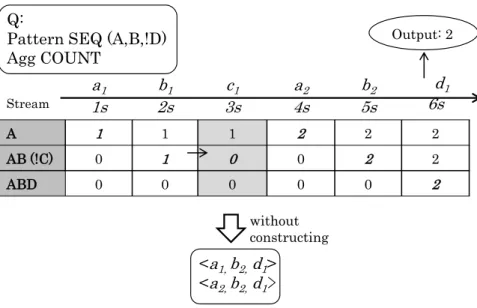
D events to complete the full sequence detection. In general, as the counts of all prefix patterns are preserved using the PreCntr structure, when C instance arrives, only the count of (A, B)must be cleared to 0, while the counts of all other prefixes, here(A)and
(A, B, D)remain unchanged. Stream a1 1s b1 2s c1 3s a2 4s b2 5s d1 6s A 1 1 1 2 2 2 AB (!C) 0 1 0 0 2 2 ABD 0 0 0 0 0 2 Output: 2 Q:
Pattern SEQ (A,B,!D) Agg COUNT
<a1, b2, d1> <a2, b2, d1>
without constructing
Figure 3.7: Pushing Negation Down to Sequence Detection Process
Example 5 Figure 3.7 illustrates how RR works through a sequence pattern(A, B,!C, D).
When c1 arrives at t = 3s, the count of (A, B) is cleared to 0 while the (A) and (A, B, D)counts are kept. The output result is 2 when d1 arrives, because the sequence
Several cases of special negation locations in a pattern, namely, at the start, at the second and at the end position of a pattern, require customized processing, as discussed next.
Negation Start. For query pattern(!A, B, C, D),RRcannot be applied as there is no
prefix pattern previous to A. The challenge caused by this special negation start case is that, initially made invalid(B, C, D)sequences following an Ainstance will eventually become valid again, once theAinstance is expired. Thus, simply applying SEMA-Seqto detect the pattern(B, C, D)is insufficient. To capture the negation start impact, a separate list recording the expiration timestamp of eachAinstance is maintained. When summing the counts on eachPreCntrto output a result, a check of theAlist is performed to ensure there is no Ainstances before this PreCntrthat are still valid. For this, we compare the expiration timestamp with thisPreCntr. If not expired, we add 0 to the aggregation result for thisPreCntrwithout modifying thePreCntrcount.
Negation End. For query pattern(A, B, C,!D), if aggregation result is output when
each D instance arrives, the output is reset to 0 as the count of (A, B, C) is reset to 0 according to the RR. To avoid this ”always 0 output”, one method is when aDinstance arrives, we output the(A, B, C)count first and then reset it to 0. Another solution would be to change the output style. For example, the aggregation result is output when required by the user instead by the arrival of each triggering event instance. In this way, the RR
would effectively handle this Negation End case.
Negation Second. For query pattern(A,!B, C, D), the count of(A)should be cleared
to 0 when B instance arrives. However, since counting is separately processed for each
Ainstance due to handle sliding window semantics. Since no counts are recorded for the
A instances, thus, the existingPreCntr structure for each A should now be completely purged, instead of first cleared to 0.
3.4
Predicates Support for A-Seq
Below, we present solutions of how to push the predicate evaluation into our aggregation process.
Local Predicates. The most common predicates over event data are local predicates,
which impose constraints on the attribute values of an event instance (e.g. Kindle.model = ”touch”). Predicates are evaluated on the relevant event instances before these instances are involved in the aggreagtion process. Event instances that do not satisfy the predicates are immediately discarded .
Equivalence Predicate Test. It is well-known that CEP queries often using
equiva-lence predicates correlate events in a sequence pattern [25]. For example, in our online shopping habit tracking scenario, the clicks should be from the same customer. Similarly, in the stock market example, the pattern of price increases and decreases should be of the same stock. An equivalence test essentially partitions an event stream into several sub-streams, where events in the same partition have the same value for the attribute used in the equivalence test (i.e. equivalence attribute). Here, we propose a technique to dy-namically partition the event stream during the sequence aggregation, henceforth called
Hashed Prefix Counter (HPC).
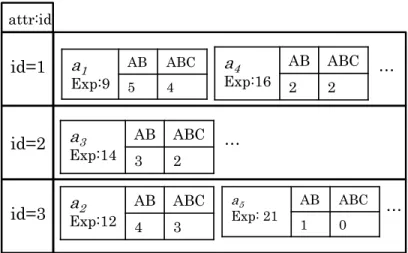
The basic idea of HPC is that the aggregation process is applied separately to each equivalent partition. Prefix counters for a STARTinstance are created upon their arrival and hashed into the corresponding partition based on the equivalence attribute value of this instance. Other event instances are similarly hashed to their corresponding partition. Aggregation results are computed based on each partition.
Pattern SEQ <A, B, C, D>
Where A.id = B.id = C.id = D.id Within 7s
id=3 ˎ a4 Exp:16 AB ABC 2 2 a1 Exp:9 AB ABC 5 4 a3 Exp:14 AB ABC 3 2 ˎ ˎ id=2 id=1 attr:id a2 Exp:12 AB ABC 4 3 a5 Exp: 21 AB ABC 1 0
Figure 3.8: Hashed Prefix Counter (HPC)
Example 6 Figure 3.8 illustrates the HPC data structure to cope with the equivalence
predicates processing in sample queryQ2. The equivalence test forQ2 is on attribute id.
The id value of each incoming event will be evaluated. Assuming three distinct id values
(1,2,3), then we create three hash partitions as depicted in Figure 3.8 with id values as
key and the prefix counters as the value. For instance, the id values of instances a1 and
a4 are 1. Thus their prefix counters are created in the ID1 partition. For instances of
type B, C, D, they will update the prefix counters in the partition determined by their respective id values.
Chapter 4
A-Seq Multi Query Strategy
For rich data streams from web-clicks to stock ticker streams, large workloads of similar queries may be processed. Since executing each query separately could lead to scalability and performance problems. Thus, we explore the opportunity to share the computation across a workload of CEP aggregation queries [15]. Consider the running example in Section 1.1.1, where merchants are interested in various purchase patterns to determine customer shopping habits, including1:
Q1 = (VKindle,BKindle,VCase,BCase) Q2 = (VKindle,BKindle,VKindleFire)
Q3 = (VKindle,BKindle,VCase,BCase,VeBook,BeBook) Q4 = (VKindle,BKindle,VCase,BCase,VLight,BLight) Q5 = (ViPad,VKindleFire,VKindle,BKindle)
Several common sub-queries (substrings) arise across these 5 pattern queries, such as
(V Kindle, BKindle). The intuition is that if we were to compute intermediate
aggre-gates for the(V Kindle, BKindle)substring, then would we be able to share this result among the other queries that contain this substring. This way, redundant aggregation
computation for common substrings would be avoided. In principle, the more queries share common substrings, the more computational resources could potentially be saved. This promise of scalability leads us to our proposed techniques below.
4.1
The Prefix Sharing Strategy
We observe that once the aggregation of a full sequence pattern is computed by A-Seq, then the aggregation of all its prefix patterns would also have been obtained as side-effect. Thus, the most straitghtforward way to achieve multi-query aggregation sharing is to share the prefix computations among queries with the same prefixes. Based on this observation, we now propose a Prefix Tree (PreTree)data structure in support of thePrefix Sharing
(PreShare)strategy in theMulti A-Seqapproach.
vKindle bKindle vKindle Fire vCase bCase vEBook bEBook vLight bLight ࡽ ࡽ ࡽ ࡽ
Figure 4.1: PreTree Structure
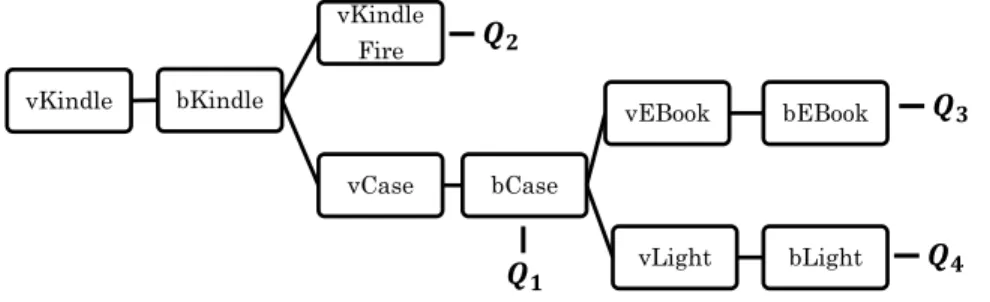
Example 7 Figure 4.1 shows an example of the PreTree structure forQ1 ∼Q4, namely,
these four prefix counters are organized into a PreTree structure. For computation of
these four patterns, the result of substring(vKindle, bKindle)is pipelined into bothQ1
andQ2, while theQ1 result is pipelined to bothQ3 andQ4.
Compared to computing each query independently without sharing also usingA-Seq
arrival of instances of each event category:
1. When a START instance arrives, aPrefix Tree(PreTree)will be created instead of a previousPreCntr. For example, in Figure 4.1, one singlePreTreeCntr structure would be initialized, compared to the four normalPreCntrs that would have been created in the non-share approach.
2. When a UDP instance arrives, the count update occurs on the corresponding loca-tion in eachPreTreeonly once. For example, when abKindleinstance arrives, one update onPreTreeis needed in place of four updates on each of the fourPreCntrs. 3. When a TRIG instance arrives, results for the the respective query can be directly
accessed from the appropriate locations within thePreTree.
This way, the redundant computation of common prefix patterns is avoided. As is apparent, very little overhead is introduced to maintain such a tree structure or to output results for this multi-query case. In fact, the more queries share the same prefix patterns, the more computation costs should be saved.
4.2
The Arbitrary Sub-pattern Sharing Mechanism:
Chop-Connect
Overall Idea of Chop-Connect Method. In general, queries may feature common
sub-expressions at random locations rather than only at their prefix positions. In the above example, P5 shares (V Kindle, BKindle)with the other four query patterns. Since we
can obtain the count of(V Kindle, BKindle)from the prefix tree that has been set up for
Q1 ∼Q4, then if we could potentially compute(V iP ad, V KindleF ire)separately, then
computation of (vKindle, bKindle)would be shared by all five queries. This intuition leads us to propose the Chop-Connect (CC) idea for tackling this general problem of sharing the computation arbitrarily of common sub-expressions. The idea is to Chop a query into substrings, with each substring being computed separately. Finally, the results of all substrings are later Connected together to get the count of the whole sequence pattern.
Analyzing the Connect Problem. Analyzing the Connect problem, we notice that
we cannot simply construct a simple Cartesian Product of two previously computed sub-counts to get the count of the longer connected sequence. Rather, the time order between instances of the two connect event types VKindleFire and VKindle matters. Since the
A-Seqapproach does not maintain any time information (except START for expiration), additional ordering knowledge between connect events must be recorded correctly to en-able the full sequence count, namely, TRIG from the first substring and START from the second substring.
One straightforward solution to solve this problem is to maintain the timestamps of all connect event instances during the computation process, and join the counts of two
substringsby comparing the timestamps of all connect event instances. For ease of expo-sition, let us now usesub1 = (A, B, C)andsub2 = (D, E)to denote the two substrings
that need to be connected, then CandDare the connect event types. As in the single A-Seqapproach, the expiration timestamps of all START (D) instances insub2 are recorded,
we now also need to maintain the timestamps of eachCinstance insub1.
Proposed Solution. However, after careful examination, we find that it is not
neces-sary to store the timestamps of all Cinstances. Instead, it is sufficient to only record the
C instance that is the most recent before the arrival of aDinstance.
Lemma 3 Any other instance that arrives before this most recent Cinstance is
For example, if the arrival order ofC andD is: < c1, c2, c3, d1, ... >, then c3 is the
most recent C instance for d1. Clearly, C instances before c3 can safely be connected
with d1 while those after c3 cannot. To conclude, the key principle in our aggregation
context is to obtain meta-data about how many sub1 matches have been detected before
each START in sub2 arrives. Example in Figure 4.2 illustrates how our above strategy
works. Stream a1 1s b1 2s c1 3s a2 4s b2 5s d1 6s c2 7s d2 8s e1 9s a1 PreCntr AB 1 1 1 2 2 2 2 2 ABC 0 1 1 1 1 3 3 3 a2 PreCntr AB 1 1 1 1 1 ABC 0 0 1 1 1 #(ABC) 1 4 1 d1 1 PreCntr DE 0 0 1 d2 4 PreCntr DE 1 #(A,B,C, d1, E) = 1 * 1 = 1 #(A,B,C, d2, E) = 4 * 1 = 4 #(A,B,C, D, E) = 1 + 4 = 5
Figure 4.2: Connect Counts of Two Substrings
Example 8 Figure 4.2 illustrates how to connect the counts of sub1 = (A, B, C) and
sub2 = (D, E) to get the count of (A, B, C, D, E). First, we compute two substrings
using our single A-Seq separately. However, to prepare for a later ”connect”
computa-tion, when d1 arrives at time t = 6s, besides creating the PreCntr for (D, E), we also
extract the count ofsub1 at that moment (#(A, B, C) = 1) and attach this count tod1’s
P reCntr for later use. Similarly, when d2 arrives, we attach #(A, B, C) = 4to d2’s
P reCntr.
full sequence pattern, a multiplication of (1) the #(sub2)and (2) the attached#(sub1)
on each PreCntr of D instance is performed. For example, when e1 arrives, there is
1 sequence match of (D, E) formed on d1 (#(D, E) = 1), and 1 match of (A, B, C)
formed before this d1 (attached#(A, B, C) = 1). Thus,#(A, B, C, d1, E) = 1∗1 = 1.
Similarly, ford2’sP reCntr,#(A, B, C, d2, E) = 4∗1 = 4.
Lastly, we sum the results of all active P reCntrs to derive the final result, that is, whene1arrives, the total count#(A, B, C, D, E) = 1 + 4 = 5.
Challenge Caused by Expiration. However, the above connect solution assumes
that events never expire. Suppose#(sub1)is attached to a START instance ofsub2 when
that START instance arrives at time ti. However, when we use this#(sub1)in the
mul-tiplication as a TRIG instance of sub2 arrives at time ti+1, this attached#(sub1) might
already have become invalid at that time. As#(sub1)is calculated separately fromsub2, #(sub1)might become invalid during at theti+1time, due to the START instance
expira-tion ofsub1. (See Section 3.2 for the event expiration details). To illustrate this problem,
consider example 8. Whene1arrives at timet= 9s,#(A, B, C)should no longer be 4 if
a1had expired beforet = 9s. Thus, the attached count would have intermittently become
incorrect, no longer accurately reflecting the most recent count upon the arrival of TRIG instances. This causes erroneous aggregation.
SnapShot Solution. We now propose a solution to this connect expiration problem.
When a START instance of sub2 arrives, instead of attaching the currentsub1 count , we
recordsub1counts on eachsub1’sP reCntrseparately with their expiration timestamps.
Therefore, when a TRIG instance arrives, the respective counts expired by its arrival can be safely discarded.
Lastly, we design the(SnapShot(SS)data structure to represent counts on allsub1’s
P reCntrs whenever asub2START instance arrives. The snapshot is organized as a table.
meta-data: 1)P reCntrtag, indicating theSTARTinstance to which thisP reCntrbelongs to, 2) the corresponding expiration time of thisP reCntr, and 3) the count of thisP reCntr. Figure 4.3 illustrates the snapshot maintenance of sub1 (A, B, C) for sub2 (D, E).
Compared to the stream in Figure 4.2, we now add the extra instancea3befored2to show
the change in the snapshots.
When d1 arrives, a1 PreCntr Exp: 10s AB ABC 2 1 d1PreCntr Exp: 14s DE 0 a2 PreCntr Exp: 13s AB ABC 1 0 START Exp Cnt a1 10 1 a2 13 0
Snapshot of (A,B,C) for d1
When d2 arrives, a1 PreCntr Exp: 10s AB ABC 2 3 d2PreCntr Exp: 17s DE 0 a2PreCntr Exp: 13s AB ABC 1 1 START Exp Cnt a1 10 3 a2 13 1 a3 18 0
Snapshot of (A,B,C) for d2
a3PreCntr Exp: 18s AB ABC 0 0 When e1 arrives, d1PreCntr Exp: 14s DE 1 d2 PreCntr Exp: 17s DE 1 Stream a1 1s b1 2s c1 3s a2 4s b2 5s d1 6s c2 7s a3 8s d2 9s e1 10s
Figure 4.3: SnapShot Maintenance
Example 9 In Figure 4.3, when d1 arrives, a snapshot (SS) of d1 with counts and
ex-piration timestamps of all sub1 prefix counters is created, and attached to d1. Whend2
arrives, similarly, another snapshot is created to record the prefix counter status of sub1
at that moment and attached tod2. Whene1 arrives att = 10s, after the update
applied to each table row ofsub2P reCntr. Expired rows are discarded, and thus won’t
be involved in any future aggregations. For example, whene1 arrives att = 10s, theSS
check finds thata1 expires at that time. Thus, only counts ofP reCntrs ofa2 anda3 will
be used. The total count#(A.B, C, D, E)att= 10sthus is calculated as:
Count1 = #(d1P reCntr) = #(A, B, C, d1, E) = 1×0 = 0,
Count2 = #(d2P reCntr) = #(A, B, C, d2, E) = 1×0 + 1×1 = 1
#(A, B, C, D, E) =Count1+Count2 = 0 + 1 = 1
For above we now introduce a new event category, calledConnect Event Type (CNET)
(besidesSTART, UPDandCNET).CNETis theSTARTevent type insub2 when
connect-ing sub1 and sub2. The arrival of aCNETinstance will trigger the process of checking
counts on sub1’s PreCntrs and creating thesub1 snapshot forsub2. For example, event
typeDfalls into the categoryCNET. Meaning when connecting(A, B, C)and(D, E), a snapshot of(A, B, C)count is created for(D, E)whenever a newD di instance arrives.
Multi-Connect Process. A query might be chopped into multi pieces rather than
just only 2. For example, pattern query (A, B, C, D, E, F, G) might be chopped into:
sub1 = (A, B, C), sub2 = (D, E), and sub3 = (F, G), as sub2 and sub3 are shared by
other queries, respectively. In this case, when the CNET instance F in sub3 arrives, it
triggers the creation of a snapshot of(A, B, C, D, E)and then attaches to this snapshot to
sub3 PreCntr. Due to the expiration problem, we postpone summing the counts on each (D, E). Instead, we calculate the snapshot counts of(A, B, C, D, E)for eachAinstance, that is, counts of(ai, B, C, D, E)for all activeai. WhenF instance arrives, these counts
can be calculated in the following two steps :
1. Calculate count of (ai, B, C, D, E) on each (D, E) PreCntr. For each (D, E)
in the snapshot with the count on (D, E)on thisPreCntrone by one. That is, we calculate the counts for(ai, B, C, dj, E).
2. Then we calculate count of (ai, B, C, D, E) on all (D, E) PreCntrs. Given the
counts calculated by step 1, we apply a sum over those snapshot counts with the sameaitag across all(D, E)PreCntrs.
Example 10 Figure 4.4 illustrates the multi-connects calculation process of the above
example. Whenf1arrives att= 12s, we first multiply the count on each(D, E)PreCntr
with its corresponding snapshot counts of(A, B, C). Then, we plus the count1with tag
a2 on d1’s PreCntr to the count 2 with tag a2 on d2’s PreCntr. Similarly, we add the
counts with same tag across all(D, E)PreCntrs. Then we attach these counts to thef1
PreCntr representing the snapshot of(A, B, C, D, E).
d1 PreCntr Exp: 17s DE 1 d2 PreCntr Exp: 20s DE 1 START Exp Cnt a1 10 2 a2 13 1 START Exp Cnt a1 10 3 a2 13 2 a3 18 1 f1 PreCntr Exp: 24s FG 0 START Exp Cnt a2 13 3 a3 18 1 t=12s, f1 arrives t=12s, a1 expires a2 1 * 1 = 1 t=12s, a1 expires a2 2 * 1 = 2 a3 1 * 1 = 1
+
4.3
Sharing Plan Selection
In the above, we have introduced a solution for tackling theConnectchallenge assuming we are given the substrings into which a given set of pattern queries is to be decomposed. However, since some computation and storage overhead is introduced by each connect
operation, we now need an effective strategy for chopping the workload into sharable sub-strings. Thus, we design a global sharing plan and call it ”Chop Strategy”. Given this ”Chop Strategy”, we chop each query in the workload into smaller substrings, such that the computation of those common substrings is shared across queries in this workload. Our goal is to find a solution with the ”minimal” overall computation costs.
Multi A-Seq Optimization Problem: Given a query workload W L, find a shared
execution plan for W L that indicates which substrings are shared by which queries (if any), with the lowest overall execution costs.
One straightforward optimal solution for this problem is exhaustive search, which is composed of 3 steps: 1) find all potential sharing substring candidates, which satisfy two conditions: substring length l >= 2, and shared by k >= 2 queries; 2) for each candidate (sharing substring), calculate itsBenefit Value (BValue), namely, the execution costs gained when sharing this candidate compared with not sharing. 3) compose all candidate combinations (subsets of all candidates), and find the combination with the largest BValue. This maximal benefit candidate combination is our final shared execution plan.
Complexity Analysis. Several practical considerations make this solution
challeng-ing. Suppose there are n queries in this W L, and the length of each query is m. For step 1), we can simply run a search over all queries to find all substrings of length from
2to m−1, and then filter those not shared by at least two queries. However, too many unqualified substrings (k < 2) will be generated, especially for larger n and m. Thus,
a smarter solution is required. For step 2), a cost model that can correctly measure the computation gain (sharing versus non-sharing) of employing a particular substring can-didate must be developed. For step 3), the time complexity of generating all subsets of the given candidates set is exponential. An exhaustive search for the optimal combination will thus need to traverse too huge of a search space for a large query workload. Thus it is in general not practical to find the optimal solution. Thus, we now propose the following solutions to cope with above three challenges.
4.3.1
Apriori for finding all potential sharing candidates
Given the similarity between this sharing candidate generation problem and the frequent itemset identification problem in association rule mining, we now deploy theApriori al-gorithm [2] to solve our problem. Apriori is a candidate generation and test approach. The key concept of Apriori is its pruning principle: if there is any itemset which is infre-quent, then its superset is guaranteed to also be infrequent. When applying the Apriori algorithm here, the pruning principlefor our problem can be stated as: if a substring
(E1, E2, ..., Ei−1)of lengthi−1is infrequent (not shared by at least 2 queries), then any
substring(E1, E2, ..., Ei−1, Ei)of lengthiwould not be frequent.
Thus, we now design the following potential candidates generation algorithm:
1. Initially, scan all queries once to get all frequent substring candidates (k >= 2)
withl= 2.
2. Repeatedly generate candidates with length l = i from frequent candidates with
l =i−1(istarts from 2) .
3. Terminate when no new frequent candidates can be generated any more.
away upon their generation. This greatly reduces the candidates size and thus saves both memory and CPU processing resources.
4.3.2
Cost-Based Benefit Model
Next, we establish a model to calculate the CPU costs of both sharing a substring candi-date X (CC method), versus not sharing it (NonSharemethod). Then the BValue of X
is obtained by: XBV alue = XN onShare−XCC. Now we analyze the estimated costs of
processing a common substringXby either of two computation approaches. To make the cost model easy to understand, we assume our stream is uniformly distributed, with the data frequency of each event type in this stream the same. Namely, each event type has the same number of instances. We estimate the cost of processing of all instances in a sample stream. We divide event types into four categories START, UPD, CNET, TRIGbased on the different operations they trigger upon their arrival (See section 3.1 and 4.2). Gener-ally, we estimate the cost of all instances in each category, and then sum them together as the total cost. The total cost of a single query can thus be formulated as:
Costtotal =
4
X
i=1
Ncati ∗Costcati∗N umcati (4.1)
Table 4.1 represents the parameters and terminology used in the cost estimation. Take the computation cost for pattern query(A, B, C, D)as an example. There is one START, two UPD and one TRIG event types in this query. Then based on the Equation 4.1, the total cost of(A, B, C, D)in a uniformly distributed stream is: Cost(A,B,C,D)=CST ART∗
NST ART ∗N umST ART +CU P D ∗NU P D ∗N umU P D +CT RIG∗NT RIG∗N umT RIG =
Table 4.1: Terminology Used in Cost Estimation
Term Definition
N0 The instances number of each event type in a uniformly distributed
stream (except the CNET instances number)
f the occurrence frequency of CNET instances, that is, (#of CNET)/N0
f N0 the number ofCNETinstances in stream
l the length of a substringX
k the number of queries that shareX
Ncati The number of instances of event categoryi
N umcati The number of event types of categoryiin a pattern
CST ART The cost of a START instance: create aPreCntr, time complexityO(C)
CU P D The cost of a UPD instance: update count of all activePreCntrs, at most
N0in Naive andf N0 in CC. Time complexityO(n)
CT RIG The cost of a TRIG instance: update and sum count of all active
PreC-ntrs, worst caseN0, time complexityO(n)
CCN ET The cost of a CNET instance: compute and create snapshot, worst case
N02, time complexityO(n2)
NonShareMethod. The cost of computing a common substringX without sharing
(duplicate in k queries). Then, the total cost is simply compute X k times. We can utilize Equation 4.1 to get the costs of computingXonce. To simplify the cost model but without underestimation, no matter what event categoryXhas, we assume thatCST ART =
CT RIG = CCN ET =CU P D = N0 operation cost. Thus, for computingX once, the cost
is: Xonce =N0∗f N0∗1 +N0∗N0∗(l−1).
The cost is composed of two parts: (1) cost of all CNET instances, and (2) cost of all other instances (as the number of CNET is different with other events based on our assumption). The first N0 in both parts represents the operation costs of an individual
event instance (no matter what event category). We simplify(l−1)asl, then, the total cost of computingX ink queries is: