12-15-2020
The Equity Premium in 150 Textbooks
The Equity Premium in 150 Textbooks
Pablo FernandezIESE Business School, [email protected]
Follow this and additional works at: https://jnf.ufm.edu/journal
Part of the Corporate Finance Commons, and the Finance and Financial Management Commons
Recommended Citation Recommended Citation
Fernandez, Pablo (2020) "The Equity Premium in 150 Textbooks," Journal of New Finance: Vol. 1 : No. 3 , Article 3.
DOI: 10.46671/2521-2486.1009
Available at: https://jnf.ufm.edu/journal/vol1/iss3/3
This article is based on a review of 150 textbooks on corporate finance and valuation published between 1979 and 2009 by authors such as Brealey, Myers, Copeland, Damodaran, Merton, Ross, Bruner, Bodie, Penman, Arzac etc. Analysis of the sample shows that the books’ recommendations regarding the equity premium range from 3% to 10%, and that 51 books use different equity premia on various pages.
Moreover, the 5-year moving average is seen to have declined from 8.4% in 1990 to 5.7% in 2008 and 2009.
Some confusion arises from not distinguishing among the four concepts that the phrase equity premium designates: the Historical, the Expected, the Implied and the Required equity premium (incremental return of a diversified portfolio over the risk-free rate required by an investor). 129 of the books identify Expected and Required equity premium and 82 identify Expected and Historical equity premium.
The author concludes that finance textbooks should clarify the equity premium by incorporating distinguishing definitions of the four different concepts and conveying a clearer message about their sensible magnitudes
Keywords Keywords
equity premium, equity premium puzzle, expected equity premium JEL Code
G12, G31, M21 Acknowledgements Acknowledgements
Pablo Fernandez, IESE Business School, University of Navarra. Correspondence concerning this article should be addressed to Pablo Fernandez, IESE Business School, Camino del Cerro del Aguila 3. 28023 Madrid, Spain, e-mail: [email protected]. I had an extraordinary amount of help on this document. Gabriel Natividad gave me valuable advice and Vicente J. Bermejo provided excellent research
assistance. I have also benefited from many comments on earlier drafts of this document of many kind professors of different universities. I am grateful to Tom Aabo, Andreas Andrikopoulos, Sirio Aramonte, Evangelos Benos, Sanjay Bhagat, Lawrence Booth, Jose Manuel Campa, Tyrone Carlin, George
Constantinides, Laurence Copeland, Francesco Corielli, Ted Chadwick, Sergei Cheremushkin, Stefano Daddona, Richard Derrig, Nont Dhiensiri, Tom Downs, Isaac Ehrlich, Christophe Faugere, Andy Fodor, Ankit Gandhi, Roland Gillet, Alan Gregory, Meike Hagemeister, Jungsuk Han, Cam Harvey, Ray Hill, Craig Holden, Jacquelyn Humphrey, Roger Ibbotson, Xiaoquan Jiang, Sandy Leeds, Stefan Lewellen, Klaus Mark, Robert Merton, Dev Mishra, Seongman Moon, Imad Moosa, Lucia Morales, Arjen Mulder, Gabriel Natividad, Juan Palacios, Nacho Peña, Justin Pettit, Julio Pindado, Mike Pinegar, Lee Pinkowitz, Jack Rader, Achintya Ray, Jay Ritter, Ashok Robin, Gerasimos Rompotis, Mike Rozeff, Sergei Sarkissian, Renee Sass, Stephan Schmidle, Ana Paula Serra, William Sharpe, Michael Sher, Jake Thomas, Nik Varaiya, Tomo Vuolteenaho, Yu-Min Yen, Weiqi Zhang, and to my colleagues at IESE Business School. A version in Spanish may be downloaded in: http://ssrn.com/abstract=1166703
Submission Date 1-24-2021
Approval Date 12-12-2020
1.
Introduction
The equity premium (also called market risk premium, equity risk premium, market premium and risk premium), is one of the most important and discussed, but also most elusive parameters in finance. Part of the confusion arises from the fact that the term equity premium is used to designate four different concepts:
1. Historical equity premium (HEP): historical differential return of the stock market over treasuries.
2. Expected equity premium (EEP): expected differential return of the stock market over treasuries.
3. Required equity premium (REP): incremental return of a diversified portfolio (the market) over the risk-free rate required by an investor. It is used for calculating the required return to equity.
4. Implied equity premium (IEP): the required equity premium that arises from assuming that the market price is correct.
This article is based on a review of150 textbooks on finance and valuation. The study shows (as seen in Table 1) that different books propose the following different identities among the four equity premiums defined above:
• 129 claim that the REP = EEP.
• 12 do not say how they calculate the REP that they use.
• Damodaran (2001a, 2009) and Arzac (2005, 2007) assume that REP = IEP.
• Penman (2001, 2003) maintains that “no one knows what the REP is.”
• Fernandez (2002, 2004) claims that “different investors have different REPs” and
that “there is not a premium for the market as a whole”
Table 1: Assumptions and recommendations of the 150 textbooks
Assumption Number Recommendation
of books Max Min Average
REP = EEP 129 10.0% 3.0% 6.7%
Do not say how they calculate the REP 12 9.0% 3.0% 6.1%
REP = IEP 4 6.5% 4.0% 4.8%
“No one knows what the REP is” 2 6.0% 6.0% 6.0%
“different investors have different REPs” 2 4.0% 4.0% 4.0%
“Average HEP and surveys” 1 4.2%
Total 150 10.0% 3.0% 6.5%
Table 2: Assumptions and recommendations of the 129 books that assume that REP = EEP
Assumption Number Recommendation
of books Max Min Average
EEP= HEP 82 9.5% 3.0% 6.9%
EEP = arithmetic HEP vs. T-Bills 26 9.5% 7.1% 8.5% EEP = arithmetic HEP vs. T-Bonds 6 7.8% 5.0% 7.0%
EEP = geometric HEP vs. T-Bills 8 8.1% 5.3% 6.7%
EEP = geometric HEP vs. T-Bonds 28 7.5% 3.5% 5.5%
do not say which HEP they use 14 8.5% 3.0% 6.8%
EEP < HEP 10 7.8% 3.0% 4.8%
EEP > HEP 2 9.0% 9.0% 9.0%
Do not say how they get EEP 27 10.0% 3.0% 6.6%
No official position 3 8.0% 6.0% 7.3%
REP proportional to RF 2 3.3% 4.7% 4.0% REP = A 2
M 1 8.0%
“commonly used in practice”; “widely used” 2 3.5% 5.0% 4.3%
Total 129 10.0% 3.0% 6.7%
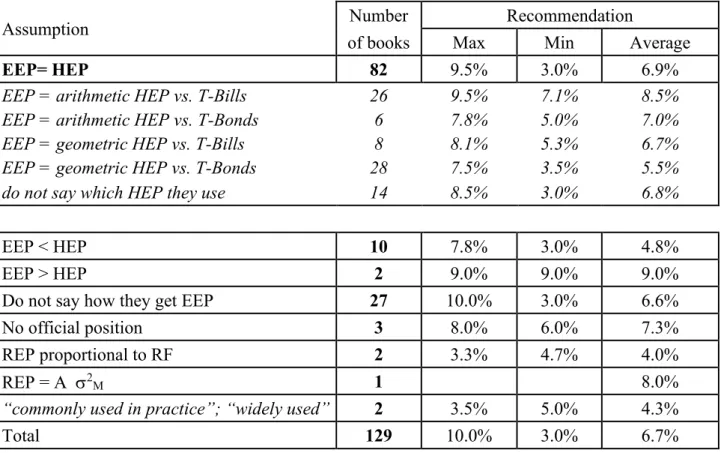
Table 2 contains some details about the 129 books that explicitly assume the REP is equal to the EEP:
• 82 books use the HEP as the best estimation of the EEP.
• 12 books use the HEP as a reference to calculate the EEP: 10 maintain that the EEP is higher than the HEP and 2 that it is lower.
• 27 books do not give details of how they calculate the HEP.
• Brealey and Myers (2000, 2003, 2005) “have no official position.”
• 2 claim that EEP is proportional to the risk-free rate.
• Bodie and Merton (2000) calculate EEP = A 2
M = 8%1.
• Titman and Martin (2007) use the EEP “commonly used in practice.” Young and
O'Byrne (2000) propose the “widely used”.
119 of the books explicitly recommend using the CAPM for calculating the required
return to equity, which continues to be, in Warren Buffett’s words, “seductively precise.” The
CAPM assumes that REP and EEP are unique and equal.
Section II is a review of the recommendations of 150 finance and valuation textbooks about the risk premium. Section III comments on the four different concepts of the equity premium and mentions the most commonly used sources in the textbooks. Section IV argues that REP and EEP may be different for different investors and provides the conclusion.
2.
The equity premium in the textbooks
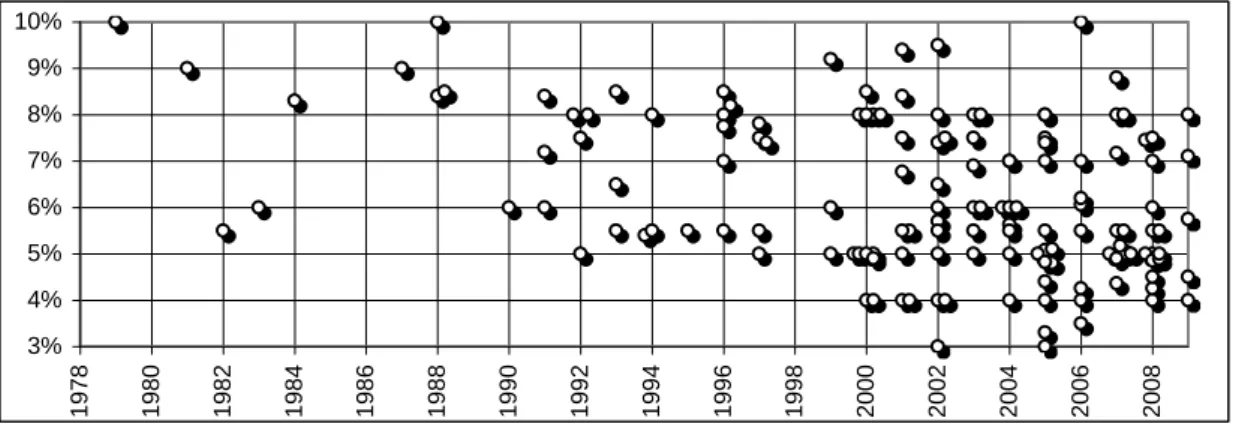
Figure 1 contains the evolution of the Required Equity Premium (REP) used or recommended by 150 books and helps to explain the confusion that many students and practitioners have about the equity premium. The average is 6.5%. Figure 2 shows that the 5-year moving average has declined from 8.4% in 1990 to 5.7% in 2008 and 2009.
Figure 1: Evolution of the Required Equity Premium (REP) used or recommended in 150 finance and valuation textbooks
Figure 2: Moving average (last 5 years) of the REP used or recommended in 150 finance and valuation textbooks
Figures 1 and 2 are in line with an update of Welch (2000), which reports that in December 2007, 90% of professors used equity premiums of between 4% and 8.5% in their classrooms. These figures are also in line with Fernandez (2008) which reports that, in June 2008, finance professors in Spain used equity premiums of between 3.5% and 10% (average 5.5%) and with Fernandez (2009) according to which the average REP used in 2008 by professors in the USA (6.3%) was higher than that used by their colleagues in Europe (5.3%). Exhibit 1 contains the main assumptions and recommendations about the equity premium of the 150 books. A wide variety of premiums are used and recommended by academics. I will briefly review those with greatest unit sales according to two publishers.
According to Ibbotson, Brealey and Myers considered that REP = EEP = arithmetic HEP over T-Bills until 1996: 8.3% in 1984 and 8.4% in 1988, 1991 and 1996. But in 2000 and
2003, they stated that “Brealey and Myers have no official position on the exact market risk
3% 4% 5% 6% 7% 8% 9% 10% 1978 1980 1982 1984 1986 1988 1990 1992 1994 1996 1998 2000 2002 2004 2006 2008 5% 6% 7% 8% 9% 1988 1990 1992 1994 1996 1998 2000 2002 2004 2006 2008
premium, but we believe a range of 6 to 8.5% is reasonable for the United States.” In 2005,
they decreased that range to “5 to 8 percent.”
Copeland et al. (1990 and 1995), authors of the McKinsey book on valuation, advised using a REP = geometric HEP versus Government T-Bonds, which were 6% and 5.5% respectively. However, in 2000 and 2005 they changed criteria and advised using the arithmetic2 HEP of 2-year returns versus Government T-Bonds reduced by a survivorship bias.
In 2000 they recommended 4.5-5% and in 2005 they used a REP of 4.8% because “we believe that the market risk premium as of year-end 2003 was just under 5%.”
In 1994, 1996, 1997, 2001b, 2001c and 2002 Damodaran recommended that REP = EEP = geometric HEP versus T-bonds = 5.5%3. In 2001a and 2006, he used a REP = IEP =
4%. However, in 1994 and in 1997 he calculated the cost of equity of PepsiCo using, respectively, REPs of 6.41% (geometric HEP 1926-90 using T-Bills) and 8.41% (arithmetic HEP 1926-90 using T-Bills). Damodaran (2005) used different market risk premiums: 4%, 4.82%, 5.5% and 6%.
Ross et al. recommended in all editions that REP = EEP = arithmetic HEP vs. T-Bills: 8.5% (1988, 1993 and 1996), 9.2% (1999), 9.5% (2002) and 8.4% (2005). However, Ross et al. (2003a and 2003b) used different REPs: 10%; 9.1%; 8.6%; 8%; 7% and 6%.
Bodie et al. (1993) used a REP = EEP = 6.5%. In 1996, they used a REP = EEP = HEP
– 1% = 7.75%4. In 2002, they used a REP = 6.5%, but in 2003, 2005 and 2009, they used
different REPs: 8% and 5%.
Copeland and Weston (1979 and 1988) used a REP = 10%, Weston and Copeland (1992) used a REP of 5%, and Weston, Mitchel and Mulherin (2004) used REP = EEP = 7%.
Van Horne (1983) used a REP = EEP = 6%. In 1992, he used a REP = 5% because:
According to Penman (2001), “the market risk premium is a big guess… No one knows what the market risk premium is.” In 2003, he admitted that “we really do not have a sound method to estimate the cost of capital… Estimates [of the equity premium] range, in texts and academic research, from 3.0% to 9.2%,” and he used 6%.
Bodie and Merton (2000) and Bodie et al. (2009) used 8% for USA.
Stowe et al. (2002, Chartered Financial Analysts Program) use a REP = Geometric HEP using T-Bonds during 1926-2000, according to Ibbotson = 5.7%5.
Bruner (2004) used a REP of 6% because “from 1926 to 2000, the risk premium for common stocks has averaged about 6% when measured geometrically.”
Arzac (2005) used a REP of 5.08%, the EEP calculated using a Gordon equation. Titman and Martin (2007) mention that “Historical data suggest that the equity risk premium for the market portfolio has averaged 6% to 8% a year over the past 75 years. However… for the examples of this book we will use a REP of 5% which is commonly used in practice.”
Siegel (2002) concluded that “the future equity premium is likely to be in the range of 2 to 3%, about one-half the level that has prevailed over the past 20 years.”6 Siegel (2007) affirms that “the abnormally high equity premium since 1926 is certainly not sustainable.”
According to Shapiro (2005, pp 148) “an expected equity risk premium of 4 to 6% appears reasonable. In contrast, the historical equity risk premium of 7% appears to be too high for current conditions.” However, he uses different REPs in his examples: 5%, 7.5% and 8%.
The REPs used to calculate the cost of equity in the teaching notes published by the Harvard Business School have decreased over time. Until 1989 most teaching notes used REPs between 8 and 9%7. In 1989, the teaching note for the case Simmons Japan Limited admitted
A3XX used 6%. On the contrary, the REPs used in the teaching notes published by the Darden Business School have increased slightly over time. The teaching notes in Bruner (1999) use REPs in the 5.4-5.6% range, whereas the teaching note of the 2002 case The Timken Company uses 6%.
It is easy to conclude that there is not a generally accepted equity premium point estimate, nor is there a common method to estimate it: the recommendations regarding the equity premium of the textbooks range from 3% to 10% and some books use different equity premia on different pages.
3.
Four different concepts
The four concepts (HEP, REP, EEP and IEP) designate different realities8. The HEP is
easy to calculate and is equal for all investors, provided they use the same time frame, the same market index, the same risk-free instrument and the same average (arithmetic or geometric). But the EEP, the REP and the IEP may be different for different investors and are not observable magnitudes.
The Historical Equity Premium (HEP) is the historical average differential return of the market portfolio over risk-free debt. The most widely cited sources are: Ibbotson Associates whose U.S. database starts in 1926; Dimson et al. (2007) that calculates the HEP for 17 countries over 106 years (1900-2005), and the Center for Research in Security Prices (CRSP) at the University of Chicago. 40 books use data from Ibbotson, 6 from Dimson et al., 3 from CRSP, 10 use their own data, and the rest do not mention which data they use.
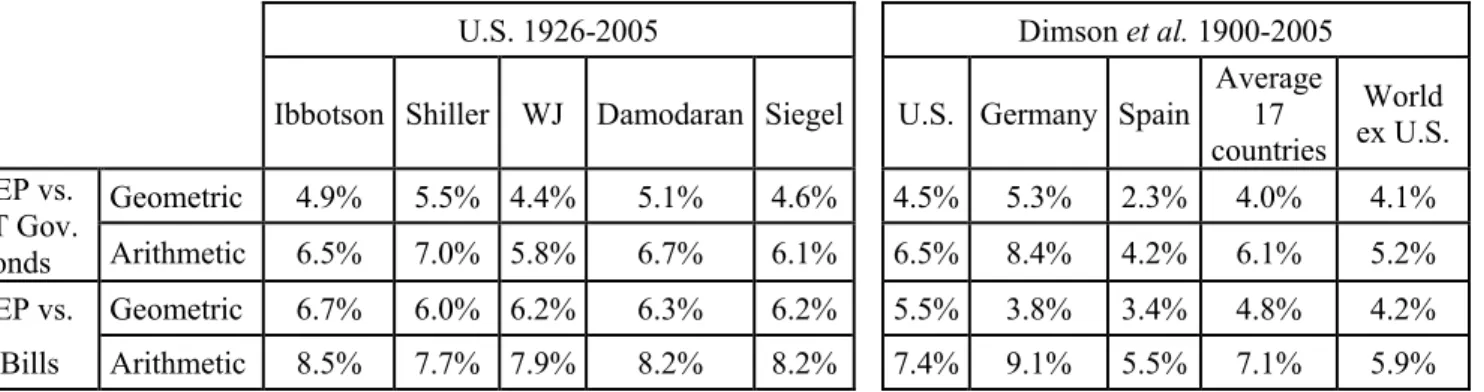
Table 2 above shows the range of the recommendations of the 82 books that assume that REP = EEP = HEP goes from 3.5% to 9.5%. However, as shown in Table 3, different authors do not get the same result for the HEP even using the same time frame (1926-2005),
average (geometric or arithmetic) and risk-free instrument (Long-Term Government Bonds or T-Bills). The differences are mainly due to the stock indexes chosen.
Table 3: Different Historical Equity Premiums (HEP) according to different authors
U.S. 1926-2005 Dimson et al. 1900-2005
Ibbotson Shiller WJ Damodaran Siegel U.S. Germany Spain Average 17 countries World ex U.S. HEP vs. LT Gov. Bonds Geometric 4.9% 5.5% 4.4% 5.1% 4.6% 4.5% 5.3% 2.3% 4.0% 4.1% Arithmetic 6.5% 7.0% 5.8% 6.7% 6.1% 6.5% 8.4% 4.2% 6.1% 5.2% HEP vs. Geometric 6.7% 6.0% 6.2% 6.3% 6.2% 5.5% 3.8% 3.4% 4.8% 4.2% T-Bills Arithmetic 8.5% 7.7% 7.9% 8.2% 8.2% 7.4% 9.1% 5.5% 7.1% 5.9%
Sources: Ibbotson Associates (2006). http://aida.econ.yale.edu/~shiller/data.htm. WJ: updated from Wilson and Jones (2002). Damodaran: http://pages.stern.nyu.edu/~adamodar/. Siegel: updated from Siegel (2005). Dimson et al.: Table 3 of Dimson, Marsh and Staunton (2007).
The estimates of Dimson et al. (2007) (see Table 3) incorporate the earlier part of the 20th century as well as the opening years of the 21st century but, as the authors point out,
“virtually all of the 16 countries experienced trading breaks… often in wartime”: e.g., during World War I, World War II or the Spanish Civil War. They claim that “we were able to bridge these gaps,” but this assertion is questionable9. Brailsford et al. (2008) also document concerns
about data quality in Australia prior to 1958.
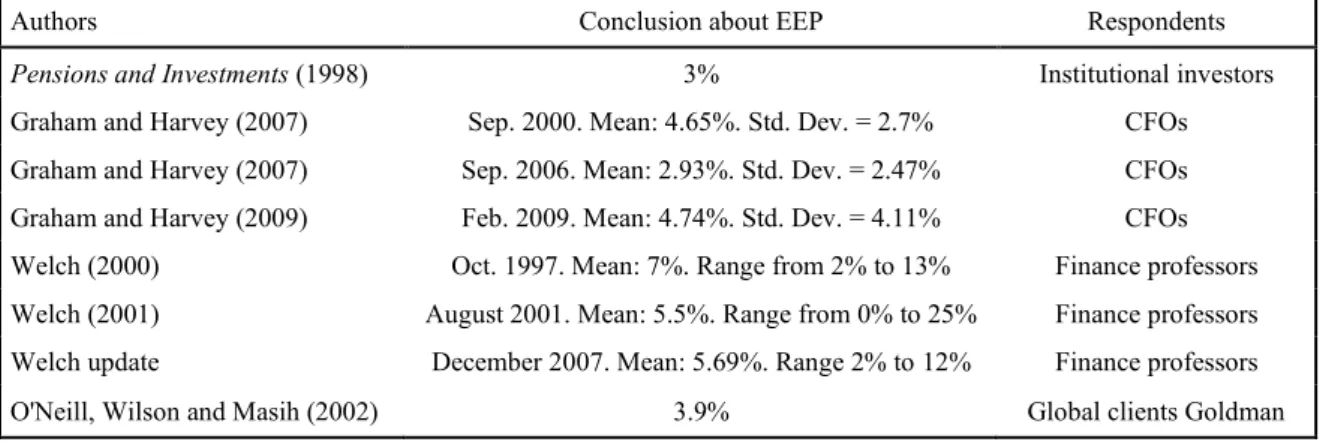
Some authors try to find the Expected Equity Premium (EEP) by conducting surveys. Welch (2000) performed two surveys with finance professors in 1997 and 1998, asking them what they thought the EEP would be over the next 30 years. He obtained 226 replies, ranging from 1% to 15%, with an average arithmetic EEP of 7% above T-Bonds10. Welch (2001)
presented the results of a survey of 510 finance and economics professors performed in August 2001 and the consensus for the 30-year arithmetic EEP was 5.5%, much lower than just 3 years earlier. In an update published in 2008, the mean was 5.69%, but the answers of about 400 finance professors ranged from 2% to 12%. Welch also reports that the equity premium “used
in class” in December 2007 was on average 5.89%, and 90% of the professors used equity
premiums between 4% and 8.5%.
Graham and Harvey (2007) indicate that U.S. CFOs reduced their average 10-year EEP from 4.65% in September 2000 to 2.93% by September 2006, but the standard deviation of the 465 responses in 2006 was 2.47%. Graham and Harvey (2009) indicate that U.S. CFOs again increased their average EEP to 4.74% with a standard deviation of 4.11%. Goldman Sachs (O'Neill, Wilson and Masih, 2002) conducted a survey of its global clients in July 2002 and the average long-run EEP was 3.9%, with most responses between 3.5% and 4.5%. The magazine Pensions and Investments (12/1/1998) carried out a survey among professionals working for institutional investors: the average EEP was 3%.
Table 4: Estimates of the EEP (Expected Equity Premium) according to different surveys
Authors Conclusion about EEP Respondents
Pensions and Investments (1998) 3% Institutional investors Graham and Harvey (2007) Sep. 2000. Mean: 4.65%. Std. Dev. = 2.7% CFOs Graham and Harvey (2007) Sep. 2006. Mean: 2.93%. Std. Dev. = 2.47% CFOs Graham and Harvey (2009) Feb. 2009. Mean: 4.74%. Std. Dev. = 4.11% CFOs Welch (2000) Oct. 1997. Mean: 7%. Range from 2% to 13% Finance professors Welch (2001) August 2001. Mean: 5.5%. Range from 0% to 25% Finance professors Welch update December 2007. Mean: 5.69%. Range 2% to 12% Finance professors O'Neill, Wilson and Masih (2002) 3.9% Global clients Goldman
Fernandez (2010) surveys professors about the Required MRP: the average Market Risk Premium (MRP) used in 2010 by professors in the USA (6.0%) was higher than that used by their colleagues in Europe (5.3%). He also reports statistics for 33 countries: the average MRP used in 2010 ranges from 3.6% (Denmark) to 10.9% (Mexico). 29% of the professors decreased the MRP in 2010, 16% increased it and 55% used the same MRP. The dispersion of the MRP used was high: the average range of MRP used by professors for the same country was 7.4% and the average standard deviation was 2.4%. He received 1,511 responses from professors11. Of these 1,511 answers, 915 respondents provided a specific MRP used in 2010.
According to an anecdote from Merton Miller (2000, page 3) about the expected market
return in the Nobel context: “I still remember the teasing we financial economists, Harry
Markowitz, William Sharpe, and I, had to put up with from the physicists and chemists in Stockholm when we conceded that the basic unit of our research, the expected rate of return, was not actually observable. I tried to tease back by reminding them of their neutrino –a particle with no mass whose presence was inferred only as a missing residual from the interactions of other particles. But that was eight years ago. In the meantime, the neutrino has been detected.”
Table 1 reports that 129 books explicitly affirm that REP = EEP. 82 of them assume that REP = EEP = HEP and presume that the historical record provides an adequate guide for future expected long-term behaviour. However, as the surveys mentioned report, the EEPs change over time and are very disparate. It is therefore not clear why averages from past decades should determine expected returns in the 21st century.
Numerous papers and books assert or imply that there is a “market” EEP. However, investors and professors do not share “homogeneous expectations”; do not hold the same
portfolio of risky assets and may have different assessments of the expected equity premium. Tables 2 and 4 also highlight that different investors have different EEPs.
A conclusion about the expected equity premium may be that of Brealey et al. (2005, page 154): “Out of this debate only one firm conclusion emerges: Do not trust anyone who claims to know what returns investors expect”. In order for all investors to share a common EEP, it is necessary to assume homogeneous expectations (or a representative investor) and, with our knowledge of financial markets, this assumption is not a reasonable one. With homogeneous expectations it is also difficult to explain why the annual trading volume of most exchanges is more than twice their market capitalization.
The required equity premium (REP) is the answer to the following question: What incremental return do I require for investing in a diversified portfolio of shares (a stock index, for example) over the risk-free rate? It is a crucial parameter because the REP is the key to determining the company’s required return to equity, the weighted average cost of capital
(WACC) and the required return to any investment project.
Different investors and different companies may, and in fact do, use different REPs. Many valuations refer to some of the 150 books analyzed as the source of the equity premium used and, given the dispersion of their recommendations as reflected in Figure 1, it is not surprising that different investors use different REPs.
The Implied Equity Premium (IEP) is the implicit REP used in the valuation of a stock (or market index) that matches the current market value. The most widely used model to calculate the IEP is the dividend discount model. According to this model, the current price per share (P0) is the present value of expected dividends discounted at the required rate of return (Ke). If d1 is the dividend (equity cash flow) per share expected to be received at time 1, and g the expected long term growth rate in dividends per share, then:
P0 = d1 / (Ke - g), which implies: IEP = d1/P0 + g - RF (1)
Fama and French (2002), using a discounted dividend model, estimated the IEP for the period 1951-2000 between 2.55% and 4.32%, far below the HEP (7.43%).
The estimates of the IEP depend on the particular assumption made for the expected growth. Even if market prices are correct for all investors, there is not an IEP common to all investors: there are many pairs (IEP, g) that accomplish equation (1). If equation (1) holds, the expected return for the shareholders is equal to the required return for the shareholders (Ke), but there are many required returns (as many as expected growths, g) in the market. Many papers in the financial literature report different estimates of the IEP with great dispersion, such
as for example, O'Hanlon and Steele (2000, IEP = 4 to 6%), Jagannathan et al. (2000, IEP = 3.04%), Claus and Thomas (2001, IEP = 3%), Harris and Marston (2001, IEP = 7.14%), Goedhart et al. (2002, 5% 1962-79 and 3.6% in 1990-2000.), Ritter and Warr (2002, IEP = 12 in 1980 and -2% in 1999), and Harris et al. (2003, IEP = 7.3%).
It seems that there is no common IEP in the market. For any particular investors, the REP and the IEP are equal, but the EEP is not necessarily equal to the REP (unless the investors consider that the market price is equal to the value of the shares). Obviously, investors will hold shares if their EEP is higher than (or equal to) their REP and will not hold otherwise. We can find out the REP and the EEP of investors by asking them, although for many investors the REP is not an explicit parameter but, rather, it is implicit in the price they are prepared to pay for the shares. However, it is not possible to determine the REP for the market as a whole, because it does not exist: even if we knew the REPs of all the investors in the market, it would be meaningless to talk of a REP for the market as a whole. There is a distribution of REPs and we can only say that some percentage of investors have REPs contained in a range. The average of that distribution cannot be interpreted as the REP of the market.
The rationale for this is to be found in the aggregation theorems of microeconomics, which in actual fact are non-aggregation theorems. One model that works well individually for a number of people may not work for all of the people together12.
4.
Discussion and conclusion
The recommendations regarding the equity premium of 150 finance and valuation textbooks published between 1979 and 2009 range from 3% to 10%. Several books use different equity premia on different pages and most books do not distinguish among the four different concepts that the phrase equity premium designates: Historical equity premium, Expected equity premium, Required equity premium and Implied equity premium.
There is not a generally accepted equity premium point estimate, nor is there a common method to estimate it, even for the HEP.
Although some books mention that “the true Equity Risk Premium is an expectation”
and also that “the goal is to estimate the true Equity Risk Premium as of the valuation date”, I think that we cannot speak of a “true Equity Risk Premium”. Different investors have different REPs and different EEPs. A unique IEP requires us to assume homogeneous expectations for the expected growth (g); but there are several pairs (IEP, g) that satisfy current market prices. We could only speak in terms of an EEP = REP = IEP if all investors had the same expectations. If they did, it would make sense to speak of a market risk premium, according to which all investors would have the market portfolio.
However, different investors have different expectations of equity cash flows and different evaluations of their risk (which translate into different discount rates, different REPs and different EEPs). There are investors who think that a company is undervalued (and buy or hold shares), investors that think the company is overvalued (and sell or do not buy shares), and investors who think that the company is fairly valued (and sell or hold shares). The investors that did the last trade, or the rest of the investors that held or did not have shares do not have a common REP nor common expectations of the equity cash flows.
A reasonable REP may be constant for all maturities, while reasonable EEPs may be different for different maturities. EEPs may be negative for some maturities (for example, in 2000, in 2007 and in 2008 many were negative) while REPs should be always positive.
Which equity premium do I use to value companies and investment projects? In most of the valuations that I have done in the 21st century I have used REPs between 3.8 and 4.3%
for Europe and for the U.S. Given the yields of the T-Bonds, I (and most of my students and clients) think that an additional 4% compensates the additional risk of a diversified portfolio.
The findings of this study lead to the conclusion that finance textbooks should clarify the equity premium by incorporating distinguishing definitions of the four different concepts and conveying a clearer message about their sensible magnitudes. It is necessary to distinguish among the different concepts and to specify to which equity premium we are referring
Exhibit 1. Equity premiums recommended and used in textbooks
Author(s) of the Textbook Assumption Period for
HEP
REP
recommended REP used Pages in the textbook
Brealey and Myers
2nd edition. 1984 REP=EEP=arith HEP vs. T-Bills 1926-81 8.3% 8.3% 119, 132. 13 3rd edition. 1988 REP=EEP=arith HEP vs. T-Bills 1926-85 8.4% 8.4% 126, 139, 140, 185 4th edition. 1991 REP=EEP=arith HEP vs. T-Bills 1926-88 8.4% 8.4% 131, 194, 196 5th edition. 1996 REP=EEP=arith HEP vs. T-Bills 1926-95 8.4% 8.4% 180, 181, 218,
6th edition. 2000 No official position 6.0 - 8.5% 8.0% 160, 195
7th edition. 2003 No official position 6.0 - 8.5% 8.0% 160, 19514
8th edition. 2005 (with
Allen) No official position 5.0 - 8% 6-8.5%
75, 15415, 178(8.5%); 222 (8%); 229 (6%) Copeland, Koller and Murrin (McKinsey)
1st edition. 1990 REP=EEP=geo HEP vs. T-Bonds 1926-88 5 - 6% 6% 193 (5-6%); 205 (6%); 19616
2nd ed. 1995 REP=EEP=geo HEP vs. T-Bonds 1926-92 5 - 6% 5.5% 268
3rd ed. 2000 REP=EEP=arith HEP – 1.5-2% 1926-98 4.5 - 5% 5% 221 (4.5-5%); 231 (5%)17 4th ed. 2005. Goedhart,
Koller & Wessels REP=EEP=arith HEP – 1-2% 1903-2002 3.5 – 4.5% 4.8%
297 (REP=EEP); 29818; 539 (4.8%); 30319 Copeland and Weston (1979) REP = EEP 10% 321 (1988) REP = EEP 9.83%, 10% 204, 458, 531
Weston and Copeland
(1992) REP = HEP = EEP 6 -8% 5%, 7.5% 5% (407, 944); 7,5% (610)
and Shastri (2005) REP = EEP = arith.HEP vs. T-Bonds 1963-02 5% 5,5% 17320; 526
Ross, Westerfield and Jaffe
2nd edition. 1988 REP = EEP = arith HEP vs. T-Bills 1926-88 8.5% 8.5% 243-4, 28721 3rd edition. 1993 REP = EEP = arith HEP vs. T-Bills 1926-93 8.5% 8.5%
4th edition. 1996 REP = EEP = arith HEP vs. T-Bills 1926-94 8.5% 8.5% 241, 280 5th edition. 1999 REP = EEP = arith HEP vs. T-Bills 1926-97 9.2% 9.2% 25922, 261 6th edition. 2002 REP = EEP = arith HEP vs. T-Bills 1926-99 9.5% 9.5% 259, 274, 324 7th edition. 2005 REP = EEP = arith HEP vs. T-Bills 1926-02 8.4% 8% 259 (8.4%), 286 (8%)
Author(s) of the Textbook Assumption Period for HEP recommended REP REP used Pages in the textbook
Ross, Westerfield and Jordan (2003a) 4th
edition. REP = EEP = arith HEP vs. T-Bills 1926-01 8.8% 6-9%
6% (352); 7% (380); 8% (356, 367, 382): 9% (374)
Ross, Westerfield and Jordan (2003b) 6th
edition. REP = EEP = arith HEP vs. T-Bills 1926-00 9.1% 6-10%
6% (517); 7% (449); 8% (445, 509, 520, 522); 8.6% (441) 9.1% (395,
504); 10% (521)
Damodaran
Damodaran on Valuation
(1994) 1st ed. REP = EEP = geo HEP vs.T-Bonds 1926-90 5.5% 5.5% 2223
Investment Valuation
(1996), 1st ed. REP = EEP = geo HEP vs.T-Bonds 1926-90 5.5% 5.5% 251
Corporate Finance (1997)
1st ed REP = EEP = geo HEP vs.T-Bonds 1926-90 5.5% 5.5% 12824
The Dark Side of Valuation
(2001a) average IEP 1970-2000 4% 4% 67 (4%)25;
The Dark Side of Valuation
(2009) 2nd ed. IEP 5 - 6.5%
5% (241), 6% (398, 494), 6.5% (431, 558)
Corporate Finance (2001b)
2nd ed REP = EEP = geo HEP vs.T-Bonds 5.5% 5.5% 237, 339, 425 and 426
Corporate Finance (2001c)
2nd intl ed REP = EEP = geo HEP vs.T-Bonds 0.88% – 1926-98 5.5% 5.5% 19226 Investment Valuation
(2002), 2nd ed. REP = EEP = geo HEP vs.T-Bonds 1928-2000 5.51% 5.51% 170; 171; 174 Applied Corporate Finance
(2005) REP = EEP = geo HEP vs.T-Bonds 1928-03 4.82% 4 – 6%
4% (355); 4.82% (349, 368, 562); 5.5% (271, 389, 401, 481); 6% (335,
336). Damodaran on Valuation
(2006) 2nd ed. REP = EEP = geo HEP vs.T-Bonds 1928-2004 4.84% 4%
41; 4% (160, 173, 189); 5% (341); 4727
Damodaran on Valuation
(1994) 1st ed. REP = EEP = geo HEP vs.T-Bonds 1926-90 5.5% 5.5% 2228
Investment Valuation
Author(s) of the Textbook Assumption Period for HEP recommended REP REP used Pages in the textbook
Weston et al.
Weston & Brigham (1982),
6th ed. 5-6% 39329
Weston, Chung and Siu
(1997) 7.5%
Weston, Mitchel and
Mulherin (2004) REP = EEP = arith.HEP vs. T-bonds 1926-2000 7.3% 7% 260
Weaver, Weston and
Weaver (2004) 5.63% 308, 309
Weston, Weaver and
Weaver (2004), REP = EEP = arith.HEP vs. T-bonds 1926-2000 7.3% 7% 153, 161
Case Problems in Finance
Butters, Fruhan, Mullins and Piper (1981)
REP = EEP = geo. HEP vs.T-Bonds +
4% 1926-74 9% 9% 15030, 151
Butters, Fruhan, Mullins and Piper (1987)
REP = EEP = geo. HEP vs.T-Bonds +
4% 1926-74 9% 9% 330, 331
Fruhan, Kester, Mason,
Piper and Ruback (1992) REP = EEP = arith. HEP vs.T-Bills 1926-90 8.4% 8% 417, 418 Kester, Fruhan, Piper and
Ruback (1997) REP = EEP = arith. HEP vs.T-Bills 1926-95 7.4%% 7%, 8% 558, 559 Kester, Ruback and Tufano
(2005) REP = EEP = arith. HEP vs.T-Bonds 1926-95 7.4% 7% 443, 444
Bodie, Kane and Marcus
2nd edition. 1993 REP = EEP 6.5% 6.5% 54931
3rd edition. 1996 REP = EEP = arith HEP vs. T-Bills - 1% 1926-94 7.75% 7.75% 535
5th edition. 2002 REP = EEP 6.5% 6.5% 57532
6th edition. 2003 REP = EEP = arith HEP vs. T-Bills 1926-2001 8.64% 5%; 8% 8% (426,431); 5% (415); 15733
8th edition. 2009 REP = EEP 5%; 8% 8% (318, 590); 5% (589);
Adair (2005) REP = EEP34; geo. HEP
3,3%-8,6% 169 (3.3%), 175 (6%), 179 (8.6%)
Adsera and Vinolas (1997) 3 – 7% 5%, 4% 185, 188, 193, 249
Author(s) of the Textbook Assumption Period for HEP recommended REP REP used Pages in the textbook
Antill and Lee (2008) REP = EEP= HEP 1900-2005 3-4% 3.5 – 4% 34, 4% (202, 217, 288); 3.5% (45, 49, 51)
Arnold (2005) REP = EEP = HEP 101 years 4.4% 229
Arzac (2005) REP = IEP 5.08% 5.08% Exhibit 3.4
Arzac (2007) REP = IEP 4.36% 4.36% Exhibit 3.4
Benninga and Sarig (1997) REP = EEP 8% 242, 259, 266, 298, 365, 367
Berk, DeMarzo, and Harford (2008) EEP< HEP 5% 35
Black, Wright and Bachman (2000) Average HEP and surveys
3.5%-4.8% 3.5% (57); 4-4.8%(304, 316)
Block and Hirt (2004) REP = EEP = HEP 1926-00 6% 345
Bodie and Merton (2000) REP = A 2
M 8% 34736
Bodie, Merton and Cleeton (2009) 8% 369
Booth and Cleary (2007) REP = HEP 5.17%
Bossaerts and Degaard (2006) REP = EEP = HEP 2.5-6% 59, 61
Brigham and Houston (2004) REP = EEP 5% 4%, 5% 195, 331, 365
Brigham and Houston (2009), 12th ed. REP = EEP 4%, 5% 253, 374, 432
Brigham, Gapenski and Daves (1999) REP = EEP 5% 5% 156, 956
Brigham, Gapenski & Ehrhardt (1999) 6% 5%, 6% 215, 415, 416
Bruner (2004) REP = EEP = geo HEP vs.T-Bonds 1926-2000 6% 6% 265, 269, 294
Butler (2000) REP = EEP = arith. HEP vs.T-Bills 8.5% 618
Chisholm (2002) 5% 170
Clayman, Fridson & Troughton (2008) REP = EEP 4%, 7% 140, 157
Crundwell (2008) REP = EEP = HEP
4.85%-8.5% 369, 382, 401, 588
Davies (2008) REP = EEP 6% -9% 9% (212), 7% (222), 6% (230)
Author(s) of the Textbook Assumption Period for HEP recommended REP REP used Pages in the textbook
Elton and Gruber (1991) 7.2% 472
English (2001) REP = 5% < HEP 5% 228, 305
Estrada (2006) REP = EEP. Defines REP correctly 5.5% 5.5% 7538, 76, 176
Evans and Bishop (2001) REP = EEP = arith. HEP vs.T-Bonds 1926-00 7.76% 7%, 7,5% 124, 135, 270 Fabozzi and Grant (2000) REP = EEP = geo HEP vs.T-Bonds 1926-93 5 -6% 5% 82, 83, 154
Feldman (2005) REP = EEP = HEP 1926-2001 7.4% 70
Fernandez (2002) Not a premium for the market as a whole 4%
Fernandez (2001, 2004) “different investors have different REPs” 4% 608, 62339
Ferris and Pecherot (2002) REP = EEP = arith HEP vs.T-Bills 1926-98 7.5% 7.5% 79, 80
Geddes (2008) 4 - 5% 170, appendix
Goetzmann and Ibbotson (2006) REP = EEP 6.2% 740, 8, 269
Grant (2002) REP = EEP 6% 66, 160
Grinblatt and Titman (2001) REP = EEP 8.4% 385
Guerard (2005) REP = EEP = HEP 7.38% 51
Guerard and Schwartz (2007) REP = EEP = arith. HEP vs.T-Bills 1926-93 8%, 8.8% 8% (235); 8.8% (188, 276, 456)
Hawawini and Viallet (2002) REP = EEP = geo HEP vs.T-Bonds 1926-99 6.2% 6.2% 328
Higgins (2003) REP = HEP 6.9% 6.9% 303
Hitchner (2006) REP = EEP = geo. HEP vs.T-Bills 1926-99 8.1% 7%, 5.5% 144, 248, 548
Jones, C. P. (1996) REP = EEP = geo. HEP vs.T-Bills 1926-93 5.3% 7% 154, 246 (7%)
Jones, C. P. (2006) REP = EEP = geo. HEP vs.T-Bills 1920-04 6.06% 6.06% 160 (6.06%); 255 (6; 7%)
Kasper L. J. (1997) REP = EEP = geo. HEP vs.T-Bills 1954-1996 7,81% 7,81% 143
Keown, Petty, Martin and Scott (1994) 7%, 9% 251, 360
Kim and Kim (2006) REP = EEP 10% 402, 420
Lacey and Chambers (2003) REP = EEP 7-8% 283, 284
Author(s) of the Textbook Assumption Period for HEP recommended REP REP used Pages in the textbook
Lopez and Garcia (2005) REP = 0.7 RF 4.2%, 3%, 3.5% 36, 134, 194, 232
Lumby and Jones (2003) REP = EEP 5-7% 264 (6%), 267 (7%), 648 (5%)
Madura and Fox (2007) REP = EEP 6 - 10% 10% (502), 6% (612)
Marin and Rubio (2001) REP = EEP = geo. HEP vs.T-Bills 1963-1997 6.77% 6.77% 209, 300, 304,
Martin and Petty (2000) REP = EEP = geo. HEP vs.T-Bills 8% 97
Martin and Trujillo (2000) REP = EEP 3%,4% 146, 148, 159, 160, 166 (4%)
Mascarenas (1993) REP = EEP 5-6% 56
Mascarenas (1996) REP = EEP = HEP 5-6% 5% 104
Mascarenas (2004) REP = EEP = geo. HEP vs.T-Bonds 1928-2001 5.17% 3.5%, 5.5% 3.5% (40, 165); 5.5% (40, 167) Mascarenas (2005) REP = EEP = geo. HEP vs.T-Bonds 1928-2001 5.1% 5.1%, 5.5% 271, 273, 279, 316 (5.5%) Moyer, McGuigan, and Kretlow (2001) REP = EEP = arith. HEP vs.T-Bills 1926-98 9.4% 9.4%; 8% 202, 42741
Palepu and Healy (2007) REP = EEP = HEP 4,9% 331, 33342, 334
Parrino and Kidwell (2008) REP = EEP = HEP 1926-06 6.51 8.4% – 447, 623
Penman (2001) 1st ed. “No one knows what the REP is” 6% 76, 69143
Penman (2003) 2nd ed. “we do not have a sound method to
estimate the cost of capital” 6% 44544, 443
Pereiro (2002) REP = EEP< HEP 4% 4% 120
Pettit (2007) REP = EEP = HEP 1900-2003 5% 5% 9, 16
Pike and Neale (2008) REP = EEP 5% 665
Pratt (2002) REP = EEP = HEP 7.4%, 8% 68, 74
Pratt and Grabowski (2008) REP = EEP 3.5-6% 5% 90, 113, 126, 235
Pratt and Niculita (2007) REP = EEP = arith HEP vs.T-Bills 1926-06 7.17% 7.17% 186, 210, 223, 532 Pratt, Reilly and Schweihs (2000) REP = EEP = arith HEP vs.T-Bills 1926-98 8% 8% 163, 178, 190
Author(s) of the Textbook Assumption Period for HEP recommended REP REP used Pages in the textbook
Rojo (2007) REP = EEP = arith. HEP 5% 11.71% 5 – 5% (122); 5.2% (130); 8.88% (132); 11.71% (153)
Rosenbaum, Pearl & Perella (2009) REP = EEP = HEP 1926-07 7.1% 7.1% 147, 148
Ryan (2006) REP = EEP = HEP 1900-2001 3.5% 102, 175, 314, 319
Shapiro (1992) Defines REP correctly 8% 482
Shapiro (2005) EEP< HEP 4 - 6% 7,5% (151), 5% (160 and 187), 8%
(169), 14845
Shim and Siegel (2007), REP = EEP 4 – 6% 284, 433
Shim, Siegel and Dauber (2008) REP = EEP 6% 23.70 and 49.05
Siegel and Shim (2000) REP = EEP 4.9% 124
Sironi and Resti (2007) REP = EEP. DDM 4-6% 5.5% 742-743
Smart and Megginson (2008) REP = EEP = arith. HEP vs.T-Bills 1900-05 7.4% 6 - 7% 6% (201, 202, 236); 7% (245)
Stewart (1991) REP = EEP = geo. HEP vs.T-Bonds 1925-89 6% 6% 43846, 442
Stowe et al. (2002) REP = EEP = geo HEP vs.T-Bonds 1926-00 5.7% 5.7% 4947
Sanjurjo and Reinoso (2003) REP = EEP = HEP 5 – 8% 5%, 5.5% 69, 240, 311, 328, 387
Siegel (2002) REP = EEP< HEP 2 – 3% 12448.
Tham and Velez-Pareja (2004) REP = EEP = HEP 6-7.5% 314, 319
Titman and Martin (2007) commonly used in practice 5% 14349
Van Horne (1983), 6th edition REP = EEP = HEP 6.0% 21550
Van Horne (1992), 8th edition REP = EEP = HEP 3 - 7% 5.0% 43851
Vernimmen et al. (2005) EEP is not HEP 4.5-5.63% 424, 431
Viebig, Varmaz, and Poddig (2008) REP = EEP = geo HEP vs.T-Bills 1900-2005 5.5% 4 – 5.5% 7% (15); 4.82 (18); 5,5% (40); 4% (235)
Weaver and Weston (2008) REP = EEP = geo HEP vs.T-Bonds 1926-05 4.89% 4.89%
Welch (2009)52 REP = EEP 3% - 5% 251 (4%), 252 (5%), 753 (3%)
Author(s) of the Textbook Assumption Period for HEP recommended REP REP used Pages in the textbook
5.
Endnotes
1 “The variance of the market portfolio (2M) times a weighted average of the degree
of risk aversion of the holders of wealth (A). Suppose that 2M = 20% and A = 2. Then the
risk premium on the market portfolio is 8%.”
2 Although in the 2nd edition they stated (page 268) “we use a geometric average of
rates of return because arithmetic averages are biased by the measurement period.”
3 Damodaran (2001c, page 192): “we must confess that this is more for the sake of
continuity with the previous version of the book and for purposes of saving a significant amount
of reworking practice problems and solutions.”
4 They argue that “although the HEP is a guide to the EEP one might expect from the
market, there is no reason that the risk premium cannot vary somewhat from period to period.”
5 They also mention the “bond yield plus risk premium method.” Under this approach,
the cost of equity is equal to the “yield to maturity on the company´s long-term debt plus a
typical risk premium of 3-4%, based on experience.”
6 Siegel also affirms that: “Although it may seem that stocks are riskier than long-term
government bonds, this is not true. The safest investment in the long run (from the point of
view of preserving the investor’s purchasing power) has been stocks, not Treasury bonds.”
7 For example, the teaching notes of the cases Levitz Furniture Corp. (9%, 1986), Richardson Vicks (8.8%, 1985), Gulf Oil Corporation (8.8%, 1984). Goodyear Restructuring (8.8%, 1986), Owens Corning Fiberglas (8.5%, 1986), Atlantic Corporation (8.5%, 1984) and RJR Nabisco (8%, 1988). Gilson (2000) uses 7.5% and mentions that “the market risk premium
has historically been about 7.5%, on average, although academic estimates of the ex ante
premium range from 0.5% to 12%.”
8 We agree with Bostock (2004): “understanding the equity premium is largely a matter
of using clear terms.”
9 Dimson et al (2007) explain in their footnote 7 that “In Spain, trading was suspended
during the Civil War from July 1936 to April 1939, and the Madrid exchange remained closed through February 1940; over the closure we assume a zero change in nominal stock prices and
zero dividends.” They also mention an “unbridgeable discontinuity, namely, bond and bill (but
not equity) returns in Germany during the hyperinflation of 1922–23, when German bond and bill investors suffered a total loss of –100%. … When reporting equity premiums for Germany … we thus have no alternative but to exclude the years 1922–23.”
10 At that time, the most recent Ibbotson Associates Yearbook reported an arithmetic HEP versus T-bills of 8.9% (1926–1997).
11 He also received more than 2,400 answers from analysts, companies, banks and investment banks: he analyses them in the document. "Market Risk Premium used in 2010 by
Analysts and Companies: a survey with 2,400 answers”: downloadable in
http://ssrn.com/abstract=1609563
12 According to Mas-Colell et al. (1995, page 120): “it is not true that whenever
aggregate demand can be generated by a representative consumer, this representative
consumer’s preferences have normative contents. It may even be the case that a positive
representative consumer exists but that there is no social welfare function that leads to a
normative representative consumer.”
13 (1984, page 119), (1988, page 127) and (1991, page 131): “the crucial assumption
future risk premium can be measured by the average past risk premium. One could quarrel with
this assumption, but at least it yields estimates of the market return that seem sensible.”
14 “How about the market risk premium? As we have pointed out in the last chapter,
we can’t measure EEP with precision. From past evidence it appears to be about 9%, although
many economists and financial managers would forecast a lower figure. Let’s use 8% in this example.”
15 “Brealey, Myers and Allen have no official position on the exact market risk
premium, but we believe that a range of 5 to 8 percent is reasonable for the risk premium in
the United States.” “It seems that the EEP over this period was … 5.3%. This is 2.3% lower
than the realized risk premium in the period 1900-2003.”
16 “Our opinion is that the best forecast of the risk premium is its long-run geometric
average.” Ibbotson geom. HEP vs. T-Bonds in 1926-1988 was 5.4% (page194).
17 “It is unlikely that the U.S. Market index will do as well over the next century as it
has in the past, so we adjust downward the historical arithmetic average market risk premium. If we substract a 1.5 to 2% survivorship bias from the long-term arithmetic average of 6.5%, we conclude that the market risk premium should be in the 4.5-5% range.” 6.5% was the
arithmetic HEP of 2-year returns in the period 1926-1998 (page 220). The geometric HEP of 1-year returns was 5.9%.
18 “we believe that the market risk premium as of year-end 2003 was just under 5%.”
19 “Using data from Jorion and Goetzmann, we find that between 1926 and 1996, the
U.S. arithmetic annual return exceeded the median return on a set of 11 countries with continuous histories dating to the 1920s by 1.9% in real terms, or 1.4% in nominal terms. If we subtract a 1% to 2% survivorship bias from the long-term arithmetic average of 5.5 percent
(arithmetic mean of 10-year holding periods returns from 1903 to 2002) the difference implies the future range of the U.S. market risk premium should be 3.5% to 4.5%.”
20 They argue that using 1963-2002 data, “our estimate of the market risk premium
would be 11.9% (the average arithmetic return on the S&P 500 index) minus 7% (the average arithmetic return on intermediate-term U.S. government bonds. Thus, our estimate of the
market risk premium would be roughly 5% in nominal terms.”
21 “REP depends on the average risk aversion of investors and the variance of the
market return. If these two don’t change much, the EEP should not change either, and we may
estimate REP from historical data.”
22 “financial economists use [the HEP] as the best estimate to occur in the future. We
will use it frequently in the text.”
23 However, on page 24 he used a REP of 6.41% (geometric HEP 1926-1990 using T-Bills). For Germany (page 164) he used a REP of 3.3%.
24 On page 128 he used a REP of 8.41% (arithmetic HEP 1926-1990 using T-Bills).
25 “The average implied equity-risk premium between 1970 and 2000 is approximately
4%.”
26 HEP vs. T-bonds 1926-98 = 6.38%. “In this book we use a premium of 5.5% in most of the examples involving US companies.” In a footnote “we must confess that this is more for
the sake of continuity with the previous version of the book and for purposes of saving a significant amount of reworking practice problems and solutions.”
27 Using a dividend discount model, he concludes that “the implied premium for the
US and the average implied equity risk premium has been between about 4% over the past 40
28 However, on page 24 he used a REP of 6.41% (geometric HEP 1926-1990 using T-Bills). For Germany (page 164) he used a REP of 3.3%.
29 “the market risk premium can be considered relatively stable at 5 to 6% for practical
application.”
30 “In recent years, the rate of return on Treasury bills has averaged about 5 to 8%. A
reasonable estimate might be 6%. The average annual return on the market as a whole (or an index such as the S&P 500) over the past 25 to 35 years has been in the range of 10% to 12%. Adjusting for higher long-term inflation might yield an estimate in the range of 14% to 16%
with a midpoint of 15%.”
31 They justified a REP = EEP = 6.5% (14.5%-8%): “Suppose the consensus forecast for the expected rate of return on the market portfolio in 1990 was about 14.5%”
32 They argue that “the HEP has been closer to 9.14%... Although the HEP is one guide
as to the EEP one might expect from the market, there is no reason that the risk premium cannot vary somewhat from period to period. Moreover, recent research suggests that in the last 50 years the HEP was considerably better than the market participants at the time were anticipating. Such a pattern could indicate that the economy performed better than initially anticipated during this period, or that the discount rate declined.” 9.14% was the arithmetic
HEP using T-Bonds in the period 1926-1999.
33 “The instability of average excess return over the 19-year subperiods calls into
question the precision of the 76-year average HEP (8.64%) as an estimate of the EEP… There
is an emerging consensus that the HEP is an unrealistic high estimate of the EEP.”
34 According to the Philadelphia Federal Reserve’s Survey of Professional Forecasters.
35 “Some researches believe that the future expected returns for the market are likely
to be even lower than these historical numbers, in a range of 3% to 5% over T bills.”
36 “In the CAPM, the equilibrium risk premium on the market portfolio is equal to the
variance of the market portfolio ( 2M) times a weighted average of the degree of risk aversion of the holders of wealth (A). Suppose that M = 20% and A = 2. Then the risk premium on
the market portfolio is 8%.”
37 Simple average of the arithmetic and geometric HEP
38 Estrada defines correctly the REP: “the additional compensation required by
investors for investing in risky assets as opposed to investing in risk-free assets.”
39 He mentions that “the HEP, the EEP and the REP are different concepts” and that
“different investors have different REPs.”
40 “The Equity Risk Premium is the expected return of the stock market minus the
expected return of a riskless bond.” “It figures into the cost of equity capital.” “From the
valuation view point, it figures into the discount rate that is used in calculations of present
value.”
41 “If the 9.4% market risk premium is used, then the risk-free rate must be the
short-term Treasury bill rate. When the 8% market risk premium is used, then the risk-free rate must be the long-term government bond rate.”
42 “It is prudent to use a range of REP estimates in computing a firm’s cost of capital.”
43 “the market risk premium is a big guess. Research papers and textbooks estimate it
in the range of 4.5% to 9.2%.... Compound the error in beta and the error in the risk premium
and you have a considerable problem… No one knows what the market risk premium is.”
44 “we really do not have a sound method to estimate the cost of capital… Estimates
45 “an expected equity risk premium of 4 to 6% appears reasonable. In contrast, the
historical equity risk premium of 7% appears to be too high for current conditions.”
46 “Is there any fundamental reason why market risk premium should be 6%? Not that
I can figure… Don’t ask. Just memorize it, and then head out to recess.”
47 They also mention the “bond yield plus risk premium method.” Under this approach,
the cost of equity is equal to the “yield to maturity on the company’s long-term debt plus a typical risk premium of 3-4%, based on experience.”
48 He concluded that “the future equity premium is likely to be in the range of 2 to 3%,
about one-half the level that has prevailed over the past 20 years.”
49 “The market risk premiums that are used in applications of the CAPM are simply
guesses.” “Historical data suggest that the equity risk premium for the market portfolio has
averaged 6% to 8% a year over the past 75 years. However, there is good reason to believe that looking forward the equity risk premium will not be this high. Indeed, current equity risk premium forecasts can be as low as 3%. For the examples of this book we will use an equity
risk premium of 5% which is commonly used in practice.”
50 6% =13% - 7%. He justified it: “Suppose, for easy illustration, that the expected
risk-free rate is an average of the risk-free rates that prevailed over the ten-year period and that
the expected market return is average of market returns over that period.”
51 “Assume that a rate of return of about 13% on stocks in general is expected to prevail
and that a risk-free rate of 8% is expected.” “The ‘before hand’ or ex ante market risk premium has ranged from 3 to 7%.”
52 Welch, I. (2009, pg 259): “No one knows the true equity premium”. Welch, I. (2009,
pg 260): “Reasonable individuals can choose equity premium estimates as low as 1% or as
References
Adair, T. (2005), Corporate Finance Demystified, McGraw-Hill; 1st edition.
Antill, N. and K. Lee (2008), Company Valuation Under IFRS, Harriman House Publishing. Arnold, G. (2005), Handbook of Corporate Finance, FT Press
Arzac, E. R. (2007), Valuation for Mergers, Buyouts, and Restructuring, John Wiley & Sons Inc. 2nd edition. 1st edition: 2005.
Benninga, S. Z. and O. H Sarig (1997), Corporate Finance: A Valuation Approach, McGraw-Hill/Irwin; 1st edition.
Berk, J., P. DeMarzo, and J. Harford (2008), Fundamentals of Corporate Finance. Pearson Education.
Black, A., P. Wright and J. Bachman (2000), In Search of Shareholder Value. Managing the Drivers of Performance, FT Prentice Hall, 2nd ed.
Block, S.B. and G. A. Hirt (2004), Foundations of Financial Management, McGraw-Hill/Irwin; 11th edition.
Bodie, Z., A. Kane, and A. J. Marcus (2003), Essentials of Investments, 5th edition. NY:
McGraw Hill.
Bodie, Z., A. Kane, and A. J. Marcus (2009), Investments, 8th edition. NY: McGraw Hill.
Previous editions: 1989, 1993, 1996, 1999, 2002, 2004.
Bodie, Z., and R. Merton (2000), Finance,New Jersey: Prentice Hall.
Bodie, Z., R. Merton and D.L. Cleeton (2009), Financial Economics, 2nd edition, Pearson,
International edition.
Bossaerts, P.L. and B. A. Degaard (2006), Lectures on Corporate Finance, World Scientific Publishing Company; 2 edition.
Bostock, P. (2004), “The Equity Premium,” Journal of Portfolio Management 30(2), pp.
104-111.
Brailsford, T., J. C. Handley and K. Maheswaran (2008), “Re-examination of the historical
equity risk premium in Australia,” Accounting and Finance, vol. 48, issue 1, pp. 73-97
Brealey, R.A. and S.C. Myers (2003), Principles of Corporate Finance, 7th edition, New York:
McGraw-Hill. Previous editions: 1981, 1984, 1988, 1991, 1996 and 2000.
Brealey, R.A., S.C. Myers and F. Allen (2005), Principles of Corporate Finance, 8th edition,
McGraw-Hill/Irwin.
Brigham, E. and J. F. Houston (2009), Fundamentals of Financial Management, Thomson One, 12th ed. 10th ed. in 2004
Brigham, E., L. C. Gapenski and M. C. Ehrhardt (1999), Financial Management, The Dryden Press, 9th edition
Brigham, E., L. C. Gapenski and P. R. Daves (1999), Intermediate Financial Management, The Dryden Press, 6th edition.
Bruner, R. F. (1999), Instructor’s Resource Manual to accompany Case Studies in Finance, 3rd edition, McGraw-Hill/Irwin.
Bruner, R. F. (2004), Applied Mergers and Acquisitions, NY: John Wiley & Sons. Butler, K.C. (2000), Multinational Finance, 2nd ed., South-Western College Pub.
Butters, J. K., W.E. Fruhan, D.W. Mullins and T.R. Piper (1987), Case Problems in Finance, 9th ed., Richard D. Irwin, Inc. Previous editions: 8th in 1981; 7th in 1975.
Chisholm, A. (2002), An Introduction to Capital Markets: Products, Strategies, Participants,
Claus, J.J. and J.K. Thomas (2001), “Equity Premia as Low as Three Percent? Evidence from
Analysts’ Earnings Forecasts for Domestic and International Stock Markets,” Journal of
Finance. 55, (5), pp. 1629-66.
Clayman, M.R., M. S. Fridson and G. H. Troughton (2008), Corporate Finance: A Practical Approach, Wiley.
Copeland, T. E., and J. F. Weston (1988), Financial Theory and Corporate Policy. 3rd edition, Reading, MA: Addison-Wesley. First edition: 1979.
Copeland, T. E., J. F. Weston and K. Shastri (2005), Financial Theory and Corporate Policy.
4th edition, Pearson Addison-Wesley.
Copeland, T. E., T. Koller, and J. Murrin (2000), Valuation: Measuring and Managing the Value of Companies. 3rd edition. New York: Wiley. Previous editions: 1990 and 1995.
Cowles, A. (1939), Common Stock Indexes, Principia Press, Bloomington, Indiana.
Crundwell, F. K. (2008), Finance for Engineers: Evaluation and Funding of Capital Projects, 1st edition Springer.
Damodaran, A. (2001a), The Dark Side of Valuation, New York: Prentice-Hall.
Damodaran, A. (2001b), Corporate Finance: Theory and Practice. 2nd edition, New York: John Wiley and Sons.
Damodaran, A. (2001c), Corporate Finance: Theory and Practice. 2nd international edition, New York: John Wiley and Sons.
Damodaran, A. (2002), Investment Valuation, 2nd edition New York: John Wiley and Sons. 1st
edition: 1996.
Damodaran, A. (2005), Applied Corporate Finance: A User's Manual, Wiley; 2nd edition
Damodaran, A. (2006), Damodaran on Valuation, 2nd edition. New York: John Wiley and
Damodaran, A. (2009), The Dark Side of Valuation, New York: Prentice-Hall, 2nd edition.
Davies, T. (2008), Strategic Corporate Finance, McGraw Hill Higher Education.
Dempsey, M. (2017), Stock markets and corporate finance, World Scientific, New Jersey, United States. 8,75% (p. 171) p. 181: “the CAPM fails as a “capital asset pricing model” but remains as a valid “cost of equity formula” for the firm.
DePamphilis, D. (2007), Mergers, Acquisitions, and Other Restructuring Activities, 4th edition,
Academic Press.
Dimson, E., P. Marsh and M. Staunton (2006a), Global Investment Returns Yearbook 2006. ABN AMRO/London Business School.
Dimson, E., P. Marsh and M. Staunton (2006b), DMS Global Returns data module. Chicago, IL: Ibbotson Associates.
Dimson, E., P. Marsh and M. Staunton (2007),“The Worldwide Equity Premium: A Smaller
Puzzle,” in Handbook of investments: Equity risk premium, R. Mehra, Elsevier.
Eiteman, D.K. and A.I. Stonehill (1986), Multinational Business Finance, Addison Wesley, 4th ed. 5th ed in 1989.
Elton, E. J. and M. J. Gruber (1991), Modern Portfolio Theory and Investment Analysis, Wiley; 4th ed.
English, J. (2001), Applied Equity Analysis: Stock Valuation Techniques for Wall Street Professionals, McGraw-Hill; 1st edition.
Estrada, J. (2006), Finance in a Nutshell, Financial Times Prentice Hall Press.
Evans, F. C. and D. M. Bishop (2001), Valuation for M&A: Building Value in Private Companies; Wiley; 1 edition.
Fabozzi, F.J. and J. L. Grant (2000), Value-Based Metrics: Foundations and Practice, Wiley; 1 edition.
Fama, E.F. and K.R. French (2002), “The Equity Risk Premium”, Journal of Finance 57 no. 2, pp. 637-659.
Feldman, S. J (2005), Principles of Private Firm Valuation, Wiley; 1st edition.
Fernandez, P. (2002), Valuation Methods and Shareholder Value Creation. Academic Press, San Diego, CA.
Fernandez, P. (2006), “Equity Premium: Historical, Expected, Required and Implied,” IESE
Business School Working paper, SSRN n. 933070.
Fernandez, P. (2008), "The Equity Premium in July 2008: Survey,” IESE Business School
Working paper, SSRN n. 1159818.
Fernandez, P. (2009), “Market Risk Premium Used in 2008 by Professors: A Survey with 1,400 Answers”, SSRN n 1344209
Fernandez, P. and J. del Campo (2010), “Market Risk Premium used in 2010 by Professors: a
survey with 1,500 answers”, SSRN n 1606563.
Ferris, K.R. and B. S. Pecherot Petitt (2002), Valuation: Avoiding the Winner's Curse, Prentice Hall.
Fruhan, W.E., W.C. Kester, S.P. Mason, T.R. Piper and R.S. Ruback (1992), Case Problems in Finance, 10th ed., Richard D. Irwin, Inc.
Geddes, R. (2008), An Introduction to Corporate Finance: Transactions and Techniques, Wiley; 2nd Edition.
Gilson, S.C. (2000), “Valuing Companies in Corporate Restructurings”, Harvard Business
School Technical Note 9-201-073.
Goedhart, M., T. Koller and D. Wessels (2002), “The real cost of Equity,” McKinsey &
Goetzmann, W. N. and R. G. Ibbotson (2006), The Equity Risk Premium: Essays and Explorations, Oxford University Press, USA.
Graham, J.R. and C.R. Harvey (2007), "The Equity Risk Premium in January 2007: Evidence
from the Global CFO Outlook Survey,” Icfai Journal of Financial Risk Management, Vol.
IV, No. 2, pp. 46-61.
Graham, J.R. and C.R. Harvey (2009), “The Equity Risk Premium amid a Global Financial
Crisis”, SSRN: n 1405459
Grant, J. L. (2002), Foundations of Economic Value Added, Wiley; 2nd edition
Grinblatt, M. and S. Titman (2001), Financial Markets & Corporate Strategy, McGraw-Hill/Irwin; 2nd ed.
Guerard, J.B (2005), Corporate Financial Policy and R&D Management, Wiley, 2 edition Guerard, J. B. and E. Schwartz (2007), Quantitative Corporate Finance, Springer, 1st edition.
Harris, R.S. and F.C. Marston (2001), “The Market Risk Premium: Expectational Estimates
Using Analysts’ Forecasts,” Journal of Applied Finance, Vol. 11.
Harris, R.S., F.C. Marston, D.R. Mishra and T.J. O'Brien (2003), “Ex Ante Cost of Equity
Estimates of S&P 500 Firms: The Choice Between Global and Domestic CAPM,” Financial
Management, Vol. 32, No. 3, Autumn.
Hawawini, G. and C. Viallet (2002), Finance for Executives, 2nd edition, South-Western,
Thompson Learning.
Higgins, R. (2003), Analysis for Financial Management, McGraw Hill Higher Education, 7th
ed. 9th ed. in 2009
Hitchner, J.R. (2006), Financial Valuation: Applications and Models, Wiley Finance
Ibbotson Associates (2006), Stocks, Bonds, Bills, and Inflation, Valuation Edition, 2006 Yearbook.
Ibbotson, R. (2002), TIAA-CREF Investment Forum, June.
Jacquier, E., A. Kane, and A.J. Marcus (2003), “Geometric or Arithmetic Mean: A
Reconsideration,” Financial Analysts Journal, Vol. 59, No. 6, pp. 46-53.
Jagannathan, R., E.R. McGrattan, and A.D. Shcherbina (2000), “The Declining U.S. Equity
Premium,” Federal Reserve Bank of Minneapolis Quarterly Review, Vol. 24, pp. 3–19.
Jones, C. P. (2006), Investments: Analysis and Management, Wiley; 10th ed. 5th ed. in 1996.
Jorion, P., and W. N. Goetzmann (1999), “Global stock markets in the twentieth century,”
Journal of Finance 54 (June), pp. 953-80.
Kasper L. J. (1997), Business Valuations: Advanced Topics, Quorum Books.
Keown, A., W. Petty, J. Martin and D. Scott (1994), Foundations of Finance: The Logic and Practice of Finance Management, Prentice Hall.
Kester, W.C., R.S. Ruback and P. Tufano (2005), Case Problems in Finance, 12th ed.,
McGraw-Hill Int. 11th ed: 1997.
Kim, S. and S. Kim (2006), Global Corporate Finance: Text and Cases, Wiley-Blackwell; 6th
ed.
Koller, T.; Goedhart, M. and D. Wessels (2005), Valuation: Measuring and Managing the Value of Companies, 4th Edition,McKinsey & Company, Inc. Wiley.
Lacey, N.L. and D. R. Chambers (2003), Modern Corporate Finance: Theory & Practice, Hayden Mcneil Pub; 4 th edition.
Li, H. and Y. Xu (2002), “Survival Bias and the Equity Premium Puzzle,” Journal of Finance
57, pp. 1981-1993.
Lumby, S. and C. Jones (2003), Corporate Finance: Theory and Practice, Cengage Lrng Business Press; 7th edition.
Martin, J. L. and A. Trujillo (2000), Manual de valoración de empresas, Ariel.
Martin, J.D. and J.W. Petty (2000), Value Based Management, Harvard Business School Press, Boston,
Mascarenas, J. (1996), Manual de Fusiones y Adquisiciones de Empresas, 2nd ed. McGraw Hill. Madrid. 1st. ed.: 1993
Mas-Colell, A., M. D. Whinston and J. R. Green (1995), Microeconomic Theory, Oxford University Press.
Miller, M.H. (2000), “The History of Finance: An Eyewitness Account,” Journal of Applied
Corporate Finance, Vol. 13 No. 2, pp. 8–14.
Moyer, R.C., J. R. McGuigan, and W. J. Kretlow (2001), Contemporary Financial Management, 8th ed., South-Western College Pub.
O'Hanlon, J. and A. Steele (2000), “Estimating the Equity Risk Premium Using Accounting
Fundamentals,” Journal of Business Finance & Accounting 27 (9&10), pp. 1051-1083.
O'Neill, J., D. Wilson and R. Masih (2002), “The Equity Risk Premium from an Economics
Perspective,” Goldman Sachs, Global Economics Paper No. 84.
Palepu, K. G. and P. M. Healy (2007), Business Analysis and Valuation: Using Financial Statements, South-Western College Pub; 4 edition.
Parrino, R. and D. S. Kidwell (2008), Fundamentals of Corporate Finance, Wiley;
Penman, S.H. (2003), Financial Statement Analysis and Security Valuation, 2nd edition,
McGraw-Hill. 1st ed. in 2001.
Pereiro, L. E. (2002), Valuation of Companies in Emerging Markets, Wiley; 1st edition. Pettit, J. (2007), Strategic Corporate Finance: Applications in Valuation and Capital
Pike, R. and B. Neale (2008), Corporate Finance & Investment, Financial Times Management; 6 Ill edition.
Pratt, S.P. (2002), Cost of Capital: Estimation and Applications, 2nd edition, Wiley.
Pratt, S.P. and A. V. Niculita (2007), Valuing a Business, 5th Edition, McGraw-Hill Library of Investment and Finance.
Pratt, S.P. and R. J. Grabowski (2008), Cost of Capital: Applications and Examples, 3rd edition,
Wiley.
Pratt, S.P., R. F. Reilly and R. P. Schweihs (2000), Valuing A Business, 4th edition, McGraw-Hill
Reilly, F.K. and K.C. Brown (2000), Investment Analysis and Portfolio Management, South-Western Coll. Pub; 6th ed.
Ritter, J.R. and R. Warr (2002), "The Decline of Inflation and the Bull Market of 1982 to 1999,”
Journal of Financial and Quantitative Analysis, Vol. 37, No. 1, pp. 29-61.
Rosenbaum, J., J. Pearl and J. R. Perella (2009), Investment Banking, Wiley Finance.
Ross, S. A., R. W. Westerfield and B. D Jordan (2003a), Essentials of Corporate Finance, 4th
edition, McGraw-Hill/Irwin.
Ross, S. A., R. W. Westerfield and B. D Jordan (2003b), Fundamentals of Corporate Finance, 6th edition, McGraw-Hill/Irwin.
Ross, S. A., R. W. Westerfield and J. F. Jaffe (2005), Corporate Finance, 7th edition,
Homewood, IL: McGraw-Hill/Irwin. Previous editions: 1998, 1993, 1996, 1999 and 2002. Ryan, B. (2006), Corporate Finance and Valuation, Cengage Lrng Business Press; 1st edition.
Shapiro, A.C. (2005), Capital Budgeting and Investment Analysis, Pearson, Prentice Hall. Shiller, R. J. (2000), Irrational Exuberance, Princeton University Press, Princeton New Jersey,