Public Knowledge Organizations:
Unity in Diversity.
Lionne Koens, MSc.
Paper for the Eu-SPRI Early Career Researcher Career Conference / Ingenio PhD Days 1. Introduction
Next to universities, public knowledge organizations form an integral part of many national science and innovation systems. They inform and execute government policy, disseminate knowledge and stimulate economic growth through innovation. They ensure our food safety, manage large (economically non-viable) facilities, monitor societal developments, enable pre-competitive research and innovation, help solve crimes and so forth.
In the international literature they are called by various names such as “public research institutes” (OECD, 2011), “government research establishments” (Boden et al., 2004) or “non-university research institutes” (Speelman, 2006). Subsections of them have become known as “government laboratories” or “research and technology organizations (RTOs)” (Arnold, Barker and Slipersaeter, 2010). Despite the existing terminology, it is not always clear which organizations fall under these definitions. A 2011 OECD study showed that there was no agreement between countries on what should be considered a “public research institute”. Nor is there a set of functions that only they execute.
In the Netherlands, there are various publicly funded organizations performing applied research and knowledge accumulation activities which – unlike for example universities and advisory councils – are not part of a system that defines them as a group with common characteristics1. There is no standard vocabulary which describes the work that they do. It is
this group of organizations that we wished to get a grip on. So we simply asked ourselves:: which public knowledge organizations do we have in the Netherlands, what do they do, and how are they funded? In finding answers to these questions we aim to contribute to the development of a vocabulary to understand them and to presentthem in an ordered way. This paper is based on research performed at the Rathenau Institute that culminated in the report Facts & Figures: the Public Knowledge Organizations2 (Koens, Chiong-Meza, Faasse and De Jonge, 2016). It presents the data and insights from this project.
We decided to call them public knowledge organizations for two reasons. By using the term knowledge instead of research, we wish to draw attention to the fact that the work they do
1 There is some recent development. A selection of organizations (those which are here classified as policy‐ oriented institutes and government laboratories) is profiling itself as the “Rijkskennisinstellingen” (“state knowledge institutes” (freely translated)) to gain more visibility. 2 This project I executed in cooperation with dr. ir. Catherine Chiong‐Meza, dr. Patricia Faasse, Drs. Jos de Jonge and Prof. dr. Barend van der Meulen. The Facts & Figures report is in Dutch. The title here is freely translated into English. As of yet, there is no English version of the report.
involves much more than research alone. As we shall see, activities such as monitoring, testing and managing facilities are equally central to their work as research is.
In what follows we will present the Dutch public knowledge organizations in an ordered way, showing both their unity and their diversity. First, we will give some more background on the kind of organizations we are talking about. Second, we will present our method, the criteria we used to make a selection and the definition of public knowledge organizations that ensues. Finally, our research approach has brought to the fore a group of public knowledge organizations with a set of functions and target groups that has not been explicitly covered in the earlier literature. Thus, our research introduces a new distinction in kinds of public
knowledge organizations. They are similar to RTOs but have a different target group and, as a consequence of that, develop different activities.
2. Hybridity as defining characteristic
The work that public knowledge organizations do differs from that of universities and
academic research institutes in that it is not driven by curiosity, but by the concrete needs of several stakeholders. Many of them have been set up with a mission to support the
formulation and execution of government policies, research areas of national interest or responsibilities or to stimulate economic growth through the support of innovation (Gulbrandsen, 2011: OECD, 2011).
To meet these goals, they combine research with activities such as policy advice, monitoring, testing (of food safety, air quality, etc.), forensic investigation and the
maintenance of large research facilities. With these activities they provide the knowledge necessary for government to fulfill its societal responsibilities. These include the
development, execution and evaluation of policy and the maintenance of public values such as safety and health. Yet their activities are also concerned with the government
responsibility for the maintenance of a healthy economy and public service system.
Several functions are identified by multiple authors (Laredo and Mustar, 2000: Boden et al., 2004: Arnold, Barker and Slipersaeter, 2010: OECD, 2011: Gulbrandsen, 2011), although rarely – with the notable exception of Laredo and Mustar – in a system that attempts to give an exclusive list. Functions that are mentioned are:
Basic and applied research
Policy advice: information for the development, execution and evaluation of policy
Contribution to the preservation of the public good, such as (food) safety through for example testing and regulatory functions.
Market-oriented, often pre-competitive research
Education and training
Knowledge dissemination
The preservation of (access to) data or knowledge collections
The management and maintenance of large research facilities
Due to their dual focus on scientific research and societal needs and their aim to bridge the two, the public knowledge organizations have often been called boundary organizations. The term boundary work was originally cornered by Gieryn (1983) and means that scientists
constantly negotiate boundaries between activities that may be considered as scientific, as opposed to non-scientific. Public knowledge organizations are labelled as boundary
organizations because they are “places where science and policy are connected and where boundary work needs to be done to ensure its position as both a scientific and as a policy-relevant institute” (Huitema and Turnhout, 2009: p.579).
Over the years, the goals and rationales for the existence of public knowledge organizations have changed. One important development, for example, is that public knowledge
organizations are increasingly stimulated to be responsive to market demands and to develop knowledge together with partners in industry (OECD, 2011). These changing societal circumstances and policies affect the public knowledge organizations and induce them to continuously find a balance between the different tasks that have been assigned to them.
This balancing between different fields with different operational rationalities makes the public knowledge organizations hybrid organizations (Gulbrandsen, 2011). A hybrid organization is an organization that incorporates different conflicting value systems in its work (Brandsen, Van de Donk and Kenis, 2006). This causes conflicts that need to be solved in order to ensure legitimacy. Gulbrandsen identifies two dimensions of hybridity. The first is the traditional tension between science and non-science: their work is based on scientific principles, but geared to the needs of non-scientific stakeholders. The second dimension of hybridity Gulbrandsen (2011) identifies is the public-private dimension. Public knowledge organizations work for public organizations and goals, for example when they do forensic investigation and monitor societal developments – and for private organizations, for example when they use their facilities and knowledge to develop and test new technologies. When we combine these two dimensions, we can characterize the public knowledge
organizations as entities balancing between the four spheres of science, government, market and society. Each sphere puts different, sometimes conflicting demands upon them. Their legitimacy as an organization with their specific task package depends on the extent to which they are successful in doing this. This hybrid nature makes it difficult to define them in a positive way: what binds them is exactly what makes them different; their hybridity. The following paragraph describes our bottom-up methodology in identifying the public
knowledge organizations and in defining the characteristics that bind them.
3. The Dutch public knowledge organizations
Statistically, the Frascati Manual speaks of the “government sector” (OECD, 2015). However, this statistical group does not always cover all organizations that could be classified as a public knowledge organization (OECD, 2011). A 2011 OECD study showed that there is no agreement between countries as to which organizations should be
considered a “public research institute”.
In the Netherlands, the most comprehensive overview of the Dutch public knowledge infrastructure is given by H. Speelman (2006: Speelman and Maas, 2010), who identifies 110 non-university research institutes. Other overviews are given by the SCP (Netherlands Institute for Social Research) (Ketting, 2002) and the AWTI (Advisory Council for Science, Technology and Innovation) (2010). While these studies give an overview of the different ‘kinds’ of public knowledge organizations, they do not bind them together as one group with a shared definition based on functional characteristics. The SCP even argues this is not
possible, because those organizations that call themselves or are called “knowledge centers” (or an equivalent term) by others, do not share a specific and exclusive set of functions.
To determine which organizations in the Netherlands could be classified as public
knowledge organizations, we took a bottom-up approach. We started with an inventory of all Dutch publicly funded, national organizations that perform research activities or accumulate knowledge on a certain topic. From this inventory, those organizations for whom research or knowledge accumulation is a main task, were selected. We used information on their websites and their most recent annual reports to check whether research or knowledge accumulation indeed was their main task. However, not all organizations had publicly available formal documents stating their tasks. In some cases these documents were available, but the organizations had evolved so much that these documents were no longer applicable. Neither did we have access to data indicating which part of the budget or personnel was connected with research or knowledge accumulation activities. At several points during this process, we discussed our findings in a group of five researchers3. In this
interactive process, we identified 29 organizations as public knowledge organizations (see table 2).
Two groups that match this general criterion were excluded beforehand, because they are already part of a well-defined group with common characteristics. Research institutes linked to universities or the two large academic organizations in the Netherlands (NWO
(Netherlands Organization for Scientific Research)) and KNAW (Royal Netherlands Academy of Arts and Sciences)) are the first group.4 They are part of the academic world
and recognizable as such. Their work closely resembles that of universities. The second group we excluded were the advisory councils and inspectorates. While they do share some characteristics and functions of a public knowledge organization, they are publicly
recognized as a group based on their advisory or inspection capacity.
The group that remained still was characterized by a great variety of tasks, but is united in embodying a combination of research and other knowledge intensive activities such as monitoring, testing, advice and the development of new innovations with societal partners. Unesco labels these activities as “scientific and technological services” (Unesco, 1978: also, Boden et al., 2004). For the same reason as we speak of knowledge organizations instead of research organizations, we have called them ‘knowledge intensive services’.
It is thus not a specific set of functions that sets them apart as a group, but their hybridity. As hybrid organizations, they must balance between the requirements put upon them by the spheres of science, government, market and society. Each sphere puts different, sometimes conflicting demands upon them. Their legitimacy as an organization with their specific task package depends on the extent to which they are successful in accommodating these different demands. 3 These are the researchers involved in the project that culminated in the Facts & Figures publication on which this publication is based, mentioned in the introduction: dr. ir. Catherine Chiong‐Meza, dr. Patricia Faasse, drs. Jos de Jonge and prof. dr. Barend van der Meulen 4 This also includes the academic medical centers.
Adding this element to the formal characteristics, we arrive at the following definition of a public knowledge organization:
‐ It is a stone organization: located in a building and not a ‘virtual institute’.
‐ It is located outside of the academic community.
‐ Research or the accumulation of knowledge is the primary task of the organization. That primary task is combined with the provision of knowledge intensive services that are the primary legitimation of the organization.
‐ The organization is part of the public domain and contributes to the knowledge base
or policy execution of at least one ministry.
‐ For this, the organization has a governance relation with at least one ministry: The organization receives structural funding from at least one ministry; and
At least one ministry influences the activities of the organization. That influence may be limited to a research program connected to the structural funding, but can also extend to the execution of statutory tasks and
accompanying accounting mechanisms.
4. Unity in diversity
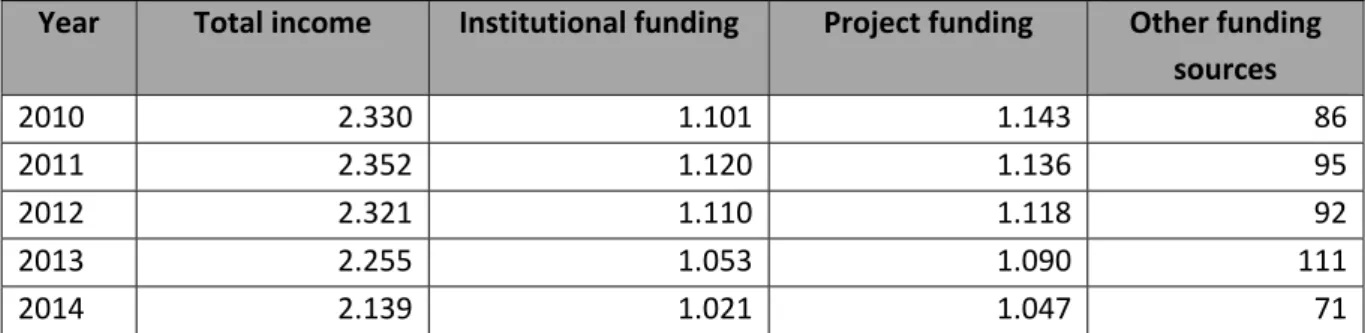
The 29 public knowledge organizations received a combined income of € 2.139 million in 2014 (see table 1). Of this income, € 1.021 million is structural funding from the central government (“institutional funding”)5. Next to that, the organizations perform contract
research for a variety parties and apply for research grants, for example from the European Horizon 2020 program (“project funding”). While their missions are nationally oriented, they work both nationally and internationally. Finally, the public knowledge organizations may gain income through for example the selling of data and licenses, the renting out of facilities and the organization of professional training courses. In 2014, the public knowledge
organizations provided employment for 14.606 full time equivalent.
Between 2010 and 2014 the income of the public knowledge organizations has decreased by eight percent (€ 191 million) (see table 1). The institutional funding has decreased by 7 percent, the project funding by 8,4 percent.
5 Due to limitations in the data, it is not possible to indicate which part of the total annual government R&D
budget goes to the public knowledge organizations. Not all organizations are a part of the formal R&D statistics and not all institutional funding is directed at R&D. For example the Netherlands Institute for Safety ((N) IFV), also manages supplies for (amongst others) the fire‐brigades.
Table 1. Income public knowledge organizations 2010-2014 (in million €)*
Year Total income Institutional funding Project funding Other funding sources 2010 2.330 1.101 1.143 86 2011 2.352 1.120 1.136 95 2012 2.321 1.110 1.118 92 2013 2.255 1.053 1.090 111 2014 2.139 1.021 1.047 71
* Due to missing financial data, two organizations (KiM and NLDA) are excluded from these figures.
All 29 organizations are – by definition – involved in research or knowledge accumulation activities. Because they have public tasks, they communicate the results of this research to both the general public and specific target groups, such as policy makers and professionals. This happens through for example the online publication of reports, the organization of symposia and media performances. They differ in the kind and combination of knowledge intensive services they provide. Based on the work of these 29 organizations, we have identified five services that cover the work that they do:
1. Policy support: providing information and knowledge necessary for the development, execution, and evaluation of policy.
2. Policy implementation: services that contribute to the execution of responsibilities of the government, such as testing food and buying vaccines. Many of these tasks are established by law.
3. Knowledge development for societal stakeholders: using research and knowledge to support and improve the work of stakeholders in business, industry and public service organizations. This has two forms:
a. R&D/innovation: supporting organizations with the development of innovations.
b. Professional platform: enabling the exchange and cocreation of knowledge between professionals.
4. Accumulation and management of facilities, data and knowledge: ensuring that knowledge, data and/or large research facilities remain available and accessible. 5. Professional training: offering training courses to a specific group of (future)
professionals.
Table 2. Knowledge intensive services*
Knowledge development for societal stakeholders
Accumulation and management of facilities, data and knowledge
Organization Policy support Policy implementa tion R&D/innovati on support Professional platform facilities Collection- or datamanage ment Professional training Policy-oriented organizations KiM*** X X WODC X X CPB X SCP X PBL X Government laboratories KNMI X X X X X X X NFI X X X X RIVM X X X X X X X CBS X X X X (N)IFV X X X X X X TO2-institutes** Deltares *** X X X X X DLO X X X X X ECN X X X MARIN*** X X X X NLR X X X TNO X X X X X X Sector-oriented organizations Boekman foundation *** X X Geonovum*** X X X Movisie*** X X X X X Mulier Institute*** X X NJi*** X X X X X NIVEL*** X X X SWOV X X X Trimbos-institute*** X X X X X VeiligheidNL*** X X X X X Vilans*** X X X X
Professional research and training organizations
Clingendael*** X X X
Police
Academy X X X X
* Where possible identification of functions is based on existing laws and regulations. For a few organizations where laws or regulations were available, tasks have been added based on the information on their websites (KNMI, RIVM, NFI, MARIN, Deltares, TNO, SWOV)
** for the TO2 institutes (Deltares, DLO, ECN, MARIN, NLR and TNO), we have looked at laws and regulations pertaining to the individual institutes as well as the three tasks formulated for the group by the ministry of Economic Affairs in their “Visie op
het toegepast onderzoek” (Vision on applied research).
*** For these organizations no laws or regulations containing tasks were available. The functions are based on the content o their websites.
Based on their primary knowledge intensive services, the organizations can be divided into five groups, as already indicated in table 2. In most cases, this division coincides with a difference in the formal organizational distance to the governing department. This table immediately shows that while there is a unity to be discovered, underneath it there is a lot of diversity. Describing these five groups by their main discriminating knowledge intensive services by no means implies that that service is done solely by that group, nor that it is provided exclusively by that group. Table 2clarifies that.
Policy Oriented Institutes
The five policy oriented institutes analyze policy options, propose new ones, answer direct questions from ministries, chart the consequences of government policies and evaluate them. They also monitor societal trends and developments, both on the short and long term. The policy oriented institutes are formally an integral part of their governing department, but are independent where their research methods and content of their reports are concerned.
The important difference is that KiM (mobility: ministry of Infrastructure and the Environment) and WODC (security, justice and migration: ministry of Security and Justice) are primarily focused on one department. The other three (the so-called ‘Planningbureaus’) have an interdepartmental focus. The PBL researches environmental and spatial planning issues, the SCP looks at societal developments and CPB does economic policy analysis. In 2014 they gained an income of € 67.715 million, of which € 56.232 million was institutional funding. As a group, their income decreased by 9,7 percent since 2010.
Government laboratories
The government laboratories are primarily focused on policy implementation: an important part of their activities contributes to the execution of public tasks for which the government carries responsibility. For example, the Netherlands Forensic Institute (NFI) does forensic investigation, the Royal Dutch Meteorological Institute (KNMI) issues formal weather
warnings and manages the meteorological and seismological infrastructure and the National Institute for Public Health and the Environment (RIVM) uses its knowledge to buy vaccines and coordinate the execution of the national vaccination program. Netherlands Statistics (CBS) produces the official national statistics and the Netherlands Institute for Safety (N)IFV manages supplies for (amongst others) the fire-brigades.
Organizationally, they are semi-independent. The KNMI, NFI and RIVM are agencies: they have an independent management but remain under ministerial responsibility. They are thus formally a part of the government. The CBS and (N)IFV are not. In 2014 the total income of these five organizations was € 712.776 million euros. As a group, their income decreased by
2,8 percent. If we remove the (N)IFV from the equation6, their income decreases with 6,7
percent.
TO2-institutes
The TO2-institutes are the Dutch Research and Technology Organizations (RTOs). They were established with the goal of connecting the fundamental research of universities with the applied research needs of industry and business. They support the research needs of partners in industry, business and government by performing both pre-competitive research (in consortia) and competitive contract research. Some of them (TNO (applied research), MARIN (maritime research) and NLR (aerospace research)) also do research for Defence.
They are responsible for almost half of the total income of the public knowledge
organizations: € 1.057.390 million. 35 percent of that income is institutional funding, ranging from 10,9 percent for MARIN and Deltares (water and subsurface research) to 40,4 percent for TNO. Where TNO has the same status as the CBS and (N)IFV, the other five are private foundations.
6 The (N)IFV has had a significant change of tasks in 2013, effectively creating a new organization with more
Sector-oriented organizations
These ten organizations are set apart functionally by their support for professionals. They provide a platform for professionals in health care, sports, culture or security to share their knowledge, develop products that support these professionals (or empower their clients) and are a repository of available knowledge and/or data. They develop guidelines for health care professionals, public information packages or campaigns and professional training courses. They have databanks filled with effective interventions, data or relevant literature, and they organize spaces (both on- and offline) where professionals can meet.
The sector-oriented organizations are private foundations. They have a combined income of € 111.991 million. € 42.141 million (37,6 percent) of that income is institutional funding. This ranges from 16,8 percent institutional funding (Geonovum) to over 60 percent (Boekman foundation, SWOV and VeiligheidNL).
Professional research and training organizations
Three organizations combine their (strongly sector-oriented) research activities with professional training activities. The Netherlands Institute of International Relations, Clingendael, focuses its training and education activities on current and future diplomats. The Police Academy provides the official education programs for the police. The
Netherlands Defence Academy (NLDA) provides the academic degrees for the military.
Together they received an income of € 189.435 million in 2014. 58,1 percent of that income is institutional funding. The percentage of institutional funding ranges from 23,7 percent at Clingendael to nearly 100 percent at the NLDA.
Figure 1 is a graphic summary of this paragraph and shows the five groups in relation to each other.
Figure 1 Size and position of the public knowledge organizations Professional research and training organizations 3 organizations € 189 million Clingendael, Police Academy, NLDA TO2‐institutes 6 organizations € 1.237 million Deltares, DLO, ECN, MARIN, NLR, TNO
Formal distance to governing mini
stry
Policy oriented organizations 5 organizations € 67 million CPB, KiM, PBL, SCP, WODC Sector‐oriented organizations 10 organizations € 125 million Boekman Foundation, Geonovum, Movisie, Mulier, NIVEL, NJi, SWOV, Trimbos, Vilans, VeiligheidNL Government laboratories 5 organizations € 712 million CBS, (N)IFV, KNMI, NFI, RIVMPrimary function
Professional training Knowledge development for societal stakeholders Policy support Policy implementation Platform Function R&D/innovation support5. Conclusion
Our research intention was to shine a light on a group of organizations that operate as a separate part of the Dutch public knowledge infrastructure, but are not visible as a group within Dutch policy discussions: the public knowledge organizations. We have identified them as hybrid organizations: they combine research or knowledge accumulation with ‘knowledge intensive services’. This requires them to constantly balance between the spheres of science, government, market and society. They serve public and private, scientific and non-scientific goals that require the upholding of conflicting values within one public knowledge organization. Their legitimization depends on their success in doing so in a constantly changing environment.
Taking their hybridity as their defining characteristic enables us to better understand the dynamics within which these organizations operate. When they fail to find a correct balance, they receive complaints because they diverge from their mission. If they focus too much on fundamental research, they are accused of academic drift. If they would only do competitive research, they become consultants. In short, if they fail to pay attention to one dimension, they are no longer acting like a public knowledge organization should act. Their hybridity as such is not just an organizational characteristic, it is at the core of what they are.
Based on the nature of the knowledge intensive services they provide, we ordered the Dutch public knowledge organizations into five groups. The policy oriented organizations are primarily focused on providing evidence for policy through the monitoring of societal developments and the evaluation of (possible) government policies. The government laboratories play a role in the execution of knowledge intensive government responsibilities, such as ensuring our safety. The TO2-institutes are the Dutch Research and Technology Organizations (RTOs). They enable innovation – for market and society – that would not take place without government support, due to market failure. The sector-oriented organizations are found primarily in the area of health care. They support the work of professionals in public service organizations through providing a platform for knowledge accumulation and exchange. Finally, the professional research and training organizations combine their research with professional training for (future) diplomats, the police and the armed forces. Naturally, there is a mix of these knowledge oriented services in each public knowledge organization, as we have seen in table 2. There is, however, a difference in the kinds of services the public knowledge organizations primarily identify with.
This ordering has brought a group of organizations to the stage that was less visible in both policy discussions on public knowledge organizations and the literature on these kinds of organizations. Their focus on the empowerment of professionals in primarily public service organizations and their clients merits separate attention. While similar to the RTOs in their field-oriented mission, this focus creates a kind and combination of tasks that is different from that of the TO2-organizations.
Both the identification of public knowledge organization as hybrid organizations balancing between the spheres of science, government, market and society and the ordering of the public knowledge organizations can nourish both the public and political debate on the added value of the public knowledge organizations. It helps us understand the kind of services that these organizations offer and the public values that they preserve by doing so. Gulbrandsen’s approach of research institutes as hybrid organizations helps us understand the tensions that they have to deal with in order to provide these knowledge intensive services to a variety of stakeholders.
On top of that, our functional characterization has brought to the forefront a group of institutes with common tasks that was not visible before, the sector-oriented organizations. As more and more government responsibilities are decentralized, their focus on
accumulating, sharing and connecting knowledge and supporting the professionals that hold and work with that knowledge may be of increasing importance.
List of abbreviations/names
CBS Statistics Netherlands
Clingendael Netherlands Institute of International Relations
CPB Netherlands Bureau for Economic Policy Analysis
DLO Dienst Landbouwkundig Onderzoek7
ECN Energy research Centre of the Netherlands
(N) IFV Netherlands Institute for Safety
KiM Netherlands Institute for Transport Policy Analysis
KNAW Royal Dutch Academy of Arts and Sciences
KNMI Royal Netherland Meteorological Institute
MARIN Maritime Research Institute Netherlands
Movisie Netherlands Centre for social development
NFI Netherlands Forensic Institute
NIVEL Netherlands institute for health services research
NJi Netherlands Youth Institute
NLDA Netherlands Defence Academy
NLR Netherlands Aerospace Centre
NWO Netherlands Organization for Scientific Research
PBL Netherlands Environmental Assessment Agency
RIVM National Institute for Public Health and the Environment
SCP The Netherlands Institute for Social Research
SWOV Institute for Road Safety Research
TNO Netherlands Organisation for Applied Scientific Research
Trimbos-institute Netherlands institute of mental health and addiction
WODC Research and Documentation Centre
References
Arnold, E., Barker, K. and Slipersaeter, S.(2010).Research Institutes in the ERA.
Technopolis group.
AWTI.(2010).Kennis Plaatsen. Onderzoeksinstituten in een Veranderende Omgeving. Advies nr. 75. Rijswijk: Quantes.
Boden, R., Cox, D., Nedeva, M. and Barker, K.(2004).Scrutinising Science. The Changing UK Government of Science. London: Palgrave Macmillan.
Brandsen, T., Van de Donk, W. and Kenis, P.(2006).Meervoudig Bestuur. Publieke Dienstverlening door Hybride Organisaties. Den Haag: uitgeverij Lemma.
Pp.421-436.
Gieryn, T.F.(1983).Boundary-Work and the Demarcation of Science from Non-Science: Strains and Interests in Professional Ideologies of Scientists. American Sociological Review. Vol. 48:6. Pp.781-795.
Gulbrandsen, M.(2011).Research Institutes as Hybrid Organizations: Central Challenges to their Legitimacy. Policy Science. Vol. 44. Pp. 215-230.
Huitema, D. & Turnhout, E.(2009). Working at the Science-Policy Interface: a Discursive Analysis of Boundary Work at the Netherlands Environmental Assessment Agency.
Environmental Politics. Vol. 18:4. P.576-594.
Ketting, E.(2002).Kenniscentra in Nederland. Een Inventariserend Onderzoek naar Kenmerken en Groei van het aantal Kenniscentra. Den Haag:SCP.
Koens, L., Chiong Meza, C., Faasse, P. and De Jonge, J.(2016).Feiten & Cijfers: de Publieke Kennisorganisaties. Den Haag: Rathenau Instituut.
Laredo, P. and Mustar, P.(2000).Laboratory Activity Profiles: an Explanaory Approach. [Preliminary Version]. Retrieved from:
http://ifris.org/wp-content/blogs.dir/1/files/2014/10/51.-Laredo-Mustar-labos-2000.pdf.
Speelman, H.(2006).Vernieuwing van de Publieke Kennisinfrastructuur van Nederland. Eindrapportage inzake de Niet-Universitaire Kennisinfrastructuur. Delft: TNO.
Speelman H. and Maas, K.(2010).De Publieke Kennisinfrastructuur van Nederland op Hoofdlijnen. Vervolgrapportage inzake de Niet-Universitaire Kennisinfrastructuur.
Delft: TNO.
OECD.(2011).Public Research Institutions: Mapping Sector Trends. Paris: OECD
OECD.(2015). Frascati Manual 2015. Guidelines for Collecting and Reporting Data on Research and Experimental Development, the measurement of scientific,
technological and innovation activities. Paris: OECD Publishing.
Unesco (1978). Recommendation concerning the international standardisation of statistics on science and technology. Paris: Unesco.