Proceedings of the Society for Computation in Linguistics
Proceedings of the Society for Computation in Linguistics
Volume 3 Article 24
2020
Communication-based Evaluation for Natural Language
Communication-based Evaluation for Natural Language
Generation
Generation
Benjamin NewmanStanford University, [email protected] Reuben Cohn-Gordon
[email protected] Christopher Potts
Stanford University, [email protected]
Follow this and additional works at: https://scholarworks.umass.edu/scil Part of the Computational Linguistics Commons
Recommended Citation Recommended Citation
Newman, Benjamin; Cohn-Gordon, Reuben; and Potts, Christopher (2020) "Communication-based Evaluation for Natural Language Generation," Proceedings of the Society for Computation in Linguistics: Vol. 3 , Article 24.
Available at: https://scholarworks.umass.edu/scil/vol3/iss1/24
This Paper is brought to you for free and open access by ScholarWorks@UMass Amherst. It has been accepted for inclusion in Proceedings of the Society for Computation in Linguistics by an authorized editor of
Communication-based Evaluation for Natural Language Generation
Benjamin NewmanStanford University Reuben Cohn-GordonStanford University
{ blnewman, reubencg, cgpotts } @stanford.edu
Christopher Potts
Stanford University
Abstract
Natural language generation (NLG) systems are commonly evaluated using n-gram over-lap measures (e.g. BLEU, ROUGE). These measures do not directly capture semantics or speaker intentions, and so they often turn out to be misaligned with our true goals for NLG. In this work, we argue instead for communication-based evaluations: assuming the purpose of an NLG system is to convey in-formation to a reader/listener, we can directly evaluate its effectiveness at this task using the Rational Speech Acts model of pragmatic lan-guage use. We illustrate with a color refer-ence dataset that contains descriptions in pre-defined quality categories, showing that our method better aligns with these quality cate-gories than do any of the prominent n-gram overlap methods.
1 Introduction
Natural language generation (NLG) models are in-creasingly prominent as core components in di-alogue agents, story generators, summarization tools, image captioning systems, and others. NLG models are generally evaluated according to met-rics that are defined in terms of the n-gram over-lap between the model-generated candidate and human-generated reference texts. However, these metrics suffer from a well-known limitation: they assume that quality candidates will always share many exact token matches with ones generated by humans. This assumption is false for many com-mon linguistic phenomena. For example, synony-mous expressions receive low scores with most of these metrics even though humans find them equally good, and negated candidates receive high scores even where the negation leads to dramatic deviation from the reference texts. Such met-rics are particularly ineffective in scenarios where there are many potentially appropriate utterances (Liu et al.,2016;Novikova et al.,2017).
To avoid this problem, one might turn to hu-man judgments to assess the quality of model-generated language. In this setting, humans rate language according to grammaticality, typicality, informativeness, interestingness, and other qual-itative dimensions (Lowe et al.,2017;Hashimoto et al.,2019;Chaganty et al.,2018). This addresses the problems with n-gram overlap methods, but it is expensive, and the human task does not reflect natural language use, which can lead to unreliable data.
One shortcoming of these methods is that they fail to take into account the communicative func-tion of language; a speaker’s goal is not only to produce well-formed expressions, but also to con-vey relevant information to a listener. Likewise, a listener is not only an assessor of quality, but also an agent that forms beliefs based on speak-ers’ utterances. Thus, our NLG systems should be expected to use language to communicate as well, and we should evaluate these systems, not based on surface-level features of their utterances, but rather on the information they convey.
In this work, we argue for such communication-based evaluations. In language use, the speaker intends to communicate information to the listener using an utterance, and the listener infers some information from that utterance. This provides the basis for evaluation: if the listener’s inference aligns with the speaker’s intentions, the utterance was successful. If these intentions are not aligned, the utterance was less successful.
We formalize communication-based NLG eval-uations using the Rational Speech Acts model of pragmatic language use (Frank and Goodman,
2012). To motivate this approach, we rely on a color reference game (Monroe et al.,2017,2018). In this game, a speaker and a listener see a set of three colors. The speaker is told one color is the target and tries to communicate the target to
the listener using a natural language utterance. A good utterance is more likely to lead the listener to select the target, while a bad utterance is less likely to do so. In turn, effective metrics should assign high scores to good utterances and low scores to bad ones.
To test our evaluation proposal, we asked crowdworkers to write color descriptions falling into three separate quality categories: those that describe only the target color (descriptive candi-dates); those that describe the target color and at least one other color in the context ( ambigu-ouscandidates); and those that describe only one non-target color in the context (misleading can-didates). We then assess the extent to which our method’s scores align with these categories. For comparison, we also investigate the extent to which n-gram overlap metrics correlate with ut-terance quality, focusing specifically on BLEU, METEOR, ROUGE, and CIDEr. We find that our communication-based metrics correlate more strongly than n-gram overlap metrics do. Our find-ings suggest that, when evaluating NLG models grounded in a task, it is more effective to use task performance than n-gram overlap metrics.
2 Related Work 2.1 NLG Evaluation
Existing NLG evaluation methods make use of n-gram overlap scores, human evaluations, and model-based evaluations. Our own method blends human evaluation and model-based evaluation, as we advocate using humans or building models to act on generated language
Other model-based evaluations take a variety of forms. Some involve training models to esti-mate human judgments of utterance quality (Lowe et al., 2017; Duˇsek et al., 2017; Kann et al.,
2018). Others require training models to dis-tinguish between language generated by humans and models—an adversarial evaluation (Bowman et al.,2016;Liu et al.,2016;Kannan and Vinyals,
2016; Bruni and Fern´andez,2017). These meth-ods focus on the utterance in a vacuum and tend to not to consider how language will actually interact with other conversational participants. They treat humans as assessors of quality or adversarial lis-teners, whereas our proposal takes the perspective that listeners are cooperative interlocutors who use the language they hear to inform their beliefs about the world.
Our approach can also be seen as part of a larger effort to incorporate context into NLG evaluation. Prior work in this area includes the image caption-ing metric SPICE, which uses scene graphs to as-sess candidate captions (Anderson et al., 2016). Similarly, Lowe et al. (2017) use conversational context to predict how human annotators would score dialogue agents, and the importance of con-text in assessment of this domain is noted byLiu et al. (2016). Our work incorporates contextual information by modeling the task a hypothetical listener will perform with the language produced.
2.2 Task-based Language Evaluation
Our work is particularly relevant for evaluation of utterances in task-specific scenarios. Overwhelm-ingly, work in this area uses humans perform-ing some task with model-generated utterances to evaluate these utterances (Andreas and Klein,
2016; Andreas et al.,2017;Golland et al., 2010;
Mao et al.,2016; Vedantam et al.,2017). Addi-tionally, automatic evaluation metrics have been proposed.Monroe et al.(2017) andCohn-Gordon et al.(2018) use a combination of language models conditioned on the context and Bayes’ rule, while
Mao et al. (2016) use their joint image and text classifier to evaluate potential object descriptions. We compare these two approaches as well. Addi-tionally, referring expressions tend not to be evalu-ated using n-gram overlap metrics;Vedantam et al.
(2017)’s use of CIDEr is an exception. As far as we know, these communication-based and n-gram overlap evaluation approaches have not previously been compared.
2.3 Communicative Informativity
Our communication-based evaluation method is closely related to the Rational Speech Acts (RSA) framework of pragmatic language use. This framework describes communication between two agents as a rational act where one agent, the speaker, chooses to communicate some informa-tion to another agent, the listener. The speaker chooses their utterance to maximize their utility, which in the framework involves choosing the ut-terance most helpful to the listener (Goodman and Frank,2016). This idea has been used to model a wide range of linguistic phenomena.
This utility function is very similar to our pro-posed method’s scoring function—differing only in a cost term. To our knowledge, this is the first case where this rational speaker utility function is
used to evaluate language rather than model hu-man utterance selection.
3 N-gram Overlap Evaluation Metrics
We now introduce the n-gram overlap metrics we adopt as baselines for our evaluations. These met-rics evaluate candidate utterances by identifying the n-grams shared between the candidate utter-ances and human-generated reference utterutter-ances. They are commonly used for evaluation in a va-riety of domains and are consistently compared when evaluating the effectiveness of different met-rics for various tasks (summarization, image cap-tioning, dialogue;Novikova et al. 2017;Kilickaya et al. 2017;Sharma et al. 2017).
BLEU BLEU (BiLingual Evaluation Under-study) was conceived as a method for automat-ically evaluating machine translation systems by comparing the tokens in the system outputs to ref-erence sentences constructed by expert translators (Papineni et al., 2002). BLEU consists of two components—a modified n-gram precision and a brevity penalty. The modified n-gram precision re-wards candidate translations that contain the same n-grams as the references. Calculated precisions for n-grams of different sizes are then geometri-cally averaged together. Conventionally, n-gram overlaps for n = 1, 2, 3, and 4 are calculated. The second component of the BLEU score, the brevity penalty, acts as a recall constraint. Long candi-date utterances could achieve a high modified n-gram precision by containing many n-n-grams, but the brevity penalty negatively impacts the score of candidates longer than the reference.
METEOR METEOR (Metric for Evaluation of Translation with Explicit ORdering), like BLEU, is designed for assessing utterances gener-ated by machine translation systems (Banerjee and Lavie, 2005). METEOR searches for an align-ment between the candidate and reference sen-tence using a form of beam search. Stemmed words, synonyms, and even paraphrases are con-sidered in seeking the optimal alignment. This alignment is used to a calculate an F-score, usu-ally favoring recall over precision. METEOR also has a “fragmentation score” that penalizes non-contiguous alignments and addresses issues re-lated to word order. High METEOR scores mean large overlap between the tokens in the reference and candidate (including synonymy) as well as the
correct word order.
ROUGE ROUGE (Recall Oriented Under-study of Gisting Evaluation) is a class of n-gram overlap metrics for assessing summaries (Lin,
2004). Like BLEU, many ROUGE metrics op-erate on the n-gram level, but unlike BLEU, their main component is an n-gram recall score that gives the proportion of n-grams in a reference that are in the candidate rather than a precision score that gives the proportion of n-grams in the candidate that are in the reference. The version of ROUGE we use here is called ROUGE-L. It uses the longest common subsequence between the candidate summary and reference summary to calculate an F-score heavily favoring recall. As such, a high ROUGE-L score indicates that a large proportion of tokens from the reference oc-cur in the candidate, so longer candidates are re-warded (Vedantam et al.,2015).
CIDEr CIDEr (Consensus-based Image De-scription Evaluation) is an n-gram overlap met-ric that assesses image captions (Vedantam et al.,
2015). It attempts to capture how well a candi-date agrees with the “consensus” of a large group of references. It does this by creating TF-IDF vec-tors for different n-grams sizes from the reference and candidate captions and calculating a weighted average of the cosine similarities between vectors for different n-gram sizes. Inverse document fre-quency is calculated over all of the reference sen-tences in the dataset. High CIDEr scores indicate that a candidate caption uses the same infrequent, and likely informative, n-grams as a number of the references.
While the metrics described above (other than CIDEr) are defined for a single candidate and a single reference, the intention is that they be used with multiple reference texts per candidate, and
Finch et al.(2004) found that using more reference sentences increases the reliability of these metrics. Gains start at 4 and continue up until 50 reference sentences in some cases (Vedantam et al.,2015). This is because a greater number of references provides more opportunities for the candidate to get a higher score. Because of this, when com-paring these metrics to our communication-based evaluation we use multiple references.
4 Communication-based Evaluation
We now define our communication-based evalua-tion method in general terms, leaving its specific application to the color reference game to Sec-tion5.
For our evaluation, we treat an NLG system as a speaker attempting to communicate about a topic
t. We denote the set of all world states relevant tot
asWt, with a random world state drawn from this
set represented aswt 2 Wt. These world states
reflect any aspect of the world a speaker might want to communicate. While this set is poten-tially infinite, the topictlimits the set to just
con-tain alternatives relevant to what commands the speaker’s attention. The speaker’s knowledge of the state of the world relevant to their communica-tive topic can then be represented as a distribution over world states,S(wt), as they may have
differ-ent confidence levels about differdiffer-ent alternatives. The speaker’s goal is to communicate their distri-bution to the listener with an utteranceu. After
hearingu, the listener has some beliefs about the
same topic-relevant states, which we can represent with the conditional distributionL(wt | u). This
distribution signifies the listener’s representation of the world related tot, so, if the speaker is suc-cessful,L(wt | u)should be close toS(wt). As
such, we can define our methodMto measure the similarity between these two distributions with the KL-divergence:
M(u|S, L) =DKL(S(wt)kL(wt |u)) (1)
If the speaker has a specific target statewtarget in
mind, then all of the speaker’s probability mass is onwtarget. In that situation, the KL-Divergence
is equivalent to the negative log-likelihood of the listener’s probability of the true target color being the target:
M(u|L, S) = logL(wtarget |u) (2)
This value directly quantifies the listener’s ac-curacy in guessing the speaker’s target state.
This metric can also be seen as measuring the communicative informativeness ofuin the sense of RSA. As described previously, in this frame-work, a speaker chooses an utterance to maxi-mize their utility. Conventionally, this utility is the quantity represented by our metric—the KL-divergence between the speaker’s observed distri-bution of the world and what they expect their lis-tener’s distribution to be after hearing the potential
utterance. In this way, our approach can be seen as defining NLG quality in terms of pragmatic lan-guage use.
As is evident from this description, our method requires NLG systems to be construed as produc-ing utterances that would help a listener distin-guish among relevant alternative states. For ex-ample, an image captioning system has to be de-signed, not just to create true captions for its in-put images, but also to create captions that would help a listener choose that input from among a set of distractor images (Vedantam et al.,2017;Mao et al.,2016;Cohn-Gordon et al.,2018). Similarly, a summarization tool should produce summaries that capture exactly the information that makes the source text stand out with respect to related in-puts (Zhang et al.,2018), and a pure text genera-tion tool (a language model) might be refashioned to produce texts conditional on specific pieces of metadata (e.g. genre, author) so that we can as-sess it based on a listener’s ability to recover that metadata from distractors (Shen et al.,2019). In general, we feel that these are healthy impositions on these tasks, as they encourage the systems to be grounded in specific contexts and to produce utter-ances that are not just true but also informative.
5 Evaluating the Evaluation Approaches
We assess the effectiveness of our evaluation method using the color reference game described byMonroe et al. (2017), in which a speaker and a listener each see the same set of three color swatches (though perhaps in different orders) and the speaker’s task is to convey the identity of their (hidden) target color to the listener. This scenario is ideal for our evaluation because the communica-tive goal is clear, and we can easily adjust this goal in ways that affect utterance quality.
5.1 Data
Our assessment hinges on the ability of a metric to distinguish good candidate utterances from bad ones. As such, we need utterances that are clear and consistent in their quality. To ensure consis-tent quality, we rely on humans to generate our candidate utterances. The utterances we solicited each fall into one of three categories:descriptive,
ambiguous, ormisleading:
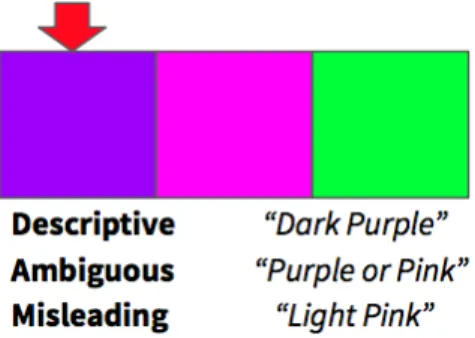
1. Descriptive Candidates: These consist of in-formative descriptions that are intended to
Figure 1: A hypothetical context with captions of dif-ferent qualities. The red arrow points to the target color. The descriptive caption picks out the target, the am-biguous one selects two colors, and the misleading cap-tion picks out a distractor color.
distinguish between the target and the distrac-tors (i.e. non-target) colors. These should re-ceive the highest scores.
2. Ambiguous Candidates: These consist of uninformative descriptions that are intended to correctly describe the target and at least one of the distractors. These should receive scores in the middle of the scale.
3. Misleading Candidates: These consist of de-scriptions that are intended to describe one of the distractors and not the target. These should receive the lowest scores.
We obtained ourdescriptivecandidates by aug-menting the dataset ofMonroe et al.(2017). We selected 360 distinct color context–utterance pairs from the development set in which listeners were able to correctly identify the target. Because these metrics perform better with more references, we collected 5 reference descriptions for each of the 360 contexts from Mechanical Turk workers. In-stead of having workers play the reference game in pairs, we described the game and asked that they play the speaker role. Separately, we then had three crowdworkers perform the listener role with each utterance. We kept only the utterances where at least two of the listeners identified the target cor-rectly. We ended up with a total of 1,912 descrip-tive candidates with on average 5.2 references per context.
TheMonroe et al.(2017) dataset does not con-tain labeled ambiguous descriptions, so we ob-tained ourambiguous candidates by having Me-chanical Turk workers play the color reference
game in the 360 color contexts as “ambiguous” speakers. The ambiguous speakers were asked to provide a description that applied to the target color while making it difficult for the listener to select the target. Any ambiguous descriptions that matched descriptive candidates for their context exactly were discarded. Some examples include “Blue” when the context contains a dark blue tar-get and a light blue distractor, or “Color of the rainbow”. Whether these captions are ambigu-ous in the sense that they communicate no rele-vant information or merely underspecified in the sense that that they do not provide enough infor-mation, these captions are of lower quality than the descriptive ones. There are 1,343 ambiguous candidates.
Finally, the Monroe et al.(2017) corpus does not explicitly contain misleading descriptions, but we did obtain a portion of ourmisleading candi-dates from their dataset. To do so, we made sure to select our 360 contexts as 180 context pairs. Each pair contains the same colors, but with a dif-ferent target color. Therefore, a descriptive can-didate for one context in the pair is a misleading caption for the other—the description directs the listener to the wrong color. Descriptive candidates from contexts with the same colors but different targets are our misleading candidates. We expect that these misleading candidates should be differ-ent from the descriptive ones, but they may be the same if all the colors are similar. To ensure that the descriptive and misleading candidates were dis-tinct in the cases where the colors were different, we removed misleading candidates found in their context’s reference sets if the distance between colors had a distance of at least 20 according to the CIEDE2000 standard (Sharma et al.,2005). There are 1,909 misleading candidates in all.
Because descriptive candidates pick out the tar-get color, they are better than ambiguous candi-dates, and because ambiguous candidates apply to the target color, they are better than misleading candidates. An effective evaluation metric should then assign the highest scores to descriptive can-didates, middle-of-the-range scores to ambiguous candidates, and the lowest scores to misleading candidates. An example of what these captions might look like can be found in Figure1.
Our dataset and code can be found athttps:
5.2 Models for Communication-based Evaluation
To use our communication-based evaluation method in the color reference game scenario, we need to define our world states, speaker distribu-tions, and listener distributions. The set of world statesWt includes one state in which each color
in the context is the target, and the speaker’s ob-served distributionS(wt)puts all its probability
mass on the true target color. The listener’s dis-tributionL(wt|u)requires further consideration.
This distribution can be modeled as any distribu-tion over the world states condidistribu-tioned on an utter-ance. We introduce three ways to generate such a distribution: human listeners, a Literal Listener model, and a Pragmatic Listener model.
To obtain a human listener in the sense of our evaluation, we had Mechanical Turk workers play the role of listeners in the reference game: they were given color contexts and candidate descrip-tions from each of the quality categories and were asked to select the color that the candidate best de-scribes. The distribution they represent, L(wt | u), has all of its probability mass on the color they
select. We had three workers play the reference game with each candidate utterance we collect.
If human data is unavailable, the distribution
L(wt | u)can be modeled computationally. We
consider two such models.
The first model is a “Literal Listener”. The model takes an utterance as input and uses it to directly compute a distribution over world states. FollowingMonroe et al.(2017), we parameterize this Literal Listener with an LSTM that produces a mean color vectorµand covariance matrix⌃from
an utterance, and these are used to score each con-text colorf:
score(f) = (f µ)⌃(f µ) (3)
The scores are then normalized using a softmax function to obtain the required distribution over colors representing L(wt | u). We trained our
model on the⇡15,000 utterances in the training
set specified by Monroe et al. (2017), and eval-uated on the test set of approximately the same size. We found that the target is assigned the high-est score 76.53% of the time, much higher than chance performance of 33%.
In contrast to our Literal Listener model, our “Pragmatic Listener” model finds the probability of thecandidate utterancegiven that each color
in the context is the target, P(u | wt). These
probabilities are used to derive L(wt | u)using
Bayes’ rule. To find the probability of the utter-ance, we use an LSTM as a conditional language model. The model is trained and structured fol-lowingMonroe et al.(2017), and initialized with pretrained GloVe embeddings (Pennington et al.,
2014). Inverting with Bayes’ rule involves spec-ifying a prior over utterances, and we treat this prior as uniform for simplicity. This model is
pragmaticin the sense that it explicitly takes into account the view of a hypothetical speaker. This is the path taken in the automatic metrics used byMonroe et al.(2018) andCohn-Gordon et al.
(2018). This listener assigns the highest score to the target color in 75.02% of test-set contexts, also much better than chance.
Finally, we use our listener and speaker distri-butions to assign a score to the utterance follow-ing (1). Because the speaker’s distribution has all probability on one world state, the scoreM(u | L, S)reduces to the negative log likelihood of the
target world statewtarget given the utterance, as in (2) above. To put this score into a space similar to the F-measure spaces of the n-gram overlap met-rics, we reporte M(u|L,S), or equivalently, the
lis-tener’s probability for the target color.
It is important to note that because the states are defined only in terms of the target color, the only aspect that matters to an utterance’s quality is whether it leads a listener to select the target. We do not explicitly evaluate stylistic aspects such as grammaticality or politeness, though the world states and distributions could be augmented to in-clude these as inKao et al. 2014. By defining our task in this manner, we are assuming that stylistic elements do not contribute to communicative suc-cess. While this is certainly not true in many situ-ations, we believe is appropriate for this particular context.
5.3 Comparisons
To evaluate the effectiveness of our metrics at detecting how well utterances communicate a speaker’s beliefs, we investigate the extent to which good utterances receive high scores and bad utterances receive low scores. We evaluate all of the utterances in each of the three quality cate-gories: descriptive, ambiguous, and misleading.
First, for our baseline experiments, we run the n-gram overlap metrics to compare each of the
de-Figure 2: Violin plots showing the distribution of scores assigned by each metric across the three caption qualities. In the first two columns, we have the four n-gram overlap baselines. In the third column, we have the listener model metrics. On the right, we have the gold-standard human listener results. Violin plots are created with Gaussian kernel density estimate with bandwidth 0.2. Horizontal bars show ranges and means.
Metric ⇢ r ⌧ Human 0.701 0.701 0.661 Literal Listener 0.581 0.613 0.486 Pragmatic Listener 0.554 0.556 0.444 BLEU-1 0.363 0.350 0.290 ROUGE-L 0.441 0.439 0.378 METEOR 0.482 0.479 0.404 CIDEr 0.401 0.417 0.340
Table 1: Pearson’s⇢, Spearman’sr, and Kendall’s⌧ correlation values between assigned scores and quality categories. BLEU-1 is reported because it is the best of the BLEU scores. All correlations are significant at p <0.05and all Pearson’s correlations are different at p <0.05according to a Williams’ test.
scriptive, ambiguous, and misleading candidates to references from their contexts. We run these assessments with thenlgevalpackage (Sharma et al.,2017). We report the smoothed distributions of n-gram overlap scores for each category sepa-rately in the left two columns of Figure2.
Next, we run our two communication-based evaluation models on each of these candidates. The score reported for an utterance is the probabil-ity the model assigns to the true target color being the target after processing the utterance. Again,
we report the distribution of scores separated by category in the third column of Figure2.
Finally, we plot our ground-truth human-listener scores. If the human human-listener correctly identified the target, the caption they saw received a score of 1; if they did not, the caption received a score of 0. Because we asked three crowdwork-ers to play the role of the listener for the captions we collected, we have 4,353 scores for descriptive captions, 4,029 for ambiguous captions, and 4,353 for misleading captions. The smoothed distribu-tion of scores is on the far right in Figure2.
We want to see the extent to which these scores correlate with the quality categories of the given utterances. Following the logic of Section 5.1, we assign descriptive candidates a score of 1, am-biguous candidates a score of 2, and misleading candidates a score of 3, and we report correla-tions calculated by Pearson’s⇢, Spearman’sr, and
Kendall’s⌧. In this situation, we have large
num-bers of points around certain scores (e.g. 1 for the Literal Listener), and these scores have meaning themselves, so we report Pearson’s⇢. We are also interested in the overall monotonicity of the metric scores across categories—we want to avoid good candidates receiving bad scores and vice versa. As such, we report the Spearman’srand Kendall’s⌧
as well. The magnitudes of these coefficients are in Table1.
We are also interested in the extent to which our method’s correlations differ from the n-gram over-lap ones, so we run a Williams’ test for dependent Pearson’s correlations. We find all Pearson’s cor-relations are significantly different atp <0.05.
6 Discussion
6.1 Qualitative Analysis
The results we observe are in accordance with the widely attested observation that n-gram overlap metrics do not capture human judgments particu-larly well (Novikova et al.,2017;Kilickaya et al.,
2017). While all of the correlations are relatively weak, METEOR is the strongest n-gram overlap metric—its use of synonyms may very well aid it in this color-reference scenario. The success of it and ROUGE-L compared to other metrics points to recall being an important component of infor-mativity in this task. This makes sense: if a cadidate utterance does not contain enough of the n-grams found in a reference, it will likely be more difficult for a listener to select the target. On the other end, BLEU has the worst correlation. Ad-ditionally, metrics like ROUGE-L, BLEU, and CIDEr have been shown to correlate with human judgments on a system rather than individual sen-tence level (Novikova et al., 2017). Our results corroborate this poor sentence-level performance. Previous work has found that n-gram overlap metrics are able to assign low scores to poorly judged utterances but fail to assign high scores to positively judged ones (Chaganty et al., 2018;
Novikova et al.,2017). Our results provide some support for this claim, especially for METEOR and CIDEr. BLEU and ROUGE-L, however, give mid-to-high scores to a large number of ut-terances regardless of their quality.
Finally, it is clear that human listeners are per-forming a reasonable evaluation, tightly aligned with the quality categories. We also observe that the human listener score distribution is closely mirrored by the Literal Listeners’ scores. How-ever, the bimodal nature of the scores given to am-biguous sentences is not ideal. We seek a met-ric that assigns ambiguous utterances mid-range scores to reflect that they convey some informa-tion, but these are rare in the human responses and model predictions. Despite this, the superiority of the listener methods over the n-gram methods is evident both in the shapes of the distributions and their correlations.
6.2 Literal vs. Pragmatic Listener
Even though the Literal and Pragmatic Listener models are more effective than n-gram overlap metrics, they do evaluate the descriptive and am-biguous candidates differently. As noted above, the Literal Listener seems to work in a very po-larized manner: captions are either good, earning a high score, or bad, earning a low score, with-out much in between. This is likely a result of training the Literal Listener model with a cross-entropy loss objective. This training scheme does not reward high-entropy distributions over outputs and pushes the model to always output a confident score (closer to one). This problem is not quite as apparent with the Pragmatic Listener, but many of the descriptive and ambiguous candidates appear to be assigned a range of higher scores. Interest-ingly, the Pragmatic Listener’s distributions have higher entropy than the Literal Listener’s. This might be because the Pragmatic Listener is based on a language model, so the probabilities it as-signs reflect the probabilities of potentially mul-tiple tokens. Some might be less informative than others, which would smooth out the distribution over colors. All told, the Literal Listener corre-lates slightly better with the quality categories than the Pragmatic Listener does.
6.3 Quality of the Listener Model
If our communication-based method is to be ef-fective, the listener model used must be accu-rate. This is because our evaluation method as-sumes that communicative errors are the fault of the speaker and not the listener. Realistically, this is not the case—no listener, human or model, is perfect. Although our listener models are not 100% accurate, they are still able to distinguish between candidates of different qualities. In other words, despite their imperfections, these models are still reliable evaluators.
6.4 Shortcomings of Communication-based Evaluation
Hashimoto et al. (2019) claim that a sufficient evaluation method will incorporate the “quality” of a model’s utterances as well as its “diversity”. Quality is tied to precision—a good model’s utter-ances are effective. Diversity is tied to recall—a good model will be able to produce any utterance a human might. Our method focuses solely on the quality aspect of this picture. To see why this
may be problematic, note that a system that simply looked up descriptions in our data given contexts would appear perfect despite not meeting any di-versity goals. This means that, if we want to mea-sure diversity, we have to resort to a second met-ric (e.g. perplexity or HUSE-D;Hashimoto et al. 2019). That said, current automatic measures of quality, like n-gram overlap metrics, are not effec-tive, and our proposed method addresses this.
Another caution is that our method depends only on the communicative goal of the speaker, which reduces the importance of other aspects of utterance quality. For example, in our color refer-ence game scenario, grammaticality of utterances is only evaluated to the extent that grammatical descriptions aid a listener in selecting the correct color. If “blue dark on click the” and “click on the dark blue” both lead to the listener selecting the dark blue color, they will both be regarded as equally good, even though only the second is well-formed. Evaluating other aspects of qual-ity, such as politeness, style, or tone, similarly re-quires careful consideration. Each of these can be thought of as achieving some communicative goal, but this goal along with the listener models and world states must be specified carefully to ensure that such properties are taken into account.
7 Conclusion
We developed an NLG evaluation method that is motivated by the idea that an utterance’s quality is determined by how well it leads a listener to ac-curately recover the speaker’s communicative in-tentions. We evaluated the effectiveness of this evaluation method using a simple color reference game in which we could systematically vary ut-terance quality and then assess how well different methods correlate with quality in this sense. In this setting, our communication-based method dramat-ically out-performed standard n-gram-based meth-ods. What’s more, our method can be used in any setting in which there is a well-defined action for a listener to perform in response to an utter-ance. One could, for example, apply this evalua-tion method to summarizaevalua-tion, image capevalua-tioning, translation, and even pure text generation, with tasks such as recovering the input from distrac-tors, identifying salient points or features, or cap-turing shades of meaning. Although our method arguably does not capture every sense of quality that we might have for NLG, it does key directly
into a fundamental goal we have for these systems, which is that they communicate effectively with humans using natural language.
8 Acknowledgements
The authors would like to thank Julia Gong and Suvir Mirchandani for their early assistance as well as the Stanford CSLI 2019 research interns, particularly Hanson Lu and Josephine Soddano. Thank you also to our reviewers for their helpful comments, and to our Amazon Mechanical Turk participants for their invaluable work. This mate-rial is based in part upon work supported by the NSF under Grant No. SMA-1659585.
References
Peter Anderson, Basura Fernando, Mark Johnson, and Stephen Gould. 2016. Spice: Semantic
proposi-tional image caption evaluation. InECCV.
Jacob Andreas, Anca Dragan, and Dan Klein. 2017.
Translating neuralese. In Proceedings of the 55th
Annual Meeting of the Association for Computa-tional Linguistics (Volume 1: Long Papers), pages 232–242, Vancouver, Canada. Association for Com-putational Linguistics.
Jacob Andreas and Dan Klein. 2016.Reasoning about
pragmatics with neural listeners and speakers. In
Proceedings of the 2016 Conference on Empirical Methods in Natural Language Processing, pages 1173–1182, Austin, Texas. Association for Compu-tational Linguistics.
Satanjeev Banerjee and Alon Lavie. 2005. METEOR: An automatic metric for MT evaluation with
im-proved correlation with human judgments. In
Pro-ceedings of the ACL Workshop on Intrinsic and Ex-trinsic Evaluation Measures for Machine Transla-tion and/or SummarizaTransla-tion, pages 65–72, Ann Ar-bor, Michigan. Association for Computational Lin-guistics.
Samuel R. Bowman, Luke Vilnis, Oriol Vinyals, An-drew Dai, Rafal Jozefowicz, and Samy Bengio. 2016. Generating sentences from a continuous
space. InProceedings of The 20th SIGNLL
Con-ference on Computational Natural Language Learn-ing, pages 10–21, Berlin, Germany. Association for Computational Linguistics.
Elia Bruni and Raquel Fern´andez. 2017.
Adversar-ial evaluation for open-domain dAdversar-ialogue generation.
In Proceedings of the 18th Annual SIGdial Meet-ing on Discourse and Dialogue, pages 284–288, Saarbr¨ucken, Germany. Association for Computa-tional Linguistics.
Arun Chaganty, Stephen Mussmann, and Percy Liang. 2018. The price of debiasing automatic metrics in
natural language evalaution. InProceedings of the 56th Annual Meeting of the Association for Com-putational Linguistics (Volume 1: Long Papers), pages 643–653, Melbourne, Australia. Association for Computational Linguistics.
Reuben Cohn-Gordon, Noah Goodman, and Christo-pher Potts. 2018. Pragmatically informative image
captioning with character-level inference.
Proceed-ings of the 2018 Conference of the North American Chapter of the Association for Computational Lin-guistics: Human Language Technologies, Volume 2 (Short Papers).
Ondˇrej Duˇsek, Jekaterina Novikova, and Verena Rieser. 2017. Referenceless quality estimation for natural
language generation. Proceedings of the 1st
Work-shop on Learning to Generate Natural Language. Andrew Finch, Yasuhiro Akiba, and Eiichiro Sumita.
2004. How does automatic machine translation evaluation correlate with human scoring as the
num-ber of reference translations increases? In
Proceed-ings of the Fourth International Conference on Lan-guage Resources and Evaluation (LREC’04), Lis-bon, Portugal. European Language Resources Asso-ciation (ELRA).
Michael C. Frank and Noah D. Goodman. 2012.
Pre-dicting pragmatic reasoning in language games.
Sci-ence, 336(6084):998.
Dave Golland, Percy Liang, and Dan Klein. 2010. A game-theoretic approach to generating spatial
de-scriptions. InProceedings of the 2010 Conference
on Empirical Methods in Natural Language Pro-cessing, pages 410–419, Cambridge, MA. Associ-ation for ComputAssoci-ational Linguistics.
Noah Goodman and Michael Frank. 2016. Pragmatic
language interpretation as probabilistic inference.
Trends in cognitive sciences, 20(11):818–829. Tatsunori Hashimoto, Hugh Zhang, and Percy Liang.
2019.Unifying human and statistical evaluation for
natural language generation. InProceedings of the
2019 Conference of the North American Chapter of the Association for Computational Linguistics: Hu-man Language Technologies, Volume 1 (Long and Short Papers), pages 1689–1701, Minneapolis, Min-nesota. Association for Computational Linguistics. Katharina Kann, Sascha Rothe, and Katja Filippova.
2018. Sentence-level fluency evaluation:
Refer-ences help, but can be spared! In Proceedings
of the 22nd Conference on Computational Natural Language Learning, pages 313–323, Brussels, Bel-gium. Association for Computational Linguistics. Anjuli Kannan and Oriol Vinyals. 2016. Adversarial
evaluation of dialogue models. NIPS Workshop on
Adversarial Training.
Justine T Kao, Jean Y Wu, Leon Bergen, and Noah D Goodman. 2014. Nonliteral understanding of num-ber words. Proceedings of the National Academy of Sciences, 111(33):12002–12007.
Mert Kilickaya, Aykut Erdem, Nazli Ikizler-Cinbis, and Erkut Erdem. 2017. Re-evaluating automatic
metrics for image captioning. InProceedings of the
15th Conference of the European Chapter of the As-sociation for Computational Linguistics: Volume 1, Long Papers, pages 199–209, Valencia, Spain. As-sociation for Computational Linguistics.
Chin-Yew Lin. 2004. ROUGE: A package for
auto-matic evaluation of summaries. InText
Summariza-tion Branches Out, pages 74–81, Barcelona, Spain. Association for Computational Linguistics. Chia-Wei Liu, Ryan Lowe, Iulian Serban, Mike
Nose-worthy, Laurent Charlin, and Joelle Pineau. 2016.
How NOT to evaluate your dialogue system: An empirical study of unsupervised evaluation metrics
for dialogue response generation. InProceedings of
the 2016 Conference on Empirical Methods in Natu-ral Language Processing, pages 2122–2132, Austin, Texas. Association for Computational Linguistics. Ryan Lowe, Michael Noseworthy, Iulian Vlad
Ser-ban, Nicolas Angelard-Gontier, Yoshua Bengio, and Joelle Pineau. 2017. Towards an automatic
Tur-ing test: LearnTur-ing to evaluate dialogue responses.
InProceedings of the 55th Annual Meeting of the Association for Computational Linguistics (Volume 1: Long Papers), pages 1116–1126, Vancouver, Canada. Association for Computational Linguistics. Junhua Mao, Jonathan Huang, Alexander Toshev, Oana Camburu, Alan L Yuille, and Kevin Murphy. 2016.
Generation and comprehension of unambiguous
ob-ject descriptions. InProceedings of the IEEE
con-ference on computer vision and pattern recognition, pages 11–20.
Will Monroe, Robert XD Hawkins, Noah D Goodman, and Christopher Potts. 2017. Colors in context: A pragmatic neural model for grounded language
un-derstanding. Transactions of the Association for
Computational Linguistics, 5:325–338.
Will Monroe, Jennifer Hu, Andrew Jong, and Christo-pher Potts. 2018. Generating bilingual pragmatic
color references. InProceedings of the 2018
Con-ference of the North American Chapter of the Asso-ciation for Computational Linguistics: Human Lan-guage Technologies, Volume 1 (Long Papers), pages 2155–2165, New Orleans, Louisiana. Association for Computational Linguistics.
Jekaterina Novikova, Ondˇrej Duˇsek, Amanda Cer-cas Curry, and Verena Rieser. 2017. Why we need
new evaluation metrics for NLG. In Proceedings
of the 2017 Conference on Empirical Methods in Natural Language Processing, pages 2241–2252, Copenhagen, Denmark. Association for Computa-tional Linguistics.
Kishore Papineni, Salim Roukos, Todd Ward, and Wei-Jing Zhu. 2002. Bleu: a method for automatic
eval-uation of machine translation. InProceedings of the
40th Annual Meeting of the Association for Com-putational Linguistics, pages 311–318, Philadelphia,
Pennsylvania, USA. Association for Computational Linguistics.
Jeffrey Pennington, Richard Socher, and Christopher Manning. 2014. Glove: Global vectors for word
representation. InProceedings of the 2014
Con-ference on Empirical Methods in Natural Language Processing (EMNLP), pages 1532–1543, Doha, Qatar. Association for Computational Linguistics. Gaurav Sharma, Wencheng Wu, and Edul N Dalal.
2005. The CIEDE2000 color-difference formula: Implementation notes, supplementary test data, and
mathematical observations. Color Research &
Ap-plication: Endorsed by Inter-Society Color Council, The Colour Group (Great Britain), Canadian Soci-ety for Color, Color Science Association of Japan, Dutch Society for the Study of Color, The Swedish Colour Centre Foundation, Colour Society of Aus-tralia, Centre Franc¸ais de la Couleur, 30(1):21–30. Shikhar Sharma, Layla El Asri, Hannes Schulz, and
Jeremie Zumer. 2017. Relevance of unsupervised metrics in task-oriented dialogue for evaluating
nat-ural language generation.CoRR, abs/1706.09799.
Sheng Shen, Daniel Fried, Jacob Andreas, and Dan Klein. 2019. Pragmatically informative text
gen-eration. In Proceedings of the 2019 Conference
of the North American Chapter of the Association for Computational Linguistics: Human Language Technologies, Volume 1 (Long and Short Papers), pages 4060–4067, Minneapolis, Minnesota. Associ-ation for ComputAssoci-ational Linguistics.
Ramakrishna Vedantam, Samy Bengio, Kevin Murphy, Devi Parikh, and Gal Chechik. 2017.Context-aware
captions from context-agnostic supervision. CoRR,
abs/1701.02870.
Ramakrishna Vedantam, C. Lawrence Zitnick, and Devi Parikh. 2015. Cider: Consensus-based image
description evaluation. InProceedings of the IEEE
conference on computer vision and pattern recogni-tion, pages 4566–4575.
Yuhao Zhang, Daisy Yi Ding, Tianpei Qian, Christo-pher D. Manning, and Curtis P. Langlotz. 2018.
Learning to summarize radiology findings. In
EMNLP 2018 Workshop on Health Text Mining and Information Analysis.