for Entity Matching using Genetic
Programming
Inauguraldissertation
zur Erlangung des akademischen Grades eines Doktors der Naturwissenschaften
der Universit¨at Mannheim
vorgelegt von
Diplom-Informatiker Univ. Robert Isele aus Waldshut-Tiengen
Korreferent: Professor Dr. Heiner Stuckenschmidt, Universit¨at Mannheim Tag der m¨undlichen Pr¨ufung: 10. Juni 2013
Abstract
A central problem in data integration and data cleansing is to identify pairs of entities in data sets that describe the same real-world object. Many exist-ing methods for matchexist-ing entities rely on explicit linkage rules, which specify how two entities are compared for equivalence. Unfortunately, writing ac-curate linkage rules by hand is a non-trivial problem that requires detailed knowledge of the involved data sets. Another important issue is the efficient execution of linkage rules.
In this thesis, we propose a set of novel methods that cover the com-plete entity matching workflow from the generation of linkage rules using genetic programming algorithms to their efficient execution on distributed systems. First, we propose a supervised learning algorithm that is capable of generating linkage rules from a gold standard consisting of set of entity pairs that have been labeled as duplicates or non-duplicates. We show that the introduced algorithm outperforms previously proposed entity matching approaches including the state-of-the-art genetic programming approach by de Carvalho et al. and is capable of learning linkage rules that achieve a similar accuracy than the human written rule for the same problem.
In order to also cover use cases for which no gold standard is available, we propose a complementary active learning algorithm that generates a gold standard interactively by asking the user to confirm or decline the equivalence of a small number of entity pairs. In the experimental evaluation, labeling at most 50 link candidates was necessary in order to match the performance that is achieved by the supervised GenLink algorithm on the entire gold standard.
Finally, we propose an efficient execution workflow that can be run on cluster of multiple machines. The execution workflow employs a novel mul-tidimensional indexing method that allows the efficient execution of learned linkage rules by reducing the number of required comparisons significantly.
Zusammenfassung
Ein zentrales Problem der Datenintegration und Datenbereinigung ist das Finden von Paaren von Entit¨aten in Datensets, welche das gleiche Realwelt-Objekt beschreiben. Viele bestehende Methoden f¨ur das Identifizieren solcher Paare basieren auf dom¨anenspezifischen Verkn¨upfungsregeln, die festlegen, wie zwei Entit¨aten auf ¨Aquivalenz verglichen werden. Allerdings ist das Schreiben solcher Verkn¨upfungsregeln von Hand in der Praxis aufwendig und erfordert eine detaillierte Kenntnis der verwendeten Datensets. Ein weiteres wichtiges Problem stellt das effiziente Ausf¨uhren der generierten Verkn¨upfungsregeln dar.
Die vorliegenden Arbeit f¨uhrt neuartige Algorithmen ein, die den gesamten Entity Matching Prozess abdecken, von der automatischen Erzeu-gung von effektiven Verkn¨upfungsregeln bis zu deren effizienten Ausf¨uhrung. Zuerst wird ein genetischer Algorithmus eingef¨uhrt, der Verkn¨upfungsregeln aus einem Goldstandard lernt, welcher aus einer Menge von Paaren von En-tit¨aten besteht, worin jedes Paar als Duplikat oder Nicht-Duplikat gekennze-ichnet ist. Die experimentelle Evaluierung zeigt, dass der eingef¨uhrte Al-gorithmus eine h¨ohere Genauigkeit als bestehende Verfahren einschließlich eines k¨urzlich eingef¨uhrten genetischen Algorithmus erreicht. Außerdem er-reichten die gelernten Verkn¨upfungsregeln eine vergleichbare Genauigkeit als Regeln die f¨ur das gleiche Datenset von Hand geschrieben wurden.
Um auch Anwendungsf¨alle abzudecken, in denen kein Goldstandard verf¨ugbar ist, wird anschließend ein komplement¨arer Active Learning Al-gorithmus eingef¨uhrt, welcher Verkn¨upfungsregeln interaktiv lernt indem er dem Nutzer eine kleine Anzahl von Beispielpaaren pr¨asentiert, welcher dieser als Duplikat oder Nicht-Duplikat kennzeichnet. In den Experimenten erre-ichte der vorgestellte Algorithmus, nach dem der Nutzer maximal 50 Kan-didaten manuell gekennzeichnet hat, eine vergleichbare Genauigkeit als der ¨
uberwachte Algorithm auf dem gesamten Goldstandard.
Abschließend f¨uhrt die vorliegenden Arbeit einen Algorithmus zur Aus-fuehrung der gelernten Verkn¨upfungsregeln auf verteilten Architekturen ein. Der eingef¨uhrte Algorithmus nutzt ein neuartiges Indexierungsverfahren, welches die Anzahl der notwendigen Vergleiche signifikant reduziert.
Contents
Abstract i
1 Introduction 1
1.1 Use Cases . . . 6
1.1.1 Data Integration . . . 6
1.1.2 Matching Census Data . . . 7
1.1.3 Bibliographic Databases . . . 8
1.1.4 Publishing Linked Data . . . 10
1.2 Contributions . . . 15 1.3 Thesis Outline . . . 17 1.4 Published Work . . . 22 2 Linkage Rules 23 2.1 Problem Definition . . . 24 2.2 Data Preparation . . . 25 2.2.1 Standardization . . . 26 2.2.2 Stop-Word Removal . . . 27 2.2.3 Structural Transformations . . . 27 2.3 Field Matching . . . 29 2.3.1 Character-Based Measures . . . 30 2.3.2 Token-Based Measures . . . 32 2.3.3 Hybrid Measures . . . 34 2.3.4 Other Measures . . . 35
2.4 Previous Work on Linkage Rules. . . 38
2.4.1 Linear Classifiers . . . 38
2.4.2 Threshold-based Boolean Classifiers . . . 38
2.4.3 Other Representations . . . 39
2.5 An Expressive Linkage Rule Representation . . . 40
2.5.1 Example . . . 42
2.5.2 Semantics . . . 43
2.5.3 Discussion . . . 45 iii
2.5.4 Representing Common Classifiers . . . 47
2.6 Summary . . . 48
3 Supervised Learning of Linkage Rules 49 3.1 Problem Definition . . . 50
3.2 Genetic Programming . . . 51
3.2.1 Generating the Initial Population . . . 51
3.2.2 Evolving the Population . . . 52
3.2.3 Bloating Control . . . 55
3.3 The GenLink Algorithm . . . 55
3.3.1 Generating the Initial Population . . . 57
3.3.2 Evolving the Population . . . 59
3.3.3 Crossover Operators . . . 60
3.3.4 Bloating Control . . . 68
3.4 Previous Work on Supervised Learning . . . 68
3.4.1 Linear Classifiers . . . 69
3.4.2 Threshold-based Boolean Classifiers . . . 71
3.4.3 Genetic Programming . . . 74
3.4.4 Collective Approaches . . . 75
3.4.5 Unsupervised Approaches . . . 77
3.4.6 Discussion . . . 78
3.5 Evaluation and Discussion . . . 80
3.5.1 Data Sets . . . 81 3.5.2 Experimental Setup . . . 84 3.5.3 Evaluation Measures . . . 85 3.5.4 Overall Results . . . 86 3.5.5 Detailed Evaluation . . . 94 3.6 Summary . . . 99
4 Active Learning of Linkage Rules 103 4.1 Active Learning . . . 104
4.1.1 Query Strategies . . . 106
4.1.2 Uncertainty Sampling . . . 106
4.1.3 Query-by-Committee . . . 107
4.2 The ActiveGenLink Algorithm . . . 109
4.2.1 Query Strategy . . . 111
4.2.2 Building the Unlabeled Pool . . . 115
4.3 Previous Work on Active Learning . . . 116
4.3.1 Linear and Threshold-based Boolean Classifiers . . . . 116
4.3.2 Genetic Programming . . . 118
4.4 Evaluation and Discussion . . . 122
4.4.1 Experiment Setup . . . 122
4.4.2 Comparison with Supervised Learning . . . 123
4.4.3 Scalability . . . 127
4.4.4 Comparison of Different Query Strategies . . . 131
4.5 Summary . . . 132
5 Execution of Linkage Rules 135 5.1 Scalability Challenges . . . 136
5.1.1 Quadratic Execution Time . . . 136
5.1.2 Parallel Execution . . . 136
5.1.3 Memory Constraints . . . 137
5.2 Execution Data Flow . . . 137
5.2.1 Indexing . . . 137
5.2.2 Caching . . . 139
5.2.3 Generating Comparison Pairs . . . 140
5.2.4 Matching . . . 140
5.2.5 Filtering . . . 140
5.3 The MultiBlock Indexing Approach . . . 141
5.3.1 Data Flow . . . 142
5.3.2 Indexing Distance Measures . . . 145
5.3.3 Indexing Aggregations . . . 148
5.4 Previous Work on Indexing . . . 149
5.4.1 Blocking . . . 149
5.4.2 Sorted Neighborhood . . . 150
5.4.3 Sorted Blocks . . . 151
5.4.4 Q-Gram Indexing . . . 151
5.4.5 Canopy Clustering . . . 151
5.4.6 Metric Embedding Methods . . . 152
5.4.7 StringMap . . . 153
5.4.8 Discussion . . . 155
5.5 Distributed Execution of Linkage Rules . . . 156
5.5.1 Cluster Programming Models . . . 156
5.5.2 MapReduce Data Flow . . . 159
5.6 Evaluation and Discussion . . . 163
5.6.1 Experiment Setup . . . 163
5.6.2 Comparison with Other Methods . . . 164
5.6.3 Scalability . . . 167
5.6.4 Effectiveness . . . 169
5.6.5 MapReduce . . . 170
6 The Silk Link Discovery Framework 173
6.1 Silk Link Specification Language . . . 174
6.2 Silk Workbench . . . 177
6.2.1 Workspace Browser . . . 177
6.2.2 Linkage Rule Learner . . . 179
6.2.3 Linkage Rule Editor . . . 181
6.2.4 Reference Links Manager . . . 181
7 Conclusion 185 7.1 Summary . . . 185
7.1.1 Lowering the Effort . . . 185
7.1.2 Increasing the Accuracy . . . 186
7.1.3 Increasing the Efficiency . . . 187
7.2 Limitations and Future Work . . . 188
7.2.1 Collective Matching . . . 188
7.2.2 Distance Measures and Transformations . . . 190
7.2.3 Learning of Functions Parameters . . . 190
7.2.4 Population Seeding . . . 190 7.2.5 Query Strategy . . . 191 List of Figures 193 List of Tables 195 Listings 197 Bibliography 199
Chapter 1
Introduction
As companies are generating an ever increasing amount of data and more and more structured data is becoming available on the public Web, methods to integrate large data sources are moving into focus. An apparent issue in these data integration efforts is that data sources may use different repre-sentations for the same real-world object. For instance, different publication databases may contain citations to the same publication or different scientific databases may contain information about the same drugs. Identifying such duplicated entries constitutes an important issue in data integration. The process of identifying duplicates has been well studied in various research areas and is known as entity matching, instance matching, data matching, record linkage, coreference resolution, deduplication, duplicate record detec-tion and merge/purge [Elmagarmid et al., 2007; Christen, 2012; Gu et al., 2003; Winkler, 1995; Hern´andez and Stolfo, 1995].
Table 1.1 illustrates the need for entity matching on an example database. In this example, the first two rows correspond to the same movie, even if
Title Release Date Director Runtime
Frankenstein July 20, 1958 Howard W. Koch 83 min
Frankenstein 1958 Howard Koch 83 min
Frankenstein Nov. 21, 1931 James Whale 71 min
The Revenge of Frankenstein June 1, 1958 Terence Fisher 89 min Table 1.1: Excerpt of a movie database.
the dates and director names differ slightly. On the other hand, although the title of the third movie matches the titles of the previous movies, its distinct release date and director suggest that, in fact, it identifies a different movie than the previous ones. The last movie also identifies a distinct movie,
although its release data is very close to the release dates of the first two movies.
The goal of an entity matching task is to identify entities in data sets that denote the same real-world object [K¨opcke and Rahm, 2010]. Entity matching is concerned with both identifying duplicates within a single data set (intra-source duplicates) as well as finding entities in multiple data sets that denote the same real-world object (inter-source duplicates) [Naumann and Herschel, 2010]. For each found pair of duplicates, the entity matching tasks generates alink that connects both matching entities.
A variety of approaches for solving the entity matching problem have been proposed in literature [Elmagarmid et al., 2007; Naumann and Herschel, 2010; Christen, 2012]. In the context of this thesis, we focus on rule-based approaches that employ domain-specific linkage rules [Winkler, 1995] that specify the conditions that two entities must fulfill in order to be be con-sidered a duplicate. For this purpose, linkage rules typically determine the overall similarity of two entities by comparing individual properties of both entities. For instance, in the above example of a movie database, a linkage rule may compare the titles and the release date of two entities in order to determine if both entities refer to the identical movie. As data sets may contain typographical errors or other kind of data heterogenities, properties of duplicated entities are not necessarily exact matches and thus need to be compared by using a distance measure. A distance measure determines the difference between two values based on a heuristic, such as, for instance, the number of characters that need to be changed in the first string value in order to transform it into the second string value. In addition, a linkage rule needs to define a distance threshold for each property that is compared that specifies the allowed maximum difference between two values. For instance, when comparing two release dates, a threshold could allow for a difference of 10 days for values of that particular property. Based on the distance of two properties and the corresponding distance threshold, a linkage rule is able to compute a similarity score for each property. The resulting similarity scores of all compared properties are than combined into a single similarity score. Different methods for aggregating multiple similarity scores can be used for that purpose, such as the weighted average, which, after assigning weights to each property that is compared, combines all values linearly. Furthermore, if the data sources use different data formats, property values need to be normalized by applying data transformations prior to the comparison.
The specific linkage rule that is needed for a particular entity matching task strongly depends on the data sources that are to be matched and the specific use case. Different data sources may use different data formats or can be structured differently, e.g., use different terms to express the same
in-formation. In addition, the notion of what is considered a duplicate depends on the concrete use case. For instance, a specific movie database may want to distinguish between different editions of the same movie (e.g., theatrical cut vs. director’s cut) in which case two entities that describe different editions of a specific movie should not be identified as duplicates, while other movie databases do not make that distinction.
Figure 1.1 depicts the overall workflow of a rule-based entity matching task. In the following, we describe each step in more detail and highlight the
Figure 1.1: Entity Matching Workflow. challenges that occur.
Linkage Rule Generation: Before executing the actual matching, a link-age rule needs to be built, which specifies how two entities are compared for equivalence. Linkage Rules can be created by a human expert based on the data sources that are to be matched. Writing good linkage rules by hand is a non-trivial problem as the rule author needs to have de-tailed knowledge about the structure of the data sets. We illustrate this point with the example of a data set about movies. Even within this simple example the linkage rule author faces a couple of challenges: First of all, a comparison solely by label fails for cases when movies with the same title actually represent distinct movies that have been released in different years. Therefore, the linkage rule needs to com-pare, at the very least, the titles of the movies as well as their release dates and combine both similarities with an appropriate aggregation function. As data sets can be noisy (e.g., the release dates might be off by a couple of days), the rule author also needs to choose suitable distance measures together with appropriate distance thresholds. The discovery of all data heterogenities that are not covered by the linkage rule yet, is often not obvious and strongly dependent on the concrete data sets. For instance, a data source may contain some names that
are formatted as ”hfirst namei hlast namei” while other names are for-matted as ”hlast namei,hfirst namei”. Finding such heterogenities and adding the specific data transformations to avoid mismatches is often very tedious. Thus, writing a linkage rule is not only a cumbersome but also a time consuming task.
Linkage Rule Execution: The aim of the linkage rule execution is to iden-tify all pairs of entities for which the provided linkage rule is fulfilled. Figure 1.2 illustrates a typical entity matching data flow for two data sources. As the na¨ıve approach of evaluating a linkage rule for all
possi-Figure 1.2: Execution Data Flow.
ble pairs of entities scales quadratically with the number of entities, an indexing method is usually employed to dismiss definitive non-matches early. Based on the index, a set of comparison pairs that contain two entities that are potential matches is generated. The linkage rule is only evaluated for each comparison pair. The output of the linkage rule execution is a set of links wherein each link connects two entities that have been found to match according to the linkage rule.
Various indexing methods have been proposed in literature to increase the efficiency by detecting and dismissing definitive non-matches early in the matching process.[Christen, 2012; Naumann and Herschel, 2010; K¨opcke and Rahm, 2010; K¨opcke et al., 2010]. Unfortunately, many of these methods may lead to a decrease of recall due to false dismissals. In the previous example of a movie data set, an indexing method may for instance assign an index to each entity based on the release year of the movie that it describes. In this case, only entities about movies with the same release date need to be compared with the linkage rule. On the downside, entities that contain a wrong release date would be dismissed in this example. Developing indexing methods that reduce the number of comparisons while still generating a comparison pair for all matching entities is an ongoing research topic [Christen, 2011]. Evaluation: The purpose of the evaluation step is to measure the success of
the entity matching task and to find potential errors in the generated links. The success of the entity matching task can be determined by comparing the generated links with a gold standard consisting of a set of reference links. A set ofreference links consist of positive reference links that identify pairs of entities that are known to match and negative reference links that identify pairs that that are known non-matches. If no reference links are known, a gold standard can be generated by a human expert who confirms or rejects a number of links. The creation of the reference links usually involves manual effort as a human expert is involved in confirming or declining candidate links. For that reason, it is desirable to reduce the number of link candidates that need to be labeled manually.
The challenge in reducing the labeling effort lies in choosing a set of link candidates for labeling that constitutes a representative sample of the entire data set. The reason why the na¨ıve approach of choosing a few random links for labeling usually fails can be easily understood by looking at the example data set about movies that has been introduced in Table 1.1. In this example, a random selection of pairs of entities to be labeled as matches or non-matches would not guarantee that the rather rare case of a pair of movies that share the same title but still represent distinct movies due to different release dates is chosen. After a set of reference links has been generated, two kinds of errors can be detected: False positive links, which are links that have been generated between entities that describe different real-world objects; and false negative links, which are positive reference links that have been missed by the entity matching task. The found errors can be used to improve the linkage rule, i.e., by going back to the linkage rule generation step of the entity matching workflow. This way, the linkage rule can be constantly improved by repeatedly improving the linkage rule, executing the linkage rule and identifying errors in the linkage rule.
In this thesis, we propose a set of novel methods that cover the complete entity matching workflow from the generation of linkage rules to their effi-cient execution on distributed systems. First of all, we present an expressive linkage rule representation, which may combine different similarity measures non-linearly and may employ chains of data translations to normalize data prior to comparison. In order to lower the effort of generating linkage rules, we propose the GenLink genetic programming algorithm to learn linkage rules that are based on the introduced representation. GenLink is a
super-vised learning algorithm that generates linkage rules from existing reference links.
As in many cases reference links are not available, we propose the Active-GenLink active learning algorithm that generates reference links by requiring the user to confirm or decline a small number of link candidates. ActiveG-enLink uses a novel query strategy that selects link candidates for labeling that yield a high information gain. By that it reduces the number of link candidates that need to be labeled by the user.
Finally, we present algorithms to efficiently execute the learned linkage rules based on the MultiBlock indexing method. MultiBlock uses a multidi-mensional index in which similar entities are located near each other in order to dismiss definitive non-matches early. All proposed algorithms have been implemented as part of the Silk Link Discovery Framework.
The electronic version of this dissertation along with links to data sets that have been used for evaluation in this work can be found at:
http://dissertation.robertisele.com
1.1
Use Cases
Entity matching has a abundance of use cases in a variety of application scenarios. In the following, we underline the motivation for entity matching by discussing four uses cases.
1.1.1
Data Integration
The purpose of data integration is to integrate multiple data sources into a single data set [Doan and Halevy, 2005]. A common problem in data integration efforts occurs when multiple entities from different data sources describe the same real-world object. In this case, duplicated entities from different data sources need to be identified and merged into a single entity. The essential task of identifying these duplicates is carried out by an entity matching process. Data integration problems are not bound to a specific data format and can be found, for instance, in relational databases or XML documents.
For instance, when integrating multiple data sources about persons, dif-ferent entities in distinct data sources may refer to the same real person. We illustrate this problem by looking at two entries from two multi-domain data sources: Freebase and DBpedia. Freebase1 [Bollacker et al., 2008] is a
1
collaboratively created knowledge base. DBpedia2 [Bizer et al., 2009b] is a
structured data set that has been extracted from Wikipedia articles. Fig-ure 1.3 shows the entry for Woody Allen in both data sets. Both data sets
(a) Freebase entry (b) DBpedia entry
Figure 1.3: Woody Allen in Freebase and DBpedia. Retrieved June 18, 2012. provided similar information, such as his name and his birth date. On the other hand, some properties, such as his height and information about his relatives, are only present in one data set. Therefore, merging both entities into a single entity would enrich the available data and provide a unified view of all information about Woody Allen.
1.1.2
Matching Census Data
A data integration challenge that is faced by many statistical institutes is the problem of integrating census data sets that have been collected from different sources [Jaro, 1989]. Table 1.2 shows three example census records: Matching different census records can be difficult for a number of reasons, including:
• Persons may move to other locations or change their family name.
• Streets may be renamed.
• Administrative regions may be reorganized. 2
Name Birthdate Street Zip Code
J. Doe 2/12/1965 Main street 16 78701
Mr. John Doe 2/12/1965 Main st. 16 78701 Jack Smith 5/4/1986 Main street 18 78701
Table 1.2: Examples of census records.
• Persons names or addresses may be formatted differently.
In literature, entity matching has been applied to census data in a number of cases: Early work on applying entity matching for matching census records has been applied by Jaro [1989] on matching the 1985 Census of Tampa, Florida. Based on this preliminary work, the U.S. Bureau of the Census employed entity matching to merge administrative lists in the US census [Winkler and Thibaudeau, 1991]. Similar work has been conducted by the Australian bureau of statistics [Conn and Bishop, 2005].
All of these three efforts followed the same entity matching workflow, that has been proposed by Jaro [1989]:
Data Preparation Values such as names and addresses are standardized in order to normalize different spellings. For instance, different spellings of the name “John Doe”‘, such as “Mr. John Doe” and “J. Doe” can be normalized to “J. Doe” by removing common words (e.g., “Mr.”, “Dr.” etc.) and shorting the given name by leaving only its first character. Field Matching The values of certain properties of pairs of entities are
matched. The particular properties that are matched depends on the concrete data sets. Properties that qualify for matching include the name, gender, address or data of birth of the matched persons. For each of the matched properties, a similarity score is computed.
Match Decision All individual similarity scores are combined into a single similarity score. The scores are combined by taking the weighted av-erage of all scores. Weights are specified so that properties that carry more information are weighted higher.
1.1.3
Bibliographic Databases
A bibliographic database collects citations to publications, such as research papers or books, together with corresponding metadata, such as article ab-stracts. A citation contains all information that is needed to identify a par-ticular publication, including the name of the authors, the title of the paper,
the publication venue and the publication date. Applications of bibliographic databases are numerous [Lee et al., 2007; Christen, 2012]: They allow to mea-sure the impact of a particular researcher. Furthermore, researchers can use them to search for papers that cover a particular research area or to find publications that are related to a specific paper. Examples of popular bibli-ographic databases are [Ford and O’Hara, 2008]: CiteSeerX3[Li et al., 2006], DBLP4 [Ley, 2002, 2009], Google Scholar5 and Microsoft Academic Search6. Figure 1.4 shows a screenshot of Google Scholar that illustrates the diffi-culty of finding citations that point to the same publication. The presented
Figure 1.4: Screenshot of Google Scholar.
screenshot displays the result of a search for all versions of the paper “On Computable Numbers, with an Application to the Entscheidungsproblem” by Alan Turing. Each entry represents a citation to the paper that has been collected in the Web. The third entry represents a citation of a edited col-lection of papers published by Copeland [2004], which amongst other papers
3 http://citeseerx.ist.psu.edu 4 http://dblp.uni-trier.de/ 5 http://scholar.google.com 6 http://academic.research.microsoft.com/
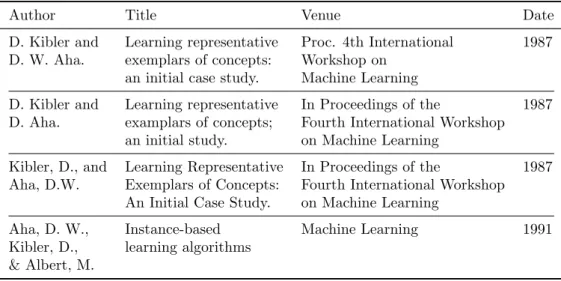
also contains the sought-after paper. The fourth entry has been identified as matching the sought-after paper in spite of the wrong spelling of the author. A number of methods have been proposed that specifically focus on matching citations [Hylton, 1996; Cousins, 1998; Sitas and Kapidakis, 2008]. A data set that has been frequently used to evaluate the performance of dif-ferent methods for matching citations is the Cora data set. The Cora data set contains citations that have been collected from the Cora Computer Science research paper search engine [McCallum et al., 2000b,a]. Table 1.3 shows a few entries from the Cora data set. This example demonstrates some of the
Author Title Venue Date
D. Kibler and Learning representative Proc. 4th International 1987 D. W. Aha. exemplars of concepts: Workshop on
an initial case study. Machine Learning
D. Kibler and Learning representative In Proceedings of the 1987 D. Aha. examplars of concepts; Fourth International Workshop
an initial study. on Machine Learning
Kibler, D., and Learning Representative In Proceedings of the 1987 Aha, D.W. Exemplars of Concepts: Fourth International Workshop
An Initial Case Study. on Machine Learning
Aha, D. W., Instance-based Machine Learning 1991
Kibler, D., learning algorithms & Albert, M.
Table 1.3: Excerpt from the Cora data set. The first three citations refer to the same publication.
challenges that can occur when matching citations:
• Author names may be formatted differently.
• Journals and Conferences are sometimes abbreviated.
• Citations with spelling mistakes should still be identified as duplicates. In Section 3.5.1, we will introduce the Cora data set in detail as one of the data sets that are used to evaluate the performance of the learning algorithms that are proposed in this thesis.
1.1.4
Publishing Linked Data
The central idea of Linked Data [Heath and Bizer, 2011] is to create a Web of Data by publishing and interlinking structured data on the Web. The term
Linked Data refers to a set of best practices for two main purposes: First, to make structured data available on the Web by following existing stan-dards that have been defined by the World Wide Web Consortium (W3C). And secondly, to connect entities by setting typed RDF links, which can be followed in order to discover related entities.
In particular, the core principles of Linked Data, which have been pro-posed by Tim Berners-Lee in his Linked Data note [Berners-Lee, 2006], are the following:
(1) Use URIs as names for things
Uniform Resource Identifiers (URIs) [Berners-Lee et al., 1998] provide glob-ally unique identifiers for entities, link types and concepts. URIs can be used to identify arbitrary things, such as:
Cities: For instance, the URI http://dbpedia.org/resource/Berlin identifies the city of Berlin in DBpedia7 [Bizer et al., 2009b]
Organizations: The URI http://www.w3.org/data#W3C identifies the W3C.
Persons: Tim Berners-Lee is identified in the Semantic Web Confer-ence data set8 by the URI http://data.semanticweb.org/person/
tim-berners-lee.
(2) Use HTTP URIs so that people can look up those names URIs are not merely used as identifiers for things, they are also meant to be dereferenceable. A dereferenceable URI allows the retrieval of informa-tion about the referenced thing from the provider of the URI. The Hypertext Transfer Protocol (HTTP) [Fielding et al., 1999] provides the protocol for ac-cessing information about the referenced entity, link or concept. For instance, a HTTP request on the URI http://dbpedia.org/resource/Berlin, re-turns structured data that describes the city of Berlin as provided by the DBpedia data source.
(3) Use standards to provide information
While the traditional Web relies on human readable documents in order to represented information, the idea of Linked Data is to provide machine read-able structured data. In Linked Data, the Resource Description Framework
7
http://dbpedia.org 8
(RDF) [Manola and Miller, 2004] provides the common format for represent-ing structured data. It follows a graph-based model wherein entities and con-cepts are represented as nodes, while links are represented as edges between nodes. Figure 1.5 depicts an example RDF graph. In the shown example, an
Figure 1.5: Excerpt of an RDF graph.
excerpt from the RDF graph that is returned when dereferencing the URI http://dbpedia.org/resource/Woody_Allen is shown. According to the shown RDF fragment, the given URI identifies an entity of type Person with the name “Woody Allen”. While the name is specified using a literal string value, the home town New York City is referred to with another URI. More information about New York City could be requested by dereferencing the corresponding URI.
An alternative way to access RDF data sources is to provide a SPARQL query service. SPARQL [Prud’hommeaux and Seaborne, 2008] is a query language to retrieve data that is structured using RDF.
(4) Include links to other URIs
While the first three principles are concerned with publishing isolated Linked Data sources on the Web, the fourth principle gives attention to connecting entities in different data sources. In the same way as entities inside a single data source can be connected using an internal RDF link, such as the home-town property in Figure 1.5, external RDF links refer to entities in another data source. Three types of external RDF links are commonly used [Heath and Bizer, 2011]:
Relationship Links relate two entities in different data sources. For in-stance, an entity about a music record in a music data source can point to the corresponding artist in a data source about persons us-ing the RDF property http://xmlns.com/foaf/0.1/maker from the FOAF vocabulary [Brickley and Miller, 2005].
Identity Links connect two entities from different data sources that de-scribe the same real-world object. By convention, the http://www. w3.org/2002/07/owl#sameAs property is usually used to set identity links.
Vocabulary Links are used to relate an entity to a term in a vocabulary or to connect two related terms. For instance, in Figure 1.5, the entity that describes Woody Allen is related to the term that identifies persons in the DBpedia.
Figure 1.6 shows an example with three RDF data sources. This
ex-Figure 1.6: Interconnected RDF data sources. The original URIs have been shortened for illustration.
ample shows how the entity that describes the city of Berlin in DBpedia is connected to other data sources. A LinkedData consumer that dereferences the URI identifying Berlin in DBpedia receives an RDF graph that, among information about Berlin that is provided by DBpedia itself, also contains RDF links to other data sets. For instance, the Linked Data consumer can discover additional information about Berlin by following the owl:sameAs link to the corresponding entity in Eurostat9. On the other hand,
follow-ing the owl:sameAs link to the New York Times10 data set gives access to
information provided by the New York Times.
One of the most prominent efforts around Linked Data is the W3CLinked Open Data (LOD) community project11. The primary aim of LOD is to make information freely available on the Web by using the Linked Data principles.
9
http://ec.europa.eu/eurostat. An RDF version has been published at http:// wifo5-03.informatik.uni-mannheim.de/eurostat/. 10 http://data.nytimes.com/ 11 http://www.w3.org/wiki/SweoIG/TaskForces/CommunityProjects/ LinkingOpenData
The Data Hub12 is an effort to catalog Linked Open Data sources. The
LOD cloud visualizes the current state of the Web of Linked Open Data (see Figure 1.7). The amount of data that is published as Linked Open Data
Figure 1.7: LOD cloud from 2011-09-19. The diagram is maintained by Richard Cyganiak and Anja Jentzsch.
has grown significantly over the last years and is estimated at over 31 billion RDF statements13.
Linked Data Publishers can follow the Linked Data principle of connect-ing data sources by settconnect-ing RDF links from the entities in the data source to related entities in other Linked Data sources. In order to help data publish-ers to set RDF links pointing into other data sources, several link discovery tools - such as Silk or LIMES [Ngonga Ngomo and Auer, 2011] - have been developed. These tools employ entity matching techniques in order to com-pare entities in different Linked Data sources based on user-provided linkage rules, which specify the conditions that must hold true for two entities in order to be interlinked. The links are usually published together with the primary data set itself, but can also be published separately.
12
http://thedatahub.org/ 13
1.2
Contributions
In this thesis, we propose novel algorithms for learning linkage rules that employ an expressive representation that can be executed efficiently. In par-ticular, this thesis makes the following four contributions:
(1) An Expressive Linkage Rule Representation: We propose an ex-pressive linkage rule representation, which is capable of combining dif-ferent distance measures non-linearly and may include chains of data transformations to normalize values prior to comparison. The pro-posed linkage rule representation is more expressive than previous work and subsumes threshold-based boolean classifiers and linear classifiers. Linkage Rules are represented as an operator tree and can be under-stood and modified by humans. The proposed linkage rule representa-tion will be introduced in Chapter 2.
(2) Supervised Learning of Linkage Rules: We propose the GenLink genetic programming algorithm to evolve linkage rules from a set of reference links. The learned linkage rules may utilize the full expres-sivity of the introduced representation. The basic idea of GenLink is to evolve the population of linkage rules by using a set of specialized crossover operators. Each of these operators only operates on one as-pect of the linkage rule, e.g., one crossover operator builds chains of transformations while another operator only combines distance thresh-olds. The experimental evaluation shows that the proposed algorithm is capable of learning linkage rules which:
• Select discriminative properties for comparison.
• Select chains of data transformations to normalize property values prior to comparison.
• Select appropriate distance measures combined with suitable dis-tance thresholds.
• Select appropriate aggregation functions that combine the result of multiple comparisons.
We show that GenLink outperforms the state-of-the-art genetic pro-gramming algorithm for entity matching recently presented by de Car-valho et al. [2012] and is capable of learning linkage rules that achieve a similar accuracy than the human written rule for the same problem. GenLink will be discussed in detail in Chapter 3.
(3) Active Learning of Linkage Rules: For cases where no or only a small number of reference links are available, we propose the Active-GenLink algorithm to generate additional reference links interactively. ActiveGenLink combines genetic programming with active learning in order to automate the generation of the linkage rule while the user only has to verify a set of link candidates. ActiveGenLink uses a novel query strategy that reduces the number of candidates, which need to be la-beled by the user, and outperforms the query-by-vote-entropy strategy, which has been previously used for active learning of linkage rules. The idea of the proposed query strategy is to select link candidates for la-beling that yield a high information gain. Within our experiments, by labeling a small number of links, ActiveGenLink was capable of finding linkage rules with a comparable performance than GenLink on a much bigger set of reference links. In addition, ActiveGenLink outperformed recent unsupervised algorithms after manually labeling a few link can-didates. ActiveGenLink will be discussed in detail in Chapter 4. (4) Efficient Execution of Linkage Rules: It is essential that the
learned linkage rules can be executed efficiently on local or distributed architectures. This thesis proposes the novel MultiBlock indexing method that allows the efficient execution of linkage rules. MultiBlock uses a multidimensional index in which similar objects are located near each other. In each dimension the entities are indexed by a different property increasing the efficiency of the index significantly. In addition, it guarantees that no false dismissals can occur. We show that, using MultiBlock, the linkage rules can be executed efficiently on distributed architectures, such as Hadoop clusters. The proposed execution data flow data that includes MultiBlock will be discussed in Chapter 5.
The proposed methods have been implemented as part of the Silk Link Dis-covery Framework [Isele et al., 2010]. Silk discovers matching entities within data sets that are represented as RDF. The main application area of the framework is to find matching entities within data sets that are accessible on the Web according to the Linked Data principles [Bizer et al., 2009a]. The discovered matches may be used to set RDF links (owl:sameAs) between the data sources. Silk Link Discovery Framework is available for download un-der the terms of the Apache License14and all experiments that are presented in this thesis can thus be repeated by the interested reader. The Silk Link Discovery Framework will be introduced in Chapter 6.
14
1.3
Thesis Outline
Chapter 1: Introduction
This chapter introduces the reader to the main topics of this thesis and highlights its contributions.
Chapter 2: Linkage Rules
This chapter introduces the various parts of a linkage rule in detail and pro-poses an expressive linkage rule representation. The proposed representation may employ data preparation techniques prior to comparing different values of the entities that are to be matched. It allows to combine the resulting similarity scores non-linearly into a single similarity score.
Section 2.2: Data Preparation. As data sources may use different data formats, data needs to be normalized prior to comparison. This section introduces well-known data transformation and standardization meth-ods. The presented methods can be used in the proposed linkage rule representation to normalize property values of entities that are to be compared.
Section 2.3: Field Matching. The similarity between different entities is usually assessed by comparing the values of individual properties of the entities. This section introduces distance measures that are com-monly used to deal with different types of errors, such as typographical variations. The proposed linkage rule representation employs distance measures for comparing the normalized values of two entities.
Section 2.4: Previous Work on Linkage Rules. A linkage rule speci-fies the conditions that must hold true for two entities in order to be considered a match. For this purpose, a linkage rule may combine mul-tiple comparisons of different properties of the entities that are to be matched. This section discusses previous work on representing linkage rules. It shows that popular representations include linear classifiers that combine multiple comparison scores by computing the weighted average and threshold-based boolean classifiers that combine multiple comparisons using logical operators. In contrast to the representation that is proposed in this thesis, linear and threshold-based boolean clas-sifiers do not include data transformations into the linkage rule, but rely on a preceding data preparation stage instead [Elmagarmid et al., 2007].
Section 2.5: An Expressive Linkage Rule Representation. In this sec-tion, we propose an expressive linkage rule representasec-tion, which may combine different distance measures non-linearly and may include chains of data transformations to normalize values prior to compari-son. We show that the introduced linkage rule representation is more expressive than previous work and subsumes threshold-based boolean classifiers as well as linear classifiers.
Section 2.6: Summary. This section summarizes the main points of this chapter.
Chapter 3: Supervised Learning of Linkage Rules
This chapter introduces the first key contribution of this thesis: The GenLink learning algorithm. It motivates machine learning of linkage rules by pointing out that creating linkage rules by hand is a non-trivial problem and requires a high level of expertise together with detailed knowledge of the data sets. We introduce supervised learning as a method to automate the creation of a linkage rule in cases where existing reference links are known.
Section 3.1: Problem Definition. We formalize the problem of learning a linkage rule from existing reference links.
Section 3.2: Genetic Programming. In this section, we introduce ge-netic programming to the reader. We describe the general genetic programming algorithm and highlight the capability of genetic pro-gramming to learn arbitrary operator trees.
Section 3.3: GenLink. In this section, we propose the GenLink super-vised learning algorithm, which employs genetic programming in order to learn linkage rules from a set of existing reference links. Following the genetic programming paradigm, GenLink starts with an initial pop-ulation of candidate solutions, which is iteratively evolved by applying a set of genetic operators.
Section 3.4: Previous Work. This section provides an overview of the current state-of-the-art in machine learning of linkage rules. We dis-cuss supervised learning algorithms, which are concerned with learning linkage rules from reference links, as well as unsupervised learning algo-rithms, which are concerned with matching entities when no reference links are available. We show that most previous algorithms for learn-ing linkage rules either employ threshold-based boolean classifiers or
linear classifiers for representing linkage rules. In addition, we dis-cuss a previously proposed genetic programming algorithm for learning more expressive linkage rules. Finally, we compare the reported perfor-mance scores for different entity matching approaches that have been evaluated on two frequently used evaluation data sets.
Section 3.5: Evaluation and Discussion. We evaluate GenLink with six data sets: (1) We evaluate the learning performance on two frequently used record linkage data sets. The results show that the proposed ap-proach outperforms the state-of-the-art genetic programming apap-proach for entity matching by de Carvalho et al. [2012]. (2) We evaluate the performance with two data sets from the Ontology Alignment Evalu-ation Initiative and compare our results to the participating systems. (3) We compare the learned linkage rules with linkage rules created by a human expert for the same data set. The results show that our approach is capable of learning linkage rules, which achieve a similar accuracy than the human written rule for the same problem.
As we propose an approach that uses a linkage rule representation that is more expressive than the most common representations used in record linkage, we compared the learning performance to threshold-based boolean classifiers and linear classifiers. As GenLink further does not use subtree crossover, which is the de-facto standard in genetic pro-gramming, we evaluated the actual contribution to the learning perfor-mance of the introduced specialized crossover operators.
Section 3.6: Summary. This section summarizes the main points of this chapter.
Chapter 4: Active Learning of Linkage Rules
This chapter starts with highlighting the dependency of supervised learning on existing training data in the form of reference links. We motivates the use of active learning as a semi-supervised learning approach to overcome this limitation by generating additional reference links with minimal user-interaction. Finally, it presents the second key contribution of this thesis: The ActiveGenLink learning algorithm.
Section 4.1: Active Learning. This section introduces active learning to the reader.
Section 4.2: ActiveGenLink. In this section, we propose the ActiveGen-Link algorithm, which combines genetic programming and active
learn-ing to learn linkage rules interactively. We introduce a novel query strategy that reduces user involvement by selecting the link candidates to be verified by the user that are the most informative.
Section 4.3: Previous Work. In this section, we discuss previous work in active learning in general and present existing applications of active learning to entity matching.
Section 4.4: Evaluation and Discussion. We evaluate the performance of ActiveGenLink on the same data sets as have been used to evaluate the supervised GenLink algorithm in the previous chapter. The exper-iments are executed by labeling a maximum of 50 link candidates for each data set and comparing the final performance to results that have been achieved by GenLink. We show that by labeling a small number of link candidates, ActiveGenLink achieves a comparable performance than GenLink on the full set of reference links.
Section 4.5: Summary. This section summarizes the main points of this chapter.
Chapter 5: Execution of Linkage Rules
The efficient execution of linkage rules is essential to scale to large data sets. This chapter introduces a complete workflow to efficiently execute linkage rules which have been manually written or learned by one of the algorithms previously proposed.
Section 5.2: Execution Workflow. This section introduces the overall data flow of executing a linkage rule.
Section 5.3: MultiBlock. We propose a novel indexing method called MultiBlock to efficiently execute linkage rules. The proposed method uses a multidimensional index in which similar objects are located near each other in order to improve the efficiency beyond existing methods. Section 5.4: Previous Work on Indexing. The naive method of execut-ing a linkage rule is to evaluate the rule for each pair of entities from the Cartesian product of all known entities. In record linkage, many index-ing methods have been proposed that substantially reduce the number of required entity comparisons. This section discusses the most com-mon methods.
Section 5.5: Distributed Execution of Linkage Rules. In this sec-tion, we discuss methods to scale the execution of linkage rules to a cluster of machines. We propose a distributed MapReduce-based data flow that employs MultiBlock to scale out the execution of a linkage rule.
Section 5.6: Evaluation and Discussion. We evaluate both the effi-ciency and the effectiveness of the proposed MultiBlock approach. Ef-ficiency is demonstrated by showing that MultiBlock outperforms pre-viously proposed indexing methods. Effectiveness is demonstrated by showing that MultiBlock reduces the number of comparisons signifi-cantly without any false dismissals, even when used with complex link-age rules. Finally, we demonstrate that MultiBlock can be run using the MapReduce paradigm to scale efficiently to a cluster of machines. Section 5.7: Summary. This section summarizes the main points of this
chapter.
Chapter 6: The Silk Link Discovery Framework
This section introduces the Silk Link Discovery Framework. Silk discovers matching entities within data sets that are represented as RDF. Silk imple-ments all methods for learning and executing linkage rules that are proposed by this thesis.
Section 6.1: Silk Link Specification Language. The Silk Link Specifi-cation Language (Silk-LSL) is a declarative language for representing link specifications. A link specification encapsulates all information needed to interlink two data sets. This includes the type of link that is to be generated, information on how to access the data sets that are to be interlinked, the linkage rule including a link filter and finally the outputs to which the link should be written to.
Section 6.2: Silk Workbench. This section describes the Silk Work-bench, a web application that provides a graphical user interface to the Silk Link Discovery Framework. The Silk Workbench provides a graphical user interface to the supervised learning as well as active learning methods implemented in the Silk Link Discovery Framework.
Chapter 7: Conclusion
This chapter summarizes the main contributions of this thesis and discusses known limitations and directions for future work.
1.4
Published Work
Parts of the work presented in this thesis have been published previously:
• Previous work on the GenLink genetic programming algorithm has been presented at two occasions:
Robert Isele, Christian Bizer: Learning Expressive Linkage Rules using Genetic Programming. Proceedings of the VLDB Endowment (PVLDB) 5(11):1638-1649, August 2012.
Robert Isele, Christian Bizer: Learning Linkage Rules us-ing Genetic Programmus-ing. Proceedus-ings of the Sixth Interna-tional Workshop on Ontology Matching, October 2011.
• Previous work on the ActiveGenLink active learning algorithm has been presented at two occasions:
Robert Isele, Christian Bizer: Active Learning of Expressive Linkage Rules using Genetic Programming. Web Semantics: Science, Services and Agents on the World Wide Web, 2013. Robert Isele, Anja Jentzsch, Christian Bizer: Active Learn-ing of Expressive Linkage Rules for the Web of Data. Pro-ceedings of the 12th International Conference on Web Engi-neering (ICWE), July 2012.
• Previous work on the MultiBlock indexing approach is covered by the following publication:
Robert Isele, Anja Jentzsch, Christian Bizer: Efficient Multi-dimensional Blocking for Link Discovery without losing Re-call. Proceedings of the 14th International Workshop on the Web and Databases (WebDB), June 2011.
• The Silk Link Discovery Framework in general is covered in: Robert Isele, Anja Jentzsch, Christian Bizer: Silk Server – Adding missing Links while consuming Linked Data. Pro-ceedings of the First International Workshop on Consuming Linked Data (COLD), November 2010.
Chapter 2
Linkage Rules
A number of different approaches for solving the entity matching problem have been proposed in literature: Unsupervised approaches aim to match entities without any user-provided configuration [K¨opcke and Rahm, 2010; Euzenat et al., 2011a; Aguirre et al., 2012]. An unsupervised approach iden-tifies matching entities based on the characteristics of the data set. In ad-dition, some unsupervised approaches have been proposed that exploit data set independent background knowledge [Michalowski et al., 2004; Doan et al., 2003]. In contrast to unsupervised approaches, rule-based approaches clas-sify each pair of entities as match or non-match based on data set specific linkage rules Winkler [1995]. Within rule-based approaches, a linkage rule specifies how the similarity of a pair of entities is determined. In contrast to rule-based approaches that are local in the sense that they conduct match decisions for each pair of entities independently, collective entity matching approaches conduct match decisions of all related pairs of entities at once globally [Bhattacharya and Getoor, 2007] by exploiting relationships between different types of entities. In the context of this thesis, we focus on machine learning and execution of expressive linkage rules. Section 3.4 will discuss in more detail how our approach compares to unsupervised and collective approaches.
In this section, we will introduce the various components of linkage rules. At first, we will introduce data normalization techniques for preparing values for matching. After that, we will introduce common distance measures for comparing values for similarity. In addition, we will discuss previous work on representing linkage rules that combine multiple similarity measures. Finally, we will introduce the first main contribution of this thesis: a linkage rule representation that is more expressive than previous work and includes data transformations to normalize values prior to comparison.
2.1
Problem Definition
We consider the problem of matching entities between two sets of entities A and B. Each entity e ∈ A∪B can be described with a set of properties e.p1, e.p2, . . . e.pn. For instance, an entity denoting a person may be described
by the properties name,birthday and address. The objective is to determine which entities inA and B identify the same real-world object.
The general problem of entity matching can be formalized as follows [Fel-legi and Sunter, 1969]:
Definition 2.1 (Entity Matching) Given two sets of entities A and B, find the subset of all pairs of entities for which a relation ∼R holds:
M ={(a, b);a∼R b, a∈A, b∈B}
Similarly, we define the set of all pairs for which ∼R does not hold:
U = (A×B)\M
The purpose of relation ∼R is to relate all entities that represent the
same real-world object. Note that entities that are related bysimR are not
necessarily equal (i.e., define properties with the same values). Instead of that, they may differ in some of their values, for instance, due to errors in the data set.
In some cases a subset of M and U is already known prior to matching in the form of reference links.
Definition 2.2 (Reference Links) A set of positive reference links R+ ⊆
M contains pairs of entities for which relation ∼R is known to hold (i.e.,
which identify the same real-world object). Analogously, a set of negative reference links R− ⊆ U contains pairs of entities for which relation ∼R is
known to not hold (i.e., which identify different real-world objects).
Reference links can serve two purposes: Firstly, they can be used to evaluate the quality of a linkage rule. But more importantly, they can also be used to infer a linkage rule, which specifies how the similarity of a pair of entities is determined.
Definition 2.3 (Linkage Rule) A linkage rule l assigns a similarity score to each pair of entities:
l: A×B →[0,1]
The set of matching entities is given by all pairs for which the similarity according to the linkage rule exceeds a threshold θ:
As the linkage rule may return arbitrary values in the range [0,1], we fix the value of the thresholdθ to 0.5 without loss of generality. In literature, linkage rules are also known as identity rules [Lim et al., 1993], record matching rules [Fan et al., 2009] and record matching packages [Arasu et al., 2010]. By using the term linkage rule, we follow the terminology introduced by Fellegi et al. in their article A Theory for Record Linkage [Fellegi and Sunter, 1969].
Instead of using a single threshold, it has also been proposed to use two different thresholds in order to distinguish between three classes: match, non-match, andpossible match [Fellegi and Sunter, 1969]. If the linkage rule assigns a similarity score that is between both thresholds, the pair is regarded as possible match. If the similarity score is higher than the bigger threshold the entity pair is regarded asmatch. Similarly, If the similarity score is lower than the smaller threshold the entity pair is regarded as non-match. The introduction of a third class enables the user to distinguish between entity pairs that are possible matches and thus need to be reviewed by a human expert and entity pairs which are considered certain matches and do not need to be manually confirmed.
2.2
Data Preparation
Data preparation is usually carried out as a separate step preceding the actual matching of the entities. Motivations for using a preparatory data normalization step are diverse:
Firstly, if two data sources that adhere to different schemata are to be matched, their schemata need to be standardized. For instance, one data source might represent person names in separate properties for the first and the last name, while another data source may use a single property for both. In cases like this, data transformation functions need to be applied in order to transform both data sources to a consistent schema.
Another motivation for data normalization is the presence of typograph-ical errors. While some typographtypograph-ical errors cannot easily by removed and have to be dealt with in the comparison phase, many kinds of errors can be removed by a normalization step prior to matching. Examples include the use of an irregular letter case or the inconsistent use of separation characters, such as hyphens. Apart from typographical errors, mismatches also originate from the use of different data formats. In many cases, the reason for this is a lack of an established standard format. Examples of different data formats include the use of different units of measurements and the use of different formats for addresses and telephone numbers.
func-tions for the purpose of preparing the data for matching [Rahm and Do, 2000; Sarawagi, 2008; Pyle, 1999; Elmagarmid et al., 2007; Christen, 2012].
2.2.1
Standardization
Standardization transformations translate values that do not adhere to a consistent content format to a uniform representation [Elmagarmid et al., 2007].
Case Normalization
A common source of mismatches is the use of an irregular letter case (e.g., “eMail” vs. “EMAIL”). A way to address case inconsistency is to normalize all values to lower case prior to comparing them. Figure 2.1 presents a simple example.
Figure 2.1: Case normalization.
Address Standardization
Address standardization is the task of normalizing street addresses into a uniform format [Winkler, 1995; Elmagarmid et al., 2007]. Address standard-ization is necessary if addresses are not following a consistent format.
For illustration, we have a look at two alternative spellings of the same address:
• 23 gary street, Berlin, DE
• 23 Gary St., 10999 Berlin, Germany
A typical approach to standardize such inconsistencies consists of at least three steps:
(1) Segment each address into its components and store each component in a separate entity field (house number, street, city, state, zip code). This step can be skipped if the data set already provides each component separately.
(3) Normalize the letter case, e.g., by capitalizing all words.
In literature, a number of more sophisticated methods for standardiza-tion have been proposed [Li et al., 2002; Guo et al., 2009]. While none of these methods typically achieves optimal results, they are usually sufficient to ensure that subsequent fuzzy string matching methods are capable of iden-tifying potential duplicates.
2.2.2
Stop-Word Removal
A typical normalization operation is to remove characters or words that are very common or do not carry significant extra information [Christen, 2012]. For instance, when matching person names, prefixing titles, such as “Mr.” or “Dr.”, can usually be removed prior to matching. Another example is the removal of common words, such as “the” or “of”.
2.2.3
Structural Transformations
While many data transformations are only applied on the values of a sin-gle property, some other data transformations apply structural transforma-tions on the data sets. For instance, a data source that uses the FOAF vocabulary [Brickley and Miller, 2005] may represent person names using the foaf:firstName and foaf:lastName properties, while a data source using the DBpedia ontology may represent the same names using just the dbpedia:name property. In order to compare entities expressed in differ-ent schemata or data formats, their values have to be normalized prior to comparing them for similarity. In this example, we could achieve this in two ways: We could concatenate foaf:firstName and foaf:lastName into a single name before comparing them to dbpedia:name using a character-based distance measure, such as the Levenshtein distance. Alternatively, we could split the values of dbpedia:name using a tokenizer and compare them to the values of foaf:firstName and foaf:lastName using a token-based distance measure, such as the Jaccard coefficient. Figure 2.2 illustrates the concatenation of two properties as well as the splitting of a single property into two properties. An overview of more complex structural transformations can be found in [Benjamin Braatz, 2008].
Segmentation
Segmentation is a special case of a structural transformation in which a string is split into a set of predefined properties [Sarawagi, 2008]. In literature, a
Figure 2.2: Concatenation and splitting of properties as examples of a struc-tural transformations.
variety of approaches have been proposed to segment strings into structured entities such as product descriptions [Kannan et al., 2011; Ghani et al., 2006], postal addresses [Cai et al., 2005], bibliography records [Borkar et al., 2001] and person names [Christen, 2012].
Figure 2.3 shows an example of segmenting a product description into different properties, such as the product name and the manufacturer of the product.
Figure 2.3: Segmentation of a product offer.
Popular approaches for segmentation in the context of entity matching in-clude rule-based segmentation and statistical segmentation [Christen, 2012]. A typical rule-based segmentation approach consists of a set of rules in which each rule is of the form:
pattern→action
The idea of a rule is that whenever the specified pattern is found in the input string, the corresponding action is executed. An action usually assigns the found pattern, or a part of it, to a specific output property. An example of a rule which extracts a price tag from a product description is:
{currency sign preceded by number} → {Assign number to price property}
In contrast to rule-based systems, statistical segmentation approaches are not based on hard rules. Statistical segmentation approaches start by segmenting the input string into tokens or word chunks. A probability dis-tribution is than used to assign segments of the input string to an output property.
In practice, rule-based methods are usually preferred to statistical meth-ods when the input data is regular and thus strict rules work well [Sarawagi,
2008]. On the other hand, statistical methods are usually preferred if the input data is noisy.
Extraction of Values from URIs
Many data sets that are published as Linked Data encode information in the URI of each entity, which is not necessarily replicated in a property. Data transformations can be used to extract specific values from the URIs, which thereby can be used for matching the corresponding entities. Figure 2.4 illustrates the extraction of an identifier from a URI in a life science data set.
Figure 2.4: Extract a literal value from an URI.
2.3
Field Matching
The task of assessing the similarity of two string values is central to entity matching. As each entity provides a number of fields, matching two enti-ties comes down to comparing the values of individual fields of both entienti-ties. For instance, when matching entities describing persons, field matching tech-niques can be employed to compare individual properties of the persons, such as their names, their birth date or their address.
Field matching measures can either be formulated as similarity measures or as distance measures [Naumann and Herschel, 2010]. Given two string values that are built from an alphabet Σ, a similarity measure returns a value from the range [0,1]:
sim: Σ∗×Σ∗ →[0,1]
A similarity measure returns 1 if both strings are equivalent and 0 if both strings don’t share any similarity. Analogously, we can define a distance measure as:
dist: Σ∗×Σ∗ →R
A distance measure returns 0 if both strings are equivalent and higher val-ues for dissimilar strings. Note that, in contrast to similarity measures, in general, distance measures are not normalized (i.e., they might return values
bigger than one). In order to avoid any confusion, we formulate all measures as distance measures in the context of this work.
In literature, many distance measures have been proposed to match string values for entity matching. Each distance measure is typically targeted at handling a certain kind of variations in the string values. Which distance measure yields the optimal results depends on the specific entity fields that are to be compared and the particular data set. In order to compare two entity fields, a string measure needs to be chosen together with a distance threshold. The distance threshold indicates the maximum distance that is allowed between two values for them to be considered a match.
This section introduces distance measures that are commonly used to deal with different types of variations. We will describe the most well-known character-based measures, which assess the similarity of two strings by com-paring them on the level of individual characters, as well as token-based measures, which compare both strings on the level of individual words. We will also introduce hybrid measures, which combine character-based measures and token-based measure in order to gain the advantages of both. More spe-cific similarity measures, such as measures to compare numeric strings, are also discussed.
Comprehensive overviews of common distance measures can be found in [Elmagarmid et al., 2007; Christen, 2012; Naumann and Herschel, 2010]. While the performance of different distance measures depends on the char-acteristics of the data set, experimental performance comparisons of various distance measures can be found in [Cohen et al., 2003; Christen, 2006].
2.3.1
Character-Based Measures
Character-based distance measures assess the similarity of two string values on character level. They are well-suited for handling typographical errors. Levenshtein Distance
Given two strings s1 and s2, the Levenshtein distance [Levenshtein, 1966]
(sometimes also callededit distance) is defined as the the minimum number of edit operations that are needed to transforms1intos2. Three edit operations
are allowed:
• Insertionof a character into the string.
• Deletion of a character from the string.
We illustrate the computation of the Levenshtein distance on two simple examples: The Levenshtein distance between the strings “Table” and “able” is one as “Table” can be transformed into “able” by deleting the first charac-ter. Similarly, the distance between “Table” and “Cable” is also one as they can be transformed into each other by substituting one character.
Given a finite alphabet Σ and two strings σ1 ∈ Σ∗ and σ2 ∈ Σ∗, the
(unnormalized) Levenshtein distance always returns a whole number between 0 and max(|σ1|,|σ2|). Based on this observation, the Levenshtein distance
can be normalized in order to yield a value from the interval [0,1]: N ormalizedLevensthein(σ1, σ2) :=
Levenshtein(σ1, σ2)
max(|σ1|,|σ2|)
(2.1) Many variations and improvements, both to matching performance as well as execution performance, have been made to the original Levenshtein distance. A comprehensive overview and experimental evaluation of different algorithms for computing the Levenshtein distance can be found in [Navarro, 2001].
Jaro Distance
The Jaro distance metric [Jaro, 1989] has been originally developed to com-pare person names in the U.S. Census. The idea of the Jaro distance is to count the number of common characters within a specific distance. The Jaro distance is defined as [Winkler, 1990]:
J aro(σ1, σ2) := ( 0 if c= 0 1 3 c |σ1|+ c |σ2|+ c−τ c otherwise (2.2) The Jaro distance is based on two parameters:
c: The number of characters that are in common in both strings. Two char-acters are considered in common, if their position in both strings is no further apart than half the length of the longer string minus one.
τ: The number of transpositions of characters. Jaro-Winkler Distance
The Jaro-Winkler distance measure [Winkler, 1990] is an extension of the Jaro distance that assigns a smaller distance to names with a common prefix The Jaro-Winkler distance is defined as [Winkler, 1990]:
J aroW inkler(σ1, σ2) :=J aro(σ1, σ2) +
min(i,4)