Statistics Publications Statistics
2010
Simulating Data to Study Performance of Finite
Mixture Modeling and Clustering Algorithms
Ranjan Maitra
Iowa State University, [email protected]
Volodymyr Melnykov
North Dakota State University--Fargo, [email protected]
Follow this and additional works at:http://lib.dr.iastate.edu/stat_las_pubs
Part of theStatistics and Probability Commons
The complete bibliographic information for this item can be found athttp://lib.dr.iastate.edu/ stat_las_pubs/72. For information on how to cite this item, please visithttp://lib.dr.iastate.edu/ howtocite.html.
This Article is brought to you for free and open access by the Statistics at Iowa State University Digital Repository. It has been accepted for inclusion in Statistics Publications by an authorized administrator of Iowa State University Digital Repository. For more information, please contact
Simulating Data to Study Performance of Finite Mixture Modeling and
Clustering Algorithms
Abstract
A new method is proposed to generate sample Gaussian mixture distributions according to prespecified overlap characteristics. Such methodology is useful in the context of evaluating performance of clustering algorithms. Our suggested approach involves derivation of and calculation of the exact overlap between every cluster pair, measured in terms of their total probability of misclassification, and then guided simulation of Gaussian components satisfying prespecified overlap characteristics. The algorithm is illustrated in two and five dimensions using contour plots and parallel distribution plots, respectively, which we introduce and develop to display mixture distributions in higher dimensions. We also study properties of the algorithm and variability in the simulated mixtures. The utility of the suggested algorithm is demonstrated via a study of initialization strategies in Gaussian clustering. This article has supplementary material online.
Keywords
Cluster overlap, Eccentricity of ellipsoid, Mclust, MixSim, Mixture distribution, Parallel distribution plots
Disciplines
Statistics and Probability
Comments
This is an Accepted Manuscript of an article published by Taylor & Francis in Journal of Computational and Graphical Statisticson January 2012, available online : http://www.tandf.com/10.1198/jcgs.2009.08054.
Simulating Data to Study Performance of Finite Mixture
Modeling and Clustering Algorithms
Ranjan Maitra and Volodymyr Melnykov
∗ AbstractA new method is proposed to generate sample Gaussian mixture distributions according to pre-specified overlap characteristics. Such methodology is useful in the context of eval-uating performance of clustering algorithms. Our suggested approach involves derivation of and calculation of the exact overlap between every cluster pair, measured in terms of their total probability of misclassification, and then guided simulation of Gaussian components satisfying pre-specified overlap characteristics. The algorithm is illustrated in two and five dimensions using contour plots and parallel distribution plots, respectively, which we introduce and de-velop to display mixture distributions in higher dimensions. We also study properties of the algorithm and variability in the simulated mixtures. The utility of the suggested algorithm is demonstrated via a study of initialization strategies in Gaussian clustering.
KEYWORDS: cluster overlap, eccentricity of ellipsoid,Mclust, mixture distribution,MixSim, par-allel distribution plots
1. INTRODUCTION
There is a plethora of statistical literature on clustering datasets (Everitt, Landau and Leesem 2001; Fraley and Raftery 2002; Hartigan 1985; Kaufman and Rousseuw 1990; Kettenring 2006; McLach-lan and Basford 1988; Murtagh 1985; Ramey 1985). With no uniformly best method, it is impor-tant to understand the strengths and weaknesses of different algorithms. Many researchers evaluate performance by applying suggested methodologies to select classification datasets such as Fisher’s Iris (Anderson 1935), Ruspini (1970), crabs (Campbell and Mahon 1974), textures (Brodatz 1966), etc, but this approach, while undoubtedly helpful, does not provide for an extensive investigation into the properties of the algorithm. For one, the adage (see page 74) of Box and Draper (1987) that
∗Ranjan Maitra is Associate Professor in the Department of Statistics and Statistical Laboratory, Iowa State
Uni-versity, Ames, IA and Volodymyr Melnykov is Assistant Professor in the Department of Statistics, North Dakota State University, Fargo, ND 58102. This research was supported in part by the National Science Foundation CAREER Grant # DMS-0437555 and by the National Institutes of Health DC–0006740.
”All models are wrong. Some models are useful.” means that performance can not be calibrated in terms of models with known properties. Also, the relatively easier task of classification is often not possible to perfect on these datasets, raising further misgivings on using them to judge clustering ability. But the biggest drawback to relying exclusively on them to evaluate clustering algorithms is that detailed and systematic assessment in a wide variety of scenarios is not possible.
Dasgupta (1999) defined c-separation in the context of learning Gaussian mixtures as
fol-lows: two p-variate Gaussian densities Np(µi,Σi) and Np(µj,Σj) are c-separated if k µi −
µj k≥ cppmax (dmax(Σi), dmax(Σj)), wheredmax(Σ) is the largest eigenvalue ofΣ. He
men-tioned that there is significant to moderate to scant overlap between at least two clusters forc =
0.5,1.0and2.0. Likas, Vlassis and Verbeek (2003),Verbeek, Vlassis and Krose (2003) and
Ver-beek, Vlassis and Nunnink (2003) used these values to evaluate performance of their clustering algorithms on different simulation datasets. Maitra (2009) modified the above to require equality
for at least one pair (i, j), calling it “exact-c-separation” between at least two clusters, and used
it to study different initialization strategies vis-a-vis different values of c. He however pointed
out that separation between clusters as defined above depends only on the means and the largest eigenvalues of the cluster dispersions, regardless of their orientation or mixing proportion. Thus,
the degree of difficulty of clustering is, at best, only partially captured by exact-c-separation.
Other suggestions have been made in the clustering and applied literature. Most are built on the common-sense assumption that difficulty in clustering can be indexed in some way by the degree of overlap (or separation) between clusters. We refer to Steinley and Henson (2005) for a detailed description of many of these methods, presenting only a brief summary here. Milligan (1985) developed a widely-used algorithm that generates well-separated clusters from truncated multivariate normal distributions. But the algorithm’s statements on degree of separation may be unrealistic (Atlas and Overall 1994) and thus clustering methods can not be fully evaluated under wide ranges of conditions (Steinley and Henson 2005). Similar shortcomings are also characteristic of methods proposed by Blashfield (1976), Kuiper and Fisher (1975), Gold and Hoffman (1976), McIntyre and Blashfield (1980) and Price (1993). Atlas and Overall (1994) manipulated intra-class correlation to control cluster overlap, but they mention that their description is not “perceptually meaningful” (p. 583). Waller, Underhill and Kaiser (1999) provided a qualitative approach to controlling cluster overlap which lacks quantitation and can not be extended to high dimensions.
Recent years have also seen development of the “OCLUS” (Steinley and Henson 2005) and
generated with known (asymptotic) overlap between two clusters, with the proviso that no more than three clusters overlap at the same time. This automatically rules out many possible configura-tions. The algorithm is also limited in its ability to generate clusters with differing correlation
struc-tures. TheRpackage “GenClus” (Qiu and Joe 2006a) uses Qiu and Joe (2006b)’s separation index
which is defined in an univariate framework as the difference of the biggest lower and the smallest upper quantiles divided by the difference of the biggest upper and the smallest lower quantiles. The ratio is thus close to unity when the gap between two clusters is substantial, and negative with a lower bound of -1 when they overlap. This index is not directly extended to multiple dimensions,
so Qiu and Joe (2006a) propose finding the one-dimensional projection with approximate highest
separation index. The attempt to characterize separation between several multi-dimensional clus-ters by means of the best single univariate projection clearly loses substantial information, and thus resulting statements on cluster overlap are very partial and can be misleading.
In this paper, we define overlap between two Gaussian clusters as the sum of their misclas-sification probabilities (Section 2). Computing these probabilities is straightforward in spherical and homogeneous clustering scenarios but involves evaluating the cumulative distribution func-tion (cdf) of the distribufunc-tion of linear combinafunc-tions of independent non-central chi-squared and normal random variables in the general case. This is accomplished using Davies (1980) AS 155 algorithm. We compute exact overlap and develop an iterative algorithm to generate random clus-ters with pre-specified average or/and maximum overlap. Our algorithm applies to all dimensions and to Gaussian mixture models, and is illustrated and analyzed for different overlap
characteris-tics in many settings in Section 3 and in the supplement. We also introduce aparallel distribution
plotto display multivariate mixture distributions. Section 4 calibrates four different initialization
strategies for the expectation-maximization (EM) algorithm for Gaussian mixtures as an example of how our algorithm may be utilized. We conclude with some discussion.
2. METHODOLOGY
LetX1,X2, . . . ,Xnbe independent, identically distributed (iid) p-variate observations from the
mixture density g(x) =
K P
k=1
πkφ(x;µk,Σk), where πk is the probability that Xi belongs to the
kth group with meanµk and dispersion matrixΣkandp-dimensional multivariate normal density
φ(x;µk,Σk) = (2π)− p 2|Σk|− 1 2 exp{−1 2(x−µk)0Σ −1
k (x−µk)}. Our goal is to devise ways to
spec-ify {πk,µk,Σk}s, such that generated realizations X1,X2, . . . ,Xn satisfy some pre-specified
mea-sure in the form of overlap between clusters. Consider two clusters indexed by φ(x;µi,Σi)and
φ(x;µj,Σj)and with probabilities of occurrenceπi andπj. We define overlapωij between these
two clusters in terms of the sum of the two misclassification probabilitiesωj|iandωi|j, where
ωj|i =Pr πiφ(X;µi,Σi)< πjφ(X;µj,Σj)|X ∼Np(µi,Σi) =PrNp(µi,Σi) (X −µj)0Σj−1(X −µj)−(X −µi)0Σ−i 1(X−µi)<log π 2 j |Σi| π2 i |Σj| (1)
and similarly,ωi|j =PrNp(µj,Σj)
h (X −µi)0Σ−i 1(X−µi)−(X −µj)0Σ−j1(X −µj)<log π2i|Σj| π2 j|Σi| i .
2.1 Overlap between two clusters
When both Gaussian clusters have the same covariance structure Σi = Σj ≡ Σ, derivation
of overlap is relatively straightforward. For then ωj|i = Φ(−12
q (µj−µi)0Σ−1(µ j−µi) + logπj πi (µj −µi)0Σ−1(µj−µi)− 1
2), where Φ(x) is the standard normal cdf atx. ω
i|j is
essen-tially the same, with the only difference thatπi is interchanged withπj. It follows that ifπi =πj,
then ωj|i = ωi|j, resulting in ωij = 2Φ
−1 2 q µj−µi0Σ−1 µj−µi
. For spherical
clus-ters withπi 6= πj, ωj|i = Φ(−kµj −µik/2σ+σlog
πj
πi/kµj −µik), with, once again, a similar
expression forωi|j. For equal mixing proportionsπi =πj,ωij = 2Φ −
µi −µj /2σ . For the case of general covariance matrices, we are led to the following
Theorem 2.1. Consider twop-variate Gaussian clusters indexed by Np(µi,Σi) andNp(µj,Σj)
and mixing proportionsπiandπj, respectively. DefineΣj|i ≡Σ 1 2 i Σ −1 j Σ 1 2
i , with spectral
decompo-sition given by Σj|i = Γj|iΛj|iΓj|i0 , where Λj|i is a diagonal matrix of eigenvaluesλ1, λ2, . . . , λp
ofΣj|i, andΓj|i is the corresponding matrix of eigenvectorsγ1,γ2, . . . ,γp ofΣj|i. Then
ωj|i = PrNp(µi,Σi) p X l=1 l:λl6=1 (λl−1)Ul+ 2 p X l=1 l:λl=1 δlWl ≤ p X l=1 l:λl6=1 λlδl2 λl−1 − p X l=1 l:λl=1 δl2+ log π 2 j |Σi | π2 i |Σj | , (2)
where Ul’s are independent noncentral-χ2-distributed random variables with one degree of
free-dom and non-centrality parameter given by λ2
lδl2/(λl −1)2 with δl = γl0Σ −1
2
i (µi −µj) for l ∈ {1,2, . . . , p} ∩ {l : λl = 16 }, independent of the Wl’s, which are independent N(0,1)random
variables, forl ∈ {1,2, . . . , p} ∩ {l :λl= 1}.
Proof: When X ∼ Np(µi,Σi), it is well-known that (X −µi) 0Σ−1 i (X −µi) ∼ χ2p. Let Z ∼ Np(0,I). Then(X −µj)0Σ −1 j (X −µj) d = (Σ 1 2 i Z +µi −µj)0Σ −1 j (Σ 1 2 iZ +µi −µj) =
[Z +Σ− 1 2 i (µi −µj)]0Σ 1 2 i Σ −1 j Σ 1 2 i [Z +Σ −1 2 i (µi −µj)] = [W +Γ 0 j|iΣ −1 2 i (µi −µj)]0Λj|i[W + Γ0j|iΣ− 1 2 i (µi−µj)] = Pp l=1λl(Wl+δl) 2, whereW =Γ0
j|iZ. Note also that(X−µi)
0Σ−1 i (X− µi)=d Z0Z =W0W =Pp l=1W 2 l ∼χ 2
p. Thusωj|ireduces to Pr[Ppl=1λl(Wl+δl)2−
Pp l=1W 2 l < log π 2 j|Σi| π2 i|Σj|] = Pr[ Pp l=1{(λl−1)Wl2+ 2λlδlWl+λlδ2l} < log π2 j|Σi| π2
i|Σj|]. Further reduction proceeds
with regard to whetherλlis greater than, less than, or equal to 1, which we address separately.
(a) λl >1: In this case, (λl − 1)Wl2 + 2λlδlWl +λlδ2l = (
√ λl−1Wl +λlδl/ √ λl−1)2 − λlδ2l/(λl −1). Note that √ λl−1Wl +λlδl/ √ λl−1 ∼ N(λlδl/ √ λl−1, λl− 1)so that (√λl−1Wl+λlδl/ √ λl−1)2 ∼(λl−1)χ21,λ2 lδl2/(λl−1)2. (b) λl <1: Here(λl−1)Wl2+2λlδlWl+λlδl2 =−( √ 1−λlWl−λlδl/ √ 1−λl)2−λlδ2l/(λl−1)
where, similar to before,(√1−λlWl−λlδl/
√ 1−λl)2 ∼(1−λl)χ21,λ2 lδ 2 l/(λl−1)2. (c) λl = 1: In this case,(λl−1)Wl2+ 2λlδlWl+λlδl2 = 2δlWl+δl2.
Combining (a), (b) and (c) and moving terms around yields (2) in the statement of the theorem. 2
Analytic calculation of ωj|i is impractical, but numerical computation is readily done using
Algorithm AS 155 (Davies 1980). Thus we can calculateωij between any pair of Gaussian clusters.
Our goal now is to provide an algorithm to generate mean and dispersion parameters for clusters with specified overlap characteristics, where overlap is calculated using the above.
2.2 Simulating Gaussian cluster parameters
The main idea underlying our algorithm for generating clusters with pre-specified overlap charac-teristic is to simulate random cluster mean vectors and dispersion matrices and to scale the latter iteratively such that the distribution of calculated overlaps between clusters essentially matches the desired overlap properties. Since overlap between clusters may be specified in several ways, we fix ideas by assuming that this specification is in the form of the maximum or average (but at this point, not both) overlap between all cluster pairs. We present our algorithm next.
2.2.1. Clusters with pre-specified average or maximum pairwise overlap The specific steps of our iterative algorithm are as follows:
1. Generating initial cluster parameters. ObtainK randomp-variate cluster centers{µk;k = 1,2, . . . , K}. To do so, take a random sample of sizeKfrom some user-specified distribution
matrices{Σk;k = 1, . . . , K}. Although there are many approaches to generatingΣks, we
propose using realizations from the standard Wishart distribution with degrees of freedom
given byp+ 1. This is speedily done using the Bartlett (1939) decomposition of the Wishart
distribution. While the low choice of degrees of freedom allows for great flexibility in orien-tation and shape of the realized matrix, it also has the potential to provide us with dispersion matrices that are near-singular. This may not be desirable, so we allow pre-specification of a maximum eccentricity emax for all Σks. Similar to two-dimensional ellipses, we define
eccentricity ofΣ inp-dimensions ase = p1−d(p)/d(1), whered(1) ≥ d(2) ≥ . . . ≥ d(p)
are the eigenvalues ofΣ. Thus, given current realizations Σk, we get corresponding
spec-tral decompositions Σk = VkDkV0k, with Dk as the diagonal matrix of eigenvalues (in
decreasing order) ofΣk andVk as the matrix of corresponding eigenvectors, and calculate
the eccentricity eks. For those Σk’s (say, Σl) for which ek > emax, we shrink
eigenval-ues towards d((1)l) such that e(newl) = emax. In order to do this, we obtain new eigenvalues
d((l∗i)) = d((1)l)(1− e2max(d(1)(l) − d((li)))/(d(1)(l) −d((pl)))). Note that d((1)l∗) ≥ d((2)l∗) ≥ . . . ≥ d((l∗p)),
d(1)(l∗) = d((1)l), and enew(l) = emax. Reconstitute Σ∗l = VlD∗lV
0
l, where Vl is as above, and
Dl∗ is the diagonal matrix of the new eigenvalues d((1)l∗) ≥ d(2)(l∗) ≥ . . . ≥ d((l∗p)). To simplify
notation, we continue referring to the new matrixΣ∗l asΣl.
2. Calculate overlap between clusters. For each cluster pair{(i, j); 1 ≤ i < j ≤ K}indexed
by corresponding parameters{(πi,µi,Σi),(πj,µj,Σj)}, obtainωj|i,ωi|j,Σj|i,Σi|j,δi|jand
δj|i whereδi|j =Γ0i|jΣ
−1 2
j (µj −µi). Calculate ωij for the cluster pair using Davies (1980)
AS 155 algorithm on Equation (2) in Theorem 2.1. Computeωˆˇ orωˆ¯ depending on whether
the desired controlling characteristic is ωˇ or ω¯, respectively. If the difference between the
ˆ ˇ
ω (orωˆ¯) and ωˇ (correspondingly,ω¯) is negligible (i.e. within some pre-specified tolerance
level ), then the Gaussian cluster parameters {(πk,µk,Σk) : k = 1,2, . . . , K} provide
parameters for a simulated dataset that correspond to the desired overlap characteristic. 3. Scaling clusters. If Step 2 is not successful, replace each Σk with its scaled version cΣk,
wherecis chosen as follows. For each pair of clusters (i, j), calculateωj|i (and thus ωˆ¯(c)
orωˆˇ(c)) as a function ofc, by applying Theorem 2.1 to cΣk’s. Use root-finding techniques
to find a csatisfying ωˆˇ(c) = ˇω (or ωˆ¯(c) = ¯ω). For this c, the Gaussian cluster
parame-ters {(πk,µk, cΣk) : k = 1,2, . . . , K} provide parameters for the simulated dataset that
Some additional comments are in order. Note that, but for the minor adjustmentδnewi|j = c−12δi|j,
Step 3 does not require re-computation of the quantities already calculated in Step 2 and involved in Equation (2). This speeds up computation, making root-finding in Step 3 practical.
Step 3 is successful only when Step 1 yields valid candidate(µk,Σk, πk)s, i.e. those capable
of attaining the targetω¯ (orωˇ). Asc→ ∞,δnewi|j →0andωj|i →ωj|i∞ = PrNp(µi,Σi)
h Pp l=1 l:λl6=1 (λl− 1)Ul ≤ log π2 j|Σi| π2 i|Σj| i where Ul iid
∼ central-χ2 with one degree of freedom. Thus for every
candi-date pair, a limiting overlap (ω∞ij = ωj|i∞ +ωi|j∞) can be obtained, with corresponding limiting
average (ωˆ¯∞) or maximum (ωˆˇ∞) overlaps. If ω¯ˆ∞ < ω¯ (or ωˆˇ∞ < ωˇ), then the desired overlap
characteristic is possibly unattainable using the (consequently invalid) candidate (µk,Σk, πk)s,
and new candidates are needed from Step 1. By continuity arguments, andωˆ¯(c)→0 (ˆωˇ(c)→0)
as c → 0, Step 3 is always successful for valid candidate (µk,Σk, πk)s. Also, the asymptotic
overlap is completely specified by(Σk, πk)s; candidateµks play no role whatsoever. Finally, note
that a conceptually more efficient approach would be to compare the maximum ofωˆ¯(c)– instead
ofωˆ¯∞ (orωˆˇ(c) – instead ofωˆˇ∞) – with the target ω¯ (or ωˇ), thereby retaining possible candidate
(µk,Σk, πk)s otherwise discarded becauseωˆ¯∞ <ω¯ (orωˆˇ∞ < ωˇ). However, maximizingωˆ¯(c)by
taking derivatives produces functions as in Theorem 2.1 of Press (1966), which require expensive
calculations of the confluent hypergeometric function 1F1 (Slater 1960). Potential gains would
likely be lost, especially considering our experience that the maximum ofωij(c)never exceeded
ωij∞for any pair of components(i, j)in thousands of simulation experiments.
Our objective of avoiding computationally expensive calculations involving 1F1 is also why
we choose not to use a derivative-based Newton-Raphson method for finding a root in Step 3.
We instead first hone in on bounds on the targetcby restricting attention to (positive or negative)
powers of 2, and then find a root using the method of Forsythe, Malcolm and Moler (1980). The material presented so far details a computationally practical approach to generating Gaus-sian clustered data satisfying some overlap characteristic such as average or maximal overlap. However, a single characteristic is unlikely to comprehensively capture overlap in a realization. For instance, the average overlap may come about from few cluster pairs with substantial overlap, or where many cluster pairs have overlap measures close to each other (and the average). At the other end, the maximal overlap is driven entirely by one cluster pair (the one with largest overlap, which amount we control). Consequently, we may obtain scenarios with very varying clustering difficulty, yet summarized by the same characteristic. Thus, we need strategies which can control at least two overlap characteristics. We address a way to generate Gaussian cluster parameters
satisfying two overlap characteristics – the average and maximal overlap – next.
2.2.2. Clusters with pre-specified average and maximum pairwise overlap The basic
philoso-phy here is to first use Section 2.2.1 to generate{(µk,Σk, πk) :k = 1,2, . . . , K}satisfyingωˇ. The
component pair satisfying ωˇ is held fixed while the remaining clusters are scaled to also achieve
the targetedω¯. The algorithm is iterative in spirit with specifics as follow:
1. Initial generation. Use Section 2.2.1 to obtain(µk,Σk, πk)s satisfyingωˇ. Find (i∗, j∗) 3
ωi∗j∗ = ˇω. Unless the realization is discarded in Step 2 below,(µi∗,Σi∗, πi∗)and(µj∗,Σj∗, πj∗)
are kept unchanged all the way through to termination of the algorithm.
2. Validity check. Findc(call it c∨) such that ωij(c∨) ≤ ωˇ ∀(i, j) 6= (i∗, j∗). If ω¯ˆ(c∨) < ω¯,
Step 3 may not terminate, so discard the realization and redo Step 1 again.
3. Limited scaling. Redo Step 3 of the algorithm in Section 2.2.1 to obtain the targeted ω¯,
with c ∈ (0, c∨). Note that the pair (i∗, j∗) does not participate, and thus λnewi∗|j = cλi∗|j,
λnewi|j∗ =λi|j∗/candδnewi|j∗ =δi|j∗in the calculations for Equation 2 of Theorem 2.1.
4. Final check. Ifωij(c)> ωi∗j∗ for some(i, j)6= (i∗, j∗), discard realization and redo Step 1.
Ac∨in Step 2 is guaranteed to exist, because for every pair(i, j)6= (i∗, j∗),ωij(c)→0asc→
0. We findc∨by first considering the pair(i0, j0)with largest asymptotic overlapωi∞0j0. Ifωi∞0j0 ≤ωˇ,
then the desiredc∨ is obtained: letc∨ ≡ ∞. Otherwise, findcfor whichωi0j0(c) = ˇω. This is our
candidatec0
∨: we evaluateωij(c0∨)for all other pairs(i, j)(including pairs with one componenti∗
orj∗). Ifωi00j00(c0∨)>ωˇfor some pair(i00, j00), we find an updated candidatec1∨ ∈(0, c0∨)satisfying
ωi00j00(c1∨) = ˇω. The process continues until a globalc∨satisfying all pairs is found.
Step 4 is a final bulwark against the possibility that any configuration at this stage does not
satisfy bothω¯ andωˇ. This last may be a rare possibility, however, since none of our realizations
were discarded at this stage in any of the thousands of simulation experiments reported in this paper.
Controlling overlap characteristics through both ω¯ and ωˇ provides greater definition to the
complexity of the clustering problem, while keeping implementation of the algorithm practical.
However, forK > 2and ω¯ very close toωˇ, it may still not be possible to obtain a realization in
a reasonable amount of computer time. For most practical scenarios however, ωˇ is unlikely to be
It may also be desirable to specify distribution of the overlaps in terms of other characteristics
such as ω¯ and standard deviation ωσ. We propose rewriting such characteristics (which may be
harder to implement for cluster generation using the methods above) in approximate terms ofω¯and
ˇ
ω. We assume that the pairwise overlaps areK(K+1)/2random draws from aβ(γ, ν)distribution,
and use the relationships IE(ω) = γ/(γ+ν)and Var(ω) = γν/[(γ+ν)2(γ+ν + 1)]. Equating
the above withω¯ andω2
σ respectively provides the following estimatesγ =
¯ ω 2¯ω+1 ¯ ω(1+¯ω) ω2 σ(2¯ω+1)2 −1 andν = 2¯1+¯ω+1ω ω2ω¯(1+¯ω) σ(2¯ω+1)2 −1
. Note that there are constraints on the set of possible values forω¯
andωσ related to the fact thatγ, ν >0. Given the distribution of overlaps, we are thus able to use
order statistic theory to find the density ofωˇ. The mode of this density is calculated numerically
and can be used in conjunction withω¯ to obtain clusters with desired overlap characteristics. We
note that we have found this relationship to hold in all our empirical experiments with K larger
than 5 and values ofω¯ ≤0.05. In the clustering context, the last is a reasonable restriction. Thus,
we propose using this empirical relationship forK >5andω¯ ≤0.05. ForK ≤5orω >¯ 0.05, we
continue with specifying overlap in terms ofω¯andωˇ directly. If some realization does not satisfy
some desired additional characteristic, we discard the sample and regenerate a new proposal.
2.2.3. Incorporating scatter in clustered datasets There has of late been great interest in the development of algorithms addressing clustering in the presence of scatter (Maitra and Ramler 2008; Tseng and Wong 2005). Experimental cases allowing for algorithms to be calibrated are
fairly straightforward given our algorithm: we generatep-dimensional uniform realizations on the
desired hypercube containing the clusters, but outside the100(1−αs)%regions of concentration for
the mixture density
K P
k=1
πkφ(x;µk,Σk). The proportion of scatter (s) as well asαsare parameters
in the cluster generation, impacting clustering performance, and can be pre-set as desired.
2.2.4. Comparison of overlap probability and c-separation We end this section by
compar-ing our overlap measure with exact-c-separation (Dasgupta 1999; Maitra 2009) for homogeneous
spherical clusters. In this case,ωˇ = 2Φn−c
√ p
2
o
, so that for homogeneous spherical clusters, using
ˇ
ωas the sole characteristic to describe cluster overlap is equivalent to using exact-c-separation.
3. ILLUSTRATION AND ANALYSIS OF ALGORITHM
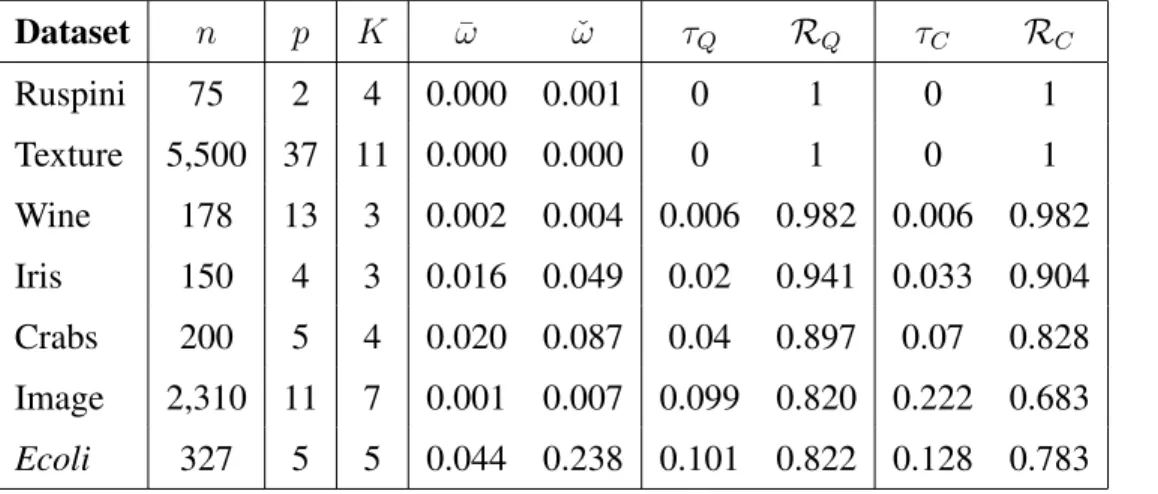
In this section, we examine and illustrate different aspects of the algorithm presented in Section 2. We examine overlap characteristics of some commonly-used classification datasets and present
Table 1: Misclassification rates (τQ, τC) and adjusted Rand indices (RQ,RC) obtained on some
standard classification datasets using quadratic discriminant analysis (QDA) and EM-clustering.
Dataset n p K ω¯ ωˇ τQ RQ τC RC Ruspini 75 2 4 0.000 0.001 0 1 0 1 Texture 5,500 37 11 0.000 0.000 0 1 0 1 Wine 178 13 3 0.002 0.004 0.006 0.982 0.006 0.982 Iris 150 4 3 0.016 0.049 0.02 0.941 0.033 0.904 Crabs 200 5 4 0.020 0.087 0.04 0.897 0.07 0.828 Image 2,310 11 7 0.001 0.007 0.099 0.820 0.222 0.683 Ecoli 327 5 5 0.044 0.238 0.101 0.822 0.128 0.783
realized mixture densities with substantial and lowω¯ and low and moderate variation ωσ in these
overlaps. We chose= 10−6ande
max = 0.9in all experiments. Further, we setπks to all be at least
π∧, the smallest value for which there is, with high probability, at least(p+ 1)observations from
each component in a dataset containingnobservations from the mixture. We also study possible
geometries of generated mixture densities, and present studies on convergence of Section 2.2.1 Step 3 and Section 2.2.2 Step 2. For brevity, we summarize our results here, with details on many of these issues relegated to the supplementary materials. In what follows, figures and tables labeled with the prefix “S-” refer to figures and tables in the supplement.
3.1 Illustration on Classification Datasets
In order to understand possible values of ω¯ and ωˇ, we first calculate overlap characteristics of
some commonly-used classification datasets. These are the Iris (Anderson 1935), Ruspini (1970), crabs (Campbell and Mahon 1974), textures (Brodatz 1966), wine (Forina 1991), image (D.J. New-man and Merz 1998) and Ecoli (Nakai and Kinehasa 1991) datasets. We summarize in Table 1
our calculated ω¯ and ωˇ, misclassification rates τ and adjusted Rand measures R (Hubert and
Arabie 1985) using quadratic discriminant analysis (QDA) and model-based clustering using EM.
Bothτ andR are calculated between the true classifications on one hand and the QDA and EM
groupings each on the other. Note thatR ≤1with equality attained for a perfectly matched
group-ing. Further, to minimize impact of initialization, the EM was started using the true group means,
dispersions and mixing proportions. Thus, the attainedRs can be regarded as the best-case values
calcula-tions are made assuming a Gaussian distribution, with each dataset as one realization from this presumed distribution. Thus, restricting attention to classification datasets means that comprehen-sive understanding of clustering performance may be difficult. The results on the image dataset perhaps highlight this dilemma the best: we are unclear whether its relatively poorer performance
is driven byK,p, model inadequacy, imprecise estimation of parameters, whether it is just because
the dataset is one less probable realization from the mixture, etc. We note that for similar(K, p, n),
low values ofω¯ andωˇ generally provide lower τs and higherRs, while higher values correspond
to worse performance (higherτs and lowerRs).
3.2 Simulation Experiments 0.0 0.2 0.4 0.6 0.8 1.0 0.0 0.2 0.4 0.6 0.8 1.0 Overlap
Adjusted Rand Inde
x
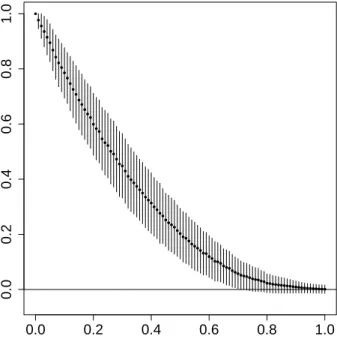
Figure 1: Mean±SDs ofRs to evaluate
cluster-ing in two-component two-dimensional Gaussian mixtures with different levels of overlap.
3.2.1. Validity of Overlap as Surrogate for Clustering Complexity We first investigated the validity of using our defined overlap as a surrogate measure for clustering complex-ity. We simulated 2,000 datasets, each with 100 observations, from a dimensional
two-component Gaussian mixture satisfying π∧ =
0.2and a given overlap measure (sinceK = 2,
¯
ω = ˇω ≡ω). For each dataset, we applied the
EM algorithm (initialized, with the parameter values that generated the dataset, to eliminate possible ill-effects of improper initialization),
obtained parameter estimates, and computedR
on the derived classification. This was done forω ∈ {0.001,0.01,0.02,0.03, . . . ,1.0}. Fig-ure 1 displays the mean and standard deviations
ofRfor the different values ofω. Clearly,ω tracksRvery well (inversely), providing support for
using our overlap measure as a reasonable surrogate for clustering complexity.
Figures S-1 and S-2 display sample two-component two-dimensional finite mixture models,
forω ∈[0.001,0.75]. From these figures, it appears that distinctions between the two components
is sometimes unclear for ω = 0.15. The trend is accentuated at higher values: the two
being two Gaussian components perhaps provides us with some visual cue into their individual structures. This matches the trend in Figure 1, since as components become indistinguishable, we
essentially move towards a random class assignment, for which caseRis constructed to have zero
expectation (Hubert and Arabie 1985). Based on Figure 1 and the realized mixtures in Figures S-1 and S-2, we conclude that pairwise overlaps of below 0.05 indicate well-separated components, while those between around 0.05 and 0.1 indicate moderate separation. Pairwise overlaps above 0.15 in general produce poorly-separated components. We use this in determining possible choices
forωˇ andω¯. Figures S-1 and S-2 also provide some inkling into possible geometries induced by
our simulation algorithm for differentω.
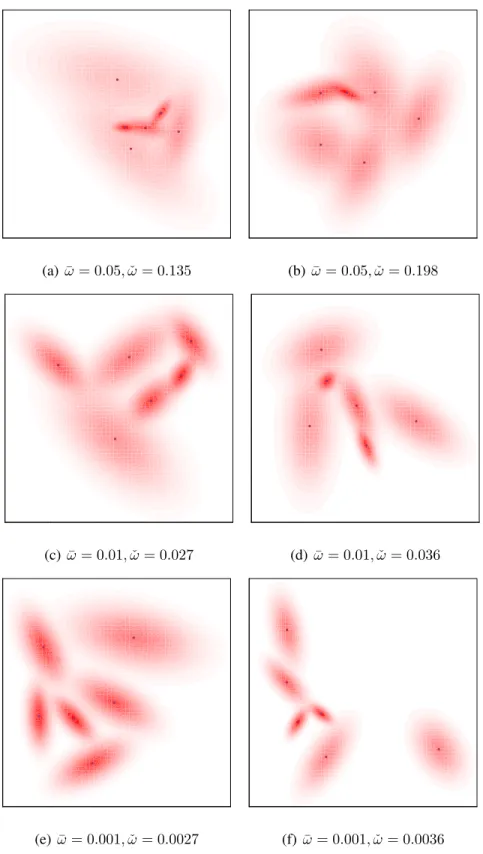
3.2.2. Two-dimensional Experiments Figure 2 presents contour plots of sample two-dimensional
mixture distributions generated forK = 6 and different values(¯ω,ωˇ). The choice ofωˇ was
dic-tated by ωσ = ¯ω and2¯ω and using the empirical β distribution for cluster overlaps discussed in
Section 2.2.2. We setπ∧ = 0.14. Different choices ofω¯ andωˇ provide us with realizations with
widely varying mixture (and cluster) characteristics. To see this, note that Figures 2a and 2b both
have high average overlap (ω¯ = 0.05) between cluster pairs. In Figure 2a,ωˇis comparatively low,
which means that quite a few pairs of clusters have substantial overlap between them. In Figure 2b however, the clusters are better-separated except for the top left cluster pair which is quite
poorly-separated, satisfyingωˇ and contributing substantially to the highω¯ value of 0.05. Thus, in the first
case, many pairs of clusters have considerable overlap between them, but in the second case, a few cluster pairs have substantial overlap while the rest overlap moderately. The same trends are repeated for Figures 2c and 2d and Figures 2e and 2f, even though the cluster pairs are increasingly
better-separated, satisfying ω¯ = 0.01and 0.001, respectively. Thus in Figure 2e, there is at best
modest overlap between any two clusters, while in Figure 2f, there is even less overlap, save for the two clusters with smallest dispersions, which have far more overlap than the clusters in Figure 2e.
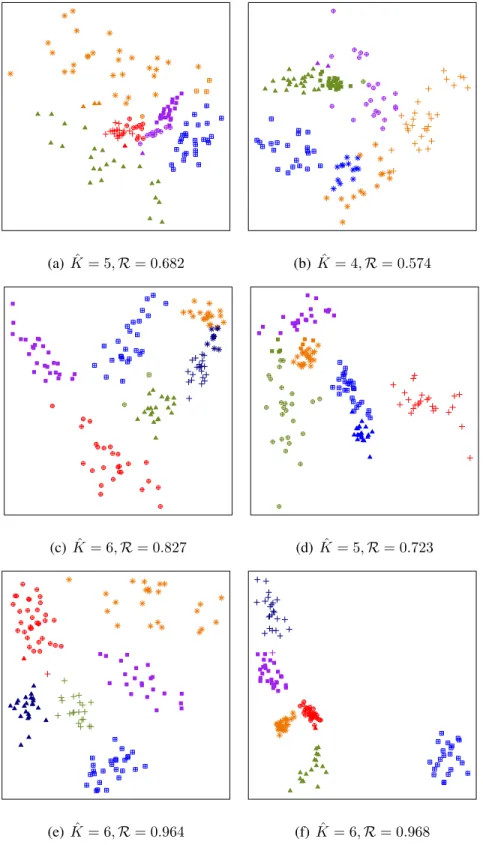
Impact on performance ofMClust We also clustered a sample dataset obtained from each mix-ture model in Figure 2. We generated 150 realizations from each distribution and classified each observation to its most likely group, based on the true parameter values. The resulting classifica-tion, displayed in each of Figures 3a–f via plotting character, represents the idealized grouping that can perhaps ever be achieved at each point. (Note that even supervised learning in the form of QDA may not always be expected to achieve this result, since the parameter values are estimated from
0.0 0.2 0.4 0.6 0.8 1.0 (a) ω¯ = 0.05,ωˇ = 0.135 0.0 0.2 0.4 0.6 0.8 1.0 (b) ω¯= 0.05,ωˇ= 0.198 0.0 0.2 0.4 0.6 0.8 1.0 (c) ω¯ = 0.01,ωˇ = 0.027 0.0 0.2 0.4 0.6 0.8 1.0 (d) ω¯ = 0.01,ωˇ = 0.036 0.0 0.2 0.4 0.6 0.8 1.0 (e)ω¯ = 0.001,ωˇ = 0.0027 0.0 0.2 0.4 0.6 0.8 1.0 (f) ω¯ = 0.001,ωˇ = 0.0036
Figure 2: Contour plots of sample six-component mixture distributions in two dimensions obtained
the training data.) For each dataset, we used model-based clustering via theMclustfunction in the
R package MCLUST(Fraley and Raftery 2006). The function uses BIC to obtain the best-fitting
model over a range of mixing components, set to be between 1 and 12 here. We invokedMclustto
choose the best model with unstructured dispersion matrices. Figure 3a–f uses color to display the
resulting groupings. We also reportRbetween theMclustand the idealized classifications.
Figure 3 illustrates the impact on the performance ofMclustof varying the amount and nature
of overlap between clusters. ThusMclust’s performance was worse for largerω¯, but the magnitude
of poor performance depended on ωˇ. For instance, consider the two cases for whichω¯ = 0.05.
In Figure 3a where there is considerable overlap between many clusters, Mclust identified five
groups, misclassifying portions of almost every class and distributing observations from the
least-separated cluster into two other classes. In Figure 3b however,Rwas lower with the major part of
the disagreement due to the merger of the two most-overlapping groups, and the near-merger of the
next most-overlapping clusters – thus BIC optimally identified only four groups. Whenω¯ = 0.01,
performance was better withωˇ = 0.027(Figure 3c; six optimal clusters) because all cluster pairs
at best modestly overlapped with each other. On the other hand, withω¯ = 0.01and ωˇ = 0.036,
there were expectedly more misclassifications between the few cluster pairs with moderate overlap while the remaining groups were well-identified: BIC found only five clusters to be optimal. With
¯
ω = 0.001 both scenarios performed well, even though the case with ωˇ = 0.004 had a slightly
higherRvalue than the one withωˇ = 0.003. The results of these illustrative experiments indicate
that the nature and degree of overlap between groups, as summarized byω¯andωˇ, have the potential
to impact performance of clustering algorithms, in this caseMclust. We note that our statements on
clustering performance are inferred here based only on one sample realization from each setting: obtaining a comprehensive understanding will entail generating several datasets with given overlap characteristics and evaluating performance on each. Indeed, this last is the objective of our cluster generation algorithm, which we demonstrate in Section 4.
We conclude this section by referring to Figures S-3 and S-4 (in the supplement) which provide four sample mixture model realizations, for each of the six pairs of settings in Figure 2. These figures display very well the range of six-component mixture models that can be obtained using our simulation algorithm. Additionally, as with the two-component examples, it seems that many
(a) Kˆ = 5,R= 0.682 (b) Kˆ = 4,R= 0.574
(c)Kˆ = 6,R= 0.827 (d) Kˆ = 5,R= 0.723
(e) Kˆ = 6,R= 0.964 (f)Kˆ = 6,R= 0.968
Figure 3: Groupings obtained usingMcluston a realization from the corresponding mixture
dis-tributions of Figure 2. Color indicates theMclustgrouping and character the best possible
classi-fication with known parameter values. Optimal numbers of clusters as determined by BIC are also noted in the captions for each sub-figure.
3.2.3. Higher-dimensional Examples We have also successfully used our algorithm to simulate mixture distributions of up to 50 components and for dimensions of up to 100. Note that in terms of computational effort, our algorithm is quadratic in the number of clusters because we calculate all pairwise overlaps between components. There is no ready technique for displaying
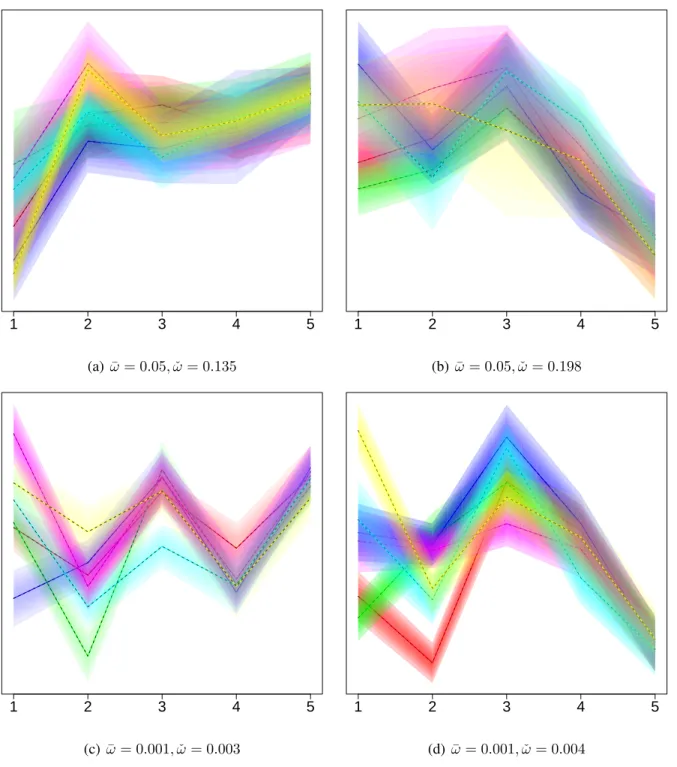
higher-dimensional distributions, so we introduce theparallel distribution plot, and use this in Figure 4 to
illustrate some sample mixture distributions realized using our algorithm.
Parallel distribution plot The objective of the parallel distribution plot is to display a mul-tivariate mixture distribution in a way that contrasts and highlights the distinctiveness of each mixture component. We note that the dispersion matrix of a mixture density of the kind
consid-ered in this paper,i.e. g(x) =
K P k=1 πkφ(x;µk,Σk), is given byΣ• = K P k=1 πkΣk + K P k=1 πkµkµ0k− K P l=1 K P k=1
πlπkµlµ0k. Let V• be the matrix of orthonormal eigenvectors [v1...v2.... . ....vp],
correspond-ing to the eigenvalues d1 ≥ d2 ≥ . . . dp of Σ•. Applying the rotation V0• to the mixture
pro-vides us with the principal components (PCs) of the mixture. These PCs are uncorrelated with
decreasing variance given by d1 ≥ d2 ≥ . . . dp. Also, the distribution of these PCs is still a
mixture, of (rotated) Gaussians, with the kth rotated component having mixing proportion πk
and multivariate Gaussian distribution with mean vector V0•µk and dispersion V0•ΣkV•. We
display the distribution of each mixture component, borrowing ideas from parallel coordinate
plots (Inselberg 1985; Wegman 1990). Note that each componentk only contributes a total mass
of probabilityπk. For each componentkandjth marginal distribution (in projection space), locate
the quantiles{qkj1, qkj2, . . . , qkjm}corresponding to them−1equal increments in probabilities in
(0, πk). The quantileqkjiof thejth marginal distribution is connected to the quantileqk(j+1)iof the
(j+ 1)th marginal distribution by means of a parallel coordinate plot. The polygon formed by the
two successive quantiles and the lines joining each is shaded with a given color, unique to every cluster component, and with varying opacity. The opacity at the vertical edges of each polygon
is proportional to the density at the mid-point of the interval (qkji, qkj(i+1)). Inside the polygon,
the opacity varies smoothly in the horizontal direction (only) as a convex combination of the edge opacities. Thus, we get a parallel distribution plot. Finally, we contend that though we develop and use parallel distribution plots here solely to display mixture distributions, they can also be used to display grouped data, by replacing each theoretical quantile by its empirical cousin.
1 2 3 4 5 (a)ω¯= 0.05,ωˇ= 0.135 1 2 3 4 5 (b) ω¯ = 0.05,ωˇ = 0.198 1 2 3 4 5 (c) ω¯ = 0.001,ωˇ = 0.003 1 2 3 4 5 (d) ω¯ = 0.001,ωˇ = 0.004
Figure 4: Parallel distribution plots of six-component mixture distributions in five dimensions and
distributions obtained using our algorithm at four different settings. As expected, the total spread of the mixture distribution decreases with increase in PC dimension. The mixture components are also more separable in the first few PCs than in the later ones. This is because the dominant source of variability in the mixture distribution is between-cluster variability and that is better separated in the first few components. Towards the end, the PCs are dominated by random noise arising from the within-cluster variability over the between-cluster variability. Figure 4a illustrates the
case for when ω¯ = 0.05andωˇ = 0.135, while Figure 4b illustrates the case for whenω¯ = 0.05
and ωˇ = 0.198. In both cases, there is overlap between several clusters, but in the second case,
the overlap between the green and red components dominates. In both cases, between-cluster variability is dominated by its within-cluster cousin fairly soon among the PCs. On the other hand, Figure 4c and 4d indicate that between-cluster variability continues to dominate within-cluster variability even for higher PCs. Also, the mixture components are much better separated on the whole for Figure 4c and 4d than for Figure 4a and 4b, but the blue and cyan clusters dominate the average overlap in Figure 4d.
3.2.4. Other Properties of Simulation Algorithm We also explored variability in simulated mix-ture distributions in higher dimensions. We generated 25 datasets each, for different combinations
of (ω,¯ ωˇ) from 7-, 9- and 11-component multivariate normal mixtures in 5-, 7- and 10-dimensional
spaces, respectively. For everyp, we setω¯to be 0.05, 0.01 andωˇto be such that the empirical
coef-ficient of variation (ωσ/ω¯) in overlap between components was 1 and 2. π∧s were stipulated to be
0.06, 0.04 and 0.03 for the 5-, 7- and 10-dimensional experiments, respectively, so that there would
be at leastp+ 1observations from each of the 7, 9 and 11 components with very high probability,
when we drew samples of sizen = 500, 1,000, and1,500, respectively, in further experiments in
Section 4.) Expected Kullback-Leibler divergences calculated for each pair of mixture model den-sities obtained for each setting, and detailed in Table S-1 (supplement), show substantial variability in simulated models.
We also analyzed the number of times initial realizations had to be discarded and regenerated in order to guarantee Step 3 of the algorithm in Section 2.2.1 or Step 2 of the algorithm in Sec-tion 2.2.2 in the generaSec-tion of these sets of mixture models. The results are reported in Table S-2 in the supplement. As expected, there is a large number of regenerations needed for larger numbers of clusters and when the average overlap is closer to the maximum overlap. We note, however, that these regenerations are at the trial stage of each algorithm, with evaluations and regenerations
done in each case before the iterative stage is entered into.
4. UTILITY OF PROPOSED ALGORITHM
Here we demonstrate utility of the proposed algorithm in evaluating some initialization methods for Gaussian finite mixture modeling and model-based clustering algorithms. Initialization is cru-cially important in the performance of many iterative optimization-partitioning algorithms with a number of largely heuristic approaches in the literature. We evaluate four initialization methods that have previously shown promise in model-based clustering. Our objective is to illustrate the utility of our algorithm in comparing and contrasting performance under different scenarios and see if recommendations, if any, can be made with regard to each method.
Our first initialization approach was the em-EM algorithm of Biernacki, Celeux and Govaert
(2003), so named because it uses several short runsof the EM, each initialized with a valid (in
terms of existence of likelihood) random start as parameter estimates. Each short run stops the EM algorithm, initialized with the above random start, according to a lax convergence criterion. The procedure is repeated until an overall pre-specified number of total short run iterations is ex-hausted. At this point, the solution with the highest log likelihood value is declared to be the initializer for the long EM, which then proceeds to termination using the desired stringent
conver-gence criterion. We used p2 total short run iterations and a lax convergence criterion of no more
than one percent relative change in log likelihood for our experiments. Our second approach, the
Rnd-EM, used Maitra (2009)’s proposed modification that eliminates each short EM step by just evaluating the likelihood at the initial valid random start and choosing the parameters with highest
likelihood. With the shortem run eliminated, the best initializer is thus obtained from a number
of candidate points equivalent to the total number(p2)of short run iterations. Our third approach
used Mclust which integrates model-based hierarchical clustering with a likelihood gain merge criterion to determine an initial grouping (Fraley and Raftery 2006) from where initializing param-eter estimates are fed into the EM algorithm. Finally, we used the multi-staged approach proposed by Maitra (2009) in providing initial values for the EM algorithm. This is a general strategy
pro-posed by him to find a large number of local modes, and to choose representatives from theKmost
widely-separated ones. We use the specific implementation of this algorithm in Maitra (2009). Our demonstration suite used simulated datasets generated from the mixture models in
Sec-tion 3.2.4. In this utility demonstrator, we assumed thatKwas known in all cases. We calculatedR
initialized with the true parameter values. In each case, we also evaluated estimation performance
of these converged EM results by calculating the expected Kullback-Leibler divergence (KL) of
the estimated model relative to the true mixture model.
Table 2 summarizes results for the 5- and 10-dimensional experiments. Results for the
7-dimensional experiments are provided in Table S-3. It is clear thatMclustoutperforms the other
algorithms for cases with small average overlap. In general, it also does better thanemEMor
Rnd-EM when the variation in overlap between clusters is higher. Further, there is some degradation
inMclust’s performance with increasing dimensionality. On the other hand,emEMandRnd-EM
do not appear to be very different from each other: the latter seems to perform better with higher dimensions. This may be because higher dimensions mean a larger number of short run iterations
(for emEM) and random starts (for Rnd-EM) in our setup. This suggests that using computing
power to evaluate more potential starting points may be more profitable than using it to running
short run iterations. It is significant to note, however that bothemEMandRnd-EMare outclassed
byMclustin all cases when cluster pairs have low average overlap. We note that the multi-staged approach of Maitra (2009) very rarely ourperforms the others. This is a surprising finding in that it contradicts the findings in Maitra (2009) where performance was calibrated on simulation
exper-iments indexed using exact-c-separation. Finally, we note that while there is not much difference
between performance in clustering and maximum likelihood parameter estimation in mixture
mod-els, with both RandKL having very similar trends, they are not completely identical. This is a
pointer to the fact that what may be the perfect sauce for the goose (parameter estimation in finite mixture models) may not be perfect for the gander (model-based clustering) and vice-versa.
The above is a demonstration of the benchmarking that can be made possible using our cluster
simulation algorithm. We note thatMclustis the best performer when clusters are well-separated
and Rnd-EM and emEM as a better performer when clusters are less well-separated. Note that
Rnd-EMandemEMperform similar and often split honors in many cases. There is thus, not much
distinction between these two methods, even thoughRnd-EMseems to be better at more efficient
use of computing resources. Thus, Mclustmay be used when clusters are a prioriknown to be
well-separated. When clusters are known to be poorly-separated,Rnd-EMmay be used. Otherwise,
if separation between clusters is not known, a better option may be to try outRnd-EMandMclust
Table 2: Adjusted Rand (R) similarity measures of EM-cluster groupings and expected
Kullback-Leibler divergences (KL) of estimated mixture model densities obtained, using different
initializa-tion strategies (starts), over 25 replications for different overlap characteristics. Summary statistics
represented are the medianR(R1
2) and medianKL(KL
1
2) and corresponding interquartile ranges
(IR 1 2 andIKL 1 2
). Finally,R#1andKL#1represent the number of replications (out of 25) for which
the given initialization strategy did as well (in terms of higherRand lowerKL) as the best strategy.
Starts p= 5, k= 7, n= 500 p= 10, k= 11, n= 1,500 ¯ ω 0.15 0.10 0.05 0.01 0.001 0.15 0.10 0.05 0.01 0.001 ˇ ω 0.49 0.319 0.15 0.27 0.03 0.05 0.003 0.005 0.62 0.41 0.20 0.44 0.04 0.08 0.004 0.008 emEM R1 2 0.35 0.45 0.69 0.67 0.79 0.81 0.89 0.88 0.25 0.34 0.57 0.55 0.84 0.86 0.87 0.92 IR 1 2 0.13 0.15 0.15 0.14 0.19 0.14 0.16 0.20 0.18 0.15 0.08 0.08 0.07 0.10 0.12 0.07 R#1 6 7 10 7 5 2 6 3 13 11 13 9 8 10 2 0 KL1 2 0.30 0.30 0.32 0.28 0.29 0.29 0.34 0.30 0.46 0.49 0.48 0.49 0.52 0.47 0.47 0.50 IKL 1 2 0.05 0.08 0.05 0.07 0.17 0.11 0.09 0.14 0.05 0.07 0.05 0.07 0.09 0.08 0.14 0.12 KL#1 10 9 11 10 6 5 1 1 10 10 14 11 5 7 0 1 Rnd-EM R1 2 0.37 0.46 0.64 0.61 0.84 0.83 0.89 0.91 0.23 0.31 0.58 0.58 0.83 0.78 0.91 0.92 IR 1 2 0.18 0.12 0.12 0.18 0.16 0.13 0.17 0.13 0.11 0.19 0.15 0.11 0.11 0.11 0.14 0.12 R#1 13 8 6 10 5 2 3 6 6 11 11 12 8 0 1 0 KL1 2 0.30 0.29 0.32 0.30 0.28 0.29 0.33 0.34 0.47 0.50 0.50 0.49 0.47 0.46 0.48 0.46 IKL 1 2 0.07 0.04 0.07 0.09 0.10 0.05 0.19 0.07 0.05 0.06 0.05 0.06 0.09 0.07 0.07 0.14 KL#1 14 9 9 7 3 3 5 4 7 12 8 10 11 4 2 1 Mclust R1 2 0.28 0.40 0.65 0.62 0.95 0.96 1.0 1.0 0.16 0.25 0.45 0.48 0.83 0.84 1.0 1.0 IR 1 2 0.16 0.13 0.19 0.14 0.14 0.15 0.00 0.01 0.16 0.21 0.16 0.20 0.09 0.10 0.01 0.00 R#1 5 6 9 6 15 19 23 20 5 2 0 3 9 12 22 25 KL1 2 0.35 0.33 0.35 0.32 0.22 0.24 0.18 0.19 0.50 0.58 0.55 0.55 0.47 0.42 0.33 0.31 IKL 1 2 0.08 0.08 0.05 0.07 0.10 0.07 0.04 0.05 0.09 0.09 0.12 0.06 0.07 0.10 0.08 0.05 KL#1 0 2 4 6 15 17 17 13 5 2 2 3 8 13 23 23 Multi-sta g ed R1 2 0.22 0.40 0.50 0.52 0.68 0.70 0.86 0.91 0.05 0.12 0.36 0.42 0.64 0.70 0.78 0.78 IR 1 2 0.17 0.24 0.21 0.16 0.24 0.17 0.22 0.20 0.12 0.18 0.22 0.33 0.16 0.20 0.14 0.17 R#1 1 4 0 2 0 2 1 5 1 1 1 1 0 3 0 0 KL1 2 0.35 0.32 0.42 0.36 0.42 0.41 0.35 0.30 0.56 0.58 0.65 0.58 0.63 0.62 0.77 0.73 IKL 1 2 0.16 0.09 0.23 0.12 0.20 0.17 0.34 0.22 0.85 0.08 0.17 0.21 0.12 0.20 0.43 0.28 KL#1 1 5 1 2 1 0 2 7 3 1 1 1 1 1 0 0
5. DISCUSSION
In this paper, we develop methodology and provide an algorithm for generating clustered data according to desired cluster overlap characteristics. Such characteristics serve as a surrogate for clustering difficulty and can lead to better understanding and calibration of the performance of clustering algorithms. Our algorithm generates clusters according to exactly pre-specified average and maximal pairwise overlap. We illustrate our algorithm in the context of mixture distributions and in sample two- and five-dimensional experiments with six components. We also introduce
the parallel distribution plot to display mixture distributions in high dimensions. A R package
implementing the algorithm has been developed and will be publicly released soon. Finally, we demonstrate potential utility of the algorithm in a test scenario where we evaluate performance of four initialization strategies in the context of EM-clustering in a range of clustering settings over several dimensions and numbers of true groups. This ability to study properties of different clus-tering algorithms and related strategies is the main goal for devising our suggested methodology.
One reviewer has asked why we define pairwise overlap in terms of the unweighted sum
ωi|j +ωj|i, rather than the weighted sum (πjωi|j +πiωj|i)/(πi +πj). We preferred the former
because weighting would potentially damp out the effect of misclassification of components with small relative mixing proportions, even though they affect clustering performance (as indexed by
R). We have not investigated using the weighted sum as an overlap measure: it would be
interest-ing to study its performance. We note however, that Figure 1 indicates thatRis very well-tracked
by our defined overlap measure. Also, our algorithm was developed in the context of soft clus-tering using Gaussian mixture models. However, the methodology developed here can be very easily applied to the case of hard clustering with a fixed partition Gaussian clustering model. A third issue not particularly emphasized in this paper is that Theorem 2.1 can help summarize the distinctiveness between groups obtained by Gaussian clustering of a given dataset. Thus, clustered data can be analyzed to study how different one cluster is from another by measuring the overlap between them. As mentioned in Section 2.2.3, desired scatter can also be very easily incorpo-rated in our algorithm. In this paper, we characterize cluster overlap in terms of the average and maximum pairwise overlap. It would be interesting to see if summaries based on other proper-ties of overlap could also be developed in a practical setting. Finally, our algorithm is specific to generating Gaussian mixtures with desired cluster overlap properties and can not readily handle heavy-tailed or skewed distributions. One possibility may be to use the Box-Cox transformation in each dimension to match desired skewness and (approximately) desired overlap characteristics.
Thus, while the methodology suggested in this paper can be regarded as an important contribution to for evaluating clustering algorithms, quite a few issues meriting further attention remain.
ACKNOWLEDGMENTS
We thank the editor, an associate editor and two referees whose helpful suggestions and insightful comments greatly improved the quality of this manuscrpt.
SUPPLEMENTARY MATERIALS
Additional Investigations: Sections S-1–3 along with Figures S-1–4 and Tables S-1–3 are in the supplementary materials archive of the journal website. (appendix.pdf)
R-package: R-package ”MixSim” implementing this algorithm is available on C-RAN. (MixSim 0.1-04.tar.gz)
REFERENCES
Anderson, E. (1935), “The Irises of the Gaspe Peninsula,”Bulletin of the American Iris Society,
59, 2–5.
Atlas, R., and Overall, J. (1994), “Comparative evaluation of two superior stopping rules for
hier-archical cluster analysis,”Psychometrika, 59, 581–591.
Bartlett, M. S. (1939), “A note on tests of significance in multivariate analysis,”Proceedings of the
Cambridge Philosophical Society, 35, 180–185.
Biernacki, C., Celeux, G., and Govaert, G. (2003), “Choosing starting values for the EM algorithm
for getting the highest likelihood in multivariate Gaussian mixture models,”Computational
Statistics and Data Analysis, 413, 561–575.
Blashfield, R. K. (1976), “Mixture model tests of cluster analysis - Accuracy of 4 agglomerative
hierarchical methods,”Psychological Bulletin, 83, 377–388.
Box, G. E. P., and Draper, N. R. (1987), Empirical Model-Building and Response Surfaces, New
York, NY: John Wiley.
Brodatz, P. (1966),A Photographic Album for Artists and Designers, New York: Dover.
Campbell, N. A., and Mahon, R. J. (1974), “A Multivariate Study of Variation in Two Species of
Rock Crab of GenusLeptograsus,”Australian Journal of Zoology, 22, 417–25.
Dasgupta, S. (1999), Learning mixtures of Gaussians,, inProc. IEEE Symposium on Foundations
Davies, R. (1980), “The distribution of a linear combination of χ2 random variables,” Applied
Statistics, 29, 323–333.
D.J. Newman, S. Hettich, C. B., and Merz, C. (1998), “UCI Repository of machine learning databases,” , .
URL:http://www.ics.uci.edu/∼mlearn/MLRepository.html
Everitt, B. S., Landau, S., and Leesem, M. (2001),Cluster Analysis (4th ed.), New York: Hodder
Arnold.
Forina, M. (1991),PARVUS - An extendible package for data exploration, classification and
cor-relation., Genoa, Italy: Institute of Pharmaceutical and Food Analysis and Technologies.
Forsythe, G., Malcolm, M., and Moler, C. (1980),Computer methods for mathematical
computa-tions, Moscow: Mir.
Fraley, C., and Raftery, A. E. (2002), “Model-Based Clustering, Discriminant Analysis, and
Den-sity Estimation,”Journal of the American Statistical Association, 97, 611–631.
Fraley, C., and Raftery, A. E. (2006), MCLUST Version 3 for R: Normal Mixture Modeling and Model-Based Clustering,, Technical Report 504, University of Washington, Department of Statistics, Seattle, WA. 2006.
Gold, E. M., and Hoffman, P. J. (1976), “Flange detection cluster analysis,”Multivariate
Behav-ioral Research, 11, 217–235.
Hartigan, J. (1985), “Statistical theory in clustering,”Journal of Classification, 2, 63–76.
Hubert, L., and Arabie, P. (1985), “Comparing partitions,”Journal of Classification, 2, 193–218.
Inselberg, A. (1985), “The plane with parallel coordinates,”The Visual Computer, 1, 69–91.
Kaufman, L., and Rousseuw, P. J. (1990), Finding Groups in Data, New York: John Wiley and
Sons, Inc.
Kettenring, J. R. (2006), “The practice of cluster analysis,”Journal of classification, 23, 3–30.
Kuiper, F. K., and Fisher, L. (1975), “A Monte Carlo comparison of six clustering procedures,”
Biometrics, 31, 777–783.
Likas, A., Vlassis, N., and Verbeek, J. J. (2003), “The globalk-means clustering algorithm,”
Pat-tern Recognition, 36, 451–461.
Maitra, R. (2009), “Initializing Partition-Optimization Algorithms,” IEEE/ACM Transactions on
Computational Biology and Bioinformatics, 6, 144–157.
Maitra, R., and Ramler, I. P. (2008), “Clustering in the Presence of Scatter,”Biometrics, Z, XXX–
McIntyre, R. M., and Blashfield, R. K. (1980), “A nearest-centroid technique for evaluating the
minimum-variance clustering procedure,”Multivariate Behavioral Research, 15, 225–238.
McLachlan, G. J., and Basford, K. E. (1988), Mixture Models: Inference and Applications to
Clustering, New York: Marcel Dekker.
Milligan, G. W. (1985), “An algorithm for generating artificial test clusters,” Psychometrika,
50, 123–127.
Murtagh, F. (1985),Multi-dimensional clustering algorithms, Berlin; New York: Springer-Verlag.
Nakai, K., and Kinehasa, M. (1991), “Expert sytem for predicting protein localization sites in
gram-negative bacteria,”PROTEINS: Structure, Function, and Genetics, 11, 95–110.
Press, S. J. (1966), “Linear combinations of non-central chi-square variates,”Annals of
Mathemat-ical Statistics, 37, 480–487.
Price, L. J. (1993), “Identifying cluster overlap with normix population membership probabilities,”
Multivariate Behavioral Research, 28, 235–262.
Qiu, W., and Joe, H. (2006a), “Generation of random clusters with specified degree of separation,”
Journal of Classification, 23, 315–334.
Qiu, W., and Joe, H. (2006b), “Separation index and partial membership for clustering,”
Compu-tational Statistics and Data Analysis, 50, 585–603.
Ramey, D. B. (1985), “Nonparametric clustering techniques,” in Encyclopedia of Statistical
Sci-ence, Vol. 6, New York: Wiley, pp. 318–319.
Ruspini, E. (1970), “Numerical methods for fuzzy clustering,”Information Science, 2, 319–350.
Slater, L. J. (1960),Confluent hypergeometric functions, London: Cambridge University Press.
Steinley, D., and Henson, R. (2005), “OCLUS: An Analytic Method for Generating Clusters with
Known Overlap,”Journal of Classification, 22, 221–250.
Tseng, G. C., and Wong, W. H. (2005), “Tight clustering: A resampling-based approach for
iden-tifying stable and tight patterns in data,”Biometrics, 61, 10–16.
Verbeek, J., Vlassis, N., and Krose, B. (2003), “Efficient greedy learning of Gaussian mixture
models,”Neural Computation, 15, 469–485.
Verbeek, J., Vlassis, N., and Nunnink, J. (2003), “A variational EM algorithm for large-scale
mixture modeling,”Annual Conference of the Advanced School for Computing and Imaging,
pp. 1–7.
Waller, N. G., Underhill, J. M., and Kaiser, H. A. (1999), “A method for generating simulated
plas-modes and artificial test clusters with user-defined shape, size, and orientation,”Multivariate
Wegman, E. (1990), “Hyperdimensional data analysis using parallel coordinates,” Journal of the American Statistical Association, 85, 664–675.