
c
PROTECTING CRITICAL INFRASTRUCTURE SYSTEMS USING CYBER, PHYSICAL, AND SOCIO-TECHNICAL MODELS
BY
CARMEN CHEH
DISSERTATION
Submitted in partial fulfillment of the requirements for the degree of Doctor of Philosophy in Computer Science
in the Graduate College of the
University of Illinois at Urbana-Champaign, 2019
Urbana, Illinois Doctoral Committee:
Professor William H. Sanders, Chair
Dr. Binbin Chen, Advanced Digital Sciences Center Professor Carl Gunter
Professor Klara Nahrstedt
ABSTRACT
Critical infrastructure systems are vital to all nations, and incapacitating such systems can result in devastating impact on the general public. Therefore, it is essential to protect such systems from malicious threats. Today, the increasing interconnectedness of critical infrastructure systems has greatly improved system efficiency at the cost of a larger attack surface. In recent years, we have seen cyber-attack campaigns in addition to physical attacks on various critical infrastructure systems around the world. Thus it is important to protect such systems from adversarial physical and cyber threats.
In this dissertation, we propose to protect critical infrastructure systems by (1) assessing the safety of the system and (2) detecting malicious physical threats on the system by using models that integrate the cyber, physical, and human domains. We support our dissertation statement by applying our contributions to a railway system case study.
First, we perform a security analysis to identify malicious threats and suggest potential detection mechanisms to strengthen the system defense. We define a general ontology that represents cyber-physical system components and relationships among them, and cyber and physical actions by a human actor. We model a railway station using concepts from that ontology, and feed the model into the ADVISE tool to automatically generate an attack execution graph. We analyze that attack execution graph and show that the addition of a potential defense system for physical movement is an effective mechanism for improving system security.
We then conduct a safety analysis to identify potential cyber attacks on the railway signaling system that would violate system safety. To do so, we use networks of timed automata to model the cyber-physical control feedback loop that drives system service. We develop a set of transformations on state automata that represent combinations of cyber actions of a human actor. Then, we perform model checking to identify the cyber attack scenarios that would compromise system safety. We demonstrate that while certain safety countermeasures can mitigate attacks by outsider adversaries, attacks by insider adversaries would still succeed. Reapplication of our security analysis with the addition of the cyber-attack vectors that we discovered shows that adversaries prefer to use physical and social means to gain access to the railway station and attack the system.
Thus, to strengthen the physical security of the system, we develop defense systems that detect suspicious physical movement by human actors in a railway station. We identify ab-normal movement behavior by comparing sequences of movement to historic ab-normal
move-ment models. In doing so, we first build models of normal movemove-ment behavior by using historic building access control logs. Then, in real-time, we screen physical accesses and check for deviations in users’ behavior from the normal movement behavior model. If we find any, we flag those physical accesses as suspicious. We show that our detection approach is able to flag suspicious behavior with increasing likelihood as the malicious movement sequence increases.
We then develop approaches to identify tailgating in building access control logs by using physical constraints about human movement and space occupancy. This work was motivated by the observation that adversaries may thwart building access control systems by physical and social means, e.g., by “tailgating,” or following closely behind, an authorized person. We use cyber and physical data sources to build models of the physical locations of people. Then, we flag tailgating instances when the physical constraints on human movement and space occupancy are violated. We show that our detection approach is able to identify certain tailgating scenarios and that the addition of other data sources, such as physical data sources, allows us to build a more complete model of physical location.
Finally, we reapply our security analysis with the addition of defense systems. The results of our analysis show that the inclusion of the defense systems incentivizes adversaries to expend more effort and time to launch a cyber-attack campaign instead of attempting to gain access to the railway station. Therefore, our defense systems help to strengthen the overall security posture of the system.
In conclusion, we identify several cyber and physical attack scenarios that would affect sys-tem safety, and we develop physical defense syssys-tems that demonstrably increase the syssys-tem’s security posture. Thus, in this dissertation, we present an integration of security analysis, safety analysis, and system defense that uses cyber, physical, and socio-technical models to protect critical infrastructure systems.
ACKNOWLEDGMENTS
I would first like to thank my adviser, Professor William H. Sanders, for the financial, technical, and emotional support that he has provided to me over these years. He gave me the freedom to pursue my research interests and pushed me to be an independent researcher while always providing me with assurance and confidence that I had the ability to do great work. I would not have been able to complete my dissertation work without his advice and support.
I thank my University of Illinois at Urbana-Champaign (UIUC) committee members, Pro-fessor Carl Gunter and ProPro-fessor Klara Nahrstedt, for their insightful feedback and guidance on my dissertation work. Their doors were always open to me when I needed help, and some of the technical contributions in this dissertation were based on research discussions with them, for which I’m very grateful. I thank them for believing in and supporting my work.
I would also like to thank my Singapore collaborators in the Advanced Digital Sciences Center (ADSC) and A*STAR, Dr. Binbin Chen and William G. Temple. My dissertation work started from the internship that I did at ADSC. Despite time zone differences, I had countless hours-long meetings with them that culminated in paper publications that I would not have been able to pull off by myself. Their detailed feedback and hands-on guidance pushed me to work even harder than before, and I sincerely thank them for all their time and effort. Dr. Binbin Chen and Dr. Jia Xu also graciously agreed to be my committee members, and I thank them for sacrificing their sleep to attend my presentations. I also thank my ADSC colleagues, Yan Li, Yue Wu, and Alex Tran for their help and support.
A huge thanks goes to my railway system collaborators in Singapore, without whom none of this work would have been possible. In particular, I thank the SMRT Communication and Control staff for their support of my work and for always answering my countless questions patiently. I thank Bobby Goh and Alvin Lim for providing me with immense data and knowledge about the railway system. These helpful, friendly, and approachable railway staff members have made my collaboration with them very fruitful and enjoyable.
My deepest gratitude goes to the members of the PERFORM group who helped me immensely in my work and made me feel very much at home in a foreign country. Our offices were like a second home to me, and despite my constant jokes about lack of space (among other things), I enjoyed the time spent with them talking about various random things aside from work. Also, many of the technical contributions in my work and the skills I’ve picked up are due to my interactions with them. In particular, I thank Ahmed Fawaz,
Uttam Thakore, Atul Bohara, Mohammad Noureddine, Benjamin Ujcich, Michael Rausch, Ken Keefe, Brett Feddersen, Varun Badrinath Krishna, Ron Wright, and David Huang. I could not have asked for better colleagues.
I extend my warmest thanks to the Coordinated Science Lab (CSL) staff, Jenny Appleq-uist, Linda Morris, and Dawn Cheek-Wooten. My writing has greatly improved with Jenny’s feedback, and I’m glad to see that the number of red marks on my papers has dropped con-siderably since my first year in graduate studies. I could always count on Jenny to read my papers, even when deadlines were tight, and I sincerely apologize for always having to drop things on her at a busy time. I’ll sorely miss relying on her to catch my English mistakes, and I hope that in the future, I’ll get to share my other nonacademic writings with her as well. I also thank Linda Morris for being a warm, friendly, motherly figure to welcome me in the CSL main office when I dropped by. I always felt comfortable and at home in her presence, and I thank her for constantly being there to support me and my work. I also thank Dawn Cheek-Wooten for all her work in handling my conference travel bookings and expenses. I could always relax knowing that she would handle matters. I thank her for being a good friend to me too.
I thank all the friends I’ve made at UIUC who made my stay here all the more enjoyable. In particular, I thank the folks in the DEPEND group, Arjun Athreya, Subho Banerjee, Phuong Cao, Saurabh Jha, and Yoga Varatharajah; my mentor Giang Nguyen; and my friends in the Computer Science department, Vincent Bindschaedler and Susannah Johnson. I also thank my good friend Hsiao-Ying Huang for her companionship; I thank her for all our discussions, rants, and fun outings. A big thanks also goes to Uncle Szetoh and his family for being people I could trust and depend on during my stay at UIUC.
Finally, the people I thank the most are my parents, whose love and support made me who I am today. Whatever hardships I faced during the workday, I knew I could go home, tell them about it, and feel reassured and comforted. I’m glad that I could make them proud of me. Although I hardly ever say it out loud, I love you, Mum and Dad.
This work was supported in part by the Army Research Office under Award No. W911NF-13-1-0086 and National Research Foundation (NRF), Prime Minister’s Office, Singapore, under its National Cybersecurity R&D Programme (Award No. NRF2014NCR-NCR001-31) and administered by the National Cybersecurity R&D Directorate, and supported in part by the research grant for the Human-Centered Cyber-physical Systems Programme at the Advanced Digital Sciences Center from Singapore’s Agency for Science, Technology and Research (A*STAR). Any opinions, findings, and conclusions or recommendations expressed in this dissertation are those of the author(s) and do not necessarily reflect the views of the Army Research Office.
TABLE OF CONTENTS
CHAPTER 1 INTRODUCTION . . . 1
1.1 Cyber-Physical Systems Characteristics . . . 1
1.2 Protecting Cyber-Physical Systems . . . 3
1.3 Cyber, Physical, and Socio-Technical Models for System Protection . . . 5
1.4 Critical Infrastructure Case Study . . . 6
1.5 Dissertation Contributions . . . 8
CHAPTER 2 CYBER-PHYSICAL SYSTEM ASSESSMENT: SECURITY RISK ANALYSIS . . . 11
2.1 Background and Motivation . . . 11
2.2 Ontology: System Model . . . 13
2.3 Ontology: Attack Steps . . . 16
2.4 Case Study: Railway Station . . . 19
2.5 Adversary Profiles and Goals . . . 22
2.6 Experiment Setup . . . 24
2.7 Results of Security Analysis . . . 27
2.8 Related Work . . . 30
2.9 Conclusion . . . 31
CHAPTER 3 CYBER-PHYSICAL SYSTEM ASSESSMENT: SAFETY ANALYSIS 33 3.1 Background and Motivation . . . 33
3.2 Related Work . . . 35
3.3 State Automaton Model . . . 36
3.4 Case Study: Railway Signaling System . . . 40
3.5 Railway System Model . . . 46
3.6 Results of Safety Analysis . . . 52
3.7 Safety Countermeasures . . . 57
3.8 Security Analysis: Identifying The Likely Threat Vector to be Exploited . . . 58
3.9 Conclusion . . . 63
CHAPTER 4 SOCIO-TECHNICAL SYSTEM DEFENSE: DETECTING AB-NORMAL PHYSICAL MOVEMENT . . . 65
4.1 Background and Motivation . . . 65
4.2 Definitions and System Model . . . 67
4.3 Malicious Movement Detection Framework: Offline Phase . . . 71
4.4 Malicious Movement Detection Framework: Online Phase . . . 74
4.5 Empirical Analysis of Data . . . 79
4.6 Evaluation: Detection Performance . . . 86
4.8 Related Work . . . 97
4.9 Conclusion . . . 99
CHAPTER 5 SOCIO-TECHNICAL SYSTEM DEFENSE: DETECTING TAIL-GATING . . . 100
5.1 Background and Motivation . . . 100
5.2 Related Work . . . 101
5.3 Case Study: Railway Station . . . 102
5.4 Physical Constraints on Human Movement . . . 106
5.5 Using Building Topology to Infer Tailgating . . . 107
5.6 Tracking Room Occupancy to Infer Tailgating . . . 109
5.7 Discussion . . . 114
5.8 Security Analysis: Evaluating Our System Defense Approaches . . . 115
5.9 Conclusion . . . 118 CHAPTER 6 CONCLUSION . . . 119 6.1 Review of Contributions . . . 119 6.2 Future Directions . . . 120 6.3 Concluding Remarks . . . 124 REFERENCES . . . 126
CHAPTER 1: INTRODUCTION
Critical infrastructure systems such as power grids, water treatment facilities, and trans-portation systems are vital to the public welfare of a nation. Incapacitating such systems would result in devastating impacts on the safety and well-being of the general public, and critical infrastructure protection programs are therefore in place to protect such systems from both non-malicious and malicious threats [1]. While non-malicious threats result in random, accidental failures, malicious threats are targeted towards causing large system fail-ures. Thus, in this dissertation, we focus on protecting critical infrastructure systems from malicious threats.
Today, a lot of critical infrastructure systems are becoming increasingly interconnected. By interconnecting devices in those systems, we improve the system’s efficiency, but at the expense of an increased attack surface. In addition to physical attacks, malicious adver-saries are now able to launch cyber-attack campaigns that result in real-world consequences, impacting citizen welfare. For example, the Stuxnet worm that infected multiple nuclear power facilities in Iran resulted in the failure of many uranium-enriching centrifuges [2]. In 2015, the cyber attack on the Ukranian power grid caused a major disruption in electrical supply to customers for hours [3]. As those examples show, it is of the utmost importance to protect the safety of such critical infrastructure systems from adversarial threats that span both the cyber and physical domains.
1.1 CYBER-PHYSICAL SYSTEMS CHARACTERISTICS
Cyber-physical systems, of which critical infrastructure systems are an important subcate-gory, consist of sensors and actuators that are connected together using network equipment. These systems are unlike other typical networked systems, e.g., enterprise networks, for which a significant body of research has been conducted for decades. Thus, in more recent years, a lot of effort has been put into researching security mechanisms and enforcing them in cyber-physical systems for the sake of protecting such systems.
The operation of critical infrastructure cyber-physical systems is fundamentally different from that of other networked systems, since the services provided by critical systems impact people’s physical lives (e.g., by transporting commuters, powering consumers’ homes through the power grid, and supplying clean water to residences). Efficiency, continuous service, and timeliness are therefore important features for cyber-physical systems to maintain. Thus, safety and security measures that are to be built in must not affect the continuing operation
Cyber
Physical
Actions
Human Actor
Figure 1.1: The three different domains of the system cyber-physical-human model. The human domain is shown by the User icon, which acts on the two other domains.
of a system.
We can see cyber-physical systems as encompassing three different domains: cyber, phys-ical, and human, as shown in Figure 1.1. The arrows in that diagram show the interactions between the cyber and physical domain, as well as the human and system (cyber and phys-ical) domain. In the following paragraphs, we describe those interactions in terms of the cyber-physical and socio-technical domains.
Cyber-Physical Domain. In cyber-physical systems, service is driven by physical pro-cesses and control feedback loops. Thus, system behavior is defined in terms of the physical operation of devices, whereas in other enterprise systems, user behavior drives system oper-ation.
Specifically, the transmission of data and control commands over the cyber space affects the operation of the physical processes. In turn, the data transmitted in the cyber space originate in measurements of the physical processes by sensors. That complex control feed-back loop ties the cyber and physical domains of the system closely together to provide system service. The interactions among heterogeneous types of devices also imply that a slight disruption in the operation of devices in the system can cause a cascade of events that affect system service. Thus, the attack surface of the system spans a wide variety of devices. The system also receives external stimuli from human actors, and thus we examine the socio-technical domain of the system next.
Socio-Technical Domain. The capabilities and roles of the human actors in cyber-physical systems are more diversified than in traditional enterprise systems. While the human actors in enterprise systems predominantly interact with the cyber domain of the system, a human actor in a cyber-physical system interacts with both the physical and cyber domains of the system.
In particular, a human actor can control network hosts, including their software, data, and network packets. A human actor can also interact with the physical equipment directly within the buildings in which it is housed and affect the physical processes. Because of the control feedback loop that links the physical and cyber domains of the system, both the physical and cyber actions have a rippling effect on those two domains, which can lead to major impacts on system operation. Thus, both the physical and cyber actions of the human actors are possible malicious threat vectors that can adversely affect the system operation and safety.
1.2 PROTECTING CYBER-PHYSICAL SYSTEMS
It is therefore important to understand how the physical state and the cyber state of the system are intertwined together, with the effects in one domain affecting the other because of the actions of human users. A cohesive approach to protecting cyber-physical systems then involves a close scrutiny of the cyber-physical and socio-technical domains. In this dissertation, we present a way to protect critical infrastructure systems by (1) assessing the safety of the system and (2) detecting malicious threats on the system.
1.2.1 System Assessment
Just as for other systems, such as enterprise and cloud systems, it is important to conduct an assessment of a critical infrastructure system to understand how it performs under ma-licious and non-mama-licious faults. However, critical infrastructure systems are unique in that systemsafety is of paramount importance. Safetyis the “freedom from those conditions that can cause death, injury, occupational illness, damage to or loss of equipment or property, or damage to the environment” [4]. An unsafe critical infrastructure system can result in catastrophic physical effects in the real world, and therefore, it is important to analyze and protect such systems.
In particular, system administrators need to ensure that this system remains safe under malicious and non-malicious actions. To prove that the system is safe, models of the system are built and theoretically verified for compliance with the safety property.
Safety analysis has traditionally been focused on proving the correctness of physical pro-cesses and control under non-malicious faults. With the evolution of critical infrastructure systems to include cyber control and communication, safety analysis has changed to include proving of the correctness of software and application data under non-malicious faults. In
other words, safety analysis needs to take into account the cyber processes that affect the physical system.
With the larger attack surface of the cyber-physical system, malicious threats are also rapidly increasing in importance for system safety. Many researchers, domain experts, and government bodies have thus identified the need for cyber security in safety-critical sys-tems [5, 6] and have proposed different approaches for merging safety analysis and security analysis [7–9]. It is essential to integrate security knowledge about malicious behavior into safety analysis to account for malicious faults or threats. The results of performing a safety analysis of a system under malicious threats can then inform the system administrator as to the sequence of malicious actions that will force the system into an unsafe state.
To understand what system defenses can be put into place to detect malicious actions, a security analysis is needed on top of the safety analysis. A security analysis models the adversary’s decision-making process and allows the system administrator to compare the differing actions an adversary might take when different system defenses are in place. Thus, the system administrator will be able to decide what system defenses should be installed to protect the safety of the system.
Security analysis has traditionally focused on malicious attacks in the cyber domain of the system, which includes the networks and hosts. However, in cyber-physical systems, attacks on the physical domain of the system can have propagating effects on the cyber domain of the system and aid cyber-based attacks.
Therefore, it is important to consider the actions of a malicious attacker on both the cyber and physical processes and communications in conducting a safety and security analysis of a critical infrastructure system.
1.2.2 Malicious Threat Detection
In addition to conducting an analysis of the system design, it is important to implement de-tection mechanisms in the system to sieve out potential malicious threats that have bypassed the security and safety perimeter. Most of the existing detection mechanisms presented in research publications and implemented in tools can be grouped into three main categories: misuse-based, behavior-based, and specification-based [10, 11].
Both misuse-based and behavior-based detection mechanisms are common to other tra-ditional networked systems. Misuse-based mechanisms model known bad system states, whereas behavior-based mechanisms model system states that are statistically deemed nor-mal. While misuse-based detection mechanisms are unable to detect unknown bad system states, behavior-based mechanisms are able to detect bad system states that are outside
the statistically normal model. However, behavior-based mechanisms suffer from high false positive rates, since the derived model relies on a training set of normal data.
All of those detection mechanisms typically utilize data from host machines and network connections to identify threats to the system. In other words, the detection mechanisms focus on threats involving the cyber domain of the system. However, they do not take into account the physical behavior of the system and the effect of human actors’ actions on the system.
The third class of detection mechanisms, those that are specification-based, is more tai-lored to cyber-physical systems. Since the operation of cyber-physical systems is driven by physical processes and control feedback loops, we can construct well-defined models of a system’s behavior based on laws of physics. Deviations from the model would then be con-sidered potential malicious behavior, since they could directly affect the system operation. Unlike behavior-based mechanisms that sift through data logs to model a system’s normal behavior, specification-based mechanisms derive models from formal specifications of the system that represent legitimate system operation. Therefore, specification-based mecha-nisms complement behavior-based mechamecha-nisms by catching the effects of malicious actions that appear in the system.
1.3 CYBER, PHYSICAL, AND SOCIO-TECHNICAL MODELS FOR SYSTEM PROTECTION
In the previous section, we described the different domains of cyber-physical systems, particularly, critical infrastructure systems. We showed that the interactions among those domains drive system operation, and thus are essential to consider in system assessment and malicious threat detection.
Therefore, in this dissertation, we propose to use models of the cyber-physical relationships among system components, and socio-technical interactions between the user and the critical infrastructure system, to protect the system.
A model helps to structure expert knowledge about a given system in a way that enables algorithms to automatically explore the consequences of certain behavior. It also aids the system practitioner in providing a more intuitive view of the system state for further analysis. While most models developed for critical infrastructure systems focus on representing either cyber control and communication or physical processes, we propose the need for models that represent a combination of the cyber, physical, and human domains of the system.
As shown and discussed by various members of the research community [12], it is imper-ative to analyze not just one domain of the system (cyber, physical, or human) but also the
interactions among them in the system. By considering those cross-domain interactions, we gain a more comprehensive understanding of the system behavior.
More precisely, it is important to understand the interactions among the entities in the system so that we can understand how the effect of an action performed on one entity can manifest across the system’s physical and cyber domains, thus affecting system operation.
Thus, we model the system as a collection of topologically interconnected components in which the connections represent physical, cyber, cyber-physical, or socio-technical relations. Specifically, we model both the cyber network and physical equipment states of the system, as well as the interactions among those states. We also model a malicious human actor that physically moves around a building and accesses the equipment within it, and tampers with network messages in the system. We model those physical and cyber actions of the human actor on top of the existing system model to analyze the impact of those actions. By building a model of the system and its human actors, we can formally reason about the cyber-physical interactions among human actors and the system.
In this dissertation, we will illustrate our modeling approach on a critical infrastructure system, namely the railway transportation system that we describe below.
1.4 CRITICAL INFRASTRUCTURE CASE STUDY
While we intend for our work presented in this dissertation to apply to general critical infrastructure systems, we focus on transportation systems so as to provide concrete results and insights. In addition, the selected system possesses properties that are similar to those of other critical infrastructure systems and, thus, are a good representative set.
Transportation systems are part of a nation’s critical infrastructure systems. Ranging from railway systems to bus networks, these transportation systems aim to move people or objects across geographical space. In particular, we consider a railway transit system, which is an important component of a nation’s transportation system.
Over the years, railway systems have started to integrate cyber technologies and infras-tructure to improve system efficiency. Although the quality of system service has increased as a result, the dependence on cyber infrastructure also increases the system’s susceptibility to attacks. For example, in August 2016, there was a five-day series of service disruptions due to intermittent signal interference in our studied railway system. When it reappeared again in November 2016, data scientists traced the issue back to the failure of signaling hard-ware on a single train [13–15]. The failure interrupted signaling communications on other trains that were close to that train, triggering safety features to activate emergency braking.
Although the signal interference was not the result of an attack, the incident showcased how the failure of one cyber component can affect an entire system.
The impact of an attack on a railway system can be severe, ranging from loss of service and station blackouts to derailment. For example, a Polish teenager once rewired a remote control to communicate with wireless switch junctions in a railway system, causing derailment of a train and injury of twelve people [16]. Since the track was accessible to the public, the attack was easily performed. The potential loss of revenue and human life is motivating the pursuit of greater physical and cyber security for such systems. In particular, the insider threat is of the utmost importance, as illustrated by a 2006 case in which two traffic engineers hacked into a Los Angeles signal system, causing a major traffic disruption [17].
The railway system is a distributed system with cyber controllers and sensors that auto-mate the movement of physical trains over a railway line. System efficiency can be measured byroute capacity, the number of trains that can be driven on the rail lines while maintaining safety conditions, which is determined by an acceptable distance between trains, orheadway. The signaling system involves detecting the location of trains and communicating this information back to nearby trains to inform decisions about train movement. Historically, the location of trains was detected using track circuit signaling. Track circuits, which are electrical devices located intermittently at fixed-block intervals on the rail tracks, were used to detect the presence of a train on the rail segment. That information was then relayed to the train via electromagnetic signals. Thus, the route capacity was restricted by the fixed-block configuration that could only relay discrete locations based on the position of the track circuits.
Over the years, the signaling system has evolved from track circuit signaling to Commu-nication-Based Train Control (CBTC) systems, which allow for continuous monitoring of a train’s location. Information is transmitted via radio signals instead of electromagnetic signals, allowing for richer and larger amounts of data to be transferred. Processing units on the trainborne system use the transmitted location information from beacons installed on the track in tandem with other sensor data to calculate the exact location of the train. So the moving block configuration of CBTC systems removes the restriction of the fixed-block configuration, thus allowing trains to be closer to each other. Therefore, route capacity has vastly improved because of the decrease in headways while maintaining safety conditions.
Many other subsystems of the railway system, such as the traction power and environ-mental systems, are also increasingly automated. Aided by networked communications, a centralized control center can monitor and control those mechanical devices in real-time. The data collected by the control center are also visualized and presented to the system staff members, allowing them to control the system remotely. The inherent complexity of
the system increases the difficulty of system analyses because the change in behavior of one component can cause a cascade of events, leading to consequences in the real world. For ex-ample, a malfunction of the water pumping system in the studied railway system caused the tunnels to be flooded with water, resulting in a close to 21-hour service disruption [18, 19]. Thus, targeting of subsystems that are not directly related to train movement can have an impact on system service. Therefore, in our dissertation, we build a model of the system and its users so that we can formally reason about the cyber-physical interactions among devices and the humans acting upon them.
1.5 DISSERTATION CONTRIBUTIONS
The general contribution of our dissertation is the combination of heterogeneous data to build a comprehensive understanding of system state that facilitates system design analysis and dynamic security solutions. Specifically, our dissertation statement is the following:
The protection of critical cyber-physical infrastructure systems against malicious human-initiated cyber and physical actions can be achieved by a novel integration of security analysis, safety analysis, and system defense that uses cyber, physical, and socio-technical models.
Our specific contributions in this dissertation are the following:
• We introduced a novel ontology describing the cyber and physical system components of the system, and the effects of cyber and physical actions made by a human actor, for automatic generation of attack graphs.
• We developed a set of strategic transformations on state automaton models that rep-resent the cyber actions of a human adversary on a cyber-physical system in order to verify safety properties.
• We conducted the first large-scale analysis of human movement in an indoor setting for detection of malicious physical movements.
• We performed the first real-life study of identification of tailgating through use of cyber data collected by building access control systems and physical sign-in log data collected from railway stations.
The dissertation is divided into two main components: system assessment of safety and security properties (Chapters 2 and 3), and cyber-physical threat detection (Chapters 4 and 5).
Security Analysis: In Chapter 2, we discuss a security analysis of railway stations that we conducted using an automatically generated attack execution graph, which is a variant of an attack graph. We define a general ontology that represents knowledge about the cyber and physical components in a system, the relationships among them, and the effects of cyber and physical actions made by a human actor. We developed a model of the railway station by using concepts from the ontology, and input that model into the ADVISE [20] tool to generate an attack execution graph. The results of a security analysis of the attack execution graph suggest potential defense mechanisms that can be put into place. In particular, our analysis shows that identification of malicious physical movement is an effective mechanism for securing a system.
Safety Analysis: In Chapter 3, we discuss a safety analysis of a railway system that we conducted using a state automaton model that represents both the cyber and physical states of the system. We defined a set of transformations on the state automaton model to represent the cyber actions taken by an human adversary actor. Then we built a state automaton model of the railway signaling system and used model-checking techniques on that model to verify the safety property of the system under different sets of adversary capabilities. The results of that safety analysis inform us about the potential threat vectors and the effects on system safety. We also evaluated several safety countermeasures to determine how much they alleviate the potential threats. Finally, by enhancing our ADVISE model of the railway station from Chapter 2 to include the potential threat vectors uncovered in Chapter 3, we analyze which of the threat vectors are likely to be exploited. The results of that analysis suggest that adversaries are incentivized to use physical and social means rather than cyber means to attack a system.
Physical Threat Detection: In Chapters 4 and 5, we analyze the physical movement be-havior of the human actors in a system to detect potentially anomalous movement that could signify precursor behavior, such as physical reconnaissance or physical intrusions by insiders.
In Chapter 4, we develop socio-technical models that represent normal patterns of movement behavior of human actors through a building. We built those models based on historic cyber data collected from building access control systems. Then, we used those models to screen physical card accesses in real-time to detect anomalous move-ment patterns that might indicate malicious intent. We evaluated our approach by injecting random movement sequences into a real-life physical card access dataset and
found that our approach can detect abnormal movement with increasing accuracy as the length of the abnormal movement sequence increases.
In Chapter 5, we address the limitations of using cyber data collected from socio-technical systems, i.e., building access control systems, for analyses. Specifically, we show from cross-examinations with other physical data sources and an observation study of real-life movement behavior that the social phenomenon of tailgating (i.e., following closely behind an authorized person) is not detected by building access control systems. We developed several approaches to infer tailgating from physical card access data by using physical constraints about human movement. We modeled the physical location of human actors in the system and updated that model for every event in the physical card access data. In addition, we leveraged physical data sources collected from the railway system to obtain a more accurate model of the physical location and space occupancy. Our results show that we can identify certain scenarios of tailgating behavior by using physical constraints and physical data sources to complement cyber data.
In Chapter 5, we also analyze how our real-time approach from Chapter 4 and post-incident analyses from Chapter 5 affect the adversary’s choices in attacking a system. We describe an enhancement of our ADVISE model from Chapter 3 that includes the detection probabilities of our approaches. The results of our analysis suggest that adversaries prefer to launch cyber campaigns against a system in a manner that avoids detection by the defender, despite the amount of time and effort required. In other words, our physical threat detection approaches incentivized the adversary to shift to a more costly, time-consuming attack strategy. Thus, our physical threat detection approaches are useful in increasing the level of security of a system.
Finally, we conclude the dissertation in Chapter 6 with a discussion of the generality of our approach, lessons learned in the course of our research, and avenues of future work to explore.
CHAPTER 2: CYBER-PHYSICAL SYSTEM ASSESSMENT: SECURITY RISK ANALYSIS
System administrators often conduct security risk analyses of their cyber-physical systems to determine which components of the system are at risk of being targeted by an adversary and decide what system defenses should be installed to mitigate such risks. Most security risk analyses have focused on modeling the cyber domain of such systems by enumerating the possible attacks that could be used to compromise the system and cause a cascading impact in the physical world. However, physical attacks that target devices in cyber-physical systems are just as concerning. The Metcalf power station sniper attack [21, 22], where gunmen shot the transformers in a power station, is a prime example of such a physical attack. Further, physical attacks coupled with synchronized cyber efforts are commonly overlooked by security risk analyses. In this chapter, we focus on modeling of physical attacks and their consequences, and apply our approach to a railway station case study to provide insights into the security of the system.
2.1 BACKGROUND AND MOTIVATION
In a recent survey related to industrial control systems [23], only 20% of respondents said that they had “sufficient visibility into their organization’s attack surface.” That is an unacceptable situation; system practitioners need a sound, scientific approach they can use to evaluate the attack surfaces of their systems. For systems that are already operational, red-teaming or penetration tests are an expensive but potentially useful option. For systems that are in the design phase, system practitioners often rely on construction of attack graphs that describe the possible ways an adversary could attack the system.
We propose to use the ADversary VIew Security Evaluation (ADVISE) meta modeling approach [24], which uses a variant of attack graphs to perform a formal, repeatable, and auditable analysis of system designs. Attack graphs are used to analyze a system by enu-merating all the possible attack steps that an adversary could take to achieve a goal [25, 26]. However, traditional attack graphs do not evaluate useful probabilistic metrics like the most common attack vector for a given adversary, expected time to complete an attack, and ex-pected cost to the defender. The ADVISE approach builds a richer attack graph, termed anattack execution graph (AEG), which models additional details about attacks in order to facilitate a more comprehensive and quantitative analysis of an adversary’s attack path.
The process of building such attack graphs, however, requires a lot of manual effort by an expert practitioner. The practitioner needs to enumerate the possible attack steps for each
Generate
AEG
System Instance
Diagram
Adversary Model
Goals
Adversary Profiles
Simulate
Attack
Steps
System
Ontology
ADVISE Meta alpha tool
Results
1
2
3
Sy
ste
m
-s
p
ec
ific
Inp
u
ts
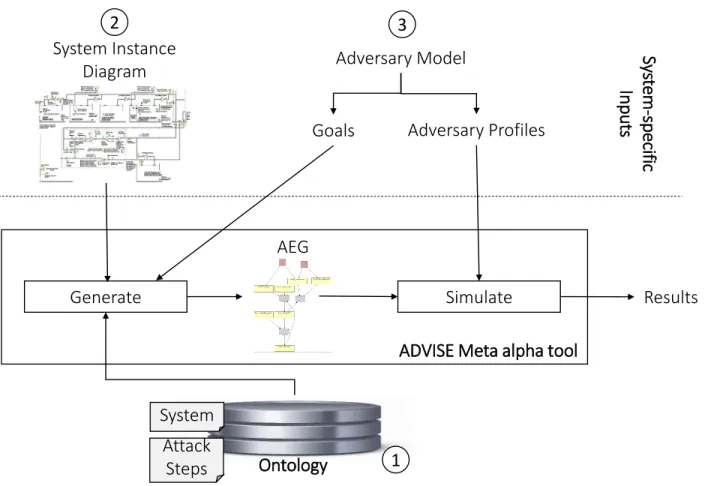
Figure 2.1: The general modeling approach. The numbered bubbles represent the order in which we describe the different inputs to the ADVISE Meta tool.
system component and connect those attack steps together. To reduce the practitioner’s effort, the ADVISE meta modeling approach separates the knowledge of the system from knowledge of the attack steps, allowing the actual construction of the attack execution graph to be automated.
The ADVISE meta modeling approach relies on an ontology that represents a high-level system model that uses familiar atomic elements and semantic relationships among them. The ontology serves as a knowledge base that describes the system entities and the definitions of attacks. Unlike vulnerability databases, ontologies allow practitioners to automatically derive where and how attacks may be applicable to a given system. The ontology allows the practitioner to specify attack steps just once during the construction of the ontology; subsequently, the only changes that a practitioner needs to make are updates to the system model. The attack graph is automatically generated through reasoning on the system model instance that is based on the ontology [24].
number of user-specified inputs, and outputs an AEG. Figure 2.1 illustrates that process. In this chapter, we describe how we constructed an ontology that models (1) the cyber-physical system entities and relationships, and (2) the attack steps that can be performed on those entities. This ontology is the first step towards a formal definition of a library of physical attacks that can be reused by other system case studies. Next, we discuss how we constructed a system instance diagram that describes a specific case study in terms of the types of entities and relationships that are present in the cyber-physical architecture of the studied system. Those types of entities and relationships are given by the ontology. We used the ADVISE Meta tool to reason on that system instance diagram and automatically generate an AEG [20,27] that leads to the user-specified goals. We also specified information about the threat models and quantitative metrics that we want to calculate. Given that information, the tool simulates an adversary’s decision-making by using a discrete-event, game-theory-based algorithm and outputs the calculated metrics and the chosen attack path. We have applied our modeling approach to a case study of a railway station. In particular, we have evaluated the effects of physical attacks on a railway transit system. We specified different threat models and used the ADVISE meta model tool to simulate the different adversaries’ decision-making processes. Here, we analyze the attack paths that are output from the tool to obtain insights regarding the system security. From the simulation results, we also identify (1) which adversaries pose the biggest threat to the system, (2) which attacks are most likely to happen, and (3) what additional defenses should be deployed to identify and prevent certain attacks.
2.2 ONTOLOGY: SYSTEM MODEL
The ontology consists of two components: (1) a representation of cyber-physical systems, and (2) a library of attack steps that apply to that representation. We first start with a general conceptual understanding of the systems that we want to model; that will then drive the creation of classes and relations in the ontology.
Conceptually, we describe the system in terms of three non-disjoint domains: physical, cyber, and information. We distinguish among the three domains because they represent the levels at which human cognition perceives information [28]. The physical domain consists of devices and spaces. Devices are located in spaces. The cyber domain consists of hosts and the network topology. Correspondingly, the hosts are devices (physical domain) that contain control software that transmits and receives digital data, and the network topology consists of cables connecting hosts that allow the transmission of bits. Lastly, the information domain consists of digital data such as control data and logs. Those digital assets are represented
SpaceDivider Device ProgrammableDevice Space Device Room Non-room loggedAccess,unloggedAccess affectsPower,affectsTemperature controls contains Asset DigitalAsset Data Log ControlData networkConnection has
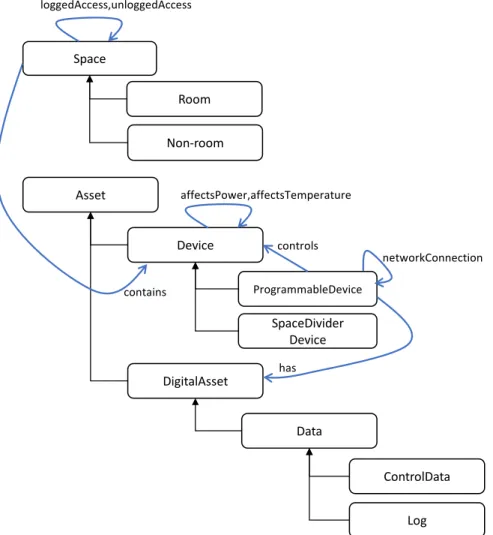
Figure 2.2: Our constructed ontology. Black boxes are component classes. Arcs with filled arrowheads represent inheritance, and labeled arcs are relationships.
as bits of information. By describing the system using the three domains, we can define actions (attack steps) that affect the system at different levels of abstraction. We can also drill down into low-level details about the effects of those actions.
We have translated our general conceptual understanding into the ontology, which is shown graphically in Figure 2.2. The ontology defines component classes and kinds of relations that are definable between instances of the classes. The component classes use inheritance to describe specialization of types. The ontology’s inheritance allows us to automatically infer information regarding child classes through deductive reasoning. More specifically, child classes inherit relationships and properties (attacks) from their parent classes [29].
The ontology describes the entities and their relationships across the thee domains: phys-ical, cyber, and information. We translated the two types of entities in the physical domain, device and space, into the parent classes Deviceand Space, respectively. The class Space
is further divided into two child classes,RoomandNon-room(e.g., corridors). Compared to aNon-room, aRoomhouses more critical kinds of assets and is typically the destination of adversaries.
We define a classAssetthat represents both the physical and cyber entities in the system that a practitioner seeks to defend. In particular, the class Asset has child classes Device and DigitalAsset.
The classDevicealso has child classes that represent the specialized capability of a device. The ProgrammableDevice child class contains software that can control the behavior of other assets (e.g., a host with SCADA software or a PLC); this class represents the cyber hosts. TheSpaceDividerDevice child class represents an asset that can divide two spaces (e.g., a roller shutter or door). The class DigitalAsset represents the information domain. It has a child class Data, which is further divided into the two child classes ControlData and Log.1
There are two different relations between Space instances based on how a person can move between the spaces. If a card reader is installed on the door bordering the two spaces, a person needs to have possession of an access card in order to move from one space to the other, and the person’s movement is also logged by the system. TheloggedAccessrelationship from a Space to a Space captures that situation. Otherwise, if no card reader is present, a person can move without restriction between the two spaces with no access card, and the relation is calledunloggedAccess. If there is aSpaceDividerDevice separating the two Spaceinstances, then a third relation,unloggedDividerAccess, from the twoSpaceinstances to the SpaceDividerDevice is used. The Space class is also related to the Device class. Specifically, a Space contains Devices.
There are a few relations between Devices, based on their functionality. In particular, a ProgrammableDevice controls other Devices programmatically. For example, a host machine with the proper control software can send commands to the Programmable Logic Controllers (PLCs) that it controls, and the PLCs in turn control the devices. Depending on the type of device, the results of controlling a device will affect the power, temperature, or movement of other devices. Specifically, an Asset affectsPower or affectsTemperature of another Asset. In addition to controlling other assets, a ProgrammableDevice also controlsMovementToken of aSpace by adding or removing permissions of an access card to access that space.
TheProgrammableDevicealso hasnetworkConnections with other ProgrammableDe-vices in the cyber domain. In addition, a ProgrammableDevice has DigitalAssets on
1There can be other subclasses of DigitalAsset, for example, to distinguish between data and software
it whose values may affect the running of the system devices.
Finally, we define a Subsystem attribute for both Devices and Spaces. This attribute identifies the subsystem to which a device or space belongs, and thus allows us to restrict access to the physical device or space. We also define state variables for Devices that represent the Power, Temperature, and controlSetting of the device. Adversary actions will affect the values of those state variables.
2.3 ONTOLOGY: ATTACK STEPS
The ontology consists of generic attack steps that can be applied to the classes. By defining a library of attack steps, we use the ontology to reason on a system instance diagram and automatically enumerate which attack steps can be applied to the system entities. In particular, we use the ontology’s multiple inheritance feature to derive all the entities that are vulnerable to a specific attack.
We can illustrate the multiple inheritance feature with a small example. In our ontology in Figure 2.2, we can define an attackA that is applicable to any physical device. We model that by attaching A to the classDevice. From the inheritance structure, that implies that A is applicable to all subclasses of Device, including ProgrammableDevice (or cyber hosts). That simplifies the job of creating an attack graph, since the practitioner does not need to recall that a host is also aDeviceand thus susceptible to attacks on physical devices. The ontology thus allows us to generate a complete AEG with respect to the defined attack steps, removing the chance for manual human error.
In Table 2.1, we define attack steps that can be applied at the level of abstraction cor-responding to each of the three domains that we defined earlier. The preconditions and postconditions associated with each attack step are listed in Table 2.2.
Some of the attack steps (Overheat, PowerOff, AffectsPower, and AffectsTemper-ature) are not actual attacks performed by an adversary, but instead model the physical consequences of certain actions.
In particular, when the temperature of a device is not properly controlled and increases to a high value, theOverheatattack step is triggered. The result of that step is that power to the device is cut, i.e., the state variable power is set to a value of zero. When the power to a device is cut, the PowerOff attack step is triggered; that removes the controlSetting of the device, since it is no longer able to control other devices that may depend on it.
The effect of controlling a device and changing its controlSetting is then reflected in the other devices under that device’s influence. Specifically, if a device d1 affectsPower of another device d2, then changing the controlSetting of d1 will trigger the AffectsPower
attack step, which then changes the power state variable of the affected deviced2. Similarly, theAffectsTemperatureattack step propagates changes to thetemperature of the affected device.
Table 2.1: List of attack steps defined in ontology.
Domain Attack Step Ontology Class
Physical Move Space Damage Device DirectControl Device Overheat Device PowerOff Device AffectsPower Device AffectsTemperature Device Cyber Login ProgrammableDevice RemoteControl Device NetworkMove ProgrammableDevice Information DelMovementToken Data
AddMovementToken Data
Physical Domain: In the physical domain, there are three different types of attack steps. Moverepresents an adversary’s movement from oneSpaceto another. If the access is logged (i.e., the loggedaccess relation connects the two spaces), the attack step will succeed only if the adversary possesses an access card with the appropriate permission (represented by the appropriate Space X access element, where X corresponds to the Subsystem attribute of the space). The access will, however, be detected. If the access is unlogged (i.e., the unloggedaccess relation connects the two spaces), the attack step always succeeds, because the adversary can move between the two spaces without restriction, and this attack is not detected.
An adversary can also perform anAction on a device. There are two main types of ac-tions: DamageandDirectControl. Both are associated with theDeviceclass. Damage involves physical destruction of the device. The result of theDamageattack step is that the power to the device is lost. DirectControl requires the adversary to have physical access to the cabinet housing the physical device in order to manually control the settings of the device. The result of the attack step DirectControl changes the controlSetting associated with the device. Depending on the type of device (e.g., breaker, lights), the effect of changing the controlSetting can range from turning the device off to controlling the device to achieve a specific setting (e.g., dimming the lights by 30%).
Table 2.2: Preconditions and postconditions associated with attack steps
Attack Step Precondition Postcondition
Move Access: Space X
Space: PhysicalPresence
Space: PhysicalPresence Access: AssetAccess
Damage Access: AssetAccess Device: Power
DirectControl Access: AssetAccess Device: controlSetting Overheat Device: Temperature Device: Power
PowerOff Device: Power Device: controlSetting
AffectsPower Device: controlSetting Device: Power
AffectsTemperature Device: controlSetting Device: Temperature Login Access: AssetAccess
Access: Access X Access: RemoteToken ProgrammableDevice: software RemoteControl Access: RemoteToken Access: Access X ProgrammableDevice: software Device: controlSetting NetworkMove Access: Access X
ProgrammableDevice: software ProgrammableDevice: software DelMovementToken Access: Access X
ProgrammableDevice: software Access: Space X AddMovementToken Access: Access X
ProgrammableDevice: software Access: Space X
Cyber Domain: In the cyber domain, there are two possible attack steps: Login and RemoteControl. The Login action is associated only with the ProgrammableDevice class, whereas theRemoteControlaction is associated with the parentDeviceclass. Much likeDirectControl,RemoteControlchanges thecontrolSetting associated with the device by using the control software on a ProgrammableDevice to manipulate the settings of the device. An adversary can alsoLogin into a ProgrammableDevice. The result of the Loginattack step is that the adversary is allowed to gain access to the control software. If the ProgrammableDevice has networkConnections to other ProgrammableDevices, the adversary can perform theNetworkMoveattack step to gain access to the other networked hosts. Depending on the system role that is used to perform the Login action (which are represented by the appropriate Asset X access element, where X corresponds to the Subsystem attribute of the device), the adversary can then perform the RemoteControl action for devices that the adversary has permission to control
Information Domain: In the information domain, we consider two more specific attack steps that are tailored to the case study. In particular, they involve either removing per-missions from or adding them to the adversary’s arsenal. These attack steps are associated
with theData class. If an adversary gains access to the BAC server, he or she can use the RemoveMovementToken attack step to remove all access card permissions (allSpace X access elements, whereXis any of the three subsystems) and locks the roller shutters so that people are unable to move into or out of the station. The AddMovementToken attack step grants an adversary all access card permissions and thus allows him or her to move through all rooms in the station.
2.4 CASE STUDY: RAILWAY STATION
In this section, we describe the case study of the railway transit system that we study in this dissertation. Physical security is an important concern for critical infrastructure systems such as industrial control facilities. In this chapter, we focus on the physical security of a railway station. The railway station is a single building with one or more railway lines running through it. The railway system we studied is located underground, and the railway lines are housed in a tunnel. We will reuse this particular railway station in Chapters 4 and 5.
The railway station contains many rooms that house the equipment necessary for running the station and its portion of the railway track. Each room serves a specific function, and there are multiple rooms that share the same function. These rooms are not accessible to the general public. Staff members possess access cards that have been granted permissions by theBuilding Access Control (BAC) server, thus allowing them to move through parts of the station according to their system role (e.g., maintenance staff, station operator).
The devices control the movement of trains (e.g., signaling, traction power) and people (e.g., escalators, roller shutters). Other devices control the environment of the station and track (e.g., fan, water chiller). The environment of a space also affects the functioning of devices and movement of people. For example, high temperatures can cause a device to overheat and trip, or cause a fire that will result in evacuation of commuters.
2.4.1 System Instance Diagram
We constructed asystem instance diagram that represents our railway station case study. The system architecture and the relations among the devices are modeled using the con-structs we defined in our ontology. We chose the following set of representative rooms:
• PSC:Houses cyber hosts that station operators use to monitor and control the devices in the station.
En vir on ment C ontr ol R oo m C or r 3 N on -roo m Ou tsid e Non -room C orr 1 N on -roo m C or r 2 N on -roo m C on cou rse N on -roo m Pla tf or m N on -roo m P ow er R oo m PS C R oo m Se rv er R oo m H os t Pr og ram m ab leDe vi ce Pow erb oar d 1 De vi ce P ow er b oa rd 2 De vi ce Temp C ontr ol De vi ce P ow er b oa rd 3 De vi ce PL C Pr og ram m ab leDe vi ce B A C Se rv er Pr og ram m ab leDe vi ce P ow er b oa rd 4 De vi ce P ow er S ys tem De vi ce Tr ack De vi ce Tu n n el N on -roo m R el at ion Ic on u n log ged Acc ess log ged Acc ess cont ain s Sign alin g R oo m P ow er b oa rd 5 De vi ce Sign als Se rv er De vi ce Tr ain De vi ce Figure 2.3: The ph ysical station arc hitecture view of the system instance dia gram. Th e b o xes represen t the en tities in the railw a y station. Eac h b o x has a unique name and b elongs to a class in the on tology .
Pow erb oar d 1 De vi ce PS C R oo m H os t Pr og ram m ab leDe vi ce C orr 1 N on -roo m P ow er b oa rd 2 De vi ce En vir on ment C ontr ol R oo m Temp C ontr ol De vi ce C on cou rse N on -roo m Ou tsid e Non -room B A C Se rv er Pr og ram m ab leDe vi ce PL C Pr og ram m ab leDe vi ce C or r 3 N on -roo m Se rv er R oo m P ow er b oa rd 3 De vi ce Pla tf or m N on -roo m C or r 2 N on -roo m P ow er R oo m P ow er b oa rd 4 De vi ce P ow er S ys tem De vi ce Sign alin g R oo m P ow er b oa rd 5 De vi ce Tr ain De vi ce Sign als Se rv er De vi ce Tr ack De vi ce Tu n n el N on -roo m R el at ion Ic on contr ols n et w or kC on n ect ion af fect sP ow er af fect sT emp er at u re Figure 2.4: The relations among the d evices in the ph ysical stat ion.
• Server Room: Houses the Programmable Logic Controllers (PLCs) that control the operation of other devices, and theBuilding Access Control (BAC) server that manages accesses to the doors and roller shutters.
• Traction Power (Power Room): Houses the equipment that controls the power to the track.
• Signaling (Signal Room): Houses the servers that communicate with trains on the track to control their movement as they pull into and leave the station.
• Water Chiller (Environment Control Room): Houses equipment that controls the temperature in the station.
The system instance diagram is depicted in Figures 2.3 and 2.4. The layout of the station and the devices within the rooms is shown in Figure 2.3, and the relationships among the devices are shown in Figure 2.4.
2.5 ADVERSARY PROFILES AND GOALS
We now define the adversary profiles and their goals. The two main assets that an adver-sary would target are the trains and the commuters within a station. For example, affecting the movement of trains includes delaying trains to affect service revenue, and acceleration of trains to endanger human lives. Targeting the movement of people can cause mass evacua-tion and chaos, which can lead to significant injuries caused by a panicking crowd. Affecting the system environment might consist of creating fire or smoke within the station or tunnel. Within the same threat model, we can define different types of adversary profiles based on their skills, their system access, and their preferences for remaining undetected. Each attack step requires some preconditions to be satisfied before it can be attempted, e.g., the adversary’s skill in an activity, or the adversary’s access permissions to a system component. So depending on the adversary profile, some of the attack steps that we defined earlier can or cannot be attempted. We now define different types of adversaries who differ in system access and skill level.
The accesses that an adversary may have are (1) permissions to perform theMoveattack step to enter a Space, and (2) permissions to perform the DirectControl, RemoteCon-trol,Login, or NetworkMove attack steps to control an Asset. We define three types of adversary profiles: an Outsider adversary with skills to break door access locks, a Privi-legedInsider adversary who has gained access to all types of legitimate access cards, and anInsider adversary. Table 2.3 shows the accesses that those adversaries possess.
T able 2.3: The access elemen ts p ossessed b y differen t adv ersary profiles at the start of the sim ulation. Outsider Privileged Insider Insider Cleaner Station Op Main tenance Staff En v Ctrl P o w er Access Ctrl Serv er Signals Physical Access Corr 1 X X X X PSC X X X En v Ctrl Rm X X X X Corr 3 X X X X X Serv er Rm X X X X X Corr 2 X X X X X P o w er Rm X X X X Signaling Rm X X X X AssetAccess PB 1 X X Host X X PB 2 X X T emp Con trol X X X PB 3 X X PLC X X X BA C Serv er X X PB 4 X X P o w er System X X X PB 5 X X Signals Serv er X X X
We define four goals that the adversary wants to achieve: (1) stopping train movement (TrainStop), (2) locking the station exits (LockExits), (3) controlling the temperature in the station (TempCtrlOff), and (4) controlling the trains’ movements (TrainCollision).
The first goal halts the movement of trains (Train) and thus disrupts system service. More specifically, it is represented by either switching the value of the power state variable of the Track Device from 1 (On) to 0 (Off), or switching the value of the power state variable of the Signals Server Device from 1 (On) to 0 (Off). The second goal affects the commuters’ movements (BAC Server).2 The third goal affects the station’s environment
(Temp Control) and is represented by switching the value of thetemperature state variable
of theTemp ControlDevice from 1 (On) to 0 (Off). Finally, the fourth goal affects system safety (Train) and can result in train collisions or derailment. It is represented by switching the value of the controlSetting state variable of the Train Device from 1 (On) to 0 (Off).
2.6 EXPERIMENT SETUP
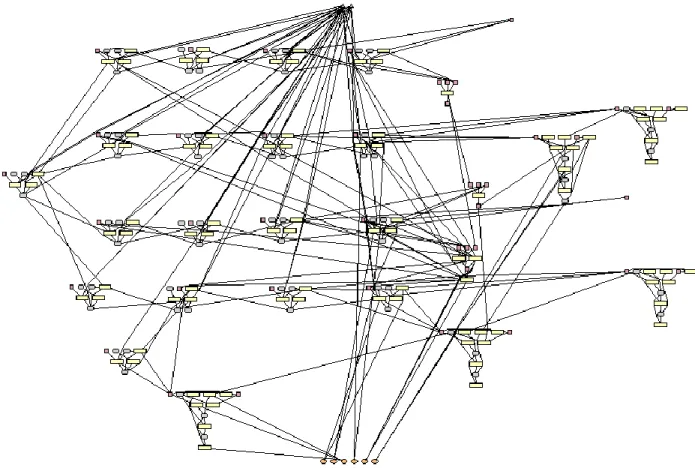
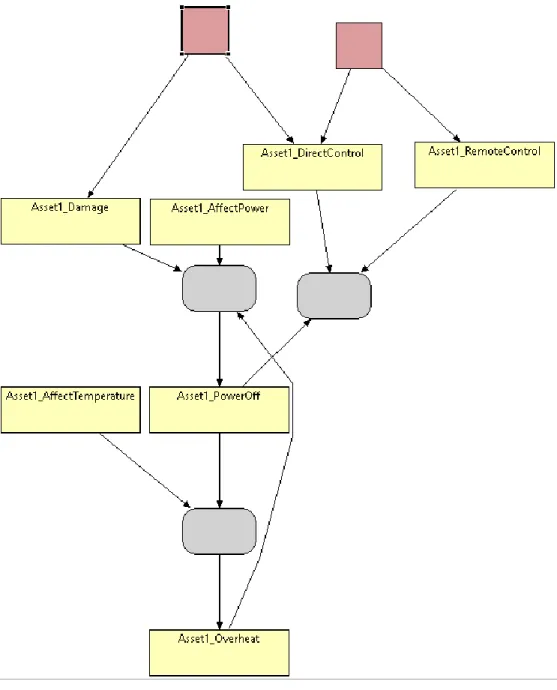
We input our system instance diagram and adversary models into the ADVISE Meta tool, which used our defined ontology to reason on the inputs needed to generate an AEG. Figure 2.5 shows the generated AEG, and Figure 2.6 shows a portion of the AEG for an Asset. We describe the parameters of the model and discuss the results in the following subsections.
We used the tool to simulate the actions taken by an adversary profile and calculated metric values for that set of actions. The metrics we defined are (1) the total cost of performing attacks, (2) the number of attack steps needed to accomplish a goal, and (3) the fraction of attack steps that are likely to be detected. Those metrics describe the different trade-offs that an adversary will make when attacking the system. We analyzed the resulting metric values to obtain insights regarding (1) the possible sequence of actions taken by an adversary, (2) the assets that require further protection, (3) the user actions that require further monitoring, and (4) the set of adversaries that pose the highest risk to the system’s security.
For each attack step, we defined (1) how much it costs the adversary to attempt the attack step and (2) the probability that the attack step will be detected by a defender. Those settings will impact the adversary’s decision-making process when he or she is choosing among different attack paths.
The cost of an attack step is quantified in terms of the expert knowledge and physical effort
2Although these access elements refer to the adversary’s access, we assume that removal of those elements
Figure 2.5: The full attack execution graph.
Table 2.4: The cost incurred by an adversary and the detection probability of each attack step. If the adversary has physical access to a device, damaging that device has a cost of 3; otherwise, damaging that device has a cost of 10.
Mo v e Damage DirectCon trol RemoteCon trol Login AddMo v em en t DelMo v emen t Cost 1 3 or 10 8 7 3 5 5 Detection Prob 0 1 0 0 0 1 1
required to execute the attack. The cost is a relative score that is an integer from the range of 1 to 10, where 1 represents the least effort and 10 represents the most effort. The probability that an attack will be detected by a defender is a floating value that ranges from 0 to 1. We assume that as a preliminary defense, the defender can monitor the devices through CCTV cameras in the rooms, and can monitor the state of the commuters by direct observation. Based on our understanding of the system and possible attacks as well as discussions with
Figure 2.6: A snippet of the attack execution graph for an asset. our railway system collaborators, we set the parameters as shown in Table 2.4.
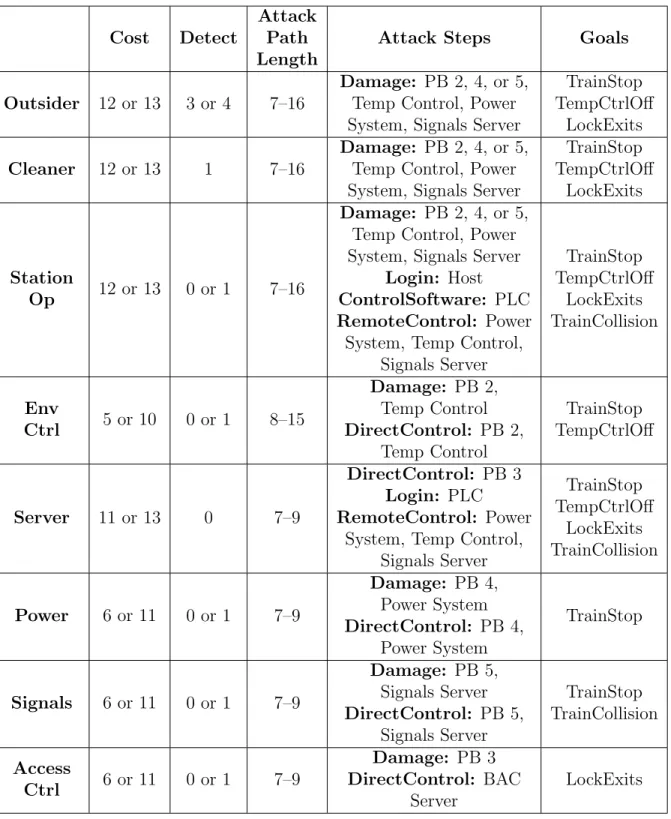
We assigned the lowest cost to theMoveaction step, followed byLogin. Moving through the spaces has the lowest cost, followed by logging into an asset or damaging an asset to which the adversary has physical access. After logging in, an adversary can remotely control devices. Doing so requires knowledge of how to operate the control software through the Human Machine Interface (HMI) (which abstracts out the details of the physical controls) of the host, so the cost of the RemoteControl action is higher than that of Login. On the other hand, directly controlling the asset (DirectControl) requires more knowledge



![4 [(1,5 Dibenzyl 2,4 dioxo 2,3,4,5 tetrahydro 1H 1,5 benzodiazepin 3 yl)methyl] 1 n octyl 1H 1,2,3 triazole](data:image/gif;base64,R0lGODlhAQABAIAAAP///wAAACH5BAEAAAAALAAAAAABAAEAAAICRAEAOw==)