________________
* Heillyn Nunez Camacho, Department of Communication and Psychology, Aalborg University, Denmark Email: [email protected]
Stijn Rybels, Faculty of Design Sciences, University of Antwerp, Belgium Email: [email protected]
Tom Coppens, Faculty of Design Sciences, University of Antwerp, Belgium Email: [email protected]
Andrés Valderrama Pineda, Department of Planning, Aalborg University, Denmark Email: [email protected]
World Café as a Participatory Approach to Facilitate the Implementation Process of Problem-Based Learning
Heillyn Nunez Camacho, Stijn Rybels, Tom Coppens and Andrés Valderrama Pineda *
ABSTRACT
Shifting from a traditional lecture-based teaching approach to a student-centred approach, such as Problem-Based Learning (PBL), demands significant changes in Higher Educational Institutions (HEIs). It requires changes for teachers, students, institutional management, and even the physical learning environment. Once a university is not designed from the beginning to insert this type of pedagogy, it is difficult to promote a change of this nature if the institution is committed to a more traditional pedagogical approach. Therefore, introducing PBL as an important innovation faces problems of conservatism, institutional inertia, path dependency, lack of knowhow and knowledge among teachers, poor institutional support, and poor connection with societal and economic actors. This article presents the World Café technique as a participatory method to identify and overcome some of the challenges when implementing a PBL approach. We confront the results of the Citylab World Café with the challenges identified in the literature. The authors identify three aspects of the implementation process of PBL in HEIs that can be facilitated through the World Café technique: (1) understanding the principles of PBL through engaging in a constructive dialogue, (2) fostering critical reflections about teaching and learning practises, and (3) changing the organisational culture by promoting collective sense-making and the construction of meaning.
INTRODUCTION
Over the last 40 years, the study of Problem-Based Learning (PBL) in educational settings has been consolidated as a field of theoretical and empirical work. Different contributions to its study have discussed the relevance of PBL as a pedagogical approach from teaching, learning, and organisational perspectives. Within the organisational perspective, which is the focus of this article, several contributions have concluded that leadership, organisational culture, and change management play a significant role in successful implementation of PBL (Camacho, Coto, & Jørgensen, 2018; Kolmos, 2010).
The shift from a traditional lecture-based teaching approach to a student-centred approach, such as PBL, demands significant changes in educational institutions. These changes require reflections on the teaching and learning practises and challenge several of the established values and assumptions about how to teach and how to learn in conventional universities. In this context, PBL constitutes a fundamental strategic innovation. This requires changing mental models by questioning and challenging current practises and viewing education in a new way by leaders and organisational members (Jacobs & Heracleous, 2005). In this article we argue that implementing PBL may better be supported by using participative approaches that mobilise people to share and discuss their experiences, values, and assumptions in a collaborative learning experience rather than implementing PBL top down.
The World Café is a known technique of participatory methods for change (Bushe & Marshak, 2009; Raelin, 2012). It enables a step-by-step conversational process of engaging large groups of people who share interest in a certain topic, problem, or opportunity in order to create a shared understanding (Brown & Isaacs, 2005).
This article examines how the World Café technique helps to identify and eventually overcome some barriers when implementing a PBL pedagogical approach. To produce change, this examination is necessary to create and share knowledge about PBL itself, share understanding of university organisation and organisational practise, and redefine values, assumptions and beliefs about learning and teaching practises.
Within the Citylab project, a World Café was developed (Citylab World Café) to initiate a dialogue for the implementation of PBL among 17 European and Latin-American Higher Educational Institutions (HEIs). By confronting the results of the Citylab World Café with the implementation challenges that are found in the literature, we argue that the World Café technique has the potential to support the needed change process.
In the next section, we briefly present the World Café technique. Then, we discuss some of the challenges to implement PBL found in the literature. This is followed by a methodological description of the World Café developed in the Citylab project. Following that, we present and discuss our practical experience of using the World Café technique as a participatory method to foster change toward PBL within the Citylab project. Finally, we provide a conclusion.
WORLD CAFÉ: THEORETICAL AND EMPIRICAL UNDERSTANDING
The concept of World Café was first coined by Brown and Isaacs in 1995. Since its creation, the technique has been widely used in diverse contexts and fields. Fallon & Connaugton (2016, pp. 3–5) present a review of different applications of World Café around the world. The technique can be defined as a step-by-step, conversational process of engaging large groups of people who share an interest in a topic, problem, or opportunity (Brown & Isaacs, 2005). Fouche and Light (2010, p. 28) define World Café as ‘a conversational process that helps groups to engage in constructive dialogue around critical questions, to build personal relationships, and to foster collaborative learning’. The technique emphasises inquiry and understanding rather than problem solving; in other words, the method creates a collective understanding rather than action plans (Prewitt, 2011).
In a World Café, participants are seated in groups of four to five people around tables that are arranged similar to a café setting (small decorated tables to encourage conversations). The conversations are guided by predetermined questions that concern the participants. Participants move around to different tables discussing the question(s). Each table has a host who shares highlights from the previous conversation. The main assumption is that participants cross-pollinate ideas and insights when they move around tables. As the conversation progresses, new discoveries emerge and collective knowledge grows and evolves (Brown & Isaacs, 2005; Fouche & Light, 2010; Prewitt, 2011). Regarding the value of dialogue and conversations in World Café, Hurley and Brown (2010, p. 3) state that
talking together has been a primary means for discovering common interests, sharing knowledge, imagining the future, and cooperating to survive and thrive. The natural cross-pollination of relationships, ideas, and meaning as people move from one conversation to others enables us to learn, explore possibilities, and co-create together. From this perspective, conversations are action—the very
heartbeat and lifeblood of social systems like organizations, communities, and cultures.
Table hosts have a relevant role as facilitator. They compile notes of the emerging ideas and are advised to provide clear instructions and to procure, weave, and connect ideas generated from the dialogue (Lorenzetti, Azulai, & Walsh, 2016). Hosts may foster or hinder creativity, knowledge creation, and collaborative learning depending on their skills. Therefore, the facilitator ‘needs to be highly focused on helping participants find shared meaning on a subject of deep collective importance’ (Prewitt, 2011, p. 196).
There are seven design principles to be carefully considered when creating the environment for dialogue, knowledge sharing, knowledge creation, and collaborative learning: (1) setting the context, (2) creating a hospitable space, (3) exploring questions that matter, (4) encouraging everybody to contribute, (5) connecting diverse and different perspectives, (6) listening together to identify patterns, and (7) gathering collective discoveries (Hurley & Brown, 2010).
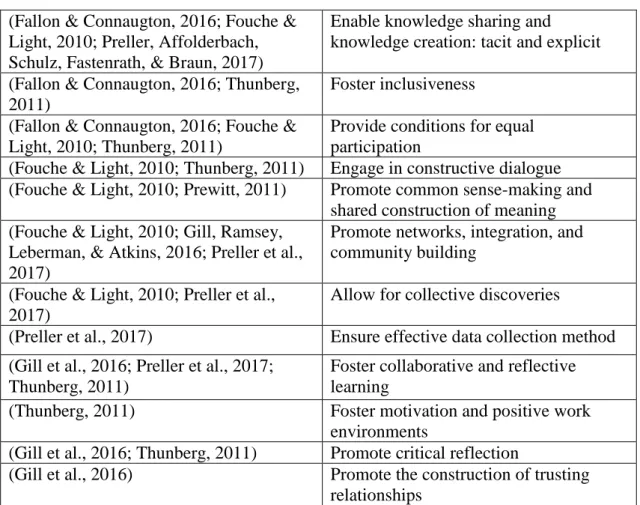
In Table 1, the values of World Café as identified in different international research projects are presented.
(Fallon & Connaugton, 2016; Fouche & Light, 2010; Preller, Affolderbach, Schulz, Fastenrath, & Braun, 2017)
Enable knowledge sharing and knowledge creation: tacit and explicit (Fallon & Connaugton, 2016; Thunberg,
2011)
Foster inclusiveness (Fallon & Connaugton, 2016; Fouche &
Light, 2010; Thunberg, 2011)
Provide conditions for equal participation
(Fouche & Light, 2010; Thunberg, 2011) Engage in constructive dialogue (Fouche & Light, 2010; Prewitt, 2011) Promote common sense-making and
shared construction of meaning (Fouche & Light, 2010; Gill, Ramsey,
Leberman, & Atkins, 2016; Preller et al., 2017)
Promote networks, integration, and community building
(Fouche & Light, 2010; Preller et al., 2017)
Allow for collective discoveries
(Preller et al., 2017) Ensure effective data collection method (Gill et al., 2016; Preller et al., 2017;
Thunberg, 2011)
Foster collaborative and reflective learning
(Thunberg, 2011) Foster motivation and positive work environments
(Gill et al., 2016; Thunberg, 2011) Promote critical reflection
(Gill et al., 2016) Promote the construction of trusting relationships
THE CITYLAB WORLD CAFÉ
The Citylab project aimed to stimulate innovation in teaching and learning in Latin-American and European HEIs through the introduction and further development of interdisciplinary and transdisciplinary PBL methods, thus developing key competences and skills among Latin-American and European students. To achieve this aim, the project brought together 17 universities from the two continents. As part of the project, each institution developed a Citylab Module – interdisciplinary accredited PBL modules with students and teachers from different faculties. These modules focused on sustainable cities, a common theme used as a vehicle for innovation in teaching, since sustainable cities can be considered one of the key places in which innovation is already present and which offers opportunities to broaden the modules throughout the university.
In order to identify the challenges related to the implementation of PBL that each HEI faced, a technical workshop was organised and hosted by the University of Lima in October 2016. During the workshop, the Citylab project leaders needed to find a way to share their knowledge and insights in a short time that allowed for active participation by all members. Moreover, a technique needed to be developed that could be reproduced to facilitate the PBL implementation process at the organisational level of each HEI.
Therefore, the World Café technique was introduced during this technical workshop to allow large group conversations on the challenges, experiences, and opportunities of PBL implementation.
The Citylab World Café included two representatives from each member of the project. In total, 40 participants with different professional backgrounds and areas of expertise from 17 universities as well as two associated partners (UCLG and Columbus Association) attended the project.
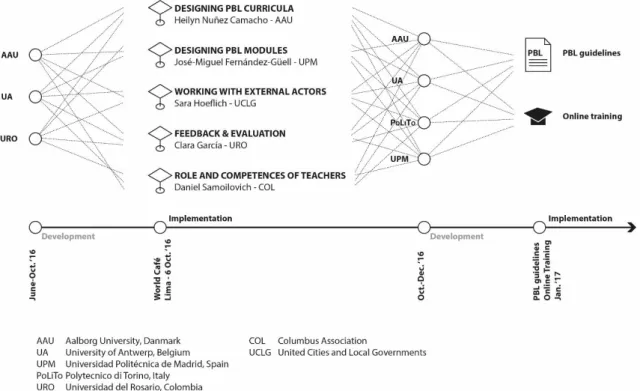
Figure 1. The development of the Citylab World Café
When designing the Citylab World Café (Figure 1), we brought complementary knowledge and practical knowhow, experiences, and skills from different universities together on the subjects of learning methodologies, interdisciplinary and transdisciplinary approaches, and salient urban problems. In a first phase, Aalborg University (AAU), the Centre for Teaching and Learning from the University of Rosario (URO), and the University of Antwerp (UAntwerpen) were involved. Aalborg University’s PBL expertise was invoked to strengthen and structure existing learning approaches with pedagogical support, while UROs’ expertise was used to increase the pedagogical quality of existing project-based learning methods in urban design studios. Moreover, the group built on UAntwerpen’s considerable experience in engaging societal actors to solve real-life problems as well as attracting multidisciplinary expertise when dealing with urban challenges in their urban design studios. These inputs were used to design the World Café, which consisted of five topics: designing PBL curricula, designing PBL modules, working with external actors and real-life problems, giving feedback and evaluation in PBL modules, and determining the role and competences of teachers and instructors.
During the implementation of the workshop, there were five tables called table cafés. Each table covered one of the topics listed above. The group dynamic consisted of progressive rounds of 30 minutes at each table. After 30 minutes, participants were invited to move to another café table to discuss a new theme. Participants of one table were discouraged from moving all together to the next table café; instead, they were
encouraged to spread out in order to have the opportunity to interact with different people. Each café table had a rapporteur or barkeeper who moderated the discussion and connected the insights from the previous discussions. After five rounds, a plenary session occurred to discuss the general inputs from the five tables and to produce an overview of the conclusions and agree upon further actions. The outcome of the World Café resulted in the development of the PBL guidelines and an online training program for teachers involved in the Citylab Modules, which were two main deliverables of the project. The first three rounds of each table were audio recorded. The posters presented in the plenary session were scanned and the presentation of each of the rapporteurs was also audio recorded. The data was organized in the following way: the raw data was organized in a table; the questions were placed in the rows and the rounds were placed in the columns; then, in this matrix, notes were taken on the answers given to each question in each round.
A second round of data analysis was conducted by focusing on the role and skills of each rapporteur, the dynamic of each group, the discussion that each question created, the level of difficulty in understanding the questions, the level of engagement with the questions, the influence of the rapporteur on the direction of the discussion, how the common understanding evolved, and how the technique allowed the explicit identification of assumptions and beliefs about PBL, organisational culture, and the teaching and learning processes.
PBL IMPLEMENTATION CHALLENGES
Currently, a number of educational institutions are attempting to transform their traditional teaching approach towards PBL; examples include those involved in the Citylab project, as well as many others reported in the literature (Kolmos & de Graaff, 2007; Li, 2013; Nunes de Oliveira, 2011). Empirical accounts reveal that implementing PBL is a significant change for many educational institutions.
Among the challenges reported in previous empirical research (Bouhuijs, 2011; Camacho, Coto, & Jørgensen, 2018; Kolmos & de Graaff, 2007; Li, 2013; Li, Du, & Stojcevski, 2009; Li & Henriksen, 2010), we discuss three of the most common challenges: change in the organisational culture, change in the teacher value system, and change in the institutional structure and organisation. Additionally, in this section we briefly discuss if participatory change management may be a relevant approach to implement PBL in HEIs.
Change in the organisational culture
In order to understand culture and how it shapes organisational actions, it is necessary to explore the various manifestations and definitions of organisational culture. In the literature it is possible to identify reliable representations of organisational cultures: artefact, values, assumptions (Schein, 2010), symbols, meanings (Alvesson, 2013), and orientations – values, norms, and tacit assumptions (Hoy, Tarter, & Kottkamp, 1991).
We adopt the following definition of organisational culture:
the collective, mutually shaping patterns of norms, values, practices, beliefs, and assumptions that guide the behavior of individuals and groups in an institute of higher education and provide a frame of reference within which to interpret the meaning of events and actions on and off campus. This definition emphasizes normative influences on behavior as well as the underlying system of assumptions and beliefs shared by culture bearers. (Kuh & Whitt, 1988, pp. 28–29)
Bouhuijs (2011) refers to two cultural clashes when implementing PBL in traditional universities. The first is an epistemological controversy about what knowledge is and what students should learn. He states that the most traditional academia is committed to ‘True Knowledge’. This value clashes with the constructivist background of PBL, where the students are allowed to express and deal with imprecise ideas that are developed as they work with real-life events and consider different theories. Students are not corrected on their imprecise ideas about a certain issue; instead, they are guided to create knowledge and better understand the issue at hand and the epistemological tools at their disposal. Therefore, some academic staff would have difficulties understanding and adopting this constructivist theory that is contradictory with their established practise of teaching True Knowledge.
Another aspect of this clash is presented by Li and Henriken (2010) when discussing the challenges to implement PBL in an Australian university. They denominate the event ‘pedagogical debate’ among the teachers. This case reveals that knowledge coverage is one of the main worries among academic staff. The teachers who were committed to the change and aware that PBL is about cultivation of certain skills and not about knowledge scope found it difficult to let go of the conventional way of delivering knowledge. The researchers reported that teachers organised lectures in addition to the PBL course to guarantee that all knowledge was covered.
The second cultural clash described by Bouhuijs (2011) is related to the type of culture that academia fosters, such as individual professionalism. In contrast, PBL promotes a collaborative and interdisciplinary approach to professionalism. We highlight two
aspects. The first is the fact that the act of teaching is an individualistic practise. Teachers are alone in their classroom; therefore, most of the process of planning and teaching is developed individually (Conole, 2013). To foster this practise at the higher education level, a golden rule of teaching autonomy exists in many universities, which means that teachers decide what to do in the classroom. The second aspect is related to highly ranked academics who believe they can create their own work environment and not be bothered by others (Bouhuijs, 2011). These norms and traditions need to be modified when working with PBL since many activities that are developed should be conducted as a team. Teachers must learn to work collaboratively, and the overall organisational culture will favour or hinder the establishment of this collaborative and learning practise according to existing rules and incentives (Nunes de Oliveira, 2011).
The general argument in the literature is that changes toward PBL require a shift in the university’s organisational culture (Bouhuijs, 2011; Camacho et al., 2018; Kolmos & de Graaff, 2007; Li et al., 2009; Nunes de Oliveira, 2011) and the recognition of this fact would allow for the design of strategies to cope with this shift.
Teacher system values
The second required change when implementing PBL is to change teachers’ understanding of and experience with teaching and learning. The empirical research reports variations on teachers’ personal beliefs and attitudes towards the learning process (Nunes de Oliveira, 2011), rethinking their traditional roles as sole experts and authorities in their interactions with students and colleagues (Al-Beiruty, 2008; Sandoval, Cortés, & Lizano, 2015), adjusting classroom structure and dynamics (Mora, Coto, & Alfaro, 2014), and changing assumptions about learning (Kolmos, 2010; Kolmos & de Graaff, 2007).
We may better understand this challenge by observing it through Wenger’s social theory of learning (1998), which embraces four aspects: meaning, practise, community, and identity. Wenger understands learning as a practise of identity formation, a mode of belonging to something meaningful. Thus, learning makes people who they are. Teachers who are involved in the PBL transformation have many years of experience, and they have a learning trajectory that, using Wenger’s concept, has formed who they are and what their beliefs are regarding teaching and learning. Changing from a traditional teaching approach to PBL demands the construction of new learning experiences, new practises, a new sense of belonging, and a new identity. Wenger defines identity as a layering of events of participation and reification by which our experience and its social interpretation inform each other. As we encounter our effects on the world and develop our relations with others, these layers build upon each other to produce our identity as a
very complex interweaving of participative experience and reificative projections. (Wenger, 1998, p. 151)
From this point of view, we interpret that implementing a PBL approach creates tension between teachers’ existing knowledge, practise, experience, and beliefs, and that this tension needs to be addressed to facilitate new ways of knowing to cover the process of development of teachers’ identities as professionals.
Organisational change
As has been mentioned, the implementation of PBL is a change process through which individuals and organisational cultures are modified, demanding a new view of the world, new knowledge to be acquired, and new teaching and learning practises to be created. Furthermore, the institution as a whole must change as well.
The literature demonstrates that universities will face several challenges. For example, Mora et al. (2014) mention changes in the administrative structure of the university, while Sandoval et al. (2015) refer to the curriculum changes in order to allocate the new ways of working within PBL which are not part of traditional teaching approaches, such as the role of the supervisor. Another aspect mentioned in the literature is balancing the semester workload (Sandoval et al., 2015). Both change in the curriculum and balancing the workload will create tension as teachers may see these aspects as an attack on their current status. This restructuring would affect their number of work hours, their individual control of certain courses, and their need to work more collaboratively at the program level. These tensions may lead to resistance to change (Bouhuijs, 2011). However, a change at the curricular, organisational, and structural level at the university must take place in order to be able to work within the PBL approach.
A common aspect mentioned in the literature is the issue of preparation time to implement PBL (Bouhuijs, 2011; Mora et al., 2014; Nunes de Oliveira, 2011; Sandoval et al., 2015). Teachers need time to learn PBL, create new material, learn to work together, and prepare the students, among other aspects. However, it is common that teachers are required to learn new university processes while maintaining their regular workload and their research and publication demands. Therefore, clear strategies to train and inform the staff and to incentivise them to take the new roles should be developed at the management level.
A final comment about some of the challenges faced at the organisational level is reported by Li (2013) and Li and Henriksen (2010), who discuss how the different understandings of PBL brought tension in its implementation in two different universities, one in
Australia and another in China. In those studies, they found that there was no fixed, standardised, single, and uniform definition of PBL, neither within the scientific literature nor among their staff. As the members had their own interpretation of PBL which were not in line with the managerial understanding, the managerial effort to standardise the understanding of PBL prompted significant discussions among the staff. As these authors state, the diversity in PBL interpretations can be attributed to different work experience and educational experience, and those many interpretations should not be seen as incorrect perspectives that need to be corrected; instead, they should be treated in a tolerant and constructive manner.
Overall, these empirical reports demonstrate that the implementation of PBL demands a new way of organising and structuring universities; therefore, to avoid returning to their traditional teaching practise, approaching PBL with a clear change management strategy is necessary to address the complexity and dynamics of HEIs that are changing to PBL (Li & Henriksen, 2010).
Participatory change approach for PBL implementation
Within the PBL field, there are recommendations about how to deal with the change process. A commonly cited approach is the one proposed by Kolmos and de Graaff (2007), who distinguish two strategies for initiating PBL in an educational institution: a top-down approach and a bottom-up approach. Each approach has its strengths and weaknesses. The Kolmos and de Graaff (2007) authors point out that neither of these strategies are sufficient for successful change and propose a combination of the two strategies, which is also the recommendation of Li and Henriksen (2010).
As there are different perspectives about how to deal with a change process for the implementation of PBL, there are also different perspectives about how to conduct change in organisations in general. One of these approaches is called participatory organisational change (Raelin, 2012), where communication, dialogue, and participation are key elements to enable learning, growth, and transformation.
Communication is understood not only as a fundamental aspect of change process but as the process of change itself. Change is created, sustained, and managed in and by communication (Ford & Ford, 1995). Communication, within organisational change, can be classified as programmatic or participatory (Russ, 2008). The programmatic approach is characterized by a top-down monologic communication to obtain approval, commitment, and engagement about an organisational change that the management has adopted. This ‘telling and selling approach’ is commonly communicated through memos, newsletters, videos, etc., while the participatory approach leverages dialogic
communication to involve most of the stakeholders by asking for ideas and input about the change and the implementation process. This approach is based on the assumption that employees should be active participants in the change.
On the other hand, dialogue, within participatory organisational change, is defined by Raelin (2012, p. 8) as ‘the medium through which people seek shared meaning and understanding’. Furthermore, he elaborates that people involved in dialogue listen to each other, reflect upon different perspectives, and are willing to change based on what they learn. Isaacs (1993, p. 25) understands dialogue as an interaction.
People gradually learn to suspend their defensive exchanges and furthermore, to probe into the underlying reasons for why those exchanges exist… . The central propose is simply to establish a field of genuine meeting and inquiry…, a setting in which people can allow a free flow of meaning and vigorous exploration of the collective background of their thought, their personal predisposition, the nature of their shared attention, and the rigid features of their individual and collective assumptions.
In other words, dialogue helps reveal and change underlying values and assumptions. Similarly, Senge (1997) also argues that dialogue fosters organisational learning through a deep understanding of different points of view.
The third main aspect of participatory organisational change is participation, understood as a horizontal process of knowledge exchanges, which entails an active and horizontal exchange of ideas. It requires an intentional creation of the spaces where participants feel comfortable and safe to express their views, experiences, feelings, and concerns (Hinthorne & Schneider, 2012).
Participatory practises enhance empowerment, positive employee attitudes, motivation, satisfaction, and organisational learning (Argyris & Schön, 1996; Pardo-Del-Val, Martínez-Fuentes, & Roig-Dobón, 2012; Senge, 1997; Sverke, Hellgren, Näswall, Göransson, & Öhrming, 2008) and create a context in which stakeholders (those affected by the change) have a voice and a choice in making decisions (Fals-Borda, 1992; Muller & Druin, 2012).
It is our argument that PBL implementation can be better approached from a participatory organisational change perspective, which will discover and overcome the challenges that the process has for the particular organisation. By taking a dialogical approach to incorporate PBL into the organisational practise, we may avoid the tension of seeing universities as systems that need to be fixed after completing an analysis (normally by
comparing them with PBL universities). One should focus rather on creating the conditions to foster conversations that will increase the awareness of the variety of experiences, knowledge, and understanding within the system (Bushe & Marshak, 2009, p. 360). In other words, this approach provides an opportunity to understand organisational culture and teacher system values and to identify the main organisational challenges.
DISCUSSION
By confronting the data of the Citylab World Café (see the main categories in Table 2) with the literature on PBL implementation challenges (discussed in the previous section), we identified three aspects of the implementation process of PBL in HEIs that can be facilitated through the World Café technique: (1) understanding the principles of PBL by engaging in a constructive dialogue, (2) fostering critical reflections about teaching and learning practises, and (3) changing the organisational culture by promoting sense-making and the construction of meaning.
In Figure 2, we show the relationship between the categories from our data and the main categories found in the PBL implementation literature.
Category Description
Misunderstandings and different definitions of PBL
There was the belief that theory and practise are two different aspects of learning and, therefore, there was speculation about possible adequate balances (for example 50% PBL and 50% lectures). The same assumption fosters a long discussion about the use of PBL for practical courses, such as studios and theoretical courses. There were also discussions about the definition and understanding of PBL, participants hold
assumptions about PBL such as: the students learn alone, PBL is the application of theory, students cannot learn without first having a theoretical base, etc. Some of these claims were not aligned with the theoretical background of PBL.
Change teachers’ conceptions of teaching and learning, as well as their relationships with others
There was a clear need to change the teacher’s role,
competences, and conceptions about teaching and learning. Values, assumptions, and beliefs about the role of the teacher were constantly discussed. Issues such as ego, control, power, and relationship with colleagues and students were explored and discussed.
Change in the structure and organisation of universities
The organisational issues also had a relevant role during the discussion. The following issues were discussed: the need for student and academic staff training, support from the
administration, changes in the structure of the curriculum and administration, required time investments, and work and study spaces.
Instrumentalisation of PBL
There was a need for instrumentalisation in order to implement PBL. Participants developed metaphors and visualisations (roadmaps, classification of courses, type of facilitators, evaluation rubrics, etc.) that would help them understand and apply PBL. In some instances, they needed artefacts (plans, procedures, schedules, curricula, etc.) to understand PBL applied in their context.
Table 2. Main issues discussed during the Citylab World Café
Figure 2. Relationship between the CityLab World Café data and previous empirical research
Understanding PBL by engaging in a constructive dialogue
Our empirical data shows that the World Café technique helps to reveal assumptions, beliefs, and understandings about teaching and learning in general and about PBL in particular.
When the different participants joined the Citylab project, a general assumption was that every member had a shared understanding of PBL as a teaching and learning philosophy. However, when discussing the different questions during the Citylab World Café, each member’s individual perception and understanding of PBL was revealed. Participants had very different understandings of PBL and its principles (see Figure 3). The diversity of understandings ranged from PBL as the application of theory (practical courses) to an entirely new paradigm of learning. Therefore, these different understandings inform different materialisations of PBL in the teaching practise. For those who understand PBL as a method to apply theoretical knowledge, PBL should only be used in a low percentage of the curriculum, and lecture-based teaching would take most of the curriculum and allow students to acquire the basic knowledge before applying it. Conversely, for those who understand PBL as a way to create situated knowledge, the entire curriculum should be modified, and the traditional teaching and learning paradigm should be reconstructed. These two perspectives were represented in the Citylab project and led to conflict when implementing PBL.
Many different universities, departments, and schools were represented in the Citylab World Café. Each participant brought their own traits and teaching experience when understanding and interpreting PBL. In the World Café there was no dictatorial definition of what PBL is or is not; instead, it was a presentation of different views that helped make sense of the concept. It was a dialogue, as described by Isaacs (1993), a genuine meeting and inquiry where participants are allowed free expression of meanings and an exploration of their thoughts. The dialogical activity revealed underlying values and
assumptions (e.g. PBL being for practical courses, it being impossible to learn theory using PBL, students needing true knowledge first) that, once revealed, can be explored, discussed, and slowly changed.
During the World Café, people were willing to listen to each other with respect and to hear different perspectives even when they disagreed. This willingness to listen allowed the sharing of knowledge and experiences. It was common to hear examples about how teachers have dealt with the implementation of PBL at the individual or group level, which contributes to the knowledge-creation process. The technique prevents participants from bringing external definitions of PBL and trying to force them into a new context. Instead, the technique fosters the visualisation of the current understanding and the beginning of a shared construction of understanding PBL for the specific context.
Fostering critical reflections about teaching and learning practise
As shown in Table 1, the World Café technique encourages critical and collaborative reflection. We understand critical reflection as the time to step back and examine our thoughts by asking challenging questions. It could also be defined as a process of becoming aware of our actions and values system (Revans, 1998). In Schon’s (1983) terms, we may define it as reflection in action (during an event) and reflection on action (after the event). In general, it is an ongoing scrutiny process of identifying the assumptions underlying our actions. The word ‘critical’ in critical reflection emphasises the ability to be transformative, a kind of thinking that leads to some kind of change (Fook, 2015). Within organisations, critical reflection supports the process of becoming aware of a problem, challenging the leadership, revealing power struggles, and challenging current routines (Thunberg, 2011). Furthermore, critical reflection in organisations depends on participants who are open to thinking together and taking actions (Thunberg, 2011).
If PBL is a learning philosophy that demands students to understand the why, what, and how of their learning, it is only fair that teachers go through a reflective activity to find the answer to those questions as well. We argue that this process is well supported by the World Café technique, which encourages a collective critical thinking. During the Citylab World Café, participants were concerned about the potential of PBL to cover theoretical knowledge (see Figure 3), and they expressed and discussed it collectively. As the activity progressed, they discussed questions about their roles as teachers, the skills that they should have, and the need to create new interactions and synergies with other disciplines as well as with their colleagues (see Figure 4 for quotes revealing these reflective questions/comments).
Tsoukas (2009) argues that through productive dialogue people can review and change their background and create new organisational knowledge. Knowledge creation can be defined as a spiral process of interactions between explicit and tacit knowledge (Nonaka & Takeuchi, 1995). An important aspect of knowledge creation is the space where the knowledge creation takes place. It means that spaces influence how we interact; for example, it is different to interact in an auditorium than in a collaborative space, such as a Design Thinking studio. Nonaka and Takeuchi (1995) have identified this space as ‘Ba’. According to them, the Ba is shared space for emerging relationships where information is interpreted to become knowledge. The Ba refers to the physical space as the mental space. Within other fields, this space has been identified as the ‘third space of understanding’ by Hall (2014) in her research on indigenous people and as ‘third space’ by Muller and Druin 2012) in their research on participatory design. We found the World Café creates this Ba, which supports the sharing of tacit and explicit knowledge and the creation of new knowledge.
Changing the organisational culture
The empirical research on PBL implementation deals with the inevitable issue about organisational culture change, which affects the organisation as a whole but also the professional culture of the teacher. We identified the value of the World Café technique to initiate these organisational culture changes. The research of Jacobs and Heracleous (2005) concludes that dialogue as a reflective form in the change process (a) allows
people to critically review and inquire into underlying assumptions of individual and collective mental models (these mental models were revealed during the World Café), (b) fosters the creation of collective language (teachers created metaphors and artefacts to make sense of PBL in their context), (c) encourages shifts in mental maps, and (d) reveals mental models that can be critically investigated and changed. Nevertheless, when we do not have evidence of changes in teachers’ mental models, we have evidence of teachers sharing their ways of thinking, which may start the process of discussing why we think in the way we do and eventually allow for a modification of our mental model. In other words, we see the potential of the World Café to create the space to initiate dialogue that may change the values, assumptions, and beliefs of participants, who are representative of organisational culture.
CONCLUSION
This paper tackles the question of how the World Café technique can facilitate dealing with the challenges in implementing PBL in HEIs. In order to answer the question, we identified challenges from the literature and collected empirical data from Citylab World Café. Our review found three main challenges when implementing PBL: change of the organisational culture, a reification of the teacher’s identity, and changes in the structure and organisation of the HEIs. Issues related to these challenges were well identified in our data from the Citylab World Café, and we described three specific aspects where the use of World Café would contribute to a successful implementation of PBL: First, it provides the space and the conditions for a dialogue to construct a shared understanding and definition of PBL. Second, it helps reveal teachers’ system values about teaching and learning, the conditions to explore and discuss them, and the space for knowledge creation. Finally, it fosters the discovery of the diversity of knowledge, experiences, and concerns within a specific educational institution by approaching the PBL change process from a dialogical perspective instead of a diagnostic one and, as a result, co-creates a new organisational culture based on the principles of PBL.
ACKNOWLEDGEMENT
The work presented in this paper was conducted in the context of the Erasmus + Key Action 2 project ‘Citylab LA’, a project funded with the support of the European Commission. This article only reflects the views of the authors, and the commission cannot be held responsible for any use which may be made of the information contained herein.
References
Al-Beiruty, E. (2008). Orgaizational Changes and Problem-based Learning Curriculum in Dental Education: a Case Study of the Harvard School of Dental medicine (PhD-thesis). University of Denver, USA.
Alvesson, M. (2013). Understanding Organizational Culture (2. ed.). London: SAGE Publications.
Argyris, C., & Schön, D. (1996). Organizational Learning II: Theory, Method, and Practice. USA: Addison Wesley Publishing Company.
Bouhuijs, P. (2011). Implementing Problem Based Learning: Why is it so hard? Revista de Docencia Universitaria, 9(1), 17–24.
Brown, J., & Isaacs, W. (2005). The World Café. San Francisco: Berrett-Koehler. Bushe, G., & Marshak, R. (2009). Revisioning Organization Development Diagnostic
and Dialogic Premises and Patterns of Practice. The Journal of Applied
Behavioral Science, 45(3), 348–368. https://doi.org/10.1177/0021886309335070 Camacho, H., Coto, M., & Jørgensen, K. (2018). How Does Organisational Culture
Influence the Process of Change Towards PBL? Journal of Problem Based Learning in Higher Education, 6(2), 32–57.
https://doi.org/10.5278/ojs.jpblhe.v6i2.2140
Conole, G. (2013). Designing for Learning in an Open World. New York, NY : Springer New York.
Fallon, H., & Connaugton, L. (2016). Using a World Café to Explore New Spaces and New Models for Front Line Services: A Case Study from the Irish University Library Sector. New Reivew of Academic Librarianship, 0(0), 1–17.
https://doi.org/10.1080/13614533.2015.1126291
Fals-Borda, O. (1992). Evolution and Convergence in Participatory Action Research. In J. Frideres (Ed.), A World of Communities: Participatory Research Perspectives (pp. 14–19). Toronto: Captus University Publications.
Fook, J. (2015). Reflective Practice and Critical Reflection. In J. Lishman (Ed.),
Handbook for Practice Learning in Social Work and Social Care (Third Edition, pp. 440–454). London: Jessica Kingsley Publishers.
Ford, J., & Ford, L. (1995). The role of conversations in producing intentional change in organization. Academy of Management Review, 20(3), 541–570.
Fouche, C., & Light, G. (2010). An Invitation to Dialogue ‘The World Cafe´ ’ In Social Work. Qualitative Social Work, 10(1), 28–48.
https://doi.org/10.1177/1473325010376016
Gill, L., Ramsey, P., Leberman, S., & Atkins, S. (2016). Using World Café to Enhance Relationship-building for the Purpose of Developing Trust in Emotional
Intelligence Training Environments. The Electronic Journal of Business Research Methods, 14(2), 98–110.
Hall, L. (2014). “With” not “about” – Emerging paradigms for research in a cross-cultural space. International Journal of Research & Methods in Education, 37(4), 376–389. doi:10.1080/1743727X.2014.909401.
Hinthorne, L., & Schneider, K. (2012). Playing with Purpose: Using Serious Play to Enhance Participatory Development Communication in Research. International Journal of Communication, 6, 2801–2824.
Hoy, W., Tarter, J., & Kottkamp, R. (1991). Open schools/healthy schools: Measuring organizational climate. Newbury Park: Sage.
Hurley, T., & Brown, J. (2010). Conversational Leadership: Thinking Together for a Change. Oxford Leadership Journal, 1(2).
Isaacs, W. (1993). Takign Flight: Dialogue, Collective Thinking, and Organizational Learning. Organizational Dynamics, 22(2), 24–39. https://doi.org/10.1016/0090-2616(93)90051-2
Jacobs, C., & Heracleous, L. (2005). Answers for questions to come: reflective dialogue as an enabler of strategic innovation. Journal of Organizational Change
Management, 18(4), 338–352. https://doi.org/10.1108/09534810510607047 Kolmos, A. (2010). Premises for Changing to PBL. International Journal for the
Scholarship of Teaching and Learning, 4(1).
Kolmos, A., & de Graaff, E. (2007). Process of Changing to PBL. In E. de Graaff & A. Kolmos (Eds.), Management of Change. Implementation of Problem-Based and Project Based Learning in Engineering (pp. 31–44). SENSE PUBLISHERS. Kuh, G., & Whitt, E. (1988). The Invisible Tapestry: Culture in American Colleges and
Universities (No. 1). Washington, DC: Office of Educational Research and Improvement.
Li, H. (2013). Educational change towards problem based learning : an organizational perspective. River Publishers.
Li, H., Du, X., & Stojcevski, A. (2009). Educational transformation to PBL- what has changed. Presented at the 2nd International Research Symposium on PBL, Victoria Unversity Press.
Li, H., & Henriksen, L. (2010). A Story of Organizational Change to PBL in Australia. Presented at the Joint International IGIP-SEFI Annual Conference, Trnava, Slovakia.
Lorenzetti, L., Azulai, A., & Walsh, C. (2016). Addressing Power in Conversation: Enhancing the Transformative Learning Capacities of the World Cafe. Journal of Transformative Education, 14(3), 200–2019.
https://doi.org/10.1177/1541344616634889
Mora, S., Coto, M., & Alfaro, G. (2014). A proposal for integrating PBL in
programming courses. Presented at the XL Conferencia Latinoamericana de Informática, Montevideo, Argentina.
Muller, M., & Druin, A. (2012). Participatory Design: The Third Space in HCI. In J. Jacko (Ed.), The Human-Computer Interaction Handbook (3rd ed.). Boca Raton, Fla: CRC Press.
Nonaka, I., & Takeuchi, H. (1995). The knowledge-creating company : how Japanese companies create the dynamics of innovation. New York: Oxford University Press.
Nunes de Oliveira, J. (2011). Nine Years of Project-Based Learning in Engineering. Revista de Docencia Universitaria, 9(1), 45–55.
Pardo-Del-Val, M., Martínez-Fuentes, C., & Roig-Dobón, S. (2012). Participative management and its influence on organizational change. Management Decision, 50(10), 1843–1860. https://doi.org/10.1108/00251741211279639
Preller, B., Affolderbach, J., Schulz, C., Fastenrath, S., & Braun, B. (2017). Interactive Knowledge Generation in Urban Green Building Transitions. The Professional Geographer, 69(2), 214–224. https://doi.org/10.1080/00330124.2016.1208104 Prewitt, V. (2011). Working in the café: lessons in group dialogue. The Learning
Organization, 18(3), 189–202. https://doi.org/10.1108/09696471111123252 Raelin, J. (2012). Dialogue and deliberation as expressions of democratic leadership in
participatory organizational change. Journal of Organizational Change
Management, 25(1), 7–23. https://doi.org/doi.org/10.1108/09534811211199574 Revans, R. (1998). ABC of Action Learning. London: Lemos & Crane.
Russ, T. (2008). Communicating Change: A Review and Critical Analysis of
Programmatic and Participatory Implementation Approaches. Journal of Change Management, 8(3–4), 199–211. https://doi.org/10.1080/14697010802594604 Sandoval, M., Cortés, R., & Lizano, F. (2015). PBL in System Engineering Grades: a
Bottom-Up Perspective. Presented at the International Joint Conference on the Learner in Engineering Education, San Sebastian, Spain: Aalborg : Aalborg University Press.
Schein, E. H. (2010). Organizational culture and leadership, fourth edition (4th ed). San Francisco: Jossey-Bass.
Schon, D. (1983). The Reflective Parctitioner: How Professionals Think in Action. New York: Basic.
Senge, P. (1997). The Fifth Discipline (Vol. 1).
Sverke, M., Hellgren, J., Näswall, K., Göransson, S., & Öhrming, J. (2008). Employee Participation in Organizational Change: Investigating the Effects of Proactive vs. Reactive Implementation of Downsizing in Swedish
Hospitals**/Mitarbeiterbeteiligung im organisationalen Wandel: Die Effekte proaktiver vs. reaktiver Implementierung von Downsizing in schwedischen Krankenhäusern. German Journal of Research in Human Resource Management, 22(2), 111–129. https://doi.org/10.1688/1862-0000_zfp_2008_02_sverke
Thunberg, O. (2011). World cafes and dialog seminars as processes for reflective learning in organisations. Reflective Practice, 12(3), 319–333.
https://doi.org/10.1080/14623943.2011.571864
Tsoukas, H. (2009). A Dialogical Approach to the Creation of New Knowledge in Organizations. Organization Science, 20(6), 941–957.
https://doi.org/doi.org/10.1287/orsc.1090.0435
Wenger, E. (1998). Communities of Practice: Learning, meaning and Identity. New York: Cambridge University Press.