A version of this article was published when our team was known as Apollo Associated Services.
Solving Supply Chain Problems Proactively
By Chris Eckert – President, Sologic, & Brian Hughes – Vice President, Sologic
A version of this article appeared in the February 2010 issue of Industrial Engineer magazine.Managing the problems associated with the global supply chain of major products these days requires a flexible, adaptable, and consistent approach.
One need look no further than the latest commercial aircraft designed by Boeing to see just how far a company is willing to go to realize the numerous and enormous benefits of a decentralized, extended global supply chain. Expertise and specialization is focused directly on individual components. Profit and loss responsibility is concentrated into smaller, more manageable (and thereby accountable) business units. Risk is diversified across multiple “baskets” of suppliers. The benefits of local markets (such as cheaper labor and the proximity to raw materials) can be exploited. The list goes on.
But Boeing’s strategy also shows some of the inherent risks and unfortunate consequences associated with managing such a supply chain. Unfortunately, it is one thing to map out all the potential benefits of a diversified global supply chain, yet quite another for the company and its managers to actually make it out alive given the risks involved.
While the new 787 by Boeing may be one of the most ambitious attempts at wringing benefits from an extended global supply chain, we can find other examples of all sizes, shapes, and flavors. Globalization is just another way to say “global supply chain.” Like it or not, it is here to stay.
Companies that learn to manage the risks of a global supply chain can expect to reap, at the very least, the reward of survival. But those that learn to proactively manage the problems encountered in such a diverse system can expect to rule their sectors. The key component to proactive problem solving is a robust Solution Management System (SMS) built on a solid, adaptable root cause analysis program. The following is a set of simple steps and guidelines for establishing such a system, and explains how learning from failures in the supply chain is the best way to proactively minimize the risk of future failures. These guidelines will help establish or improve an SMS. If you already have a strong SMS that achieves
A version of this article was published when our team was known as Apollo Associated Services.
the desired results, you might skim down to the more advanced steps at the end. There’s something here for everyone.
Step 1: Map the Supply Chain
This may seem to be an obvious first step. In fact, many companies have an accurate understanding of their supply chain – at least at a high level. However, inside the larger process steps are a series of smaller steps. The key is to have each function map out the part of the supply chain for which they are responsible.
- Inputs: Raw materials (as one example) o Where do they come from?
o How do you ascertain their quality? o What is the target delivery time? - Process Steps:
o What happens at each step?
o What is the target cycle time for each step?
o What other functions or suppliers interface at each step? - Outputs:
o What does the process create?
o What is the throughput for the process? o What is the quality of the output?
o How quickly is it being delivered to the next step?
The trick is to keep it simple, manageable and consistent. It should be easy for one manager to explain his/her process to another in a short amount of time. And be sure to involve knowledgeable front-line employees in the creation of the process map. They have specific process awareness that is important to capture. Securing their buy-in through involvement early is important because they will play a crucial role in later steps.
Step 2: Manage Bottlenecks
Once you understand the process inputs, steps, and outputs, you must manage throughput. Without launching into a discussion on theory of constraints, it is important to identify the bottleneck steps in your
A version of this article was published when our team was known as Apollo Associated Services.
process. These process steps are critical to your ability to meet production commitments. Therefore, an effective solution management system must focus on eliminating problems impacting these bottlenecks.
Step 3: Identify Key Performance Indicators
Now that you understand your process steps and bottlenecks, the next step is to develop/refine key performance indicators (KPIs) to determine whether you are meeting your production targets. Problem visibility is required in order to solve the problem, and is enhanced when viewed in light of production deviations. Therefore, metrics need to be developed to provide real-time information showing at a minimum:
- Number of units
- Estimated time to finish lot - Target time to finish lot
- Rejects, along with reason for reject - Downtime, along with reason for downtime
Again, keep it simple. Some of the best systems supply real-time information to the operator which helps to focus attention on critical deviations. But not every company operates at such a level. Do not develop a system that drowns the user in data. And do not feel like you need state- of-the-art technology in order to develop effective KPIs. Regardless of the sophistication of the technology used to capture and report information, operations needs to see where breakdowns occur.
Step 4: Identify Triggering Criteria
Getting accurate performance information from your process is important. But in order for that information to drive behaviors, you need to have simple, clearly defined thresholds (triggers) that initiate a root cause analysis. Triggers should be based on the information supplied by the KPIs determined above.
Obviously, the supply chain is going to be most sensitive to problems at bottlenecks because they determine throughput. So, start with the bottlenecks you identified in Step 2 above. Then move on to other steps – always keeping in mind throughput goals and their impact on the supply chain.
It is important to note that setting threshold levels is one variable in a critical equation regarding your solution management system. It is often difficult for managers to resist setting extremely low thresholds because they want to be problem-free. What is wrong with this approach? Low triggers create larger numbers of formal investigations. Managers chronically overestimate the bandwidth of team members to
A version of this article was published when our team was known as Apollo Associated Services.
effectively investigate problems above and beyond their regular responsibilities – particularly in today’s climate of “do more, faster and better, with less.”
But let’s face it, like all good things, a quality investigation takes some time – both from the investigator as well as from the team of experts required. A formal, consistent root cause analysis methodology helps ensure this time is used in the most effective way possible and helps to determine where to realistically set thresholds. Setting thresholds that are too low relative to the investigation capacity of an organization will flood the system. If low thresholds are needed, additional investigation capacity must be provided. So be prepared to either back off on the thresholds or to invest in developing additional facilitators. At the end of the day, the value of achieving the production goals of the supply chain should drive this decision.
Step 5: Implement a Consistent Root Cause Analysis Methodology
Most companies do root cause analysis, but few do it well. Even fewer actually have a robust, sustainable and effective root cause analysis program in place. In other words, few programs are integrated with their work processes and are reaping the potential risk reduction, cost savings, and ROI. The first four steps above make good process sense. Operations people in the best companies have these steps down to a science. But no process is perfect – every system breaks down at some point. Recurring failures show us opportunities for systemic improvement. Failures present us with unique insight into where we can eliminate risks in the supply chain and thereby make it more robust, but only when we have a comprehensive root cause analysis program in place. This does not have to be difficult or expensive. But in order to achieve great results in today’s supply chain, you must do more than brainstorm around fishbone categories or ask ‘why’ five times. What is needed is a simple, yet robust, root cause analysis process upon which you can develop a proactive capability to reduce the risk of future supply chain problems.RCA Step One: Problem Recognition and Definition
Problem recognition is achieved by using the triggers developed in Step 4 above. Every significant deviation from defined goals requires a formal root cause analysis. If you’ve done a good job defining triggers, and you have balanced your investigative capacity at an appropriate level, problem recognition should be easy. Segments of the supply chain should be assigned to various investigators who watch for triggers to occur, then investigate.
A version of this article was published when our team was known as Apollo Associated Services.
Once an investigation has been triggered, the investigator (with help from the team) needs to create a problem statement by documenting specific information regarding the problem. At a minimum, this information needs to include:
- the problem title - the threshold triggered - when the problem occurred
- where the problem occurred in the supply chain - the impact on the supply chain
Impact is often relative to a specific supply chain link. Impact categories can often be identified ahead of time. For instance, if the product is a pharmaceutical product, the following may be appropriate:
o “patient safety,” o “worker safety,”
o “regulatory impact,” and o “product quality”
(This list is not exhaustive, and it does not account for discrete impact values that may be important in any given investigation. Frequency of recurrence needs to be documented. Risk assessments also should be conducted at this point.)
Do not shortcut the process by skipping RCA Step 1. Making sure everyone involved
understands the purpose of the investigation, as well as the impact on the supply chain, is critical to everything else that follows.
RCA Step Two: Identify Causes
An effective investigation is not solely brainstorming possible causes. Brainstorming, a la the fishbone technique, is a crude form of analysis that risks wasting time just when time is of the
A version of this article was published when our team was known as Apollo Associated Services.
essence. The most effective way to identify causes is by starting with the problem identified in RCA Step One above. Then, using a logical process, the team deconstructs the problem to identify its underlying causes.
At a high level, it works like this:
- An effect is the result of at least two or more causes. These causes combine at a point in time, which results in the effect. This implies that every time you ask “why” of an effect, you find multiple causes – all of which are logically required in order for the effect to exist.
- Every cause is also an effect. This means that as the investigator continues to ask why, more and more causes are found. The result is a diagram that looks like a tree on its side, with the trunk on the left and the branches developing to the right.
- You can keep asking “why” until your diagram is large enough to accurately represent the problem.
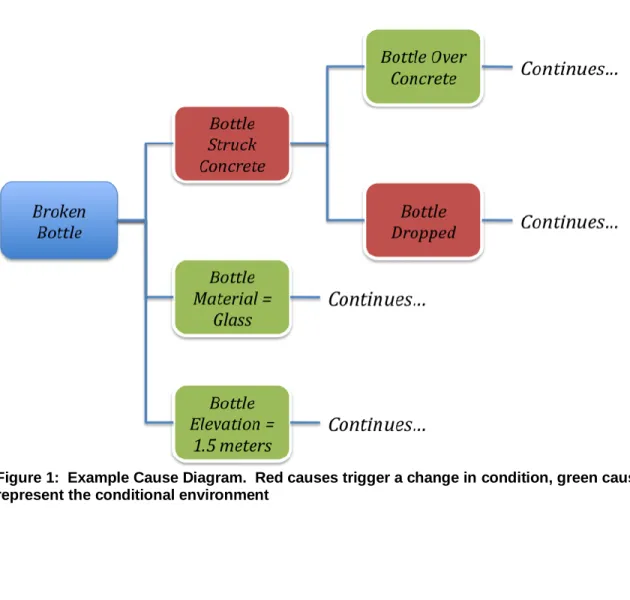
An important aspect of developing a logically sound cause diagram is to recognize two different types of causes. Some causes are catalysts – these causes trigger a change in condition. They can be thought of as variables in the causal equation because their timing is often difficult to predict. Example: a triggering cause of a “broken bottle” is “bottle dropped.” This cause is momentary and transferable – it can happen any time to any person holding a bottle.
Other causes are more stable over time. These causes act as constants in the causal equation and are found in the conditional environment. Continuing the example above, other causes of a “broken bottle” are “bottle material” = “glass and bottle elevation” = “five feet.” Both of these causes are required for the outcome of the event to be the effect of a “broken bottle.” Therefore, they should be represented in the analysis.
FOR A DIAGRAM, CLICK TO SEE APPENDIX A
Both types of causes play a role in an event – the conditional environment and initiators of change in condition. A good investigator – with the right training and a little practice – can achieve a high degree of proficiency at representing both types of causes in an analysis. This is important for at least two reasons. First, any threshold-triggering problem is important. In such
A version of this article was published when our team was known as Apollo Associated Services.
a case, it is essential to develop a thorough understanding of the problem. Second, a thorough understanding of a problem’s causes allows the maximum opportunity to identify effective solutions, which is the goal of any investigation. Often, these solutions can be fast, cheap, easy, and highly effective – always welcome qualities in today’s economic environment.
This logical determination of causes continues until the investigation team has developed a thorough understanding of the problem. This means that they can accurately explain what happened, and identify an effective list of solutions that reduce the risk of recurrence. They may not find all the causes, nor do they need to. The goal of the investigation is to explain the problem to others and to reduce the risk of recurrence through implementation of solutions that break the causal chain. Once this has been achieved, the investigation can be closed.
Developing an accurate, logical representation of the causes is important, but there is another important step. The causes need to be supported with evidence. Evidence supports the inclusion of causes in the analysis. Sometimes the available evidence is not very good. Other times, it is as solid as a rock. The goal of the investigation team is to uncover the best evidence. The primary reason for finding solid evidence is to ensure the investigation team has confidence in the accuracy of its representation, as well as in the solutions it identifies.
RCA Step Three: Identify Solutions
Once the causes have been identified, along with their logical relationships and supporting evidence, the team then examines the causes to find opportunities for solutions. Effective solutions control causes. Individually, a single solution reduces the risk that the problem will recur. However, when multiple solutions controlling multiple causes are identified, the risk of recurrence drops even more substantially. And the risk drops the farthest when causes from the conditional environment (the constants in the causal equation discussed above) are controlled. These causes are consistent over a period of time. If you change the conditional environment, you reduce the base-level risk that affects everyone operating in that environment.
RCA Step Four: Implement Solutions
It is nothing less than a shame when a team does a good job investigating a problem and identifying solutions, and then those solutions fall by the wayside in favor of the newest crisis of the day. It is true… many solutions never get implemented. This happens more often than
A version of this article was published when our team was known as Apollo Associated Services.
members of a supply chain like to admit. Inherent in a robust RCA program is the ability to implement solutions in a timely fashion. This includes ensuring that the solutions implemented do not cause other problems in the supply chain and evaluating the effectiveness after an agreed-upon period of time.
Step 6: Identify Systemic Risks
An effective solution management system delivers more than risk-reducing solutions for individual
problems. It creates a history of problem causes, represented in a consistent common format that can be mined for systemic opportunities. A systemic problem is a nugget of elevated risk in the supply chain. For instance, if one organization in the supply chain has a high rate of turnover that is playing a role in multiple problems, this high turnover rate represents a systemic risk to the entire supply chain that needs to be addressed. Other common systemic problems include forgoing maintenance on critical assets in lieu of production, low employee morale, late shipments of crucial raw materials, and the list goes on. A systemic issue is a common cause for a recurring series of problems. Suspected systemic issues can be pinpointed in individual analyses during review by causal analysis experts. They can then be confirmed by examining a sample set of past analyses to find out if the suspected systemic issue has played a recurring role in past problems.
Once systemic issues are identified, their causes can be examined in the same manner as described above. Removing these causes reduces the risk of future recurrence. Identifying and mitigating systemic issues is the best way to proactively prevent future supply chain problems, because -- left unchecked -- these systemic causes will show up over and over again in future problems.
Step 7: Report/Share Results
If each organization in the supply chain were to master the above steps, there is no doubt that the result would be a reduction in both problem frequency and impact. But the supply chain will benefit even more when a simple, effective reporting process is included. Reporting memorializes the work of the
investigation team. When done well, it helps leverage the maximum benefit from the efforts of the team. Too often, links in the supply chain remain compartmentalized. This is understandable. Teammates on one project may be competitors on another. Plus, it is not easy to admit failures – let alone thoroughly document and share them with the entire team. Unfortunately, the entire supply chain suffers as a result. Some of the most egregious manifestations of the detriments of compartmentalization can be found in
A version of this article was published when our team was known as Apollo Associated Services.
hospitals. Errors are often driven underground for fear of litigation, which slows the spread of important learning opportunities, ultimately increasing the risks to anyone requiring medical attention in any hospital.
Learning from failures in the supply chain, and sharing those learnings through the organization, is the best way to proactively minimize the risk of future failures. Effective and timely reporting helps facilitate this in the short term. The best opportunities should be singled out as case studies and presented at conferences, as well as published in trade periodicals -- all facilitating long-term success.
Step 8: Scale Across Supply Chain
Everything described so far is scalable. You can build a proactive solution management system at any link in the supply chain. Before rolling a process like this out across the entire supply chain, though, it is best to ensure that it works on a reduced scale. The entire process can be piloted at an individual link in the chain. This allows for modifications to be made before any broader rollout. Flexibility will be required – today’s global supply chain involves different companies, countries, governments, and cultures. However, the steps defined here are constants that should exist in some form at each link.
Feedback loops need to be included that allow for the continuous improvement of the process. This is a living process – continual evolution should be engineered into it and encouraged over time. Also, everyone needs to buy in for the process to work. This starts with the upper management in each link. Building cross-functional, cross-organizational work teams can help ensure consistency and keep everyone on the same page.
Overriding principle
The process will work best when you, your suppliers and your customers are all engaged as part of the problem-solving team. Yes, this is scary, and a risk, but history has proven repeatedly this pays great dividends. After all, do you really believe your customers put any stock in the “root cause” of “operator error” and the typically accompanying solution of “re-trained operator” or “disciplined operator”?
When you bring your customer and suppliers together to complete the RCA on the problem, you will find the following:
A version of this article was published when our team was known as Apollo Associated Services.
Each party discovers very real and important constraints that other parties have to live within and deal with. This increased understanding leads to better collaboration and teamwork.
Suppliers appreciate the opportunity to be equal partners in the problem-solving process rather than recipients of grenades tossed over the fence line. They develop more trust in you and exert more energy to find truly effective solutions. You will begin to see less “retraining” and “discipline,” and more substantive solutions.
Customers see that you are serious about improving the quality of your goods/services, and they usually are more understanding and cooperative with you as you implement your solutions. Who wouldn’t like a bit more of this these days?
Chris Eckert is president and Brian Hughes is vice president of Sologic, a leading innovator in root cause analysis training, consulting and investigations, www.sologic.com. Chris is a Professional Engineer, a Certified Maintenance and Reliability Professional, and formerly a reliability engineer with Dow Chemical and Rohm Haas. You can reach Chris directly at [email protected] or 989-835-3402. Brian has led significant incident investigations, including those related to major explosions, chemical releases, consumer product contamination, manufacturing defects and supply chain processes. Brian has helped clients achieve savings in excess of $100 million as well as significant improvements in safety, reliability and quality. You can reach Brian directly at [email protected] and 206-282-7703.
A version of this article was published when our team was known as Apollo Associated Services.
Appendix A: Example Cause Diagram – Broken Bottle
Figure 1: Example Cause Diagram. Red causes trigger a change in condition, green causes represent the conditional environment