Volume 40 Issue 9 Article 1
2015
Is ATAR useful for predicting the Success of Australian Students
Is ATAR useful for predicting the Success of Australian Students
in Initial Teacher Education?
in Initial Teacher Education?
Vince J. Wright
Australian Catholic University, [email protected]
Follow this and additional works at: https://ro.ecu.edu.au/ajte
Part of the Teacher Education and Professional Development Commons Recommended Citation
Recommended Citation
Wright, V. J. (2015). Is ATAR useful for predicting the Success of Australian Students in Initial Teacher Education?. Australian Journal of Teacher Education, 40(9).
http://dx.doi.org/10.14221/ajte.2015v40n9.1
This Journal Article is posted at Research Online. https://ro.ecu.edu.au/ajte/vol40/iss9/1
Is ATAR Useful For Predicting The Success of Australian Students In Initial
Teacher Education?
Vince Wright
Australian Catholic University
Abstract: Quality teaching is the most significant systemic factor contributing to student achievement. Attracting, developing and retaining effective teachers are important goals for Australia as they are for all nations. Debate rages currently about criteria for selection of students into Initial Teacher Education (ITE). The Australian Tertiary Admission Rank (ATAR) is promoted by some commentators as a useful selection measure. The data from six cohorts of students from undergraduate degree programmes at a Melbourne university campus were investigated to evaluate the validity of ATAR as a predictor of academic success and performance on school placement. ATAR was positively related to academic success for students in the three Bachelor of Education Primary cohorts but was weakly related for the three Early Childhood/Primary cohorts. Ratings of
performance by associate teachers on placement were unrelated to ATAR for all six cohorts. Given less than one third of students
nationally enter ITE on the basis of their ATAR the data suggest that a variety of selection methods and criteria are required and ensuring high standards within ITE courses is the best way to control for quality of graduates.
Introduction
In the globalised competition for improved student achievement the quality of
teaching is widely recognised as the most productive focus of attention. While factors such as student background, peer and parental expectations have considerable influence on students’ achievement it is the quality of teaching that has the greatest systemic effect (Goe, 2007; Hanushek, 2011; Hattie, 2009). Alton-Lee (2003) reported that teachers contribute 30% on average to gains in student achievement. She added that the impact is as high as 60% for students of greatest need. In short, teachers matter. Some commentators question the
transportability of factors of success from one national system to others. Attributing gains in student achievement solely to the quality of teaching is debatable. Other researchers suggest an ecological approach to educational improvement that also considers factors such as mobility, poverty, languages other than instructional, access to nutrition and medical care (Braun, 2008), broadened methods for assessing achievement, and application of democratic principles in changing teacher practices (Coffield, 2011).
Most comparative studies of student achievement assume the validity and reliability of international measures such as the Trends in International Mathematics and Science Study (TIMSS) and the Programme for International Student Achievement (PISA). Cross-national comparisons suggest that education systems able to attract top academic students to teaching, develop them into effective teachers through high quality professional learning opportunities,
to have higher average student achievement (McKinsey Company, 2007; Mourshed, Chijioke, & Barber, 2010; OECD, 2013). Darling-Hammond (2010) described how
Singapore and Finland, two high performing countries on PISA, recruit from the top third of high school graduates. These nations support their students financially and pastorally through studentships and mentoring during the early years of teaching. There is evidence of the Mathew effect operating in the sense that students who enter initial teacher training (ITE) with higher grades seem to learn more. For example, measures of high-school achievement and the number of mathematics classes associate highly with the mathematical content and pedagogical content knowledge of graduating teachers and their subsequent effectiveness in improving student achievement over their early years of teaching (Blomeke, Suhl, Kaiser, & Dohrmann, 2012).
However, other research about the relative impact of teachers with high scores on standardised tests, compared to teachers with average scores, points to marginal but small differences in the achievement gains of their students on reading and mathematics at primary (elementary) level (Clotfelter, Ladd, & Vigdor, 2007) and across varied subjects at secondary (college) level (Clotfelter, Ladd, & Vigdor, 2010). Even if it is assumed that higher
standardised test scores for teachers translates into higher achievement for students the price of change is significant for nations wishing to attract students into teaching. Yeh’s (2009) meta-analysis suggested that for the United States of America to entice entrants to ITE who achieve at least one standard deviation above the mean on Standardised Achievement Tests (SAT’s), salaries would need to be raised by a minimum of 44.65%, an unsustainable increase.
What Matters in Initial Teacher Education?
An often-voiced argument is that ITE should draw from students who have already demonstrated academic scholarship, maturity and commitment by being awarded a
Bachelor’s degree in an appropriate discipline. For example, McLean Davies et al. (2013) argue that the success of a Masters level clinical practice based model of ITE is dependent on prospective teachers possessing “a well-defined body of knowledge” (p.96). The implication is that an undergraduate degree is required to establish this knowledge. However the evidence in favour of requiring higher degrees for entry into ITE is inconsistent, despite such level of qualification being expected in some successful systems such as that in Finland. Possession of a Masters level degree by the teacher does not translate into higher gains in mathematics and reading for elementary (primary) students (Hanushek, 2011; Harris & Sass, 2011). In some studies higher degrees in subjects like mathematics have actually been associated with negative gains in student achievement (Zuzovsky, 2009).
Learning ‘on the job’ in the first years of teaching is the factor most associated with improvements to student achievement. A common difficulty with research about the impact of higher degrees is the use of course completion as the measure of subject knowledge. Studies in which researchers use independent tests of mathematical subject knowledge, particularly assessment of pedagogical-content knowledge, scores are positively associated with student achievement (Baumert et al., 2010; Hill, Ball, & Schilling, 2008). It seems that gaining a higher degree does not necessarily translate into stronger content knowledge and pedagogical content knowledge for pre-service teachers.
Opportunities to learn during ITE also have a significant impact on early career teachers’ effectiveness. In an extensive review of the characteristics of ITE programmes in New York State, Boyd, Grossman, Lankford, Loeb, and Wyckoff (2009) found that
teachers’ ability to promote achievement gains in the first two years of teaching. Highly effective programmes include those that include student-teaching experiences such as micro-teaching, a capstone teaching project, and practical classroom tasks such as hearing students read or analysing work samples for formative assessment purposes.
The Australian Context
Teacher education in Australia has been the subject of continual review based on limited evidence (Louden, 2008) and resulting in little significant long-term change (Aspland, 2006). The recently announced establishment of The Teacher Education Ministerial Advisory Group (TEMAG) signalled another round of political attention. TEMAG (2014a) was
charged with responsibility to “bring together the available evidence base” and “develop strong, practical recommendations” (p. 5). The advisory group deliberated at a time of vigorous debate about declining standards for entry into ITE, over-supply of graduates coupled with high rates of under-employment, alarming rates of attrition for early career teachers and an ageing teaching workforce. In their final report TEMAG recommended that providers of ITE use sophisticated approaches to select the best candidates and stopped short of calling for single minimum cut-off scores based on academic performance at secondary schooling (TEMAG, 2014b). The Australian Tertiary Admission Rank (ATAR), introduced in the period 2009-2010, is the obvious measure that could be used to select candidates for ITE in Australia. ATAR is a percentile between ‘less than 30” and 99.95. It is calculated from students’ best four subjects in Year 12, the final year of secondary education, with 10% contribution from their weakest two subjects.
TEMAG’s recommendations were informed by up-to-date data on the Australian education system. In 2013 there were 261,585 full-time-equivalent teaching positions in Australia (ABS, 2014) with the average age of primary teachers at 43.8 years and 45.0 years for secondary teachers (McKenzie, Weldon, Rowley, Murphy, & McMillan, 2014). The profession has a significant gender imbalance with 80.9% of primary teachers and 58.4% of secondary teachers being female and an under-representation of people with indigenous aboriginal and Torres Strait ethnicity. There has been only a slight increase in the average age since 2010. However 18% of primary and 20% of secondary teachers are aged 55 years or older. Combined with a national population growth of 1.7% per year, which is highly variable by state due largely to immigration, the statistics suggest some demand for early career teachers in the next ten years. This approaching demand is little comfort to the 44 000 teachers reported as unable to find work in New South Wales (Cervini, 2013; McDougall, 2014; Todd, 2014). Increases to the retirement age and restrictions to eligibility for
government funded superannuation are likely to cause teachers to delay their exit from the workforce.
The lack of state, let alone national, workforce planning is likely to be exacerbated by changes to entry arrangements for ITE. 2014 was the first year of open entry for ITE meaning that the 48 nationally accredited providers were free to accept any number of applicants to Commonwealth funded places they deemed appropriate. In 2012 the number of
commencements into ITE was 30,457, an 8% increase on the 2011 figure, and 16,650
students graduated in 2012 with teaching qualifications (Australian Institute for Teaching and School Leadership (AITSL), 2014). On 2012 data alone, without factoring in increases in places offered, providers graduated the equivalent of 6.4% of the total number of fulltime positions available. At that rate the teacher workforce could be replaced by graduates every 16 years.
Perceptions of oversupply must be tempered by the harsh reality that an estimated 50% of early career teachers leave the profession within the first five years (Gallant & Riley, 2014). This proportion is consistent with data from North America, Europe and the United Kingdom. Richardson and Watt (2006) reported that the greater proportion of entrants to teacher education in three large Australian universities were from lower to middle socio-economic families. The main motivations of these students for selecting teaching were self-perceptions of their potential ability at teaching, valuing social contribution, and previous positive experiences they had of being taught by others. The altruistic motivations of beginning teachers may be a significant factor in their disillusionment when they are faced with the constraints of school life and culture (Gallant & Riley, 2014). The likelihood of high exit rates by early career teachers is substantiated by the 2013 workforce report (McKenzie et al., 2014). 5.1% of primary and 7.7% of secondary teachers planned to leave the profession. Significant proportions of early career teachers (39.9% primary and 43.4% secondary) were unsure about how long they would continue teaching.
The high attrition of early career teachers is not attributable to poor quality ITE. McKenzie et al’s (2014) survey of staff in Australian schools suggests that at least 50% of early career teachers have high levels of satisfaction with their initial preparation, particularly their preparedness in regard to national standards, content and teaching of that content, planning, engaging in professional learning and engaging with colleagues, parents and the community. These results are confirmed by Mayer et al. (2013) who report similarly strong perceptions of preparedness from ITE graduates in their early years of teaching and from their employing principals. The researchers report significant positive differences in
perceived preparedness between graduates in favour of Masters’ and Bachelors’ degrees over graduates of Diploma courses.
Perhaps the perception of over-supply of graduates has fuelled recent debate about declining entry requirements for teaching. For example, Dinham (2013) lamented the “general downward slide of entry standards to undergraduate teacher training courses” (p. 99). He noted that top performing countries draw their prospective teachers from the top quartile of school leavers and argued for a higher degree profession. Establishing which students are in the top quartile of academic achievement depends on a consistent measure of that achievement. ATAR presents a measure that can be used to judge the academic level of entrants to ITE. Preiss and Butt (2013, January 18) provide evidence that some Universities in Australia accept students into ITE with ATARs as low as 43.
In this article we consider whether or not entry level of pre-service teachers, as
measured by ATAR is a good predictor of their academic success and classroom performance in ITE programs. We consider the performance of two groups, students in the undergraduate four-year Bachelor of Education Primary and the equivalent programme for the Early
Childhood/Primary course.
We investigate the following research questions:
Is ATAR a valid predictor of students’ academic success in ITE?
Is ATAR a valid predictor of students’ performance on teaching placement in schools?
Method
The students attended a medium sized University located in Melbourne, Australia, in 2014. They studied in two courses, Early Childhood/Primary, and Primary. Data was
available for three year groups of students in each course, years two, three and four. This yielded six cohorts and offered the opportunity to investigate patterns among entry years as well as the characteristics of the students opting for different courses. The Early
Childhood/Primary course is a four year degree programme that qualifies students to work in educational settings with children from birth to Year Six. The Primary course is also of four years duration and prepares students to teach in primary schools from Foundation to Year Six.
Three measures were used to address the research question; ATAR on entry to the University, Grade Point Average (GPA), and a global rating by their associate teacher on each student’s most recent placement. GPA is a cumulative measure of academic
achievement during a whole course of study. For the students in this study GPA at the beginning of 2014 was used. GPA is calculated from the mean of the values associated with grades from credit bearing units as follows; Pass (4), Credit (5), Distinction (6) and High Distinction (7). A first year student achieving four passes, three credits and one distinction in their eight units would have a GPA of 4.625. Lecturers-in-charge of units up to the end of 2013 complied with normative grade distributions meaning that proportions of a unit cohort were assigned grades as follows; Fail-Pass (50%), Credit (20%), Distinction and High
Distinction (20% in total). Some discretion was permitted for lecturers but these distributions were applied with minimal variance to large cohorts such as those in the Early
Childhood/Primary and Primary courses. A large proportion of students gain GPAs of between four and five but a very small proportion gain GPAs above six. Therefore GPA is a more discrimatory measure of academic achievement at higher levels (5-7) than in the middle range (4-5).
To obtain some measure of the performance of the students during school placements, reports from associate teachers were used. Placement occurs at different times during the year dependent on the course, for example fourth year students conclude their placements in late September while students in their second year finish in early December. At the end the placement each student is rated on a seven point scale to indicate the extent to which they have met the stated outcomes overall. Notes and the scale on the report form are as follows: A score of 3.5 or less on the scale of 0 – 7 constitutes an UNSATISFACTORY grade.
Codes:
ND – Not demonstrated; PD – Partially demonstrated; D – Demonstrated; HD - Highly demonstrated
Figure 1: Rating guidelines for associate teachers
In some cases associate teachers mark positions on the scale between the whole numbers so the location is interpreted as a decimal to one place, for example 5.8. There is general reluctance among associate teachers to assign ratings of 3.5 or less. Consequentially the practice of professional staff in the placement office is to investigate the performance of any student with a rating of five or less.
All students in the six cohorts were included in the data initially. However some cleaning of the data was needed to eliminate students for whom associate teacher ratings were unavailable due to students postponing their placement, withdrawing from the course or in a small number of cases where the report had yet to be filed. Cleaning left those students who were full participants in their course for the whole year of 2014.
0
1
2
3
4
5
6
7
Results
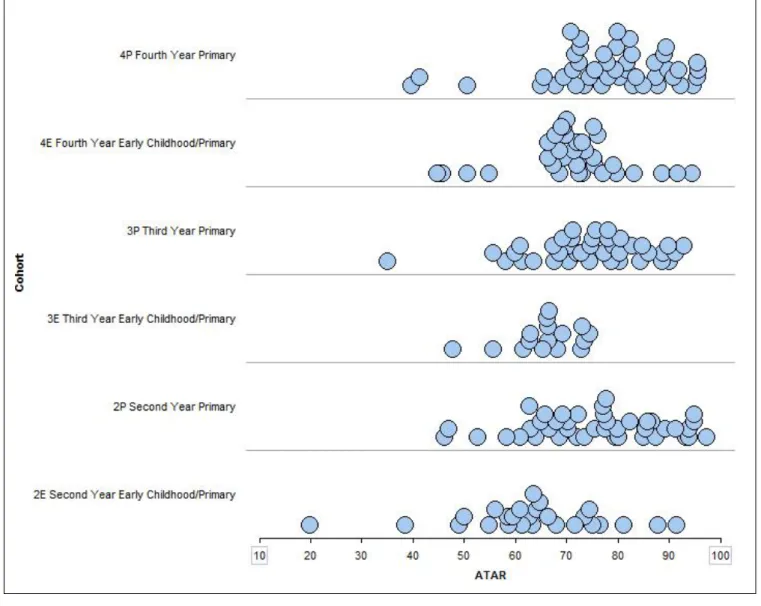
Data from a total group of 602 students are included in the study. The average entry ATARs and number of students for each cohort are given in Table 1. The number of students in each cohort decreases with successive years while mean ATAR increases. Given the data do not reflect longitudinal measures from the same cohorts of students it is impossible to say that these patterns are due to factors such as increased demand for the courses or lower entry requirements over time, changes to the demographics of the student body, or attrition from the courses.
Course Second Year Third Year Fourth Year
Early Childhood/Primary 65.39 (n = 97) 66.77 (n = 75) 71.58 (n = 76) Primary 71.31 (n = 147) 71.75 (n = 109) 76.27 (n = 98)
Table 1: Mean entry ATAR by cohort
To investigate the relationship between ATAR and GPA scatterplots were created. Figure 2 shows the displays for the respective Bachelor of Education Early
Childhood/Primary cohorts and Figure 3 shows the displays for the Bachelor of Education, Primary, cohorts. For the Primary cohort the assumption of a linear regression model seems reasonable and the relationship between ATAR and GPA is positive, particularly at the upper end of the distributions where high ATARs seem associated with high GPAs. However, the relationship for students with lower ATARs is less clear. Some students with entry ATARs lower than 60 appear to gain GPAs of 4.5 or more during their first year of study. Conversely students with ATARs lower than 60 are disproportionally represented in the group who have GPAs less than four by the end of their first year of study, meaning these students have failed units. GPAs of less than four are very uncommon in the third and four year cohorts
suggesting that failing student either leave the course by election or exclusion.
The assumption of a linear positive relationship between entry ATAR and GPAs is inappropriate for students in the Early Childhood/Primary cohorts. While the linear line of regression for the third year cohort looks slightly positive there appears to be little association for the second and fourth year cohorts. Gaining GPAs of five or higher is not restricted to students with high entry ATARs and one student with an entry ATAR of “30 or less” achieves a GPA of over six at the end of their first year of study. In general, students with ATARs of 60 or less gain GPAs above four. In fact a quadratic model is a better fit to the data for the third and fourth year Early Childhood/Primary cohorts as students with entry ATARs of 65 or less gain better GPAs proportionally than those with ATARs in the range 65 to 75.
The global rating of performance proved to be a poor discriminator of performance on placement. Associate teachers tended to rate students as six or seven, the highest two whole number points on the scale. The lack of range limited access to correlations between entry ATAR and classroom performance. To consider how entry ATAR associated with
performance on placement the distributions of students rated as five or less (at risk), and of students scoring seven (highest) were plotted. Figure 4 shows that entry ATAR was a poor predictor for being considered ‘at risk’ on placement. Those at risk are distributed across the range of entry ATARs and most of the students ‘at risk’ in their fourth year of study have ATARs of 75 or more. Similarly there seems to be no obvious relationship between entry ATAR and gaining the highest rating from the associate teacher. Figure 5 shows that students given a rating of seven have entry ATARs across the full range from ‘less than thirty’ to 95. One third of all students in the study receive ratings of seven which suggests that the scale is not a strong discriminating measure of high performance by students on school placement.
To test the relationships between entry ATAR, and both GPA and placement rating Pearson Product Moment correlation co-efficient statistics are presented in Table 2.
Moderately positive relationships exist between ATAR and GPA for all of the Bachelor of Education Primary cohorts and the results are statistically significant. This relationship is less positive for the Early Childhood Primary cohorts. In particular there appears to be no
relationship between ATAR and GPA for the second year cohort. The correlation coefficients between ATAR and placement rating show weak relationships. Only for the second year and third year primary cohorts is any significant result found and the relationships are weakly positive. The lack of discrimination in the rating given by associate teachers may be the major reason for the absence of any relationship or it may not exist in the first place.
There are implications from these data for the use of ATAR alone as a predictor of success in ITE. The appeal of ATAR as a screening measurement for entry into ITE is that it is easily standardised across all of the states of Australia. Since ATAR is a percentile rank it would be tempting to implement a cut score as a selection criterion for selecting school leavers.
Table 2: Pearson Product Moment Correlations between ATAR and GPA, and ATAR and Placement Rating
Discussion
Entry ATAR is moderately correlated with academic success, as measured by GPA, for all cohorts in the Primary programme but is weakly correlated for the Early
Childhood/Primary cohorts. Clearly the differences between compositions of these cohorts, combined with other significant factors like personal motivation, maturation, and the effects of study, make academic achievement in secondary school of varying reliability as a
predictor. There is considerable variation in GPA among students with similar ATARs across the whole range, and across all six cohorts. For the majority of students undergraduate study comes at a time of transitioning between adolescence and adulthood. While a strong positive relationship between ATAR and GPA might be expected, other factors in students’ lives mediate against that. Attitude and commitment to study may well be as important to academic success at University as previous achievement in Year 12 of secondary school. There is no clear relationship between entry ATAR and ratings of performance on placement by associate teachers. The ATARs of students who are at risk and who meet the outcomes at a high level are distributed across the range. ATAR is a poor predictor of those ratings.
Use of ATAR as a singular screening tool for entry into ITE is not justified from these data and is of questionable value given the changing characteristics of the student body entering tertiary study. In 2012 about 41% of students entered ITE directly from secondary school. Only 28% of the students entering ITE were accepted on the basis of their ATAR alone and of those students the majority, 56%, had an ATAR between 61 and 80, with 31%
Cohort Correlation between ATAR and GPA
Correlation between ATAR and Placement
Rating Bachelor of Education Early
Childhood/ Primary Year Two
r (95) = 0.086 -0.030
Bachelor of Education Early Childhood/ Primary Year
Three
r (73) = 0.276* -0.050 Bachelor of Education Early
Childhood/ Primary Year Four
r (74) = 0.239 -0.105
Bachelor of Education
Primary Year Two r (145) = 0.562** 0.215* Bachelor of Education
Primary Year Three r (107) = 0.442** 0.232* Bachelor of Education
Primary Year Four r (96) = 0.464** 0.136
accepted on the basis of other ‘mechanisms’ such as interviews, referee’s reports, work history and other qualifications. ATAR is used as the sole entry requirement for less than one third of current entrants to ITE reflecting a changing pattern in the life experiences and circumstances of those seeking to become teachers. For example, twenty-two percent of those beginning ITE in 2012 were studying through external attendance modes, e.g. online courses, which representan increase of 132% in distance mode studentships since 2005. Students studying through online external courses are proportionally more likely to be mature aged, second career learners in rural areas than the general population of entrants to ITE (AITSL, 2014, p. 15). Entrants in 2012 were also more likely to have a first degree than in 2005. Even if ATAR was dubiously accepted as an entry criterion it could be applied to only two-fifths of the applicants to ITE.
The data reported in this research come from one university located in a large state capital. Universities, like all institutions, have unique locations, histories and cultures that affect the composition of their student body. In addition the cohorts of students in this study are engaged in courses that prepare them for Early Childhood and Primary educational settings. There are obvious limitations in terms of generalising to students from other Universities and other courses across Australia. We also acknowledge the need for a more discriminatory yet practical measure of student performance on classroom placement. That said, the data offer interesting insights into the usefulness of ATAR as a predictor of success for these particular student cohorts.
Conclusion
The data from this study and from ITE institutions across Australia suggest that, at best, ATAR is useful when used in conjunction with other measures and mechanisms to determine entry to ITE. On the basis of this study ATAR, by itself is only a moderate
indicator of academic success and an unreliable indicator of success on school placement for the students entering ITE. Given the changing nature of students entering ITE, reflecting the greater proportion of enrolments from graduates and mature aged people, the singular use of ATAR scores as an entry requirement is not viable. Competition is unlikely to change as the preferred mechanism to ensure quality control of ITE courses. Rigorous assessment within the institutions, based on achievement in the academic courses and teaching experience in schools, is likely to be a more useful for ensuring the quality of exiting students than strict entry criteria based on ATAR. This observation is consistent with TEMAG’s resistance to using ATAR as a blanket screening benchmark for entry to ITE, and with the group’s recommendations pertaining to tighter control over the quality of ITE courses. These data show that the group of students who are rated by their associate teachers as highly effective displays a wide range in entry ATAR. Clearly classroom readiness on exit from ITE cannot be reliably predicted by academic ranking on entry.
References
Australian Bureau of Statistics (ABS) (2014). 4221.0 – School Australia, 2013. Retrieved from: www.abs.gov.au/ausstats/abs@nsfl/latest
products/4221.0Main%20Features100052013?
Australian Institute for Teaching and School Leadership (AITSL). (2014). Initial teacher education: Data report 2014. AITSL. Melbourne. Retrieved from
http://www.aitsl.edu.au/initial-teacher-education
Alton-Lee, A. (2003). Quality teaching for diverse students in schooling; Best evidence synthesis. Wellington, NZ: Ministry of Education.
Aspland, T. (2006). Changing patterns of teacher education in Australia. Education Research and Perspectives, 33(2).
Baumert, J., Kunter, M., Blum, W., Brunner, M, Voss, T. Jordan, A., Klusmann, U, Krauss, S., Neubrand, M., & Tsai, Y. (2010). Teachers’ mathematical knowledge, cognitive activation in the classroom, and student progress. American Educational Research Journal, 47(1), 133-180. http://dx.doi.org/10.3102/0002831209345157
Blomeke, S., Suhl, U., Kaiser, G., & Dohrmann, M. (2012). Family background, entry selectivity and opportunities to learn: What matters in primary teacher education? An international comparison of fifteen countries. Teachers and Teacher Education, 28(2012), 44-55. http://dx.doi.org/10.1016/j.tate.2011.08.006
Boyd, D. J., Grossman, P. L., Lankford, H., Loeb, S., & Wyckoff, J. (2009). Teacher preparation and student achievement. Educational Evaluation and Policy Analysis,
31(4), 416-440. http://dx.doi.org/10.3102/0162373709353129
Braun, H. (2008). Review of the McKinsey Report: how the world's best perfroming school systems come out on top. Journel of Educational Change, 9, 317-320.
http://dx.doi.org/10.1007/s10833-008-9075-9
Cervini, E. (2013). Are we facing a glut of teachers?, The Sydney Morning Herald. Retrieved from http://www.smh.com.au/national/education/are-we-facing-a-glut-of-teachers-20130829-2ss22.html
Clotfelter, C. T., Ladd, H. F., & Vigdor, J. L. (2007). How and why do teacher credentials matter for student achievement? (Working Paper No. 2): National Centre for Analysis of Longitudinal Data in Education Research. http://dx.doi.org/10.3386/w12828 Clotfelter, C. T., Ladd, H. F., & Vigdor, J. L. (2010). Teacher credentials and student
achievement in High School: A cross-subject analysis with student fixed effects.
Journal of Human Resources, 45(3), 655-681. http://dx.doi.org/10.1353/jhr.2010.0023
Coffield, F. (2011). Why the Mckinsey reports will not improve school systems. Journal of Educational Policy, 27(1), 131-149. doi: 10.1080/02680939.2011.623243
Darling-Hammond, L. (2010). Teacher education and the American future. Journal of Teacher Education, 61(1-2), 35-47. http://dx.doi.org/10.1080/02680939.2011.623243 Dinham, S. (2013). The quality teaching movement in Australia encounters difficult terrain: a
personal perspective. Australian Journal of Education, 57(2), 91-106. http://dx.doi.org/10.1177/0004944113485840
Gallant, A., & Riley, P. (2014). Early career teachers attrition: new thoughts on an intractable problem. Teacher Development, 2014, 1-19.
http://dx.doi.org/10.1080/13664530.2014.945129
Goe, L. (2007). The link between teacher quality and student outcomes: A research synthesis. Washington, DC: National Comprehensive Centre for Teacher quality. Retrieved from: http://files.eric.ed.gov/fulltext/ED521219.pdf
TEMAG. (2014). Issues paper. Teacher Education Ministerial Advisory Group. Canberra. Retrieved from
http://studentsfirst.gov.au/files/temag_issues_paper_-_april_2014_4.pdf
Hanushek. (2011). The economic value of higher teacher quality. Economics of Education Review, 30(2011), 466-479. http://dx.doi.org/10.1016/j.econedurev.2010.12.006 Harris, D. N., & Sass, T. R. (2011). Teacher training, teacher quality and student
achievement. Journal of Public Economics, 95(2011), 798-812. http://dx.doi.org/10.1016/j.jpubeco.2010.11.009
Hattie, J. (2009). Visible Learning : A Synthesis of Over 800 Meta-Analyses Relating to Achievement. London Routledge.
Louden, W. (2008). 101 Damnations: the persistence of criticism and the absence of evidence about teacher education in Australia. Teachers and Teaching: theory and practice, 14(4), 357-368. http://dx.doi.org/10.1080/13540600802037777
Mayer, D., Allard, A., Dixon, M., Doecke, B., Kostogriz, A., Rowan, L., . . . Moss, J. (2013). Studying the Effectiveness of Teacher Education (SETE): research brief 4 (pp. 1-4). Melbourne: Deakin University.
McDougall, B. (2014). No school jobs available for thousands of trained teachers throughout NSW schools, The Daily Telegraph. Retrieved from
http://www.dailytelegraph.com.au/news/nsw/no-school-jobs-available-for-thousands-
of-trained-teachers-throughout-nsw-schools/story-fni0cx12-1226980912361?nk=931e6ab61e21908bafd3a25a30b88129
McKenzie, P., Weldon, P. R., Rowley, G., Murphy, M., & McMillan, J. (2014). Staff in Australia’s schools 2013: main report on the survey. Melbourne: Australian Council for Educational Research (ACER).
McKinsey Company. (2007). How the world's best-performing school systems come out on top. np: McKinsey Company.
http://www.mckinsey.com/clientservice/socialsector/ourpractices/philanthropy.asp. Mclean Davies, L., Anderson, M., Deans, J., Dinham, S., Griffin, P., Kameniar, B., . . . Tyler,
D. (2013). Masterly preparation: embedding clinical practice in a graduate pre-service teacher education programme. Journl of Education for Teaching: International Research and Pedagogy, 39(1), 93-106.
Mourshed, M., Chijioke, C., & Barber, M. (2010). How the world’s most improved school
systems keep getting better. np:McKinsey & Company. Retrieved from
http://www.mckinsey.com/client_service/social_sector/latest_thinking/worlds_most_i mproved_schools
OECD. (2013). PISA 2012 results: What makes schools successful? Resources, policies and practices (Vol. IV): PISA, OECD Publishing.
Preiss, B., & Butt, C. (2013, January 18). Teacher entry ranking tumbles: The Age. Richardson, P. W., & Watt, H. M. G. (2006). Who chooses teaching and why?: Profiling
characteristics and motivations across three Australian universities. Asia-Pacific Journal of Teacher Education, 34(1), 27-56.
http://dx.doi.org/10.1080/13598660500480290
Teacher Education Ministerial Advisory Group (TEMAG). (2014a). Teacher Education Ministerial Advisory Group: Issues paper. Sydney: Department of Education and Training. Retrieved from
http://sydney.edu.au/about/government/TEMAG%20Issues%20Paper%20April%202 014.pdf
Teacher Education Ministerial Advisory Group (TEMAG). (2014b). Action now: Classroom ready teachers. Sydney: Department of Education and Training. Retrieved from: https://docs.education.gov.au/system/files/doc/other/action_now_classroom_ready_te achers_print.pdf
Todd, D. (17 September, 2014). Unemployment rises among post-graduates: Financial Review. Retrieved from
http://www.afr.com/p/national/education/unemployment_rises_among_postgraduates _oeZYjMBNwJ9CYWxG2AWeWN
Yeh, S. S. (2009). The cost-effectiveness of raising teacher quality. Educational Research Review, 4(2009), 220-232. http://dx.doi.org/10.1016/j.edurev.2008.06.002
Zuzovsky, R. (2009). Teachers’ qualifications and their impact on student achievement: Findings from TIMSS 2003 data for Israel. In: International Association for the Evaluation of Educational Achievement (IEA) and Educational Testing Service (ETS) (Eds.), IERI monographseries issues and methodologies in large-scale assessments
(Vol. 2). Retrieved June 2, 2009, from
http://www.ierinstitute.org/IERI_Monograph_Volume_02 Chapter