www.ijtrd.com
Total Quality Management Model in Indonesia
Higher Education
1
Lena Ellitan and
2Teodora Winda Mullia,
1,2
Faculty of Business, Widya Mandala Catholic University Surabaya Indonesia
Abstract: The rapid development of competition in the world of higher education requires the education to think of the right competitive strategy to provide superior service to customers and prospective customers are students and prospective students. But the paradigm that consumers are student must have changed that consumers today are many parties that are interconnected, for example, users, communities, governments and other parties. Efforts should be made in this case is to make changes that higher education is able to play an active role as a provider of intellectual asset for the real sector in order to compete in the global market. higher education in Indonesia has not been able to respond quickly to changes in the external environment education there. The new paradigm focuses on the role of higher education institutions as a service industry or industry knowledge which the higher education institutions to compete based on quality. Educational paradigm dynamic and flexible to changes that there is indispensable in responding to competitive conditions were very competitive today. Through the TQM approach as a management approach as higher education policy is expected stretegis able to overcome the existing problems by integrating TQM into the paradigm of higher education in Indonesia. Application of Total Quality Management (TQM) in higher education in Indonesia requires commitment and consistency. TQM approach provides benefits for the organization to carry out continuous improvements so as to anticipate the changes that occur in response to changes in external factors and guarantee the success of higher education in its operations in the competitive environment that is increasingly competitive .. This study aims to model the dimension of quality in education in the context of these consumers and the paradigm of education as a service industry or industryknowledge.
Keyword: TQM, Competition, Higher Education
I. BACKGROUND OF THE STUDY
The rapid development of competition in the world of higher education requires the world of education to think of the right competitive strategy in providing superior services to consumers and prospective consumers, namely students and prospective students. become more rational in making choices, and have higher demands on the quality of education and higher education services that will be their choice. In this condition the image of a large university and long operating period is no longer sufficient to be seen as a competitive advantage from another perspective so that strategic policies are needed to continue to exist in the existing competition.
Higher education in Indonesia is inseparable from the influence of external factors such as demographic trends, technology, economic changes, and competition between higher education institutions in Indonesia. Facing these conditions, higher education in Indonesia must be at the forefront in facing existing environmental changes through formal education that educates someone to become a professional and has certain competencies (Departemen
Pendidikan Nasional, 2005). The effort that must be made in this regard is to make changes so that higher education can play an active role as a provider of intellectual assets for the real sector in order to be able to compete in the global market (Kementrian Pendidikan dan Kebudayaan, 2012). Universities play a role in providing student graduates in various levels of education from diplomas, bachelor's, professional education, masters, to doctorates that can be accessed by the industrial sector to meet the needs of their workforce. On certain occasions, the industrial sector provides "technical opportunities" for students to receive training and explanations about the world of business, work processes, and the ins and outs of the company through visits to companies that automatically cannot be given or obtained in class. In fact, it cannot be denied that there is often a "mismatch" between the world of academia (universities) and the world of business (industry), so that understanding, policy and management of collaboration is needed through the creation of synergies between universities and industry. To overcome the mis-match that occurs between the two parties, collaboration is needed that aims to create a transfer of knowledge from university to industry. To overcome the mis-match that occurs between the two parties, collaboration is needed that aims to create a transfer of knowledge from university to industry.
The tighter competition between universities, both state universities (PTN) and private universities (PTS) and to achieve the goal of collaboration between universities and industries that benefit both parties has an impact on the importance of continuously improving the quality of organizational systems through the implementation of Total Quality Management (TQM) in higher education in Indonesia (Nasution, 2005). The TQM approach benefits organizations to make continuous improvements so they are able to anticipate changes that occur in response to changes in external factors and ensure the success of higher education in its operations in an increasingly competitive competitive environment (Dewi, 2008),. The implementation of TQM is able to promise success for the institution because TQM uses a comprehensive and continuous approach that focuses on quality. Tjiptono and Diana, (2001), suggested four areas of TQM implementation in higher education, namely: 1) TQM implementation in improving the function and administration of higher education related to managerial role decision-making processes to meet consumer (student) demand, 2) integration of TQM in education carried out through the process of internalizing the TQM philosophy in the education process, 3) the implementation of TQM as a teaching method in the teaching and learning process related to the teacher-centered focus process to student-centered focus, 4) the implementation of TQM in managing university research activities through training to improve capability of the researcher.
This study focuses on the integration of TQM in higher education in Indonesia, which is motivated by the condition of the world of education in Indonesia that has not been able to
www.ijtrd.com
respond quickly to existing changes in the external environment of education that are caused by less dynamic education models (Rasto, 2012). It is due to they are inflexible. Incidentally it is very necessary in responding to changes in conditions of change and very competitive competition today. Through the TQM approach as a management approach as a strategic policy it is expected that higher education can overcome existing problems by integrating TQM into higher education in Indonesia. To integrate TQM in higher education and meet the needs of the industrial world for competent tertiary graduates, collaboration between the two parties is needed to discuss the implementation of TQM and its integration in education. This study aims to analyze the relationship between perceptions of academic managers about the pressure of external factors to adopt Total Quality Management and the integration of Total Quality Management in the management of Higher Education Institutions.
II. LITERATURE REVIEW
A. Total Quality Management (TQM) in Higher Education
The tighter competition between higher education resulted in a paradigm shift in higher education institutions. The traditional paradigm focuses on imaging higher education institutions as a social institution that provides higher education opportunities for the community. Higher education institutions are responsible for the provision and funding of higher education based on sources of funds obtained from religious bodies and philanthropists from both domestic and international, and foundations established by businesses to fund the operations of higher education.
The new paradigm focuses on the role of higher education institutions as service industries or knowledge industries where higher education institutions compete based on quality. In this condition, the process of higher education is seen as a continuous improvement that starts from a series of cycles from the idea of producing qualified graduates to the responsibility of higher education in providing satisfaction for users of these higher education graduates. Through the feedback provided by users (users) of higher education graduates, specific ideas can be developed for redesigning the education model, improving the existing teaching and learning process in higher education (Wijaya, 2008), explaining continuous quality improvement efforts in higher education .
The approach proposed by (Dewi, 2008) shows that to guarantee the quality of higher education three approaches can be used, namely accreditation approach, outcome assessment approach, and open system approach, each of which has a different approach. The accreditation approach focuses on institutional inputs such as student achievement, degree faculty, facilities and physical resources with underlying assumptions that if quality inputs are available, high-quality outputs will also be obtained. The outcome assessment approach emphasizes the importance of evaluating tertiary output such as student achievement, graduation, and employment or position, but this approach does not provide a basis for determining problems in the teaching and learning process although it cannot be denied that this approach provides valuable institutions for students , and the public. This approach provides valuable contributions to institutions, students and the public. An open system approach is an integrated quality assurance system for higher education and emphasizes quality needs at the input, process and output stages.
The successful implementation of TQM in the business
world inspires higher education to adopt TQM in the world of education, in addition to the sharp level of competition between universities and the pressure of global competition challenges the implementation of higher education in Indonesia. To provide added value to the competitiveness of higher education, mastery of competitive advantage is needed in terms of the quality of the study programs that are owned. This is because the study program will later be assessed through an accreditation system both by the National Accreditation Agency, International Quality Standards Agency, and Professional Standards. (Wijaya, 2008), describe the various pressures faced by higher education in enhancing the competitive advantage of the study program as described in Figure 3. The figure explains that in the vision and mission of higher education there is a desire and hope to produce explicitly high-quality higher education that can make the program competitive studies. In addition, a focused positioning in higher education is needed to improve the competitive advantage of the study program.
B. The Importance of TQM in Higher Education
The importance of integrating TQM in higher education is stated by Tjiptono and Diana (2001)which states that business society expects TQM to be integrated in higher education because the delay in higher education in dealing with external changes will result in increasing the cost of education in the business world. reeducation. This is a major challenge for higher education to be able to always improve performance by providing the knowledge and skills needed by the job market in the business world, namely by developing an educational process that is adaptive to external changes.
A study of the importance of competing strategies for higher education in dealing with external change was carried out by Ahmadi, (2009). According to him, in the face of unpredictable changes in the external environment, management of higher education requires a management system known as TQM as one of the strategies that is considered optimal in dealing with changes that occur in all aspects of organizational life. Academic quality improvement and teaching methods are the main targets for the academic community to produce quality and competent graduates (Utomo, 2005).
Related to the quality of higher education and customers, Ahmadi, (2009).states that if higher education is not able to anticipate external needs and improve quality, the customer will leave it. In this case, the concept of TQM is needed to prepare students for the world of work by understanding the basic concepts of mature management. The more rapid development of information technology, makes it easier for prospective students to be able to choose higher education based on the quality of education and teaching offered so that the critical attitude of prospective students towards higher education is increasing. This condition is indicated by the fact that the choice in deciding to choose private tertiary education in Indonesia, for example, the choice of prospective students will tend to be based on their choice of choosing a university that has achieved equal status. Herbert et al. (1995) argue that 77% of respondents agree that TQM makes a new contribution to management practices rather than traditional management theory. To improve the quality of higher education it can be done by developing and increasing the scientific degree of teachers at the higher education level. In the TQM approach, quality is determined by the customer, so customer satisfaction is a top priority in the TQM organization and is an urgent matter for the organization to
www.ijtrd.com
have a clear idea of who the customer is (Deming, 1986). A number of education in Indonesia have received favorite titles which are marked by the swelling of a number of prospective students who want to get seats in certain universities. The predicate obtained by an education certainly comes from internal customers who are satisfied with what they feel and receive while studying at the college and external customers who have seen themselves performing well from the university alumni where they have studied.
III. RESEARCH METHODS
A. Sample and Population
The population in this study were PTN and PTS, while the research sample used in this study was the academic manager of the Bachelor of Business program in Java. The procedure for sampling in this study used purposive sampling and stratified sampling methods.
B. Reliability and Validity Test
Even though the instruments used were adopted and modified from various existing literature, testing the reliability of the instrument was carried out by calculating Chronbach's alpha. Instruments are considered to have high reliability if the Chronbach's Alpha value is higher than 0.5 (Mihardja, 2010,). In addition, additional testing was also carried out by looking at instrument reliability instruments by calculating the efficiency of homegeneity. The homogeneity coefficient is the correlation between individual items with the total score of all items. The higher the coefficient, the more reliable the instrument. If the correlation between individual items with total scores is not significant then the item is invalid.
C. Data Analysis Technique
In this study to test the relationship between variables used Pearson Product Moment Correlation, while to see the significance of the frequency differences obtained from the two samples, Chi Square method with the SPPS program was used.
1. Pearson Product Moment Correlation:
This method is used to find relationships between two or more variables. The measure used to determine the degree of relationship especially for quantitative data is called the correlation coefficient, which is to show the strength of the relationship and the direction of the relationship between variations in the two score distributions. In this study using Pearson Product Moment correlation because the variables used by researchers are continuous variables. This method is used to test hypotheses 1 to the hypothesis 4. The formula used is:
Where: X and Y are the scores of each variable N is the number of subjects studied
2. Chi Square Method
To test hypothesis 5 to Hypothesis 8 the Chi Square method is used. In testing hypotheses, this method is used to test the frequency difference hypothesis obtained from two or more samples whether or not they have differences or not. The formula for Chi Square if the table used is 2x2 then it can be
obtained by the formula:
𝑋
2=
𝑁 (𝑎𝑑 − 𝑏𝑐)
2
𝑎 + 𝑏
𝑐 + 𝑑
(𝑏 + 𝑑)
Where: N = number of individuals or subjects
IV. ANALYSIS AND DISCUSSION
A. Data Description and Analysis
To find out how the TQM implementation process is carried out by universities in order to improve university performance and the benefits obtained after the university implements TQM, the authors use several data collection techniques including interview, questionnaire, and observation. Questionnaire results that have been collected in the form of percentages based on their respective dimensions are compared with the results of interviews with university leaders and other relevant parties such as educators and education. This is done to find out whether the steps taken by the university in implementing TQM have been based on the principles of TQM in order to analyze the application of TQM that has been carried out by the university and find out its impact on the performance of the university concerned.
Data collected from the questionnaire results, processed so that it can provide meaning and explanation to facilitate analysis of research results. The questionnaires distributed were 60 copies distributed to university leaders and 38 copies returned. The contents of the questionnaire included various statements regarding the actions taken by the university in implementing TQM in accordance with the principles contained therein. All statements are answered by respondents by giving a checklist (√) to one of the answer choices provided with an alternative answer to Srongly Agree, Agree, Neutral, Disagree, and Strongly disagree. The data described and analyzed are the answers to questionnaires, then the data is collected and processed in the form of a percentage to find out how well the university implements TQM principles to manage and carry out activities that can be described as follows:
The preparation phase is the phase where the university prepares before implementing TQM. In this phase the university does is establish and establish strong commitments among all university citizens, both within the organization such as lecturers and employees as well as students and those outside the organization such as parents and surrounding communities to be oriented towards total quality (Ariani, 2003). Where every person both inside and outside the organization has an important role in improving the quality of the university.
Total Quality Management in the learning process and education administration is related to the integration of TQM elements into the determination of the university curriculum and teaching and learning process in the classroom, as well as decision making in terms of managing university administration to support the achievement of the university's long-term strategic goals. Total in work means that everyone involved both directly and indirectly in the management of educational activities has an important role in realizing the vision, mission, strategy, and goals / objectives of the university for all university citizens required to have a high totality of work in carrying out their duties and their responsibilities. Total in work can also be interpreted as free from errors from the start or negating errors. While the total in each person means that all citizens must participate in
www.ijtrd.com
controlling and improving all aspects of quality, both in terms of input, process, and educational output produced by the university.
The university also forms a quality assurance group as a body that plays a role that is responsible for controlling and improving the quality of education by acting as a consideration provider in the implementation of education, as well as a controller and mediator for the implementation of education (Wijaya, 2008). The next step taken by the university in the preparation phase includes: making a clear job description by re-describing the roles, goals and responsibilities of each university citizen; adhering to the concept of training and empowerment of employees to improve the quality of their human resources, and apply the cross fungtional team concept so that the attention of each employee is focused on team efforts and cooperative thinking. Universities always determine university goals / objectives for the next three years based on SWOT analysis to continue to improve and improve the quality of education through plans and quality improvement programs that have been prepared.
The planning phase is the next step that the organization must take in the process of implementing TQM. In this stage, the university plans an implementation approach by using the PDCA cycle to evaluate and follow up on work programs implemented by universities in order to improve the quality of education. Universities include TQM elements into the preparation of university curricula and in managing educational activities and classroom learning processes.The implementation phase is the last step in implementing TQM. The activity plan that has been prepared at the planning stage is realized at this stage (Noviyanti, 2010). Each work program that has been prepared is analyzed using the PDCA cycle to make continuous improvement efforts. The University empowers a system of monitoring and evaluation of programs that have been prepared in its efforts to achieve quality improvement.
From the data that has been analyzed, it can be explained that in implementing TQM, universities first adopt TQM principles in managing educational activities, including focusing on customer satisfaction both internal and external customers of the university by always trying to identify and meet customer needs and provide services that satisfying for its customers; respect for each person by applying the 3T concept, namely total in the teaching process and education administration, total in work and total in every person where the university always believes that all employees have an important role in realizing the goals and ideals of the university; Management based on facts, namely by solving problems and making decisions based on objective data and information; and continuous improvement, namely improvement efforts made by the university to achieve quality improvement through the preparation of quality improvement plans and programs for the short and long term. The results of discussion of the TQM principles applied by the university in implementing TQM will be elaborated in detail as follows:
First, institutions carry out continuous improvement. The University uses the PDCA cycle to make continuous improvements both to established standards, to improve the quality of education, university facilities and the quality of services provided by the university. Most university lecturers and employees agree that universities always make improvements to the standards set to improve the quality of the university by referring to standards set by national standards. This is done by developing quality improvement programs and
raising university standards in stages, such as continuing to improve the qualifications of lecturers and employees to improve the quality of human resources owned by the university. University efforts are considered very good in making improvements to the standards set by the university in managing quality-oriented educational activities. Improvements to the quality of education are also continuously carried out by universities to improve quality continuously by developing quality improvement programs that are tailored to the goals of the university (Hasan, 2011). The university also plans to carry out ISO certification to improve the quality of its education. For this reason, almost all respondents consisting of teachers and employees agree that the university is always trying to make improvements to the quality of its education very well.
To deal with the technology that continues to grow, the university also makes improvements to the infrastructure owned to support the effectiveness of the education process (Retnoningsih, 2012). The questionnaire results show that university lecturers and employees feel that efforts to improve university infrastructure are being carried out and will continue to be carried out by universities in supporting educational activities. University plans to improve IT-based facilities and create a system of management and inventory of infrastructure facilities to control infrastructure use and analyze needs in the future, it is part of the remedial actions taken by the university. In terms of improving service services, based on the results of the questionnaire, it was shown that most lecturers and employees agreed that the university always made improvements to the services provided to customers by trying to create a system of evaluation and performance and employees to find out the work results of employees so that the university can apply recognition / appreciation to appreciate their performance.
Continuous improvement in terms of students to improve the quality and quantity of students optimally is considered good. Universities make improvements, among others, on learning programs implemented by universities, infrastructure to improve the effectiveness of student learning activities, and on services provided by universities to achieve customer satisfaction optimally (Ariani, 2003). Most students agree that universities always make improvements to the learning programs implemented by the university to improve the absorption and quality of students on the education materials provided such as improving curriculum design quality, improving the quality of learning activities through a monitoring and evaluation system to maintain the consistency of learning quality, and other educational programs to develop student creativity and quality both in academic and non-academic fields.
Efforts to improve university infrastructure in supporting educational activities from the perspective of students are good. The average student agrees that many universities make improvements to university infrastructure in supporting educational activities by creating an inventory system of university infrastructure to manage and analyze customer needs both for now and in the future. Continuous improvement is also carried out by universities for services offered by universities to students by compiling SOPs to facilitate administrative activities and financial management of universities, improve library services with the availability of multimedia libraries, and improve the design of student service systems such as renewing the new student admission system in order to attract outstanding students, and providing information services online (Fauziah, H., 2008).
www.ijtrd.com
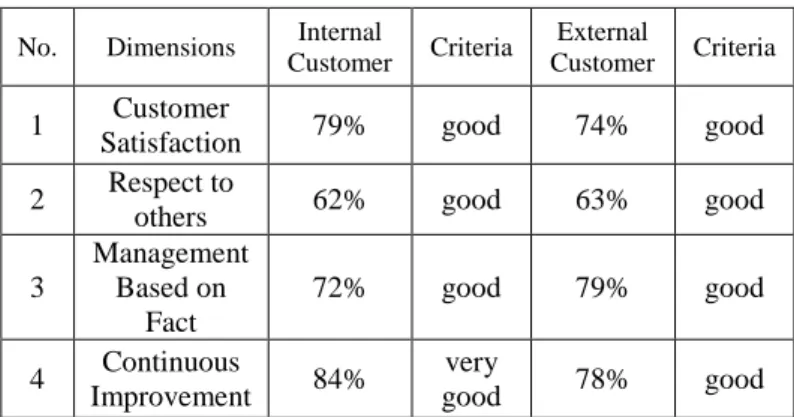
Table 1: Recapitulation of Percentage of Application of TQM Principles at UKWMS
No. Dimensions Internal
Customer Criteria
External
Customer Criteria
1 Customer
Satisfaction 79% good 74% good 2 Respect to
others 62% good 63% good 3 Management Based on Fact 72% good 79% good 4 Continuous Improvement 84% very good 78% good The Table above shows the comparison of scores obtained from the results of questionnaires between lecturers and employees as university internal customers with students as university external customers based on TQM principles that have been applied by the university.
CONCLUSIONS AND SUGESTIONS
From the results of research on TQM implementation carried out by universities in order to improve performance, conclusions can be drawn:
1. The process of implementing TQM carried out by universities in order to improve university performance has gone well. The TQM implementation process carried out by the university consists of 3 stages, namely: (1) the preparation stage, where at this stage the university begins to establish a commitment to total quality in carrying out the educational process. (2) the planning stage, where the university begins to adopt the elements of TQM in preparing educational activities. (3) the implementation phase, where the university begins to implement a work program that has been prepared with quality orientation and continuous improvement to achieve quality improvement using the PDCA cycle.
2. The impact of TQM implementation efforts carried out by universities in order to improve university performance can be seen in terms of input, process, and educational output produced by the university. In terms of input, TQM implementation efforts have an impact on improving the quality of human resources owned, increasing employee productivity and performance, and increasing student absorption (Fadli, 2010). The impact of the implementation of TQM in terms of the educational process can be seen from the creation of a more conducive learning environment, the creation of solid team collaboration, and the creation of a more systematic learning process (Hanafiah., 2011),. In terms of output, it can be seen from the increasing quality of university graduates as well as the increasing image of the university among the community which of course will help improve the university's competitiveness.
Seeing the problems faced by the university in the process of managing educational activities, here are suggestions to be able to minimize the existing problems:
1. The university should continue to maintain the process of implementing TQM that has been implemented by the university so that what is the target / goal of the university can be achieved.
2. To be able to implement TQM properly, the university should also involve all people both within the organization such as lecturers and employees, as well as those outside the organization such as the surrounding community.
3. It is better for universities to increase their internal customer satisfaction in terms of services to motivate employee performance such as remuneration in accordance with customer expectations so that lecturers and employees at the university are motivated to "self manage".
References
[1] Ahmadi, S. C., 2009, Implementasi Sistem Manajemen Mutu di SMKN 2 Wonosari Gunungkidul (Analisis Pelayanan Terhadap Pelanggan Eksternal Primer).Program Pasca Sarjana UIN Sunan Kalijaga, Yogyakarta.
[2] Ariani, D. W., 2003, Manajemen Kualitas Pendekatan Sisi Kualitatif. Jakarta: Penerbit Ghalia Indonesia. [3] Departemen Pendidikan Nasional, 2005, Kinerja
Universitas, disampaikan oleh Direktorat Jendral
Pendidikan, Jakarta.
[4] Dewi, I.R., 2008, Pengaruh Penerapan Total Quality
Management (TQM), Sistem Pengukuran Kinerja dan
Sistem Penghargaan (Reward) terhadap Kinerja Manajerial. Program Studi Akuntansi Universitas Negeri Padang.
[5] Fadli, A.Z., 2010, Implementasi Manajemen Berbasis Universitas dalam Meningkatkan Mutu Pendidikan.
FITK UIN Jakarta.
[6] Fauziah, H., 2008, Implementasi Manajemen Mutu Terpadu Dalam Rangka Meningkatkan Kepuasan Pelanggan Internal Di SMA Al-Kautsar Bandar Lampung, Jurnal Sains dan Inovasi IV(2) 92-101 (2008).
[7] Hanafiah., 2011, Penerapan Manajemen Berbasis Universitas dalam Peningkatan Mutu. Kultura Volume: 12,No. 1, September 2011.
[8] Hasan, F., 2011, Peran Komite Universitas dalam Meningkatkan Mutu Pendidikan pada SMPN 244 Jakarta.Program Studi Manajemen Pendidikan UIN Jakarta.
[9] Kementrian Pendidikan dan Kebudayaan, 2012, Potret Pendidikan di Indonesia, Jakarta.
[10] Mihardja, E. J., 2010, Populasi dan Sampling, Pusat
Pengembangan Bahan Ajar- UMB, Jakarta:
Universitas Mercubuana Jakarta.
[11] Nasution, M. N., 2005,Manajemen Mutu Terpadu (TQM). Bogor: Penerbit Ghalia Indonesia.
[12] Noviyanti, F., 2010, Pengaruh Sistem Pengukuran Kinerja dan Sistem Reward terhadap Hubungan Antara TQM dengan Kinerja Manajerial, Fakultas EkonomiUPN Veteran Jawa Timur.
[13] Rasto., 2012, Faktor Determinan Mutu KinerjaUniversitas,Prodi Pendidikan Manajemen Perkantoran Universitas Pendidikan Indonesia. [14] Retnoningsih, N., 2012, Pelaksanaan TQM di
Universitas Islam Terpadu Mi Luqman Al Hakim Tegal, ISSN 2252-7001.
[15] Tjiptono, F., dan D. Anastasia, 2001,Total Quality
Management, Yogyakarta: ANDI. Sistem Pendidikan
Nasional (SisDIkNas), 2003, Undang-Undang Republik IndonesiaNomor 20 Tahun 2003.
[16] Utomo, H., 2005, Penerapan Total Quality Management,Majalah Ilmiah Kopertis Wilayah VI,
Volume XV, Nomor 23, Tahun 2005.
[17] Wijaya, D., 2008, Implementasi Manajemen Mutu Terpadu Dalam Penyelenggaraan Pendidikan di Universitas,Jurnal Pendidikan Penabur - No.10/Tahun ke-7/Juni 2008.